

Fatima_Tariq
16.1k Publications

Fatima_Tariq
 Compte Square Vérifié+
Signaler
Bloquer l’utilisateur
Nutritionist / Dietitian
168 Suivis
67.4K+ Abonnés
79.6K+ J’aime
Publications
Tous
Citations
Direct
·
--
Baissier
I still remember one of my earliest big trading losses.
It was $PEPE , and I lost around $1,200.
What makes the story different is that I didn't chase the absolute top. I actually managed to get what I considered a good entry. The market structure looked promising, momentum was strong, and at the time, the trade made sense to me.
Then October happened.
$PEPE saw a sudden and aggressive crash, and the move against my position happened much faster than I was prepared for. What started as a trade I felt confident about turned into a huge loss.
That was when I learned something I hadn't fully understood before:
A good entry doesn't mean a trade can't go wrong.
I had spent more time thinking about where to enter than thinking about what I would do if the market suddenly moved against me.
The loss wasn't just about $PEPE .
It showed me how important position size, invalidation, risk management and having an exit plan really are.
Before that trade, I thought finding the right entry was one of the hardest parts of trading.
After losing ~$1,200, I realized the harder part is knowing how much you're willing to lose when you're wrong.
I still trade. I still make mistakes. But I don't look at every strong setup the same way anymore.
Because crypto can give you a perfect-looking entry today and completely change the market tomorrow.
That $1,200 loss hurt at the time.
But it became one of the most important trading lessons I've had.
The market didn't just take $1,200 from me.
It taught me what I wasn't prepared for.
#LearnWithFatima
{spot}(PEPEUSDT)
I still remember one of my earliest big trading losses.
It was $PEPE , and I lost around $1,200.
What makes the story different is that I didn't chase the absolute top. I actually managed to get what I considered a good entry. The market structure looked promising, momentum was strong, and at the time, the trade made sense to me.
Then October happened.
$PEPE saw a sudden and aggressive crash, and the move against my position happened much faster than I was prepared for. What started as a trade I felt confident about turned into a huge loss.
That was when I learned something I hadn't fully understood before:
A good entry doesn't mean a trade can't go wrong.
I had spent more time thinking about where to enter than thinking about what I would do if the market suddenly moved against me.
The loss wasn't just about $PEPE .
It showed me how important position size, invalidation, risk management and having an exit plan really are.
Before that trade, I thought finding the right entry was one of the hardest parts of trading.
After losing ~$1,200, I realized the harder part is knowing how much you're willing to lose when you're wrong.
I still trade. I still make mistakes. But I don't look at every strong setup the same way anymore.
Because crypto can give you a perfect-looking entry today and completely change the market tomorrow.
That $1,200 loss hurt at the time.
But it became one of the most important trading lessons I've had.
The market didn't just take $1,200 from me.
It taught me what I wasn't prepared for.
#LearnWithFatima
It was $PEPE , and I lost around $1,200.
What makes the story different is that I didn't chase the absolute top. I actually managed to get what I considered a good entry. The market structure looked promising, momentum was strong, and at the time, the trade made sense to me.
Then October happened.
$PEPE saw a sudden and aggressive crash, and the move against my position happened much faster than I was prepared for. What started as a trade I felt confident about turned into a huge loss.
That was when I learned something I hadn't fully understood before:
A good entry doesn't mean a trade can't go wrong.
I had spent more time thinking about where to enter than thinking about what I would do if the market suddenly moved against me.
The loss wasn't just about $PEPE .
It showed me how important position size, invalidation, risk management and having an exit plan really are.
Before that trade, I thought finding the right entry was one of the hardest parts of trading.
After losing ~$1,200, I realized the harder part is knowing how much you're willing to lose when you're wrong.
I still trade. I still make mistakes. But I don't look at every strong setup the same way anymore.
Because crypto can give you a perfect-looking entry today and completely change the market tomorrow.
That $1,200 loss hurt at the time.
But it became one of the most important trading lessons I've had.
The market didn't just take $1,200 from me.
It taught me what I wasn't prepared for.
#LearnWithFatima


6
5
1.3k
·
--
Baissier
Trading is not about always profiting it's about learning from overall mistakes
$XAU Trade Update !
Opened a LONG at $4,297, but price moved to ~$4,288, so the entry came before breakout confirmation.
Support level is $4,286 reclaim zone now $4,291–$4,297 and Below $4,286 setup weakens
With 20× leverage, risk management matters more than trying to recover quickly. No averaging down. Waiting for confirmation before the next move.
It's not financial Advice DYOR always .
#XAU #LearnWithFatima
Trading is not about always profiting it's about learning from overall mistakes
$XAU Trade Update !
Opened a LONG at $4,297, but price moved to ~$4,288, so the entry came before breakout confirmation.
Support level is $4,286 reclaim zone now $4,291–$4,297 and Below $4,286 setup weakens
With 20× leverage, risk management matters more than trying to recover quickly. No averaging down. Waiting for confirmation before the next move.
It's not financial Advice DYOR always .
#XAU #LearnWithFatima
$XAU Trade Update !
Opened a LONG at $4,297, but price moved to ~$4,288, so the entry came before breakout confirmation.
Support level is $4,286 reclaim zone now $4,291–$4,297 and Below $4,286 setup weakens
With 20× leverage, risk management matters more than trying to recover quickly. No averaging down. Waiting for confirmation before the next move.
It's not financial Advice DYOR always .
#XAU #LearnWithFatima

2
14
3k
·
--
Dear #LearnWithFatima Family !
I claim the Camp MVP title.
What I enjoyed most was how Day 1-10 connected: security → small real trades → risk control → mindset. No hype, just building a safe habit: Secure first, start small, DYOR, watch much trade little. This changed me from FOMO to focused.
#BinanceSummerCamp
Love the whole 10-Days Journey .
Dear #LearnWithFatima Family !
I claim the Camp MVP title.
What I enjoyed most was how Day 1-10 connected: security → small real trades → risk control → mindset. No hype, just building a safe habit: Secure first, start small, DYOR, watch much trade little. This changed me from FOMO to focused.
#BinanceSummerCamp
Love the whole 10-Days Journey .
I claim the Camp MVP title.
What I enjoyed most was how Day 1-10 connected: security → small real trades → risk control → mindset. No hype, just building a safe habit: Secure first, start small, DYOR, watch much trade little. This changed me from FOMO to focused.
#BinanceSummerCamp
Love the whole 10-Days Journey .

4
21
1.9k
·
--
Haussier
Alhamdullilah 😌 ! Trading is not only about luck.
You can get lucky on one trade, but you cannot build consistency on luck alone.
Good trading comes from understanding the market, managing risk, controlling emotions, and having a plan before entering a position.
Sometimes the best trade is no trade at all.
A winning trade does not always mean you made a good decision, and a losing trade does not always mean you made a bad one.
The real goal is to survive the bad trades, protect your capital, and stay disciplined long enough for your edge to matter.
Luck can affect one trade.
A process determines what happens over hundreds of trades. #LearnWithFatima
Alhamdullilah 😌 ! Trading is not only about luck.
You can get lucky on one trade, but you cannot build consistency on luck alone.
Good trading comes from understanding the market, managing risk, controlling emotions, and having a plan before entering a position.
Sometimes the best trade is no trade at all.
A winning trade does not always mean you made a good decision, and a losing trade does not always mean you made a bad one.
The real goal is to survive the bad trades, protect your capital, and stay disciplined long enough for your edge to matter.
Luck can affect one trade.
A process determines what happens over hundreds of trades. #LearnWithFatima
You can get lucky on one trade, but you cannot build consistency on luck alone.
Good trading comes from understanding the market, managing risk, controlling emotions, and having a plan before entering a position.
Sometimes the best trade is no trade at all.
A winning trade does not always mean you made a good decision, and a losing trade does not always mean you made a bad one.
The real goal is to survive the bad trades, protect your capital, and stay disciplined long enough for your edge to matter.
Luck can affect one trade.
A process determines what happens over hundreds of trades. #LearnWithFatima
18
51
11.7k
·
--
Article
Bitcoin Breaks $85K as Short Squeeze Meets a New Macro TestBitcoin entered the week with its strongest move in months, climbing above $85,000 on September 21 and reaching an intraday high around $85,166, its highest level since January. The move came after BTC reclaimed the $80,000–$82,000 area and followed its first weekly close above the 50-week moving average in 45 weeks.
The important question now is not simply whether Bitcoin can keep moving higher. It is whether the rally can transition from short-covering into sustained spot demand while BTC enters a major holder supply zone and macro conditions remain complicated.
$85K Breakout Was Powerful, But Leverage Did Much of the Work
The latest move was accompanied by a major derivatives flush.
CoinGlass data reported by The Block showed more than $750 million in crypto liquidations over 24 hours, including approximately $648.3 million in short positions. Bitcoin alone accounted for about $360.7 million of liquidations.
On the shorter one-hour window, more than $262 million of shorts were liquidated as BTC crossed $84,000, while total crypto liquidations reached roughly $272 million.
That matters because forced buying can accelerate a breakout without necessarily proving that fresh investors are aggressively accumulating at spot.
There is evidence of genuine demand as well. U.S. spot Bitcoin ETFs recorded about $433 million of net inflows on September 18, with Fidelity's fund accounting for roughly $311 million.
So the current setup is mixed: ETF demand has returned, but leverage-driven buying has also been a major part of the move.
Long-Term Holders Are Selling Less as BTC Enters the $83K–$86K Zone
Another important change is happening on the supply side.
Recent on-chain analysis cited by Binance News shows that Bitcoin held by long-term holders has declined for five consecutive weeks since August 19, but the pace of distribution has slowed sharply.
The figures circulating in the latest market analysis put LTH net distribution at roughly 105,900 BTC on August 30 versus 21,700 BTC on September 20, representing an approximately 80% reduction in the pace of selling.
That slowdown is important because BTC is now moving through the $83,000–$86,000 area identified as a significant long-term-holder supply concentration.
If holders who bought around these levels use the recovery to exit at breakeven, the zone could create additional supply. On the other hand, if BTC absorbs that supply without another major distribution wave, the market structure becomes more interesting.
The distinction is simple:
Breaking $85K is the price signal.
Holding $85K against existing holder supply is the confirmation signal.
Hashrate Is Recovering, But Miners Are Still Lagging Bitcoin
Bitcoin's network economics are also changing as price rises.
A move from roughly $75,000 to $85,000 represents a 13% increase in BTC's price, improving miner revenue per unit of computing power before accounting for difficulty changes.
The hashrate recovery therefore makes economic sense: higher BTC prices can bring marginal mining machines back toward profitability.
But mining equities have not matched Bitcoin's performance. The Block reported that the median return among tracked Bitcoin mining companies was only 1.8%, while Core Scientific underperformed Bitcoin by 27% and TeraWulf by 24%. AI data-center ambitions and the capital requirements of those businesses have complicated the relationship between mining stocks and BTC itself.
There is also a natural limit. Bitcoin's difficulty adjusts approximately every two weeks, so if hashrate continues increasing without a comparable BTC price increase, competition for block rewards increases and revenue per unit of computing power is compressed.
Technically, the next major level being watched is around $89,000, close to the 100-week moving average cited by market analysts.
The Macro Picture Is Still Far From Easy
Bitcoin's rally is happening while the Federal Reserve remains concerned about inflation.
Chicago Fed President Austan Goolsbee said September 21 that the Fed may need to respond with higher interest rates if strong demand is contributing to persistent inflation. He also emphasized that policymakers need evidence that supply shocks are actually fading before they can confidently return inflation to the 2% target. U.S. inflation was still 3.7% in July, according to his remarks reported by Reuters.
That creates an unusual backdrop for risk assets.
Oil prices have recently fallen, helping ease pressure on bond yields and risk sentiment. On September 21, Brent crude was around $101.20, down 2.6% on the day, while the U.S. 10-year Treasury yield had retreated to about 4.95%.
But the inflation problem has not disappeared.
The University of Michigan's preliminary September consumer-sentiment reading came in at 47.8, down from 51.7 in August and 55.1 a year earlier. One-year inflation expectations also rose to 4.6% from 4.0%. The final September survey is scheduled for September 25.
So BTC is climbing while the macro data still carries significant inflation and rate risk.
Treasury Buybacks Add Another Layer to the Market
Treasury Secretary Scott Bessent has defended the government's bond-buyback program, describing the recent $6 billion operation as successful. The debate is focused on whether Treasury intervention can meaningfully improve market liquidity without masking underlying pressure from deficits, inflation and long-term yields.
The long end remains important for Bitcoin because rising Treasury yields can tighten financial conditions and compete with risk assets for capital.
For crypto traders, the key relationship is therefore not simply Fed vs. Bitcoin. Oil, inflation expectations, Treasury yields and liquidity are all feeding into the same risk-asset equation.
SEC Opens a New Chapter for Tokenized Stocks
One of the biggest structural developments this week comes from the U.S. Securities and Exchange Commission.
On September 17, the SEC approved a temporary, conditional five-year Innovation Exemption allowing certain Tokenized Securities Venues to trade tokenized U.S. stocks on public blockchains under specified conditions.
The framework requires tokenized stocks to provide holders with the same rights and privileges as the equivalent traditional shares, including dividend and voting rights. It also gives issuers an opportunity to object to third-party tokenization, while smart contracts used by qualifying venues must be auditable and publicly deployed on a permissionless blockchain.
This is significant because tokenization is moving from an industry concept toward a regulated market experiment.
The first practical trading window begins September 22, making this one of the most important crypto-market developments to watch this week.
What Matters From Here?
Bitcoin's move above $85,000 has changed the short-term structure, but the next phase depends on whether several signals confirm each other.
BTC: $85K breakout, with ~$89K as the next major technical reference.Supply: $83K–$86K remains a key LTH holder zone.Leverage: More than $648M in crypto shorts were liquidated over 24 hours.ETF demand: About $433M of spot BTC ETF inflows were recorded on September 18.Macro: Goolsbee continues to leave the door open to higher rates if inflation remains persistent.Consumer data: September sentiment is at 47.8, with final data due September 25.Regulation: SEC's five-year conditional tokenization framework begins its practical rollout this week.Mining: Hashrate recovery is positive for network security, but rising difficulty can eventually pressure miner economics.
The biggest market question now is whether $85K becomes a new base or simply another liquidity event created by short covering.
If spot demand continues absorbing the $83K–$86K holder supply, the structure will look materially different from a rally driven mainly by liquidations. If demand fades while long-term holders begin distributing again, the breakout will face a very different test.
For September 22–25, the combination of BTC's $85K hold, ETF flows, oil, Treasury yields, Goolsbee's comments and the SEC's tokenized-stock rollout may tell us more than the breakout itself.
#BitcoinHits$85K #LearnWithFatima
#bitcoin $BTC #BTC走势分析
{future}(BTCUSDT)
Bitcoin Breaks $85K as Short Squeeze Meets a New Macro Test
Bitcoin entered the week with its strongest move in months, climbing above $85,000 on September 21 and reaching an intraday high around $85,166, its highest level since January. The move came after BTC reclaimed the $80,000–$82,000 area and followed its first weekly close above the 50-week moving average in 45 weeks.
The important question now is not simply whether Bitcoin can keep moving higher. It is whether the rally can transition from short-covering into sustained spot demand while BTC enters a major holder supply zone and macro conditions remain complicated.
$85K Breakout Was Powerful, But Leverage Did Much of the Work
The latest move was accompanied by a major derivatives flush.
CoinGlass data reported by The Block showed more than $750 million in crypto liquidations over 24 hours, including approximately $648.3 million in short positions. Bitcoin alone accounted for about $360.7 million of liquidations.
On the shorter one-hour window, more than $262 million of shorts were liquidated as BTC crossed $84,000, while total crypto liquidations reached roughly $272 million.
That matters because forced buying can accelerate a breakout without necessarily proving that fresh investors are aggressively accumulating at spot.
There is evidence of genuine demand as well. U.S. spot Bitcoin ETFs recorded about $433 million of net inflows on September 18, with Fidelity's fund accounting for roughly $311 million.
So the current setup is mixed: ETF demand has returned, but leverage-driven buying has also been a major part of the move.
Long-Term Holders Are Selling Less as BTC Enters the $83K–$86K Zone
Another important change is happening on the supply side.
Recent on-chain analysis cited by Binance News shows that Bitcoin held by long-term holders has declined for five consecutive weeks since August 19, but the pace of distribution has slowed sharply.
The figures circulating in the latest market analysis put LTH net distribution at roughly 105,900 BTC on August 30 versus 21,700 BTC on September 20, representing an approximately 80% reduction in the pace of selling.
That slowdown is important because BTC is now moving through the $83,000–$86,000 area identified as a significant long-term-holder supply concentration.
If holders who bought around these levels use the recovery to exit at breakeven, the zone could create additional supply. On the other hand, if BTC absorbs that supply without another major distribution wave, the market structure becomes more interesting.
The distinction is simple:
Breaking $85K is the price signal.
Holding $85K against existing holder supply is the confirmation signal.
Hashrate Is Recovering, But Miners Are Still Lagging Bitcoin
Bitcoin's network economics are also changing as price rises.
A move from roughly $75,000 to $85,000 represents a 13% increase in BTC's price, improving miner revenue per unit of computing power before accounting for difficulty changes.
The hashrate recovery therefore makes economic sense: higher BTC prices can bring marginal mining machines back toward profitability.
But mining equities have not matched Bitcoin's performance. The Block reported that the median return among tracked Bitcoin mining companies was only 1.8%, while Core Scientific underperformed Bitcoin by 27% and TeraWulf by 24%. AI data-center ambitions and the capital requirements of those businesses have complicated the relationship between mining stocks and BTC itself.
There is also a natural limit. Bitcoin's difficulty adjusts approximately every two weeks, so if hashrate continues increasing without a comparable BTC price increase, competition for block rewards increases and revenue per unit of computing power is compressed.
Technically, the next major level being watched is around $89,000, close to the 100-week moving average cited by market analysts.
The Macro Picture Is Still Far From Easy
Bitcoin's rally is happening while the Federal Reserve remains concerned about inflation.
Chicago Fed President Austan Goolsbee said September 21 that the Fed may need to respond with higher interest rates if strong demand is contributing to persistent inflation. He also emphasized that policymakers need evidence that supply shocks are actually fading before they can confidently return inflation to the 2% target. U.S. inflation was still 3.7% in July, according to his remarks reported by Reuters.
That creates an unusual backdrop for risk assets.
Oil prices have recently fallen, helping ease pressure on bond yields and risk sentiment. On September 21, Brent crude was around $101.20, down 2.6% on the day, while the U.S. 10-year Treasury yield had retreated to about 4.95%.
But the inflation problem has not disappeared.
The University of Michigan's preliminary September consumer-sentiment reading came in at 47.8, down from 51.7 in August and 55.1 a year earlier. One-year inflation expectations also rose to 4.6% from 4.0%. The final September survey is scheduled for September 25.
So BTC is climbing while the macro data still carries significant inflation and rate risk.
Treasury Buybacks Add Another Layer to the Market
Treasury Secretary Scott Bessent has defended the government's bond-buyback program, describing the recent $6 billion operation as successful. The debate is focused on whether Treasury intervention can meaningfully improve market liquidity without masking underlying pressure from deficits, inflation and long-term yields.
The long end remains important for Bitcoin because rising Treasury yields can tighten financial conditions and compete with risk assets for capital.
For crypto traders, the key relationship is therefore not simply Fed vs. Bitcoin. Oil, inflation expectations, Treasury yields and liquidity are all feeding into the same risk-asset equation.
SEC Opens a New Chapter for Tokenized Stocks
One of the biggest structural developments this week comes from the U.S. Securities and Exchange Commission.
On September 17, the SEC approved a temporary, conditional five-year Innovation Exemption allowing certain Tokenized Securities Venues to trade tokenized U.S. stocks on public blockchains under specified conditions.
The framework requires tokenized stocks to provide holders with the same rights and privileges as the equivalent traditional shares, including dividend and voting rights. It also gives issuers an opportunity to object to third-party tokenization, while smart contracts used by qualifying venues must be auditable and publicly deployed on a permissionless blockchain.
This is significant because tokenization is moving from an industry concept toward a regulated market experiment.
The first practical trading window begins September 22, making this one of the most important crypto-market developments to watch this week.
What Matters From Here?
Bitcoin's move above $85,000 has changed the short-term structure, but the next phase depends on whether several signals confirm each other.
BTC: $85K breakout, with ~$89K as the next major technical reference.Supply: $83K–$86K remains a key LTH holder zone.Leverage: More than $648M in crypto shorts were liquidated over 24 hours.ETF demand: About $433M of spot BTC ETF inflows were recorded on September 18.Macro: Goolsbee continues to leave the door open to higher rates if inflation remains persistent.Consumer data: September sentiment is at 47.8, with final data due September 25.Regulation: SEC's five-year conditional tokenization framework begins its practical rollout this week.Mining: Hashrate recovery is positive for network security, but rising difficulty can eventually pressure miner economics.
The biggest market question now is whether $85K becomes a new base or simply another liquidity event created by short covering.
If spot demand continues absorbing the $83K–$86K holder supply, the structure will look materially different from a rally driven mainly by liquidations. If demand fades while long-term holders begin distributing again, the breakout will face a very different test.
For September 22–25, the combination of BTC's $85K hold, ETF flows, oil, Treasury yields, Goolsbee's comments and the SEC's tokenized-stock rollout may tell us more than the breakout itself.
#BitcoinHits$85K #LearnWithFatima
#bitcoin $BTC #BTC走势分析
The important question now is not simply whether Bitcoin can keep moving higher. It is whether the rally can transition from short-covering into sustained spot demand while BTC enters a major holder supply zone and macro conditions remain complicated.
$85K Breakout Was Powerful, But Leverage Did Much of the Work
The latest move was accompanied by a major derivatives flush.
CoinGlass data reported by The Block showed more than $750 million in crypto liquidations over 24 hours, including approximately $648.3 million in short positions. Bitcoin alone accounted for about $360.7 million of liquidations.
On the shorter one-hour window, more than $262 million of shorts were liquidated as BTC crossed $84,000, while total crypto liquidations reached roughly $272 million.
That matters because forced buying can accelerate a breakout without necessarily proving that fresh investors are aggressively accumulating at spot.
There is evidence of genuine demand as well. U.S. spot Bitcoin ETFs recorded about $433 million of net inflows on September 18, with Fidelity's fund accounting for roughly $311 million.
So the current setup is mixed: ETF demand has returned, but leverage-driven buying has also been a major part of the move.
Long-Term Holders Are Selling Less as BTC Enters the $83K–$86K Zone
Another important change is happening on the supply side.
Recent on-chain analysis cited by Binance News shows that Bitcoin held by long-term holders has declined for five consecutive weeks since August 19, but the pace of distribution has slowed sharply.
The figures circulating in the latest market analysis put LTH net distribution at roughly 105,900 BTC on August 30 versus 21,700 BTC on September 20, representing an approximately 80% reduction in the pace of selling.
That slowdown is important because BTC is now moving through the $83,000–$86,000 area identified as a significant long-term-holder supply concentration.
If holders who bought around these levels use the recovery to exit at breakeven, the zone could create additional supply. On the other hand, if BTC absorbs that supply without another major distribution wave, the market structure becomes more interesting.
The distinction is simple:
Breaking $85K is the price signal.
Holding $85K against existing holder supply is the confirmation signal.
Hashrate Is Recovering, But Miners Are Still Lagging Bitcoin
Bitcoin's network economics are also changing as price rises.
A move from roughly $75,000 to $85,000 represents a 13% increase in BTC's price, improving miner revenue per unit of computing power before accounting for difficulty changes.
The hashrate recovery therefore makes economic sense: higher BTC prices can bring marginal mining machines back toward profitability.
But mining equities have not matched Bitcoin's performance. The Block reported that the median return among tracked Bitcoin mining companies was only 1.8%, while Core Scientific underperformed Bitcoin by 27% and TeraWulf by 24%. AI data-center ambitions and the capital requirements of those businesses have complicated the relationship between mining stocks and BTC itself.
There is also a natural limit. Bitcoin's difficulty adjusts approximately every two weeks, so if hashrate continues increasing without a comparable BTC price increase, competition for block rewards increases and revenue per unit of computing power is compressed.
Technically, the next major level being watched is around $89,000, close to the 100-week moving average cited by market analysts.
The Macro Picture Is Still Far From Easy
Bitcoin's rally is happening while the Federal Reserve remains concerned about inflation.
Chicago Fed President Austan Goolsbee said September 21 that the Fed may need to respond with higher interest rates if strong demand is contributing to persistent inflation. He also emphasized that policymakers need evidence that supply shocks are actually fading before they can confidently return inflation to the 2% target. U.S. inflation was still 3.7% in July, according to his remarks reported by Reuters.
That creates an unusual backdrop for risk assets.
Oil prices have recently fallen, helping ease pressure on bond yields and risk sentiment. On September 21, Brent crude was around $101.20, down 2.6% on the day, while the U.S. 10-year Treasury yield had retreated to about 4.95%.
But the inflation problem has not disappeared.
The University of Michigan's preliminary September consumer-sentiment reading came in at 47.8, down from 51.7 in August and 55.1 a year earlier. One-year inflation expectations also rose to 4.6% from 4.0%. The final September survey is scheduled for September 25.
So BTC is climbing while the macro data still carries significant inflation and rate risk.
Treasury Buybacks Add Another Layer to the Market
Treasury Secretary Scott Bessent has defended the government's bond-buyback program, describing the recent $6 billion operation as successful. The debate is focused on whether Treasury intervention can meaningfully improve market liquidity without masking underlying pressure from deficits, inflation and long-term yields.
The long end remains important for Bitcoin because rising Treasury yields can tighten financial conditions and compete with risk assets for capital.
For crypto traders, the key relationship is therefore not simply Fed vs. Bitcoin. Oil, inflation expectations, Treasury yields and liquidity are all feeding into the same risk-asset equation.
SEC Opens a New Chapter for Tokenized Stocks
One of the biggest structural developments this week comes from the U.S. Securities and Exchange Commission.
On September 17, the SEC approved a temporary, conditional five-year Innovation Exemption allowing certain Tokenized Securities Venues to trade tokenized U.S. stocks on public blockchains under specified conditions.
The framework requires tokenized stocks to provide holders with the same rights and privileges as the equivalent traditional shares, including dividend and voting rights. It also gives issuers an opportunity to object to third-party tokenization, while smart contracts used by qualifying venues must be auditable and publicly deployed on a permissionless blockchain.
This is significant because tokenization is moving from an industry concept toward a regulated market experiment.
The first practical trading window begins September 22, making this one of the most important crypto-market developments to watch this week.
What Matters From Here?
Bitcoin's move above $85,000 has changed the short-term structure, but the next phase depends on whether several signals confirm each other.
BTC: $85K breakout, with ~$89K as the next major technical reference.Supply: $83K–$86K remains a key LTH holder zone.Leverage: More than $648M in crypto shorts were liquidated over 24 hours.ETF demand: About $433M of spot BTC ETF inflows were recorded on September 18.Macro: Goolsbee continues to leave the door open to higher rates if inflation remains persistent.Consumer data: September sentiment is at 47.8, with final data due September 25.Regulation: SEC's five-year conditional tokenization framework begins its practical rollout this week.Mining: Hashrate recovery is positive for network security, but rising difficulty can eventually pressure miner economics.
The biggest market question now is whether $85K becomes a new base or simply another liquidity event created by short covering.
If spot demand continues absorbing the $83K–$86K holder supply, the structure will look materially different from a rally driven mainly by liquidations. If demand fades while long-term holders begin distributing again, the breakout will face a very different test.
For September 22–25, the combination of BTC's $85K hold, ETF flows, oil, Treasury yields, Goolsbee's comments and the SEC's tokenized-stock rollout may tell us more than the breakout itself.
#BitcoinHits$85K #LearnWithFatima
#bitcoin $BTC #BTC走势分析
8
968
·
--
Vérifié
Article
AVAX Breaks Above $10, Then a $13.86M Short Wall Appears$AVAX has made one of its strongest moves in September, but the on-chain positioning is now getting interesting.
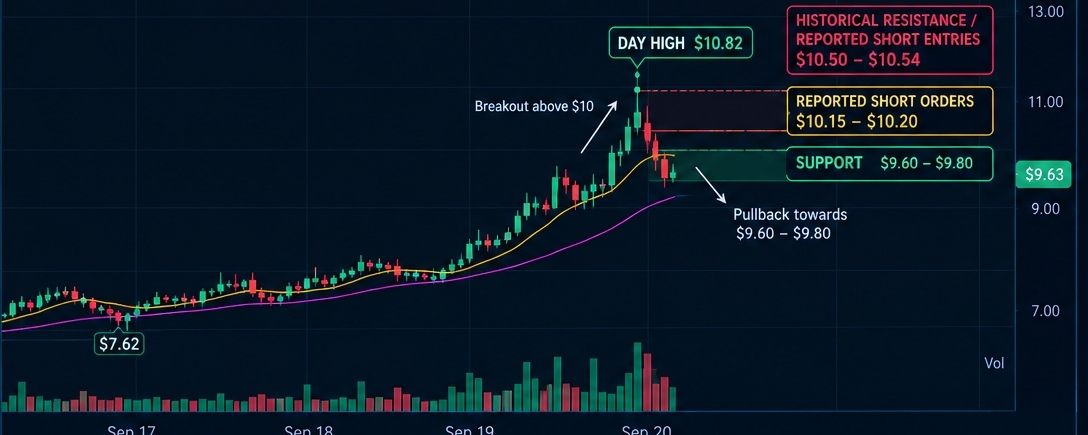
On September 20, 2026, AVAX briefly pushed to around $10.82, after trading near $7.2–$8.3 earlier this week. Daily data shows AVAX moved from a $7.61 close on September 17 → $8.20 on September 18 → $10.10 on September 19, before pulling back today.
The move is happening ahead of Avalanche's Helicon mainnet upgrade scheduled for September 22, which introduces changes including shorter minimum staking durations, auto-renewed staking and Continuous Execution on the C-Chain.
But while spot momentum pushed through $10, some large Hyperliquid-linked addresses were preparing for higher prices to become selling opportunities.
According to TradingBeats monitoring reported by BlockBeats, addresses 0xf517 and 0xb1ec, linked to Hyperliquid ecosystem builder NMTD, placed AVAX ladder sell orders within the same minute on September 20. The reported pending orders totaled approximately $13.866M.
The interesting part is where those orders sit:
• 0xf517: ladder started around $10.20• 0xb1ec: ladder started around $10.15• 100 sell orders each• Around $5.081M of the remaining plan between $10.83–$15• Around $8.785M between $10.84–$17
Lower orders were already getting filled as AVAX pushed higher. The two addresses reportedly opened around $289.5K in shorts during the day and were holding roughly $240.4K in AVAX shorts, with around $24.5K unrealized profit at the time of reporting. Their average entries were approximately $10.50 and $10.54.
There is also an important historical reference.
From February through May, AVAX spent most of its time inside an $8.50–$10.50 range, with 117 of 120 daily candles closing inside that zone according to the cited monitoring. The $10.50 area repeatedly acted as resistance.
So today's move above $10 is not happening in empty space.
The broader derivatives picture also matters. Aggregated AVAX open interest was around $234M, up 23.27% over 24 hours, showing that leverage and positioning have expanded alongside the price move.
At the time of the report, AVAX was around $9.55, roughly 11.6% higher over 24 hours, after touching $10.82. My Binance chart also shows the pullback toward $9.63, with the 1H MA(7) around $9.61 and MA(25) around $9.57.
That creates a very clear market structure to watch:
$9.60–$9.80: immediate support / momentum zone$10.15–$10.20: first major reported sell-order area$10.50–$10.54: historical resistance + reported short entries$10.82–$10.83: today's high and start of the larger ladder$15–$17: much larger reported sell-order zone
The key question is not simply whether AVAX can break $10.
It already did.
The more interesting question is whether AVAX can absorb the liquidity sitting above $10.15–$10.83 and turn the old $10.50 resistance into support.
With Helicon only two days away, rising open interest, strong spot momentum and millions of dollars in reported ladder orders above the market, AVAX is now sitting at a much more important technical and derivatives intersection than it was a few days ago.
Breakout confirmed, or liquidity trap? 👀
Not financial advice. DYOR and manage risk.
#AVAX #LearnWithFatima $AVAX
#MarketUpdate #Write2Earn #trading
AVAX Breaks Above $10, Then a $13.86M Short Wall Appears
$AVAX has made one of its strongest moves in September, but the on-chain positioning is now getting interesting.
On September 20, 2026, AVAX briefly pushed to around $10.82, after trading near $7.2–$8.3 earlier this week. Daily data shows AVAX moved from a $7.61 close on September 17 → $8.20 on September 18 → $10.10 on September 19, before pulling back today.
The move is happening ahead of Avalanche's Helicon mainnet upgrade scheduled for September 22, which introduces changes including shorter minimum staking durations, auto-renewed staking and Continuous Execution on the C-Chain.
But while spot momentum pushed through $10, some large Hyperliquid-linked addresses were preparing for higher prices to become selling opportunities.
According to TradingBeats monitoring reported by BlockBeats, addresses 0xf517 and 0xb1ec, linked to Hyperliquid ecosystem builder NMTD, placed AVAX ladder sell orders within the same minute on September 20. The reported pending orders totaled approximately $13.866M.
The interesting part is where those orders sit:
• 0xf517: ladder started around $10.20• 0xb1ec: ladder started around $10.15• 100 sell orders each• Around $5.081M of the remaining plan between $10.83–$15• Around $8.785M between $10.84–$17
Lower orders were already getting filled as AVAX pushed higher. The two addresses reportedly opened around $289.5K in shorts during the day and were holding roughly $240.4K in AVAX shorts, with around $24.5K unrealized profit at the time of reporting. Their average entries were approximately $10.50 and $10.54.
There is also an important historical reference.
From February through May, AVAX spent most of its time inside an $8.50–$10.50 range, with 117 of 120 daily candles closing inside that zone according to the cited monitoring. The $10.50 area repeatedly acted as resistance.
So today's move above $10 is not happening in empty space.
The broader derivatives picture also matters. Aggregated AVAX open interest was around $234M, up 23.27% over 24 hours, showing that leverage and positioning have expanded alongside the price move.
At the time of the report, AVAX was around $9.55, roughly 11.6% higher over 24 hours, after touching $10.82. My Binance chart also shows the pullback toward $9.63, with the 1H MA(7) around $9.61 and MA(25) around $9.57.
That creates a very clear market structure to watch:
$9.60–$9.80: immediate support / momentum zone$10.15–$10.20: first major reported sell-order area$10.50–$10.54: historical resistance + reported short entries$10.82–$10.83: today's high and start of the larger ladder$15–$17: much larger reported sell-order zone
The key question is not simply whether AVAX can break $10.
It already did.
The more interesting question is whether AVAX can absorb the liquidity sitting above $10.15–$10.83 and turn the old $10.50 resistance into support.
With Helicon only two days away, rising open interest, strong spot momentum and millions of dollars in reported ladder orders above the market, AVAX is now sitting at a much more important technical and derivatives intersection than it was a few days ago.
Breakout confirmed, or liquidity trap? 👀
Not financial advice. DYOR and manage risk.
#AVAX #LearnWithFatima $AVAX
#MarketUpdate #Write2Earn #trading
On September 20, 2026, AVAX briefly pushed to around $10.82, after trading near $7.2–$8.3 earlier this week. Daily data shows AVAX moved from a $7.61 close on September 17 → $8.20 on September 18 → $10.10 on September 19, before pulling back today.
The move is happening ahead of Avalanche's Helicon mainnet upgrade scheduled for September 22, which introduces changes including shorter minimum staking durations, auto-renewed staking and Continuous Execution on the C-Chain.
But while spot momentum pushed through $10, some large Hyperliquid-linked addresses were preparing for higher prices to become selling opportunities.
According to TradingBeats monitoring reported by BlockBeats, addresses 0xf517 and 0xb1ec, linked to Hyperliquid ecosystem builder NMTD, placed AVAX ladder sell orders within the same minute on September 20. The reported pending orders totaled approximately $13.866M.
The interesting part is where those orders sit:
• 0xf517: ladder started around $10.20• 0xb1ec: ladder started around $10.15• 100 sell orders each• Around $5.081M of the remaining plan between $10.83–$15• Around $8.785M between $10.84–$17
Lower orders were already getting filled as AVAX pushed higher. The two addresses reportedly opened around $289.5K in shorts during the day and were holding roughly $240.4K in AVAX shorts, with around $24.5K unrealized profit at the time of reporting. Their average entries were approximately $10.50 and $10.54.
There is also an important historical reference.
From February through May, AVAX spent most of its time inside an $8.50–$10.50 range, with 117 of 120 daily candles closing inside that zone according to the cited monitoring. The $10.50 area repeatedly acted as resistance.
So today's move above $10 is not happening in empty space.
The broader derivatives picture also matters. Aggregated AVAX open interest was around $234M, up 23.27% over 24 hours, showing that leverage and positioning have expanded alongside the price move.
At the time of the report, AVAX was around $9.55, roughly 11.6% higher over 24 hours, after touching $10.82. My Binance chart also shows the pullback toward $9.63, with the 1H MA(7) around $9.61 and MA(25) around $9.57.
That creates a very clear market structure to watch:
$9.60–$9.80: immediate support / momentum zone$10.15–$10.20: first major reported sell-order area$10.50–$10.54: historical resistance + reported short entries$10.82–$10.83: today's high and start of the larger ladder$15–$17: much larger reported sell-order zone
The key question is not simply whether AVAX can break $10.
It already did.
The more interesting question is whether AVAX can absorb the liquidity sitting above $10.15–$10.83 and turn the old $10.50 resistance into support.
With Helicon only two days away, rising open interest, strong spot momentum and millions of dollars in reported ladder orders above the market, AVAX is now sitting at a much more important technical and derivatives intersection than it was a few days ago.
Breakout confirmed, or liquidity trap? 👀
Not financial advice. DYOR and manage risk.
#AVAX #LearnWithFatima $AVAX
#MarketUpdate #Write2Earn #trading
3
8
3.3k
·
--
Article
Bitcoin Reclaims the Spotlight as Macro Pressure Fails to Break Crypto DemandThe crypto market is entering the weekend with a very different setup from what the macro headlines suggested.
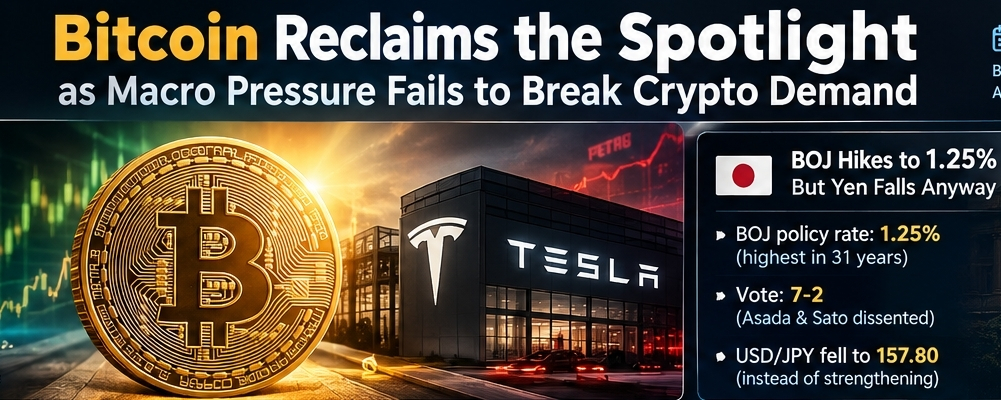
On September 19, 2026, Bitcoin's market capitalization moved above $1.63 trillion, putting it ahead of Tesla's roughly $1.438 trillion market value by around $190 billion and returning Bitcoin to the top tier of global assets. BTC also gained roughly 5% over 24 hours, despite a week that delivered a U.S. rate hike, a Bank of Japan rate hike, elevated oil prices and another setback for U.S. crypto legislation.
The more interesting question is not simply why Bitcoin went up.
It is why demand remained intact while several traditional macro signals were pointing toward tighter financial conditions.
Bitcoin Absorbed a Heavy Macro Week
On September 16, the Federal Reserve raised its benchmark rate by 25 basis points to 3.75%-4.00%, the first U.S. rate increase since July 2023. The decision was unanimous at 12-0, while the latest projections indicated that policymakers see the possibility of another hike before the end of 2026.
Normally, higher rates create pressure on speculative assets because the opportunity cost of holding riskier investments increases.
Yet Bitcoin has remained relatively resilient.
Blockware's Mitchell Askew has characterized the September price action as a form of seller exhaustion. BTC is reportedly down only around 1.5% during September, historically one of Bitcoin's weaker calendar months, despite the combination of tighter Fed policy, the failed CLARITY Act cloture vote, elevated energy prices and the BOJ decision.
The technical level now matters more.
Around 8% of Bitcoin's circulating supply was acquired between $80,000 and $82,000, creating a significant realized-price zone. At the same time, the 50-week moving average sits near $81,081.
That puts the $80K-$82K area directly in focus.
A sustained move above this region would change the technical structure considerably. Failure to reclaim it would leave the market facing another supply zone where holders may look to exit at breakeven or reduce exposure.
Morgan Stanley's ETF Flow Is Quietly Becoming More Interesting
One of the less dramatic but potentially more important developments is happening inside Bitcoin ETFs.
Morgan Stanley's MSBT reportedly recorded approximately $51.5 million of net inflows across 20 consecutive sessions without a single outflow day, averaging roughly $2.6 million per session.
The absolute number is small compared with the approximately $99.5 billion U.S. Bitcoin ETF complex, but the consistency is what deserves attention.
The period included extremely volatile sessions, including approximately $731 million of single-day inflows and a $450 million single-day outflow across the broader market.
Yet MSBT maintained its streak.
That pattern can be consistent with scheduled or model-driven allocation rather than short-term discretionary trading. Morgan Stanley's wealth-management distribution gives that interpretation some context, although ETF flow data alone cannot prove the motivation behind individual purchases.
The wider ETF picture is still mixed. U.S. Bitcoin ETFs remain approximately $1 billion negative year-to-date, despite roughly $3.52 billion of net inflows during August.
There is also a substantial fee difference inside the sector. Grayscale's GBTC carries a reported 1.50% expense ratio, while BlackRock's IBIT is around 0.25%. That cost gap continues to influence where investors allocate within the ETF complex.
So the ETF story is not simply "institutions are buying Bitcoin."
It is becoming a more nuanced story of which investors are buying, through which vehicles, and whether the flows are strategic or tactical.
The BOJ Hiked — Yet the Yen Fell
The Bank of Japan added another unusual macro signal on September 18.
The BOJ raised its policy rate by 25 basis points to 1.25%, the highest level in roughly 31 years, with the decision passing 7-2. Board members Toichiro Asada and Ayano Sato dissented.
Instead of strengthening, however, the yen weakened sharply, with USD/JPY moving above 157 and reaching around 157.80 in the session.
That reaction matters for global liquidity.
A rate hike would normally be expected to support the currency. But markets had largely anticipated the move, while the dissenting votes and lack of a firm signal for additional tightening reduced expectations for an aggressive BOJ tightening cycle. The result was continued pressure on the yen.
For risk assets, this creates an important distinction.
A higher Japanese policy rate does not automatically mean global liquidity is tightening immediately. If the yen remains weak, the incentive to borrow yen and deploy capital into higher-yielding assets can remain relevant.
That does not mean a carry-trade unwind cannot happen. It means the September 18 BOJ decision did not deliver the clean risk-off signal that a conventional rate-hike narrative might suggest.
Altcoin ETF Competition Is Moving to the Next Stage
While Bitcoin continues to dominate institutional attention, the ETF race is expanding.
On September 18, 21Shares filed an amended Form S-1 for its proposed 21Shares Injective ETF, adding another altcoin to the growing list of potential U.S. exchange-traded products. The SEC filing confirms that the product is a registration filing, not an approval or guarantee that the ETF will launch.
Injective is particularly interesting because staking adds another dimension to the investment thesis.
The supplied market data puts INJ's market capitalization around $488 million, while reported 2025 staking yields ranged roughly from 9.3% to 13.62% annually.
If an investment product eventually provides regulated exposure while incorporating staking economics, it could create a structure that differs materially from traditional equity ETFs.
But the regulatory process still matters.
An S-1/A is not an approval. Custody, operational structure, staking treatment and other regulatory considerations still need to be resolved before an actual product can begin trading.
And Injective is not alone. The broader filing race now includes products linked to assets such as SOL, XRP, LTC, ADA and DeFi tokens.
The market is moving from the question of whether crypto belongs inside regulated investment products to a more competitive question:
Which crypto assets will receive that institutional wrapper next?
XRP's Supply Picture Is Moving in the Opposite Direction
XRP is showing another interesting divergence.
On September 17, U.S. spot XRP ETFs recorded approximately $5.15 million in net outflows. Yet the products remained around $9.60 million positive for the week, meaning the weekly inflow streak could potentially reach ten consecutive weeks depending on the final session.
More interesting is the exchange-reserve data.
XRP held on exchanges reportedly fell to around 1.7 billion XRP, a seven-year low.
Lower exchange balances can mean less immediately available supply for spot selling, although exchange reserves alone should never be treated as proof of future price direction.
At the same time, CME XRP futures' share of activity reportedly increased from around 10% in mid-August to 17%, suggesting greater participation through regulated derivatives markets.
That creates a mixed but important picture:
ETF flows show a temporary withdrawal, while exchange balances show declining immediately available supply.
Those two signals need to be watched together rather than interpreting either one in isolation.
The Bigger Market Signal
Put all of these developments together and the current crypto market looks less like a simple risk-on rally and more like a market absorbing multiple conflicting forces.
The Fed has returned to rate hikes.
The BOJ has moved its policy rate to 1.25%.
The yen is still weak around 157-158 per dollar.
U.S. Bitcoin ETFs have a mixed year-to-date flow picture.
Bitcoin has nevertheless pushed its market capitalization above $1.63 trillion.
Morgan Stanley's MSBT has recorded 20 consecutive sessions without an outflow day.
XRP exchange reserves have reached a seven-year low.
And the U.S. ETF pipeline is expanding beyond Bitcoin and Ethereum toward assets such as Injective.
The headline is therefore bigger than Bitcoin simply beating Tesla's market cap.
The real story is that crypto demand is continuing to develop underneath a much more complicated macro environment.
For Bitcoin, the next major technical test remains the $80,000-$82,000 zone and the $81,081 50-week moving average. For the broader market, the more important developments may be the persistence of institutional ETF flows, the direction of global liquidity and whether the growing altcoin ETF pipeline turns registration filings into actual approved products.
The next phase of the market may not be defined by one headline.
It may be defined by capital quietly moving through several different channels at the same time.
#BOJRaisesRatesTo31YearHigh #Bitcoin #LearnWithFatima #Etherium #Xrp🔥🔥 $BTC
{future}(BTCUSDT)
$ETH
{future}(ETHUSDT)
$XRP
{future}(XRPUSDT)
Bitcoin Reclaims the Spotlight as Macro Pressure Fails to Break Crypto Demand
The crypto market is entering the weekend with a very different setup from what the macro headlines suggested.
On September 19, 2026, Bitcoin's market capitalization moved above $1.63 trillion, putting it ahead of Tesla's roughly $1.438 trillion market value by around $190 billion and returning Bitcoin to the top tier of global assets. BTC also gained roughly 5% over 24 hours, despite a week that delivered a U.S. rate hike, a Bank of Japan rate hike, elevated oil prices and another setback for U.S. crypto legislation.
The more interesting question is not simply why Bitcoin went up.
It is why demand remained intact while several traditional macro signals were pointing toward tighter financial conditions.
Bitcoin Absorbed a Heavy Macro Week
On September 16, the Federal Reserve raised its benchmark rate by 25 basis points to 3.75%-4.00%, the first U.S. rate increase since July 2023. The decision was unanimous at 12-0, while the latest projections indicated that policymakers see the possibility of another hike before the end of 2026.
Normally, higher rates create pressure on speculative assets because the opportunity cost of holding riskier investments increases.
Yet Bitcoin has remained relatively resilient.
Blockware's Mitchell Askew has characterized the September price action as a form of seller exhaustion. BTC is reportedly down only around 1.5% during September, historically one of Bitcoin's weaker calendar months, despite the combination of tighter Fed policy, the failed CLARITY Act cloture vote, elevated energy prices and the BOJ decision.
The technical level now matters more.
Around 8% of Bitcoin's circulating supply was acquired between $80,000 and $82,000, creating a significant realized-price zone. At the same time, the 50-week moving average sits near $81,081.
That puts the $80K-$82K area directly in focus.
A sustained move above this region would change the technical structure considerably. Failure to reclaim it would leave the market facing another supply zone where holders may look to exit at breakeven or reduce exposure.
Morgan Stanley's ETF Flow Is Quietly Becoming More Interesting
One of the less dramatic but potentially more important developments is happening inside Bitcoin ETFs.
Morgan Stanley's MSBT reportedly recorded approximately $51.5 million of net inflows across 20 consecutive sessions without a single outflow day, averaging roughly $2.6 million per session.
The absolute number is small compared with the approximately $99.5 billion U.S. Bitcoin ETF complex, but the consistency is what deserves attention.
The period included extremely volatile sessions, including approximately $731 million of single-day inflows and a $450 million single-day outflow across the broader market.
Yet MSBT maintained its streak.
That pattern can be consistent with scheduled or model-driven allocation rather than short-term discretionary trading. Morgan Stanley's wealth-management distribution gives that interpretation some context, although ETF flow data alone cannot prove the motivation behind individual purchases.
The wider ETF picture is still mixed. U.S. Bitcoin ETFs remain approximately $1 billion negative year-to-date, despite roughly $3.52 billion of net inflows during August.
There is also a substantial fee difference inside the sector. Grayscale's GBTC carries a reported 1.50% expense ratio, while BlackRock's IBIT is around 0.25%. That cost gap continues to influence where investors allocate within the ETF complex.
So the ETF story is not simply "institutions are buying Bitcoin."
It is becoming a more nuanced story of which investors are buying, through which vehicles, and whether the flows are strategic or tactical.
The BOJ Hiked — Yet the Yen Fell
The Bank of Japan added another unusual macro signal on September 18.
The BOJ raised its policy rate by 25 basis points to 1.25%, the highest level in roughly 31 years, with the decision passing 7-2. Board members Toichiro Asada and Ayano Sato dissented.
Instead of strengthening, however, the yen weakened sharply, with USD/JPY moving above 157 and reaching around 157.80 in the session.
That reaction matters for global liquidity.
A rate hike would normally be expected to support the currency. But markets had largely anticipated the move, while the dissenting votes and lack of a firm signal for additional tightening reduced expectations for an aggressive BOJ tightening cycle. The result was continued pressure on the yen.
For risk assets, this creates an important distinction.
A higher Japanese policy rate does not automatically mean global liquidity is tightening immediately. If the yen remains weak, the incentive to borrow yen and deploy capital into higher-yielding assets can remain relevant.
That does not mean a carry-trade unwind cannot happen. It means the September 18 BOJ decision did not deliver the clean risk-off signal that a conventional rate-hike narrative might suggest.
Altcoin ETF Competition Is Moving to the Next Stage
While Bitcoin continues to dominate institutional attention, the ETF race is expanding.
On September 18, 21Shares filed an amended Form S-1 for its proposed 21Shares Injective ETF, adding another altcoin to the growing list of potential U.S. exchange-traded products. The SEC filing confirms that the product is a registration filing, not an approval or guarantee that the ETF will launch.
Injective is particularly interesting because staking adds another dimension to the investment thesis.
The supplied market data puts INJ's market capitalization around $488 million, while reported 2025 staking yields ranged roughly from 9.3% to 13.62% annually.
If an investment product eventually provides regulated exposure while incorporating staking economics, it could create a structure that differs materially from traditional equity ETFs.
But the regulatory process still matters.
An S-1/A is not an approval. Custody, operational structure, staking treatment and other regulatory considerations still need to be resolved before an actual product can begin trading.
And Injective is not alone. The broader filing race now includes products linked to assets such as SOL, XRP, LTC, ADA and DeFi tokens.
The market is moving from the question of whether crypto belongs inside regulated investment products to a more competitive question:
Which crypto assets will receive that institutional wrapper next?
XRP's Supply Picture Is Moving in the Opposite Direction
XRP is showing another interesting divergence.
On September 17, U.S. spot XRP ETFs recorded approximately $5.15 million in net outflows. Yet the products remained around $9.60 million positive for the week, meaning the weekly inflow streak could potentially reach ten consecutive weeks depending on the final session.
More interesting is the exchange-reserve data.
XRP held on exchanges reportedly fell to around 1.7 billion XRP, a seven-year low.
Lower exchange balances can mean less immediately available supply for spot selling, although exchange reserves alone should never be treated as proof of future price direction.
At the same time, CME XRP futures' share of activity reportedly increased from around 10% in mid-August to 17%, suggesting greater participation through regulated derivatives markets.
That creates a mixed but important picture:
ETF flows show a temporary withdrawal, while exchange balances show declining immediately available supply.
Those two signals need to be watched together rather than interpreting either one in isolation.
The Bigger Market Signal
Put all of these developments together and the current crypto market looks less like a simple risk-on rally and more like a market absorbing multiple conflicting forces.
The Fed has returned to rate hikes.
The BOJ has moved its policy rate to 1.25%.
The yen is still weak around 157-158 per dollar.
U.S. Bitcoin ETFs have a mixed year-to-date flow picture.
Bitcoin has nevertheless pushed its market capitalization above $1.63 trillion.
Morgan Stanley's MSBT has recorded 20 consecutive sessions without an outflow day.
XRP exchange reserves have reached a seven-year low.
And the U.S. ETF pipeline is expanding beyond Bitcoin and Ethereum toward assets such as Injective.
The headline is therefore bigger than Bitcoin simply beating Tesla's market cap.
The real story is that crypto demand is continuing to develop underneath a much more complicated macro environment.
For Bitcoin, the next major technical test remains the $80,000-$82,000 zone and the $81,081 50-week moving average. For the broader market, the more important developments may be the persistence of institutional ETF flows, the direction of global liquidity and whether the growing altcoin ETF pipeline turns registration filings into actual approved products.
The next phase of the market may not be defined by one headline.
It may be defined by capital quietly moving through several different channels at the same time.
#BOJRaisesRatesTo31YearHigh #Bitcoin #LearnWithFatima #Etherium #Xrp🔥🔥 $BTC
$ETH
$XRP
On September 19, 2026, Bitcoin's market capitalization moved above $1.63 trillion, putting it ahead of Tesla's roughly $1.438 trillion market value by around $190 billion and returning Bitcoin to the top tier of global assets. BTC also gained roughly 5% over 24 hours, despite a week that delivered a U.S. rate hike, a Bank of Japan rate hike, elevated oil prices and another setback for U.S. crypto legislation.
The more interesting question is not simply why Bitcoin went up.
It is why demand remained intact while several traditional macro signals were pointing toward tighter financial conditions.
Bitcoin Absorbed a Heavy Macro Week
On September 16, the Federal Reserve raised its benchmark rate by 25 basis points to 3.75%-4.00%, the first U.S. rate increase since July 2023. The decision was unanimous at 12-0, while the latest projections indicated that policymakers see the possibility of another hike before the end of 2026.
Normally, higher rates create pressure on speculative assets because the opportunity cost of holding riskier investments increases.
Yet Bitcoin has remained relatively resilient.
Blockware's Mitchell Askew has characterized the September price action as a form of seller exhaustion. BTC is reportedly down only around 1.5% during September, historically one of Bitcoin's weaker calendar months, despite the combination of tighter Fed policy, the failed CLARITY Act cloture vote, elevated energy prices and the BOJ decision.
The technical level now matters more.
Around 8% of Bitcoin's circulating supply was acquired between $80,000 and $82,000, creating a significant realized-price zone. At the same time, the 50-week moving average sits near $81,081.
That puts the $80K-$82K area directly in focus.
A sustained move above this region would change the technical structure considerably. Failure to reclaim it would leave the market facing another supply zone where holders may look to exit at breakeven or reduce exposure.
Morgan Stanley's ETF Flow Is Quietly Becoming More Interesting
One of the less dramatic but potentially more important developments is happening inside Bitcoin ETFs.
Morgan Stanley's MSBT reportedly recorded approximately $51.5 million of net inflows across 20 consecutive sessions without a single outflow day, averaging roughly $2.6 million per session.
The absolute number is small compared with the approximately $99.5 billion U.S. Bitcoin ETF complex, but the consistency is what deserves attention.
The period included extremely volatile sessions, including approximately $731 million of single-day inflows and a $450 million single-day outflow across the broader market.
Yet MSBT maintained its streak.
That pattern can be consistent with scheduled or model-driven allocation rather than short-term discretionary trading. Morgan Stanley's wealth-management distribution gives that interpretation some context, although ETF flow data alone cannot prove the motivation behind individual purchases.
The wider ETF picture is still mixed. U.S. Bitcoin ETFs remain approximately $1 billion negative year-to-date, despite roughly $3.52 billion of net inflows during August.
There is also a substantial fee difference inside the sector. Grayscale's GBTC carries a reported 1.50% expense ratio, while BlackRock's IBIT is around 0.25%. That cost gap continues to influence where investors allocate within the ETF complex.
So the ETF story is not simply "institutions are buying Bitcoin."
It is becoming a more nuanced story of which investors are buying, through which vehicles, and whether the flows are strategic or tactical.
The BOJ Hiked — Yet the Yen Fell
The Bank of Japan added another unusual macro signal on September 18.
The BOJ raised its policy rate by 25 basis points to 1.25%, the highest level in roughly 31 years, with the decision passing 7-2. Board members Toichiro Asada and Ayano Sato dissented.
Instead of strengthening, however, the yen weakened sharply, with USD/JPY moving above 157 and reaching around 157.80 in the session.
That reaction matters for global liquidity.
A rate hike would normally be expected to support the currency. But markets had largely anticipated the move, while the dissenting votes and lack of a firm signal for additional tightening reduced expectations for an aggressive BOJ tightening cycle. The result was continued pressure on the yen.
For risk assets, this creates an important distinction.
A higher Japanese policy rate does not automatically mean global liquidity is tightening immediately. If the yen remains weak, the incentive to borrow yen and deploy capital into higher-yielding assets can remain relevant.
That does not mean a carry-trade unwind cannot happen. It means the September 18 BOJ decision did not deliver the clean risk-off signal that a conventional rate-hike narrative might suggest.
Altcoin ETF Competition Is Moving to the Next Stage
While Bitcoin continues to dominate institutional attention, the ETF race is expanding.
On September 18, 21Shares filed an amended Form S-1 for its proposed 21Shares Injective ETF, adding another altcoin to the growing list of potential U.S. exchange-traded products. The SEC filing confirms that the product is a registration filing, not an approval or guarantee that the ETF will launch.
Injective is particularly interesting because staking adds another dimension to the investment thesis.
The supplied market data puts INJ's market capitalization around $488 million, while reported 2025 staking yields ranged roughly from 9.3% to 13.62% annually.
If an investment product eventually provides regulated exposure while incorporating staking economics, it could create a structure that differs materially from traditional equity ETFs.
But the regulatory process still matters.
An S-1/A is not an approval. Custody, operational structure, staking treatment and other regulatory considerations still need to be resolved before an actual product can begin trading.
And Injective is not alone. The broader filing race now includes products linked to assets such as SOL, XRP, LTC, ADA and DeFi tokens.
The market is moving from the question of whether crypto belongs inside regulated investment products to a more competitive question:
Which crypto assets will receive that institutional wrapper next?
XRP's Supply Picture Is Moving in the Opposite Direction
XRP is showing another interesting divergence.
On September 17, U.S. spot XRP ETFs recorded approximately $5.15 million in net outflows. Yet the products remained around $9.60 million positive for the week, meaning the weekly inflow streak could potentially reach ten consecutive weeks depending on the final session.
More interesting is the exchange-reserve data.
XRP held on exchanges reportedly fell to around 1.7 billion XRP, a seven-year low.
Lower exchange balances can mean less immediately available supply for spot selling, although exchange reserves alone should never be treated as proof of future price direction.
At the same time, CME XRP futures' share of activity reportedly increased from around 10% in mid-August to 17%, suggesting greater participation through regulated derivatives markets.
That creates a mixed but important picture:
ETF flows show a temporary withdrawal, while exchange balances show declining immediately available supply.
Those two signals need to be watched together rather than interpreting either one in isolation.
The Bigger Market Signal
Put all of these developments together and the current crypto market looks less like a simple risk-on rally and more like a market absorbing multiple conflicting forces.
The Fed has returned to rate hikes.
The BOJ has moved its policy rate to 1.25%.
The yen is still weak around 157-158 per dollar.
U.S. Bitcoin ETFs have a mixed year-to-date flow picture.
Bitcoin has nevertheless pushed its market capitalization above $1.63 trillion.
Morgan Stanley's MSBT has recorded 20 consecutive sessions without an outflow day.
XRP exchange reserves have reached a seven-year low.
And the U.S. ETF pipeline is expanding beyond Bitcoin and Ethereum toward assets such as Injective.
The headline is therefore bigger than Bitcoin simply beating Tesla's market cap.
The real story is that crypto demand is continuing to develop underneath a much more complicated macro environment.
For Bitcoin, the next major technical test remains the $80,000-$82,000 zone and the $81,081 50-week moving average. For the broader market, the more important developments may be the persistence of institutional ETF flows, the direction of global liquidity and whether the growing altcoin ETF pipeline turns registration filings into actual approved products.
The next phase of the market may not be defined by one headline.
It may be defined by capital quietly moving through several different channels at the same time.
#BOJRaisesRatesTo31YearHigh #Bitcoin #LearnWithFatima #Etherium #Xrp🔥🔥 $BTC
$ETH
$XRP
4
17
6.5k
·
--
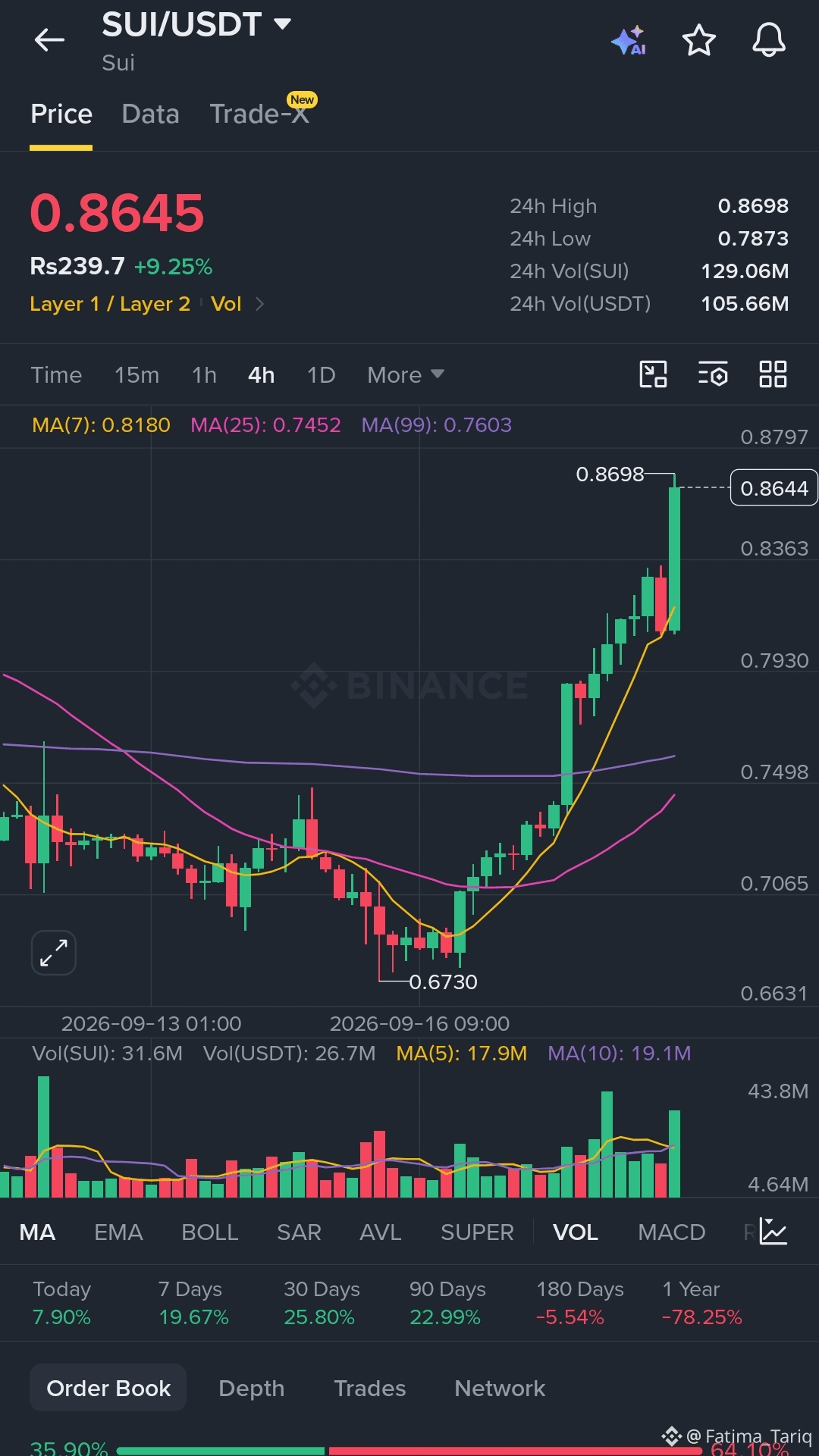
Congratulations🎉🥳$SUI
First Tp Hits successfully 😁
waiting for others Tp Hits also ...
#LearnWithFatima
{future}(SUIUSDT)
Congratulations🎉🥳$SUI
First Tp Hits successfully 😁
waiting for others Tp Hits also ...
#LearnWithFatima
First Tp Hits successfully 😁
waiting for others Tp Hits also ...
#LearnWithFatima
Fatima_Tariq
·
--
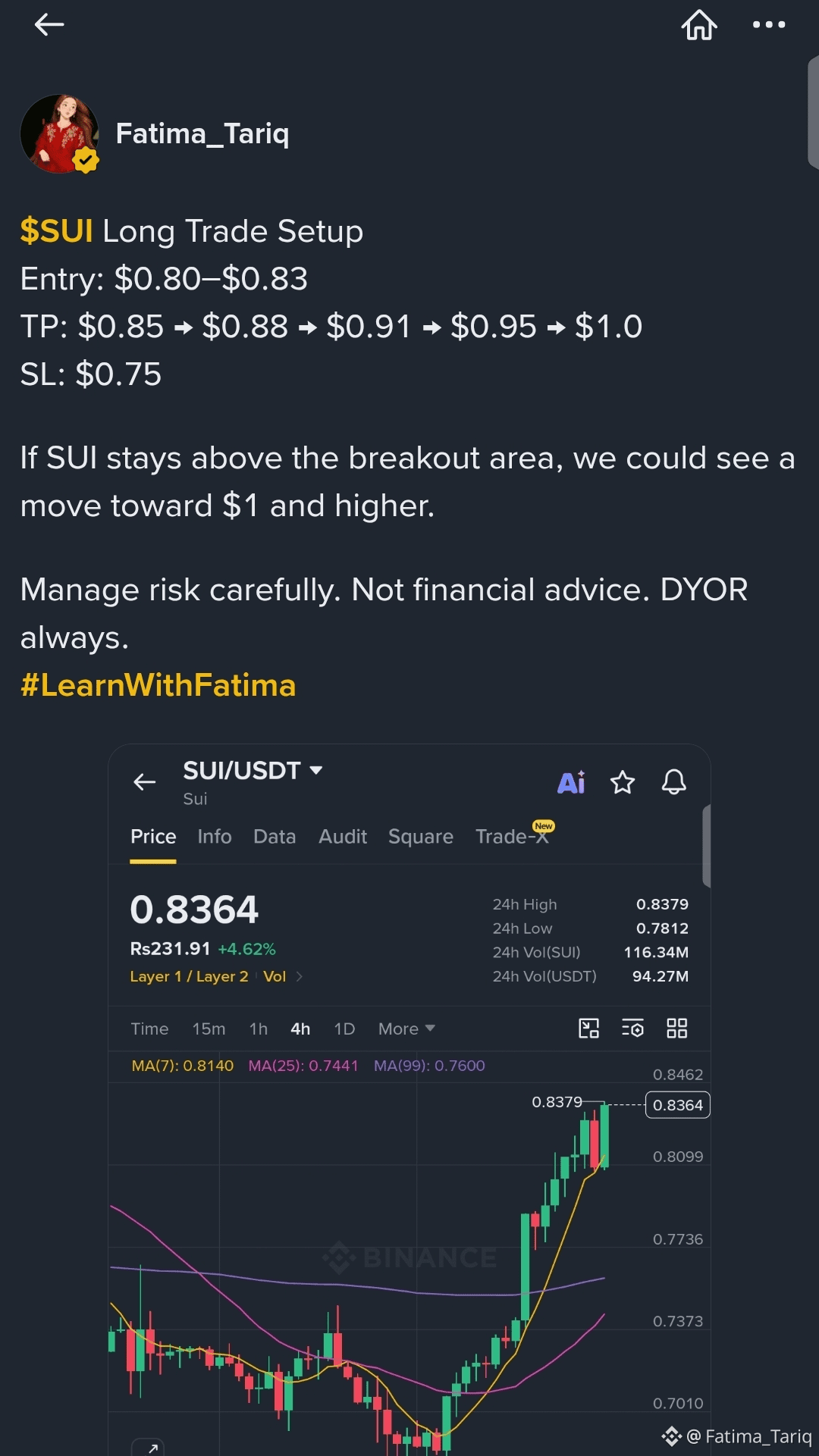
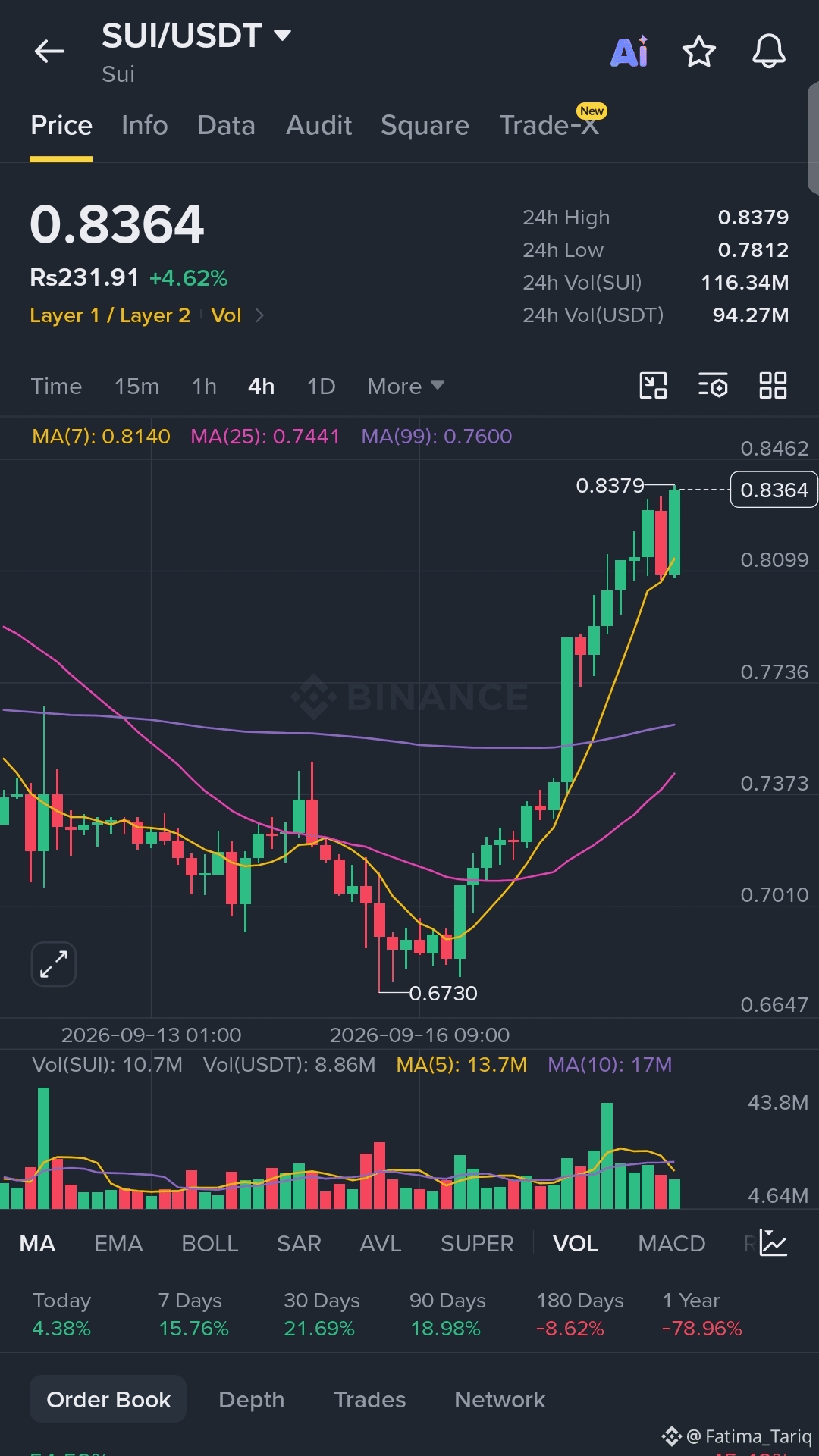
Haussier$SUI Long Trade Setup
Entry: $0.80–$0.83
TP: $0.85 → $0.88 → $0.91 → $0.95 → $1.0
SL: $0.75
If SUI stays above the breakout area, we could see a move toward $1 and higher.
Manage risk carefully. Not financial advice. DYOR always.
#LearnWithFatima
Entry: $0.80–$0.83
TP: $0.85 → $0.88 → $0.91 → $0.95 → $1.0
SL: $0.75
If SUI stays above the breakout area, we could see a move toward $1 and higher.
Manage risk carefully. Not financial advice. DYOR always.
#LearnWithFatima
4
333
·
--
Haussier
$SUI Long Trade Setup
{future}(SUIUSDT)
Entry: $0.80–$0.83
TP: $0.85 → $0.88 → $0.91 → $0.95 → $1.0
SL: $0.75
If SUI stays above the breakout area, we could see a move toward $1 and higher.
Manage risk carefully. Not financial advice. DYOR always.
#LearnWithFatima
$SUI Long Trade Setup
Entry: $0.80–$0.83
TP: $0.85 → $0.88 → $0.91 → $0.95 → $1.0
SL: $0.75
If SUI stays above the breakout area, we could see a move toward $1 and higher.
Manage risk carefully. Not financial advice. DYOR always.
#LearnWithFatima
Entry: $0.80–$0.83
TP: $0.85 → $0.88 → $0.91 → $0.95 → $1.0
SL: $0.75
If SUI stays above the breakout area, we could see a move toward $1 and higher.
Manage risk carefully. Not financial advice. DYOR always.
#LearnWithFatima
1
6
873
·
--
Haussier
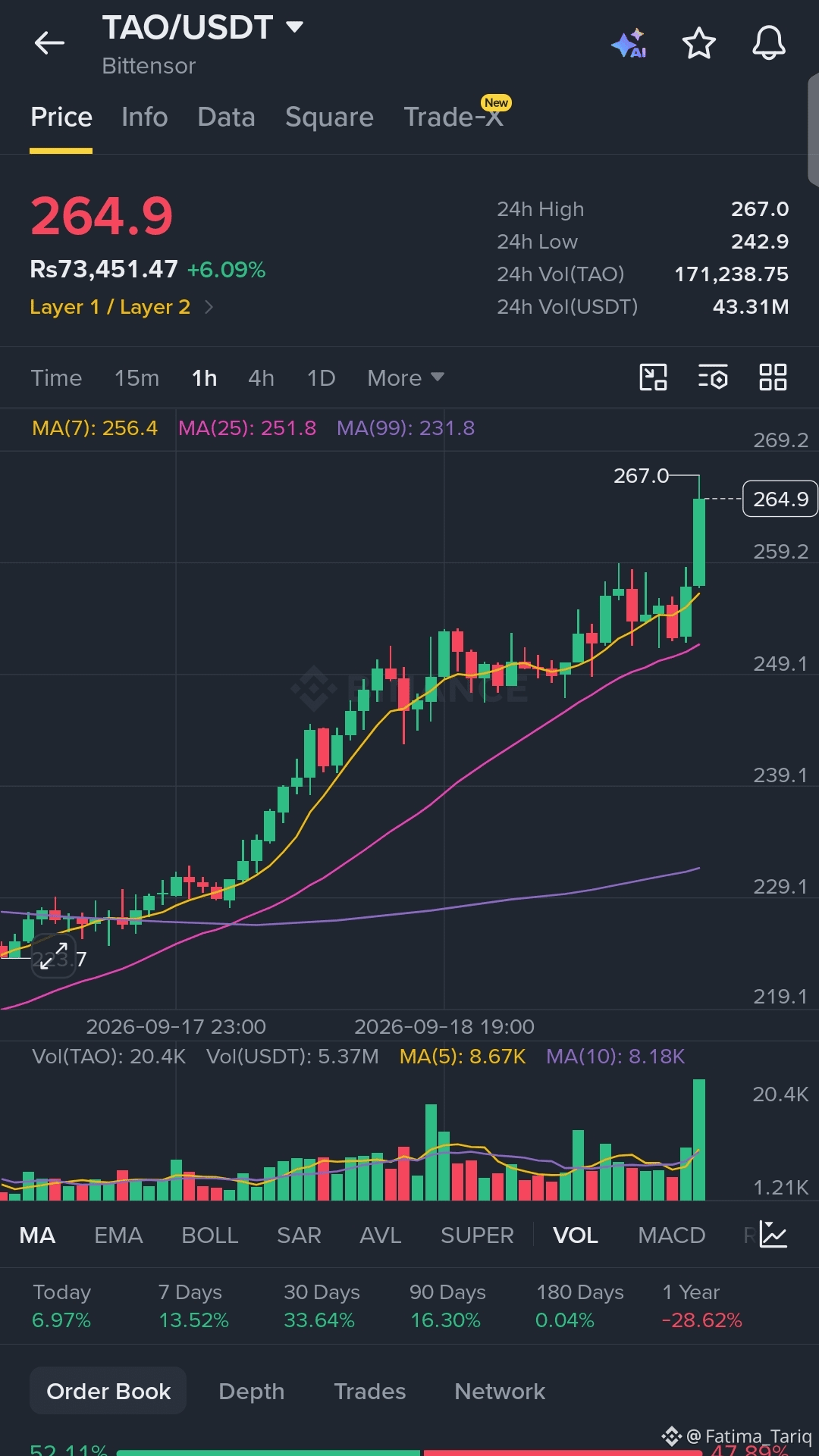
$TAO Long Trade setup
{future}(TAOUSDT)
$TAO is holding an uptrend with higher highs and higher lows, while price remains above the key moving averages. The $260–$270 zone is the area I’m watching for entries.
The major level is $290 resistance. A clean breakout and hold above $290 could open the way toward:
TP1: $279, TP2: $328 ,TP3: $399,
TP4: $399, TP5: $480 , SL: $238 .
For me, the key confirmation is volume-backed strength through $290. If that level breaks and holds, the structure could continue expanding higher.
Not financial advice. DYOR always.
#LearnWithFatima
$TAO Long Trade setup
$TAO is holding an uptrend with higher highs and higher lows, while price remains above the key moving averages. The $260–$270 zone is the area I’m watching for entries.
The major level is $290 resistance. A clean breakout and hold above $290 could open the way toward:
TP1: $279, TP2: $328 ,TP3: $399,
TP4: $399, TP5: $480 , SL: $238 .
For me, the key confirmation is volume-backed strength through $290. If that level breaks and holds, the structure could continue expanding higher.
Not financial advice. DYOR always.
#LearnWithFatima
$TAO is holding an uptrend with higher highs and higher lows, while price remains above the key moving averages. The $260–$270 zone is the area I’m watching for entries.
The major level is $290 resistance. A clean breakout and hold above $290 could open the way toward:
TP1: $279, TP2: $328 ,TP3: $399,
TP4: $399, TP5: $480 , SL: $238 .
For me, the key confirmation is volume-backed strength through $290. If that level breaks and holds, the structure could continue expanding higher.
Not financial advice. DYOR always.
#LearnWithFatima

2
5
402
·
--
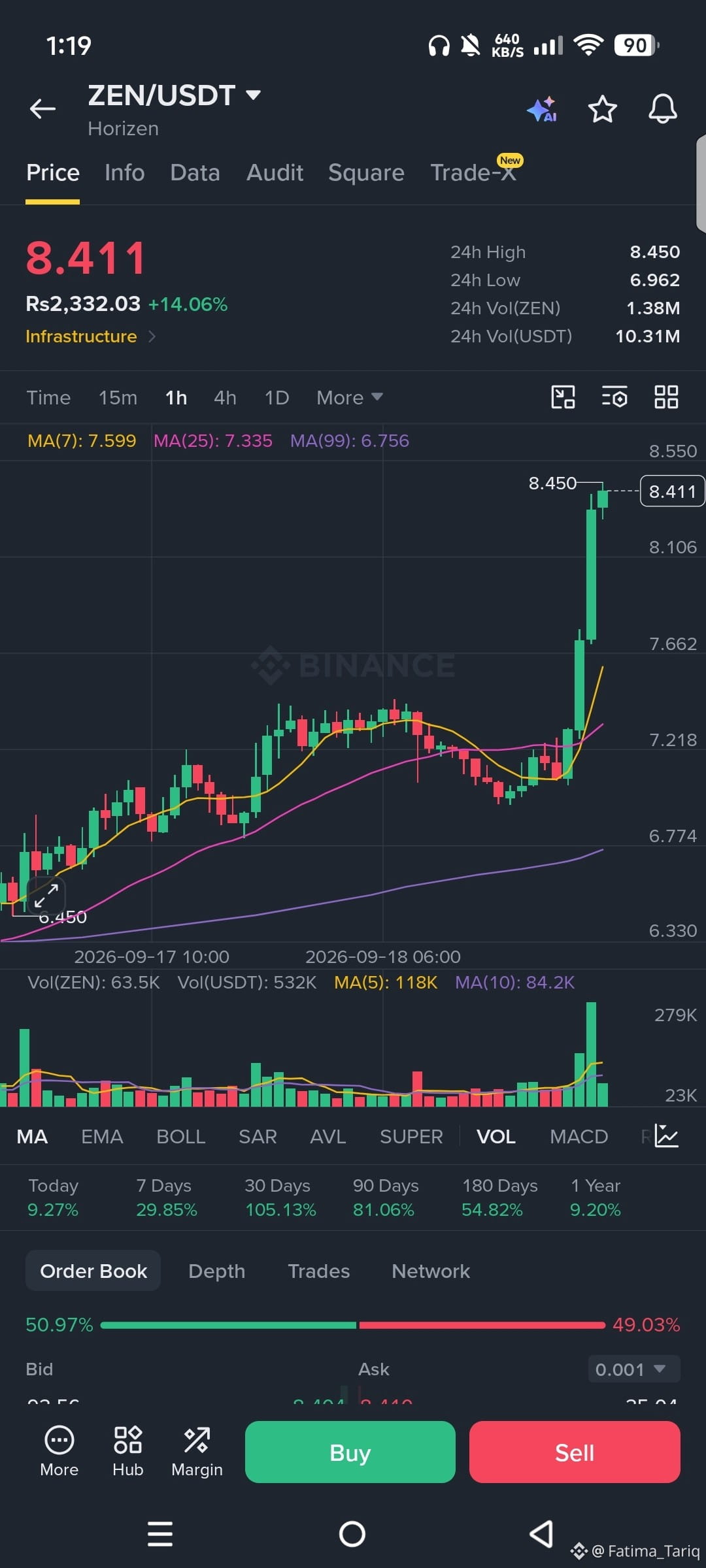
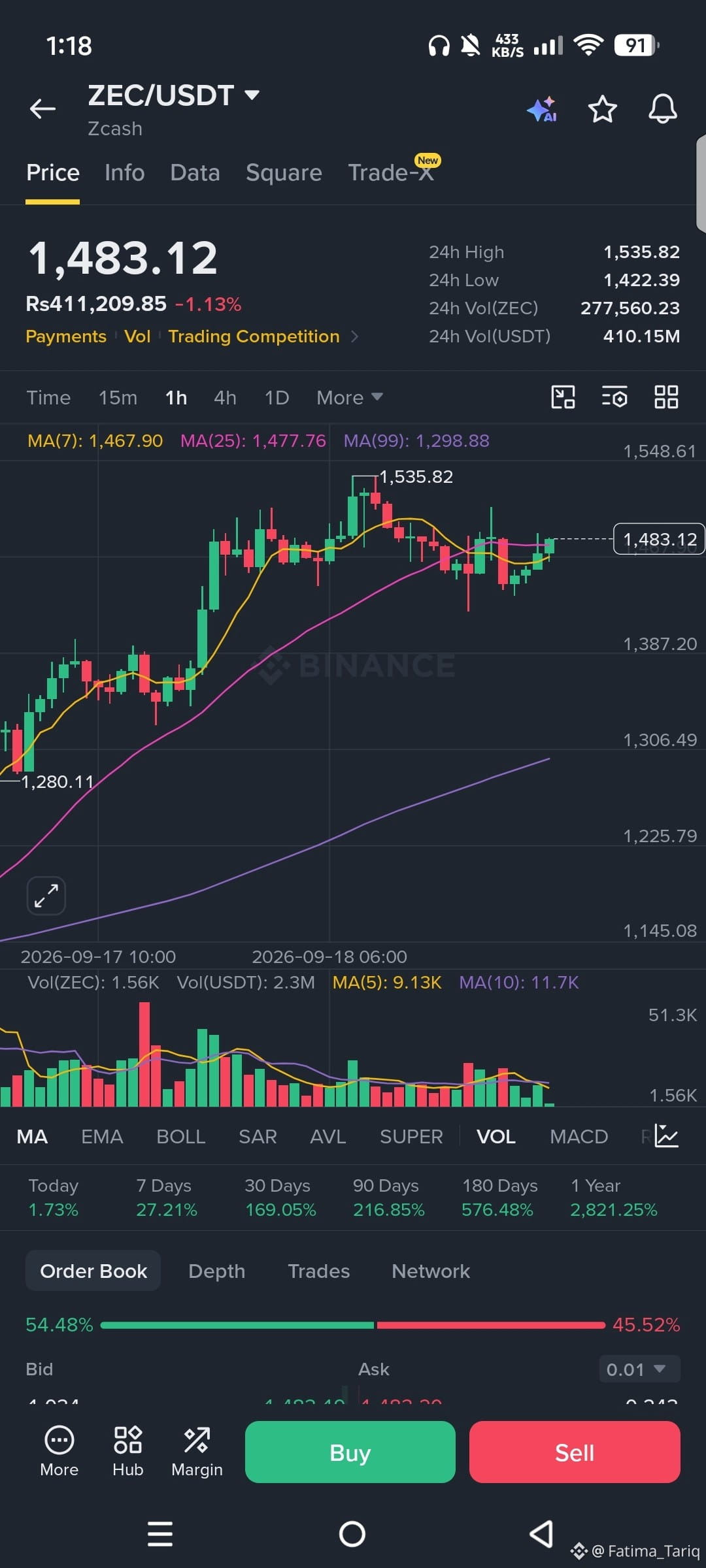
Both $ZEC and $ZEN played out as predicted. 🎯
TPs hit successfully, with extra profits booked along the way. Hope the #LearnWithFatima family secured their profits and got a safe exit.
Not financial advice.
Always DYOR and manage your risk.
{future}(ZECUSDT)
{spot}(ZENUSDT)
Both $ZEC and $ZEN played out as predicted. 🎯
TPs hit successfully, with extra profits booked along the way. Hope the #LearnWithFatima family secured their profits and got a safe exit.
Not financial advice.
Always DYOR and manage your risk.
TPs hit successfully, with extra profits booked along the way. Hope the #LearnWithFatima family secured their profits and got a safe exit.
Not financial advice.
Always DYOR and manage your risk.
Fatima_Tariq
·
--
HaussierZEC / DASH / ZEN Trade Setup 👀
$ZEC : $1,340 breakout → $1,400 / $1,500
Entry: $1,330–1,360
Invalidation: below $1,280
$DASH : $56 breakout → $62 / $70
Entry: $54–57
Invalidation: below $51
$ZEN : $6.80 breakout → $7.50 / $8.20
Entry: $6.60–6.85
Invalidation: below $6.20
#ZEC has the strongest momentum, while #DASH and #ZEN are the catch-up trades. ZEC recently closed around $1,263 after a 13.8% daily move, showing how volatile this rotation is.
It's Not a Financial advice DYOR always .
#LearnWithFatima #ZcashRises6%
$ZEC : $1,340 breakout → $1,400 / $1,500
Entry: $1,330–1,360
Invalidation: below $1,280
$DASH : $56 breakout → $62 / $70
Entry: $54–57
Invalidation: below $51
$ZEN : $6.80 breakout → $7.50 / $8.20
Entry: $6.60–6.85
Invalidation: below $6.20
#ZEC has the strongest momentum, while #DASH and #ZEN are the catch-up trades. ZEC recently closed around $1,263 after a 13.8% daily move, showing how volatile this rotation is.
It's Not a Financial advice DYOR always .
#LearnWithFatima #ZcashRises6%
4
797
·
--
Day #4 TradFi.
Ready to become a Cross-Market Explorer?
My Takeaway from TradFi on Binance Lesson:*
1. Risk:Same stock = same risk. -30% in traditional = -30% on Binance. Convenience does not reduce risk.
2. Dividend: Stocks dividend comes as USDC / extra shares. bStocks dividend auto-converts to more bStock tokens in Spot.
3. One Account View: Best feature - Crypto, Tokenized Stocks, and Gold all in one place with live P&L.
4. Product Clarity:
- Stocks = For real ownership & dividends
- bStocks = For 24/7 & fractional trading
- Pre-IPO = For early exposure before listing
- Commodities Perps = For gold/oil with leverage
5. Beginner Strategy: With $50, Tokenized Stocks (1:1, no leverage) is safest to start, not Perps.
Suggestion:Add more real P&L examples for each product to help new users.
ITS NOT FINANCIAL ADVICE DYOR ALWAYS !
#BinanceSummerCamp @Binance_Angels
Day #4 TradFi.
Ready to become a Cross-Market Explorer?
My Takeaway from TradFi on Binance Lesson:*
1. Risk:Same stock = same risk. -30% in traditional = -30% on Binance. Convenience does not reduce risk.
2. Dividend: Stocks dividend comes as USDC / extra shares. bStocks dividend auto-converts to more bStock tokens in Spot.
3. One Account View: Best feature - Crypto, Tokenized Stocks, and Gold all in one place with live P&L.
4. Product Clarity:
- Stocks = For real ownership & dividends
- bStocks = For 24/7 & fractional trading
- Pre-IPO = For early exposure before listing
- Commodities Perps = For gold/oil with leverage
5. Beginner Strategy: With $50, Tokenized Stocks (1:1, no leverage) is safest to start, not Perps.
Suggestion:Add more real P&L examples for each product to help new users.
ITS NOT FINANCIAL ADVICE DYOR ALWAYS !
#BinanceSummerCamp @Binance Angels
Ready to become a Cross-Market Explorer?
My Takeaway from TradFi on Binance Lesson:*
1. Risk:Same stock = same risk. -30% in traditional = -30% on Binance. Convenience does not reduce risk.
2. Dividend: Stocks dividend comes as USDC / extra shares. bStocks dividend auto-converts to more bStock tokens in Spot.
3. One Account View: Best feature - Crypto, Tokenized Stocks, and Gold all in one place with live P&L.
4. Product Clarity:
- Stocks = For real ownership & dividends
- bStocks = For 24/7 & fractional trading
- Pre-IPO = For early exposure before listing
- Commodities Perps = For gold/oil with leverage
5. Beginner Strategy: With $50, Tokenized Stocks (1:1, no leverage) is safest to start, not Perps.
Suggestion:Add more real P&L examples for each product to help new users.
ITS NOT FINANCIAL ADVICE DYOR ALWAYS !
#BinanceSummerCamp @Binance Angels

8
549
·
--
Haussier
ZEC / DASH / ZEN Trade Setup 👀
$ZEC : $1,340 breakout → $1,400 / $1,500
Entry: $1,330–1,360
Invalidation: below $1,280
$DASH : $56 breakout → $62 / $70
Entry: $54–57
Invalidation: below $51
$ZEN : $6.80 breakout → $7.50 / $8.20
Entry: $6.60–6.85
Invalidation: below $6.20
#ZEC has the strongest momentum, while #DASH and #ZEN are the catch-up trades. ZEC recently closed around $1,263 after a 13.8% daily move, showing how volatile this rotation is.
It's Not a Financial advice DYOR always .
#LearnWithFatima #ZcashRises6%
ZEC / DASH / ZEN Trade Setup 👀
$ZEC : $1,340 breakout → $1,400 / $1,500
Entry: $1,330–1,360
Invalidation: below $1,280
$DASH : $56 breakout → $62 / $70
Entry: $54–57
Invalidation: below $51
$ZEN : $6.80 breakout → $7.50 / $8.20
Entry: $6.60–6.85
Invalidation: below $6.20
#ZEC has the strongest momentum, while #DASH and #ZEN are the catch-up trades. ZEC recently closed around $1,263 after a 13.8% daily move, showing how volatile this rotation is.
It's Not a Financial advice DYOR always .
#LearnWithFatima #ZcashRises6%
$ZEC : $1,340 breakout → $1,400 / $1,500
Entry: $1,330–1,360
Invalidation: below $1,280
$DASH : $56 breakout → $62 / $70
Entry: $54–57
Invalidation: below $51
$ZEN : $6.80 breakout → $7.50 / $8.20
Entry: $6.60–6.85
Invalidation: below $6.20
#ZEC has the strongest momentum, while #DASH and #ZEN are the catch-up trades. ZEC recently closed around $1,263 after a 13.8% daily move, showing how volatile this rotation is.
It's Not a Financial advice DYOR always .
#LearnWithFatima #ZcashRises6%
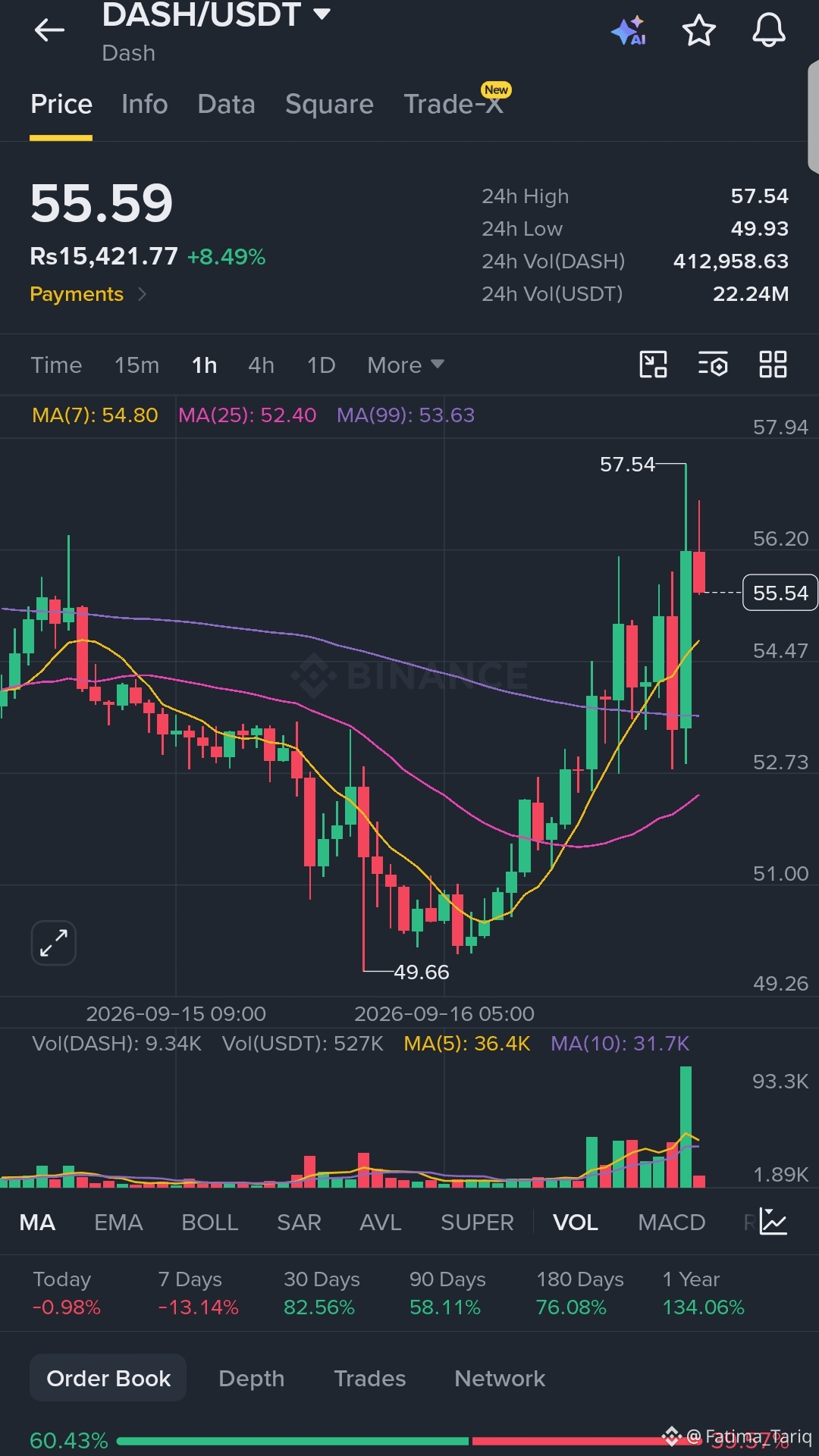
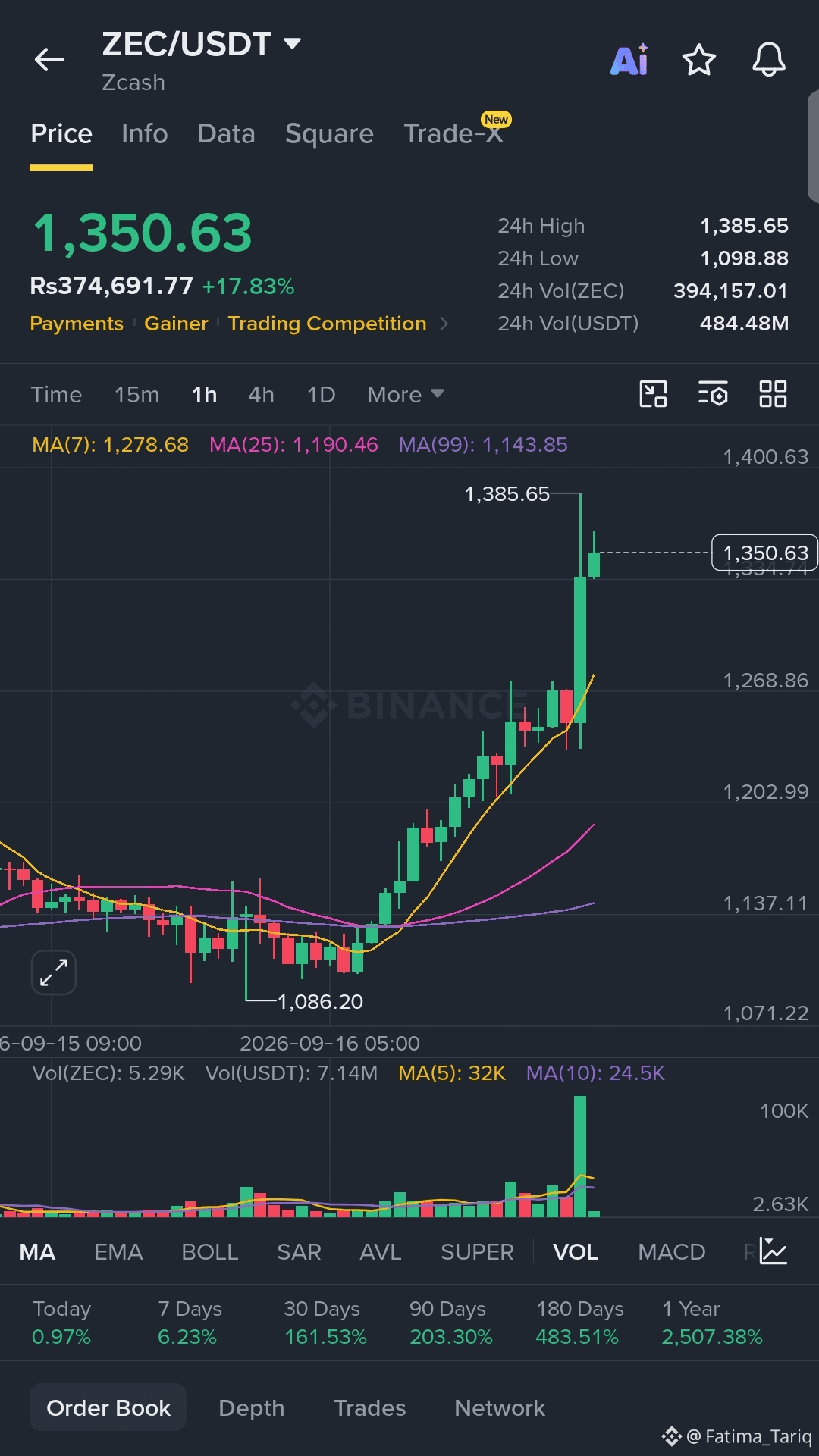
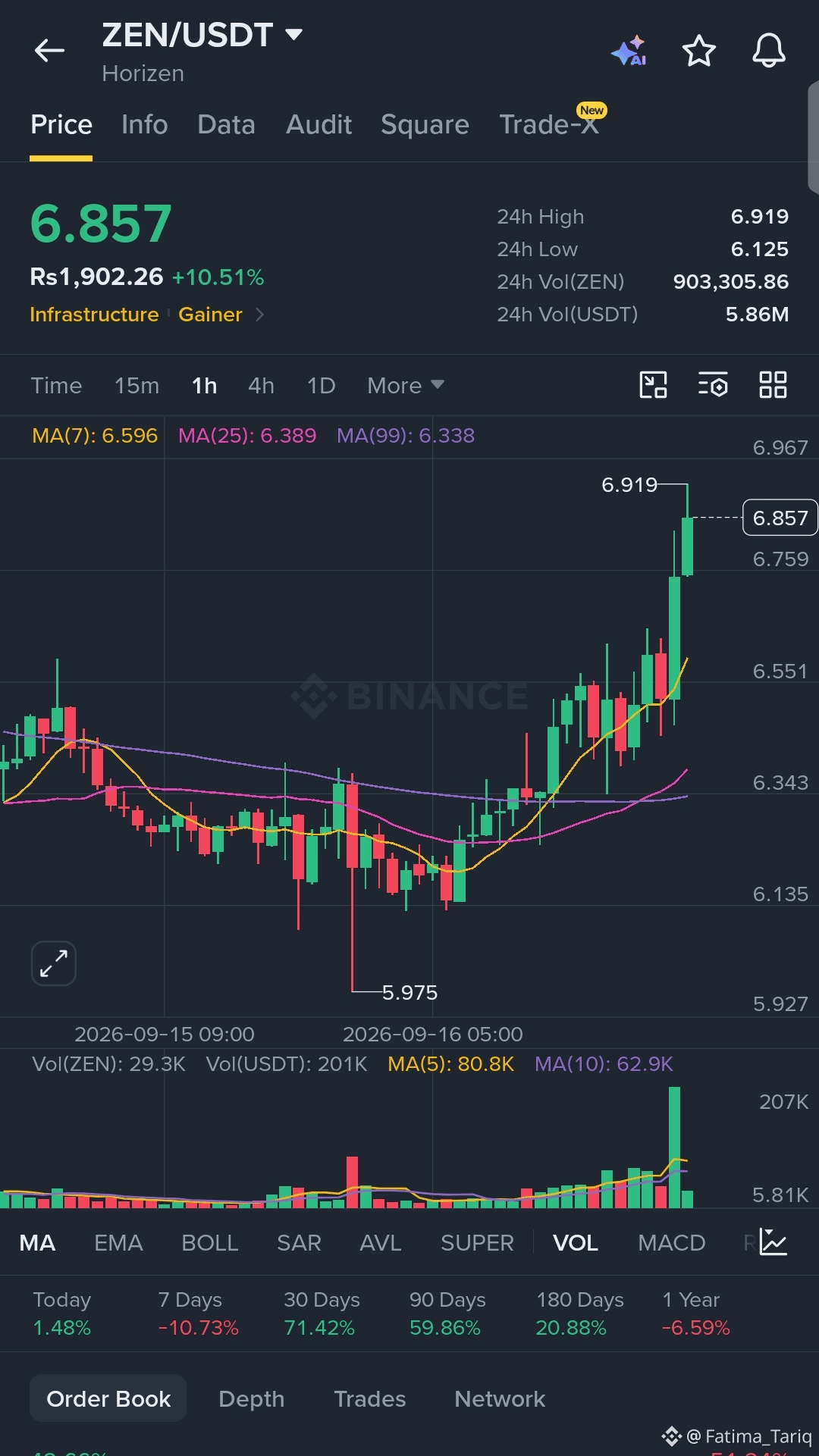
2
5
867
·
--
Baissier
𝗙𝗲𝗱 𝗛𝗶𝗸𝗲𝘀 𝗳𝗼𝗿 𝘁𝗵𝗲 𝗙𝗶𝗿𝘀𝘁 𝗧𝗶𝗺𝗲 𝗦𝗶𝗻𝗰𝗲 𝟮𝟬𝟮𝟯. 𝗡𝗼𝘄 𝘁𝗵𝗲 𝗥𝗲𝗮𝗹 𝗤𝘂𝗲𝘀𝘁𝗶𝗼𝗻 𝗜𝘀: 𝗪𝗵𝗮𝘁 𝗖𝗼𝗺𝗲𝘀 𝗡𝗲𝘅𝘁?
The Fed delivered the move markets were watching.
On September 16, 2026, the Federal Reserve raised rates by 25 bps, taking the target range from 3.50%–3.75% to 3.75%–4.00%. It was the first hike since July 2023.
But the rate hike itself was not the biggest surprise. Markets had already largely priced it in, with roughly 92–94% odds before the decision.
𝗪𝗵𝗮𝘁 𝗺𝗮𝘁𝘁𝗲𝗿𝘀 𝗳𝗼𝗿 𝗰𝗿𝘆𝗽𝘁𝗼 𝗻𝗼𝘄?
1️⃣ The dot plot The Fed's projections point to one more 25 bps hike in 2026, while policymakers expect rates to remain elevated through 2027.
2️⃣ Inflation is still the problem The Fed raised its 2026 inflation projection to 3.7%, well above its 2% target.
3️⃣ BTC entered the decision under pressure Bitcoin was trading around $75.9K ahead of the decision after falling roughly 4% on Tuesday, following the failed Senate vote on the CLARITY Act.
So I would not look at the headline “Fed hikes” alone.
The bigger question for crypto is whether this becomes one isolated hike or the beginning of a renewed tightening cycle.
For $BTC and $ETH , liquidity expectations, Treasury yields, the dollar and Powell/Warsh's forward guidance can matter more than the 25 bps headline itself.
The rate decision was expected.
The path from here is what the market has to digest. #FedRateWatch
#LearnWithFatima
𝗙𝗲𝗱 𝗛𝗶𝗸𝗲𝘀 𝗳𝗼𝗿 𝘁𝗵𝗲 𝗙𝗶𝗿𝘀𝘁 𝗧𝗶𝗺𝗲 𝗦𝗶𝗻𝗰𝗲 𝟮𝟬𝟮𝟯. 𝗡𝗼𝘄 𝘁𝗵𝗲 𝗥𝗲𝗮𝗹 𝗤𝘂𝗲𝘀𝘁𝗶𝗼𝗻 𝗜𝘀: 𝗪𝗵𝗮𝘁 𝗖𝗼𝗺𝗲𝘀 𝗡𝗲𝘅𝘁?
The Fed delivered the move markets were watching.
On September 16, 2026, the Federal Reserve raised rates by 25 bps, taking the target range from 3.50%–3.75% to 3.75%–4.00%. It was the first hike since July 2023.
But the rate hike itself was not the biggest surprise. Markets had already largely priced it in, with roughly 92–94% odds before the decision.
𝗪𝗵𝗮𝘁 𝗺𝗮𝘁𝘁𝗲𝗿𝘀 𝗳𝗼𝗿 𝗰𝗿𝘆𝗽𝘁𝗼 𝗻𝗼𝘄?
1️⃣ The dot plot The Fed's projections point to one more 25 bps hike in 2026, while policymakers expect rates to remain elevated through 2027.
2️⃣ Inflation is still the problem The Fed raised its 2026 inflation projection to 3.7%, well above its 2% target.
3️⃣ BTC entered the decision under pressure Bitcoin was trading around $75.9K ahead of the decision after falling roughly 4% on Tuesday, following the failed Senate vote on the CLARITY Act.
So I would not look at the headline “Fed hikes” alone.
The bigger question for crypto is whether this becomes one isolated hike or the beginning of a renewed tightening cycle.
For $BTC and $ETH , liquidity expectations, Treasury yields, the dollar and Powell/Warsh's forward guidance can matter more than the 25 bps headline itself.
The rate decision was expected.
The path from here is what the market has to digest. #FedRateWatch
#LearnWithFatima
The Fed delivered the move markets were watching.
On September 16, 2026, the Federal Reserve raised rates by 25 bps, taking the target range from 3.50%–3.75% to 3.75%–4.00%. It was the first hike since July 2023.
But the rate hike itself was not the biggest surprise. Markets had already largely priced it in, with roughly 92–94% odds before the decision.
𝗪𝗵𝗮𝘁 𝗺𝗮𝘁𝘁𝗲𝗿𝘀 𝗳𝗼𝗿 𝗰𝗿𝘆𝗽𝘁𝗼 𝗻𝗼𝘄?
1️⃣ The dot plot The Fed's projections point to one more 25 bps hike in 2026, while policymakers expect rates to remain elevated through 2027.
2️⃣ Inflation is still the problem The Fed raised its 2026 inflation projection to 3.7%, well above its 2% target.
3️⃣ BTC entered the decision under pressure Bitcoin was trading around $75.9K ahead of the decision after falling roughly 4% on Tuesday, following the failed Senate vote on the CLARITY Act.
So I would not look at the headline “Fed hikes” alone.
The bigger question for crypto is whether this becomes one isolated hike or the beginning of a renewed tightening cycle.
For $BTC and $ETH , liquidity expectations, Treasury yields, the dollar and Powell/Warsh's forward guidance can matter more than the 25 bps headline itself.
The rate decision was expected.
The path from here is what the market has to digest. #FedRateWatch
#LearnWithFatima


5
521
·
--
Baissier
The CLARITY Act vote just showed how quickly crypto can reprice political expectations.
The Senate failed to reach the 60 votes needed to advance the Digital Asset Market Clarity Act, putting months of negotiations on hold. BTC dropped toward $75K, while ETH, XRP and the broader altcoin market also came under pressure.
But I think the bigger issue is not the vote alone.
The market is entering a much tougher macro window. The 10-year U.S. Treasury yield moved above 5% on September 15, its highest level since 2007, while markets are heavily pricing a 25bps Fed hike.
That creates a double pressure point for crypto:
• Regulatory uncertainty returns as CLARITY stalls
• Higher yields make risk assets less attractive
• BTC is testing the $75K-$76K area
• Altcoins face even greater sensitivity to liquidity
The interesting part is that the CLARITY failure was not completely unexpected. Prediction markets had already reduced the probability of passage significantly.
So the question now is not simply, “Will BTC recover?”
It is whether BTC can hold this area while markets digest tighter monetary conditions, rising Treasury yields and renewed uncertainty around U.S. crypto regulation.
For me, $75K is becoming an important line to watch.
$BTC $ETH
#FedRateWatch
#LearnWithFatima
#ClarityActOddsHalveOnPolymarket
{future}(ETHUSDT)
{future}(BTCUSDT)
The CLARITY Act vote just showed how quickly crypto can reprice political expectations.
The Senate failed to reach the 60 votes needed to advance the Digital Asset Market Clarity Act, putting months of negotiations on hold. BTC dropped toward $75K, while ETH, XRP and the broader altcoin market also came under pressure.
But I think the bigger issue is not the vote alone.
The market is entering a much tougher macro window. The 10-year U.S. Treasury yield moved above 5% on September 15, its highest level since 2007, while markets are heavily pricing a 25bps Fed hike.
That creates a double pressure point for crypto:
• Regulatory uncertainty returns as CLARITY stalls
• Higher yields make risk assets less attractive
• BTC is testing the $75K-$76K area
• Altcoins face even greater sensitivity to liquidity
The interesting part is that the CLARITY failure was not completely unexpected. Prediction markets had already reduced the probability of passage significantly.
So the question now is not simply, “Will BTC recover?”
It is whether BTC can hold this area while markets digest tighter monetary conditions, rising Treasury yields and renewed uncertainty around U.S. crypto regulation.
For me, $75K is becoming an important line to watch.
$BTC $ETH
#FedRateWatch
#LearnWithFatima
#ClarityActOddsHalveOnPolymarket
The Senate failed to reach the 60 votes needed to advance the Digital Asset Market Clarity Act, putting months of negotiations on hold. BTC dropped toward $75K, while ETH, XRP and the broader altcoin market also came under pressure.
But I think the bigger issue is not the vote alone.
The market is entering a much tougher macro window. The 10-year U.S. Treasury yield moved above 5% on September 15, its highest level since 2007, while markets are heavily pricing a 25bps Fed hike.
That creates a double pressure point for crypto:
• Regulatory uncertainty returns as CLARITY stalls
• Higher yields make risk assets less attractive
• BTC is testing the $75K-$76K area
• Altcoins face even greater sensitivity to liquidity
The interesting part is that the CLARITY failure was not completely unexpected. Prediction markets had already reduced the probability of passage significantly.
So the question now is not simply, “Will BTC recover?”
It is whether BTC can hold this area while markets digest tighter monetary conditions, rising Treasury yields and renewed uncertainty around U.S. crypto regulation.
For me, $75K is becoming an important line to watch.
$BTC $ETH
#FedRateWatch
#LearnWithFatima
#ClarityActOddsHalveOnPolymarket
Fatima_Tariq
·
--
BaissierCLARITY Act Odds Just Collapsed. Is Crypto Regulation Losing Momentum?
The CLARITY Act is facing its biggest test yet.
Just yesterday, prediction-market odds for the bill becoming law in 2026 had climbed toward 30%, after Senate Republicans released a revised version with more than 120 changes aimed at addressing Democratic concerns.
But ahead of today’s Senate procedural vote, those odds have fallen sharply again, with reports showing Polymarket pricing dropping toward the mid-teens.
And this is where the 60-vote threshold becomes critical.
Republicans hold 53 Senate seats, meaning the bill needs at least 7 Democrats or independents to cross the line and advance.
What interests me is that the market isn't simply reacting to whether crypto regulation is “good” or “bad.”
It is pricing political execution risk.
The revised bill includes major changes around ethics, DeFi and regulatory oversight, but disagreements remain over stablecoin rules, Trump-related crypto interests and the exact regulatory framework.
So for BTC and ETH, I would not treat the CLARITY Act as an automatic bullish catalyst.
If 60 votes are secured:
→ regulatory uncertainty could decrease
→ institutional confidence could improve
→ the broader US crypto market may get a clearer framework
If the vote fails:
→ expectations for 2026 passage could deteriorate quickly
→ regulatory uncertainty remains
→ crypto may continue trading around political headlines rather than fundamentals
The bigger lesson for me is simple:
A 30% probability was never a guarantee. And a sharp drop doesn't mean the bill is permanently dead.
Today’s vote is about whether the legislation can move forward.
The real question is: can 60 senators agree on what “crypto clarity” should actually look like?
#ClarityActOddsHalveOnPolymarket
#LearnWithFatima $BTC $ETH
The CLARITY Act is facing its biggest test yet.
Just yesterday, prediction-market odds for the bill becoming law in 2026 had climbed toward 30%, after Senate Republicans released a revised version with more than 120 changes aimed at addressing Democratic concerns.
But ahead of today’s Senate procedural vote, those odds have fallen sharply again, with reports showing Polymarket pricing dropping toward the mid-teens.
And this is where the 60-vote threshold becomes critical.
Republicans hold 53 Senate seats, meaning the bill needs at least 7 Democrats or independents to cross the line and advance.
What interests me is that the market isn't simply reacting to whether crypto regulation is “good” or “bad.”
It is pricing political execution risk.
The revised bill includes major changes around ethics, DeFi and regulatory oversight, but disagreements remain over stablecoin rules, Trump-related crypto interests and the exact regulatory framework.
So for BTC and ETH, I would not treat the CLARITY Act as an automatic bullish catalyst.
If 60 votes are secured:
→ regulatory uncertainty could decrease
→ institutional confidence could improve
→ the broader US crypto market may get a clearer framework
If the vote fails:
→ expectations for 2026 passage could deteriorate quickly
→ regulatory uncertainty remains
→ crypto may continue trading around political headlines rather than fundamentals
The bigger lesson for me is simple:
A 30% probability was never a guarantee. And a sharp drop doesn't mean the bill is permanently dead.
Today’s vote is about whether the legislation can move forward.
The real question is: can 60 senators agree on what “crypto clarity” should actually look like?
#ClarityActOddsHalveOnPolymarket
#LearnWithFatima $BTC $ETH
6
444
·
--
Baissier
CLARITY Act Odds Just Collapsed. Is Crypto Regulation Losing Momentum?
The CLARITY Act is facing its biggest test yet.
Just yesterday, prediction-market odds for the bill becoming law in 2026 had climbed toward 30%, after Senate Republicans released a revised version with more than 120 changes aimed at addressing Democratic concerns.
But ahead of today’s Senate procedural vote, those odds have fallen sharply again, with reports showing Polymarket pricing dropping toward the mid-teens.
And this is where the 60-vote threshold becomes critical.
Republicans hold 53 Senate seats, meaning the bill needs at least 7 Democrats or independents to cross the line and advance.
What interests me is that the market isn't simply reacting to whether crypto regulation is “good” or “bad.”
It is pricing political execution risk.
The revised bill includes major changes around ethics, DeFi and regulatory oversight, but disagreements remain over stablecoin rules, Trump-related crypto interests and the exact regulatory framework.
So for BTC and ETH, I would not treat the CLARITY Act as an automatic bullish catalyst.
If 60 votes are secured:
→ regulatory uncertainty could decrease
→ institutional confidence could improve
→ the broader US crypto market may get a clearer framework
If the vote fails:
→ expectations for 2026 passage could deteriorate quickly
→ regulatory uncertainty remains
→ crypto may continue trading around political headlines rather than fundamentals
The bigger lesson for me is simple:
A 30% probability was never a guarantee. And a sharp drop doesn't mean the bill is permanently dead.
Today’s vote is about whether the legislation can move forward.
The real question is: can 60 senators agree on what “crypto clarity” should actually look like?
#ClarityActOddsHalveOnPolymarket
#LearnWithFatima $BTC $ETH
{future}(ETHUSDT)
{future}(BTCUSDT)
CLARITY Act Odds Just Collapsed. Is Crypto Regulation Losing Momentum?
The CLARITY Act is facing its biggest test yet.
Just yesterday, prediction-market odds for the bill becoming law in 2026 had climbed toward 30%, after Senate Republicans released a revised version with more than 120 changes aimed at addressing Democratic concerns.
But ahead of today’s Senate procedural vote, those odds have fallen sharply again, with reports showing Polymarket pricing dropping toward the mid-teens.
And this is where the 60-vote threshold becomes critical.
Republicans hold 53 Senate seats, meaning the bill needs at least 7 Democrats or independents to cross the line and advance.
What interests me is that the market isn't simply reacting to whether crypto regulation is “good” or “bad.”
It is pricing political execution risk.
The revised bill includes major changes around ethics, DeFi and regulatory oversight, but disagreements remain over stablecoin rules, Trump-related crypto interests and the exact regulatory framework.
So for BTC and ETH, I would not treat the CLARITY Act as an automatic bullish catalyst.
If 60 votes are secured:
→ regulatory uncertainty could decrease
→ institutional confidence could improve
→ the broader US crypto market may get a clearer framework
If the vote fails:
→ expectations for 2026 passage could deteriorate quickly
→ regulatory uncertainty remains
→ crypto may continue trading around political headlines rather than fundamentals
The bigger lesson for me is simple:
A 30% probability was never a guarantee. And a sharp drop doesn't mean the bill is permanently dead.
Today’s vote is about whether the legislation can move forward.
The real question is: can 60 senators agree on what “crypto clarity” should actually look like?
#ClarityActOddsHalveOnPolymarket
#LearnWithFatima $BTC $ETH
The CLARITY Act is facing its biggest test yet.
Just yesterday, prediction-market odds for the bill becoming law in 2026 had climbed toward 30%, after Senate Republicans released a revised version with more than 120 changes aimed at addressing Democratic concerns.
But ahead of today’s Senate procedural vote, those odds have fallen sharply again, with reports showing Polymarket pricing dropping toward the mid-teens.
And this is where the 60-vote threshold becomes critical.
Republicans hold 53 Senate seats, meaning the bill needs at least 7 Democrats or independents to cross the line and advance.
What interests me is that the market isn't simply reacting to whether crypto regulation is “good” or “bad.”
It is pricing political execution risk.
The revised bill includes major changes around ethics, DeFi and regulatory oversight, but disagreements remain over stablecoin rules, Trump-related crypto interests and the exact regulatory framework.
So for BTC and ETH, I would not treat the CLARITY Act as an automatic bullish catalyst.
If 60 votes are secured:
→ regulatory uncertainty could decrease
→ institutional confidence could improve
→ the broader US crypto market may get a clearer framework
If the vote fails:
→ expectations for 2026 passage could deteriorate quickly
→ regulatory uncertainty remains
→ crypto may continue trading around political headlines rather than fundamentals
The bigger lesson for me is simple:
A 30% probability was never a guarantee. And a sharp drop doesn't mean the bill is permanently dead.
Today’s vote is about whether the legislation can move forward.
The real question is: can 60 senators agree on what “crypto clarity” should actually look like?
#ClarityActOddsHalveOnPolymarket
#LearnWithFatima $BTC $ETH
2
1
5
1.3k
·
--
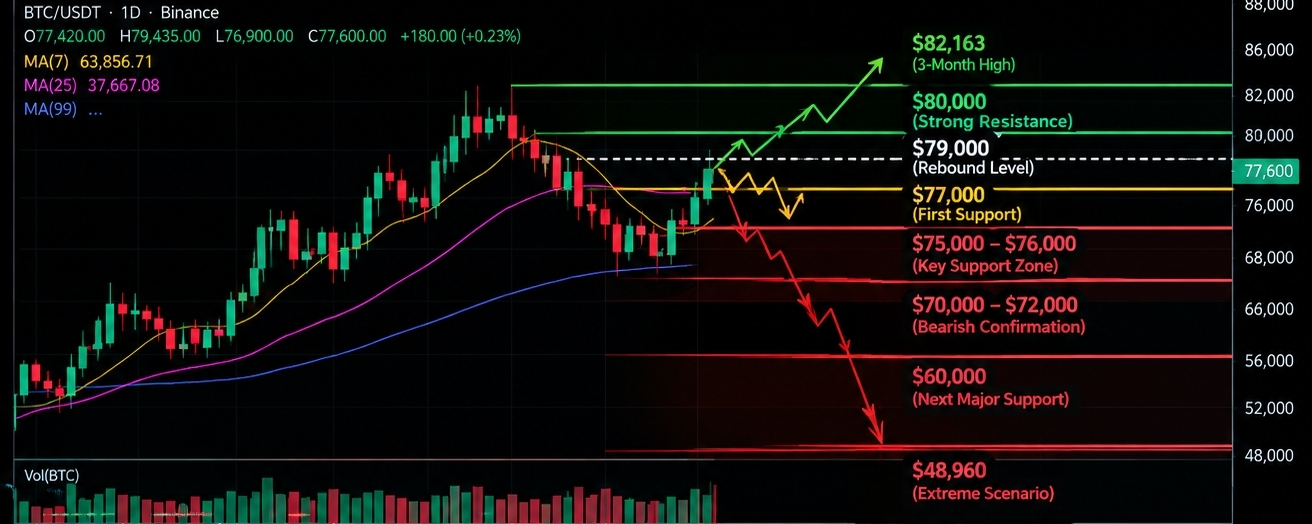
Article
Bitcoin Rebounds to $79K, So Why Are Some Traders Calling for $48K?Bitcoin briefly reclaimed the $79K area on September 15, but the move quickly cooled back toward $77K. That has created two very different views: some traders see another recovery attempt, while others are preparing for a much deeper correction toward $48K.
For me, the important part is not choosing a target. It is watching what happens at the key levels and what the macro data does next.
1. Why the $48K scenario is getting attention
The macro environment is becoming less friendly for risk assets.
10Y Treasury yield: above 5%, its highest level since 2007Oil: above $107Fed hike probability: above 94%BTC: back around $77K after failing to hold the $79K rebound
Higher yields + higher oil + stronger inflation pressure can keep liquidity tight and make BTC more vulnerable.
But $48K is not a confirmed target. From ~$77K, BTC would need to fall almost 38%.
2. What I would watch from here
👉If BTC holds $75K–$77K:
The $48K thesis becomes harder to support, especially if buyers return and ETF flows remain positive.
👉If BTC reclaims $79K–$80K:
That would show buyers are absorbing the macro pressure.
👉If BTC breaks above ~$82K:
The bearish structure would weaken significantly and the market could start looking toward higher levels again.
👉If BTC loses $75K–$76K:
That would be the first serious warning that the rebound is failing.
👉If $70K–$72K also breaks:
Then the downside structure becomes much more concerning, and deeper targets like $60K or below become more realistic.
3. The part I don't want to ignore
There is still institutional demand underneath the market.
Ethereum spot ETFs recorded around $121M in net inflows on September 14, while Bitmine holds roughly 5.95M ETH, with more than 5.06M ETH staked.
So this isn't simply a story of “everyone is selling crypto.”
My checklist is simple:
Hold $75K → recovery remains possible.Lose $75K → caution increases.Lose $70K–$72K → bearish case strengthens.Reclaim $80K → bears lose some momentum.Break ~$82K → $48K becomes much harder to argue from the current structure.
The next major catalyst is the Fed decision and guidance on September 16. Until then, I think BTC levels matter more than dramatic predictions.
What are you watching: $80K breakout or $75K breakdown?
#BitcoinReboundsTo$79K #bitcoin #BTC走势分析 #LearnWithFatima #BTC☀
Bitcoin Rebounds to $79K, So Why Are Some Traders Calling for $48K?
Bitcoin briefly reclaimed the $79K area on September 15, but the move quickly cooled back toward $77K. That has created two very different views: some traders see another recovery attempt, while others are preparing for a much deeper correction toward $48K.
For me, the important part is not choosing a target. It is watching what happens at the key levels and what the macro data does next.
1. Why the $48K scenario is getting attention
The macro environment is becoming less friendly for risk assets.
10Y Treasury yield: above 5%, its highest level since 2007Oil: above $107Fed hike probability: above 94%BTC: back around $77K after failing to hold the $79K rebound
Higher yields + higher oil + stronger inflation pressure can keep liquidity tight and make BTC more vulnerable.
But $48K is not a confirmed target. From ~$77K, BTC would need to fall almost 38%.
2. What I would watch from here
👉If BTC holds $75K–$77K:
The $48K thesis becomes harder to support, especially if buyers return and ETF flows remain positive.
👉If BTC reclaims $79K–$80K:
That would show buyers are absorbing the macro pressure.
👉If BTC breaks above ~$82K:
The bearish structure would weaken significantly and the market could start looking toward higher levels again.
👉If BTC loses $75K–$76K:
That would be the first serious warning that the rebound is failing.
👉If $70K–$72K also breaks:
Then the downside structure becomes much more concerning, and deeper targets like $60K or below become more realistic.
3. The part I don't want to ignore
There is still institutional demand underneath the market.
Ethereum spot ETFs recorded around $121M in net inflows on September 14, while Bitmine holds roughly 5.95M ETH, with more than 5.06M ETH staked.
So this isn't simply a story of “everyone is selling crypto.”
My checklist is simple:
Hold $75K → recovery remains possible.Lose $75K → caution increases.Lose $70K–$72K → bearish case strengthens.Reclaim $80K → bears lose some momentum.Break ~$82K → $48K becomes much harder to argue from the current structure.
The next major catalyst is the Fed decision and guidance on September 16. Until then, I think BTC levels matter more than dramatic predictions.
What are you watching: $80K breakout or $75K breakdown?
#BitcoinReboundsTo$79K #bitcoin #BTC走势分析 #LearnWithFatima #BTC☀
For me, the important part is not choosing a target. It is watching what happens at the key levels and what the macro data does next.
1. Why the $48K scenario is getting attention
The macro environment is becoming less friendly for risk assets.
10Y Treasury yield: above 5%, its highest level since 2007Oil: above $107Fed hike probability: above 94%BTC: back around $77K after failing to hold the $79K rebound
Higher yields + higher oil + stronger inflation pressure can keep liquidity tight and make BTC more vulnerable.
But $48K is not a confirmed target. From ~$77K, BTC would need to fall almost 38%.
2. What I would watch from here
👉If BTC holds $75K–$77K:
The $48K thesis becomes harder to support, especially if buyers return and ETF flows remain positive.
👉If BTC reclaims $79K–$80K:
That would show buyers are absorbing the macro pressure.
👉If BTC breaks above ~$82K:
The bearish structure would weaken significantly and the market could start looking toward higher levels again.
👉If BTC loses $75K–$76K:
That would be the first serious warning that the rebound is failing.
👉If $70K–$72K also breaks:
Then the downside structure becomes much more concerning, and deeper targets like $60K or below become more realistic.
3. The part I don't want to ignore
There is still institutional demand underneath the market.
Ethereum spot ETFs recorded around $121M in net inflows on September 14, while Bitmine holds roughly 5.95M ETH, with more than 5.06M ETH staked.
So this isn't simply a story of “everyone is selling crypto.”
My checklist is simple:
Hold $75K → recovery remains possible.Lose $75K → caution increases.Lose $70K–$72K → bearish case strengthens.Reclaim $80K → bears lose some momentum.Break ~$82K → $48K becomes much harder to argue from the current structure.
The next major catalyst is the Fed decision and guidance on September 16. Until then, I think BTC levels matter more than dramatic predictions.
What are you watching: $80K breakout or $75K breakdown?
#BitcoinReboundsTo$79K #bitcoin #BTC走势分析 #LearnWithFatima #BTC☀
5
1
6
909
·
--
Vérifié
CPI came in mixed. Headline CPI matched expectations at 3.4% YoY, while core CPI was 2.4% YoY. The problem was monthly core, which came in hotter at 0.3% vs 0.2% expected.
So why did $BTC still rip toward $80K?
My read: the move created liquidity above the market.
Fast green candles trigger FOMO, shorts get squeezed, and breakout traders chase. Then BTC gets rejected near the highs. That doesn’t prove a coordinated trap, but it does show that buyers still haven’t confirmed acceptance above $80K.
Now the macro calendar gets interesting:
📅 Sept 15: Clarity Act vote
📅 Sept 15–16: Fed decision, with markets leaning toward a 25 bps hike
📅 Sept 18: BOJ decision, with another hike potentially affecting global liquidity
Technically, I’m watching $76.7K.
Lose it on the daily → $72K–$69K comes into focus.
Reclaim and hold $80K → the bearish setup weakens.
And if BTC retests ~$83K and gets rejected again, I’d start watching the $64K–$65K zone.
For now, I’m not chasing the wick.
$80K reclaim or $76.7K breakdown. Let price decide.
Was that move a real breakout attempt, or liquidity being built before the next macro move?
#CPIWatch
{future}(BTCUSDT)
CPI came in mixed. Headline CPI matched expectations at 3.4% YoY, while core CPI was 2.4% YoY. The problem was monthly core, which came in hotter at 0.3% vs 0.2% expected.
So why did $BTC still rip toward $80K?
My read: the move created liquidity above the market.
Fast green candles trigger FOMO, shorts get squeezed, and breakout traders chase. Then BTC gets rejected near the highs. That doesn’t prove a coordinated trap, but it does show that buyers still haven’t confirmed acceptance above $80K.
Now the macro calendar gets interesting:
📅 Sept 15: Clarity Act vote
📅 Sept 15–16: Fed decision, with markets leaning toward a 25 bps hike
📅 Sept 18: BOJ decision, with another hike potentially affecting global liquidity
Technically, I’m watching $76.7K.
Lose it on the daily → $72K–$69K comes into focus.
Reclaim and hold $80K → the bearish setup weakens.
And if BTC retests ~$83K and gets rejected again, I’d start watching the $64K–$65K zone.
For now, I’m not chasing the wick.
$80K reclaim or $76.7K breakdown. Let price decide.
Was that move a real breakout attempt, or liquidity being built before the next macro move?
#CPIWatch
So why did $BTC still rip toward $80K?
My read: the move created liquidity above the market.
Fast green candles trigger FOMO, shorts get squeezed, and breakout traders chase. Then BTC gets rejected near the highs. That doesn’t prove a coordinated trap, but it does show that buyers still haven’t confirmed acceptance above $80K.
Now the macro calendar gets interesting:
📅 Sept 15: Clarity Act vote
📅 Sept 15–16: Fed decision, with markets leaning toward a 25 bps hike
📅 Sept 18: BOJ decision, with another hike potentially affecting global liquidity
Technically, I’m watching $76.7K.
Lose it on the daily → $72K–$69K comes into focus.
Reclaim and hold $80K → the bearish setup weakens.
And if BTC retests ~$83K and gets rejected again, I’d start watching the $64K–$65K zone.
For now, I’m not chasing the wick.
$80K reclaim or $76.7K breakdown. Let price decide.
Was that move a real breakout attempt, or liquidity being built before the next macro move?
#CPIWatch

1
5
1.4k
·
--
Baissier
Vérifié
Will CPI Trigger a Rate Hike? #CPIWatch
CPI week has turned into a much bigger rate-policy test than I expected.
On September 4, August nonfarm payrolls came in at 162K, far above the roughly 56K expected, while unemployment held at 4.1%. July payrolls were also revised up to 21K from the previous 23K decline. The jobs report pushed the probability of a September Fed hike higher, but CPI is now the number that can confirm or challenge that view.
And the inflation backdrop isn't exactly comfortable.
July CPI was 3.4% YoY, while core CPI was 2.5% YoY, both still above the Fed's 2% inflation target. For August, economists were expecting headline CPI to rise 0.4% MoM and 3.4% YoY, with core CPI at 0.2% MoM and 2.4% YoY. The report is scheduled for September 11 at 8:30 AM ET.
Then came another warning sign. August PPI rose 0.4% MoM, with annual producer-price inflation reaching 5.4%, adding more pressure to the inflation story. Markets were already pricing around a 70% chance of a 25 bp hike at the September 15–16 Fed meeting.
My take: I'm leaning bearish on stocks and bullish on the rate-hike trade if CPI beats expectations. A hot print could push Treasury yields and the dollar higher while putting pressure on risk assets and gold.
But if CPI comes in soft, this positioning can reverse quickly. With payrolls beating expectations and CPI in focus, what do you expect next: a Fed hike, a hold, or a bullish/bearish move in markets?
$BNB
{future}(BNBUSDT)
$SOL
{future}(SOLUSDT)
$BTC
{future}(BTCUSDT)
Will CPI Trigger a Rate Hike? #CPIWatch
CPI week has turned into a much bigger rate-policy test than I expected.
On September 4, August nonfarm payrolls came in at 162K, far above the roughly 56K expected, while unemployment held at 4.1%. July payrolls were also revised up to 21K from the previous 23K decline. The jobs report pushed the probability of a September Fed hike higher, but CPI is now the number that can confirm or challenge that view.
And the inflation backdrop isn't exactly comfortable.
July CPI was 3.4% YoY, while core CPI was 2.5% YoY, both still above the Fed's 2% inflation target. For August, economists were expecting headline CPI to rise 0.4% MoM and 3.4% YoY, with core CPI at 0.2% MoM and 2.4% YoY. The report is scheduled for September 11 at 8:30 AM ET.
Then came another warning sign. August PPI rose 0.4% MoM, with annual producer-price inflation reaching 5.4%, adding more pressure to the inflation story. Markets were already pricing around a 70% chance of a 25 bp hike at the September 15–16 Fed meeting.
My take: I'm leaning bearish on stocks and bullish on the rate-hike trade if CPI beats expectations. A hot print could push Treasury yields and the dollar higher while putting pressure on risk assets and gold.
But if CPI comes in soft, this positioning can reverse quickly. With payrolls beating expectations and CPI in focus, what do you expect next: a Fed hike, a hold, or a bullish/bearish move in markets?
$BNB
$SOL
$BTC
CPI week has turned into a much bigger rate-policy test than I expected.
On September 4, August nonfarm payrolls came in at 162K, far above the roughly 56K expected, while unemployment held at 4.1%. July payrolls were also revised up to 21K from the previous 23K decline. The jobs report pushed the probability of a September Fed hike higher, but CPI is now the number that can confirm or challenge that view.
And the inflation backdrop isn't exactly comfortable.
July CPI was 3.4% YoY, while core CPI was 2.5% YoY, both still above the Fed's 2% inflation target. For August, economists were expecting headline CPI to rise 0.4% MoM and 3.4% YoY, with core CPI at 0.2% MoM and 2.4% YoY. The report is scheduled for September 11 at 8:30 AM ET.
Then came another warning sign. August PPI rose 0.4% MoM, with annual producer-price inflation reaching 5.4%, adding more pressure to the inflation story. Markets were already pricing around a 70% chance of a 25 bp hike at the September 15–16 Fed meeting.
My take: I'm leaning bearish on stocks and bullish on the rate-hike trade if CPI beats expectations. A hot print could push Treasury yields and the dollar higher while putting pressure on risk assets and gold.
But if CPI comes in soft, this positioning can reverse quickly. With payrolls beating expectations and CPI in focus, what do you expect next: a Fed hike, a hold, or a bullish/bearish move in markets?
$BNB
$SOL
$BTC
Hold Rates
29%
Hike 25bps
21%
Bullish After CPI
29%
Bearish After CPI
21%
14 Votes • Vote fermé
3
10
790
·
--
Haussier
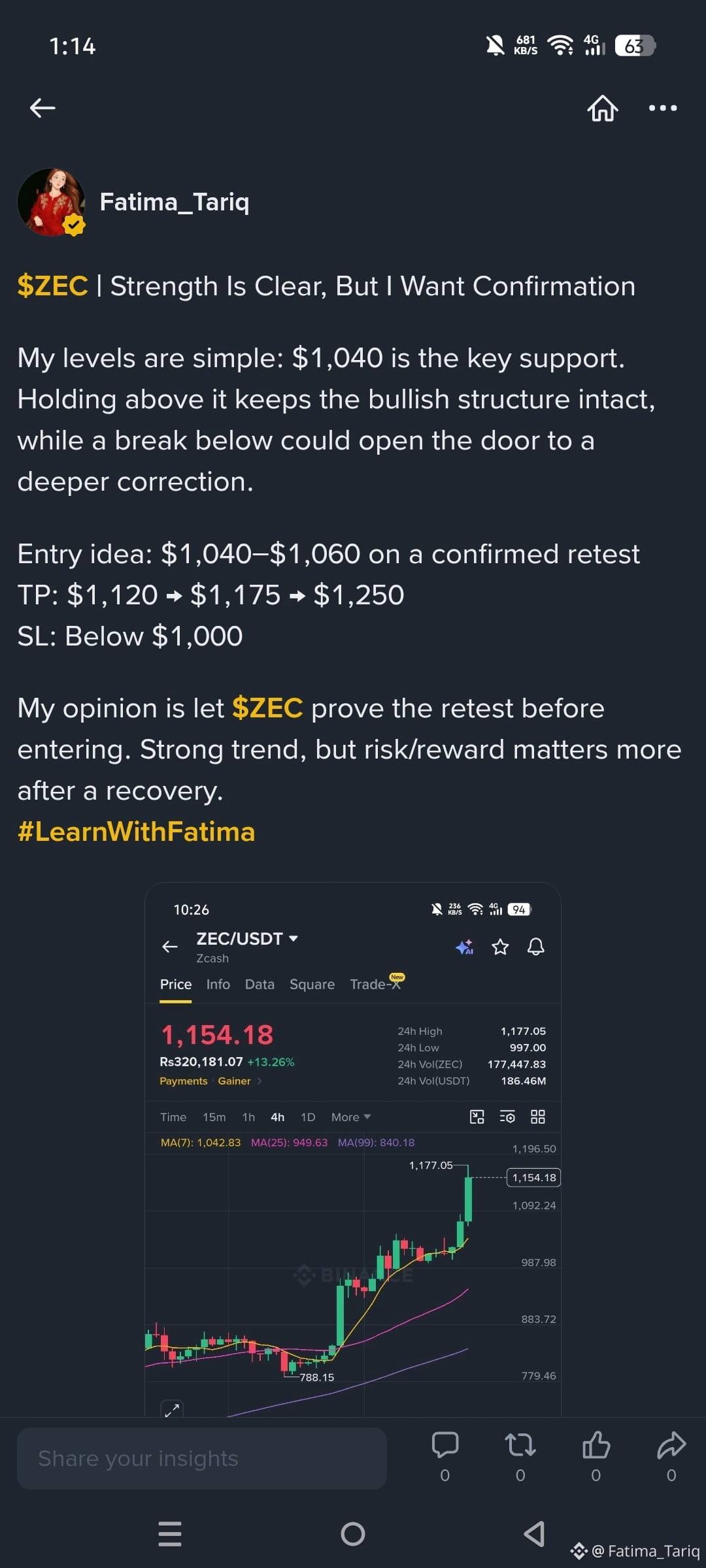
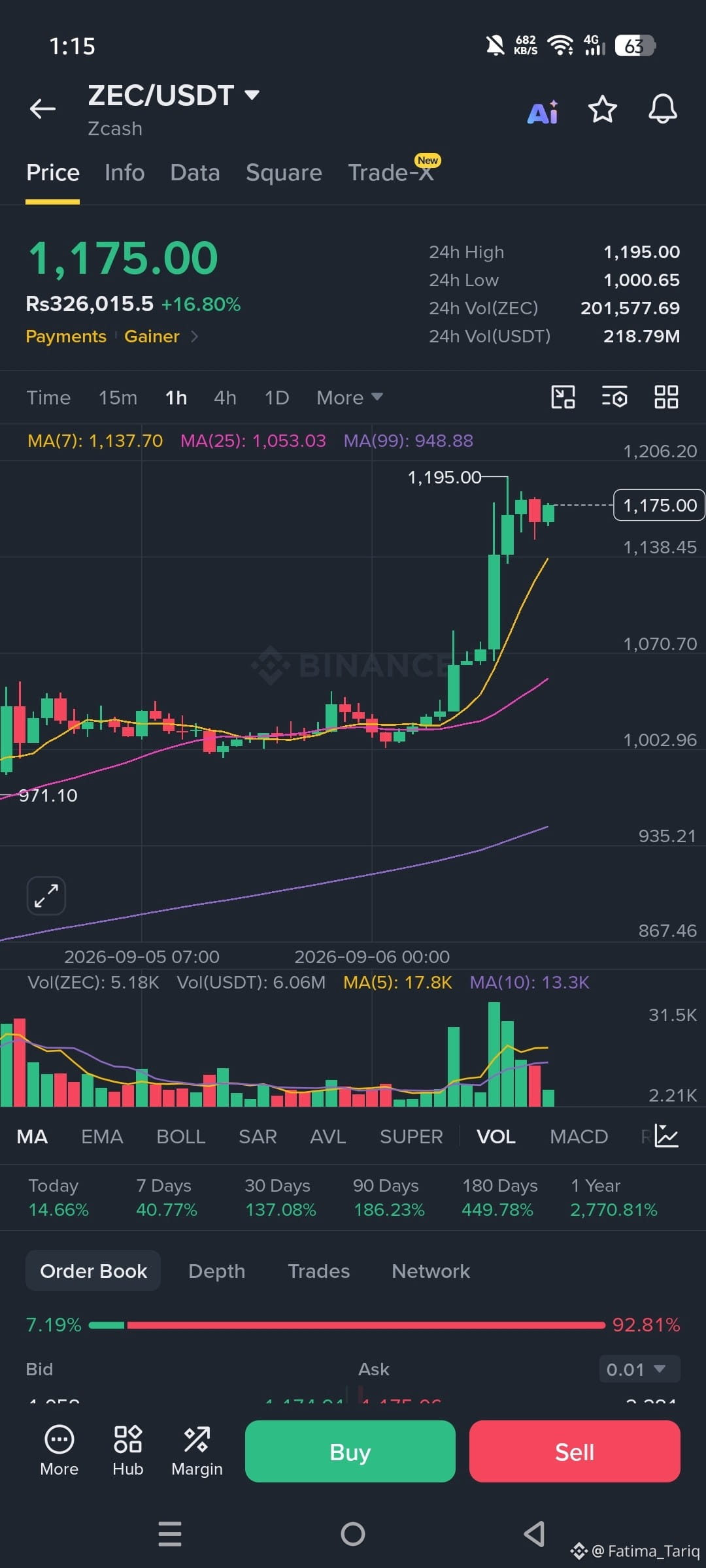
Votre contenu coté a été supprimé
3
386
Connectez-vous pour découvrir plus de contenu
Rejoignez la communauté mondiale des adeptes de cryptomonnaies sur Binance Square
⚡️ Suviez les dernières informations importantes sur les cryptomonnaies.
💬 Jugé digne de confiance par la plus grande plateforme d’échange de cryptomonnaies au monde.
👍 Découvrez les connaissances que partagent les créateurs vérifiés.
Adresse e-mail/Nº de téléphone
Sujets d’actualité
UKFCAWinsCourtOrderToRecover851400Pounds
10,686 vues
525 mentions
🚨 CRYPTO REGULATION JUST ENTERED A NEW PHASE: THEY’RE NOT ONLY WRITING RULES — THEY’RE TAKING MONEY BACK.
The UK’s FCA has secured another court-backed asset recovery, reinforcing a broader enforcement push against unauthorized financial and crypto-related activity.
And look at what’s happening simultaneously:
🇬🇧 FCA → enforcement + asset recovery
🇺🇸 SEC → clearer rules for functional crypto assets
🇺🇸 Fed → formal stablecoin supervision under the GENIUS Act
That combination matters.
Regulators are no longer debating whether crypto belongs inside the financial system.
They’re increasingly deciding who gets access, what rules they follow, and what happens when those rules are broken.
The next crypto cycle may not be “regulation vs innovation.”
It may be regulated crypto vs everyone who can’t meet the standard. 👀
$COIN $CRCL $BTC
#ukfcawinscourtordertorecover851400pounds #ChainlinkLaunchesCCIP2WithEnterpriseVerification #GoldFallsTo$4144 #QNTFallsOver40%FromMorningHigh #USDTAdds845900HoldersInPast7Days
KimHotbae
·2 mentions J’aime
·4k vues
ChainlinkLaunchesCCIP2WithEnterpriseVerification
24,408 vues
742 mentions
GoldFallsTo$4144
9,677 vues
123 mentions