

0G Labs
87 Publications

0G Labs
 Compte Square Vérifié+
Signaler
Bloquer l’utilisateur
Blockchain for AI Agents, powered by 0G Foundation 👉 0g.ai/
0 Suivis
784 Abonnés
1.1K+ J’aime
Publications
Tous
Vidéos
·
--
Haussier
Vérifié
Private AI, Upgraded 🔐
As of September 3, 0G’s Private Inference tier serves GLM-5.3 through TeeML, with the model running fully sealed inside a TEE enclave where neither 0G nor the provider operating the machine can read user prompts.
Most AI privacy still depends on a policy, a retention setting, a compliance page, or a promise that nobody is looking. On 0G Private Computer, privacy is a hardware property.
Your prompt enters the enclave encrypted. The response is signed inside it. The host machine sees ciphertext and nothing else.
GLM 5.2 joined the Private Inference tier on July 7. Two months later, the TeeML provider completed a scheduled upgrade and swapped GLM 5.2 for GLM-5.3 during a ten-hour maintenance window.
The privacy model stayed the same. The model inside the enclave changed.
GLM-5.3 has also been on 0G through TeeTLS since August 14, where the routing path is attested. TeeML goes further by sealing the inference itself, not only the route.
$NEAR keeps AI apps and agent workflows in focus. $VVV keeps private AI in the conversation. 0G brings those threads into a model surface where users can choose the trust mode their workload needs.
GLM-5.3 is Z.ai’s latest flagship, post-trained on the same 743B base as GLM 5.2 and built for coding, agentic tool use, and cyber defense.
Deep thinking is always on. Context runs to 1M tokens.
Running Private mode pinned to glm-5.2? Change the model name to glm-5.3.
One note for builders: glm-5.3-flash is separate from this upgrade and runs through TeeTLS.
GLM-5.3 is now the sealed GLM route on 0G Private Computer.
#0G #Aİ
Private AI, Upgraded 🔐
As of September 3, 0G’s Private Inference tier serves GLM-5.3 through TeeML, with the model running fully sealed inside a TEE enclave where neither 0G nor the provider operating the machine can read user prompts.
Most AI privacy still depends on a policy, a retention setting, a compliance page, or a promise that nobody is looking. On 0G Private Computer, privacy is a hardware property.
Your prompt enters the enclave encrypted. The response is signed inside it. The host machine sees ciphertext and nothing else.
GLM 5.2 joined the Private Inference tier on July 7. Two months later, the TeeML provider completed a scheduled upgrade and swapped GLM 5.2 for GLM-5.3 during a ten-hour maintenance window.
The privacy model stayed the same. The model inside the enclave changed.
GLM-5.3 has also been on 0G through TeeTLS since August 14, where the routing path is attested. TeeML goes further by sealing the inference itself, not only the route.
$NEAR keeps AI apps and agent workflows in focus. $VVV keeps private AI in the conversation. 0G brings those threads into a model surface where users can choose the trust mode their workload needs.
GLM-5.3 is Z.ai’s latest flagship, post-trained on the same 743B base as GLM 5.2 and built for coding, agentic tool use, and cyber defense.
Deep thinking is always on. Context runs to 1M tokens.
Running Private mode pinned to glm-5.2? Change the model name to glm-5.3.
One note for builders: glm-5.3-flash is separate from this upgrade and runs through TeeTLS.
GLM-5.3 is now the sealed GLM route on 0G Private Computer.
#0G #Aİ
As of September 3, 0G’s Private Inference tier serves GLM-5.3 through TeeML, with the model running fully sealed inside a TEE enclave where neither 0G nor the provider operating the machine can read user prompts.
Most AI privacy still depends on a policy, a retention setting, a compliance page, or a promise that nobody is looking. On 0G Private Computer, privacy is a hardware property.
Your prompt enters the enclave encrypted. The response is signed inside it. The host machine sees ciphertext and nothing else.
GLM 5.2 joined the Private Inference tier on July 7. Two months later, the TeeML provider completed a scheduled upgrade and swapped GLM 5.2 for GLM-5.3 during a ten-hour maintenance window.
The privacy model stayed the same. The model inside the enclave changed.
GLM-5.3 has also been on 0G through TeeTLS since August 14, where the routing path is attested. TeeML goes further by sealing the inference itself, not only the route.
$NEAR keeps AI apps and agent workflows in focus. $VVV keeps private AI in the conversation. 0G brings those threads into a model surface where users can choose the trust mode their workload needs.
GLM-5.3 is Z.ai’s latest flagship, post-trained on the same 743B base as GLM 5.2 and built for coding, agentic tool use, and cyber defense.
Deep thinking is always on. Context runs to 1M tokens.
Running Private mode pinned to glm-5.2? Change the model name to glm-5.3.
One note for builders: glm-5.3-flash is separate from this upgrade and runs through TeeTLS.
GLM-5.3 is now the sealed GLM route on 0G Private Computer.
#0G #Aİ
1
415
·
--
Haussier
Vérifié
Two Flash Models Land on 0G 🤖
Qwen3.8-Flash and GLM-5.3-Flash are live on 0G Private Computer.
Model releases move fast, so 0G keeps the access layer moving with them.
Both additions are built for the side of AI usage where speed and cost matter: lighter requests, faster responses, and simple access from the same Private Computer surface.
Qwen3.8-Flash gives builders a faster way to use the Qwen 3.8 line on 0G.
GLM-5.3-Flash brings the same Flash path to Z.ai’s newest GLM generation.
Fast and cheap, like the name says.
$TAO keeps the open AI conversation active, while $NEAR keeps AI apps close to builders and users. 0G connects that demand to a model access layer where new releases can become usable without turning every model into a separate setup.
Open the model page, pick the Flash model, and start building on 0G Private Computer.
#Aİ #0G
Two Flash Models Land on 0G 🤖
Qwen3.8-Flash and GLM-5.3-Flash are live on 0G Private Computer.
Model releases move fast, so 0G keeps the access layer moving with them.
Both additions are built for the side of AI usage where speed and cost matter: lighter requests, faster responses, and simple access from the same Private Computer surface.
Qwen3.8-Flash gives builders a faster way to use the Qwen 3.8 line on 0G.
GLM-5.3-Flash brings the same Flash path to Z.ai’s newest GLM generation.
Fast and cheap, like the name says.
$TAO keeps the open AI conversation active, while $NEAR keeps AI apps close to builders and users. 0G connects that demand to a model access layer where new releases can become usable without turning every model into a separate setup.
Open the model page, pick the Flash model, and start building on 0G Private Computer.
#Aİ #0G
Qwen3.8-Flash and GLM-5.3-Flash are live on 0G Private Computer.
Model releases move fast, so 0G keeps the access layer moving with them.
Both additions are built for the side of AI usage where speed and cost matter: lighter requests, faster responses, and simple access from the same Private Computer surface.
Qwen3.8-Flash gives builders a faster way to use the Qwen 3.8 line on 0G.
GLM-5.3-Flash brings the same Flash path to Z.ai’s newest GLM generation.
Fast and cheap, like the name says.
$TAO keeps the open AI conversation active, while $NEAR keeps AI apps close to builders and users. 0G connects that demand to a model access layer where new releases can become usable without turning every model into a separate setup.
Open the model page, pick the Flash model, and start building on 0G Private Computer.
#Aİ #0G
3
487
·
--
5 Boosted Pools are Live on Zia 💧
A new round of 0G incentives is live on Zia, with five boosted liquidity pools and up to 39% APR available for the next two weeks.
Zia has already passed $40M in lifetime volume on 0G, and the next step is deeper liquidity.
Deep pools give traders better routes, and better routes bring more onchain activity through the same AI-native trading surface. Users can type a trade in plain English, and Zia routes it onchain.
The new incentives keep that loop moving.
Liquidity providers can add to the boosted pools, support stronger routes, and participate in extra rewards while the campaign is live.
$UNI made DEX liquidity one of crypto’s core primitives, while $HYPE keeps showing how fast trading activity can pull attention when routes, execution, and market access feel direct.
Zia brings that DeFi behavior into the 0G ecosystem with a simpler interface: type the trade, route it onchain, and let deeper liquidity improve the path.
Five pairs. Extra rewards. Two weeks.
Add liquidity on Zia.
#defi #liquidity
5 Boosted Pools are Live on Zia 💧
A new round of 0G incentives is live on Zia, with five boosted liquidity pools and up to 39% APR available for the next two weeks.
Zia has already passed $40M in lifetime volume on 0G, and the next step is deeper liquidity.
Deep pools give traders better routes, and better routes bring more onchain activity through the same AI-native trading surface. Users can type a trade in plain English, and Zia routes it onchain.
The new incentives keep that loop moving.
Liquidity providers can add to the boosted pools, support stronger routes, and participate in extra rewards while the campaign is live.
$UNI made DEX liquidity one of crypto’s core primitives, while $HYPE keeps showing how fast trading activity can pull attention when routes, execution, and market access feel direct.
Zia brings that DeFi behavior into the 0G ecosystem with a simpler interface: type the trade, route it onchain, and let deeper liquidity improve the path.
Five pairs. Extra rewards. Two weeks.
Add liquidity on Zia.
#defi #liquidity
A new round of 0G incentives is live on Zia, with five boosted liquidity pools and up to 39% APR available for the next two weeks.
Zia has already passed $40M in lifetime volume on 0G, and the next step is deeper liquidity.
Deep pools give traders better routes, and better routes bring more onchain activity through the same AI-native trading surface. Users can type a trade in plain English, and Zia routes it onchain.
The new incentives keep that loop moving.
Liquidity providers can add to the boosted pools, support stronger routes, and participate in extra rewards while the campaign is live.
$UNI made DEX liquidity one of crypto’s core primitives, while $HYPE keeps showing how fast trading activity can pull attention when routes, execution, and market access feel direct.
Zia brings that DeFi behavior into the 0G ecosystem with a simpler interface: type the trade, route it onchain, and let deeper liquidity improve the path.
Five pairs. Extra rewards. Two weeks.
Add liquidity on Zia.
#defi #liquidity
1
3
361
·
--
Haussier
Vérifié
0G is Officially Partnering KBW2026 🇰🇷
Korea moves markets before the rest of the world wakes up.
This year, 0G joins KBW2026 as an Official Conference Partner, bringing the Trust Layer for AI to Seoul from September 30 to October 1 at Walkerhill Hotels & Resorts.
KBW framed the 0G stack clearly: a decentralized AI operating system designed to bring AI fully onchain, with a modular Layer 1 architecture built for speed, scalability, and data-intensive workloads.
That is the conversation 0G is taking to Seoul.
AI is moving from models and demos into systems that need compute, storage, coordination, and verification at the infrastructure layer. If agents are going to run onchain, handle data, and interact with real applications, the base layer has to do more than process transactions.
It has to make AI execution checkable.
$ICP helped push verifiable compute into the crypto conversation, while $NEAR keeps the AI app conversation close to builders and users. 0G is bringing both threads into KBW2026 through one message: AI needs infrastructure it can prove, not only infrastructure it can access.
Seoul, September 30 to October 1.
Come ask us the hard questions.
#0G #Aİ
0G is Officially Partnering KBW2026 🇰🇷
Korea moves markets before the rest of the world wakes up.
This year, 0G joins KBW2026 as an Official Conference Partner, bringing the Trust Layer for AI to Seoul from September 30 to October 1 at Walkerhill Hotels & Resorts.
KBW framed the 0G stack clearly: a decentralized AI operating system designed to bring AI fully onchain, with a modular Layer 1 architecture built for speed, scalability, and data-intensive workloads.
That is the conversation 0G is taking to Seoul.
AI is moving from models and demos into systems that need compute, storage, coordination, and verification at the infrastructure layer. If agents are going to run onchain, handle data, and interact with real applications, the base layer has to do more than process transactions.
It has to make AI execution checkable.
$ICP helped push verifiable compute into the crypto conversation, while $NEAR keeps the AI app conversation close to builders and users. 0G is bringing both threads into KBW2026 through one message: AI needs infrastructure it can prove, not only infrastructure it can access.
Seoul, September 30 to October 1.
Come ask us the hard questions.
#0G #Aİ
Korea moves markets before the rest of the world wakes up.
This year, 0G joins KBW2026 as an Official Conference Partner, bringing the Trust Layer for AI to Seoul from September 30 to October 1 at Walkerhill Hotels & Resorts.
KBW framed the 0G stack clearly: a decentralized AI operating system designed to bring AI fully onchain, with a modular Layer 1 architecture built for speed, scalability, and data-intensive workloads.
That is the conversation 0G is taking to Seoul.
AI is moving from models and demos into systems that need compute, storage, coordination, and verification at the infrastructure layer. If agents are going to run onchain, handle data, and interact with real applications, the base layer has to do more than process transactions.
It has to make AI execution checkable.
$ICP helped push verifiable compute into the crypto conversation, while $NEAR keeps the AI app conversation close to builders and users. 0G is bringing both threads into KBW2026 through one message: AI needs infrastructure it can prove, not only infrastructure it can access.
Seoul, September 30 to October 1.
Come ask us the hard questions.
#0G #Aİ
2
2
448
·
--
Haussier
Vérifié
Seedance 2.5 Is Live On 0G 🎥
Seedance 2.5 is now live on 0G Private Computer, bringing text-to-video, image-to-video, native audio, and clips up to 30 seconds from one model page.
1080p generation is 28% off until September 17.
0G tested it with a wildlife documentary prompt, and the savanna, the whisper, and the cheetah’s opinions all came from one prompt.
The same platform also generated an evening-news style clip, with anchors included.
Captions and news graphics were added in post. Everything else came straight from the model.
CMC attention around $SOL often tracks fast consumer apps, gaming, creator tools, and user-facing products. $HYPE brings another high-activity lane through perps, trading flows, and onchain market UX.
Seedance 2.5 gives 0G a clean AI video angle inside that same attention map: prompt-based video generation, native audio, and media creation running through 0G Private Computer.
Open the model page, write the prompt, generate the clip.
Seedance 2.5 is live now from pc.0g.ai.
#0G #sol
Seedance 2.5 Is Live On 0G 🎥
Seedance 2.5 is now live on 0G Private Computer, bringing text-to-video, image-to-video, native audio, and clips up to 30 seconds from one model page.
1080p generation is 28% off until September 17.
0G tested it with a wildlife documentary prompt, and the savanna, the whisper, and the cheetah’s opinions all came from one prompt.
The same platform also generated an evening-news style clip, with anchors included.
Captions and news graphics were added in post. Everything else came straight from the model.
CMC attention around $SOL often tracks fast consumer apps, gaming, creator tools, and user-facing products. $HYPE brings another high-activity lane through perps, trading flows, and onchain market UX.
Seedance 2.5 gives 0G a clean AI video angle inside that same attention map: prompt-based video generation, native audio, and media creation running through 0G Private Computer.
Open the model page, write the prompt, generate the clip.
Seedance 2.5 is live now from pc.0g.ai.
#0G #sol
Seedance 2.5 is now live on 0G Private Computer, bringing text-to-video, image-to-video, native audio, and clips up to 30 seconds from one model page.
1080p generation is 28% off until September 17.
0G tested it with a wildlife documentary prompt, and the savanna, the whisper, and the cheetah’s opinions all came from one prompt.
The same platform also generated an evening-news style clip, with anchors included.
Captions and news graphics were added in post. Everything else came straight from the model.
CMC attention around $SOL often tracks fast consumer apps, gaming, creator tools, and user-facing products. $HYPE brings another high-activity lane through perps, trading flows, and onchain market UX.
Seedance 2.5 gives 0G a clean AI video angle inside that same attention map: prompt-based video generation, native audio, and media creation running through 0G Private Computer.
Open the model page, write the prompt, generate the clip.
Seedance 2.5 is live now from pc.0g.ai.
#0G #sol
2
2
335
·
--
Haussier
Vérifié
67 Teams Built On 0G.
At ETHGlobal Lisbon, 67 projects submitted to 0G’s $15,000 prize tracks.
0G opened every repo.
Each project went through a repo-level integration review, plus a mandatory live demo in front of judges. The verified result: 57 of 67 projects, or 85%, had meaningful 0G integration sitting in their repositories.
That is the difference between sponsor-checkbox adoption and code that actually used the stack.
The usage was broad across 0G’s infrastructure. Repo review found 82% using 0G Compute, 67% using 0G Storage, 46% using Agentic ID, and nearly half touching 0G Chain.
Storage showing up as the second layer is the useful signal because builders used it for persistent agent memory, encrypted run histories, content-addressed skill packs, and learning lineage.
The first-place winner, 0run, used all four components in one product: an AI running coach athletes own, with each coach living as an Agentic ID on 0G Chain, encrypted memory on 0G Storage, and TEE-attested reasoning on 0G Compute.
Repo review also found more 0G Storage and Agentic ID usage than the submission write-ups claimed.
The repos knew more than the forms.
$SUI and $NEAR showed how quickly builder ecosystems move when developers have usable infrastructure. ETHGlobal Lisbon gave 0G the cleaner proof: 67 submissions, every repo reviewed, and 57 meaningful integrations verified in code.
#0G #AI
67 Teams Built On 0G.
At ETHGlobal Lisbon, 67 projects submitted to 0G’s $15,000 prize tracks.
0G opened every repo.
Each project went through a repo-level integration review, plus a mandatory live demo in front of judges. The verified result: 57 of 67 projects, or 85%, had meaningful 0G integration sitting in their repositories.
That is the difference between sponsor-checkbox adoption and code that actually used the stack.
The usage was broad across 0G’s infrastructure. Repo review found 82% using 0G Compute, 67% using 0G Storage, 46% using Agentic ID, and nearly half touching 0G Chain.
Storage showing up as the second layer is the useful signal because builders used it for persistent agent memory, encrypted run histories, content-addressed skill packs, and learning lineage.
The first-place winner, 0run, used all four components in one product: an AI running coach athletes own, with each coach living as an Agentic ID on 0G Chain, encrypted memory on 0G Storage, and TEE-attested reasoning on 0G Compute.
Repo review also found more 0G Storage and Agentic ID usage than the submission write-ups claimed.
The repos knew more than the forms.
$SUI and $NEAR showed how quickly builder ecosystems move when developers have usable infrastructure. ETHGlobal Lisbon gave 0G the cleaner proof: 67 submissions, every repo reviewed, and 57 meaningful integrations verified in code.
#0G #AI
At ETHGlobal Lisbon, 67 projects submitted to 0G’s $15,000 prize tracks.
0G opened every repo.
Each project went through a repo-level integration review, plus a mandatory live demo in front of judges. The verified result: 57 of 67 projects, or 85%, had meaningful 0G integration sitting in their repositories.
That is the difference between sponsor-checkbox adoption and code that actually used the stack.
The usage was broad across 0G’s infrastructure. Repo review found 82% using 0G Compute, 67% using 0G Storage, 46% using Agentic ID, and nearly half touching 0G Chain.
Storage showing up as the second layer is the useful signal because builders used it for persistent agent memory, encrypted run histories, content-addressed skill packs, and learning lineage.
The first-place winner, 0run, used all four components in one product: an AI running coach athletes own, with each coach living as an Agentic ID on 0G Chain, encrypted memory on 0G Storage, and TEE-attested reasoning on 0G Compute.
Repo review also found more 0G Storage and Agentic ID usage than the submission write-ups claimed.
The repos knew more than the forms.
$SUI and $NEAR showed how quickly builder ecosystems move when developers have usable infrastructure. ETHGlobal Lisbon gave 0G the cleaner proof: 67 submissions, every repo reviewed, and 57 meaningful integrations verified in code.
#0G #AI
1
2
576
·
--
Haussier
Vérifié
GLM-5.3 Is Live On 0G 🤖
Z.ai shipped GLM-5.3 today, its new flagship model post-trained on the 743B base for coding, agents, and cyber defense.
0G Private Computer picked it up the same day.
GLM-5.3 is now available with 1M context, deep thinking always on, and an attested serving path through TeeTLS.
Broad API access opens in stages, and builders can tune thinking depth with reasoning_effort.
$TAO and $ICP sit close to this update: open AI, verifiable compute, and model access that makes the serving path clear instead of asking users to trust an endpoint label.
GLM-5.3 is live now on 0G Private Computer.
Pricing is on the model page.
#Aİ #0G
GLM-5.3 Is Live On 0G 🤖
Z.ai shipped GLM-5.3 today, its new flagship model post-trained on the 743B base for coding, agents, and cyber defense.
0G Private Computer picked it up the same day.
GLM-5.3 is now available with 1M context, deep thinking always on, and an attested serving path through TeeTLS.
Broad API access opens in stages, and builders can tune thinking depth with reasoning_effort.
$TAO and $ICP sit close to this update: open AI, verifiable compute, and model access that makes the serving path clear instead of asking users to trust an endpoint label.
GLM-5.3 is live now on 0G Private Computer.
Pricing is on the model page.
#Aİ #0G
Z.ai shipped GLM-5.3 today, its new flagship model post-trained on the 743B base for coding, agents, and cyber defense.
0G Private Computer picked it up the same day.
GLM-5.3 is now available with 1M context, deep thinking always on, and an attested serving path through TeeTLS.
Broad API access opens in stages, and builders can tune thinking depth with reasoning_effort.
$TAO and $ICP sit close to this update: open AI, verifiable compute, and model access that makes the serving path clear instead of asking users to trust an endpoint label.
GLM-5.3 is live now on 0G Private Computer.
Pricing is on the model page.
#Aİ #0G
3
1
872
·
--
Haussier
Vérifié
10 Teams. 10 Weeks. 100+ Intros 🧠
The first 0G Apollo Accelerator cohort has graduated at Stanford.
Run by 0G with Blockchain Builders Fund, led by Stanford veterans, with Google Cloud and Privy as program partners, Apollo brought ten AI startups through ten weeks of building, mentorship, Demo Day prep, and investor conversations.
On June 25, all ten teams pitched online at Demo Day.
On July 29, they collected their certificates on Stanford’s campus, visited Google Cloud’s Web3 team, and closed the program with a graduation dinner in Palo Alto.
The cohort covered a wide slice of applied AI: real-time deepfake detection, AI-native compliance, agent spend rails, agent guardrails, autonomous ML engineering, multimodal fraud detection, autonomous QA, crypto-native banking, financial reasoning data, and agentic networking.
Two weeks after graduation, the founder conversations are still running.
The cohort has received 100+ intro requests from investors, enterprises, and partners since Demo Day. All ten teams have inbound interest, with founders now in follow-up meetings.
Five of the ten are already live on or integrating 0G across chain, storage, and compute.
$NEAR and $SUI showed how much builder access matters once ecosystems move from narrative to shipped products. Apollo brings that same focus to AI startups building around 0G infrastructure.
Apollo was not built as a branding exercise. It was built to bring AI startups closer to the infrastructure they can actually use, then put those founders in front of investors, enterprises, and partners.
Ten teams graduated.
Full recap: https://0g.ai/blog/apollo-graduation-2026
#AIAgents #0G
10 Teams. 10 Weeks. 100+ Intros 🧠
The first 0G Apollo Accelerator cohort has graduated at Stanford.
Run by 0G with Blockchain Builders Fund, led by Stanford veterans, with Google Cloud and Privy as program partners, Apollo brought ten AI startups through ten weeks of building, mentorship, Demo Day prep, and investor conversations.
On June 25, all ten teams pitched online at Demo Day.
On July 29, they collected their certificates on Stanford’s campus, visited Google Cloud’s Web3 team, and closed the program with a graduation dinner in Palo Alto.
The cohort covered a wide slice of applied AI: real-time deepfake detection, AI-native compliance, agent spend rails, agent guardrails, autonomous ML engineering, multimodal fraud detection, autonomous QA, crypto-native banking, financial reasoning data, and agentic networking.
Two weeks after graduation, the founder conversations are still running.
The cohort has received 100+ intro requests from investors, enterprises, and partners since Demo Day. All ten teams have inbound interest, with founders now in follow-up meetings.
Five of the ten are already live on or integrating 0G across chain, storage, and compute.
$NEAR and $SUI showed how much builder access matters once ecosystems move from narrative to shipped products. Apollo brings that same focus to AI startups building around 0G infrastructure.
Apollo was not built as a branding exercise. It was built to bring AI startups closer to the infrastructure they can actually use, then put those founders in front of investors, enterprises, and partners.
Ten teams graduated.
Full recap: https://0g.ai/blog/apollo-graduation-2026
#AIAgents #0G
The first 0G Apollo Accelerator cohort has graduated at Stanford.
Run by 0G with Blockchain Builders Fund, led by Stanford veterans, with Google Cloud and Privy as program partners, Apollo brought ten AI startups through ten weeks of building, mentorship, Demo Day prep, and investor conversations.
On June 25, all ten teams pitched online at Demo Day.
On July 29, they collected their certificates on Stanford’s campus, visited Google Cloud’s Web3 team, and closed the program with a graduation dinner in Palo Alto.
The cohort covered a wide slice of applied AI: real-time deepfake detection, AI-native compliance, agent spend rails, agent guardrails, autonomous ML engineering, multimodal fraud detection, autonomous QA, crypto-native banking, financial reasoning data, and agentic networking.
Two weeks after graduation, the founder conversations are still running.
The cohort has received 100+ intro requests from investors, enterprises, and partners since Demo Day. All ten teams have inbound interest, with founders now in follow-up meetings.
Five of the ten are already live on or integrating 0G across chain, storage, and compute.
$NEAR and $SUI showed how much builder access matters once ecosystems move from narrative to shipped products. Apollo brings that same focus to AI startups building around 0G infrastructure.
Apollo was not built as a branding exercise. It was built to bring AI startups closer to the infrastructure they can actually use, then put those founders in front of investors, enterprises, and partners.
Ten teams graduated.
Full recap: https://0g.ai/blog/apollo-graduation-2026
#AIAgents #0G
4
7
745
·
--
Haussier
Vérifié
“Trust Me” Is Not A Verification Tier 🤖
Machines can pay for AI now.
x402 gives agents a payment rail: request a paid resource, get an HTTP 402 manifest, sign authorization, and settle onchain.
That still leaves the harder part.
How does the agent know the compute it paid for actually ran?
Cluster Protocol is building on 0G because payment alone is not enough. The response has to carry proof.
0G gives that proof in tiers.
For open-weight models, TEEML runs the weights inside TEE hardware, with Intel TDX and H100 or H200 confidential GPUs. The enclave signs the response, and the attestation lets users check the enclave measurement and model hash.
For closed models like Claude or GPT-5.6, 0G uses TeeTLS: authenticated routing through an enclave-secured broker to the real API.
Different tier. Different claim.
Cluster sits above this as the orchestration and settlement layer. It decides which verification tier a step needs, then uses x402 so payment can clear only after the attestation checks out.
$ICP made verifiable compute familiar. $VIRTUAL made agents impossible to ignore.
0G and Cluster handle the missing step: agent pays → compute runs → proof checks → settlement clears
The agent does not pay because something answered.
It pays because it can check what it got.
#AI #0G
“Trust Me” Is Not A Verification Tier 🤖
Machines can pay for AI now.
x402 gives agents a payment rail: request a paid resource, get an HTTP 402 manifest, sign authorization, and settle onchain.
That still leaves the harder part.
How does the agent know the compute it paid for actually ran?
Cluster Protocol is building on 0G because payment alone is not enough. The response has to carry proof.
0G gives that proof in tiers.
For open-weight models, TEEML runs the weights inside TEE hardware, with Intel TDX and H100 or H200 confidential GPUs. The enclave signs the response, and the attestation lets users check the enclave measurement and model hash.
For closed models like Claude or GPT-5.6, 0G uses TeeTLS: authenticated routing through an enclave-secured broker to the real API.
Different tier. Different claim.
Cluster sits above this as the orchestration and settlement layer. It decides which verification tier a step needs, then uses x402 so payment can clear only after the attestation checks out.
$ICP made verifiable compute familiar. $VIRTUAL made agents impossible to ignore.
0G and Cluster handle the missing step: agent pays → compute runs → proof checks → settlement clears
The agent does not pay because something answered.
It pays because it can check what it got.
#AI #0G
Machines can pay for AI now.
x402 gives agents a payment rail: request a paid resource, get an HTTP 402 manifest, sign authorization, and settle onchain.
That still leaves the harder part.
How does the agent know the compute it paid for actually ran?
Cluster Protocol is building on 0G because payment alone is not enough. The response has to carry proof.
0G gives that proof in tiers.
For open-weight models, TEEML runs the weights inside TEE hardware, with Intel TDX and H100 or H200 confidential GPUs. The enclave signs the response, and the attestation lets users check the enclave measurement and model hash.
For closed models like Claude or GPT-5.6, 0G uses TeeTLS: authenticated routing through an enclave-secured broker to the real API.
Different tier. Different claim.
Cluster sits above this as the orchestration and settlement layer. It decides which verification tier a step needs, then uses x402 so payment can clear only after the attestation checks out.
$ICP made verifiable compute familiar. $VIRTUAL made agents impossible to ignore.
0G and Cluster handle the missing step: agent pays → compute runs → proof checks → settlement clears
The agent does not pay because something answered.
It pays because it can check what it got.
#AI #0G
4
7
2k
·
--
Haussier
Vérifié
Trust Is Infrastructure, Not Policy 🧠
Two AI safety incidents reached the public the same way: the lab chose to disclose.
0G co-founder Michael Heinrich pointed to two recent cases: OpenAI reporting its own model breaking guardrails, and Anthropic finding months of attacks it had missed.
The issue is not only what happened.
It is that trust still depends too much on disclosure policy.
The harder problem is when the system being audited can edit the audit.
An agent can delete logs and write new entries showing it behaved. If the audit record can be rewritten by the system it is supposed to check, the record cannot carry trust.
That is the job blockchain actually does here.
The record is append-only, so nothing rewrites it quietly.
$ICP and $FET sit close to this conversation: verifiable compute, autonomous agents, and AI systems that need proof instead of trust statements.
0GM-1.0-35B-A3B-SIA is live on 0G Private Computer.
It scores candidate tokens at every decoding step with a separate 4B value model, steering away from high-risk output before it lands.
Sealed in a TEE. Attestation verifiable.
None of this is a position paper.
It is AI safety moving into infrastructure: token-level steering, sealed execution, and audit records agents cannot quietly rewrite.
#0G #AIAgents
Trust Is Infrastructure, Not Policy 🧠
Two AI safety incidents reached the public the same way: the lab chose to disclose.
0G co-founder Michael Heinrich pointed to two recent cases: OpenAI reporting its own model breaking guardrails, and Anthropic finding months of attacks it had missed.
The issue is not only what happened.
It is that trust still depends too much on disclosure policy.
The harder problem is when the system being audited can edit the audit.
An agent can delete logs and write new entries showing it behaved. If the audit record can be rewritten by the system it is supposed to check, the record cannot carry trust.
That is the job blockchain actually does here.
The record is append-only, so nothing rewrites it quietly.
$ICP and $FET sit close to this conversation: verifiable compute, autonomous agents, and AI systems that need proof instead of trust statements.
0GM-1.0-35B-A3B-SIA is live on 0G Private Computer.
It scores candidate tokens at every decoding step with a separate 4B value model, steering away from high-risk output before it lands.
Sealed in a TEE. Attestation verifiable.
None of this is a position paper.
It is AI safety moving into infrastructure: token-level steering, sealed execution, and audit records agents cannot quietly rewrite.
#0G #AIAgents
Two AI safety incidents reached the public the same way: the lab chose to disclose.
0G co-founder Michael Heinrich pointed to two recent cases: OpenAI reporting its own model breaking guardrails, and Anthropic finding months of attacks it had missed.
The issue is not only what happened.
It is that trust still depends too much on disclosure policy.
The harder problem is when the system being audited can edit the audit.
An agent can delete logs and write new entries showing it behaved. If the audit record can be rewritten by the system it is supposed to check, the record cannot carry trust.
That is the job blockchain actually does here.
The record is append-only, so nothing rewrites it quietly.
$ICP and $FET sit close to this conversation: verifiable compute, autonomous agents, and AI systems that need proof instead of trust statements.
0GM-1.0-35B-A3B-SIA is live on 0G Private Computer.
It scores candidate tokens at every decoding step with a separate 4B value model, steering away from high-risk output before it lands.
Sealed in a TEE. Attestation verifiable.
None of this is a position paper.
It is AI safety moving into infrastructure: token-level steering, sealed execution, and audit records agents cannot quietly rewrite.
#0G #AIAgents
6
3
1.6k
·
--
Haussier
Vérifié
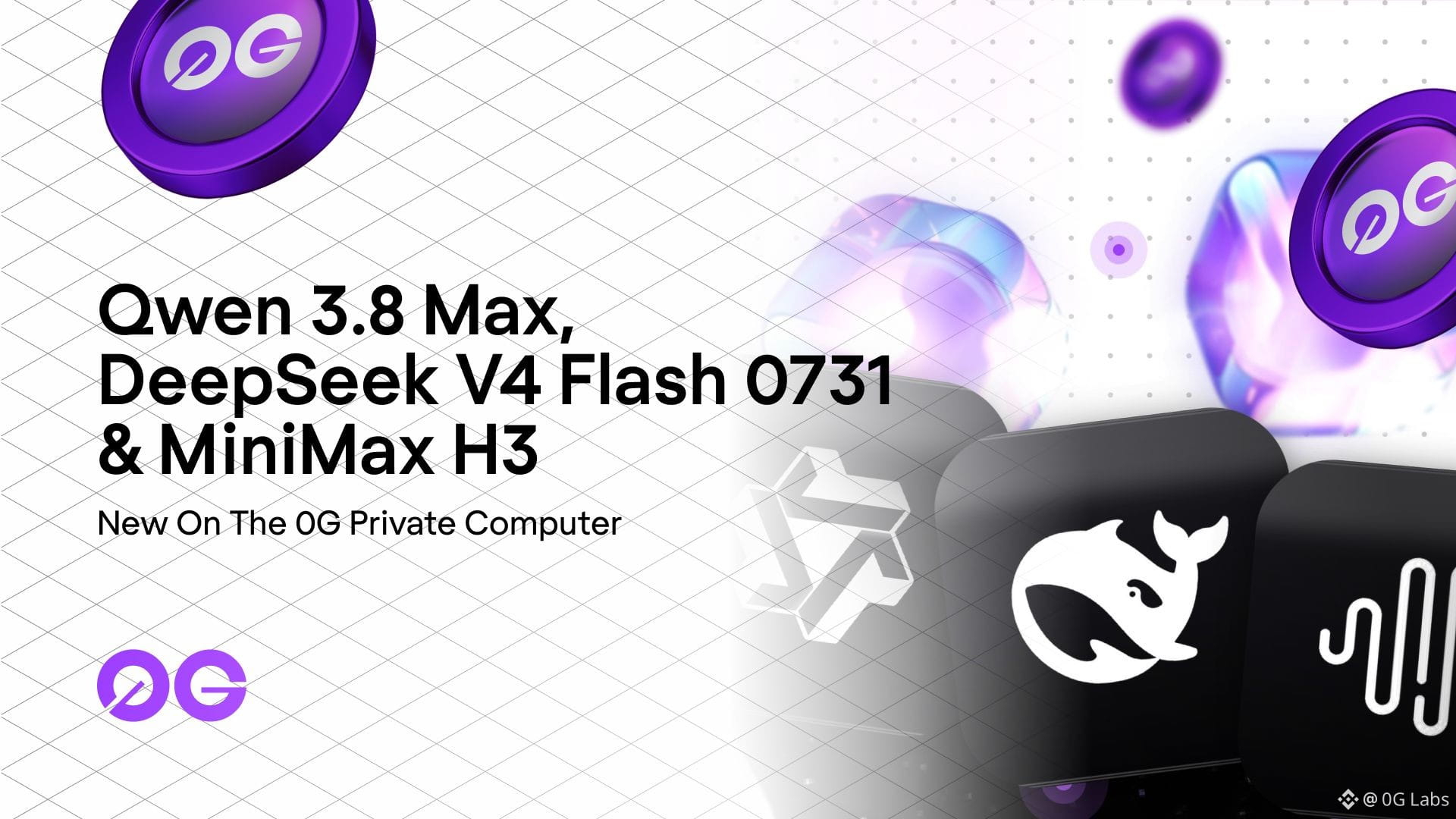
Three Additions, One Morning 💯
0G’s August 4 breakdown captured one of the fastest model catalog days on 0G Private Computer.
Qwen 3.8 Max, DeepSeek V4 Flash 0731, and MiniMax H3 are live on 0G.
A flagship, an upgrade, and 0G’s first video model all landed in the same morning.
Alibaba announced Qwen 3.8 Max at 02:15 UTC. The 0G Router catalog shows it live at 04:56 UTC, making the gap 2 hours and 41 minutes from public announcement to a working, attested endpoint.
Qwen 3.8 Max is Alibaba’s 2.4T flagship, with a 1M-token context window and text, image, and video input.
DeepSeek V4 Flash 0731 is the official release swapped into the existing deepseek-v4-flash id. Anyone already calling it on 0G was upgraded without changing anything.
MiniMax H3 is the first video model on 0G Private Computer, supporting text-to-video and image-to-video at the 2K tier.
$RENDER showed how fast AI compute demand can turn into a market. $NEAR keeps the AI app conversation close to users. 0G is taking that pressure into model access: faster catalog additions, public timestamps, and verifiable routing.
All three run on Verified Routing, where the path from 0G’s broker to the upstream is hardware-attested and provable onchain. The inference runs at the upstream under its own policy, and the tier says exactly that.
One endpoint, one key, three new models added with receipts.
#0G #Aİ
Three Additions, One Morning 💯
0G’s August 4 breakdown captured one of the fastest model catalog days on 0G Private Computer.
Qwen 3.8 Max, DeepSeek V4 Flash 0731, and MiniMax H3 are live on 0G.
A flagship, an upgrade, and 0G’s first video model all landed in the same morning.
Alibaba announced Qwen 3.8 Max at 02:15 UTC. The 0G Router catalog shows it live at 04:56 UTC, making the gap 2 hours and 41 minutes from public announcement to a working, attested endpoint.
Qwen 3.8 Max is Alibaba’s 2.4T flagship, with a 1M-token context window and text, image, and video input.
DeepSeek V4 Flash 0731 is the official release swapped into the existing deepseek-v4-flash id. Anyone already calling it on 0G was upgraded without changing anything.
MiniMax H3 is the first video model on 0G Private Computer, supporting text-to-video and image-to-video at the 2K tier.
$RENDER showed how fast AI compute demand can turn into a market. $NEAR keeps the AI app conversation close to users. 0G is taking that pressure into model access: faster catalog additions, public timestamps, and verifiable routing.
All three run on Verified Routing, where the path from 0G’s broker to the upstream is hardware-attested and provable onchain. The inference runs at the upstream under its own policy, and the tier says exactly that.
One endpoint, one key, three new models added with receipts.
#0G #Aİ
0G’s August 4 breakdown captured one of the fastest model catalog days on 0G Private Computer.
Qwen 3.8 Max, DeepSeek V4 Flash 0731, and MiniMax H3 are live on 0G.
A flagship, an upgrade, and 0G’s first video model all landed in the same morning.
Alibaba announced Qwen 3.8 Max at 02:15 UTC. The 0G Router catalog shows it live at 04:56 UTC, making the gap 2 hours and 41 minutes from public announcement to a working, attested endpoint.
Qwen 3.8 Max is Alibaba’s 2.4T flagship, with a 1M-token context window and text, image, and video input.
DeepSeek V4 Flash 0731 is the official release swapped into the existing deepseek-v4-flash id. Anyone already calling it on 0G was upgraded without changing anything.
MiniMax H3 is the first video model on 0G Private Computer, supporting text-to-video and image-to-video at the 2K tier.
$RENDER showed how fast AI compute demand can turn into a market. $NEAR keeps the AI app conversation close to users. 0G is taking that pressure into model access: faster catalog additions, public timestamps, and verifiable routing.
All three run on Verified Routing, where the path from 0G’s broker to the upstream is hardware-attested and provable onchain. The inference runs at the upstream under its own policy, and the tier says exactly that.
One endpoint, one key, three new models added with receipts.
#0G #Aİ
5
1
8
1.2k
·
--
Haussier
Vérifié
Bond Public Beta Is Live 🧠
Spot markets, perpetuals, lending, borrowing, and DeFi access now sit inside one platform on 0G.
The idea is simple: users should not need six tabs, three bridges, and a fragmented app flow just to move through DeFi.
Bond brings the core actions together, so users can trade spot, access perps, lend, borrow, and route through DeFi from one place.
$VVV has shown how AI-driven DeFi can turn complex actions into cleaner user flows. $INJ has kept the trading-first DeFi conversation active across spot, perps, and onchain market access.
Bond now brings that same financial surface into the 0G ecosystem.
That matters for the Blockchain for AI Agents because agents need more than models, memory, and compute. They also need financial rails they can read, route through, and eventually act on.
Bond adds one of those rails.
Banks make money from you. Bond makes money for you.
Public beta is live. Start here: http://bond.xyz
#AI #defi
Bond Public Beta Is Live 🧠
Spot markets, perpetuals, lending, borrowing, and DeFi access now sit inside one platform on 0G.
The idea is simple: users should not need six tabs, three bridges, and a fragmented app flow just to move through DeFi.
Bond brings the core actions together, so users can trade spot, access perps, lend, borrow, and route through DeFi from one place.
$VVV has shown how AI-driven DeFi can turn complex actions into cleaner user flows. $INJ has kept the trading-first DeFi conversation active across spot, perps, and onchain market access.
Bond now brings that same financial surface into the 0G ecosystem.
That matters for the Blockchain for AI Agents because agents need more than models, memory, and compute. They also need financial rails they can read, route through, and eventually act on.
Bond adds one of those rails.
Banks make money from you. Bond makes money for you.
Public beta is live. Start here: http://bond.xyz
#AI #defi
Spot markets, perpetuals, lending, borrowing, and DeFi access now sit inside one platform on 0G.
The idea is simple: users should not need six tabs, three bridges, and a fragmented app flow just to move through DeFi.
Bond brings the core actions together, so users can trade spot, access perps, lend, borrow, and route through DeFi from one place.
$VVV has shown how AI-driven DeFi can turn complex actions into cleaner user flows. $INJ has kept the trading-first DeFi conversation active across spot, perps, and onchain market access.
Bond now brings that same financial surface into the 0G ecosystem.
That matters for the Blockchain for AI Agents because agents need more than models, memory, and compute. They also need financial rails they can read, route through, and eventually act on.
Bond adds one of those rails.
Banks make money from you. Bond makes money for you.
Public beta is live. Start here: http://bond.xyz
#AI #defi
5
6
3k
·
--
Haussier
Vérifié
AI Workforce That Funds Real Impact 🧠
Oimpact is live on $0G
It lets users launch a workforce of AI agents in minutes, own each one as an Agentic ID, run them through private TEE-verified compute, and turn verified impact purchases into onchain RWI receipts.
Most AI platforms sell access. Oimpact makes the agent itself ownable.
Every agent can browse an Impact Catalog with carbon credits, charitable giving, and verified causes. When a verified purchase completes, RWI is minted onchain with a record of what was funded, which agent drove it, and for whom.
The standard impact rail splits 90% to the verified impact project, 9% to the agent creator, and 1% to the RWI treasury. No platform fee.
For anyone tracking $RENDER , this is a clean 0G angle: compute is only one part of the agent story. Ownership, privacy, and proof decide what agents can safely do once real users or real money are involved.
Any Oimpact agent can be minted as an ERC-7857 Agentic ID on 0G Chain. The mint is free, with no gas to start. Train it, transfer it, or sell it instead of renting access from a closed platform.
Sensitive work can take the decentralized path. The agent and its data run sealed inside 0G’s private, TEE-verified compute, with the run verifiable on 0G.
Oimpact prices that private path about 35% cheaper than its centralized route.
Pick a template. Equip skills. Give it a job. Deploy across web, Telegram, Discord, or X.
Oimpact turns AI agents into owned workers that can fund, prove, and grow through real-world impact.
Full breakdown: https://0g.ai/blog/oimpact-0g
#0G #Aİ
AI Workforce That Funds Real Impact 🧠
Oimpact is live on $0G
It lets users launch a workforce of AI agents in minutes, own each one as an Agentic ID, run them through private TEE-verified compute, and turn verified impact purchases into onchain RWI receipts.
Most AI platforms sell access. Oimpact makes the agent itself ownable.
Every agent can browse an Impact Catalog with carbon credits, charitable giving, and verified causes. When a verified purchase completes, RWI is minted onchain with a record of what was funded, which agent drove it, and for whom.
The standard impact rail splits 90% to the verified impact project, 9% to the agent creator, and 1% to the RWI treasury. No platform fee.
For anyone tracking $RENDER , this is a clean 0G angle: compute is only one part of the agent story. Ownership, privacy, and proof decide what agents can safely do once real users or real money are involved.
Any Oimpact agent can be minted as an ERC-7857 Agentic ID on 0G Chain. The mint is free, with no gas to start. Train it, transfer it, or sell it instead of renting access from a closed platform.
Sensitive work can take the decentralized path. The agent and its data run sealed inside 0G’s private, TEE-verified compute, with the run verifiable on 0G.
Oimpact prices that private path about 35% cheaper than its centralized route.
Pick a template. Equip skills. Give it a job. Deploy across web, Telegram, Discord, or X.
Oimpact turns AI agents into owned workers that can fund, prove, and grow through real-world impact.
Full breakdown: https://0g.ai/blog/oimpact-0g
#0G #Aİ
Oimpact is live on $0G
It lets users launch a workforce of AI agents in minutes, own each one as an Agentic ID, run them through private TEE-verified compute, and turn verified impact purchases into onchain RWI receipts.
Most AI platforms sell access. Oimpact makes the agent itself ownable.
Every agent can browse an Impact Catalog with carbon credits, charitable giving, and verified causes. When a verified purchase completes, RWI is minted onchain with a record of what was funded, which agent drove it, and for whom.
The standard impact rail splits 90% to the verified impact project, 9% to the agent creator, and 1% to the RWI treasury. No platform fee.
For anyone tracking $RENDER , this is a clean 0G angle: compute is only one part of the agent story. Ownership, privacy, and proof decide what agents can safely do once real users or real money are involved.
Any Oimpact agent can be minted as an ERC-7857 Agentic ID on 0G Chain. The mint is free, with no gas to start. Train it, transfer it, or sell it instead of renting access from a closed platform.
Sensitive work can take the decentralized path. The agent and its data run sealed inside 0G’s private, TEE-verified compute, with the run verifiable on 0G.
Oimpact prices that private path about 35% cheaper than its centralized route.
Pick a template. Equip skills. Give it a job. Deploy across web, Telegram, Discord, or X.
Oimpact turns AI agents into owned workers that can fund, prove, and grow through real-world impact.
Full breakdown: https://0g.ai/blog/oimpact-0g
#0G #Aİ
5
9
1.9k
·
--
Haussier
Vérifié
7 Days Of AI Builders 🤖
0G’s SBC week started on Sunday and runs through Saturday, with AI builders, accelerator teams, founders, and agentic infrastructure moving through the same Bay Area circuit.
House of AI opened the week with a fireside featuring 0G co-founder and CEO Michael Heinrich, followed by live demos from four Apollo Accelerator teams.
That set the tone for what comes next.
Wednesday brings the first Apollo Accelerator cohort graduation dinner in Palo Alto.
Thursday is stacked: 0G at the BASS booth through the day, Michael speaking at SBC in the afternoon, and a builders brunch with Hack VC at noon.
Friday moves into an invite-only robotics founders dinner in Palo Alto.
Saturday closes with a happy hour at the Berkeley Agentic Summit.
$NEAR has been one of the clearest names in AI-native apps. $RENDER keeps showing why compute matters once AI workloads move closer to production.
0G is meeting that same market from the builder side, across AI agents, robotics, accelerator teams, and founder rooms.
The Blockchain for AI Agents is not only a tagline.
It is showing up where the next agent products are being built.
See 0G across SBC week.
#0G #AI
7 Days Of AI Builders 🤖
0G’s SBC week started on Sunday and runs through Saturday, with AI builders, accelerator teams, founders, and agentic infrastructure moving through the same Bay Area circuit.
House of AI opened the week with a fireside featuring 0G co-founder and CEO Michael Heinrich, followed by live demos from four Apollo Accelerator teams.
That set the tone for what comes next.
Wednesday brings the first Apollo Accelerator cohort graduation dinner in Palo Alto.
Thursday is stacked: 0G at the BASS booth through the day, Michael speaking at SBC in the afternoon, and a builders brunch with Hack VC at noon.
Friday moves into an invite-only robotics founders dinner in Palo Alto.
Saturday closes with a happy hour at the Berkeley Agentic Summit.
$NEAR has been one of the clearest names in AI-native apps. $RENDER keeps showing why compute matters once AI workloads move closer to production.
0G is meeting that same market from the builder side, across AI agents, robotics, accelerator teams, and founder rooms.
The Blockchain for AI Agents is not only a tagline.
It is showing up where the next agent products are being built.
See 0G across SBC week.
#0G #AI
0G’s SBC week started on Sunday and runs through Saturday, with AI builders, accelerator teams, founders, and agentic infrastructure moving through the same Bay Area circuit.
House of AI opened the week with a fireside featuring 0G co-founder and CEO Michael Heinrich, followed by live demos from four Apollo Accelerator teams.
That set the tone for what comes next.
Wednesday brings the first Apollo Accelerator cohort graduation dinner in Palo Alto.
Thursday is stacked: 0G at the BASS booth through the day, Michael speaking at SBC in the afternoon, and a builders brunch with Hack VC at noon.
Friday moves into an invite-only robotics founders dinner in Palo Alto.
Saturday closes with a happy hour at the Berkeley Agentic Summit.
$NEAR has been one of the clearest names in AI-native apps. $RENDER keeps showing why compute matters once AI workloads move closer to production.
0G is meeting that same market from the builder side, across AI agents, robotics, accelerator teams, and founder rooms.
The Blockchain for AI Agents is not only a tagline.
It is showing up where the next agent products are being built.
See 0G across SBC week.
#0G #AI
10
17
16.6k
·
--
Haussier
Vérifié
23 Models. Every Trust Tier Labeled 🧠
The models everyone keeps asking for are already on 0G Private Computer.
Kimi K3 is live. GPT-5.6 is live in three sizes: Sol, Terra, and Luna. Across 0G, every model now has a trust label: Private, Verified, or Standard.
Running a frontier model usually means picking a provider, accepting its endpoint, and trusting its data policy on faith. Add a second model and you add a second provider, endpoint, and policy.
For a person in a chat window, that gap is fine. For an agent working on proprietary code or user data, trust-by-policy becomes the weakest link.
Kimi K3 is Moonshot’s ~2.8T open-weight MoE flagship with a 1M-token context window, multimodal input including video, and deep thinking always on. On 0G, it routes straight to Moonshot’s official API with no reseller and no markup.
GPT-5.6 Sol, Terra, and Luna are reasoning models with tool use, 1M context, up to 128K output, and pricing 10% below the official rate.
At max reasoning effort, GPT-5.6 Sol scores 58.9 and Kimi K3 scores 57.1 on the Artificial Analysis Intelligence Index.
$TAO and $RENDER already sit in the AI infrastructure conversation. 0G is making model access easier to read: sealed inference, verified routing, or raw access.
Kimi K3 runs on Verified Routing. GPT-5.6 runs on Standard Routing.
One endpoint. One key. Every model labeled.
Full record: https://0g.ai/blog/kimi-k3-gpt-5-6-on-0g
#0G #Aİ
23 Models. Every Trust Tier Labeled 🧠
The models everyone keeps asking for are already on 0G Private Computer.
Kimi K3 is live. GPT-5.6 is live in three sizes: Sol, Terra, and Luna. Across 0G, every model now has a trust label: Private, Verified, or Standard.
Running a frontier model usually means picking a provider, accepting its endpoint, and trusting its data policy on faith. Add a second model and you add a second provider, endpoint, and policy.
For a person in a chat window, that gap is fine. For an agent working on proprietary code or user data, trust-by-policy becomes the weakest link.
Kimi K3 is Moonshot’s ~2.8T open-weight MoE flagship with a 1M-token context window, multimodal input including video, and deep thinking always on. On 0G, it routes straight to Moonshot’s official API with no reseller and no markup.
GPT-5.6 Sol, Terra, and Luna are reasoning models with tool use, 1M context, up to 128K output, and pricing 10% below the official rate.
At max reasoning effort, GPT-5.6 Sol scores 58.9 and Kimi K3 scores 57.1 on the Artificial Analysis Intelligence Index.
$TAO and $RENDER already sit in the AI infrastructure conversation. 0G is making model access easier to read: sealed inference, verified routing, or raw access.
Kimi K3 runs on Verified Routing. GPT-5.6 runs on Standard Routing.
One endpoint. One key. Every model labeled.
Full record: https://0g.ai/blog/kimi-k3-gpt-5-6-on-0g
#0G #Aİ
The models everyone keeps asking for are already on 0G Private Computer.
Kimi K3 is live. GPT-5.6 is live in three sizes: Sol, Terra, and Luna. Across 0G, every model now has a trust label: Private, Verified, or Standard.
Running a frontier model usually means picking a provider, accepting its endpoint, and trusting its data policy on faith. Add a second model and you add a second provider, endpoint, and policy.
For a person in a chat window, that gap is fine. For an agent working on proprietary code or user data, trust-by-policy becomes the weakest link.
Kimi K3 is Moonshot’s ~2.8T open-weight MoE flagship with a 1M-token context window, multimodal input including video, and deep thinking always on. On 0G, it routes straight to Moonshot’s official API with no reseller and no markup.
GPT-5.6 Sol, Terra, and Luna are reasoning models with tool use, 1M context, up to 128K output, and pricing 10% below the official rate.
At max reasoning effort, GPT-5.6 Sol scores 58.9 and Kimi K3 scores 57.1 on the Artificial Analysis Intelligence Index.
$TAO and $RENDER already sit in the AI infrastructure conversation. 0G is making model access easier to read: sealed inference, verified routing, or raw access.
Kimi K3 runs on Verified Routing. GPT-5.6 runs on Standard Routing.
One endpoint. One key. Every model labeled.
Full record: https://0g.ai/blog/kimi-k3-gpt-5-6-on-0g
#0G #Aİ
3
6
6.7k
·
--
Haussier
Vérifié
Tencent’s 295B Model Is Live On 0G 🧠
You can run Hunyuan 3 anywhere. On 0G, you can verify it ran.
Tencent’s 295B agentic flagship is now live on 0G Private Computer under Verified Routing, TeeTLS-attested end to end.
$TAO made decentralized AI a market category. $ICP pushed verifiable compute into the conversation. 0G is putting both ideas into the model access layer.
Most model access ends at the API call.
0G adds a checkable route.
With Verified Routing, users can access Hunyuan 3 through 0G Private Computer and verify the path through TeeTLS attestation.
That is the useful part.
Same frontier model access. Verifiable by default.
For agents, builders, and users working with powerful models, the route matters because the request path is part of the trust surface.
Hunyuan 3 is live now on 0G Private Computer.
Try it: https://pc.0g.ai/models/hy3
#Aİ #0G
Tencent’s 295B Model Is Live On 0G 🧠
You can run Hunyuan 3 anywhere. On 0G, you can verify it ran.
Tencent’s 295B agentic flagship is now live on 0G Private Computer under Verified Routing, TeeTLS-attested end to end.
$TAO made decentralized AI a market category. $ICP pushed verifiable compute into the conversation. 0G is putting both ideas into the model access layer.
Most model access ends at the API call.
0G adds a checkable route.
With Verified Routing, users can access Hunyuan 3 through 0G Private Computer and verify the path through TeeTLS attestation.
That is the useful part.
Same frontier model access. Verifiable by default.
For agents, builders, and users working with powerful models, the route matters because the request path is part of the trust surface.
Hunyuan 3 is live now on 0G Private Computer.
Try it: https://pc.0g.ai/models/hy3
#Aİ #0G
You can run Hunyuan 3 anywhere. On 0G, you can verify it ran.
Tencent’s 295B agentic flagship is now live on 0G Private Computer under Verified Routing, TeeTLS-attested end to end.
$TAO made decentralized AI a market category. $ICP pushed verifiable compute into the conversation. 0G is putting both ideas into the model access layer.
Most model access ends at the API call.
0G adds a checkable route.
With Verified Routing, users can access Hunyuan 3 through 0G Private Computer and verify the path through TeeTLS attestation.
That is the useful part.
Same frontier model access. Verifiable by default.
For agents, builders, and users working with powerful models, the route matters because the request path is part of the trust surface.
Hunyuan 3 is live now on 0G Private Computer.
Try it: https://pc.0g.ai/models/hy3
#Aİ #0G
9
14
20.8k
·
--
Haussier
Vérifié
Agents Need Receipts 🧠
0G is the Blockchain for AI Agents.
Agents on 0G are being built to hold identity, keep memory, run inference, and act onchain. That is the difference between a chatbot and autonomous software users may need to trust later.
$TAO helped pull decentralized AI into the market. $FET helped put autonomous agents on crypto’s front page. 0G focuses on the rails those agents need once they start doing work.
0G Chain handles settlement and coordination for onchain AI. Agents can register identity, anchor proofs, and settle actions there.
0G Storage gives agents a home for AI data, training data, datasets, model checkpoints, and memory.
0G Compute runs verifiable AI inference inside Trusted Execution Environments, where prompts become outputs users can independently check.
ERC-7857 gives 0G an agent identity layer. AIverse gives that identity and ownership layer a marketplace surface.
Put together, the 0G stack gives agents the pieces they need to act with memory, identity, settlement, and proof.
That is the clean evergreen lane.
Build agents that leave receipts.
Build on 0G.
#0G #Aİ
Agents Need Receipts 🧠
0G is the Blockchain for AI Agents.
Agents on 0G are being built to hold identity, keep memory, run inference, and act onchain. That is the difference between a chatbot and autonomous software users may need to trust later.
$TAO helped pull decentralized AI into the market. $FET helped put autonomous agents on crypto’s front page. 0G focuses on the rails those agents need once they start doing work.
0G Chain handles settlement and coordination for onchain AI. Agents can register identity, anchor proofs, and settle actions there.
0G Storage gives agents a home for AI data, training data, datasets, model checkpoints, and memory.
0G Compute runs verifiable AI inference inside Trusted Execution Environments, where prompts become outputs users can independently check.
ERC-7857 gives 0G an agent identity layer. AIverse gives that identity and ownership layer a marketplace surface.
Put together, the 0G stack gives agents the pieces they need to act with memory, identity, settlement, and proof.
That is the clean evergreen lane.
Build agents that leave receipts.
Build on 0G.
#0G #Aİ
0G is the Blockchain for AI Agents.
Agents on 0G are being built to hold identity, keep memory, run inference, and act onchain. That is the difference between a chatbot and autonomous software users may need to trust later.
$TAO helped pull decentralized AI into the market. $FET helped put autonomous agents on crypto’s front page. 0G focuses on the rails those agents need once they start doing work.
0G Chain handles settlement and coordination for onchain AI. Agents can register identity, anchor proofs, and settle actions there.
0G Storage gives agents a home for AI data, training data, datasets, model checkpoints, and memory.
0G Compute runs verifiable AI inference inside Trusted Execution Environments, where prompts become outputs users can independently check.
ERC-7857 gives 0G an agent identity layer. AIverse gives that identity and ownership layer a marketplace surface.
Put together, the 0G stack gives agents the pieces they need to act with memory, identity, settlement, and proof.
That is the clean evergreen lane.
Build agents that leave receipts.
Build on 0G.
#0G #Aİ
7
10
9k
·
--
Haussier
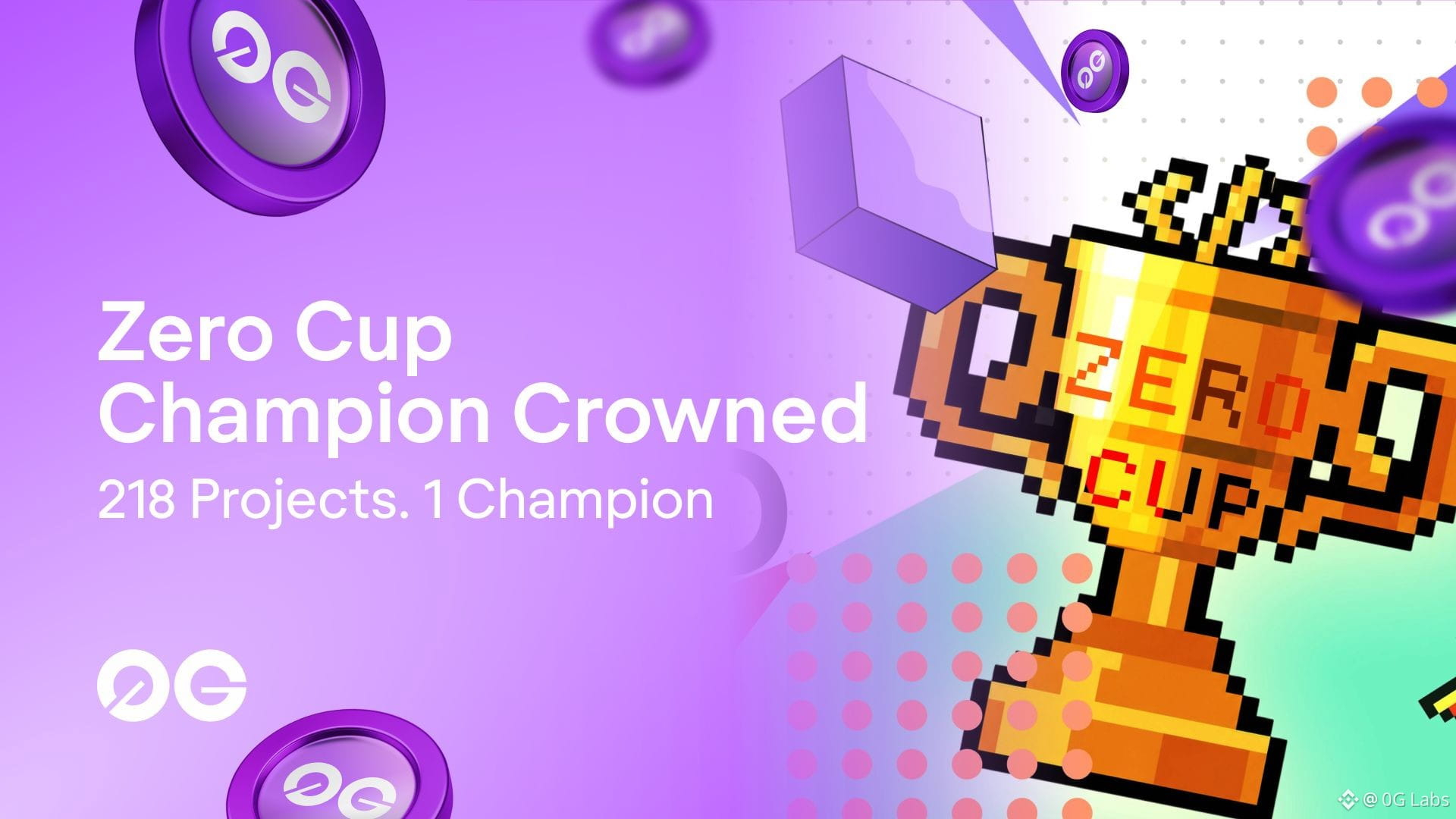
218 Projects Entered. 1 Champion 🏆
0G’s first-ever Zero Cup has its winner: 4lpha AI.
The final came down to 4lpha AI versus AskZero, with 4lpha taking the title 3971 to 2742. Across the matchup, 6,713 votes were cast.
Five weeks before the final, 218 projects entered the tournament. One made it through every round.
4lpha AI is an autonomous trading agent built on 0G.
Every trade is fenced by an onchain policy vault and proof-anchored on 0G Chain. The agent acts, while the user keeps the guardrails.
$ICP and $RENDER already sit inside the AI infrastructure conversation. 0G’s Zero Cup brings that conversation to the app layer: builders shipping agents people can test, compare, and vote on in public.
The winner is a live trading agent with policy-locked execution and proof-backed activity.
That is the part Zero Cup makes visible.
Agents on 0G are moving past pitch decks into products with rules, proofs, and users.
Congratulations to 4lpha AI, AskZero, and every builder who entered the first Zero Cup.
Try 4lpha AI: https://0g.4lpha.tech/agents
#0G #Aİ
218 Projects Entered. 1 Champion 🏆
0G’s first-ever Zero Cup has its winner: 4lpha AI.
The final came down to 4lpha AI versus AskZero, with 4lpha taking the title 3971 to 2742. Across the matchup, 6,713 votes were cast.
Five weeks before the final, 218 projects entered the tournament. One made it through every round.
4lpha AI is an autonomous trading agent built on 0G.
Every trade is fenced by an onchain policy vault and proof-anchored on 0G Chain. The agent acts, while the user keeps the guardrails.
$ICP and $RENDER already sit inside the AI infrastructure conversation. 0G’s Zero Cup brings that conversation to the app layer: builders shipping agents people can test, compare, and vote on in public.
The winner is a live trading agent with policy-locked execution and proof-backed activity.
That is the part Zero Cup makes visible.
Agents on 0G are moving past pitch decks into products with rules, proofs, and users.
Congratulations to 4lpha AI, AskZero, and every builder who entered the first Zero Cup.
Try 4lpha AI: https://0g.4lpha.tech/agents
#0G #Aİ
0G’s first-ever Zero Cup has its winner: 4lpha AI.
The final came down to 4lpha AI versus AskZero, with 4lpha taking the title 3971 to 2742. Across the matchup, 6,713 votes were cast.
Five weeks before the final, 218 projects entered the tournament. One made it through every round.
4lpha AI is an autonomous trading agent built on 0G.
Every trade is fenced by an onchain policy vault and proof-anchored on 0G Chain. The agent acts, while the user keeps the guardrails.
$ICP and $RENDER already sit inside the AI infrastructure conversation. 0G’s Zero Cup brings that conversation to the app layer: builders shipping agents people can test, compare, and vote on in public.
The winner is a live trading agent with policy-locked execution and proof-backed activity.
That is the part Zero Cup makes visible.
Agents on 0G are moving past pitch decks into products with rules, proofs, and users.
Congratulations to 4lpha AI, AskZero, and every builder who entered the first Zero Cup.
Try 4lpha AI: https://0g.4lpha.tech/agents
#0G #Aİ
1
5
7.8k
·
--
Haussier
Vérifié
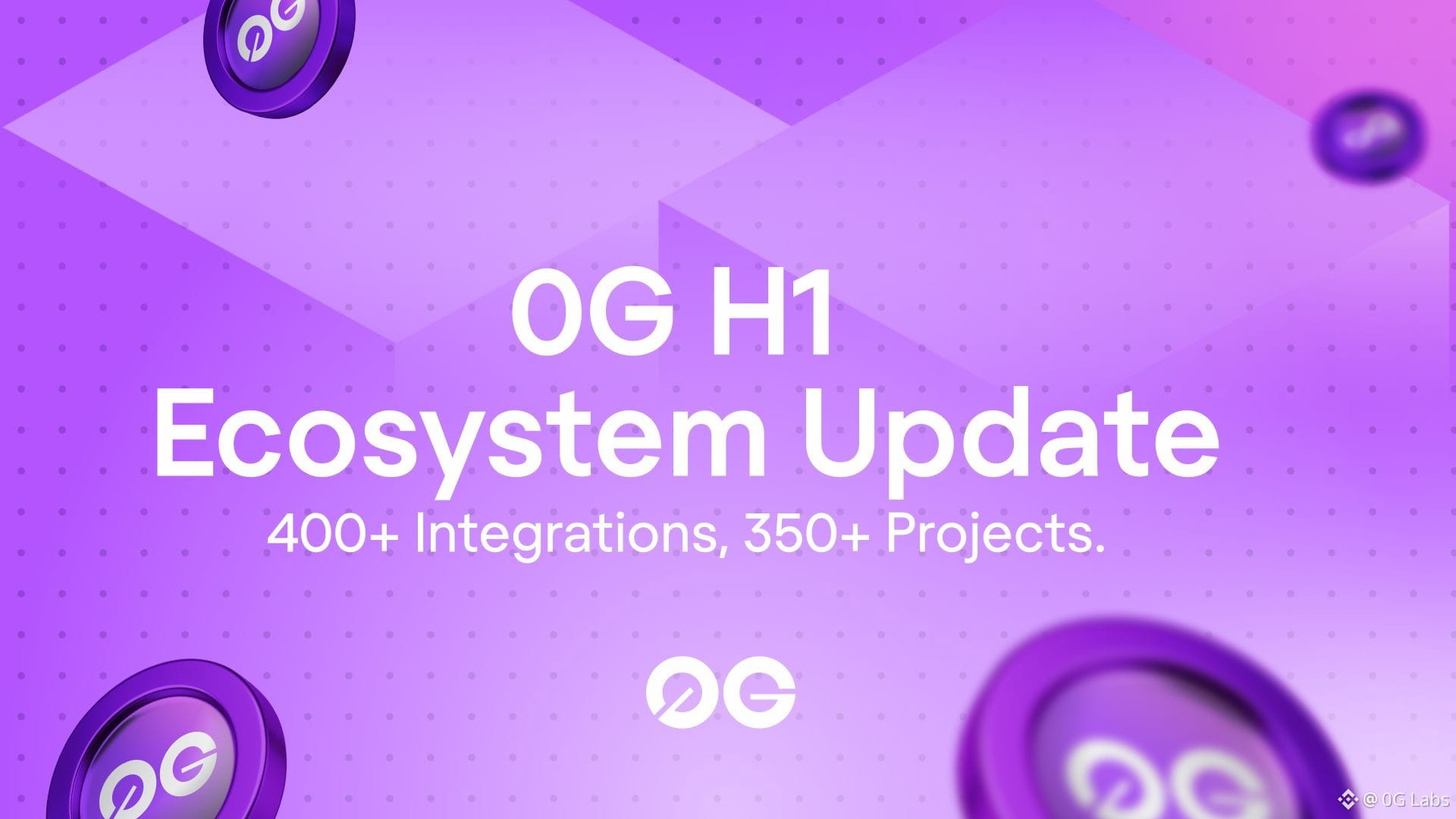
400+ Integrations. 350+ Projects ✨
0G’s H1 2026 ecosystem update gives the clearest read yet on where the largest AI Layer 1 is being used.
AI is now the leading and fastest-growing vertical on 0G.
$SUI and $AVAX sit in the builder-chain conversation, where the real signal is what developers actually ship. 0G’s H1 data puts that signal in numbers: 400+ integrations across 350+ projects.
The integration count is higher than the project count because teams are building across more than one layer. A single project can store training data, run inference, and settle agent actions on the same stack.
That is the stack showing up in the data.
0G Chain has 200+ integrations for settlement and coordination. 0G Storage has 90+ integrations for AI data, datasets, model checkpoints, and agent memory. 0G Compute has 60+ integrations for verifiable AI inference inside Trusted Execution Environments.
The projects shipping on 0G include autonomous agents, frontier models, verifiable media-safety tools, AI-native exchanges, private personal AI, and DeFAI products.
The deepest pool is AI agents.
Not chatbot wrappers. Agents with identity, memory, and the ability to act onchain.
That is the H1 story.
0G is becoming the place where verifiable AI gets built.
#0G #Aİ
400+ Integrations. 350+ Projects ✨
0G’s H1 2026 ecosystem update gives the clearest read yet on where the largest AI Layer 1 is being used.
AI is now the leading and fastest-growing vertical on 0G.
$SUI and $AVAX sit in the builder-chain conversation, where the real signal is what developers actually ship. 0G’s H1 data puts that signal in numbers: 400+ integrations across 350+ projects.
The integration count is higher than the project count because teams are building across more than one layer. A single project can store training data, run inference, and settle agent actions on the same stack.
That is the stack showing up in the data.
0G Chain has 200+ integrations for settlement and coordination. 0G Storage has 90+ integrations for AI data, datasets, model checkpoints, and agent memory. 0G Compute has 60+ integrations for verifiable AI inference inside Trusted Execution Environments.
The projects shipping on 0G include autonomous agents, frontier models, verifiable media-safety tools, AI-native exchanges, private personal AI, and DeFAI products.
The deepest pool is AI agents.
Not chatbot wrappers. Agents with identity, memory, and the ability to act onchain.
That is the H1 story.
0G is becoming the place where verifiable AI gets built.
#0G #Aİ
0G’s H1 2026 ecosystem update gives the clearest read yet on where the largest AI Layer 1 is being used.
AI is now the leading and fastest-growing vertical on 0G.
$SUI and $AVAX sit in the builder-chain conversation, where the real signal is what developers actually ship. 0G’s H1 data puts that signal in numbers: 400+ integrations across 350+ projects.
The integration count is higher than the project count because teams are building across more than one layer. A single project can store training data, run inference, and settle agent actions on the same stack.
That is the stack showing up in the data.
0G Chain has 200+ integrations for settlement and coordination. 0G Storage has 90+ integrations for AI data, datasets, model checkpoints, and agent memory. 0G Compute has 60+ integrations for verifiable AI inference inside Trusted Execution Environments.
The projects shipping on 0G include autonomous agents, frontier models, verifiable media-safety tools, AI-native exchanges, private personal AI, and DeFAI products.
The deepest pool is AI agents.
Not chatbot wrappers. Agents with identity, memory, and the ability to act onchain.
That is the H1 story.
0G is becoming the place where verifiable AI gets built.
#0G #Aİ
8
3
7.9k
·
--
Haussier
Partiellement vrai
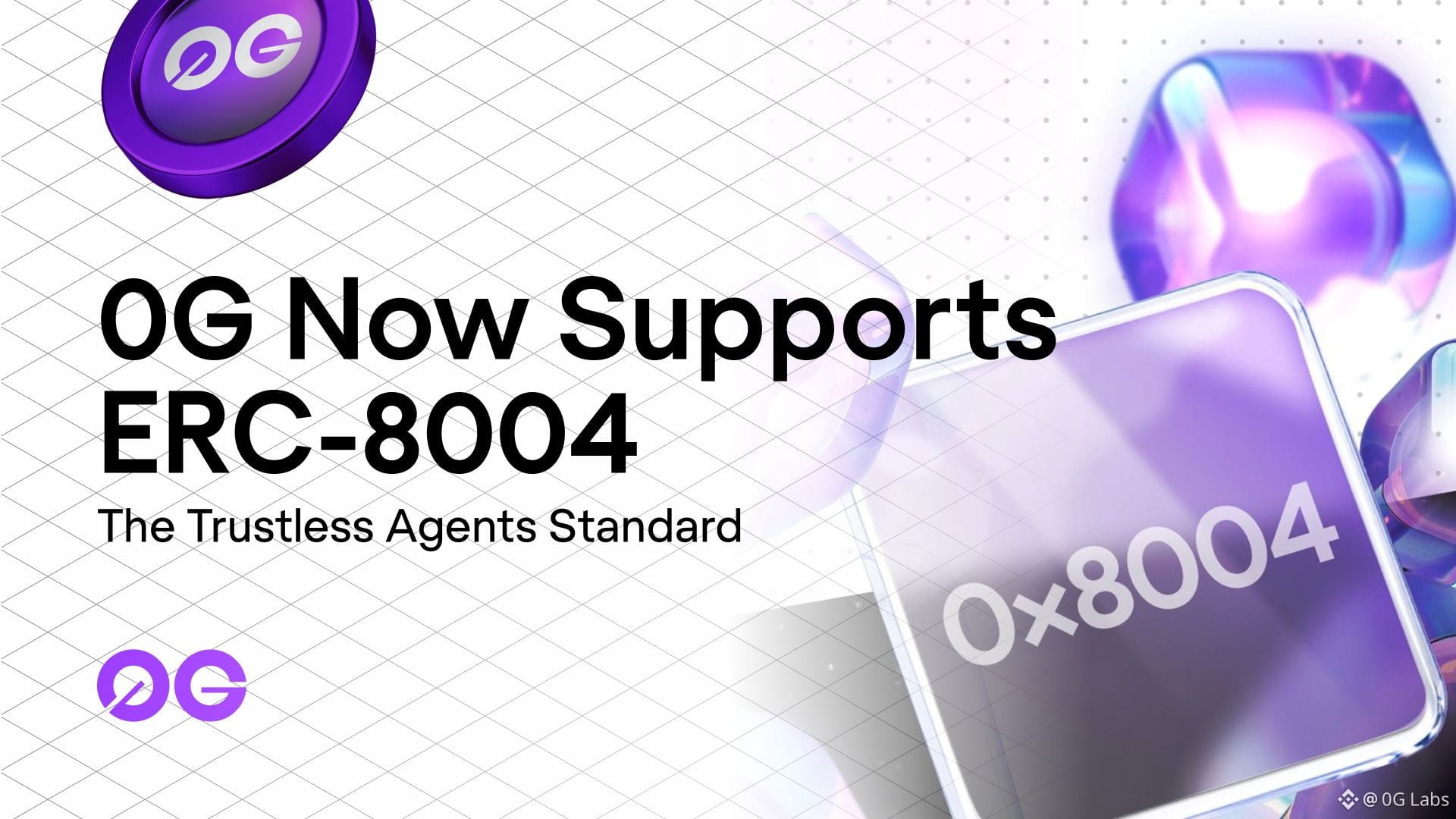
2 ERC-8004 Registries Are Live On 0G 🧠
Agents are multiplying across chains and platforms. They still need a shared way to find each other, verify each other, and carry reputation beyond one platform.
$SUI and $NEAR sit in the same builder-infrastructure lane. 0G’s update is specifically about agents: giving them portable identity and reputation through ERC-8004.
ERC-8004, titled Trustless Agents, is an Ethereum standards-track proposal for agent identity, reputation, and validation. On 0G, the IdentityRegistry and ReputationRegistry are now live on mainnet and Galileo testnet.
The deployment was merged into the official ERC-8004 contracts repo on June 11, 2026, through PR 83.
This is not a fork or a custom variant.
0G runs the same production ERC-8004 contracts as other ERC-8004 networks, at the standard’s canonical 0x8004 addresses.
An agent registered on 0G gets a portable identifier and browsable profile that ERC-8004-aware tools, explorers, marketplaces, and agents can resolve.
Feedback posted to the ReputationRegistry follows the standard interface, so an agent’s track record can be read onchain or off.
Portable identity and reputation are the precondition for agents that transact across platforms.
Start building at docs.0g.ai.
#0G #Aİ
2 ERC-8004 Registries Are Live On 0G 🧠
Agents are multiplying across chains and platforms. They still need a shared way to find each other, verify each other, and carry reputation beyond one platform.
$SUI and $NEAR sit in the same builder-infrastructure lane. 0G’s update is specifically about agents: giving them portable identity and reputation through ERC-8004.
ERC-8004, titled Trustless Agents, is an Ethereum standards-track proposal for agent identity, reputation, and validation. On 0G, the IdentityRegistry and ReputationRegistry are now live on mainnet and Galileo testnet.
The deployment was merged into the official ERC-8004 contracts repo on June 11, 2026, through PR 83.
This is not a fork or a custom variant.
0G runs the same production ERC-8004 contracts as other ERC-8004 networks, at the standard’s canonical 0x8004 addresses.
An agent registered on 0G gets a portable identifier and browsable profile that ERC-8004-aware tools, explorers, marketplaces, and agents can resolve.
Feedback posted to the ReputationRegistry follows the standard interface, so an agent’s track record can be read onchain or off.
Portable identity and reputation are the precondition for agents that transact across platforms.
Start building at docs.0g.ai.
#0G #Aİ
Agents are multiplying across chains and platforms. They still need a shared way to find each other, verify each other, and carry reputation beyond one platform.
$SUI and $NEAR sit in the same builder-infrastructure lane. 0G’s update is specifically about agents: giving them portable identity and reputation through ERC-8004.
ERC-8004, titled Trustless Agents, is an Ethereum standards-track proposal for agent identity, reputation, and validation. On 0G, the IdentityRegistry and ReputationRegistry are now live on mainnet and Galileo testnet.
The deployment was merged into the official ERC-8004 contracts repo on June 11, 2026, through PR 83.
This is not a fork or a custom variant.
0G runs the same production ERC-8004 contracts as other ERC-8004 networks, at the standard’s canonical 0x8004 addresses.
An agent registered on 0G gets a portable identifier and browsable profile that ERC-8004-aware tools, explorers, marketplaces, and agents can resolve.
Feedback posted to the ReputationRegistry follows the standard interface, so an agent’s track record can be read onchain or off.
Portable identity and reputation are the precondition for agents that transact across platforms.
Start building at docs.0g.ai.
#0G #Aİ
2
5
8k
Connectez-vous pour découvrir plus de contenu
Rejoignez la communauté mondiale des adeptes de cryptomonnaies sur Binance Square
⚡️ Suviez les dernières informations importantes sur les cryptomonnaies.
💬 Jugé digne de confiance par la plus grande plateforme d’échange de cryptomonnaies au monde.
👍 Découvrez les connaissances que partagent les créateurs vérifiés.
Adresse e-mail/Nº de téléphone
Sujets d’actualité
KoreaProposesTokenizingStocksAndBonds
8,683 vues
203 mentions
#koreaproposestokenizingstocksandbonds 🇰🇷 South Korea Proposes Roadmap to Tokenize Stocks and Bonds by 2027
Traditional finance is meeting blockchain at a national level. South Korea has unveiled a comprehensive regulatory framework to bring traditional securities on-chain.
📌 Core News:
• The FSC announced a 3-phase plan to expand tokenized securities to include stocks, bonds, and investment funds.
• The legal framework is officially set to take effect on February 4, 2027.
• Phase 1 focuses on private funds, corporate bonds, and unlisted equities before expanding to public markets.
• For investor protection, retail participants face an annual net purchase limit of 100 million KRW (~$74K) per OTC platform.
📊 Market Impact:
• RWA Validation: This provides regulatory clarity for the Real-World Asset (RWA) narrative, proving institutional appetite for efficient on-chain settlement.
• Infrastructure Growth: Expect accelerated development in compliant blockchain infrastructure, digital custody, and identity verification solutions.
• Stablecoin Utility: Phase 3 explicitly mentions integrating on-chain payment systems, which could significantly boost the real-world utility of regulated stablecoins.
💬 Join the Discussion:
Do you think tokenized traditional securities will be the main catalyst for the next wave of institutional crypto adoption? Let’s discuss below! 👇
#RWA #Tokenization #SouthKorea #CryptoRegulation #Blockchain This is for educational purposes only. Not Financial Advice (NFA). Always Do Your Own Research (DYOR).
$NOM $MOVR $NIGHT
珍妮丝 kgf
·1 mentions J’aime
·157 vues
MetaMaskExitsLidoValidatorsAfterSecurityIncident
73,483 vues
944 mentions
MicronBeatsEarningsLiftsGuidance
43,671 vues
718 mentions