

#quickfarm
quickfarm
64,829 vues
168 mentions
Populaire
Récents

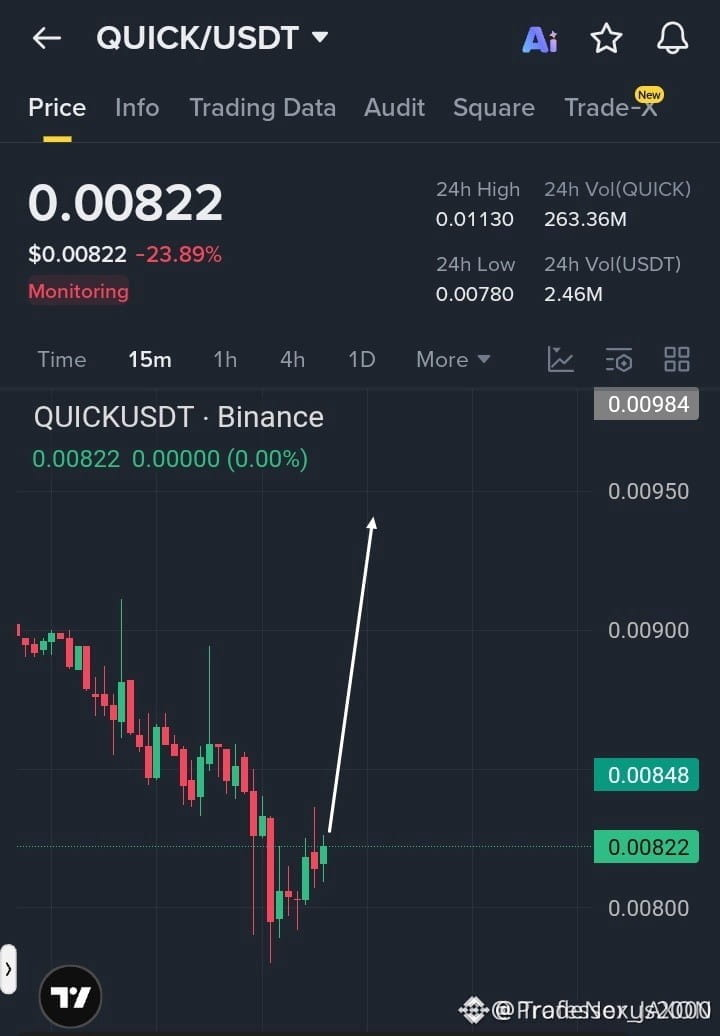
$QUICK REVERSAL SETUP NEAR SUPPORT ⚡
Entry: 0.00810 - 0.00825 🎯
Target: 0.00848 / 0.00890 / 0.00984 ✅
Stop Loss: 0.00775 🛡️
$QUICK is attempting a short-term recovery after defending the 0.00800 area, with higher lows on lower timeframes pointing to improving buyer control. If price holds the entry band, the path toward nearby resistance levels remains open, though liquidity can stay thin and volatility elevated. This looks like a momentum rebound setup rather than confirmation of a broader trend shift.
Not financial advice. Manage your risk.
#quickfarm #CryptoTrading #Altcoins #TechnicalAnalysis
•
{spot}(QUICKUSDT)
$QUICK REVERSAL SETUP NEAR SUPPORT ⚡
Entry: 0.00810 - 0.00825 🎯
Target: 0.00848 / 0.00890 / 0.00984 ✅
Stop Loss: 0.00775 🛡️
$QUICK is attempting a short-term recovery after defending the 0.00800 area, with higher lows on lower timeframes pointing to improving buyer control. If price holds the entry band, the path toward nearby resistance levels remains open, though liquidity can stay thin and volatility elevated. This looks like a momentum rebound setup rather than confirmation of a broader trend shift.
Not financial advice. Manage your risk.
#quickfarm #CryptoTrading #Altcoins #TechnicalAnalysis
•
Entry: 0.00810 - 0.00825 🎯
Target: 0.00848 / 0.00890 / 0.00984 ✅
Stop Loss: 0.00775 🛡️
$QUICK is attempting a short-term recovery after defending the 0.00800 area, with higher lows on lower timeframes pointing to improving buyer control. If price holds the entry band, the path toward nearby resistance levels remains open, though liquidity can stay thin and volatility elevated. This looks like a momentum rebound setup rather than confirmation of a broader trend shift.
Not financial advice. Manage your risk.
#quickfarm #CryptoTrading #Altcoins #TechnicalAnalysis
•
47

·
--
$QNT 🚨🔥 QNT تنفجر اليوم! +95% تقريباً… ماذا يحدث؟
عملة Quant $QNT تتصدر المشهد حالياً، والسعر يدور حول $298 بعد ارتفاع يقارب +95% خلال 24 ساعة، مع حجم تداول ضخم يتجاوز $1.2 مليار.
📊 الأرقام الآن: 💰 السعر: ~$298 🚀 24 ساعة: +95.16% 💵 حجم التداول: ~$1.2B 🏦 القيمة السوقية: ~$3.6B
⚠️ لكن انتبه: بعد حركة تقترب من +100%، مطاردة السعر قد تكون عالية المخاطر.
🎯 مناطق المراقبة: 🔴 $300 — حاجز نفسي مهم 🔴 $320 — منطقة مقاومة محتملة 🟢 $280 — دعم أول للمراقبة 🟢 $260 — دعم أعمق
🚀 إذا حافظ QNT على الزخم واستقر فوق $300، قد تستمر المضاربات. 📉 أما فقدان الزخم فقد يؤدي إلى جني أرباح سريع.
🔥 السؤال: هل QNT تستطيع تجاوز $320 أم أن التصحيح أصبح أقرب؟
👇 اكتب توقعك: 🚀 استمرار الصعود 📉 تصحيح
⚠️ تحليل تعليمي وليس توصية مالية.
#QNT #quickfarm uant #BitcoinDunyamiz nanceSquare #Crypto_Jobs🎯 rypto #FedProposesPaymentStablecoinRules
{spot}(QNTUSDT)
نوفل_كريبتو
$QNT 🚨🔥 QNT تنفجر اليوم! +95% تقريباً… ماذا يحدث؟
عملة Quant $QNT تتصدر المشهد حالياً، والسعر يدور حول $298 بعد ارتفاع يقارب +95% خلال 24 ساعة، مع حجم تداول ضخم يتجاوز $1.2 مليار.
📊 الأرقام الآن: 💰 السعر: ~$298 🚀 24 ساعة: +95.16% 💵 حجم التداول: ~$1.2B 🏦 القيمة السوقية: ~$3.6B
⚠️ لكن انتبه: بعد حركة تقترب من +100%، مطاردة السعر قد تكون عالية المخاطر.
🎯 مناطق المراقبة: 🔴 $300 — حاجز نفسي مهم 🔴 $320 — منطقة مقاومة محتملة 🟢 $280 — دعم أول للمراقبة 🟢 $260 — دعم أعمق
🚀 إذا حافظ QNT على الزخم واستقر فوق $300، قد تستمر المضاربات. 📉 أما فقدان الزخم فقد يؤدي إلى جني أرباح سريع.
🔥 السؤال: هل QNT تستطيع تجاوز $320 أم أن التصحيح أصبح أقرب؟
👇 اكتب توقعك: 🚀 استمرار الصعود 📉 تصحيح
⚠️ تحليل تعليمي وليس توصية مالية.
#QNT #quickfarm uant #BitcoinDunyamiz nanceSquare #Crypto_Jobs🎯 rypto #FedProposesPaymentStablecoinRules
نوفل_كريبتو
عملة Quant $QNT تتصدر المشهد حالياً، والسعر يدور حول $298 بعد ارتفاع يقارب +95% خلال 24 ساعة، مع حجم تداول ضخم يتجاوز $1.2 مليار.
📊 الأرقام الآن: 💰 السعر: ~$298 🚀 24 ساعة: +95.16% 💵 حجم التداول: ~$1.2B 🏦 القيمة السوقية: ~$3.6B
⚠️ لكن انتبه: بعد حركة تقترب من +100%، مطاردة السعر قد تكون عالية المخاطر.
🎯 مناطق المراقبة: 🔴 $300 — حاجز نفسي مهم 🔴 $320 — منطقة مقاومة محتملة 🟢 $280 — دعم أول للمراقبة 🟢 $260 — دعم أعمق
🚀 إذا حافظ QNT على الزخم واستقر فوق $300، قد تستمر المضاربات. 📉 أما فقدان الزخم فقد يؤدي إلى جني أرباح سريع.
🔥 السؤال: هل QNT تستطيع تجاوز $320 أم أن التصحيح أصبح أقرب؟
👇 اكتب توقعك: 🚀 استمرار الصعود 📉 تصحيح
⚠️ تحليل تعليمي وليس توصية مالية.
#QNT #quickfarm uant #BitcoinDunyamiz nanceSquare #Crypto_Jobs🎯 rypto #FedProposesPaymentStablecoinRules
نوفل_كريبتو
1
187

·
--
Haussier
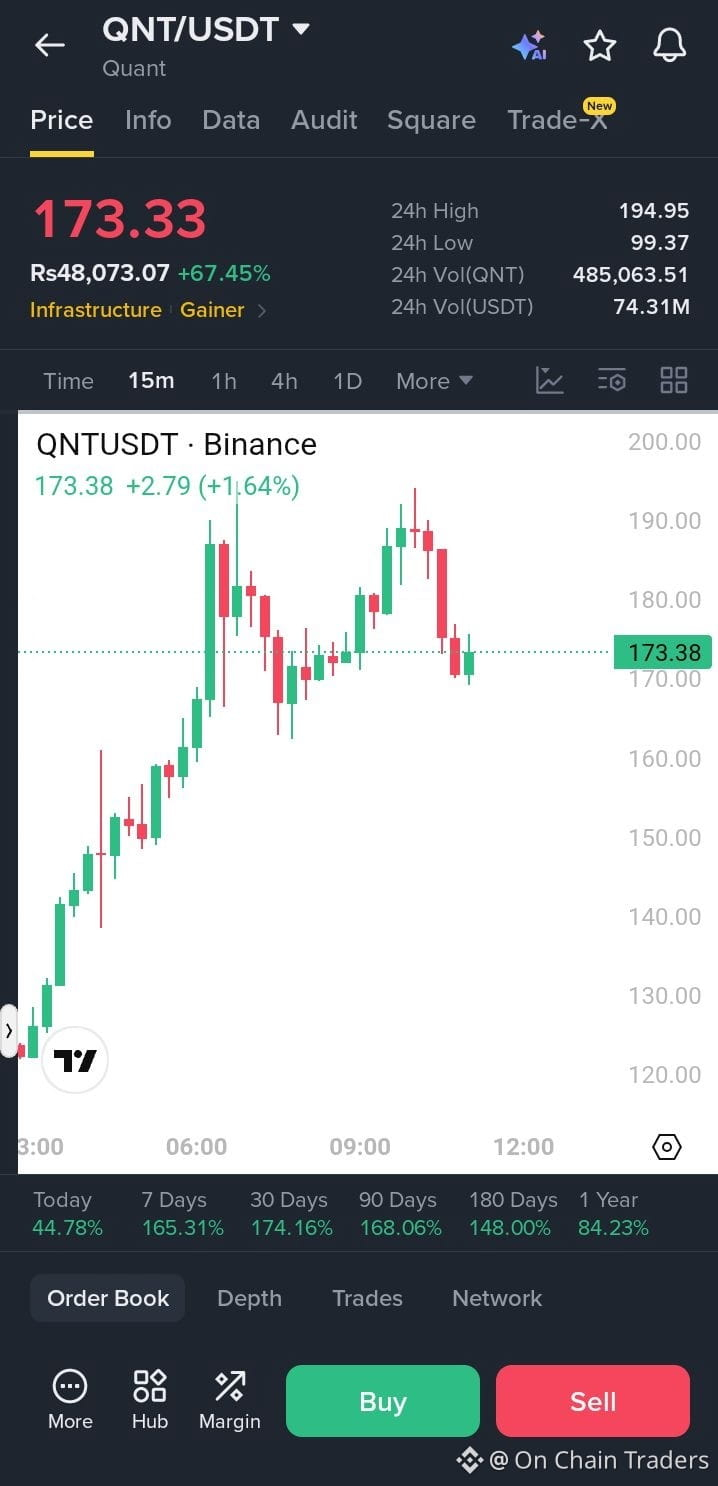
$NVDAB QNT is holding strong after a major breakout, with $170 acting as key support.
Entry: $168–$173
TP1: $180 | TP2: $190 | TP3: $200
SL: $160
Bullish above $170; a clean break above $195 could extend the next upside move.
#quickfarm
{spot}(NVDABUSDT)
#BinanceSquareTalks #BinanceSquareTalks #CryptoWatchMay2024
$NVDAB QNT is holding strong after a major breakout, with $170 acting as key support.
Entry: $168–$173
TP1: $180 | TP2: $190 | TP3: $200
SL: $160
Bullish above $170; a clean break above $195 could extend the next upside move.
#quickfarm
#BinanceSquareTalks #BinanceSquareTalks #CryptoWatchMay2024
Entry: $168–$173
TP1: $180 | TP2: $190 | TP3: $200
SL: $160
Bullish above $170; a clean break above $195 could extend the next upside move.
#quickfarm
#BinanceSquareTalks #BinanceSquareTalks #CryptoWatchMay2024
102

📈 $XRP is trading around $1.42 as the market watches today’s U.S. crypto-regulation developments.
🔥 With volatility elevated, do you think XRP can reclaim $1.50+ next?
🚀 $POWER has been moving aggressively, with trading activity surging and price momentum catching attention.
🚀 $AIN is attracting attention as traders watch its current momentum and volume.
📊 Do you think AIN can push higher from here, or is a pullback more likely?
#altcoins #xrp #power #quickfarm #Market_Update
{spot}(XRPUSDT)
{alpha}(560x9dc44ae5be187eca9e2a67e33f27a4c91cea1223)
{stock_us}(AIN.US)
📈 $XRP is trading around $1.42 as the market watches today’s U.S. crypto-regulation developments.
🔥 With volatility elevated, do you think XRP can reclaim $1.50+ next?
🚀 $POWER has been moving aggressively, with trading activity surging and price momentum catching attention.
🚀 $AIN is attracting attention as traders watch its current momentum and volume.
📊 Do you think AIN can push higher from here, or is a pullback more likely?
#altcoins #xrp #power #quickfarm #Market_Update
🔥 With volatility elevated, do you think XRP can reclaim $1.50+ next?
🚀 $POWER has been moving aggressively, with trading activity surging and price momentum catching attention.
🚀 $AIN is attracting attention as traders watch its current momentum and volume.
📊 Do you think AIN can push higher from here, or is a pullback more likely?
#altcoins #xrp #power #quickfarm #Market_Update
💰 XRP — $1.42
0%
💰 POWER — ~$0.19
0%
💰 AIN — $0.01054
0%
0 Votes • Vote fermé
115
·
--
Haussier
{spot}(NVDABUSDT)
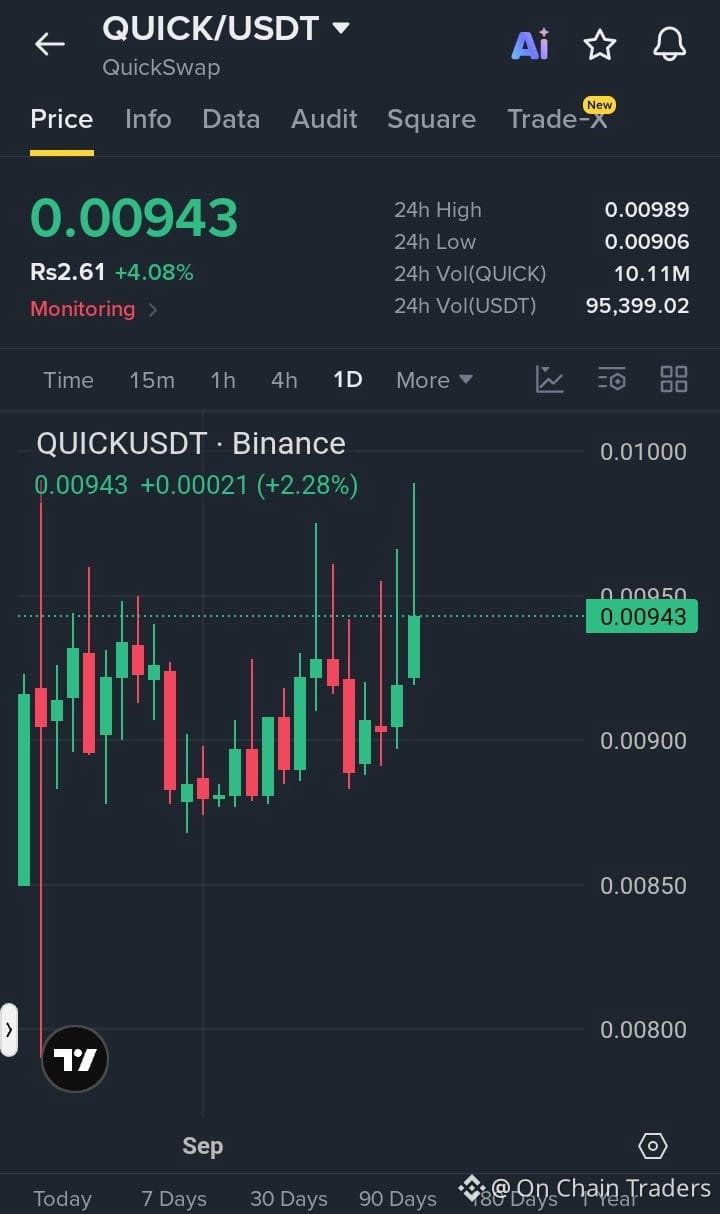
$NVDAB QUICK | Bullish Breakout Watch
Holding $0.00940 with a higher-low structure.
Pattern: Ascending base; breakout above $0.00990 could accelerate.
Entry: $0.00930–$0.00950
TP1 $0.00990 | TP2 $0.01030 | TP3 $0.01080
SL: $0.00905 | Bullish above $0.00930, bearish below support.
#QuickCryptoGiveaway #quickfarm #cryptotradingpro #CryptoTradingPrediction
$NVDAB QUICK | Bullish Breakout Watch
Holding $0.00940 with a higher-low structure.
Pattern: Ascending base; breakout above $0.00990 could accelerate.
Entry: $0.00930–$0.00950
TP1 $0.00990 | TP2 $0.01030 | TP3 $0.01080
SL: $0.00905 | Bullish above $0.00930, bearish below support.
#QuickCryptoGiveaway #quickfarm #cryptotradingpro #CryptoTradingPrediction
Holding $0.00940 with a higher-low structure.
Pattern: Ascending base; breakout above $0.00990 could accelerate.
Entry: $0.00930–$0.00950
TP1 $0.00990 | TP2 $0.01030 | TP3 $0.01080
SL: $0.00905 | Bullish above $0.00930, bearish below support.
#QuickCryptoGiveaway #quickfarm #cryptotradingpro #CryptoTradingPrediction
1
42

Adapt or Fail: Why TradFi Must Treat Stablecoins as Infrastructure, Not CompetitionThe early years of the decentralized finance (DeFi) boom were defined by a wild west approach to interoperability. As the blockchain ecosystem fractured into dozens of competing networks, the industry rushed to build “bridges”—digital conduits designed to move value across these isolated islands.
While these third-party bridges addressed a genuine market need, they arrived with severe architectural flaws. According to Przemek Kowalczyk, co-founder and CEO of Ramp Network, the problem wasn’t the intention behind these tools, but the inherent risk in their design.
Traditional third-party bridges typically operate on a “lock-and-mint” mechanism. To move an asset from Ethereum to Solana, for example, a user locks their original tokens in a smart contract on the source chain. The bridge then mints a wrapped or synthetic representation of that asset on the destination chain.
This architecture creates a massive honeypot for hackers. Because security often depends on a small set of validators or a narrow coordination layer, the attack surface is expansive. If the central vault holding the original assets is compromised, the wrapped tokens on the other side become effectively worthless. This fragility has led to billions of dollars in losses through high-profile exploits over the past several years.
The industry is now undergoing a fundamental shift away from these traditional structures. In their place, native swap-based approaches are becoming the standard for cross-chain interoperability. Unlike bridges that rely on synthetic representations, native swaps allow users to exchange assets across chains directly. Liquidity is sourced across multiple networks, and the transaction settles into the destination asset itself.
That removes several of the trust assumptions that made many early bridges fragile,” Kowalczyk explains. By settling directly into the native asset of the destination network, the need for “wrapped” tokens—and the centralized risks associated with them—is eliminated.
As the underlying rails of DeFi become more robust through native swaps, the way users interact with those rails is also changing. The rise of artificial intelligence (AI) agents is shifting DeFi from a manual environment to an automated one.
Kowalczyk notes that agent frameworks like Openclaw are moving from experimental tools into broader integration. This transition signals a shift from theory to infrastructure, where execution becomes continuous and data-driven.
Agents can monitor liquidity, rebalance positions, adjust collateral, and route swaps without human input,” Kowalczyk says. For experienced participants, this represents a significant efficiency gain; for new users, it lowers the barrier to entry by handling the technical “heavy lifting” in the background.
This evolution is colliding with traditional finance (TradFi), particularly through the rapid adoption of stablecoins. For legacy companies that generated revenue from slow, expensive cross-border payments, stablecoins represent a paradigm shift.
Kowalczyk argues that the institutions that thrive will be those that stop viewing stablecoins as competition and start viewing them as infrastructure. Stablecoins compress settlement times and run 24/7, bypassing the traditional delays of correspondent banking.
Once someone experiences value moving at any hour and clearing in minutes, slower alternatives feel broken,” Kowalczyk observes.
While USD-pegged stablecoins currently dominate the market—reflecting the dollar’s role in global trade and reserves—the landscape is diversifying. Kowalczyk suggests that global competition with the dollar is not necessarily the right framework for other currencies.
#quickfarm
#FactCheck
#BinanceHerYerde
#HalvingUpdate
#HotTrends
Adapt or Fail: Why TradFi Must Treat Stablecoins as Infrastructure, Not Competition
The early years of the decentralized finance (DeFi) boom were defined by a wild west approach to interoperability. As the blockchain ecosystem fractured into dozens of competing networks, the industry rushed to build “bridges”—digital conduits designed to move value across these isolated islands.
While these third-party bridges addressed a genuine market need, they arrived with severe architectural flaws. According to Przemek Kowalczyk, co-founder and CEO of Ramp Network, the problem wasn’t the intention behind these tools, but the inherent risk in their design.
Traditional third-party bridges typically operate on a “lock-and-mint” mechanism. To move an asset from Ethereum to Solana, for example, a user locks their original tokens in a smart contract on the source chain. The bridge then mints a wrapped or synthetic representation of that asset on the destination chain.
This architecture creates a massive honeypot for hackers. Because security often depends on a small set of validators or a narrow coordination layer, the attack surface is expansive. If the central vault holding the original assets is compromised, the wrapped tokens on the other side become effectively worthless. This fragility has led to billions of dollars in losses through high-profile exploits over the past several years.
The industry is now undergoing a fundamental shift away from these traditional structures. In their place, native swap-based approaches are becoming the standard for cross-chain interoperability. Unlike bridges that rely on synthetic representations, native swaps allow users to exchange assets across chains directly. Liquidity is sourced across multiple networks, and the transaction settles into the destination asset itself.
That removes several of the trust assumptions that made many early bridges fragile,” Kowalczyk explains. By settling directly into the native asset of the destination network, the need for “wrapped” tokens—and the centralized risks associated with them—is eliminated.
As the underlying rails of DeFi become more robust through native swaps, the way users interact with those rails is also changing. The rise of artificial intelligence (AI) agents is shifting DeFi from a manual environment to an automated one.
Kowalczyk notes that agent frameworks like Openclaw are moving from experimental tools into broader integration. This transition signals a shift from theory to infrastructure, where execution becomes continuous and data-driven.
Agents can monitor liquidity, rebalance positions, adjust collateral, and route swaps without human input,” Kowalczyk says. For experienced participants, this represents a significant efficiency gain; for new users, it lowers the barrier to entry by handling the technical “heavy lifting” in the background.
This evolution is colliding with traditional finance (TradFi), particularly through the rapid adoption of stablecoins. For legacy companies that generated revenue from slow, expensive cross-border payments, stablecoins represent a paradigm shift.
Kowalczyk argues that the institutions that thrive will be those that stop viewing stablecoins as competition and start viewing them as infrastructure. Stablecoins compress settlement times and run 24/7, bypassing the traditional delays of correspondent banking.
Once someone experiences value moving at any hour and clearing in minutes, slower alternatives feel broken,” Kowalczyk observes.
While USD-pegged stablecoins currently dominate the market—reflecting the dollar’s role in global trade and reserves—the landscape is diversifying. Kowalczyk suggests that global competition with the dollar is not necessarily the right framework for other currencies.
#quickfarm
#FactCheck
#BinanceHerYerde
#HalvingUpdate
#HotTrends
While these third-party bridges addressed a genuine market need, they arrived with severe architectural flaws. According to Przemek Kowalczyk, co-founder and CEO of Ramp Network, the problem wasn’t the intention behind these tools, but the inherent risk in their design.
Traditional third-party bridges typically operate on a “lock-and-mint” mechanism. To move an asset from Ethereum to Solana, for example, a user locks their original tokens in a smart contract on the source chain. The bridge then mints a wrapped or synthetic representation of that asset on the destination chain.
This architecture creates a massive honeypot for hackers. Because security often depends on a small set of validators or a narrow coordination layer, the attack surface is expansive. If the central vault holding the original assets is compromised, the wrapped tokens on the other side become effectively worthless. This fragility has led to billions of dollars in losses through high-profile exploits over the past several years.
The industry is now undergoing a fundamental shift away from these traditional structures. In their place, native swap-based approaches are becoming the standard for cross-chain interoperability. Unlike bridges that rely on synthetic representations, native swaps allow users to exchange assets across chains directly. Liquidity is sourced across multiple networks, and the transaction settles into the destination asset itself.
That removes several of the trust assumptions that made many early bridges fragile,” Kowalczyk explains. By settling directly into the native asset of the destination network, the need for “wrapped” tokens—and the centralized risks associated with them—is eliminated.
As the underlying rails of DeFi become more robust through native swaps, the way users interact with those rails is also changing. The rise of artificial intelligence (AI) agents is shifting DeFi from a manual environment to an automated one.
Kowalczyk notes that agent frameworks like Openclaw are moving from experimental tools into broader integration. This transition signals a shift from theory to infrastructure, where execution becomes continuous and data-driven.
Agents can monitor liquidity, rebalance positions, adjust collateral, and route swaps without human input,” Kowalczyk says. For experienced participants, this represents a significant efficiency gain; for new users, it lowers the barrier to entry by handling the technical “heavy lifting” in the background.
This evolution is colliding with traditional finance (TradFi), particularly through the rapid adoption of stablecoins. For legacy companies that generated revenue from slow, expensive cross-border payments, stablecoins represent a paradigm shift.
Kowalczyk argues that the institutions that thrive will be those that stop viewing stablecoins as competition and start viewing them as infrastructure. Stablecoins compress settlement times and run 24/7, bypassing the traditional delays of correspondent banking.
Once someone experiences value moving at any hour and clearing in minutes, slower alternatives feel broken,” Kowalczyk observes.
While USD-pegged stablecoins currently dominate the market—reflecting the dollar’s role in global trade and reserves—the landscape is diversifying. Kowalczyk suggests that global competition with the dollar is not necessarily the right framework for other currencies.
#quickfarm
#FactCheck
#BinanceHerYerde
#HalvingUpdate
#HotTrends
88
Major US Indexes Gain Monday as Iran Ceasefire Talks Ease Market FearsThe Dow Jones Industrial Average climbed 137 points, or 0.3%, while the S&P 500 gained 0.4% and the Nasdaq Composite added 0.5%. The S&P 500 extended its fourth consecutive day of gains but remains roughly 4% below levels seen before the U.S.-Iran conflict escalated.
Mediators from Egypt, Pakistan and Turkey floated truce proposals over the weekend, including a 45-day ceasefire framework and a plan to reopen the Strait of Hormuz. Conflicting reports say Iran signaled willingness to negotiate access through the waterway, which handles about one-fifth of global oil and liquefied natural gas trade. Other reports note ceasefire talks have been rejected.
Trump called Iran “an active, willing participant” in talks but said its counterproposal fell short. He repeated threats Monday that the U.S. could strike Iranian infrastructure and warned the country could be taken out “in one night” if the strait remained closed past his deadline
West Texas Intermediate crude settled near $103 a barrel and Brent crude near $109. Oil prices swung through the session before closing with modest gains as traders weighed supply disruption risks against any prospect of de-escalation
Technology and consumer staples led sector gains. Ciena Corp., Lumentum, Seagate Technology and Netflix all posted advances. Utilities including CMS Energy and Entergy touched new 52-week highs. Energy shares moved higher on ongoing supply disruption concerns. Consumer discretionary lagged, and Keurig Dr Pepper hit a 52-week low.
The CBOE Volatility Index held above 24, signaling that traders were not ready to fully price out downside risk.
The Institute for Supply Management’s services PMI for March fell to 54.0 from 56.1 in February, missing the economist consensus of 55.4. The prices-paid index climbed to 70.7, its highest reading since October 2022. The employment component dropped to 45.2, its weakest level since December 2023.
No Federal Reserve news and other high-impact data were on the calendar to start the week. The focus remained squarely on the Middle East. At the same time, JPMorgan Chase CEO Jamie Dimon warned of broader inflation risks tied to the conflict.
Other analysts pointed to strong hiring numbers from the March jobs report and productivity gains from the technology sector as potential offsets. Investors will watch Trump‘s Tuesday deadline closely. Any escalation that keeps oil prices at current levels could complicate the Federal Reserve’s rate path ahead of Friday’s March consumer price index report.
The Federal Open Market Committee (FOMC) releases minutes from its March meeting Wednesday. Delta Air Lines and Constellation Brands are among companies scheduled to report earnings later in the week, marking an early test of how corporate America is absorbing higher energy costs.
Markets remain reactive rather than conviction-driven. Until the Strait of Hormuz situation resolves or inflation data shifts expectations, the near-term direction hinges on factors outside corporate fundamentals.
#Robertkiyosaki
#EconomicAlert
#quickfarm
#Liquidations
#HODLStrategy
Major US Indexes Gain Monday as Iran Ceasefire Talks Ease Market Fears
The Dow Jones Industrial Average climbed 137 points, or 0.3%, while the S&P 500 gained 0.4% and the Nasdaq Composite added 0.5%. The S&P 500 extended its fourth consecutive day of gains but remains roughly 4% below levels seen before the U.S.-Iran conflict escalated.
Mediators from Egypt, Pakistan and Turkey floated truce proposals over the weekend, including a 45-day ceasefire framework and a plan to reopen the Strait of Hormuz. Conflicting reports say Iran signaled willingness to negotiate access through the waterway, which handles about one-fifth of global oil and liquefied natural gas trade. Other reports note ceasefire talks have been rejected.
Trump called Iran “an active, willing participant” in talks but said its counterproposal fell short. He repeated threats Monday that the U.S. could strike Iranian infrastructure and warned the country could be taken out “in one night” if the strait remained closed past his deadline
West Texas Intermediate crude settled near $103 a barrel and Brent crude near $109. Oil prices swung through the session before closing with modest gains as traders weighed supply disruption risks against any prospect of de-escalation
Technology and consumer staples led sector gains. Ciena Corp., Lumentum, Seagate Technology and Netflix all posted advances. Utilities including CMS Energy and Entergy touched new 52-week highs. Energy shares moved higher on ongoing supply disruption concerns. Consumer discretionary lagged, and Keurig Dr Pepper hit a 52-week low.
The CBOE Volatility Index held above 24, signaling that traders were not ready to fully price out downside risk.
The Institute for Supply Management’s services PMI for March fell to 54.0 from 56.1 in February, missing the economist consensus of 55.4. The prices-paid index climbed to 70.7, its highest reading since October 2022. The employment component dropped to 45.2, its weakest level since December 2023.
No Federal Reserve news and other high-impact data were on the calendar to start the week. The focus remained squarely on the Middle East. At the same time, JPMorgan Chase CEO Jamie Dimon warned of broader inflation risks tied to the conflict.
Other analysts pointed to strong hiring numbers from the March jobs report and productivity gains from the technology sector as potential offsets. Investors will watch Trump‘s Tuesday deadline closely. Any escalation that keeps oil prices at current levels could complicate the Federal Reserve’s rate path ahead of Friday’s March consumer price index report.
The Federal Open Market Committee (FOMC) releases minutes from its March meeting Wednesday. Delta Air Lines and Constellation Brands are among companies scheduled to report earnings later in the week, marking an early test of how corporate America is absorbing higher energy costs.
Markets remain reactive rather than conviction-driven. Until the Strait of Hormuz situation resolves or inflation data shifts expectations, the near-term direction hinges on factors outside corporate fundamentals.
#Robertkiyosaki
#EconomicAlert
#quickfarm
#Liquidations
#HODLStrategy
Mediators from Egypt, Pakistan and Turkey floated truce proposals over the weekend, including a 45-day ceasefire framework and a plan to reopen the Strait of Hormuz. Conflicting reports say Iran signaled willingness to negotiate access through the waterway, which handles about one-fifth of global oil and liquefied natural gas trade. Other reports note ceasefire talks have been rejected.
Trump called Iran “an active, willing participant” in talks but said its counterproposal fell short. He repeated threats Monday that the U.S. could strike Iranian infrastructure and warned the country could be taken out “in one night” if the strait remained closed past his deadline
West Texas Intermediate crude settled near $103 a barrel and Brent crude near $109. Oil prices swung through the session before closing with modest gains as traders weighed supply disruption risks against any prospect of de-escalation
Technology and consumer staples led sector gains. Ciena Corp., Lumentum, Seagate Technology and Netflix all posted advances. Utilities including CMS Energy and Entergy touched new 52-week highs. Energy shares moved higher on ongoing supply disruption concerns. Consumer discretionary lagged, and Keurig Dr Pepper hit a 52-week low.
The CBOE Volatility Index held above 24, signaling that traders were not ready to fully price out downside risk.
The Institute for Supply Management’s services PMI for March fell to 54.0 from 56.1 in February, missing the economist consensus of 55.4. The prices-paid index climbed to 70.7, its highest reading since October 2022. The employment component dropped to 45.2, its weakest level since December 2023.
No Federal Reserve news and other high-impact data were on the calendar to start the week. The focus remained squarely on the Middle East. At the same time, JPMorgan Chase CEO Jamie Dimon warned of broader inflation risks tied to the conflict.
Other analysts pointed to strong hiring numbers from the March jobs report and productivity gains from the technology sector as potential offsets. Investors will watch Trump‘s Tuesday deadline closely. Any escalation that keeps oil prices at current levels could complicate the Federal Reserve’s rate path ahead of Friday’s March consumer price index report.
The Federal Open Market Committee (FOMC) releases minutes from its March meeting Wednesday. Delta Air Lines and Constellation Brands are among companies scheduled to report earnings later in the week, marking an early test of how corporate America is absorbing higher energy costs.
Markets remain reactive rather than conviction-driven. Until the Strait of Hormuz situation resolves or inflation data shifts expectations, the near-term direction hinges on factors outside corporate fundamentals.
#Robertkiyosaki
#EconomicAlert
#quickfarm
#Liquidations
#HODLStrategy
1
119

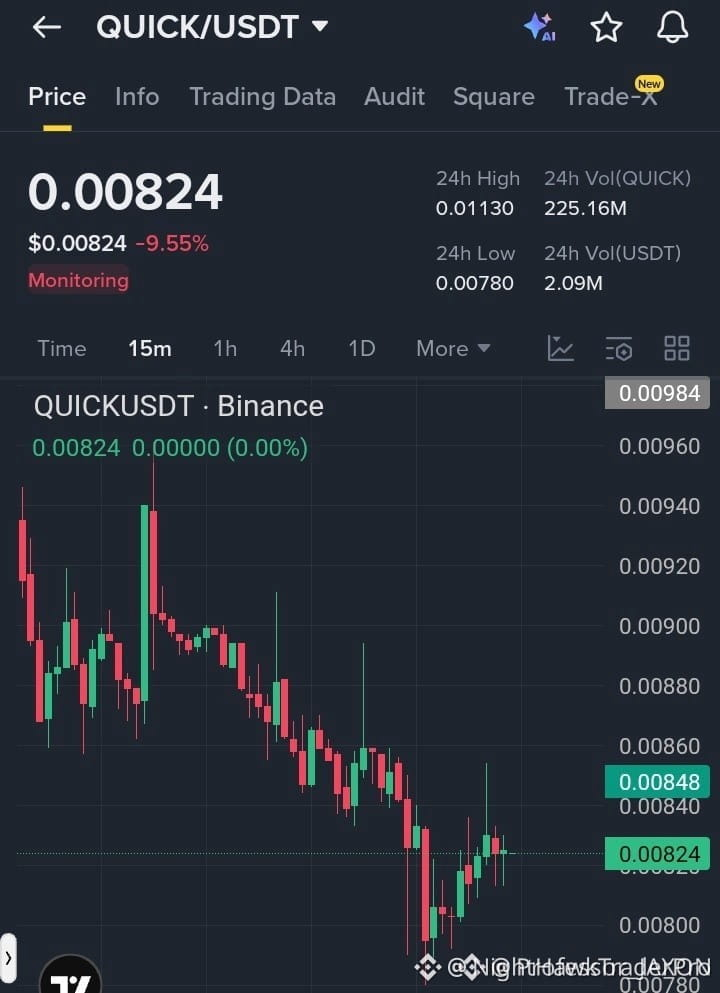
$QUICK SHORT PRESSURE IS STILL LIVE 🚨
Entry: 0.00822 – 0.00835 🔥
Target: 0.00805 / 0.00790 / 0.00775 🚀
Stop Loss: 0.00858 🛑
Bears are still driving the tape. Price failed to reclaim key resistance, and sellers remain in control. If momentum continues, downside levels stay in play. Move with discipline, not emotion.
Not financial advice. Manage your risk.
#Crypto #Trading #Altcoins #BinanceSquar #quickfarm
⚡
{spot}(QUICKUSDT)
$QUICK SHORT PRESSURE IS STILL LIVE 🚨
Entry: 0.00822 – 0.00835 🔥
Target: 0.00805 / 0.00790 / 0.00775 🚀
Stop Loss: 0.00858 🛑
Bears are still driving the tape. Price failed to reclaim key resistance, and sellers remain in control. If momentum continues, downside levels stay in play. Move with discipline, not emotion.
Not financial advice. Manage your risk.
#Crypto #Trading #Altcoins #BinanceSquar #quickfarm
⚡
Entry: 0.00822 – 0.00835 🔥
Target: 0.00805 / 0.00790 / 0.00775 🚀
Stop Loss: 0.00858 🛑
Bears are still driving the tape. Price failed to reclaim key resistance, and sellers remain in control. If momentum continues, downside levels stay in play. Move with discipline, not emotion.
Not financial advice. Manage your risk.
#Crypto #Trading #Altcoins #BinanceSquar #quickfarm
⚡
47
FII Institute names Princess Maha Al Saud as new CEOThe Board of Trustees of the Future Investment Initiative (FII) Institute has appointed Princess Dr. Maha bint Mishari bin Abdulaziz as the institute's new chief executive officer, succeeding founding CEO Richard Attias.
Princess Dr. Maha brings extensive leadership experience across healthcare, higher education, research, institutional development and international engagement.
Most recently, she served as Vice President of External Relations and Advancement at Alfaisal University, where she played a key role in strengthening the university's global partnerships and reputation.
In her new role, Princess Dr. Maha will lead the next phase of growth for the FII Institute, advancing its mission of bringing together investors, innovators, policymakers and business leaders to address global challenges through investment and collaboration
Yasir Al-Rumayyan, chairman of the FII Institute Board of Trustees and governor of the Public Investment Fund (PIF), said Princess Dr. Maha's leadership, vision and international perspective would help strengthen the institute's position as a global platform for investment, ideas and solutions.
He said she would work closely with Richard Attias, who will continue as chairman of the Executive Committee, as the institute expands its global impact.
"The Institute has become a globally recognized platform for dialogue, innovation and investment," she said. "I look forward to working with the Board of Trustees, the Executive Committee, our partners and our talented team to further advance our mission and create meaningful impact for future generations."
She is scheduled to deliver the opening remarks on the second day of the FII PRIORITY Europe Summit in Rome on June 19.
#quickfarm
#Write2Earn
#ETHETFsApproved
#Robertkiyosaki
#YapayzekaAI
FII Institute names Princess Maha Al Saud as new CEO
The Board of Trustees of the Future Investment Initiative (FII) Institute has appointed Princess Dr. Maha bint Mishari bin Abdulaziz as the institute's new chief executive officer, succeeding founding CEO Richard Attias.
Princess Dr. Maha brings extensive leadership experience across healthcare, higher education, research, institutional development and international engagement.
Most recently, she served as Vice President of External Relations and Advancement at Alfaisal University, where she played a key role in strengthening the university's global partnerships and reputation.
In her new role, Princess Dr. Maha will lead the next phase of growth for the FII Institute, advancing its mission of bringing together investors, innovators, policymakers and business leaders to address global challenges through investment and collaboration
Yasir Al-Rumayyan, chairman of the FII Institute Board of Trustees and governor of the Public Investment Fund (PIF), said Princess Dr. Maha's leadership, vision and international perspective would help strengthen the institute's position as a global platform for investment, ideas and solutions.
He said she would work closely with Richard Attias, who will continue as chairman of the Executive Committee, as the institute expands its global impact.
"The Institute has become a globally recognized platform for dialogue, innovation and investment," she said. "I look forward to working with the Board of Trustees, the Executive Committee, our partners and our talented team to further advance our mission and create meaningful impact for future generations."
She is scheduled to deliver the opening remarks on the second day of the FII PRIORITY Europe Summit in Rome on June 19.
#quickfarm
#Write2Earn
#ETHETFsApproved
#Robertkiyosaki
#YapayzekaAI
Princess Dr. Maha brings extensive leadership experience across healthcare, higher education, research, institutional development and international engagement.
Most recently, she served as Vice President of External Relations and Advancement at Alfaisal University, where she played a key role in strengthening the university's global partnerships and reputation.
In her new role, Princess Dr. Maha will lead the next phase of growth for the FII Institute, advancing its mission of bringing together investors, innovators, policymakers and business leaders to address global challenges through investment and collaboration
Yasir Al-Rumayyan, chairman of the FII Institute Board of Trustees and governor of the Public Investment Fund (PIF), said Princess Dr. Maha's leadership, vision and international perspective would help strengthen the institute's position as a global platform for investment, ideas and solutions.
He said she would work closely with Richard Attias, who will continue as chairman of the Executive Committee, as the institute expands its global impact.
"The Institute has become a globally recognized platform for dialogue, innovation and investment," she said. "I look forward to working with the Board of Trustees, the Executive Committee, our partners and our talented team to further advance our mission and create meaningful impact for future generations."
She is scheduled to deliver the opening remarks on the second day of the FII PRIORITY Europe Summit in Rome on June 19.
#quickfarm
#Write2Earn
#ETHETFsApproved
#Robertkiyosaki
#YapayzekaAI
92
Why a frustrated Trump is turning again to bombs to force Iran’s handThe Trump administration is making a new bid to prove a core assumption the Iran war so far suggests is flawed: that punishing strikes from a far superior US military force will force Tehran to capitulate.
President Donald Trump ordered new attacks on multiple Iranian targets on Wednesday, hours after accusing the Islamic Republic of “tapping us along” and not making a deal. “They keep playing us for suckers,” he said.
Defense Secretary Pete Hegseth explained that Washington was “clearly signaling” to Iran’s leaders and hoped to “enhance” its diplomatic position. “If we need to negotiate with bombs, we will negotiate with bombs,” he said.
The full extent of the target list and damage from the new air strikes was not immediately clear. US Central Command said in a statement that American forces fired precision munitions at Iranian military surveillance capabilities, communication systems and air defense assets.
Analysts will assess in coming days whether the attacks, some in southern Iran and apparently meant to loosen Tehran’s grip on the Strait of Hormuz, will narrow Iran’s options and shift its negotiating stance.
Sometimes in warfare, adjustments in strategy and strikes that reach a critical mass can change outcomes. But the risk is that this new offensive may simply prolong a pattern that has confounded Trump. While US forces repeatedly chalk up tactical wins, military options are yet to secure an overall strategic triumph.
Evidence of the last three months suggests that Washington only instills greater stubbornness among Iran’s leaders when it intensifies military pressure and reinforces a belief in Tehran that Trump can’t be trusted on any eventual deal.
No lasting agreement can be achieved through threats, intimidation or the use of force,” Iran’s ambassador to the United Nations Amir Saeid Iravani said Wednesday, according to Iran’s official Islamic Republic News Agency (IRNA).
If the new round of attacks doesn’t work, there’s sure to be a renewed focus on Trump’s return to coercion. One answer is his lifelong stance that each showdown has only a winner and a loser. His instinct that bringing down the hammer may force Iran to fold, meanwhile, is right out of the real estate magnate’s playbook — even if such an approach is yet to yield big wins for his diplomacy.
The president’s aggression infuses his administration’s worldview. “You can see when someone’s trying to tap, tap, tap on a deal,” Hegseth said. “Instead they’re going to have tap, tap, tap, bombs dropping on key facilities in Iran from the United States of America.
But if the new air strikes don’t force Tehran to concede, Trump will again be asked why he’s so wedded to an approach that keeps failing.
#quickfarm
#ETHETFS
#haroonahmadofficial
#JohnCarl
#btc70k
Why a frustrated Trump is turning again to bombs to force Iran’s hand
The Trump administration is making a new bid to prove a core assumption the Iran war so far suggests is flawed: that punishing strikes from a far superior US military force will force Tehran to capitulate.
President Donald Trump ordered new attacks on multiple Iranian targets on Wednesday, hours after accusing the Islamic Republic of “tapping us along” and not making a deal. “They keep playing us for suckers,” he said.
Defense Secretary Pete Hegseth explained that Washington was “clearly signaling” to Iran’s leaders and hoped to “enhance” its diplomatic position. “If we need to negotiate with bombs, we will negotiate with bombs,” he said.
The full extent of the target list and damage from the new air strikes was not immediately clear. US Central Command said in a statement that American forces fired precision munitions at Iranian military surveillance capabilities, communication systems and air defense assets.
Analysts will assess in coming days whether the attacks, some in southern Iran and apparently meant to loosen Tehran’s grip on the Strait of Hormuz, will narrow Iran’s options and shift its negotiating stance.
Sometimes in warfare, adjustments in strategy and strikes that reach a critical mass can change outcomes. But the risk is that this new offensive may simply prolong a pattern that has confounded Trump. While US forces repeatedly chalk up tactical wins, military options are yet to secure an overall strategic triumph.
Evidence of the last three months suggests that Washington only instills greater stubbornness among Iran’s leaders when it intensifies military pressure and reinforces a belief in Tehran that Trump can’t be trusted on any eventual deal.
No lasting agreement can be achieved through threats, intimidation or the use of force,” Iran’s ambassador to the United Nations Amir Saeid Iravani said Wednesday, according to Iran’s official Islamic Republic News Agency (IRNA).
If the new round of attacks doesn’t work, there’s sure to be a renewed focus on Trump’s return to coercion. One answer is his lifelong stance that each showdown has only a winner and a loser. His instinct that bringing down the hammer may force Iran to fold, meanwhile, is right out of the real estate magnate’s playbook — even if such an approach is yet to yield big wins for his diplomacy.
The president’s aggression infuses his administration’s worldview. “You can see when someone’s trying to tap, tap, tap on a deal,” Hegseth said. “Instead they’re going to have tap, tap, tap, bombs dropping on key facilities in Iran from the United States of America.
But if the new air strikes don’t force Tehran to concede, Trump will again be asked why he’s so wedded to an approach that keeps failing.
#quickfarm
#ETHETFS
#haroonahmadofficial
#JohnCarl
#btc70k
President Donald Trump ordered new attacks on multiple Iranian targets on Wednesday, hours after accusing the Islamic Republic of “tapping us along” and not making a deal. “They keep playing us for suckers,” he said.
Defense Secretary Pete Hegseth explained that Washington was “clearly signaling” to Iran’s leaders and hoped to “enhance” its diplomatic position. “If we need to negotiate with bombs, we will negotiate with bombs,” he said.
The full extent of the target list and damage from the new air strikes was not immediately clear. US Central Command said in a statement that American forces fired precision munitions at Iranian military surveillance capabilities, communication systems and air defense assets.
Analysts will assess in coming days whether the attacks, some in southern Iran and apparently meant to loosen Tehran’s grip on the Strait of Hormuz, will narrow Iran’s options and shift its negotiating stance.
Sometimes in warfare, adjustments in strategy and strikes that reach a critical mass can change outcomes. But the risk is that this new offensive may simply prolong a pattern that has confounded Trump. While US forces repeatedly chalk up tactical wins, military options are yet to secure an overall strategic triumph.
Evidence of the last three months suggests that Washington only instills greater stubbornness among Iran’s leaders when it intensifies military pressure and reinforces a belief in Tehran that Trump can’t be trusted on any eventual deal.
No lasting agreement can be achieved through threats, intimidation or the use of force,” Iran’s ambassador to the United Nations Amir Saeid Iravani said Wednesday, according to Iran’s official Islamic Republic News Agency (IRNA).
If the new round of attacks doesn’t work, there’s sure to be a renewed focus on Trump’s return to coercion. One answer is his lifelong stance that each showdown has only a winner and a loser. His instinct that bringing down the hammer may force Iran to fold, meanwhile, is right out of the real estate magnate’s playbook — even if such an approach is yet to yield big wins for his diplomacy.
The president’s aggression infuses his administration’s worldview. “You can see when someone’s trying to tap, tap, tap on a deal,” Hegseth said. “Instead they’re going to have tap, tap, tap, bombs dropping on key facilities in Iran from the United States of America.
But if the new air strikes don’t force Tehran to concede, Trump will again be asked why he’s so wedded to an approach that keeps failing.
#quickfarm
#ETHETFS
#haroonahmadofficial
#JohnCarl
#btc70k
394
Bitcoin ETFs are no bigger today than when Trump won the electionNet assets of U.S.-listed spot ETFs have fallen to levels last seen just after Trump won the election in early November 2024.
This is not to say the ETFs didn't grow in the 19-month period. Hopes that Trump would deliver on his campaign promise of friendlier crypto regulation helped push bitcoin higher, along with ETF assets. Total net assets crossed $90 billion within a week of this election win and went on to hit a record high of $169.54 billion in October 2025.
But since then, these post-election gains have been erased even though the Securities and Exchange Commission (SEC), under the Trump administration, dropped several high-profile enforcement actions. The U.S. has established a strategic bitcoin reserve and, further, the Digital Asset Market Clarity Act, which seeks to establish jurisdictional boundaries between the SEC and CFTC and give the industry the legal heft, is advancing in Washington.
In other words, the regulatory environment has never been more favorable, yet investors' response has been to leave, pulling the net assets lower.
These ETFs have registered a net outflow of over $5 billion in four weeks. Cumulative net inflows since inception, which peaked at $62.77 billion in October 2025 when bitcoin was at its all-time high, have since declined by nearly $9 billion to $53.77 billion, the lowest since August last year.
ETF outflows reflected short-term pressure as inflation drives the Fed hawkish, while on-chain supply tightening remains intact," Binance Research said in a report shared with CoinDesk.
Market analyst and former co-founder of 21Shares, Ophelia Snyder, said AI and other trending corners of the financial market are draining capital from crypto.
You have ETF outflows as investors are increasingly distracted by other narratives competing for attention and capital, whether that's AI, SpaceX, or other high-profile growth stories. You have ongoing market jitters around geopolitics, the Strait of Hormuz, U.S. jobs data, inflation, and broader macroeconomic uncertainty," she said in an email.
#quickfarm
#CPIWatch
#Fatihcoşar
#SniperStrategy
#CryptoPatience
Bitcoin ETFs are no bigger today than when Trump won the election
Net assets of U.S.-listed spot ETFs have fallen to levels last seen just after Trump won the election in early November 2024.
This is not to say the ETFs didn't grow in the 19-month period. Hopes that Trump would deliver on his campaign promise of friendlier crypto regulation helped push bitcoin higher, along with ETF assets. Total net assets crossed $90 billion within a week of this election win and went on to hit a record high of $169.54 billion in October 2025.
But since then, these post-election gains have been erased even though the Securities and Exchange Commission (SEC), under the Trump administration, dropped several high-profile enforcement actions. The U.S. has established a strategic bitcoin reserve and, further, the Digital Asset Market Clarity Act, which seeks to establish jurisdictional boundaries between the SEC and CFTC and give the industry the legal heft, is advancing in Washington.
In other words, the regulatory environment has never been more favorable, yet investors' response has been to leave, pulling the net assets lower.
These ETFs have registered a net outflow of over $5 billion in four weeks. Cumulative net inflows since inception, which peaked at $62.77 billion in October 2025 when bitcoin was at its all-time high, have since declined by nearly $9 billion to $53.77 billion, the lowest since August last year.
ETF outflows reflected short-term pressure as inflation drives the Fed hawkish, while on-chain supply tightening remains intact," Binance Research said in a report shared with CoinDesk.
Market analyst and former co-founder of 21Shares, Ophelia Snyder, said AI and other trending corners of the financial market are draining capital from crypto.
You have ETF outflows as investors are increasingly distracted by other narratives competing for attention and capital, whether that's AI, SpaceX, or other high-profile growth stories. You have ongoing market jitters around geopolitics, the Strait of Hormuz, U.S. jobs data, inflation, and broader macroeconomic uncertainty," she said in an email.
#quickfarm
#CPIWatch
#Fatihcoşar
#SniperStrategy
#CryptoPatience
This is not to say the ETFs didn't grow in the 19-month period. Hopes that Trump would deliver on his campaign promise of friendlier crypto regulation helped push bitcoin higher, along with ETF assets. Total net assets crossed $90 billion within a week of this election win and went on to hit a record high of $169.54 billion in October 2025.
But since then, these post-election gains have been erased even though the Securities and Exchange Commission (SEC), under the Trump administration, dropped several high-profile enforcement actions. The U.S. has established a strategic bitcoin reserve and, further, the Digital Asset Market Clarity Act, which seeks to establish jurisdictional boundaries between the SEC and CFTC and give the industry the legal heft, is advancing in Washington.
In other words, the regulatory environment has never been more favorable, yet investors' response has been to leave, pulling the net assets lower.
These ETFs have registered a net outflow of over $5 billion in four weeks. Cumulative net inflows since inception, which peaked at $62.77 billion in October 2025 when bitcoin was at its all-time high, have since declined by nearly $9 billion to $53.77 billion, the lowest since August last year.
ETF outflows reflected short-term pressure as inflation drives the Fed hawkish, while on-chain supply tightening remains intact," Binance Research said in a report shared with CoinDesk.
Market analyst and former co-founder of 21Shares, Ophelia Snyder, said AI and other trending corners of the financial market are draining capital from crypto.
You have ETF outflows as investors are increasingly distracted by other narratives competing for attention and capital, whether that's AI, SpaceX, or other high-profile growth stories. You have ongoing market jitters around geopolitics, the Strait of Hormuz, U.S. jobs data, inflation, and broader macroeconomic uncertainty," she said in an email.
#quickfarm
#CPIWatch
#Fatihcoşar
#SniperStrategy
#CryptoPatience
76
Article
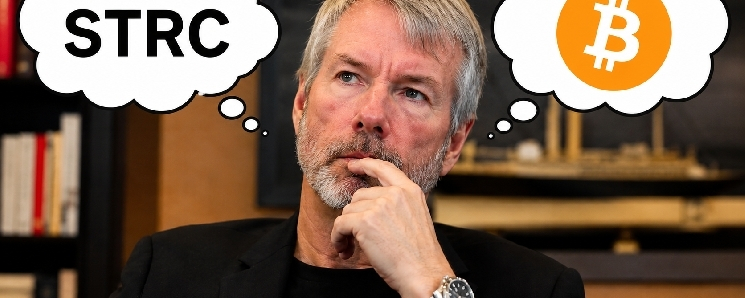
Ekhon premium kore deta geyto..but ame cera to tui pabi na aytai prblmQuick Maths On STRC Buybacks: The Truth About Net Bitcoin Per Share and Accretion
Strategy initiated open-market repurchases of STRC last week (July 20 through July 26, 2026), buying 288,930 shares for ~$25 million at an average price of $86.52. Notably, the company bought no Bitcoin and continued to grow its cash reserve.
Last week’s STRC buyback follows Strategy’s Digital Credit Capital Framework, announced on June 29 in response to the June volatility, which authorized up to $1 billion of repurchases across STRC, STRF, STRD, and STRK. Likely because STRC is now viewed as Strategy’s flagship product, STRC was identified as the initial priority for these buybacks.
Buyback logic starts with the position of MSTR common stock in the capital structure. Common equity owns the residual value after every senior claim has been satisfied. Strategy’s $BTC and cash are its liquid assets. Debt and preferred stock sit ahead of MSTR. Strategy’s USD Reserve (read: cash) offset part of those senior claims. The common stock therefore represents the value left after subtracting debt and preferred stock from the bitcoin reserve and adding back available cash.
This is effectively Strategy’s recently introduced “Net Bitcoin Per Share” metric. Strategy’s current methodology calculates Net $BTC by taking bitcoin holdings and subtracting the bitcoin-equivalent value of out-of-the-money convertible debt, other debt-like instruments, and outstanding perpetual preferred stock, then adding back the USD Reserve. Notice that this is exactly the same description as the prior paragraph!
Net $BTC is divided by fully diluted common shares to produce Net BPS. Strategy’s disclosures mark July 23 as the boundary for its revised mNAV methodology, which uses Net BPS as its denominator.
This metric gives MSTR investors a direct view of $BTC economically attributable to common equity after senior claims. Gross Bitcoin Per Share can rise when Strategy issues more preferred stock or debt to buy bitcoin. Net Bitcoin Per Share captures the liability created alongside that bitcoin purchase, answering the question of how much bitcoin remains for common shareholders after the more senior investors in the capital structure are paid.
Strategy retired $28.893 million of STRC stated amount for about $24.998 million based on the reported average price. The difference equals approximately $3.895 million, and this value accrues to MSTR.
(It’s worth mentioning that also related to this is STRC’s current 12% annualized dividend rate. Retiring $28.893 million of STRC stated amount also removes roughly $3.47 million of annual dividend requirements. Also consider that since STRC is still well below $100, the company likely will raise the dividend, meaning the actual annual dividend expense removed is likely higher.)
Net $BTC identifies the residual $BTC owned by the common stock by considering all the senior liabilities which sit ahead. The STRC buyback is a move of financial engineering to improve the Net $BTC per share metric of the company.
This post Quick Maths On STRC Buybacks: The Truth About Net Bitcoin Per Share and Accretion first appeared on Bitcoin Magazine and is written by Allard Peng.
#Write2Earn
#quickfarm
#gonnarich
#btc70k
#Notcoin
Ekhon premium kore deta geyto..but ame cera to tui pabi na aytai prblm
Quick Maths On STRC Buybacks: The Truth About Net Bitcoin Per Share and Accretion
Strategy initiated open-market repurchases of STRC last week (July 20 through July 26, 2026), buying 288,930 shares for ~$25 million at an average price of $86.52. Notably, the company bought no Bitcoin and continued to grow its cash reserve.
Last week’s STRC buyback follows Strategy’s Digital Credit Capital Framework, announced on June 29 in response to the June volatility, which authorized up to $1 billion of repurchases across STRC, STRF, STRD, and STRK. Likely because STRC is now viewed as Strategy’s flagship product, STRC was identified as the initial priority for these buybacks.
Buyback logic starts with the position of MSTR common stock in the capital structure. Common equity owns the residual value after every senior claim has been satisfied. Strategy’s $BTC and cash are its liquid assets. Debt and preferred stock sit ahead of MSTR. Strategy’s USD Reserve (read: cash) offset part of those senior claims. The common stock therefore represents the value left after subtracting debt and preferred stock from the bitcoin reserve and adding back available cash.
This is effectively Strategy’s recently introduced “Net Bitcoin Per Share” metric. Strategy’s current methodology calculates Net $BTC by taking bitcoin holdings and subtracting the bitcoin-equivalent value of out-of-the-money convertible debt, other debt-like instruments, and outstanding perpetual preferred stock, then adding back the USD Reserve. Notice that this is exactly the same description as the prior paragraph!
Net $BTC is divided by fully diluted common shares to produce Net BPS. Strategy’s disclosures mark July 23 as the boundary for its revised mNAV methodology, which uses Net BPS as its denominator.
This metric gives MSTR investors a direct view of $BTC economically attributable to common equity after senior claims. Gross Bitcoin Per Share can rise when Strategy issues more preferred stock or debt to buy bitcoin. Net Bitcoin Per Share captures the liability created alongside that bitcoin purchase, answering the question of how much bitcoin remains for common shareholders after the more senior investors in the capital structure are paid.
Strategy retired $28.893 million of STRC stated amount for about $24.998 million based on the reported average price. The difference equals approximately $3.895 million, and this value accrues to MSTR.
(It’s worth mentioning that also related to this is STRC’s current 12% annualized dividend rate. Retiring $28.893 million of STRC stated amount also removes roughly $3.47 million of annual dividend requirements. Also consider that since STRC is still well below $100, the company likely will raise the dividend, meaning the actual annual dividend expense removed is likely higher.)
Net $BTC identifies the residual $BTC owned by the common stock by considering all the senior liabilities which sit ahead. The STRC buyback is a move of financial engineering to improve the Net $BTC per share metric of the company.
This post Quick Maths On STRC Buybacks: The Truth About Net Bitcoin Per Share and Accretion first appeared on Bitcoin Magazine and is written by Allard Peng.
#Write2Earn
#quickfarm
#gonnarich
#btc70k
#Notcoin
Strategy initiated open-market repurchases of STRC last week (July 20 through July 26, 2026), buying 288,930 shares for ~$25 million at an average price of $86.52. Notably, the company bought no Bitcoin and continued to grow its cash reserve.
Last week’s STRC buyback follows Strategy’s Digital Credit Capital Framework, announced on June 29 in response to the June volatility, which authorized up to $1 billion of repurchases across STRC, STRF, STRD, and STRK. Likely because STRC is now viewed as Strategy’s flagship product, STRC was identified as the initial priority for these buybacks.
Buyback logic starts with the position of MSTR common stock in the capital structure. Common equity owns the residual value after every senior claim has been satisfied. Strategy’s $BTC and cash are its liquid assets. Debt and preferred stock sit ahead of MSTR. Strategy’s USD Reserve (read: cash) offset part of those senior claims. The common stock therefore represents the value left after subtracting debt and preferred stock from the bitcoin reserve and adding back available cash.
This is effectively Strategy’s recently introduced “Net Bitcoin Per Share” metric. Strategy’s current methodology calculates Net $BTC by taking bitcoin holdings and subtracting the bitcoin-equivalent value of out-of-the-money convertible debt, other debt-like instruments, and outstanding perpetual preferred stock, then adding back the USD Reserve. Notice that this is exactly the same description as the prior paragraph!
Net $BTC is divided by fully diluted common shares to produce Net BPS. Strategy’s disclosures mark July 23 as the boundary for its revised mNAV methodology, which uses Net BPS as its denominator.
This metric gives MSTR investors a direct view of $BTC economically attributable to common equity after senior claims. Gross Bitcoin Per Share can rise when Strategy issues more preferred stock or debt to buy bitcoin. Net Bitcoin Per Share captures the liability created alongside that bitcoin purchase, answering the question of how much bitcoin remains for common shareholders after the more senior investors in the capital structure are paid.
Strategy retired $28.893 million of STRC stated amount for about $24.998 million based on the reported average price. The difference equals approximately $3.895 million, and this value accrues to MSTR.
(It’s worth mentioning that also related to this is STRC’s current 12% annualized dividend rate. Retiring $28.893 million of STRC stated amount also removes roughly $3.47 million of annual dividend requirements. Also consider that since STRC is still well below $100, the company likely will raise the dividend, meaning the actual annual dividend expense removed is likely higher.)
Net $BTC identifies the residual $BTC owned by the common stock by considering all the senior liabilities which sit ahead. The STRC buyback is a move of financial engineering to improve the Net $BTC per share metric of the company.
This post Quick Maths On STRC Buybacks: The Truth About Net Bitcoin Per Share and Accretion first appeared on Bitcoin Magazine and is written by Allard Peng.
#Write2Earn
#quickfarm
#gonnarich
#btc70k
#Notcoin
71

·
--
🚀 $ACE
{spot}(ACEUSDT)
/USDT EXPLODES +81.43%! 🔥
💥 Current Price: $0.1319 📈 24H Gain: +81.43% 🎯 24H High: $0.1420 📉 24H Low: $0.0710 💰 24H Volume: 238.50M ACE | 26.84M USDT
⚡ Buyers are firmly in control as ACE continues printing higher highs. Price is trading above the MA(7), MA(25), and MA(99), confirming strong short-term bullish momentum.
👀 Key Levels: 🟢 Support: $0.1220 🎯 Resistance: $0.1420 🚀 A breakout above $0.1420 could trigger the next explosive leg up!
⚠️ After such a massive rally, expect volatility. Manage risk and avoid chasing green candles.
#Write2Earn! #EarnFreeCrypto2024 #quickfarm #solana #Notcoin👀🔥
$CTSI
{spot}(CTSIUSDT)
$ST
{alpha}(560x70be40667385500c5da7f108a022e21b606045dd)
🚀 $ACE
/USDT EXPLODES +81.43%! 🔥
💥 Current Price: $0.1319 📈 24H Gain: +81.43% 🎯 24H High: $0.1420 📉 24H Low: $0.0710 💰 24H Volume: 238.50M ACE | 26.84M USDT
⚡ Buyers are firmly in control as ACE continues printing higher highs. Price is trading above the MA(7), MA(25), and MA(99), confirming strong short-term bullish momentum.
👀 Key Levels: 🟢 Support: $0.1220 🎯 Resistance: $0.1420 🚀 A breakout above $0.1420 could trigger the next explosive leg up!
⚠️ After such a massive rally, expect volatility. Manage risk and avoid chasing green candles.
#Write2Earn! #EarnFreeCrypto2024 #quickfarm #solana #Notcoin👀🔥
$CTSI
$ST
/USDT EXPLODES +81.43%! 🔥
💥 Current Price: $0.1319 📈 24H Gain: +81.43% 🎯 24H High: $0.1420 📉 24H Low: $0.0710 💰 24H Volume: 238.50M ACE | 26.84M USDT
⚡ Buyers are firmly in control as ACE continues printing higher highs. Price is trading above the MA(7), MA(25), and MA(99), confirming strong short-term bullish momentum.
👀 Key Levels: 🟢 Support: $0.1220 🎯 Resistance: $0.1420 🚀 A breakout above $0.1420 could trigger the next explosive leg up!
⚠️ After such a massive rally, expect volatility. Manage risk and avoid chasing green candles.
#Write2Earn! #EarnFreeCrypto2024 #quickfarm #solana #Notcoin👀🔥
$CTSI
$ST
📈 $ACE Dominates the Gainers
0%
$ACE Takes Flight: Massive Ra
0%
$ACE Explodes +81% | Is $0.14
0%
🚀 $ACE Surges 81% — Bulls
100%
2 Votes • Vote fermé
3.6k
Ethereum price: inverted cup & handle points to a crash amid ETF outflowsEthereum ETH price stabilized a bit on Sunday, rising to $1,600 from the Saturday low of $1,512. It remains 34% from its highest point in May, and 67% below its all-time high. It has also formed an inverted cup-and-handle pattern, pointing to more downside.
The daily chart shows that the ETH price has sunk in the past few months. As a result, it has remained below the 50-day Exponential Moving Average (EMA). It has also dropped below the important support level at $1,763, its lowest point in February this year.
A closer look shows that it has formed a rounded top pattern, a common bearish continuation signs in technical analysis. This rounded top is part of the inverted cup-and-handle pattern, which often leads to more downside.
The ongoing rebound is happening after the coin formed a small doji candlestick pattern. A doji candle resembles a plus and is a common bullish reversal sign in technical analysis.
Therefore, the most likely scenario is where the coin rebounds and retests the key resistance level at $1,763. This is known as a break-and-retest pattern, and usually confirms the downward trend.
As such, these technicals suggest that the coin will drop further, potentially below the key support at $1,500. A drop below that level will point to more downside, potentially to $1,000.
Data shows that American investors are dumping their ETH coins. Spot Ethereum ETFs shed over $168 million in assets this month, after losing $540 million in the previous one. These funds now have had a cumulative net inflow of $11.2 billion, with the net assets being $8.4 billion.
Spot Ethereum ETF inflows have had substantial outflows in the past few weeks as investors have moved to the stock market, which has done well this year. Despite Friday’s weakness, data show that the stock market has soared by double digits.
Many investors have turned to the stock market because of the ongoing artificial intelligence and space boom ahead of key IPOs like SpaceX and OpenAI.
At the same time, there are concerns that the Ethereum network has weakened in the past few months. For example, the total value locked (TVL) in its ecosystem has dropped sharply in this period. It dropped to $40 billion, much lower than where it was a few months ago.
At the same time, there are concerns that its network fees has continued falling. Ethereum made $39 million in fees last quarter, much lower than what other popular projects like Hyperliquid and Iran faded. Ethereum has also lost share to Hyperliquid, which has become the breakout star in the crypto industry.
#quickfarm
#Write2Earn
#ETHETFsApproved
#Robert
#TrendingTopic
Ethereum price: inverted cup & handle points to a crash amid ETF outflows
Ethereum ETH price stabilized a bit on Sunday, rising to $1,600 from the Saturday low of $1,512. It remains 34% from its highest point in May, and 67% below its all-time high. It has also formed an inverted cup-and-handle pattern, pointing to more downside.
The daily chart shows that the ETH price has sunk in the past few months. As a result, it has remained below the 50-day Exponential Moving Average (EMA). It has also dropped below the important support level at $1,763, its lowest point in February this year.
A closer look shows that it has formed a rounded top pattern, a common bearish continuation signs in technical analysis. This rounded top is part of the inverted cup-and-handle pattern, which often leads to more downside.
The ongoing rebound is happening after the coin formed a small doji candlestick pattern. A doji candle resembles a plus and is a common bullish reversal sign in technical analysis.
Therefore, the most likely scenario is where the coin rebounds and retests the key resistance level at $1,763. This is known as a break-and-retest pattern, and usually confirms the downward trend.
As such, these technicals suggest that the coin will drop further, potentially below the key support at $1,500. A drop below that level will point to more downside, potentially to $1,000.
Data shows that American investors are dumping their ETH coins. Spot Ethereum ETFs shed over $168 million in assets this month, after losing $540 million in the previous one. These funds now have had a cumulative net inflow of $11.2 billion, with the net assets being $8.4 billion.
Spot Ethereum ETF inflows have had substantial outflows in the past few weeks as investors have moved to the stock market, which has done well this year. Despite Friday’s weakness, data show that the stock market has soared by double digits.
Many investors have turned to the stock market because of the ongoing artificial intelligence and space boom ahead of key IPOs like SpaceX and OpenAI.
At the same time, there are concerns that the Ethereum network has weakened in the past few months. For example, the total value locked (TVL) in its ecosystem has dropped sharply in this period. It dropped to $40 billion, much lower than where it was a few months ago.
At the same time, there are concerns that its network fees has continued falling. Ethereum made $39 million in fees last quarter, much lower than what other popular projects like Hyperliquid and Iran faded. Ethereum has also lost share to Hyperliquid, which has become the breakout star in the crypto industry.
#quickfarm
#Write2Earn
#ETHETFsApproved
#Robert
#TrendingTopic
The daily chart shows that the ETH price has sunk in the past few months. As a result, it has remained below the 50-day Exponential Moving Average (EMA). It has also dropped below the important support level at $1,763, its lowest point in February this year.
A closer look shows that it has formed a rounded top pattern, a common bearish continuation signs in technical analysis. This rounded top is part of the inverted cup-and-handle pattern, which often leads to more downside.
The ongoing rebound is happening after the coin formed a small doji candlestick pattern. A doji candle resembles a plus and is a common bullish reversal sign in technical analysis.
Therefore, the most likely scenario is where the coin rebounds and retests the key resistance level at $1,763. This is known as a break-and-retest pattern, and usually confirms the downward trend.
As such, these technicals suggest that the coin will drop further, potentially below the key support at $1,500. A drop below that level will point to more downside, potentially to $1,000.
Data shows that American investors are dumping their ETH coins. Spot Ethereum ETFs shed over $168 million in assets this month, after losing $540 million in the previous one. These funds now have had a cumulative net inflow of $11.2 billion, with the net assets being $8.4 billion.
Spot Ethereum ETF inflows have had substantial outflows in the past few weeks as investors have moved to the stock market, which has done well this year. Despite Friday’s weakness, data show that the stock market has soared by double digits.
Many investors have turned to the stock market because of the ongoing artificial intelligence and space boom ahead of key IPOs like SpaceX and OpenAI.
At the same time, there are concerns that the Ethereum network has weakened in the past few months. For example, the total value locked (TVL) in its ecosystem has dropped sharply in this period. It dropped to $40 billion, much lower than where it was a few months ago.
At the same time, there are concerns that its network fees has continued falling. Ethereum made $39 million in fees last quarter, much lower than what other popular projects like Hyperliquid and Iran faded. Ethereum has also lost share to Hyperliquid, which has become the breakout star in the crypto industry.
#quickfarm
#Write2Earn
#ETHETFsApproved
#Robert
#TrendingTopic
84
Article
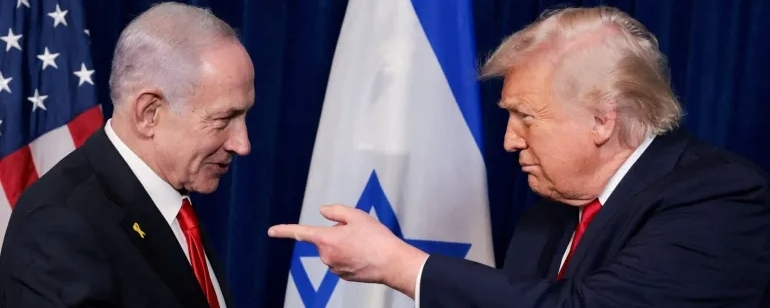
As Lebanon tests US-Iran deal, Trump must rein in Netanyahu, analysts sayIt is not another anonymously sourced report about a rift between the United States and Israel. This time, the administration of President Donald Trump appears genuinely frustrated with Prime Minister Benjamin Netanyahu’s war in Lebanon.
The opening of the memorandum of understanding (MoU) between the US and Iran calls for the “permanent termination of military operations on all fronts, including in Lebanon”, but the Israelis are not stopping their attacks in the country.
The Israeli military is continuing its deadly strikes in Lebanon and trying to advance further with its invasion, vowing to keep hold of the territory it has conquered, amounting to nearly 20 percent of the country.
“The United States is committed to PEACE, and we encourage everyone in the Middle East Region to maintain their commitment to allowing our negotiations to beautifully unfold,” Trump wrote in a social media post on Thursday.
In a message to critics of the Iran deal within the Israeli government, Vance alluded to that leverage on Thursday, reminding Israel that the US is the superpower in the relationship.
“What is your exact proposal? You’re a country of nine million people. You can’t just kill your way out of solving every single national security problem that you have,” the US vice president told The New York Times.
Parsi said Vance’s statement reflects actual tensions between the US and Israel, not the usual mild criticism by Washington that fails to affect policy.
We have seen that the volume, the decibel, the aggressiveness of the American public message is now more or less at an unprecedented level,” he told Al Jazeera.
“It shows that I think the paradigm of US-Israeli relations is about to change, and that this is because Trump is looking at the agreement as part of his key legacy, and he is willing to fight for his legacy
Matthew Duss, the executive vice president at the Center for International Policy, also said that Trump appears increasingly aware that Netanyahu may spoil the ceasefire with his campaign in Lebanon
“It’s been clear for a while that Netanyahu himself is one of the main sources of instability in the Middle East right now. He’s been the main reason why we couldn’t get a ceasefire in Gaza, and why it took so long to get a ceasefire with Iran,” Duss told Al Jazeera
“So, as always, the question is: Okay, we know that there are differences of opinion between the president and the Israeli prime minister, but do we finally have an American president who’s willing to put real pressure on Netanyahu when he misbehaves
#quickfarm
#ETHETFS
#TrendingTopic
#Dogecoin
#Shibalnu
As Lebanon tests US-Iran deal, Trump must rein in Netanyahu, analysts say
It is not another anonymously sourced report about a rift between the United States and Israel. This time, the administration of President Donald Trump appears genuinely frustrated with Prime Minister Benjamin Netanyahu’s war in Lebanon.
The opening of the memorandum of understanding (MoU) between the US and Iran calls for the “permanent termination of military operations on all fronts, including in Lebanon”, but the Israelis are not stopping their attacks in the country.
The Israeli military is continuing its deadly strikes in Lebanon and trying to advance further with its invasion, vowing to keep hold of the territory it has conquered, amounting to nearly 20 percent of the country.
“The United States is committed to PEACE, and we encourage everyone in the Middle East Region to maintain their commitment to allowing our negotiations to beautifully unfold,” Trump wrote in a social media post on Thursday.
In a message to critics of the Iran deal within the Israeli government, Vance alluded to that leverage on Thursday, reminding Israel that the US is the superpower in the relationship.
“What is your exact proposal? You’re a country of nine million people. You can’t just kill your way out of solving every single national security problem that you have,” the US vice president told The New York Times.
Parsi said Vance’s statement reflects actual tensions between the US and Israel, not the usual mild criticism by Washington that fails to affect policy.
We have seen that the volume, the decibel, the aggressiveness of the American public message is now more or less at an unprecedented level,” he told Al Jazeera.
“It shows that I think the paradigm of US-Israeli relations is about to change, and that this is because Trump is looking at the agreement as part of his key legacy, and he is willing to fight for his legacy
Matthew Duss, the executive vice president at the Center for International Policy, also said that Trump appears increasingly aware that Netanyahu may spoil the ceasefire with his campaign in Lebanon
“It’s been clear for a while that Netanyahu himself is one of the main sources of instability in the Middle East right now. He’s been the main reason why we couldn’t get a ceasefire in Gaza, and why it took so long to get a ceasefire with Iran,” Duss told Al Jazeera
“So, as always, the question is: Okay, we know that there are differences of opinion between the president and the Israeli prime minister, but do we finally have an American president who’s willing to put real pressure on Netanyahu when he misbehaves
#quickfarm
#ETHETFS
#TrendingTopic
#Dogecoin
#Shibalnu
The opening of the memorandum of understanding (MoU) between the US and Iran calls for the “permanent termination of military operations on all fronts, including in Lebanon”, but the Israelis are not stopping their attacks in the country.
The Israeli military is continuing its deadly strikes in Lebanon and trying to advance further with its invasion, vowing to keep hold of the territory it has conquered, amounting to nearly 20 percent of the country.
“The United States is committed to PEACE, and we encourage everyone in the Middle East Region to maintain their commitment to allowing our negotiations to beautifully unfold,” Trump wrote in a social media post on Thursday.
In a message to critics of the Iran deal within the Israeli government, Vance alluded to that leverage on Thursday, reminding Israel that the US is the superpower in the relationship.
“What is your exact proposal? You’re a country of nine million people. You can’t just kill your way out of solving every single national security problem that you have,” the US vice president told The New York Times.
Parsi said Vance’s statement reflects actual tensions between the US and Israel, not the usual mild criticism by Washington that fails to affect policy.
We have seen that the volume, the decibel, the aggressiveness of the American public message is now more or less at an unprecedented level,” he told Al Jazeera.
“It shows that I think the paradigm of US-Israeli relations is about to change, and that this is because Trump is looking at the agreement as part of his key legacy, and he is willing to fight for his legacy
Matthew Duss, the executive vice president at the Center for International Policy, also said that Trump appears increasingly aware that Netanyahu may spoil the ceasefire with his campaign in Lebanon
“It’s been clear for a while that Netanyahu himself is one of the main sources of instability in the Middle East right now. He’s been the main reason why we couldn’t get a ceasefire in Gaza, and why it took so long to get a ceasefire with Iran,” Duss told Al Jazeera
“So, as always, the question is: Okay, we know that there are differences of opinion between the president and the Israeli prime minister, but do we finally have an American president who’s willing to put real pressure on Netanyahu when he misbehaves
#quickfarm
#ETHETFS
#TrendingTopic
#Dogecoin
#Shibalnu
2
1
608
Here’s why Alibaba, Tencent, Xiaomi stocks are falling amid the AI boomThe biggest Chinese technology companies are underperforming the market despite the ongoing artificial intelligence boom. Xiaomi stock has plunged by 30% this year, while Tencent and Alibaba have dropped by 27% and 13%, respectively.
They have suffered steeper declines from their highest points last year. Xiaomi, which is widely seen as China’s answer to Apple, has tumbled by 55% from its highest point last year and is at its lowest point since December 2024. In contrast, Apple (NASDAQ: AAPL) has soared by 56% in the last 12 months, with its market capitalization hitting $4.60 trillion.
Alibaba, China’s equivalent to Amazon (NASDAQ: AMZN), is down 34% from its year-to-date high. Amazon, on the other hand, has soared by 33% in the last 12 months, with its market cap nearing $3 trillion.
Notably, the Hang Seng Tech Index, which is Hong Kong’s equivalent to the Nasdaq 100 Index, has dropped by over 26% from its highest point last year. The Nasdaq 100 Index is up by over 14% this year.
Xiaomi stock price has crashed hard in the past few months as concerns about its margins remained. The company is facing a major issue as prices of key components like memory soared.
As a result, its revenue and profits have plunged in the past few quarters. The most recent results showed that its revenue dropped by 10% in the first quarter to 99.14 billion yuan, while the profit for the period fell by 56.5% to 4.7 billion yuan.
The company also blamed the rising competition for the ongoing weakness in its business. Some of this weakness is coming from Apple, which has continued to gain market share in China.
#quickfarm
#Write2Earn
#Ripple
#ETHETFS
#TerraLabs
Here’s why Alibaba, Tencent, Xiaomi stocks are falling amid the AI boom
The biggest Chinese technology companies are underperforming the market despite the ongoing artificial intelligence boom. Xiaomi stock has plunged by 30% this year, while Tencent and Alibaba have dropped by 27% and 13%, respectively.
They have suffered steeper declines from their highest points last year. Xiaomi, which is widely seen as China’s answer to Apple, has tumbled by 55% from its highest point last year and is at its lowest point since December 2024. In contrast, Apple (NASDAQ: AAPL) has soared by 56% in the last 12 months, with its market capitalization hitting $4.60 trillion.
Alibaba, China’s equivalent to Amazon (NASDAQ: AMZN), is down 34% from its year-to-date high. Amazon, on the other hand, has soared by 33% in the last 12 months, with its market cap nearing $3 trillion.
Notably, the Hang Seng Tech Index, which is Hong Kong’s equivalent to the Nasdaq 100 Index, has dropped by over 26% from its highest point last year. The Nasdaq 100 Index is up by over 14% this year.
Xiaomi stock price has crashed hard in the past few months as concerns about its margins remained. The company is facing a major issue as prices of key components like memory soared.
As a result, its revenue and profits have plunged in the past few quarters. The most recent results showed that its revenue dropped by 10% in the first quarter to 99.14 billion yuan, while the profit for the period fell by 56.5% to 4.7 billion yuan.
The company also blamed the rising competition for the ongoing weakness in its business. Some of this weakness is coming from Apple, which has continued to gain market share in China.
#quickfarm
#Write2Earn
#Ripple
#ETHETFS
#TerraLabs
They have suffered steeper declines from their highest points last year. Xiaomi, which is widely seen as China’s answer to Apple, has tumbled by 55% from its highest point last year and is at its lowest point since December 2024. In contrast, Apple (NASDAQ: AAPL) has soared by 56% in the last 12 months, with its market capitalization hitting $4.60 trillion.
Alibaba, China’s equivalent to Amazon (NASDAQ: AMZN), is down 34% from its year-to-date high. Amazon, on the other hand, has soared by 33% in the last 12 months, with its market cap nearing $3 trillion.
Notably, the Hang Seng Tech Index, which is Hong Kong’s equivalent to the Nasdaq 100 Index, has dropped by over 26% from its highest point last year. The Nasdaq 100 Index is up by over 14% this year.
Xiaomi stock price has crashed hard in the past few months as concerns about its margins remained. The company is facing a major issue as prices of key components like memory soared.
As a result, its revenue and profits have plunged in the past few quarters. The most recent results showed that its revenue dropped by 10% in the first quarter to 99.14 billion yuan, while the profit for the period fell by 56.5% to 4.7 billion yuan.
The company also blamed the rising competition for the ongoing weakness in its business. Some of this weakness is coming from Apple, which has continued to gain market share in China.
#quickfarm
#Write2Earn
#Ripple
#ETHETFS
#TerraLabs
2
113

Article
Collectible NFTs in focus during nations 250th anniversary | OpinionThe Digital Asset Market Clarity Act (CLARITY Act), establishing a permanent statutory boundary between federal agencies in regulating digital assets, was formally placed on the U.S. Senate Legislative Calendar. However, its immediate passage faces strong resistance as the bill recently stumbled over crucial hurdles regarding ethics disputes and law enforcement concerns. Prediction market odds on Polymarket for the bill passing have plummeted to 47-48% (down from over 74%), with a few session days left before the August recess to debate the bill alongside competing national security priorities.
Nevertheless, the Memorandum of Understanding (MOU) issued by the SEC and CFTC and the subsequent joint interpretive release established the first formal five-part token taxonomy, explicitly classifying digital collectibles as non-securities. This provided significant regulatory clarity by confirming that NFTs are not a security. The $NFT art market has transitioned away from the speculative frenzy of 2021 into a more consolidated ecosystem with curated, high-end digital art featuring themes of the 250th anniversary of our nation. On Flag Day, celebrated on June 14th, which marks our nation’s first crypto President’s 80th Birthday, many museums are showing their commitment to preserving Digital Art for Future Generations and holding USA 250 themed exhibitions.
The Museum of Art + Light (MoA+L) unveiled its permanent digital art collection, featuring more than 40 works by 15 internationally recognized digital artists. Developed in partnership with Iconic, the collection represents a significant commitment to collecting, preserving, and exhibiting digital art that reflects the breadth, innovation, and cultural significance of digital artistic practice in the 21st century by a contemporary art museum in the US.
From the beginning, our partnership with the Museum of Art + Light has centered on the belief that digital art deserves the same level of institutional support, preservation, and public engagement as any other artistic medium,” said Chris Cummings, Founder and CEO of Iconic. “We are honored to have collaborated in helping establish a collection that not only celebrates today’s leading digital artists but also creates an important cultural resource for the future.”
Conceived as the first contemporary art museum in the world to showcase immersive, digital, and permanent collections from its inception, the MoA+L has intentionally built a collection that spans generative art, AI-assisted works, digital poetry, blockchain-native artworks, and hybrid physical-to-digital pieces to assemble a collection that captures key voices shaping contemporary digital culture.
Whether people have seen Lady Liberty in real life in different cities or only in photographs, whether the people are American or from other nationalities or cultures, the Statue of Liberty, which first served as a lighthouse standing tall in NY Harbor across from our museum has come to symbolize something important for people in their own lives at a very personal level – she represents a certain level of security, constancy, freedom, democracy, the rule of law, hope, and the abolition of slavery serving as a universal beacon of light, liberty and inspiration. We invite everyone who wants to see the Statue of Liberty Art Show or Lady Liberty herself and the largest waterfront spectacle, SAIL 4th 250…Where Light Meets Liberty! that will take place from July 3-8, 2026, in the Port of New York and New Jersey, with the main spectacle, the International Parade of Tall Ships, scheduled for July 4, 2026.
These events are part of America’s Semiquincentennial (250th) anniversary celebration and is expected to be the largest international maritime gathering in U.S. history, with over 30 tall ships from around the world, sailing up the Hudson River. Our museum, which is hosting a July 4 Watch Party Breakfast, will serve as a key viewing spot. For further details or to be an event sponsor, contact www.lighthousemuseum.org,” explained Linda Dianto, Executive Director of NLM.
#quickfarm
#jasmyustd
#MegadropLista
#HouseResolution
#KEEP_SUPPORT
Collectible NFTs in focus during nations 250th anniversary | Opinion
The Digital Asset Market Clarity Act (CLARITY Act), establishing a permanent statutory boundary between federal agencies in regulating digital assets, was formally placed on the U.S. Senate Legislative Calendar. However, its immediate passage faces strong resistance as the bill recently stumbled over crucial hurdles regarding ethics disputes and law enforcement concerns. Prediction market odds on Polymarket for the bill passing have plummeted to 47-48% (down from over 74%), with a few session days left before the August recess to debate the bill alongside competing national security priorities.
Nevertheless, the Memorandum of Understanding (MOU) issued by the SEC and CFTC and the subsequent joint interpretive release established the first formal five-part token taxonomy, explicitly classifying digital collectibles as non-securities. This provided significant regulatory clarity by confirming that NFTs are not a security. The $NFT art market has transitioned away from the speculative frenzy of 2021 into a more consolidated ecosystem with curated, high-end digital art featuring themes of the 250th anniversary of our nation. On Flag Day, celebrated on June 14th, which marks our nation’s first crypto President’s 80th Birthday, many museums are showing their commitment to preserving Digital Art for Future Generations and holding USA 250 themed exhibitions.
The Museum of Art + Light (MoA+L) unveiled its permanent digital art collection, featuring more than 40 works by 15 internationally recognized digital artists. Developed in partnership with Iconic, the collection represents a significant commitment to collecting, preserving, and exhibiting digital art that reflects the breadth, innovation, and cultural significance of digital artistic practice in the 21st century by a contemporary art museum in the US.
From the beginning, our partnership with the Museum of Art + Light has centered on the belief that digital art deserves the same level of institutional support, preservation, and public engagement as any other artistic medium,” said Chris Cummings, Founder and CEO of Iconic. “We are honored to have collaborated in helping establish a collection that not only celebrates today’s leading digital artists but also creates an important cultural resource for the future.”
Conceived as the first contemporary art museum in the world to showcase immersive, digital, and permanent collections from its inception, the MoA+L has intentionally built a collection that spans generative art, AI-assisted works, digital poetry, blockchain-native artworks, and hybrid physical-to-digital pieces to assemble a collection that captures key voices shaping contemporary digital culture.
Whether people have seen Lady Liberty in real life in different cities or only in photographs, whether the people are American or from other nationalities or cultures, the Statue of Liberty, which first served as a lighthouse standing tall in NY Harbor across from our museum has come to symbolize something important for people in their own lives at a very personal level – she represents a certain level of security, constancy, freedom, democracy, the rule of law, hope, and the abolition of slavery serving as a universal beacon of light, liberty and inspiration. We invite everyone who wants to see the Statue of Liberty Art Show or Lady Liberty herself and the largest waterfront spectacle, SAIL 4th 250…Where Light Meets Liberty! that will take place from July 3-8, 2026, in the Port of New York and New Jersey, with the main spectacle, the International Parade of Tall Ships, scheduled for July 4, 2026.
These events are part of America’s Semiquincentennial (250th) anniversary celebration and is expected to be the largest international maritime gathering in U.S. history, with over 30 tall ships from around the world, sailing up the Hudson River. Our museum, which is hosting a July 4 Watch Party Breakfast, will serve as a key viewing spot. For further details or to be an event sponsor, contact www.lighthousemuseum.org,” explained Linda Dianto, Executive Director of NLM.
#quickfarm
#jasmyustd
#MegadropLista
#HouseResolution
#KEEP_SUPPORT
Nevertheless, the Memorandum of Understanding (MOU) issued by the SEC and CFTC and the subsequent joint interpretive release established the first formal five-part token taxonomy, explicitly classifying digital collectibles as non-securities. This provided significant regulatory clarity by confirming that NFTs are not a security. The $NFT art market has transitioned away from the speculative frenzy of 2021 into a more consolidated ecosystem with curated, high-end digital art featuring themes of the 250th anniversary of our nation. On Flag Day, celebrated on June 14th, which marks our nation’s first crypto President’s 80th Birthday, many museums are showing their commitment to preserving Digital Art for Future Generations and holding USA 250 themed exhibitions.
The Museum of Art + Light (MoA+L) unveiled its permanent digital art collection, featuring more than 40 works by 15 internationally recognized digital artists. Developed in partnership with Iconic, the collection represents a significant commitment to collecting, preserving, and exhibiting digital art that reflects the breadth, innovation, and cultural significance of digital artistic practice in the 21st century by a contemporary art museum in the US.
From the beginning, our partnership with the Museum of Art + Light has centered on the belief that digital art deserves the same level of institutional support, preservation, and public engagement as any other artistic medium,” said Chris Cummings, Founder and CEO of Iconic. “We are honored to have collaborated in helping establish a collection that not only celebrates today’s leading digital artists but also creates an important cultural resource for the future.”
Conceived as the first contemporary art museum in the world to showcase immersive, digital, and permanent collections from its inception, the MoA+L has intentionally built a collection that spans generative art, AI-assisted works, digital poetry, blockchain-native artworks, and hybrid physical-to-digital pieces to assemble a collection that captures key voices shaping contemporary digital culture.
Whether people have seen Lady Liberty in real life in different cities or only in photographs, whether the people are American or from other nationalities or cultures, the Statue of Liberty, which first served as a lighthouse standing tall in NY Harbor across from our museum has come to symbolize something important for people in their own lives at a very personal level – she represents a certain level of security, constancy, freedom, democracy, the rule of law, hope, and the abolition of slavery serving as a universal beacon of light, liberty and inspiration. We invite everyone who wants to see the Statue of Liberty Art Show or Lady Liberty herself and the largest waterfront spectacle, SAIL 4th 250…Where Light Meets Liberty! that will take place from July 3-8, 2026, in the Port of New York and New Jersey, with the main spectacle, the International Parade of Tall Ships, scheduled for July 4, 2026.
These events are part of America’s Semiquincentennial (250th) anniversary celebration and is expected to be the largest international maritime gathering in U.S. history, with over 30 tall ships from around the world, sailing up the Hudson River. Our museum, which is hosting a July 4 Watch Party Breakfast, will serve as a key viewing spot. For further details or to be an event sponsor, contact www.lighthousemuseum.org,” explained Linda Dianto, Executive Director of NLM.
#quickfarm
#jasmyustd
#MegadropLista
#HouseResolution
#KEEP_SUPPORT
228

Article
Is there a Robinhood Chain tokenNo. There is no official Robinhood Chain token, there is no airdrop, and there is no snapshot. Every token currently claiming that association is either a joke that admits it or a trap that does not.
Ask the internet whether Robinhood Chain has a token and you will get a hundred confident answers, most of them wrong and several of them designed to be. The correct answer is short: no. Robinhood launched its blockchain on July 1, 2026 and did not issue a native token with it. What exists instead is a chain that runs on ether, a company stock that trades on Nasdaq, and a growing crowd of community tokens borrowing Robinhood’s branding without permission. Understanding why the chain has no token, and why that absence is precisely what makes the question dangerous, is worth more than any list of tickers.
The network is an Ethereum layer 2 built on Arbitrum’s Orbit stack, and it uses ether for gas. When you transact on Robinhood Chain, you pay fees in $ETH, the same asset that secures Ethereum. That is a deliberate design choice and it is the single most important fact in this article, because gas is the primary reason most chains issue tokens at all. For readers new to the network, crypto.news has also explained the chain itself and its Stock Tokens.
The company’s only official tradable instrument is HOOD, the common stock of Robinhood Markets on Nasdaq. That is an equity: it carries shareholder rights, it is regulated as a security, and it is bought through a brokerage account. It is not a crypto token and it does not live on the chain.
Two other tickers cause confusion and neither is what people mean. $USDG is the stablecoin used across Robinhood’s on-chain products, including as collateral for perpetual futures. It is not a Robinhood Chain token; it is a dollar stablecoin. $LIT is the token of Lighter, the perpetuals exchange that partners with Robinhood Chain. Robinhood Ventures invested in Lighter and Lighter committed $11 million of $LIT to the Robinhood community, which is a partner incentive and not a chain token.
$USDG is a dollar stablecoin used across Robinhood’s on-chain products, including as collateral and quote asset for perpetual futures. $LIT is the token of Lighter, the perpetuals exchange partnered with Robinhood Chain, in which Robinhood Ventures invested. Lighter committed $11 million of $LIT to the Robinhood community as a partner incentive. Neither is a Robinhood Chain native token.
Start from the base case that no official token exists, so any claim of one is false. Verify contract addresses against a trusted source before buying. Treat presales with extra caution, since they take money before any market price exists. Be aware that security audits are difficult on Robinhood Chain because the network is new enough that verification tooling has not caught up, which removes a check that would normally catch malicious contracts. Crypto.news has also explained verifying contracts before you transact as part of broader self-custody safety.
If the interest is exposure to Robinhood’s strategy, HOOD equity is the direct instrument. If the interest is whether the chain is working, watch the tokenized real-world asset figure, which sits around $12.8 million against roughly $312 million in total value locked. Robinhood’s second-quarter earnings on July 29 are the first meaningful look at Stock Token adoption.
#quickfarm
#Jasmyusdt⚠️⚠️
#dogwifhat
#ZeroFeeTrading
#PEPEATH
Is there a Robinhood Chain token
No. There is no official Robinhood Chain token, there is no airdrop, and there is no snapshot. Every token currently claiming that association is either a joke that admits it or a trap that does not.
Ask the internet whether Robinhood Chain has a token and you will get a hundred confident answers, most of them wrong and several of them designed to be. The correct answer is short: no. Robinhood launched its blockchain on July 1, 2026 and did not issue a native token with it. What exists instead is a chain that runs on ether, a company stock that trades on Nasdaq, and a growing crowd of community tokens borrowing Robinhood’s branding without permission. Understanding why the chain has no token, and why that absence is precisely what makes the question dangerous, is worth more than any list of tickers.
The network is an Ethereum layer 2 built on Arbitrum’s Orbit stack, and it uses ether for gas. When you transact on Robinhood Chain, you pay fees in $ETH, the same asset that secures Ethereum. That is a deliberate design choice and it is the single most important fact in this article, because gas is the primary reason most chains issue tokens at all. For readers new to the network, crypto.news has also explained the chain itself and its Stock Tokens.
The company’s only official tradable instrument is HOOD, the common stock of Robinhood Markets on Nasdaq. That is an equity: it carries shareholder rights, it is regulated as a security, and it is bought through a brokerage account. It is not a crypto token and it does not live on the chain.
Two other tickers cause confusion and neither is what people mean. $USDG is the stablecoin used across Robinhood’s on-chain products, including as collateral for perpetual futures. It is not a Robinhood Chain token; it is a dollar stablecoin. $LIT is the token of Lighter, the perpetuals exchange that partners with Robinhood Chain. Robinhood Ventures invested in Lighter and Lighter committed $11 million of $LIT to the Robinhood community, which is a partner incentive and not a chain token.
$USDG is a dollar stablecoin used across Robinhood’s on-chain products, including as collateral and quote asset for perpetual futures. $LIT is the token of Lighter, the perpetuals exchange partnered with Robinhood Chain, in which Robinhood Ventures invested. Lighter committed $11 million of $LIT to the Robinhood community as a partner incentive. Neither is a Robinhood Chain native token.
Start from the base case that no official token exists, so any claim of one is false. Verify contract addresses against a trusted source before buying. Treat presales with extra caution, since they take money before any market price exists. Be aware that security audits are difficult on Robinhood Chain because the network is new enough that verification tooling has not caught up, which removes a check that would normally catch malicious contracts. Crypto.news has also explained verifying contracts before you transact as part of broader self-custody safety.
If the interest is exposure to Robinhood’s strategy, HOOD equity is the direct instrument. If the interest is whether the chain is working, watch the tokenized real-world asset figure, which sits around $12.8 million against roughly $312 million in total value locked. Robinhood’s second-quarter earnings on July 29 are the first meaningful look at Stock Token adoption.
#quickfarm
#Jasmyusdt⚠️⚠️
#dogwifhat
#ZeroFeeTrading
#PEPEATH
Ask the internet whether Robinhood Chain has a token and you will get a hundred confident answers, most of them wrong and several of them designed to be. The correct answer is short: no. Robinhood launched its blockchain on July 1, 2026 and did not issue a native token with it. What exists instead is a chain that runs on ether, a company stock that trades on Nasdaq, and a growing crowd of community tokens borrowing Robinhood’s branding without permission. Understanding why the chain has no token, and why that absence is precisely what makes the question dangerous, is worth more than any list of tickers.
The network is an Ethereum layer 2 built on Arbitrum’s Orbit stack, and it uses ether for gas. When you transact on Robinhood Chain, you pay fees in $ETH, the same asset that secures Ethereum. That is a deliberate design choice and it is the single most important fact in this article, because gas is the primary reason most chains issue tokens at all. For readers new to the network, crypto.news has also explained the chain itself and its Stock Tokens.
The company’s only official tradable instrument is HOOD, the common stock of Robinhood Markets on Nasdaq. That is an equity: it carries shareholder rights, it is regulated as a security, and it is bought through a brokerage account. It is not a crypto token and it does not live on the chain.
Two other tickers cause confusion and neither is what people mean. $USDG is the stablecoin used across Robinhood’s on-chain products, including as collateral for perpetual futures. It is not a Robinhood Chain token; it is a dollar stablecoin. $LIT is the token of Lighter, the perpetuals exchange that partners with Robinhood Chain. Robinhood Ventures invested in Lighter and Lighter committed $11 million of $LIT to the Robinhood community, which is a partner incentive and not a chain token.
$USDG is a dollar stablecoin used across Robinhood’s on-chain products, including as collateral and quote asset for perpetual futures. $LIT is the token of Lighter, the perpetuals exchange partnered with Robinhood Chain, in which Robinhood Ventures invested. Lighter committed $11 million of $LIT to the Robinhood community as a partner incentive. Neither is a Robinhood Chain native token.
Start from the base case that no official token exists, so any claim of one is false. Verify contract addresses against a trusted source before buying. Treat presales with extra caution, since they take money before any market price exists. Be aware that security audits are difficult on Robinhood Chain because the network is new enough that verification tooling has not caught up, which removes a check that would normally catch malicious contracts. Crypto.news has also explained verifying contracts before you transact as part of broader self-custody safety.
If the interest is exposure to Robinhood’s strategy, HOOD equity is the direct instrument. If the interest is whether the chain is working, watch the tokenized real-world asset figure, which sits around $12.8 million against roughly $312 million in total value locked. Robinhood’s second-quarter earnings on July 29 are the first meaningful look at Stock Token adoption.
#quickfarm
#Jasmyusdt⚠️⚠️
#dogwifhat
#ZeroFeeTrading
#PEPEATH
79

Article
Cloudflare x402 Integration Opens Door for Bitcoin in AI Agent MicropaymentsCloudflare recently announced the launch of its monetization program via the Coinbase-led x402 machine payments standard. x402, which lets AI agents pay for data online with crypto, has been gaining steam among the AI-pilled, as it unlocks more capable agent interactions with the open web.
Cloudflare, founded in 2009, has grown from a DDoS mitigation and content delivery network (CDN) provider into one of the internet’s foundational infrastructure companies.
The company, which launched publicly in 2010, had the mission to make web performance and security accessible to everyone, not just large enterprises. Today, Cloudflare powers approximately 20-23% of all websites globally, handles tens of millions of HTTP requests per second across 330+ cities in over 100 countries, touching a significant portion of global internet traffic.
As a result of their adoption and security offering to large portions of the open web, CloudFlare’s integration of x402 is a major development for the structure of the internet. Websites that are increasingly inaccessible to the massive data demands from AI can now sell that data to AI agents for crypto. CloudFlare’s implementation only mentions Stablecoins such as USDC, the Open USD standard, but the protocol supports Bitcoin on-chain and is actively exploring integration of the Lightning network.
Kevin Leffew, co-author of the x402 protocol and AI GTM at Coinbase, told Bitcoin Magazine there’s a major user experience issue in the way AI currently interacts with the open web and x402 — which is now under the control of the Linux Foundation — is trying to solve it. “Every api call requires an api key, which in turn requires a human, and adds unnecessary friction,” Leffew explained, adding, “our goal is to kill the api key”.
Popular AI agents such as OpenClaw often require API access keys to special paid web search services, to let the AI agents access the web easily, with the mobility that a human user would enjoy. Services of this sort are offered by popular browsers and search engines such as Brave.com and Perplexity. But who out there wants to be paying a subscription service on top of computer hardware and internet access, plus AI token costs to search the web? These services also require a human to sign up with a credit card for a monthly subscription, paying for access that might be blocked by the websites holding valuable data anyway via non-standard methods. A better solution is needed.
AI agents need to be able to think about money and resource costs, and need to have a computer-friendly way to make payments for novel data. An example of this use case was recently demonstrated by an X account called “Lightning Mode AI,” which built a wrapper over ESPN FIFA data and had an AI agent pay for it in Bitcoin. The Agent was then able to quickly place bets on outcomes on markets like Polymarket, which could potentially let agent owners earn their money, during the soccer World Cup.
As a result, AI agents and their users are actively leaking data that might expose them to targeted attacks from organized cybercrime, among other risks.
This post Cloudflare x402 Integration Opens Door for Bitcoin in AI Agent Micropayments first appeared on Bitcoin Magazine and is written by Juan Galt.
Last but not least, stablecoins are fundamentally anchored to the U.S. dollar and its foreign policy. If CloudFlare wants to be a viable option for the multipolar world, it will want to start taking a neutral stance on money. The dollar, while still the most valued currency in the world, is starting to lose ground to rising powers in the east, while alternative, geopolitically neutral currencies like Bitcoin continue to rise. Bitcoin might help CloudFlare maintain or even grow its position as critical internet infrastructure in the multi-polar world.
This post Cloudflare x402 Integration Opens Door for Bitcoin in AI Agent Micropayments first appeared on Bitcoin Magazine and is written by Juan Galt.
#quickfarm
#utilization
#FlokiCoin
#GoogleDocsMagic
#ETHETFS
Cloudflare x402 Integration Opens Door for Bitcoin in AI Agent Micropayments
Cloudflare recently announced the launch of its monetization program via the Coinbase-led x402 machine payments standard. x402, which lets AI agents pay for data online with crypto, has been gaining steam among the AI-pilled, as it unlocks more capable agent interactions with the open web.
Cloudflare, founded in 2009, has grown from a DDoS mitigation and content delivery network (CDN) provider into one of the internet’s foundational infrastructure companies.
The company, which launched publicly in 2010, had the mission to make web performance and security accessible to everyone, not just large enterprises. Today, Cloudflare powers approximately 20-23% of all websites globally, handles tens of millions of HTTP requests per second across 330+ cities in over 100 countries, touching a significant portion of global internet traffic.
As a result of their adoption and security offering to large portions of the open web, CloudFlare’s integration of x402 is a major development for the structure of the internet. Websites that are increasingly inaccessible to the massive data demands from AI can now sell that data to AI agents for crypto. CloudFlare’s implementation only mentions Stablecoins such as USDC, the Open USD standard, but the protocol supports Bitcoin on-chain and is actively exploring integration of the Lightning network.
Kevin Leffew, co-author of the x402 protocol and AI GTM at Coinbase, told Bitcoin Magazine there’s a major user experience issue in the way AI currently interacts with the open web and x402 — which is now under the control of the Linux Foundation — is trying to solve it. “Every api call requires an api key, which in turn requires a human, and adds unnecessary friction,” Leffew explained, adding, “our goal is to kill the api key”.
Popular AI agents such as OpenClaw often require API access keys to special paid web search services, to let the AI agents access the web easily, with the mobility that a human user would enjoy. Services of this sort are offered by popular browsers and search engines such as Brave.com and Perplexity. But who out there wants to be paying a subscription service on top of computer hardware and internet access, plus AI token costs to search the web? These services also require a human to sign up with a credit card for a monthly subscription, paying for access that might be blocked by the websites holding valuable data anyway via non-standard methods. A better solution is needed.
AI agents need to be able to think about money and resource costs, and need to have a computer-friendly way to make payments for novel data. An example of this use case was recently demonstrated by an X account called “Lightning Mode AI,” which built a wrapper over ESPN FIFA data and had an AI agent pay for it in Bitcoin. The Agent was then able to quickly place bets on outcomes on markets like Polymarket, which could potentially let agent owners earn their money, during the soccer World Cup.
As a result, AI agents and their users are actively leaking data that might expose them to targeted attacks from organized cybercrime, among other risks.
This post Cloudflare x402 Integration Opens Door for Bitcoin in AI Agent Micropayments first appeared on Bitcoin Magazine and is written by Juan Galt.
Last but not least, stablecoins are fundamentally anchored to the U.S. dollar and its foreign policy. If CloudFlare wants to be a viable option for the multipolar world, it will want to start taking a neutral stance on money. The dollar, while still the most valued currency in the world, is starting to lose ground to rising powers in the east, while alternative, geopolitically neutral currencies like Bitcoin continue to rise. Bitcoin might help CloudFlare maintain or even grow its position as critical internet infrastructure in the multi-polar world.
This post Cloudflare x402 Integration Opens Door for Bitcoin in AI Agent Micropayments first appeared on Bitcoin Magazine and is written by Juan Galt.
#quickfarm
#utilization
#FlokiCoin
#GoogleDocsMagic
#ETHETFS
Cloudflare, founded in 2009, has grown from a DDoS mitigation and content delivery network (CDN) provider into one of the internet’s foundational infrastructure companies.
The company, which launched publicly in 2010, had the mission to make web performance and security accessible to everyone, not just large enterprises. Today, Cloudflare powers approximately 20-23% of all websites globally, handles tens of millions of HTTP requests per second across 330+ cities in over 100 countries, touching a significant portion of global internet traffic.
As a result of their adoption and security offering to large portions of the open web, CloudFlare’s integration of x402 is a major development for the structure of the internet. Websites that are increasingly inaccessible to the massive data demands from AI can now sell that data to AI agents for crypto. CloudFlare’s implementation only mentions Stablecoins such as USDC, the Open USD standard, but the protocol supports Bitcoin on-chain and is actively exploring integration of the Lightning network.
Kevin Leffew, co-author of the x402 protocol and AI GTM at Coinbase, told Bitcoin Magazine there’s a major user experience issue in the way AI currently interacts with the open web and x402 — which is now under the control of the Linux Foundation — is trying to solve it. “Every api call requires an api key, which in turn requires a human, and adds unnecessary friction,” Leffew explained, adding, “our goal is to kill the api key”.
Popular AI agents such as OpenClaw often require API access keys to special paid web search services, to let the AI agents access the web easily, with the mobility that a human user would enjoy. Services of this sort are offered by popular browsers and search engines such as Brave.com and Perplexity. But who out there wants to be paying a subscription service on top of computer hardware and internet access, plus AI token costs to search the web? These services also require a human to sign up with a credit card for a monthly subscription, paying for access that might be blocked by the websites holding valuable data anyway via non-standard methods. A better solution is needed.
AI agents need to be able to think about money and resource costs, and need to have a computer-friendly way to make payments for novel data. An example of this use case was recently demonstrated by an X account called “Lightning Mode AI,” which built a wrapper over ESPN FIFA data and had an AI agent pay for it in Bitcoin. The Agent was then able to quickly place bets on outcomes on markets like Polymarket, which could potentially let agent owners earn their money, during the soccer World Cup.
As a result, AI agents and their users are actively leaking data that might expose them to targeted attacks from organized cybercrime, among other risks.
This post Cloudflare x402 Integration Opens Door for Bitcoin in AI Agent Micropayments first appeared on Bitcoin Magazine and is written by Juan Galt.
Last but not least, stablecoins are fundamentally anchored to the U.S. dollar and its foreign policy. If CloudFlare wants to be a viable option for the multipolar world, it will want to start taking a neutral stance on money. The dollar, while still the most valued currency in the world, is starting to lose ground to rising powers in the east, while alternative, geopolitically neutral currencies like Bitcoin continue to rise. Bitcoin might help CloudFlare maintain or even grow its position as critical internet infrastructure in the multi-polar world.
This post Cloudflare x402 Integration Opens Door for Bitcoin in AI Agent Micropayments first appeared on Bitcoin Magazine and is written by Juan Galt.
#quickfarm
#utilization
#FlokiCoin
#GoogleDocsMagic
#ETHETFS
28

Article
Is Solana Gaming Back? Kintara Activity Fuels Renewed Optimism in Onchain MMOsThis June, the Solana ecosystem revived with a resurgence of operational activity in games on Solana through massive multiplayer online (MMO) titles. Interactive onchain developments built on the high-speed network are attracting a continuous flow of active users despite the sector’s initial projections.
The simulation and technical role-playing projects surpassed 20,000 monthly active users during the course of the current quarter of 2026. According to analytical records compiled by the specialized platform Dune Analytics, the internal marketplace of the game Kintara exceeded the figure of $450,000 in net transaction volume within its first weeks of operational availability. The game’s administration confirmed the technical restriction of 4,000 automated accounts or bots to preserve the platform’s financial transparency.
On the other hand, the agricultural simulation application FarmTown showed a parallel acceleration since its commercial deployment recorded on June 17, 2026. Blockchain data reveals that this platform added more than 20,000 unique wallets in a single week. The operational dynamic of this environment requires participants to use the native token $FARM to acquire virtual infrastructure upgrades. Market reports suggest that this model of constant reinvestment could directly influence the asset’s long-term volatility.
The financial behavior of the new digital assets shows much higher magnitudes compared to projects developed during the bearish period of 2022 and 2023. The previous ecosystem was led by representative collections such as The Heist, which accumulated a historical trading volume exceeding 807,000 $SOL in the Magic Eden marketplace records.
The native token of that former ecosystem, named $NANA, mobilized an estimated $616,000 daily around August 25, 2023. Data taken from the historical registry of Blockworks indicated that this figure represented 3.14% of the total trading within Solana’s decentralized exchanges (DEX) on that date. In contrast, current metrics reveal that modern tokens like $KINS process several million dollars in daily transaction volume in June 2026. This difference in scale signals that the network’s base liquidity has experienced a considerable expansion.
This increase in commercial metrics contradicts the statements made earlier this year by the leadership of the Solana Foundation, which posited that this class of digital entertainment would not regain relevance on blockchains. Technical monitoring will continue through the close of the quarterly season to evaluate whether current user retention manages to sustain the in-game token economies over the medium term.
#HotTrends
#Shibarium
#xmucanX
#Robertkiyosaki
#quickfarm
Is Solana Gaming Back? Kintara Activity Fuels Renewed Optimism in Onchain MMOs
This June, the Solana ecosystem revived with a resurgence of operational activity in games on Solana through massive multiplayer online (MMO) titles. Interactive onchain developments built on the high-speed network are attracting a continuous flow of active users despite the sector’s initial projections.
The simulation and technical role-playing projects surpassed 20,000 monthly active users during the course of the current quarter of 2026. According to analytical records compiled by the specialized platform Dune Analytics, the internal marketplace of the game Kintara exceeded the figure of $450,000 in net transaction volume within its first weeks of operational availability. The game’s administration confirmed the technical restriction of 4,000 automated accounts or bots to preserve the platform’s financial transparency.
On the other hand, the agricultural simulation application FarmTown showed a parallel acceleration since its commercial deployment recorded on June 17, 2026. Blockchain data reveals that this platform added more than 20,000 unique wallets in a single week. The operational dynamic of this environment requires participants to use the native token $FARM to acquire virtual infrastructure upgrades. Market reports suggest that this model of constant reinvestment could directly influence the asset’s long-term volatility.
The financial behavior of the new digital assets shows much higher magnitudes compared to projects developed during the bearish period of 2022 and 2023. The previous ecosystem was led by representative collections such as The Heist, which accumulated a historical trading volume exceeding 807,000 $SOL in the Magic Eden marketplace records.
The native token of that former ecosystem, named $NANA, mobilized an estimated $616,000 daily around August 25, 2023. Data taken from the historical registry of Blockworks indicated that this figure represented 3.14% of the total trading within Solana’s decentralized exchanges (DEX) on that date. In contrast, current metrics reveal that modern tokens like $KINS process several million dollars in daily transaction volume in June 2026. This difference in scale signals that the network’s base liquidity has experienced a considerable expansion.
This increase in commercial metrics contradicts the statements made earlier this year by the leadership of the Solana Foundation, which posited that this class of digital entertainment would not regain relevance on blockchains. Technical monitoring will continue through the close of the quarterly season to evaluate whether current user retention manages to sustain the in-game token economies over the medium term.
#HotTrends
#Shibarium
#xmucanX
#Robertkiyosaki
#quickfarm
The simulation and technical role-playing projects surpassed 20,000 monthly active users during the course of the current quarter of 2026. According to analytical records compiled by the specialized platform Dune Analytics, the internal marketplace of the game Kintara exceeded the figure of $450,000 in net transaction volume within its first weeks of operational availability. The game’s administration confirmed the technical restriction of 4,000 automated accounts or bots to preserve the platform’s financial transparency.
On the other hand, the agricultural simulation application FarmTown showed a parallel acceleration since its commercial deployment recorded on June 17, 2026. Blockchain data reveals that this platform added more than 20,000 unique wallets in a single week. The operational dynamic of this environment requires participants to use the native token $FARM to acquire virtual infrastructure upgrades. Market reports suggest that this model of constant reinvestment could directly influence the asset’s long-term volatility.
The financial behavior of the new digital assets shows much higher magnitudes compared to projects developed during the bearish period of 2022 and 2023. The previous ecosystem was led by representative collections such as The Heist, which accumulated a historical trading volume exceeding 807,000 $SOL in the Magic Eden marketplace records.
The native token of that former ecosystem, named $NANA, mobilized an estimated $616,000 daily around August 25, 2023. Data taken from the historical registry of Blockworks indicated that this figure represented 3.14% of the total trading within Solana’s decentralized exchanges (DEX) on that date. In contrast, current metrics reveal that modern tokens like $KINS process several million dollars in daily transaction volume in June 2026. This difference in scale signals that the network’s base liquidity has experienced a considerable expansion.
This increase in commercial metrics contradicts the statements made earlier this year by the leadership of the Solana Foundation, which posited that this class of digital entertainment would not regain relevance on blockchains. Technical monitoring will continue through the close of the quarterly season to evaluate whether current user retention manages to sustain the in-game token economies over the medium term.
#HotTrends
#Shibarium
#xmucanX
#Robertkiyosaki
#quickfarm
31
Connectez-vous pour découvrir plus de contenu
Rejoignez la communauté mondiale des adeptes de cryptomonnaies sur Binance Square
⚡️ Suviez les dernières informations importantes sur les cryptomonnaies.
💬 Jugé digne de confiance par la plus grande plateforme d’échange de cryptomonnaies au monde.
👍 Découvrez les connaissances que partagent les créateurs vérifiés.
Adresse e-mail/Nº de téléphone
Sujets d’actualité
1
#NFPWatch
10.7M vues
18,747 mentions
2
#BitcoinFundingRateTriplesTo10%
82,397 vues
844 mentions
3
#BitcoinSurpasses$86KUp2.99%
25,229 vues
84 mentions
4
#ZcashFalls21%FromSeptemberPeak
52,235 vues
655 mentions
5
#USSeptemberPayrollsAdd29KUnemploymentRises4.2%
43,406 vues
399 mentions
6
#XRPPostsFirstThreeGreenMonthsInQ3
36,840 vues
578 mentions
7
#BNBChainTokenizedStocksTop$1BAt30%Share
13,476 vues
31 mentions
8
#BitcoinRisesToward$85K
87,616 vues
141 mentions
9
#AmazonPlansToSell$8BNvidiaChips
6,979 vues
85 mentions
10
#NEARFallsToAround$4.70Down14%
45,284 vues
111 mentions