

#spacex
spacex
6.3M vues
9,670 mentions
Populaire
Récents

🚀 SPCX: big vision, bigger expectations
SpaceX is now publicly traded, giving investors direct exposure to its launch and satellite businesses. That’s a rare opportunity—but with a story this ambitious, expectations may already be sky-high.
My lean: cautiously bullish on the business, careful on the entry. Would you value SpaceX on the growth ahead—or wait for the hype to cool?
#SPCX #SpaceX #Stocks
🚀 SPCX: big vision, bigger expectations
SpaceX is now publicly traded, giving investors direct exposure to its launch and satellite businesses. That’s a rare opportunity—but with a story this ambitious, expectations may already be sky-high.
My lean: cautiously bullish on the business, careful on the entry. Would you value SpaceX on the growth ahead—or wait for the hype to cool?
#SPCX #SpaceX #Stocks
SpaceX is now publicly traded, giving investors direct exposure to its launch and satellite businesses. That’s a rare opportunity—but with a story this ambitious, expectations may already be sky-high.
My lean: cautiously bullish on the business, careful on the entry. Would you value SpaceX on the growth ahead—or wait for the hype to cool?
#SPCX #SpaceX #Stocks
49

SpaceX's first earnings as a public company: confirmed vs. claimed
🚀 The Reality Check
$7.8B Revenue Burst: Revenue surged over 90% year-over-year, beating Wall Street estimates.
Losses in Check: Lost $500M+, but narrower than anticipated.
Defense Cash Flow: Locked in $6B in US government contracts for Starshield.
❓ Unverified
A viral claim says about 90% of SpaceX revenue will be commercial this year. I couldn't find Musk's original statement, so I'm treating it as unconfirmed.
🔍 My read
Starlink is the company's main financial engine, but the new Starshield contracts show government work isn't shrinking. The mix could be more balanced than the headline suggests.
👀 What I'm watching
Whether next quarter's report breaks out commercial vs. government revenue. $SPCX.US #SpaceX #Starlink
SpaceX's first earnings as a public company: confirmed vs. claimed
🚀 The Reality Check
$7.8B Revenue Burst: Revenue surged over 90% year-over-year, beating Wall Street estimates.
Losses in Check: Lost $500M+, but narrower than anticipated.
Defense Cash Flow: Locked in $6B in US government contracts for Starshield.
❓ Unverified
A viral claim says about 90% of SpaceX revenue will be commercial this year. I couldn't find Musk's original statement, so I'm treating it as unconfirmed.
🔍 My read
Starlink is the company's main financial engine, but the new Starshield contracts show government work isn't shrinking. The mix could be more balanced than the headline suggests.
👀 What I'm watching
Whether next quarter's report breaks out commercial vs. government revenue. $SPCX.US #SpaceX #Starlink
🚀 The Reality Check
$7.8B Revenue Burst: Revenue surged over 90% year-over-year, beating Wall Street estimates.
Losses in Check: Lost $500M+, but narrower than anticipated.
Defense Cash Flow: Locked in $6B in US government contracts for Starshield.
❓ Unverified
A viral claim says about 90% of SpaceX revenue will be commercial this year. I couldn't find Musk's original statement, so I'm treating it as unconfirmed.
🔍 My read
Starlink is the company's main financial engine, but the new Starshield contracts show government work isn't shrinking. The mix could be more balanced than the headline suggests.
👀 What I'm watching
Whether next quarter's report breaks out commercial vs. government revenue. $SPCX.US #SpaceX #Starlink
SPCXUS+0,79%
1
1
175

·
--
Haussier
🚨 $SPCX.US — OCTOBER COULD TURN INTO A $100B SUPPLY TEST.
SpaceX has two major lockup releases scheduled this month:
Oct. 9: up to 328.4M shares
Oct. 24: up to another 328.4M shares
That’s 656.8M shares becoming eligible to sell. At roughly $160/share, that represents about $105B worth of stock entering the eligible supply pool.
Now compare that with a roughly $2T+ market cap.
Does that mean $105B gets dumped? No. Unlock ≠ automatic selling.
But after a strong run into the unlock window, traders should absolutely respect the potential supply overhang.
👇👇👇👇
If $SPCX loses $150–$152 after the first unlock, I’d watch for momentum toward $145, then potentially $135–$140.
But if buyers absorb the unlock and price reclaims/holds $160+, that would be a very different signal:
Huge new supply + no breakdown = strength.
Everyone is asking whether the unlock causes a 10% dump.
I’m more interested in what happens when hundreds of millions of newly eligible shares hit the market…and the stock refuses to fall. 👀
{future}(SPCXUSDT)
{stock_us}(SPCX.US)
#ElonMusk #SolanaTokenizedStockVolumeTops$4.4BInSeptember #BitcoinSpotETFsDraw$6.34BInflowsInQ3 #SECHaltsCryptoETFReviewsAmidFundingLapse #SpaceX
🚨 $SPCX.US — OCTOBER COULD TURN INTO A $100B SUPPLY TEST.
SpaceX has two major lockup releases scheduled this month:
Oct. 9: up to 328.4M shares
Oct. 24: up to another 328.4M shares
That’s 656.8M shares becoming eligible to sell. At roughly $160/share, that represents about $105B worth of stock entering the eligible supply pool.
Now compare that with a roughly $2T+ market cap.
Does that mean $105B gets dumped? No. Unlock ≠ automatic selling.
But after a strong run into the unlock window, traders should absolutely respect the potential supply overhang.
👇👇👇👇
If $SPCX loses $150–$152 after the first unlock, I’d watch for momentum toward $145, then potentially $135–$140.
But if buyers absorb the unlock and price reclaims/holds $160+, that would be a very different signal:
Huge new supply + no breakdown = strength.
Everyone is asking whether the unlock causes a 10% dump.
I’m more interested in what happens when hundreds of millions of newly eligible shares hit the market…and the stock refuses to fall. 👀
#ElonMusk #SolanaTokenizedStockVolumeTops$4.4BInSeptember #BitcoinSpotETFsDraw$6.34BInflowsInQ3 #SECHaltsCryptoETFReviewsAmidFundingLapse #SpaceX
SpaceX has two major lockup releases scheduled this month:
Oct. 9: up to 328.4M shares
Oct. 24: up to another 328.4M shares
That’s 656.8M shares becoming eligible to sell. At roughly $160/share, that represents about $105B worth of stock entering the eligible supply pool.
Now compare that with a roughly $2T+ market cap.
Does that mean $105B gets dumped? No. Unlock ≠ automatic selling.
But after a strong run into the unlock window, traders should absolutely respect the potential supply overhang.
👇👇👇👇
If $SPCX loses $150–$152 after the first unlock, I’d watch for momentum toward $145, then potentially $135–$140.
But if buyers absorb the unlock and price reclaims/holds $160+, that would be a very different signal:
Huge new supply + no breakdown = strength.
Everyone is asking whether the unlock causes a 10% dump.
I’m more interested in what happens when hundreds of millions of newly eligible shares hit the market…and the stock refuses to fall. 👀
#ElonMusk #SolanaTokenizedStockVolumeTops$4.4BInSeptember #BitcoinSpotETFsDraw$6.34BInflowsInQ3 #SECHaltsCryptoETFReviewsAmidFundingLapse #SpaceX
SPCXUS+0,79%
192

Article
🚀 Inside SpaceX: Shaping the Future of Space Tech & Next-Gen Connectivity
When we talk about ground🚀 Inside SpaceX: Shaping the Future of Space Tech & Next-Gen Connectivity
When we talk about groundbreaking innovation and multi-planetary ambition, one name stands out: SpaceX. Under the leadership of Elon Musk, SpaceX continues to push the boundaries of technology, aerospace engineering, and global connectivity.
Here is a deep dive into the major ongoing and upcoming projects driving the SpaceX ecosystem forward:
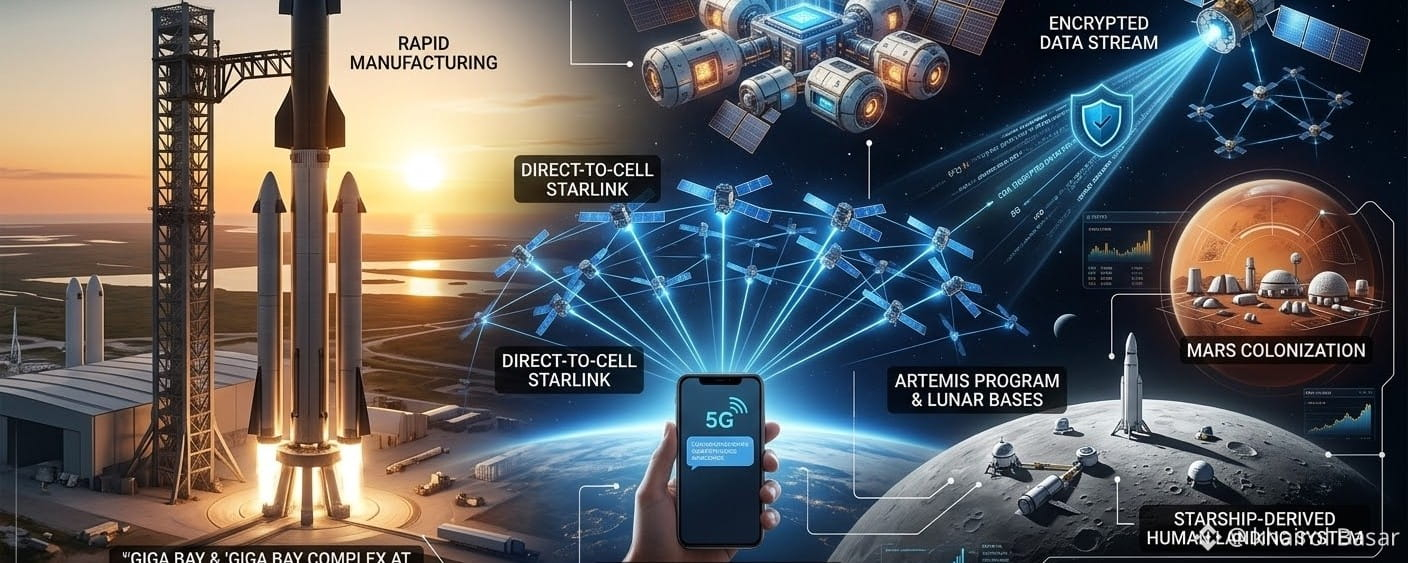
1. 🌌 Starship Program & Deep Space Exploration
The Starship system is central to SpaceX's mission—built to be the most powerful, fully reusable launch vehicle ever created.
Orbital Milestones: Following the success of Starship’s Flight 14 in late 2026, the vehicle demonstrated critical orbital endurance and precision recovery capabilities.
NASA Artemis Program: Starship serves as a core component for NASA’s Artemis program, aiming to land astronauts back on the Moon and lay the foundation for sustainable lunar bases.
Mars Settlement: The ultimate roadmap for Starship remains Mars colonization—enabling human multi-planetary life through scalable payload capacity.
2. 🏭 Starbase Giga Bay & Mass Manufacturing
To support high-frequency launches, SpaceX has expanded operations at its Starbase facility in Texas, featuring the massive Giga Bay factory.
High-Rate Production: Designed to mass-produce Starship V3 vehicles, targeting rapid turnaround times and continuous orbital testing.
Cost Efficiency: By achieving full reusability, SpaceX aims to slash launch costs per kilogram into deep space by up to 80–90%, revolutionizing commercial space economics.
3. 📱 Direct-to-Cell Starlink
SpaceX is expanding its Starlink constellation with Direct-to-Cell capabilities, bringing direct satellite connectivity straight to standard smartphones.
Zero Additional Hardware: Eliminates the need for dishes or external antennas.
Global Emergency & Coverage: Provides coverage in remote dead zones, oceans, and disaster-affected areas where terrestrial cell towers are unavailable.
4. ⚡ Solar-Powered Orbital Data Centers (xAI + SpaceX)
In partnership with xAI, SpaceX is exploring the deployment of Orbital Computing Nodes powered entirely by space-based solar energy.
Sustainable AI Compute: Moving heavy computational workloads into space leverages constant solar energy and natural cooling, bypassing terrestrial water and power constraints.
5. 🛡️ Starshield: Defense & High-Security Infrastructure
Specifically designed for government and defense agencies, Starshield uses Starlink technology for secure orbital communications.
Key Features: Earth observation, encrypted real-time communications, and resilient satellite telemetry designed for high-security defense networks.
💡 Final Thoughts for the Crypto & Tech Community
SpaceX’s relentless execution across satellite internet, deep-space logistics, and orbital infrastructure continues to inspire tech enthusiasts and investors worldwide. As space tech intersects with decentralized networks, AI compute, and global connectivity, SpaceX remains at the absolute epicenter of the next technological frontier.
💬 What do you think is SpaceX's most game-changing project? Starship or Direct-to-Cell? Drop your thoughts below! 👇
#SpaceX #Starlink #TechInnovation #ElonMusk #BinanceSquare #Space $SOL $NVDA.US #Spacex $AAPLB
{stock_us}(NVDA.US)
{stock_us}(SPCX.US)
{future}(SOLUSDT)
🚀 Inside SpaceX: Shaping the Future of Space Tech & Next-Gen Connectivity When we talk about ground
🚀 Inside SpaceX: Shaping the Future of Space Tech & Next-Gen Connectivity
When we talk about groundbreaking innovation and multi-planetary ambition, one name stands out: SpaceX. Under the leadership of Elon Musk, SpaceX continues to push the boundaries of technology, aerospace engineering, and global connectivity.
Here is a deep dive into the major ongoing and upcoming projects driving the SpaceX ecosystem forward:
1. 🌌 Starship Program & Deep Space Exploration
The Starship system is central to SpaceX's mission—built to be the most powerful, fully reusable launch vehicle ever created.
Orbital Milestones: Following the success of Starship’s Flight 14 in late 2026, the vehicle demonstrated critical orbital endurance and precision recovery capabilities.
NASA Artemis Program: Starship serves as a core component for NASA’s Artemis program, aiming to land astronauts back on the Moon and lay the foundation for sustainable lunar bases.
Mars Settlement: The ultimate roadmap for Starship remains Mars colonization—enabling human multi-planetary life through scalable payload capacity.
2. 🏭 Starbase Giga Bay & Mass Manufacturing
To support high-frequency launches, SpaceX has expanded operations at its Starbase facility in Texas, featuring the massive Giga Bay factory.
High-Rate Production: Designed to mass-produce Starship V3 vehicles, targeting rapid turnaround times and continuous orbital testing.
Cost Efficiency: By achieving full reusability, SpaceX aims to slash launch costs per kilogram into deep space by up to 80–90%, revolutionizing commercial space economics.
3. 📱 Direct-to-Cell Starlink
SpaceX is expanding its Starlink constellation with Direct-to-Cell capabilities, bringing direct satellite connectivity straight to standard smartphones.
Zero Additional Hardware: Eliminates the need for dishes or external antennas.
Global Emergency & Coverage: Provides coverage in remote dead zones, oceans, and disaster-affected areas where terrestrial cell towers are unavailable.
4. ⚡ Solar-Powered Orbital Data Centers (xAI + SpaceX)
In partnership with xAI, SpaceX is exploring the deployment of Orbital Computing Nodes powered entirely by space-based solar energy.
Sustainable AI Compute: Moving heavy computational workloads into space leverages constant solar energy and natural cooling, bypassing terrestrial water and power constraints.
5. 🛡️ Starshield: Defense & High-Security Infrastructure
Specifically designed for government and defense agencies, Starshield uses Starlink technology for secure orbital communications.
Key Features: Earth observation, encrypted real-time communications, and resilient satellite telemetry designed for high-security defense networks.
💡 Final Thoughts for the Crypto & Tech Community
SpaceX’s relentless execution across satellite internet, deep-space logistics, and orbital infrastructure continues to inspire tech enthusiasts and investors worldwide. As space tech intersects with decentralized networks, AI compute, and global connectivity, SpaceX remains at the absolute epicenter of the next technological frontier.
💬 What do you think is SpaceX's most game-changing project? Starship or Direct-to-Cell? Drop your thoughts below! 👇
#SpaceX #Starlink #TechInnovation #ElonMusk #BinanceSquare #Space $SOL $NVDA.US #Spacex $AAPLB
When we talk about groundbreaking innovation and multi-planetary ambition, one name stands out: SpaceX. Under the leadership of Elon Musk, SpaceX continues to push the boundaries of technology, aerospace engineering, and global connectivity.
Here is a deep dive into the major ongoing and upcoming projects driving the SpaceX ecosystem forward:
1. 🌌 Starship Program & Deep Space Exploration
The Starship system is central to SpaceX's mission—built to be the most powerful, fully reusable launch vehicle ever created.
Orbital Milestones: Following the success of Starship’s Flight 14 in late 2026, the vehicle demonstrated critical orbital endurance and precision recovery capabilities.
NASA Artemis Program: Starship serves as a core component for NASA’s Artemis program, aiming to land astronauts back on the Moon and lay the foundation for sustainable lunar bases.
Mars Settlement: The ultimate roadmap for Starship remains Mars colonization—enabling human multi-planetary life through scalable payload capacity.
2. 🏭 Starbase Giga Bay & Mass Manufacturing
To support high-frequency launches, SpaceX has expanded operations at its Starbase facility in Texas, featuring the massive Giga Bay factory.
High-Rate Production: Designed to mass-produce Starship V3 vehicles, targeting rapid turnaround times and continuous orbital testing.
Cost Efficiency: By achieving full reusability, SpaceX aims to slash launch costs per kilogram into deep space by up to 80–90%, revolutionizing commercial space economics.
3. 📱 Direct-to-Cell Starlink
SpaceX is expanding its Starlink constellation with Direct-to-Cell capabilities, bringing direct satellite connectivity straight to standard smartphones.
Zero Additional Hardware: Eliminates the need for dishes or external antennas.
Global Emergency & Coverage: Provides coverage in remote dead zones, oceans, and disaster-affected areas where terrestrial cell towers are unavailable.
4. ⚡ Solar-Powered Orbital Data Centers (xAI + SpaceX)
In partnership with xAI, SpaceX is exploring the deployment of Orbital Computing Nodes powered entirely by space-based solar energy.
Sustainable AI Compute: Moving heavy computational workloads into space leverages constant solar energy and natural cooling, bypassing terrestrial water and power constraints.
5. 🛡️ Starshield: Defense & High-Security Infrastructure
Specifically designed for government and defense agencies, Starshield uses Starlink technology for secure orbital communications.
Key Features: Earth observation, encrypted real-time communications, and resilient satellite telemetry designed for high-security defense networks.
💡 Final Thoughts for the Crypto & Tech Community
SpaceX’s relentless execution across satellite internet, deep-space logistics, and orbital infrastructure continues to inspire tech enthusiasts and investors worldwide. As space tech intersects with decentralized networks, AI compute, and global connectivity, SpaceX remains at the absolute epicenter of the next technological frontier.
💬 What do you think is SpaceX's most game-changing project? Starship or Direct-to-Cell? Drop your thoughts below! 👇
#SpaceX #Starlink #TechInnovation #ElonMusk #BinanceSquare #Space $SOL $NVDA.US #Spacex $AAPLB
182

·
--
🚀 Elon Musk says roughly 90% of SpaceX’s revenue this year will be commercial, with government revenue falling below 5% in Q4.
Starlink has transformed SpaceX’s business model. The company is increasingly looking less like a traditional government-focused launch company and more like a global connectivity and technology platform.
📡 Starlink
🌍 Global Connectivity
🤖 AI & Data Centers
🚀 Space Technology
SpaceX is no longer just about rockets — it’s becoming a massive technology ecosystem.#SpaceX #ElonMusk #Starlink #SPCX #Tesla #SpaceTechnology #AI #Technology #SatelliteInternet #Investing #Stocks #Business #Innovation #FutureTech #Crypto#Bianace #SpaceX
🚀 Elon Musk says roughly 90% of SpaceX’s revenue this year will be commercial, with government revenue falling below 5% in Q4.
Starlink has transformed SpaceX’s business model. The company is increasingly looking less like a traditional government-focused launch company and more like a global connectivity and technology platform.
📡 Starlink
🌍 Global Connectivity
🤖 AI & Data Centers
🚀 Space Technology
SpaceX is no longer just about rockets — it’s becoming a massive technology ecosystem.#SpaceX #ElonMusk #Starlink #SPCX #Tesla #SpaceTechnology #AI #Technology #SatelliteInternet #Investing #Stocks #Business #Innovation #FutureTech #Crypto#Bianace #SpaceX
Starlink has transformed SpaceX’s business model. The company is increasingly looking less like a traditional government-focused launch company and more like a global connectivity and technology platform.
📡 Starlink
🌍 Global Connectivity
🤖 AI & Data Centers
🚀 Space Technology
SpaceX is no longer just about rockets — it’s becoming a massive technology ecosystem.#SpaceX #ElonMusk #Starlink #SPCX #Tesla #SpaceTechnology #AI #Technology #SatelliteInternet #Investing #Stocks #Business #Innovation #FutureTech #Crypto#Bianace #SpaceX

239

·
--
Vérifié
Article
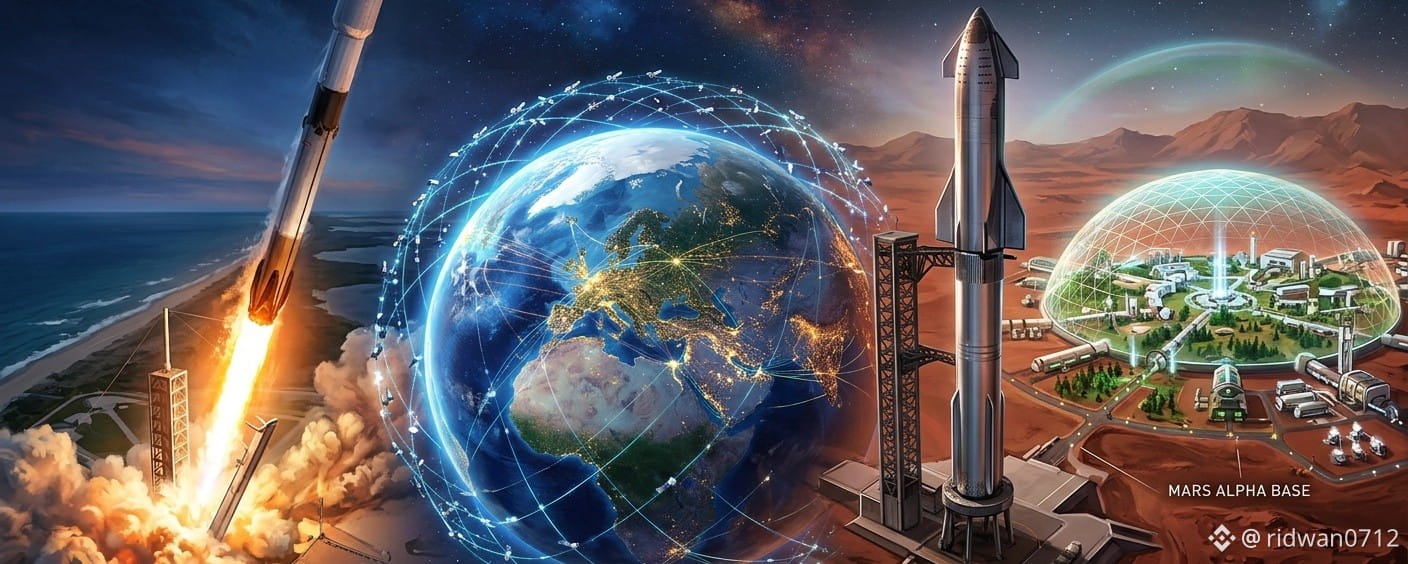
SpaceX's transformation from a rocket company into a global technology powerhouse.SpaceX's stock jumped more than 7% on October 3, 2026, closing at $158.96. It would be easy to credit another engineering win, but investors seem to be reacting to something bigger. The company is no longer just building rockets; it's pushing into AI, and the market is starting to price it like a company that sits where aerospace and artificial intelligence meet.
SpaceX pulled off three big launches in just 13 hours. Crew-13 took a fresh crew up to the International Space Station, Transporter-18 put 130 payloads into orbit (Google's AI satellites among them), and a Falcon Heavy flew the classified NROL-97 mission for the National Reconnaissance Office. It wasn't only a technical flex. Investors saw a company that can launch often and rarely miss, and the stock reflected that.
Then came Starship Flight 14, which reached full orbit for the first time with 26 Starlink V3 satellites on board. That matters because Starship is built to fly again and again at a much lower cost. If it works as planned, daily launches and a bigger satellite network stop sounding far-fetched. SpaceX is clearly thinking about the next few decades, not just the next few missions.
But the real boost to the stock came from somewhere unexpected: AI infrastructure. SpaceX landed contracts with Google (about $920 million a month) and Anthropic (about $1.25 billion a month), which adds up to roughly $26 billion a year. In effect, it's now selling high-capacity data center power for AI computing. That gives the company a cushion if the rocket business slows down and a new place to grow.
Fast-paced rocket launches, Starship's orbital debut, and big AI contracts sent SpaceX's stock soaring. Reports say Elon Musk's wealth jumped by $61 billion in a single day. Analysts at Bernstein, Oppenheimer, and Macquarie raised their price targets to a range of $218 to $280, averaging $235. To investors, SpaceX is no longer just an aerospace leader. It's a serious player in the global tech market.
The risks haven't gone away. The AI contracts can be cancelled with 90 days' notice, and Starship is still early in its development. but the upside looks much bigger. If Starship keeps succeeding and the AI deals hold, SpaceX could end up leading in two frontiers at once: outer space and artificial intelligence.
Today's surge reflects a bigger story about transformation. The back-to-back launches built trust, Starship's breakthrough pointed to the future, and the AI contracts opened up new revenue. It all adds up to one idea: SpaceX is turning into a tech powerhouse with two wings: rockets and AI.
📚 References
1. Kompas Money. Elon Musk’s Wealth Increases by Rp 1,092 Trillion. October 3, 2026.
2. Blockonomi. Triple Rocket Launch Spree Drives SpaceX Stock Up 7%. October 3, 2026.
3. FinanceFeeds. SpaceX Stock at $159: Bull $235, Bear $145. October 3, 2026.
#SpaceX $SPCX.US #SPCX
{stock_us}(SPCX.US)
SpaceX's transformation from a rocket company into a global technology powerhouse.
SpaceX's stock jumped more than 7% on October 3, 2026, closing at $158.96. It would be easy to credit another engineering win, but investors seem to be reacting to something bigger. The company is no longer just building rockets; it's pushing into AI, and the market is starting to price it like a company that sits where aerospace and artificial intelligence meet.
SpaceX pulled off three big launches in just 13 hours. Crew-13 took a fresh crew up to the International Space Station, Transporter-18 put 130 payloads into orbit (Google's AI satellites among them), and a Falcon Heavy flew the classified NROL-97 mission for the National Reconnaissance Office. It wasn't only a technical flex. Investors saw a company that can launch often and rarely miss, and the stock reflected that.
Then came Starship Flight 14, which reached full orbit for the first time with 26 Starlink V3 satellites on board. That matters because Starship is built to fly again and again at a much lower cost. If it works as planned, daily launches and a bigger satellite network stop sounding far-fetched. SpaceX is clearly thinking about the next few decades, not just the next few missions.
But the real boost to the stock came from somewhere unexpected: AI infrastructure. SpaceX landed contracts with Google (about $920 million a month) and Anthropic (about $1.25 billion a month), which adds up to roughly $26 billion a year. In effect, it's now selling high-capacity data center power for AI computing. That gives the company a cushion if the rocket business slows down and a new place to grow.
Fast-paced rocket launches, Starship's orbital debut, and big AI contracts sent SpaceX's stock soaring. Reports say Elon Musk's wealth jumped by $61 billion in a single day. Analysts at Bernstein, Oppenheimer, and Macquarie raised their price targets to a range of $218 to $280, averaging $235. To investors, SpaceX is no longer just an aerospace leader. It's a serious player in the global tech market.
The risks haven't gone away. The AI contracts can be cancelled with 90 days' notice, and Starship is still early in its development. but the upside looks much bigger. If Starship keeps succeeding and the AI deals hold, SpaceX could end up leading in two frontiers at once: outer space and artificial intelligence.
Today's surge reflects a bigger story about transformation. The back-to-back launches built trust, Starship's breakthrough pointed to the future, and the AI contracts opened up new revenue. It all adds up to one idea: SpaceX is turning into a tech powerhouse with two wings: rockets and AI.
📚 References
1. Kompas Money. Elon Musk’s Wealth Increases by Rp 1,092 Trillion. October 3, 2026.
2. Blockonomi. Triple Rocket Launch Spree Drives SpaceX Stock Up 7%. October 3, 2026.
3. FinanceFeeds. SpaceX Stock at $159: Bull $235, Bear $145. October 3, 2026.
#SpaceX $SPCX.US #SPCX
SpaceX pulled off three big launches in just 13 hours. Crew-13 took a fresh crew up to the International Space Station, Transporter-18 put 130 payloads into orbit (Google's AI satellites among them), and a Falcon Heavy flew the classified NROL-97 mission for the National Reconnaissance Office. It wasn't only a technical flex. Investors saw a company that can launch often and rarely miss, and the stock reflected that.
Then came Starship Flight 14, which reached full orbit for the first time with 26 Starlink V3 satellites on board. That matters because Starship is built to fly again and again at a much lower cost. If it works as planned, daily launches and a bigger satellite network stop sounding far-fetched. SpaceX is clearly thinking about the next few decades, not just the next few missions.
But the real boost to the stock came from somewhere unexpected: AI infrastructure. SpaceX landed contracts with Google (about $920 million a month) and Anthropic (about $1.25 billion a month), which adds up to roughly $26 billion a year. In effect, it's now selling high-capacity data center power for AI computing. That gives the company a cushion if the rocket business slows down and a new place to grow.
Fast-paced rocket launches, Starship's orbital debut, and big AI contracts sent SpaceX's stock soaring. Reports say Elon Musk's wealth jumped by $61 billion in a single day. Analysts at Bernstein, Oppenheimer, and Macquarie raised their price targets to a range of $218 to $280, averaging $235. To investors, SpaceX is no longer just an aerospace leader. It's a serious player in the global tech market.
The risks haven't gone away. The AI contracts can be cancelled with 90 days' notice, and Starship is still early in its development. but the upside looks much bigger. If Starship keeps succeeding and the AI deals hold, SpaceX could end up leading in two frontiers at once: outer space and artificial intelligence.
Today's surge reflects a bigger story about transformation. The back-to-back launches built trust, Starship's breakthrough pointed to the future, and the AI contracts opened up new revenue. It all adds up to one idea: SpaceX is turning into a tech powerhouse with two wings: rockets and AI.
📚 References
1. Kompas Money. Elon Musk’s Wealth Increases by Rp 1,092 Trillion. October 3, 2026.
2. Blockonomi. Triple Rocket Launch Spree Drives SpaceX Stock Up 7%. October 3, 2026.
3. FinanceFeeds. SpaceX Stock at $159: Bull $235, Bear $145. October 3, 2026.
#SpaceX $SPCX.US #SPCX
SPCXUS+0,79%
1
352

·
--
Haussier
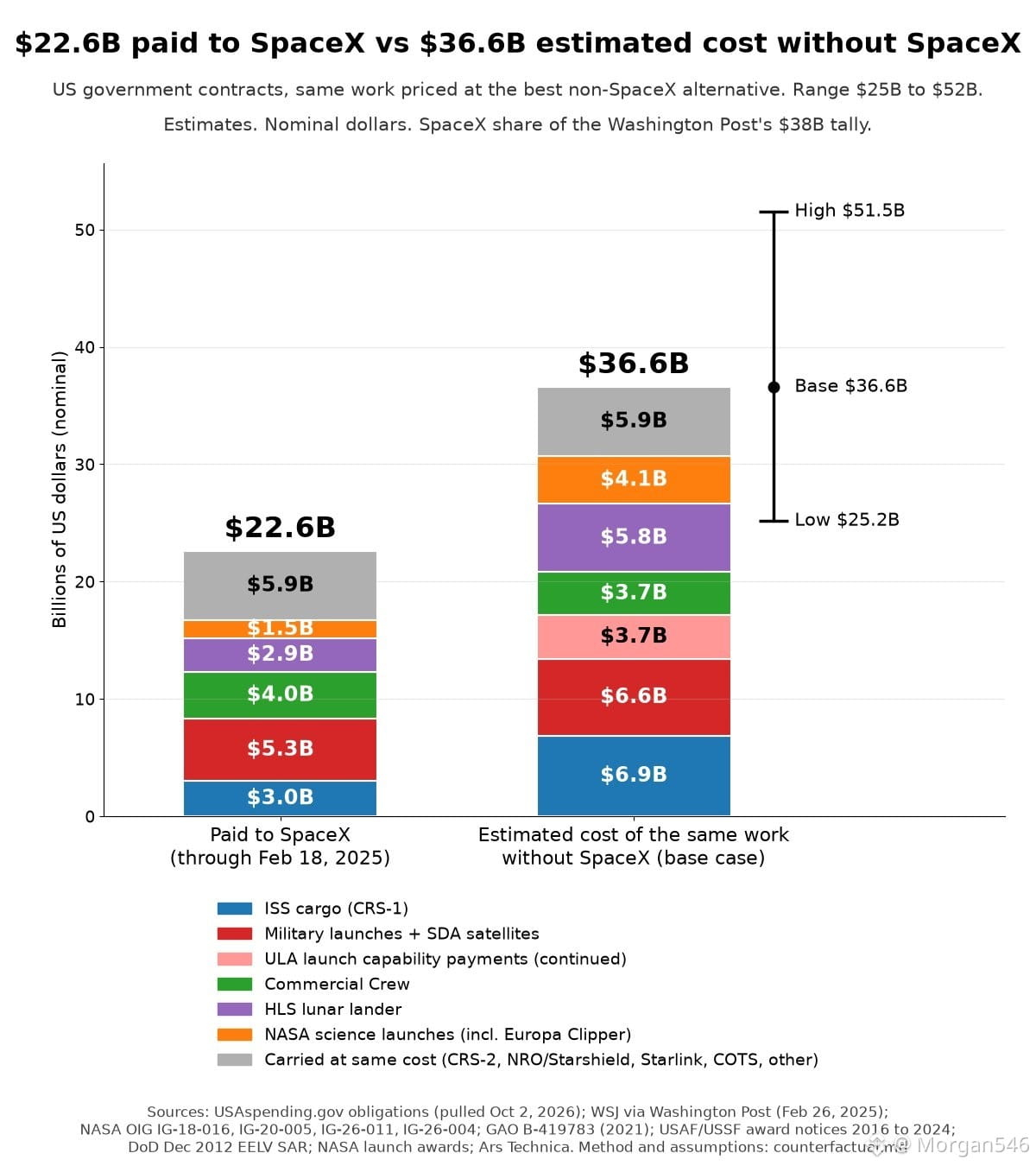
The Washington Post famously claimed Elon Musk's companies received $38B from US governments. The truth? Elon Musk's company, SpaceX, SAVED the US Government (and taxpayers) an estimated $14B. I've covered that in detail in the upcoming article, but here's the graphic:#SpaceX
The Washington Post famously claimed Elon Musk's companies received $38B from US governments. The truth? Elon Musk's company, SpaceX, SAVED the US Government (and taxpayers) an estimated $14B. I've covered that in detail in the upcoming article, but here's the graphic:#SpaceX
47


·
--
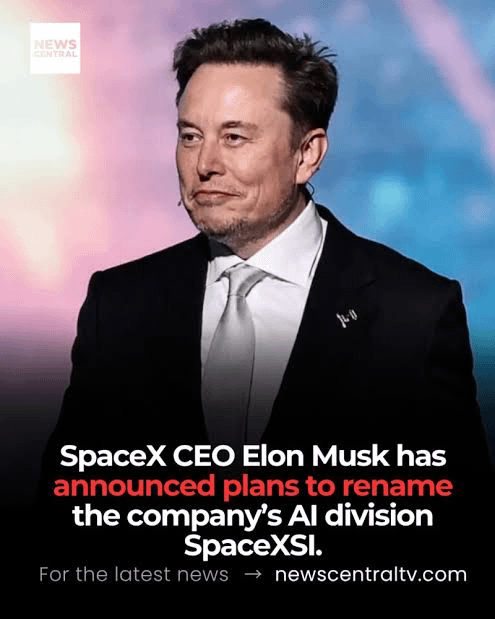
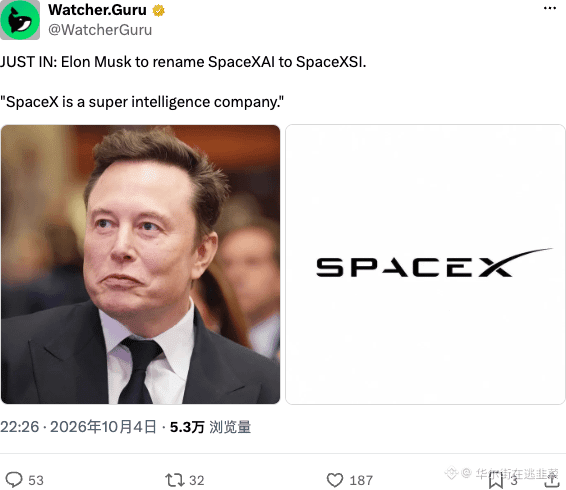
AI这词都不配用了?马斯克要把SpaceXAI改名成SpaceXSI——SI=超级智能,老马造词水平再创新高🤡 先冷静:这消息八成是恶搞号放的风,本人没官宣,经典的钓鱼套路。但币圈从不问真假,SpaceX一上热搜,链上同名梗图币先拉30%再说。想冲的自己掂量盈亏比,别给假新闻抬轿。
$DOGE #SpaceX #AI
AI这词都不配用了?马斯克要把SpaceXAI改名成SpaceXSI——SI=超级智能,老马造词水平再创新高🤡 先冷静:这消息八成是恶搞号放的风,本人没官宣,经典的钓鱼套路。但币圈从不问真假,SpaceX一上热搜,链上同名梗图币先拉30%再说。想冲的自己掂量盈亏比,别给假新闻抬轿。
$DOGE #SpaceX #AI
$DOGE #SpaceX #AI
Square-Creator-d6ec2ddc08f565c88398:
这是特朗普要求正式修改的命名。
1
765
·
--
Haussier
🚀 Saham SpaceX ($SPCX ) Kembali Menguat & Tarik Perhatian Pasar!
Sektor antariksa mendominasi Wall Street seiring meningkatnya permintaan Starlink dan Starship.
Sentimen positif ini memicu akumulasi besar dari investor institusi maupun ritel.
Dinamika momentum $SPCX mengingatkan pada pola pergerakan breakout token crypto utama.
Apakah penguatan saham tech ini bakal ikut mendorong bullish sentiment di pasar crypto?
Bagikan prediksi harga kalian untuk $SPCX di kolom komentar! 👇
#SpaceX #SPCX #BinanceSquare #TradFi #CryptoNews
{spot}(SPCXBUSDT)
🚀 Saham SpaceX ($SPCX ) Kembali Menguat & Tarik Perhatian Pasar!
Sektor antariksa mendominasi Wall Street seiring meningkatnya permintaan Starlink dan Starship.
Sentimen positif ini memicu akumulasi besar dari investor institusi maupun ritel.
Dinamika momentum $SPCX mengingatkan pada pola pergerakan breakout token crypto utama.
Apakah penguatan saham tech ini bakal ikut mendorong bullish sentiment di pasar crypto?
Bagikan prediksi harga kalian untuk $SPCX di kolom komentar! 👇
#SpaceX #SPCX #BinanceSquare #TradFi #CryptoNews
Sektor antariksa mendominasi Wall Street seiring meningkatnya permintaan Starlink dan Starship.
Sentimen positif ini memicu akumulasi besar dari investor institusi maupun ritel.
Dinamika momentum $SPCX mengingatkan pada pola pergerakan breakout token crypto utama.
Apakah penguatan saham tech ini bakal ikut mendorong bullish sentiment di pasar crypto?
Bagikan prediksi harga kalian untuk $SPCX di kolom komentar! 👇
#SpaceX #SPCX #BinanceSquare #TradFi #CryptoNews
1
456

·
--
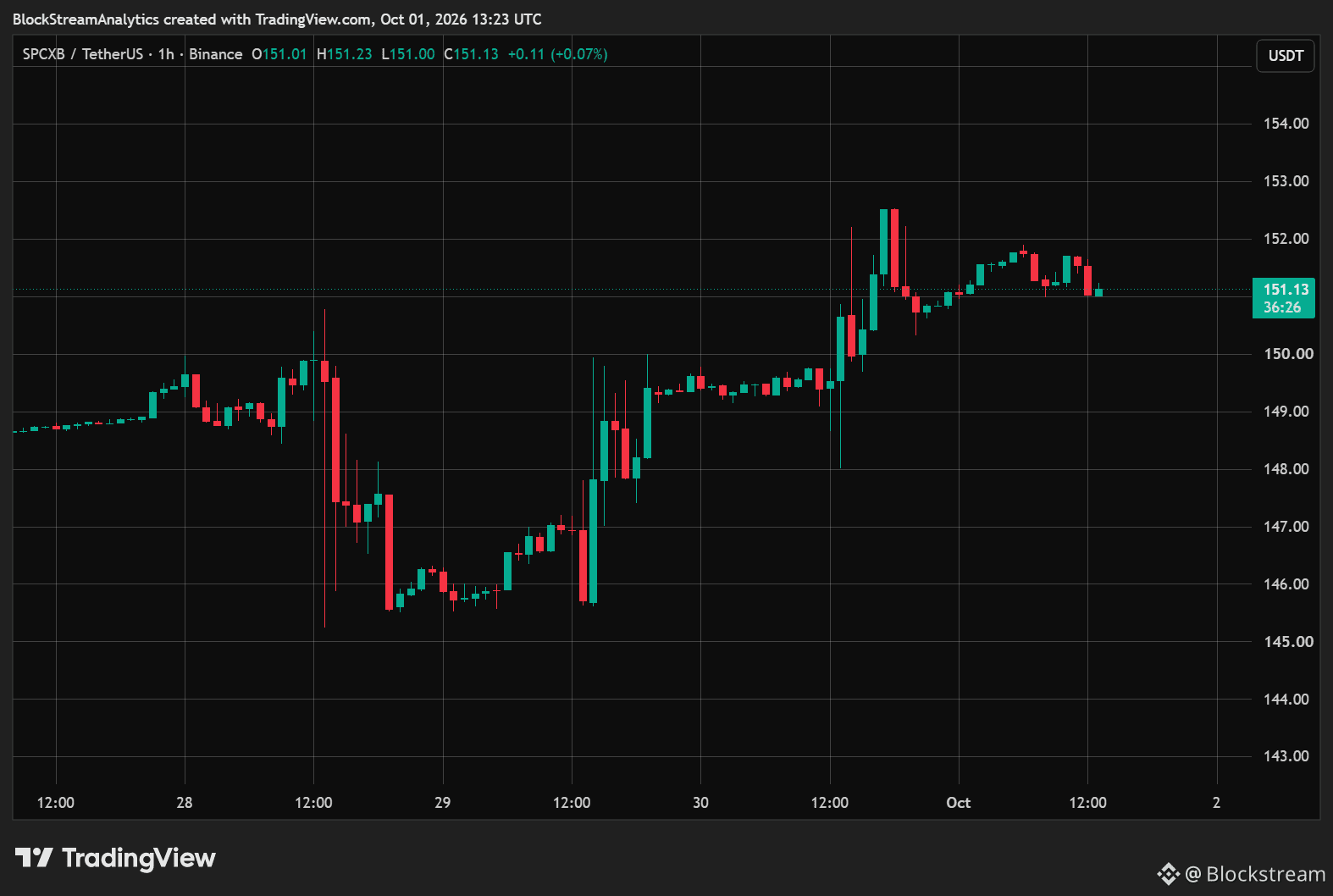
$SPCXB BULLISH CONSOLIDATION 🚨🚨 SpaceX stock holding key support!
Entry: $148.50 – $150.50
TP1: $154.00 | TP2: $160.00 | TP3: $168.00
SL: $144.50
$SPCXB is consolidating near $151.13 after breaking out above $150.00. Holding above the $148.50 support zone keeps this bullish structure intact for the next expansion leg. Wait for a retest into the entry zone for optimal risk-to-reward. Protect your capital and manage risk carefully!
⚡ Trade Execution: Tap $SPCXB right here to check live depth chart & trade instantly! 📈⚔️
{spot}(SPCXBUSDT)
#SpaceX #BStocks #BlockStreamAnalytics #US10YearYieldNears5.3%
$SPCXB BULLISH CONSOLIDATION 🚨🚨 SpaceX stock holding key support!
Entry: $148.50 – $150.50
TP1: $154.00 | TP2: $160.00 | TP3: $168.00
SL: $144.50
$SPCXB is consolidating near $151.13 after breaking out above $150.00. Holding above the $148.50 support zone keeps this bullish structure intact for the next expansion leg. Wait for a retest into the entry zone for optimal risk-to-reward. Protect your capital and manage risk carefully!
⚡ Trade Execution: Tap $SPCXB right here to check live depth chart & trade instantly! 📈⚔️
#SpaceX #BStocks #BlockStreamAnalytics #US10YearYieldNears5.3%
Entry: $148.50 – $150.50
TP1: $154.00 | TP2: $160.00 | TP3: $168.00
SL: $144.50
$SPCXB is consolidating near $151.13 after breaking out above $150.00. Holding above the $148.50 support zone keeps this bullish structure intact for the next expansion leg. Wait for a retest into the entry zone for optimal risk-to-reward. Protect your capital and manage risk carefully!
⚡ Trade Execution: Tap $SPCXB right here to check live depth chart & trade instantly! 📈⚔️
#SpaceX #BStocks #BlockStreamAnalytics #US10YearYieldNears5.3%
1
1
132

·
--
13小时三次发射,$SPCX 直接拉了6.56%,现价159,成交额15.8亿。
新闻也写明白了,谷歌的轨道AI实验搭车上去了。市场就吃这套,马斯克只要让火箭别停,故事就永远有人买单。
真正值得看的是另一件事。上周非农拉胯,加息预期凉了,$SPCX 跟着大盘一起high。这就有意思了——一家还没上市的公司,硬是被塞进TradFi代币化的筐里,7x24交易,跟黄金原油美股一个货架。说白了,现在玩的就是预期本身,不是财报,不是现金流,是"星链+星舰+轨道AI"三个词叠一起的想象力。
159这个位置,上方160.11刚摸过就被摁回来。追高的人要想清楚,你买的是火箭,还是马斯克的那张嘴。
$SPCX 我盯着,不动手...
#SpaceX
13小时三次发射,$SPCX 直接拉了6.56%,现价159,成交额15.8亿。
新闻也写明白了,谷歌的轨道AI实验搭车上去了。市场就吃这套,马斯克只要让火箭别停,故事就永远有人买单。
真正值得看的是另一件事。上周非农拉胯,加息预期凉了,$SPCX 跟着大盘一起high。这就有意思了——一家还没上市的公司,硬是被塞进TradFi代币化的筐里,7x24交易,跟黄金原油美股一个货架。说白了,现在玩的就是预期本身,不是财报,不是现金流,是"星链+星舰+轨道AI"三个词叠一起的想象力。
159这个位置,上方160.11刚摸过就被摁回来。追高的人要想清楚,你买的是火箭,还是马斯克的那张嘴。
$SPCX 我盯着,不动手...
#SpaceX
新闻也写明白了,谷歌的轨道AI实验搭车上去了。市场就吃这套,马斯克只要让火箭别停,故事就永远有人买单。
真正值得看的是另一件事。上周非农拉胯,加息预期凉了,$SPCX 跟着大盘一起high。这就有意思了——一家还没上市的公司,硬是被塞进TradFi代币化的筐里,7x24交易,跟黄金原油美股一个货架。说白了,现在玩的就是预期本身,不是财报,不是现金流,是"星链+星舰+轨道AI"三个词叠一起的想象力。
159这个位置,上方160.11刚摸过就被摁回来。追高的人要想清楚,你买的是火箭,还是马斯克的那张嘴。
$SPCX 我盯着,不动手...
#SpaceX
66

·
--
Article
SpaceX与AI比翼双飞!10月1日,SpaceX的Falcon9执行Transporter-18 任务,一口气把130个载荷送入低轨,重点是,里面藏着一顆 Google 的 Project Suncatcher原型卫星!!
①AI芯片第一次真正上天。
这颗卫星搭载Google TPU,任务很直接:测试AI芯片在太空中的辐射、温度、散热以及长期运行能力。
Google 已确认卫星成功入轨并建立联系,接下来几周开始收集真实数据。自此,“太空数据中心”开始从PPT进入实测阶段。
②为什么偏偏是太空?
地面AI算力继续扩张,绕不开三个东西:电力、土地、散热。而轨道基础设施提供了另一种可能:更长时间利用太阳能、大规模卫星组网、激光星间通信、重型火箭降低运输成本。
所以未来竞争的可能不仅是“GPU→数据中心→电网”,而是进一步延伸成“芯片→火箭→卫星→能源→太空算力”。
③SpaceX的地位最有意思。
Google做TPU, 其他公司研究轨道能源和数据中心。但这些东西想上天,都需要一个共同入口:低成本、高频率、大运力的发射能力。
Transporter-18本身就是最直接的证明——一次任务搭载130个载荷。而如果未来Starship真正进入高频商业运输阶段、 SpaceX的角色就不只是 "造火箭”,它可能越来越像太空时代的基础设施入口。
所以我们现在看SpaceX,已经不能只盯Starlink。真正值得跟踪的是:Starship+Starlink+Al算力+太空能源+发射基础设施。
这条线才刚开始。
迭加前几天的星舰顺利入轨、市场基本面松动,昨晚SpaceX股价怒涨7%,虽然比我预期的反弹晚了两天。
我一直对SpaceX抱有极强的耐心和信心,一直对马斯克有着无条件的膜拜,一直发贴坚称SpaceX每次的调整都是逢低建仓的机会,一直坚信SpaceX一定不会让投资者失望!
#SpaceX #Google #美股超话 $SPCXB
{spot}(SPCXBUSDT)
$GOOGLB
{spot}(GOOGLBUSDT)
SpaceX与AI比翼双飞!
10月1日,SpaceX的Falcon9执行Transporter-18 任务,一口气把130个载荷送入低轨,重点是,里面藏着一顆 Google 的 Project Suncatcher原型卫星!!
①AI芯片第一次真正上天。
这颗卫星搭载Google TPU,任务很直接:测试AI芯片在太空中的辐射、温度、散热以及长期运行能力。
Google 已确认卫星成功入轨并建立联系,接下来几周开始收集真实数据。自此,“太空数据中心”开始从PPT进入实测阶段。
②为什么偏偏是太空?
地面AI算力继续扩张,绕不开三个东西:电力、土地、散热。而轨道基础设施提供了另一种可能:更长时间利用太阳能、大规模卫星组网、激光星间通信、重型火箭降低运输成本。
所以未来竞争的可能不仅是“GPU→数据中心→电网”,而是进一步延伸成“芯片→火箭→卫星→能源→太空算力”。
③SpaceX的地位最有意思。
Google做TPU, 其他公司研究轨道能源和数据中心。但这些东西想上天,都需要一个共同入口:低成本、高频率、大运力的发射能力。
Transporter-18本身就是最直接的证明——一次任务搭载130个载荷。而如果未来Starship真正进入高频商业运输阶段、 SpaceX的角色就不只是 "造火箭”,它可能越来越像太空时代的基础设施入口。
所以我们现在看SpaceX,已经不能只盯Starlink。真正值得跟踪的是:Starship+Starlink+Al算力+太空能源+发射基础设施。
这条线才刚开始。
迭加前几天的星舰顺利入轨、市场基本面松动,昨晚SpaceX股价怒涨7%,虽然比我预期的反弹晚了两天。
我一直对SpaceX抱有极强的耐心和信心,一直对马斯克有着无条件的膜拜,一直发贴坚称SpaceX每次的调整都是逢低建仓的机会,一直坚信SpaceX一定不会让投资者失望!
#SpaceX #Google #美股超话 $SPCXB
$GOOGLB
①AI芯片第一次真正上天。
这颗卫星搭载Google TPU,任务很直接:测试AI芯片在太空中的辐射、温度、散热以及长期运行能力。
Google 已确认卫星成功入轨并建立联系,接下来几周开始收集真实数据。自此,“太空数据中心”开始从PPT进入实测阶段。
②为什么偏偏是太空?
地面AI算力继续扩张,绕不开三个东西:电力、土地、散热。而轨道基础设施提供了另一种可能:更长时间利用太阳能、大规模卫星组网、激光星间通信、重型火箭降低运输成本。
所以未来竞争的可能不仅是“GPU→数据中心→电网”,而是进一步延伸成“芯片→火箭→卫星→能源→太空算力”。
③SpaceX的地位最有意思。
Google做TPU, 其他公司研究轨道能源和数据中心。但这些东西想上天,都需要一个共同入口:低成本、高频率、大运力的发射能力。
Transporter-18本身就是最直接的证明——一次任务搭载130个载荷。而如果未来Starship真正进入高频商业运输阶段、 SpaceX的角色就不只是 "造火箭”,它可能越来越像太空时代的基础设施入口。
所以我们现在看SpaceX,已经不能只盯Starlink。真正值得跟踪的是:Starship+Starlink+Al算力+太空能源+发射基础设施。
这条线才刚开始。
迭加前几天的星舰顺利入轨、市场基本面松动,昨晚SpaceX股价怒涨7%,虽然比我预期的反弹晚了两天。
我一直对SpaceX抱有极强的耐心和信心,一直对马斯克有着无条件的膜拜,一直发贴坚称SpaceX每次的调整都是逢低建仓的机会,一直坚信SpaceX一定不会让投资者失望!
#SpaceX #Google #美股超话 $SPCXB
$GOOGLB
2
230

·
--
SPCX / $158.98 +6.53% - El cohete que ni Elon se atreve
$SPCX SpaceX概念 $158.98 +6.53% 天上飞的币,地上割的人 🚀
项目档案:TradFi太空探索技术,Off-Hours,币圈炒马斯克的火箭,火箭没上天,你的仓位先上天了。
数据:现价 $158.98,24h最高 $160.11 最低 $149.16,成交 10.14M SPCX / 1.58B USDT,1.58B的量炒一个美股山寨?今天Hoy +6.56%,7天 +7.07%,30天 +12.10%,90天 -0.26% - 三个月原地踏步。看图,7号到29号从 $148 横到 $146 跌成狗,Oct 1还在 $149 装死,10月3号一根8M量的绿色擎天柱直接拉到 $160,6,62K那根就是外盘机器人拉的,现货 $159.116 +7.25% 追得更猛。
毒评:SpaceX还没上市,你先把燃料费给交了,炒空气都比炒这个真实。
#SPCX #SpaceX
{future}(SPCXUSDT)
SPCX / $158.98 +6.53% - El cohete que ni Elon se atreve
$SPCX SpaceX概念 $158.98 +6.53% 天上飞的币,地上割的人 🚀
项目档案:TradFi太空探索技术,Off-Hours,币圈炒马斯克的火箭,火箭没上天,你的仓位先上天了。
数据:现价 $158.98,24h最高 $160.11 最低 $149.16,成交 10.14M SPCX / 1.58B USDT,1.58B的量炒一个美股山寨?今天Hoy +6.56%,7天 +7.07%,30天 +12.10%,90天 -0.26% - 三个月原地踏步。看图,7号到29号从 $148 横到 $146 跌成狗,Oct 1还在 $149 装死,10月3号一根8M量的绿色擎天柱直接拉到 $160,6,62K那根就是外盘机器人拉的,现货 $159.116 +7.25% 追得更猛。
毒评:SpaceX还没上市,你先把燃料费给交了,炒空气都比炒这个真实。
#SPCX #SpaceX
$SPCX SpaceX概念 $158.98 +6.53% 天上飞的币,地上割的人 🚀
项目档案:TradFi太空探索技术,Off-Hours,币圈炒马斯克的火箭,火箭没上天,你的仓位先上天了。
数据:现价 $158.98,24h最高 $160.11 最低 $149.16,成交 10.14M SPCX / 1.58B USDT,1.58B的量炒一个美股山寨?今天Hoy +6.56%,7天 +7.07%,30天 +12.10%,90天 -0.26% - 三个月原地踏步。看图,7号到29号从 $148 横到 $146 跌成狗,Oct 1还在 $149 装死,10月3号一根8M量的绿色擎天柱直接拉到 $160,6,62K那根就是外盘机器人拉的,现货 $159.116 +7.25% 追得更猛。
毒评:SpaceX还没上市,你先把燃料费给交了,炒空气都比炒这个真实。
#SPCX #SpaceX
2
33
·
--
🚀 $SPCX.US — SPACEX HAS TWO STORIES HAPPENING AT ONCE.
Starship is proving the future.
Falcon 9 is still printing reliability.
That contrast may be the most important part of the SpaceX story right now.
Starship Flight 14 finally reached orbit and deployed 26 Starlink V3 satellites — a major step toward turning the giant rocket into a real commercial platform. But a Raptor engine issue also forced the mission to end early, reminding investors that Starship is still very much in development.
Meanwhile, the old workhorse keeps doing what it does best.
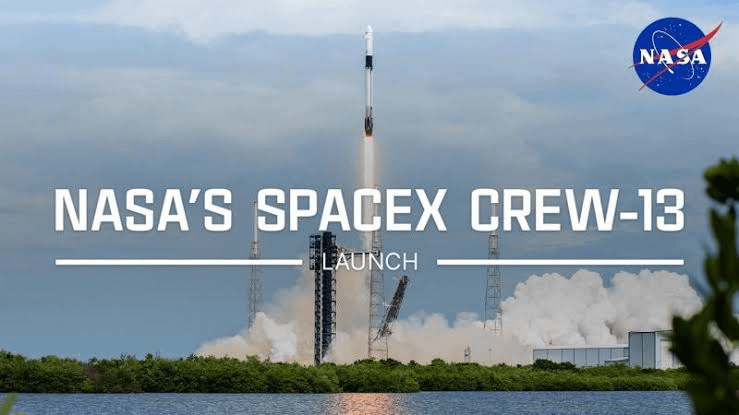
NASA and SpaceX have cleared Crew-13 for launch on Falcon 9 + Dragon, with liftoff targeted for Oct. 1 from Cape Canaveral.
That gives SpaceX something very few companies have:
One system generating dependable execution today.
Another system trying to redefine the economics of space tomorrow.
Falcon 9 keeps proving the business.
Starship keeps expanding the ceiling.
That’s a powerful combination.
Current reliability + future scale.
And if Starship eventually becomes as repeatable as Falcon 9?
That’s when the SpaceX story gets much bigger.
{stock_us}(SPCX.US)
#MetaMaskExitsLidoValidatorsAfterSecurityIncident #MicronBeatsEarningsLiftsGuidance #CFTCSubmitsTwoEventContractRulesToWhiteHouse #BitcoinClears$85200 #SpaceX
🚀 $SPCX.US — SPACEX HAS TWO STORIES HAPPENING AT ONCE.
Starship is proving the future.
Falcon 9 is still printing reliability.
That contrast may be the most important part of the SpaceX story right now.
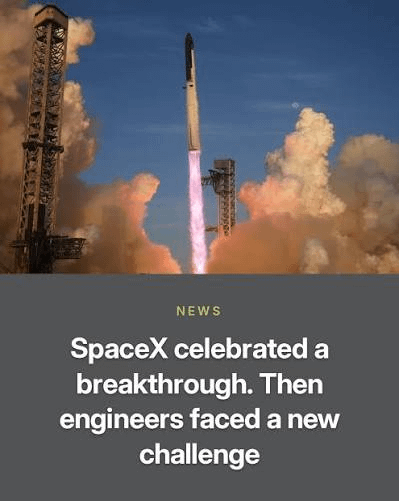
Starship Flight 14 finally reached orbit and deployed 26 Starlink V3 satellites — a major step toward turning the giant rocket into a real commercial platform. But a Raptor engine issue also forced the mission to end early, reminding investors that Starship is still very much in development.
Meanwhile, the old workhorse keeps doing what it does best.
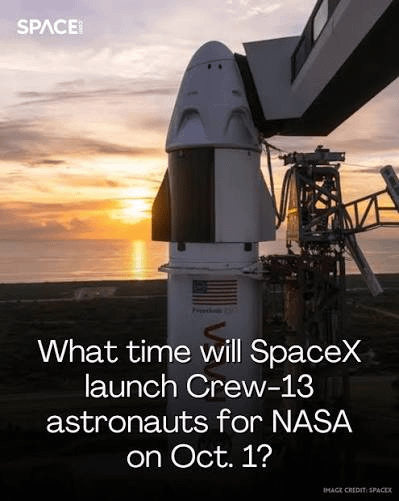
NASA and SpaceX have cleared Crew-13 for launch on Falcon 9 + Dragon, with liftoff targeted for Oct. 1 from Cape Canaveral.
That gives SpaceX something very few companies have:
One system generating dependable execution today.
Another system trying to redefine the economics of space tomorrow.
Falcon 9 keeps proving the business.
Starship keeps expanding the ceiling.
That’s a powerful combination.
Current reliability + future scale.
And if Starship eventually becomes as repeatable as Falcon 9?
That’s when the SpaceX story gets much bigger.
#MetaMaskExitsLidoValidatorsAfterSecurityIncident #MicronBeatsEarningsLiftsGuidance #CFTCSubmitsTwoEventContractRulesToWhiteHouse #BitcoinClears$85200 #SpaceX
Starship is proving the future.
Falcon 9 is still printing reliability.
That contrast may be the most important part of the SpaceX story right now.
Starship Flight 14 finally reached orbit and deployed 26 Starlink V3 satellites — a major step toward turning the giant rocket into a real commercial platform. But a Raptor engine issue also forced the mission to end early, reminding investors that Starship is still very much in development.
Meanwhile, the old workhorse keeps doing what it does best.
NASA and SpaceX have cleared Crew-13 for launch on Falcon 9 + Dragon, with liftoff targeted for Oct. 1 from Cape Canaveral.
That gives SpaceX something very few companies have:
One system generating dependable execution today.
Another system trying to redefine the economics of space tomorrow.
Falcon 9 keeps proving the business.
Starship keeps expanding the ceiling.
That’s a powerful combination.
Current reliability + future scale.
And if Starship eventually becomes as repeatable as Falcon 9?
That’s when the SpaceX story gets much bigger.
#MetaMaskExitsLidoValidatorsAfterSecurityIncident #MicronBeatsEarningsLiftsGuidance #CFTCSubmitsTwoEventContractRulesToWhiteHouse #BitcoinClears$85200 #SpaceX
SPCXUS+0,79%
260
·
--
🚨 $SPCX.US — STARSHIP JUST PROVED THE BULL CASE… AND EXPOSED THE BEAR CASE IN THE SAME FLIGHT.
Flight 14 was a breakthrough.
Starship reached orbit for the first time and deployed 26 Starlink V3 satellites — its first meaningful payload delivery to orbit.
That’s the bullish part.
The uncomfortable part?
A Raptor engine shut down unexpectedly, and the mission ended far earlier than planned. Reuters says the cause is still under investigation, and if it points to a broader propulsion design issue, it could pressure the timeline for NASA’s Artemis moon missions.
So the setup is simple:
Orbit achieved.
Commercial payload deployed.
But reliability is still not fully solved.
That makes Starship more interesting, not less.
Because now the question is no longer:
“Can Starship reach orbit?”
It’s:
“Can SpaceX make this repeatable fast enough for Starlink, Artemis, and high-frequency launches?”
One flight just moved Starship from experiment to infrastructure.
Now reliability decides how valuable that infrastructure becomes.
{stock_us}(SPCX.US)
#MetaMaskExitsLidoValidatorsAfterSecurityIncident #MicronBeatsEarningsLiftsGuidance #CFTCSubmitsTwoEventContractRulesToWhiteHouse #USCorePCEEasesTo3%InAugust #SpaceX
🚨 $SPCX.US — STARSHIP JUST PROVED THE BULL CASE… AND EXPOSED THE BEAR CASE IN THE SAME FLIGHT.
Flight 14 was a breakthrough.
Starship reached orbit for the first time and deployed 26 Starlink V3 satellites — its first meaningful payload delivery to orbit.
That’s the bullish part.
The uncomfortable part?
A Raptor engine shut down unexpectedly, and the mission ended far earlier than planned. Reuters says the cause is still under investigation, and if it points to a broader propulsion design issue, it could pressure the timeline for NASA’s Artemis moon missions.
So the setup is simple:
Orbit achieved.
Commercial payload deployed.
But reliability is still not fully solved.
That makes Starship more interesting, not less.
Because now the question is no longer:
“Can Starship reach orbit?”
It’s:
“Can SpaceX make this repeatable fast enough for Starlink, Artemis, and high-frequency launches?”
One flight just moved Starship from experiment to infrastructure.
Now reliability decides how valuable that infrastructure becomes.
#MetaMaskExitsLidoValidatorsAfterSecurityIncident #MicronBeatsEarningsLiftsGuidance #CFTCSubmitsTwoEventContractRulesToWhiteHouse #USCorePCEEasesTo3%InAugust #SpaceX
Flight 14 was a breakthrough.
Starship reached orbit for the first time and deployed 26 Starlink V3 satellites — its first meaningful payload delivery to orbit.
That’s the bullish part.
The uncomfortable part?
A Raptor engine shut down unexpectedly, and the mission ended far earlier than planned. Reuters says the cause is still under investigation, and if it points to a broader propulsion design issue, it could pressure the timeline for NASA’s Artemis moon missions.
So the setup is simple:
Orbit achieved.
Commercial payload deployed.
But reliability is still not fully solved.
That makes Starship more interesting, not less.
Because now the question is no longer:
“Can Starship reach orbit?”
It’s:
“Can SpaceX make this repeatable fast enough for Starlink, Artemis, and high-frequency launches?”
One flight just moved Starship from experiment to infrastructure.
Now reliability decides how valuable that infrastructure becomes.
#MetaMaskExitsLidoValidatorsAfterSecurityIncident #MicronBeatsEarningsLiftsGuidance #CFTCSubmitsTwoEventContractRulesToWhiteHouse #USCorePCEEasesTo3%InAugust #SpaceX
SPCXUS+0,79%
232

·
--
Haussier
#SpaceX #Crew13 #TradingAnalysis
🚀 CONFIRMACIÓN TOTAL DE LA MISIÓN: SpaceX culmina la consolidación y desata una potente expansión alcista 🛰️⚡
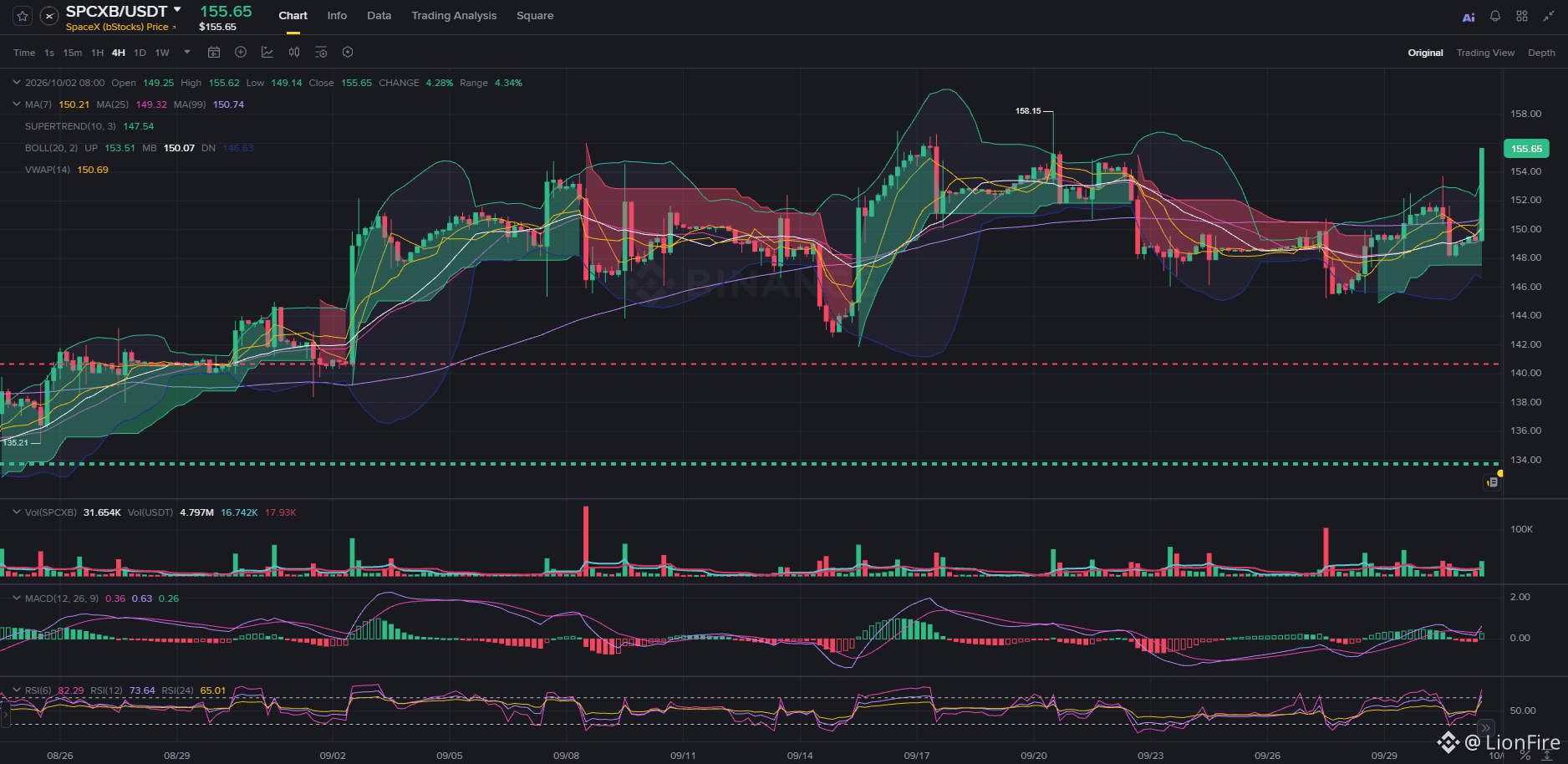
Tras confirmar el éxito absoluto de la misión completa y verificar la llegada a la Estación Espacial Internacional, el mercado despejó cualquier incertidumbre. La toma de liquidez vista tras el lanzamiento quedó íntegramente absorbida y $SPCXB ($155.65) imprimió una contundente vela de ruptura en el gráfico de 4h, anotándose un avance del +4.28% que reactiva de inmediato la tendencia alcista principal.
📊 1. Ruptura técnica y volumen institucional:
💥 Ignición con volumen: El despegue vino validado por una fuerte entrada compradora que elevó el volumen a 31.86K SPCXB (~$4.79M USDT), confirmando que las manos fuertes aprovecharon la consolidación previa para acumular antes de la expansión.
🚀 Perforación de techos dinámicos: En una sola sesión de 4H, el precio superó con holgura la banda superior de Bollinger ($153.51), dejando atrás el bloque de resistencia formado por la MA7 ($150.21), la MA25 ($149.33), el VWAP ($150.69) y la MA99 ($150.74).
⚡ Aceleración de osciladores: El MACD expande su histograma en positivo hacia +0.26, mientras el RSI(6) trepa hasta los 87.79 puntos en señal de fuerte impulso comprador.
🎯 2. Hoja de ruta y niveles a vigilar:
🎯 Ataque al máximo previo ($158.15): La cotización se dirige directamente a testear el techo local de los $158.15. Quebrar esa resistencia con volumen activará una nueva fase de descubrimiento de precio hacia los $160+.
🛡️ Piso dinámico actualizado: El nuevo soporte inmediato para retrocesos intradiarios queda respaldado por la banda media de Bollinger ($150.07) y el nivel del Supertrend alcista en $147.54.
🔴 Línea roja estructural ($141.60): Nuestro soporte base maestro se mantiene intacto y muy por debajo del precio, blindando la salud del ciclo.
💡 Cuando la ejecución operacional impecable de un monopolio aeroespacial se sincroniza con el apetito institucional, las pausas técnicas duran poco⚡
#SpaceX #Crew13 #TradingAnalysis
🚀 CONFIRMACIÓN TOTAL DE LA MISIÓN: SpaceX culmina la consolidación y desata una potente expansión alcista 🛰️⚡
Tras confirmar el éxito absoluto de la misión completa y verificar la llegada a la Estación Espacial Internacional, el mercado despejó cualquier incertidumbre. La toma de liquidez vista tras el lanzamiento quedó íntegramente absorbida y $SPCXB ($155.65) imprimió una contundente vela de ruptura en el gráfico de 4h, anotándose un avance del +4.28% que reactiva de inmediato la tendencia alcista principal.
📊 1. Ruptura técnica y volumen institucional:
💥 Ignición con volumen: El despegue vino validado por una fuerte entrada compradora que elevó el volumen a 31.86K SPCXB (~$4.79M USDT), confirmando que las manos fuertes aprovecharon la consolidación previa para acumular antes de la expansión.
🚀 Perforación de techos dinámicos: En una sola sesión de 4H, el precio superó con holgura la banda superior de Bollinger ($153.51), dejando atrás el bloque de resistencia formado por la MA7 ($150.21), la MA25 ($149.33), el VWAP ($150.69) y la MA99 ($150.74).
⚡ Aceleración de osciladores: El MACD expande su histograma en positivo hacia +0.26, mientras el RSI(6) trepa hasta los 87.79 puntos en señal de fuerte impulso comprador.
🎯 2. Hoja de ruta y niveles a vigilar:
🎯 Ataque al máximo previo ($158.15): La cotización se dirige directamente a testear el techo local de los $158.15. Quebrar esa resistencia con volumen activará una nueva fase de descubrimiento de precio hacia los $160+.
🛡️ Piso dinámico actualizado: El nuevo soporte inmediato para retrocesos intradiarios queda respaldado por la banda media de Bollinger ($150.07) y el nivel del Supertrend alcista en $147.54.
🔴 Línea roja estructural ($141.60): Nuestro soporte base maestro se mantiene intacto y muy por debajo del precio, blindando la salud del ciclo.
💡 Cuando la ejecución operacional impecable de un monopolio aeroespacial se sincroniza con el apetito institucional, las pausas técnicas duran poco⚡
🚀 CONFIRMACIÓN TOTAL DE LA MISIÓN: SpaceX culmina la consolidación y desata una potente expansión alcista 🛰️⚡
Tras confirmar el éxito absoluto de la misión completa y verificar la llegada a la Estación Espacial Internacional, el mercado despejó cualquier incertidumbre. La toma de liquidez vista tras el lanzamiento quedó íntegramente absorbida y $SPCXB ($155.65) imprimió una contundente vela de ruptura en el gráfico de 4h, anotándose un avance del +4.28% que reactiva de inmediato la tendencia alcista principal.
📊 1. Ruptura técnica y volumen institucional:
💥 Ignición con volumen: El despegue vino validado por una fuerte entrada compradora que elevó el volumen a 31.86K SPCXB (~$4.79M USDT), confirmando que las manos fuertes aprovecharon la consolidación previa para acumular antes de la expansión.
🚀 Perforación de techos dinámicos: En una sola sesión de 4H, el precio superó con holgura la banda superior de Bollinger ($153.51), dejando atrás el bloque de resistencia formado por la MA7 ($150.21), la MA25 ($149.33), el VWAP ($150.69) y la MA99 ($150.74).
⚡ Aceleración de osciladores: El MACD expande su histograma en positivo hacia +0.26, mientras el RSI(6) trepa hasta los 87.79 puntos en señal de fuerte impulso comprador.
🎯 2. Hoja de ruta y niveles a vigilar:
🎯 Ataque al máximo previo ($158.15): La cotización se dirige directamente a testear el techo local de los $158.15. Quebrar esa resistencia con volumen activará una nueva fase de descubrimiento de precio hacia los $160+.
🛡️ Piso dinámico actualizado: El nuevo soporte inmediato para retrocesos intradiarios queda respaldado por la banda media de Bollinger ($150.07) y el nivel del Supertrend alcista en $147.54.
🔴 Línea roja estructural ($141.60): Nuestro soporte base maestro se mantiene intacto y muy por debajo del precio, blindando la salud del ciclo.
💡 Cuando la ejecución operacional impecable de un monopolio aeroespacial se sincroniza con el apetito institucional, las pausas técnicas duran poco⚡
1
211

·
--
Haussier
الذكاء الاصطناعي يغادر الأرض إلى المدار!
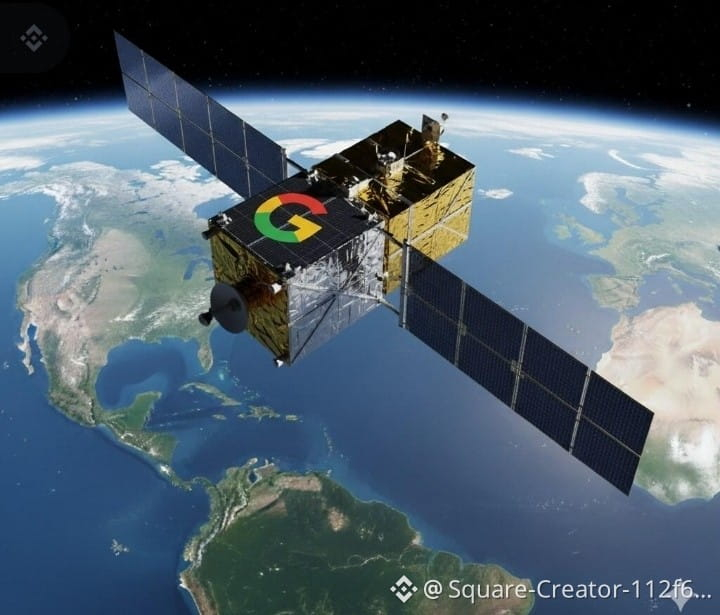
أطلقت SpaceX أول نموذج تجريبي لمشروع Project Suncatcher التابع لـGoogle، حاملاً شرائح ذكاء اصطناعي إلى المدار. 🛰️
الفكرة طموحة: اختبار إمكانية بناء مراكز بيانات للذكاء الاصطناعي في الفضاء والاستفادة من الطاقة الشمسية شبه المستمرة.
لكن الطريق ليس سهلاً؛ فالإشعاع، التبريد، والاتصالات بين الأقمار الصناعية ما زالت تحديات رئيسية.
إذا نجحت التجارب القادمة، فقد نرى مستقبلًا تكون فيه البنية التحتية للـAI فوق الأرض، وليس عليها فقط. 🌍➡️🛰️
#Google #SpaceX #AI #artificialintelligence
الذكاء الاصطناعي يغادر الأرض إلى المدار!
أطلقت SpaceX أول نموذج تجريبي لمشروع Project Suncatcher التابع لـGoogle، حاملاً شرائح ذكاء اصطناعي إلى المدار. 🛰️
الفكرة طموحة: اختبار إمكانية بناء مراكز بيانات للذكاء الاصطناعي في الفضاء والاستفادة من الطاقة الشمسية شبه المستمرة.
لكن الطريق ليس سهلاً؛ فالإشعاع، التبريد، والاتصالات بين الأقمار الصناعية ما زالت تحديات رئيسية.
إذا نجحت التجارب القادمة، فقد نرى مستقبلًا تكون فيه البنية التحتية للـAI فوق الأرض، وليس عليها فقط. 🌍➡️🛰️
#Google #SpaceX #AI #artificialintelligence
أطلقت SpaceX أول نموذج تجريبي لمشروع Project Suncatcher التابع لـGoogle، حاملاً شرائح ذكاء اصطناعي إلى المدار. 🛰️
الفكرة طموحة: اختبار إمكانية بناء مراكز بيانات للذكاء الاصطناعي في الفضاء والاستفادة من الطاقة الشمسية شبه المستمرة.
لكن الطريق ليس سهلاً؛ فالإشعاع، التبريد، والاتصالات بين الأقمار الصناعية ما زالت تحديات رئيسية.
إذا نجحت التجارب القادمة، فقد نرى مستقبلًا تكون فيه البنية التحتية للـAI فوق الأرض، وليس عليها فقط. 🌍➡️🛰️
#Google #SpaceX #AI #artificialintelligence
5
298

·
--
Haussier
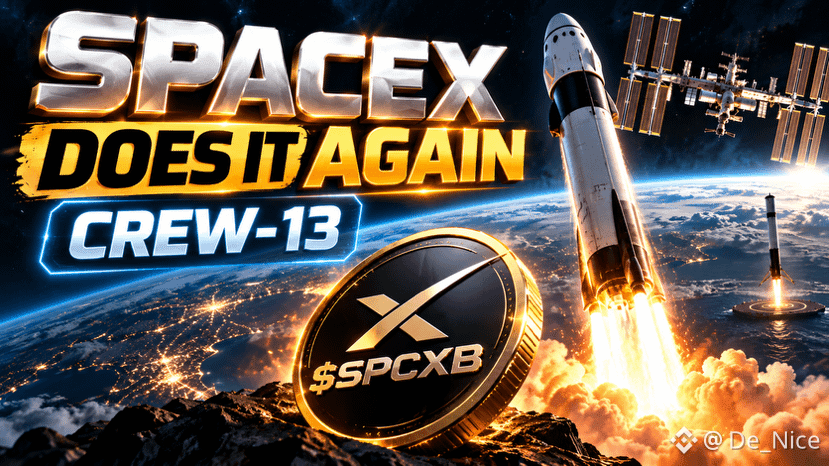
🚀 $SPCXB: SPACEX ЗНОВУ ДОСТАВЛЯЄ — CREW-13 ВЖЕ НА ОРБІТІ
SpaceX щойно додала ще один успішний запуск у свою статистику: 1 жовтня Falcon 9 відправив чотирьох астронавтів місії Crew-13 до МКС.
🔥 Crew Dragon вирушив у приблизно 8-годинну подорож до станції на висоті близько 400 км. На борту — представники NASA, Канади та Росії.
Але для бізнес-історії SpaceX цікавіше інше: перший ступінь Falcon 9 після запуску знову успішно повернувся на Землю.
Саме багаторазовість ракет залишається однією з ключових переваг SpaceX: компанія не просто запускає вантажі й людей — вона перетворила повернення дорогого обладнання на регулярну операцію.
І все це відбувається буквально через кілька днів після великого прориву Starship, який уперше вийшов на орбіту та розгорнув 26 Starlink V3.
Для $SPCXB маємо цікаву серію фундаментальних подій: Starship → Starlink → Crew-13.
📈 Bullish: стабільний темп запусків + прогрес Starship.
📉 Ризик: $SPCXB залишається токенізованою експозицією на приватну компанію, а сильні новини не гарантують зростання ціни.
Три сильні події поспіль — $SPCXB BUY чи WAIT? 👇
#spcxb #SpaceX #Starship #bStocks
{future}(SPCXUSDT)
{spot}(SPCXBUSDT)
🚀 $SPCXB : SPACEX ЗНОВУ ДОСТАВЛЯЄ — CREW-13 ВЖЕ НА ОРБІТІ
SpaceX щойно додала ще один успішний запуск у свою статистику: 1 жовтня Falcon 9 відправив чотирьох астронавтів місії Crew-13 до МКС.
🔥 Crew Dragon вирушив у приблизно 8-годинну подорож до станції на висоті близько 400 км. На борту — представники NASA, Канади та Росії.
Але для бізнес-історії SpaceX цікавіше інше: перший ступінь Falcon 9 після запуску знову успішно повернувся на Землю.
Саме багаторазовість ракет залишається однією з ключових переваг SpaceX: компанія не просто запускає вантажі й людей — вона перетворила повернення дорогого обладнання на регулярну операцію.
І все це відбувається буквально через кілька днів після великого прориву Starship, який уперше вийшов на орбіту та розгорнув 26 Starlink V3.
Для $SPCXB маємо цікаву серію фундаментальних подій: Starship → Starlink → Crew-13.
📈 Bullish: стабільний темп запусків + прогрес Starship.
📉 Ризик: $SPCXB залишається токенізованою експозицією на приватну компанію, а сильні новини не гарантують зростання ціни.
Три сильні події поспіль — $SPCXB BUY чи WAIT? 👇
#spcxb #SpaceX #Starship #bStocks
SpaceX щойно додала ще один успішний запуск у свою статистику: 1 жовтня Falcon 9 відправив чотирьох астронавтів місії Crew-13 до МКС.
🔥 Crew Dragon вирушив у приблизно 8-годинну подорож до станції на висоті близько 400 км. На борту — представники NASA, Канади та Росії.
Але для бізнес-історії SpaceX цікавіше інше: перший ступінь Falcon 9 після запуску знову успішно повернувся на Землю.
Саме багаторазовість ракет залишається однією з ключових переваг SpaceX: компанія не просто запускає вантажі й людей — вона перетворила повернення дорогого обладнання на регулярну операцію.
І все це відбувається буквально через кілька днів після великого прориву Starship, який уперше вийшов на орбіту та розгорнув 26 Starlink V3.
Для $SPCXB маємо цікаву серію фундаментальних подій: Starship → Starlink → Crew-13.
📈 Bullish: стабільний темп запусків + прогрес Starship.
📉 Ризик: $SPCXB залишається токенізованою експозицією на приватну компанію, а сильні новини не гарантують зростання ціни.
Три сильні події поспіль — $SPCXB BUY чи WAIT? 👇
#spcxb #SpaceX #Starship #bStocks
2
502
Article
SPACE X VS THE WORLD$BTC $ETH
🚀 SPACE X VS THE WORLD: THE SATELLITE INTERNET WAR IS JUST BEGINNING
Everyone talks about SpaceX for rockets.
But the bigger story may be Starlink. 🌐
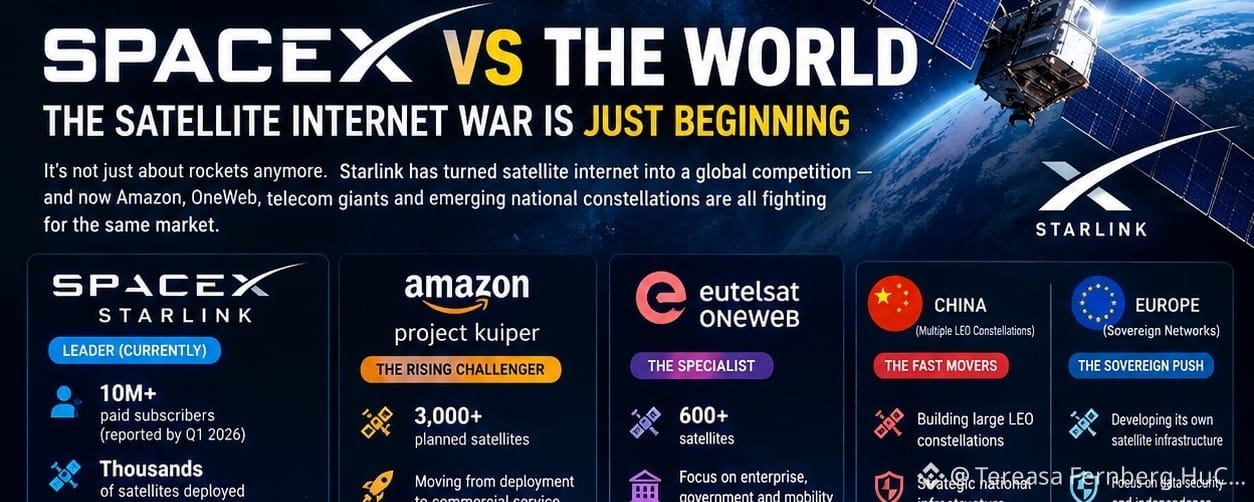
SpaceX has turned satellite internet into a global competition — and Amazon, OneWeb, telecom companies and emerging national constellations are now fighting for the same market.
📊 Here’s where the race stands:
🔹 Starlink / SpaceX
• 10M+ paid subscribers reported by Q1 2026
• Thousands of satellites already deployed
• Consumer + aviation + maritime + enterprise markets
• Expanding toward direct-to-phone connectivity
🔹 Amazon Leo (formerly Project Kuiper)
• Backed by Amazon’s enormous ecosystem
• Building a planned constellation of 3,000+ satellites
• Moving from deployment toward commercial service
• Potential advantage: AWS + enterprise customers
🔹 Eutelsat OneWeb
• 600+ satellites
• Strong focus on enterprise, government and mobility
• Different strategy from Starlink’s mass consumer model
And the competition is getting even bigger.
China is developing multiple large LEO constellations, while Europe is developing its own sovereign satellite infrastructure.
🔥 But here’s the interesting part for investors:
This isn't simply a battle over internet subscriptions.
It's potentially a battle over:
🛰️ Global connectivity
📱 Satellite-to-phone communication
✈️ In-flight internet
🚢 Maritime connectivity
🏢 Enterprise communications
🤖 AI infrastructure
🌍 Remote-area connectivity
Starlink's current scale gives SpaceX a major head start, but Amazon Leo and other networks are trying to turn that lead into a competitive race.
And yesterday, SpaceX's Starship successfully deployed its first batch of Starlink V3 satellites, designed to provide substantially more network capacity than earlier generations.
💡 The real question isn't “Who has the most satellites?”
The question is:
Who can convert satellites → customers → recurring revenue → global infrastructure?
That is the metric worth watching.
📈 And for crypto investors, there's another angle:
The companies building global digital infrastructure today could influence how billions of people connect to the internet tomorrow.
The satellite-internet race is no longer just a space story.
It's becoming a technology + telecom + AI + infrastructure story.
🚀 SpaceX vs Amazon vs OneWeb vs the next generation of LEO networks.
The competition has officially entered a new phase.
#SpaceX #BitcoinClears$85200 #USADPAdds90000JobsInSeptember
SPACE X VS THE WORLD
$BTC $ETH
🚀 SPACE X VS THE WORLD: THE SATELLITE INTERNET WAR IS JUST BEGINNING
Everyone talks about SpaceX for rockets.
But the bigger story may be Starlink. 🌐
SpaceX has turned satellite internet into a global competition — and Amazon, OneWeb, telecom companies and emerging national constellations are now fighting for the same market.
📊 Here’s where the race stands:
🔹 Starlink / SpaceX
• 10M+ paid subscribers reported by Q1 2026
• Thousands of satellites already deployed
• Consumer + aviation + maritime + enterprise markets
• Expanding toward direct-to-phone connectivity
🔹 Amazon Leo (formerly Project Kuiper)
• Backed by Amazon’s enormous ecosystem
• Building a planned constellation of 3,000+ satellites
• Moving from deployment toward commercial service
• Potential advantage: AWS + enterprise customers
🔹 Eutelsat OneWeb
• 600+ satellites
• Strong focus on enterprise, government and mobility
• Different strategy from Starlink’s mass consumer model
And the competition is getting even bigger.
China is developing multiple large LEO constellations, while Europe is developing its own sovereign satellite infrastructure.
🔥 But here’s the interesting part for investors:
This isn't simply a battle over internet subscriptions.
It's potentially a battle over:
🛰️ Global connectivity
📱 Satellite-to-phone communication
✈️ In-flight internet
🚢 Maritime connectivity
🏢 Enterprise communications
🤖 AI infrastructure
🌍 Remote-area connectivity
Starlink's current scale gives SpaceX a major head start, but Amazon Leo and other networks are trying to turn that lead into a competitive race.
And yesterday, SpaceX's Starship successfully deployed its first batch of Starlink V3 satellites, designed to provide substantially more network capacity than earlier generations.
💡 The real question isn't “Who has the most satellites?”
The question is:
Who can convert satellites → customers → recurring revenue → global infrastructure?
That is the metric worth watching.
📈 And for crypto investors, there's another angle:
The companies building global digital infrastructure today could influence how billions of people connect to the internet tomorrow.
The satellite-internet race is no longer just a space story.
It's becoming a technology + telecom + AI + infrastructure story.
🚀 SpaceX vs Amazon vs OneWeb vs the next generation of LEO networks.
The competition has officially entered a new phase.
#SpaceX #BitcoinClears$85200 #USADPAdds90000JobsInSeptember
🚀 SPACE X VS THE WORLD: THE SATELLITE INTERNET WAR IS JUST BEGINNING
Everyone talks about SpaceX for rockets.
But the bigger story may be Starlink. 🌐
SpaceX has turned satellite internet into a global competition — and Amazon, OneWeb, telecom companies and emerging national constellations are now fighting for the same market.
📊 Here’s where the race stands:
🔹 Starlink / SpaceX
• 10M+ paid subscribers reported by Q1 2026
• Thousands of satellites already deployed
• Consumer + aviation + maritime + enterprise markets
• Expanding toward direct-to-phone connectivity
🔹 Amazon Leo (formerly Project Kuiper)
• Backed by Amazon’s enormous ecosystem
• Building a planned constellation of 3,000+ satellites
• Moving from deployment toward commercial service
• Potential advantage: AWS + enterprise customers
🔹 Eutelsat OneWeb
• 600+ satellites
• Strong focus on enterprise, government and mobility
• Different strategy from Starlink’s mass consumer model
And the competition is getting even bigger.
China is developing multiple large LEO constellations, while Europe is developing its own sovereign satellite infrastructure.
🔥 But here’s the interesting part for investors:
This isn't simply a battle over internet subscriptions.
It's potentially a battle over:
🛰️ Global connectivity
📱 Satellite-to-phone communication
✈️ In-flight internet
🚢 Maritime connectivity
🏢 Enterprise communications
🤖 AI infrastructure
🌍 Remote-area connectivity
Starlink's current scale gives SpaceX a major head start, but Amazon Leo and other networks are trying to turn that lead into a competitive race.
And yesterday, SpaceX's Starship successfully deployed its first batch of Starlink V3 satellites, designed to provide substantially more network capacity than earlier generations.
💡 The real question isn't “Who has the most satellites?”
The question is:
Who can convert satellites → customers → recurring revenue → global infrastructure?
That is the metric worth watching.
📈 And for crypto investors, there's another angle:
The companies building global digital infrastructure today could influence how billions of people connect to the internet tomorrow.
The satellite-internet race is no longer just a space story.
It's becoming a technology + telecom + AI + infrastructure story.
🚀 SpaceX vs Amazon vs OneWeb vs the next generation of LEO networks.
The competition has officially entered a new phase.
#SpaceX #BitcoinClears$85200 #USADPAdds90000JobsInSeptember
85
Connectez-vous pour découvrir plus de contenu
Rejoignez la communauté mondiale des adeptes de cryptomonnaies sur Binance Square
⚡️ Suviez les dernières informations importantes sur les cryptomonnaies.
💬 Jugé digne de confiance par la plus grande plateforme d’échange de cryptomonnaies au monde.
👍 Découvrez les connaissances que partagent les créateurs vérifiés.
Adresse e-mail/Nº de téléphone
Sujets d’actualité
1
#DriftHackVictimsBeginClaims
22,515 vues
385 mentions
2
#SolanaTokenizedStockVolumeTops$4.4BInSeptember
3,705 vues
44 mentions
3
#BitcoinSpotETFsDraw$6.34BInflowsInQ3
14,041 vues
160 mentions
4
#EthereumValidatorExitQueueJumps392%
189,516 vues
1,533 mentions
5
#IMFApprovesElSalvador$138MWithBitcoinWaiver
17,972 vues
98 mentions
6
#SECHaltsCryptoETFReviewsAmidFundingLapse
320,488 vues
2,320 mentions
7
#ZcashETFPostsFirstWeeklyOutflow$93.6M
103,695 vues
269 mentions
8
#GreekPoliceBustCryptoScamRingArrest17
441,015 vues
2,902 mentions
9
#BitcoinRejectedAt$87K
238,405 vues
343 mentions
10
#FedOctoberRateHikeOddsFallTo17%
459,447 vues
3,003 mentions