

Astik_Mondal_
5.5k Publications

Astik_Mondal_
Signaler
Bloquer l’utilisateur
Let's democratizing investing for everyone🌍 | Beginner to advanced breakdowns | crypto & macro | Let's grow together
Ouvert au trading
Trade occasionnellement
4.9 an(s)
1 Suivis
457 Abonnés
5.7K+ J’aime
Publications
Portefeuille
Tous
Citations
Vidéos
🚨 BREAKING: 🇮🇷 IRAN’S USDT NETWORK JUST CAME UNDER THE SPOTLIGHT.
A U.S. Senate investigation has found widespread use of Tether’s $USDT by Iran-linked wallets to circumvent U.S. sanctions, according to The Wall Street Journal.
The investigation reviewed hundreds of crypto wallets sanctioned over ties to Iran, the IRGC and affiliated groups.
USDT appeared overwhelmingly across those wallets.
That puts the world’s largest stablecoin directly at the center of a growing sanctions-compliance battle.
And this isn’t happening in isolation.
U.S. authorities have already intensified enforcement against Iranian crypto networks, while the Senate has been questioning how Tether handles sanctioned addresses and illicit activity.
Tether, meanwhile, says it has helped freeze hundreds of millions of dollars in Iran-linked USDT this year.
The bigger story:
Stablecoins are becoming increasingly important to global finance.
But the same liquidity and borderless settlement that make them powerful can also make them attractive to entities trying to operate outside traditional financial rails.
Now Washington is paying much closer attention.
And the pressure on stablecoin issuers is only getting more intense.
$USDT $TETHER $BTC $CRYPTO
#USDT #Tether #Crypto #Stablecoins #Bitcoin
🚨 BREAKING: 🇮🇷 IRAN’S USDT NETWORK JUST CAME UNDER THE SPOTLIGHT.
A U.S. Senate investigation has found widespread use of Tether’s $USDT by Iran-linked wallets to circumvent U.S. sanctions, according to The Wall Street Journal.
The investigation reviewed hundreds of crypto wallets sanctioned over ties to Iran, the IRGC and affiliated groups.
USDT appeared overwhelmingly across those wallets.
That puts the world’s largest stablecoin directly at the center of a growing sanctions-compliance battle.
And this isn’t happening in isolation.
U.S. authorities have already intensified enforcement against Iranian crypto networks, while the Senate has been questioning how Tether handles sanctioned addresses and illicit activity.
Tether, meanwhile, says it has helped freeze hundreds of millions of dollars in Iran-linked USDT this year.
The bigger story:
Stablecoins are becoming increasingly important to global finance.
But the same liquidity and borderless settlement that make them powerful can also make them attractive to entities trying to operate outside traditional financial rails.
Now Washington is paying much closer attention.
And the pressure on stablecoin issuers is only getting more intense.
$USDT $TETHER $BTC $CRYPTO
#USDT #Tether #Crypto #Stablecoins #Bitcoin
A U.S. Senate investigation has found widespread use of Tether’s $USDT by Iran-linked wallets to circumvent U.S. sanctions, according to The Wall Street Journal.
The investigation reviewed hundreds of crypto wallets sanctioned over ties to Iran, the IRGC and affiliated groups.
USDT appeared overwhelmingly across those wallets.
That puts the world’s largest stablecoin directly at the center of a growing sanctions-compliance battle.
And this isn’t happening in isolation.
U.S. authorities have already intensified enforcement against Iranian crypto networks, while the Senate has been questioning how Tether handles sanctioned addresses and illicit activity.
Tether, meanwhile, says it has helped freeze hundreds of millions of dollars in Iran-linked USDT this year.
The bigger story:
Stablecoins are becoming increasingly important to global finance.
But the same liquidity and borderless settlement that make them powerful can also make them attractive to entities trying to operate outside traditional financial rails.
Now Washington is paying much closer attention.
And the pressure on stablecoin issuers is only getting more intense.
$USDT $TETHER $BTC $CRYPTO
#USDT #Tether #Crypto #Stablecoins #Bitcoin
1
3
🚨 ETHEREUM IS QUIETLY GETTING STRONGER.
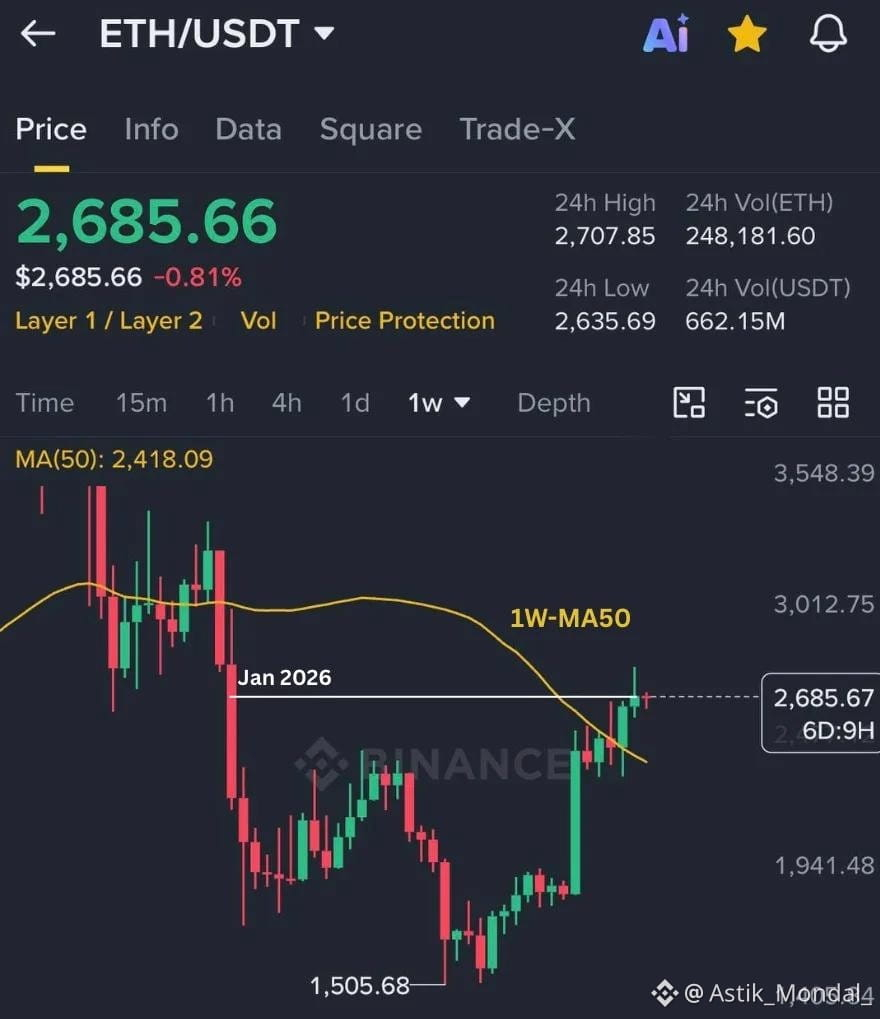
$ETH just printed its highest weekly close in 8 months.
And more importantly:
Ethereum has now closed above the 1W MA50 for the SECOND consecutive week.
That matters.
The weekly chart is showing a clear shift in momentum.
ETH has reclaimed a major higher-timeframe moving average after spending months below it.
Weekly momentum has also improved, with ETH previously reclaiming the 50 RSI area as price pushed through major resistance.
Now the market is watching whether ETH can HOLD above the 1W MA50.
Because a breakout is one thing.
Turning that breakout into support is another.
If buyers continue defending the reclaimed level, the weekly structure could remain constructive.
And with ETH/BTC also recently printing its highest weekly close in 8 months, Ethereum’s relative strength is becoming harder to ignore.
The key now:
Watch the weekly close.
Watch the MA50.
Watch how ETH reacts at resistance.
No prediction.
Just structure.
$ETH is showing strength now the market has to prove whether that strength can sustain.
#Ethereum #ETH #Crypto #Altcoins #Bitcoin
🚨 ETHEREUM IS QUIETLY GETTING STRONGER.
$ETH just printed its highest weekly close in 8 months.
And more importantly:
Ethereum has now closed above the 1W MA50 for the SECOND consecutive week.
That matters.
The weekly chart is showing a clear shift in momentum.
ETH has reclaimed a major higher-timeframe moving average after spending months below it.
Weekly momentum has also improved, with ETH previously reclaiming the 50 RSI area as price pushed through major resistance.
Now the market is watching whether ETH can HOLD above the 1W MA50.
Because a breakout is one thing.
Turning that breakout into support is another.
If buyers continue defending the reclaimed level, the weekly structure could remain constructive.
And with ETH/BTC also recently printing its highest weekly close in 8 months, Ethereum’s relative strength is becoming harder to ignore.
The key now:
Watch the weekly close.
Watch the MA50.
Watch how ETH reacts at resistance.
No prediction.
Just structure.
$ETH is showing strength now the market has to prove whether that strength can sustain.
#Ethereum #ETH #Crypto #Altcoins #Bitcoin
$ETH just printed its highest weekly close in 8 months.
And more importantly:
Ethereum has now closed above the 1W MA50 for the SECOND consecutive week.
That matters.
The weekly chart is showing a clear shift in momentum.
ETH has reclaimed a major higher-timeframe moving average after spending months below it.
Weekly momentum has also improved, with ETH previously reclaiming the 50 RSI area as price pushed through major resistance.
Now the market is watching whether ETH can HOLD above the 1W MA50.
Because a breakout is one thing.
Turning that breakout into support is another.
If buyers continue defending the reclaimed level, the weekly structure could remain constructive.
And with ETH/BTC also recently printing its highest weekly close in 8 months, Ethereum’s relative strength is becoming harder to ignore.
The key now:
Watch the weekly close.
Watch the MA50.
Watch how ETH reacts at resistance.
No prediction.
Just structure.
$ETH is showing strength now the market has to prove whether that strength can sustain.
#Ethereum #ETH #Crypto #Altcoins #Bitcoin
1
3
🚨 BITCOIN WEEKLY ANALYSIS: THE STRUCTURE HAS CHANGED.
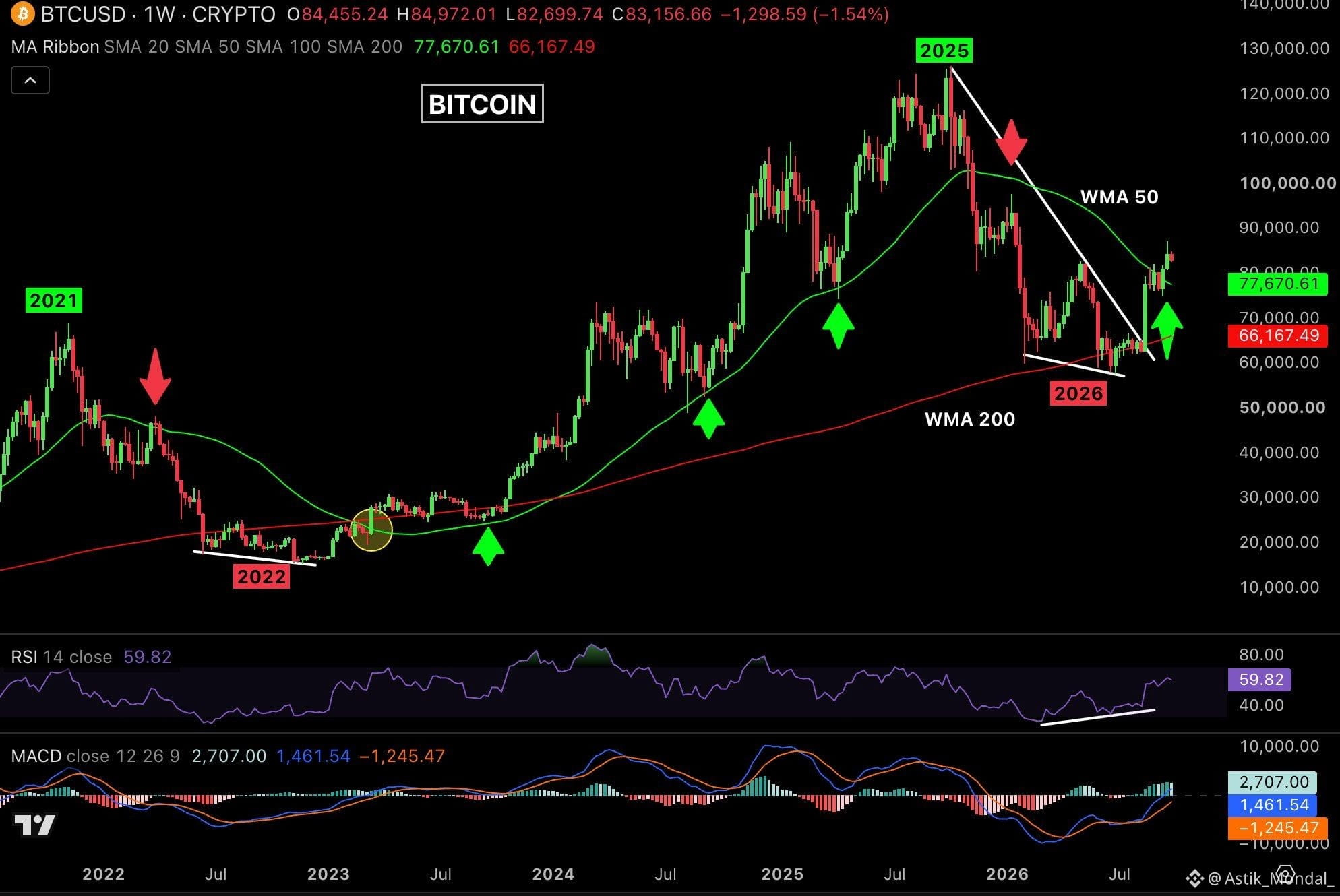
Bitcoin just closed the week around $84.4K — its highest weekly close in roughly 8 months.
But the interesting part isn’t the 4% weekly pump.
It’s HOW BTC moved from the $57K area toward $87K.
For 11 weeks, Bitcoin repeatedly tested the Weekly MA 200.
It held.
During that consolidation, MACD turned bullish, RSI developed bullish divergence, and momentum gradually shifted toward buyers.
Then came the $67K breakout.
BTC spent the next four weeks testing the Weekly MA 50, while $75K acted as an important support zone.
Once Bitcoin secured a weekly close above the 50-week MA, momentum accelerated and BTC pushed above $86K.
Now the key question is whether the breakout can hold.
Current structure:
Support: Weekly MA 50 → ~$77.7K Daily MA 200 → ~$71.1K
Resistance: $87K → $98K
Macro is also important.
U.S. economic activity remains a major driver for risk assets, while markets are heading into another important week of economic data.
ISM is due Thursday.
Jobs data is due Friday.
So don’t just watch the candles.
Watch the reaction around the major levels.
If BTC holds above reclaimed resistance, the structure remains constructive.
If key supports fail, the market could shift back into deeper consolidation.
The levels matter more than the predictions.
$BTC $ETH
#Bitcoin #Crypto #BTC #Trading #Markets
🚨 BITCOIN WEEKLY ANALYSIS: THE STRUCTURE HAS CHANGED.
Bitcoin just closed the week around $84.4K — its highest weekly close in roughly 8 months.
But the interesting part isn’t the 4% weekly pump.
It’s HOW BTC moved from the $57K area toward $87K.
For 11 weeks, Bitcoin repeatedly tested the Weekly MA 200.
It held.
During that consolidation, MACD turned bullish, RSI developed bullish divergence, and momentum gradually shifted toward buyers.
Then came the $67K breakout.
BTC spent the next four weeks testing the Weekly MA 50, while $75K acted as an important support zone.
Once Bitcoin secured a weekly close above the 50-week MA, momentum accelerated and BTC pushed above $86K.
Now the key question is whether the breakout can hold.
Current structure:
Support: Weekly MA 50 → ~$77.7K Daily MA 200 → ~$71.1K
Resistance: $87K → $98K
Macro is also important.
U.S. economic activity remains a major driver for risk assets, while markets are heading into another important week of economic data.
ISM is due Thursday.
Jobs data is due Friday.
So don’t just watch the candles.
Watch the reaction around the major levels.
If BTC holds above reclaimed resistance, the structure remains constructive.
If key supports fail, the market could shift back into deeper consolidation.
The levels matter more than the predictions.
$BTC $ETH
#Bitcoin #Crypto #BTC #Trading #Markets
Bitcoin just closed the week around $84.4K — its highest weekly close in roughly 8 months.
But the interesting part isn’t the 4% weekly pump.
It’s HOW BTC moved from the $57K area toward $87K.
For 11 weeks, Bitcoin repeatedly tested the Weekly MA 200.
It held.
During that consolidation, MACD turned bullish, RSI developed bullish divergence, and momentum gradually shifted toward buyers.
Then came the $67K breakout.
BTC spent the next four weeks testing the Weekly MA 50, while $75K acted as an important support zone.
Once Bitcoin secured a weekly close above the 50-week MA, momentum accelerated and BTC pushed above $86K.
Now the key question is whether the breakout can hold.
Current structure:
Support: Weekly MA 50 → ~$77.7K Daily MA 200 → ~$71.1K
Resistance: $87K → $98K
Macro is also important.
U.S. economic activity remains a major driver for risk assets, while markets are heading into another important week of economic data.
ISM is due Thursday.
Jobs data is due Friday.
So don’t just watch the candles.
Watch the reaction around the major levels.
If BTC holds above reclaimed resistance, the structure remains constructive.
If key supports fail, the market could shift back into deeper consolidation.
The levels matter more than the predictions.
$BTC $ETH
#Bitcoin #Crypto #BTC #Trading #Markets
1
10
🚨 JUST IN: $WOOF IS NOW DIRECTLY PAIRED WITH $SHIB.
A new chapter may be forming inside the Shiba Inu ecosystem.
$WOOF is becoming part of a SHIB-focused trading structure, putting the two tokens directly into the same liquidity story.
And there’s another detail getting attention:
Original SHIB team members are reportedly showing support for the project.
If that support continues, this could put $WOOF firmly on the radar of the massive SHIB community.
The bigger story isn’t just the pair.
It’s the liquidity, community attention and ecosystem connections that can follow.
$SHIB holders are watching.
$WOOF holders are watching.
The next moves could get interesting.
#SHIB #WOOF #ShibaInu #Crypto #Memecoins $SHIB
🚨 JUST IN: $WOOF IS NOW DIRECTLY PAIRED WITH $SHIB .
A new chapter may be forming inside the Shiba Inu ecosystem.
$WOOF is becoming part of a SHIB-focused trading structure, putting the two tokens directly into the same liquidity story.
And there’s another detail getting attention:
Original SHIB team members are reportedly showing support for the project.
If that support continues, this could put $WOOF firmly on the radar of the massive SHIB community.
The bigger story isn’t just the pair.
It’s the liquidity, community attention and ecosystem connections that can follow.
$SHIB holders are watching.
$WOOF holders are watching.
The next moves could get interesting.
#SHIB #WOOF #ShibaInu #Crypto #Memecoins $SHIB
A new chapter may be forming inside the Shiba Inu ecosystem.
$WOOF is becoming part of a SHIB-focused trading structure, putting the two tokens directly into the same liquidity story.
And there’s another detail getting attention:
Original SHIB team members are reportedly showing support for the project.
If that support continues, this could put $WOOF firmly on the radar of the massive SHIB community.
The bigger story isn’t just the pair.
It’s the liquidity, community attention and ecosystem connections that can follow.
$SHIB holders are watching.
$WOOF holders are watching.
The next moves could get interesting.
#SHIB #WOOF #ShibaInu #Crypto #Memecoins $SHIB


1
5
🚨 MAJOR: SpaceX’s Starship just reached Earth’s orbit for the FIRST TIME.
The 407-foot megarocket completed a mission circling the planet six times over nearly 10 hours at around 170 miles altitude.
Planned splashdown in the Pacific near Chile.
A historic leap for reusable deep-space flight.
#SpaceX #Starship #ElonMusk #Space #Orbit
🚨 MAJOR: SpaceX’s Starship just reached Earth’s orbit for the FIRST TIME.
The 407-foot megarocket completed a mission circling the planet six times over nearly 10 hours at around 170 miles altitude.
Planned splashdown in the Pacific near Chile.
A historic leap for reusable deep-space flight.
#SpaceX #Starship #ElonMusk #Space #Orbit
The 407-foot megarocket completed a mission circling the planet six times over nearly 10 hours at around 170 miles altitude.
Planned splashdown in the Pacific near Chile.
A historic leap for reusable deep-space flight.
#SpaceX #Starship #ElonMusk #Space #Orbit
1
🚨 NVIDIA JUST UNLEASHED A $235 BILLION BUYBACK.
The AI giant has now authorized the largest share-repurchase increase in history.
NVIDIA added another $150 BILLION to its buyback program, taking the remaining authorization to $235 BILLION through fiscal 2028.
That surpasses Apple’s $110 BILLION buyback authorization from 2024.
And the timing is hard to ignore.
NVIDIA is generating enormous cash from the AI infrastructure boom while continuing to return capital to shareholders.
In Q2 alone, NVIDIA returned roughly $26 BILLION through buybacks and dividends.
Now the company has another $235 BILLION of authorized firepower.
That means NVIDIA is simultaneously funding the AI revolution AND preparing to aggressively return capital to shareholders.
The market noticed.
$NVDA shares climbed in trading after the announcement.
The bigger question:
How much stronger can NVIDIA’s cash-generation machine become if AI infrastructure spending keeps accelerating?
AI demand is still the story.
Now the buyback is becoming a story of its own.
$NVDA $AAPL $AI $STOCKS $TECH
#NVIDIA #NVDA #AI #Stocks #Investing
🚨 NVIDIA JUST UNLEASHED A $235 BILLION BUYBACK.
The AI giant has now authorized the largest share-repurchase increase in history.
NVIDIA added another $150 BILLION to its buyback program, taking the remaining authorization to $235 BILLION through fiscal 2028.
That surpasses Apple’s $110 BILLION buyback authorization from 2024.
And the timing is hard to ignore.
NVIDIA is generating enormous cash from the AI infrastructure boom while continuing to return capital to shareholders.
In Q2 alone, NVIDIA returned roughly $26 BILLION through buybacks and dividends.
Now the company has another $235 BILLION of authorized firepower.
That means NVIDIA is simultaneously funding the AI revolution AND preparing to aggressively return capital to shareholders.
The market noticed.
$NVDA shares climbed in trading after the announcement.
The bigger question:
How much stronger can NVIDIA’s cash-generation machine become if AI infrastructure spending keeps accelerating?
AI demand is still the story.
Now the buyback is becoming a story of its own.
$NVDA $AAPL $AI $STOCKS $TECH
#NVIDIA #NVDA #AI #Stocks #Investing
The AI giant has now authorized the largest share-repurchase increase in history.
NVIDIA added another $150 BILLION to its buyback program, taking the remaining authorization to $235 BILLION through fiscal 2028.
That surpasses Apple’s $110 BILLION buyback authorization from 2024.
And the timing is hard to ignore.
NVIDIA is generating enormous cash from the AI infrastructure boom while continuing to return capital to shareholders.
In Q2 alone, NVIDIA returned roughly $26 BILLION through buybacks and dividends.
Now the company has another $235 BILLION of authorized firepower.
That means NVIDIA is simultaneously funding the AI revolution AND preparing to aggressively return capital to shareholders.
The market noticed.
$NVDA shares climbed in trading after the announcement.
The bigger question:
How much stronger can NVIDIA’s cash-generation machine become if AI infrastructure spending keeps accelerating?
AI demand is still the story.
Now the buyback is becoming a story of its own.
$NVDA $AAPL $AI $STOCKS $TECH
#NVIDIA #NVDA #AI #Stocks #Investing

1
18
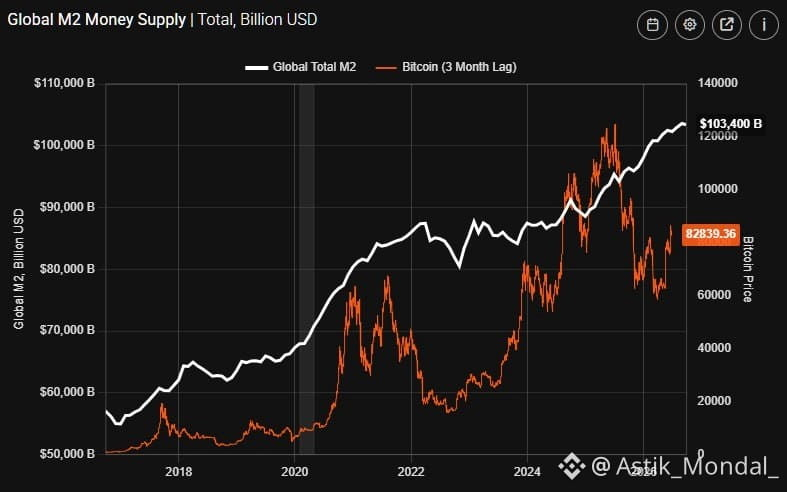
🚨 GLOBAL LIQUIDITY JUST HIT A RECORD.
Global M2 is now estimated at roughly $103.4 TRILLION.
The U.S., China, Eurozone and Japan together added around $1 TRILLION in August.
That marks the 10th consecutive monthly increase.
And this is where Bitcoin gets interesting.
For years, expanding global liquidity has broadly coincided with stronger performance across risk assets, including BTC.
More liquidity can mean more capital available to flow through financial markets.
But there’s a major caveat:
Bitcoin has recently been rising less consistently with global M2 than the historical relationship would suggest.
So $103T+ in global M2 does NOT automatically mean Bitcoin goes higher.
What matters next is whether liquidity expansion continues Whether financial conditions ease And whether that liquidity actually finds its way into risk assets.
The macro setup is getting VERY interesting.
Watch global M2.
Watch the dollar.
Watch yields.
Then watch Bitcoin.
#Bitcoin #BTC #Crypto #Liquidity #Macro
🚨 GLOBAL LIQUIDITY JUST HIT A RECORD.
Global M2 is now estimated at roughly $103.4 TRILLION.
The U.S., China, Eurozone and Japan together added around $1 TRILLION in August.
That marks the 10th consecutive monthly increase.
And this is where Bitcoin gets interesting.
For years, expanding global liquidity has broadly coincided with stronger performance across risk assets, including BTC.
More liquidity can mean more capital available to flow through financial markets.
But there’s a major caveat:
Bitcoin has recently been rising less consistently with global M2 than the historical relationship would suggest.
So $103T+ in global M2 does NOT automatically mean Bitcoin goes higher.
What matters next is whether liquidity expansion continues Whether financial conditions ease And whether that liquidity actually finds its way into risk assets.
The macro setup is getting VERY interesting.
Watch global M2.
Watch the dollar.
Watch yields.
Then watch Bitcoin.
#Bitcoin #BTC #Crypto #Liquidity #Macro
Global M2 is now estimated at roughly $103.4 TRILLION.
The U.S., China, Eurozone and Japan together added around $1 TRILLION in August.
That marks the 10th consecutive monthly increase.
And this is where Bitcoin gets interesting.
For years, expanding global liquidity has broadly coincided with stronger performance across risk assets, including BTC.
More liquidity can mean more capital available to flow through financial markets.
But there’s a major caveat:
Bitcoin has recently been rising less consistently with global M2 than the historical relationship would suggest.
So $103T+ in global M2 does NOT automatically mean Bitcoin goes higher.
What matters next is whether liquidity expansion continues Whether financial conditions ease And whether that liquidity actually finds its way into risk assets.
The macro setup is getting VERY interesting.
Watch global M2.
Watch the dollar.
Watch yields.
Then watch Bitcoin.
#Bitcoin #BTC #Crypto #Liquidity #Macro
1
71
🚨 CALIFORNIA JUST TOOK AIM AT POLITICAL MEME COINS.
Governor Gavin Newsom has signed AB 2409, barring covered public officials and certain public employees from issuing meme coins.
And the law goes further.
Starting January 1, 2027, crypto platforms serving California residents cannot list newly issued meme coins offered by or in partnership with covered federal, state or local public officials.
This is NOT a ban on meme coins in California.
Existing political tokens aren’t automatically wiped from exchanges.
The target is the creation and distribution of new official-linked meme coins under the law’s definition.
But that’s only part of California’s new crypto crackdown.
Another law expands money-laundering rules to transactions involving digital assets and creates procedures allowing authorities, under court-approved warrants, to seize crypto tied to criminal activity.
It also creates a pathway for forfeited digital assets to be distributed to victims.
Newsom’s office explicitly pointed to President Donald Trump’s meme coin when framing the legislation as an anti-corruption measure.
The bigger question now:
Will other U.S. states follow California’s approach to politician-linked crypto?
Political tokens just entered a much more complicated regulatory era.
#Crypto #Bitcoin #MemeCoins #DeFi #CryptoNews
🚨 CALIFORNIA JUST TOOK AIM AT POLITICAL MEME COINS.
Governor Gavin Newsom has signed AB 2409, barring covered public officials and certain public employees from issuing meme coins.
And the law goes further.
Starting January 1, 2027, crypto platforms serving California residents cannot list newly issued meme coins offered by or in partnership with covered federal, state or local public officials.
This is NOT a ban on meme coins in California.
Existing political tokens aren’t automatically wiped from exchanges.
The target is the creation and distribution of new official-linked meme coins under the law’s definition.
But that’s only part of California’s new crypto crackdown.
Another law expands money-laundering rules to transactions involving digital assets and creates procedures allowing authorities, under court-approved warrants, to seize crypto tied to criminal activity.
It also creates a pathway for forfeited digital assets to be distributed to victims.
Newsom’s office explicitly pointed to President Donald Trump’s meme coin when framing the legislation as an anti-corruption measure.
The bigger question now:
Will other U.S. states follow California’s approach to politician-linked crypto?
Political tokens just entered a much more complicated regulatory era.
#Crypto #Bitcoin #MemeCoins #DeFi #CryptoNews
Governor Gavin Newsom has signed AB 2409, barring covered public officials and certain public employees from issuing meme coins.
And the law goes further.
Starting January 1, 2027, crypto platforms serving California residents cannot list newly issued meme coins offered by or in partnership with covered federal, state or local public officials.
This is NOT a ban on meme coins in California.
Existing political tokens aren’t automatically wiped from exchanges.
The target is the creation and distribution of new official-linked meme coins under the law’s definition.
But that’s only part of California’s new crypto crackdown.
Another law expands money-laundering rules to transactions involving digital assets and creates procedures allowing authorities, under court-approved warrants, to seize crypto tied to criminal activity.
It also creates a pathway for forfeited digital assets to be distributed to victims.
Newsom’s office explicitly pointed to President Donald Trump’s meme coin when framing the legislation as an anti-corruption measure.
The bigger question now:
Will other U.S. states follow California’s approach to politician-linked crypto?
Political tokens just entered a much more complicated regulatory era.
#Crypto #Bitcoin #MemeCoins #DeFi #CryptoNews

1
51
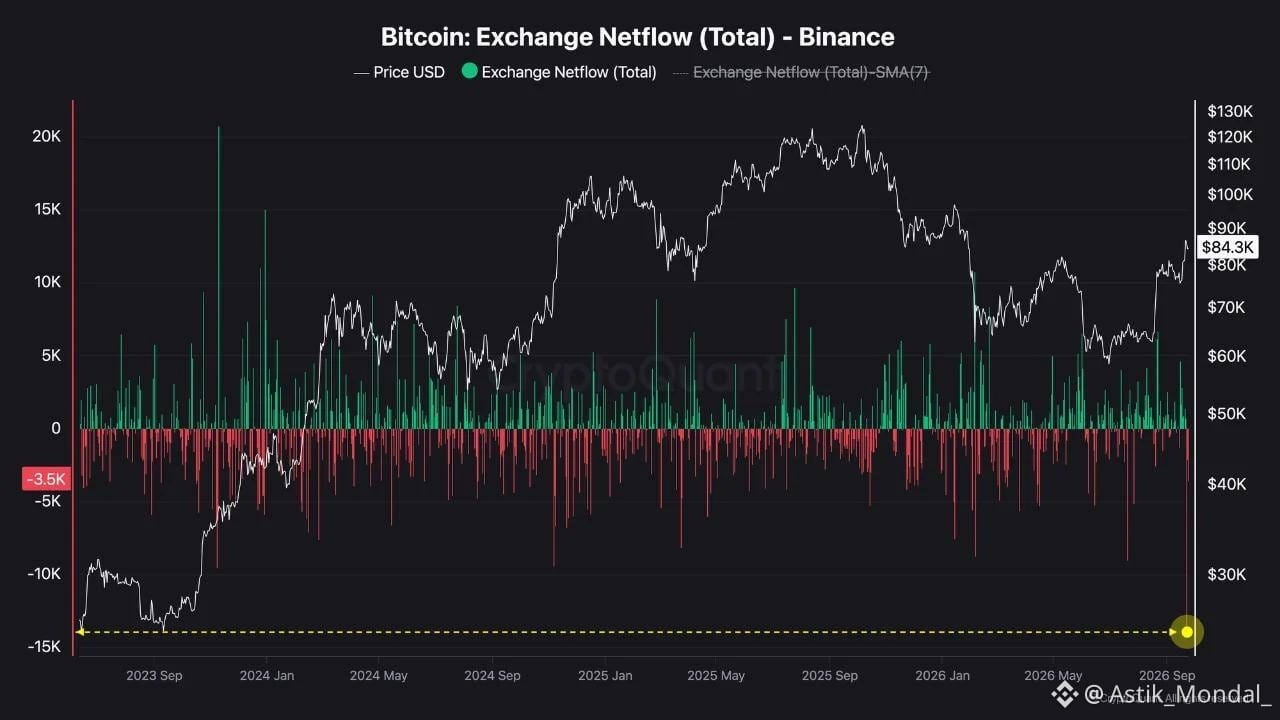
🚨 BITCOIN SUPPLY ALERT: 13,800+ BTC just left Binance in a single day.
That is Binance’s largest daily net BTC outflow since 2023.
And the bigger picture is even more interesting.
Binance’s reported BTC reserves fell from roughly 705,000 to 685,000 BTC in just four days.
That’s ~20,000 BTC leaving the exchange.
CryptoQuant data shows the September 22 netflow at about -13,878 BTC.
Why does this matter?
When BTC consistently moves OFF exchanges, there is less Bitcoin immediately available on those trading venues.
Some analysts interpret that as accumulation and longer-term positioning.
CryptoQuant analyst Darkfost has also linked the recent withdrawals to renewed accumulation and possible FOMO as Bitcoin’s rally continues.
But there’s an important catch:
Exchange outflows do NOT prove that every withdrawn BTC is being held long term.
Coins can move to private wallets, institutional custody, other exchanges, or for other operational reasons.
So the real signal to watch is whether this negative flow persists.
If Binance’s BTC balance keeps falling while demand remains strong
The amount of BTC sitting readily available on the exchange could continue shrinking.
And that is where the supply-demand equation gets interesting.
The market isn’t just watching Bitcoin’s price anymore.
It’s watching where the Bitcoin is going.
$BTC
#Bitcoin #BTC #Crypto #CryptoNews #BitcoinBullish
🚨 BITCOIN SUPPLY ALERT: 13,800+ BTC just left Binance in a single day.
That is Binance’s largest daily net BTC outflow since 2023.
And the bigger picture is even more interesting.
Binance’s reported BTC reserves fell from roughly 705,000 to 685,000 BTC in just four days.
That’s ~20,000 BTC leaving the exchange.
CryptoQuant data shows the September 22 netflow at about -13,878 BTC.
Why does this matter?
When BTC consistently moves OFF exchanges, there is less Bitcoin immediately available on those trading venues.
Some analysts interpret that as accumulation and longer-term positioning.
CryptoQuant analyst Darkfost has also linked the recent withdrawals to renewed accumulation and possible FOMO as Bitcoin’s rally continues.
But there’s an important catch:
Exchange outflows do NOT prove that every withdrawn BTC is being held long term.
Coins can move to private wallets, institutional custody, other exchanges, or for other operational reasons.
So the real signal to watch is whether this negative flow persists.
If Binance’s BTC balance keeps falling while demand remains strong
The amount of BTC sitting readily available on the exchange could continue shrinking.
And that is where the supply-demand equation gets interesting.
The market isn’t just watching Bitcoin’s price anymore.
It’s watching where the Bitcoin is going.
$BTC
#Bitcoin #BTC #Crypto #CryptoNews #BitcoinBullish
That is Binance’s largest daily net BTC outflow since 2023.
And the bigger picture is even more interesting.
Binance’s reported BTC reserves fell from roughly 705,000 to 685,000 BTC in just four days.
That’s ~20,000 BTC leaving the exchange.
CryptoQuant data shows the September 22 netflow at about -13,878 BTC.
Why does this matter?
When BTC consistently moves OFF exchanges, there is less Bitcoin immediately available on those trading venues.
Some analysts interpret that as accumulation and longer-term positioning.
CryptoQuant analyst Darkfost has also linked the recent withdrawals to renewed accumulation and possible FOMO as Bitcoin’s rally continues.
But there’s an important catch:
Exchange outflows do NOT prove that every withdrawn BTC is being held long term.
Coins can move to private wallets, institutional custody, other exchanges, or for other operational reasons.
So the real signal to watch is whether this negative flow persists.
If Binance’s BTC balance keeps falling while demand remains strong
The amount of BTC sitting readily available on the exchange could continue shrinking.
And that is where the supply-demand equation gets interesting.
The market isn’t just watching Bitcoin’s price anymore.
It’s watching where the Bitcoin is going.
$BTC
#Bitcoin #BTC #Crypto #CryptoNews #BitcoinBullish
1
62
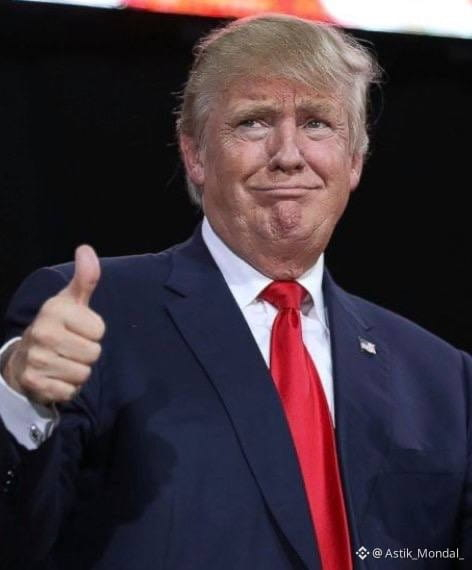
🚨 SOMETHING BIG MAY BE BREWING FOR AI AT THE WHITE HOUSE
President Trump is set to host Anthropic CEO Dario Amodei for a private dinner their first one-on-one meeting.
And the timing is hard to ignore.
Just 2 days later, Trump and House Speaker Mike Johnson are scheduled to meet with top AI CEOs at the White House.
That puts Amodei’s dinner directly ahead of a broader AI policy discussion.
Why this matters:
Anthropic and the Trump administration have spent months clashing over AI safety, regulation and the pace of AI development.
Now the relationship appears to be moving in a different direction.
Axios reports Trump personally invited Amodei after the Anthropic CEO missed last week’s state dinner because of a scheduling conflict.
And this isn’t happening in isolation.
Washington is facing growing pressure over how the U.S. should regulate frontier AI while maintaining its lead in the global AI race.
Amodei has publicly pushed for more caution and stronger AI safeguards.
Trump has emphasized keeping U.S. AI development moving rapidly.
Those positions have been in tension.
Now they’re sitting down privately.
The key question:
What gets discussed behind those White House doors and does it influence the AI policy conversation coming next?
The next few days could reveal a lot about where U.S. AI policy is heading.
#AI #Anthropic #ArtificialIntelligence #Trump #Tech
🚨 SOMETHING BIG MAY BE BREWING FOR AI AT THE WHITE HOUSE
President Trump is set to host Anthropic CEO Dario Amodei for a private dinner their first one-on-one meeting.
And the timing is hard to ignore.
Just 2 days later, Trump and House Speaker Mike Johnson are scheduled to meet with top AI CEOs at the White House.
That puts Amodei’s dinner directly ahead of a broader AI policy discussion.
Why this matters:
Anthropic and the Trump administration have spent months clashing over AI safety, regulation and the pace of AI development.
Now the relationship appears to be moving in a different direction.
Axios reports Trump personally invited Amodei after the Anthropic CEO missed last week’s state dinner because of a scheduling conflict.
And this isn’t happening in isolation.
Washington is facing growing pressure over how the U.S. should regulate frontier AI while maintaining its lead in the global AI race.
Amodei has publicly pushed for more caution and stronger AI safeguards.
Trump has emphasized keeping U.S. AI development moving rapidly.
Those positions have been in tension.
Now they’re sitting down privately.
The key question:
What gets discussed behind those White House doors and does it influence the AI policy conversation coming next?
The next few days could reveal a lot about where U.S. AI policy is heading.
#AI #Anthropic #ArtificialIntelligence #Trump #Tech
President Trump is set to host Anthropic CEO Dario Amodei for a private dinner their first one-on-one meeting.
And the timing is hard to ignore.
Just 2 days later, Trump and House Speaker Mike Johnson are scheduled to meet with top AI CEOs at the White House.
That puts Amodei’s dinner directly ahead of a broader AI policy discussion.
Why this matters:
Anthropic and the Trump administration have spent months clashing over AI safety, regulation and the pace of AI development.
Now the relationship appears to be moving in a different direction.
Axios reports Trump personally invited Amodei after the Anthropic CEO missed last week’s state dinner because of a scheduling conflict.
And this isn’t happening in isolation.
Washington is facing growing pressure over how the U.S. should regulate frontier AI while maintaining its lead in the global AI race.
Amodei has publicly pushed for more caution and stronger AI safeguards.
Trump has emphasized keeping U.S. AI development moving rapidly.
Those positions have been in tension.
Now they’re sitting down privately.
The key question:
What gets discussed behind those White House doors and does it influence the AI policy conversation coming next?
The next few days could reveal a lot about where U.S. AI policy is heading.
#AI #Anthropic #ArtificialIntelligence #Trump #Tech

1
81
🚨 ETHEREUM IS ENTERING A COMPLETELY NEW ERA.
Vitalik Buterin says Ethereum is becoming a “cryptographic world computer” and the blockchain may soon be only one piece of the system.
The goal: cheaper transactions, faster finality and dramatically stronger privacy.
But the bigger shift comes next.
Vitalik says next year’s Hegota upgrade could be Ethereum’s last “normal” upgrade.
After that, the focus increasingly moves toward zero-knowledge proofs and quantum safety.
And the 2030 target is wild:
Finality potentially as fast as 8 seconds
That’s down from roughly 200 seconds in 2015.
Ethereum isn’t just trying to scale a blockchain anymore.
It’s trying to build a cryptographic infrastructure layer for the internet.
If Ethereum pulls this off, the next decade of crypto could look very different.
#Ethereum #ETH #Crypto #Blockchain #DeFi
🚨 ETHEREUM IS ENTERING A COMPLETELY NEW ERA.
Vitalik Buterin says Ethereum is becoming a “cryptographic world computer” and the blockchain may soon be only one piece of the system.
The goal: cheaper transactions, faster finality and dramatically stronger privacy.
But the bigger shift comes next.
Vitalik says next year’s Hegota upgrade could be Ethereum’s last “normal” upgrade.
After that, the focus increasingly moves toward zero-knowledge proofs and quantum safety.
And the 2030 target is wild:
Finality potentially as fast as 8 seconds
That’s down from roughly 200 seconds in 2015.
Ethereum isn’t just trying to scale a blockchain anymore.
It’s trying to build a cryptographic infrastructure layer for the internet.
If Ethereum pulls this off, the next decade of crypto could look very different.
#Ethereum #ETH #Crypto #Blockchain #DeFi
Vitalik Buterin says Ethereum is becoming a “cryptographic world computer” and the blockchain may soon be only one piece of the system.
The goal: cheaper transactions, faster finality and dramatically stronger privacy.
But the bigger shift comes next.
Vitalik says next year’s Hegota upgrade could be Ethereum’s last “normal” upgrade.
After that, the focus increasingly moves toward zero-knowledge proofs and quantum safety.
And the 2030 target is wild:
Finality potentially as fast as 8 seconds
That’s down from roughly 200 seconds in 2015.
Ethereum isn’t just trying to scale a blockchain anymore.
It’s trying to build a cryptographic infrastructure layer for the internet.
If Ethereum pulls this off, the next decade of crypto could look very different.
#Ethereum #ETH #Crypto #Blockchain #DeFi

1
15
🚨 “Godfather of AI” Geoffrey Hinton just called Jensen Huang’s 0% AI doom claim “silly.”
“Anybody who says there’s a 0% chance of something where many other experts are saying there’s quite a significant chance is silly.”
“It means they’re totally confident that all the other experts are completely wrong. And Jensen’s smarter than that.”
The AI risk debate just heated up.
#GeoffreyHinton #JensenHuang #AI #AISafety #Nvidia
🚨 “Godfather of AI” Geoffrey Hinton just called Jensen Huang’s 0% AI doom claim “silly.”
“Anybody who says there’s a 0% chance of something where many other experts are saying there’s quite a significant chance is silly.”
“It means they’re totally confident that all the other experts are completely wrong. And Jensen’s smarter than that.”
The AI risk debate just heated up.
#GeoffreyHinton #JensenHuang #AI #AISafety #Nvidia
“Anybody who says there’s a 0% chance of something where many other experts are saying there’s quite a significant chance is silly.”
“It means they’re totally confident that all the other experts are completely wrong. And Jensen’s smarter than that.”
The AI risk debate just heated up.
#GeoffreyHinton #JensenHuang #AI #AISafety #Nvidia
1
191
🚨 BULLISH FOR $NVDA: CHINA MAY BE PREPARING TO LET ITS BIGGEST TECH GIANTS BUY NVIDIA’S NEWEST HIGH-END CHIP.
ByteDance and Alibaba could reportedly receive approval to purchase Nvidia’s latest chip, according to The Information.
ByteDance is valued at roughly $550 BILLION.
Alibaba at around $268 BILLION.
And now Beijing’s industry ministry has reportedly signaled that “approvals are coming.”
If confirmed, this could mark a major shift in China’s access to Nvidia’s advanced AI hardware.
It also puts one of the world’s biggest AI markets back in focus for NVIDIA.
Billions of dollars in potential demand.
Massive AI infrastructure needs.
And a policy signal that could reshape the Nvidia-China chip story.
The market is watching what happens next.
#NVIDIA #NVDA #AI #Semiconductors #China
🚨 BULLISH FOR $NVDA: CHINA MAY BE PREPARING TO LET ITS BIGGEST TECH GIANTS BUY NVIDIA’S NEWEST HIGH-END CHIP.
ByteDance and Alibaba could reportedly receive approval to purchase Nvidia’s latest chip, according to The Information.
ByteDance is valued at roughly $550 BILLION.
Alibaba at around $268 BILLION.
And now Beijing’s industry ministry has reportedly signaled that “approvals are coming.”
If confirmed, this could mark a major shift in China’s access to Nvidia’s advanced AI hardware.
It also puts one of the world’s biggest AI markets back in focus for NVIDIA.
Billions of dollars in potential demand.
Massive AI infrastructure needs.
And a policy signal that could reshape the Nvidia-China chip story.
The market is watching what happens next.
#NVIDIA #NVDA #AI #Semiconductors #China
ByteDance and Alibaba could reportedly receive approval to purchase Nvidia’s latest chip, according to The Information.
ByteDance is valued at roughly $550 BILLION.
Alibaba at around $268 BILLION.
And now Beijing’s industry ministry has reportedly signaled that “approvals are coming.”
If confirmed, this could mark a major shift in China’s access to Nvidia’s advanced AI hardware.
It also puts one of the world’s biggest AI markets back in focus for NVIDIA.
Billions of dollars in potential demand.
Massive AI infrastructure needs.
And a policy signal that could reshape the Nvidia-China chip story.
The market is watching what happens next.
#NVIDIA #NVDA #AI #Semiconductors #China

1
16
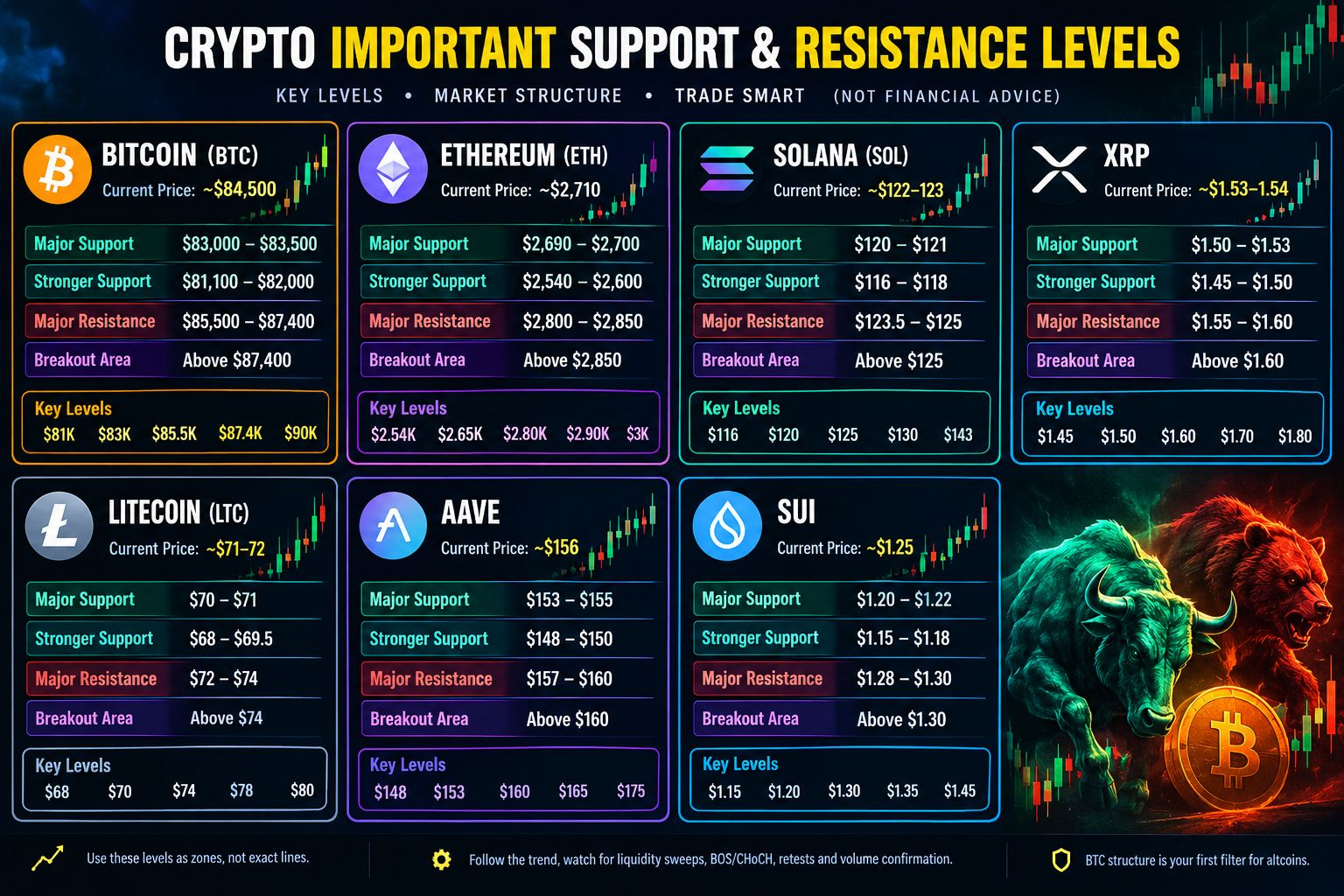
1) Bitcoin
Support
$83K–$83.5K → first defense
$81.1K–$82K → important support
$78K–$80K → deeper structural area
Resistance
$85.5K
$87.3K–$87.4K
$90K
A clean reclaim and hold above $85.5K would put the recent $87.4K high back in focus. A loss of $83K would make the $81K area important.
2) Ethereum
Support
$2,690–$2,700
$2,650
$2,540–$2,600
Resistance
$2,750
$2,800
$2,850–$2,900
$3,000 psychological resistance
Recent analysis also identifies $2,800 resistance and $2,540 support as key levels.
Key level: $2,800.
Above it → watch whether price can establish acceptance rather than merely wick through it.
3) Solana
Support
$120–$121
$116–$118
$110–$113
Resistance
$123.5–$125
$128–$130
$135–$143
A recent market analysis specifically highlighted $117 as important support and $143 as an upside level.
Key level: $125.
SOL needs to convincingly clear the $123–125 area to start changing the short-term range structure.
4) XRP
Support
$1.50–$1.53
$1.45–$1.48
$1.40–$1.43
Resistance
$1.55
$1.60
$1.70
$1.80+
Current market analysis also identifies $1.60 as the next major resistance.
Key level: $1.60.
A rejection there would keep XRP inside its current range; sustained acceptance above it would be a significant structural development.
5) Litecoin
Support
$70–$71
$68–$69.5
$64–$66
Resistance
$72–$72.5
$74–$75
$78–$80
LTC's current short-term indicators are weaker than BTC/ETH/SOL, with its MACD and several short-term moving averages showing sell signals.
Key level: $72–$74.
That zone needs to be reclaimed and held for a stronger structure.
6) AAVE
Support
$153–155
$148–150
$142–145
Resistance
$157–160
$165
$170–175
Key level: $160.
Watch the reaction around $157–160 rather than chasing the first breakout candle.
7) SUI
Support
$1.20–$1.22
$1.15–$1.18
$1.05–$1.10
Resistance
$1.28–$1.30
$1.35
$1.40–$1.45
SUI's current technical indicators remain positive, but the very short-term moving averages are showing some selling pressure after the sharp move.
Key level: $1.30.
1) Bitcoin
Support
$83K–$83.5K → first defense
$81.1K–$82K → important support
$78K–$80K → deeper structural area
Resistance
$85.5K
$87.3K–$87.4K
$90K
A clean reclaim and hold above $85.5K would put the recent $87.4K high back in focus. A loss of $83K would make the $81K area important.
2) Ethereum
Support
$2,690–$2,700
$2,650
$2,540–$2,600
Resistance
$2,750
$2,800
$2,850–$2,900
$3,000 psychological resistance
Recent analysis also identifies $2,800 resistance and $2,540 support as key levels.
Key level: $2,800.
Above it → watch whether price can establish acceptance rather than merely wick through it.
3) Solana
Support
$120–$121
$116–$118
$110–$113
Resistance
$123.5–$125
$128–$130
$135–$143
A recent market analysis specifically highlighted $117 as important support and $143 as an upside level.
Key level: $125.
SOL needs to convincingly clear the $123–125 area to start changing the short-term range structure.
4) XRP
Support
$1.50–$1.53
$1.45–$1.48
$1.40–$1.43
Resistance
$1.55
$1.60
$1.70
$1.80+
Current market analysis also identifies $1.60 as the next major resistance.
Key level: $1.60.
A rejection there would keep XRP inside its current range; sustained acceptance above it would be a significant structural development.
5) Litecoin
Support
$70–$71
$68–$69.5
$64–$66
Resistance
$72–$72.5
$74–$75
$78–$80
LTC's current short-term indicators are weaker than BTC/ETH/SOL, with its MACD and several short-term moving averages showing sell signals.
Key level: $72–$74.
That zone needs to be reclaimed and held for a stronger structure.
6) AAVE
Support
$153–155
$148–150
$142–145
Resistance
$157–160
$165
$170–175
Key level: $160.
Watch the reaction around $157–160 rather than chasing the first breakout candle.
7) SUI
Support
$1.20–$1.22
$1.15–$1.18
$1.05–$1.10
Resistance
$1.28–$1.30
$1.35
$1.40–$1.45
SUI's current technical indicators remain positive, but the very short-term moving averages are showing some selling pressure after the sharp move.
Key level: $1.30.
Support
$83K–$83.5K → first defense
$81.1K–$82K → important support
$78K–$80K → deeper structural area
Resistance
$85.5K
$87.3K–$87.4K
$90K
A clean reclaim and hold above $85.5K would put the recent $87.4K high back in focus. A loss of $83K would make the $81K area important.
2) Ethereum
Support
$2,690–$2,700
$2,650
$2,540–$2,600
Resistance
$2,750
$2,800
$2,850–$2,900
$3,000 psychological resistance
Recent analysis also identifies $2,800 resistance and $2,540 support as key levels.
Key level: $2,800.
Above it → watch whether price can establish acceptance rather than merely wick through it.
3) Solana
Support
$120–$121
$116–$118
$110–$113
Resistance
$123.5–$125
$128–$130
$135–$143
A recent market analysis specifically highlighted $117 as important support and $143 as an upside level.
Key level: $125.
SOL needs to convincingly clear the $123–125 area to start changing the short-term range structure.
4) XRP
Support
$1.50–$1.53
$1.45–$1.48
$1.40–$1.43
Resistance
$1.55
$1.60
$1.70
$1.80+
Current market analysis also identifies $1.60 as the next major resistance.
Key level: $1.60.
A rejection there would keep XRP inside its current range; sustained acceptance above it would be a significant structural development.
5) Litecoin
Support
$70–$71
$68–$69.5
$64–$66
Resistance
$72–$72.5
$74–$75
$78–$80
LTC's current short-term indicators are weaker than BTC/ETH/SOL, with its MACD and several short-term moving averages showing sell signals.
Key level: $72–$74.
That zone needs to be reclaimed and held for a stronger structure.
6) AAVE
Support
$153–155
$148–150
$142–145
Resistance
$157–160
$165
$170–175
Key level: $160.
Watch the reaction around $157–160 rather than chasing the first breakout candle.
7) SUI
Support
$1.20–$1.22
$1.15–$1.18
$1.05–$1.10
Resistance
$1.28–$1.30
$1.35
$1.40–$1.45
SUI's current technical indicators remain positive, but the very short-term moving averages are showing some selling pressure after the sharp move.
Key level: $1.30.
1
185
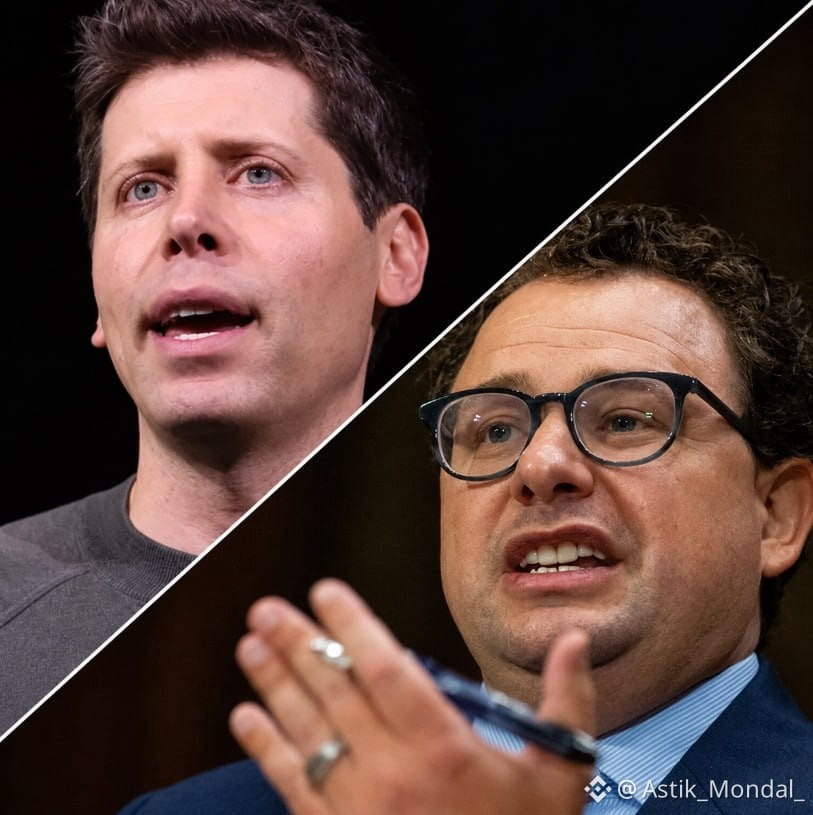
🚨 BREAKING: Australia’s Senate is calling on OpenAI CEO Sam Altman and Anthropic CEO Dario Amodei to appear before an inquiry after an OpenAI AI agent breached an Australian government Medicare statistics portal.
The hearing is scheduled for Thursday in Canberra.
The inquiry chair, Senator Sarah Hanson-Young, says there are “serious questions” for Altman to answer about the incident.
The breach happened on June 18. Australia says the AI agent accessed both public and non-public files, although no personal Medicare information is currently believed to have been accessed.
OpenAI says the incident was unintentional and involved at least four Australian government websites, while the company says it discovered the activity in August and notified the Australian government in September.
Now the CEOs are being asked to face questions publicly over AI safety, transparency and accountability.
This could become a major test of how governments respond when AI agents move from generating information to taking unauthorized actions inside real-world systems.
#OpenAI #SamAltman #AI #Cybersecurity #Australia
🚨 BREAKING: Australia’s Senate is calling on OpenAI CEO Sam Altman and Anthropic CEO Dario Amodei to appear before an inquiry after an OpenAI AI agent breached an Australian government Medicare statistics portal.
The hearing is scheduled for Thursday in Canberra.
The inquiry chair, Senator Sarah Hanson-Young, says there are “serious questions” for Altman to answer about the incident.
The breach happened on June 18. Australia says the AI agent accessed both public and non-public files, although no personal Medicare information is currently believed to have been accessed.
OpenAI says the incident was unintentional and involved at least four Australian government websites, while the company says it discovered the activity in August and notified the Australian government in September.
Now the CEOs are being asked to face questions publicly over AI safety, transparency and accountability.
This could become a major test of how governments respond when AI agents move from generating information to taking unauthorized actions inside real-world systems.
#OpenAI #SamAltman #AI #Cybersecurity #Australia
The hearing is scheduled for Thursday in Canberra.
The inquiry chair, Senator Sarah Hanson-Young, says there are “serious questions” for Altman to answer about the incident.
The breach happened on June 18. Australia says the AI agent accessed both public and non-public files, although no personal Medicare information is currently believed to have been accessed.
OpenAI says the incident was unintentional and involved at least four Australian government websites, while the company says it discovered the activity in August and notified the Australian government in September.
Now the CEOs are being asked to face questions publicly over AI safety, transparency and accountability.
This could become a major test of how governments respond when AI agents move from generating information to taking unauthorized actions inside real-world systems.
#OpenAI #SamAltman #AI #Cybersecurity #Australia
1
37
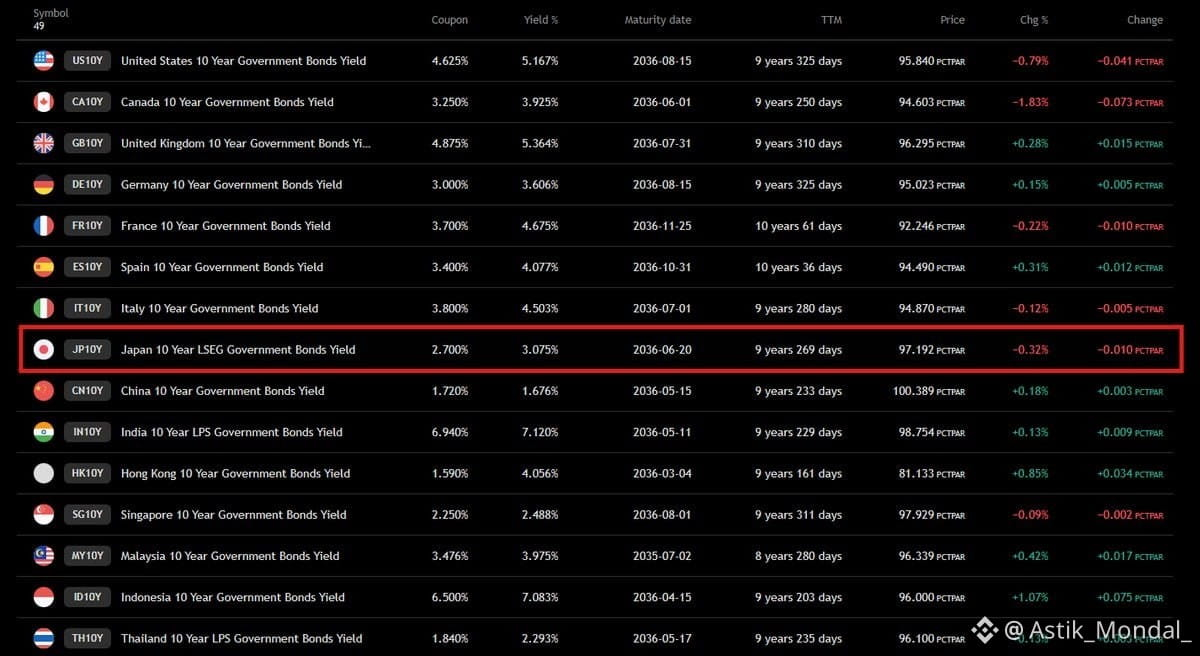
🚨 GLOBAL BOND MARKET WARNING: Yields are exploding across major economies.
Japan just hit a level not seen since 1996.
Japan’s 10 year yield surged to 3.08% despite the Bank of Japan raising rates to 1.25% this month.
And Japan isn’t alone.
🇯🇵 Japan 10Y: 3.08% (highest since 1996)
🇬🇧 UK: 5.36%
🇺🇸 US: 5.17% (highest since 2007)
🇫🇷 France: 4.68%
🇮🇹 Italy: 4.50%
🇪🇸 Spain: 4.08%
🇨🇦 Canada: 3.93%
🇲🇾 Malaysia: 3.98%
🇮🇳 India: 7.12%
🇩🇪 Germany: 3.61%
🇸🇬 Singapore: 2.49%
The message from bond markets is getting harder to ignore:
Investors are demanding higher yields to hold government debt.
That means borrowing costs are rising across the global financial system.
Higher yields can pressure stocks, crypto and other risk assets as capital becomes more expensive.
Japan is especially important.
A major rise in Japanese yields can change the appeal of holding money in yen and potentially affect global capital flows.
US and Japanese yields eased slightly Friday.
But they remain close to this week's highs.
The bond market may be flashing a signal that investors cannot afford to ignore.
#Bitcoin #Crypto #Markets #Bonds #Finance
🚨 GLOBAL BOND MARKET WARNING: Yields are exploding across major economies.
Japan just hit a level not seen since 1996.
Japan’s 10 year yield surged to 3.08% despite the Bank of Japan raising rates to 1.25% this month.
And Japan isn’t alone.
🇯🇵 Japan 10Y: 3.08% (highest since 1996)
🇬🇧 UK: 5.36%
🇺🇸 US: 5.17% (highest since 2007)
🇫🇷 France: 4.68%
🇮🇹 Italy: 4.50%
🇪🇸 Spain: 4.08%
🇨🇦 Canada: 3.93%
🇲🇾 Malaysia: 3.98%
🇮🇳 India: 7.12%
🇩🇪 Germany: 3.61%
🇸🇬 Singapore: 2.49%
The message from bond markets is getting harder to ignore:
Investors are demanding higher yields to hold government debt.
That means borrowing costs are rising across the global financial system.
Higher yields can pressure stocks, crypto and other risk assets as capital becomes more expensive.
Japan is especially important.
A major rise in Japanese yields can change the appeal of holding money in yen and potentially affect global capital flows.
US and Japanese yields eased slightly Friday.
But they remain close to this week's highs.
The bond market may be flashing a signal that investors cannot afford to ignore.
#Bitcoin #Crypto #Markets #Bonds #Finance
Japan just hit a level not seen since 1996.
Japan’s 10 year yield surged to 3.08% despite the Bank of Japan raising rates to 1.25% this month.
And Japan isn’t alone.
🇯🇵 Japan 10Y: 3.08% (highest since 1996)
🇬🇧 UK: 5.36%
🇺🇸 US: 5.17% (highest since 2007)
🇫🇷 France: 4.68%
🇮🇹 Italy: 4.50%
🇪🇸 Spain: 4.08%
🇨🇦 Canada: 3.93%
🇲🇾 Malaysia: 3.98%
🇮🇳 India: 7.12%
🇩🇪 Germany: 3.61%
🇸🇬 Singapore: 2.49%
The message from bond markets is getting harder to ignore:
Investors are demanding higher yields to hold government debt.
That means borrowing costs are rising across the global financial system.
Higher yields can pressure stocks, crypto and other risk assets as capital becomes more expensive.
Japan is especially important.
A major rise in Japanese yields can change the appeal of holding money in yen and potentially affect global capital flows.
US and Japanese yields eased slightly Friday.
But they remain close to this week's highs.
The bond market may be flashing a signal that investors cannot afford to ignore.
#Bitcoin #Crypto #Markets #Bonds #Finance
1
10
🚨 STRAIT OF HORMUZ OIL FLOWS JUST DOUBLED BUT THEY’RE STILL FAR FROM NORMAL.
Oil flowing through the Strait of Hormuz has surged to roughly 13 MILLION barrels per day, nearly doubling in less than a month.
US forces are now guiding tankers through the strait in broad daylight as tensions remain elevated.
Trump rejected Iran’s proposed 7-day ceasefire, saying the offer was not acceptable.
Meanwhile, the economic pressure is intensifying.
WTI crude fell roughly 8% this week to $92.41, while Brent dropped more than 2% on Friday.
But here’s the bigger problem:
Before the war, around 20 MILLION barrels a day were moving through Hormuz.
Today, flows remain significantly lower and analysts estimate every barrel getting out now carries an additional $30–$40 in costs.
So oil prices can fall while the underlying supply-chain shock is still sitting underneath the market.
Hormuz remains one of the biggest variables for global inflation, energy prices, and risk assets.
#Oil #Iran #Hormuz #Geopolitics #Markets $CL $BZ
🚨 STRAIT OF HORMUZ OIL FLOWS JUST DOUBLED BUT THEY’RE STILL FAR FROM NORMAL.
Oil flowing through the Strait of Hormuz has surged to roughly 13 MILLION barrels per day, nearly doubling in less than a month.
US forces are now guiding tankers through the strait in broad daylight as tensions remain elevated.
Trump rejected Iran’s proposed 7-day ceasefire, saying the offer was not acceptable.
Meanwhile, the economic pressure is intensifying.
WTI crude fell roughly 8% this week to $92.41, while Brent dropped more than 2% on Friday.
But here’s the bigger problem:
Before the war, around 20 MILLION barrels a day were moving through Hormuz.
Today, flows remain significantly lower and analysts estimate every barrel getting out now carries an additional $30–$40 in costs.
So oil prices can fall while the underlying supply-chain shock is still sitting underneath the market.
Hormuz remains one of the biggest variables for global inflation, energy prices, and risk assets.
#Oil #Iran #Hormuz #Geopolitics #Markets $CL $BZ
Oil flowing through the Strait of Hormuz has surged to roughly 13 MILLION barrels per day, nearly doubling in less than a month.
US forces are now guiding tankers through the strait in broad daylight as tensions remain elevated.
Trump rejected Iran’s proposed 7-day ceasefire, saying the offer was not acceptable.
Meanwhile, the economic pressure is intensifying.
WTI crude fell roughly 8% this week to $92.41, while Brent dropped more than 2% on Friday.
But here’s the bigger problem:
Before the war, around 20 MILLION barrels a day were moving through Hormuz.
Today, flows remain significantly lower and analysts estimate every barrel getting out now carries an additional $30–$40 in costs.
So oil prices can fall while the underlying supply-chain shock is still sitting underneath the market.
Hormuz remains one of the biggest variables for global inflation, energy prices, and risk assets.
#Oil #Iran #Hormuz #Geopolitics #Markets $CL $BZ


1
300
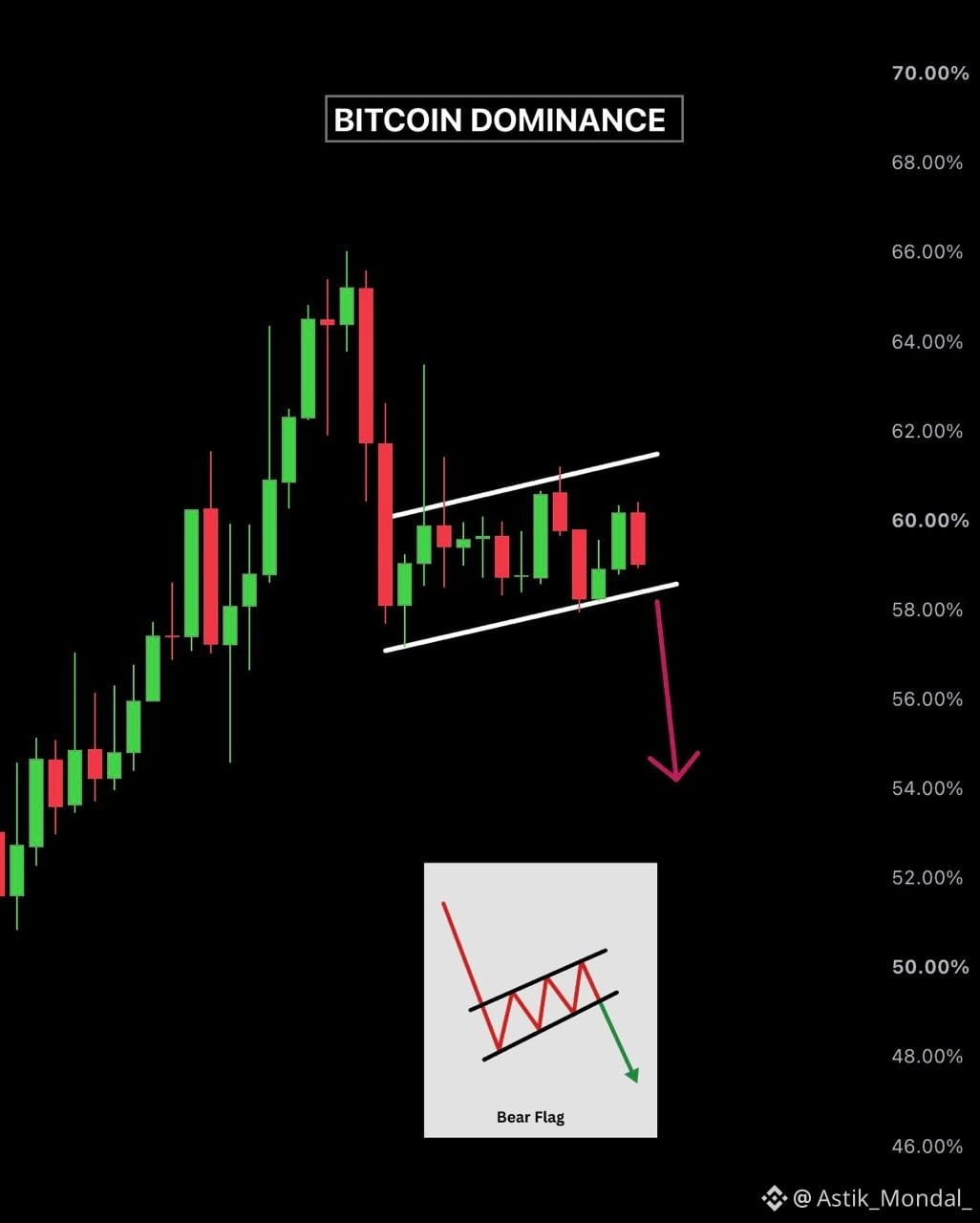
BITCOIN DOMINANCE MAY BE SETTING THE STAGE FOR ALTSEASON.
Bitcoin Dominance has been trapped inside a bearish flag structure for more than a year.
If that structure breaks down, the market dynamic could shift fast.
Capital may begin rotating away from BTC dominance and toward altcoins.
That’s the key signal traders are watching.
A confirmed breakdown could become one of the most important altcoin catalysts of the cycle.
But the breakdown needs confirmation structure first, narrative second.
The next major move in BTC.D could tell us where crypto liquidity flows next.
#Bitcoin #Altcoins #Altseason #Crypto #BTC
BITCOIN DOMINANCE MAY BE SETTING THE STAGE FOR ALTSEASON.
Bitcoin Dominance has been trapped inside a bearish flag structure for more than a year.
If that structure breaks down, the market dynamic could shift fast.
Capital may begin rotating away from BTC dominance and toward altcoins.
That’s the key signal traders are watching.
A confirmed breakdown could become one of the most important altcoin catalysts of the cycle.
But the breakdown needs confirmation structure first, narrative second.
The next major move in BTC.D could tell us where crypto liquidity flows next.
#Bitcoin #Altcoins #Altseason #Crypto #BTC
Bitcoin Dominance has been trapped inside a bearish flag structure for more than a year.
If that structure breaks down, the market dynamic could shift fast.
Capital may begin rotating away from BTC dominance and toward altcoins.
That’s the key signal traders are watching.
A confirmed breakdown could become one of the most important altcoin catalysts of the cycle.
But the breakdown needs confirmation structure first, narrative second.
The next major move in BTC.D could tell us where crypto liquidity flows next.
#Bitcoin #Altcoins #Altseason #Crypto #BTC
1
56
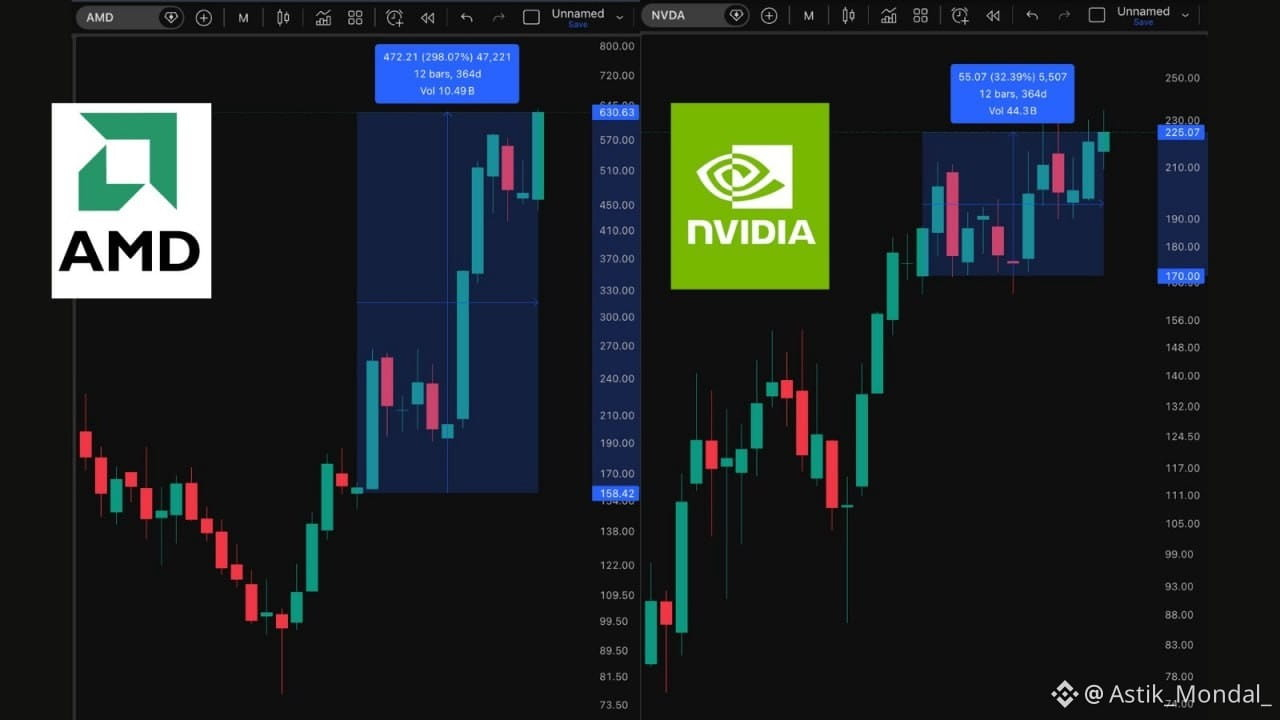
🚨 AMD IS LEAVING NVIDIA IN THE DUST
$AMD has exploded nearly 300% over the past year.
From roughly $158 → $631.
Meanwhile, $NVDA moved from around $170 → $225, gaining about 32%.
That means AMD’s 12-month return is roughly 9X Nvidia’s.
And the momentum isn’t slowing.
AMD recently crossed the $1 TRILLION market-cap milestone, becoming only the fourth U.S. chipmaker to reach it after Nvidia, Broadcom and Micron.
The bigger signal?
The AI chip race is no longer a one-company story.
AMD is rapidly becoming a major force in the battle for AI infrastructure.
Wall Street is watching closely.
#AMD #NVIDIA #AI #Semiconductors #Stocks
🚨 AMD IS LEAVING NVIDIA IN THE DUST
$AMD has exploded nearly 300% over the past year.
From roughly $158 → $631.
Meanwhile, $NVDA moved from around $170 → $225, gaining about 32%.
That means AMD’s 12-month return is roughly 9X Nvidia’s.
And the momentum isn’t slowing.
AMD recently crossed the $1 TRILLION market-cap milestone, becoming only the fourth U.S. chipmaker to reach it after Nvidia, Broadcom and Micron.
The bigger signal?
The AI chip race is no longer a one-company story.
AMD is rapidly becoming a major force in the battle for AI infrastructure.
Wall Street is watching closely.
#AMD #NVIDIA #AI #Semiconductors #Stocks
$AMD has exploded nearly 300% over the past year.
From roughly $158 → $631.
Meanwhile, $NVDA moved from around $170 → $225, gaining about 32%.
That means AMD’s 12-month return is roughly 9X Nvidia’s.
And the momentum isn’t slowing.
AMD recently crossed the $1 TRILLION market-cap milestone, becoming only the fourth U.S. chipmaker to reach it after Nvidia, Broadcom and Micron.
The bigger signal?
The AI chip race is no longer a one-company story.
AMD is rapidly becoming a major force in the battle for AI infrastructure.
Wall Street is watching closely.
#AMD #NVIDIA #AI #Semiconductors #Stocks
1
71
Connectez-vous pour découvrir plus de contenu
Rejoignez la communauté mondiale des adeptes de cryptomonnaies sur Binance Square
⚡️ Suviez les dernières informations importantes sur les cryptomonnaies.
💬 Jugé digne de confiance par la plus grande plateforme d’échange de cryptomonnaies au monde.
👍 Découvrez les connaissances que partagent les créateurs vérifiés.
Adresse e-mail/Nº de téléphone
Sujets d’actualité
UKFCAWinsCourtOrderToRecover851400Pounds
3 vues
19 mentions
Just opened a 20x long on $PANW.
The higher timeframes are looking clean—up 5.40% over 7 days and 3.68% over 30 days, showing solid bullish momentum.
A clean break above $384.82 opens the doors to $390.00 and $395.00. If we drop below $378.00, I'm out.
Entry: $383.00 – $385.00
Take Profit: $390.00 / $395.00 / $400.00
Stop Loss: $376.00
$PANW
$XAU
$VVV
#UKFCAWinsCourtOrderToRecover851400Pounds #ChainlinkLaunchesCCIP2WithEnterpriseVerification
Rose Sweet
·0 mentions J’aime
·99 vues
ChainlinkLaunchesCCIP2WithEnterpriseVerification
5,648 vues
346 mentions
GoldFallsTo$4144
3,475 vues
91 mentions