

#fed
fed
20.1M vues
29,656 mentions
Populaire
Récents


·
--
Haussier
Vérifié
$WLD
{spot}(WLDUSDT)
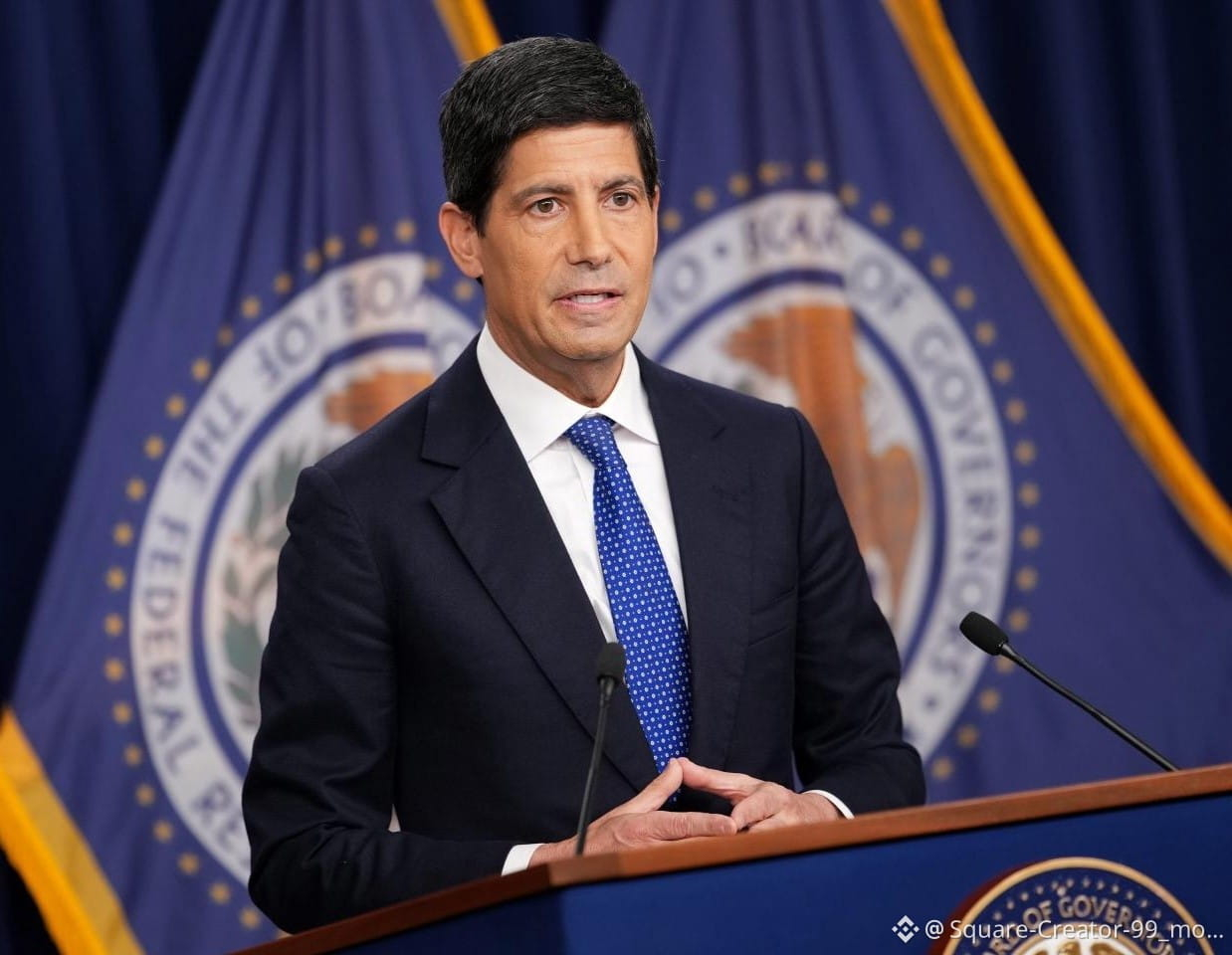
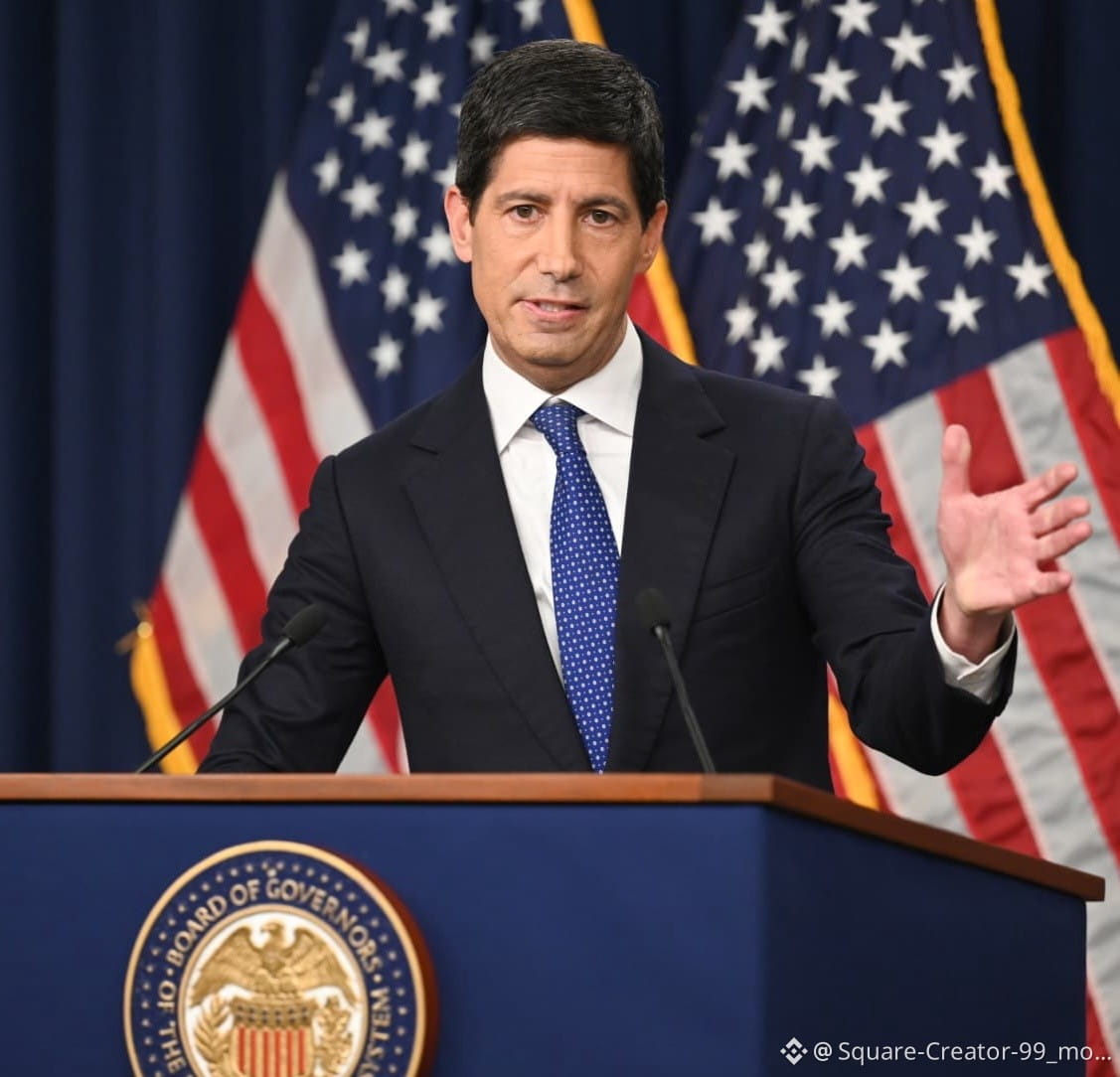
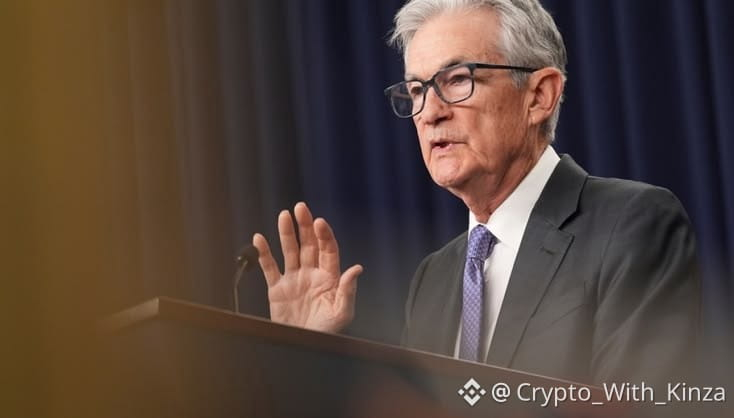
Federal Reserve Chair Kevin Warsh has adopted a markedly different communicative approach compared to June and July
He took fewer questions and delivered noticeably shorter, more focused responses, steering well clear of lengthy details or drawn-out explanations
$NEAR
{spot}(NEARUSDT)
This shift reflects a clear move towards brevity and precision, letting the decision itself—specifically the interest rate hike—carry the primary message to the markets and investors
Rather than over-explaining, Warsh is sticking strictly to the core points, cutting through the ambiguity and enhancing the clarity of monetary policy
$SUI
{spot}(SUIUSDT)
It appears this strategy is aimed at bolstering the central bank's credibility by relying on actions rather than words, ensuring the actual decision speaks far louder than any additional commentary
#FedProposesPaymentStablecoinRules #Fed #KevinWarshLeadsFederalRese
$WLD
Federal Reserve Chair Kevin Warsh has adopted a markedly different communicative approach compared to June and July
He took fewer questions and delivered noticeably shorter, more focused responses, steering well clear of lengthy details or drawn-out explanations
$NEAR
This shift reflects a clear move towards brevity and precision, letting the decision itself—specifically the interest rate hike—carry the primary message to the markets and investors
Rather than over-explaining, Warsh is sticking strictly to the core points, cutting through the ambiguity and enhancing the clarity of monetary policy
$SUI
It appears this strategy is aimed at bolstering the central bank's credibility by relying on actions rather than words, ensuring the actual decision speaks far louder than any additional commentary
#FedProposesPaymentStablecoinRules #Fed #KevinWarshLeadsFederalRese
Federal Reserve Chair Kevin Warsh has adopted a markedly different communicative approach compared to June and July
He took fewer questions and delivered noticeably shorter, more focused responses, steering well clear of lengthy details or drawn-out explanations
$NEAR
This shift reflects a clear move towards brevity and precision, letting the decision itself—specifically the interest rate hike—carry the primary message to the markets and investors
Rather than over-explaining, Warsh is sticking strictly to the core points, cutting through the ambiguity and enhancing the clarity of monetary policy
$SUI
It appears this strategy is aimed at bolstering the central bank's credibility by relying on actions rather than words, ensuring the actual decision speaks far louder than any additional commentary
#FedProposesPaymentStablecoinRules #Fed #KevinWarshLeadsFederalRese
206 Atlas:
Warsh’s brevity doesn’t make WLD bullish. The -11% price action contradicts your thesis.
1
1
4.9k

·
--
Haussier
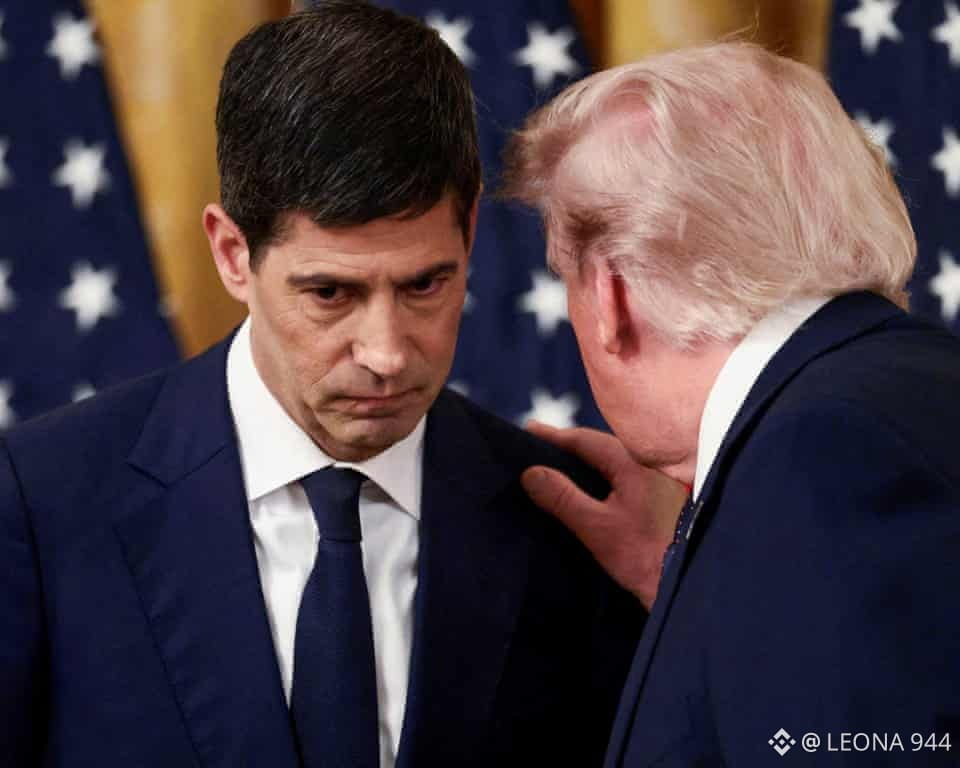
🚨 BREAKING TODAY: New Fed Chair Kevin Warsh Faces Critical Test at Jackson Hole!
Fed Chair Warsh under pressure as inflation fears mount and US bond market bleeds!
Investors waiting for his speech at Jackson Hole for rate cut signals - will he give the market a comfort blanket or trigger more volatility?
Trump's spending + Iran war fears = Bond sell-off getting worse
Meanwhile Binance Top Gems pumping:
$SUI $ENA $LINK $AVAX $SOL $HBAR $XRP $CRV $celo $ICP
Volatility Opportunity for gems
#Fed #JacksonHole #KevinWarsh
🚨 BREAKING TODAY: New Fed Chair Kevin Warsh Faces Critical Test at Jackson Hole!
Fed Chair Warsh under pressure as inflation fears mount and US bond market bleeds!
Investors waiting for his speech at Jackson Hole for rate cut signals - will he give the market a comfort blanket or trigger more volatility?
Trump's spending + Iran war fears = Bond sell-off getting worse
Meanwhile Binance Top Gems pumping:
$SUI $ENA $LINK $AVAX $SOL $HBAR $XRP $CRV $celo $ICP
Volatility Opportunity for gems
#Fed #JacksonHole #KevinWarsh
Fed Chair Warsh under pressure as inflation fears mount and US bond market bleeds!
Investors waiting for his speech at Jackson Hole for rate cut signals - will he give the market a comfort blanket or trigger more volatility?
Trump's spending + Iran war fears = Bond sell-off getting worse
Meanwhile Binance Top Gems pumping:
$SUI $ENA $LINK $AVAX $SOL $HBAR $XRP $CRV $celo $ICP
Volatility Opportunity for gems
#Fed #JacksonHole #KevinWarsh
1
104

·
--
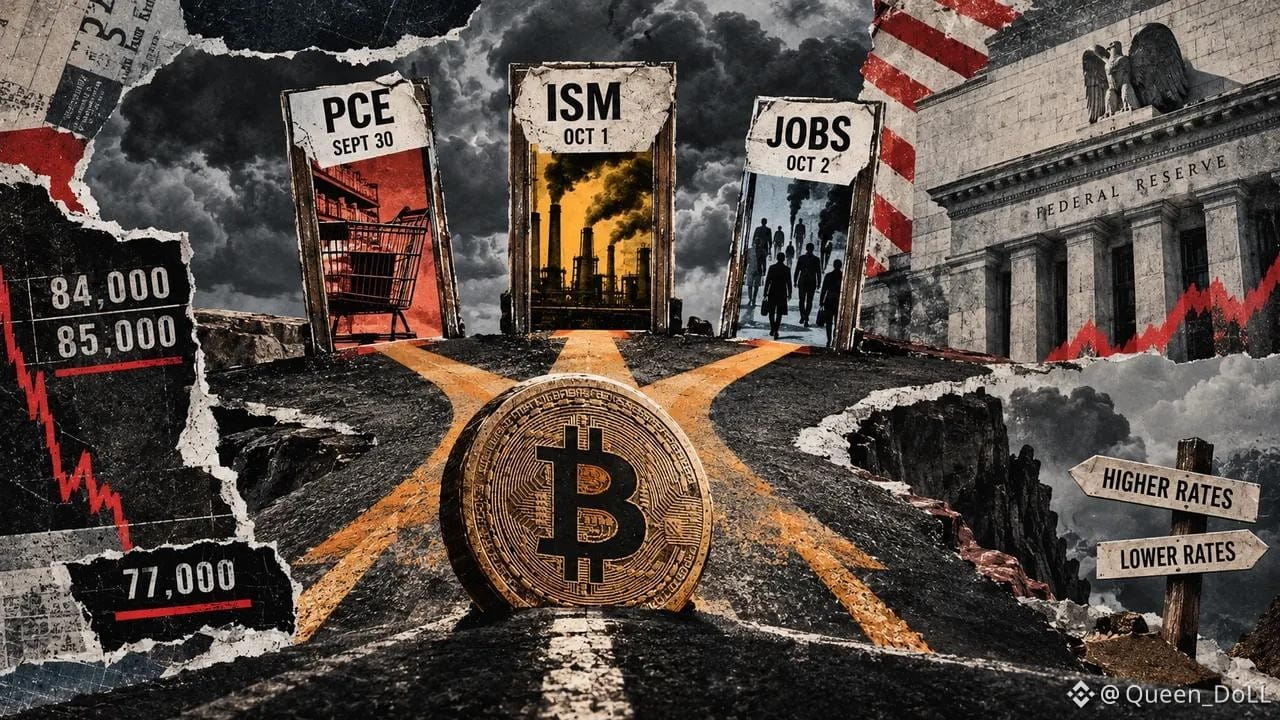
🔥 BTC HAS TWO MACRO TESTS IN 48 HOURS
Bitcoin could get a major volatility trigger from the next two US data releases.
The Sept. 30 PCE report will show August inflation. If the numbers come in softer than expected, BTC could react positively as traders price in a more supportive Fed path.
But the story doesn’t end there.
On Oct. 1, ISM Manufacturing brings September data, including newer signals from factory costs, fuel and freight pressures that PCE won’t capture yet.
So we could see a soft PCE reaction push BTC higher, only for that move to face pressure if ISM points toward rising cost inflation and higher Treasury yields.
For me, the key isn’t just the headline number.
It’s how yields and Fed expectations react after both reports.
$QNT $NMR $BTC
#Bitcoin #BTC #CryptoMarket #Fed #cryptotrading
🔥 BTC HAS TWO MACRO TESTS IN 48 HOURS
Bitcoin could get a major volatility trigger from the next two US data releases.
The Sept. 30 PCE report will show August inflation. If the numbers come in softer than expected, BTC could react positively as traders price in a more supportive Fed path.
But the story doesn’t end there.
On Oct. 1, ISM Manufacturing brings September data, including newer signals from factory costs, fuel and freight pressures that PCE won’t capture yet.
So we could see a soft PCE reaction push BTC higher, only for that move to face pressure if ISM points toward rising cost inflation and higher Treasury yields.
For me, the key isn’t just the headline number.
It’s how yields and Fed expectations react after both reports.
$QNT $NMR $BTC
#Bitcoin #BTC #CryptoMarket #Fed #cryptotrading
Bitcoin could get a major volatility trigger from the next two US data releases.
The Sept. 30 PCE report will show August inflation. If the numbers come in softer than expected, BTC could react positively as traders price in a more supportive Fed path.
But the story doesn’t end there.
On Oct. 1, ISM Manufacturing brings September data, including newer signals from factory costs, fuel and freight pressures that PCE won’t capture yet.
So we could see a soft PCE reaction push BTC higher, only for that move to face pressure if ISM points toward rising cost inflation and higher Treasury yields.
For me, the key isn’t just the headline number.
It’s how yields and Fed expectations react after both reports.
$QNT $NMR $BTC
#Bitcoin #BTC #CryptoMarket #Fed #cryptotrading
Shaheen 69:
Nice post keep it continue.
1
2
40

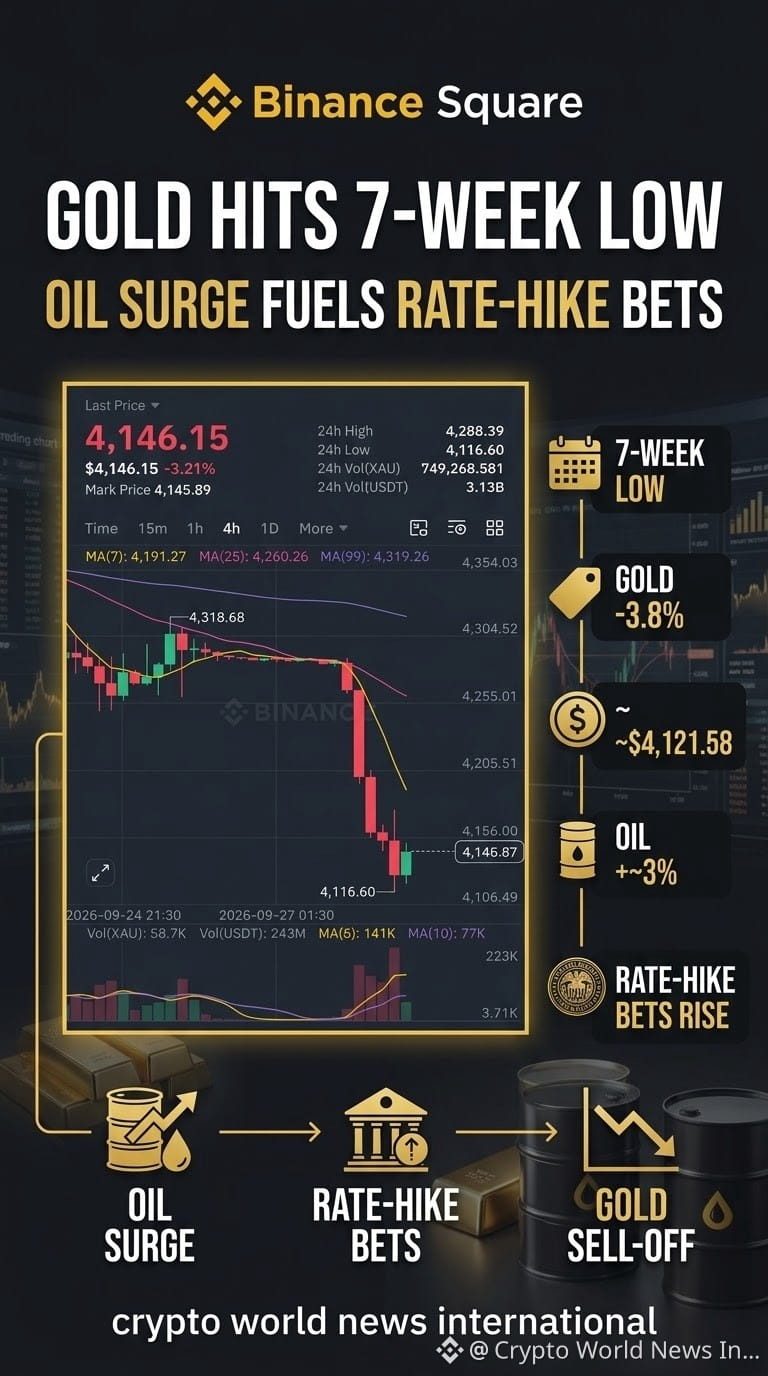
🚨 GOLD CRASHES TO 7-WEEK LOW AS OIL SURGE FUELS RATE-HIKE BETS
Gold suffered a sharp sell-off on Monday as rising oil prices increased inflation concerns and strengthened expectations for tighter U.S. monetary policy.
Key Points:
• Spot gold fell as much as 4%
• Gold hit a seven-week low near $4,110
• Spot gold was around $4,121.58, down 3.8%
• Oil prices jumped about 3%
• Markets priced a high probability of another Fed rate hike
• A stronger dollar and higher Treasury yields added pressure
Market Insight:
Higher oil prices are raising inflation concerns, while stronger rate-hike expectations are increasing the pressure on non-yielding gold.
Asset to Watch: 🥇 Gold (XAU)
#Gold #XAU #Fed #Inflation #Markets $XAU $CL $BZ
{future}(BZUSDT)
{future}(CLUSDT)
{future}(XAUUSDT)
🚨 GOLD CRASHES TO 7-WEEK LOW AS OIL SURGE FUELS RATE-HIKE BETS
Gold suffered a sharp sell-off on Monday as rising oil prices increased inflation concerns and strengthened expectations for tighter U.S. monetary policy.
Key Points:
• Spot gold fell as much as 4%
• Gold hit a seven-week low near $4,110
• Spot gold was around $4,121.58, down 3.8%
• Oil prices jumped about 3%
• Markets priced a high probability of another Fed rate hike
• A stronger dollar and higher Treasury yields added pressure
Market Insight:
Higher oil prices are raising inflation concerns, while stronger rate-hike expectations are increasing the pressure on non-yielding gold.
Asset to Watch: 🥇 Gold (XAU)
#Gold #XAU #Fed #Inflation #Markets $XAU $CL $BZ
Gold suffered a sharp sell-off on Monday as rising oil prices increased inflation concerns and strengthened expectations for tighter U.S. monetary policy.
Key Points:
• Spot gold fell as much as 4%
• Gold hit a seven-week low near $4,110
• Spot gold was around $4,121.58, down 3.8%
• Oil prices jumped about 3%
• Markets priced a high probability of another Fed rate hike
• A stronger dollar and higher Treasury yields added pressure
Market Insight:
Higher oil prices are raising inflation concerns, while stronger rate-hike expectations are increasing the pressure on non-yielding gold.
Asset to Watch: 🥇 Gold (XAU)
#Gold #XAU #Fed #Inflation #Markets $XAU $CL $BZ
330

·
--
Partiellement vrai
Article
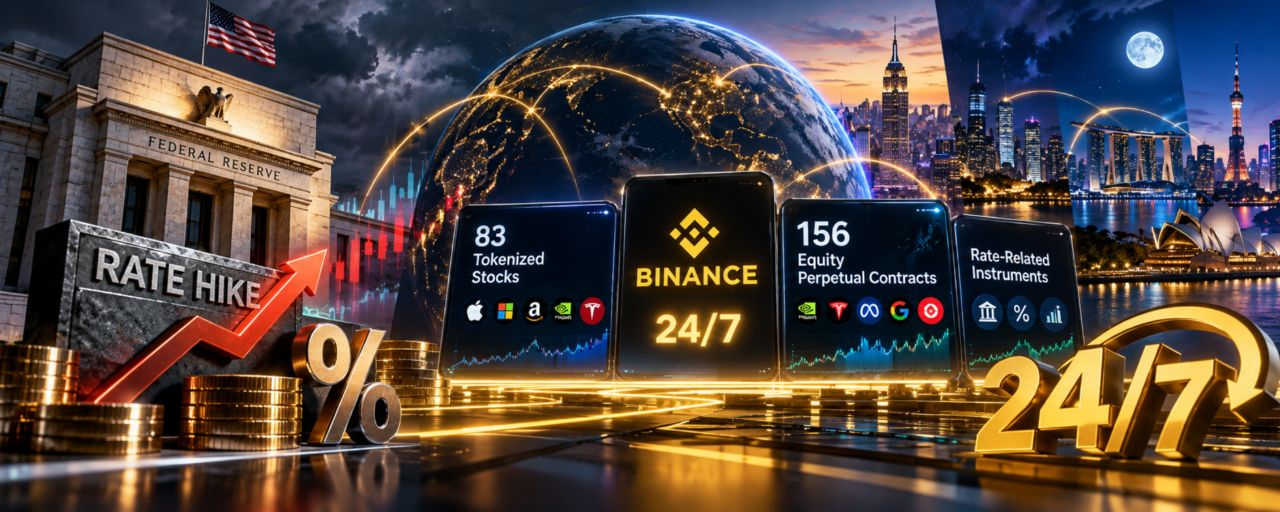
Binance Never Sleeps — W39: The Fed Hiked. Where Does Capital Go Next?The September 2026 FOMC delivered a hawkish surprise, putting renewed focus on interest rates, liquidity and the direction of global capital. But unlike traditional markets, the reaction does not end when Wall Street closes.
In crypto markets, positioning continues around the clock. On Binance, traders can monitor and express views on tokenized equities, equity perpetual contracts and rate-related instruments even when traditional stock markets are closed.
This creates a different way to observe how capital is being repositioned as the market digests the Federal Reserve's latest move.
The Fed Hiked — But the Story Is Bigger Than One Rate Decision
A Federal Reserve rate hike affects more than the cost of borrowing. It changes the relative attractiveness of cash, bonds, equities and risk assets.
When rates stay higher for longer, investors typically reassess how much risk they want to take. Higher yields can make traditional fixed-income assets more attractive, while tighter financial conditions can pressure assets whose valuations depend heavily on future growth.
The key question after September's FOMC is therefore not simply “Did the Fed hike?”
It is:
Where does capital move next if higher rates persist?
Markets are constantly pricing expectations for future monetary policy. That means the immediate reaction can differ from the longer-term interpretation.
Short-Term and Long-Term Views Can Diverge
One of the most interesting aspects of the current environment is the difference between short-term and longer-term positioning.
In the short term, traders may react to the Fed's hawkish signal by reducing exposure to risk assets or positioning for additional tightening.
Over a longer horizon, however, investors may focus on whether inflation eventually cools, economic growth slows and the tightening cycle reaches its later stages.
That creates a market where different time horizons can produce very different views.
A trader looking at the next few days may see tighter liquidity.
An investor looking months ahead may instead be watching for the point where monetary policy eventually becomes less restrictive.
Neither view needs to dominate the market. Both can exist simultaneously.
Capital Reallocation Doesn't Stop at the Closing Bell
This is where 24/7 markets become particularly interesting.
Traditional U.S. equity markets operate according to fixed trading hours. Once the session closes, investors generally have to wait for the next market open to adjust positions in conventional stocks.
Crypto markets operate differently.
On Binance, the ecosystem includes 83 tokenized stocks, 156 equity perpetual contracts and rate-related instruments, allowing eligible users to continue monitoring and positioning around global macro events beyond traditional market hours.
That does not mean every instrument behaves identically to its underlying market, and availability can depend on jurisdiction and product eligibility. But it does mean market participants have more ways to express views when conventional exchanges are closed.
From Macro Data to Market Positioning
The Fed's decision is only one part of the equation.
Traders will also be watching inflation data, employment numbers, Treasury yields, economic growth and future FOMC guidance.
For crypto participants, these macro signals increasingly matter because Bitcoin and other digital assets are deeply connected to global liquidity and risk appetite.
Tokenized equities and equity perpetuals add another layer. They allow traders to monitor sentiment around individual companies and broader equity markets while traditional exchanges are offline.
That creates a continuous feedback loop between macro expectations, equity sentiment and crypto liquidity.
Binance Never Sleeps
The important takeaway from W39 is that the Fed's decision is not the end of the story. It is the beginning of another round of capital repricing.
The market is now asking whether higher rates remain restrictive, how quickly expectations can change, and which assets attract capital as investors adjust their portfolios.
With markets increasingly operating across borders and around the clock, capital reallocation doesn't wait for Monday morning.
Wall Street may close. The market keeps moving.
Always consider your own risk tolerance and do your own research. Product availability and eligibility vary by jurisdiction.
#Binance #Fed #RateHike #BTC
$BNB $BTW $PIEVERSE
{future}(PIEVERSEUSDT)
{future}(BTWUSDT)
{spot}(BNBUSDT)
Binance Never Sleeps — W39: The Fed Hiked. Where Does Capital Go Next?
The September 2026 FOMC delivered a hawkish surprise, putting renewed focus on interest rates, liquidity and the direction of global capital. But unlike traditional markets, the reaction does not end when Wall Street closes.
In crypto markets, positioning continues around the clock. On Binance, traders can monitor and express views on tokenized equities, equity perpetual contracts and rate-related instruments even when traditional stock markets are closed.
This creates a different way to observe how capital is being repositioned as the market digests the Federal Reserve's latest move.
The Fed Hiked — But the Story Is Bigger Than One Rate Decision
A Federal Reserve rate hike affects more than the cost of borrowing. It changes the relative attractiveness of cash, bonds, equities and risk assets.
When rates stay higher for longer, investors typically reassess how much risk they want to take. Higher yields can make traditional fixed-income assets more attractive, while tighter financial conditions can pressure assets whose valuations depend heavily on future growth.
The key question after September's FOMC is therefore not simply “Did the Fed hike?”
It is:
Where does capital move next if higher rates persist?
Markets are constantly pricing expectations for future monetary policy. That means the immediate reaction can differ from the longer-term interpretation.
Short-Term and Long-Term Views Can Diverge
One of the most interesting aspects of the current environment is the difference between short-term and longer-term positioning.
In the short term, traders may react to the Fed's hawkish signal by reducing exposure to risk assets or positioning for additional tightening.
Over a longer horizon, however, investors may focus on whether inflation eventually cools, economic growth slows and the tightening cycle reaches its later stages.
That creates a market where different time horizons can produce very different views.
A trader looking at the next few days may see tighter liquidity.
An investor looking months ahead may instead be watching for the point where monetary policy eventually becomes less restrictive.
Neither view needs to dominate the market. Both can exist simultaneously.
Capital Reallocation Doesn't Stop at the Closing Bell
This is where 24/7 markets become particularly interesting.
Traditional U.S. equity markets operate according to fixed trading hours. Once the session closes, investors generally have to wait for the next market open to adjust positions in conventional stocks.
Crypto markets operate differently.
On Binance, the ecosystem includes 83 tokenized stocks, 156 equity perpetual contracts and rate-related instruments, allowing eligible users to continue monitoring and positioning around global macro events beyond traditional market hours.
That does not mean every instrument behaves identically to its underlying market, and availability can depend on jurisdiction and product eligibility. But it does mean market participants have more ways to express views when conventional exchanges are closed.
From Macro Data to Market Positioning
The Fed's decision is only one part of the equation.
Traders will also be watching inflation data, employment numbers, Treasury yields, economic growth and future FOMC guidance.
For crypto participants, these macro signals increasingly matter because Bitcoin and other digital assets are deeply connected to global liquidity and risk appetite.
Tokenized equities and equity perpetuals add another layer. They allow traders to monitor sentiment around individual companies and broader equity markets while traditional exchanges are offline.
That creates a continuous feedback loop between macro expectations, equity sentiment and crypto liquidity.
Binance Never Sleeps
The important takeaway from W39 is that the Fed's decision is not the end of the story. It is the beginning of another round of capital repricing.
The market is now asking whether higher rates remain restrictive, how quickly expectations can change, and which assets attract capital as investors adjust their portfolios.
With markets increasingly operating across borders and around the clock, capital reallocation doesn't wait for Monday morning.
Wall Street may close. The market keeps moving.
Always consider your own risk tolerance and do your own research. Product availability and eligibility vary by jurisdiction.
#Binance #Fed #RateHike #BTC
$BNB $BTW $PIEVERSE
In crypto markets, positioning continues around the clock. On Binance, traders can monitor and express views on tokenized equities, equity perpetual contracts and rate-related instruments even when traditional stock markets are closed.
This creates a different way to observe how capital is being repositioned as the market digests the Federal Reserve's latest move.
The Fed Hiked — But the Story Is Bigger Than One Rate Decision
A Federal Reserve rate hike affects more than the cost of borrowing. It changes the relative attractiveness of cash, bonds, equities and risk assets.
When rates stay higher for longer, investors typically reassess how much risk they want to take. Higher yields can make traditional fixed-income assets more attractive, while tighter financial conditions can pressure assets whose valuations depend heavily on future growth.
The key question after September's FOMC is therefore not simply “Did the Fed hike?”
It is:
Where does capital move next if higher rates persist?
Markets are constantly pricing expectations for future monetary policy. That means the immediate reaction can differ from the longer-term interpretation.
Short-Term and Long-Term Views Can Diverge
One of the most interesting aspects of the current environment is the difference between short-term and longer-term positioning.
In the short term, traders may react to the Fed's hawkish signal by reducing exposure to risk assets or positioning for additional tightening.
Over a longer horizon, however, investors may focus on whether inflation eventually cools, economic growth slows and the tightening cycle reaches its later stages.
That creates a market where different time horizons can produce very different views.
A trader looking at the next few days may see tighter liquidity.
An investor looking months ahead may instead be watching for the point where monetary policy eventually becomes less restrictive.
Neither view needs to dominate the market. Both can exist simultaneously.
Capital Reallocation Doesn't Stop at the Closing Bell
This is where 24/7 markets become particularly interesting.
Traditional U.S. equity markets operate according to fixed trading hours. Once the session closes, investors generally have to wait for the next market open to adjust positions in conventional stocks.
Crypto markets operate differently.
On Binance, the ecosystem includes 83 tokenized stocks, 156 equity perpetual contracts and rate-related instruments, allowing eligible users to continue monitoring and positioning around global macro events beyond traditional market hours.
That does not mean every instrument behaves identically to its underlying market, and availability can depend on jurisdiction and product eligibility. But it does mean market participants have more ways to express views when conventional exchanges are closed.
From Macro Data to Market Positioning
The Fed's decision is only one part of the equation.
Traders will also be watching inflation data, employment numbers, Treasury yields, economic growth and future FOMC guidance.
For crypto participants, these macro signals increasingly matter because Bitcoin and other digital assets are deeply connected to global liquidity and risk appetite.
Tokenized equities and equity perpetuals add another layer. They allow traders to monitor sentiment around individual companies and broader equity markets while traditional exchanges are offline.
That creates a continuous feedback loop between macro expectations, equity sentiment and crypto liquidity.
Binance Never Sleeps
The important takeaway from W39 is that the Fed's decision is not the end of the story. It is the beginning of another round of capital repricing.
The market is now asking whether higher rates remain restrictive, how quickly expectations can change, and which assets attract capital as investors adjust their portfolios.
With markets increasingly operating across borders and around the clock, capital reallocation doesn't wait for Monday morning.
Wall Street may close. The market keeps moving.
Always consider your own risk tolerance and do your own research. Product availability and eligibility vary by jurisdiction.
#Binance #Fed #RateHike #BTC
$BNB $BTW $PIEVERSE
3
909

·
--
Haussier
Vérifié
🚨 𝐀𝐋𝐄𝐑𝐓..... 𝐓𝐇𝐈𝐒 𝐖𝐄𝐄𝐊 𝐂𝐎𝐔𝐋𝐃 𝐆𝐄𝐓 𝐖𝐈𝐋𝐃 🚨
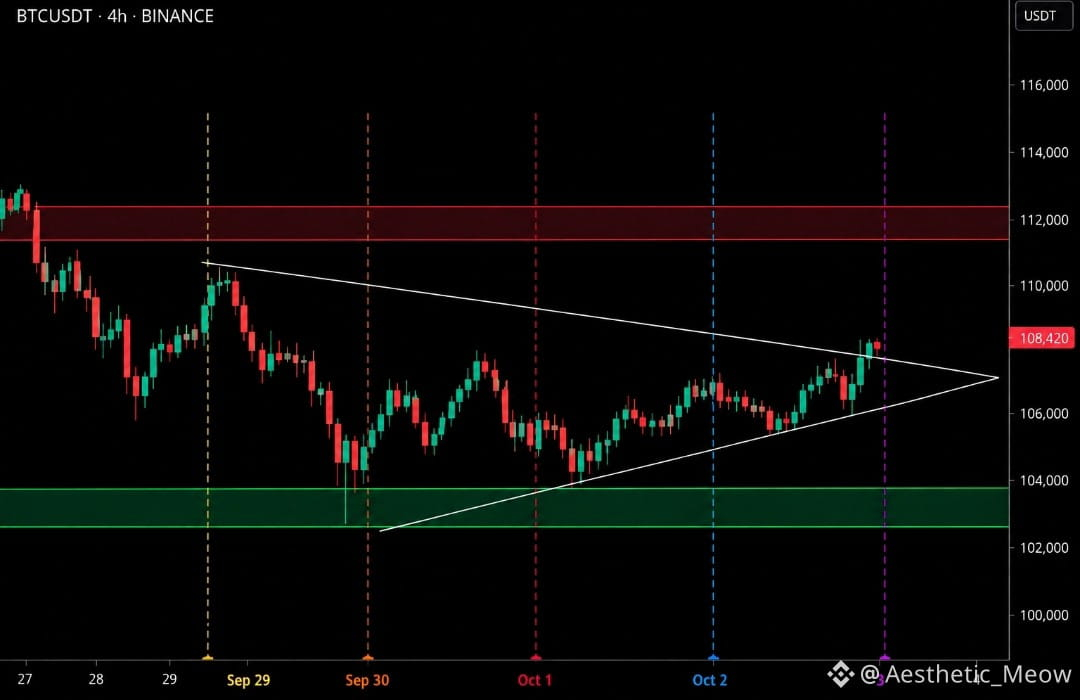
$BTC — THE MACRO CALENDAR IS ABSOLUTELY PACKED 🔥
🇺🇸 Monday → Fed officials take the stage
Tuesday → JOLTS + Consumer Confidence
Wednesday → ADP + Q2 GDP revision + PCE inflation
Thursday → Jobless Claims + ISM Manufacturing PMI
Friday → NFP + Unemployment + Wage data + Factory/Trade data
📊 Jobs… inflation… growth… Fed policy…
Almost every major economic trigger is landing within DAYS.
One surprise number could change market expectations fast — putting $BTC, $ETH, crypto, stocks and the dollar under the spotlight.
⚠️ BIG DATA. BIG REACTIONS. STAY ALERT.
#BTC #Crypto #Fed #NFP
{spot}(BTCUSDT)
$QNT
{spot}(QNTUSDT)
$BTW
{future}(BTWUSDT)
🚨 𝐀𝐋𝐄𝐑𝐓..... 𝐓𝐇𝐈𝐒 𝐖𝐄𝐄𝐊 𝐂𝐎𝐔𝐋𝐃 𝐆𝐄𝐓 𝐖𝐈𝐋𝐃 🚨
$BTC — THE MACRO CALENDAR IS ABSOLUTELY PACKED 🔥
🇺🇸 Monday → Fed officials take the stage
Tuesday → JOLTS + Consumer Confidence
Wednesday → ADP + Q2 GDP revision + PCE inflation
Thursday → Jobless Claims + ISM Manufacturing PMI
Friday → NFP + Unemployment + Wage data + Factory/Trade data
📊 Jobs… inflation… growth… Fed policy…
Almost every major economic trigger is landing within DAYS.
One surprise number could change market expectations fast — putting $BTC , $ETH, crypto, stocks and the dollar under the spotlight.
⚠️ BIG DATA. BIG REACTIONS. STAY ALERT.
#BTC #Crypto #Fed #NFP
$QNT
$BTW
$BTC — THE MACRO CALENDAR IS ABSOLUTELY PACKED 🔥
🇺🇸 Monday → Fed officials take the stage
Tuesday → JOLTS + Consumer Confidence
Wednesday → ADP + Q2 GDP revision + PCE inflation
Thursday → Jobless Claims + ISM Manufacturing PMI
Friday → NFP + Unemployment + Wage data + Factory/Trade data
📊 Jobs… inflation… growth… Fed policy…
Almost every major economic trigger is landing within DAYS.
One surprise number could change market expectations fast — putting $BTC , $ETH, crypto, stocks and the dollar under the spotlight.
⚠️ BIG DATA. BIG REACTIONS. STAY ALERT.
#BTC #Crypto #Fed #NFP
$QNT
$BTW
1
715

·
--
October hike odds went from 64.2% at Friday's settle to 70.3% on this morning's FedWatch read, over a weekend with no data out. And crude fell into it... November $CL WTI lost 3.82% on the week, which on its face should have taken some heat off the Fed.
I think rates are pricing where crude sits. November WTI is still up 9.93% on the month, and it's the level that works through into inflation with a lag (the oil-lag read Tim West and I use), so one red week in oil doesn't do much to the hike case.
Wednesday's August PCE is the next inflation print that could move the October number. If it comes in soft and the odds don't give back the weekend move, I'd take that as the market looking past the data to energy. Let's see how it trades.
#Fed #Rates #Oil #Macro
October hike odds went from 64.2% at Friday's settle to 70.3% on this morning's FedWatch read, over a weekend with no data out. And crude fell into it... November $CL WTI lost 3.82% on the week, which on its face should have taken some heat off the Fed.
I think rates are pricing where crude sits. November WTI is still up 9.93% on the month, and it's the level that works through into inflation with a lag (the oil-lag read Tim West and I use), so one red week in oil doesn't do much to the hike case.
Wednesday's August PCE is the next inflation print that could move the October number. If it comes in soft and the odds don't give back the weekend move, I'd take that as the market looking past the data to energy. Let's see how it trades.
#Fed #Rates #Oil #Macro
I think rates are pricing where crude sits. November WTI is still up 9.93% on the month, and it's the level that works through into inflation with a lag (the oil-lag read Tim West and I use), so one red week in oil doesn't do much to the hike case.
Wednesday's August PCE is the next inflation print that could move the October number. If it comes in soft and the odds don't give back the weekend move, I'd take that as the market looking past the data to energy. Let's see how it trades.
#Fed #Rates #Oil #Macro
172

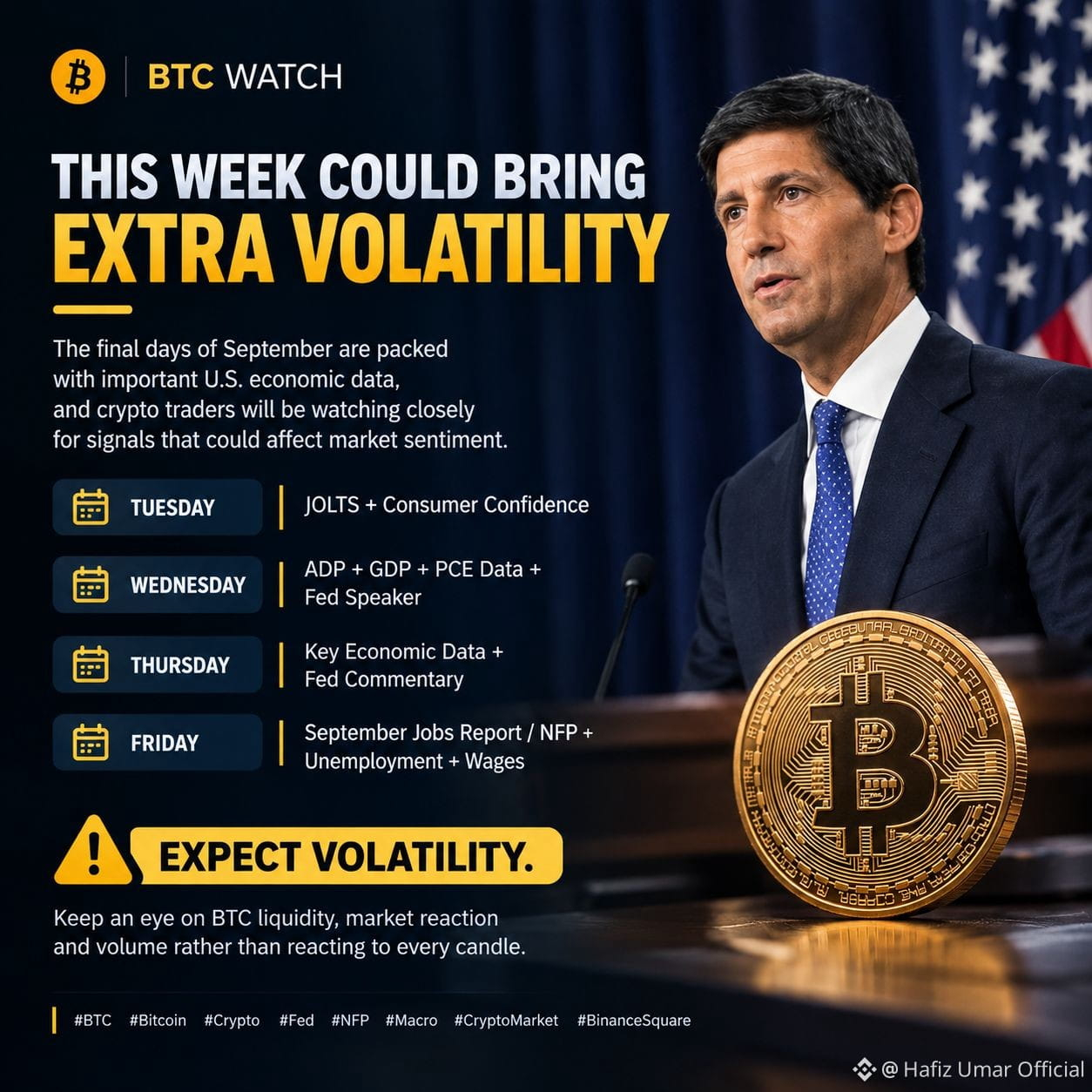
BTC WATCH: THIS WEEK COULD BRING EXTRA VOLATILITY
The final days of September are packed with important U.S. economic data, and crypto traders will be watching closely for signals that could affect market sentiment.
🇺🇸 Tuesday → JOLTS + Consumer Confidence
🇺🇸 Wednesday → ADP + GDP + PCE data + Fed speaker
🇺🇸 Thursday → Key economic data + Fed commentary
🇺🇸 Friday → September Jobs Report / NFP + Unemployment + Wages
The focus will be on employment, economic growth and inflation.
Stronger or weaker-than-expected numbers could change expectations around future Fed policy and potentially add volatility across BTC and the broader crypto market. ?
Federal Reserve Bank of New York +1
⚠️ Expect bigger moves as the data comes in.
Keep an eye on BTC liquidity, market reaction and volume rather than reacting to every candle.
$BTC $ETH $QNT
#BTC #FED #NFC
BTC WATCH: THIS WEEK COULD BRING EXTRA VOLATILITY
The final days of September are packed with important U.S. economic data, and crypto traders will be watching closely for signals that could affect market sentiment.
🇺🇸 Tuesday → JOLTS + Consumer Confidence
🇺🇸 Wednesday → ADP + GDP + PCE data + Fed speaker
🇺🇸 Thursday → Key economic data + Fed commentary
🇺🇸 Friday → September Jobs Report / NFP + Unemployment + Wages
The focus will be on employment, economic growth and inflation.
Stronger or weaker-than-expected numbers could change expectations around future Fed policy and potentially add volatility across BTC and the broader crypto market. ?
Federal Reserve Bank of New York +1
⚠️ Expect bigger moves as the data comes in.
Keep an eye on BTC liquidity, market reaction and volume rather than reacting to every candle.
$BTC $ETH $QNT
#BTC #FED #NFC
The final days of September are packed with important U.S. economic data, and crypto traders will be watching closely for signals that could affect market sentiment.
🇺🇸 Tuesday → JOLTS + Consumer Confidence
🇺🇸 Wednesday → ADP + GDP + PCE data + Fed speaker
🇺🇸 Thursday → Key economic data + Fed commentary
🇺🇸 Friday → September Jobs Report / NFP + Unemployment + Wages
The focus will be on employment, economic growth and inflation.
Stronger or weaker-than-expected numbers could change expectations around future Fed policy and potentially add volatility across BTC and the broader crypto market. ?
Federal Reserve Bank of New York +1
⚠️ Expect bigger moves as the data comes in.
Keep an eye on BTC liquidity, market reaction and volume rather than reacting to every candle.
$BTC $ETH $QNT
#BTC #FED #NFC
MuhammadWaheed100:
good
4
3
4
392

·
--
🚨 BTC ALERT — THIS WEEK MATTERS!
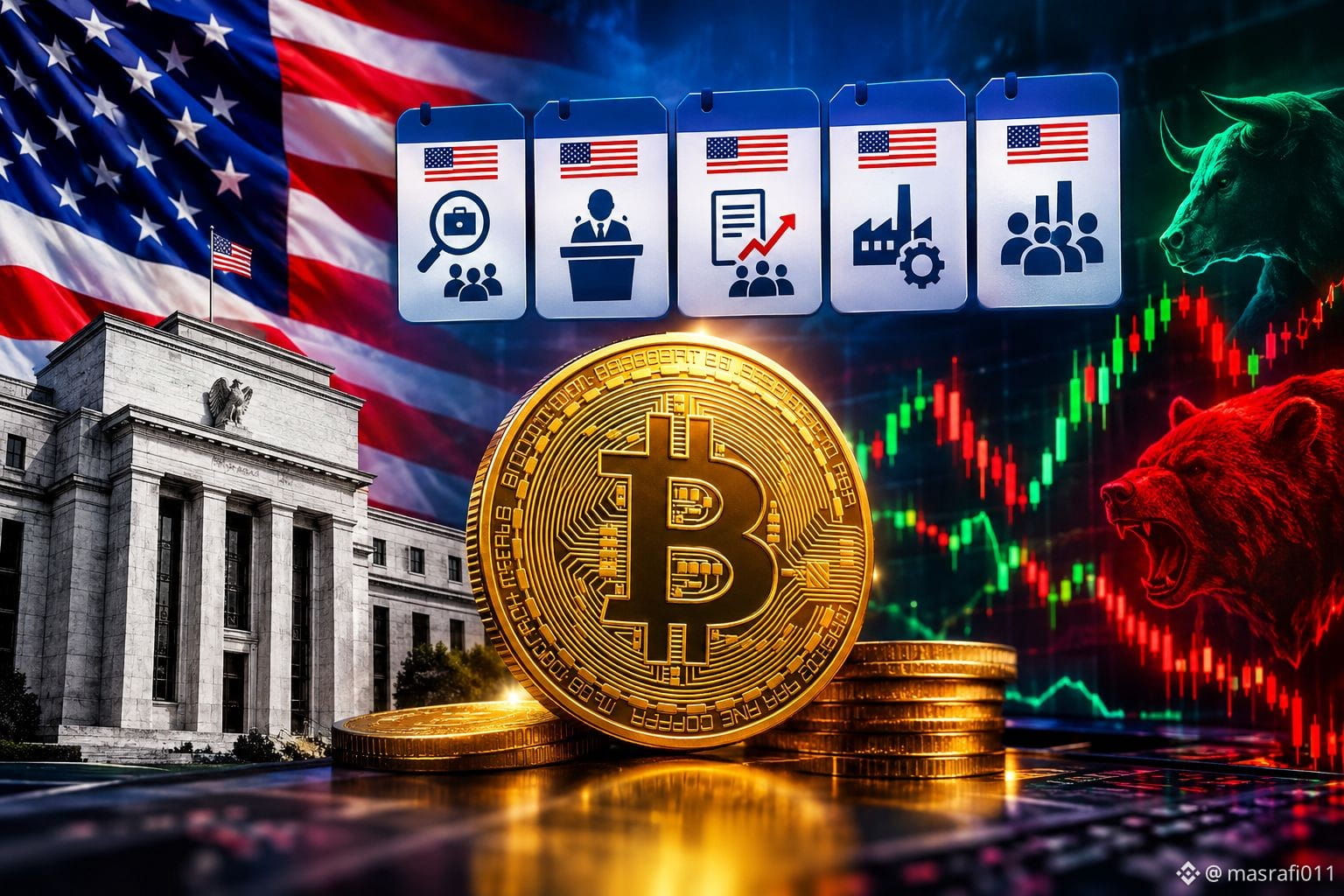
Bitcoin traders are heading into an important week as fresh U.S. economic data could influence expectations around the Federal Reserve’s next decision.
🇺🇸 Tuesday: JOLTS Job Openings + Consumer Confidence
🇺🇸 Wednesday: Federal Reserve officials’ speeches
🇺🇸 Thursday: Jobless Claims + ISM Manufacturing PMI
🇺🇸 Friday: NFP Jobs Report + Unemployment Rate + Wage Data
📊 The market will be watching employment, economic growth and inflation-related signals closely.
🔥 Stronger-than-expected numbers could affect expectations for interest rates, while weaker data may create a different market outlook.
⚠️ Bitcoin could see increased volatility this week. Trade carefully and manage risk.
#BTC #Crypto #Fed #bitcoin
🚨 BTC ALERT — THIS WEEK MATTERS!
Bitcoin traders are heading into an important week as fresh U.S. economic data could influence expectations around the Federal Reserve’s next decision.
🇺🇸 Tuesday: JOLTS Job Openings + Consumer Confidence
🇺🇸 Wednesday: Federal Reserve officials’ speeches
🇺🇸 Thursday: Jobless Claims + ISM Manufacturing PMI
🇺🇸 Friday: NFP Jobs Report + Unemployment Rate + Wage Data
📊 The market will be watching employment, economic growth and inflation-related signals closely.
🔥 Stronger-than-expected numbers could affect expectations for interest rates, while weaker data may create a different market outlook.
⚠️ Bitcoin could see increased volatility this week. Trade carefully and manage risk.
#BTC #Crypto #Fed #bitcoin
Bitcoin traders are heading into an important week as fresh U.S. economic data could influence expectations around the Federal Reserve’s next decision.
🇺🇸 Tuesday: JOLTS Job Openings + Consumer Confidence
🇺🇸 Wednesday: Federal Reserve officials’ speeches
🇺🇸 Thursday: Jobless Claims + ISM Manufacturing PMI
🇺🇸 Friday: NFP Jobs Report + Unemployment Rate + Wage Data
📊 The market will be watching employment, economic growth and inflation-related signals closely.
🔥 Stronger-than-expected numbers could affect expectations for interest rates, while weaker data may create a different market outlook.
⚠️ Bitcoin could see increased volatility this week. Trade carefully and manage risk.
#BTC #Crypto #Fed #bitcoin
1
83

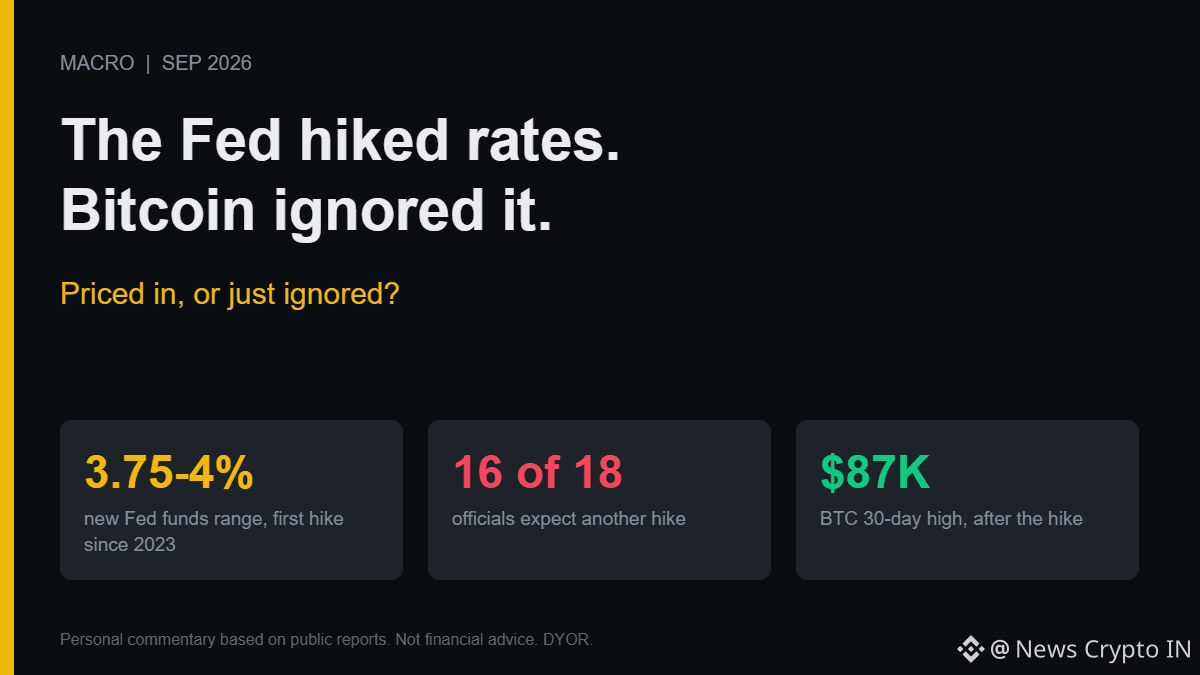
The Fed hiked rates on Sept 16: 25 bps to 3.75%-4%. Unanimous, 12-0, and the first hike since July 2023. 16 of 18 officials expect at least one more, and markets are pricing hikes into 2027.
Bitcoin's response: up. $BTC went from a 30-day low near $75K to a high of $87K, and it still sits around $84K.
The textbook says tighter money pressures risk assets. Crypto Twitter says "it was already priced in." Maybe. But "priced in" is often what people say when they can't explain a move.
Here's the uncomfortable read: this rally looks carried by a narrow bid (record ETF inflows, corporate treasury buying), not broad liquidity. Narrow bids are the first to fade when yields keep climbing, and the Fed's own dot plot says the tightening isn't finished.
Higher Treasury yields also hand big money a risk-free alternative paying ~4%. Crypto has to beat that hurdle, and it pays nothing unless you stake or lend it.
I'm not calling a top. Just noting the setup: a hawkish Fed, rising yields, and a market ignoring both. Either the Fed blinks or the market does.
Which one are you positioned for?
#Fed #Bitcoin
The Fed hiked rates on Sept 16: 25 bps to 3.75%-4%. Unanimous, 12-0, and the first hike since July 2023. 16 of 18 officials expect at least one more, and markets are pricing hikes into 2027.
Bitcoin's response: up. $BTC went from a 30-day low near $75K to a high of $87K, and it still sits around $84K.
The textbook says tighter money pressures risk assets. Crypto Twitter says "it was already priced in." Maybe. But "priced in" is often what people say when they can't explain a move.
Here's the uncomfortable read: this rally looks carried by a narrow bid (record ETF inflows, corporate treasury buying), not broad liquidity. Narrow bids are the first to fade when yields keep climbing, and the Fed's own dot plot says the tightening isn't finished.
Higher Treasury yields also hand big money a risk-free alternative paying ~4%. Crypto has to beat that hurdle, and it pays nothing unless you stake or lend it.
I'm not calling a top. Just noting the setup: a hawkish Fed, rising yields, and a market ignoring both. Either the Fed blinks or the market does.
Which one are you positioned for?
#Fed #Bitcoin
Bitcoin's response: up. $BTC went from a 30-day low near $75K to a high of $87K, and it still sits around $84K.
The textbook says tighter money pressures risk assets. Crypto Twitter says "it was already priced in." Maybe. But "priced in" is often what people say when they can't explain a move.
Here's the uncomfortable read: this rally looks carried by a narrow bid (record ETF inflows, corporate treasury buying), not broad liquidity. Narrow bids are the first to fade when yields keep climbing, and the Fed's own dot plot says the tightening isn't finished.
Higher Treasury yields also hand big money a risk-free alternative paying ~4%. Crypto has to beat that hurdle, and it pays nothing unless you stake or lend it.
I'm not calling a top. Just noting the setup: a hawkish Fed, rising yields, and a market ignoring both. Either the Fed blinks or the market does.
Which one are you positioned for?
#Fed #Bitcoin
1
111

·
--
📉 Bond Market Outlook
The 10Y yield sitting in the 5% range is unlikely to last long.
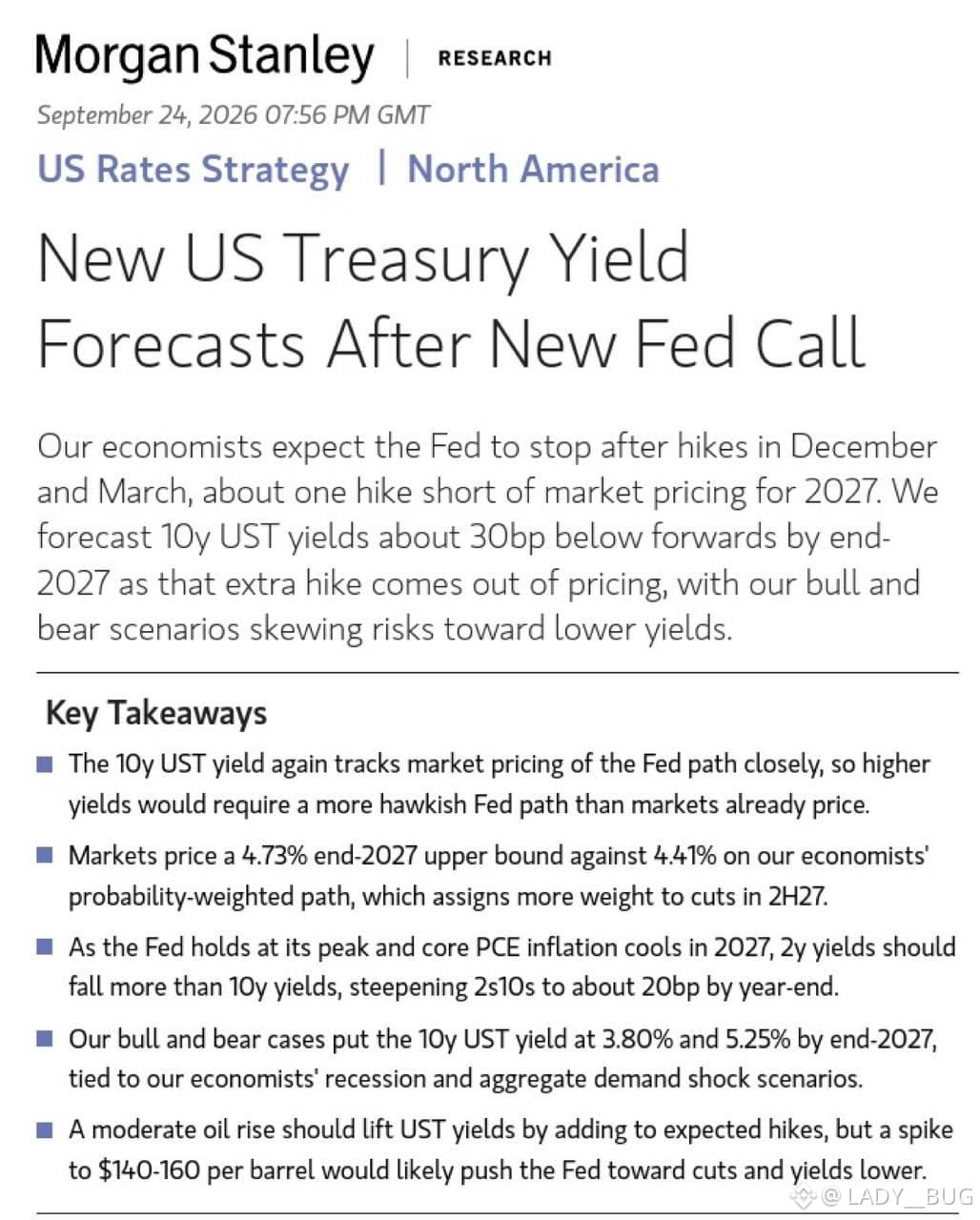
Morgan Stanley forecasts the Fed will hike 25bps in December and another 25bps in March, then hold at 4.25–4.50%.
The market is pricing one more hike by 2027. If those expectations fade, Treasury yields could fall.
Key call: The 2Y may fall more sharply than the 10Y in H2 2027, causing the yield curve to steepen again.
Watch: oil prices $CL $BZ & the economy.
Bottom line: The bond market looks like it’s overreacting to further Fed tightening. In 2027, lower Treasury yields are more likely than higher.
#Bonds #Fed #TreasuryYields #Macro
NFA
📉 Bond Market Outlook
The 10Y yield sitting in the 5% range is unlikely to last long.
Morgan Stanley forecasts the Fed will hike 25bps in December and another 25bps in March, then hold at 4.25–4.50%.
The market is pricing one more hike by 2027. If those expectations fade, Treasury yields could fall.
Key call: The 2Y may fall more sharply than the 10Y in H2 2027, causing the yield curve to steepen again.
Watch: oil prices $CL $BZ & the economy.
Bottom line: The bond market looks like it’s overreacting to further Fed tightening. In 2027, lower Treasury yields are more likely than higher.
#Bonds #Fed #TreasuryYields #Macro
NFA
The 10Y yield sitting in the 5% range is unlikely to last long.
Morgan Stanley forecasts the Fed will hike 25bps in December and another 25bps in March, then hold at 4.25–4.50%.
The market is pricing one more hike by 2027. If those expectations fade, Treasury yields could fall.
Key call: The 2Y may fall more sharply than the 10Y in H2 2027, causing the yield curve to steepen again.
Watch: oil prices $CL $BZ & the economy.
Bottom line: The bond market looks like it’s overreacting to further Fed tightening. In 2027, lower Treasury yields are more likely than higher.
#Bonds #Fed #TreasuryYields #Macro
NFA
83

·
--
Haussier
#fedproposespaymentstablecoinrules
🚨 THE FED IS BRINGING STABLECOINS CLOSER TO TRADITIONAL FINANCE.
The Federal Reserve has proposed new rules for payment stablecoin issuers under the GENIUS Act.
💵 Full backing with permitted reserve assets
🏦 Short-term U.S. Treasury bills could qualify as reserves
🛡️ New capital & risk-management requirements
🏛️ Fed-supervised banks could apply to issue payment stablecoins
⏳ Public comments open for 60 days
This could be another major step toward regulated stablecoins becoming part of the U.S. payments system.
👀 Stablecoins are getting serious attention from Wall Street.
#Fed #stablecoin #crypto
#fedproposespaymentstablecoinrules
🚨 THE FED IS BRINGING STABLECOINS CLOSER TO TRADITIONAL FINANCE.
The Federal Reserve has proposed new rules for payment stablecoin issuers under the GENIUS Act.
💵 Full backing with permitted reserve assets
🏦 Short-term U.S. Treasury bills could qualify as reserves
🛡️ New capital & risk-management requirements
🏛️ Fed-supervised banks could apply to issue payment stablecoins
⏳ Public comments open for 60 days
This could be another major step toward regulated stablecoins becoming part of the U.S. payments system.
👀 Stablecoins are getting serious attention from Wall Street.
#Fed #stablecoin #crypto
🚨 THE FED IS BRINGING STABLECOINS CLOSER TO TRADITIONAL FINANCE.
The Federal Reserve has proposed new rules for payment stablecoin issuers under the GENIUS Act.
💵 Full backing with permitted reserve assets
🏦 Short-term U.S. Treasury bills could qualify as reserves
🛡️ New capital & risk-management requirements
🏛️ Fed-supervised banks could apply to issue payment stablecoins
⏳ Public comments open for 60 days
This could be another major step toward regulated stablecoins becoming part of the U.S. payments system.
👀 Stablecoins are getting serious attention from Wall Street.
#Fed #stablecoin #crypto
1
143
·
--
Haussier
$BTC
{future}(BTCUSDT)
Get ready for a proper wild week in the global markets, mate!
We’ve got some right crucial economic data dropping that’s bound to shake things up and decide where Bitcoin, Solana, and Ethereum are headed
On Monday, the Bank of Japan releases its minutes, dropping hints on interest rate hikes. Any hawkish talk could easily boost the US dollar and put a bit of squeeze on crypto
Wednesday’s the big one, though: the PCE inflation index drops, showing us what’s really going on with prices, alongside GDP figures revealing the true strength of the economy
$SOL
{future}(SOLUSDT)
If those numbers come in hot, it means a tougher Fed, higher rates for longer, and less appetite for risk—putting serious pressure on Bitcoin, Ethereum, and Solana
But if the stats look weak, it opens the door for rate cuts and could spark a proper massive rally across the crypto market
Come Thursday, we’ve got the ISM Manufacturing Index ,Any industrial growth strengthens the narrative of solid economic expansion
And Friday wraps it up with the jobs report, which could be an absolute bombshell. A strong labour market supports high interest rates and slows down Bitcoin's momentum, whereas weak employment figures could trigger a massive buying spree in Solana and Ethereum, thanks to all that liquidity
$ETH
{future}(ETHUSDT)
This ain't just any ordinary week, innit... a single piece of data could flip the whole trend from a slump to absolute madness, or the other way round. Keep your eyes peeled, because Bitcoin, Ethereum, and Solana are just waiting for the signal!
#Market_Update #USGovernment #Fed
$BTC
Get ready for a proper wild week in the global markets, mate!
We’ve got some right crucial economic data dropping that’s bound to shake things up and decide where Bitcoin, Solana, and Ethereum are headed
On Monday, the Bank of Japan releases its minutes, dropping hints on interest rate hikes. Any hawkish talk could easily boost the US dollar and put a bit of squeeze on crypto
Wednesday’s the big one, though: the PCE inflation index drops, showing us what’s really going on with prices, alongside GDP figures revealing the true strength of the economy
$SOL
If those numbers come in hot, it means a tougher Fed, higher rates for longer, and less appetite for risk—putting serious pressure on Bitcoin, Ethereum, and Solana
But if the stats look weak, it opens the door for rate cuts and could spark a proper massive rally across the crypto market
Come Thursday, we’ve got the ISM Manufacturing Index ,Any industrial growth strengthens the narrative of solid economic expansion
And Friday wraps it up with the jobs report, which could be an absolute bombshell. A strong labour market supports high interest rates and slows down Bitcoin's momentum, whereas weak employment figures could trigger a massive buying spree in Solana and Ethereum, thanks to all that liquidity
$ETH
This ain't just any ordinary week, innit... a single piece of data could flip the whole trend from a slump to absolute madness, or the other way round. Keep your eyes peeled, because Bitcoin, Ethereum, and Solana are just waiting for the signal!
#Market_Update #USGovernment #Fed
Get ready for a proper wild week in the global markets, mate!
We’ve got some right crucial economic data dropping that’s bound to shake things up and decide where Bitcoin, Solana, and Ethereum are headed
On Monday, the Bank of Japan releases its minutes, dropping hints on interest rate hikes. Any hawkish talk could easily boost the US dollar and put a bit of squeeze on crypto
Wednesday’s the big one, though: the PCE inflation index drops, showing us what’s really going on with prices, alongside GDP figures revealing the true strength of the economy
$SOL
If those numbers come in hot, it means a tougher Fed, higher rates for longer, and less appetite for risk—putting serious pressure on Bitcoin, Ethereum, and Solana
But if the stats look weak, it opens the door for rate cuts and could spark a proper massive rally across the crypto market
Come Thursday, we’ve got the ISM Manufacturing Index ,Any industrial growth strengthens the narrative of solid economic expansion
And Friday wraps it up with the jobs report, which could be an absolute bombshell. A strong labour market supports high interest rates and slows down Bitcoin's momentum, whereas weak employment figures could trigger a massive buying spree in Solana and Ethereum, thanks to all that liquidity
$ETH
This ain't just any ordinary week, innit... a single piece of data could flip the whole trend from a slump to absolute madness, or the other way round. Keep your eyes peeled, because Bitcoin, Ethereum, and Solana are just waiting for the signal!
#Market_Update #USGovernment #Fed
1
514

#FedProposes48HourLiquidationRuleForIssuers 🚨 FED WATCH 🚨
The Federal Reserve is reportedly proposing a 48-hour liquidation rule for issuers — a move that could bring major changes to how issuers manage liquidity and risk.
⚠️ For crypto and stablecoin markets, faster liquidation requirements could mean: • Tighter risk controls
• More liquidity discipline
• Greater transparency for issuers
• Potential impact on market stability
The key question: How will issuers and crypto markets adapt if this rule moves forward? 👀
#FedProposes48HourLiquidationRuleForIssuers #Crypto #Stablecoins #Fed $WEN
{future}(WENUSDT)
$CFG.US
{stock_us}(CFG.US)
$AR
{future}(ARUSDT)
#FedProposes48HourLiquidationRuleForIssuers 🚨 FED WATCH 🚨
The Federal Reserve is reportedly proposing a 48-hour liquidation rule for issuers — a move that could bring major changes to how issuers manage liquidity and risk.
⚠️ For crypto and stablecoin markets, faster liquidation requirements could mean: • Tighter risk controls
• More liquidity discipline
• Greater transparency for issuers
• Potential impact on market stability
The key question: How will issuers and crypto markets adapt if this rule moves forward? 👀
#FedProposes48HourLiquidationRuleForIssuers #Crypto #Stablecoins #Fed $WEN
$CFG.US
$AR
The Federal Reserve is reportedly proposing a 48-hour liquidation rule for issuers — a move that could bring major changes to how issuers manage liquidity and risk.
⚠️ For crypto and stablecoin markets, faster liquidation requirements could mean: • Tighter risk controls
• More liquidity discipline
• Greater transparency for issuers
• Potential impact on market stability
The key question: How will issuers and crypto markets adapt if this rule moves forward? 👀
#FedProposes48HourLiquidationRuleForIssuers #Crypto #Stablecoins #Fed $WEN
$CFG.US
$AR
349

The Fed's newly proposed stablecoin guidelines introduce a ticking clock for issuers facing reserve deficits, demanding rapid corrective action within tight deadlines. This aggressive policy framework could inadvertently spark aggressive sell-offs and sudden market panics. When redemption pressures collide with strict regulatory timelines, traders might witness forced liquidations unfold across major platforms in a matter of hours. Regulatory oversight is evolving fast, and liquidity management is now the ultimate test for crypto assets. $USDT $USDC #Regulation #Stablecoins #Fed
The Fed's newly proposed stablecoin guidelines introduce a ticking clock for issuers facing reserve deficits, demanding rapid corrective action within tight deadlines. This aggressive policy framework could inadvertently spark aggressive sell-offs and sudden market panics. When redemption pressures collide with strict regulatory timelines, traders might witness forced liquidations unfold across major platforms in a matter of hours. Regulatory oversight is evolving fast, and liquidity management is now the ultimate test for crypto assets. $USDT $USDC #Regulation #Stablecoins #Fed

·
--
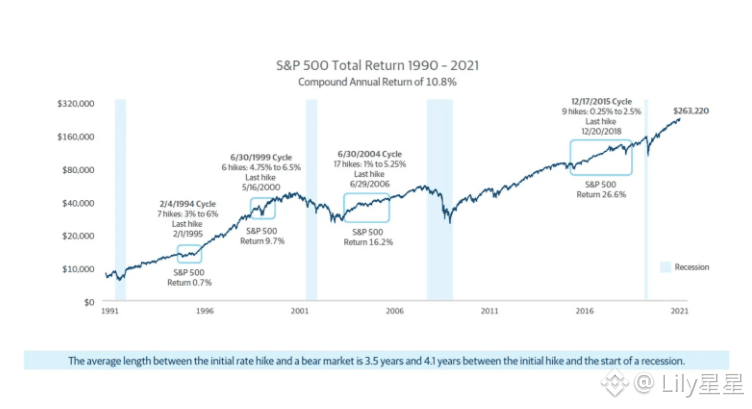
🚨 BREAKING: Fed Interest Rate Update & What It Means for Crypto Markets! 🚨
The Federal Open Market Committee (FOMC) unanimously voted (12-0) to raise the federal funds target rate by 25 basis points, pushing the baseline range to 3.75%–4.00%.
This marks the Fed's first interest rate hike since mid-2023, signaling a temporary halt to easy liquidity as central bankers respond to persistent inflation metrics.
📊 Historical Context & Federal Reserve Rate Policy
Historically, unexpected interest rate hikes drive a short-term flight toward yield-bearing traditional assets as capital costs rise. However, crypto markets often absorb initial sell-offs through priced-in expectations and structural liquidity dynamics.
Key Macro Highlights You Need to Know
The Decision: Target range lifted to 3.75%–4.00% (up from 3.50%–3.75%).
Inflation Concerns: Core inflation metrics staying above target levels prompted the FOMC to tighten liquidity.
Dot Plot Outlook: Projections suggest the median policy rate could settle near 4.1% by the end of 2026, indicating the potential for one additional rate adjustment before year-end.
📉 Technical Chart Patterns & Market Positioning
When trading Fed news cycles, watch for key technical formations around high-volatility support and resistance zones:
Short-Term Liquidity Swings: Macro shifts trigger leveraged liquidations on both long and short positions before true directional trend formation.
Key Price Levels: Focus on major horizontal support levels and daily moving averages to confirm whether pullbacks represent absorption or deeper trend shifts.
Yield Opportunity Costs: Higher risk-free yields place short-term pressure on non-yielding speculative assets, favoring high-conviction structural holdings over high-leverage trades.
💡 Avoid Over-Leverage: High-impact macro events carry wider spreads and frequent slippage across derivatives desks.
#Fed #PolymarketBankFailureBetsDrawFDICConcern #QNTRises39%
🚨 BREAKING: Fed Interest Rate Update & What It Means for Crypto Markets! 🚨
The Federal Open Market Committee (FOMC) unanimously voted (12-0) to raise the federal funds target rate by 25 basis points, pushing the baseline range to 3.75%–4.00%.
This marks the Fed's first interest rate hike since mid-2023, signaling a temporary halt to easy liquidity as central bankers respond to persistent inflation metrics.
📊 Historical Context & Federal Reserve Rate Policy
Historically, unexpected interest rate hikes drive a short-term flight toward yield-bearing traditional assets as capital costs rise. However, crypto markets often absorb initial sell-offs through priced-in expectations and structural liquidity dynamics.
Key Macro Highlights You Need to Know
The Decision: Target range lifted to 3.75%–4.00% (up from 3.50%–3.75%).
Inflation Concerns: Core inflation metrics staying above target levels prompted the FOMC to tighten liquidity.
Dot Plot Outlook: Projections suggest the median policy rate could settle near 4.1% by the end of 2026, indicating the potential for one additional rate adjustment before year-end.
📉 Technical Chart Patterns & Market Positioning
When trading Fed news cycles, watch for key technical formations around high-volatility support and resistance zones:
Short-Term Liquidity Swings: Macro shifts trigger leveraged liquidations on both long and short positions before true directional trend formation.
Key Price Levels: Focus on major horizontal support levels and daily moving averages to confirm whether pullbacks represent absorption or deeper trend shifts.
Yield Opportunity Costs: Higher risk-free yields place short-term pressure on non-yielding speculative assets, favoring high-conviction structural holdings over high-leverage trades.
💡 Avoid Over-Leverage: High-impact macro events carry wider spreads and frequent slippage across derivatives desks.
#Fed #PolymarketBankFailureBetsDrawFDICConcern #QNTRises39%
The Federal Open Market Committee (FOMC) unanimously voted (12-0) to raise the federal funds target rate by 25 basis points, pushing the baseline range to 3.75%–4.00%.
This marks the Fed's first interest rate hike since mid-2023, signaling a temporary halt to easy liquidity as central bankers respond to persistent inflation metrics.
📊 Historical Context & Federal Reserve Rate Policy
Historically, unexpected interest rate hikes drive a short-term flight toward yield-bearing traditional assets as capital costs rise. However, crypto markets often absorb initial sell-offs through priced-in expectations and structural liquidity dynamics.
Key Macro Highlights You Need to Know
The Decision: Target range lifted to 3.75%–4.00% (up from 3.50%–3.75%).
Inflation Concerns: Core inflation metrics staying above target levels prompted the FOMC to tighten liquidity.
Dot Plot Outlook: Projections suggest the median policy rate could settle near 4.1% by the end of 2026, indicating the potential for one additional rate adjustment before year-end.
📉 Technical Chart Patterns & Market Positioning
When trading Fed news cycles, watch for key technical formations around high-volatility support and resistance zones:
Short-Term Liquidity Swings: Macro shifts trigger leveraged liquidations on both long and short positions before true directional trend formation.
Key Price Levels: Focus on major horizontal support levels and daily moving averages to confirm whether pullbacks represent absorption or deeper trend shifts.
Yield Opportunity Costs: Higher risk-free yields place short-term pressure on non-yielding speculative assets, favoring high-conviction structural holdings over high-leverage trades.
💡 Avoid Over-Leverage: High-impact macro events carry wider spreads and frequent slippage across derivatives desks.
#Fed #PolymarketBankFailureBetsDrawFDICConcern #QNTRises39%
1
12

·
--
根据芝商所(CME)的最新监测数据,市场目前预计美联储在即将到来的10月议息会议上加息25个基点的概率已经升至70.9%,而维持在3.75%-4.00%区间的概率仅剩29.1%。同时,预计到12月累计加息50个基点的概率也达到了58.7%,这显示出市场对紧缩周期的预期正在重新调整。
这一数据的变化非常关键,它反映出市场原本对加息周期结束的预期再度受到考验。此前投资者普遍猜测利率政策可能逐步转向,但最新的概率分布表明,交易员们正在为更长时间的高利率环境做准备,宏观博弈进入了新的阶段。
从传统金融市场来看,加息预期的攀升通常会直接支撑美元指数和美债收益率走高。在这种背景下,黄金等无息资产以及全球风险资产的估值往往会承压,市场整体的流动性和风险偏好都可能出现阶段性的收缩。
对于加密市场而言,这可能意味着 $BTC 和主流币种将继续面临宏观流动性偏紧的考验。投资者目前的情绪整体偏向观望,短期内资金面或将维持震荡博弈的态势,后市走向仍需密切关注后续核心经济数据的验证。
#Fed #InterestRates #CryptoMarket
根据芝商所(CME)的最新监测数据,市场目前预计美联储在即将到来的10月议息会议上加息25个基点的概率已经升至70.9%,而维持在3.75%-4.00%区间的概率仅剩29.1%。同时,预计到12月累计加息50个基点的概率也达到了58.7%,这显示出市场对紧缩周期的预期正在重新调整。
这一数据的变化非常关键,它反映出市场原本对加息周期结束的预期再度受到考验。此前投资者普遍猜测利率政策可能逐步转向,但最新的概率分布表明,交易员们正在为更长时间的高利率环境做准备,宏观博弈进入了新的阶段。
从传统金融市场来看,加息预期的攀升通常会直接支撑美元指数和美债收益率走高。在这种背景下,黄金等无息资产以及全球风险资产的估值往往会承压,市场整体的流动性和风险偏好都可能出现阶段性的收缩。
对于加密市场而言,这可能意味着 $BTC 和主流币种将继续面临宏观流动性偏紧的考验。投资者目前的情绪整体偏向观望,短期内资金面或将维持震荡博弈的态势,后市走向仍需密切关注后续核心经济数据的验证。
#Fed #InterestRates #CryptoMarket
这一数据的变化非常关键,它反映出市场原本对加息周期结束的预期再度受到考验。此前投资者普遍猜测利率政策可能逐步转向,但最新的概率分布表明,交易员们正在为更长时间的高利率环境做准备,宏观博弈进入了新的阶段。
从传统金融市场来看,加息预期的攀升通常会直接支撑美元指数和美债收益率走高。在这种背景下,黄金等无息资产以及全球风险资产的估值往往会承压,市场整体的流动性和风险偏好都可能出现阶段性的收缩。
对于加密市场而言,这可能意味着 $BTC 和主流币种将继续面临宏观流动性偏紧的考验。投资者目前的情绪整体偏向观望,短期内资金面或将维持震荡博弈的态势,后市走向仍需密切关注后续核心经济数据的验证。
#Fed #InterestRates #CryptoMarket

根据芝加哥商品交易所(CME)的最新监测数据,市场预计美联储在10月会议上将利率上调25个基点的概率已攀升至70.9%,而按兵不动在3.75%-4.00%区间的概率仅为29.1%。此外,12月累计加息50个基点的概率更是达到了58.7%,维持现有水平的概率仅剩5.0%。
这一预期变动传递出极其严峻的信号,表明抗通胀的压力依然沉重。原本市场对宽松周期的过度乐观预期可能面临彻底落空,高利率维持更久甚至再度收紧的现实正在重塑宏观逻辑。
在传统金融领域,紧缩预期的升温将推高美债收益率并支撑美元走强。这对全球流动性造成直接抽吸,风险资产包括美股与大宗商品普遍承压,防御性策略或将重新成为机构主流。
对于加密市场而言,高企的利率环境将极大抑制外部增量资金的入场意愿。若美联储重启加息周期,$BTC 与主流加密资产可能面临更长期的流动性折价与估值修正压力,投资者需警惕潜在的回调风险。📉
#Fed #InterestRates #CryptoMarket
根据芝加哥商品交易所(CME)的最新监测数据,市场预计美联储在10月会议上将利率上调25个基点的概率已攀升至70.9%,而按兵不动在3.75%-4.00%区间的概率仅为29.1%。此外,12月累计加息50个基点的概率更是达到了58.7%,维持现有水平的概率仅剩5.0%。
这一预期变动传递出极其严峻的信号,表明抗通胀的压力依然沉重。原本市场对宽松周期的过度乐观预期可能面临彻底落空,高利率维持更久甚至再度收紧的现实正在重塑宏观逻辑。
在传统金融领域,紧缩预期的升温将推高美债收益率并支撑美元走强。这对全球流动性造成直接抽吸,风险资产包括美股与大宗商品普遍承压,防御性策略或将重新成为机构主流。
对于加密市场而言,高企的利率环境将极大抑制外部增量资金的入场意愿。若美联储重启加息周期,$BTC 与主流加密资产可能面临更长期的流动性折价与估值修正压力,投资者需警惕潜在的回调风险。📉
#Fed #InterestRates #CryptoMarket
这一预期变动传递出极其严峻的信号,表明抗通胀的压力依然沉重。原本市场对宽松周期的过度乐观预期可能面临彻底落空,高利率维持更久甚至再度收紧的现实正在重塑宏观逻辑。
在传统金融领域,紧缩预期的升温将推高美债收益率并支撑美元走强。这对全球流动性造成直接抽吸,风险资产包括美股与大宗商品普遍承压,防御性策略或将重新成为机构主流。
对于加密市场而言,高企的利率环境将极大抑制外部增量资金的入场意愿。若美联储重启加息周期,$BTC 与主流加密资产可能面临更长期的流动性折价与估值修正压力,投资者需警惕潜在的回调风险。📉
#Fed #InterestRates #CryptoMarket
1

根据芝商所(CME FedWatch)最新利率互换数据,市场对美联储10月加息25个基点的概率已飙升至70.9%,而维持在3.75%-4.00%区间的概率降至29.1%。同时,12月累计加息50个基点的预期亦攀升至58.7%。
这表明衍生品市场正迅速消化流动性紧缩路径,终端利率预期被进一步提前推高。宏观流动性重新定价的背后,实质上正在为下半年的货币政策路径做最后的利空释放。
在传统金融市场中,美债收益率曲线与美元指数应声出现技术性反弹。然而,高概率的加息定价往往意味着预期已基本反映在盘面上,利空出尽的买预期卖事实节点正在临近。
对于加密市场而言,$BTC 与主流风险资产在关键支撑位表现出极强的承接力。随着加息概率突破70%的技术临界点,一旦靴子落地,流动性边际改善的窗口将为风险资产提供强劲的技术性反弹动能。📊
#Fed #InterestRates #CryptoMarket
根据芝商所(CME FedWatch)最新利率互换数据,市场对美联储10月加息25个基点的概率已飙升至70.9%,而维持在3.75%-4.00%区间的概率降至29.1%。同时,12月累计加息50个基点的预期亦攀升至58.7%。
这表明衍生品市场正迅速消化流动性紧缩路径,终端利率预期被进一步提前推高。宏观流动性重新定价的背后,实质上正在为下半年的货币政策路径做最后的利空释放。
在传统金融市场中,美债收益率曲线与美元指数应声出现技术性反弹。然而,高概率的加息定价往往意味着预期已基本反映在盘面上,利空出尽的买预期卖事实节点正在临近。
对于加密市场而言,$BTC 与主流风险资产在关键支撑位表现出极强的承接力。随着加息概率突破70%的技术临界点,一旦靴子落地,流动性边际改善的窗口将为风险资产提供强劲的技术性反弹动能。📊
#Fed #InterestRates #CryptoMarket
这表明衍生品市场正迅速消化流动性紧缩路径,终端利率预期被进一步提前推高。宏观流动性重新定价的背后,实质上正在为下半年的货币政策路径做最后的利空释放。
在传统金融市场中,美债收益率曲线与美元指数应声出现技术性反弹。然而,高概率的加息定价往往意味着预期已基本反映在盘面上,利空出尽的买预期卖事实节点正在临近。
对于加密市场而言,$BTC 与主流风险资产在关键支撑位表现出极强的承接力。随着加息概率突破70%的技术临界点,一旦靴子落地,流动性边际改善的窗口将为风险资产提供强劲的技术性反弹动能。📊
#Fed #InterestRates #CryptoMarket
2

·
--
Dữ liệu mới nhất từ công cụ FedWatch của CME Group vừa ghi nhận sự thay đổi đáng kể trong kỳ vọng chính sách tiền tệ. Theo đó, thị trường hiện định giá xác suất Cục Dự trữ Liên bang Mỹ (Fed) tăng lãi suất 25 điểm cơ bản tại cuộc họp tháng 10 lên tới 70.9%, trong khi khả năng giữ nguyên mức 3.75%-4.00% chỉ còn 29.1%. Đáng chú ý hơn, kịch bản tăng tổng cộng 50 điểm cơ bản tính đến tháng 12 đang chiếm ưu thế với 58.7%.
Sự dịch chuyển này cho thấy thị trường đang phải định giá lại rủi ro lạm phát dai dẳng thay vì kỳ vọng nới lỏng sớm. Việc xác suất thắt chặt chính sách tăng vọt phản ánh áp lực kinh tế vĩ mô vẫn rất lớn, buộc Fed phải duy trì lập trường cứng rắn hơn so với các dự báo trước đó.
Đối với thị trường tài chính truyền thống, động thái này thường tạo lực đẩy cho đồng USD và lợi suất trái phiếu kho bạc Mỹ. Ngược lại, các tài sản định giá theo rủi ro như chứng khoán và hàng hóa có thể đối mặt với áp lực điều chỉnh trong ngắn hạn khi chi phí vốn tiếp tục tăng cao.
Về phía thị trường crypto, môi trường thanh khoản thắt chặt sẽ tạo sức ép lớn lên đường giá của $BTC và toàn bộ nhóm altcoin. Dòng tiền đầu cơ có xu hướng phòng thủ và rút bớt đòn bẩy, khiến thị trường dễ bước vào giai đoạn biến động mạnh trước thềm các kỳ họp chính sách tiếp theo.
#Fed #InterestRates #CryptoMarket
Dữ liệu mới nhất từ công cụ FedWatch của CME Group vừa ghi nhận sự thay đổi đáng kể trong kỳ vọng chính sách tiền tệ. Theo đó, thị trường hiện định giá xác suất Cục Dự trữ Liên bang Mỹ (Fed) tăng lãi suất 25 điểm cơ bản tại cuộc họp tháng 10 lên tới 70.9%, trong khi khả năng giữ nguyên mức 3.75%-4.00% chỉ còn 29.1%. Đáng chú ý hơn, kịch bản tăng tổng cộng 50 điểm cơ bản tính đến tháng 12 đang chiếm ưu thế với 58.7%.
Sự dịch chuyển này cho thấy thị trường đang phải định giá lại rủi ro lạm phát dai dẳng thay vì kỳ vọng nới lỏng sớm. Việc xác suất thắt chặt chính sách tăng vọt phản ánh áp lực kinh tế vĩ mô vẫn rất lớn, buộc Fed phải duy trì lập trường cứng rắn hơn so với các dự báo trước đó.
Đối với thị trường tài chính truyền thống, động thái này thường tạo lực đẩy cho đồng USD và lợi suất trái phiếu kho bạc Mỹ. Ngược lại, các tài sản định giá theo rủi ro như chứng khoán và hàng hóa có thể đối mặt với áp lực điều chỉnh trong ngắn hạn khi chi phí vốn tiếp tục tăng cao.
Về phía thị trường crypto, môi trường thanh khoản thắt chặt sẽ tạo sức ép lớn lên đường giá của $BTC và toàn bộ nhóm altcoin. Dòng tiền đầu cơ có xu hướng phòng thủ và rút bớt đòn bẩy, khiến thị trường dễ bước vào giai đoạn biến động mạnh trước thềm các kỳ họp chính sách tiếp theo.
#Fed #InterestRates #CryptoMarket
Sự dịch chuyển này cho thấy thị trường đang phải định giá lại rủi ro lạm phát dai dẳng thay vì kỳ vọng nới lỏng sớm. Việc xác suất thắt chặt chính sách tăng vọt phản ánh áp lực kinh tế vĩ mô vẫn rất lớn, buộc Fed phải duy trì lập trường cứng rắn hơn so với các dự báo trước đó.
Đối với thị trường tài chính truyền thống, động thái này thường tạo lực đẩy cho đồng USD và lợi suất trái phiếu kho bạc Mỹ. Ngược lại, các tài sản định giá theo rủi ro như chứng khoán và hàng hóa có thể đối mặt với áp lực điều chỉnh trong ngắn hạn khi chi phí vốn tiếp tục tăng cao.
Về phía thị trường crypto, môi trường thanh khoản thắt chặt sẽ tạo sức ép lớn lên đường giá của $BTC và toàn bộ nhóm altcoin. Dòng tiền đầu cơ có xu hướng phòng thủ và rút bớt đòn bẩy, khiến thị trường dễ bước vào giai đoạn biến động mạnh trước thềm các kỳ họp chính sách tiếp theo.
#Fed #InterestRates #CryptoMarket
227
Connectez-vous pour découvrir plus de contenu
Rejoignez la communauté mondiale des adeptes de cryptomonnaies sur Binance Square
⚡️ Suviez les dernières informations importantes sur les cryptomonnaies.
💬 Jugé digne de confiance par la plus grande plateforme d’échange de cryptomonnaies au monde.
👍 Découvrez les connaissances que partagent les créateurs vérifiés.
Adresse e-mail/Nº de téléphone
Sujets d’actualité
1
#BitgetHackerFailsToMoveStolenFunds
116 vues
52 mentions
2
#BitMineETHHoldingsTop6Million
3,428 vues
213 mentions
3
#StrategyAdds1666BTCHoldingsReach847666
2,449 vues
161 mentions
4
#NvidiaApproves$150BBuyback
2,485 vues
57 mentions
5
#OpenAIDelaysGPT6.1OverSafetyIssues
14,137 vues
486 mentions
6
#AMDToAcquireWorldLabsFor$8.2B
1,272 vues
47 mentions
7
#AnthropicIPOProspectusCouldValueItOver$2T
4,302 vues
73 mentions
8
#HackersDrainOver12.4MXRPFromDCENTWallets
29,239 vues
593 mentions
9
#SECSaysDecentralizedTokenBuybacksNotInvestmentContracts
2,550 vues
39 mentions
10
#UKFCAWinsCourtOrderToRecover851400Pounds
85,455 vues
1,433 mentions