
talha-110
522 Posts

talha-110
High-Frequency Trader
2.3 Years
84 Following
91 Followers
288 Liked
Posts
All
Quotes
PINNED
Partly True
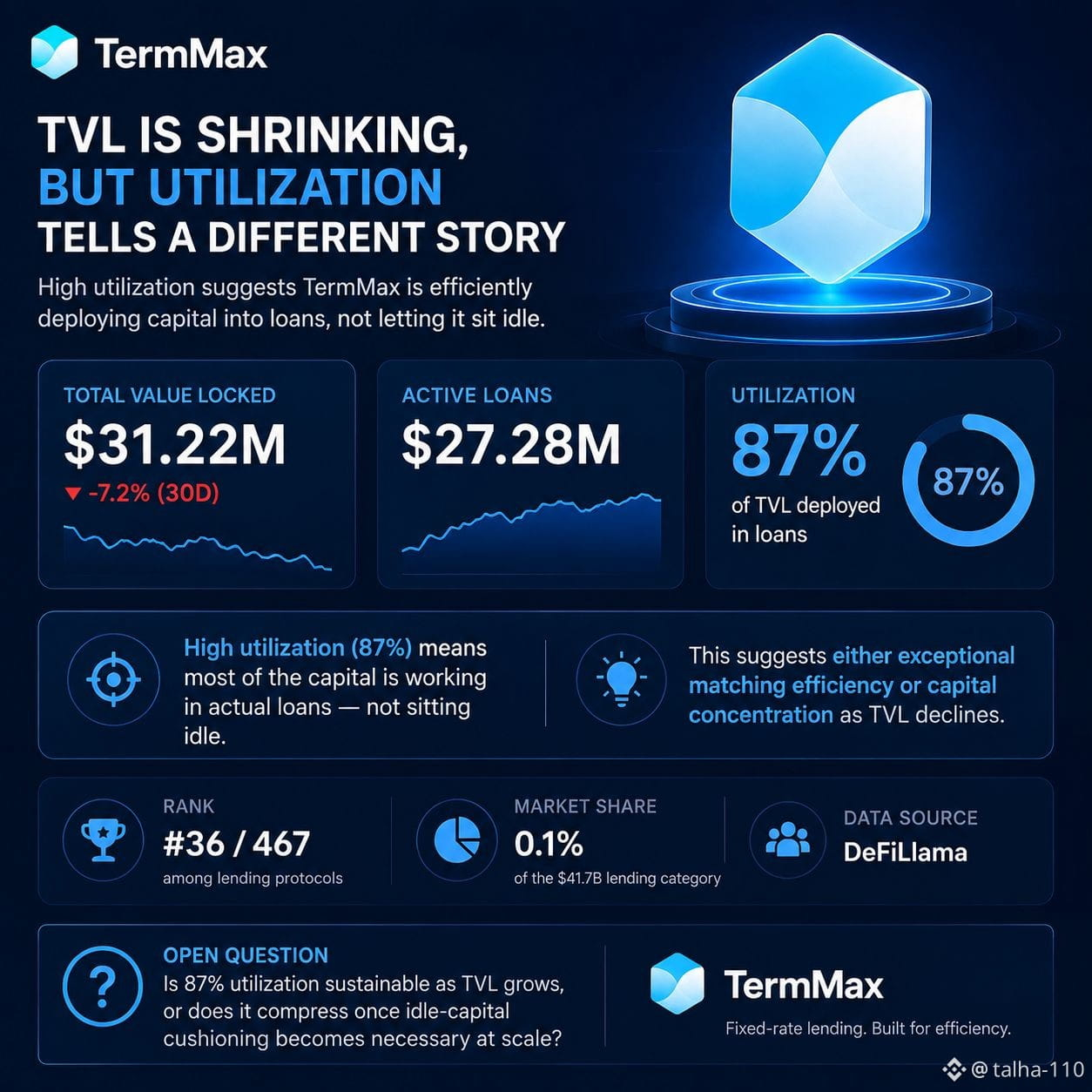
TermMax: TVL Is Shrinking, But Utilization Tells a Different Story
TermMax's TVL sits at $31.22M right now — down 7.2% over the past 30 days. On its own, that reads like a protocol losing steam.
But pair it with active loans of $27.28M, and the picture shifts. That's roughly 87% of total locked capital currently deployed in actual loans — not sitting idle waiting to be matched.
That's an unusually high utilization rate for a fixed-rate lending protocol. Most lending platforms carry meaningful idle capital because supply and demand rarely match perfectly at any given moment. An 87% utilization ratio suggests one of two things: either TermMax's Range Order and curator system is genuinely efficient at matching lenders to borrowers, or the TVL decline itself is concentrating remaining capital into markets that are already active — shrinking the denominator faster than the numerator.
Context matters too: TermMax ranks #36 among 467 lending protocols tracked by DefiLlama, holding just 0.1% of the $41.7B lending category. Small absolute size, but that utilization number is the kind of efficiency metric that doesn't scale with TVL — it's either structurally sound or it isn't, regardless of protocol size.
Open question: is 87% utilization sustainable as TVL grows, or does it compress once idle-capital cushioning becomes necessary at scale? #termmax @TermMax
TermMax's TVL sits at $31.22M right now — down 7.2% over the past 30 days. On its own, that reads like a protocol losing steam.
But pair it with active loans of $27.28M, and the picture shifts. That's roughly 87% of total locked capital currently deployed in actual loans — not sitting idle waiting to be matched.
That's an unusually high utilization rate for a fixed-rate lending protocol. Most lending platforms carry meaningful idle capital because supply and demand rarely match perfectly at any given moment. An 87% utilization ratio suggests one of two things: either TermMax's Range Order and curator system is genuinely efficient at matching lenders to borrowers, or the TVL decline itself is concentrating remaining capital into markets that are already active — shrinking the denominator faster than the numerator.
Context matters too: TermMax ranks #36 among 467 lending protocols tracked by DefiLlama, holding just 0.1% of the $41.7B lending category. Small absolute size, but that utilization number is the kind of efficiency metric that doesn't scale with TVL — it's either structurally sound or it isn't, regardless of protocol size.
Open question: is 87% utilization sustainable as TVL grows, or does it compress once idle-capital cushioning becomes necessary at scale? #termmax @TermMax
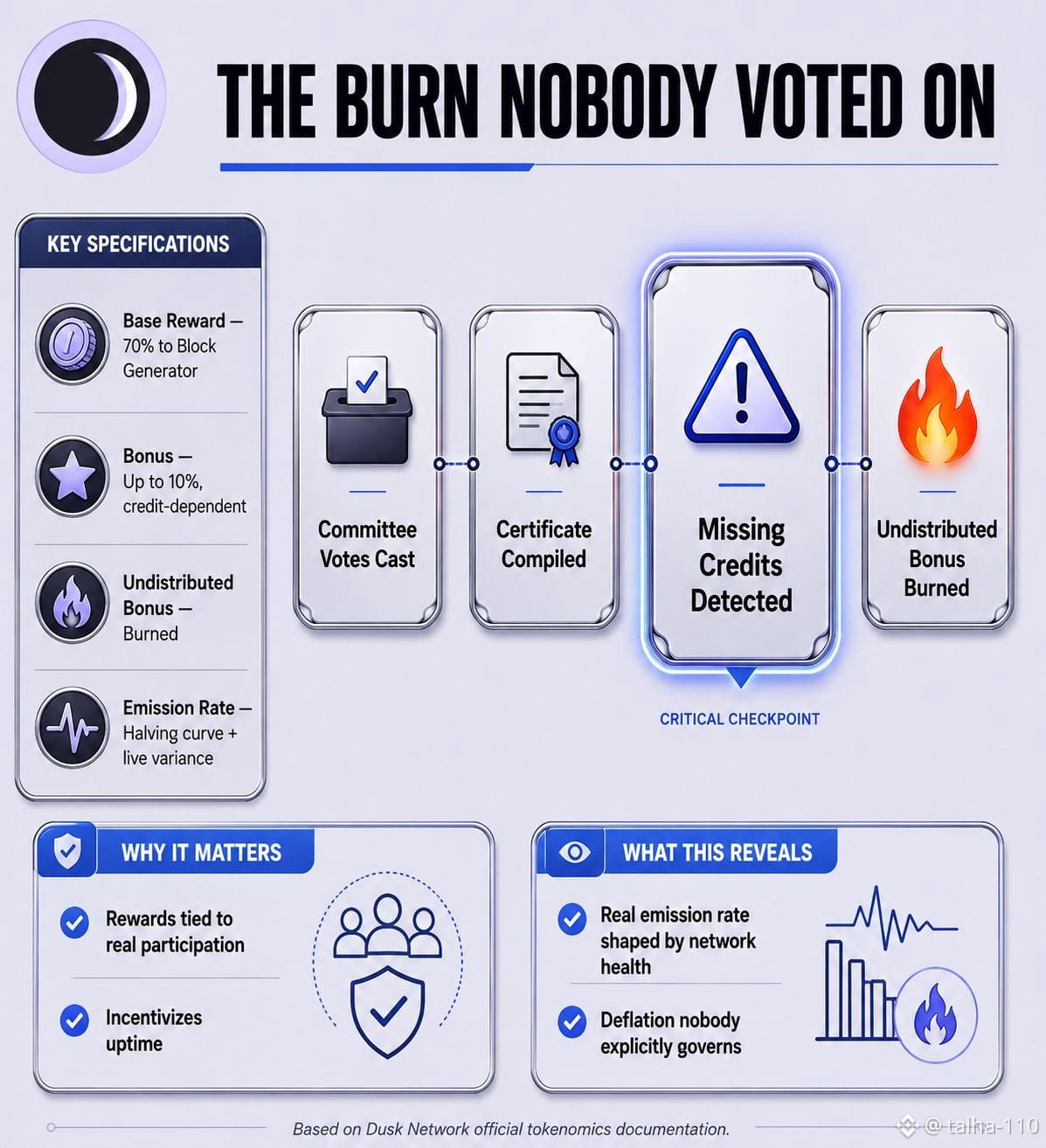
Every block on Dusk, the Block Generator earns a guaranteed 70% cut, plus up to an additional 10% bonus — but that bonus isn't fixed. It scales with how many committee credits (votes) actually got included in the certificate confirming the previous block. If some of those votes are missing — say, provisioners were offline or slow to respond — the undistributed portion of that bonus doesn't roll over to anyone. It gets burned outright.
What that quietly means is that Dusk's actual circulating emission isn't purely a function of the halving schedule everyone points to. It also depends, block by block, on how completely the network participates in its own consensus. A network with strong uptime and fast, well-synced provisioners burns less and pays out more; a network with sluggish or partially offline committees is silently burning DUSK it never even distributed. The halving curve tells you the ceiling. The actual emission rate underneath that ceiling is being shaped in real time by how healthy consensus participation is on any given block — a deflationary lever nobody voted on, running quietly in the background of every single block.
$DUSK #dusk @Dusk
What that quietly means is that Dusk's actual circulating emission isn't purely a function of the halving schedule everyone points to. It also depends, block by block, on how completely the network participates in its own consensus. A network with strong uptime and fast, well-synced provisioners burns less and pays out more; a network with sluggish or partially offline committees is silently burning DUSK it never even distributed. The halving curve tells you the ceiling. The actual emission rate underneath that ceiling is being shaped in real time by how healthy consensus participation is on any given block — a deflationary lever nobody voted on, running quietly in the background of every single block.
$DUSK #dusk @Dusk
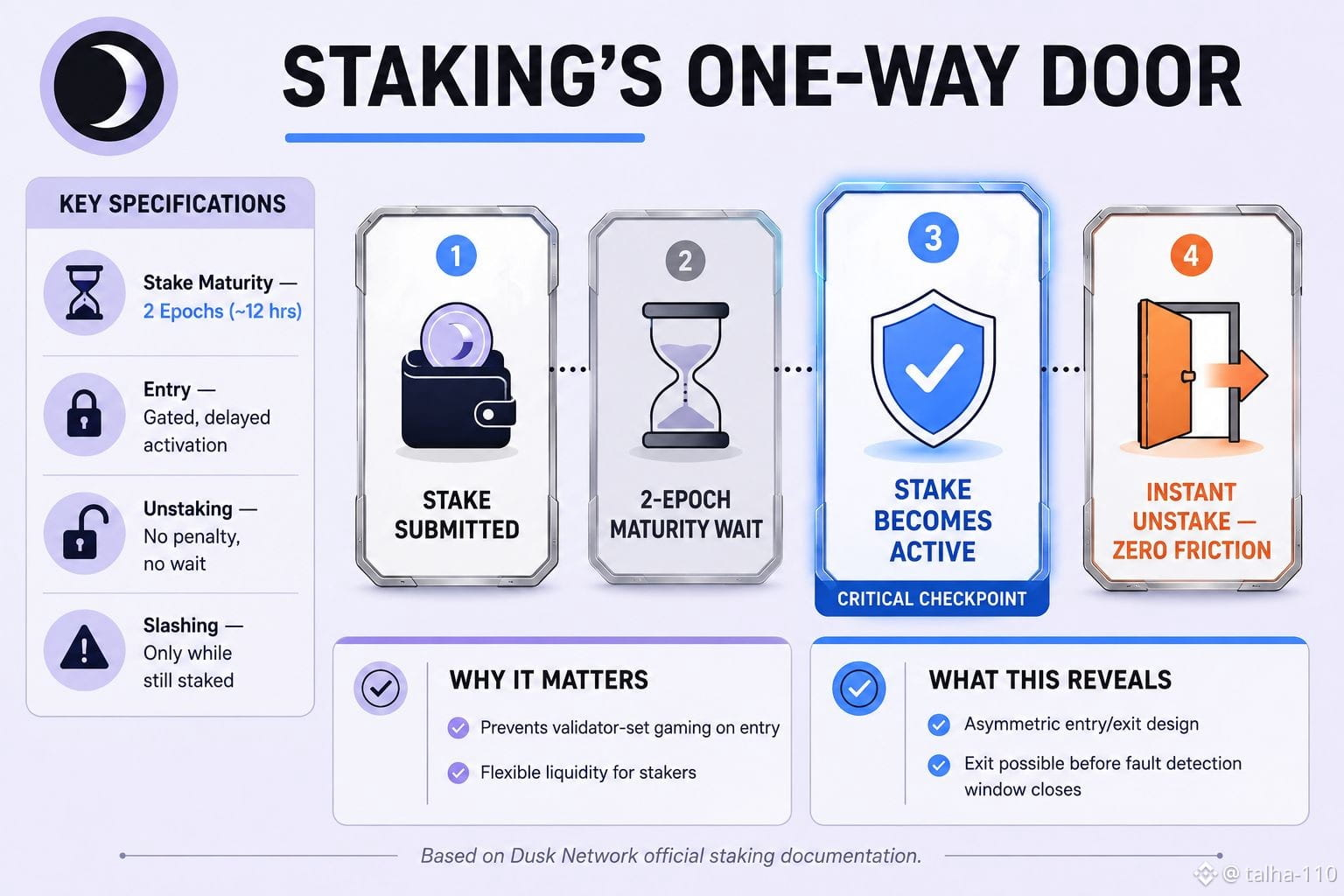
I've been digging into Dusk's staking mechanics lately, and there's something about the entry-vs-exit design that keeps nagging at me. When you stake DUSK, your funds don't start working right away — they sit in a 2-epoch maturity period, roughly 4320 blocks, close to 12 hours, before that stake is even eligible to vote or produce blocks and start earning anything. Fair enough, most PoS networks have some version of this, it stops people from gaming the validator set the moment they show up.
What caught me off guard was the other side of it. Unstaking on Dusk has none of that friction. No cooldown, no penalty, nothing. The official docs are blunt about it — you can pull your entire stake out whenever you want, instantly. Compare that to networks like Ethereum or Cosmos-based chains where unbonding can take days or weeks, specifically so slashing has a window to catch bad behavior before someone can walk away clean.
So you end up with this lopsided setup: getting in takes patience, getting out takes nothing. And because slashing only fires when a fault is actually caught on-chain while you're still staked, it opens up a scenario worth sitting with — a provisioner who's quietly built up a good track record could, in theory, pull their entire stake out an instant before doing something risky, and simply be gone before any penalty mechanism even has a chance to react.
I'm not saying this is being exploited, I have no evidence of that. But when the door out is that wide open, it makes me wonder how much weight the "no exit friction" design choice was actually given during the tokenomics planning, versus it just being a convenience feature that nobody stress-tested against this exact angle.
$DUSK #dusk @Dusk
What caught me off guard was the other side of it. Unstaking on Dusk has none of that friction. No cooldown, no penalty, nothing. The official docs are blunt about it — you can pull your entire stake out whenever you want, instantly. Compare that to networks like Ethereum or Cosmos-based chains where unbonding can take days or weeks, specifically so slashing has a window to catch bad behavior before someone can walk away clean.
So you end up with this lopsided setup: getting in takes patience, getting out takes nothing. And because slashing only fires when a fault is actually caught on-chain while you're still staked, it opens up a scenario worth sitting with — a provisioner who's quietly built up a good track record could, in theory, pull their entire stake out an instant before doing something risky, and simply be gone before any penalty mechanism even has a chance to react.
I'm not saying this is being exploited, I have no evidence of that. But when the door out is that wide open, it makes me wonder how much weight the "no exit friction" design choice was actually given during the tokenomics planning, versus it just being a convenience feature that nobody stress-tested against this exact angle.
$DUSK #dusk @Dusk
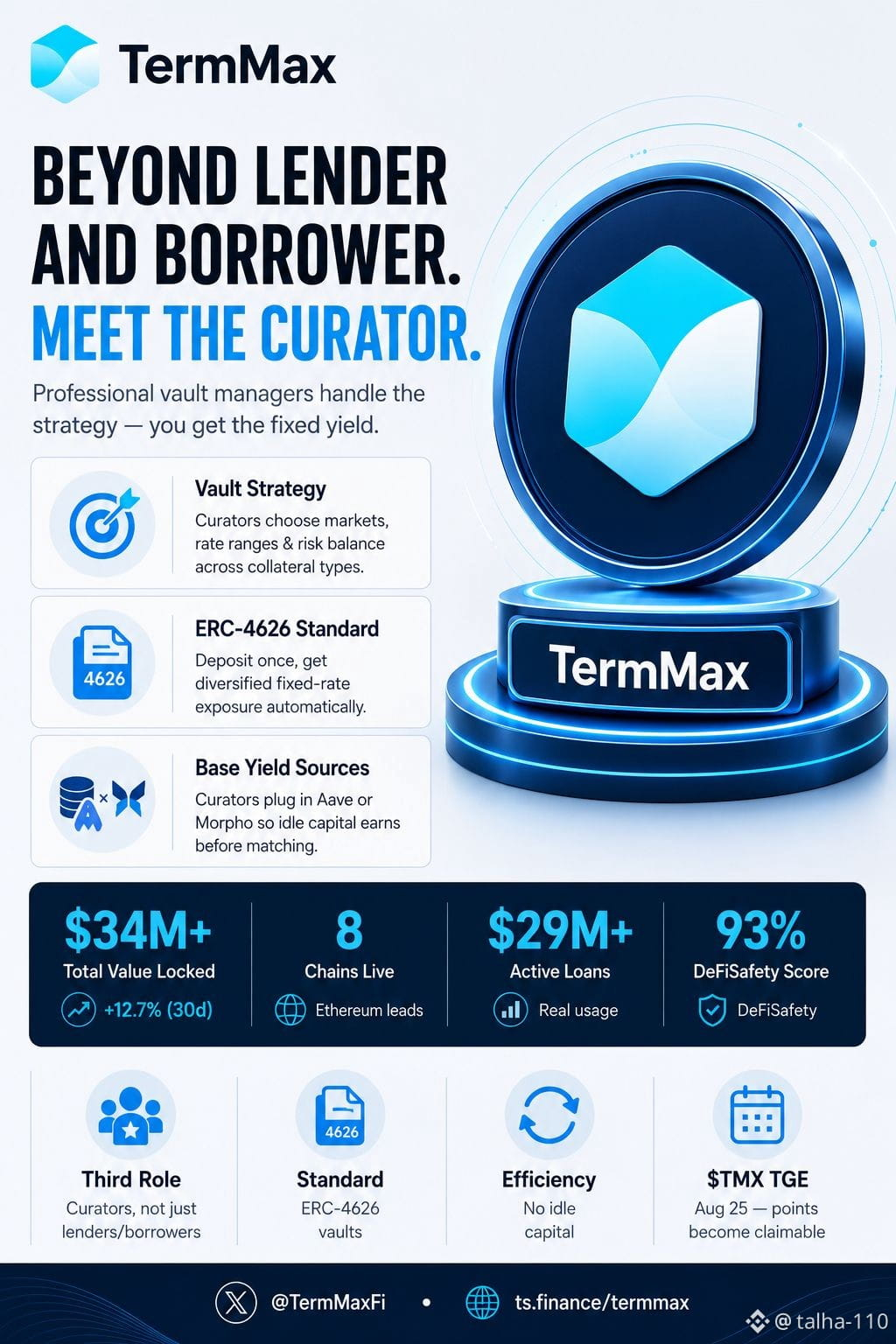
Most people who interact with TermMax show up as either lenders or borrowers. There's a third role I hadn't really paid attention to until recently: Curators.
Curators are the professional managers running the vaults on the protocol. They're the ones deciding which markets get capital, what rate ranges to offer, and how to balance risk across different collateral types. Instead of every user manually managing their own range orders, curators take on that strategy and optimization work.
For depositors, this makes things a lot simpler. You put capital into a vault, and the curator spreads it across multiple fixed-rate markets for you. You still get fixed-yield exposure — you just don't have to sit there setting, adjusting, and monitoring individual orders yourself.
Here's the part I found genuinely clever: TermMax vaults follow the ERC-4626 standard, and curators can plug in external protocols like Aave or Morpho as a base yield source. So even before your capital gets matched into a fixed-rate position, it's not just sitting idle — it's earning in the background the whole time.
It sits in this useful middle ground — more hands-on than pure passive lending, but way less work than running your own range orders. The curator absorbs the complexity, and depositors get an easier way into the fixed-rate side of things.
It's not the flashiest part of TermMax, but it's one of those structural pieces that lets the protocol actually scale beyond individual users placing their own orders one by one.
#termmax @TermMax
Curators are the professional managers running the vaults on the protocol. They're the ones deciding which markets get capital, what rate ranges to offer, and how to balance risk across different collateral types. Instead of every user manually managing their own range orders, curators take on that strategy and optimization work.
For depositors, this makes things a lot simpler. You put capital into a vault, and the curator spreads it across multiple fixed-rate markets for you. You still get fixed-yield exposure — you just don't have to sit there setting, adjusting, and monitoring individual orders yourself.
Here's the part I found genuinely clever: TermMax vaults follow the ERC-4626 standard, and curators can plug in external protocols like Aave or Morpho as a base yield source. So even before your capital gets matched into a fixed-rate position, it's not just sitting idle — it's earning in the background the whole time.
It sits in this useful middle ground — more hands-on than pure passive lending, but way less work than running your own range orders. The curator absorbs the complexity, and depositors get an easier way into the fixed-rate side of things.
It's not the flashiest part of TermMax, but it's one of those structural pieces that lets the protocol actually scale beyond individual users placing their own orders one by one.
#termmax @TermMax
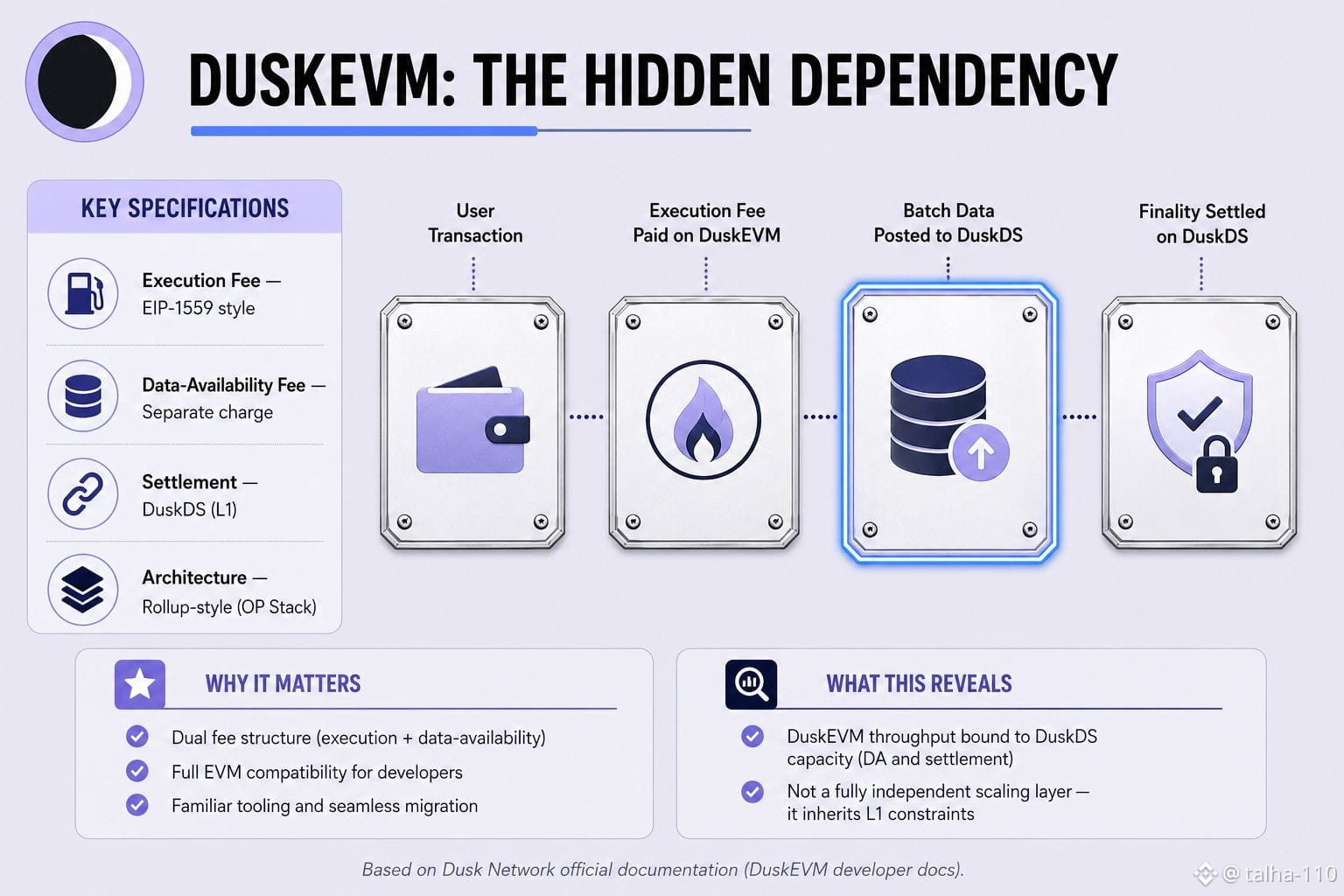
DuskEVM looks for a separate fee for each transaction—an EIP-1559-style execution fee, and a separate data-availability fee charged for posting batch data on DuskDS. This two-tier fee model is automatically estimated in wallets/SDKs, so most users don’t even realize that the gas they pay is actually the combined cost of two different things. What’s interesting is that DuskEVM is pitched as an “EVM-compatible scaling layer,” but this data-availability dependency reveals that DuskEVM isn’t actually independent—finality and data storage for every transaction are still settled on DuskDS. In other words, DuskEVM doesn’t have its own throughput capacity; it’s directly bounded by the capacity of the base layer (DuskDS), just like a rollup architecture where L2 appears “faster,” but its security and data guarantees still depend on L1. That’s why when DuskDS is under load, both the cost and speed of DuskEVM can be automatically affected—regardless of whether DuskEVM has its own separate execution layer.
$DUSK #dusk @Dusk
$DUSK #dusk @Dusk
Verified
One thing that doesn’t get talked about enough in fixed-rate lending is the waiting time.
You pick a rate, deposit your capital, and then you wait for a borrower to match you. Until that match happens, the money is often just sitting there doing nothing. That gap can quietly reduce your overall returns, especially if the market is slow.
TermMax handles this differently.
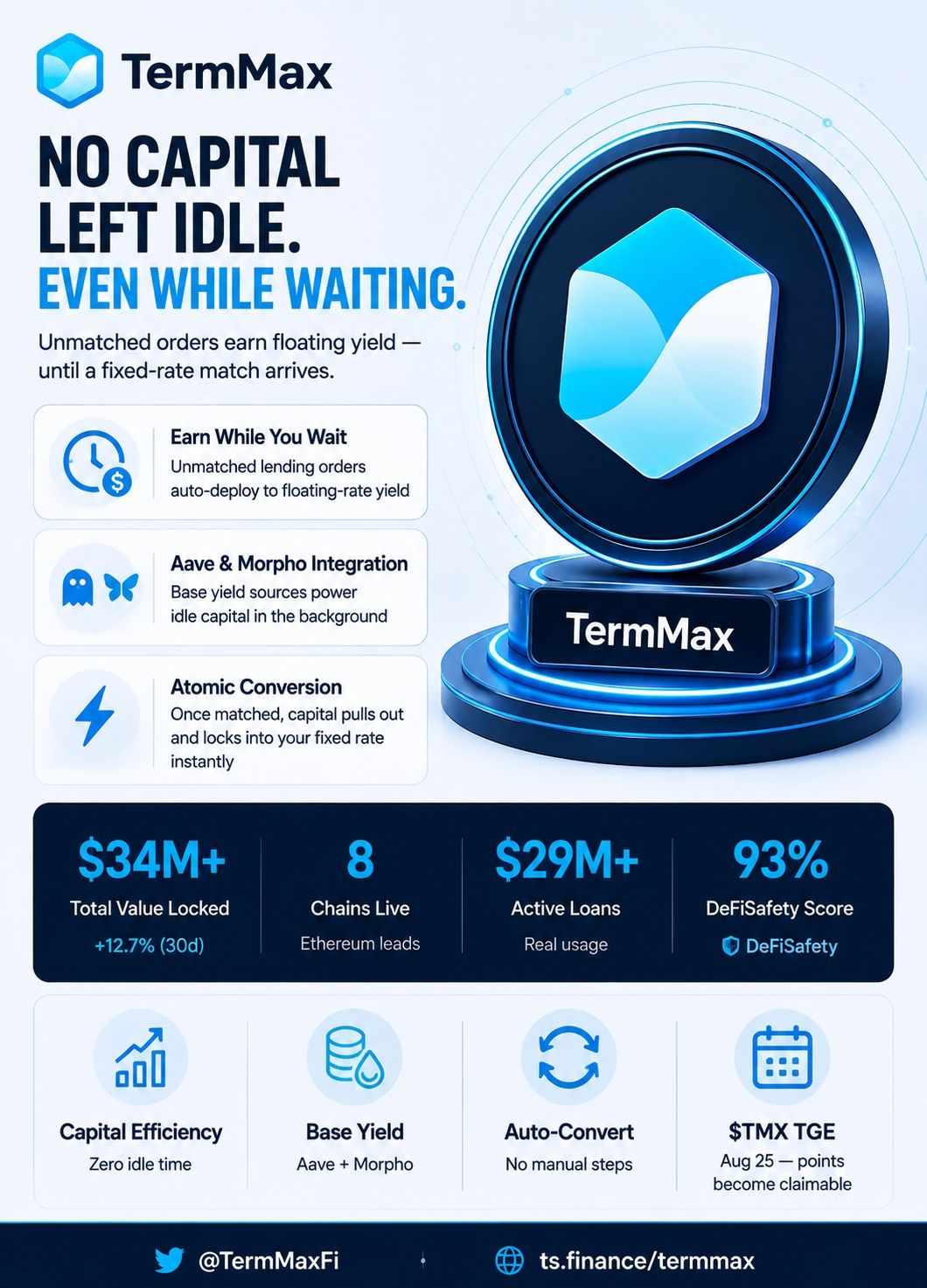
If your lending order hasn’t been fully matched yet, the unmatched portion doesn’t stay idle. It can be automatically put to work in the background on floating-rate protocols like Aave and Morpho. So even while you’re waiting for someone to take your fixed rate, the capital is still generating some yield.
Once a borrower matches the rate you offered, the position switches over to the normal fixed-rate setup. The capital is pulled automatically — no manual steps required.
Most discussions around TermMax focus on the fixed rates or the isolated market structure. This part — what happens to capital during the unmatched window — usually gets overlooked. But it’s a practical design choice that improves capital efficiency without changing the core fixed-rate promise.
Small detail, but it makes a real difference.
#termmax @TermMax
You pick a rate, deposit your capital, and then you wait for a borrower to match you. Until that match happens, the money is often just sitting there doing nothing. That gap can quietly reduce your overall returns, especially if the market is slow.
TermMax handles this differently.
If your lending order hasn’t been fully matched yet, the unmatched portion doesn’t stay idle. It can be automatically put to work in the background on floating-rate protocols like Aave and Morpho. So even while you’re waiting for someone to take your fixed rate, the capital is still generating some yield.
Once a borrower matches the rate you offered, the position switches over to the normal fixed-rate setup. The capital is pulled automatically — no manual steps required.
Most discussions around TermMax focus on the fixed rates or the isolated market structure. This part — what happens to capital during the unmatched window — usually gets overlooked. But it’s a practical design choice that improves capital efficiency without changing the core fixed-rate promise.
Small detail, but it makes a real difference.
#termmax @TermMax
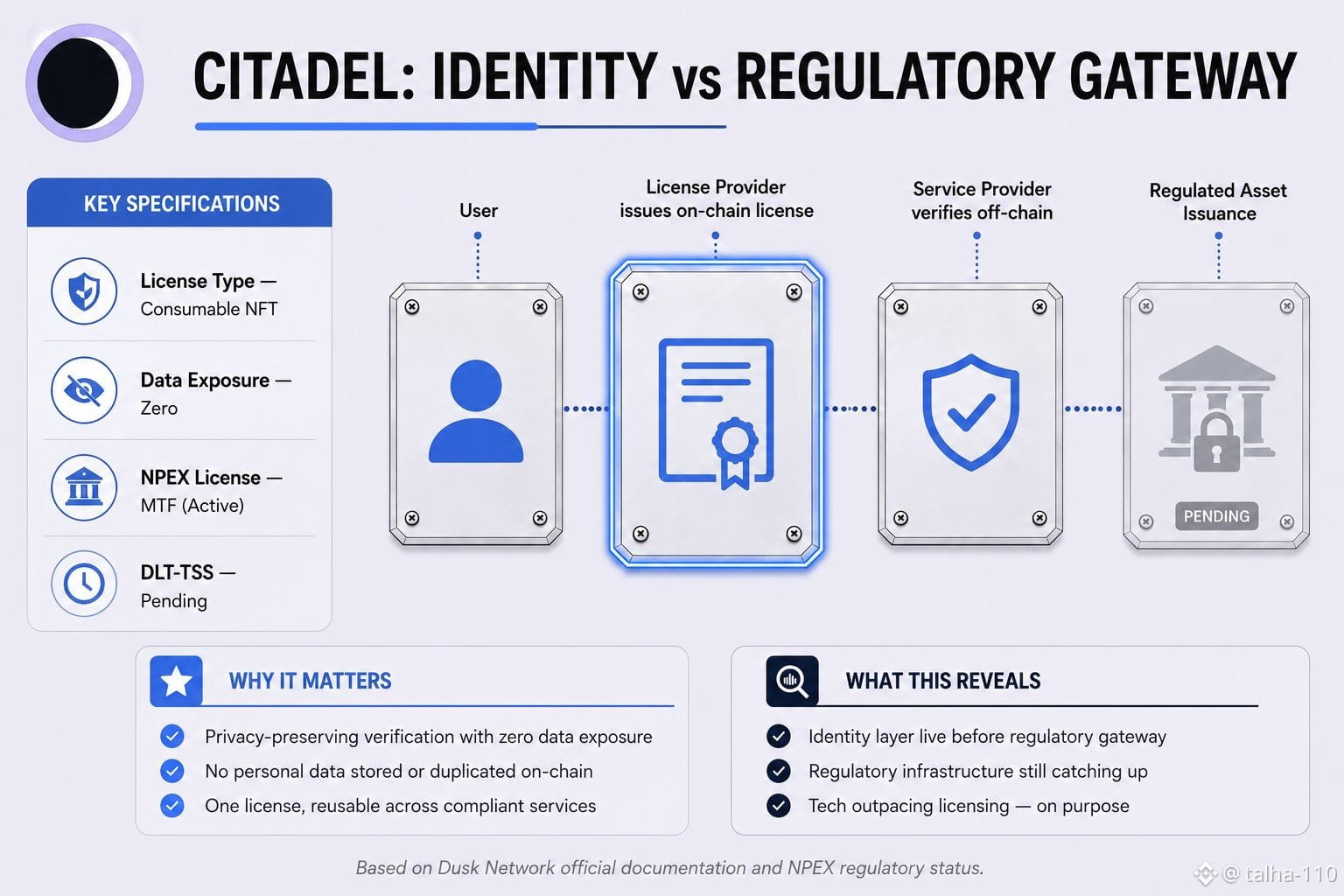
Dusk's Citadel KYC system issues NFT-based "licenses" — a user gets verified once (for something like age or residency), a License Provider issues a consumable license on-chain, and a Service Provider can then verify that license off-chain without ever seeing the underlying personal data. The whole identity layer is already live and functional. But when I looked into what this compliance infrastructure was actually built for, it turns out Dusk's regulatory partner NPEX currently only holds an MTF (Multilateral Trading Facility) license — the DLT-TSS license, which is what's actually needed to natively issue and tokenize regulated assets on-chain, is still "in progress." So the privacy-preserving identity layer is sitting there fully ready, but the actual legal gateway for the regulated asset issuance this system was designed to support is still waiting on approval.
If the identity infrastructure matured before the asset issuance layer did, the question is: what's actually bottlenecking the RWA pipeline — the tech, or the regulation?
@Dusk $DUSK #dusk
$GPS
$ACE
If the identity infrastructure matured before the asset issuance layer did, the question is: what's actually bottlenecking the RWA pipeline — the tech, or the regulation?
@Dusk $DUSK #dusk
$GPS
$ACE
I used to think "fixed-rate" on TermMax basically meant the risk was gone — lock a rate, know your return, move on. Digging into how the protocol actually structures its markets, that assumption didn't quite survive.
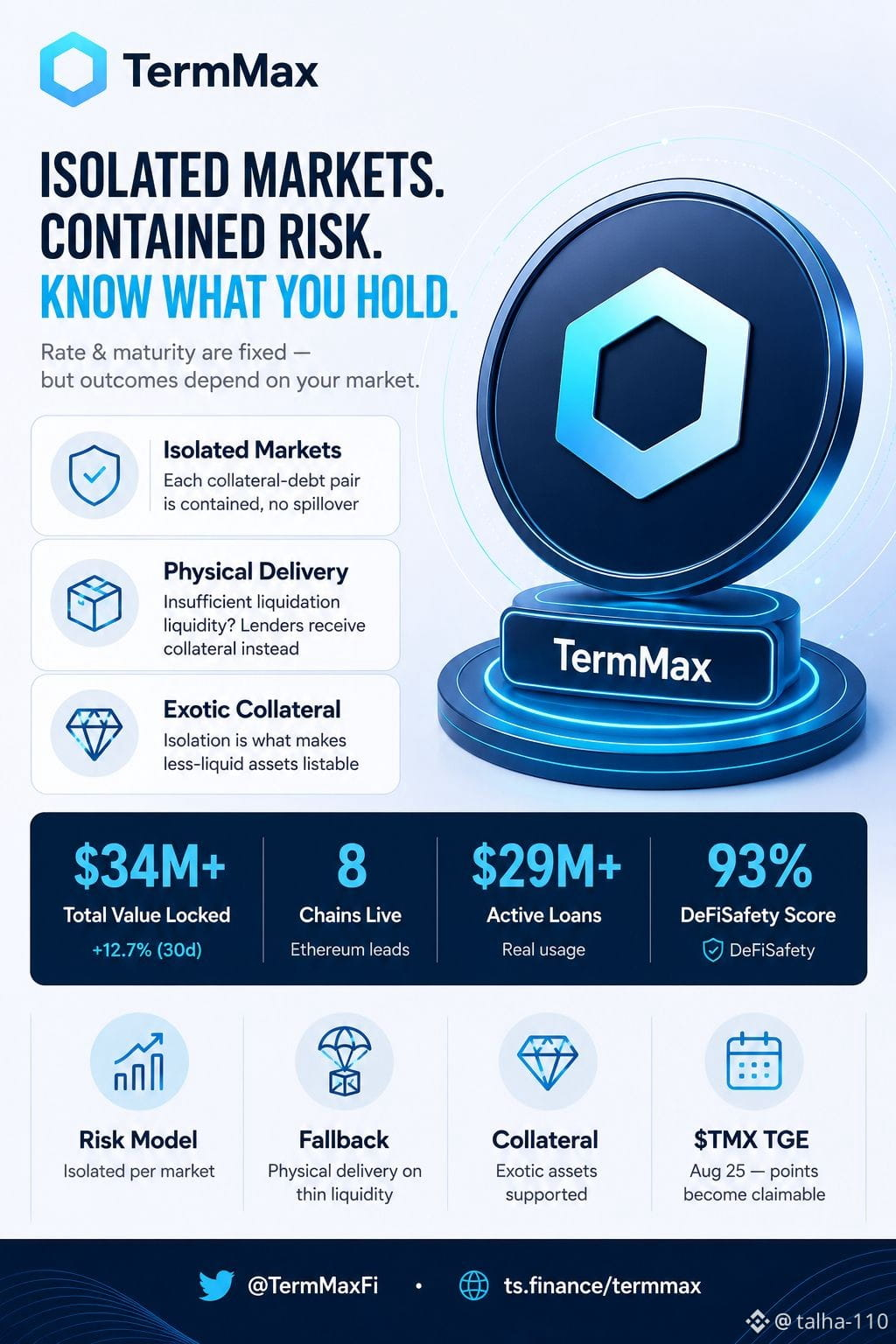
TermMax runs on isolated markets. Each one is a specific collateral-debt pair, and your exposure stays contained inside that pair. That's actually the point — it's what lets the protocol support exotic or less-liquid collateral without one bad asset draining a shared pool, the way it can on some other lending platforms.
But isolation cuts both ways. If a market's collateral crashes hard and there isn't enough liquidity to liquidate it cleanly, TermMax has a fallback that doesn't get much airtime: physical delivery. Instead of getting your debt token back, lenders can end up holding the borrower's actual collateral instead.
So yes — the rate is fixed, the maturity is fixed. But what you actually walk away with in a worst-case scenario depends on which isolated market you picked and how thin its liquidity was. That's a detail easy to miss when "fixed-rate" is doing most of the talking.
None of this makes the design bad — isolation is exactly what makes exotic-collateral markets possible in the first place. It just means the risk didn't vanish. It moved from "will my rate change" to "which market did I choose."
#termmax @TermMax
$GPS
$PIEVERSE
$ACE
TermMax runs on isolated markets. Each one is a specific collateral-debt pair, and your exposure stays contained inside that pair. That's actually the point — it's what lets the protocol support exotic or less-liquid collateral without one bad asset draining a shared pool, the way it can on some other lending platforms.
But isolation cuts both ways. If a market's collateral crashes hard and there isn't enough liquidity to liquidate it cleanly, TermMax has a fallback that doesn't get much airtime: physical delivery. Instead of getting your debt token back, lenders can end up holding the borrower's actual collateral instead.
So yes — the rate is fixed, the maturity is fixed. But what you actually walk away with in a worst-case scenario depends on which isolated market you picked and how thin its liquidity was. That's a detail easy to miss when "fixed-rate" is doing most of the talking.
None of this makes the design bad — isolation is exactly what makes exotic-collateral markets possible in the first place. It just means the risk didn't vanish. It moved from "will my rate change" to "which market did I choose."
#termmax @TermMax
$GPS
$PIEVERSE
$ACE
Verified
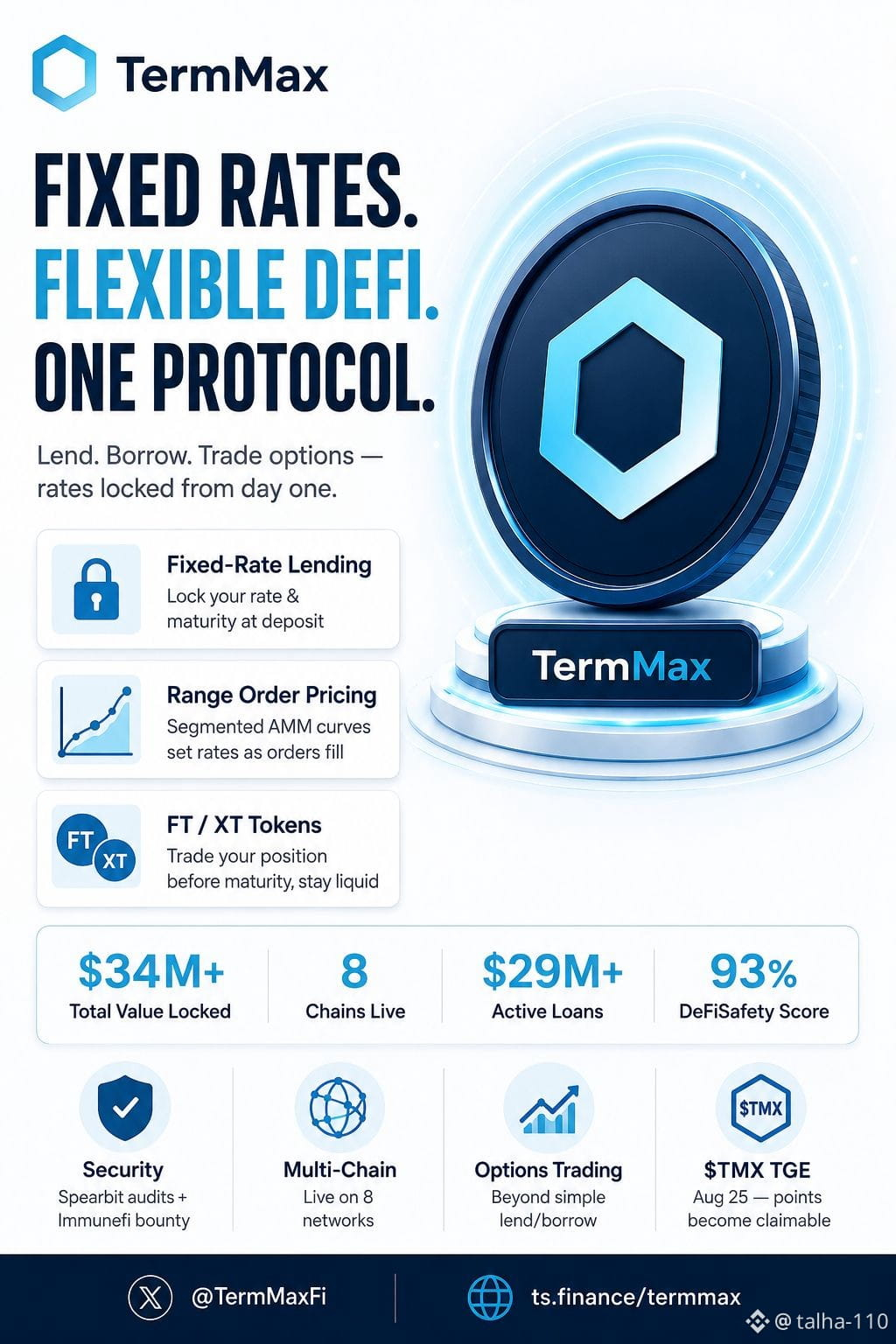
TermMax: Protocol Overview & Mechanism Analysis
Initial assumption walking in: another fixed-rate lending protocol chasing a trend. Deeper analysis of the mechanism reveals a more deliberate design.
Core Purpose:
Conventional DeFi lending operates on floating rates — utilization-driven, unpredictable, and shifting between the moment of deposit and the moment of withdrawal. TermMax eliminates that variable entirely. Both rate and maturity are fixed at position entry. The return is known from day one, not discovered at the end.
Underlying Mechanism:
The system is built around two core instruments — FT (Fixed-rate Token) and XT. Lending generates an FT, which represents a binding commitment: one debt token repaid at maturity. Critically, the FT remains liquid pre-maturity — it can be traded on the open market, meaning capital isn't locked for the full term.
Pricing execution runs through Range Orders — segmented pricing curves where the applicable rate shifts as an order fills across segments. This is an AMM-based architecture (V1), an evolution from the earlier orderbook-and-auction model, engineered specifically to improve liquidity aggregation.
Verified Metrics:
The protocol is live across 8 chains (Ethereum holding the dominant share), with $34M+ in Total Value Locked and $29M+ in active loans — indicating deployed capital and real usage, not idle liquidity.
The Broader Thesis:
Fixed-rate infrastructure isn't just a UX improvement — it's a prerequisite. As tokenized stocks and real-world assets move onchain, predictable financing becomes as critical as the asset itself being onchain.
Open question: Is TermMax positioning as a lending market, or as the fixed-rate credit infrastructure the next DeFi cycle will require?
#TermMaxFi #termmax @TermMax
$STAR
$BTW
$TUT
Initial assumption walking in: another fixed-rate lending protocol chasing a trend. Deeper analysis of the mechanism reveals a more deliberate design.
Core Purpose:
Conventional DeFi lending operates on floating rates — utilization-driven, unpredictable, and shifting between the moment of deposit and the moment of withdrawal. TermMax eliminates that variable entirely. Both rate and maturity are fixed at position entry. The return is known from day one, not discovered at the end.
Underlying Mechanism:
The system is built around two core instruments — FT (Fixed-rate Token) and XT. Lending generates an FT, which represents a binding commitment: one debt token repaid at maturity. Critically, the FT remains liquid pre-maturity — it can be traded on the open market, meaning capital isn't locked for the full term.
Pricing execution runs through Range Orders — segmented pricing curves where the applicable rate shifts as an order fills across segments. This is an AMM-based architecture (V1), an evolution from the earlier orderbook-and-auction model, engineered specifically to improve liquidity aggregation.
Verified Metrics:
The protocol is live across 8 chains (Ethereum holding the dominant share), with $34M+ in Total Value Locked and $29M+ in active loans — indicating deployed capital and real usage, not idle liquidity.
The Broader Thesis:
Fixed-rate infrastructure isn't just a UX improvement — it's a prerequisite. As tokenized stocks and real-world assets move onchain, predictable financing becomes as critical as the asset itself being onchain.
Open question: Is TermMax positioning as a lending market, or as the fixed-rate credit infrastructure the next DeFi cycle will require?
#TermMaxFi #termmax @TermMax
$STAR
$BTW
$TUT
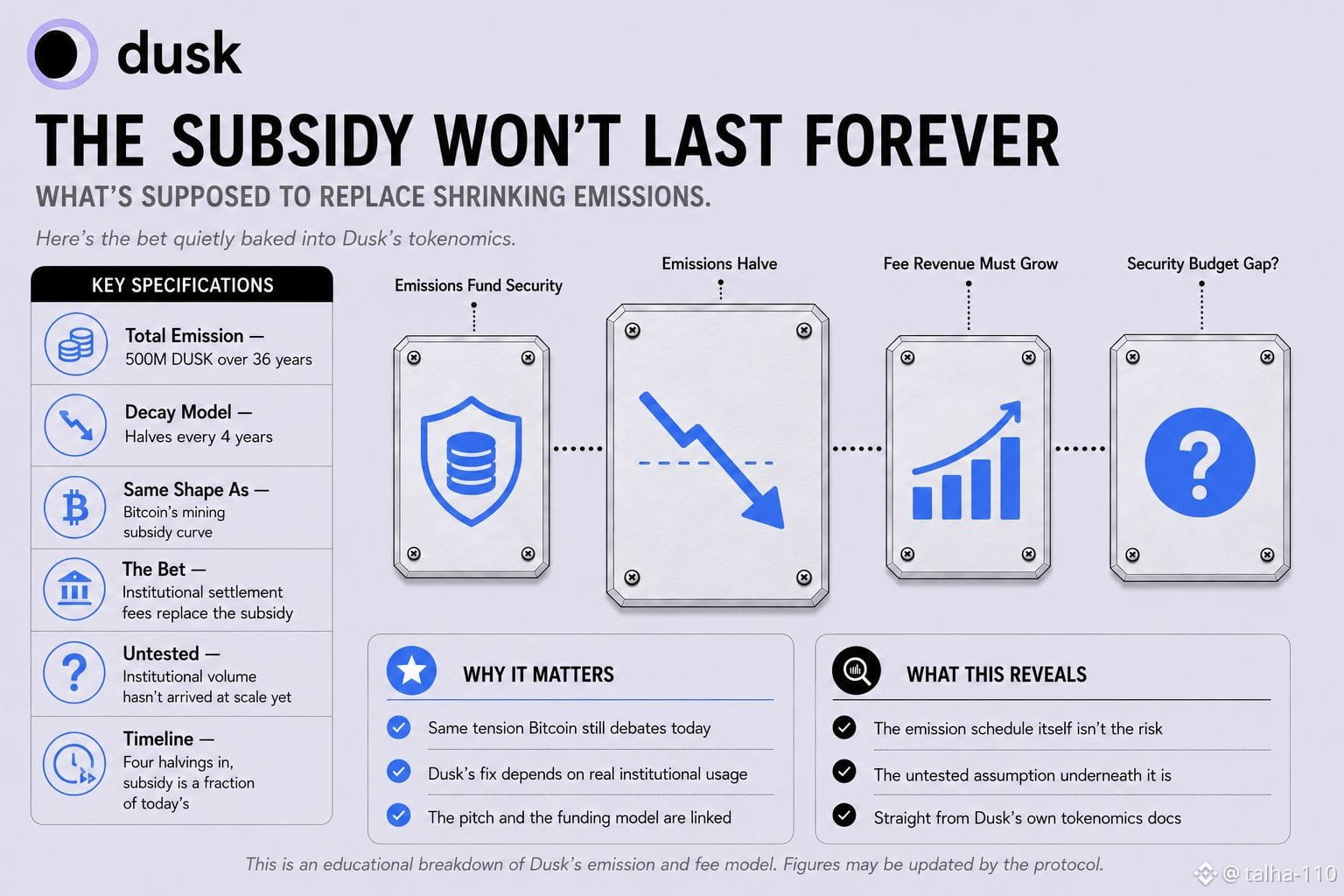
Dusk's staking rewards run on a geometric decay curve that cuts emissions in half every four years, the same halving shape Bitcoin's mining reward follows, spread across a fixed 500 million DUSK budget released over 36 years on top of the 500 million that already existed before mainnet. That detail alone isn't surprising, plenty of networks taper emissions. What's worth sitting with is what's supposed to replace that funding once it shrinks far enough. Bitcoin's version of this exact problem gets debated constantly, miners eventually need transaction fees to fully replace the block subsidy, and whether fee revenue alone can sustain enough security is still an open argument decades in. Dusk is walking into a structurally similar position, except its entire pitch depends on becoming infrastructure for regulated financial settlement, tokenized securities, institutional RWA flows, the kind of usage that's supposed to generate real fee volume precisely because it's real financial activity, not speculative trading. So there's an implicit bet baked into the tokenomics. Early on, emissions carry most of the weight of paying provisioners to secure the network. Four halvings in, sixteen years out, that subsidy is a fraction of where it started, and gas fees from actual settlement activity are supposed to have grown enough to pick up the difference. Nobody knows yet whether institutional-grade transaction volume actually generates fee revenue at that scale, because the institutions this network is built for mostly haven't shown up in volume yet. The emission schedule isn't the risk. The assumption baked quietly underneath it, that real-world asset settlement will eventually generate enough fee revenue to replace a shrinking subsidy, is the part nobody's actually tested.
$DUSK #dusk @Dusk
$HEMI
$CYS
$DUSK #dusk @Dusk
$HEMI
$CYS
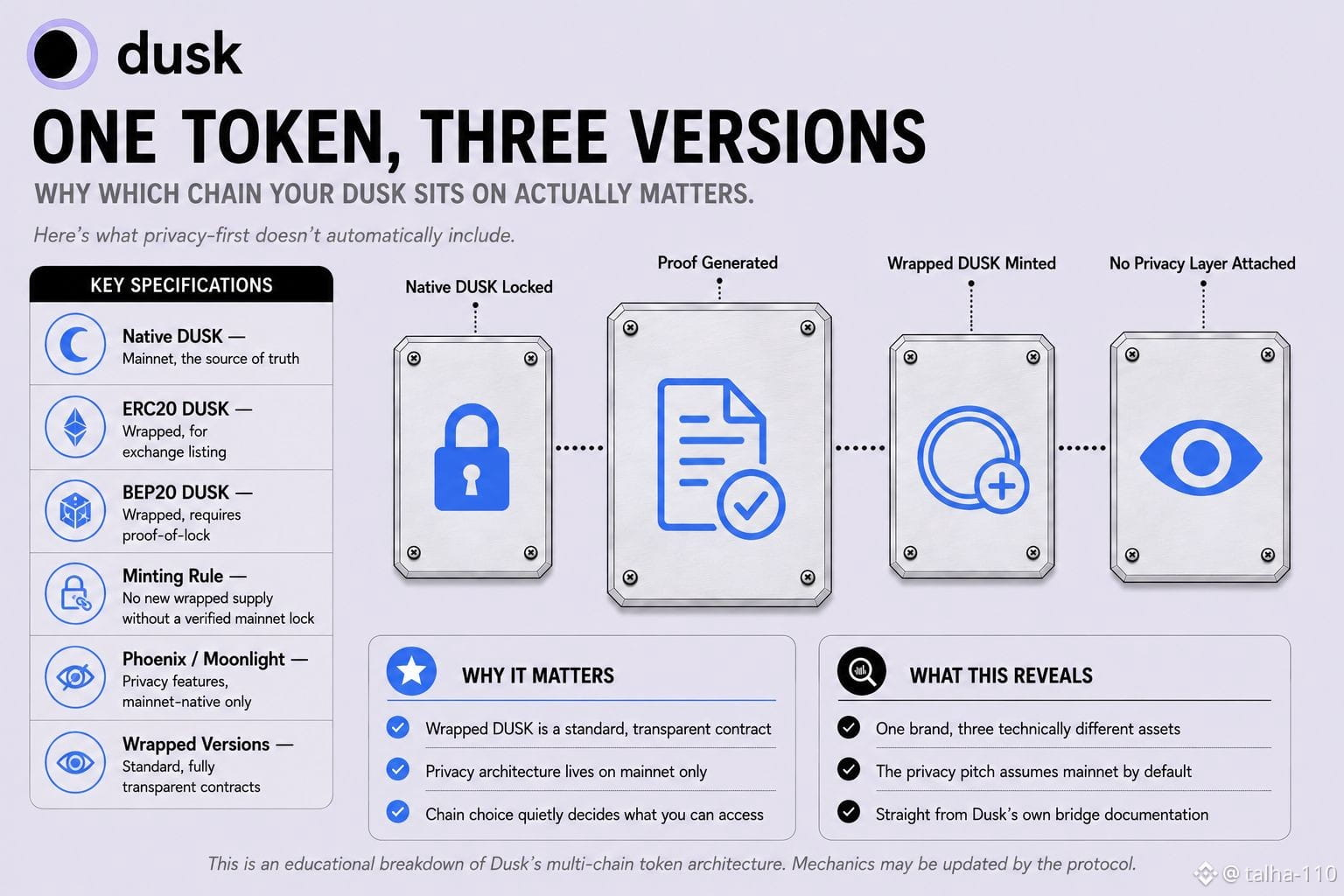
At first I assumed DUSK was just DUSK, one token, one ledger, wherever you held it. Reading Dusk's own bridge documentation, that assumption breaks down the moment you look at how the network actually structures its multi-chain presence. DUSK exists as three separate assets right now, native DUSK on the Dusk mainnet, plus ERC20 and BEP20 versions on Ethereum and BSC for exchange listings and migration. The bridge connecting them isn't symmetric. BEP20 DUSK is explicitly treated as a wrapped asset, and minting new BEP20 supply is only permitted after cryptographic proof that an equivalent amount got locked on the mainnet side first. Dusk's own team describes native mainnet DUSK as the source of truth for exactly this reason, everything else is a derivative that only exists because something real got locked up somewhere else. That's a normal bridge design, plenty of networks work this way. But it collides with the privacy pitch in a way that's easy to miss. Phoenix and Moonlight, the two transaction models actually offering privacy or public transparency by design, are mainnet-native concepts. ERC20 and BEP20 DUSK are just standard token contracts sitting on Ethereum and BSC, fully transparent by definition, with none of Dusk's own privacy architecture attached to them at all. So depending on which version of DUSK someone actually holds, native mainnet or a wrapped bridge asset, they may not have access to any of Dusk's privacy features at all, regardless of whether they'd choose Phoenix or Moonlight if they did. The brand is privacy-first. Whether a given holder's DUSK is even capable of touching that privacy layer depends entirely on which chain it's sitting on, a detail the "privacy-first" framing doesn't really surface.
$DUSK #dusk @Dusk
$HEMI
$APR
$DUSK #dusk @Dusk
$HEMI
$APR
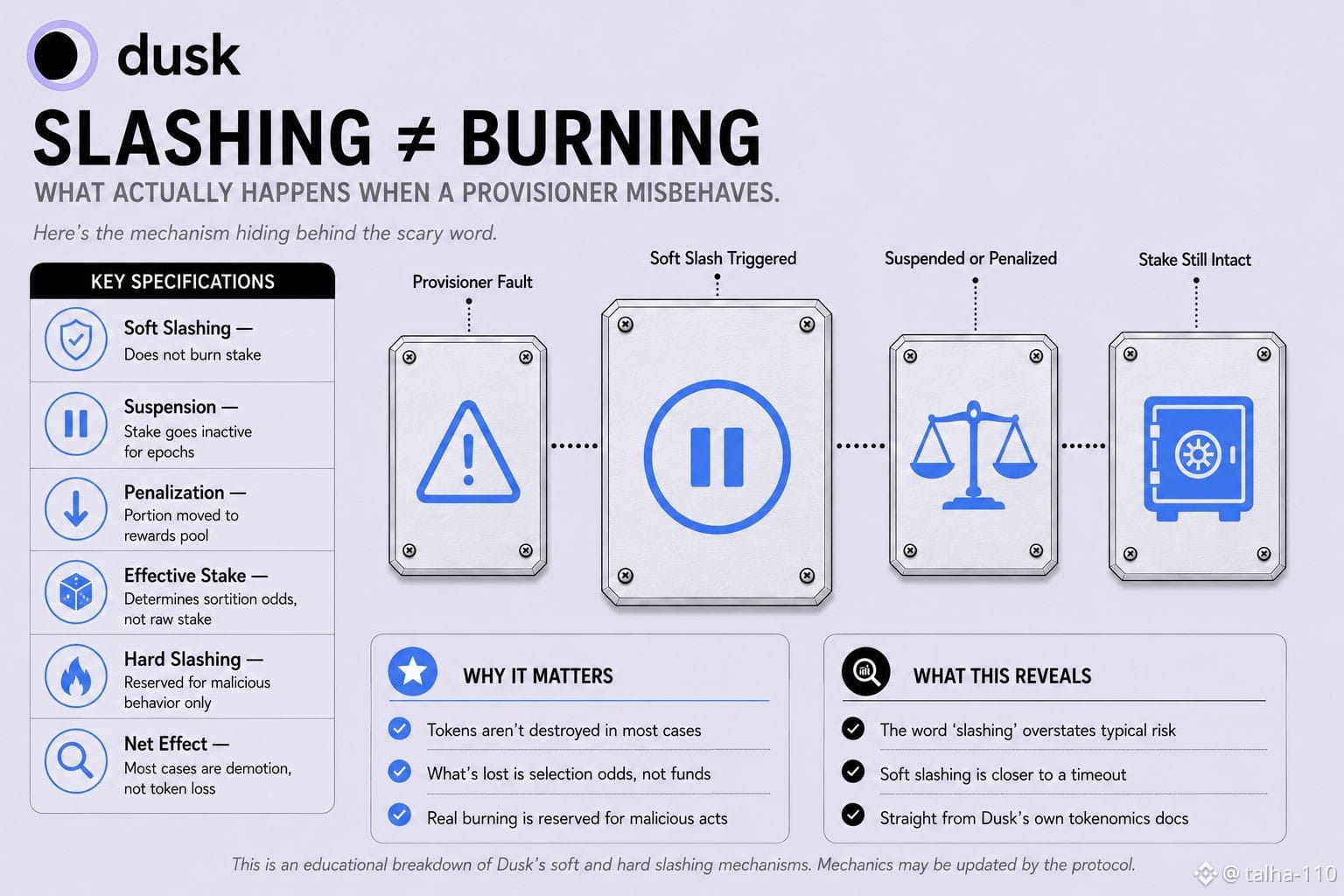
At first I assumed "slashing" on Dusk worked the way it does almost everywhere else, misbehave and a chunk of your staked DUSK gets destroyed, gone permanently, that's the whole deterrent. Reading Dusk's own tokenomics documentation, that assumption is wrong for the vast majority of real cases. Dusk runs soft slashing as its primary mechanism, and soft slashing explicitly does not burn stake at all. Instead it works two ways, suspension, where a misbehaving provisioner's entire stake goes inactive for one or more epochs, not eligible for selection, earning nothing, or penalization, where a portion of stake gets moved into the claimable rewards pool, which reduces effective stake used in sortition without actually destroying any tokens. So the DUSK never disappears. What disappears is influence, the ability to get selected as a voter or block generator, because sortition odds scale with effective stake, not raw stake. A provisioner who misses producing a block when selected doesn't lose money in the sense most people picture slashing working, they lose standing, their chances of getting picked again shrink for a set number of epochs. Hard slashing, the kind that actually burns stake, exists too, but it's reserved for genuinely malicious behavior, not the everyday downtime and missed duties that soft slashing is built to handle. That distinction matters for how you think about the risk of running or delegating to a provisioner. The scary word is "slashing." The actual mechanism, most of the time, is closer to a temporary demotion than a penalty that costs you tokens.
$DUSK #dusk @Dusk
$DUSK #dusk @Dusk
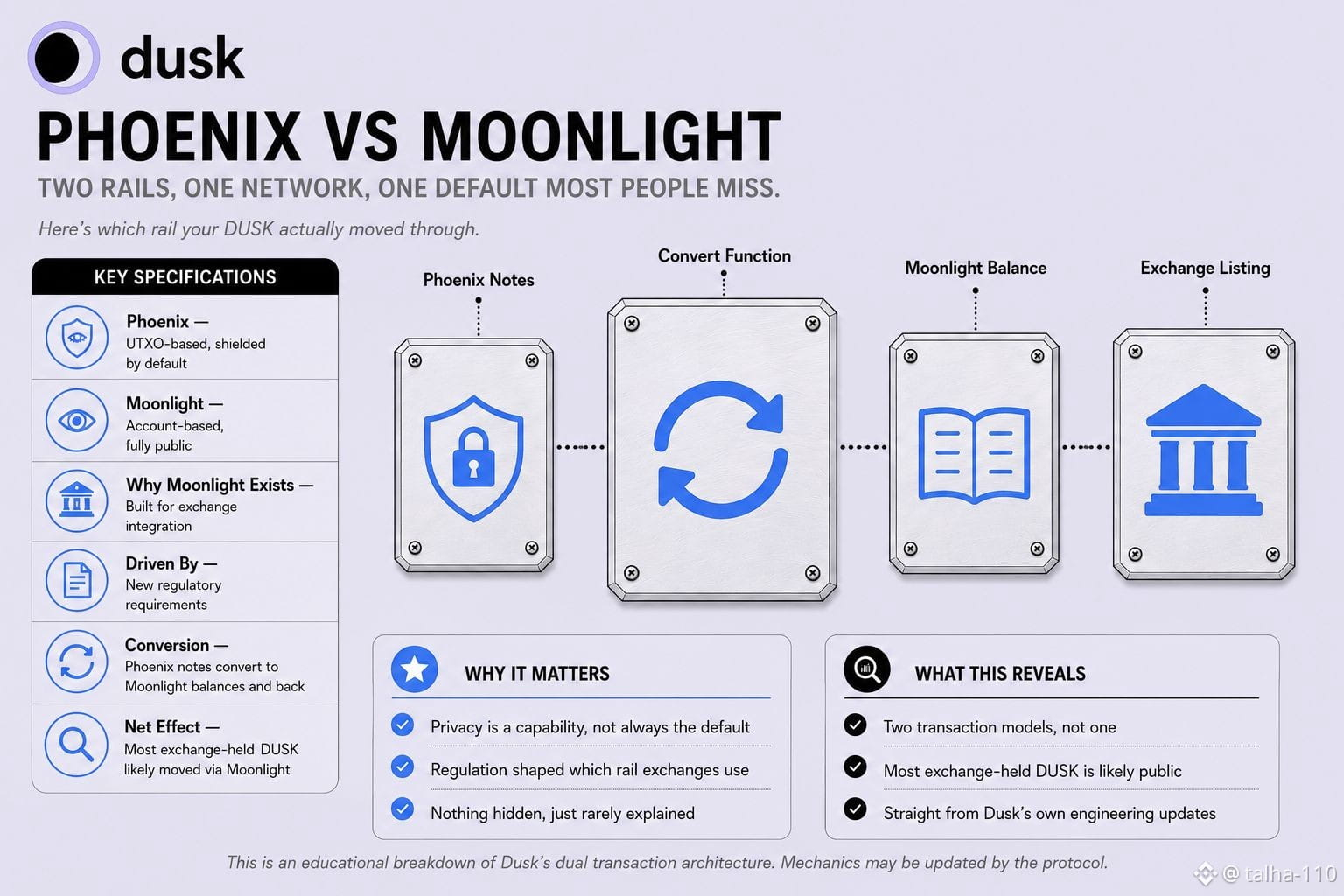
At first I assumed Dusk being a "privacy blockchain" meant every DUSK transaction runs through the same shielded rail by default, Phoenix, zero-knowledge proofs, hidden balances, that's just how the network works. Reading Dusk's own engineering updates, that's only half the picture. Dusk actually runs two separate transaction models side by side. Phoenix is UTXO-based and shielded, the private one everyone associates with the brand. Moonlight is account-based and fully transparent, addresses and balances publicly listed, functioning almost exactly like a normal Ethereum account. What's notable is why Moonlight exists at all. Dusk's own team has said directly that they needed it specifically to integrate mainnet with exchanges, because new regulations required a transparent, easily auditable rail for that kind of listing and compliance work. So the fully public transaction model wasn't a compromise bolted on as an afterthought, it was a requirement for getting DUSK onto exchanges in the first place. That means the DUSK sitting in most people's exchange balances right now most likely moved through Moonlight, the transparent side, not Phoenix, the private side the whole brand is built around. The two models do convert into each other, Phoenix notes can become Moonlight balances and back, so nothing here is broken or hidden. But it does mean "privacy-first" describes the protocol's capability, not necessarily the default path most DUSK actually travels once it touches a centralized exchange, and that's a meaningfully different claim than the one usually being pitched.
$DUSK #dusk @Dusk
$DUSK #dusk @Dusk
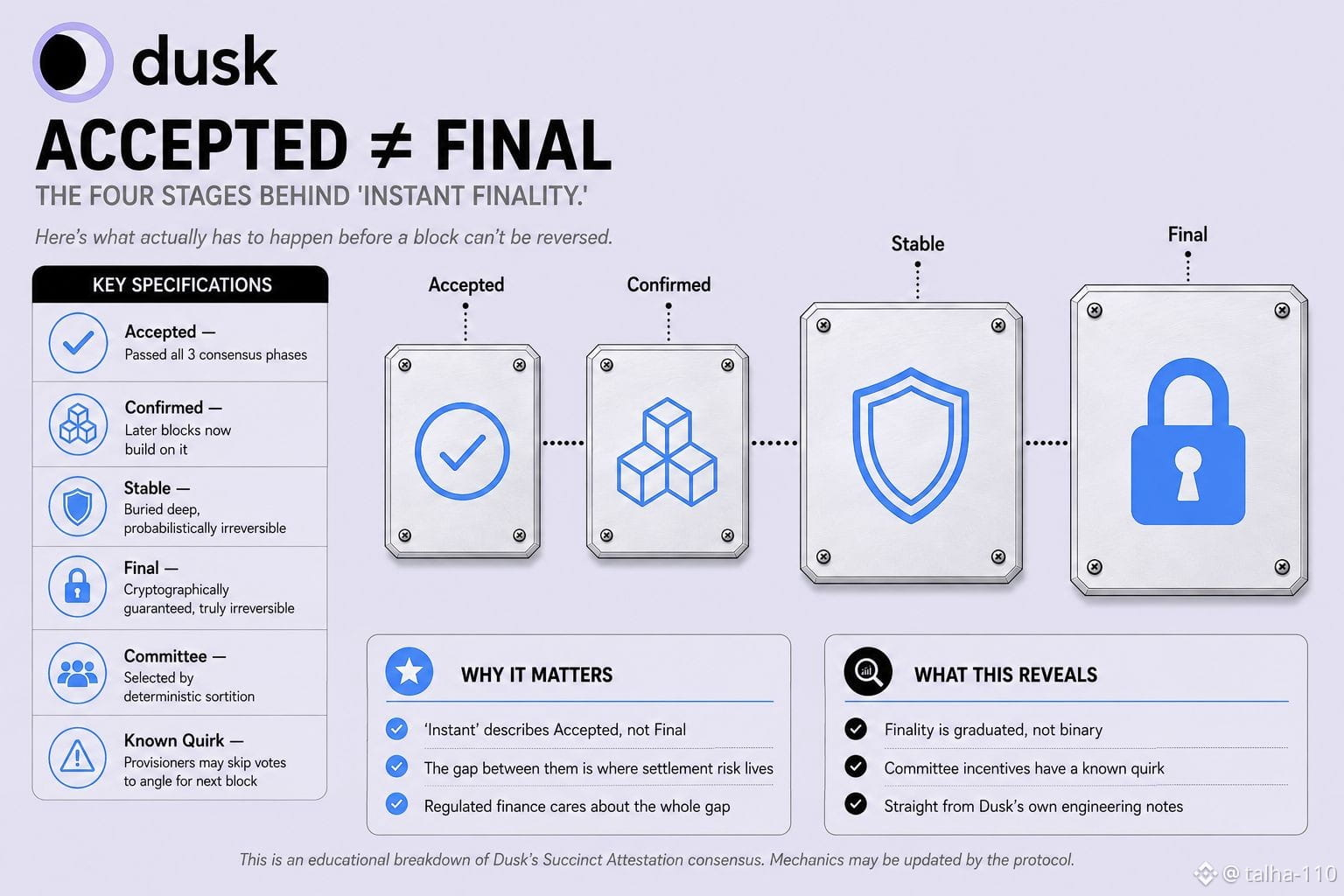
At first I assumed Dusk's "deterministic finality" pitch meant a block is simply final or not, binary, the moment it's produced. Reading the network's own finality states, that framing oversimplifies what's actually happening. A block on Dusk passes through four distinct stages before it's truly locked in, Accepted once it clears the current round's three consensus phases, Confirmed once later blocks build on top of it, Stable once it's buried deep enough to be probabilistically irreversible, and only then Final, the point where reversal becomes cryptographically guaranteed impossible rather than just extremely unlikely. So "instant finality" is doing a lot of work in that phrase. The block is Accepted fast, genuinely fast, that part of the pitch holds. But Accepted and Final aren't the same guarantee, and the gap between them is exactly where a regulated financial settlement would care most. There's a second layer to this most people gloss over too. Consensus runs through committees selected by deterministic sortition, and if a provisioner ends up selected for a voting committee in one round while also being the block generator for the next one, they're incentivized to just skip their vote, hoping to get picked as proposer next instead. Dusk's own engineering writeup treats this as an expected behavior pattern, not a hypothetical, and the fix is exclusion from that committee if it happens. So the settlement layer that's marketed as deterministic and instant is actually a graduated process with a known incentive quirk baked into its committee selection, both true, both quietly more complicated than the one-line pitch.
$DUSK #dusk @Dusk
$DUSK #dusk @Dusk
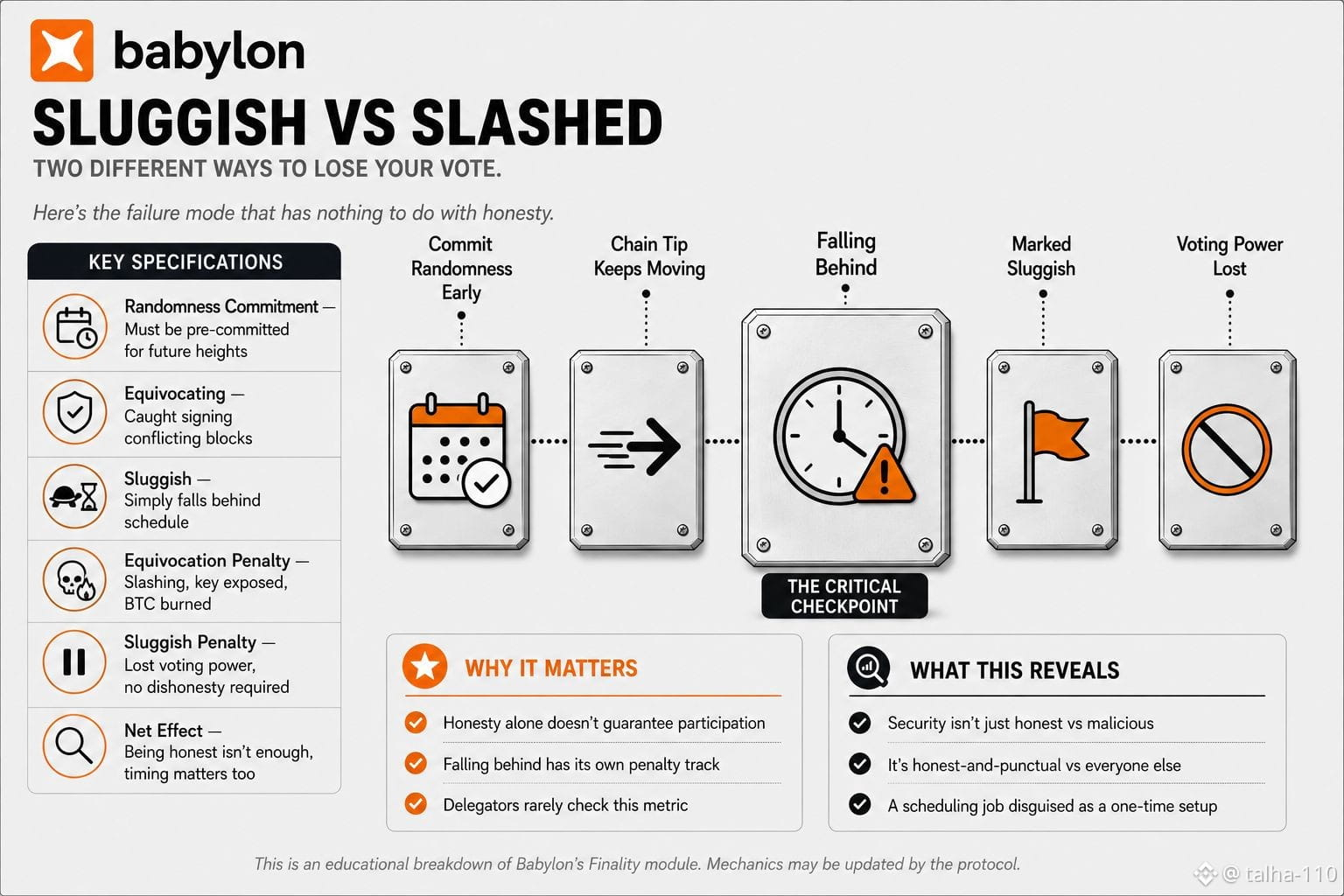
At first I assumed the only thing that could cost a Finality Provider their standing was outright malicious behavior, signing two conflicting blocks, getting caught, getting slashed, the classic honest-or-dishonest binary. Reading Babylon's own Finality module documentation, there's a second, quieter failure path that has nothing to do with honesty at all. Before a Finality Provider can even vote on a block, they have to proactively commit EOTS public randomness for that specific future height, in advance, before the block is even proposed. Babylon's system separately tracks two categories of problem providers, equivocating ones who get caught signing conflicting messages, and sluggish ones who simply fail to show up in time. Being slow isn't the same violation as being dishonest, but it still gets tracked and penalized as its own category. What that means in practice is a provider can be fully honest, never sign anything conflicting, never attempt anything adversarial, and still lose voting ability for a given height purely because their randomness commitment didn't keep pace with the chain's tip. Committing randomness isn't a one-time setup step, it's an ongoing forecasting job, staying ahead of a chain that keeps moving whether you're ready or not. So the actual security model being described isn't just honest versus malicious. It's honest-and-punctual versus everyone else, including honest providers who simply fell behind on a scheduling requirement most people staking to them probably never think to check.
@BabylonLabs_io #baby $BABY
@BabylonLabs_io #baby $BABY
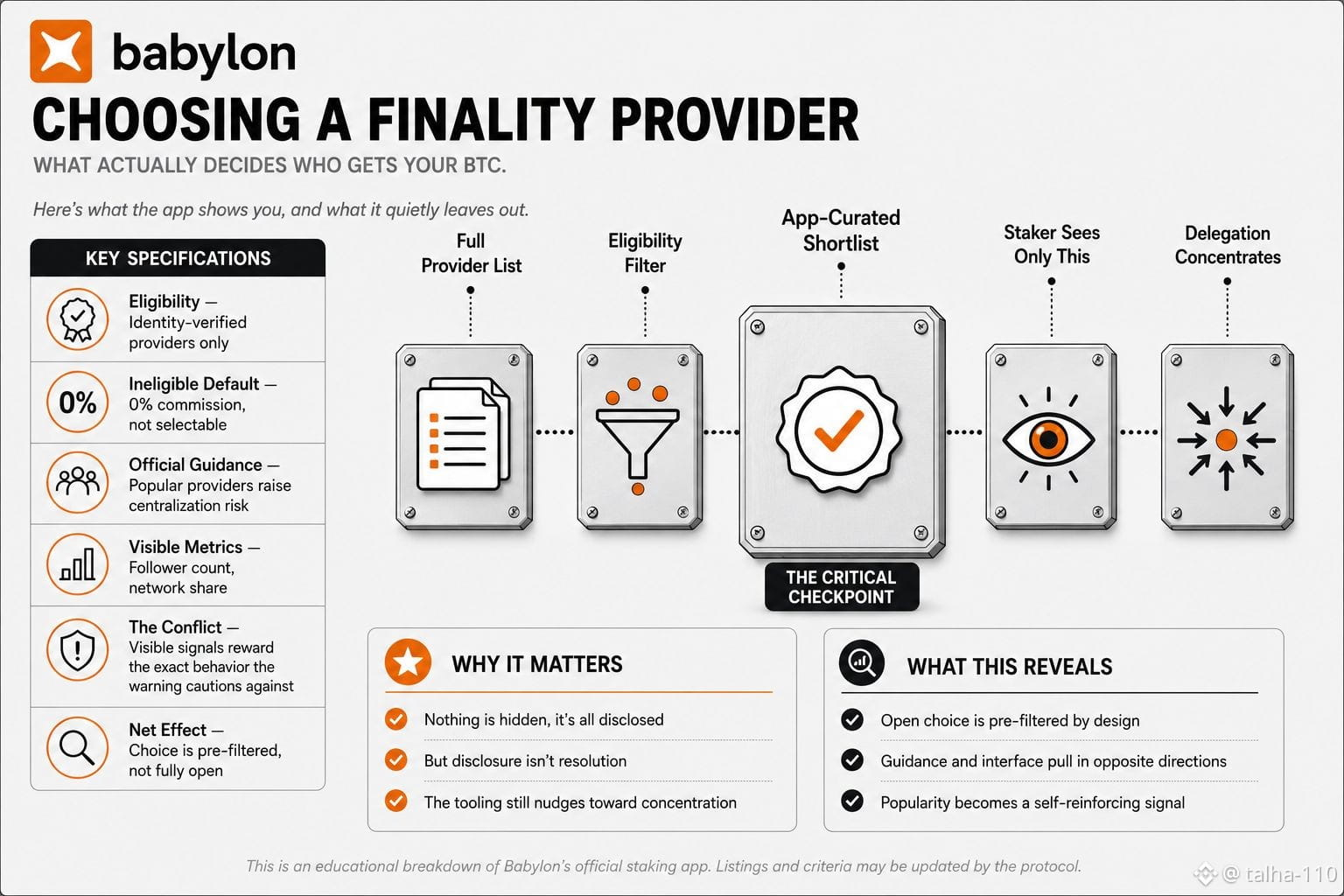
At first I assumed choosing a Finality Provider worked like picking any Cosmos validator, open list, pick whoever you like, the network naturally stays distributed as people spread their stake around based on preference. Reading Babylon's own eligibility rules for the official staking app, the process nudges toward concentration in a way that assumption doesn't account for. Only Finality Providers that pass strict identity verification and registration criteria get listed in the app with their commission rate, website, and a visible checkmark. Providers that don't meet that bar can technically still receive BTC delegations if someone delegates to them directly outside the app, but they're capped at 0% commission by default and the app won't even let a regular staker select them as an option. So the "open choice" is really open only within a pre-filtered, officially curated shortlist, everyone outside that list is functionally invisible to anyone using the standard flow. Babylon's own staking guide adds a second layer to this, explicitly warning stakers that delegating to the most popular providers increases centralization risk, while also listing follower count and network share as the main signals to evaluate a provider by. Those two pieces of advice pull in opposite directions. The visible signals the app surfaces are exactly the ones that make popular providers look more trustworthy, which is exactly the behavior the same documentation says to be cautious about. Nothing here is hidden or dishonest, it's all disclosed. But disclosing a tension isn't the same as resolving it, and right now the tooling quietly rewards the concentration the guidance is warning people against.
@BabylonLabs_io $BABY #baby $BTC
@BabylonLabs_io $BABY #baby $BTC
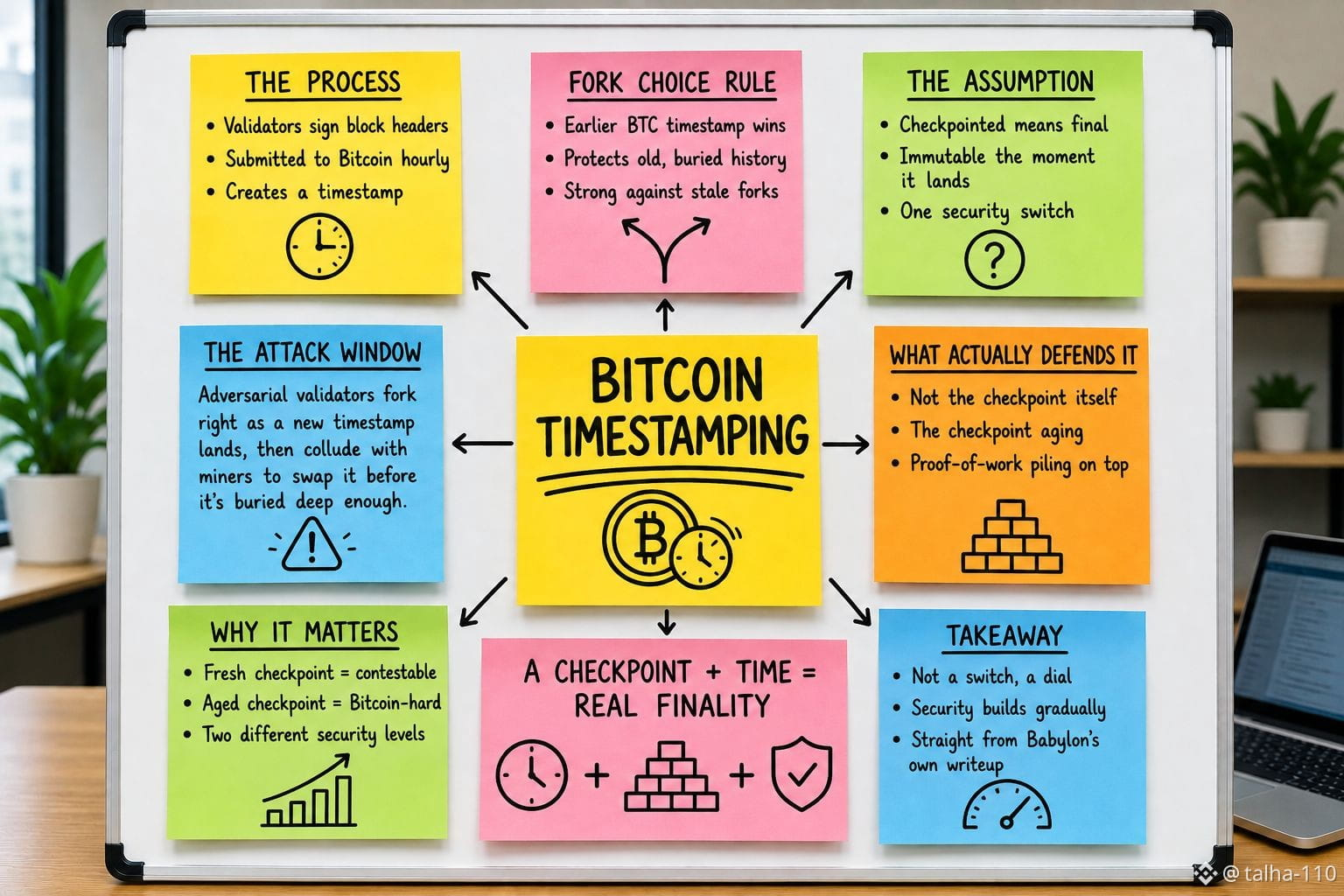
At first I assumed "checkpointed to Bitcoin" meant a Babylon block becomes essentially Bitcoin-final the moment it's timestamped, immutable the second it lands on chain. Reading Babylon's own writeup on fast unbonding, the actual security model has a narrower window than that framing suggests. Validators sign headers of Genesis blocks and submit them to Bitcoin roughly once every hour, and the fork-choice rule says whichever fork has the earlier Bitcoin timestamp wins. That's genuinely strong protection against attacks that start from old, already-buried history. But Babylon's own documentation walks through a more specific scenario: if adversarial validators wait until their withdrawal requests clear, then fork the chain right as their blocks get a fresh timestamp, and then collude with Bitcoin miners to replace that specific timestamp with a later one before it's buried deep enough to be economically irreversible, the attack can still work. The defense against that isn't the checkpoint existing, it's the checkpoint aging, accumulating enough proof-of-work on top of it that rewriting it becomes too expensive to bother. So there are really two different security levels being described under one phrase. A checkpoint that just landed is honest-majority-dependent and theoretically contestable. A checkpoint that's been sitting for a while is Bitcoin-hard and effectively final. The pitch talks about Bitcoin security like it's a single switch that flips on at each hourly commit. The actual guarantee is closer to a dial that only fully locks in after enough time has passed for Bitcoin's own proof-of-work to make reversal not worth attempting.
@BabylonLabs_io $BABY #baby
@BabylonLabs_io $BABY #baby
Verified
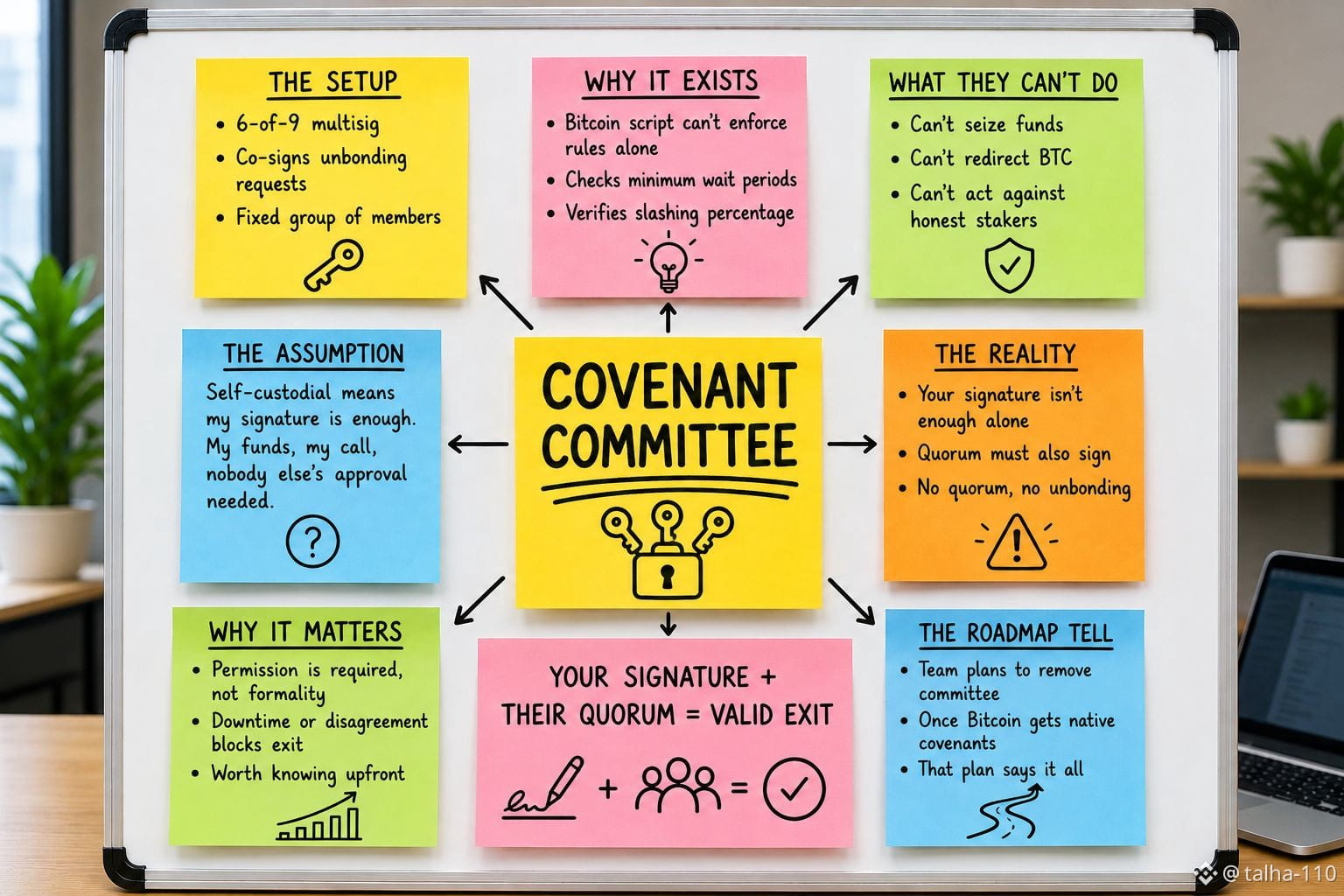
At first I assumed self-custodial meant exactly what it sounds like, my signature, my funds, nobody else's approval required to move them. Reading the actual Bitcoin staking script Babylon uses, that's only partly true. Every staking position is locked using a script that requires the staker's signature, yes, but unbonding before the timelock expires also requires signatures from a quorum of something called the covenant committee, a fixed group operating on a 6-of-9 multi-signature setup. Bitcoin's scripting language isn't expressive enough to enforce unbonding rules like minimum wait periods or correct slashing percentages on its own, so this committee exists specifically to check every request and co-sign it if it's protocol-compliant. Which means unbonding your own Bitcoin isn't just you signing a transaction. It's you signing, and then waiting for enough of nine specific people to also sign before that transaction is valid at all. The docs are upfront that this committee can't act against honest stakers, they can't seize funds or redirect them anywhere outside the rules. But their permission is still a required ingredient, not a formality. If the quorum can't be reached, for whatever reason, downtime, disagreement, unavailability, the unbonding path doesn't execute, full stop. Babylon's own team has said they intend to move away from this committee once Bitcoin gets native covenant support. That roadmap detail alone tells you something, if self-custody were already complete as described, there'd be nothing left to move away from.
@BabylonLabs_io #baby
$BABY
$KOMA
$AKE
@BabylonLabs_io #baby
$BABY
$KOMA
$AKE
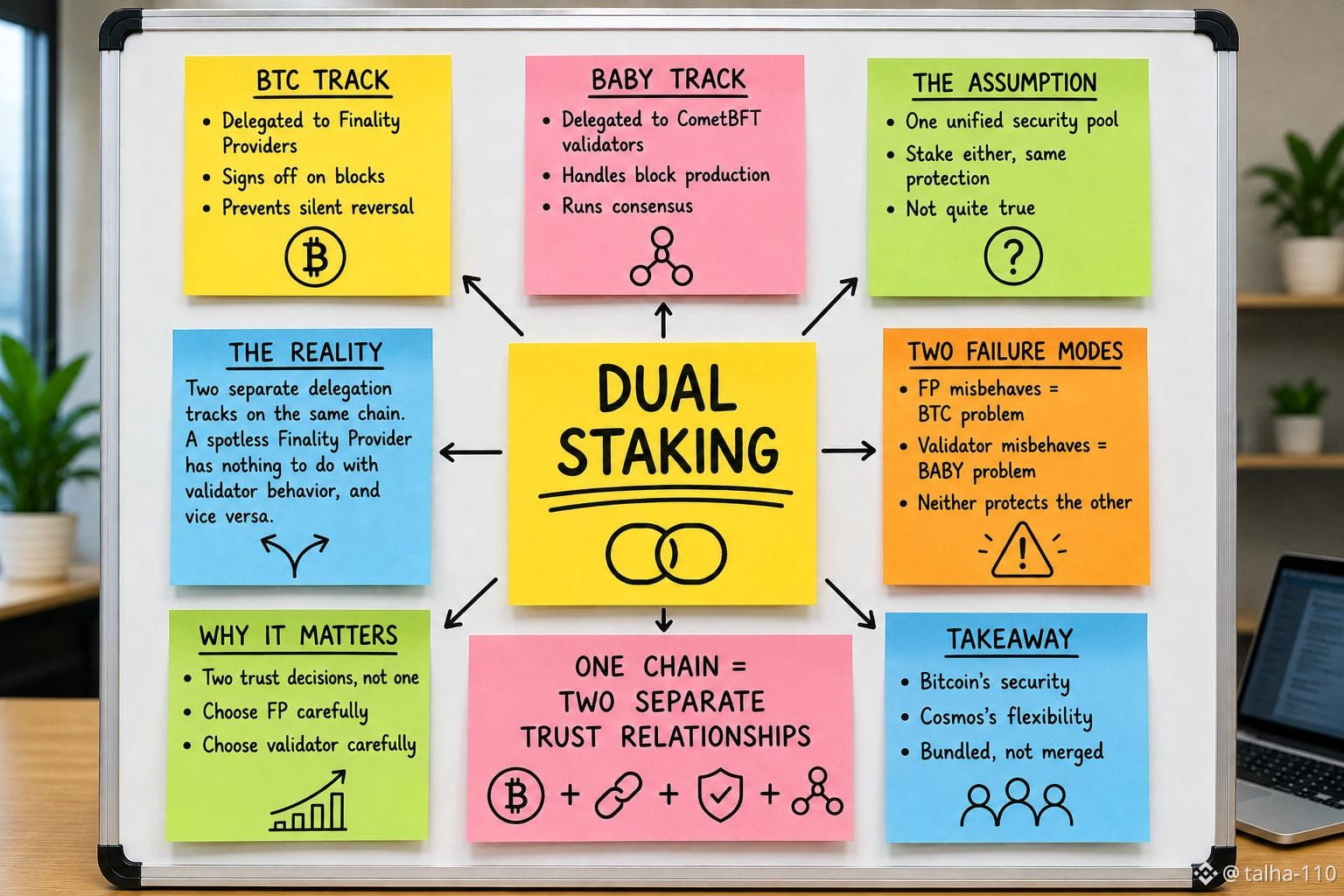
At first I assumed Babylon Genesis had one unified staking system, stake either asset and you're contributing to the same pool of security either way. Reading how the dual staking model is actually structured, that assumption doesn't hold. BTC and BABY don't feed into one shared mechanism, they run through two entirely separate delegation tracks that happen to sit on the same chain. BTC gets delegated to Finality Providers, whose job is signing off on blocks so finality can't quietly be reversed. BABY gets delegated to CometBFT validators, who handle actual block production and consensus. Different roles, different responsibilities, different sets of people you're trusting when you delegate to either one. What that means in practice is that someone could run a Finality Provider with a spotless signing record and still have nothing to do with whether blocks get produced correctly, and a validator could be excellent at block production while having zero exposure to the Bitcoin-backed slashing conditions on the other track. The pitch is "Bitcoin's security plus Cosmos's flexibility," which sounds like one reinforced system. What it actually is is two separate trust relationships running in parallel, each with its own failure mode, bundled under one chain name. If a Finality Provider misbehaves, that's a BTC delegation problem. If a validator misbehaves, that's a BABY delegation problem. Neither one automatically protects you from the other, which means picking who to delegate BTC to and picking who to delegate BABY to are two separate decisions people are quietly treating as one.
@BabylonLabs_io #baby $BABY
$GRVT $TRX
@BabylonLabs_io #baby $BABY
$GRVT $TRX
Verified
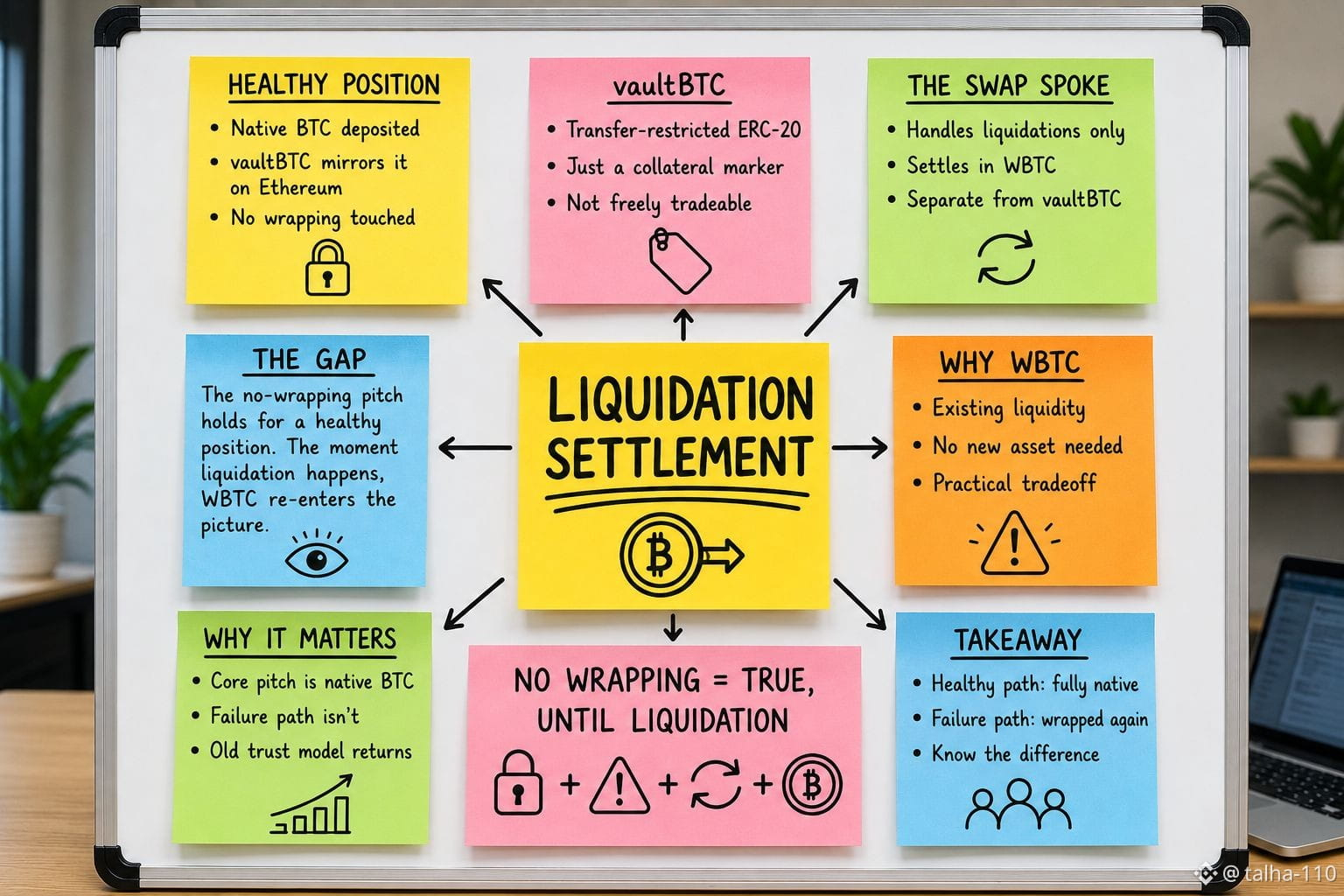
At first I assumed the entire pitch of Trustless Bitcoin Vaults was that wrapping never enters the picture, native BTC stays native the whole way through, borrowing, collateral, everything. Reading the actual Aave v4 integration proposal, that holds true right up until something goes wrong. When BTC gets locked into a vault, Ethereum sees it represented as vaultBTC, a transfer-restricted token mirroring the locked position, not freely tradeable, just a verifiable marker of collateral state. That part still respects the no-wrapping promise. But liquidations don't settle in vaultBTC. They settle through a separate Swap Spoke, denominated in WBTC, the same wrapped Bitcoin token the whole system was supposedly designed to avoid depending on. So the pitch holds for a healthy position. Deposit native BTC, borrow against it, repay, unlock, no wrapper touched any of it. The moment a position gets liquidated, the exit path runs through the exact wrapped-asset model TBV exists to route around. That's not a flaw exactly, WBTC has liquidity that a brand new settlement asset wouldn't have on day one. But it does mean the "no wrapping" claim is really "no wrapping, as long as nothing goes wrong." The failure path is where the old trust model quietly comes back in.
@BabylonLabs_io #baby
$BABY
$GRVT
$BTC
@BabylonLabs_io #baby
$BABY
$GRVT
$BTC
Log in to explore more content