

层楼bnb
301 Posts

层楼bnb
Report
Block User
专研RWA、主流加密,
内容皆原创,
感谢支持,欢迎交流。
我的币安推荐码:CENGLOU
Open Trade

BNB Holder
Frequent Trader
2.8 Years
15 Following
125 Followers
194 Liked
Posts
Portfolio
All
Quotes
Videos
·
--
Verified
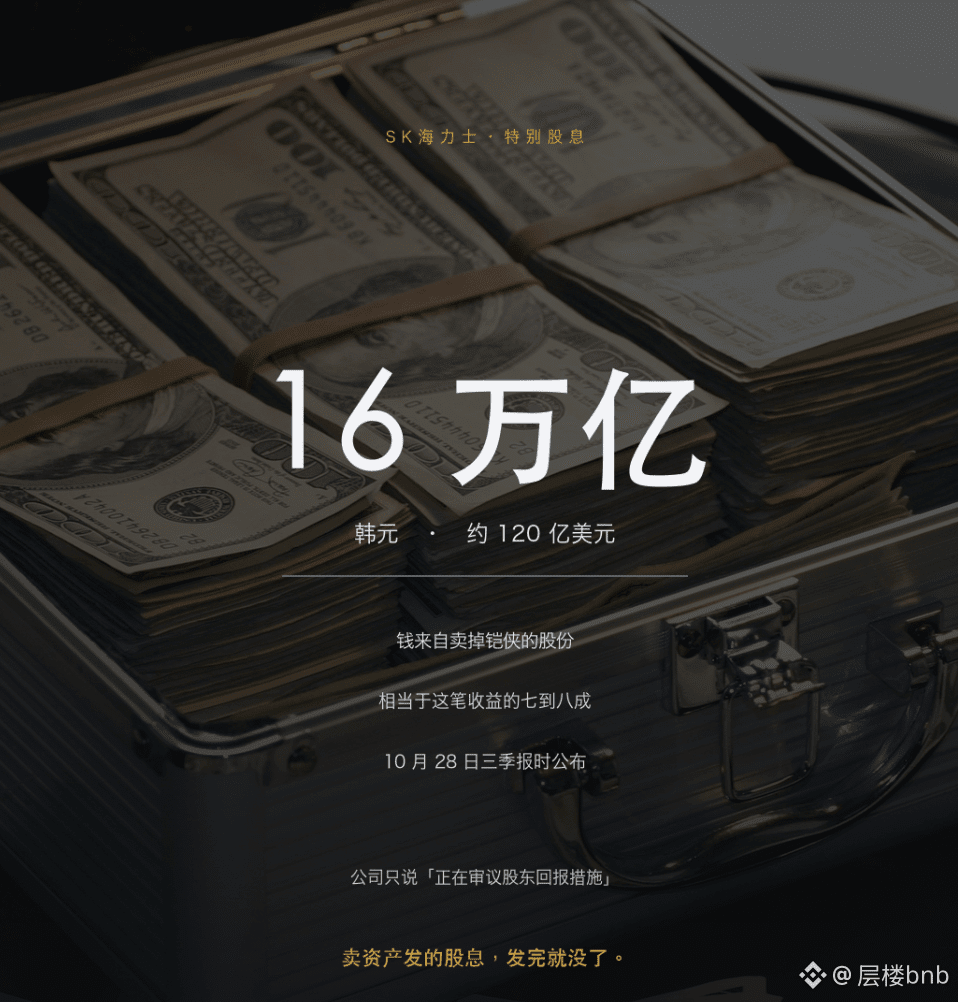
SK hynix is planning a special dividend of 16 trillion won, equivalent to about $12 billion.
The money will come from selling its stake in Kioxia. Korean media reported on October 26 that the special dividend would amount to 70–80% of the proceeds from the sale of its Kioxia stake. The company is set to announce it alongside its third-quarter results on October 28.
SK hynix responded to the reports by saying it was “reviewing various shareholder return measures,” without confirming either the amount or the form.
The 16 trillion won comes from asset disposals, not operating cash flow. After paying out this dividend, there won’t be another one next year.
The memory industry is currently in an upcycle. HBM is selling well, and operating cash flow is already strong. Using proceeds from asset sales for a special dividend suggests the company believes the return on its Kioxia investment is now lower than simply returning the money to shareholders.
That 2018 investment is now paying off. #sk海力士据报拟派特别股息
$SKHYB
{spot}(SKHYBUSDT)
SK hynix is planning a special dividend of 16 trillion won, equivalent to about $12 billion.
The money will come from selling its stake in Kioxia. Korean media reported on October 26 that the special dividend would amount to 70–80% of the proceeds from the sale of its Kioxia stake. The company is set to announce it alongside its third-quarter results on October 28.
SK hynix responded to the reports by saying it was “reviewing various shareholder return measures,” without confirming either the amount or the form.
The 16 trillion won comes from asset disposals, not operating cash flow. After paying out this dividend, there won’t be another one next year.
The memory industry is currently in an upcycle. HBM is selling well, and operating cash flow is already strong. Using proceeds from asset sales for a special dividend suggests the company believes the return on its Kioxia investment is now lower than simply returning the money to shareholders.
That 2018 investment is now paying off. #sk海力士据报拟派特别股息
$SKHYB
1.4k
·
--
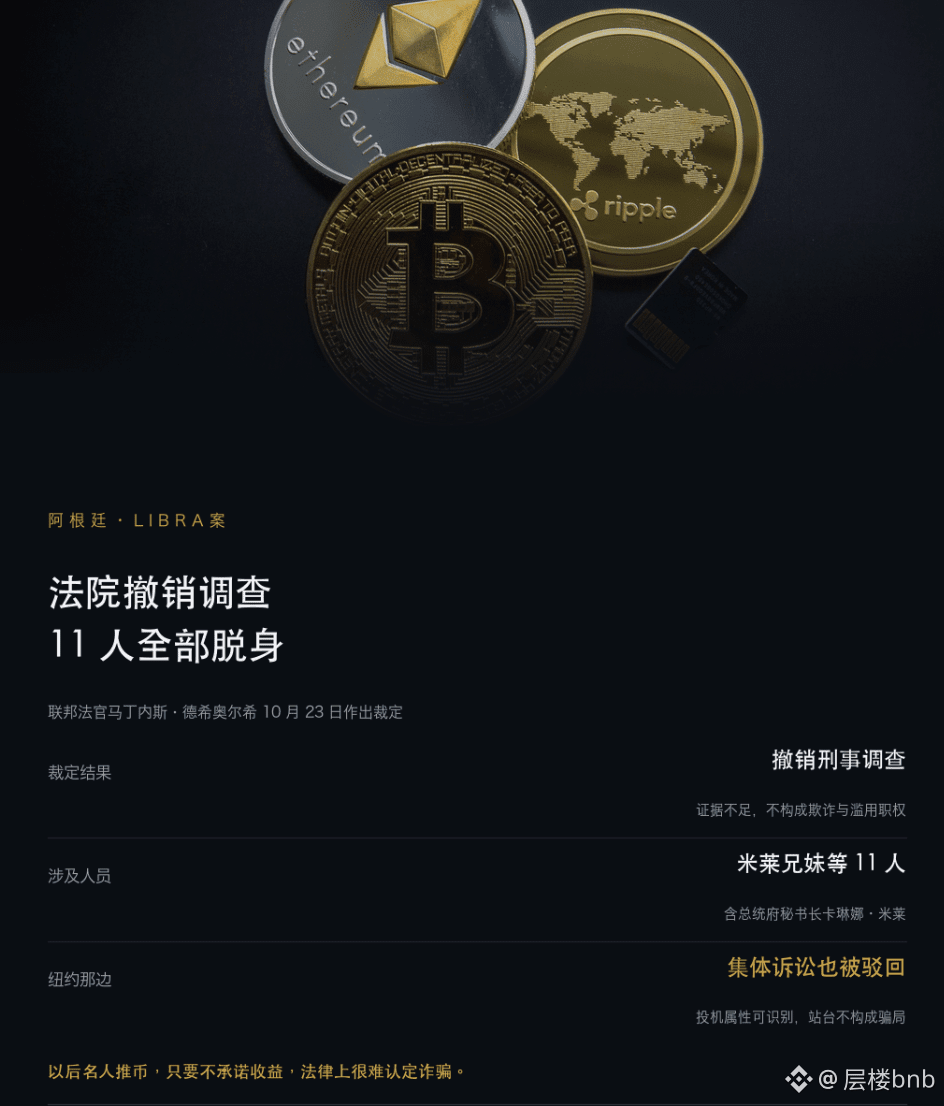
An Argentine federal judge dismissed the criminal investigation into President Milei on October 23, letting 11 people—including his sister, Karina Milei—off the hook.
Judge Martínez de Giorgi said there was insufficient evidence to establish fraud or abuse of power.
The story goes back to February last year. Milei promoted a token called $LIBRA on social media. Its price soared, then quickly plunged to zero, prompting a federal court investigation.
That same year, a class-action lawsuit in New York was also dismissed. The ruling put it plainly: the token’s speculative nature was identifiable, and promoting it did not amount to a scam.
Two courts, two legal systems, and the same conclusion.
The implications are significant. In the future, it may be difficult to legally establish fraud when celebrities promote tokens, as long as they don’t promise returns or make false statements. Investors who suffer losses will have to prove for themselves, “I was misled”—a high bar.
Milei is now seeking compensation in return, claiming he was defamed for “one year, eight months, and nine days.” #阿根廷法院驳回米莱libra案 $PEOPLE $TRUMP
{future}(TRUMPUSDT)
{future}(PEOPLEUSDT)
An Argentine federal judge dismissed the criminal investigation into President Milei on October 23, letting 11 people—including his sister, Karina Milei—off the hook.
Judge Martínez de Giorgi said there was insufficient evidence to establish fraud or abuse of power.
The story goes back to February last year. Milei promoted a token called $LIBRA on social media. Its price soared, then quickly plunged to zero, prompting a federal court investigation.
That same year, a class-action lawsuit in New York was also dismissed. The ruling put it plainly: the token’s speculative nature was identifiable, and promoting it did not amount to a scam.
Two courts, two legal systems, and the same conclusion.
The implications are significant. In the future, it may be difficult to legally establish fraud when celebrities promote tokens, as long as they don’t promise returns or make false statements. Investors who suffer losses will have to prove for themselves, “I was misled”—a high bar.
Milei is now seeking compensation in return, claiming he was defamed for “one year, eight months, and nine days.” #阿根廷法院驳回米莱libra案 $PEOPLE $TRUMP
3
1
3.4k
·
--
A big drop doesn’t mean it’s cheap: Double 11 and the consumer culture of the retail-investor crowd #股票财报季
A big drop doesn’t mean it’s cheap: Double 11 and the consumer culture of the retail-investor crowd #股票财报季
58
·
--
South Korea is preparing to bring stablecoins under the Foreign Exchange Transactions Act.
The government and central bank plan to complete revisions within this year, regulating stablecoins as payment instruments. In a business report to the National Assembly, the Bank of Korea said it is consulting with the government on rules for cross-border virtual assets and plans to set up a monitoring system that requires reporting through the foreign exchange data network.
The Digital Asset Basic Act is also moving in the same direction. It covers exchange licensing and rules for issuing stablecoins.
Bringing stablecoins under the foreign exchange law changes their legal classification. They were previously considered virtual assets; now they are being treated more like payment instruments and cross-border flows of funds.
Once their classification changes, everything that follows changes too. Whether cross-border transfers must be reported, the transaction limits, and whether issuers must hold reserves will all be rewritten.
If South Korea’s move goes ahead, other countries dealing with dollar stablecoins will likely follow suit.#韩国拟将稳定币纳入外汇法监管 $DATAIP
{future}(DATAIPUSDT)
South Korea is preparing to bring stablecoins under the Foreign Exchange Transactions Act.
The government and central bank plan to complete revisions within this year, regulating stablecoins as payment instruments. In a business report to the National Assembly, the Bank of Korea said it is consulting with the government on rules for cross-border virtual assets and plans to set up a monitoring system that requires reporting through the foreign exchange data network.
The Digital Asset Basic Act is also moving in the same direction. It covers exchange licensing and rules for issuing stablecoins.
Bringing stablecoins under the foreign exchange law changes their legal classification. They were previously considered virtual assets; now they are being treated more like payment instruments and cross-border flows of funds.
Once their classification changes, everything that follows changes too. Whether cross-border transfers must be reported, the transaction limits, and whether issuers must hold reserves will all be rewritten.
If South Korea’s move goes ahead, other countries dealing with dollar stablecoins will likely follow suit.#韩国拟将稳定币纳入外汇法监管 $DATAIP

1
4.6k
·
--
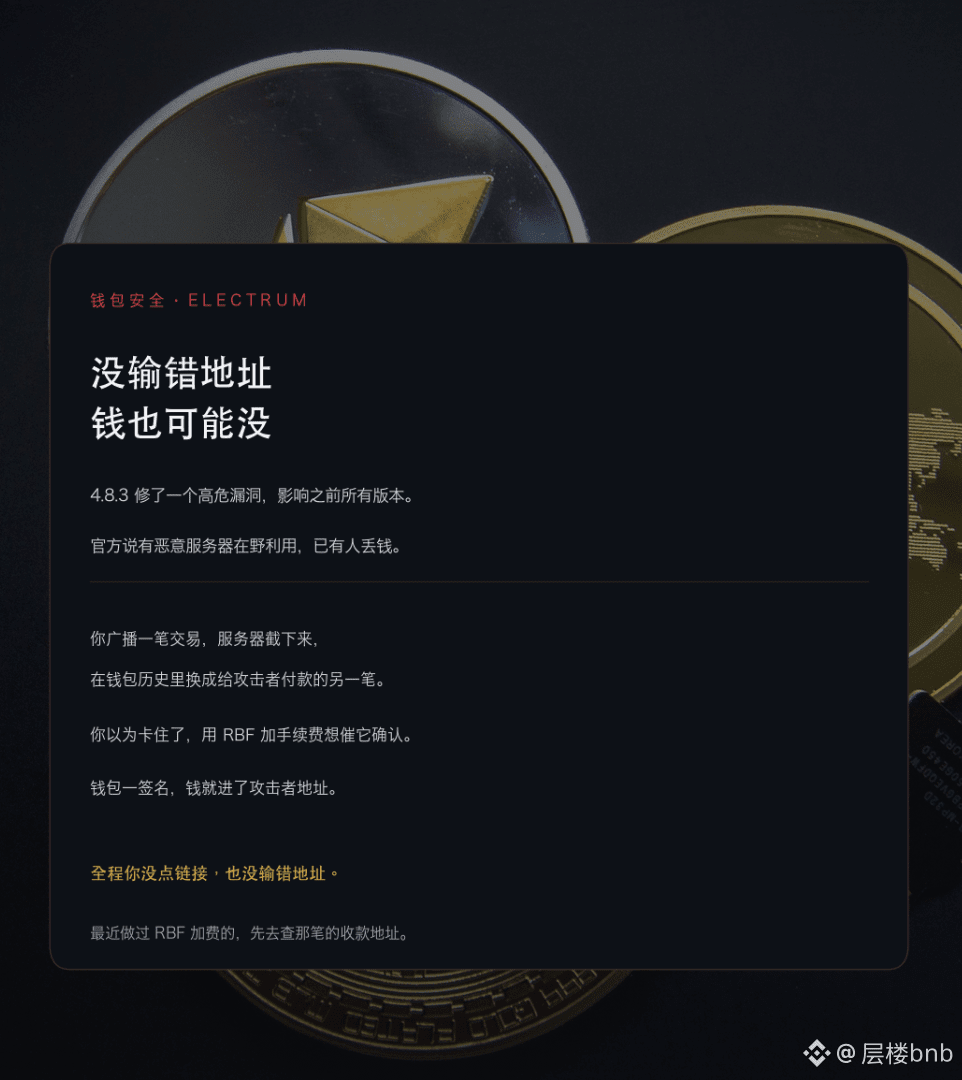
If you use the Electrum wallet, you should update to version 4.8.3 today.
This version fixes a critical vulnerability that affects all versions before 4.8.3. Electrum's developers say malicious servers have already exploited it in the wild, and some users have lost money.
The attack is quite stealthy.
You broadcast a transaction, and a malicious server intercepts it, then replaces it in your wallet history with another transaction addressed to the attacker.
Thinking your transaction is stuck, you use RBF to increase the fee and speed up confirmation. At this point, the wallet signs the transaction, and the money goes to the attacker's address.
You never mistyped an address or clicked a link.
If you've used Electrum recently and increased the fee on a transaction using RBF, check that the recipient address is correct. Then update.#electrum修复4.8.3前版本高危漏洞 $TRUST
{future}(TRUSTUSDT)
If you use the Electrum wallet, you should update to version 4.8.3 today.
This version fixes a critical vulnerability that affects all versions before 4.8.3. Electrum's developers say malicious servers have already exploited it in the wild, and some users have lost money.
The attack is quite stealthy.
You broadcast a transaction, and a malicious server intercepts it, then replaces it in your wallet history with another transaction addressed to the attacker.
Thinking your transaction is stuck, you use RBF to increase the fee and speed up confirmation. At this point, the wallet signs the transaction, and the money goes to the attacker's address.
You never mistyped an address or clicked a link.
If you've used Electrum recently and increased the fee on a transaction using RBF, check that the recipient address is correct. Then update.#electrum修复4.8.3前版本高危漏洞 $TRUST
5
1
10.8k
·
--
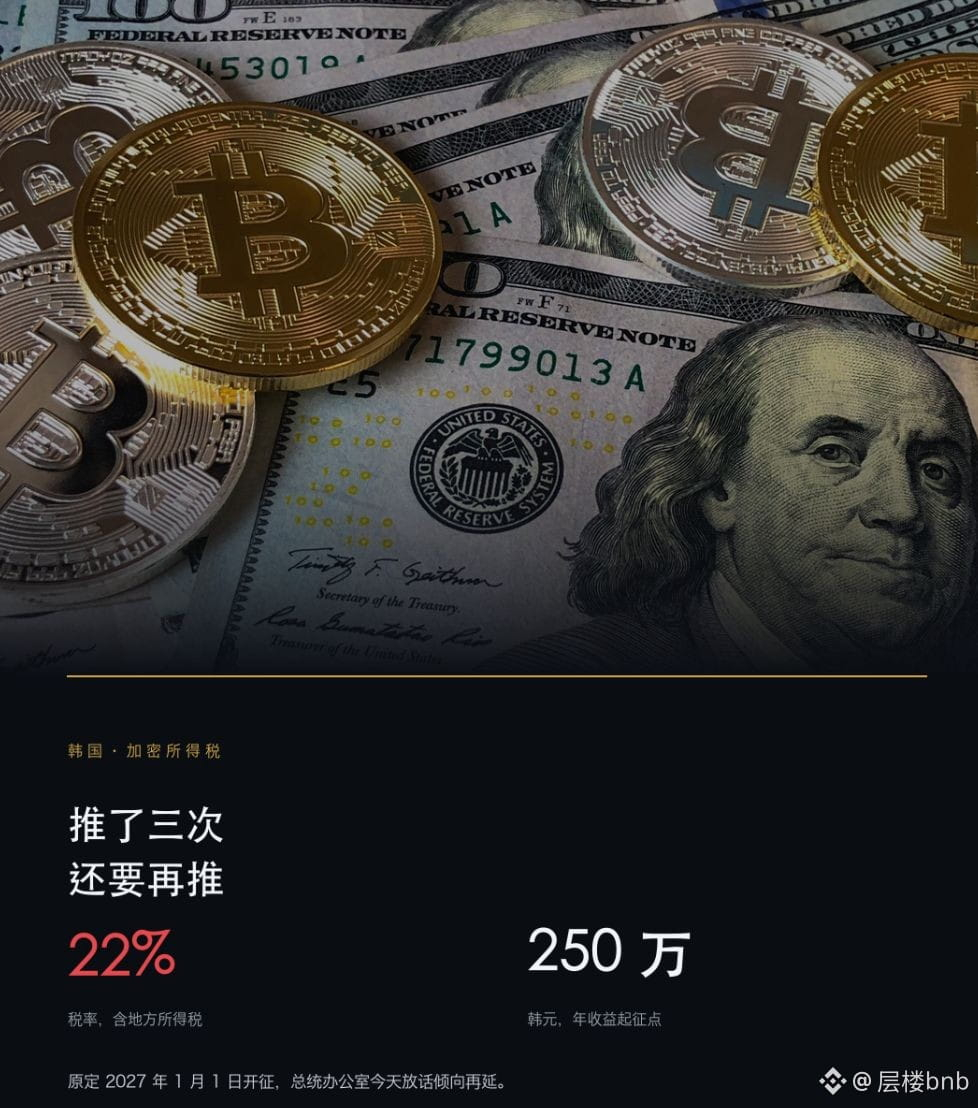
South Korea’s presidential office said today that it is leaning toward delaying the crypto income tax once again.
The tax was originally scheduled to take effect on January 1, 2027. The rate is 20%, or 22% including local income tax, with an annual earnings threshold of 2.5 million won.
The tax was set in a 2020 amendment, and it has already been postponed three times.
Last Tuesday, the government called several exchanges—Upbit, Bithumb, and Coinone—and DAXA to a meeting. The industry’s concerns were specific: how to calculate staking rewards, what prices to use for airdrops, and who should be liable for DeFi gains and losses. Those rules have yet to be set, and the infrastructure is not ready either.
South Korean retail investors are strongly opposed to the tax, especially those in their 20s and 30s. Politicians have to think about votes, so the issue keeps getting pushed back.
A delay is good news for the market. But the fact that it still hasn’t been implemented after six years shows that the problems with implementation are harder to solve than the tax rate itself. #韩国推迟加密货币所得税 $KAIA
{future}(KAIAUSDT)
South Korea’s presidential office said today that it is leaning toward delaying the crypto income tax once again.
The tax was originally scheduled to take effect on January 1, 2027. The rate is 20%, or 22% including local income tax, with an annual earnings threshold of 2.5 million won.
The tax was set in a 2020 amendment, and it has already been postponed three times.
Last Tuesday, the government called several exchanges—Upbit, Bithumb, and Coinone—and DAXA to a meeting. The industry’s concerns were specific: how to calculate staking rewards, what prices to use for airdrops, and who should be liable for DeFi gains and losses. Those rules have yet to be set, and the infrastructure is not ready either.
South Korean retail investors are strongly opposed to the tax, especially those in their 20s and 30s. Politicians have to think about votes, so the issue keeps getting pushed back.
A delay is good news for the market. But the fact that it still hasn’t been implemented after six years shows that the problems with implementation are harder to solve than the tax rate itself. #韩国推迟加密货币所得税 $KAIA
2
2
4.8k
·
--
Verified
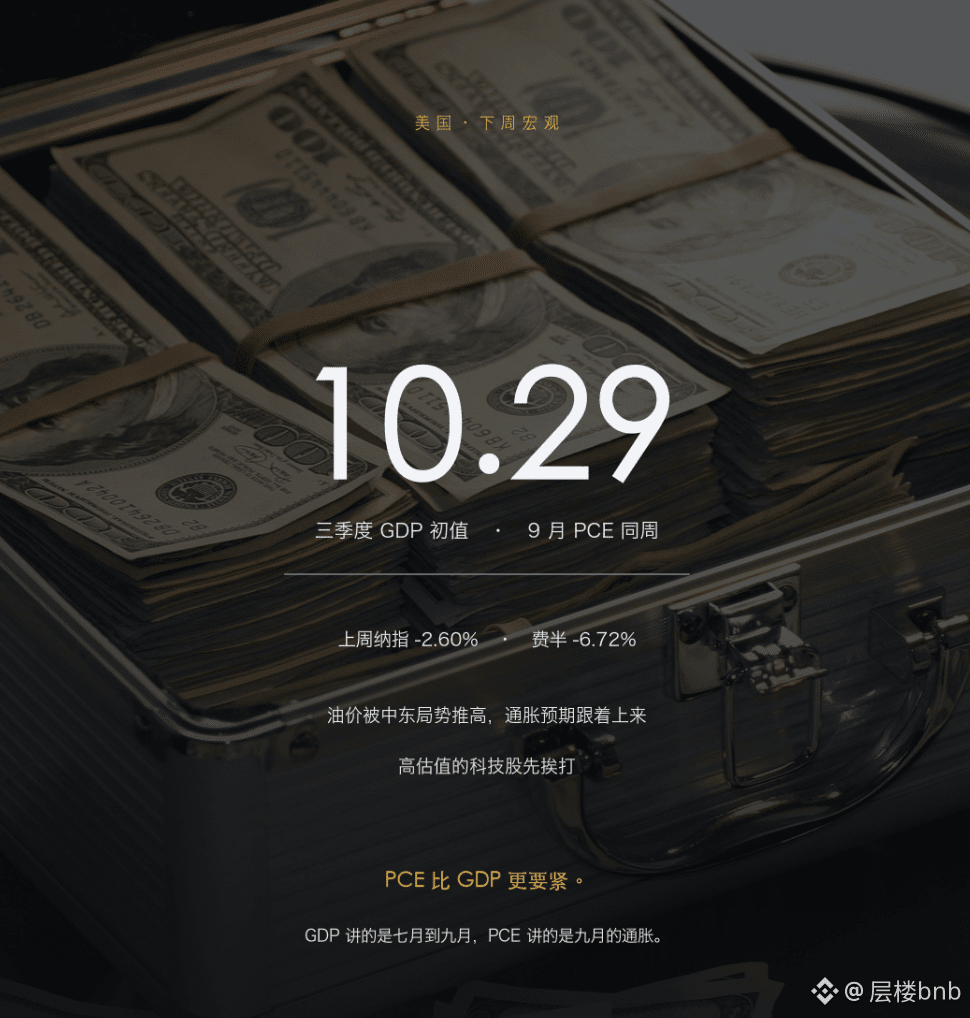
Two economic reports are due from the U.S. next week: the advance estimate of third-quarter GDP and September PCE.
According to the BEA calendar, GDP is scheduled for October 29. PCE is also due that week.
Both reports are drawing a lot of attention because U.S. stocks were hit by rising inflation expectations last week. On October 22, the Nasdaq fell 2.6% and the Philadelphia Semiconductor Index dropped 6.72%, as tensions in the Middle East pushed oil prices higher and markets worried that inflation could return.
If core PCE rises by more than 0.3% month over month, the odds of no rate cut in November will increase significantly. High-valuation tech stocks could take another hit.
If PCE comes down and the impact of oil prices proves temporary, this pullback may have been just a shakeout.
The key report to watch next week is PCE. GDP reflects activity from July through September, while PCE gives us a real-time read on inflation in September.
Markets are currently betting on a rate cut. We’ll find out on Thursday evening whether that bet is right. #美国下周将公布q3gdp和9月pce $BZ
{future}(BZUSDT)
Two economic reports are due from the U.S. next week: the advance estimate of third-quarter GDP and September PCE.
According to the BEA calendar, GDP is scheduled for October 29. PCE is also due that week.
Both reports are drawing a lot of attention because U.S. stocks were hit by rising inflation expectations last week. On October 22, the Nasdaq fell 2.6% and the Philadelphia Semiconductor Index dropped 6.72%, as tensions in the Middle East pushed oil prices higher and markets worried that inflation could return.
If core PCE rises by more than 0.3% month over month, the odds of no rate cut in November will increase significantly. High-valuation tech stocks could take another hit.
If PCE comes down and the impact of oil prices proves temporary, this pullback may have been just a shakeout.
The key report to watch next week is PCE. GDP reflects activity from July through September, while PCE gives us a real-time read on inflation in September.
Markets are currently betting on a rate cut. We’ll find out on Thursday evening whether that bet is right. #美国下周将公布q3gdp和9月pce $BZ
1
4.9k
·
--
Verified
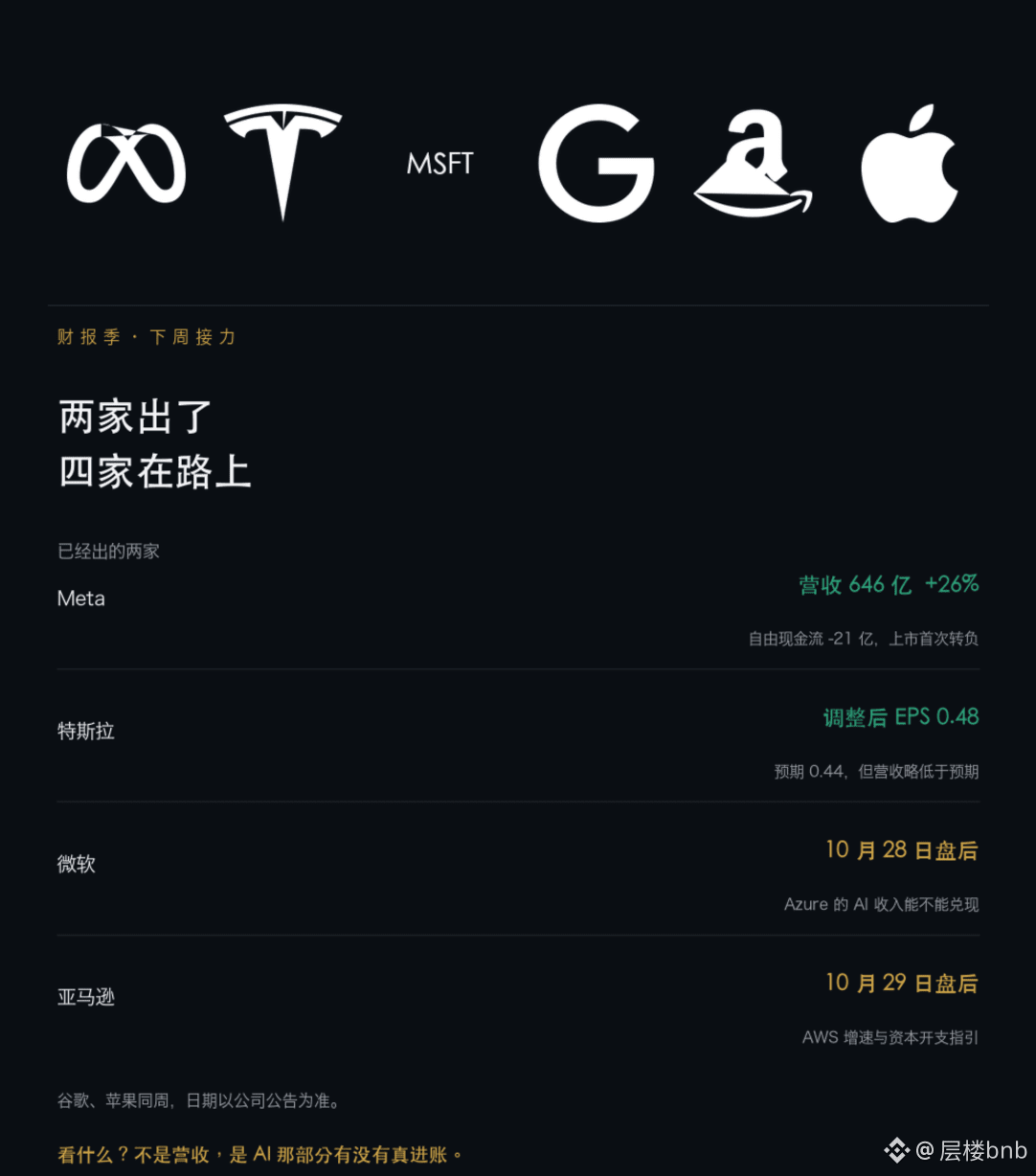
Meta and Tesla have both reported earnings, but the word “beat” needs to be taken with a grain of salt.
Meta: Revenue was $64.6 billion, up 26% and above the $63.3 billion expected. Its fourth-quarter guidance was $74.5 billion at the midpoint, also above expectations. But free cash flow was -$2.1 billion, turning negative for the first time since the company went public.
Tesla: Revenue was $28.05 billion, down 0.2% year over year and slightly below expectations. But adjusted earnings per share came in at $0.48, beating the market’s $0.44 estimate. Capital expenditures were just $4.73 billion, versus expectations of $7.95 billion.
One is spending, the other is cutting back, yet the market reaction was the opposite: Meta rose as much as 6% after hours, while Tesla fell more than 3%.
Up next: Microsoft after the market close on October 28 and Amazon on October 29. Google and Apple are also reporting this week.
What should we watch? Not revenue, but whether AI is actually bringing in money—cloud growth, paid Copilot subscriptions, and the efficiency of ad recommendations.
This earnings season, the market has shifted from “watching investment” to “watching returns.” #股票财报季
2
8
24.6k
·
--
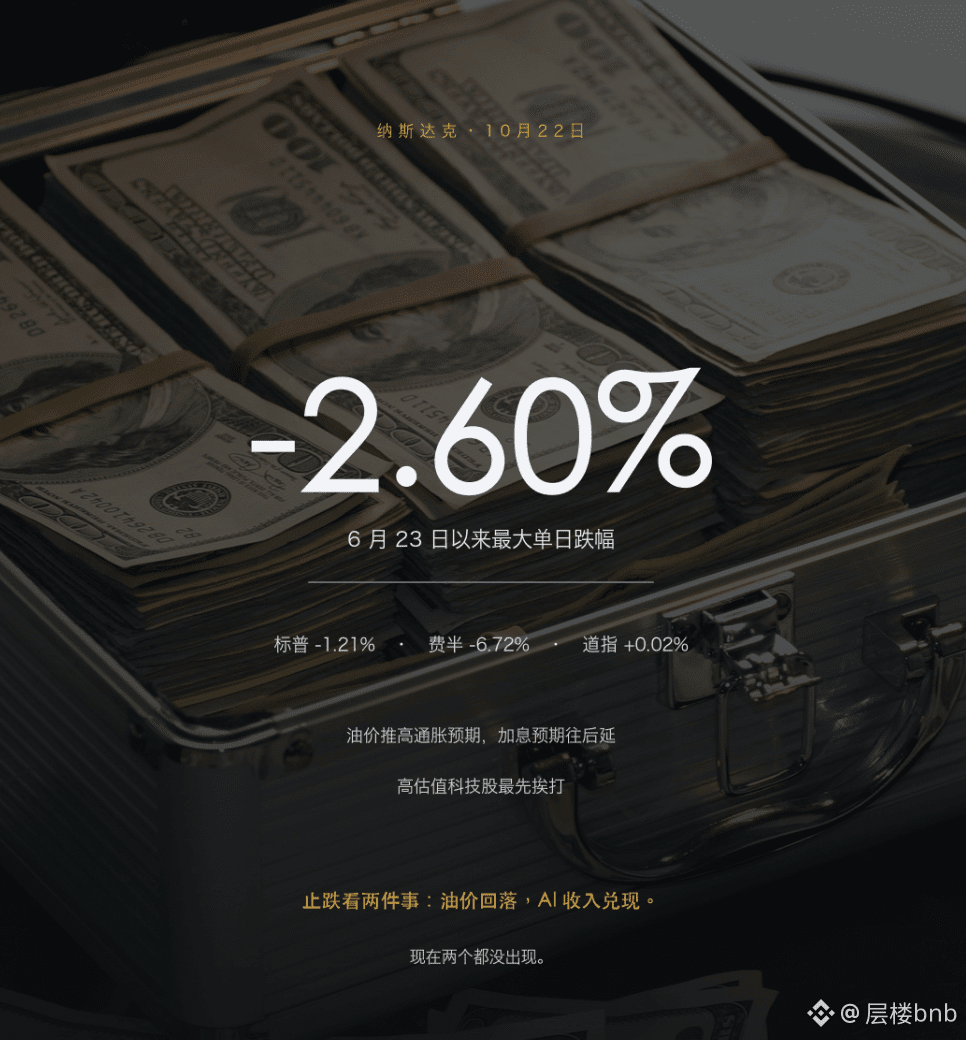
U.S. stocks fell for two days. On October 22, the Nasdaq dropped 2.60%, its biggest one-day decline since June 23; the S&P 500 fell 1.21%, its worst showing since late July. The Philadelphia Semiconductor Index plunged 6.72% in a single day, and Lam Research fell 11%.
The sell-off eased a little on the 23rd. The Magnificent Seven fell just 0.44%, but there was no rebound.
There are two layers of reasons behind the decline.
On the surface, it’s oil prices. Tensions in the Middle East have pushed oil prices higher, stoking fears that inflation will return. Expectations for rate hikes have been pushed back from the first quarter of next year, putting high-valuation tech stocks under pressure first.
At a deeper level, it’s the AI narrative. Meta spent $34.9 billion on data centers in a single quarter, and its free cash flow turned negative for the first time; Tesla cut its full-year capital expenditure from $25 billion to $20 billion. The market is starting to ask: When will all this spending turn into revenue?
When will the decline stop? Watch for two signals: oil prices pulling back, and next week’s earnings reports showing whether AI revenue is materializing.
Neither has happened yet. #道指下跌653点
115
·
--
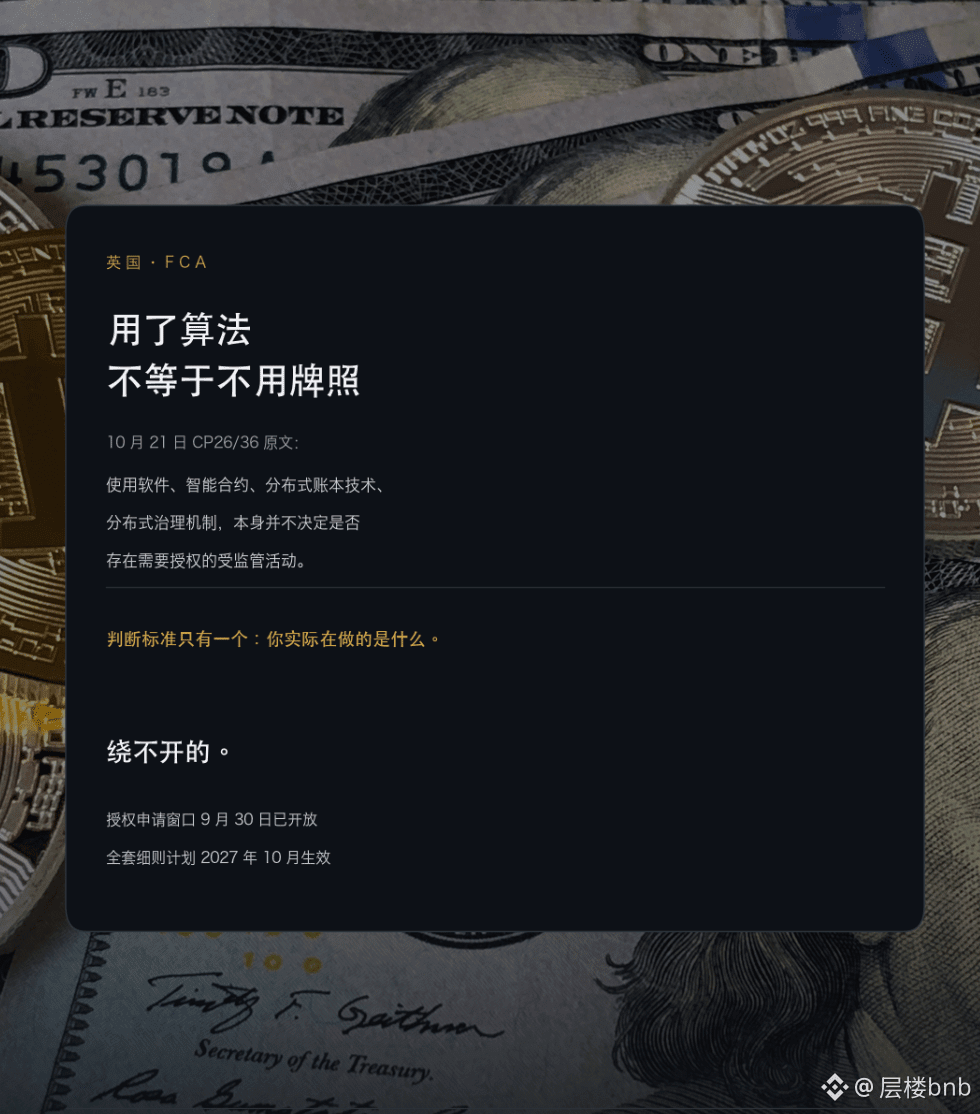
Last week, the UK FCA clarified one thing in a new document: using algorithms, smart contracts or decentralised governance does not, in itself, determine whether you need a licence.
The CP26/36 *Guidance on the Regulatory Perimeter for Cryptoassets*, published on 21 October, states that using software, smart contracts, distributed ledger technology or distributed governance mechanisms does not, in itself, determine whether a regulated activity requiring authorisation is taking place.
There is only one test: what activity are you actually carrying out?
This has a direct impact on algorithmic trading applications. Many people assume that “my strategy runs on-chain, the code executes automatically, and I don’t touch users’ money” means they can sidestep regulation. The FCA’s message is that they can’t: it’s what you do that matters, not the technology you use.
The context is that the FCA opened the window for cryptoasset authorisation applications on 30 September, with the full rules scheduled to take effect in October 2027.
For project teams, the question to answer now is not “Am I decentralised enough?” but “Are my activities on the list of regulated activities?” #英国算法加密交易应用或需fca授权
2
2
4k
·
--
A summary of the global distribution of listed companies: where are the best assets? Follow the globe to find out. #股票财报季
A summary of the global distribution of listed companies: where are the best assets? Follow the globe to find out. #股票财报季
52
·
--
The IRS plans to lower penalties for unreported crypto transactions.
The background is that Form 1099-DA takes effect starting with the 2025 tax year. The rule is that exchanges, as brokers, report each of your transactions to the IRS.
But the reports include only gross proceeds, not cost basis.
In other words, the exchange tells the IRS how much you sold for, but not what it cost you. You have to calculate and report your gains or losses yourself.
These penalties are usually based on the number of forms, not the amount of money. A single on-chain swap could involve several forms: swapping tokens, bridging across chains, then swapping back—each transaction is a taxable event.
Per-form penalties just aren't realistic in crypto. An active address can make thousands of transactions a year, leading to astronomical fines.
So lowering penalties doesn't mean easing oversight; it means getting the data flowing first. If penalties are too harsh, exchanges may choose not to report; if they're reasonable, the data can be collected reliably.
#irs拟降低加密案件税务披露罚款

3
2
12.1k
·
--
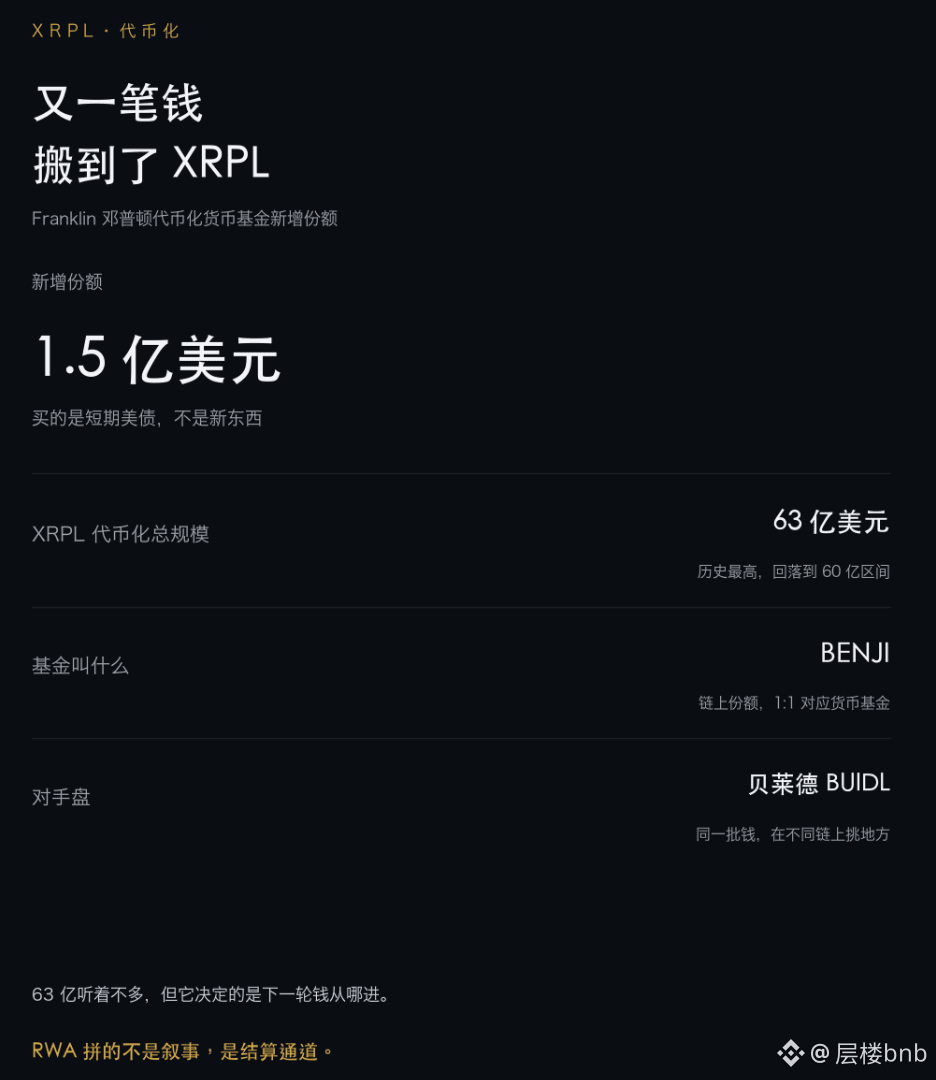
Franklin Templeton’s tokenized money market fund on XRPL just added another $150 million in shares.
It’s not buying anything new—just short-term U.S. Treasuries. The fund’s on-chain token is called BENJI, and each share corresponds 1:1 to a share in the off-chain fund.
The total value of tokenized assets on XRPL is now $6.3 billion, an all-time high. After surpassing $6 billion for the first time this month, it pulled back into the $6 billion range.
$6.3 billion may not sound like much. But the significance isn’t the size—it’s the settlement rails.
With assets like short-term Treasuries, it’s never about the yield; everyone’s yields are roughly the same. It’s about whether you can redeem at any time, get your money in minutes, and transact on weekends too.
BlackRock’s BUIDL is doing the same thing, just on a different blockchain.
The same pool of money is choosing where to go across different chains. That’s the reality of RWA today: it’s not new assets moving on-chain, but old assets switching settlement rails.
Whoever builds the rails first is where the next wave of money will flow.#富兰克林邓普顿xrpl新增1.5亿美元份额 $XRP
{future}(XRPUSDT)
Franklin Templeton’s tokenized money market fund on XRPL just added another $150 million in shares.
It’s not buying anything new—just short-term U.S. Treasuries. The fund’s on-chain token is called BENJI, and each share corresponds 1:1 to a share in the off-chain fund.
The total value of tokenized assets on XRPL is now $6.3 billion, an all-time high. After surpassing $6 billion for the first time this month, it pulled back into the $6 billion range.
$6.3 billion may not sound like much. But the significance isn’t the size—it’s the settlement rails.
With assets like short-term Treasuries, it’s never about the yield; everyone’s yields are roughly the same. It’s about whether you can redeem at any time, get your money in minutes, and transact on weekends too.
BlackRock’s BUIDL is doing the same thing, just on a different blockchain.
The same pool of money is choosing where to go across different chains. That’s the reality of RWA today: it’s not new assets moving on-chain, but old assets switching settlement rails.
Whoever builds the rails first is where the next wave of money will flow.#富兰克林邓普顿xrpl新增1.5亿美元份额 $XRP
1
2.6k
·
--
Good for holders, but a hard constraint for issuers.
The OCC has finalized its first rule under the GENIUS Act, effective January 18, 2027.
The most notable change is to the redemption provisions.
The proposed version from February this year included a provision allowing the redemption period to be automatically extended from 2 business days to 7 days when redemption requests in a single day exceeded 10% of the amount outstanding.
The final version removed that provision.
What replaced it? If redemption requests exceed 10% of the amount issued within 24 hours, the issuer must notify the OCC within 24 hours.
In other words: during a run, issuers used to be able to delay your redemption for a week and be entirely within their rights. Not anymore. They’ll have to handle it themselves—and report it within a day.
None of the reserve requirements have been relaxed: 1:1 backing, liquidity, counterparty exposure limits, and stress testing all remain.
Interestingly, the rules have actually been loosened on another front: the presumption of violations involving affiliate and third-party rewards has been removed. That preserves room for models like Coinbase’s, which uses USDC rewards to attract users.
#occ取消稳定币七天赎回自动延期

2
2
2.6k
·
--
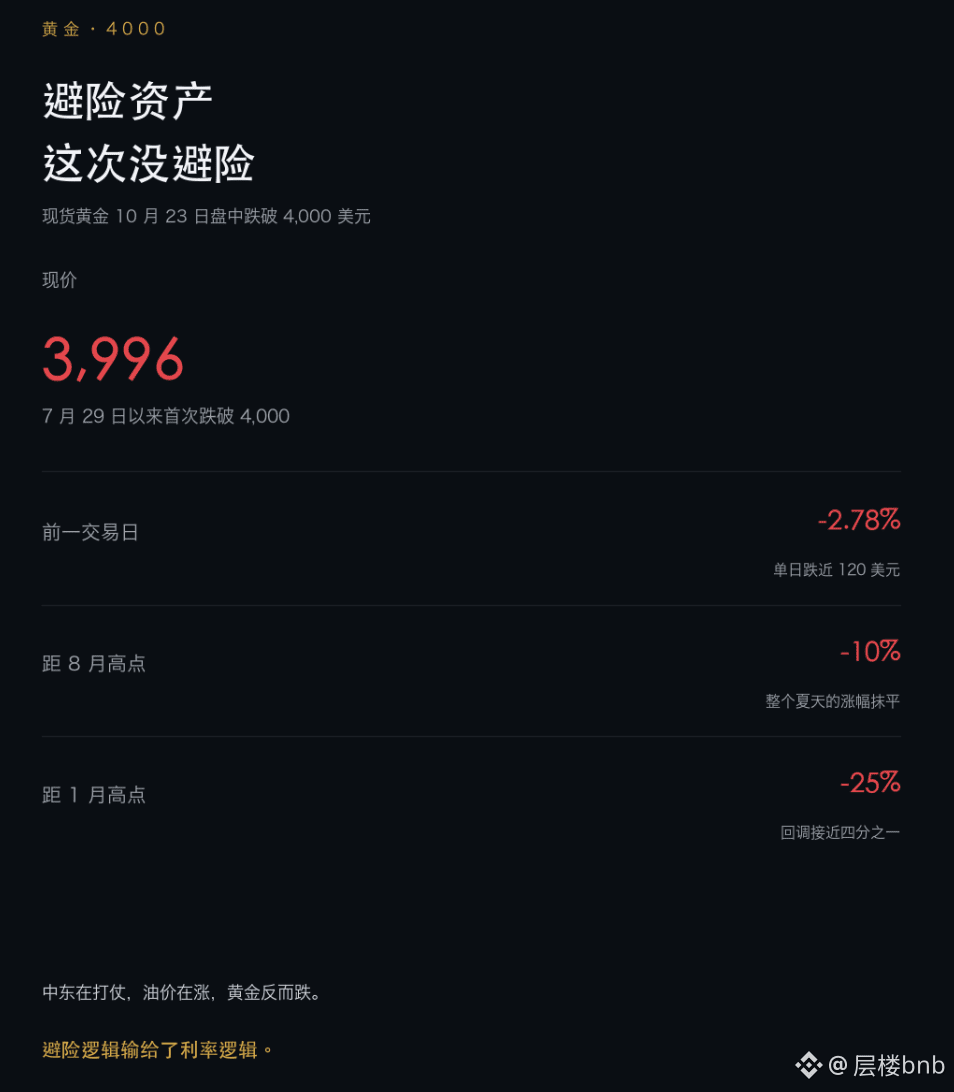
Spot gold fell below $4,000 intraday yesterday for the first time since July 29. It’s now at 3996.
It had already dropped 2.78% the day before, falling nearly $120 in a single day. It’s down more than 10% from its August high, and nearly 25% from its January high. Almost all of its gains over the summer have been wiped out.
The strange thing is: there’s a war in the Middle East, oil prices are rising, and gold should theoretically be going up.
Instead, it fell.
The reason isn’t complicated. This bout of inflation is driven by oil prices, not demand. When oil prices rise, the market worries that expectations of interest rate hikes will stretch into the first quarter of next year—and gold is especially vulnerable to rising real interest rates.
So the safe-haven narrative lost out to the interest-rate narrative.
The same reason also explains two other things: the Nasdaq fell 2.6%, and Bitcoin dropped back to 80,000.
One oil price has weighed on stocks, crypto, and gold all at once. $XAUT
{future}(XAUTUSDT)
#黄金自7月以来首次跌破4000美元
Spot gold fell below $4,000 intraday yesterday for the first time since July 29. It’s now at 3996.
It had already dropped 2.78% the day before, falling nearly $120 in a single day. It’s down more than 10% from its August high, and nearly 25% from its January high. Almost all of its gains over the summer have been wiped out.
The strange thing is: there’s a war in the Middle East, oil prices are rising, and gold should theoretically be going up.
Instead, it fell.
The reason isn’t complicated. This bout of inflation is driven by oil prices, not demand. When oil prices rise, the market worries that expectations of interest rate hikes will stretch into the first quarter of next year—and gold is especially vulnerable to rising real interest rates.
So the safe-haven narrative lost out to the interest-rate narrative.
The same reason also explains two other things: the Nasdaq fell 2.6%, and Bitcoin dropped back to 80,000.
One oil price has weighed on stocks, crypto, and gold all at once. $XAUT
#黄金自7月以来首次跌破4000美元
2
2
3.5k
·
--
With an old meme coin like this, never focus on how much it’s up. If you’re holding it, you know it’s already fallen off a cliff. It pumps, then traps another wave of buyers—best to steer clear!
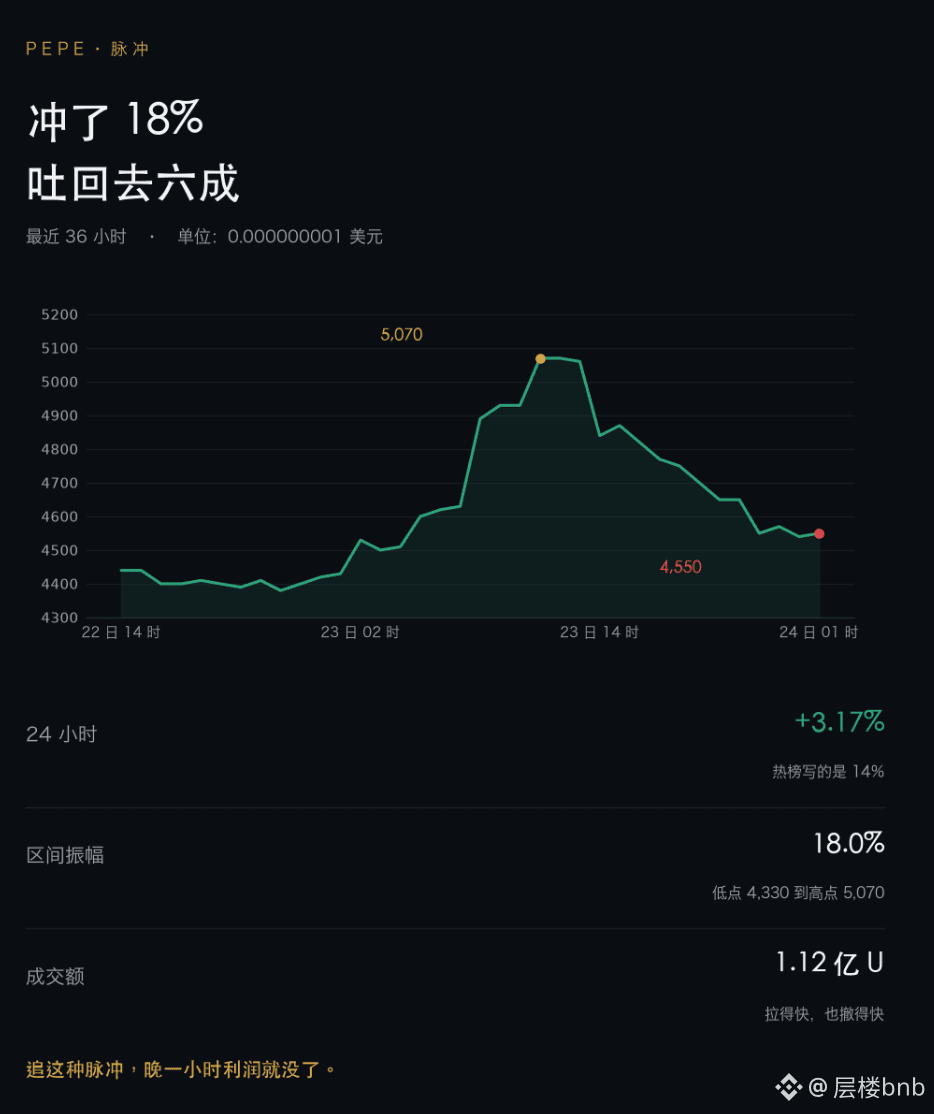
PEPE surged to 0.00000511 yesterday, up 14%, leading the altcoins.
It’s now at 0.00000456, with just +3.17% left over the past 24 hours.
Six-tenths of that 14% has already been wiped out.
$PEPE
{spot}(PEPEUSDT)
#pepe上涨14%领涨山寨币反弹
With an old meme coin like this, never focus on how much it’s up. If you’re holding it, you know it’s already fallen off a cliff. It pumps, then traps another wave of buyers—best to steer clear!
PEPE surged to 0.00000511 yesterday, up 14%, leading the altcoins.
It’s now at 0.00000456, with just +3.17% left over the past 24 hours.
Six-tenths of that 14% has already been wiped out.
$PEPE
#pepe上涨14%领涨山寨币反弹
PEPE surged to 0.00000511 yesterday, up 14%, leading the altcoins.
It’s now at 0.00000456, with just +3.17% left over the past 24 hours.
Six-tenths of that 14% has already been wiped out.
$PEPE
#pepe上涨14%领涨山寨币反弹
20
13
27.3k
Log in to explore more content
Join global crypto users on Binance Square
⚡️ Get latest and useful information about crypto.
💬 Trusted by the world’s largest crypto exchange.
👍 Discover real insights from verified creators.
Email / Phone number
Trending Topics
BinancePick
2.5M views
137,704 Discussing
Join #EarningsSeason: Predict Earnings on Binance Pick, Share Your Take on Binance Square!
Binance Square Official
·399 Likes
·337k views
EarningsSeason
4.9M views
23,879 Discussing
ElectrumWalletBugLetRogueServersStealFunds
2,414 views
133 Discussing