
SilentWatchdog
74 Posts

SilentWatchdog
Report
Block User
Ділюся власним досвідом на Binance. Коротко розбираю продукти, результати та помилки.

SOL Holder
High-Frequency Trader
1.5 Years
64 Following
54 Followers
155 Liked
Posts
All
Videos
PINNED
Partly True
From $200 to $5631 in five years
Year 2021. You have $1,000 to spare. You split it evenly: $200 each in NVIDIA, Tesla, Apple, Amazon, and Micron stocks — and you hold them for almost five years.
We return to the portfolio in 2026.
The initial $200 in each company would have grown to approximately:
NVIDIA — $1,971
Tesla — $295
Apple — $444
Amazon — $297
Micron — $2,623
Total — about $5,631. Profit — $4,631, or +463%.
But the most interesting part: over 90% of the profit came from just NVIDIA and Micron.
The world is betting on technologies that require computing chips and memory.
bStocks appeared on Binance this summer. Similar tokenized products already existed on other platforms, and the shares themselves have been traded for many years.
bStocks are certificates linked to stocks, not direct ownership of them.
Where would you invest $1,000 over the next five years? 😇
#bStocks #Binance $NVDAB $MUB
From $200 to $5631 in five years
Year 2021. You have $1,000 to spare. You split it evenly: $200 each in NVIDIA, Tesla, Apple, Amazon, and Micron stocks — and you hold them for almost five years.
We return to the portfolio in 2026.
The initial $200 in each company would have grown to approximately:
NVIDIA — $1,971
Tesla — $295
Apple — $444
Amazon — $297
Micron — $2,623
Total — about $5,631. Profit — $4,631, or +463%.
But the most interesting part: over 90% of the profit came from just NVIDIA and Micron.
The world is betting on technologies that require computing chips and memory.
bStocks appeared on Binance this summer. Similar tokenized products already existed on other platforms, and the shares themselves have been traded for many years.
bStocks are certificates linked to stocks, not direct ownership of them.
Where would you invest $1,000 over the next five years? 😇
#bStocks #Binance $NVDAB $MUB
Year 2021. You have $1,000 to spare. You split it evenly: $200 each in NVIDIA, Tesla, Apple, Amazon, and Micron stocks — and you hold them for almost five years.
We return to the portfolio in 2026.
The initial $200 in each company would have grown to approximately:
NVIDIA — $1,971
Tesla — $295
Apple — $444
Amazon — $297
Micron — $2,623
Total — about $5,631. Profit — $4,631, or +463%.
But the most interesting part: over 90% of the profit came from just NVIDIA and Micron.
The world is betting on technologies that require computing chips and memory.
bStocks appeared on Binance this summer. Similar tokenized products already existed on other platforms, and the shares themselves have been traded for many years.
bStocks are certificates linked to stocks, not direct ownership of them.
Where would you invest $1,000 over the next five years? 😇
#bStocks #Binance $NVDAB $MUB
NVIDIA
Micron
Кошик із п’яти компаній
Не інвестував би в bStock
6 day(s) left
1
989
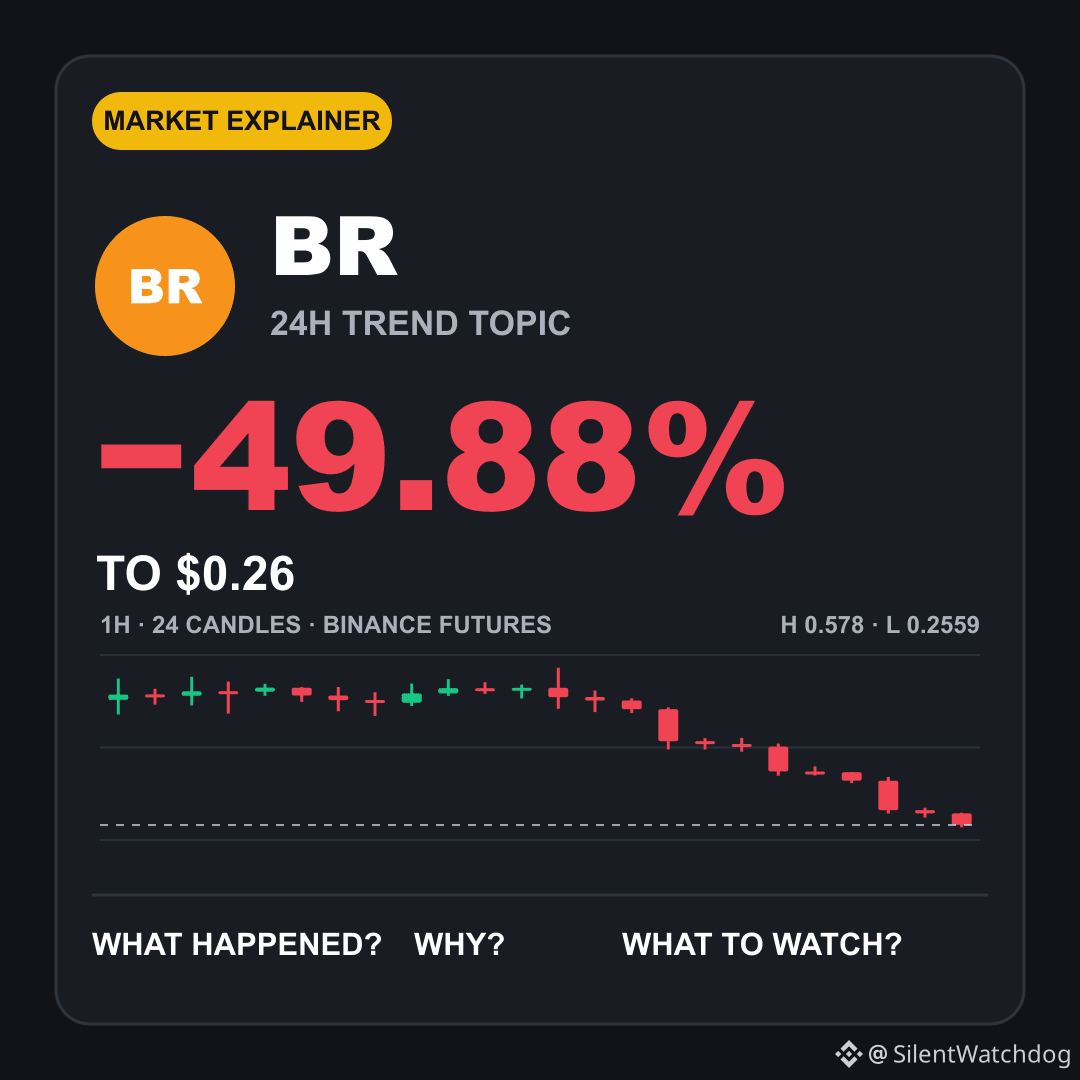
$BR turned in just a few hours into a tough test for those who held the token not only “for the pump” but also to participate in Bedrock governance. According to Binance at the time of observation, BRUSDT was trading at about 0.25976 USDT, was down nearly 49.9% over 24 hours, and volume exceeded 392 million USDT.
Bedrock is a DeFi project with the BR token, which can be locked into veBR to vote on the distribution of rewards in the protocol. And here lies the paradox: the official product documentation exists, the mechanism works, but at the time of checking there was no fresh public announcement from Bedrock or Binance directly explaining today’s crash.
If you traded $BR today, was it a dip buy or a painful stop loss?
$BR turned in just a few hours into a tough test for those who held the token not only “for the pump” but also to participate in Bedrock governance. According to Binance at the time of observation, BRUSDT was trading at about 0.25976 USDT, was down nearly 49.9% over 24 hours, and volume exceeded 392 million USDT.
Bedrock is a DeFi project with the BR token, which can be locked into veBR to vote on the distribution of rewards in the protocol. And here lies the paradox: the official product documentation exists, the mechanism works, but at the time of checking there was no fresh public announcement from Bedrock or Binance directly explaining today’s crash.
If you traded $BR today, was it a dip buy or a painful stop loss?
Bedrock is a DeFi project with the BR token, which can be locked into veBR to vote on the distribution of rewards in the protocol. And here lies the paradox: the official product documentation exists, the mechanism works, but at the time of checking there was no fresh public announcement from Bedrock or Binance directly explaining today’s crash.
If you traded $BR today, was it a dip buy or a painful stop loss?
2
1
70
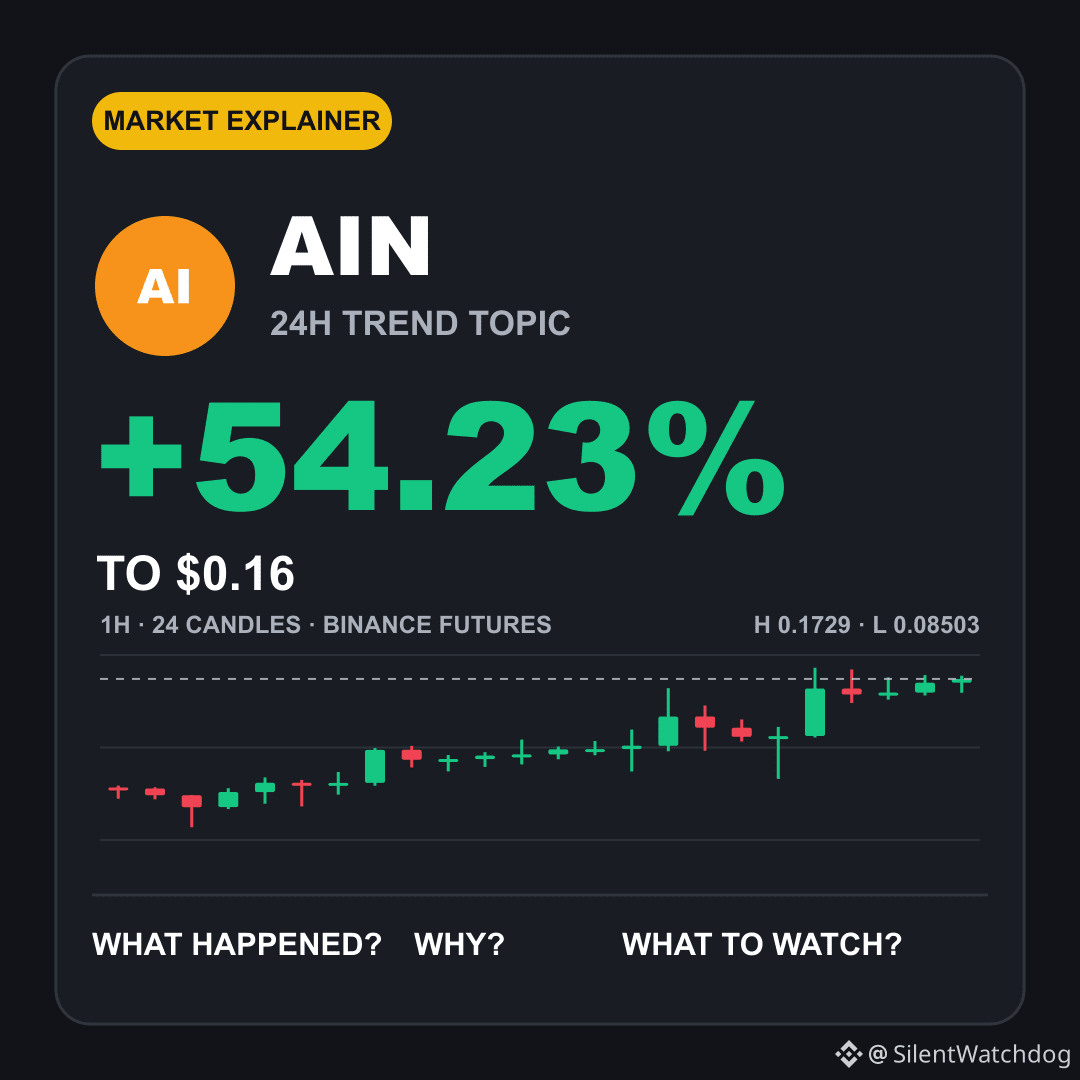
$AIN drew attention not only with the number, but also with a strange informational gap. According to Binance at the time of observation, AINUSDT was worth approximately 0.15896 USDT, adding about 54% over 24 hours, while trading volume exceeded 269 million USDT.
But Binance separately notes: AIN is not listed in spot on a centralized exchange; it’s only available via Wallet/DEX routes, whereas the AINUSDT futures contract has existed since July 11, 2025. The AI Network project itself is an ecosystem centered around AINSpace, a “digital village” where people and AI agents interact with each other.
What’s most interesting now isn’t “why it already grew,” but whether, after this surge, there will be an official explanation, new liquidity, or stronger interest in the product itself. Would you look here for a continuation of the move, or would you already be locking in the result?
$AIN drew attention not only with the number, but also with a strange informational gap. According to Binance at the time of observation, AINUSDT was worth approximately 0.15896 USDT, adding about 54% over 24 hours, while trading volume exceeded 269 million USDT.
But Binance separately notes: AIN is not listed in spot on a centralized exchange; it’s only available via Wallet/DEX routes, whereas the AINUSDT futures contract has existed since July 11, 2025. The AI Network project itself is an ecosystem centered around AINSpace, a “digital village” where people and AI agents interact with each other.
What’s most interesting now isn’t “why it already grew,” but whether, after this surge, there will be an official explanation, new liquidity, or stronger interest in the product itself. Would you look here for a continuation of the move, or would you already be locking in the result?
But Binance separately notes: AIN is not listed in spot on a centralized exchange; it’s only available via Wallet/DEX routes, whereas the AINUSDT futures contract has existed since July 11, 2025. The AI Network project itself is an ecosystem centered around AINSpace, a “digital village” where people and AI agents interact with each other.
What’s most interesting now isn’t “why it already grew,” but whether, after this surge, there will be an official explanation, new liquidity, or stronger interest in the product itself. Would you look here for a continuation of the move, or would you already be locking in the result?
1
92
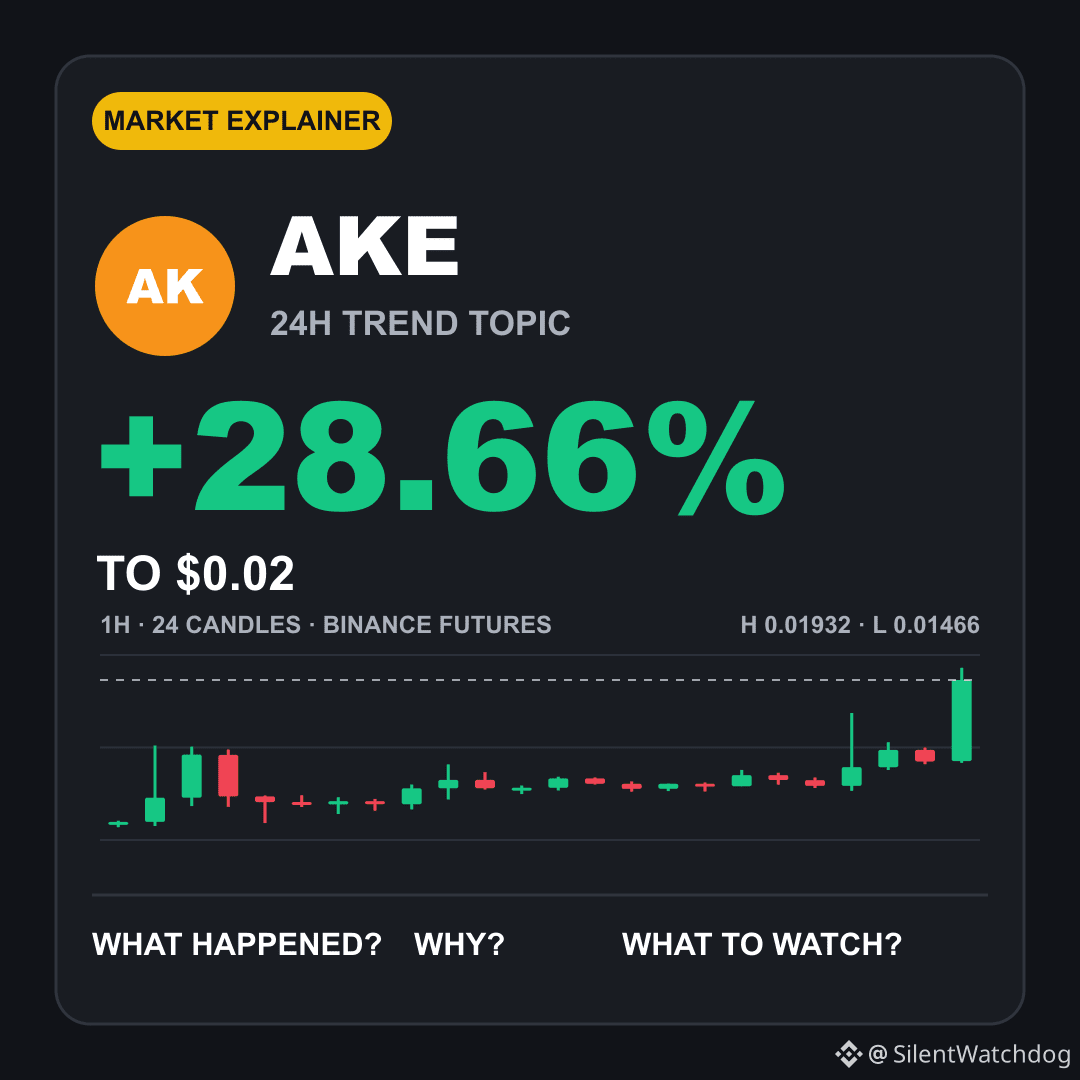
$AKE caught attention not only with its growth. According to Binance at the time of observation, the token was priced at about 0.018997 USDT, adding approximately 28.66% over 24 hours, while the daily volume in the AKEUSDT pair exceeded 60.85 million USDT.
What’s most interesting is something else: officially, Binance describes AKEDO not as a regular spot asset on the exchange, but as Binance Alpha — a separate section for new tokens. It also clearly states that AKE is not purchased directly on Binance CEX, and Alpha assets are not withdrawn from the platform.
AKEDO itself positions as an AI platform for creating games from text prompts. If you look at this rally, what matters to you right now: the pump itself, or understanding exactly where and in what trading mode $AKE is traded?
$AKE caught attention not only with its growth. According to Binance at the time of observation, the token was priced at about 0.018997 USDT, adding approximately 28.66% over 24 hours, while the daily volume in the AKEUSDT pair exceeded 60.85 million USDT.
What’s most interesting is something else: officially, Binance describes AKEDO not as a regular spot asset on the exchange, but as Binance Alpha — a separate section for new tokens. It also clearly states that AKE is not purchased directly on Binance CEX, and Alpha assets are not withdrawn from the platform.
AKEDO itself positions as an AI platform for creating games from text prompts. If you look at this rally, what matters to you right now: the pump itself, or understanding exactly where and in what trading mode $AKE is traded?
What’s most interesting is something else: officially, Binance describes AKEDO not as a regular spot asset on the exchange, but as Binance Alpha — a separate section for new tokens. It also clearly states that AKE is not purchased directly on Binance CEX, and Alpha assets are not withdrawn from the platform.
AKEDO itself positions as an AI platform for creating games from text prompts. If you look at this rally, what matters to you right now: the pump itself, or understanding exactly where and in what trading mode $AKE is traded?
1
429
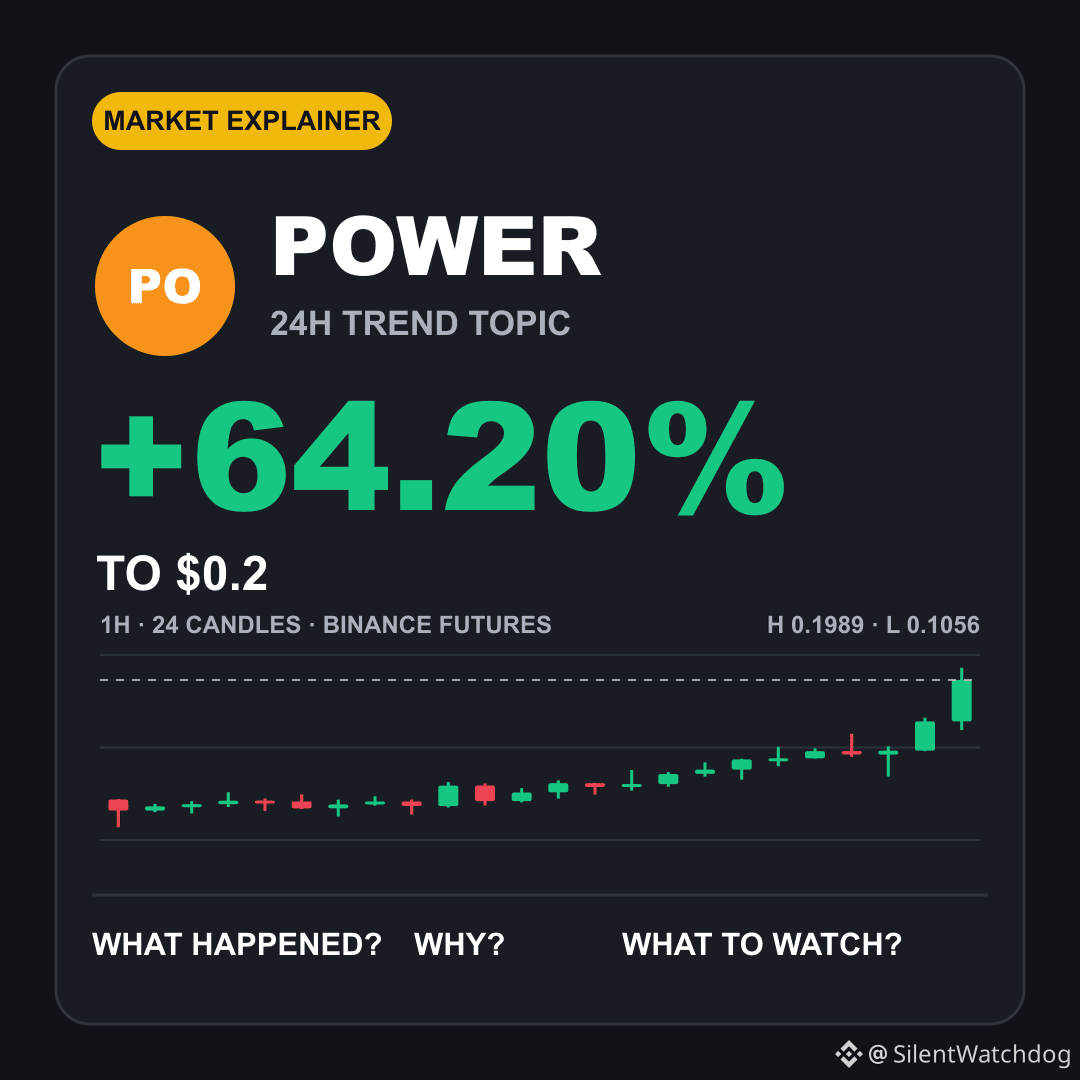
$POWER not only because of the chart, but also because of a strange information gap.
According to Binance at the time of observation, the token was adding roughly 64% over 24 hours, the price was around 0.1986, and the volume was over 81 million USDT. But I couldn’t find any fresh official catalyst for today.
What’s definitely known: Power Protocol is infrastructure for blockchain games and digital entertainment, where $POWER is envisioned as the ecosystem’s shared token. The official website mentions Pixion Games and Fableborne, and Binance previously promoted the token through Alpha, an airdrop of 375 POWER, and an August contest with $200k in rewards.
So the market right now may be trading not the news of the day, but old attention plus momentum. In this kind of situation, would you look for continuation of the move, or would you wait first for a new, confirmed announcement?
$POWER not only because of the chart, but also because of a strange information gap.
According to Binance at the time of observation, the token was adding roughly 64% over 24 hours, the price was around 0.1986, and the volume was over 81 million USDT. But I couldn’t find any fresh official catalyst for today.
What’s definitely known: Power Protocol is infrastructure for blockchain games and digital entertainment, where $POWER is envisioned as the ecosystem’s shared token. The official website mentions Pixion Games and Fableborne, and Binance previously promoted the token through Alpha, an airdrop of 375 POWER, and an August contest with $200k in rewards.
So the market right now may be trading not the news of the day, but old attention plus momentum. In this kind of situation, would you look for continuation of the move, or would you wait first for a new, confirmed announcement?
According to Binance at the time of observation, the token was adding roughly 64% over 24 hours, the price was around 0.1986, and the volume was over 81 million USDT. But I couldn’t find any fresh official catalyst for today.
What’s definitely known: Power Protocol is infrastructure for blockchain games and digital entertainment, where $POWER is envisioned as the ecosystem’s shared token. The official website mentions Pixion Games and Fableborne, and Binance previously promoted the token through Alpha, an airdrop of 375 POWER, and an August contest with $200k in rewards.
So the market right now may be trading not the news of the day, but old attention plus momentum. In this kind of situation, would you look for continuation of the move, or would you wait first for a new, confirmed announcement?
1
2
734
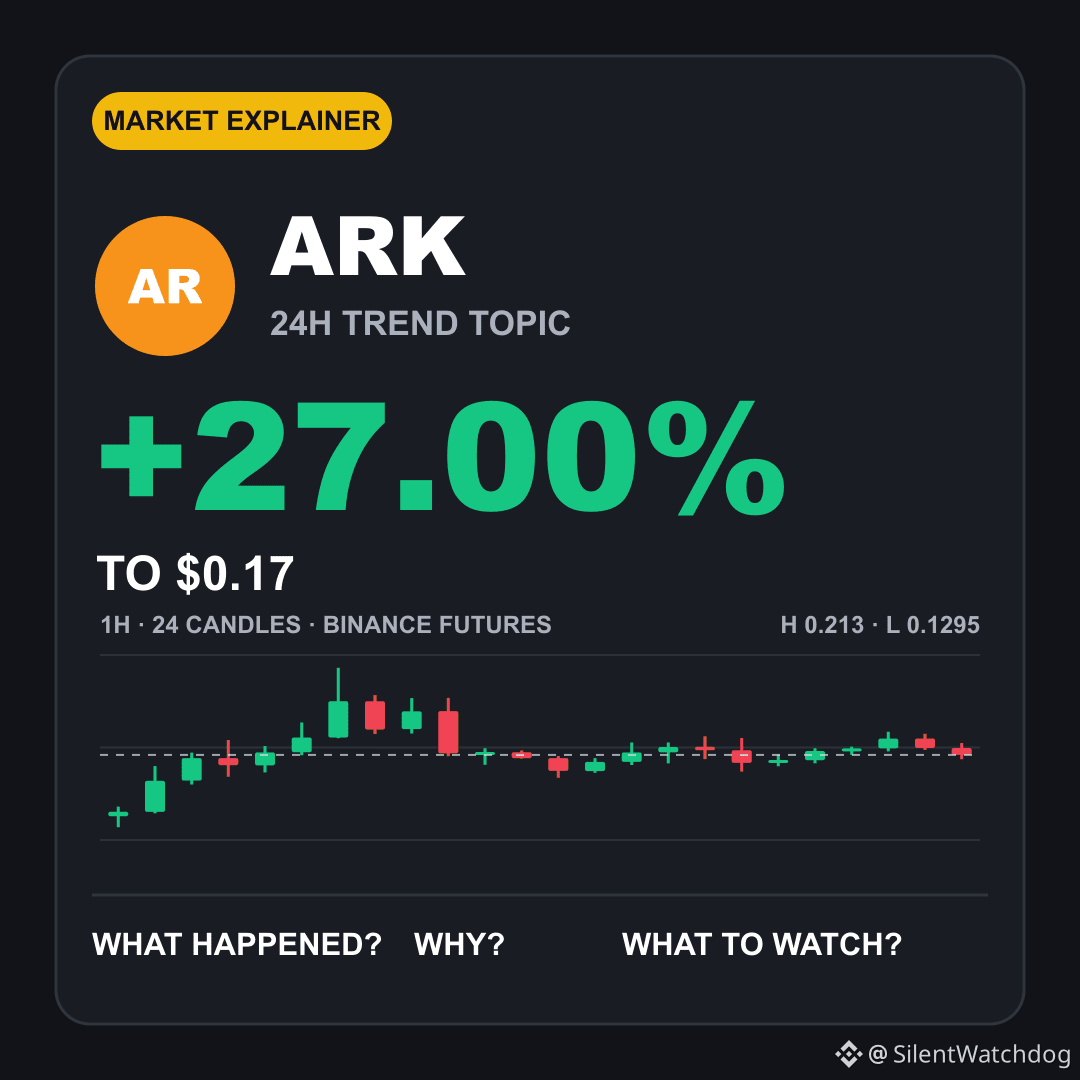
$ARK drew attention not only for its rise, but also for the strange lack of a loud, official explanation.
According to Binance at the time of observation, ARKUSDT added roughly 27% over 24 hours; the price was around 0.1703 USDT, and trading volume exceeded 109 million USDT. At the same time, in Binance’s latest list of announcements for September 14–15, there is no separate new announcement specifically about ARK, and the project’s official blog shows the usual technical report from September 11 about work on Mainsail — ARK’s blockchain architecture for developers and validators, not an obvious mainstream demand catalyst.
Now that the move has already happened, the market will continue to test a simple thing: whether a verified piece of news appears, or whether it was only a brief impulse in volume. In this situation, would you lock in profits, wait for confirmation, or not touch this move at all?
$ARK drew attention not only for its rise, but also for the strange lack of a loud, official explanation.
According to Binance at the time of observation, ARKUSDT added roughly 27% over 24 hours; the price was around 0.1703 USDT, and trading volume exceeded 109 million USDT. At the same time, in Binance’s latest list of announcements for September 14–15, there is no separate new announcement specifically about ARK, and the project’s official blog shows the usual technical report from September 11 about work on Mainsail — ARK’s blockchain architecture for developers and validators, not an obvious mainstream demand catalyst.
Now that the move has already happened, the market will continue to test a simple thing: whether a verified piece of news appears, or whether it was only a brief impulse in volume. In this situation, would you lock in profits, wait for confirmation, or not touch this move at all?
According to Binance at the time of observation, ARKUSDT added roughly 27% over 24 hours; the price was around 0.1703 USDT, and trading volume exceeded 109 million USDT. At the same time, in Binance’s latest list of announcements for September 14–15, there is no separate new announcement specifically about ARK, and the project’s official blog shows the usual technical report from September 11 about work on Mainsail — ARK’s blockchain architecture for developers and validators, not an obvious mainstream demand catalyst.
Now that the move has already happened, the market will continue to test a simple thing: whether a verified piece of news appears, or whether it was only a brief impulse in volume. In this situation, would you lock in profits, wait for confirmation, or not touch this move at all?
149
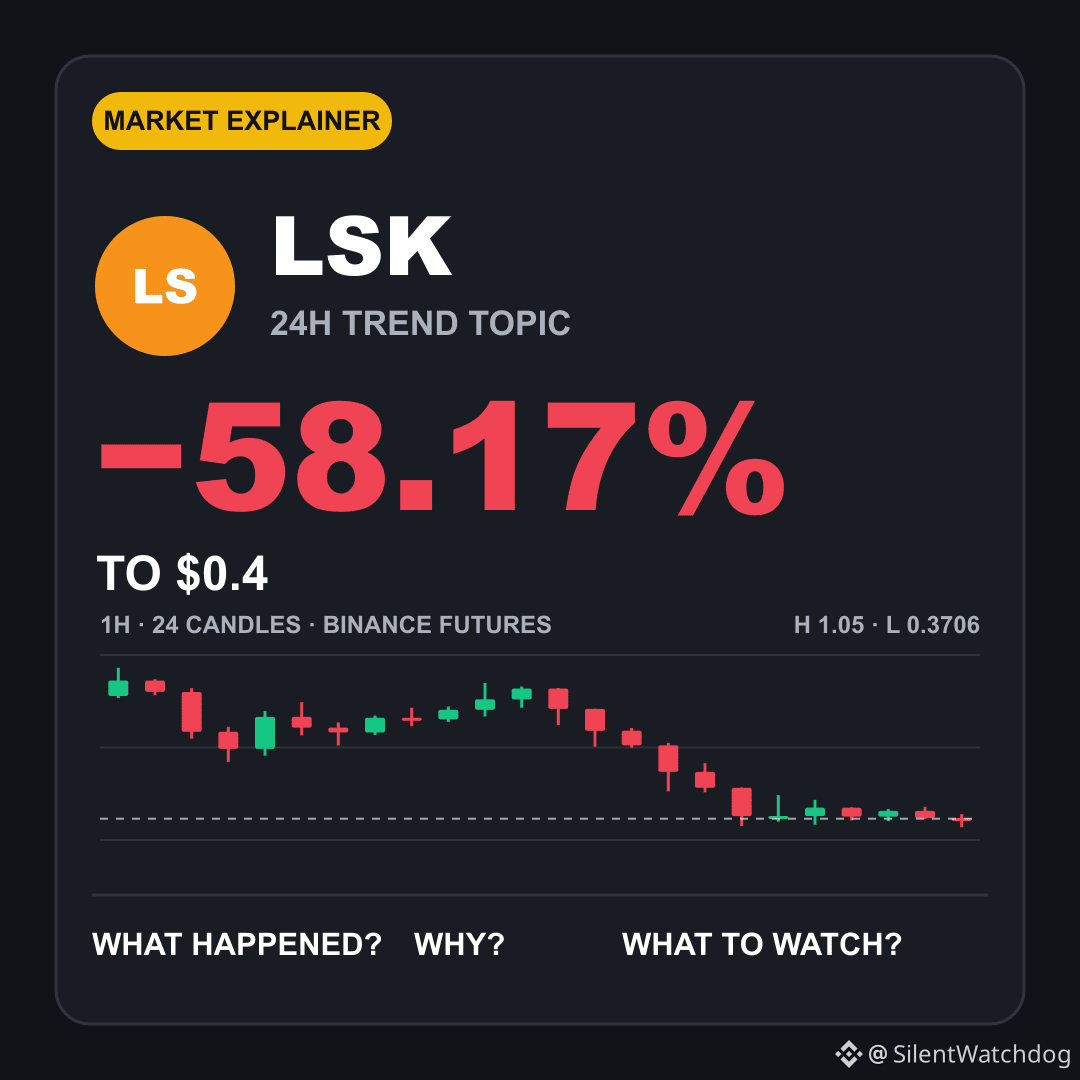
$LSK today it didn’t just drop — it reminded the market that the “old alt” can suddenly turn into a story about deadlines, migration, and a forced reassessment of risk.
According to Binance at the time of observation, LSK was trading at around 0.4016 USDT, losing about 58% over 24 hours, while volume reached nearly 1.66 billion USDT. But there’s a confirmed storyline here: the Lisk team is officially closing the Lisk Chain on October 31, 2026, and is asking to withdraw assets, while Binance already, on July 24, added LSK to the elevated-risk tag.
So the market is seeing not only a dump, but a token in transition: the old network will be shut down, stakers need to have time to unlock their positions, and exchanges are already highlighting the risks. If you held $LSK, do you see this as a one-off panic or as a fair reassessment of the asset ahead of shutting down the old chain?
$LSK today it didn’t just drop — it reminded the market that the “old alt” can suddenly turn into a story about deadlines, migration, and a forced reassessment of risk.
According to Binance at the time of observation, LSK was trading at around 0.4016 USDT, losing about 58% over 24 hours, while volume reached nearly 1.66 billion USDT. But there’s a confirmed storyline here: the Lisk team is officially closing the Lisk Chain on October 31, 2026, and is asking to withdraw assets, while Binance already, on July 24, added LSK to the elevated-risk tag.
So the market is seeing not only a dump, but a token in transition: the old network will be shut down, stakers need to have time to unlock their positions, and exchanges are already highlighting the risks. If you held $LSK , do you see this as a one-off panic or as a fair reassessment of the asset ahead of shutting down the old chain?
According to Binance at the time of observation, LSK was trading at around 0.4016 USDT, losing about 58% over 24 hours, while volume reached nearly 1.66 billion USDT. But there’s a confirmed storyline here: the Lisk team is officially closing the Lisk Chain on October 31, 2026, and is asking to withdraw assets, while Binance already, on July 24, added LSK to the elevated-risk tag.
So the market is seeing not only a dump, but a token in transition: the old network will be shut down, stakers need to have time to unlock their positions, and exchanges are already highlighting the risks. If you held $LSK , do you see this as a one-off panic or as a fair reassessment of the asset ahead of shutting down the old chain?
3
455
Verified
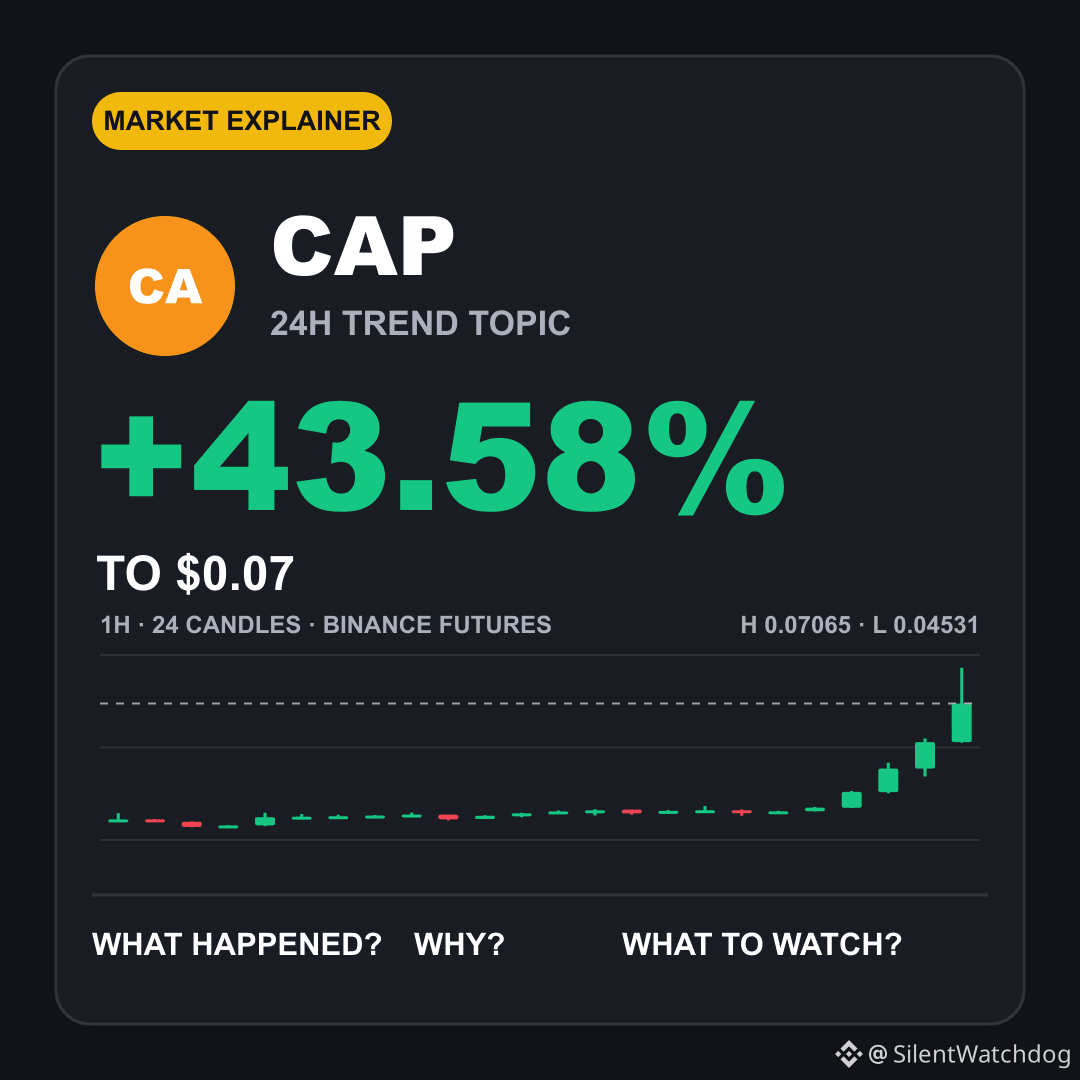
$CAP today it’s interesting not only for its chart, but also for the strange gap between the market and public facts. According to Binance at the time of observation, the token was worth about 0.067 USDT, adding roughly 43.6% over 24 hours, and the volume in the CAPUSDT pair exceeded 54.8 million USDT.
Meanwhile, what’s officially visible is different: Binance launched CAPUSDT futures on June 27 with leverage up to 10x, and at the end of July Binance Alpha ran a contest for CAP for 200,000 USDC. And Cap itself isn’t a memecoin, but a DeFi platform for dollar-denominated yield, private lending, and financial guarantees.
So now the market has given a strong push to an asset with a complex product, but without any obvious new public trigger. In such a situation, would you expect an official explanation for the move, or would you trade the fact of the abnormal attention itself?
$CAP today it’s interesting not only for its chart, but also for the strange gap between the market and public facts. According to Binance at the time of observation, the token was worth about 0.067 USDT, adding roughly 43.6% over 24 hours, and the volume in the CAPUSDT pair exceeded 54.8 million USDT.
Meanwhile, what’s officially visible is different: Binance launched CAPUSDT futures on June 27 with leverage up to 10x, and at the end of July Binance Alpha ran a contest for CAP for 200,000 USDC. And Cap itself isn’t a memecoin, but a DeFi platform for dollar-denominated yield, private lending, and financial guarantees.
So now the market has given a strong push to an asset with a complex product, but without any obvious new public trigger. In such a situation, would you expect an official explanation for the move, or would you trade the fact of the abnormal attention itself?
Meanwhile, what’s officially visible is different: Binance launched CAPUSDT futures on June 27 with leverage up to 10x, and at the end of July Binance Alpha ran a contest for CAP for 200,000 USDC. And Cap itself isn’t a memecoin, but a DeFi platform for dollar-denominated yield, private lending, and financial guarantees.
So now the market has given a strong push to an asset with a complex product, but without any obvious new public trigger. In such a situation, would you expect an official explanation for the move, or would you trade the fact of the abnormal attention itself?
1
63
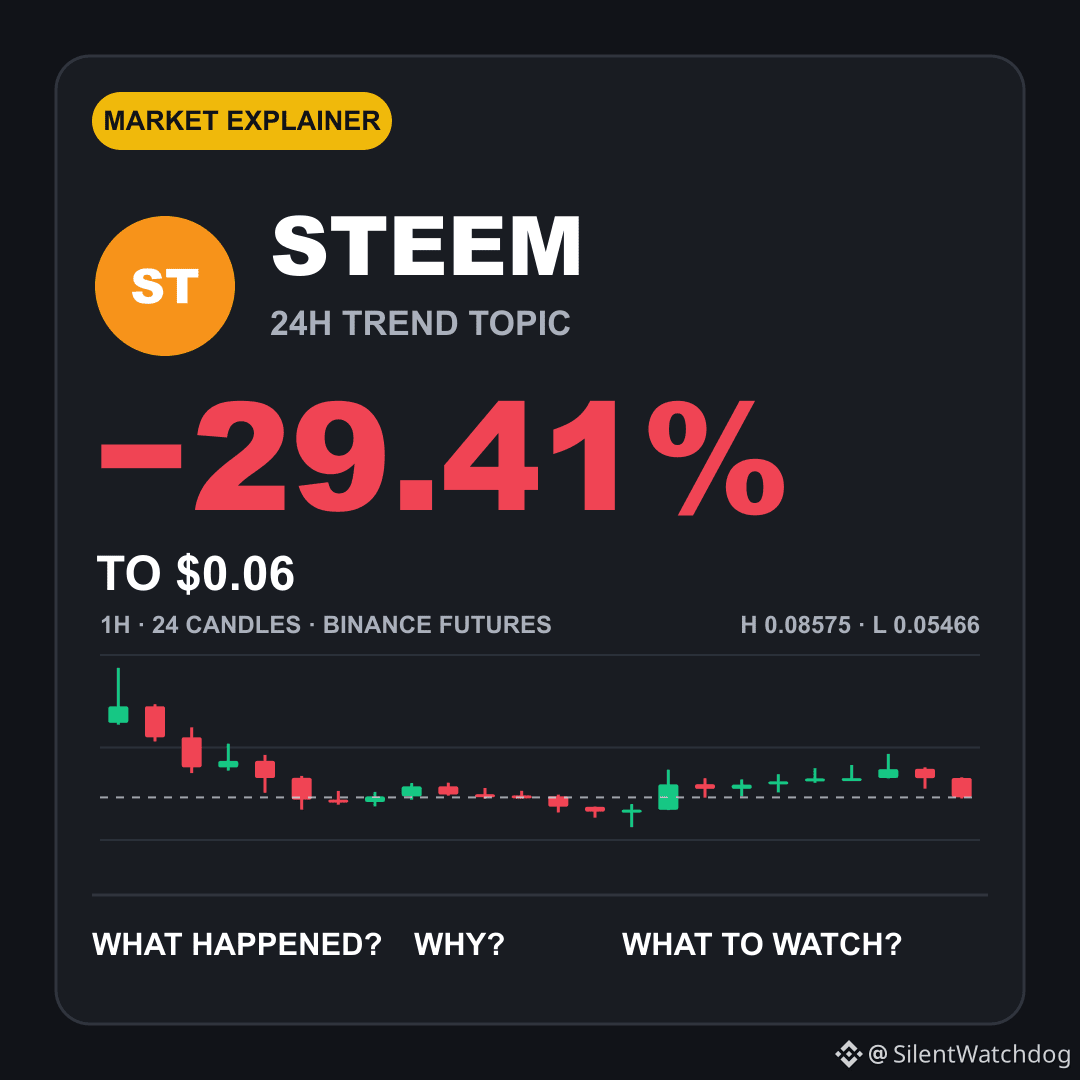
$STEEM today does not provide a history of a loud headline, but rather of a strange information vacuum.
According to Binance as of the observation time, the token was trading at around 0.05932 USDT, losing approximately 29.4% over 24 hours, while volume was close to 109.8 million USDT. For a coin of this scale, this is no longer a “quiet” move.
What is Steem? It’s an old blockchain for social networks and content platforms, where users publish posts and receive tokens for their activity.
The closest verified background: on August 18, Binance announced the removal of the STEEM/USDC pair from August 21, but $STEEM itself wasn’t removed from Binance Spot completely. There doesn’t seem to be any fresh official explanation publicly visible specifically for today’s dump.
How do you read such a move without an obvious news event: it’s panic, someone’s big position offloading, or just a trap for those looking for “the bottom”?
$STEEM today does not provide a history of a loud headline, but rather of a strange information vacuum.
According to Binance as of the observation time, the token was trading at around 0.05932 USDT, losing approximately 29.4% over 24 hours, while volume was close to 109.8 million USDT. For a coin of this scale, this is no longer a “quiet” move.
What is Steem? It’s an old blockchain for social networks and content platforms, where users publish posts and receive tokens for their activity.
The closest verified background: on August 18, Binance announced the removal of the STEEM/USDC pair from August 21, but $STEEM itself wasn’t removed from Binance Spot completely. There doesn’t seem to be any fresh official explanation publicly visible specifically for today’s dump.
How do you read such a move without an obvious news event: it’s panic, someone’s big position offloading, or just a trap for those looking for “the bottom”?
According to Binance as of the observation time, the token was trading at around 0.05932 USDT, losing approximately 29.4% over 24 hours, while volume was close to 109.8 million USDT. For a coin of this scale, this is no longer a “quiet” move.
What is Steem? It’s an old blockchain for social networks and content platforms, where users publish posts and receive tokens for their activity.
The closest verified background: on August 18, Binance announced the removal of the STEEM/USDC pair from August 21, but $STEEM itself wasn’t removed from Binance Spot completely. There doesn’t seem to be any fresh official explanation publicly visible specifically for today’s dump.
How do you read such a move without an obvious news event: it’s panic, someone’s big position offloading, or just a trap for those looking for “the bottom”?
1
114
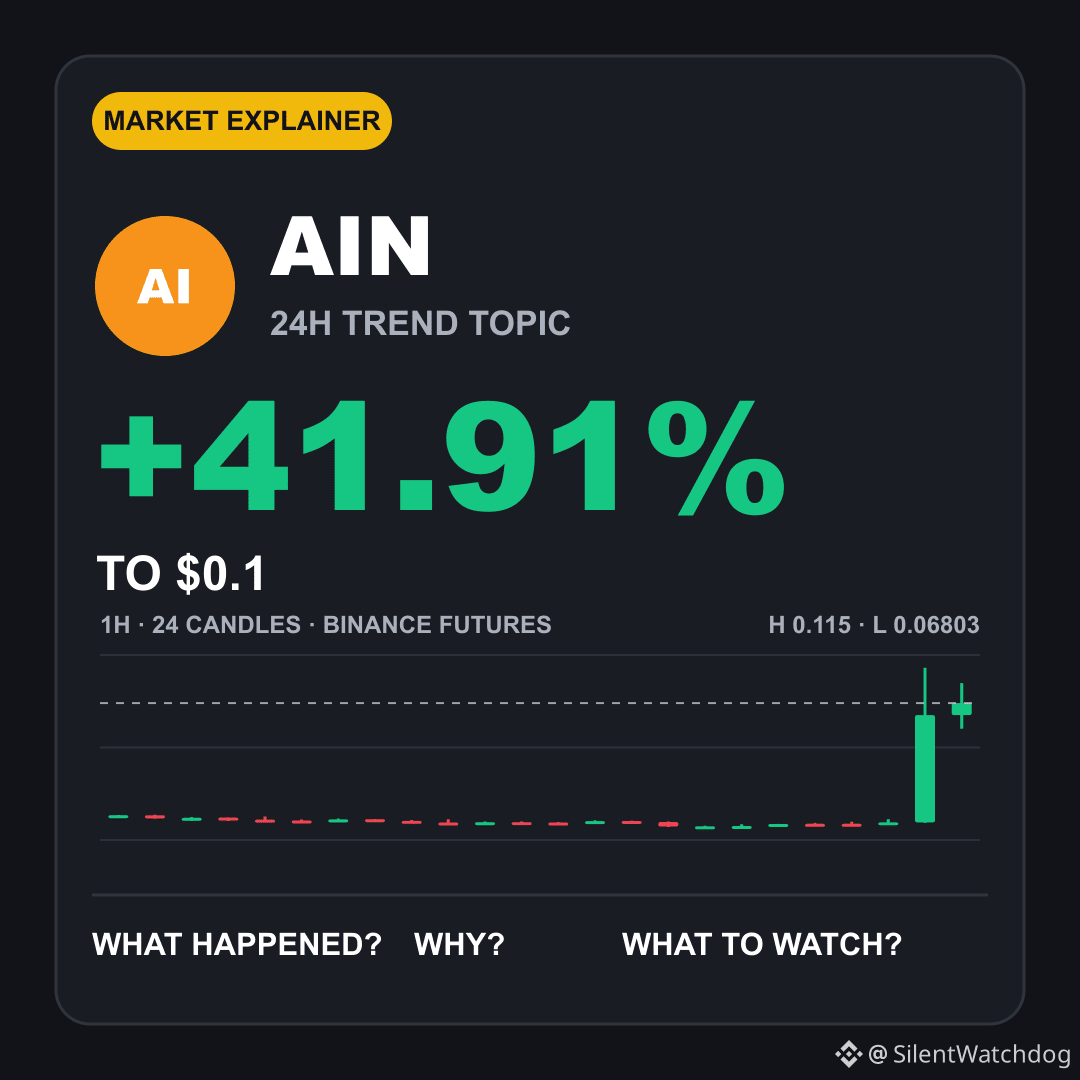
$AIN today is interesting not only because of price movement, but also because of the strange market context.
According to Binance data at the time of observation, AINUSDT added approximately 41.9% over 24 hours; the price was around 0.101, and volume was nearly 29.5 million USDT. At the same time, AIN has a futures contract on Binance dating back to July 2025, but there is no Spot listing on Binance CEX: the exchange directs users to Binance Wallet and DEX.
The AI Network itself is a blockchain for AI applications and decentralized GPU infrastructure, where $AIN is the base token. And as of September 14, 2026, there is no fresh official announcement publicly visible that simply explains this jump. In this kind of situation, would you trust the momentum without a clear news catalyst, or would you wait for confirmation with demand after the pump?
$AIN today is interesting not only because of price movement, but also because of the strange market context.
According to Binance data at the time of observation, AINUSDT added approximately 41.9% over 24 hours; the price was around 0.101, and volume was nearly 29.5 million USDT. At the same time, AIN has a futures contract on Binance dating back to July 2025, but there is no Spot listing on Binance CEX: the exchange directs users to Binance Wallet and DEX.
The AI Network itself is a blockchain for AI applications and decentralized GPU infrastructure, where $AIN is the base token. And as of September 14, 2026, there is no fresh official announcement publicly visible that simply explains this jump. In this kind of situation, would you trust the momentum without a clear news catalyst, or would you wait for confirmation with demand after the pump?
According to Binance data at the time of observation, AINUSDT added approximately 41.9% over 24 hours; the price was around 0.101, and volume was nearly 29.5 million USDT. At the same time, AIN has a futures contract on Binance dating back to July 2025, but there is no Spot listing on Binance CEX: the exchange directs users to Binance Wallet and DEX.
The AI Network itself is a blockchain for AI applications and decentralized GPU infrastructure, where $AIN is the base token. And as of September 14, 2026, there is no fresh official announcement publicly visible that simply explains this jump. In this kind of situation, would you trust the momentum without a clear news catalyst, or would you wait for confirmation with demand after the pump?
2
594
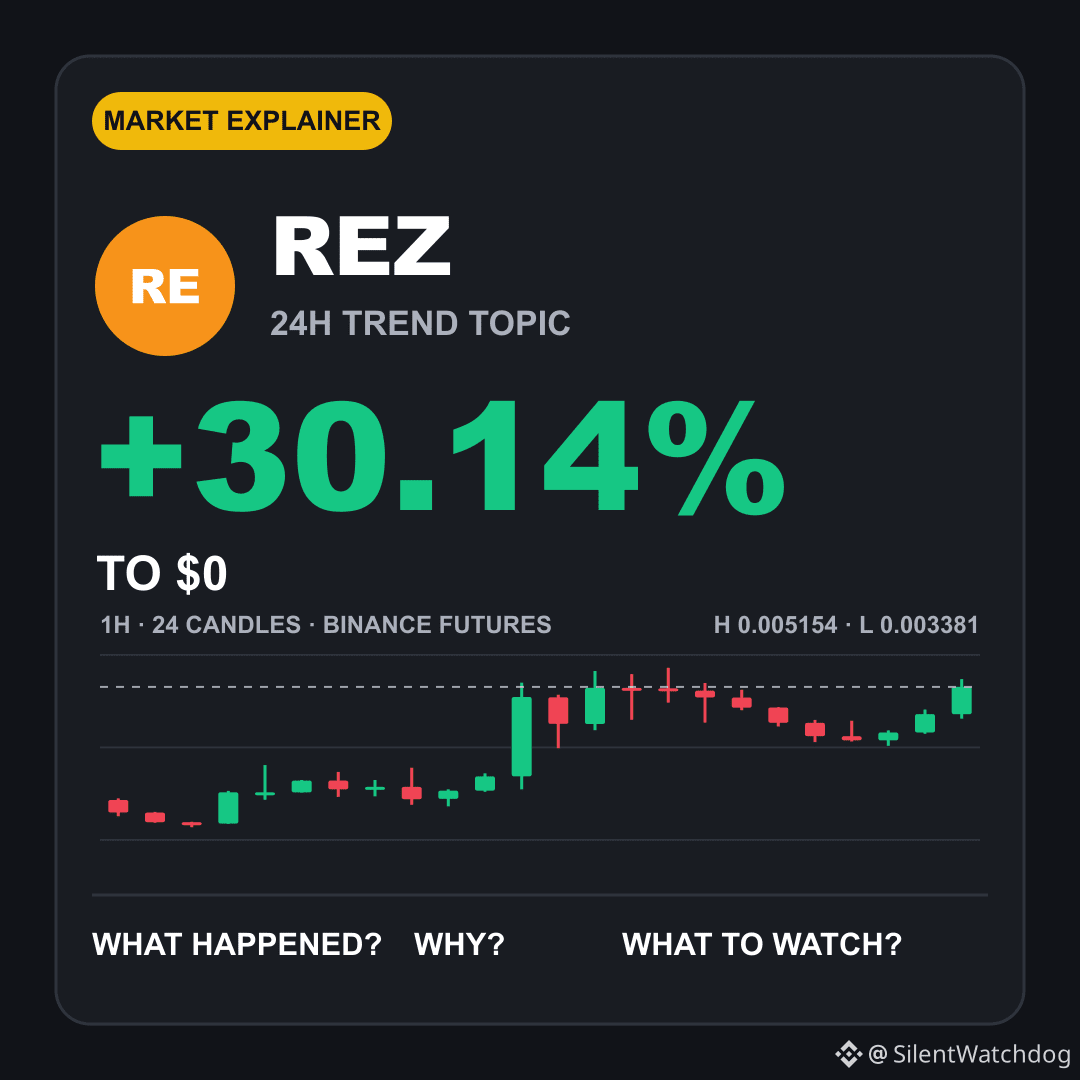
$REZ years not only due to the schedule. According to Binance data at the time of observation, the token was trading at approximately 0.004572 USDT, rising by about 30.14% over 24 hours, with volume exceeding 113.5 million USDT.
There’s a clear official trigger here: on September 11, Binance launched the Renzo trading tournament with a prize pool of 200,000 USDC and additional sprint rewards tied to trading volume. Renzo is a liquid restaking protocol where users receive a liquid token for participating in staking and restaking.
Now the market will test a simple thing: whether demand for $REZ will remain after the promotion ends on September 18, or whether the entire momentum is being sustained mainly by the exchange-based incentive. Would you be watching for volume continuation here, or were you already expecting a cooldown?
$REZ years not only due to the schedule. According to Binance data at the time of observation, the token was trading at approximately 0.004572 USDT, rising by about 30.14% over 24 hours, with volume exceeding 113.5 million USDT.
There’s a clear official trigger here: on September 11, Binance launched the Renzo trading tournament with a prize pool of 200,000 USDC and additional sprint rewards tied to trading volume. Renzo is a liquid restaking protocol where users receive a liquid token for participating in staking and restaking.
Now the market will test a simple thing: whether demand for $REZ will remain after the promotion ends on September 18, or whether the entire momentum is being sustained mainly by the exchange-based incentive. Would you be watching for volume continuation here, or were you already expecting a cooldown?
There’s a clear official trigger here: on September 11, Binance launched the Renzo trading tournament with a prize pool of 200,000 USDC and additional sprint rewards tied to trading volume. Renzo is a liquid restaking protocol where users receive a liquid token for participating in staking and restaking.
Now the market will test a simple thing: whether demand for $REZ will remain after the promotion ends on September 18, or whether the entire momentum is being sustained mainly by the exchange-based incentive. Would you be watching for volume continuation here, or were you already expecting a cooldown?
1
166
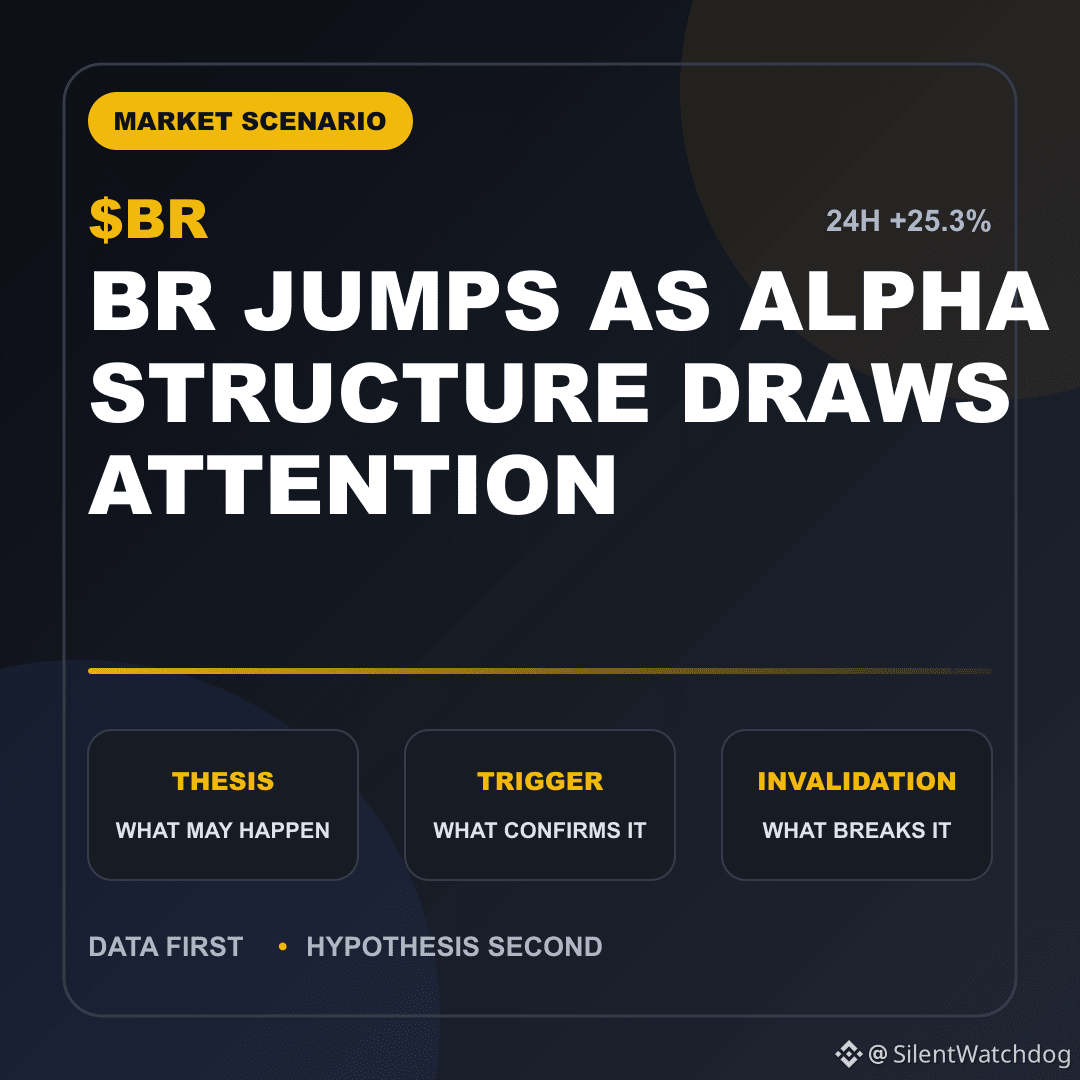
$BR suddenly spiked, but what’s more interesting here isn’t the pump itself, but the market structure. According to Binance at the time of observation, BRUSDT was approximately +25.34% over 24 hours; the price was about $0.3159, and the volume was nearly 22.9M USDT. At the same time, Binance explicitly states that Bedrock is available via Binance Alpha, not through a standard CEX listing, and such Alpha tokens cannot be withdrawn from the platform.
Bedrock is a DeFi protocol for earning on bitcoin liquidity, and $BR provides participation in governance and can be locked in veBR for voting and bonuses. My version: the market is currently testing not a one-day piece of news, but whether the story about Bedrock 2.0 and Alpha’s internal liquidity is enough to continue the move. In this situation, would you follow a new official announcement, or would you already be waiting for a sharp pullback?
$BR suddenly spiked, but what’s more interesting here isn’t the pump itself, but the market structure. According to Binance at the time of observation, BRUSDT was approximately +25.34% over 24 hours; the price was about $0.3159, and the volume was nearly 22.9M USDT. At the same time, Binance explicitly states that Bedrock is available via Binance Alpha, not through a standard CEX listing, and such Alpha tokens cannot be withdrawn from the platform.
Bedrock is a DeFi protocol for earning on bitcoin liquidity, and $BR provides participation in governance and can be locked in veBR for voting and bonuses. My version: the market is currently testing not a one-day piece of news, but whether the story about Bedrock 2.0 and Alpha’s internal liquidity is enough to continue the move. In this situation, would you follow a new official announcement, or would you already be waiting for a sharp pullback?
Bedrock is a DeFi protocol for earning on bitcoin liquidity, and $BR provides participation in governance and can be locked in veBR for voting and bonuses. My version: the market is currently testing not a one-day piece of news, but whether the story about Bedrock 2.0 and Alpha’s internal liquidity is enough to continue the move. In this situation, would you follow a new official announcement, or would you already be waiting for a sharp pullback?
1
606
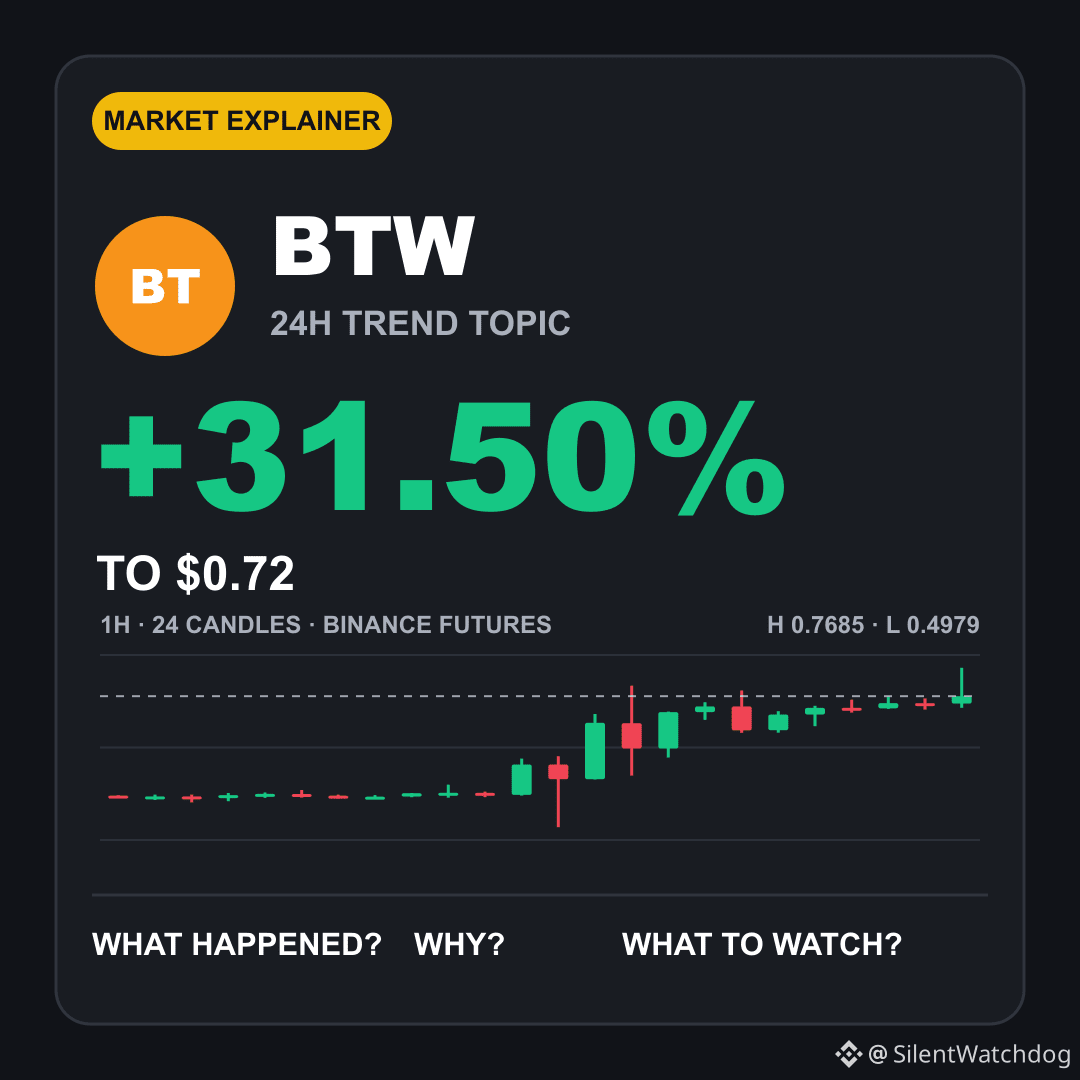
$BTW attracted attention not only with the number, but also with the strange context. According to Binance at the time of observation, BTWUSDT was priced at approximately 0.7243 USDT, rising by about 31.5% over 24 hours, while volume exceeded 119 million USDT.
The paradox is that I couldn’t find any fresh official explanation specifically for September 13. What’s known from earlier: Binance Wallet ran a pre-TGE and a 300 million BTW giveaway for Bitway, and Binance Futures launched BTWUSDT as early as June 4. And Bitway itself is not a meme—it’s a project about a Bitcoin-compatible blockchain, a bridge for BTC, and yield-generating products.
So it seems the market is now reopening an old story, but without a new, confirmed trigger. In such a situation, would you look for continuation of the momentum, or would you wait first for news that truly explains this move?
$BTW attracted attention not only with the number, but also with the strange context. According to Binance at the time of observation, BTWUSDT was priced at approximately 0.7243 USDT, rising by about 31.5% over 24 hours, while volume exceeded 119 million USDT.
The paradox is that I couldn’t find any fresh official explanation specifically for September 13. What’s known from earlier: Binance Wallet ran a pre-TGE and a 300 million BTW giveaway for Bitway, and Binance Futures launched BTWUSDT as early as June 4. And Bitway itself is not a meme—it’s a project about a Bitcoin-compatible blockchain, a bridge for BTC, and yield-generating products.
So it seems the market is now reopening an old story, but without a new, confirmed trigger. In such a situation, would you look for continuation of the momentum, or would you wait first for news that truly explains this move?
The paradox is that I couldn’t find any fresh official explanation specifically for September 13. What’s known from earlier: Binance Wallet ran a pre-TGE and a 300 million BTW giveaway for Bitway, and Binance Futures launched BTWUSDT as early as June 4. And Bitway itself is not a meme—it’s a project about a Bitcoin-compatible blockchain, a bridge for BTC, and yield-generating products.
So it seems the market is now reopening an old story, but without a new, confirmed trigger. In such a situation, would you look for continuation of the momentum, or would you wait first for news that truly explains this move?
1
480
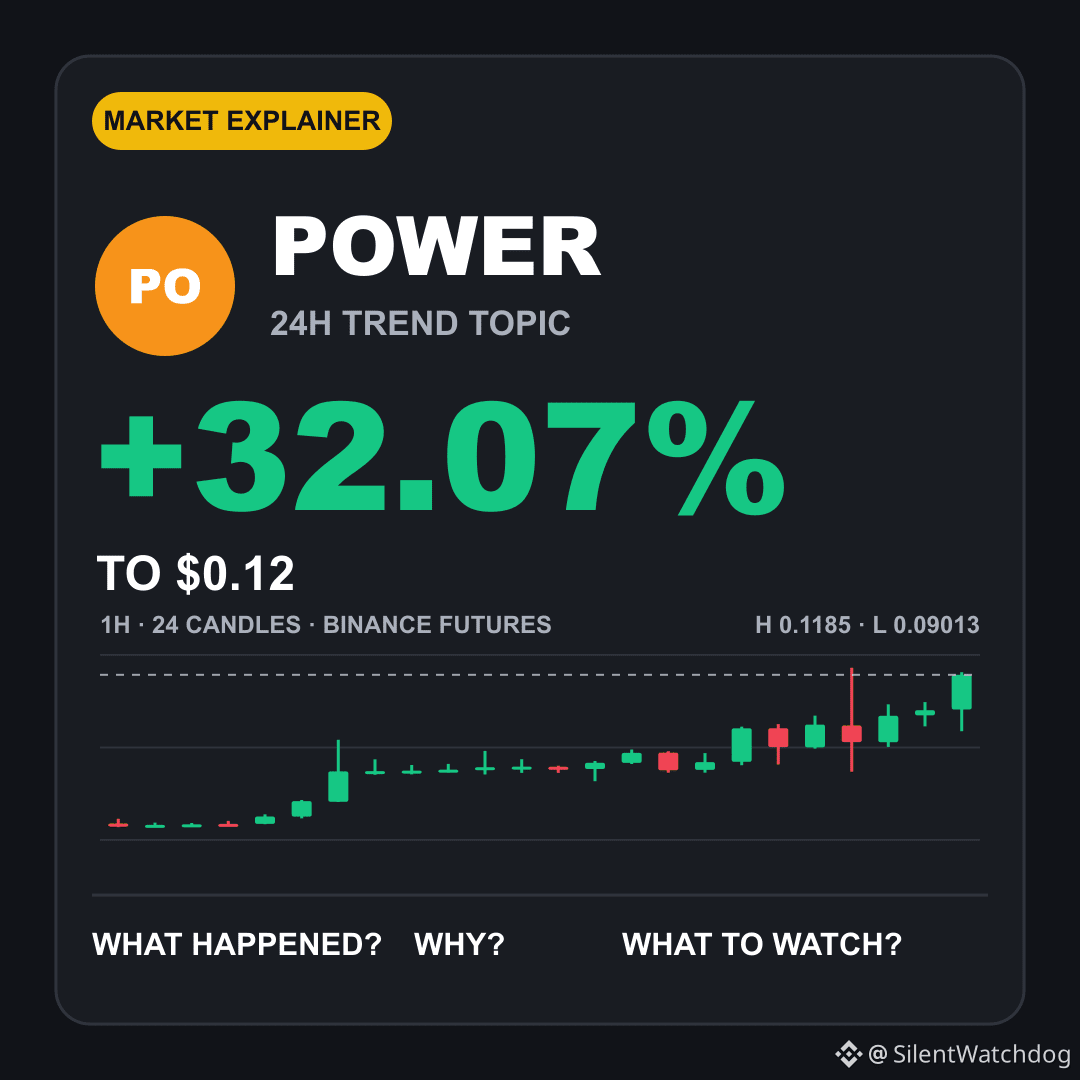
$POWER today is interesting not only with a candle, but also with the context. According to Binance at the time of observation, the token was trading at around 0.11955 USDT, adding approximately 32% over 24 hours, while volume reached nearly 19.4 million USDT.
The point is that Power Protocol is not a meme and not a “blank” ticker. In the project documentation, $POWER is described as a shared economic layer for games and other applications, and CoinMarketCap mentions Fableborne as the ecosystem’s first product, with over 380 thousand players in tests.
But there’s a paradox: among Binance’s recent public announcements on September 13, there’s no sign of a new POWER-related release. In other words, the market is already buzzing, but the verified information trail for the day is weak. Here, would you look for the continuation of the move, or would you first wait for new integrations and usage figures?
$POWER today is interesting not only with a candle, but also with the context. According to Binance at the time of observation, the token was trading at around 0.11955 USDT, adding approximately 32% over 24 hours, while volume reached nearly 19.4 million USDT.
The point is that Power Protocol is not a meme and not a “blank” ticker. In the project documentation, $POWER is described as a shared economic layer for games and other applications, and CoinMarketCap mentions Fableborne as the ecosystem’s first product, with over 380 thousand players in tests.
But there’s a paradox: among Binance’s recent public announcements on September 13, there’s no sign of a new POWER-related release. In other words, the market is already buzzing, but the verified information trail for the day is weak. Here, would you look for the continuation of the move, or would you first wait for new integrations and usage figures?
The point is that Power Protocol is not a meme and not a “blank” ticker. In the project documentation, $POWER is described as a shared economic layer for games and other applications, and CoinMarketCap mentions Fableborne as the ecosystem’s first product, with over 380 thousand players in tests.
But there’s a paradox: among Binance’s recent public announcements on September 13, there’s no sign of a new POWER-related release. In other words, the market is already buzzing, but the verified information trail for the day is weak. Here, would you look for the continuation of the move, or would you first wait for new integrations and usage figures?
2
145
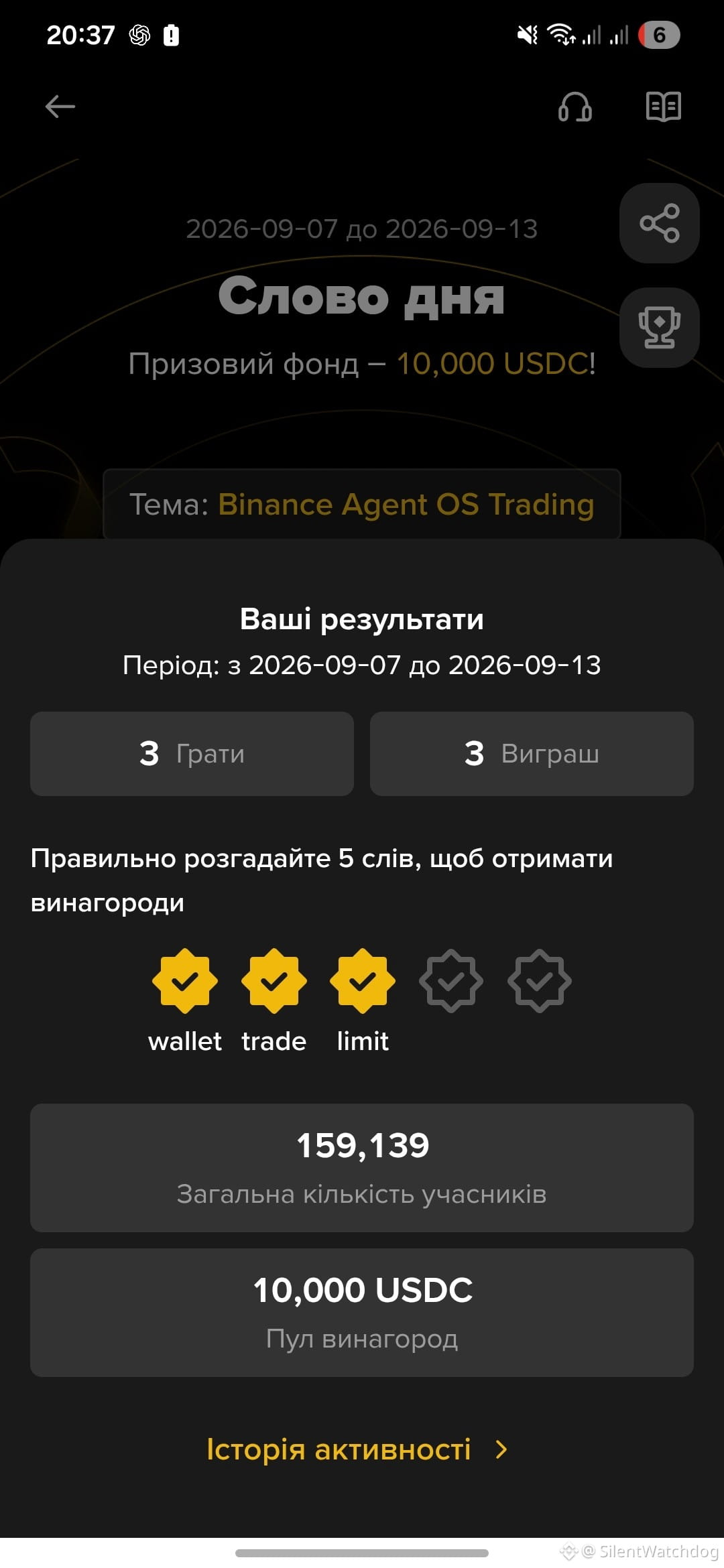
10 000 USDC for WOTD.
[Binance WOTD 🥰](https://www.binance.com/activity/word-of-the-day/Binance-Agent-OS-Trading?ref=CPA_0035HWCJ0W&utm_medium=web_share_copy)
An interesting quiz to test yourself and learn new crypto terms. And a possible bonus—pleasant addition. Even a small reward is nice when you get it for a game you like 😄🟩
🟩 7000 USDC are distributed proportionally among those who guessed at least 5 words. Maximum from this pool is 5 USDC per user.
🟩 Another 3000 USDC are split equally among those who guessed at least 5 words and played on at least 5 different days. So the final payout depends on the number of participants who met the conditions. Binance rules.
I already have three words: WALLET, TRADE, and LIMIT. And how many did you guess?
#WOTD🔥 #Binance
10 000 USDC for WOTD.
Binance WOTD 🥰
An interesting quiz to test yourself and learn new crypto terms. And a possible bonus—pleasant addition. Even a small reward is nice when you get it for a game you like 😄🟩
🟩 7000 USDC are distributed proportionally among those who guessed at least 5 words. Maximum from this pool is 5 USDC per user.
🟩 Another 3000 USDC are split equally among those who guessed at least 5 words and played on at least 5 different days. So the final payout depends on the number of participants who met the conditions. Binance rules.
I already have three words: WALLET, TRADE, and LIMIT. And how many did you guess?
#WOTD🔥 #Binance
Binance WOTD 🥰
An interesting quiz to test yourself and learn new crypto terms. And a possible bonus—pleasant addition. Even a small reward is nice when you get it for a game you like 😄🟩
🟩 7000 USDC are distributed proportionally among those who guessed at least 5 words. Maximum from this pool is 5 USDC per user.
🟩 Another 3000 USDC are split equally among those who guessed at least 5 words and played on at least 5 different days. So the final payout depends on the number of participants who met the conditions. Binance rules.
I already have three words: WALLET, TRADE, and LIMIT. And how many did you guess?
#WOTD🔥 #Binance
2
598
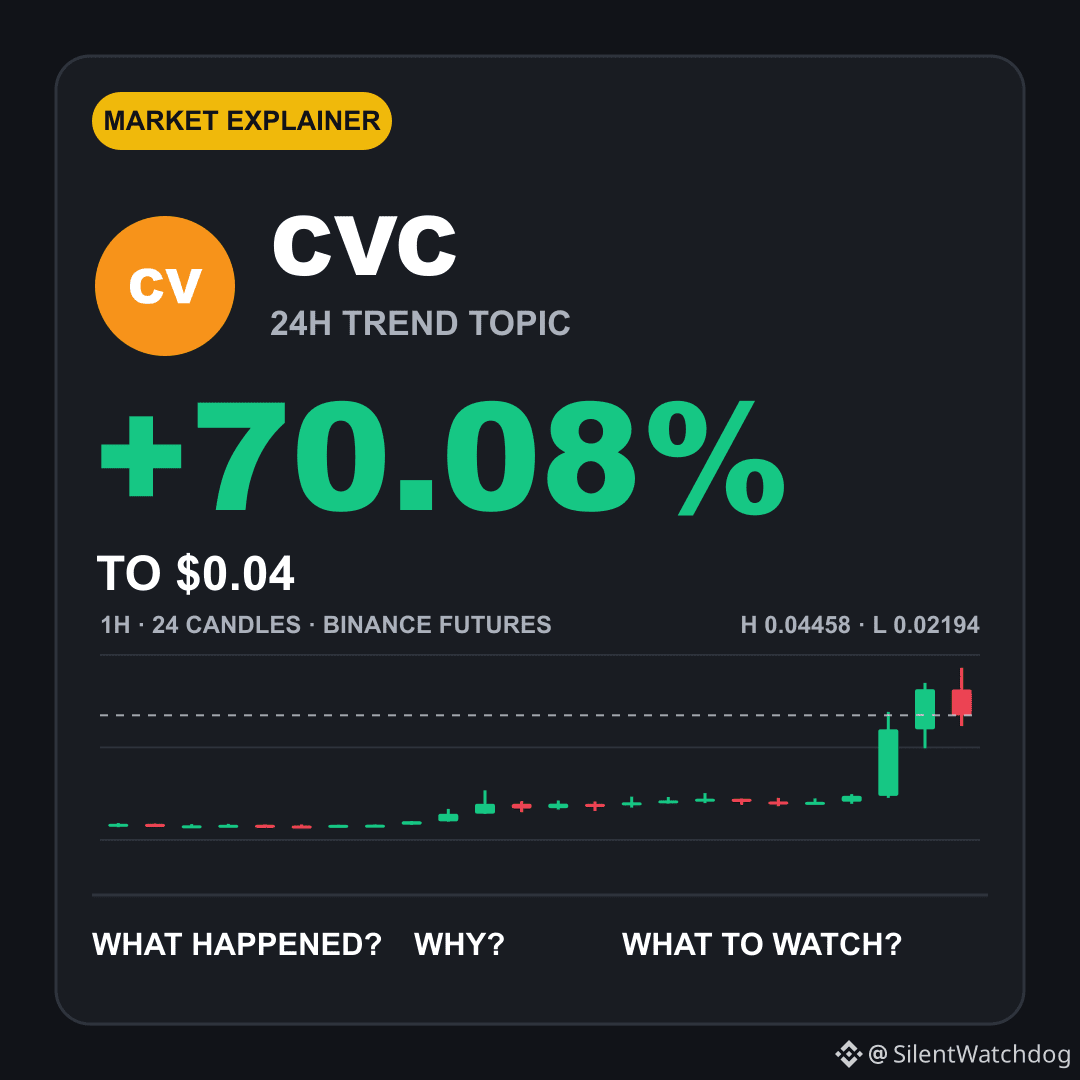
$CVC drew attention not only with numbers, but also with its strange context. According to Binance data at the time of observation, the token was up about +70% over 24 hours; the price hovered around 0.0379 USDT, and volume exceeded 168 million USDT.
The paradox is that, in the officially visible trail, there is now almost no fresh token history for Civic. Civic is a digital identity company for signing into services and verifying users. Back in June 2025, it announced the shutdown of Civic Pass, and by 2026 the website is dominated by materials about AI tools and authorization.
Now the market will test a simple thing: whether a belated public catalyst will appear, or whether this will remain a loud move without a clearly confirmed reason — would you be watching for it here, waiting for confirmation, or already out?
$CVC drew attention not only with numbers, but also with its strange context. According to Binance data at the time of observation, the token was up about +70% over 24 hours; the price hovered around 0.0379 USDT, and volume exceeded 168 million USDT.
The paradox is that, in the officially visible trail, there is now almost no fresh token history for Civic. Civic is a digital identity company for signing into services and verifying users. Back in June 2025, it announced the shutdown of Civic Pass, and by 2026 the website is dominated by materials about AI tools and authorization.
Now the market will test a simple thing: whether a belated public catalyst will appear, or whether this will remain a loud move without a clearly confirmed reason — would you be watching for it here, waiting for confirmation, or already out?
The paradox is that, in the officially visible trail, there is now almost no fresh token history for Civic. Civic is a digital identity company for signing into services and verifying users. Back in June 2025, it announced the shutdown of Civic Pass, and by 2026 the website is dominated by materials about AI tools and authorization.
Now the market will test a simple thing: whether a belated public catalyst will appear, or whether this will remain a loud move without a clearly confirmed reason — would you be watching for it here, waiting for confirmation, or already out?
2
560
Partly True
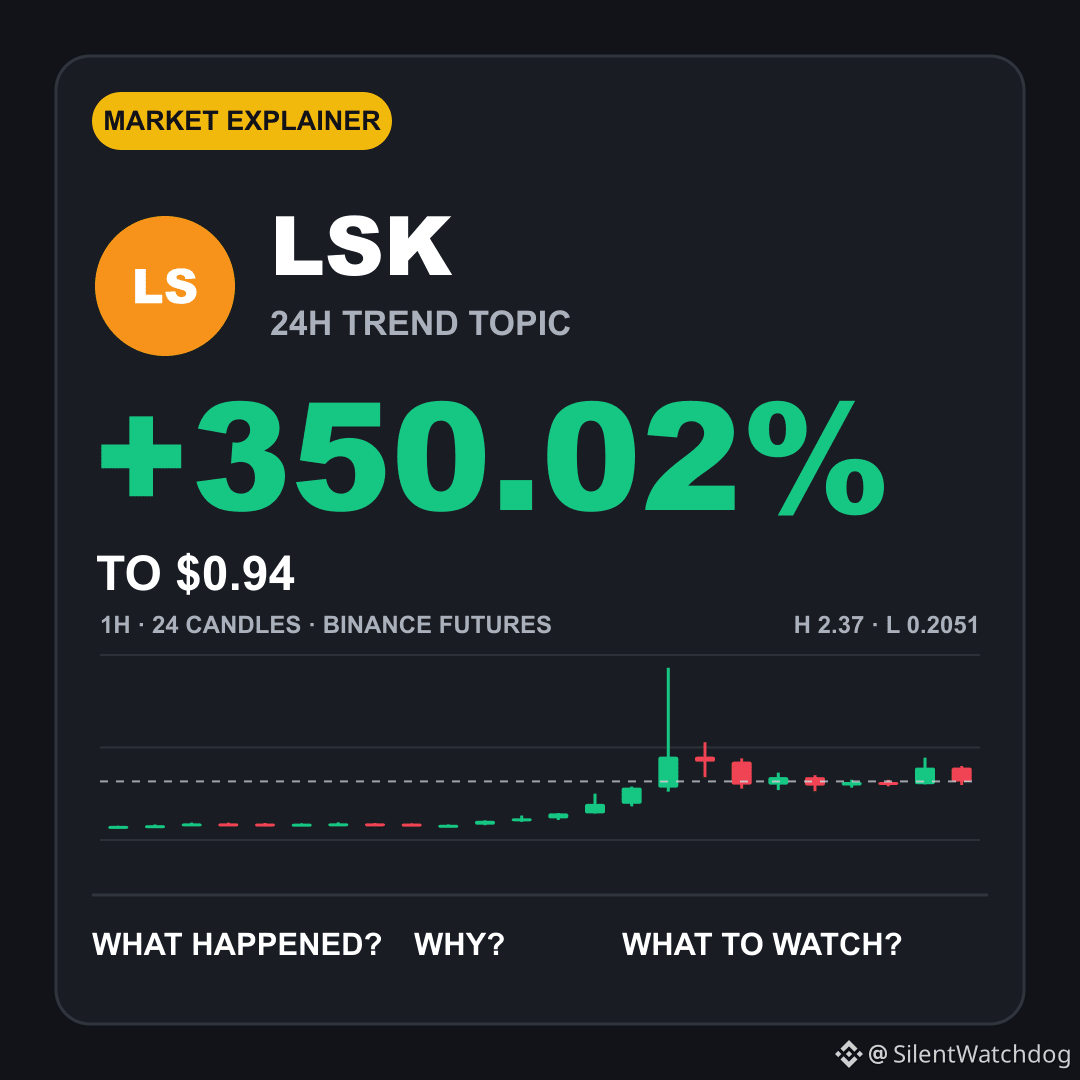
$LSK today a rare paradox emerged: according to Binance data at the time of observation, the token was up by about 350% over 24 hours, and trading volume was nearly $2.96 billion USDT. But the most interesting part isn’t the move itself. Officially, Lisk is a blockchain project for developers, but it has already warned that its own Lisk Chain will be shut down on October 31, 2026, and holders need to transfer LSK to Ethereum in advance—the bridge takes at least 7 days. In July, Binance added LSK to the Monitoring Tag, and other exchanges have already started winding down trading of the old version of the asset. In other words, the market is showing euphoria, while the official story is more about migration, deadlines, and the risk of user errors. Would you be watching the chart here, or first checking exactly where your LSK are?
$LSK today a rare paradox emerged: according to Binance data at the time of observation, the token was up by about 350% over 24 hours, and trading volume was nearly $2.96 billion USDT. But the most interesting part isn’t the move itself. Officially, Lisk is a blockchain project for developers, but it has already warned that its own Lisk Chain will be shut down on October 31, 2026, and holders need to transfer LSK to Ethereum in advance—the bridge takes at least 7 days. In July, Binance added LSK to the Monitoring Tag, and other exchanges have already started winding down trading of the old version of the asset. In other words, the market is showing euphoria, while the official story is more about migration, deadlines, and the risk of user errors. Would you be watching the chart here, or first checking exactly where your LSK are?
2
2.6k
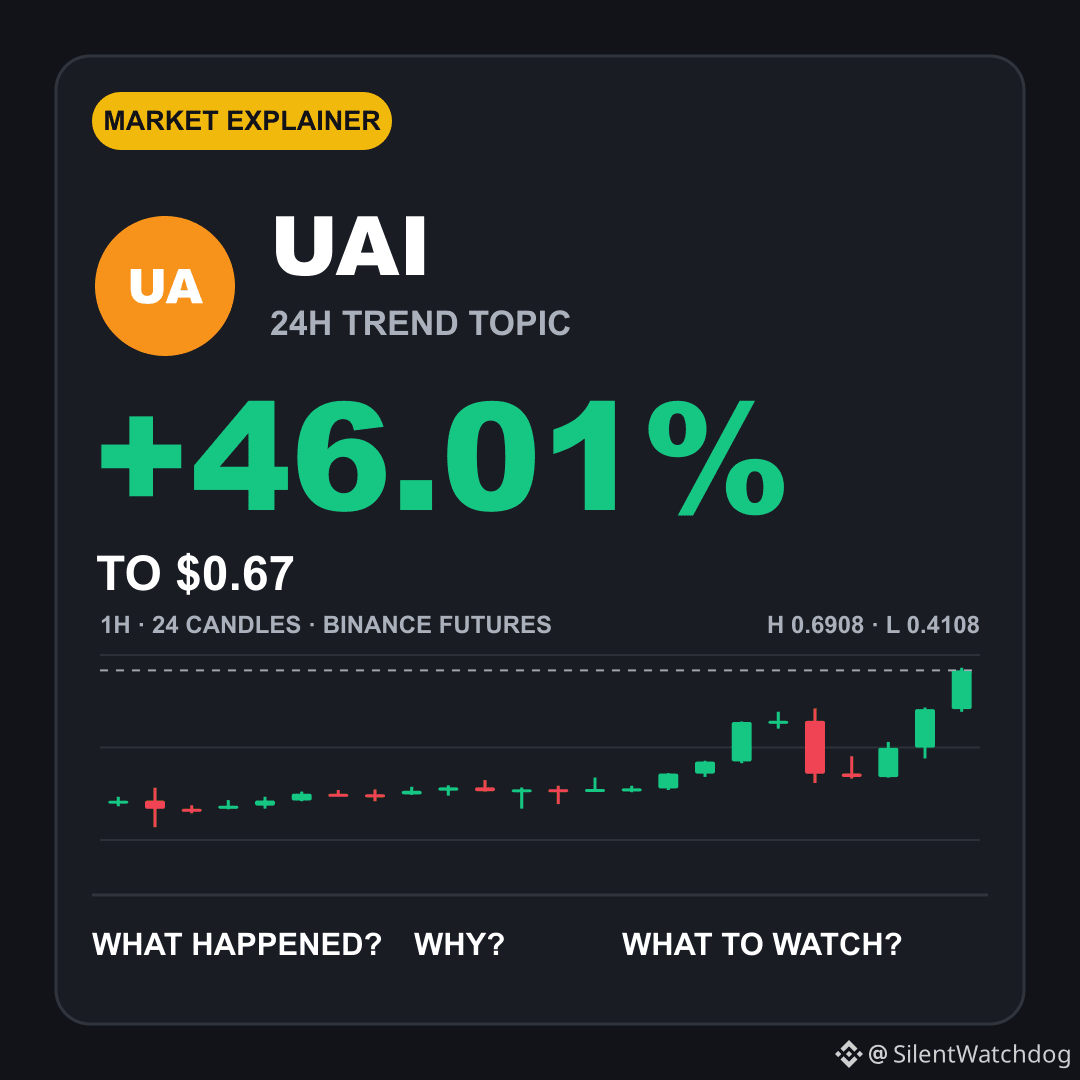
$UAI Today is interesting not only for its movement, but also for the paradox around it. According to Binance at the time of observation, UAIUSDT was up about 46% over 24 hours, the price was around 0.667 USDT, and the volume was more than 118 million USDT.
UnifAI Network is AI infrastructure for DeFi: put simply, the project promises tools where AI agents help with trading and financial strategies. In the documentation, $UAI is needed to access services, staking, and voting.
But there is no visible public fresh official announcement that directly explains this exact surge. For the market, this means one thing: right now it is more important not to look for a "secret news" item, but to watch whether a verified catalyst appears after the move. In such a situation, would you lock in the momentum or wait for an official explanation?
$UAI Today is interesting not only for its movement, but also for the paradox around it. According to Binance at the time of observation, UAIUSDT was up about 46% over 24 hours, the price was around 0.667 USDT, and the volume was more than 118 million USDT.
UnifAI Network is AI infrastructure for DeFi: put simply, the project promises tools where AI agents help with trading and financial strategies. In the documentation, $UAI is needed to access services, staking, and voting.
But there is no visible public fresh official announcement that directly explains this exact surge. For the market, this means one thing: right now it is more important not to look for a "secret news" item, but to watch whether a verified catalyst appears after the move. In such a situation, would you lock in the momentum or wait for an official explanation?
UnifAI Network is AI infrastructure for DeFi: put simply, the project promises tools where AI agents help with trading and financial strategies. In the documentation, $UAI is needed to access services, staking, and voting.
But there is no visible public fresh official announcement that directly explains this exact surge. For the market, this means one thing: right now it is more important not to look for a "secret news" item, but to watch whether a verified catalyst appears after the move. In such a situation, would you lock in the momentum or wait for an official explanation?
2
387
Verified
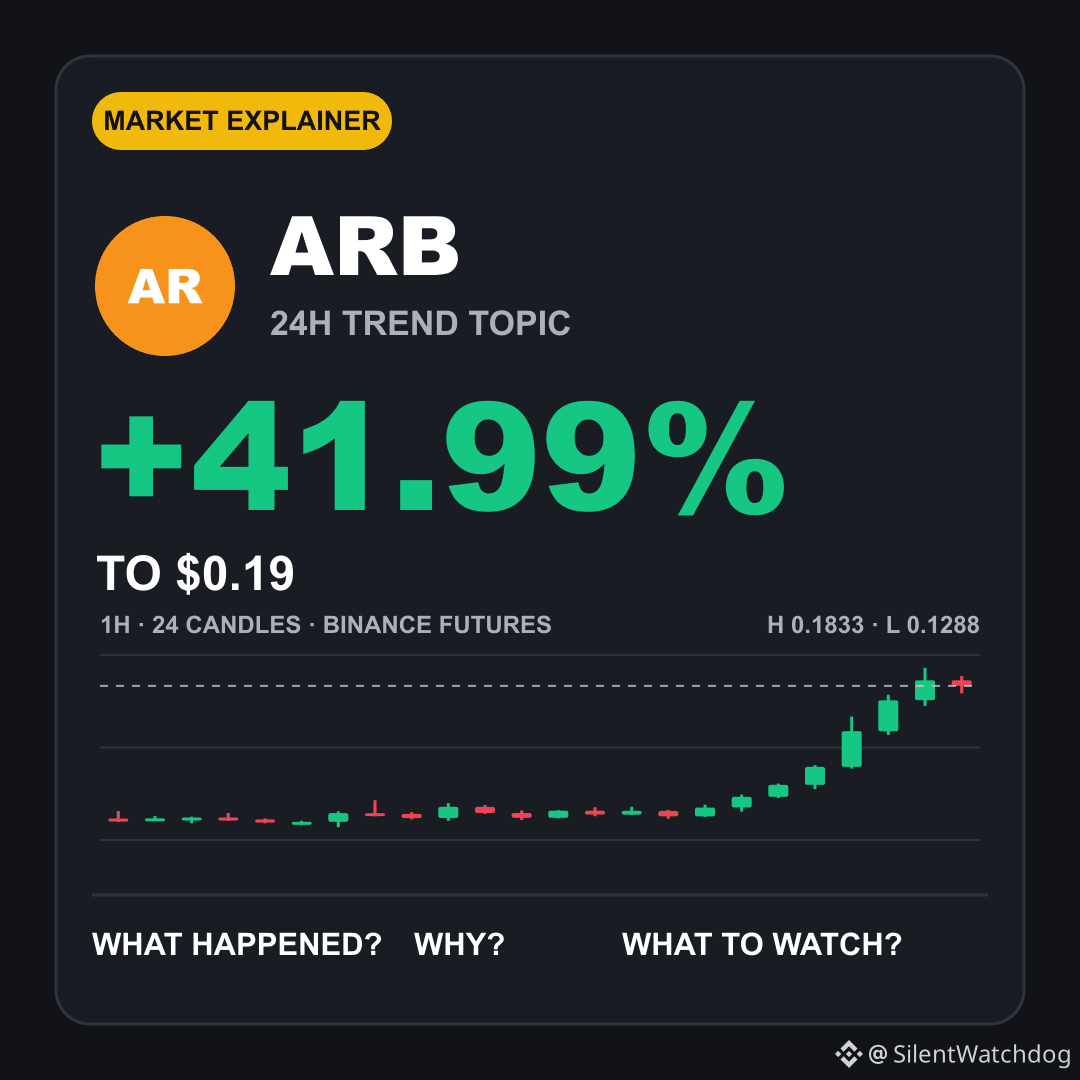
$ARB received not just a pump, but a new, clear story for the market. According to Binance at the time of observation, the token was trading around $0.187, up nearly 42% over 24 hours, and volume in the ARBUSDT pair exceeded approximately 335.6 million USDT.
On September 2, the Arbitrum Foundation reported $6.19 million in DAO revenue for H1 2026 and a 97% gross margin. At the same time, the market saw that Robinhood Chain — Robinhood’s separate blockchain built on Arbitrum technology — could bring part of the profits into the Arbitrum ecosystem.
The irony is that this cash flow goes into the DAO treasury, not directly to ARB holders. In other words, traders are effectively buying not a dividend, but a bet on the future value of the ecosystem. Do you think the market has fairly repriced ARB here, or has it already run ahead?
$ARB received not just a pump, but a new, clear story for the market. According to Binance at the time of observation, the token was trading around $0.187, up nearly 42% over 24 hours, and volume in the ARBUSDT pair exceeded approximately 335.6 million USDT.
On September 2, the Arbitrum Foundation reported $6.19 million in DAO revenue for H1 2026 and a 97% gross margin. At the same time, the market saw that Robinhood Chain — Robinhood’s separate blockchain built on Arbitrum technology — could bring part of the profits into the Arbitrum ecosystem.
The irony is that this cash flow goes into the DAO treasury, not directly to ARB holders. In other words, traders are effectively buying not a dividend, but a bet on the future value of the ecosystem. Do you think the market has fairly repriced ARB here, or has it already run ahead?
On September 2, the Arbitrum Foundation reported $6.19 million in DAO revenue for H1 2026 and a 97% gross margin. At the same time, the market saw that Robinhood Chain — Robinhood’s separate blockchain built on Arbitrum technology — could bring part of the profits into the Arbitrum ecosystem.
The irony is that this cash flow goes into the DAO treasury, not directly to ARB holders. In other words, traders are effectively buying not a dividend, but a bet on the future value of the ecosystem. Do you think the market has fairly repriced ARB here, or has it already run ahead?
3
1.1k
$SUSHI came back into the feed, not quietly. According to Binance at the time of observation, the token was trading at around $0.2655, up about 39% over 24 hours, and volume had already exceeded 82 million USDT.
The story here is more interesting than the pump itself: Sushi is a decentralized exchange for token swaps in DeFi, and the project is genuinely alive, because the official blog shows network launches and integrations. But at the time of checking, there was no sign of such a fresh official announcement for September 4-5, 2026 that would directly explain this move.
My take: the market is testing whether an old DeFi brand can attract attention again without a big piece of news. In a move like this, would you lock in profits right away or wait for confirmation from a new official release?
$SUSHI came back into the feed, not quietly. According to Binance at the time of observation, the token was trading at around $0.2655, up about 39% over 24 hours, and volume had already exceeded 82 million USDT.
The story here is more interesting than the pump itself: Sushi is a decentralized exchange for token swaps in DeFi, and the project is genuinely alive, because the official blog shows network launches and integrations. But at the time of checking, there was no sign of such a fresh official announcement for September 4-5, 2026 that would directly explain this move.
My take: the market is testing whether an old DeFi brand can attract attention again without a big piece of news. In a move like this, would you lock in profits right away or wait for confirmation from a new official release?
The story here is more interesting than the pump itself: Sushi is a decentralized exchange for token swaps in DeFi, and the project is genuinely alive, because the official blog shows network launches and integrations. But at the time of checking, there was no sign of such a fresh official announcement for September 4-5, 2026 that would directly explain this move.
My take: the market is testing whether an old DeFi brand can attract attention again without a big piece of news. In a move like this, would you lock in profits right away or wait for confirmation from a new official release?

2
461
Log in to explore more content
Join global crypto users on Binance Square
⚡️ Get latest and useful information about crypto.
💬 Trusted by the world’s largest crypto exchange.
👍 Discover real insights from verified creators.
Email / Phone number
Trending Topics
FedRateWatch
211,525 views
1,378 Discussing
Share & Win Traffic Reward in our Trending Hashtag Campaign
✨Topic: FOMC September, What's The Fed's Next Move?
👉How to Join:
Publish a short post or article with hashtag #FedRateWatch
Create content based on the below angles:
- August core CPI rose 0.3% month-over-month, and the odds of a 25bp hike this week are now close to 90%. Do you anticipate a rate hike this week? Is it a one-off, or the start of a longer hiking cycle?
- If the hike lands, how does it play out for BTC, tech stocks, and gold? Bullish or bearish?
- How are you planning to trade next? Share your BTC, stocks or gold trade/holdings with our trade sharing widget.
⏰Campaign Period:
- 2026-09-15 11:00 - 2026-09-17 3:00 UTC
🎁Reward:
- Qualified posts that comply with the above guidelines and contain more than 100 words will be reviewed and may receive a random traffic boost of 500 to 3,000 views. You will receive a notification from your feed secretary if your post is selected.
- Get a chance to have your article featured on Binance Square Official
Need ideas for your post? Visit the topic page #FedRateWatch or the Square Guide on How to Post for Better Reach.
Binance Square Official
·262 Likes
·444.7k views
BitcoinSlidesTo$76000
639 views
40 Discussing
BitcoinReboundsTo$79K
45,557 views
345 Discussing