

MALIK__ZADDA
2.7k Posts

MALIK__ZADDA
Report
Block User
THUG OF CRYPTOS
Open Trade
High-Frequency Trader
12.1 Months
318 Following
9.1K+ Followers
1.5K+ Liked
Posts
Portfolio
All
Quotes
Live
·
--
Bullish
$CAP /USDT is experiencing high upward traction, trading near 0.113901 following a +37.15% surge. Active buying volume is present—monitor support zones for trade continuation setups.
EP
0.1090–0.1145
TP
TP1 0.1220
TP2 0.1310
TP3 0.1420
SL
0.1010
$CAP #CryptoSignalsMake #Spot #Trading
{alpha}(560x99991c6aabba5a096f24f250b73580f5179b9999)
$CAP /USDT is experiencing high upward traction, trading near 0.113901 following a +37.15% surge. Active buying volume is present—monitor support zones for trade continuation setups.
EP
0.1090–0.1145
TP
TP1 0.1220
TP2 0.1310
TP3 0.1420
SL
0.1010
$CAP #CryptoSignalsMake #Spot #Trading
EP
0.1090–0.1145
TP
TP1 0.1220
TP2 0.1310
TP3 0.1420
SL
0.1010
$CAP #CryptoSignalsMake #Spot #Trading

483
·
--
$DN /USDT is moving upward steadily, trading around 0.01175 following a +26.2% gain. Monitor local demand levels for volume expansion toward higher target levels.
EP
0.01120–0.01180
TP
TP1 0.01260
TP2 0.01350
TP3 0.01470
SL
0.01040
$DN #CryptoSignals #Spot #Trading
$DN /USDT is moving upward steadily, trading around 0.01175 following a +26.2% gain. Monitor local demand levels for volume expansion toward higher target levels.
EP
0.01120–0.01180
TP
TP1 0.01260
TP2 0.01350
TP3 0.01470
SL
0.01040
$DN #CryptoSignals #Spot #Trading
EP
0.01120–0.01180
TP
TP1 0.01260
TP2 0.01350
TP3 0.01470
SL
0.01040
$DN #CryptoSignals #Spot #Trading

1
78
·
--
$SUP /USDT is gaining steady bullish traction, trading near 0.00026 after a +26.33% move up. Price action indicates solid interest—watch for a potential continuation push.
EP
0.000248–0.000262
TP
TP1 0.000282
TP2 0.000305
TP3 0.000335
SL
0.000232
$SUP #CryptoSignals #Spot #trading
$SUP /USDT is gaining steady bullish traction, trading near 0.00026 after a +26.33% move up. Price action indicates solid interest—watch for a potential continuation push.
EP
0.000248–0.000262
TP
TP1 0.000282
TP2 0.000305
TP3 0.000335
SL
0.000232
$SUP #CryptoSignals #Spot #trading
EP
0.000248–0.000262
TP
TP1 0.000282
TP2 0.000305
TP3 0.000335
SL
0.000232
$SUP #CryptoSignals #Spot #trading
89
·
--
Bullish
$BULLA USDT holds robust upward strength, up +24.20% to reach 0.09616 with active order flow. Higher-low structural patterns confirm that buyers are actively defending local pullbacks for further breakout targets.
EP
0.0855–0.0961
TP
TP1 0.1060
TP2 0.1180
TP3 0.1320
SL
0.0765
$BULLA #CryptoSignals #Spot #Trading
{future}(BULLAUSDT)
$BULLA USDT holds robust upward strength, up +24.20% to reach 0.09616 with active order flow. Higher-low structural patterns confirm that buyers are actively defending local pullbacks for further breakout targets.
EP
0.0855–0.0961
TP
TP1 0.1060
TP2 0.1180
TP3 0.1320
SL
0.0765
$BULLA #CryptoSignals #Spot #Trading
EP
0.0855–0.0961
TP
TP1 0.1060
TP2 0.1180
TP3 0.1320
SL
0.0765
$BULLA #CryptoSignals #Spot #Trading

222
·
--
$ALKIMIUSDT is moving upward steadily, up +32.31% at 0.0007456. Higher highs on lower timeframes point toward continuous buyer control and potential continuation.
EP
0.000680–0.000745
TP
TP1 0.000820
TP2 0.000910
TP3 0.001020
SL
0.000620
$ALKIMI#CryptoSignals #Spot #Trading
$ALKIMIUSDT is moving upward steadily, up +32.31% at 0.0007456. Higher highs on lower timeframes point toward continuous buyer control and potential continuation.
EP
0.000680–0.000745
TP
TP1 0.000820
TP2 0.000910
TP3 0.001020
SL
0.000620
$ALKIMI#CryptoSignals #Spot #Trading
EP
0.000680–0.000745
TP
TP1 0.000820
TP2 0.000910
TP3 0.001020
SL
0.000620
$ALKIMI#CryptoSignals #Spot #Trading
72
·
--
Bullish
$BTC is demonstrating strong upward momentum, climbing +1.37% to trade at 82,880.6 with a massive $1.66T market cap. Sustained capital inflow into top-tier assets indicates robust market confidence. Watch for breakout continuation above current consolidation ranges.
EP
81,500–83,000
TP
TP1 85,500
TP2 88,200
TP3 91,500
SL
79,800
$BTC
{spot}(BTCUSDT)
$BTC is demonstrating strong upward momentum, climbing +1.37% to trade at 82,880.6 with a massive $1.66T market cap. Sustained capital inflow into top-tier assets indicates robust market confidence. Watch for breakout continuation above current consolidation ranges.
EP
81,500–83,000
TP
TP1 85,500
TP2 88,200
TP3 91,500
SL
79,800
$BTC
EP
81,500–83,000
TP
TP1 85,500
TP2 88,200
TP3 91,500
SL
79,800
$BTC
50
·
--
Bullish
$ETH is showing healthy bullish expansion, up +0.92% to 2,433.75 backed by a $296.12B market cap. Steady demand around key structural supports keeps the mid-term trend firmly in favor of buyers. Look for volume confirmation on pullbacks.
EP
2,380.00–2,445.00
TP
TP1 2,545.00
TP2 2,660.00
TP3 2,810.00
SL
2,305.00
$ETH #cryptosignals
{spot}(ETHUSDT)
$ETH is showing healthy bullish expansion, up +0.92% to 2,433.75 backed by a $296.12B market cap. Steady demand around key structural supports keeps the mid-term trend firmly in favor of buyers. Look for volume confirmation on pullbacks.
EP
2,380.00–2,445.00
TP
TP1 2,545.00
TP2 2,660.00
TP3 2,810.00
SL
2,305.00
$ETH #cryptosignals
EP
2,380.00–2,445.00
TP
TP1 2,545.00
TP2 2,660.00
TP3 2,810.00
SL
2,305.00
$ETH #cryptosignals
40
·
--
Bullish
$BNB is maintaining steady upside pressure, advancing +1.01% to 728.103 with a $96.64B market capitalization. Price action reflects active market participation and solid defense at baseline support levels. Manage risk with disciplined stop-losses.
EP
715.00–730.00
TP
TP1 760.00
TP2 795.00
TP3 835.00
SL
695.00
$BNB
{spot}(BNBUSDT)
$BNB is maintaining steady upside pressure, advancing +1.01% to 728.103 with a $96.64B market capitalization. Price action reflects active market participation and solid defense at baseline support levels. Manage risk with disciplined stop-losses.
EP
715.00–730.00
TP
TP1 760.00
TP2 795.00
TP3 835.00
SL
695.00
$BNB
EP
715.00–730.00
TP
TP1 760.00
TP2 795.00
TP3 835.00
SL
695.00
$BNB
58
·
--
$XRP is exhibiting solid positive momentum, climbing +1.47% to 1.31558 supported by an $82.75B market cap. Order book depth suggests continuous accumulation by market participants ahead of key overhead resistance tests.
EP
1.2850–1.3200
TP
TP1 1.3850
TP2 1.4600
TP3 1.5500
SL
1.2400
$XRP #CryptoSignals #CryptoTrading
{spot}(XRPUSDT)
$XRP is exhibiting solid positive momentum, climbing +1.47% to 1.31558 supported by an $82.75B market cap. Order book depth suggests continuous accumulation by market participants ahead of key overhead resistance tests.
EP
1.2850–1.3200
TP
TP1 1.3850
TP2 1.4600
TP3 1.5500
SL
1.2400
$XRP #CryptoSignals #CryptoTrading
EP
1.2850–1.3200
TP
TP1 1.3850
TP2 1.4600
TP3 1.5500
SL
1.2400
$XRP #CryptoSignals #CryptoTrading
2
134
·
--
Bullish
$SOL is leading the major cap gainers with a +2.15% surge to 105.88, reflecting a $62.24B market cap. Strong buyer engagement and high relative volume point toward continued upside extension toward upper resistance barriers.
EP
103.00–106.20
TP
TP1 112.00
TP2 119.00
TP3 127.00
SL
99.50
$SOL #CryptoSignals #cryptotrading
{spot}(SOLUSDT)
$SOL is leading the major cap gainers with a +2.15% surge to 105.88, reflecting a $62.24B market cap. Strong buyer engagement and high relative volume point toward continued upside extension toward upper resistance barriers.
EP
103.00–106.20
TP
TP1 112.00
TP2 119.00
TP3 127.00
SL
99.50
$SOL #CryptoSignals #cryptotrading
EP
103.00–106.20
TP
TP1 112.00
TP2 119.00
TP3 127.00
SL
99.50
$SOL #CryptoSignals #cryptotrading
1
99
·
--
$GTC is picking up steady bullish traction, climbing +21.16% to 0.0079. A sustained holding above baseline demand will signal further upside expansion toward key profit targets.
EP
0.0075–0.00795
TP
TP1 0.0086
TP2 0.0094
TP3 0.0105
SL
0.0071
$GTC #CryptoSignals #cryptotrading
$GTC is picking up steady bullish traction, climbing +21.16% to 0.0079. A sustained holding above baseline demand will signal further upside expansion toward key profit targets.
EP
0.0075–0.00795
TP
TP1 0.0086
TP2 0.0094
TP3 0.0105
SL
0.0071
$GTC #CryptoSignals #cryptotrading
EP
0.0075–0.00795
TP
TP1 0.0086
TP2 0.0094
TP3 0.0105
SL
0.0071
$GTC #CryptoSignals #cryptotrading
159
·
--
$DNA is maintaining a strong bullish presence with a +34.28% gain, showing steady buyer support in current market ranges. Watch for volume continuation to test higher resistance barriers.
EP
0.2820–0.2890
TP
TP1 0.3050
TP2 0.3220
TP3 0.3450
SL
0.2710
$DNA #cryptosignals
$DNA is maintaining a strong bullish presence with a +34.28% gain, showing steady buyer support in current market ranges. Watch for volume continuation to test higher resistance barriers.
EP
0.2820–0.2890
TP
TP1 0.3050
TP2 0.3220
TP3 0.3450
SL
0.2710
$DNA #cryptosignals
EP
0.2820–0.2890
TP
TP1 0.3050
TP2 0.3220
TP3 0.3450
SL
0.2710
$DNA #cryptosignals

382
·
--
$CENT.US is experiencing a minor -3.9% pullback, consolidating near foundational support levels. Look for price stabilization and volume absorption before planning new setups.
EP
0.00212–0.00219
TP
TP1 0.00230
TP2 0.00248
TP3 0.00270
SL
0.00202
$CENT.US #cryptosignals
$CENT.US is experiencing a minor -3.9% pullback, consolidating near foundational support levels. Look for price stabilization and volume absorption before planning new setups.
EP
0.00212–0.00219
TP
TP1 0.00230
TP2 0.00248
TP3 0.00270
SL
0.00202
$CENT.US #cryptosignals
EP
0.00212–0.00219
TP
TP1 0.00230
TP2 0.00248
TP3 0.00270
SL
0.00202
$CENT.US #cryptosignals

CENTUS+0.03%
41
·
--
Bearish
$EVAA is holding steady with a minor -1.98% adjustment, remaining range-bound within a broader consolidation phase. Patience is key while waiting for a decisive breakout trigger.
EP
0.5700–0.5850
TP
TP1 0.6100
TP2 0.6450
TP3 0.6900
SL
0.5480
$EVAA #cryptosignals
{future}(EVAAUSDT)
$EVAA is holding steady with a minor -1.98% adjustment, remaining range-bound within a broader consolidation phase. Patience is key while waiting for a decisive breakout trigger.
EP
0.5700–0.5850
TP
TP1 0.6100
TP2 0.6450
TP3 0.6900
SL
0.5480
$EVAA #cryptosignals
EP
0.5700–0.5850
TP
TP1 0.6100
TP2 0.6450
TP3 0.6900
SL
0.5480
$EVAA #cryptosignals

788
·
--
Bullish
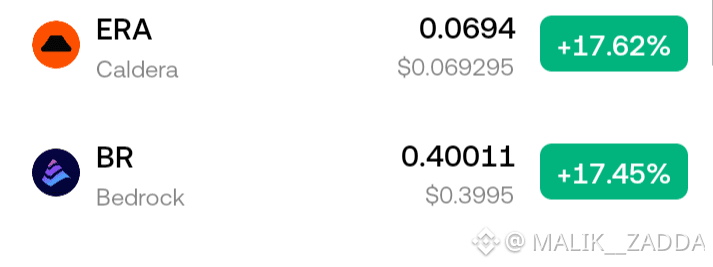
$ERA is showing solid bullish momentum, advancing +17.62% as buyers step in to drive the price higher into key expansion zones. Keep a close eye on resistance levels for continuation.
EP
0.0675–0.0698
TP
TP1 0.0745
TP2 0.0790
TP3 0.0850
SL
0.0645
$ERA #CryptoSignals
{spot}(ERAUSDT)
$ERA is showing solid bullish momentum, advancing +17.62% as buyers step in to drive the price higher into key expansion zones. Keep a close eye on resistance levels for continuation.
EP
0.0675–0.0698
TP
TP1 0.0745
TP2 0.0790
TP3 0.0850
SL
0.0645
$ERA #CryptoSignals
EP
0.0675–0.0698
TP
TP1 0.0745
TP2 0.0790
TP3 0.0850
SL
0.0645
$ERA #CryptoSignals


166
·
--
Bullish
$BR is maintaining steady upward progress, recording a +17.45% gain backed by active market participation. Manage risk properly with strict stop-loss discipline.
EP
0.3900–0.4020
TP
TP1 0.4300
TP2 0.4650
TP3 0.5050
SL
0.3720
$BR #cryptosignals
{future}(BRUSDT)
$BR is maintaining steady upward progress, recording a +17.45% gain backed by active market participation. Manage risk properly with strict stop-loss discipline.
EP
0.3900–0.4020
TP
TP1 0.4300
TP2 0.4650
TP3 0.5050
SL
0.3720
$BR #cryptosignals
EP
0.3900–0.4020
TP
TP1 0.4300
TP2 0.4650
TP3 0.5050
SL
0.3720
$BR #cryptosignals
175
·
--
Solana is experiencing a mild correction of 1.99%, currently trading around 103.75 with 20.91M volume. Price action is testing the lower boundaries of its recent range, which usually invites different perspectives from market watchers. Let's see how liquidity behaves around these levels.
$SOL
Solana is experiencing a mild correction of 1.99%, currently trading around 103.75 with 20.91M volume. Price action is testing the lower boundaries of its recent range, which usually invites different perspectives from market watchers. Let's see how liquidity behaves around these levels.
$SOL
$SOL
97
·
--
Solana is experiencing a mild correction of 1.99%, currently trading around 103.75 with 20.91M volume. Price action is testing the lower boundaries of its recent range, which usually invites different perspectives from market watchers. Let's see how liquidity behaves around these levels.
$SOL
Solana is experiencing a mild correction of 1.99%, currently trading around 103.75 with 20.91M volume. Price action is testing the lower boundaries of its recent range, which usually invites different perspectives from market watchers. Let's see how liquidity behaves around these levels.
$SOL
$SOL
123
·
--
#SolanaAlpenglowUpgradeToActivateOnOct21 #BitcoinShortTermHoldersReach4.08MBTC $WAL is under sharp downside pressure following a significant sell-off. Stabilization is essential before considering any long setups.
EP
0.0445–0.0456
TP
TP1 0.0485
TP2 0.0520
TP3 0.0560
SL
0.0420
Heavy distribution continues to impact price action. Wait for clear signs of buyer entry near local lows. Manage risk carefully.
$WAL
EP
0.0445–0.0456
TP
TP1 0.0485
TP2 0.0520
TP3 0.0560
SL
0.0420
Heavy distribution continues to impact price action. Wait for clear signs of buyer entry near local lows. Manage risk carefully.
$WAL
322
·
--

Article
Newton’s Hardest Mainnet Test May Be Approving the Right Vault Action Before It Is Too LateLate yesterday, I was moving between Newton Protocol’s VaultKit documentation and an old stablecoin depeg chart. I was not looking for a new angle. I only wanted to understand what happens after a vault curator proposes an action.
At first, the flow looked straightforward.
The curator prepares a transaction. Newton’s operators check it against the vault’s policy. If the action breaks the rules, it is rejected before it reaches the vault.
That part made immediate sense to me. A vault manager should not be able to promise depositors one strategy and quietly take completely different risks later.
Then I reached the part that changed how I saw the whole system.
VaultKit can also stop the transaction when operators do not reach quorum, when the approval expires, or when the onchain Shield cannot verify it. The policy does not need to say that the action is dangerous. If Newton cannot produce a valid approval, the transaction still does not move.
I paused there because I have seen how quickly a normal market can become an emergency. Liquidity can disappear in minutes. A stablecoin can begin slipping from its peg while everyone is still arguing about whether the move is temporary. A lending protocol can look healthy in the morning and become a serious exposure before the day ends.
In those moments, a curator may need to reduce risk immediately.
But with VaultKit, the curator cannot simply press a button and move the funds. The action becomes an intent. The Gateway sends it for evaluation. Operators check the policy and any required data. Their signatures must be collected. An attestation must be created. The Shield must verify it. Only then can the action reach the vault.
I could see the benefit. Every step makes it harder for a curator to ignore the rules when following them becomes uncomfortable.
The depositor is no longer relying only on the manager’s reputation. The restriction follows the transaction itself.
But every required step also becomes something that must work before the market moves further.
That is where Newton’s security question becomes more difficult than it first appears.
Suppose a curator is trying to exit a weakening position, but an external data source becomes unavailable. Operators fail to agree in time. The attestation expires. The action may be completely reasonable, yet the vault remains exposed because the authorization process could not finish.
An unavailable decision is no longer just a technical delay. It can become a financial event.
I do not think Newton should simply allow the curator to bypass the system. That would make the policy meaningless. Any manager could call a difficult situation an emergency and recover the same unchecked power VaultKit was designed to remove.
Newton’s public, time-delayed escape path makes sense for exactly that reason. Depositors should be able to see that the normal controls are being changed instead of discovering it after the money has moved.
Still, the design does not remove risk. It moves it.
Some risk leaves the curator’s private key and personal judgment. It enters policy design, data availability, Gateway performance, operator response, quorum formation, approval timing and emergency governance.
Newton’s mainnet beta shows that this vault authorization path is now more than a concept. What the public evidence still does not show clearly is how well the full process performs when markets are moving fast and several parts of the system are under pressure at the same time.
That is what I would watch now.
Not only how many bad transactions Newton rejects, but how often legitimate actions complete, how long approvals take during volatility, how often quorum fails, and whether attestations expire before a curator can protect the vault.
A strong security system must know when to say no.
In a live financial market, it must also be able to say yes before the right decision becomes too late.
@NewtonProtocol $NEWT #newt
Newton’s Hardest Mainnet Test May Be Approving the Right Vault Action Before It Is Too Late
Late yesterday, I was moving between Newton Protocol’s VaultKit documentation and an old stablecoin depeg chart. I was not looking for a new angle. I only wanted to understand what happens after a vault curator proposes an action.
At first, the flow looked straightforward.
The curator prepares a transaction. Newton’s operators check it against the vault’s policy. If the action breaks the rules, it is rejected before it reaches the vault.
That part made immediate sense to me. A vault manager should not be able to promise depositors one strategy and quietly take completely different risks later.
Then I reached the part that changed how I saw the whole system.
VaultKit can also stop the transaction when operators do not reach quorum, when the approval expires, or when the onchain Shield cannot verify it. The policy does not need to say that the action is dangerous. If Newton cannot produce a valid approval, the transaction still does not move.
I paused there because I have seen how quickly a normal market can become an emergency. Liquidity can disappear in minutes. A stablecoin can begin slipping from its peg while everyone is still arguing about whether the move is temporary. A lending protocol can look healthy in the morning and become a serious exposure before the day ends.
In those moments, a curator may need to reduce risk immediately.
But with VaultKit, the curator cannot simply press a button and move the funds. The action becomes an intent. The Gateway sends it for evaluation. Operators check the policy and any required data. Their signatures must be collected. An attestation must be created. The Shield must verify it. Only then can the action reach the vault.
I could see the benefit. Every step makes it harder for a curator to ignore the rules when following them becomes uncomfortable.
The depositor is no longer relying only on the manager’s reputation. The restriction follows the transaction itself.
But every required step also becomes something that must work before the market moves further.
That is where Newton’s security question becomes more difficult than it first appears.
Suppose a curator is trying to exit a weakening position, but an external data source becomes unavailable. Operators fail to agree in time. The attestation expires. The action may be completely reasonable, yet the vault remains exposed because the authorization process could not finish.
An unavailable decision is no longer just a technical delay. It can become a financial event.
I do not think Newton should simply allow the curator to bypass the system. That would make the policy meaningless. Any manager could call a difficult situation an emergency and recover the same unchecked power VaultKit was designed to remove.
Newton’s public, time-delayed escape path makes sense for exactly that reason. Depositors should be able to see that the normal controls are being changed instead of discovering it after the money has moved.
Still, the design does not remove risk. It moves it.
Some risk leaves the curator’s private key and personal judgment. It enters policy design, data availability, Gateway performance, operator response, quorum formation, approval timing and emergency governance.
Newton’s mainnet beta shows that this vault authorization path is now more than a concept. What the public evidence still does not show clearly is how well the full process performs when markets are moving fast and several parts of the system are under pressure at the same time.
That is what I would watch now.
Not only how many bad transactions Newton rejects, but how often legitimate actions complete, how long approvals take during volatility, how often quorum fails, and whether attestations expire before a curator can protect the vault.
A strong security system must know when to say no.
In a live financial market, it must also be able to say yes before the right decision becomes too late.
@NewtonProtocol $NEWT #newt
7
1
224
Log in to explore more content
Join global crypto users on Binance Square
⚡️ Get latest and useful information about crypto.
💬 Trusted by the world’s largest crypto exchange.
👍 Discover real insights from verified creators.
Email / Phone number