
Nebrythalis
29 Posts

Nebrythalis
Report
Block User
Independent Quantitative Trader
Frequent Trader
5.4 Years
18 Following
18 Followers
60 Liked
Posts
All
Quotes
PINNED
·
--
Bearish
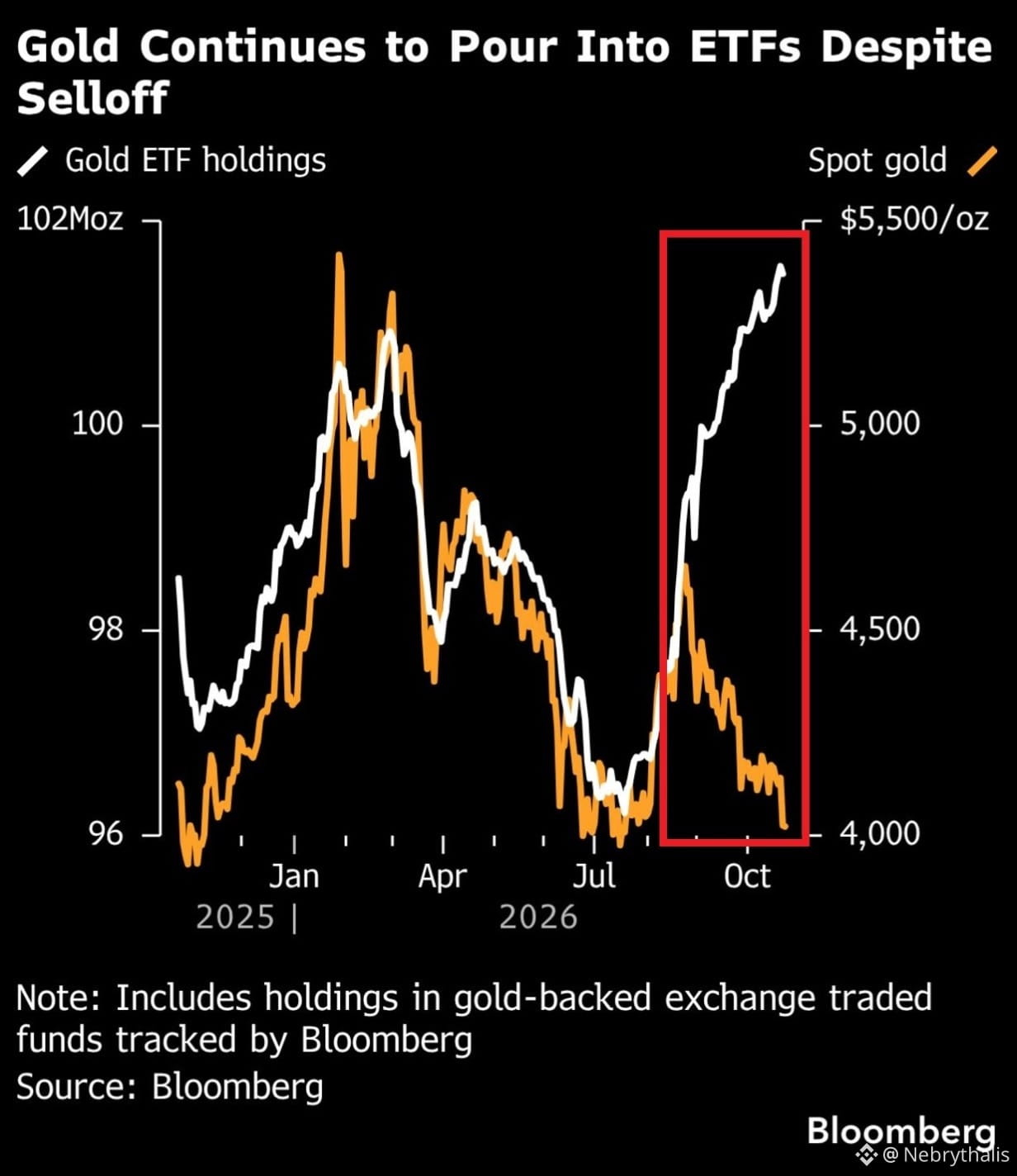
$XAU $XAUT | THE 3,818.50 PRICE TEST
The 3,818.50 level is an important reference in my previous outlook. However, reaching this level does not automatically confirm further downside.
Here's what matters:
1. Bearish continuation
A decisive candle close below 3,818.50, followed by a failed attempt to reclaim the level, could indicate further downside pressure.
2. Potential recovery
If buyers defend the area and price closes back above 3,818.50, a short-term recovery becomes a scenario worth monitoring.
3. No confirmation
If price moves sideways around this level, patience remains the better approach.
My strategy: Watch the reaction, wait for confirmation, and manage risk.
One level. Two possible scenarios. No forced predictions.
What do you expect next?
Share your reasoning below.
#CrashGold2026 #ETFGOLD
$XAU $XAUT | THE 3,818.50 PRICE TEST
The 3,818.50 level is an important reference in my previous outlook. However, reaching this level does not automatically confirm further downside.
Here's what matters:
1. Bearish continuation
A decisive candle close below 3,818.50, followed by a failed attempt to reclaim the level, could indicate further downside pressure.
2. Potential recovery
If buyers defend the area and price closes back above 3,818.50, a short-term recovery becomes a scenario worth monitoring.
3. No confirmation
If price moves sideways around this level, patience remains the better approach.
My strategy: Watch the reaction, wait for confirmation, and manage risk.
One level. Two possible scenarios. No forced predictions.
What do you expect next?
Share your reasoning below.
#CrashGold2026 #ETFGOLD
The 3,818.50 level is an important reference in my previous outlook. However, reaching this level does not automatically confirm further downside.
Here's what matters:
1. Bearish continuation
A decisive candle close below 3,818.50, followed by a failed attempt to reclaim the level, could indicate further downside pressure.
2. Potential recovery
If buyers defend the area and price closes back above 3,818.50, a short-term recovery becomes a scenario worth monitoring.
3. No confirmation
If price moves sideways around this level, patience remains the better approach.
My strategy: Watch the reaction, wait for confirmation, and manage risk.
One level. Two possible scenarios. No forced predictions.
What do you expect next?
Share your reasoning below.
#CrashGold2026 #ETFGOLD
A. Bullish recovery
B. Bearish continuation
C. SlapCZ 😂
5 day(s) left
2
2.3k
PINNED
·
--
Close 😁
Close 😁
Nebrythalis
·
--
Where is $BTC heading next?
Cast your vote before the next big move! 📉📈
#EarningsSeason #BinancePick
1
1
·
--
Close 😁
Close 😁
Nebrythalis
·
--
Gold is heating up! 🟡 Where is $XAUT heading next?
Cast your vote and share your target! 👇
#BinancePick #EarningsSeason
Cast your vote and share your target! 👇
#BinancePick #EarningsSeason
1
1
·
--
Article
Gold Is Falling. The US Economy Isn't.Gold has had an extraordinary run. But the reversal is becoming just as difficult to ignore.
And this time, it is not just gold.
Silver, platinum and palladium have also pulled back sharply from their highs. The correction is spreading across the precious-metals market.
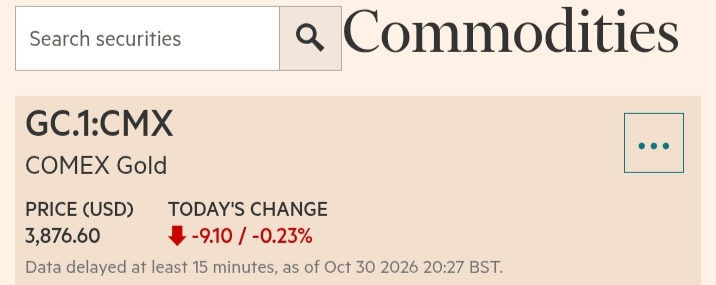
On October 30, COMEX gold closed at $3,876.60 per ounce, losing $141.10, or 3.51%, in a single session. It nearly finished at its intraday low.
But here is where things get interesting.
The US economy is still growing.
According to the BEA's advance estimate, real GDP grew at an annualised rate of 3.4% in Q3 2026, compared with 2.2% in Q2.
Private domestic demand was even stronger, with real final sales to private domestic purchasers rising 4.9%.
So why is gold struggling?
One possible explanation is that markets are reassessing how quickly the Federal Reserve can ease monetary policy.
Stronger economic growth can keep interest rates higher for longer. Higher real yields and a stronger dollar would make holding gold less attractive, particularly when investors have plenty of reasons to take profits after such a massive rally.
But I wouldn't reduce the entire sell-off to interest rates.
The simultaneous decline across precious metals suggests something else may be happening too: investors could be unwinding crowded positions after an exceptionally strong run.
And that raises a bigger question.
Gold remains an important reserve asset. Central-bank buying, geopolitical risks and diversification away from traditional reserve currencies have not suddenly become irrelevant.
But a strong long-term investment case does not guarantee that the price cannot get ahead of itself.
An asset can have solid fundamentals and still become a crowded trade.
For now, I'd be watching real yields, the US dollar, gold ETF flows and speculative positioning.
The interesting part isn't simply that gold is falling.
It's finding out what is actually driving the decline — and whether the market is correcting an overheated rally or beginning to price a different macro environment.
$XAU $XAUT
#Gold #PreciousMetals #Macroeconomics #FinancialMarkets #MarketAnalysis
Gold Is Falling. The US Economy Isn't.
Gold has had an extraordinary run. But the reversal is becoming just as difficult to ignore.
And this time, it is not just gold.
Silver, platinum and palladium have also pulled back sharply from their highs. The correction is spreading across the precious-metals market.
On October 30, COMEX gold closed at $3,876.60 per ounce, losing $141.10, or 3.51%, in a single session. It nearly finished at its intraday low.
But here is where things get interesting.
The US economy is still growing.
According to the BEA's advance estimate, real GDP grew at an annualised rate of 3.4% in Q3 2026, compared with 2.2% in Q2.
Private domestic demand was even stronger, with real final sales to private domestic purchasers rising 4.9%.
So why is gold struggling?
One possible explanation is that markets are reassessing how quickly the Federal Reserve can ease monetary policy.
Stronger economic growth can keep interest rates higher for longer. Higher real yields and a stronger dollar would make holding gold less attractive, particularly when investors have plenty of reasons to take profits after such a massive rally.
But I wouldn't reduce the entire sell-off to interest rates.
The simultaneous decline across precious metals suggests something else may be happening too: investors could be unwinding crowded positions after an exceptionally strong run.
And that raises a bigger question.
Gold remains an important reserve asset. Central-bank buying, geopolitical risks and diversification away from traditional reserve currencies have not suddenly become irrelevant.
But a strong long-term investment case does not guarantee that the price cannot get ahead of itself.
An asset can have solid fundamentals and still become a crowded trade.
For now, I'd be watching real yields, the US dollar, gold ETF flows and speculative positioning.
The interesting part isn't simply that gold is falling.
It's finding out what is actually driving the decline — and whether the market is correcting an overheated rally or beginning to price a different macro environment.
$XAU $XAUT
#Gold #PreciousMetals #Macroeconomics #FinancialMarkets #MarketAnalysis
And this time, it is not just gold.
Silver, platinum and palladium have also pulled back sharply from their highs. The correction is spreading across the precious-metals market.
On October 30, COMEX gold closed at $3,876.60 per ounce, losing $141.10, or 3.51%, in a single session. It nearly finished at its intraday low.
But here is where things get interesting.
The US economy is still growing.
According to the BEA's advance estimate, real GDP grew at an annualised rate of 3.4% in Q3 2026, compared with 2.2% in Q2.
Private domestic demand was even stronger, with real final sales to private domestic purchasers rising 4.9%.
So why is gold struggling?
One possible explanation is that markets are reassessing how quickly the Federal Reserve can ease monetary policy.
Stronger economic growth can keep interest rates higher for longer. Higher real yields and a stronger dollar would make holding gold less attractive, particularly when investors have plenty of reasons to take profits after such a massive rally.
But I wouldn't reduce the entire sell-off to interest rates.
The simultaneous decline across precious metals suggests something else may be happening too: investors could be unwinding crowded positions after an exceptionally strong run.
And that raises a bigger question.
Gold remains an important reserve asset. Central-bank buying, geopolitical risks and diversification away from traditional reserve currencies have not suddenly become irrelevant.
But a strong long-term investment case does not guarantee that the price cannot get ahead of itself.
An asset can have solid fundamentals and still become a crowded trade.
For now, I'd be watching real yields, the US dollar, gold ETF flows and speculative positioning.
The interesting part isn't simply that gold is falling.
It's finding out what is actually driving the decline — and whether the market is correcting an overheated rally or beginning to price a different macro environment.
$XAU $XAUT
#Gold #PreciousMetals #Macroeconomics #FinancialMarkets #MarketAnalysis
1
297
·
--

Article
BINANCE'S $6.3B BREACH: WHAT REALLY WENT WRONGTHE $6.3 BILLION BINANCE BREACH: HOW A COMPROMISED INTERNAL SIGNING INFRASTRUCTURE EXPOSED A CRITICAL FAILURE IN EXCHANGE SECURITY
PART II — Attack Mechanics, Root-Cause Analysis, North Korean Attribution, Asset Replenishment, and the Future of Centralized Exchange Security
Research Cut-Off: November 1, 2026
1. The Real Story Behind the $6.3 Billion Outflow
The October 29, 2026 security incident involving Binance has raised fundamental questions about the security architecture of centralized cryptocurrency exchanges.
Approximately $6.3 billion in digital assets moved out of Binance-controlled hot wallets during a coordinated operation spanning multiple blockchain networks. The incident was not simply a conventional cryptocurrency theft involving a stolen private key. The available evidence points to something considerably more concerning: unauthorized transactions were executed using Binance's own transaction authorization infrastructure.
According to TRM Labs, approximately $6.36 billion moved from Binance-attributed wallets across ten blockchain networks, with most of the transfers occurring within approximately 20 minutes beginning at 20:05 UTC on October 29.
Separately, Bitquery identified approximately $6.3 billion in outflows from 17 Binance hot wallets across nine networks between 20:04 and 23:56 UTC.
These figures come from independent blockchain investigations with different network coverage and methodologies. They should not be added together or treated as two separate losses.
The central issue is not merely the amount of cryptocurrency transferred.
It is how transactions that were validly signed by Binance-controlled wallets could nevertheless be unauthorized from the institution's perspective.
This distinction exposes a critical difference between cryptographic validity and operational legitimacy.
A blockchain can confirm that a transaction carries a valid signature. It cannot independently determine whether the institution's internal policies, authorization procedures, or intended business operations legitimately approved that transaction.
That distinction sits at the center of this incident.
2. Initial Compromise: How an Engineering Environment May Have Become an Entry Point
Binance's preliminary investigation initially pointed toward a potentially compromised DevOps engineer's laptop.
According to statements attributed to Binance co-CEO Richard Teng, the attack involved a compromised engineering device and malicious software designed to erase evidence of its activity, making forensic investigation more difficult.
Binance also indicated that investigators had identified additional points of compromise.
The company said it had found no evidence of wallet private-key leakage in its initial investigation.
This is an important distinction.
A DevOps engineer's workstation is not necessarily a financial transaction system. However, engineering environments often interact with sensitive internal infrastructure, including deployment tools, authentication services, operational dashboards, and systems responsible for executing production workloads.
If an attacker obtains access to sufficiently privileged credentials, sessions, or internal services, that access can potentially become a pathway toward systems that control financial operations.
The question is therefore not simply whether an employee's computer was compromised.
The more important question is how that compromise translated into the ability to initiate unauthorized withdrawals.
Several possibilities require investigation:
First, whether the attacker obtained access to privileged credentials or authentication sessions.
Second, whether internal withdrawal services trusted requests that should have undergone additional independent verification.
Third, whether access controls adequately separated engineering operations from financial transaction authorization.
Fourth, whether existing monitoring systems could distinguish legitimate operational requests from maliciously constructed transactions.
These are critical areas of investigation, but the publicly available evidence does not yet establish the complete sequence.
The distinction between an initial access point and the actual mechanism of financial compromise must be preserved.
A compromised laptop may explain how an attacker entered an environment. It does not automatically explain every subsequent action that enabled billions of dollars in assets to leave multiple hot wallets.
3. The Technical Mechanism: EIP-7702 and the Ethereum Hot Wallet
One of the most technically significant elements of the attack involved Ethereum's EIP-7702 mechanism.
TRM Labs identified a delegation involving 50 pre-signed authorizations.
To understand its significance, EIP-7702 must first be understood correctly.
EIP-7702 is an Ethereum protocol standard that allows an externally owned account, traditionally controlled directly by a private key, to delegate its execution behavior to code associated with a smart contract.
The mechanism was introduced to support more flexible account functionality, including transaction batching and improved user experiences.
It is not inherently a security vulnerability.
However, the security implications become significant when an account authorizes code that its owner or operator did not intend to trust.
In the Binance incident, TRM's investigation found that an attacker used EIP-7702 delegation to turn a Binance Ethereum hot wallet into a sweeper controlled by attacker-associated smart-contract logic.
A sweeper is designed to transfer assets from an account to another destination under specified execution conditions.
The preparation of 50 authorizations was particularly important.
Ethereum accounts maintain a transaction counter known as a nonce. An authorization is valid only under the corresponding nonce conditions.
By preparing 50 authorizations covering consecutive nonce values, the attacker increased the probability that at least one authorization would remain valid when submitted.
According to TRM's reconstruction, one authorization matched the wallet's nonce and allowed the delegation to execute.
The resulting smart-contract logic could then move assets from the Binance hot wallet.
Bitquery's independent investigation identified the main Ethereum hot wallet as a central component of the operation.
Its analysis found that approximately 167,464 ETH, 1.615 billion USDT, and dozens of other tokens were transferred in the initial major transaction.
The delegation remained active and enabled subsequent transfers as additional assets reached the wallet.
This is particularly concerning because the incident did not require the Ethereum network itself to be compromised.
The protocol executed the authorization according to its rules.
The security question concerns why an authorization that enabled attacker-controlled execution was signed and accepted by the exchange's infrastructure.
EIP-7702 was the mechanism used in the Ethereum portion of the attack, not proof that Ethereum itself was hacked.
4. Why the Incident Cannot Be Explained by EIP-7702 Alone
Perhaps the most important evidence comes from the other affected blockchain networks.
TRM Labs identified activity across nine additional networks beyond Ethereum.
These included Bitcoin, TRON, Solana, XRP Ledger, and several Ethereum-compatible networks.
Unlike the Ethereum operation, these transfers primarily involved ordinary signed transactions.
Bitquery's investigation found that the affected wallet transfers carried valid signatures produced through Binance-controlled infrastructure.
Its analysis identified ordinary signed transfers from 16 of the 17 hot wallets, with the Ethereum delegation mechanism accounting for the distinctive behavior of the main Ethereum wallet.
This is a critical technical distinction.
If EIP-7702 were the sole vulnerability, it would not explain why multiple other blockchain networks experienced unauthorized transfers during the same coordinated operation.
The broader evidence instead points toward a possible compromise of the exchange's internal signing and transaction authorization infrastructure.
TRM Labs reached a similar assessment, arguing that the attacker most likely obtained the ability to make Binance's hot-wallet signing systems authorize transactions of its choosing across different chains.
However, this remains an analytical assessment rather than a completed forensic conclusion.
Bitquery makes another important limitation explicit: blockchain records establish that the transfers were signed, but they cannot independently reveal which internal user, service, or process requested the signatures or how that request was obtained.
This is where the investigation must move beyond blockchain analysis.
The transaction records show what happened on-chain.
They do not reveal the complete internal sequence that caused the exchange's systems to approve the transactions.
5. North Korean Attribution: The TraderTraitor Investigation
On October 31, 2026, the Federal Bureau of Investigation publicly attributed the theft to North Korea.
The FBI identified the operation as TraderTraitor, a North Korean state-linked malicious cyber operation.
The announcement represented a major development because the attribution was no longer based solely on blockchain intelligence firms.
TRM Labs had previously reached a similar conclusion, citing on-chain and off-chain intelligence and expressing high confidence in its attribution.
The FBI also reported that investigators had observed TraderTraitor actors converting stolen assets primarily into Ethereum.
It warned that further laundering through decentralized finance platforms and instant-swap services was expected.
This pattern is consistent with the broader challenge of investigating sophisticated cryptocurrency theft.
The initial transfer is only the beginning.
Attackers must subsequently manage the stolen assets, move them across addresses, convert between different cryptocurrencies, and seek liquidity without exposing themselves to freezing mechanisms or law-enforcement intervention.
Nevertheless, attribution requires careful qualification.
Reuters reported on November 1 that US President Donald Trump had publicly stated that the United States was not yet certain whether North Korea was involved.
This creates an important distinction between the FBI's formal public attribution and the president's separate public statement.
The available reporting does not fully explain the difference between those positions.
Therefore, the responsible conclusion is that the FBI has officially attributed the operation to TraderTraitor, while the broader US government's public position has not been expressed as a completely unified assessment.
Attribution is important, but it does not replace the technical investigation into how the exchange's infrastructure was compromised.
Identifying the suspected attacker and explaining the exact mechanism of the breach are two separate investigative objectives.
6. Asset Tracing: What Was Frozen and What Remained Under Attacker Control?
Following the theft, blockchain analytics companies, stablecoin issuers, and other industry participants moved to identify and restrict the stolen assets.
TRM Labs estimated that approximately $2.7 billion in assets had been frozen or rescued through the combined efforts of relevant issuers and blockchain infrastructure participants.
Bitquery reported a similar figure through its independent on-chain investigation.
Circle froze approximately $823 million in USDC associated with the incident.
Tether also froze substantial quantities of USDT.
Additional intervention involved other token issuers and Arbitrum's Security Council, which took action involving assets on its network.
These actions demonstrate an important characteristic of the cryptocurrency ecosystem.
Although public blockchains are generally designed to operate without a central transaction authority, certain token issuers retain administrative capabilities that allow them to freeze specific addresses.
This creates opportunities for rapid intervention when stolen assets remain in tokens subject to issuer controls.
However, the situation becomes more complicated when attackers convert stablecoins into assets without equivalent issuer-level freezing mechanisms.
TRM's investigation documented attempts to convert stolen USDT into other assets and obtain liquidity through market makers and decentralized finance infrastructure, including Aave.
Bitquery also tracked approximately $729 million in stolen USDT that had been converted into ETH and TRX before relevant freezes took effect.
According to Bitquery's October 31 snapshot, approximately $3.1 billion remained under attacker control at 16:51 UTC.
This was a time-specific estimate, not a definitive assessment of Binance's final unrecovered loss.
Three concepts must therefore remain separate:
Frozen assets: Cryptocurrency that an issuer or relevant network authority has restricted.
Recovered assets: Cryptocurrency that has actually been returned to the victim or otherwise placed back under authorized control.
Unrecovered assets: Cryptocurrency that remains outside the victim's control at the relevant observation time.
A frozen wallet does not automatically mean that the funds have been returned.
Likewise, assets remaining in attacker-controlled wallets do not necessarily represent a finalized financial loss if subsequent recovery remains possible.
This distinction is essential for evaluating the true financial consequences of the incident.
7. Binance's Recovery: From 90% to 95% Asset Replenishment
By October 31, Binance announced that it had replenished approximately 90% of the affected asset value.
The company said it had allocated more than $6.34 billion to cover the incident using a combination of internal funding resources.
These included a portion of its Secure Asset Fund for Users, or SAFU, part of its Futures Insurance Fund, and corporate treasury resources.
The company also committed to restoring SAFU to approximately $1 billion.
However, the situation developed further on November 1.
In its fourth recovery update, Binance reported that approximately 95% of the affected assets had been replenished.
Reuters reported that Binance had covered approximately $6 billion of the approximately $6.3 billion stolen through the purchase of replacement tokens.
The remaining 5% consisted of less-liquid assets that could take longer to acquire in sufficient quantities.
This development represents substantial progress in financial recovery.
However, it is essential to understand what replenishment actually means.
When Binance purchases replacement tokens using its own resources, it restores the corresponding asset coverage.
That does not mean the original stolen cryptocurrency has been recovered.
For example, if an exchange loses 100 units of a particular asset and purchases another 100 units using corporate funds, its asset position may be restored without the original stolen units ever returning.
This is the distinction between financial replenishment and asset recovery.
Binance's reported 95% figure should therefore be understood as the company's stated replenishment progress, not proof that 95% of the original stolen coins have been retrieved from the attacker.
The company has stated that users will not bear the financial impact of the incident.
The remaining replenishment will depend on its ability to source less-liquid tokens through market purchases and over-the-counter transactions.
8. Withdrawal Resumption: An Important Operational Milestone, Not the End of the Investigation
Another important development occurred on November 1.
Binance began restoring withdrawal services through a phased reopening process.
According to its fourth official recovery update, the initial phase covered 15 networks with selected cryptocurrency assets.
These included Bitcoin, Ethereum, BNB Smart Chain, TRON, Solana, XRP Ledger, Polygon, Avalanche C-Chain, Arbitrum, Base, Optimism, Sui, and other supported environments.
Reuters subsequently reported that Bitcoin withdrawals had resumed, with additional assets and networks following through the phased rollout.
The decision to restore withdrawals is significant.
It indicates that Binance had completed enough operational assessments to begin returning selected services to users.
However, the phased approach also highlights that reopening financial infrastructure requires more than simply replacing the stolen assets.
Binance stated that its teams had conducted enhanced security reviews, assessed withdrawal infrastructure, verified affected services, and continued monitoring for residual risks.
This is the correct direction for incident response.
But a withdrawal reopening announcement should not be confused with a completed security investigation.
The market still requires a detailed explanation of the technical vulnerabilities, the exact scope of internal compromise, and the security reforms implemented afterward.
Until those details are independently assessable, the long-term effectiveness of the remediation process cannot be fully evaluated.
9. The Institutional Lesson: Proof of Reserves Does Not Equal Proof of Security
The Binance incident also highlights a fundamental limitation in how cryptocurrency exchanges communicate financial security.
Proof of Reserves is an important transparency mechanism.
It helps users assess whether an exchange holds the assets required to support reported customer balances, subject to the scope and methodology of the specific proof.
Nevertheless, Proof of Reserves and operational cybersecurity measure different dimensions of institutional risk.
A successful reserve verification does not demonstrate that an exchange's internal signing infrastructure is secure.
It does not independently establish that employee credentials cannot be compromised.
It does not prove that internal withdrawal services cannot be manipulated.
And it does not guarantee that transaction authorization policies will prevent malicious activity.
Binance announced a new Proof of Reserves snapshot dated October 31 and stated that a full zero-knowledge proof would take additional computational time to generate.
The distinction remains important even after the exchange reports that selected major assets have been replenished to 100% coverage.
An institution can maintain sufficient assets while simultaneously suffering a severe operational security compromise.
This is not a contradiction.
It is an indication that financial transparency and technical security must be evaluated independently.
For centralized exchanges, solvency, asset backing, key management, transaction authorization, and operational resilience should be considered complementary requirements rather than interchangeable indicators of safety.
10. What Must Change: Security Lessons for the Entire Exchange Industry
The Binance incident provides several important lessons for centralized exchanges.
First, engineering access must be strictly separated from financial transaction authority.
A compromised development environment should not automatically provide a pathway to systems capable of moving customer assets.
Second, transaction signing must require independent authorization.
The system should evaluate not only whether a request comes from an internally recognized service but also whether the requested transaction is consistent with approved operational policies.
Third, exchanges need stronger real-time anomaly detection.
Large transfers across multiple networks, unusual transaction parameters, and sudden changes in withdrawal patterns should trigger controls capable of stopping or delaying suspicious operations.
Fourth, exchanges should evaluate their hot-wallet exposure.
Hot wallets are operationally necessary, but keeping large balances accessible to internet-connected systems creates additional risks.
The objective should be to limit how much value can move before independent authorization and emergency controls intervene.
Fifth, privileged credentials and engineering devices require continuous security monitoring, strict access segmentation, and rapid revocation procedures.
Finally, incident response should include the ability to isolate compromised services, invalidate outstanding authorizations, and preserve forensic evidence.
These measures are not exclusive to Binance.
They are relevant to any institution operating large-scale cryptocurrency infrastructure.
The broader industry should also strengthen information sharing between exchanges, blockchain analytics firms, stablecoin issuers, infrastructure providers, and law-enforcement agencies.
The speed at which approximately $2.7 billion in assets was reportedly frozen or rescued demonstrates the importance of coordinated action.
However, emergency intervention is not a substitute for preventing an attacker from obtaining unauthorized transaction authority in the first place.
11. Final Assessment: Recovering the Money Is Not the Same as Fixing the Vulnerability
As of November 1, 2026, the Binance incident had entered a new stage.
The FBI had publicly attributed the attack to North Korea's TraderTraitor operation.
Independent blockchain investigators had documented the movement of approximately $6.3 billion in assets across multiple networks.
Binance had reported approximately 95% replenishment of the affected asset value and had begun restoring withdrawal services in phases.
These developments demonstrate substantial financial and operational recovery efforts.
Nevertheless, the most important question remains unresolved.
How exactly did an attacker move from a potentially compromised engineering environment to the ability to initiate validly signed transactions across multiple blockchain networks?
The publicly available evidence provides a strong indication of compromise involving internal signing and withdrawal authorization infrastructure.
But the complete root cause has not yet been established through a detailed public forensic report.
Binance has committed to publishing a post-incident review once its investigation is complete.
That report will be critical.
It should explain the initial access vector, the internal services affected, the authorization pathway exploited, the safeguards that failed, the duration of the compromise, and the specific technical measures implemented to prevent recurrence.
Without that level of disclosure, the market can evaluate Binance's financial response, but it cannot independently determine whether the underlying security weaknesses have been adequately resolved.
The broader conclusion extends beyond one exchange.
The cryptocurrency industry has invested heavily in blockchain transparency, institutional custody, reserve verification, and increasingly sophisticated financial infrastructure.
But those investments mean little if the internal systems that authorize transactions can be compromised.
A VALID CRYPTOGRAPHIC SIGNATURE DOES NOT NECESSARILY REPRESENT A LEGITIMATE INSTITUTIONAL TRANSACTION.
That is the central lesson of the October 2026 Binance breach.
Proof of Reserves can demonstrate asset backing.
Financial reserves can absorb extraordinary losses.
Blockchain analytics can help trace stolen assets.
Law-enforcement cooperation can improve attribution and recovery.
But none of these mechanisms independently proves that an exchange's internal authorization infrastructure is secure.
Ultimately, the industry's credibility will depend not only on its ability to hold billions of dollars in digital assets, but also on its ability to demonstrate that those assets cannot be moved without legitimate authorization.
FINANCIAL RESILIENCE CAN ABSORB A BREACH. OPERATIONAL SECURITY MUST PREVENT THE NEXT ONE.
RESEARCH SOURCES & PRIMARY REFERENCES
1. Federal Bureau of Investigation (FBI)
North Korea Responsible for $6 Billion+ Binance Attack. October 31, 2026.
https://www.fbi.gov/investigate/cyber/alerts/2026/north-korea-responsible-for-6-billion-binance-attack
2. TRM Labs
North Korea Steals USD 6.36 Billion From Binance in the Largest Hack in History. October 29, 2026.
https://www.trmlabs.com/resources/blog/north-korea-steals-usd-6-36-billion-from-binance-in-the-largest-hack-in-history
3. Bitquery Research
Binance's Hot Wallets Sent $6.3B to an Attacker in Under Four Hours. On-chain investigation, updated October 31, 2026.
https://bitquery.io/investigations/binance-hack
4. Binance Official Announcement
Security Incident Recovery Update #3: 90% of Stolen Assets Replenished; Proof of Reserves Snapshot Provided. October 31, 2026.
[https://www.binance.com/en/square/post/383412684372658](https://www.binance.com/en/square/post/383412684372658)
5. Binance Official Announcement
Security Incident Recovery Update #4: Withdrawals Resume in Phases. November 1, 2026.
[https://www.binance.com/en-GB/support/announcement/security-incident-recovery-update-4-withdrawals-resume-in-phases-2026-11-01-73911fb819b240f88b88256bdd318eda](https://www.binance.com/en-GB/support/announcement/security-incident-recovery-update-4-withdrawals-resume-in-phases-2026-11-01-73911fb819b240f88b88256bdd318eda)
6. Reuters
Binance Says It Has Covered $6 Billion of $6.3 Billion Stolen in Hack. October 31, 2026.
https://www.reuters.com/legal/government/binance-says-90-stolen-assets-replenished-2026-10-31/
7. Reuters
Binance Resumes Bitcoin Withdrawals After Covering Bulk of Stolen $6.3 Billion. November 1, 2026.
https://www.reuters.com/legal/government/binance-resumes-bitcoin-withdrawals-after-covering-bulk-stolen-63-billion-2026-11-01/
8. Ethereum Improvement Proposals
EIP-7702: Set Code for Externally Owned Accounts. Official Ethereum technical specification.
https://eips.ethereum.org/EIPS/eip-7702
Research Methodology and Limitations
This article distinguishes between official corporate statements, law-enforcement attribution, independent blockchain analytics, protocol documentation, and analytical interpretation.
Transaction values, frozen assets, and attacker-controlled balances are time-specific estimates. Figures from different research providers reflect their respective methodologies and observation windows.
No publicly released comprehensive forensic post-incident report had established the complete root cause as of November 1, 2026.
Disclaimer: This article is intended for informational, educational, and institutional research purposes only. It does not constitute investment advice or a recommendation to use or avoid any cryptocurrency exchange.
$BTC $XAU
#Binance2026 #CyberSecurityQ4 #CZBinance2026
BINANCE'S $6.3B BREACH: WHAT REALLY WENT WRONG
THE $6.3 BILLION BINANCE BREACH: HOW A COMPROMISED INTERNAL SIGNING INFRASTRUCTURE EXPOSED A CRITICAL FAILURE IN EXCHANGE SECURITY
PART II — Attack Mechanics, Root-Cause Analysis, North Korean Attribution, Asset Replenishment, and the Future of Centralized Exchange Security
Research Cut-Off: November 1, 2026
1. The Real Story Behind the $6.3 Billion Outflow
The October 29, 2026 security incident involving Binance has raised fundamental questions about the security architecture of centralized cryptocurrency exchanges.
Approximately $6.3 billion in digital assets moved out of Binance-controlled hot wallets during a coordinated operation spanning multiple blockchain networks. The incident was not simply a conventional cryptocurrency theft involving a stolen private key. The available evidence points to something considerably more concerning: unauthorized transactions were executed using Binance's own transaction authorization infrastructure.
According to TRM Labs, approximately $6.36 billion moved from Binance-attributed wallets across ten blockchain networks, with most of the transfers occurring within approximately 20 minutes beginning at 20:05 UTC on October 29.
Separately, Bitquery identified approximately $6.3 billion in outflows from 17 Binance hot wallets across nine networks between 20:04 and 23:56 UTC.
These figures come from independent blockchain investigations with different network coverage and methodologies. They should not be added together or treated as two separate losses.
The central issue is not merely the amount of cryptocurrency transferred.
It is how transactions that were validly signed by Binance-controlled wallets could nevertheless be unauthorized from the institution's perspective.
This distinction exposes a critical difference between cryptographic validity and operational legitimacy.
A blockchain can confirm that a transaction carries a valid signature. It cannot independently determine whether the institution's internal policies, authorization procedures, or intended business operations legitimately approved that transaction.
That distinction sits at the center of this incident.
2. Initial Compromise: How an Engineering Environment May Have Become an Entry Point
Binance's preliminary investigation initially pointed toward a potentially compromised DevOps engineer's laptop.
According to statements attributed to Binance co-CEO Richard Teng, the attack involved a compromised engineering device and malicious software designed to erase evidence of its activity, making forensic investigation more difficult.
Binance also indicated that investigators had identified additional points of compromise.
The company said it had found no evidence of wallet private-key leakage in its initial investigation.
This is an important distinction.
A DevOps engineer's workstation is not necessarily a financial transaction system. However, engineering environments often interact with sensitive internal infrastructure, including deployment tools, authentication services, operational dashboards, and systems responsible for executing production workloads.
If an attacker obtains access to sufficiently privileged credentials, sessions, or internal services, that access can potentially become a pathway toward systems that control financial operations.
The question is therefore not simply whether an employee's computer was compromised.
The more important question is how that compromise translated into the ability to initiate unauthorized withdrawals.
Several possibilities require investigation:
First, whether the attacker obtained access to privileged credentials or authentication sessions.
Second, whether internal withdrawal services trusted requests that should have undergone additional independent verification.
Third, whether access controls adequately separated engineering operations from financial transaction authorization.
Fourth, whether existing monitoring systems could distinguish legitimate operational requests from maliciously constructed transactions.
These are critical areas of investigation, but the publicly available evidence does not yet establish the complete sequence.
The distinction between an initial access point and the actual mechanism of financial compromise must be preserved.
A compromised laptop may explain how an attacker entered an environment. It does not automatically explain every subsequent action that enabled billions of dollars in assets to leave multiple hot wallets.
3. The Technical Mechanism: EIP-7702 and the Ethereum Hot Wallet
One of the most technically significant elements of the attack involved Ethereum's EIP-7702 mechanism.
TRM Labs identified a delegation involving 50 pre-signed authorizations.
To understand its significance, EIP-7702 must first be understood correctly.
EIP-7702 is an Ethereum protocol standard that allows an externally owned account, traditionally controlled directly by a private key, to delegate its execution behavior to code associated with a smart contract.
The mechanism was introduced to support more flexible account functionality, including transaction batching and improved user experiences.
It is not inherently a security vulnerability.
However, the security implications become significant when an account authorizes code that its owner or operator did not intend to trust.
In the Binance incident, TRM's investigation found that an attacker used EIP-7702 delegation to turn a Binance Ethereum hot wallet into a sweeper controlled by attacker-associated smart-contract logic.
A sweeper is designed to transfer assets from an account to another destination under specified execution conditions.
The preparation of 50 authorizations was particularly important.
Ethereum accounts maintain a transaction counter known as a nonce. An authorization is valid only under the corresponding nonce conditions.
By preparing 50 authorizations covering consecutive nonce values, the attacker increased the probability that at least one authorization would remain valid when submitted.
According to TRM's reconstruction, one authorization matched the wallet's nonce and allowed the delegation to execute.
The resulting smart-contract logic could then move assets from the Binance hot wallet.
Bitquery's independent investigation identified the main Ethereum hot wallet as a central component of the operation.
Its analysis found that approximately 167,464 ETH, 1.615 billion USDT, and dozens of other tokens were transferred in the initial major transaction.
The delegation remained active and enabled subsequent transfers as additional assets reached the wallet.
This is particularly concerning because the incident did not require the Ethereum network itself to be compromised.
The protocol executed the authorization according to its rules.
The security question concerns why an authorization that enabled attacker-controlled execution was signed and accepted by the exchange's infrastructure.
EIP-7702 was the mechanism used in the Ethereum portion of the attack, not proof that Ethereum itself was hacked.
4. Why the Incident Cannot Be Explained by EIP-7702 Alone
Perhaps the most important evidence comes from the other affected blockchain networks.
TRM Labs identified activity across nine additional networks beyond Ethereum.
These included Bitcoin, TRON, Solana, XRP Ledger, and several Ethereum-compatible networks.
Unlike the Ethereum operation, these transfers primarily involved ordinary signed transactions.
Bitquery's investigation found that the affected wallet transfers carried valid signatures produced through Binance-controlled infrastructure.
Its analysis identified ordinary signed transfers from 16 of the 17 hot wallets, with the Ethereum delegation mechanism accounting for the distinctive behavior of the main Ethereum wallet.
This is a critical technical distinction.
If EIP-7702 were the sole vulnerability, it would not explain why multiple other blockchain networks experienced unauthorized transfers during the same coordinated operation.
The broader evidence instead points toward a possible compromise of the exchange's internal signing and transaction authorization infrastructure.
TRM Labs reached a similar assessment, arguing that the attacker most likely obtained the ability to make Binance's hot-wallet signing systems authorize transactions of its choosing across different chains.
However, this remains an analytical assessment rather than a completed forensic conclusion.
Bitquery makes another important limitation explicit: blockchain records establish that the transfers were signed, but they cannot independently reveal which internal user, service, or process requested the signatures or how that request was obtained.
This is where the investigation must move beyond blockchain analysis.
The transaction records show what happened on-chain.
They do not reveal the complete internal sequence that caused the exchange's systems to approve the transactions.
5. North Korean Attribution: The TraderTraitor Investigation
On October 31, 2026, the Federal Bureau of Investigation publicly attributed the theft to North Korea.
The FBI identified the operation as TraderTraitor, a North Korean state-linked malicious cyber operation.
The announcement represented a major development because the attribution was no longer based solely on blockchain intelligence firms.
TRM Labs had previously reached a similar conclusion, citing on-chain and off-chain intelligence and expressing high confidence in its attribution.
The FBI also reported that investigators had observed TraderTraitor actors converting stolen assets primarily into Ethereum.
It warned that further laundering through decentralized finance platforms and instant-swap services was expected.
This pattern is consistent with the broader challenge of investigating sophisticated cryptocurrency theft.
The initial transfer is only the beginning.
Attackers must subsequently manage the stolen assets, move them across addresses, convert between different cryptocurrencies, and seek liquidity without exposing themselves to freezing mechanisms or law-enforcement intervention.
Nevertheless, attribution requires careful qualification.
Reuters reported on November 1 that US President Donald Trump had publicly stated that the United States was not yet certain whether North Korea was involved.
This creates an important distinction between the FBI's formal public attribution and the president's separate public statement.
The available reporting does not fully explain the difference between those positions.
Therefore, the responsible conclusion is that the FBI has officially attributed the operation to TraderTraitor, while the broader US government's public position has not been expressed as a completely unified assessment.
Attribution is important, but it does not replace the technical investigation into how the exchange's infrastructure was compromised.
Identifying the suspected attacker and explaining the exact mechanism of the breach are two separate investigative objectives.
6. Asset Tracing: What Was Frozen and What Remained Under Attacker Control?
Following the theft, blockchain analytics companies, stablecoin issuers, and other industry participants moved to identify and restrict the stolen assets.
TRM Labs estimated that approximately $2.7 billion in assets had been frozen or rescued through the combined efforts of relevant issuers and blockchain infrastructure participants.
Bitquery reported a similar figure through its independent on-chain investigation.
Circle froze approximately $823 million in USDC associated with the incident.
Tether also froze substantial quantities of USDT.
Additional intervention involved other token issuers and Arbitrum's Security Council, which took action involving assets on its network.
These actions demonstrate an important characteristic of the cryptocurrency ecosystem.
Although public blockchains are generally designed to operate without a central transaction authority, certain token issuers retain administrative capabilities that allow them to freeze specific addresses.
This creates opportunities for rapid intervention when stolen assets remain in tokens subject to issuer controls.
However, the situation becomes more complicated when attackers convert stablecoins into assets without equivalent issuer-level freezing mechanisms.
TRM's investigation documented attempts to convert stolen USDT into other assets and obtain liquidity through market makers and decentralized finance infrastructure, including Aave.
Bitquery also tracked approximately $729 million in stolen USDT that had been converted into ETH and TRX before relevant freezes took effect.
According to Bitquery's October 31 snapshot, approximately $3.1 billion remained under attacker control at 16:51 UTC.
This was a time-specific estimate, not a definitive assessment of Binance's final unrecovered loss.
Three concepts must therefore remain separate:
Frozen assets: Cryptocurrency that an issuer or relevant network authority has restricted.
Recovered assets: Cryptocurrency that has actually been returned to the victim or otherwise placed back under authorized control.
Unrecovered assets: Cryptocurrency that remains outside the victim's control at the relevant observation time.
A frozen wallet does not automatically mean that the funds have been returned.
Likewise, assets remaining in attacker-controlled wallets do not necessarily represent a finalized financial loss if subsequent recovery remains possible.
This distinction is essential for evaluating the true financial consequences of the incident.
7. Binance's Recovery: From 90% to 95% Asset Replenishment
By October 31, Binance announced that it had replenished approximately 90% of the affected asset value.
The company said it had allocated more than $6.34 billion to cover the incident using a combination of internal funding resources.
These included a portion of its Secure Asset Fund for Users, or SAFU, part of its Futures Insurance Fund, and corporate treasury resources.
The company also committed to restoring SAFU to approximately $1 billion.
However, the situation developed further on November 1.
In its fourth recovery update, Binance reported that approximately 95% of the affected assets had been replenished.
Reuters reported that Binance had covered approximately $6 billion of the approximately $6.3 billion stolen through the purchase of replacement tokens.
The remaining 5% consisted of less-liquid assets that could take longer to acquire in sufficient quantities.
This development represents substantial progress in financial recovery.
However, it is essential to understand what replenishment actually means.
When Binance purchases replacement tokens using its own resources, it restores the corresponding asset coverage.
That does not mean the original stolen cryptocurrency has been recovered.
For example, if an exchange loses 100 units of a particular asset and purchases another 100 units using corporate funds, its asset position may be restored without the original stolen units ever returning.
This is the distinction between financial replenishment and asset recovery.
Binance's reported 95% figure should therefore be understood as the company's stated replenishment progress, not proof that 95% of the original stolen coins have been retrieved from the attacker.
The company has stated that users will not bear the financial impact of the incident.
The remaining replenishment will depend on its ability to source less-liquid tokens through market purchases and over-the-counter transactions.
8. Withdrawal Resumption: An Important Operational Milestone, Not the End of the Investigation
Another important development occurred on November 1.
Binance began restoring withdrawal services through a phased reopening process.
According to its fourth official recovery update, the initial phase covered 15 networks with selected cryptocurrency assets.
These included Bitcoin, Ethereum, BNB Smart Chain, TRON, Solana, XRP Ledger, Polygon, Avalanche C-Chain, Arbitrum, Base, Optimism, Sui, and other supported environments.
Reuters subsequently reported that Bitcoin withdrawals had resumed, with additional assets and networks following through the phased rollout.
The decision to restore withdrawals is significant.
It indicates that Binance had completed enough operational assessments to begin returning selected services to users.
However, the phased approach also highlights that reopening financial infrastructure requires more than simply replacing the stolen assets.
Binance stated that its teams had conducted enhanced security reviews, assessed withdrawal infrastructure, verified affected services, and continued monitoring for residual risks.
This is the correct direction for incident response.
But a withdrawal reopening announcement should not be confused with a completed security investigation.
The market still requires a detailed explanation of the technical vulnerabilities, the exact scope of internal compromise, and the security reforms implemented afterward.
Until those details are independently assessable, the long-term effectiveness of the remediation process cannot be fully evaluated.
9. The Institutional Lesson: Proof of Reserves Does Not Equal Proof of Security
The Binance incident also highlights a fundamental limitation in how cryptocurrency exchanges communicate financial security.
Proof of Reserves is an important transparency mechanism.
It helps users assess whether an exchange holds the assets required to support reported customer balances, subject to the scope and methodology of the specific proof.
Nevertheless, Proof of Reserves and operational cybersecurity measure different dimensions of institutional risk.
A successful reserve verification does not demonstrate that an exchange's internal signing infrastructure is secure.
It does not independently establish that employee credentials cannot be compromised.
It does not prove that internal withdrawal services cannot be manipulated.
And it does not guarantee that transaction authorization policies will prevent malicious activity.
Binance announced a new Proof of Reserves snapshot dated October 31 and stated that a full zero-knowledge proof would take additional computational time to generate.
The distinction remains important even after the exchange reports that selected major assets have been replenished to 100% coverage.
An institution can maintain sufficient assets while simultaneously suffering a severe operational security compromise.
This is not a contradiction.
It is an indication that financial transparency and technical security must be evaluated independently.
For centralized exchanges, solvency, asset backing, key management, transaction authorization, and operational resilience should be considered complementary requirements rather than interchangeable indicators of safety.
10. What Must Change: Security Lessons for the Entire Exchange Industry
The Binance incident provides several important lessons for centralized exchanges.
First, engineering access must be strictly separated from financial transaction authority.
A compromised development environment should not automatically provide a pathway to systems capable of moving customer assets.
Second, transaction signing must require independent authorization.
The system should evaluate not only whether a request comes from an internally recognized service but also whether the requested transaction is consistent with approved operational policies.
Third, exchanges need stronger real-time anomaly detection.
Large transfers across multiple networks, unusual transaction parameters, and sudden changes in withdrawal patterns should trigger controls capable of stopping or delaying suspicious operations.
Fourth, exchanges should evaluate their hot-wallet exposure.
Hot wallets are operationally necessary, but keeping large balances accessible to internet-connected systems creates additional risks.
The objective should be to limit how much value can move before independent authorization and emergency controls intervene.
Fifth, privileged credentials and engineering devices require continuous security monitoring, strict access segmentation, and rapid revocation procedures.
Finally, incident response should include the ability to isolate compromised services, invalidate outstanding authorizations, and preserve forensic evidence.
These measures are not exclusive to Binance.
They are relevant to any institution operating large-scale cryptocurrency infrastructure.
The broader industry should also strengthen information sharing between exchanges, blockchain analytics firms, stablecoin issuers, infrastructure providers, and law-enforcement agencies.
The speed at which approximately $2.7 billion in assets was reportedly frozen or rescued demonstrates the importance of coordinated action.
However, emergency intervention is not a substitute for preventing an attacker from obtaining unauthorized transaction authority in the first place.
11. Final Assessment: Recovering the Money Is Not the Same as Fixing the Vulnerability
As of November 1, 2026, the Binance incident had entered a new stage.
The FBI had publicly attributed the attack to North Korea's TraderTraitor operation.
Independent blockchain investigators had documented the movement of approximately $6.3 billion in assets across multiple networks.
Binance had reported approximately 95% replenishment of the affected asset value and had begun restoring withdrawal services in phases.
These developments demonstrate substantial financial and operational recovery efforts.
Nevertheless, the most important question remains unresolved.
How exactly did an attacker move from a potentially compromised engineering environment to the ability to initiate validly signed transactions across multiple blockchain networks?
The publicly available evidence provides a strong indication of compromise involving internal signing and withdrawal authorization infrastructure.
But the complete root cause has not yet been established through a detailed public forensic report.
Binance has committed to publishing a post-incident review once its investigation is complete.
That report will be critical.
It should explain the initial access vector, the internal services affected, the authorization pathway exploited, the safeguards that failed, the duration of the compromise, and the specific technical measures implemented to prevent recurrence.
Without that level of disclosure, the market can evaluate Binance's financial response, but it cannot independently determine whether the underlying security weaknesses have been adequately resolved.
The broader conclusion extends beyond one exchange.
The cryptocurrency industry has invested heavily in blockchain transparency, institutional custody, reserve verification, and increasingly sophisticated financial infrastructure.
But those investments mean little if the internal systems that authorize transactions can be compromised.
A VALID CRYPTOGRAPHIC SIGNATURE DOES NOT NECESSARILY REPRESENT A LEGITIMATE INSTITUTIONAL TRANSACTION.
That is the central lesson of the October 2026 Binance breach.
Proof of Reserves can demonstrate asset backing.
Financial reserves can absorb extraordinary losses.
Blockchain analytics can help trace stolen assets.
Law-enforcement cooperation can improve attribution and recovery.
But none of these mechanisms independently proves that an exchange's internal authorization infrastructure is secure.
Ultimately, the industry's credibility will depend not only on its ability to hold billions of dollars in digital assets, but also on its ability to demonstrate that those assets cannot be moved without legitimate authorization.
FINANCIAL RESILIENCE CAN ABSORB A BREACH. OPERATIONAL SECURITY MUST PREVENT THE NEXT ONE.
RESEARCH SOURCES & PRIMARY REFERENCES
1. Federal Bureau of Investigation (FBI)
North Korea Responsible for $6 Billion+ Binance Attack. October 31, 2026.
https://www.fbi.gov/investigate/cyber/alerts/2026/north-korea-responsible-for-6-billion-binance-attack
2. TRM Labs
North Korea Steals USD 6.36 Billion From Binance in the Largest Hack in History. October 29, 2026.
https://www.trmlabs.com/resources/blog/north-korea-steals-usd-6-36-billion-from-binance-in-the-largest-hack-in-history
3. Bitquery Research
Binance's Hot Wallets Sent $6.3B to an Attacker in Under Four Hours. On-chain investigation, updated October 31, 2026.
https://bitquery.io/investigations/binance-hack
4. Binance Official Announcement
Security Incident Recovery Update #3: 90% of Stolen Assets Replenished; Proof of Reserves Snapshot Provided. October 31, 2026.
https://www.binance.com/en/square/post/383412684372658
5. Binance Official Announcement
Security Incident Recovery Update #4: Withdrawals Resume in Phases. November 1, 2026.
https://www.binance.com/en-GB/support/announcement/security-incident-recovery-update-4-withdrawals-resume-in-phases-2026-11-01-73911fb819b240f88b88256bdd318eda
6. Reuters
Binance Says It Has Covered $6 Billion of $6.3 Billion Stolen in Hack. October 31, 2026.
https://www.reuters.com/legal/government/binance-says-90-stolen-assets-replenished-2026-10-31/
7. Reuters
Binance Resumes Bitcoin Withdrawals After Covering Bulk of Stolen $6.3 Billion. November 1, 2026.
https://www.reuters.com/legal/government/binance-resumes-bitcoin-withdrawals-after-covering-bulk-stolen-63-billion-2026-11-01/
8. Ethereum Improvement Proposals
EIP-7702: Set Code for Externally Owned Accounts. Official Ethereum technical specification.
https://eips.ethereum.org/EIPS/eip-7702
Research Methodology and Limitations
This article distinguishes between official corporate statements, law-enforcement attribution, independent blockchain analytics, protocol documentation, and analytical interpretation.
Transaction values, frozen assets, and attacker-controlled balances are time-specific estimates. Figures from different research providers reflect their respective methodologies and observation windows.
No publicly released comprehensive forensic post-incident report had established the complete root cause as of November 1, 2026.
Disclaimer: This article is intended for informational, educational, and institutional research purposes only. It does not constitute investment advice or a recommendation to use or avoid any cryptocurrency exchange.
$BTC $XAU
#Binance2026 #CyberSecurityQ4 #CZBinance2026
PART II — Attack Mechanics, Root-Cause Analysis, North Korean Attribution, Asset Replenishment, and the Future of Centralized Exchange Security
Research Cut-Off: November 1, 2026
1. The Real Story Behind the $6.3 Billion Outflow
The October 29, 2026 security incident involving Binance has raised fundamental questions about the security architecture of centralized cryptocurrency exchanges.
Approximately $6.3 billion in digital assets moved out of Binance-controlled hot wallets during a coordinated operation spanning multiple blockchain networks. The incident was not simply a conventional cryptocurrency theft involving a stolen private key. The available evidence points to something considerably more concerning: unauthorized transactions were executed using Binance's own transaction authorization infrastructure.
According to TRM Labs, approximately $6.36 billion moved from Binance-attributed wallets across ten blockchain networks, with most of the transfers occurring within approximately 20 minutes beginning at 20:05 UTC on October 29.
Separately, Bitquery identified approximately $6.3 billion in outflows from 17 Binance hot wallets across nine networks between 20:04 and 23:56 UTC.
These figures come from independent blockchain investigations with different network coverage and methodologies. They should not be added together or treated as two separate losses.
The central issue is not merely the amount of cryptocurrency transferred.
It is how transactions that were validly signed by Binance-controlled wallets could nevertheless be unauthorized from the institution's perspective.
This distinction exposes a critical difference between cryptographic validity and operational legitimacy.
A blockchain can confirm that a transaction carries a valid signature. It cannot independently determine whether the institution's internal policies, authorization procedures, or intended business operations legitimately approved that transaction.
That distinction sits at the center of this incident.
2. Initial Compromise: How an Engineering Environment May Have Become an Entry Point
Binance's preliminary investigation initially pointed toward a potentially compromised DevOps engineer's laptop.
According to statements attributed to Binance co-CEO Richard Teng, the attack involved a compromised engineering device and malicious software designed to erase evidence of its activity, making forensic investigation more difficult.
Binance also indicated that investigators had identified additional points of compromise.
The company said it had found no evidence of wallet private-key leakage in its initial investigation.
This is an important distinction.
A DevOps engineer's workstation is not necessarily a financial transaction system. However, engineering environments often interact with sensitive internal infrastructure, including deployment tools, authentication services, operational dashboards, and systems responsible for executing production workloads.
If an attacker obtains access to sufficiently privileged credentials, sessions, or internal services, that access can potentially become a pathway toward systems that control financial operations.
The question is therefore not simply whether an employee's computer was compromised.
The more important question is how that compromise translated into the ability to initiate unauthorized withdrawals.
Several possibilities require investigation:
First, whether the attacker obtained access to privileged credentials or authentication sessions.
Second, whether internal withdrawal services trusted requests that should have undergone additional independent verification.
Third, whether access controls adequately separated engineering operations from financial transaction authorization.
Fourth, whether existing monitoring systems could distinguish legitimate operational requests from maliciously constructed transactions.
These are critical areas of investigation, but the publicly available evidence does not yet establish the complete sequence.
The distinction between an initial access point and the actual mechanism of financial compromise must be preserved.
A compromised laptop may explain how an attacker entered an environment. It does not automatically explain every subsequent action that enabled billions of dollars in assets to leave multiple hot wallets.
3. The Technical Mechanism: EIP-7702 and the Ethereum Hot Wallet
One of the most technically significant elements of the attack involved Ethereum's EIP-7702 mechanism.
TRM Labs identified a delegation involving 50 pre-signed authorizations.
To understand its significance, EIP-7702 must first be understood correctly.
EIP-7702 is an Ethereum protocol standard that allows an externally owned account, traditionally controlled directly by a private key, to delegate its execution behavior to code associated with a smart contract.
The mechanism was introduced to support more flexible account functionality, including transaction batching and improved user experiences.
It is not inherently a security vulnerability.
However, the security implications become significant when an account authorizes code that its owner or operator did not intend to trust.
In the Binance incident, TRM's investigation found that an attacker used EIP-7702 delegation to turn a Binance Ethereum hot wallet into a sweeper controlled by attacker-associated smart-contract logic.
A sweeper is designed to transfer assets from an account to another destination under specified execution conditions.
The preparation of 50 authorizations was particularly important.
Ethereum accounts maintain a transaction counter known as a nonce. An authorization is valid only under the corresponding nonce conditions.
By preparing 50 authorizations covering consecutive nonce values, the attacker increased the probability that at least one authorization would remain valid when submitted.
According to TRM's reconstruction, one authorization matched the wallet's nonce and allowed the delegation to execute.
The resulting smart-contract logic could then move assets from the Binance hot wallet.
Bitquery's independent investigation identified the main Ethereum hot wallet as a central component of the operation.
Its analysis found that approximately 167,464 ETH, 1.615 billion USDT, and dozens of other tokens were transferred in the initial major transaction.
The delegation remained active and enabled subsequent transfers as additional assets reached the wallet.
This is particularly concerning because the incident did not require the Ethereum network itself to be compromised.
The protocol executed the authorization according to its rules.
The security question concerns why an authorization that enabled attacker-controlled execution was signed and accepted by the exchange's infrastructure.
EIP-7702 was the mechanism used in the Ethereum portion of the attack, not proof that Ethereum itself was hacked.
4. Why the Incident Cannot Be Explained by EIP-7702 Alone
Perhaps the most important evidence comes from the other affected blockchain networks.
TRM Labs identified activity across nine additional networks beyond Ethereum.
These included Bitcoin, TRON, Solana, XRP Ledger, and several Ethereum-compatible networks.
Unlike the Ethereum operation, these transfers primarily involved ordinary signed transactions.
Bitquery's investigation found that the affected wallet transfers carried valid signatures produced through Binance-controlled infrastructure.
Its analysis identified ordinary signed transfers from 16 of the 17 hot wallets, with the Ethereum delegation mechanism accounting for the distinctive behavior of the main Ethereum wallet.
This is a critical technical distinction.
If EIP-7702 were the sole vulnerability, it would not explain why multiple other blockchain networks experienced unauthorized transfers during the same coordinated operation.
The broader evidence instead points toward a possible compromise of the exchange's internal signing and transaction authorization infrastructure.
TRM Labs reached a similar assessment, arguing that the attacker most likely obtained the ability to make Binance's hot-wallet signing systems authorize transactions of its choosing across different chains.
However, this remains an analytical assessment rather than a completed forensic conclusion.
Bitquery makes another important limitation explicit: blockchain records establish that the transfers were signed, but they cannot independently reveal which internal user, service, or process requested the signatures or how that request was obtained.
This is where the investigation must move beyond blockchain analysis.
The transaction records show what happened on-chain.
They do not reveal the complete internal sequence that caused the exchange's systems to approve the transactions.
5. North Korean Attribution: The TraderTraitor Investigation
On October 31, 2026, the Federal Bureau of Investigation publicly attributed the theft to North Korea.
The FBI identified the operation as TraderTraitor, a North Korean state-linked malicious cyber operation.
The announcement represented a major development because the attribution was no longer based solely on blockchain intelligence firms.
TRM Labs had previously reached a similar conclusion, citing on-chain and off-chain intelligence and expressing high confidence in its attribution.
The FBI also reported that investigators had observed TraderTraitor actors converting stolen assets primarily into Ethereum.
It warned that further laundering through decentralized finance platforms and instant-swap services was expected.
This pattern is consistent with the broader challenge of investigating sophisticated cryptocurrency theft.
The initial transfer is only the beginning.
Attackers must subsequently manage the stolen assets, move them across addresses, convert between different cryptocurrencies, and seek liquidity without exposing themselves to freezing mechanisms or law-enforcement intervention.
Nevertheless, attribution requires careful qualification.
Reuters reported on November 1 that US President Donald Trump had publicly stated that the United States was not yet certain whether North Korea was involved.
This creates an important distinction between the FBI's formal public attribution and the president's separate public statement.
The available reporting does not fully explain the difference between those positions.
Therefore, the responsible conclusion is that the FBI has officially attributed the operation to TraderTraitor, while the broader US government's public position has not been expressed as a completely unified assessment.
Attribution is important, but it does not replace the technical investigation into how the exchange's infrastructure was compromised.
Identifying the suspected attacker and explaining the exact mechanism of the breach are two separate investigative objectives.
6. Asset Tracing: What Was Frozen and What Remained Under Attacker Control?
Following the theft, blockchain analytics companies, stablecoin issuers, and other industry participants moved to identify and restrict the stolen assets.
TRM Labs estimated that approximately $2.7 billion in assets had been frozen or rescued through the combined efforts of relevant issuers and blockchain infrastructure participants.
Bitquery reported a similar figure through its independent on-chain investigation.
Circle froze approximately $823 million in USDC associated with the incident.
Tether also froze substantial quantities of USDT.
Additional intervention involved other token issuers and Arbitrum's Security Council, which took action involving assets on its network.
These actions demonstrate an important characteristic of the cryptocurrency ecosystem.
Although public blockchains are generally designed to operate without a central transaction authority, certain token issuers retain administrative capabilities that allow them to freeze specific addresses.
This creates opportunities for rapid intervention when stolen assets remain in tokens subject to issuer controls.
However, the situation becomes more complicated when attackers convert stablecoins into assets without equivalent issuer-level freezing mechanisms.
TRM's investigation documented attempts to convert stolen USDT into other assets and obtain liquidity through market makers and decentralized finance infrastructure, including Aave.
Bitquery also tracked approximately $729 million in stolen USDT that had been converted into ETH and TRX before relevant freezes took effect.
According to Bitquery's October 31 snapshot, approximately $3.1 billion remained under attacker control at 16:51 UTC.
This was a time-specific estimate, not a definitive assessment of Binance's final unrecovered loss.
Three concepts must therefore remain separate:
Frozen assets: Cryptocurrency that an issuer or relevant network authority has restricted.
Recovered assets: Cryptocurrency that has actually been returned to the victim or otherwise placed back under authorized control.
Unrecovered assets: Cryptocurrency that remains outside the victim's control at the relevant observation time.
A frozen wallet does not automatically mean that the funds have been returned.
Likewise, assets remaining in attacker-controlled wallets do not necessarily represent a finalized financial loss if subsequent recovery remains possible.
This distinction is essential for evaluating the true financial consequences of the incident.
7. Binance's Recovery: From 90% to 95% Asset Replenishment
By October 31, Binance announced that it had replenished approximately 90% of the affected asset value.
The company said it had allocated more than $6.34 billion to cover the incident using a combination of internal funding resources.
These included a portion of its Secure Asset Fund for Users, or SAFU, part of its Futures Insurance Fund, and corporate treasury resources.
The company also committed to restoring SAFU to approximately $1 billion.
However, the situation developed further on November 1.
In its fourth recovery update, Binance reported that approximately 95% of the affected assets had been replenished.
Reuters reported that Binance had covered approximately $6 billion of the approximately $6.3 billion stolen through the purchase of replacement tokens.
The remaining 5% consisted of less-liquid assets that could take longer to acquire in sufficient quantities.
This development represents substantial progress in financial recovery.
However, it is essential to understand what replenishment actually means.
When Binance purchases replacement tokens using its own resources, it restores the corresponding asset coverage.
That does not mean the original stolen cryptocurrency has been recovered.
For example, if an exchange loses 100 units of a particular asset and purchases another 100 units using corporate funds, its asset position may be restored without the original stolen units ever returning.
This is the distinction between financial replenishment and asset recovery.
Binance's reported 95% figure should therefore be understood as the company's stated replenishment progress, not proof that 95% of the original stolen coins have been retrieved from the attacker.
The company has stated that users will not bear the financial impact of the incident.
The remaining replenishment will depend on its ability to source less-liquid tokens through market purchases and over-the-counter transactions.
8. Withdrawal Resumption: An Important Operational Milestone, Not the End of the Investigation
Another important development occurred on November 1.
Binance began restoring withdrawal services through a phased reopening process.
According to its fourth official recovery update, the initial phase covered 15 networks with selected cryptocurrency assets.
These included Bitcoin, Ethereum, BNB Smart Chain, TRON, Solana, XRP Ledger, Polygon, Avalanche C-Chain, Arbitrum, Base, Optimism, Sui, and other supported environments.
Reuters subsequently reported that Bitcoin withdrawals had resumed, with additional assets and networks following through the phased rollout.
The decision to restore withdrawals is significant.
It indicates that Binance had completed enough operational assessments to begin returning selected services to users.
However, the phased approach also highlights that reopening financial infrastructure requires more than simply replacing the stolen assets.
Binance stated that its teams had conducted enhanced security reviews, assessed withdrawal infrastructure, verified affected services, and continued monitoring for residual risks.
This is the correct direction for incident response.
But a withdrawal reopening announcement should not be confused with a completed security investigation.
The market still requires a detailed explanation of the technical vulnerabilities, the exact scope of internal compromise, and the security reforms implemented afterward.
Until those details are independently assessable, the long-term effectiveness of the remediation process cannot be fully evaluated.
9. The Institutional Lesson: Proof of Reserves Does Not Equal Proof of Security
The Binance incident also highlights a fundamental limitation in how cryptocurrency exchanges communicate financial security.
Proof of Reserves is an important transparency mechanism.
It helps users assess whether an exchange holds the assets required to support reported customer balances, subject to the scope and methodology of the specific proof.
Nevertheless, Proof of Reserves and operational cybersecurity measure different dimensions of institutional risk.
A successful reserve verification does not demonstrate that an exchange's internal signing infrastructure is secure.
It does not independently establish that employee credentials cannot be compromised.
It does not prove that internal withdrawal services cannot be manipulated.
And it does not guarantee that transaction authorization policies will prevent malicious activity.
Binance announced a new Proof of Reserves snapshot dated October 31 and stated that a full zero-knowledge proof would take additional computational time to generate.
The distinction remains important even after the exchange reports that selected major assets have been replenished to 100% coverage.
An institution can maintain sufficient assets while simultaneously suffering a severe operational security compromise.
This is not a contradiction.
It is an indication that financial transparency and technical security must be evaluated independently.
For centralized exchanges, solvency, asset backing, key management, transaction authorization, and operational resilience should be considered complementary requirements rather than interchangeable indicators of safety.
10. What Must Change: Security Lessons for the Entire Exchange Industry
The Binance incident provides several important lessons for centralized exchanges.
First, engineering access must be strictly separated from financial transaction authority.
A compromised development environment should not automatically provide a pathway to systems capable of moving customer assets.
Second, transaction signing must require independent authorization.
The system should evaluate not only whether a request comes from an internally recognized service but also whether the requested transaction is consistent with approved operational policies.
Third, exchanges need stronger real-time anomaly detection.
Large transfers across multiple networks, unusual transaction parameters, and sudden changes in withdrawal patterns should trigger controls capable of stopping or delaying suspicious operations.
Fourth, exchanges should evaluate their hot-wallet exposure.
Hot wallets are operationally necessary, but keeping large balances accessible to internet-connected systems creates additional risks.
The objective should be to limit how much value can move before independent authorization and emergency controls intervene.
Fifth, privileged credentials and engineering devices require continuous security monitoring, strict access segmentation, and rapid revocation procedures.
Finally, incident response should include the ability to isolate compromised services, invalidate outstanding authorizations, and preserve forensic evidence.
These measures are not exclusive to Binance.
They are relevant to any institution operating large-scale cryptocurrency infrastructure.
The broader industry should also strengthen information sharing between exchanges, blockchain analytics firms, stablecoin issuers, infrastructure providers, and law-enforcement agencies.
The speed at which approximately $2.7 billion in assets was reportedly frozen or rescued demonstrates the importance of coordinated action.
However, emergency intervention is not a substitute for preventing an attacker from obtaining unauthorized transaction authority in the first place.
11. Final Assessment: Recovering the Money Is Not the Same as Fixing the Vulnerability
As of November 1, 2026, the Binance incident had entered a new stage.
The FBI had publicly attributed the attack to North Korea's TraderTraitor operation.
Independent blockchain investigators had documented the movement of approximately $6.3 billion in assets across multiple networks.
Binance had reported approximately 95% replenishment of the affected asset value and had begun restoring withdrawal services in phases.
These developments demonstrate substantial financial and operational recovery efforts.
Nevertheless, the most important question remains unresolved.
How exactly did an attacker move from a potentially compromised engineering environment to the ability to initiate validly signed transactions across multiple blockchain networks?
The publicly available evidence provides a strong indication of compromise involving internal signing and withdrawal authorization infrastructure.
But the complete root cause has not yet been established through a detailed public forensic report.
Binance has committed to publishing a post-incident review once its investigation is complete.
That report will be critical.
It should explain the initial access vector, the internal services affected, the authorization pathway exploited, the safeguards that failed, the duration of the compromise, and the specific technical measures implemented to prevent recurrence.
Without that level of disclosure, the market can evaluate Binance's financial response, but it cannot independently determine whether the underlying security weaknesses have been adequately resolved.
The broader conclusion extends beyond one exchange.
The cryptocurrency industry has invested heavily in blockchain transparency, institutional custody, reserve verification, and increasingly sophisticated financial infrastructure.
But those investments mean little if the internal systems that authorize transactions can be compromised.
A VALID CRYPTOGRAPHIC SIGNATURE DOES NOT NECESSARILY REPRESENT A LEGITIMATE INSTITUTIONAL TRANSACTION.
That is the central lesson of the October 2026 Binance breach.
Proof of Reserves can demonstrate asset backing.
Financial reserves can absorb extraordinary losses.
Blockchain analytics can help trace stolen assets.
Law-enforcement cooperation can improve attribution and recovery.
But none of these mechanisms independently proves that an exchange's internal authorization infrastructure is secure.
Ultimately, the industry's credibility will depend not only on its ability to hold billions of dollars in digital assets, but also on its ability to demonstrate that those assets cannot be moved without legitimate authorization.
FINANCIAL RESILIENCE CAN ABSORB A BREACH. OPERATIONAL SECURITY MUST PREVENT THE NEXT ONE.
RESEARCH SOURCES & PRIMARY REFERENCES
1. Federal Bureau of Investigation (FBI)
North Korea Responsible for $6 Billion+ Binance Attack. October 31, 2026.
https://www.fbi.gov/investigate/cyber/alerts/2026/north-korea-responsible-for-6-billion-binance-attack
2. TRM Labs
North Korea Steals USD 6.36 Billion From Binance in the Largest Hack in History. October 29, 2026.
https://www.trmlabs.com/resources/blog/north-korea-steals-usd-6-36-billion-from-binance-in-the-largest-hack-in-history
3. Bitquery Research
Binance's Hot Wallets Sent $6.3B to an Attacker in Under Four Hours. On-chain investigation, updated October 31, 2026.
https://bitquery.io/investigations/binance-hack
4. Binance Official Announcement
Security Incident Recovery Update #3: 90% of Stolen Assets Replenished; Proof of Reserves Snapshot Provided. October 31, 2026.
https://www.binance.com/en/square/post/383412684372658
5. Binance Official Announcement
Security Incident Recovery Update #4: Withdrawals Resume in Phases. November 1, 2026.
https://www.binance.com/en-GB/support/announcement/security-incident-recovery-update-4-withdrawals-resume-in-phases-2026-11-01-73911fb819b240f88b88256bdd318eda
6. Reuters
Binance Says It Has Covered $6 Billion of $6.3 Billion Stolen in Hack. October 31, 2026.
https://www.reuters.com/legal/government/binance-says-90-stolen-assets-replenished-2026-10-31/
7. Reuters
Binance Resumes Bitcoin Withdrawals After Covering Bulk of Stolen $6.3 Billion. November 1, 2026.
https://www.reuters.com/legal/government/binance-resumes-bitcoin-withdrawals-after-covering-bulk-stolen-63-billion-2026-11-01/
8. Ethereum Improvement Proposals
EIP-7702: Set Code for Externally Owned Accounts. Official Ethereum technical specification.
https://eips.ethereum.org/EIPS/eip-7702
Research Methodology and Limitations
This article distinguishes between official corporate statements, law-enforcement attribution, independent blockchain analytics, protocol documentation, and analytical interpretation.
Transaction values, frozen assets, and attacker-controlled balances are time-specific estimates. Figures from different research providers reflect their respective methodologies and observation windows.
No publicly released comprehensive forensic post-incident report had established the complete root cause as of November 1, 2026.
Disclaimer: This article is intended for informational, educational, and institutional research purposes only. It does not constitute investment advice or a recommendation to use or avoid any cryptocurrency exchange.
$BTC $XAU
#Binance2026 #CyberSecurityQ4 #CZBinance2026
1
95
·
--
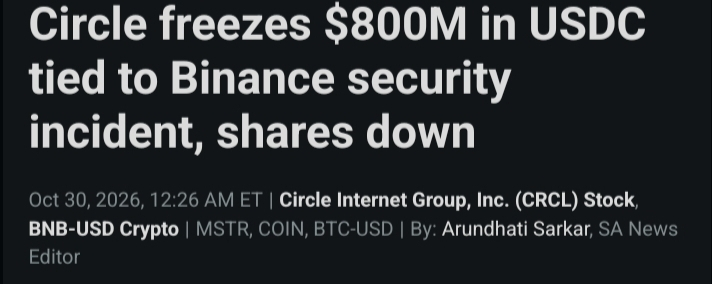
Article
BINANCE: $6.36B IN OUTFLOWS — AN OPERATIONAL SECURITY FAILURE.On October 29, 2026, approximately $6.36 billion moved from Binance-attributed wallets across 10 blockchain networks, according to TRM Labs. Most transfers occurred within roughly 20 minutes.
Binance's preliminary investigation points to a potentially compromised DevOps engineer's laptop, which may have exposed an internal service used to process withdrawals. The company says it found no evidence of wallet private-key leakage.
THE TECHNICAL MECHANISM
On Ethereum, TRM Labs identified EIP-7702 delegation involving 50 pre-signed authorizations. One matched Binance's hot wallet nonce, allowing an attacker-controlled smart contract to execute unauthorized transfers. This explains the Ethereum mechanism, not every affected chain.
THE RECOVERY
Circle froze more than $800 million in USDC linked to the incident. TRM Labs and Bitquery identified approximately $2.7 billion in assets frozen or rescued.
Bitquery also traced around $729 million in stolen USDT into ETH and TRX. At 03:54 UTC on October 30, it estimated that roughly $3.1 billion remained under the attacker's control. These are time-specific on-chain estimates, not Binance's final net loss.
THE BIGGER PICTURE
A valid cryptographic signature does not necessarily mean a transaction was legitimately authorized.
The evidence points to a potential compromise of Binance's internal signing and authorization controls, although the precise root cause remains under investigation.
Binance says it will cover the losses through SAFU and corporate funds.
PROOF OF RESERVES IS NOT PROOF OF SECURITY.
Holding sufficient assets does not, by itself, demonstrate that an institution can protect them.
Sources: Binance; TRM Labs; Bitquery Research; Reuters; Seeking Alpha | October 30, 2026.
Figures reflect source-specific estimates and observation windows. The investigation is ongoing.
#cryptocurrency #stockmarket #btcdump2026
$USDC $BTC $USD1
BINANCE: $6.36B IN OUTFLOWS — AN OPERATIONAL SECURITY FAILURE.
On October 29, 2026, approximately $6.36 billion moved from Binance-attributed wallets across 10 blockchain networks, according to TRM Labs. Most transfers occurred within roughly 20 minutes.
Binance's preliminary investigation points to a potentially compromised DevOps engineer's laptop, which may have exposed an internal service used to process withdrawals. The company says it found no evidence of wallet private-key leakage.
THE TECHNICAL MECHANISM
On Ethereum, TRM Labs identified EIP-7702 delegation involving 50 pre-signed authorizations. One matched Binance's hot wallet nonce, allowing an attacker-controlled smart contract to execute unauthorized transfers. This explains the Ethereum mechanism, not every affected chain.
THE RECOVERY
Circle froze more than $800 million in USDC linked to the incident. TRM Labs and Bitquery identified approximately $2.7 billion in assets frozen or rescued.
Bitquery also traced around $729 million in stolen USDT into ETH and TRX. At 03:54 UTC on October 30, it estimated that roughly $3.1 billion remained under the attacker's control. These are time-specific on-chain estimates, not Binance's final net loss.
THE BIGGER PICTURE
A valid cryptographic signature does not necessarily mean a transaction was legitimately authorized.
The evidence points to a potential compromise of Binance's internal signing and authorization controls, although the precise root cause remains under investigation.
Binance says it will cover the losses through SAFU and corporate funds.
PROOF OF RESERVES IS NOT PROOF OF SECURITY.
Holding sufficient assets does not, by itself, demonstrate that an institution can protect them.
Sources: Binance; TRM Labs; Bitquery Research; Reuters; Seeking Alpha | October 30, 2026.
Figures reflect source-specific estimates and observation windows. The investigation is ongoing.
#cryptocurrency #stockmarket #btcdump2026
$USDC $BTC $USD1
Binance's preliminary investigation points to a potentially compromised DevOps engineer's laptop, which may have exposed an internal service used to process withdrawals. The company says it found no evidence of wallet private-key leakage.
THE TECHNICAL MECHANISM
On Ethereum, TRM Labs identified EIP-7702 delegation involving 50 pre-signed authorizations. One matched Binance's hot wallet nonce, allowing an attacker-controlled smart contract to execute unauthorized transfers. This explains the Ethereum mechanism, not every affected chain.
THE RECOVERY
Circle froze more than $800 million in USDC linked to the incident. TRM Labs and Bitquery identified approximately $2.7 billion in assets frozen or rescued.
Bitquery also traced around $729 million in stolen USDT into ETH and TRX. At 03:54 UTC on October 30, it estimated that roughly $3.1 billion remained under the attacker's control. These are time-specific on-chain estimates, not Binance's final net loss.
THE BIGGER PICTURE
A valid cryptographic signature does not necessarily mean a transaction was legitimately authorized.
The evidence points to a potential compromise of Binance's internal signing and authorization controls, although the precise root cause remains under investigation.
Binance says it will cover the losses through SAFU and corporate funds.
PROOF OF RESERVES IS NOT PROOF OF SECURITY.
Holding sufficient assets does not, by itself, demonstrate that an institution can protect them.
Sources: Binance; TRM Labs; Bitquery Research; Reuters; Seeking Alpha | October 30, 2026.
Figures reflect source-specific estimates and observation windows. The investigation is ongoing.
#cryptocurrency #stockmarket #btcdump2026
$USDC $BTC $USD1
1
183
·
--

Article
GOLD UNDER MACRO PRESSURE: WHAT IS REALLY DRIVING THE MARKET?Gold is not simply a safe-haven asset. Its valuation reflects the interaction between monetary policy, real interest rates, currency movements, and global capital allocation.
Over the August–October 2026 observation window, these are the four dimensions that matter when assessing the next phase of the gold market.
1. REAL INTEREST RATES: THE OPPORTUNITY COST
US Treasury Inflation-Protected Securities (TIPS) provide an important benchmark for measuring real yields.
Gold offers no contractual interest income. Consequently, rising real yields can increase the opportunity cost of holding bullion, while declining real yields may improve its relative attractiveness.
The relationship is economically relevant, although it is not mechanically inverse at every point in time.
2. US DOLLAR: THE CURRENCY CHANNEL
Gold is internationally quoted in US dollars.
Dollar appreciation can create additional pressure on gold by increasing its cost for non-US buyers. However, currency movements must be assessed alongside real yields and global risk conditions.
3. INVESTMENT FLOWS: FOLLOWING CAPITAL
Gold-backed ETF flows provide insight into financial investor positioning.
Unlike price momentum alone, these flows help assess whether institutional investment demand is expanding or contracting.
Central-bank purchases represent another important demand component, although their reporting frequency and timing differ from daily market activity.
4. MONETARY POLICY: THE EXPECTATIONS FACTOR
Markets do not respond exclusively to current interest rates. They continuously reprice expectations about future Federal Reserve policy.
Inflation persistence, employment conditions, Treasury yields, and monetary policy communication can all influence the expected path of real rates.
MARKET IMPLICATION
The critical question is whether monetary conditions are becoming more restrictive or more accommodative for non-yielding assets.
For XAUUSD, the 3,818.50 level remains a reference in my previous bearish outlook.
A sustained break below that area would strengthen the downside scenario. Conversely, a strong recovery and reclaim would require reassessing the bearish thesis.
CONCLUSION
Gold's next major move should be evaluated through the interaction of monetary conditions, currency strength, and investment demand.
Price action identifies the market's direction. Macroeconomic data helps explain the forces behind it.
Research first. Position second.
— NEBRYTHALIS
Sources for empirical verification:
Federal Reserve | FRED | US Treasury | World Gold Council | ICE
$XAUT $BTC $ETH
#CrashGold2026 #Macroeconomic #Bankcentral #ETFGOLD #Binancesystemcrash
GOLD UNDER MACRO PRESSURE: WHAT IS REALLY DRIVING THE MARKET?
Gold is not simply a safe-haven asset. Its valuation reflects the interaction between monetary policy, real interest rates, currency movements, and global capital allocation.
Over the August–October 2026 observation window, these are the four dimensions that matter when assessing the next phase of the gold market.
1. REAL INTEREST RATES: THE OPPORTUNITY COST
US Treasury Inflation-Protected Securities (TIPS) provide an important benchmark for measuring real yields.
Gold offers no contractual interest income. Consequently, rising real yields can increase the opportunity cost of holding bullion, while declining real yields may improve its relative attractiveness.
The relationship is economically relevant, although it is not mechanically inverse at every point in time.
2. US DOLLAR: THE CURRENCY CHANNEL
Gold is internationally quoted in US dollars.
Dollar appreciation can create additional pressure on gold by increasing its cost for non-US buyers. However, currency movements must be assessed alongside real yields and global risk conditions.
3. INVESTMENT FLOWS: FOLLOWING CAPITAL
Gold-backed ETF flows provide insight into financial investor positioning.
Unlike price momentum alone, these flows help assess whether institutional investment demand is expanding or contracting.
Central-bank purchases represent another important demand component, although their reporting frequency and timing differ from daily market activity.
4. MONETARY POLICY: THE EXPECTATIONS FACTOR
Markets do not respond exclusively to current interest rates. They continuously reprice expectations about future Federal Reserve policy.
Inflation persistence, employment conditions, Treasury yields, and monetary policy communication can all influence the expected path of real rates.
MARKET IMPLICATION
The critical question is whether monetary conditions are becoming more restrictive or more accommodative for non-yielding assets.
For XAUUSD, the 3,818.50 level remains a reference in my previous bearish outlook.
A sustained break below that area would strengthen the downside scenario. Conversely, a strong recovery and reclaim would require reassessing the bearish thesis.
CONCLUSION
Gold's next major move should be evaluated through the interaction of monetary conditions, currency strength, and investment demand.
Price action identifies the market's direction. Macroeconomic data helps explain the forces behind it.
Research first. Position second.
— NEBRYTHALIS
Sources for empirical verification:
Federal Reserve | FRED | US Treasury | World Gold Council | ICE
$XAUT $BTC $ETH
#CrashGold2026 #Macroeconomic #Bankcentral #ETFGOLD #Binancesystemcrash
Over the August–October 2026 observation window, these are the four dimensions that matter when assessing the next phase of the gold market.
1. REAL INTEREST RATES: THE OPPORTUNITY COST
US Treasury Inflation-Protected Securities (TIPS) provide an important benchmark for measuring real yields.
Gold offers no contractual interest income. Consequently, rising real yields can increase the opportunity cost of holding bullion, while declining real yields may improve its relative attractiveness.
The relationship is economically relevant, although it is not mechanically inverse at every point in time.
2. US DOLLAR: THE CURRENCY CHANNEL
Gold is internationally quoted in US dollars.
Dollar appreciation can create additional pressure on gold by increasing its cost for non-US buyers. However, currency movements must be assessed alongside real yields and global risk conditions.
3. INVESTMENT FLOWS: FOLLOWING CAPITAL
Gold-backed ETF flows provide insight into financial investor positioning.
Unlike price momentum alone, these flows help assess whether institutional investment demand is expanding or contracting.
Central-bank purchases represent another important demand component, although their reporting frequency and timing differ from daily market activity.
4. MONETARY POLICY: THE EXPECTATIONS FACTOR
Markets do not respond exclusively to current interest rates. They continuously reprice expectations about future Federal Reserve policy.
Inflation persistence, employment conditions, Treasury yields, and monetary policy communication can all influence the expected path of real rates.
MARKET IMPLICATION
The critical question is whether monetary conditions are becoming more restrictive or more accommodative for non-yielding assets.
For XAUUSD, the 3,818.50 level remains a reference in my previous bearish outlook.
A sustained break below that area would strengthen the downside scenario. Conversely, a strong recovery and reclaim would require reassessing the bearish thesis.
CONCLUSION
Gold's next major move should be evaluated through the interaction of monetary conditions, currency strength, and investment demand.
Price action identifies the market's direction. Macroeconomic data helps explain the forces behind it.
Research first. Position second.
— NEBRYTHALIS
Sources for empirical verification:
Federal Reserve | FRED | US Treasury | World Gold Council | ICE
$XAUT $BTC $ETH
#CrashGold2026 #Macroeconomic #Bankcentral #ETFGOLD #Binancesystemcrash
1
267
·
--
Bearish
30D trade $XAU 158.5 USDT
$XAU $XAUT | Gold Market Outlook
Gold is showing signs of bearish pressure, with 3,818.50 emerging as a key downside level to watch.
The focus now is price reaction:
• A decisive break below 3,818.50 could extend the bearish move. • A strong rejection could trigger a short-term recovery. • Until bullish structure returns, downside risk remains relevant.
My view: Cautiously bearish. Confirmation before execution.
The market rewards patience, not prediction.
#CrashGold2026
$XAU $XAUT | Gold Market Outlook
Gold is showing signs of bearish pressure, with 3,818.50 emerging as a key downside level to watch.
The focus now is price reaction:
• A decisive break below 3,818.50 could extend the bearish move. • A strong rejection could trigger a short-term recovery. • Until bullish structure returns, downside risk remains relevant.
My view: Cautiously bearish. Confirmation before execution.
The market rewards patience, not prediction.
#CrashGold2026
Gold is showing signs of bearish pressure, with 3,818.50 emerging as a key downside level to watch.
The focus now is price reaction:
• A decisive break below 3,818.50 could extend the bearish move. • A strong rejection could trigger a short-term recovery. • Until bullish structure returns, downside risk remains relevant.
My view: Cautiously bearish. Confirmation before execution.
The market rewards patience, not prediction.
#CrashGold2026
213
·
--
Bearish
74000 >> 54000
$BTC #BitcoinSlipsBelow$80KAgain
74000 >> 54000
$BTC #BitcoinSlipsBelow$80KAgain
$BTC #BitcoinSlipsBelow$80KAgain
1
93
·
--
{spot}(ETHUSDT)
Hmmm 😂 $BTC $ETH $BNB
{spot}(BNBUSDT)
{spot}(BTCUSDT)
#BitcoinSlipsBelow$80KAgain
Hmmm 😂 $BTC $ETH $BNB
#BitcoinSlipsBelow$80KAgain
#BitcoinSlipsBelow$80KAgain

1
83
·
--
30D trade $XAU 158.5 USDT
GLD & IAU options positioning ahead of the November 20 expiry! 📊🪙
Massive open interest building up across strikes. Are the puts defending lower levels or are calls gearing up for a breakout?
What’s your take on gold's next major move? Drop your thoughts below! 👇
#EarningsSeason #BinancePick #Gold
$XAUT $XAU #BinancePick #EarningsSeason
GLD & IAU options positioning ahead of the November 20 expiry! 📊🪙
Massive open interest building up across strikes. Are the puts defending lower levels or are calls gearing up for a breakout?
What’s your take on gold's next major move? Drop your thoughts below! 👇
#EarningsSeason #BinancePick #Gold
$XAUT $XAU #BinancePick #EarningsSeason
Massive open interest building up across strikes. Are the puts defending lower levels or are calls gearing up for a breakout?
What’s your take on gold's next major move? Drop your thoughts below! 👇
#EarningsSeason #BinancePick #Gold
$XAUT $XAU #BinancePick #EarningsSeason
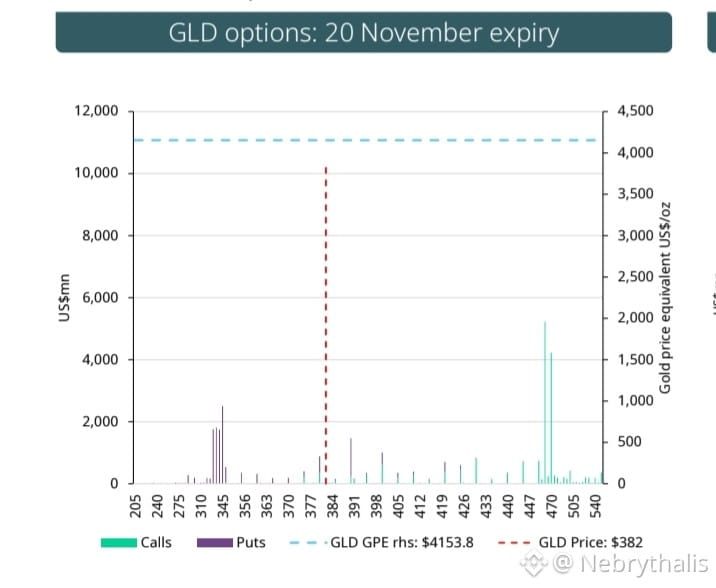
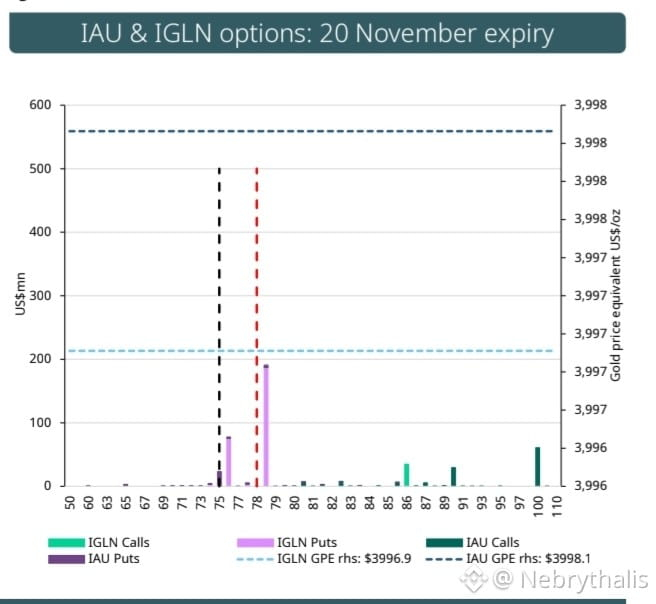
1
256
·
--
Verified
30D trade $XAU 158.5 USDT
$XAU $XAUT pulls back to ~$4,013/oz, but options data and upcoming FOMC & PCE data are signaling major moves ahead! 🟡📉
Are you buying the dip, or waiting for a deeper correction before the next leg up?
Drop your strategy below! 👇
#EarningsSeason #BinancePick
$XAU $XAUT pulls back to ~$4,013/oz, but options data and upcoming FOMC & PCE data are signaling major moves ahead! 🟡📉
Are you buying the dip, or waiting for a deeper correction before the next leg up?
Drop your strategy below! 👇
#EarningsSeason #BinancePick
Are you buying the dip, or waiting for a deeper correction before the next leg up?
Drop your strategy below! 👇
#EarningsSeason #BinancePick
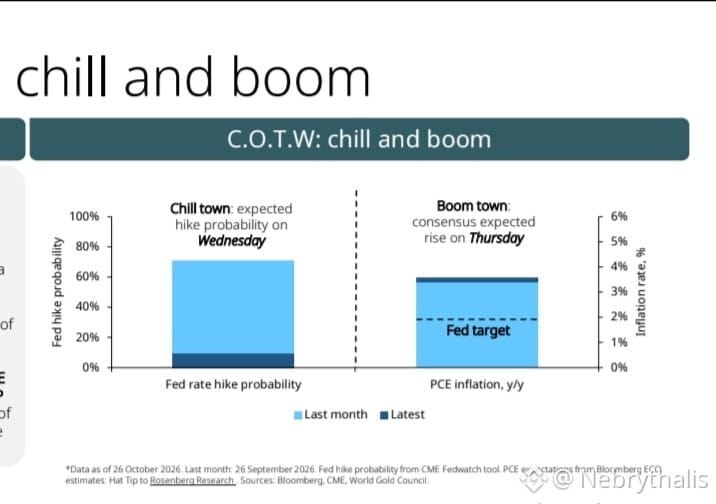
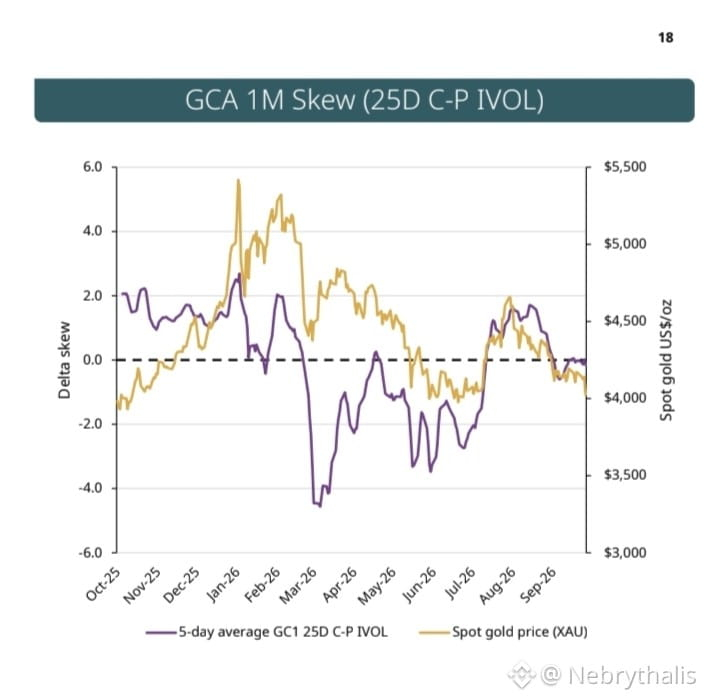
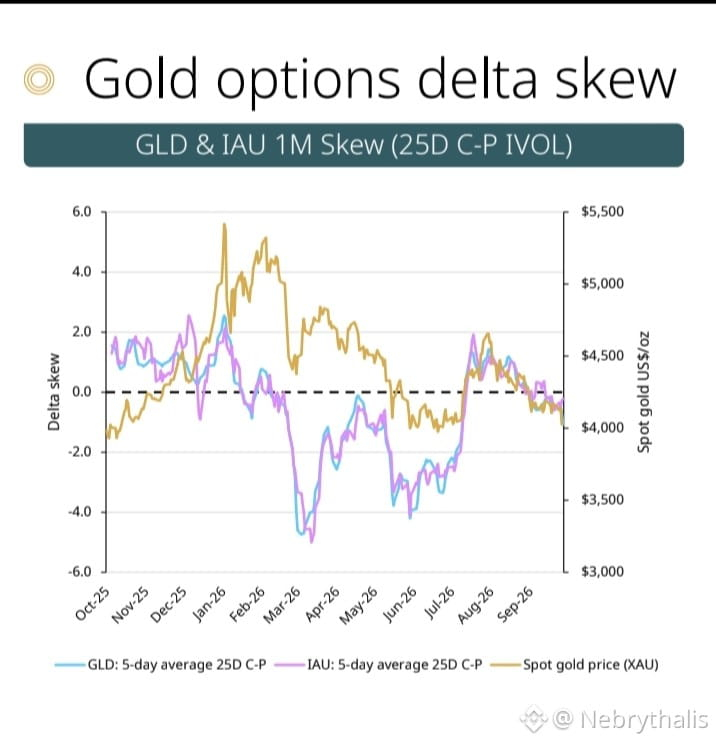
1
263
·
--
Gold is heating up! 🟡 Where is $XAUT heading next?
Cast your vote and share your target! 👇
#BinancePick #EarningsSeason
Gold is heating up! 🟡 Where is $XAUT heading next?
Cast your vote and share your target! 👇
#BinancePick #EarningsSeason
Cast your vote and share your target! 👇
#BinancePick #EarningsSeason
4190.40
61%
3818.50
24%
3750
3%
3551.45
12%
66 votes • Voting closed
1
1
801
·
--
84000
45%
74000
41%
54000
14%
22 votes • Voting closed
2
1
1
162
·
--
Bearish
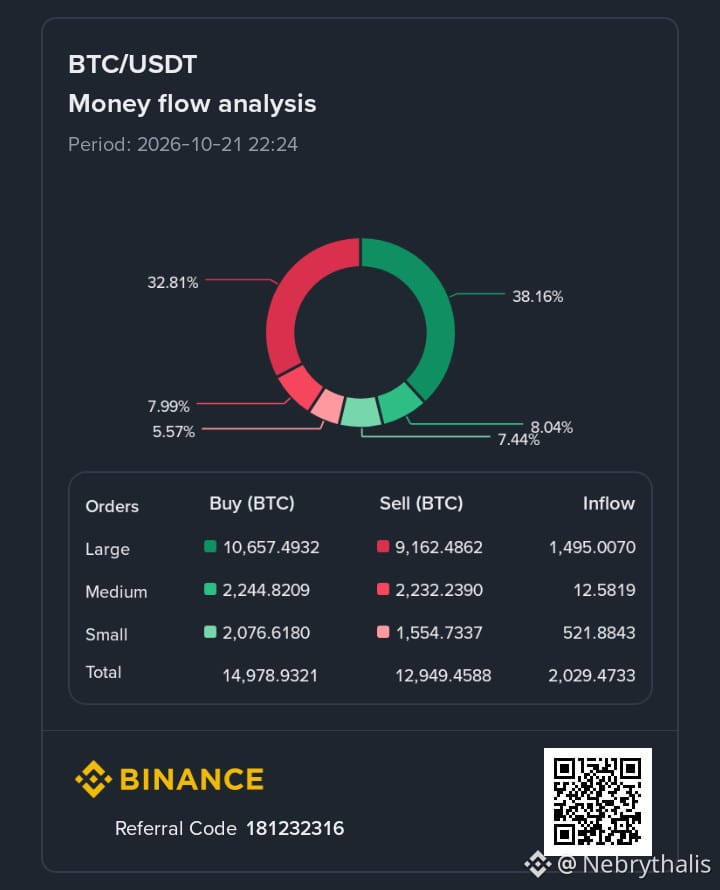
1
118

Log in to explore more content
Join global crypto users on Binance Square
⚡️ Get latest and useful information about crypto.
💬 Trusted by the world’s largest crypto exchange.
👍 Discover real insights from verified creators.
Email / Phone number
Trending Topics
BinanceWithdrawalScamWarning
5,889 views
270 Discussing
Binance Warns Users of Withdrawal Scams as Services Resume: It Will Never Charge Fees, Sell Queue Spots or Ask You to Move Funds to a “Vault”
Binance News
·5 Likes
·3.4k views
USMidtermElections
551,561 views
2,837 Discussing
USOctoberNFP-AreRateCutsStillPossible
14,086 views
324 Discussing