
Maryelliottwave
16 Posts

Maryelliottwave
Report
Block User
Founder of WAVE3 | Elliott Wave Theory • Trading Psychology • Risk Management
Open Trade
Frequent Trader
7.6 Years
8 Following
228 Followers
246 Liked
Posts
Portfolio
PINNED
Hello, Binance Square! 👋
I’m Mary from the Philippines, founder of Wave3.
I’ve been a Binance user for over 7.5 years, and I’m excited to finally start sharing my journey here on Binance Square.
I’m passionate about helping traders understand the markets through Elliott Wave Theory, Trading Psychology, and Risk Management. At Wave3, we’re committed to helping traders become more disciplined, independent, and confident in their decision-making. I’m incredibly proud that many members of our community have gone on to become champions in trading competitions across the Philippines.
Beyond trading, I’m also passionate about blockchain education. Together with my co-founder, I co-authored the Wave3 Handbook, an educational book on Elliott Wave Theory, officially registered with the National Library of the Philippines and assigned an ISBN.
Over the years, I’ve had the privilege of collaborating with several leading cryptocurrency exchanges as a KOL, affiliate partner, and VIP member. These experiences have allowed me to connect with thousands of traders while supporting the growth of the Web3 ecosystem through education.
I don’t believe in blindly following signals. I believe the best traders understand why the market moves. My goal is to help traders understand market structure, think independently, manage risk effectively, and build long-term consistency.
Here on Binance Square, I’ll be sharing Elliott Wave analysis and educational insights across crypto, forex, stocks, commodities, and indices. Whether you’re new to trading or already an experienced trader, I hope my content helps you become more confident and consistent in the markets.
If you enjoy objective market analysis and educational trading content, I’d love to have you join me on this journey. Feel free to follow me, and let’s continue learning and growing together.
See you in the next wave. 🌊📈
What market would you like me to analyze first? 👇
#BinanceSquare #ElliottWaveTheory #TechnicalAnalysis #TradingEducation #RiskManagement
Hello, Binance Square! 👋
I’m Mary from the Philippines, founder of Wave3.
I’ve been a Binance user for over 7.5 years, and I’m excited to finally start sharing my journey here on Binance Square.
I’m passionate about helping traders understand the markets through Elliott Wave Theory, Trading Psychology, and Risk Management. At Wave3, we’re committed to helping traders become more disciplined, independent, and confident in their decision-making. I’m incredibly proud that many members of our community have gone on to become champions in trading competitions across the Philippines.
Beyond trading, I’m also passionate about blockchain education. Together with my co-founder, I co-authored the Wave3 Handbook, an educational book on Elliott Wave Theory, officially registered with the National Library of the Philippines and assigned an ISBN.
Over the years, I’ve had the privilege of collaborating with several leading cryptocurrency exchanges as a KOL, affiliate partner, and VIP member. These experiences have allowed me to connect with thousands of traders while supporting the growth of the Web3 ecosystem through education.
I don’t believe in blindly following signals. I believe the best traders understand why the market moves. My goal is to help traders understand market structure, think independently, manage risk effectively, and build long-term consistency.
Here on Binance Square, I’ll be sharing Elliott Wave analysis and educational insights across crypto, forex, stocks, commodities, and indices. Whether you’re new to trading or already an experienced trader, I hope my content helps you become more confident and consistent in the markets.
If you enjoy objective market analysis and educational trading content, I’d love to have you join me on this journey. Feel free to follow me, and let’s continue learning and growing together.
See you in the next wave. 🌊📈
What market would you like me to analyze first? 👇
#BinanceSquare #ElliottWaveTheory #TechnicalAnalysis #TradingEducation #RiskManagement
I’m Mary from the Philippines, founder of Wave3.
I’ve been a Binance user for over 7.5 years, and I’m excited to finally start sharing my journey here on Binance Square.
I’m passionate about helping traders understand the markets through Elliott Wave Theory, Trading Psychology, and Risk Management. At Wave3, we’re committed to helping traders become more disciplined, independent, and confident in their decision-making. I’m incredibly proud that many members of our community have gone on to become champions in trading competitions across the Philippines.
Beyond trading, I’m also passionate about blockchain education. Together with my co-founder, I co-authored the Wave3 Handbook, an educational book on Elliott Wave Theory, officially registered with the National Library of the Philippines and assigned an ISBN.
Over the years, I’ve had the privilege of collaborating with several leading cryptocurrency exchanges as a KOL, affiliate partner, and VIP member. These experiences have allowed me to connect with thousands of traders while supporting the growth of the Web3 ecosystem through education.
I don’t believe in blindly following signals. I believe the best traders understand why the market moves. My goal is to help traders understand market structure, think independently, manage risk effectively, and build long-term consistency.
Here on Binance Square, I’ll be sharing Elliott Wave analysis and educational insights across crypto, forex, stocks, commodities, and indices. Whether you’re new to trading or already an experienced trader, I hope my content helps you become more confident and consistent in the markets.
If you enjoy objective market analysis and educational trading content, I’d love to have you join me on this journey. Feel free to follow me, and let’s continue learning and growing together.
See you in the next wave. 🌊📈
What market would you like me to analyze first? 👇
#BinanceSquare #ElliottWaveTheory #TechnicalAnalysis #TradingEducation #RiskManagement

51
4
142
63k
PINNED
$BNB | 6D UPDATE 📈
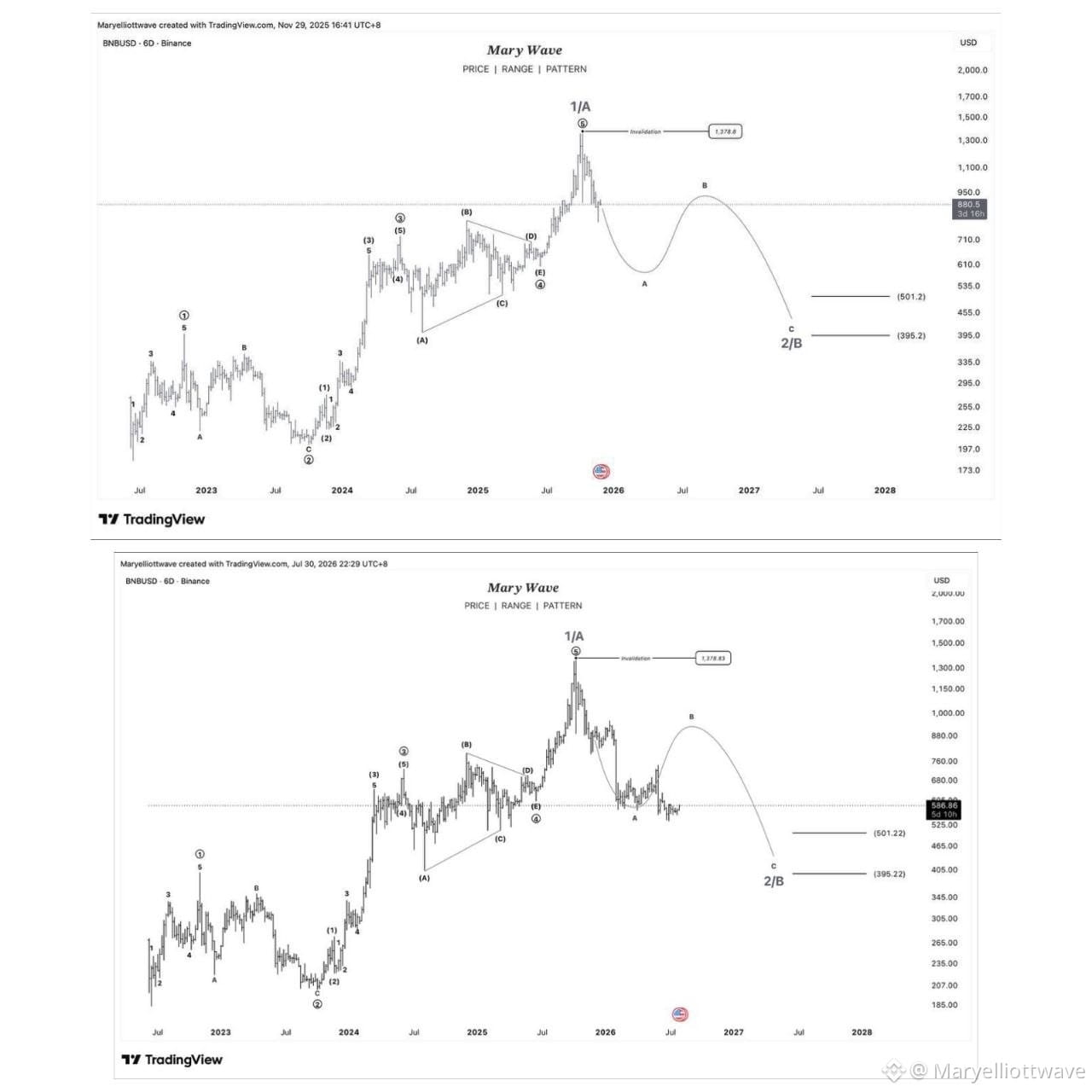
In November 2025, I shared this high-timeframe Elliott Wave roadmap for $BNB. The second chart shows how the market unfolded over the following months. I intentionally didn’t relabel the wave count so you can compare the original analysis with the current market structure.
Elliott Wave isn’t about predicting every price movement with certainty. It’s about identifying the highest-probability market structure, defining clear invalidation levels, and adapting only when price action provides a valid reason to do so.
Consistency comes from following objective Elliott Wave rules, not from constantly changing the wave count. Let price confirm the structure, respect your invalidation levels, manage your risk, and let the market unfold one wave at a time.
#BNB #BNBUSD #ElliottWave #ElliottWaveTheory #TechnicalAnalysis #CryptoTrading
$BNB | 6D UPDATE 📈
In November 2025, I shared this high-timeframe Elliott Wave roadmap for $BNB . The second chart shows how the market unfolded over the following months. I intentionally didn’t relabel the wave count so you can compare the original analysis with the current market structure.
Elliott Wave isn’t about predicting every price movement with certainty. It’s about identifying the highest-probability market structure, defining clear invalidation levels, and adapting only when price action provides a valid reason to do so.
Consistency comes from following objective Elliott Wave rules, not from constantly changing the wave count. Let price confirm the structure, respect your invalidation levels, manage your risk, and let the market unfold one wave at a time.
#BNB #BNBUSD #ElliottWave #ElliottWaveTheory #TechnicalAnalysis #CryptoTrading
In November 2025, I shared this high-timeframe Elliott Wave roadmap for $BNB . The second chart shows how the market unfolded over the following months. I intentionally didn’t relabel the wave count so you can compare the original analysis with the current market structure.
Elliott Wave isn’t about predicting every price movement with certainty. It’s about identifying the highest-probability market structure, defining clear invalidation levels, and adapting only when price action provides a valid reason to do so.
Consistency comes from following objective Elliott Wave rules, not from constantly changing the wave count. Let price confirm the structure, respect your invalidation levels, manage your risk, and let the market unfold one wave at a time.
#BNB #BNBUSD #ElliottWave #ElliottWaveTheory #TechnicalAnalysis #CryptoTrading
18
3
45
46.7k
·
--
Bullish
$BTC | 1W MACRO OUTLOOK
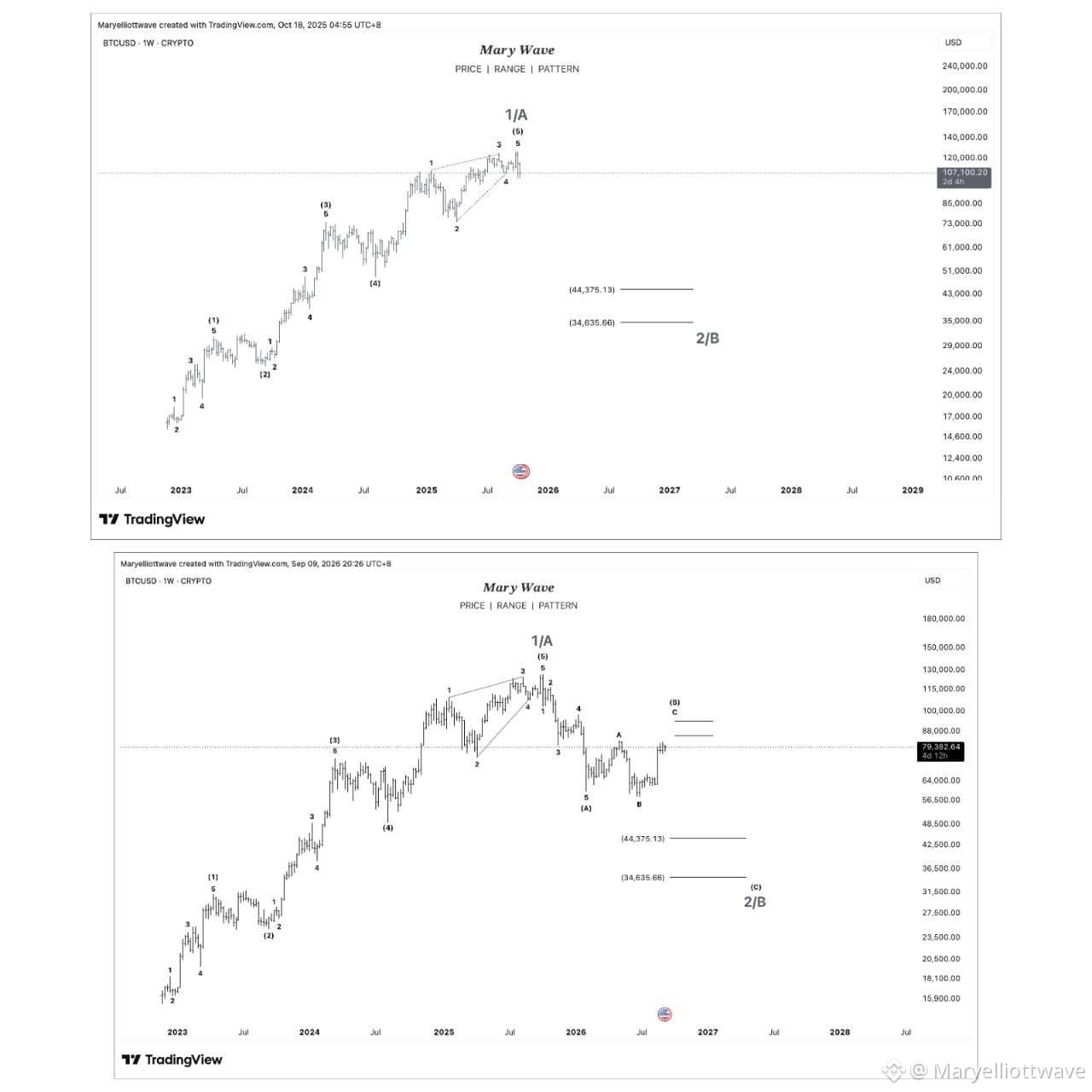
A look back at the bigger picture.
The original macro count was already tracking the completion of 1/A, with 44,375.13 and 34,635.66 marked as the deeper areas to watch for the broader 2/B correction.
As price developed, the structure began to unfold more clearly.
So far, I’m tracking the possibility that Wave (A) of 2/B has completed, followed by the current A-B-C recovery for Wave (B).
If this recovery completes and the structure confirms lower, the next phase I’ll be watching is Wave (C) toward the same projected macro areas:
44,375.13 • 34,635.66
Disclaimer: This is my personal Elliott Wave analysis, shared for educational purposes only. It is not financial advice. Always do your own research and manage your risk.
#Bitcoin #ElliottWaveTheory
$BTC | 1W MACRO OUTLOOK
A look back at the bigger picture.
The original macro count was already tracking the completion of 1/A, with 44,375.13 and 34,635.66 marked as the deeper areas to watch for the broader 2/B correction.
As price developed, the structure began to unfold more clearly.
So far, I’m tracking the possibility that Wave (A) of 2/B has completed, followed by the current A-B-C recovery for Wave (B).
If this recovery completes and the structure confirms lower, the next phase I’ll be watching is Wave (C) toward the same projected macro areas:
44,375.13 • 34,635.66
Disclaimer: This is my personal Elliott Wave analysis, shared for educational purposes only. It is not financial advice. Always do your own research and manage your risk.
#Bitcoin #ElliottWaveTheory
A look back at the bigger picture.
The original macro count was already tracking the completion of 1/A, with 44,375.13 and 34,635.66 marked as the deeper areas to watch for the broader 2/B correction.
As price developed, the structure began to unfold more clearly.
So far, I’m tracking the possibility that Wave (A) of 2/B has completed, followed by the current A-B-C recovery for Wave (B).
If this recovery completes and the structure confirms lower, the next phase I’ll be watching is Wave (C) toward the same projected macro areas:
44,375.13 • 34,635.66
Disclaimer: This is my personal Elliott Wave analysis, shared for educational purposes only. It is not financial advice. Always do your own research and manage your risk.
#Bitcoin #ElliottWaveTheory
1.2k
·
--
Bullish
$QNT | 3W MACRO OUTLOOK
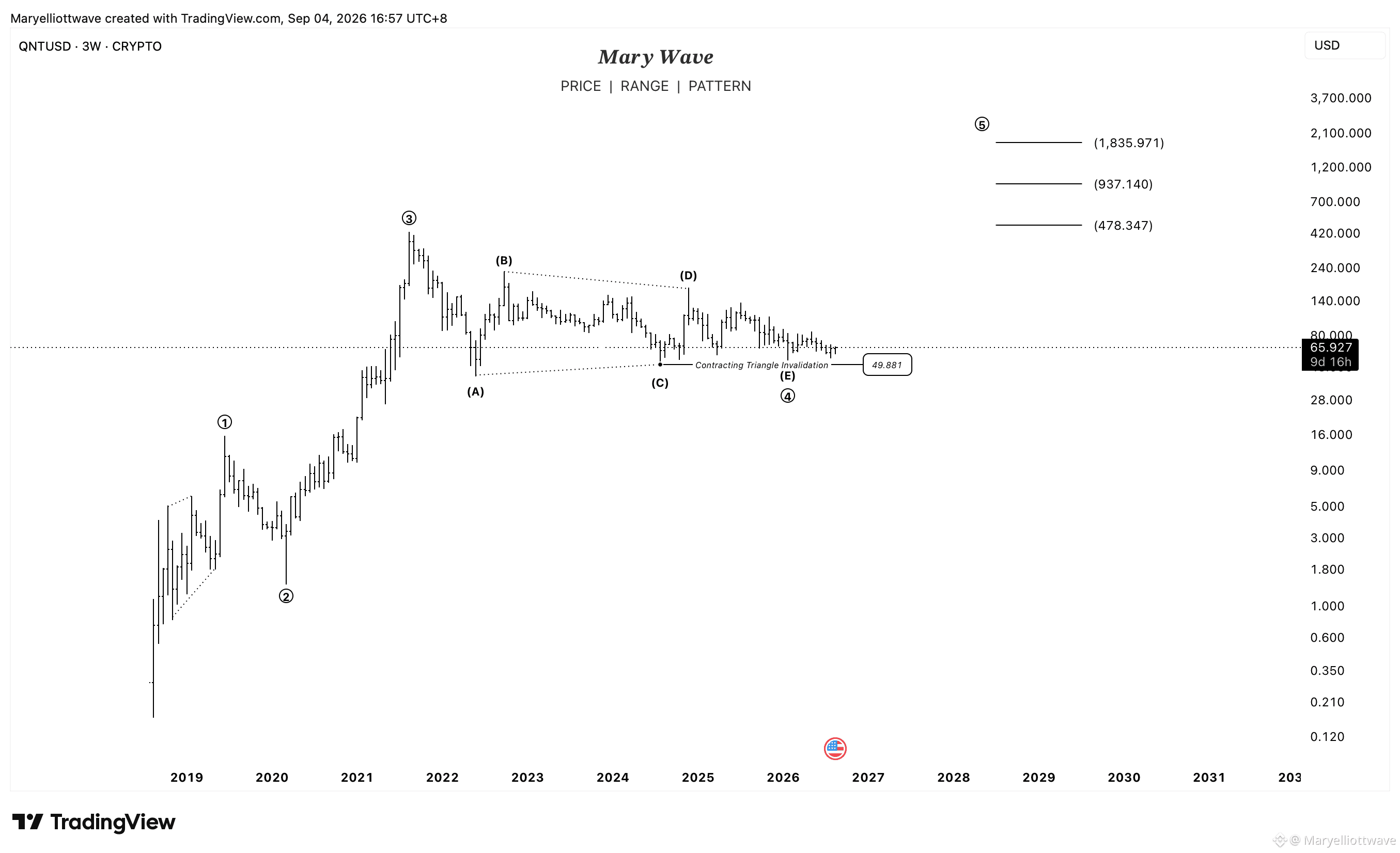
Stepping back to the 3W chart and looking at the full available price history, this is the broader Elliott Wave structure I’m currently tracking for QNT.
My current macro count suggests that Waves ①, ②, and ③ are already complete, with Wave ① developing as a diagonal.
For Wave ④, I’m tracking a possible contracting A-B-C-D-E triangle. As long as the 49.881 contracting triangle invalidation remains intact, the structure stays valid.
If the triangle completes and price confirms higher, the next areas I’ll be watching for Macro Wave ⑤ are:
478.347 • 937.140 • 1,835.971
For now, I’m letting the structure confirm itself. No need to force the count. Patience, discipline, and risk management always. 🤍
Disclaimer: This is my personal Elliott Wave analysis, shared for educational purposes only. It is not financial advice. Always do your own research and manage your risk.
#QNTUSDT #ElliottWaveTheory
$QNT | 3W MACRO OUTLOOK
Stepping back to the 3W chart and looking at the full available price history, this is the broader Elliott Wave structure I’m currently tracking for QNT.
My current macro count suggests that Waves ①, ②, and ③ are already complete, with Wave ① developing as a diagonal.
For Wave ④, I’m tracking a possible contracting A-B-C-D-E triangle. As long as the 49.881 contracting triangle invalidation remains intact, the structure stays valid.
If the triangle completes and price confirms higher, the next areas I’ll be watching for Macro Wave ⑤ are:
478.347 • 937.140 • 1,835.971
For now, I’m letting the structure confirm itself. No need to force the count. Patience, discipline, and risk management always. 🤍
Disclaimer: This is my personal Elliott Wave analysis, shared for educational purposes only. It is not financial advice. Always do your own research and manage your risk.
#QNTUSDT #ElliottWaveTheory
Stepping back to the 3W chart and looking at the full available price history, this is the broader Elliott Wave structure I’m currently tracking for QNT.
My current macro count suggests that Waves ①, ②, and ③ are already complete, with Wave ① developing as a diagonal.
For Wave ④, I’m tracking a possible contracting A-B-C-D-E triangle. As long as the 49.881 contracting triangle invalidation remains intact, the structure stays valid.
If the triangle completes and price confirms higher, the next areas I’ll be watching for Macro Wave ⑤ are:
478.347 • 937.140 • 1,835.971
For now, I’m letting the structure confirm itself. No need to force the count. Patience, discipline, and risk management always. 🤍
Disclaimer: This is my personal Elliott Wave analysis, shared for educational purposes only. It is not financial advice. Always do your own research and manage your risk.
#QNTUSDT #ElliottWaveTheory
528
·
--
Bullish
$QNT | 4H OUTLOOK
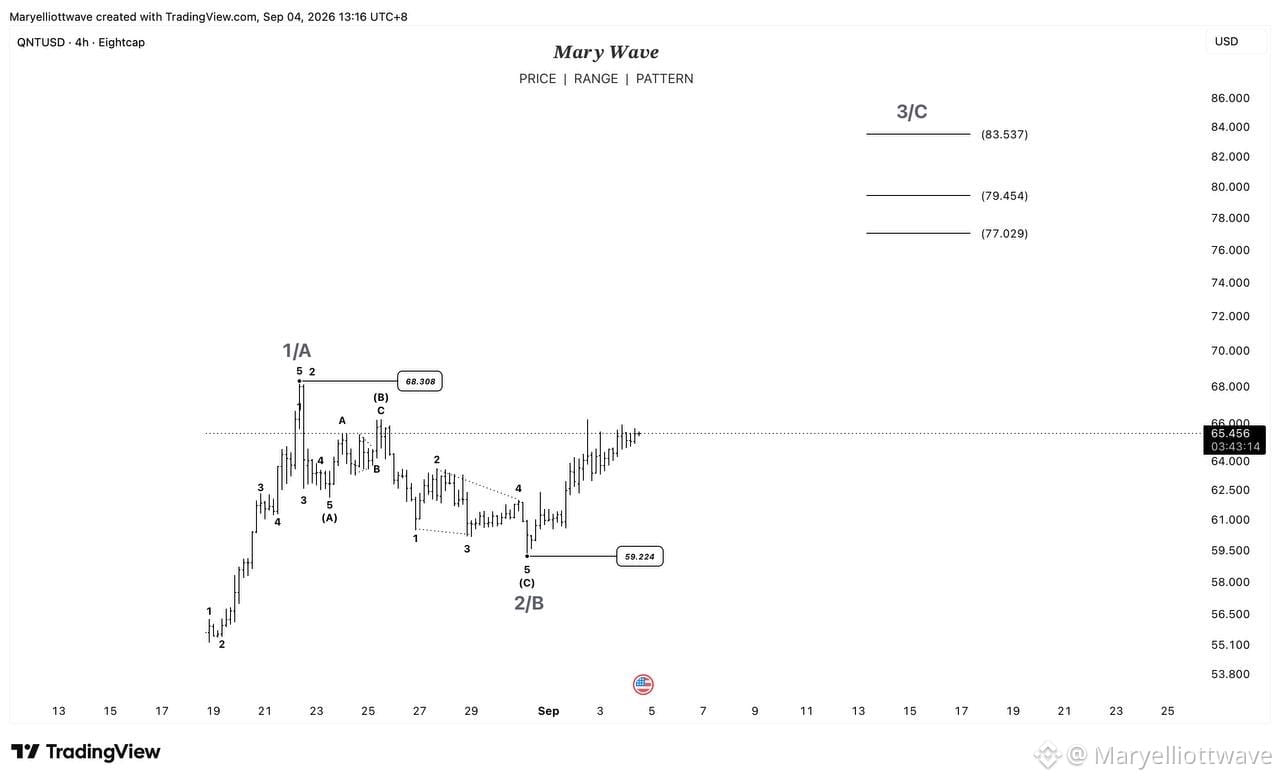
Watching the current 1/A → 2/B → 3/C structure unfold.
The 2/B correction appears complete around 59.224, with price now recovering toward the 68.308 confirmation level.
If confirmed, the next areas I’ll be watching are:
77.029 • 79.454 • 83.537
For now, I’m letting price confirm the structure first. No need to force the count. Patience, discipline, and risk management always. 🤍
Disclaimer: This is my personal Elliott Wave analysis, shared for educational purposes only. It is not financial advice. Always do your own research and manage your risk.
#QNT/USDT #ElliottWaveTheory
$QNT | 4H OUTLOOK
Watching the current 1/A → 2/B → 3/C structure unfold.
The 2/B correction appears complete around 59.224, with price now recovering toward the 68.308 confirmation level.
If confirmed, the next areas I’ll be watching are:
77.029 • 79.454 • 83.537
For now, I’m letting price confirm the structure first. No need to force the count. Patience, discipline, and risk management always. 🤍
Disclaimer: This is my personal Elliott Wave analysis, shared for educational purposes only. It is not financial advice. Always do your own research and manage your risk.
#QNT/USDT #ElliottWaveTheory
Watching the current 1/A → 2/B → 3/C structure unfold.
The 2/B correction appears complete around 59.224, with price now recovering toward the 68.308 confirmation level.
If confirmed, the next areas I’ll be watching are:
77.029 • 79.454 • 83.537
For now, I’m letting price confirm the structure first. No need to force the count. Patience, discipline, and risk management always. 🤍
Disclaimer: This is my personal Elliott Wave analysis, shared for educational purposes only. It is not financial advice. Always do your own research and manage your risk.
#QNT/USDT #ElliottWaveTheory
401
·
--
Bullish
$HYPE | 8H UPDATE 📊
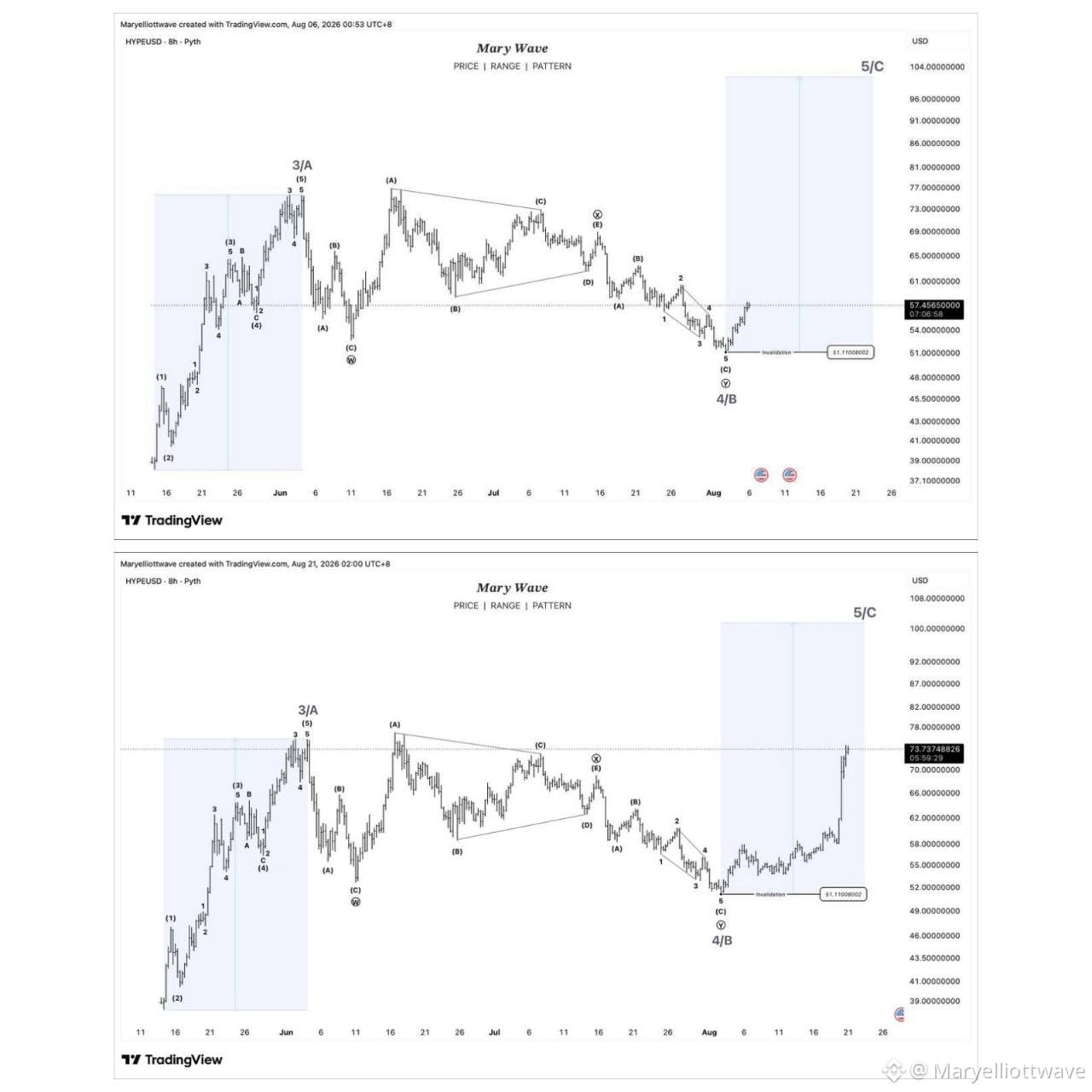
HYPE continues to follow the projected Elliott Wave structure after completing Wave 4/B around the $51 area. Price has since pushed strongly to the upside and is now trading around $73, supporting the view that Wave 5/C is already in progress. The broader target remains around the $100 area as long as the bullish structure remains intact.
Educational purposes only. Not financial advice.
$HYPE | 8H UPDATE 📊
HYPE continues to follow the projected Elliott Wave structure after completing Wave 4/B around the $51 area. Price has since pushed strongly to the upside and is now trading around $73, supporting the view that Wave 5/C is already in progress. The broader target remains around the $100 area as long as the bullish structure remains intact.
Educational purposes only. Not financial advice.
HYPE continues to follow the projected Elliott Wave structure after completing Wave 4/B around the $51 area. Price has since pushed strongly to the upside and is now trading around $73, supporting the view that Wave 5/C is already in progress. The broader target remains around the $100 area as long as the bullish structure remains intact.
Educational purposes only. Not financial advice.
2
2.3k
·
--
Bullish
$ETHFI | 12H OUTLOOK 📊
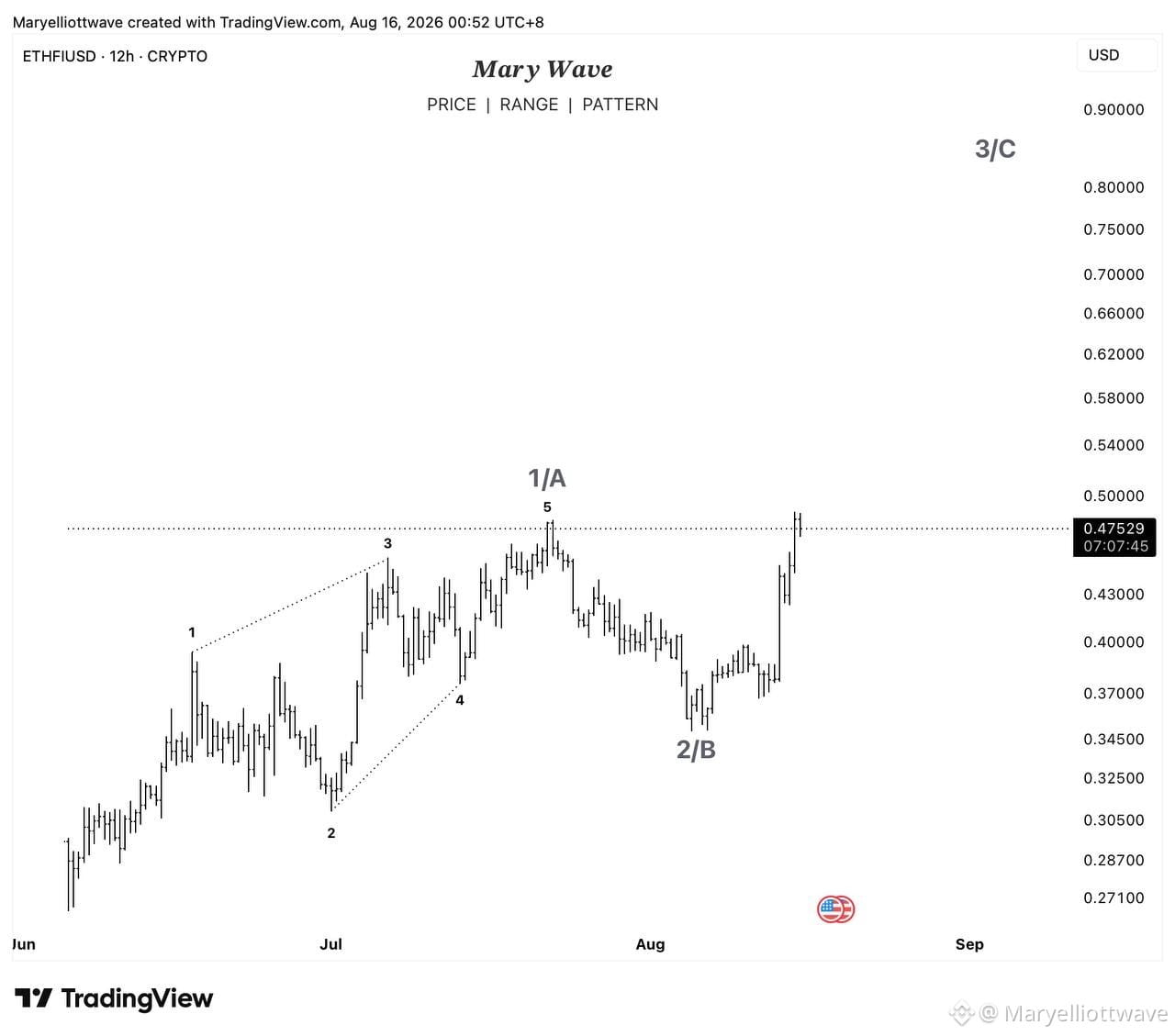
ETHFI appears to have completed Wave 2/B following the advance into Wave 1/A.
Price is now testing the previous high around the $0.48 area. A sustained break above this level would strengthen the case that Wave 3/C is already underway.
For now, I’m watching the structure and how price reacts around the Wave 1/A high.
Educational purposes only. Not financial advice.
#ETHFIUSDT #ElliottWaveTheory
$ETHFI | 12H OUTLOOK 📊
ETHFI appears to have completed Wave 2/B following the advance into Wave 1/A.
Price is now testing the previous high around the $0.48 area. A sustained break above this level would strengthen the case that Wave 3/C is already underway.
For now, I’m watching the structure and how price reacts around the Wave 1/A high.
Educational purposes only. Not financial advice.
#ETHFIUSDT #ElliottWaveTheory
ETHFI appears to have completed Wave 2/B following the advance into Wave 1/A.
Price is now testing the previous high around the $0.48 area. A sustained break above this level would strengthen the case that Wave 3/C is already underway.
For now, I’m watching the structure and how price reacts around the Wave 1/A high.
Educational purposes only. Not financial advice.
#ETHFIUSDT #ElliottWaveTheory
5
6.6k
·
--
Bullish
$USOIL | BEFORE & AFTER 📊
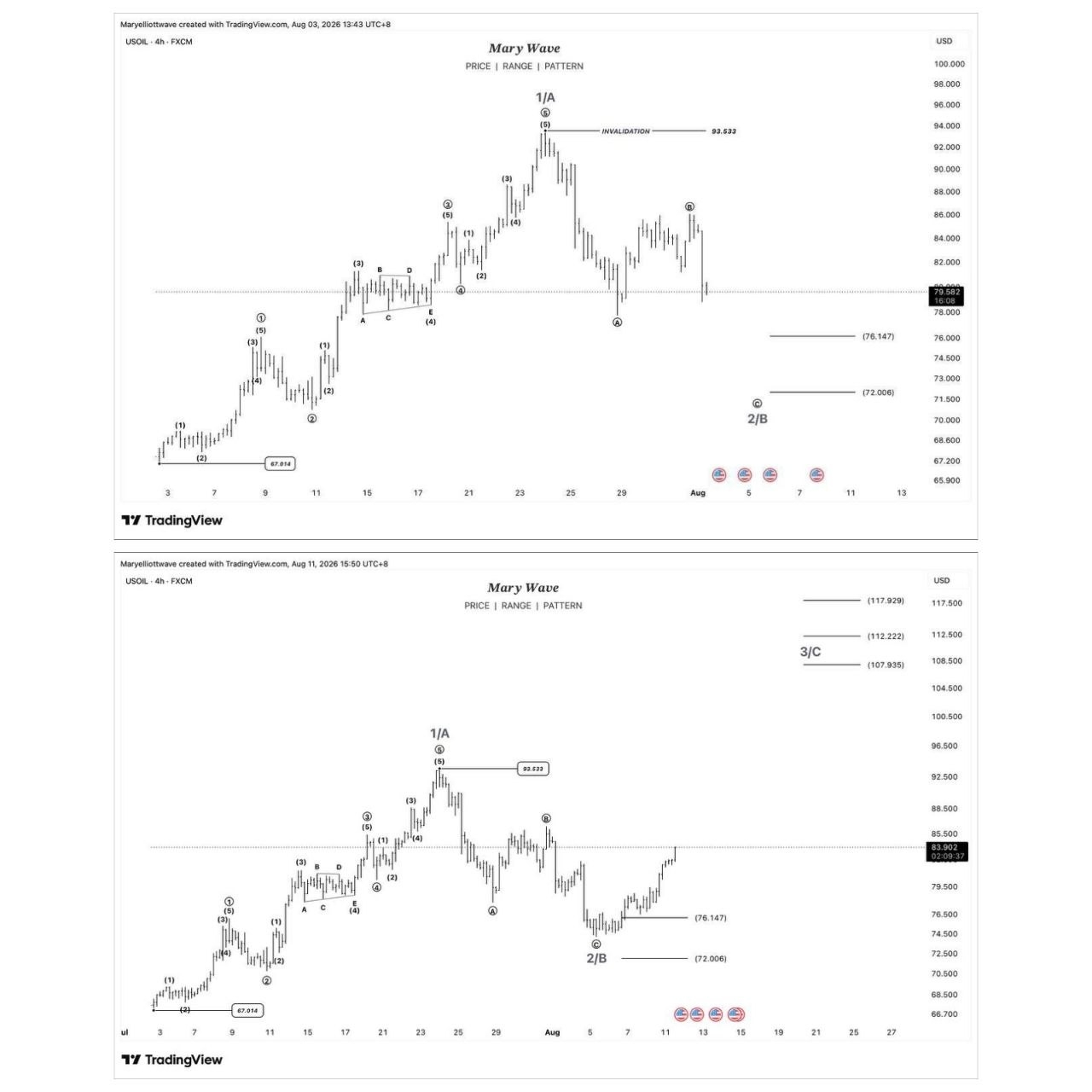
First chart was created on August 3, 2026.
I was expecting USOIL to continue lower and complete Wave 2/B around the $76.147–$72.006 area. Price eventually tapped the zone and reacted strongly from there.
Now we’re trading back above $83, and I’m watching how the structure develops from here. If this count continues to play out, Wave 3/C is the next move I’m looking for, with $107.935–$117.929 as the upside area.
One step at a time. We follow the structure and let the market do the rest. 📈
#USOILUSD #ElliottWaveTheory #TechnicalAnalysis
$USOIL | BEFORE & AFTER 📊
First chart was created on August 3, 2026.
I was expecting USOIL to continue lower and complete Wave 2/B around the $76.147–$72.006 area. Price eventually tapped the zone and reacted strongly from there.
Now we’re trading back above $83, and I’m watching how the structure develops from here. If this count continues to play out, Wave 3/C is the next move I’m looking for, with $107.935–$117.929 as the upside area.
One step at a time. We follow the structure and let the market do the rest. 📈
#USOILUSD #ElliottWaveTheory #TechnicalAnalysis
First chart was created on August 3, 2026.
I was expecting USOIL to continue lower and complete Wave 2/B around the $76.147–$72.006 area. Price eventually tapped the zone and reacted strongly from there.
Now we’re trading back above $83, and I’m watching how the structure develops from here. If this count continues to play out, Wave 3/C is the next move I’m looking for, with $107.935–$117.929 as the upside area.
One step at a time. We follow the structure and let the market do the rest. 📈
#USOILUSD #ElliottWaveTheory #TechnicalAnalysis
1
2
1.1k
$PEPE | 5D OUTLOOK 📉
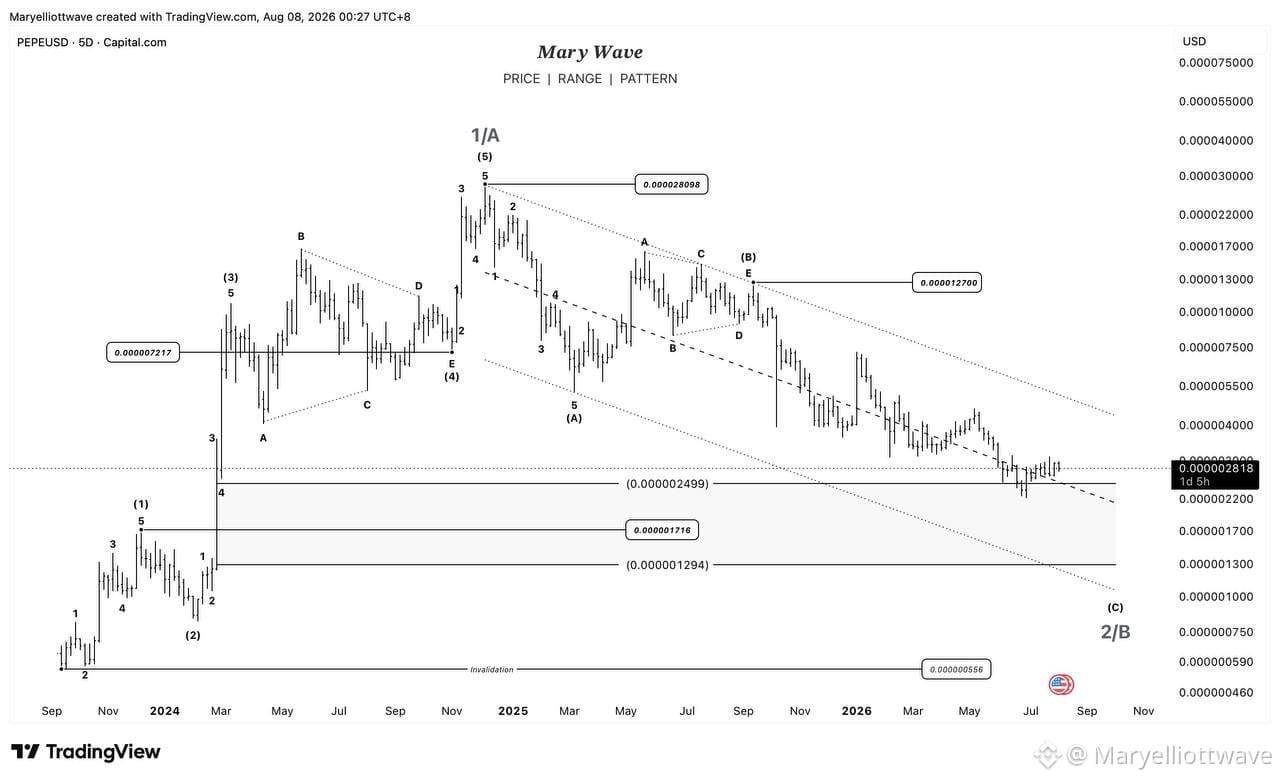
PEPE continues to develop within a broader corrective structure following the completion of a larger impulsive advance labeled Wave 1/A near $0.000028098.
From an Elliott Wave perspective, the decline from that high appears to be unfolding as an A-B-C correction, with Wave (A) already completed and Wave (B) forming a corrective triangle before price resumed its decline. The preferred scenario suggests that Wave (C) of the larger Wave 2/B is still in progress.
As long as the broader bearish structure remains intact, PEPE could continue moving lower toward the $0.000002499–$0.000001294 support zone, which remains my primary area of interest for the potential completion of Wave 2/B.
The larger bullish Elliott Wave count remains valid as long as price stays above the major invalidation level at $0.000000556. If the correction eventually completes while respecting this level, I will reassess the structure for signs of the next larger impulsive advance.
The market will ultimately determine whether this Elliott Wave count remains valid. Until then, I continue to respect the current corrective structure and remain flexible if price action provides a valid reason to reassess the count.
This analysis is for educational purposes only and should not be considered financial advice.
#PEPE #PEPEUSDT #Cryptocurrency #ElliottWaveTheory #TechnicalAnalysis
$PEPE | 5D OUTLOOK 📉
PEPE continues to develop within a broader corrective structure following the completion of a larger impulsive advance labeled Wave 1/A near $0.000028098.
From an Elliott Wave perspective, the decline from that high appears to be unfolding as an A-B-C correction, with Wave (A) already completed and Wave (B) forming a corrective triangle before price resumed its decline. The preferred scenario suggests that Wave (C) of the larger Wave 2/B is still in progress.
As long as the broader bearish structure remains intact, PEPE could continue moving lower toward the $0.000002499–$0.000001294 support zone, which remains my primary area of interest for the potential completion of Wave 2/B.
The larger bullish Elliott Wave count remains valid as long as price stays above the major invalidation level at $0.000000556. If the correction eventually completes while respecting this level, I will reassess the structure for signs of the next larger impulsive advance.
The market will ultimately determine whether this Elliott Wave count remains valid. Until then, I continue to respect the current corrective structure and remain flexible if price action provides a valid reason to reassess the count.
This analysis is for educational purposes only and should not be considered financial advice.
#PEPE #PEPEUSDT #Cryptocurrency #ElliottWaveTheory #TechnicalAnalysis
PEPE continues to develop within a broader corrective structure following the completion of a larger impulsive advance labeled Wave 1/A near $0.000028098.
From an Elliott Wave perspective, the decline from that high appears to be unfolding as an A-B-C correction, with Wave (A) already completed and Wave (B) forming a corrective triangle before price resumed its decline. The preferred scenario suggests that Wave (C) of the larger Wave 2/B is still in progress.
As long as the broader bearish structure remains intact, PEPE could continue moving lower toward the $0.000002499–$0.000001294 support zone, which remains my primary area of interest for the potential completion of Wave 2/B.
The larger bullish Elliott Wave count remains valid as long as price stays above the major invalidation level at $0.000000556. If the correction eventually completes while respecting this level, I will reassess the structure for signs of the next larger impulsive advance.
The market will ultimately determine whether this Elliott Wave count remains valid. Until then, I continue to respect the current corrective structure and remain flexible if price action provides a valid reason to reassess the count.
This analysis is for educational purposes only and should not be considered financial advice.
#PEPE #PEPEUSDT #Cryptocurrency #ElliottWaveTheory #TechnicalAnalysis
7
3.8k
·
--
Bearish
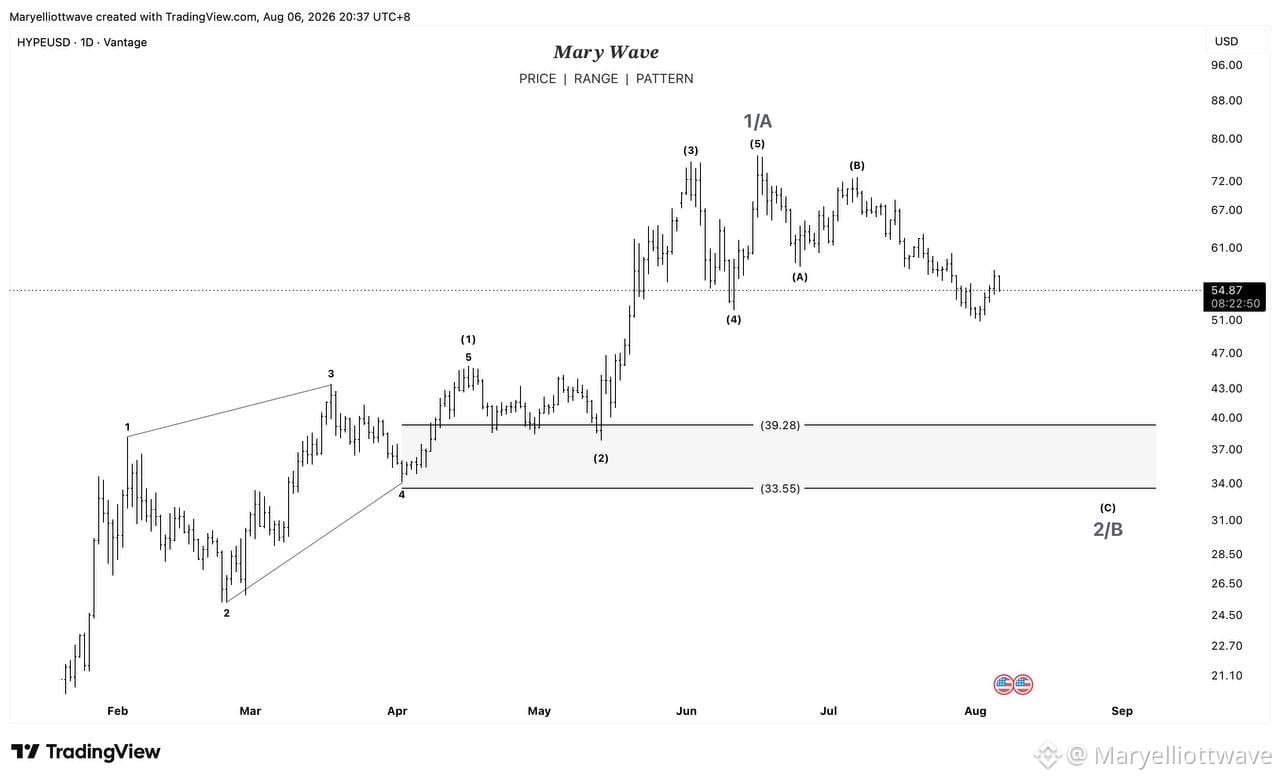
$HYPE | 1D BEARISH OUTLOOK 📉
HYPE continues to respect a broader corrective structure following the completion of a larger impulsive advance. From an Elliott Wave perspective, the recent rebound appears to be corrective in nature, suggesting that the market may still be developing Wave 2/B before the next leg lower.
As long as price remains below the previous swing highs, the preferred scenario remains bearish. If this wave count remains valid, HYPE could gradually decline toward the $39.28–$33.55 support zone, which is the primary area of interest for the potential completion of Wave 2/B.
The market will ultimately decide whether this Elliott Wave count remains valid. Until then, I continue to respect the current structure while remaining flexible enough to adapt if price action proves otherwise.
This analysis is for educational purposes only and should not be considered financial advice.
#HYPE #HYPEUSD #ElliottWaveTheory #TechnicalAnalysis
$HYPE | 1D BEARISH OUTLOOK 📉
HYPE continues to respect a broader corrective structure following the completion of a larger impulsive advance. From an Elliott Wave perspective, the recent rebound appears to be corrective in nature, suggesting that the market may still be developing Wave 2/B before the next leg lower.
As long as price remains below the previous swing highs, the preferred scenario remains bearish. If this wave count remains valid, HYPE could gradually decline toward the $39.28–$33.55 support zone, which is the primary area of interest for the potential completion of Wave 2/B.
The market will ultimately decide whether this Elliott Wave count remains valid. Until then, I continue to respect the current structure while remaining flexible enough to adapt if price action proves otherwise.
This analysis is for educational purposes only and should not be considered financial advice.
#HYPE #HYPEUSD #ElliottWaveTheory #TechnicalAnalysis
HYPE continues to respect a broader corrective structure following the completion of a larger impulsive advance. From an Elliott Wave perspective, the recent rebound appears to be corrective in nature, suggesting that the market may still be developing Wave 2/B before the next leg lower.
As long as price remains below the previous swing highs, the preferred scenario remains bearish. If this wave count remains valid, HYPE could gradually decline toward the $39.28–$33.55 support zone, which is the primary area of interest for the potential completion of Wave 2/B.
The market will ultimately decide whether this Elliott Wave count remains valid. Until then, I continue to respect the current structure while remaining flexible enough to adapt if price action proves otherwise.
This analysis is for educational purposes only and should not be considered financial advice.
#HYPE #HYPEUSD #ElliottWaveTheory #TechnicalAnalysis
289
·
--
Bullish
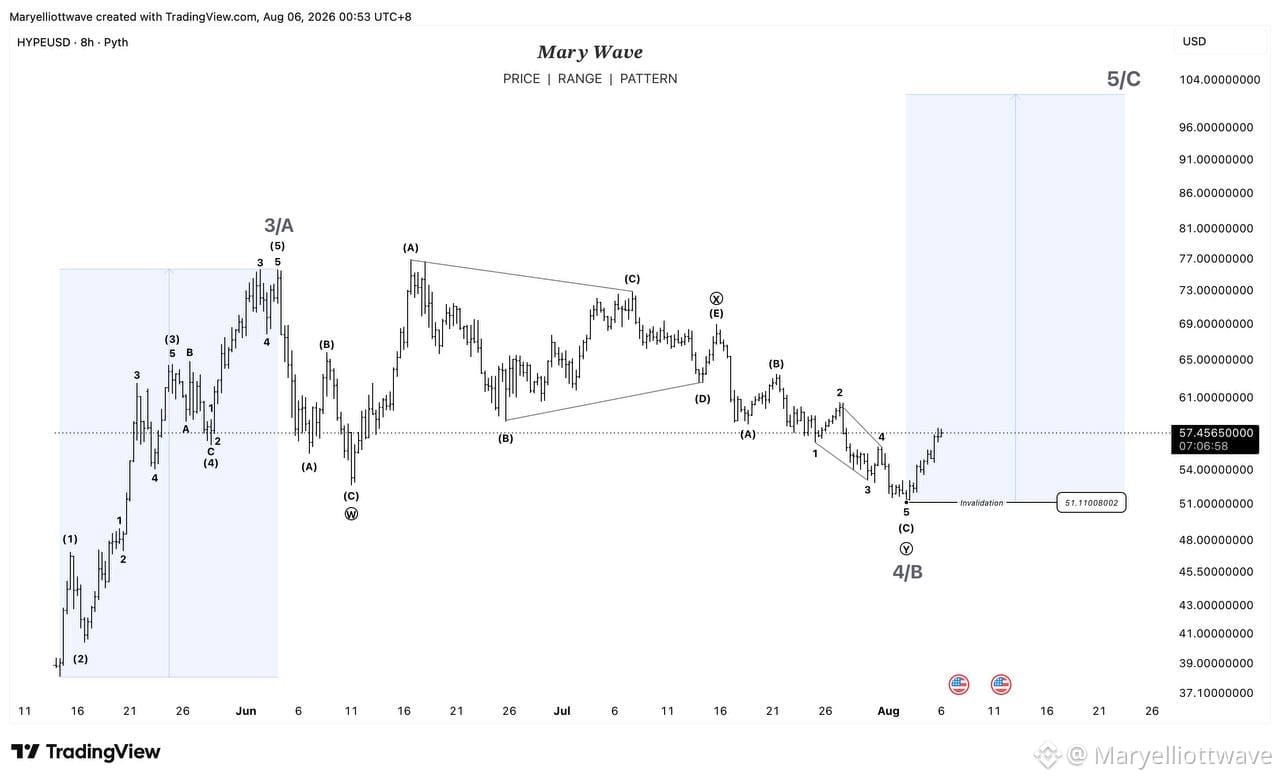
$HYPE | 8H OUTLOOK 📈
$HYPE appears to have completed a complex Wave 4/B correction, with price now showing the early stages of a potential impulsive advance.
From an Elliott Wave perspective, the recent decline looks complete, followed by an initial five-wave structure off the lows. If this count remains valid, the market may now be developing Wave 5/C, with an upside objective near the $100 area.
The current Elliott Wave count remains valid as long as price holds above the invalidation level at $51.11. A break below this level would invalidate the preferred bullish scenario and require a reassessment of the wave structure.
Elliott Wave is not about predicting every move with certainty. It is about identifying the highest-probability market structure, defining objective invalidation levels, and adapting only when price action provides a valid reason to do so.
This analysis is for educational purposes only and should not be considered financial advice.
#HYPE #Hyperliquid #ElliottWaveTheory #TechnicalAnalysis
$HYPE | 8H OUTLOOK 📈
$HYPE appears to have completed a complex Wave 4/B correction, with price now showing the early stages of a potential impulsive advance.
From an Elliott Wave perspective, the recent decline looks complete, followed by an initial five-wave structure off the lows. If this count remains valid, the market may now be developing Wave 5/C, with an upside objective near the $100 area.
The current Elliott Wave count remains valid as long as price holds above the invalidation level at $51.11. A break below this level would invalidate the preferred bullish scenario and require a reassessment of the wave structure.
Elliott Wave is not about predicting every move with certainty. It is about identifying the highest-probability market structure, defining objective invalidation levels, and adapting only when price action provides a valid reason to do so.
This analysis is for educational purposes only and should not be considered financial advice.
#HYPE #Hyperliquid #ElliottWaveTheory #TechnicalAnalysis
$HYPE appears to have completed a complex Wave 4/B correction, with price now showing the early stages of a potential impulsive advance.
From an Elliott Wave perspective, the recent decline looks complete, followed by an initial five-wave structure off the lows. If this count remains valid, the market may now be developing Wave 5/C, with an upside objective near the $100 area.
The current Elliott Wave count remains valid as long as price holds above the invalidation level at $51.11. A break below this level would invalidate the preferred bullish scenario and require a reassessment of the wave structure.
Elliott Wave is not about predicting every move with certainty. It is about identifying the highest-probability market structure, defining objective invalidation levels, and adapting only when price action provides a valid reason to do so.
This analysis is for educational purposes only and should not be considered financial advice.
#HYPE #Hyperliquid #ElliottWaveTheory #TechnicalAnalysis
1
225
·
--
Bearish
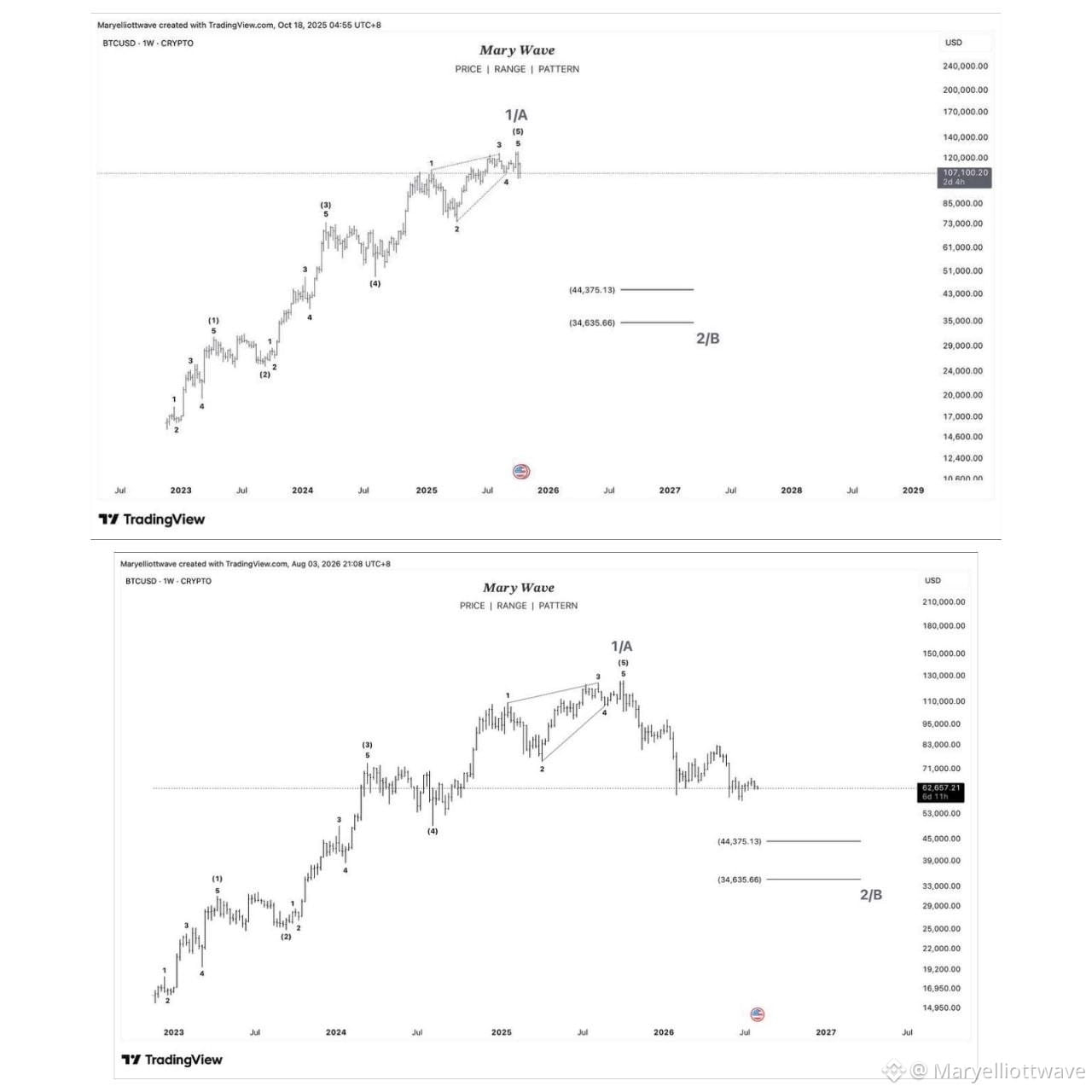
$BTC | 1W UPDATE 📈
I charted this Elliott Wave roadmap on October 18, 2025. The second chart shows how the market unfolded as of August 3, 2026.
When I first shared this analysis, I received a lot of criticism. Many believed Bitcoin would continue going straight up and that a deeper correction wasn’t possible. That’s completely fine because everyone is entitled to their own market view.
As an Elliottician, my responsibility isn’t to predict every move with certainty. It’s to analyze the market objectively using Elliott Wave rules, identify the highest-probability structure, define invalidation levels, and adapt only when price provides a valid reason to do so.
This isn’t about proving who was right or wrong. Markets don’t reward opinions. They reward discipline, risk management, and the ability to follow a structured plan.
I’m not a perfect Elliottician, and I never claim to be. There will always be alternative counts, and I adapt whenever the market invalidates a scenario. That’s part of professional analysis.
I’m grateful to those who took the time to understand the chart with an open mind. Some even shared that it helped them manage risk and make better decisions. If you disagree with an analysis, that’s completely okay. Instead of dismissing it outright, take the time to understand the structure and reasoning behind it. Even if it doesn’t match your own view, it can still provide another perspective.
Elliott Wave isn’t about predicting the future with certainty. It’s about preparing for probabilities while respecting risk.
#BTC #Bitcoin❗ #ElliottWaveTheory #TechnicalAnalysis
$BTC | 1W UPDATE 📈
I charted this Elliott Wave roadmap on October 18, 2025. The second chart shows how the market unfolded as of August 3, 2026.
When I first shared this analysis, I received a lot of criticism. Many believed Bitcoin would continue going straight up and that a deeper correction wasn’t possible. That’s completely fine because everyone is entitled to their own market view.
As an Elliottician, my responsibility isn’t to predict every move with certainty. It’s to analyze the market objectively using Elliott Wave rules, identify the highest-probability structure, define invalidation levels, and adapt only when price provides a valid reason to do so.
This isn’t about proving who was right or wrong. Markets don’t reward opinions. They reward discipline, risk management, and the ability to follow a structured plan.
I’m not a perfect Elliottician, and I never claim to be. There will always be alternative counts, and I adapt whenever the market invalidates a scenario. That’s part of professional analysis.
I’m grateful to those who took the time to understand the chart with an open mind. Some even shared that it helped them manage risk and make better decisions. If you disagree with an analysis, that’s completely okay. Instead of dismissing it outright, take the time to understand the structure and reasoning behind it. Even if it doesn’t match your own view, it can still provide another perspective.
Elliott Wave isn’t about predicting the future with certainty. It’s about preparing for probabilities while respecting risk.
#BTC #Bitcoin❗ #ElliottWaveTheory #TechnicalAnalysis
I charted this Elliott Wave roadmap on October 18, 2025. The second chart shows how the market unfolded as of August 3, 2026.
When I first shared this analysis, I received a lot of criticism. Many believed Bitcoin would continue going straight up and that a deeper correction wasn’t possible. That’s completely fine because everyone is entitled to their own market view.
As an Elliottician, my responsibility isn’t to predict every move with certainty. It’s to analyze the market objectively using Elliott Wave rules, identify the highest-probability structure, define invalidation levels, and adapt only when price provides a valid reason to do so.
This isn’t about proving who was right or wrong. Markets don’t reward opinions. They reward discipline, risk management, and the ability to follow a structured plan.
I’m not a perfect Elliottician, and I never claim to be. There will always be alternative counts, and I adapt whenever the market invalidates a scenario. That’s part of professional analysis.
I’m grateful to those who took the time to understand the chart with an open mind. Some even shared that it helped them manage risk and make better decisions. If you disagree with an analysis, that’s completely okay. Instead of dismissing it outright, take the time to understand the structure and reasoning behind it. Even if it doesn’t match your own view, it can still provide another perspective.
Elliott Wave isn’t about predicting the future with certainty. It’s about preparing for probabilities while respecting risk.
#BTC #Bitcoin❗ #ElliottWaveTheory #TechnicalAnalysis
1
207
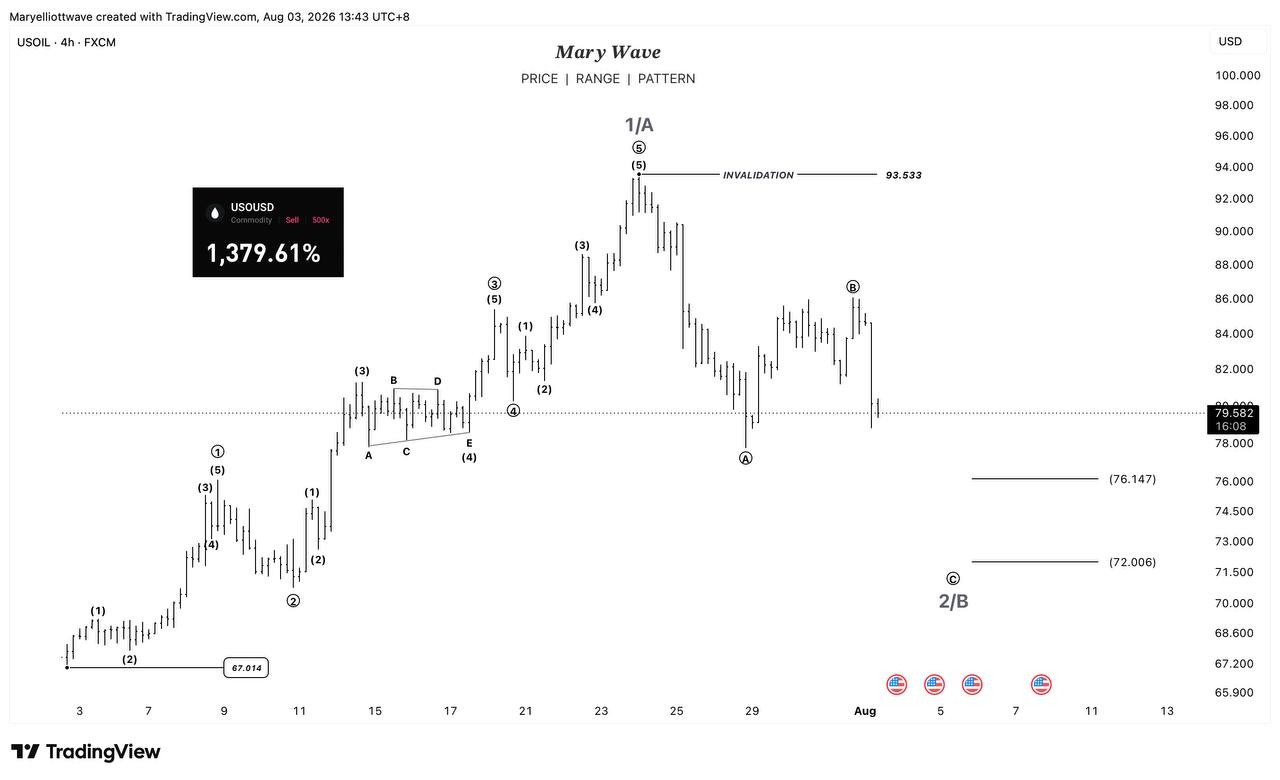
$USOIL | 4H OUTLOOK 🛢️📉
The current structure continues to favor the bearish scenario. After completing the impulsive advance, price appears to be unfolding an A-B-C corrective sequence, with wave B likely completed. As long as price remains below the invalidation level at 93.533, the primary expectation remains a continuation toward the projected 2/B zone.
In Elliott Wave Theory, the focus isn’t on predicting every candle. It’s about identifying the highest-probability market structure, respecting invalidation levels, and managing risk accordingly. The market decides the outcome; our job is simply to follow the structure.
📊 Running profit on this position: +1,379.61% (at the time of posting).
This analysis is shared for educational purposes only and is not financial advice.
#USOILUSD #TechnicalAnalysis #MarketStructure #BinanceSquare
$USOIL | 4H OUTLOOK 🛢️📉
The current structure continues to favor the bearish scenario. After completing the impulsive advance, price appears to be unfolding an A-B-C corrective sequence, with wave B likely completed. As long as price remains below the invalidation level at 93.533, the primary expectation remains a continuation toward the projected 2/B zone.
In Elliott Wave Theory, the focus isn’t on predicting every candle. It’s about identifying the highest-probability market structure, respecting invalidation levels, and managing risk accordingly. The market decides the outcome; our job is simply to follow the structure.
📊 Running profit on this position: +1,379.61% (at the time of posting).
This analysis is shared for educational purposes only and is not financial advice.
#USOILUSD #TechnicalAnalysis #MarketStructure #BinanceSquare
The current structure continues to favor the bearish scenario. After completing the impulsive advance, price appears to be unfolding an A-B-C corrective sequence, with wave B likely completed. As long as price remains below the invalidation level at 93.533, the primary expectation remains a continuation toward the projected 2/B zone.
In Elliott Wave Theory, the focus isn’t on predicting every candle. It’s about identifying the highest-probability market structure, respecting invalidation levels, and managing risk accordingly. The market decides the outcome; our job is simply to follow the structure.
📊 Running profit on this position: +1,379.61% (at the time of posting).
This analysis is shared for educational purposes only and is not financial advice.
#USOILUSD #TechnicalAnalysis #MarketStructure #BinanceSquare
145
·
--
Bearish
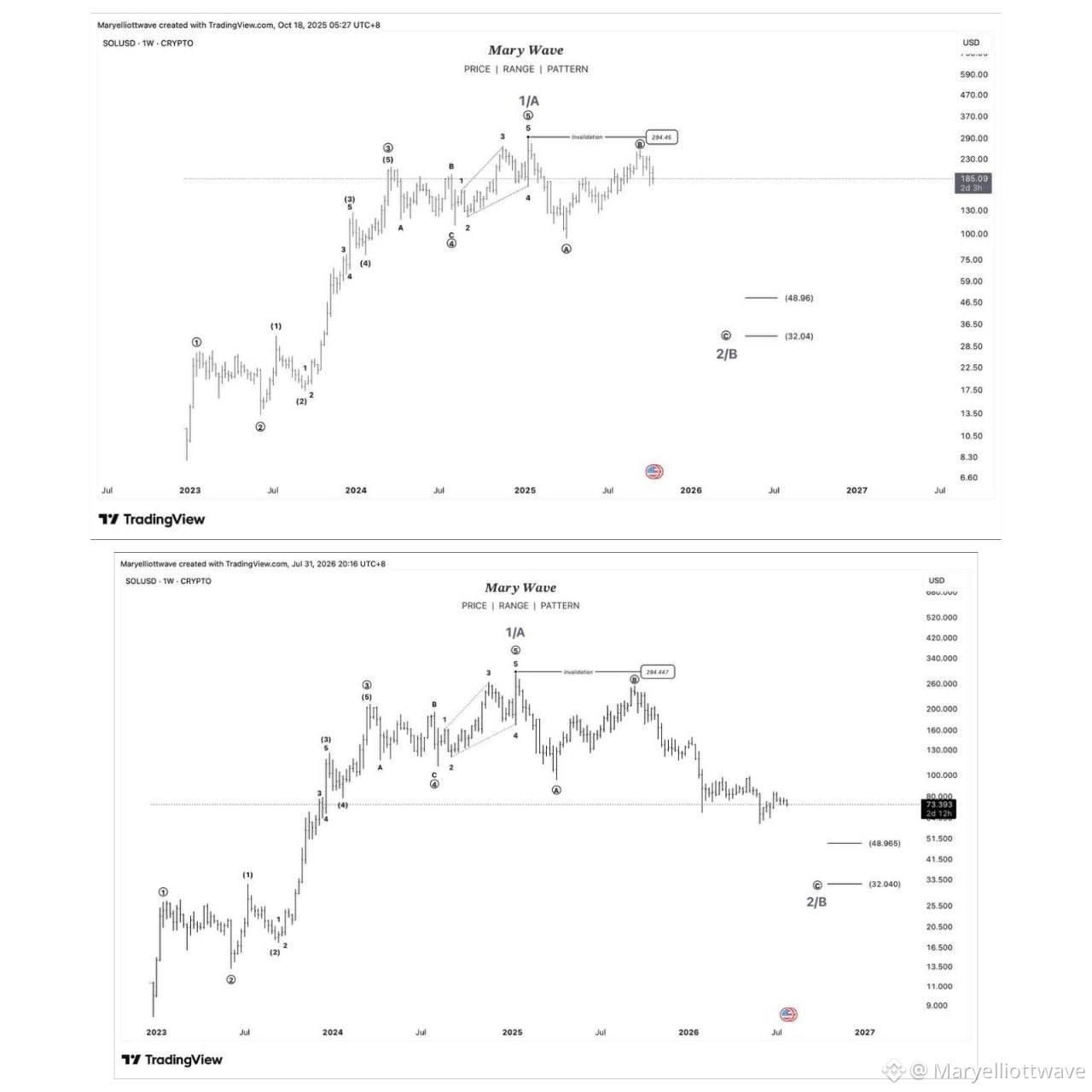
$SOL | 1W UPDATE 📈
This was one of my higher-timeframe bearish scenarios shared in October 2025. At the time, the market was approaching a key resistance area, with $294 identified as the invalidation level for the bearish count.
Over the following months, price failed to invalidate the structure and instead continued moving in the expected direction. As of this update, $SOL is trading around $73, keeping the broader Elliott Wave count intact.
One reason I rely on higher-timeframe analysis is that it allows the market enough room to develop without getting distracted by short-term volatility. A single chart won’t capture every swing, but a well-defined structure can provide a reliable roadmap as price unfolds over time.
Every market has multiple possibilities, but having a clear preferred count, an invalidation level, and proper risk management is what keeps the analysis objective.
#SOL #Solana #ElliottWave #TechnicalAnalysis #CryptoTrading #BinanceSquare
$SOL | 1W UPDATE 📈
This was one of my higher-timeframe bearish scenarios shared in October 2025. At the time, the market was approaching a key resistance area, with $294 identified as the invalidation level for the bearish count.
Over the following months, price failed to invalidate the structure and instead continued moving in the expected direction. As of this update, $SOL is trading around $73, keeping the broader Elliott Wave count intact.
One reason I rely on higher-timeframe analysis is that it allows the market enough room to develop without getting distracted by short-term volatility. A single chart won’t capture every swing, but a well-defined structure can provide a reliable roadmap as price unfolds over time.
Every market has multiple possibilities, but having a clear preferred count, an invalidation level, and proper risk management is what keeps the analysis objective.
#SOL #Solana #ElliottWave #TechnicalAnalysis #CryptoTrading #BinanceSquare
This was one of my higher-timeframe bearish scenarios shared in October 2025. At the time, the market was approaching a key resistance area, with $294 identified as the invalidation level for the bearish count.
Over the following months, price failed to invalidate the structure and instead continued moving in the expected direction. As of this update, $SOL is trading around $73, keeping the broader Elliott Wave count intact.
One reason I rely on higher-timeframe analysis is that it allows the market enough room to develop without getting distracted by short-term volatility. A single chart won’t capture every swing, but a well-defined structure can provide a reliable roadmap as price unfolds over time.
Every market has multiple possibilities, but having a clear preferred count, an invalidation level, and proper risk management is what keeps the analysis objective.
#SOL #Solana #ElliottWave #TechnicalAnalysis #CryptoTrading #BinanceSquare
7
34
37.1k
·
--
Bearish
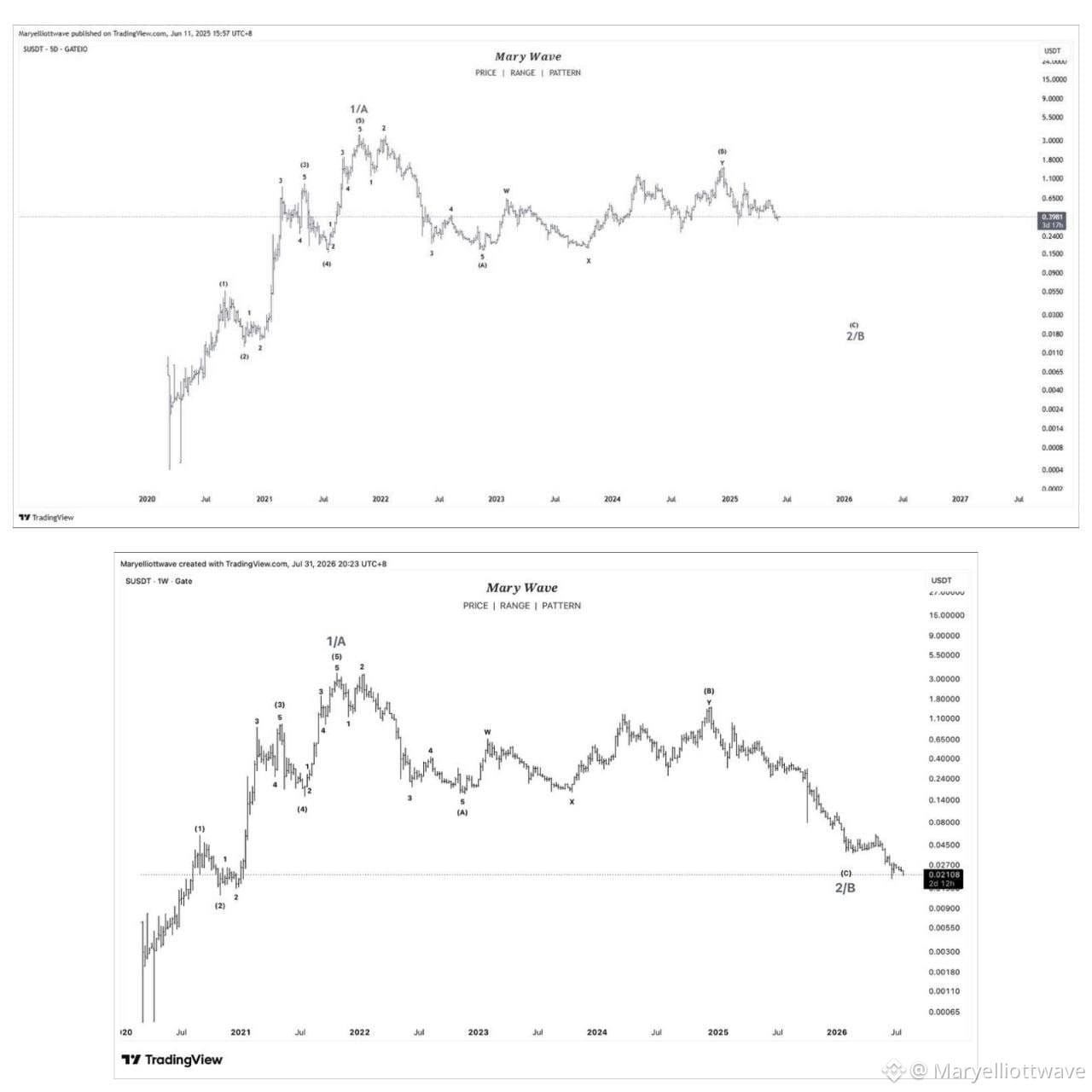
$S | 1W UPDATE 📈
Back in June 2025, I shared this higher timeframe Elliott Wave roadmap for $S , with the expectation that price would continue lower toward the Wave 2/B region.
Fast forward to July 2026, the updated chart shows that the bearish scenario continued to unfold and price has now reached the projected target area. This is why I always prefer starting with the higher timeframe. It helps filter out short term noise and keeps the focus on the dominant market structure.
No analysis is perfect, and every wave count should always have a clear invalidation level. But when the larger structure remains intact, patience often becomes one of the biggest edges a trader can have.
The market doesn’t owe us certainty. Our job is to identify the highest probability path, manage risk, and let price do the rest.
#SUSD #ElliottWave #TechnicalAnalysis #Crypto #Trading #BinanceSquare #WaveAnalysis
$S | 1W UPDATE 📈
Back in June 2025, I shared this higher timeframe Elliott Wave roadmap for $S , with the expectation that price would continue lower toward the Wave 2/B region.
Fast forward to July 2026, the updated chart shows that the bearish scenario continued to unfold and price has now reached the projected target area. This is why I always prefer starting with the higher timeframe. It helps filter out short term noise and keeps the focus on the dominant market structure.
No analysis is perfect, and every wave count should always have a clear invalidation level. But when the larger structure remains intact, patience often becomes one of the biggest edges a trader can have.
The market doesn’t owe us certainty. Our job is to identify the highest probability path, manage risk, and let price do the rest.
#SUSD #ElliottWave #TechnicalAnalysis #Crypto #Trading #BinanceSquare #WaveAnalysis
Back in June 2025, I shared this higher timeframe Elliott Wave roadmap for $S , with the expectation that price would continue lower toward the Wave 2/B region.
Fast forward to July 2026, the updated chart shows that the bearish scenario continued to unfold and price has now reached the projected target area. This is why I always prefer starting with the higher timeframe. It helps filter out short term noise and keeps the focus on the dominant market structure.
No analysis is perfect, and every wave count should always have a clear invalidation level. But when the larger structure remains intact, patience often becomes one of the biggest edges a trader can have.
The market doesn’t owe us certainty. Our job is to identify the highest probability path, manage risk, and let price do the rest.
#SUSD #ElliottWave #TechnicalAnalysis #Crypto #Trading #BinanceSquare #WaveAnalysis
6
849
Log in to explore more content
Join global crypto users on Binance Square
⚡️ Get latest and useful information about crypto.
💬 Trusted by the world’s largest crypto exchange.
👍 Discover real insights from verified creators.
Email / Phone number
Trending Topics
BitcoinReboundsTo$79K
30,427 views
246 Discussing
🚨 $BTC is pushing higher.
Bitcoin is trading around $78,804, up roughly 1.9%, after reclaiming the $78K area. The next level to watch is the intraday high near $78,905.
A clean break above that level could open the way toward $79K–$80K. If BTC gets rejected, support sits around $78,300, then $77,975.
Bulls have momentum, but BTC needs to hold above $78K.
#Bitcoin #BTC #CryptoTrading #CryptoMarket #CryptoAnalysis
PulseON
·22 Likes
·23.8k views
BessentEndorsesFinalClarityActDraft
0 views
7 Discussing
ZamaOpens16ConfidentialMorphoVaults
0 views
6 Discussing