
沧楠晟
4.9k Posts

沧楠晟
 Square Verified+
Report
Block User
公众号:@LF327369 加密飞龙 微博:加密飞龙 :推特 加密飞龙:全网同名 加密飞龙:手续费8折 LN5ZYWQB 邀请码 Web3领域研究,Crypto热点推介,土狗爱好者,一二级市场分析

Traders League Badge Beginner

PENGU Holder
Frequent Trader
5.8 Years
177 Following
31.3K+ Followers
46.5K+ Liked
1 Badges
Posts
All
Quotes
Videos
Live
PINNED
·
--
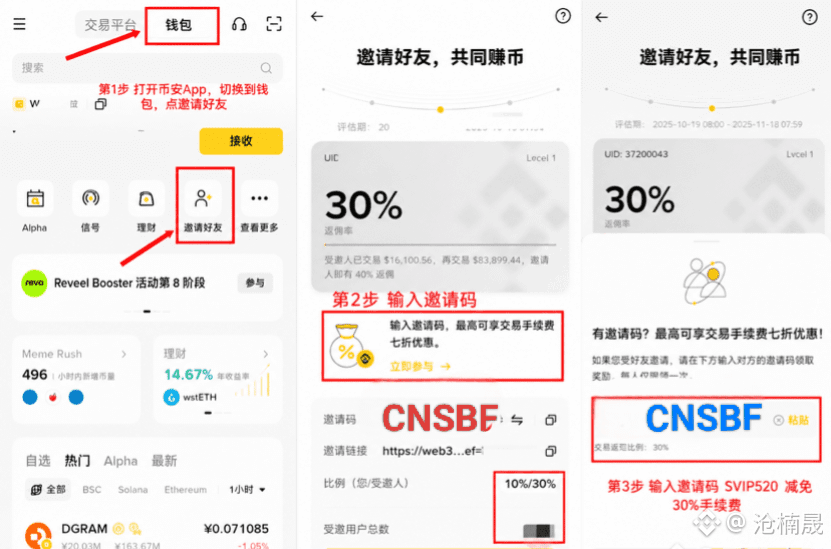
The meme market is hot right now. With tens of thousands of U trading hands frequently, just the fees alone can burn through several thousand U in a single day. This is absolutely a big problem! Money is money, no matter how little it is, so don’t ever treat it like it doesn’t matter. I strongly recommend everyone try Binance Wallet — the fee rates are really great!
First, as long as it’s an Alpha-listed coin (such as Flork, Niu Lai, etc.), the fee is always 0! The standard fee for ordinary memes is 0.5%, but if you use my referral link, you can enjoy a 30% cashback discount, which works out to only 0.35%. Recently, they also launched a 20% off promotion for the Robinhood chain. Combined with cashback, the fee is as low as 0.28%, absolutely the lowest on the entire web, and extremely friendly for large holders!
Here I’m sharing a “level-one wallet money-making idea”: everyone can register with a wallet, use an invite code to join the community, and discover the next cash cow together as early as possible!
Hurry and register with my invite code [CNSBF],
link: https://web3.binance.com/referral?ref=CNSBF.
[币安ALPHA](https://web3.binance.com/referral?ref=CNSBF) Saving money is making money, come join me and chase the next coin at low cost! $FLOCK
{future}(FLOCKUSDT)
$牛来
{future}(牛来USDT)
#美国8月新增就业16.2万近预期三倍
The meme market is hot right now. With tens of thousands of U trading hands frequently, just the fees alone can burn through several thousand U in a single day. This is absolutely a big problem! Money is money, no matter how little it is, so don’t ever treat it like it doesn’t matter. I strongly recommend everyone try Binance Wallet — the fee rates are really great!
First, as long as it’s an Alpha-listed coin (such as Flork, Niu Lai, etc.), the fee is always 0! The standard fee for ordinary memes is 0.5%, but if you use my referral link, you can enjoy a 30% cashback discount, which works out to only 0.35%. Recently, they also launched a 20% off promotion for the Robinhood chain. Combined with cashback, the fee is as low as 0.28%, absolutely the lowest on the entire web, and extremely friendly for large holders!
Here I’m sharing a “level-one wallet money-making idea”: everyone can register with a wallet, use an invite code to join the community, and discover the next cash cow together as early as possible!
Hurry and register with my invite code [CNSBF],
link: https://web3.binance.com/referral?ref=CNSBF.
币安ALPHA Saving money is making money, come join me and chase the next coin at low cost! $FLOCK
$牛来
#美国8月新增就业16.2万近预期三倍
First, as long as it’s an Alpha-listed coin (such as Flork, Niu Lai, etc.), the fee is always 0! The standard fee for ordinary memes is 0.5%, but if you use my referral link, you can enjoy a 30% cashback discount, which works out to only 0.35%. Recently, they also launched a 20% off promotion for the Robinhood chain. Combined with cashback, the fee is as low as 0.28%, absolutely the lowest on the entire web, and extremely friendly for large holders!
Here I’m sharing a “level-one wallet money-making idea”: everyone can register with a wallet, use an invite code to join the community, and discover the next cash cow together as early as possible!
Hurry and register with my invite code [CNSBF],
link: https://web3.binance.com/referral?ref=CNSBF.
币安ALPHA Saving money is making money, come join me and chase the next coin at low cost! $FLOCK
$牛来
#美国8月新增就业16.2万近预期三倍
2
1.9k
PINNED
·
--
The market is heating up, and your trading fees are turning into someone else’s “post-sleep income”
With this recent rally, I’m sure everyone has felt it too—BTC once pushed close to $78,000, the altcoin season has fully ignited, and trading volume has visibly surged. But there’s one question worth thinking about:
Where exactly does the trading fee you pay every day end up?
Referral commissions are not just about “saving on fees”
Let’s do some quick math. Binance’s spot and futures base fee rates are relatively low, but if you’re a high-frequency trader or have a certain trading volume, these small amounts add up to an eye-opening figure.
Binance Super Referral Program is designed to return part of the fees you were going to pay anyway back to your own pocket.
According to Binance’s official rules, the referrer can receive up to 40% of the commission rate, while the referred user can receive up to 20% cashback. The combined percentage for the referrer and referred user must not exceed 45%.
The market won’t always be this good, but once the referral commission pipeline is set up, it’s permanent.
When a bull market comes, trading volume grows and referral income rises with it; when a bear market comes, as long as the users you referred are still trading, the referral commissions won’t stop.
Enabling referral commissions is essentially installing a “market amplifier” for yourself—when the market is good, it helps you earn more; when the market is bad, it gives you a baseline income.
If you’re interested, just contact me directly. I’ll help you set up as a referrer and get back the fees that should rightfully belong to you.
If you need the referral commission and the referral commission enabling feature, contact me. Join the chat room to learn the specific setup process.
Click to join the referral program
[CNSBF](https://www.bsmkweb.cc/register?ref=CNSBF)
$TRUMP
{future}(TRUMPUSDT)
$ETH
{future}(ETHUSDT)
$PEPE
{spot}(PEPEUSDT)
#TRUMP突破3.4美元创3月21日以来新高 #美元跌至三个月低点
The market is heating up, and your trading fees are turning into someone else’s “post-sleep income”
With this recent rally, I’m sure everyone has felt it too—BTC once pushed close to $78,000, the altcoin season has fully ignited, and trading volume has visibly surged. But there’s one question worth thinking about:
Where exactly does the trading fee you pay every day end up?
Referral commissions are not just about “saving on fees”
Let’s do some quick math. Binance’s spot and futures base fee rates are relatively low, but if you’re a high-frequency trader or have a certain trading volume, these small amounts add up to an eye-opening figure.
Binance Super Referral Program is designed to return part of the fees you were going to pay anyway back to your own pocket.
According to Binance’s official rules, the referrer can receive up to 40% of the commission rate, while the referred user can receive up to 20% cashback. The combined percentage for the referrer and referred user must not exceed 45%.
The market won’t always be this good, but once the referral commission pipeline is set up, it’s permanent.
When a bull market comes, trading volume grows and referral income rises with it; when a bear market comes, as long as the users you referred are still trading, the referral commissions won’t stop.
Enabling referral commissions is essentially installing a “market amplifier” for yourself—when the market is good, it helps you earn more; when the market is bad, it gives you a baseline income.
If you’re interested, just contact me directly. I’ll help you set up as a referrer and get back the fees that should rightfully belong to you.
If you need the referral commission and the referral commission enabling feature, contact me. Join the chat room to learn the specific setup process.
Click to join the referral program
CNSBF
$TRUMP
$ETH
$PEPE
#TRUMP突破3.4美元创3月21日以来新高 #美元跌至三个月低点
With this recent rally, I’m sure everyone has felt it too—BTC once pushed close to $78,000, the altcoin season has fully ignited, and trading volume has visibly surged. But there’s one question worth thinking about:
Where exactly does the trading fee you pay every day end up?
Referral commissions are not just about “saving on fees”
Let’s do some quick math. Binance’s spot and futures base fee rates are relatively low, but if you’re a high-frequency trader or have a certain trading volume, these small amounts add up to an eye-opening figure.
Binance Super Referral Program is designed to return part of the fees you were going to pay anyway back to your own pocket.
According to Binance’s official rules, the referrer can receive up to 40% of the commission rate, while the referred user can receive up to 20% cashback. The combined percentage for the referrer and referred user must not exceed 45%.
The market won’t always be this good, but once the referral commission pipeline is set up, it’s permanent.
When a bull market comes, trading volume grows and referral income rises with it; when a bear market comes, as long as the users you referred are still trading, the referral commissions won’t stop.
Enabling referral commissions is essentially installing a “market amplifier” for yourself—when the market is good, it helps you earn more; when the market is bad, it gives you a baseline income.
If you’re interested, just contact me directly. I’ll help you set up as a referrer and get back the fees that should rightfully belong to you.
If you need the referral commission and the referral commission enabling feature, contact me. Join the chat room to learn the specific setup process.
Click to join the referral program
CNSBF
$TRUMP
$ETH
$PEPE
#TRUMP突破3.4美元创3月21日以来新高 #美元跌至三个月低点
2
643
·
--
Verified
$KERNEL TVL over $1 billion, three main product lines cover 10+ public chains
KernelDAO total value locked exceeds $1 billion, covering more than 10 public chains including Ethereum, BNB Chain, Arbitrum, and Optimism. Core products include: Kernel (the largest shared security network on BNB Chain, with TVL of about $650 million), Kelp LRT (Ethereum-leading liquid restaking protocol), and Gain (an automated yield vault). The project has raised a cumulative $10 million in funding, with investors including Binance Labs, SCB Limited, and Laser Digital, and it has a $40 million strategic ecosystem fund that has attracted over 25 partner projects.
{future}(KERNELUSDT)
$KERNEL TVL over $1 billion, three main product lines cover 10+ public chains
KernelDAO total value locked exceeds $1 billion, covering more than 10 public chains including Ethereum, BNB Chain, Arbitrum, and Optimism. Core products include: Kernel (the largest shared security network on BNB Chain, with TVL of about $650 million), Kelp LRT (Ethereum-leading liquid restaking protocol), and Gain (an automated yield vault). The project has raised a cumulative $10 million in funding, with investors including Binance Labs, SCB Limited, and Laser Digital, and it has a $40 million strategic ecosystem fund that has attracted over 25 partner projects.
KernelDAO total value locked exceeds $1 billion, covering more than 10 public chains including Ethereum, BNB Chain, Arbitrum, and Optimism. Core products include: Kernel (the largest shared security network on BNB Chain, with TVL of about $650 million), Kelp LRT (Ethereum-leading liquid restaking protocol), and Gain (an automated yield vault). The project has raised a cumulative $10 million in funding, with investors including Binance Labs, SCB Limited, and Laser Digital, and it has a $40 million strategic ecosystem fund that has attracted over 25 partner projects.
1
809
·
--
Bullish
As a leading RWA (real-world assets) in the Solana ecosystem, Kamino has surpassed $1 billion in RWA deposits. It has rolled out an institutional-grade yield treasury, supporting tokenized stocks and other diversified assets. In collaboration with Anchorage, Kamino has reached a three-party institutional partnership to connect the SOL staking credit channel, opening the gateway for institutional capital to enter. The accompanying KMNO-PYUSD liquidity treasury continues to provide liquidity incentives, further strengthening the ecosystem.
In terms of the sector, the Solana ecosystem has continuously attracted large-scale RWA capital over the past 30 days, making the RWA segment a key hot topic on the current layer-1 chain narrative. Large contract holders are in a favorable long position, with the long-to-short ratio at 1.55 and longs holding the dominant amount of positioning. Sector capital rotation brings opportunities for valuation recovery. $KMNO
{future}(KMNOUSDT)
As a leading RWA (real-world assets) in the Solana ecosystem, Kamino has surpassed $1 billion in RWA deposits. It has rolled out an institutional-grade yield treasury, supporting tokenized stocks and other diversified assets. In collaboration with Anchorage, Kamino has reached a three-party institutional partnership to connect the SOL staking credit channel, opening the gateway for institutional capital to enter. The accompanying KMNO-PYUSD liquidity treasury continues to provide liquidity incentives, further strengthening the ecosystem.
In terms of the sector, the Solana ecosystem has continuously attracted large-scale RWA capital over the past 30 days, making the RWA segment a key hot topic on the current layer-1 chain narrative. Large contract holders are in a favorable long position, with the long-to-short ratio at 1.55 and longs holding the dominant amount of positioning. Sector capital rotation brings opportunities for valuation recovery. $KMNO
In terms of the sector, the Solana ecosystem has continuously attracted large-scale RWA capital over the past 30 days, making the RWA segment a key hot topic on the current layer-1 chain narrative. Large contract holders are in a favorable long position, with the long-to-short ratio at 1.55 and longs holding the dominant amount of positioning. Sector capital rotation brings opportunities for valuation recovery. $KMNO
2.6k
·
--
Verified
Sino-US cooperation exceeded expectations...
Tonight, US stocks will be the first to trigger it...
If rare earths are exchanged for B300, then it would be an enormous positive catalyst.
From September 23 to 25, a state visit to the United States. $SNDK
{future}(SNDKUSDT)
$SKHYNIX
{future}(SKHYNIXUSDT)
Sino-US cooperation exceeded expectations...
Tonight, US stocks will be the first to trigger it...
If rare earths are exchanged for B300, then it would be an enormous positive catalyst.
From September 23 to 25, a state visit to the United States. $SNDK
$SKHYNIX
Tonight, US stocks will be the first to trigger it...
If rare earths are exchanged for B300, then it would be an enormous positive catalyst.
From September 23 to 25, a state visit to the United States. $SNDK
$SKHYNIX
1
2.4k
·
--
Market update: Bitcoin rises to $85,004.4, up 5.56% over the past 24 hours; Ethereum rises to $2,743.67, up 6.17% over the past 24 hours. $ETH
{future}(ETHUSDT)
$BTC
{future}(BTCUSDT)
Market update: Bitcoin rises to $85,004.4, up 5.56% over the past 24 hours; Ethereum rises to $2,743.67, up 6.17% over the past 24 hours. $ETH
$BTC
$BTC
343
·
--
Bullish
Partly True
$NIL The total contract position value is approximately 5.81 million USDT, the total position quantity is approximately 88.81 million NIL. During the day, there was a pullback from the high point, indicating that some funds have begun to withdraw during the ramp-up process. The ratio of large-holder long vs. short accounts is 1.88. Long accounts account for 65.27%, while empty short positions account for only 34.73%, meaning long-side accounts have an advantage in number. After the price surged to around 0.075, it pulled back to around 0.065. In the short term, some profit-taking has been released.
Currently, NIL benefits from a dual driver: the overall rebound in risk appetite across the crypto market and the mainnet deployment by Encrypted Markets. The narrative direction is clear. However, it’s important to note that mainnet deployment is a positive catalyst that has already been realized; the actual adoption rate and the level of developer participation still need time to be verified. The two key variables for the short-term market are (1) the progress of token unlocks on September 24 and (2) negotiations related to market makers’ selling. If the price has already risen sufficiently before the unlock, some holders may choose to realize gains ahead of time, creating a front-loaded sell pressure.
{future}(NILUSDT)
$NIL The total contract position value is approximately 5.81 million USDT, the total position quantity is approximately 88.81 million NIL. During the day, there was a pullback from the high point, indicating that some funds have begun to withdraw during the ramp-up process. The ratio of large-holder long vs. short accounts is 1.88. Long accounts account for 65.27%, while empty short positions account for only 34.73%, meaning long-side accounts have an advantage in number. After the price surged to around 0.075, it pulled back to around 0.065. In the short term, some profit-taking has been released.
Currently, NIL benefits from a dual driver: the overall rebound in risk appetite across the crypto market and the mainnet deployment by Encrypted Markets. The narrative direction is clear. However, it’s important to note that mainnet deployment is a positive catalyst that has already been realized; the actual adoption rate and the level of developer participation still need time to be verified. The two key variables for the short-term market are (1) the progress of token unlocks on September 24 and (2) negotiations related to market makers’ selling. If the price has already risen sufficiently before the unlock, some holders may choose to realize gains ahead of time, creating a front-loaded sell pressure.
Currently, NIL benefits from a dual driver: the overall rebound in risk appetite across the crypto market and the mainnet deployment by Encrypted Markets. The narrative direction is clear. However, it’s important to note that mainnet deployment is a positive catalyst that has already been realized; the actual adoption rate and the level of developer participation still need time to be verified. The two key variables for the short-term market are (1) the progress of token unlocks on September 24 and (2) negotiations related to market makers’ selling. If the price has already risen sufficiently before the unlock, some holders may choose to realize gains ahead of time, creating a front-loaded sell pressure.
2.3k
·
--
Bro, I’m back in on virtual coins again. Even though the past few days I lost so much that I even lost my underwear, I heard the rumor. A bunch of coins are being bought in bulk, and a bunch of counterfeit coins start to appreciate. I get it—this grand feast is about to begin again. This time, I won’t be the last one to leave. I want to be the first batch to make money, and I also want everyone else to foot the bill for me once.$AKE
{future}(AKEUSDT)
$UB
{future}(UBUSDT)
$CLRB.US
{stock_us}(CLRB.US)
Bro, I’m back in on virtual coins again. Even though the past few days I lost so much that I even lost my underwear, I heard the rumor. A bunch of coins are being bought in bulk, and a bunch of counterfeit coins start to appreciate. I get it—this grand feast is about to begin again. This time, I won’t be the last one to leave. I want to be the first batch to make money, and I also want everyone else to foot the bill for me once.$AKE
$UB
$CLRB.US
$UB
$CLRB.US
525
·
--
Bearish
Verified
$AKE 121st, September 21, AKE saw 2.11% of its 10 billion total token supply—2.11 billion tokens—unlocked, with a current-price value of about $127 million. In the unlocked allocation, investors accounted for 47.4% and insiders for 22.1%, totaling nearly 70%. Their cost basis is far below the current market price, and the incentive to cash out is extremely strong.
Earlier on September 20, on-chain monitoring showed the AKE price briefly spiked to 0.1646; it is suspected that a proactive market maker then withdrew 216 million AKE tokens (worth about $13.83 million) from Binance Alpha. The entity’s on-chain holdings are at least 12.4 billion tokens, representing roughly 54% of the circulating supply. This is a typical pump-and-transfer of funds: it aligns with today’s unlock release, and heavy sell-pressure from the supply side appears to have concentrated and erupted.
{future}(AKEUSDT)
$AKE 121st, September 21, AKE saw 2.11% of its 10 billion total token supply—2.11 billion tokens—unlocked, with a current-price value of about $127 million. In the unlocked allocation, investors accounted for 47.4% and insiders for 22.1%, totaling nearly 70%. Their cost basis is far below the current market price, and the incentive to cash out is extremely strong.
Earlier on September 20, on-chain monitoring showed the AKE price briefly spiked to 0.1646; it is suspected that a proactive market maker then withdrew 216 million AKE tokens (worth about $13.83 million) from Binance Alpha. The entity’s on-chain holdings are at least 12.4 billion tokens, representing roughly 54% of the circulating supply. This is a typical pump-and-transfer of funds: it aligns with today’s unlock release, and heavy sell-pressure from the supply side appears to have concentrated and erupted.
Earlier on September 20, on-chain monitoring showed the AKE price briefly spiked to 0.1646; it is suspected that a proactive market maker then withdrew 216 million AKE tokens (worth about $13.83 million) from Binance Alpha. The entity’s on-chain holdings are at least 12.4 billion tokens, representing roughly 54% of the circulating supply. This is a typical pump-and-transfer of funds: it aligns with today’s unlock release, and heavy sell-pressure from the supply side appears to have concentrated and erupted.
1
1
2.5k
·
--
Bullish
$ZETA ZetaChain community passed the shutdown of the native Cosmos L1 proposal with an exceptionally high 99.4% approval vote. Tokens are migrated 1:1 to the Solana ecosystem. Resources are comprehensively directed toward AI applications like Anuma to build an AI private memory layer. Anuma already has 300,000 users, supports 35 large language models, and delivers verifiable deployment data—perfectly aligning with today’s dual hotspots of AI Agents + the Solana ecosystem.
Contract positions in the market are steadily increasing, with large holders remaining long-dominant. The long-to-short ratio is 1.18. The Layer 1 sector collectively shows signs of recovery; AI public-chain targets such as NEAR and AVAX are seeing stronger rotation. Spillover of capital into the sector brings valuation-repair opportunities. With this governance vote now in effect, the project has definitively abandoned the failing cross-chain narrative and completed a strategic transition.
{future}(ZETAUSDT)
$ZETA ZetaChain community passed the shutdown of the native Cosmos L1 proposal with an exceptionally high 99.4% approval vote. Tokens are migrated 1:1 to the Solana ecosystem. Resources are comprehensively directed toward AI applications like Anuma to build an AI private memory layer. Anuma already has 300,000 users, supports 35 large language models, and delivers verifiable deployment data—perfectly aligning with today’s dual hotspots of AI Agents + the Solana ecosystem.
Contract positions in the market are steadily increasing, with large holders remaining long-dominant. The long-to-short ratio is 1.18. The Layer 1 sector collectively shows signs of recovery; AI public-chain targets such as NEAR and AVAX are seeing stronger rotation. Spillover of capital into the sector brings valuation-repair opportunities. With this governance vote now in effect, the project has definitively abandoned the failing cross-chain narrative and completed a strategic transition.
Contract positions in the market are steadily increasing, with large holders remaining long-dominant. The long-to-short ratio is 1.18. The Layer 1 sector collectively shows signs of recovery; AI public-chain targets such as NEAR and AVAX are seeing stronger rotation. Spillover of capital into the sector brings valuation-repair opportunities. With this governance vote now in effect, the project has definitively abandoned the failing cross-chain narrative and completed a strategic transition.
1
1.1k
·
--
Bullish
Verified
$SAGA Major strategic adjustment: sell the existing crypto-asset business segment, establish Saga AI Labs to focus on AI consumer platforms and digital character IP. It will link with games and consumer brands to expand deployment scenarios, while also working with XION to推进 chain abstraction. The narrative shifts to the currently booming AI Agent track.
With additional modular-sector funding cycling and rotation, market risk appetite has been recovering. Contract positions on the board continue to climb, with a pronounced share of large-holder long accounts; the long-to-short ratio is 1.83. The short-squeeze structure has not yet fully released. Trading volume surges and community enthusiasm rises rapidly. With support from a small float share structure, the reflexivity-driven market’s upside elasticity remains strong.
{future}(SAGAUSDT)
$SAGA Major strategic adjustment: sell the existing crypto-asset business segment, establish Saga AI Labs to focus on AI consumer platforms and digital character IP. It will link with games and consumer brands to expand deployment scenarios, while also working with XION to推进 chain abstraction. The narrative shifts to the currently booming AI Agent track.
With additional modular-sector funding cycling and rotation, market risk appetite has been recovering. Contract positions on the board continue to climb, with a pronounced share of large-holder long accounts; the long-to-short ratio is 1.83. The short-squeeze structure has not yet fully released. Trading volume surges and community enthusiasm rises rapidly. With support from a small float share structure, the reflexivity-driven market’s upside elasticity remains strong.
With additional modular-sector funding cycling and rotation, market risk appetite has been recovering. Contract positions on the board continue to climb, with a pronounced share of large-holder long accounts; the long-to-short ratio is 1.83. The short-squeeze structure has not yet fully released. Trading volume surges and community enthusiasm rises rapidly. With support from a small float share structure, the reflexivity-driven market’s upside elasticity remains strong.
6
2.5k
·
--
Bearish
$AKE Short positions account for a steady balance, but a short squeeze just happened
The total contract open interest value is approximately 29.44 million USDT, with a total open interest of about 561 million AKE. The large-holder long/short account ratio is about 1.05; long accounts account for 51.32%, and short accounts for 48.68%, meaning long and short forces have become roughly balanced. The funding rate is around -0.048%, and shorts are still paying for positions. However, just a few hours ago, within one hour AKE saw a short liquidation of 19.25 million US dollars. Shorts have been swept out in large volume, and the short-squeeze momentum has weakened significantly.
{future}(AKEUSDT)
$AKE Short positions account for a steady balance, but a short squeeze just happened
The total contract open interest value is approximately 29.44 million USDT, with a total open interest of about 561 million AKE. The large-holder long/short account ratio is about 1.05; long accounts account for 51.32%, and short accounts for 48.68%, meaning long and short forces have become roughly balanced. The funding rate is around -0.048%, and shorts are still paying for positions. However, just a few hours ago, within one hour AKE saw a short liquidation of 19.25 million US dollars. Shorts have been swept out in large volume, and the short-squeeze momentum has weakened significantly.
The total contract open interest value is approximately 29.44 million USDT, with a total open interest of about 561 million AKE. The large-holder long/short account ratio is about 1.05; long accounts account for 51.32%, and short accounts for 48.68%, meaning long and short forces have become roughly balanced. The funding rate is around -0.048%, and shorts are still paying for positions. However, just a few hours ago, within one hour AKE saw a short liquidation of 19.25 million US dollars. Shorts have been swept out in large volume, and the short-squeeze momentum has weakened significantly.
1
1.2k
·
--
Bullish
Verified
$ZEC On-chain monitoring data shows that whale Garrett Jin holds about 202,080 ZEC, worth roughly $320 million, and also holds a short position of 38,000 ZEC on Hyperliquid (valued at about $60 million). It is described as a potential partial hedge against spot holdings. The short position’s unrealized loss at one point reached $33.83 million, the liquidation price is $4,790, and it still has not been liquidated. This complex structure—where a spot whale holds a large amount of short hedges—means that if prices continue to rise, forced short covering would become an additional source of buying pressure.
As of the week of September 18, Grayscale’s Zcash spot ETF (ZCSH) recorded net inflows of $98.21 million, ranking first among 14 categories of U.S. crypto spot ETFs. This exceeds the combined net inflows of Bitcoin’s 12 ETFs by $6.21 million. During the same period, the Ethereum ETF saw net outflows of $140 million. The significant divergence in fund flows indicates that, under conditions of pressure on major coins, the privacy sector has become a target allocation for institutional capital. ZCSH holdings have increased to 596,268 ZEC, about 3.52% of the total circulating supply.
{future}(ZECUSDT)
$ZEC On-chain monitoring data shows that whale Garrett Jin holds about 202,080 ZEC, worth roughly $320 million, and also holds a short position of 38,000 ZEC on Hyperliquid (valued at about $60 million). It is described as a potential partial hedge against spot holdings. The short position’s unrealized loss at one point reached $33.83 million, the liquidation price is $4,790, and it still has not been liquidated. This complex structure—where a spot whale holds a large amount of short hedges—means that if prices continue to rise, forced short covering would become an additional source of buying pressure.
As of the week of September 18, Grayscale’s Zcash spot ETF (ZCSH) recorded net inflows of $98.21 million, ranking first among 14 categories of U.S. crypto spot ETFs. This exceeds the combined net inflows of Bitcoin’s 12 ETFs by $6.21 million. During the same period, the Ethereum ETF saw net outflows of $140 million. The significant divergence in fund flows indicates that, under conditions of pressure on major coins, the privacy sector has become a target allocation for institutional capital. ZCSH holdings have increased to 596,268 ZEC, about 3.52% of the total circulating supply.
As of the week of September 18, Grayscale’s Zcash spot ETF (ZCSH) recorded net inflows of $98.21 million, ranking first among 14 categories of U.S. crypto spot ETFs. This exceeds the combined net inflows of Bitcoin’s 12 ETFs by $6.21 million. During the same period, the Ethereum ETF saw net outflows of $140 million. The significant divergence in fund flows indicates that, under conditions of pressure on major coins, the privacy sector has become a target allocation for institutional capital. ZCSH holdings have increased to 596,268 ZEC, about 3.52% of the total circulating supply.
1
2
1.6k
·
--
Verified
$ONE Due to repeated encounters with major security vulnerabilities and excessively high maintenance costs for public chains, the official proposal is to shut down the native L1 mainnet after seven years of operation and completely abandon the traditional public-chain track. Fully migrate to the Ethereum ecosystem, all in on the hottest AI video remixing economy right now, and build an end-to-end closed-loop ecosystem for creators, AI smart agents, and distribution monetization. At the same time, provide comprehensive commercialization models including staking incentives, creator commissions, hardware subsidies, and more—an unmistakable commitment to transformation.
:The long-established public chain fully strips away its declining underlying track and precisely capitalizes on the current funding boom in AI content generation and AI creation. It perfectly aligns with the recent AI sector rotation main narrative, with the scope for storytelling imagination fully opened.
The contract’s funding structure shows clear multi-head advantages: the held position size keeps rising steadily, and the willingness to lock funds on the exchange is strong. Long accounts are dominant; combined with continuously negative funding rates, shorts have kept paying and getting trapped, while the passive short-squeeze support structure is clear. In the early stage, savvy money continued to add positions, and the short-squeeze cascade kept driving the price repair.
This migration proposal has no strong mandatory constraints. There are very few successful transition cases in the industry. The token has suffered an extremely large historical drawdown; the overhead trapped positions are heavy, and competition in the sector is fierce. Market direction is heavily driven by news and sentiment, with extremely large price swings—suitable only for short-term tactical trading and range-based speculation. Rigorously control position size, set up stop-losses properly, and do not blindly hold long to chase highs.
{future}(ONEUSDT)
$ONE Due to repeated encounters with major security vulnerabilities and excessively high maintenance costs for public chains, the official proposal is to shut down the native L1 mainnet after seven years of operation and completely abandon the traditional public-chain track. Fully migrate to the Ethereum ecosystem, all in on the hottest AI video remixing economy right now, and build an end-to-end closed-loop ecosystem for creators, AI smart agents, and distribution monetization. At the same time, provide comprehensive commercialization models including staking incentives, creator commissions, hardware subsidies, and more—an unmistakable commitment to transformation.
:The long-established public chain fully strips away its declining underlying track and precisely capitalizes on the current funding boom in AI content generation and AI creation. It perfectly aligns with the recent AI sector rotation main narrative, with the scope for storytelling imagination fully opened.
The contract’s funding structure shows clear multi-head advantages: the held position size keeps rising steadily, and the willingness to lock funds on the exchange is strong. Long accounts are dominant; combined with continuously negative funding rates, shorts have kept paying and getting trapped, while the passive short-squeeze support structure is clear. In the early stage, savvy money continued to add positions, and the short-squeeze cascade kept driving the price repair.
This migration proposal has no strong mandatory constraints. There are very few successful transition cases in the industry. The token has suffered an extremely large historical drawdown; the overhead trapped positions are heavy, and competition in the sector is fierce. Market direction is heavily driven by news and sentiment, with extremely large price swings—suitable only for short-term tactical trading and range-based speculation. Rigorously control position size, set up stop-losses properly, and do not blindly hold long to chase highs.
:The long-established public chain fully strips away its declining underlying track and precisely capitalizes on the current funding boom in AI content generation and AI creation. It perfectly aligns with the recent AI sector rotation main narrative, with the scope for storytelling imagination fully opened.
The contract’s funding structure shows clear multi-head advantages: the held position size keeps rising steadily, and the willingness to lock funds on the exchange is strong. Long accounts are dominant; combined with continuously negative funding rates, shorts have kept paying and getting trapped, while the passive short-squeeze support structure is clear. In the early stage, savvy money continued to add positions, and the short-squeeze cascade kept driving the price repair.
This migration proposal has no strong mandatory constraints. There are very few successful transition cases in the industry. The token has suffered an extremely large historical drawdown; the overhead trapped positions are heavy, and competition in the sector is fierce. Market direction is heavily driven by news and sentiment, with extremely large price swings—suitable only for short-term tactical trading and range-based speculation. Rigorously control position size, set up stop-losses properly, and do not blindly hold long to chase highs.
654
·
--
Bullish
$BTW Backed by YZi Labs+Tron, built-in BTCFi infrastructure track with authentic credentials, securing a narrative position in the current market’s mainstream hotspots.
The core driver of this upswing in this round comes from Binance Wallet’s season incentives, which have spurred capital inflows, further amplified by positive funding rates and the concentrated liquidation of shorts—forming a strong squeeze-and-rebound reflexive market.
According to contract data, short accounts are extremely overcrowded; shorts are heavily clustered, and in the short term there is strong momentum for short-covering, with rebound power as funds flow back.
Community enthusiasm has surged significantly. In the market’s short term, bullish sentiment has concentrated and erupted. With the track plus the dual support from the activity, short-term sentiment is priced with ample upside premium.
{future}(BTWUSDT)
$BTW Backed by YZi Labs+Tron, built-in BTCFi infrastructure track with authentic credentials, securing a narrative position in the current market’s mainstream hotspots.
The core driver of this upswing in this round comes from Binance Wallet’s season incentives, which have spurred capital inflows, further amplified by positive funding rates and the concentrated liquidation of shorts—forming a strong squeeze-and-rebound reflexive market.
According to contract data, short accounts are extremely overcrowded; shorts are heavily clustered, and in the short term there is strong momentum for short-covering, with rebound power as funds flow back.
Community enthusiasm has surged significantly. In the market’s short term, bullish sentiment has concentrated and erupted. With the track plus the dual support from the activity, short-term sentiment is priced with ample upside premium.
The core driver of this upswing in this round comes from Binance Wallet’s season incentives, which have spurred capital inflows, further amplified by positive funding rates and the concentrated liquidation of shorts—forming a strong squeeze-and-rebound reflexive market.
According to contract data, short accounts are extremely overcrowded; shorts are heavily clustered, and in the short term there is strong momentum for short-covering, with rebound power as funds flow back.
Community enthusiasm has surged significantly. In the market’s short term, bullish sentiment has concentrated and erupted. With the track plus the dual support from the activity, short-term sentiment is priced with ample upside premium.
1
477
·
--
Bullish
Verified
$EVAA TON native lending agreement, embedded DeFi entry within Telegram
EVAA Protocol is a decentralized lending protocol built on the TON blockchain. It is directly integrated into Telegram, allowing users to deposit, withdraw, and borrow assets within the messaging app. In July 2026, it completed a $2.5 million private round of financing, with participation from TON Ventures, Animoca Brands, CMT Digital, Polymorphic Capital, and others. The funds are used to support token issuance and ecosystem expansion. The protocol’s native token EVAA serves multiple functions including governance, staking, and fee distribution. The total supply is 50 million tokens, using a long-term linear release mechanism.
{future}(EVAAUSDT)
$EVAA TON native lending agreement, embedded DeFi entry within Telegram
EVAA Protocol is a decentralized lending protocol built on the TON blockchain. It is directly integrated into Telegram, allowing users to deposit, withdraw, and borrow assets within the messaging app. In July 2026, it completed a $2.5 million private round of financing, with participation from TON Ventures, Animoca Brands, CMT Digital, Polymorphic Capital, and others. The funds are used to support token issuance and ecosystem expansion. The protocol’s native token EVAA serves multiple functions including governance, staking, and fee distribution. The total supply is 50 million tokens, using a long-term linear release mechanism.
EVAA Protocol is a decentralized lending protocol built on the TON blockchain. It is directly integrated into Telegram, allowing users to deposit, withdraw, and borrow assets within the messaging app. In July 2026, it completed a $2.5 million private round of financing, with participation from TON Ventures, Animoca Brands, CMT Digital, Polymorphic Capital, and others. The funds are used to support token issuance and ecosystem expansion. The protocol’s native token EVAA serves multiple functions including governance, staking, and fee distribution. The total supply is 50 million tokens, using a long-term linear release mechanism.
3
2
2.3k
·
--
Bullish
$CELR mainly long-biased, aiming to capture the second-wave rebound.
Do not chase the price up. Focus on the 15-minute timeframe K-lines, and wait for the price to pull back to the short-term moving-average support. When the trading volume contracts and stabilizes, consider entering. The current sideways consolidation is digesting trapped orders above and profit-taking orders below.
Since the intraday rise has already been significant and volatility is extremely high, be sure to set a stop loss. If price breaks below the lower edge of today’s trading range, it indicates the main players have finished distributing and you must exit immediately.
Near-term, look for a pressure test around the prior high. If volume confirms with an expansion (exceeding the peak of the previous wave), there is a chance to break above the prior high at 0.005230.
The large accounts are still on board—pullbacks are an opportunity to bet on the rotation and catch-up gains of the Layer 2 sector.
{future}(CELRUSDT)
$CELR mainly long-biased, aiming to capture the second-wave rebound.
Do not chase the price up. Focus on the 15-minute timeframe K-lines, and wait for the price to pull back to the short-term moving-average support. When the trading volume contracts and stabilizes, consider entering. The current sideways consolidation is digesting trapped orders above and profit-taking orders below.
Since the intraday rise has already been significant and volatility is extremely high, be sure to set a stop loss. If price breaks below the lower edge of today’s trading range, it indicates the main players have finished distributing and you must exit immediately.
Near-term, look for a pressure test around the prior high. If volume confirms with an expansion (exceeding the peak of the previous wave), there is a chance to break above the prior high at 0.005230.
The large accounts are still on board—pullbacks are an opportunity to bet on the rotation and catch-up gains of the Layer 2 sector.
Do not chase the price up. Focus on the 15-minute timeframe K-lines, and wait for the price to pull back to the short-term moving-average support. When the trading volume contracts and stabilizes, consider entering. The current sideways consolidation is digesting trapped orders above and profit-taking orders below.
Since the intraday rise has already been significant and volatility is extremely high, be sure to set a stop loss. If price breaks below the lower edge of today’s trading range, it indicates the main players have finished distributing and you must exit immediately.
Near-term, look for a pressure test around the prior high. If volume confirms with an expansion (exceeding the peak of the previous wave), there is a chance to break above the prior high at 0.005230.
The large accounts are still on board—pullbacks are an opportunity to bet on the rotation and catch-up gains of the Layer 2 sector.
512
·
--
Bullish
$ONE welcomes a major upside signal from a fundamental logic re-architecture: a veteran L1 blockchain cuts off parts to survive, fully shuts down the outdated old L1 mainnet, and migrates its tokens—transitioning into Ethereum to become part of the new AI video remix economy track.
It’s also happening right as the AI sector is rebounding across the board. The AI narrative rotation continues to spread, and ONE seizes the wave of this opportunity to achieve a business rebirth: successfully switching from an outdated chain to the hottest AI video creation track right now, fully opening up the market’s imagination space.
Market capital structure remains healthy: contract open interest keeps rising, long and short forces are moving toward balance. After the shorts’ early concentrated liquidation, momentum has weakened; trading turnover inside the market is ample, and the short-squeeze battle structure is complete.
An official full snapshot plus an airdrop compensation mechanism protects holders’ interests and reduces migration uncertainty.
Overall: negative news has been fully digested for a thorough reset, the track hot spot resonates, and the narrative gets a brand-new upgrade—leaving plenty of room for short-term sentiment premium.
{future}(ONEUSDT)
$ONE welcomes a major upside signal from a fundamental logic re-architecture: a veteran L1 blockchain cuts off parts to survive, fully shuts down the outdated old L1 mainnet, and migrates its tokens—transitioning into Ethereum to become part of the new AI video remix economy track.
It’s also happening right as the AI sector is rebounding across the board. The AI narrative rotation continues to spread, and ONE seizes the wave of this opportunity to achieve a business rebirth: successfully switching from an outdated chain to the hottest AI video creation track right now, fully opening up the market’s imagination space.
Market capital structure remains healthy: contract open interest keeps rising, long and short forces are moving toward balance. After the shorts’ early concentrated liquidation, momentum has weakened; trading turnover inside the market is ample, and the short-squeeze battle structure is complete.
An official full snapshot plus an airdrop compensation mechanism protects holders’ interests and reduces migration uncertainty.
Overall: negative news has been fully digested for a thorough reset, the track hot spot resonates, and the narrative gets a brand-new upgrade—leaving plenty of room for short-term sentiment premium.
It’s also happening right as the AI sector is rebounding across the board. The AI narrative rotation continues to spread, and ONE seizes the wave of this opportunity to achieve a business rebirth: successfully switching from an outdated chain to the hottest AI video creation track right now, fully opening up the market’s imagination space.
Market capital structure remains healthy: contract open interest keeps rising, long and short forces are moving toward balance. After the shorts’ early concentrated liquidation, momentum has weakened; trading turnover inside the market is ample, and the short-squeeze battle structure is complete.
An official full snapshot plus an airdrop compensation mechanism protects holders’ interests and reduces migration uncertainty.
Overall: negative news has been fully digested for a thorough reset, the track hot spot resonates, and the narrative gets a brand-new upgrade—leaving plenty of room for short-term sentiment premium.
538
·
--
Bullish
Verified
$CELR Celer’s recent ecosystem integration activities have been relatively frequent. cBridge has already supported bridging uniETH to X Layer and completed integration with the Celer IM framework. Celer has also partnered with Ethereum scaling project AltLayer, as part of its Rollup interoperability layer, enabling developers building on AltLayer to leverage Celer’s cross-chain technology stack. In addition, cBridge has added support for Gelato Network, allowing users to transfer GEL tokens across chains between Ethereum and Fantom. Ongoing ecosystem integrations help maintain the protocol’s cross-chain messaging volume and fee revenue.
Celer has launched AgentPay, a payment network based on state channels, designed specifically for real-time transactions between AI agents, enabling millisecond-level settlement with extremely low transaction costs. This network provides AI agents with real-time, low-fee, and secure payment channels, addressing the blockchain performance bottlenecks in high-frequency micro-payment scenarios. At the same time, Celer Intent has introduced an intent-based cross-chain liquidity protocol to improve the efficiency of traditional cross-chain transactions. AI agent economics and intent-based trading are currently two high-attention narrative directions in the market. Celer’s technical reserves provide the narrative foundation needed to enter this track.
$CELR Celer’s recent ecosystem integration activities have been relatively frequent. cBridge has already supported bridging uniETH to X Layer and completed integration with the Celer IM framework. Celer has also partnered with Ethereum scaling project AltLayer, as part of its Rollup interoperability layer, enabling developers building on AltLayer to leverage Celer’s cross-chain technology stack. In addition, cBridge has added support for Gelato Network, allowing users to transfer GEL tokens across chains between Ethereum and Fantom. Ongoing ecosystem integrations help maintain the protocol’s cross-chain messaging volume and fee revenue.
Celer has launched AgentPay, a payment network based on state channels, designed specifically for real-time transactions between AI agents, enabling millisecond-level settlement with extremely low transaction costs. This network provides AI agents with real-time, low-fee, and secure payment channels, addressing the blockchain performance bottlenecks in high-frequency micro-payment scenarios. At the same time, Celer Intent has introduced an intent-based cross-chain liquidity protocol to improve the efficiency of traditional cross-chain transactions. AI agent economics and intent-based trading are currently two high-attention narrative directions in the market. Celer’s technical reserves provide the narrative foundation needed to enter this track.
Celer has launched AgentPay, a payment network based on state channels, designed specifically for real-time transactions between AI agents, enabling millisecond-level settlement with extremely low transaction costs. This network provides AI agents with real-time, low-fee, and secure payment channels, addressing the blockchain performance bottlenecks in high-frequency micro-payment scenarios. At the same time, Celer Intent has introduced an intent-based cross-chain liquidity protocol to improve the efficiency of traditional cross-chain transactions. AI agent economics and intent-based trading are currently two high-attention narrative directions in the market. Celer’s technical reserves provide the narrative foundation needed to enter this track.
629
·
--
$AVAX Long positions accounts are extremely crowded, with a potential short-squeeze risk lurking within. The total contract positions’ value is approximately 95.71 million USDT, and the total number of positions is about 10.15 million AVAX. The large-holder long-to-short account ratio is as high as 3.12: long accounts make up 75.74%, while short accounts are only 24.26%. In terms of number of accounts, long-position holders have an overwhelming advantage. However, this must be treated with high caution. Such an extreme long-to-short ratio suggests that a large number of retail long accounts have already poured in. As price rises, short accounts are forced to cover, so the short-squeeze structure can support the price—but if buy-side demand suddenly dries up, the concentrated exit of retail long positions is very likely to trigger a chain-reaction stampede.
{future}(AVAXUSDT)
$AVAX Long positions accounts are extremely crowded, with a potential short-squeeze risk lurking within. The total contract positions’ value is approximately 95.71 million USDT, and the total number of positions is about 10.15 million AVAX. The large-holder long-to-short account ratio is as high as 3.12: long accounts make up 75.74%, while short accounts are only 24.26%. In terms of number of accounts, long-position holders have an overwhelming advantage. However, this must be treated with high caution. Such an extreme long-to-short ratio suggests that a large number of retail long accounts have already poured in. As price rises, short accounts are forced to cover, so the short-squeeze structure can support the price—but if buy-side demand suddenly dries up, the concentrated exit of retail long positions is very likely to trigger a chain-reaction stampede.
2
1.4k
Log in to explore more content
Join global crypto users on Binance Square
⚡️ Get latest and useful information about crypto.
💬 Trusted by the world’s largest crypto exchange.
👍 Discover real insights from verified creators.
Email / Phone number
Trending Topics
AIStocksWhatNext
11,140 views
24 Discussing
Share & Win Traffic Reward in our Trending Hashtag Campaign
✨Topic: What Other Investment Opportunities Remain as AI Stocks Keep Rising?
👉How to Join:
Publish a short post or article with hashtag #AIStocksWhatNext
Share whether you’re bullish or bearish, and post your AI stock holdings or trade — using the trade widget may improve your eligibility.
You can also strengthen your post by sharing data or charts, and avoiding AI-generated images.
✍️Create content based on the below angles:
- Nvidia says chip sales will double next year, and top AI companies keep hitting record revenue, the compute spend behind it is just as staggering. Is AI demand really taking off? And how long can it last? AI stocks are up across the board. Is this a real breakout, or just a short-term bounce?
- Industry leaders are calling to slow down AI development, while Trump plans to build an “AI Force”, claiming AI could account for 25% of U.S. GDP in the future. Whose side are you on? Will state-level backing be a long-term win for AI stocks?
- Are you buying AI stocks? Share your AI-related trade/holdings with our trade sharing widget.
⏰Campaign Period:
- 2026-09-22 7:00 - 2026-09-24 4:00 UTC
🎁Reward:
- Qualified posts that comply with the above guidelines and contain more than 100 words will be reviewed and may receive a random traffic boost of 500 to 3,000 views. You will receive a notification from your feed secretary if your post is selected.
- Get a chance to have your article featured on Binance Square Official
Need ideas for your post? Visit the topic page #AIStocksWhatNext or the Square Guide on How to Post for Better Reach.
Binance Square Official
·69 Likes
·67.3k views
CardanoAddedToX402KitForADAPayments
3,596 views
171 Discussing
XRPRises8%
12,137 views
502 Discussing