
Muzzamil Baig
1.1k Posts

Muzzamil Baig
🌐Sharing the Crypto Future knowledge 🚀
194 Following
1.2K+ Followers
450 Liked
Posts
All
Live
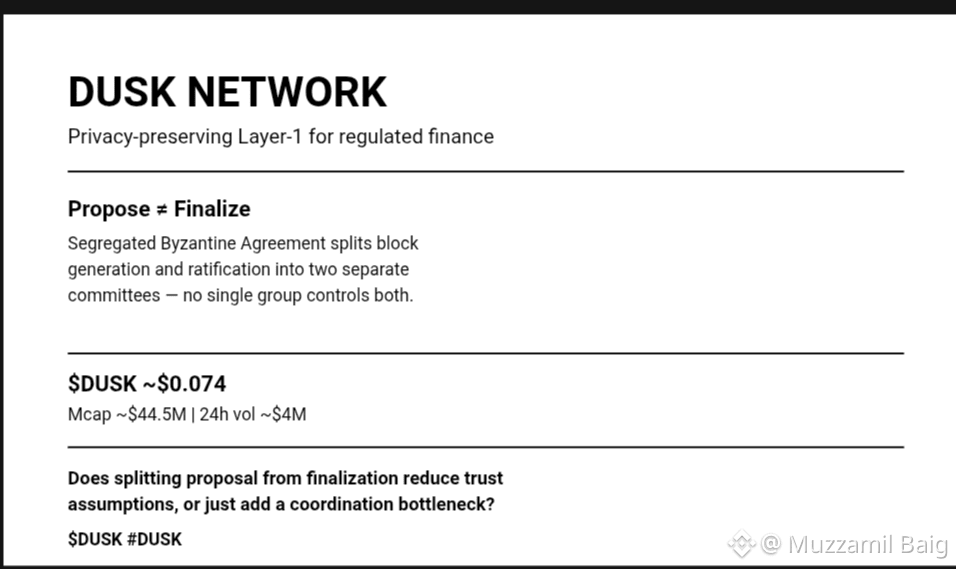
$DUSK is down about 5% today, trading near $0.074, with market cap around $44.5M and roughly $4M in 24h volume — small enough that a few large trades can move it more than you'd expect.
What's more interesting than the chart, though, is how Dusk actually reaches consensus. Most Layer-1s let the same group of validators both propose a block and finalize it. Dusk's Segregated Byzantine Agreement splits that into two separate steps — one committee generates the block, a different one ratifies it. No single group controls both ends of the process at once.
Why does that matter for a chain built on private, ZK-verified transactions? Because if the same validators who build a block could also approve it unilaterally, there's more room for that block to include something no one outside the group can verify. Separating the roles gives an extra check specifically suited to a chain where transaction contents aren't publicly visible by default.
The trade-off is coordination overhead — two committees agreeing takes more communication than one group voting alone, and that has to stay fast enough for actual settlement, not just a testnet demo.
@Dusk is betting that extra step is worth the latency cost for institutions that need auditability guarantees, not just speed.
Does splitting proposal from finalization actually reduce trust assumptions, or just add a coordination bottleneck dressed up as security?
$DUSK #dusk
What's more interesting than the chart, though, is how Dusk actually reaches consensus. Most Layer-1s let the same group of validators both propose a block and finalize it. Dusk's Segregated Byzantine Agreement splits that into two separate steps — one committee generates the block, a different one ratifies it. No single group controls both ends of the process at once.
Why does that matter for a chain built on private, ZK-verified transactions? Because if the same validators who build a block could also approve it unilaterally, there's more room for that block to include something no one outside the group can verify. Separating the roles gives an extra check specifically suited to a chain where transaction contents aren't publicly visible by default.
The trade-off is coordination overhead — two committees agreeing takes more communication than one group voting alone, and that has to stay fast enough for actual settlement, not just a testnet demo.
@Dusk is betting that extra step is worth the latency cost for institutions that need auditability guarantees, not just speed.
Does splitting proposal from finalization actually reduce trust assumptions, or just add a coordination bottleneck dressed up as security?
$DUSK #dusk
Verified
Quick one for anyone confused about what "EVM-compatible" actually means for a privacy chain — because DuskEVM doesn't work the way people assume.
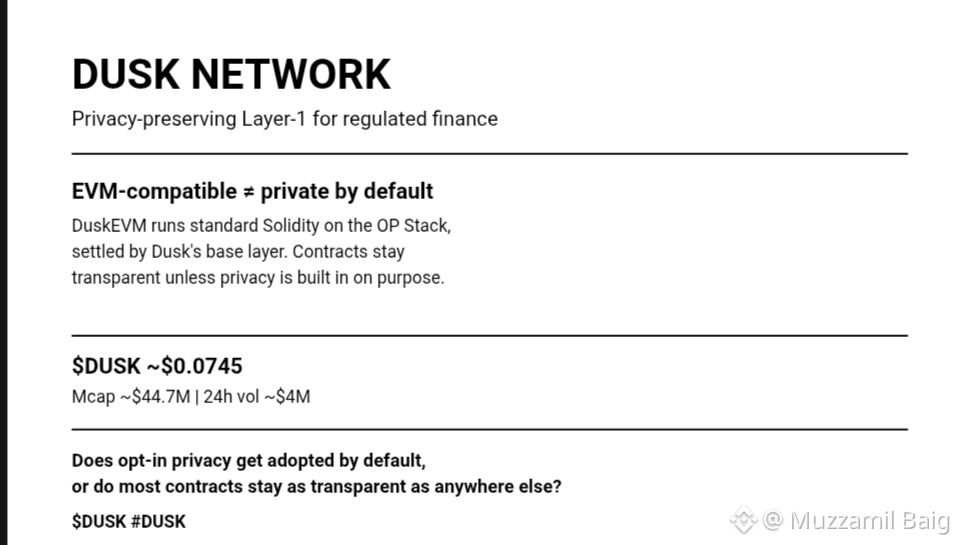
The common assumption: Dusk is a privacy chain, so anything built on it must be private by default. Not how DuskEVM works. It runs standard Solidity contracts using the OP Stack for execution, with Dusk's base layer handling settlement. That means developers get familiar tooling — same contracts, same deployment flow as any other EVM chain. But those contracts are transparent unless a developer specifically builds with Dusk's confidential primitives instead.
So EVM compatibility and privacy are two separate design choices here, not one bundled feature. A team could deploy on DuskEVM today and end up with a fully public contract, same as deploying on any L2. The privacy tooling exists, but it's opt-in, not automatic.
That's worth knowing before assuming every dApp on Dusk inherits the chain's privacy reputation.
$DUSK is trading around $0.0745 today, market cap near $44.7M, with roughly $4M in 24h volume.
@Dusk is clearly betting developers will choose the confidential path once it's easy enough to reach. Question is whether "opt-in privacy" gets adopted by default, or whether most contracts on DuskEVM end up just as transparent as everywhere else.
$DUSK #dusk
The common assumption: Dusk is a privacy chain, so anything built on it must be private by default. Not how DuskEVM works. It runs standard Solidity contracts using the OP Stack for execution, with Dusk's base layer handling settlement. That means developers get familiar tooling — same contracts, same deployment flow as any other EVM chain. But those contracts are transparent unless a developer specifically builds with Dusk's confidential primitives instead.
So EVM compatibility and privacy are two separate design choices here, not one bundled feature. A team could deploy on DuskEVM today and end up with a fully public contract, same as deploying on any L2. The privacy tooling exists, but it's opt-in, not automatic.
That's worth knowing before assuming every dApp on Dusk inherits the chain's privacy reputation.
$DUSK is trading around $0.0745 today, market cap near $44.7M, with roughly $4M in 24h volume.
@Dusk is clearly betting developers will choose the confidential path once it's easy enough to reach. Question is whether "opt-in privacy" gets adopted by default, or whether most contracts on DuskEVM end up just as transparent as everywhere else.
$DUSK #dusk
Verified
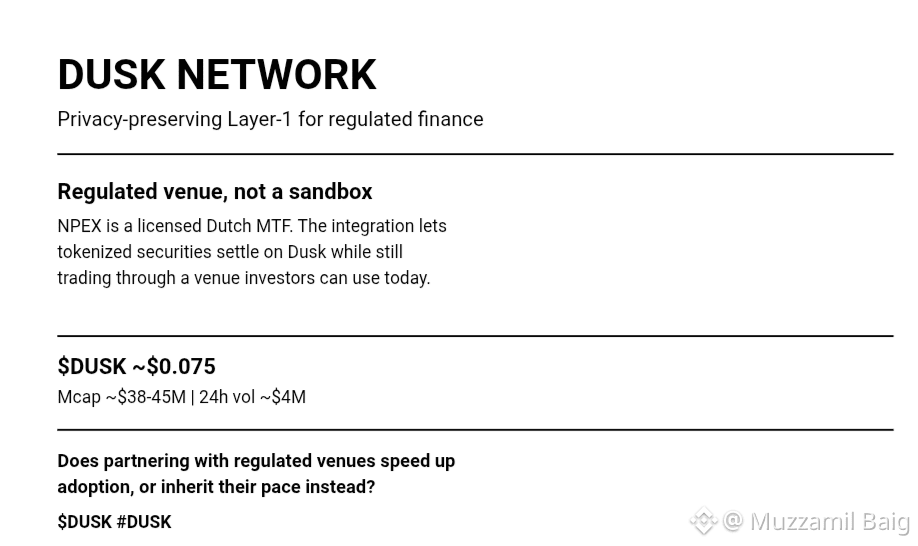
$DUSK is around $0.075 today, market cap roughly in the $38–45M range depending on the tracker, with about $4M in 24h volume.
Numbers aside, the more interesting thing this week was going through Dusk's NPEX partnership details instead of the price chart. Assumed it was another "we partnered with an exchange" press release, the kind every L1 puts out. It's not that. NPEX is a Dutch MTF — a regulated trading venue under EU law — and the integration lets tokenized securities settle on Dusk while still trading through a licensed venue investors can actually use today, not a sandbox.
That's a narrower thing than "RWA tokenization," which gets thrown around loosely right now. Most tokenization projects wrap an asset and hope a regulated venue picks it up later. Dusk built toward the venue relationship first.
The trade-off worth naming: settlement speed and privacy on-chain don't matter much if the regulated venue on the other end still runs on its own timeline and rules. Dusk's infrastructure can only move as fast as the slowest regulated counterparty it's plugged into.
@Dusk is betting that pairing with licensed venues early beats building infrastructure and waiting for regulators to catch up later.
Does partnering with regulated venues actually speed up institutional adoption, or does it just inherit their pace instead?
$DUSK #dusk
Numbers aside, the more interesting thing this week was going through Dusk's NPEX partnership details instead of the price chart. Assumed it was another "we partnered with an exchange" press release, the kind every L1 puts out. It's not that. NPEX is a Dutch MTF — a regulated trading venue under EU law — and the integration lets tokenized securities settle on Dusk while still trading through a licensed venue investors can actually use today, not a sandbox.
That's a narrower thing than "RWA tokenization," which gets thrown around loosely right now. Most tokenization projects wrap an asset and hope a regulated venue picks it up later. Dusk built toward the venue relationship first.
The trade-off worth naming: settlement speed and privacy on-chain don't matter much if the regulated venue on the other end still runs on its own timeline and rules. Dusk's infrastructure can only move as fast as the slowest regulated counterparty it's plugged into.
@Dusk is betting that pairing with licensed venues early beats building infrastructure and waiting for regulators to catch up later.
Does partnering with regulated venues actually speed up institutional adoption, or does it just inherit their pace instead?
$DUSK #dusk
Partly True
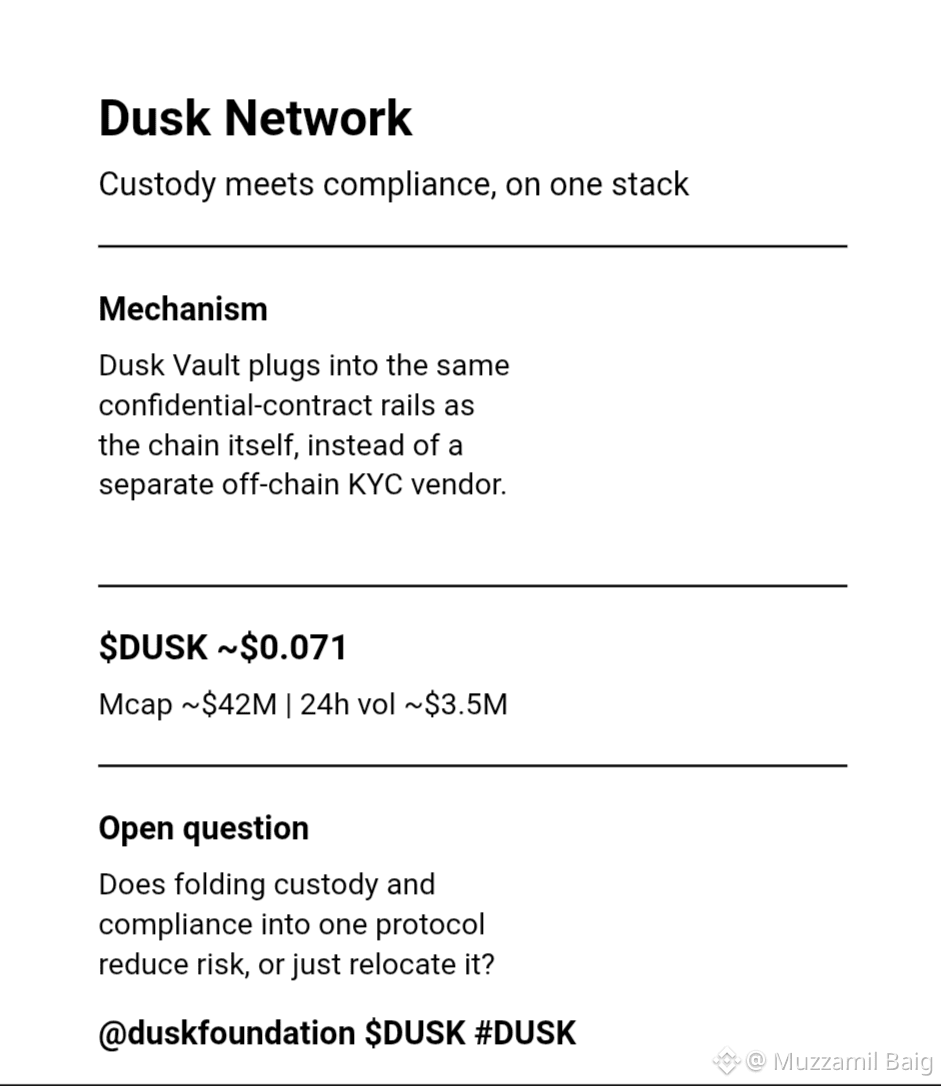
Skimmed past another "custody solution" headline and almost scrolled by, until I noticed Dusk Vault sits closer to settlement than a normal wallet product. Assumed it was cold storage with a Dusk logo on it. It actually plugs into the same confidential-contract rails the chain uses for regulated assets, so custody and compliance run through one stack instead of a wallet talking to a separate KYC vendor bolted on after the fact.
Most institutional crypto custody today works the opposite way — the chain stays dumb and transparent, compliance happens off-chain in someone's database. Dusk is folding that logic into the protocol itself.
$DUSK is around $0.071 today, down a few percent, market cap near $42M, about $3.5M moving through in 24h volume.
Cleaner on paper, but it also means Dusk Network now owns more of the trust surface institutions used to outsource to specialized custodians. @Dusk is betting that's the right trade for compliant finance.
Does folding custody and compliance into one protocol actually reduce risk, or just relocate the single point of failure somewhere less familiar?
$DUSK #dusk
Most institutional crypto custody today works the opposite way — the chain stays dumb and transparent, compliance happens off-chain in someone's database. Dusk is folding that logic into the protocol itself.
$DUSK is around $0.071 today, down a few percent, market cap near $42M, about $3.5M moving through in 24h volume.
Cleaner on paper, but it also means Dusk Network now owns more of the trust surface institutions used to outsource to specialized custodians. @Dusk is betting that's the right trade for compliant finance.
Does folding custody and compliance into one protocol actually reduce risk, or just relocate the single point of failure somewhere less familiar?
$DUSK #dusk
Verified
$DUSK sitting around $0.076 today, market cap somewhere in the $38-45M band depending on the tracker, daily volume in the $3-7M range. Small numbers. What actually caught my attention this week was a docs page, not the chart.
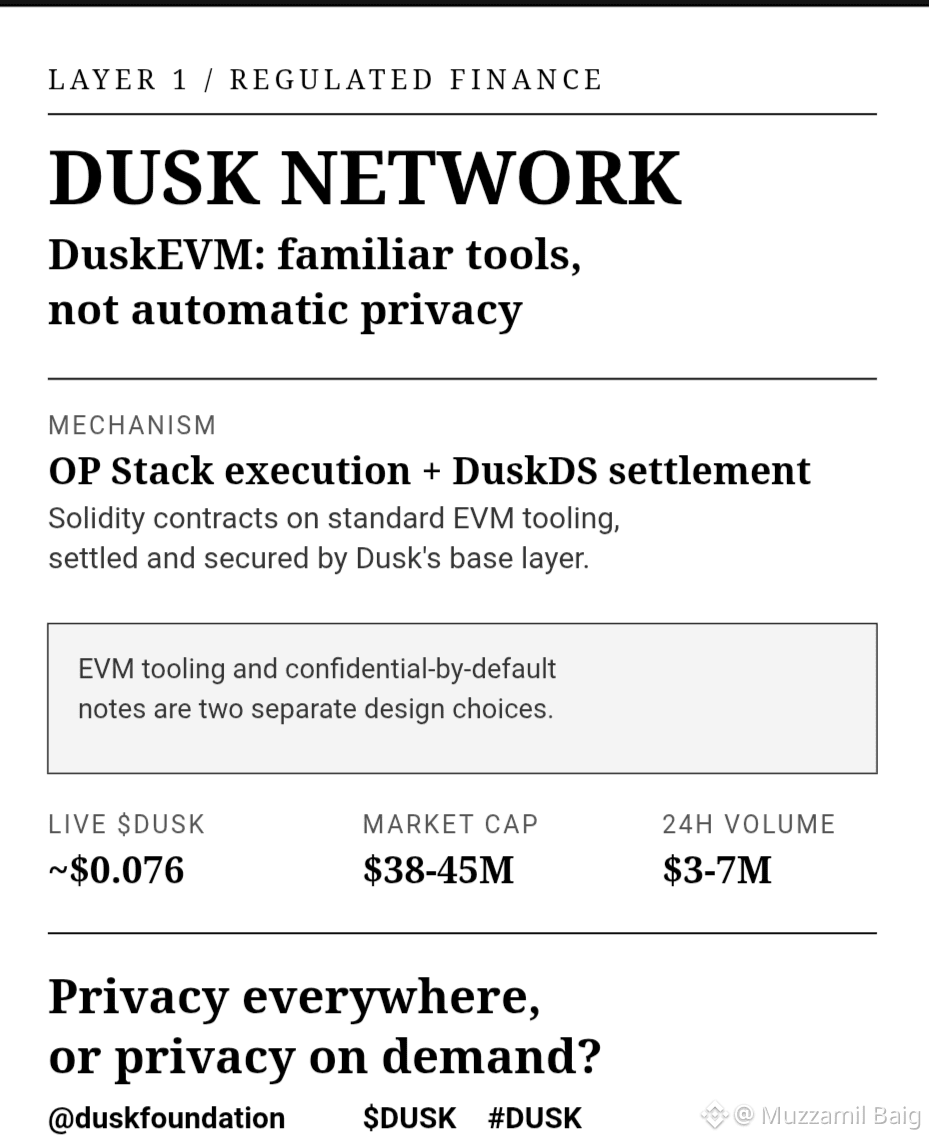
Was reading about DuskEVM expecting the usual "EVM-compatible chain" pitch — deploy your Solidity contracts, done, nothing to see here. That's not quite what it is. DuskEVM is an OP Stack-based execution environment sitting on top of DuskDS, meaning it settles and gets its data availability from Dusk's base layer while giving developers standard EVM tooling instead of forcing them to learn a new stack.
Compare that to how most privacy chains handle compatibility: they either stay isolated with custom tooling nobody outside the ecosystem wants to learn, or they go fully transparent to plug into existing DeFi. Dusk Network is trying a third path — keep the privacy-native settlement layer (Phoenix, shielded notes) underneath, but let Solidity contracts run in a familiar EVM-equivalent environment on top.
Here's what that actually means in practice: contracts deployed on DuskEVM don't automatically inherit the confidential-by-default treatment that Phoenix gives native Dusk transactions. You get familiar tooling, not automatic privacy — those are two separate design decisions, not one.
@Dusk is clearly betting compatibility gets more developers in the door faster than privacy purity would. Fair bet, maybe.
So which actually gets institutional dev teams building on regulated-finance infra faster — a chain that's privacy-native everywhere, or one that only guarantees it in specific execution environments?
#dusk
Was reading about DuskEVM expecting the usual "EVM-compatible chain" pitch — deploy your Solidity contracts, done, nothing to see here. That's not quite what it is. DuskEVM is an OP Stack-based execution environment sitting on top of DuskDS, meaning it settles and gets its data availability from Dusk's base layer while giving developers standard EVM tooling instead of forcing them to learn a new stack.
Compare that to how most privacy chains handle compatibility: they either stay isolated with custom tooling nobody outside the ecosystem wants to learn, or they go fully transparent to plug into existing DeFi. Dusk Network is trying a third path — keep the privacy-native settlement layer (Phoenix, shielded notes) underneath, but let Solidity contracts run in a familiar EVM-equivalent environment on top.
Here's what that actually means in practice: contracts deployed on DuskEVM don't automatically inherit the confidential-by-default treatment that Phoenix gives native Dusk transactions. You get familiar tooling, not automatic privacy — those are two separate design decisions, not one.
@Dusk is clearly betting compatibility gets more developers in the door faster than privacy purity would. Fair bet, maybe.
So which actually gets institutional dev teams building on regulated-finance infra faster — a chain that's privacy-native everywhere, or one that only guarantees it in specific execution environments?
#dusk
Kept thinking about this today while I was untangling a spreadsheet of my own transactions for taxes, of all things. Every line exposed, every counterparty visible if anyone bothered to look. It's such a small, annoying reminder of how little privacy we actually have with money, even the boring everyday kind.
That's the headspace I was in when I circled back to Dusk Network, courtesy of a thread from @Dusk I'd saved weeks ago and never actually finished reading.
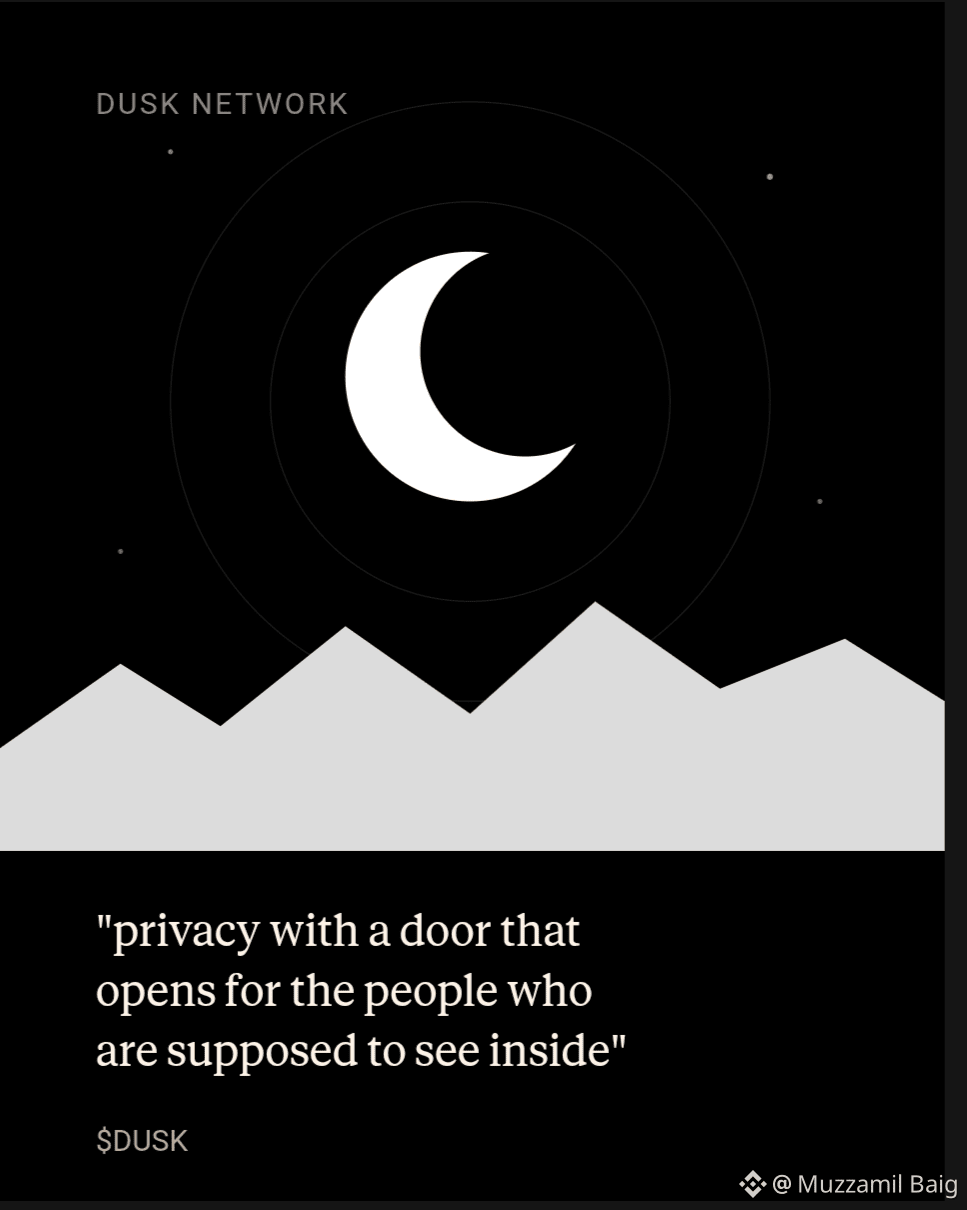
The mechanism I keep landing on is Phoenix, their transaction model. Instead of every transfer broadcasting who-sent-what-to-whom in plain sight, Phoenix uses zero-knowledge proofs so the network can confirm a transaction is valid without exposing the details to everyone watching. But — and this is the part I find interesting — it's built so the right parties can still prove compliance when needed. It's not privacy as a black box, it's privacy with a door that opens for the people who are supposed to see inside.
I respect that this is genuinely a hard engineering problem, not a marketing slogan. Most chains pick a side: full transparency or full anonymity. Trying to hold both at once, especially for something like regulated securities, feels like the kind of unglamorous work that doesn't trend on its own.
What I still wonder is how this plays out once real institutions start actually using it at scale, not just testing it. Docs are one thing, live regulatory friction is another.
No conclusions today, just a thread I keep pulling on.
$DUSK #dusk
That's the headspace I was in when I circled back to Dusk Network, courtesy of a thread from @Dusk I'd saved weeks ago and never actually finished reading.
The mechanism I keep landing on is Phoenix, their transaction model. Instead of every transfer broadcasting who-sent-what-to-whom in plain sight, Phoenix uses zero-knowledge proofs so the network can confirm a transaction is valid without exposing the details to everyone watching. But — and this is the part I find interesting — it's built so the right parties can still prove compliance when needed. It's not privacy as a black box, it's privacy with a door that opens for the people who are supposed to see inside.
I respect that this is genuinely a hard engineering problem, not a marketing slogan. Most chains pick a side: full transparency or full anonymity. Trying to hold both at once, especially for something like regulated securities, feels like the kind of unglamorous work that doesn't trend on its own.
What I still wonder is how this plays out once real institutions start actually using it at scale, not just testing it. Docs are one thing, live regulatory friction is another.
No conclusions today, just a thread I keep pulling on.
$DUSK #dusk
Been putting off writing about this part because I don't have a clean answer for it.
Someone in a group chat asked me last week why a "privacy chain" would ever bother building compliance tools at all — isn't that the whole point of privacy, to keep regulators out? I didn't have a quick reply. Sat with it for a couple days actually.
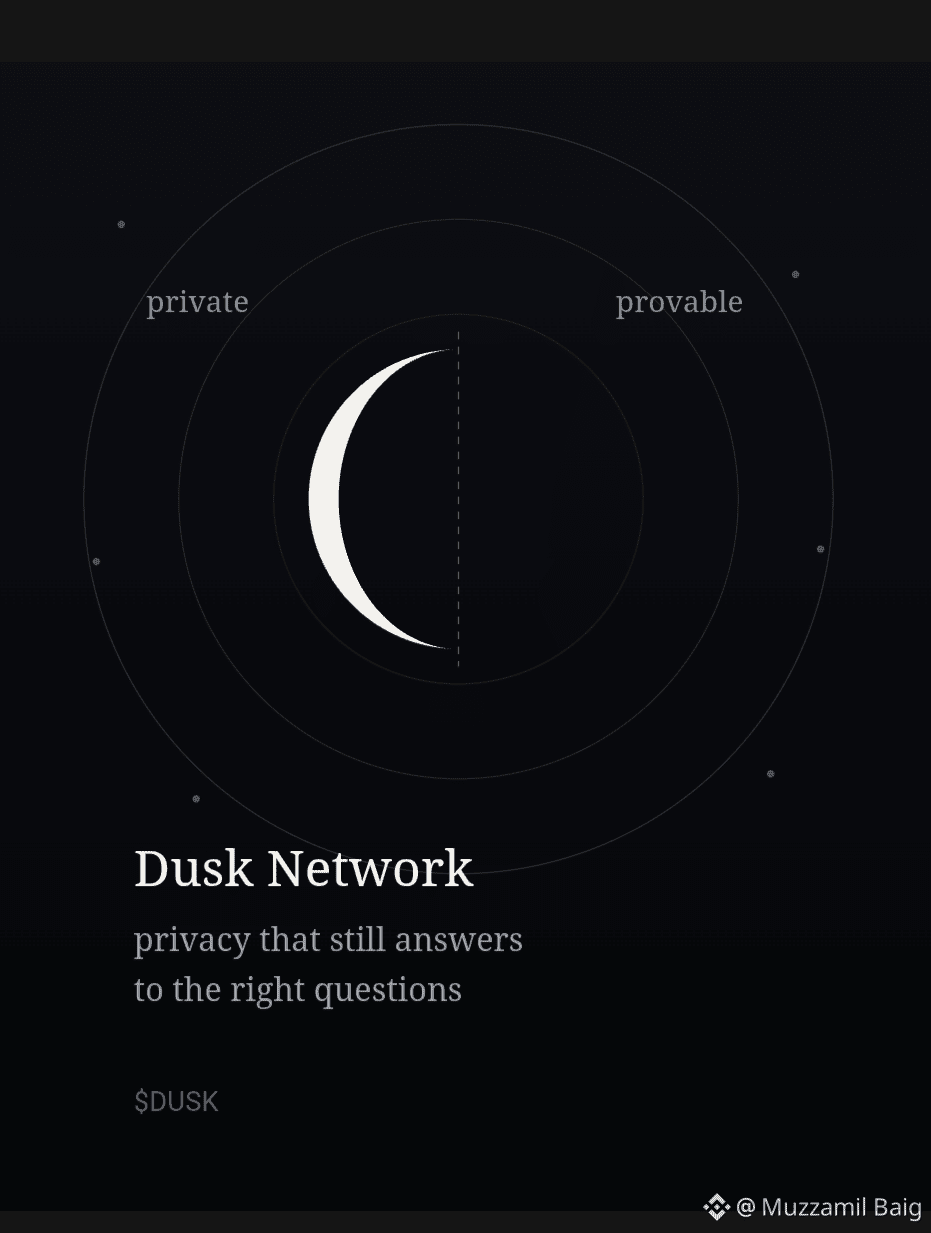
That's basically the core tension in Dusk Network's whole design. DUSK isn't trying to hide everything from everyone — it's trying to let you prove something is legitimate without exposing the raw data behind it. Selective disclosure instead of total secrecy. Which sounds reasonable in theory, but in practice it means the project has to keep satisfying two audiences that usually don't trust each other: privacy-minded users and regulators.
I don't think that's a flaw, honestly. I think it's the harder, more honest path compared to projects that just pick a side and ignore the friction. But I also can't pretend it's fully solved. Off-chain compliance frameworks, auditor access, jurisdiction differences — a lot of that still depends on institutions actually adopting the tooling, not just the tech existing.
So my open question is less "does the tech work" and more "will the slow, bureaucratic side of finance move fast enough to use it." That part isn't up to the protocol.
Still turning it over, no real conclusion yet — just where my head's at today.
$DUSK #dusk @Dusk
Someone in a group chat asked me last week why a "privacy chain" would ever bother building compliance tools at all — isn't that the whole point of privacy, to keep regulators out? I didn't have a quick reply. Sat with it for a couple days actually.
That's basically the core tension in Dusk Network's whole design. DUSK isn't trying to hide everything from everyone — it's trying to let you prove something is legitimate without exposing the raw data behind it. Selective disclosure instead of total secrecy. Which sounds reasonable in theory, but in practice it means the project has to keep satisfying two audiences that usually don't trust each other: privacy-minded users and regulators.
I don't think that's a flaw, honestly. I think it's the harder, more honest path compared to projects that just pick a side and ignore the friction. But I also can't pretend it's fully solved. Off-chain compliance frameworks, auditor access, jurisdiction differences — a lot of that still depends on institutions actually adopting the tooling, not just the tech existing.
So my open question is less "does the tech work" and more "will the slow, bureaucratic side of finance move fast enough to use it." That part isn't up to the protocol.
Still turning it over, no real conclusion yet — just where my head's at today.
$DUSK #dusk @Dusk
Partly True
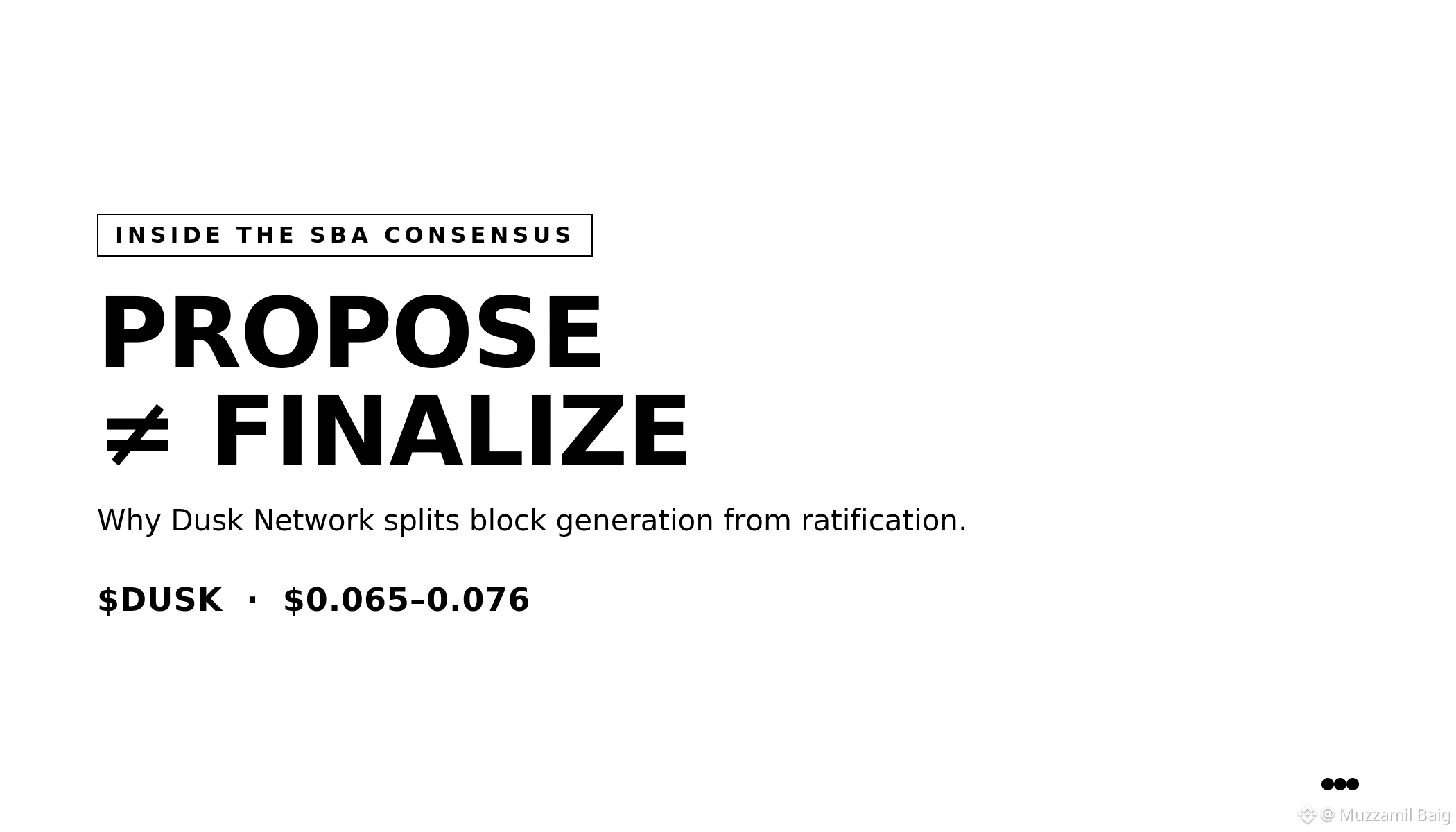
Kept coming back to Dusk's consensus mechanism this week instead of the usual price charts. Assumed Segregated Byzantine Agreement (SBA) was just another BFT variant with a rebrand — validators vote, majority wins, done. Turns out the "segregated" part actually separates block generation from block ratification into two distinct committees, so no single validator ever controls both proposing and finalizing a block at the same time.
That's a small architectural choice with a bigger consequence: it's designed to make short-range reorgs and validator collusion structurally harder, not just economically discouraged through slashing. Most chains lean entirely on "make cheating expensive." Dusk is leaning on "make cheating structurally awkward," which is a different bet.
The honest tension is that this only matters if the validator set stays genuinely decentralized over time — a two-committee split doesn't help much if the same handful of entities end up rotating through both roles anyway, which is a real risk for smaller-cap L1s as stake concentrates.
$DUSK is trading in the $0.065–0.076 range right now, market cap sitting roughly $32–45M depending on the source, on close to $3–5M in daily volume — still thin enough that consensus design isn't what's moving the number day to day. @Dusk is clearly building for the long game here rather than the chart.
Does splitting proposer and finalizer roles actually solve collusion, or does it just push the same problem one layer up to committee formation?
#dusk
That's a small architectural choice with a bigger consequence: it's designed to make short-range reorgs and validator collusion structurally harder, not just economically discouraged through slashing. Most chains lean entirely on "make cheating expensive." Dusk is leaning on "make cheating structurally awkward," which is a different bet.
The honest tension is that this only matters if the validator set stays genuinely decentralized over time — a two-committee split doesn't help much if the same handful of entities end up rotating through both roles anyway, which is a real risk for smaller-cap L1s as stake concentrates.
$DUSK is trading in the $0.065–0.076 range right now, market cap sitting roughly $32–45M depending on the source, on close to $3–5M in daily volume — still thin enough that consensus design isn't what's moving the number day to day. @Dusk is clearly building for the long game here rather than the chart.
Does splitting proposer and finalizer roles actually solve collusion, or does it just push the same problem one layer up to committee formation?
#dusk
Kept thinking about this today, so figuring I'd just write it down.
Was going through Dusk's docs last week, mostly out of boredom, and got stuck on something called the Phoenix transaction model. Didn't expect much - most chains just say "private" and leave it at that. This one actually explains how.
Phoenix works by letting a transaction prove it's valid without showing the amounts or the parties involved. Not hidden in the "trust me" sense - hidden in the "here's cryptographic proof it followed the rules" sense. That distinction sounds small until you sit with it for a minute.
What got me is that Dusk Network isn't using this just for basic transfers. It's the same model underneath their smart contract layer too, which means the privacy isn't bolted onto one feature - it's structural.
Still, I keep asking myself the same question every time I read about a new privacy mechanism: who actually verifies the "rules were followed" part when it matters? Cryptography can prove internal consistency, but real compliance still needs someone accountable on the other end. That part hasn't fully clicked for me yet, and I don't think it's fair to pretend it has.
@Dusk seems aware of this gap too, which is honestly more reassuring than if they acted like it was already solved.
Anyway. Wanted to write this down before I forgot the thread of thought.
$DUSK #dusk
Was going through Dusk's docs last week, mostly out of boredom, and got stuck on something called the Phoenix transaction model. Didn't expect much - most chains just say "private" and leave it at that. This one actually explains how.
Phoenix works by letting a transaction prove it's valid without showing the amounts or the parties involved. Not hidden in the "trust me" sense - hidden in the "here's cryptographic proof it followed the rules" sense. That distinction sounds small until you sit with it for a minute.
What got me is that Dusk Network isn't using this just for basic transfers. It's the same model underneath their smart contract layer too, which means the privacy isn't bolted onto one feature - it's structural.
Still, I keep asking myself the same question every time I read about a new privacy mechanism: who actually verifies the "rules were followed" part when it matters? Cryptography can prove internal consistency, but real compliance still needs someone accountable on the other end. That part hasn't fully clicked for me yet, and I don't think it's fair to pretend it has.
@Dusk seems aware of this gap too, which is honestly more reassuring than if they acted like it was already solved.
Anyway. Wanted to write this down before I forgot the thread of thought.
$DUSK #dusk
Partly True
Was going through Dusk's docs on Zedger last night, half-expecting it to be just another "private token" wrapper. Turns out it's built specifically for security tokens — designed so ownership transfers stay confidential on-chain but regulators can still verify compliance without seeing every transaction detail. That's a very different problem than just hiding balances.
Checked the numbers this morning too. $DUSK is trading around $0.065, with market cap sitting roughly in the $30-35M range and 24h volume around $3-4M. Not huge, but for a project targeting regulated finance rather than retail speculation, that's kind of the point — this isn't a chain optimized for hype cycles.
The tension I keep circling back to: privacy and auditability are usually treated as opposites in crypto. Dusk Network is trying to make them coexist, which sounds great on paper, but it means the hard part isn't the zero-knowledge cryptography itself — it's convincing actual regulated institutions that "provably compliant but not publicly visible" is trustworthy enough to build on. That's a much slower sell than a retail airdrop farm.
@Dusk seems to be betting institutional adoption just takes longer than crypto's usual attention span allows for.
Genuine question: if a chain has to prove compliance to regulators before it can prove itself to the market, does that put it at a structural disadvantage against faster-moving, less compliant competitors — or is that exactly the moat?
#dusk
Checked the numbers this morning too. $DUSK is trading around $0.065, with market cap sitting roughly in the $30-35M range and 24h volume around $3-4M. Not huge, but for a project targeting regulated finance rather than retail speculation, that's kind of the point — this isn't a chain optimized for hype cycles.
The tension I keep circling back to: privacy and auditability are usually treated as opposites in crypto. Dusk Network is trying to make them coexist, which sounds great on paper, but it means the hard part isn't the zero-knowledge cryptography itself — it's convincing actual regulated institutions that "provably compliant but not publicly visible" is trustworthy enough to build on. That's a much slower sell than a retail airdrop farm.
@Dusk seems to be betting institutional adoption just takes longer than crypto's usual attention span allows for.
Genuine question: if a chain has to prove compliance to regulators before it can prove itself to the market, does that put it at a structural disadvantage against faster-moving, less compliant competitors — or is that exactly the moat?
#dusk
I spent a bit of time looking at how Dusk Network actually settles security tokens, and honestly, that's where it gets interesting.
My first assumption was that Zedger is just another token standard. Fungible tokens, some compliance checks bolted on, nothing new.
That's not really what it's doing.
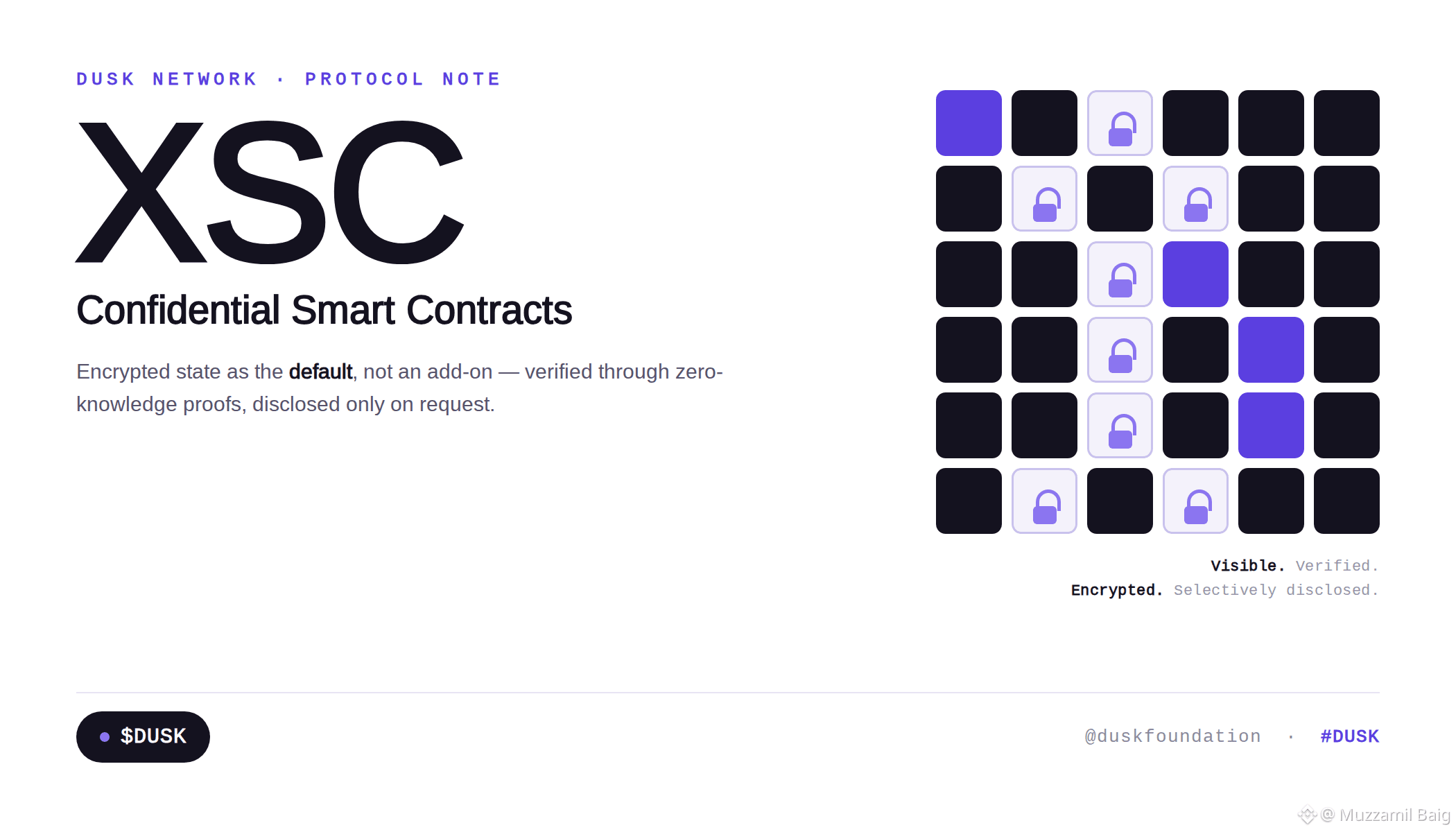
Zedger is built specifically for regulated securities — shares, bonds, fund units — where ownership records need to be both provable and private. Instead of exposing every holder's balance on-chain like a typical ERC-20 style ledger, it separates the settlement logic from the visibility layer. Transfers get validated and finalized, but who owns what stays shielded unless a regulator or auditor is explicitly given access.
Sounds boring.
Until you realize most "compliant" tokenization projects solve this by keeping records off-chain and just anchoring hashes on-chain. Zedger tries to do the actual settlement on-chain, which is a much harder problem.
The open question I keep coming back to: how much of the compliance layer — KYC checks, transfer restrictions, auditor access — ends up depending on off-chain infrastructure anyway. Privacy on-chain is one thing. Regulatory auditability without a trusted middleman is a different, harder claim.
$DUSK is trading in the ~$0.065-0.07 range right now, market cap around $32-45M, 24h volume roughly $3-4M — modest, but this is infrastructure for a market that barely exists yet.
If Dusk Network actually becomes a settlement layer real institutions use for tokenized securities, Zedger is probably the least glamorous, most important piece of it.
Curious what @Dusk has said about how much of that compliance tooling stays off-chain long term — anyone tracked this closely?
#dusk
My first assumption was that Zedger is just another token standard. Fungible tokens, some compliance checks bolted on, nothing new.
That's not really what it's doing.
Zedger is built specifically for regulated securities — shares, bonds, fund units — where ownership records need to be both provable and private. Instead of exposing every holder's balance on-chain like a typical ERC-20 style ledger, it separates the settlement logic from the visibility layer. Transfers get validated and finalized, but who owns what stays shielded unless a regulator or auditor is explicitly given access.
Sounds boring.
Until you realize most "compliant" tokenization projects solve this by keeping records off-chain and just anchoring hashes on-chain. Zedger tries to do the actual settlement on-chain, which is a much harder problem.
The open question I keep coming back to: how much of the compliance layer — KYC checks, transfer restrictions, auditor access — ends up depending on off-chain infrastructure anyway. Privacy on-chain is one thing. Regulatory auditability without a trusted middleman is a different, harder claim.
$DUSK is trading in the ~$0.065-0.07 range right now, market cap around $32-45M, 24h volume roughly $3-4M — modest, but this is infrastructure for a market that barely exists yet.
If Dusk Network actually becomes a settlement layer real institutions use for tokenized securities, Zedger is probably the least glamorous, most important piece of it.
Curious what @Dusk has said about how much of that compliance tooling stays off-chain long term — anyone tracked this closely?
#dusk
Verified
Spent some time this week actually reading through Dusk Network's Phoenix transaction model instead of skimming the usual explainer threads.
My first assumption was simple: private transactions just hide the amount and hope the math holds up somewhere behind the scenes.
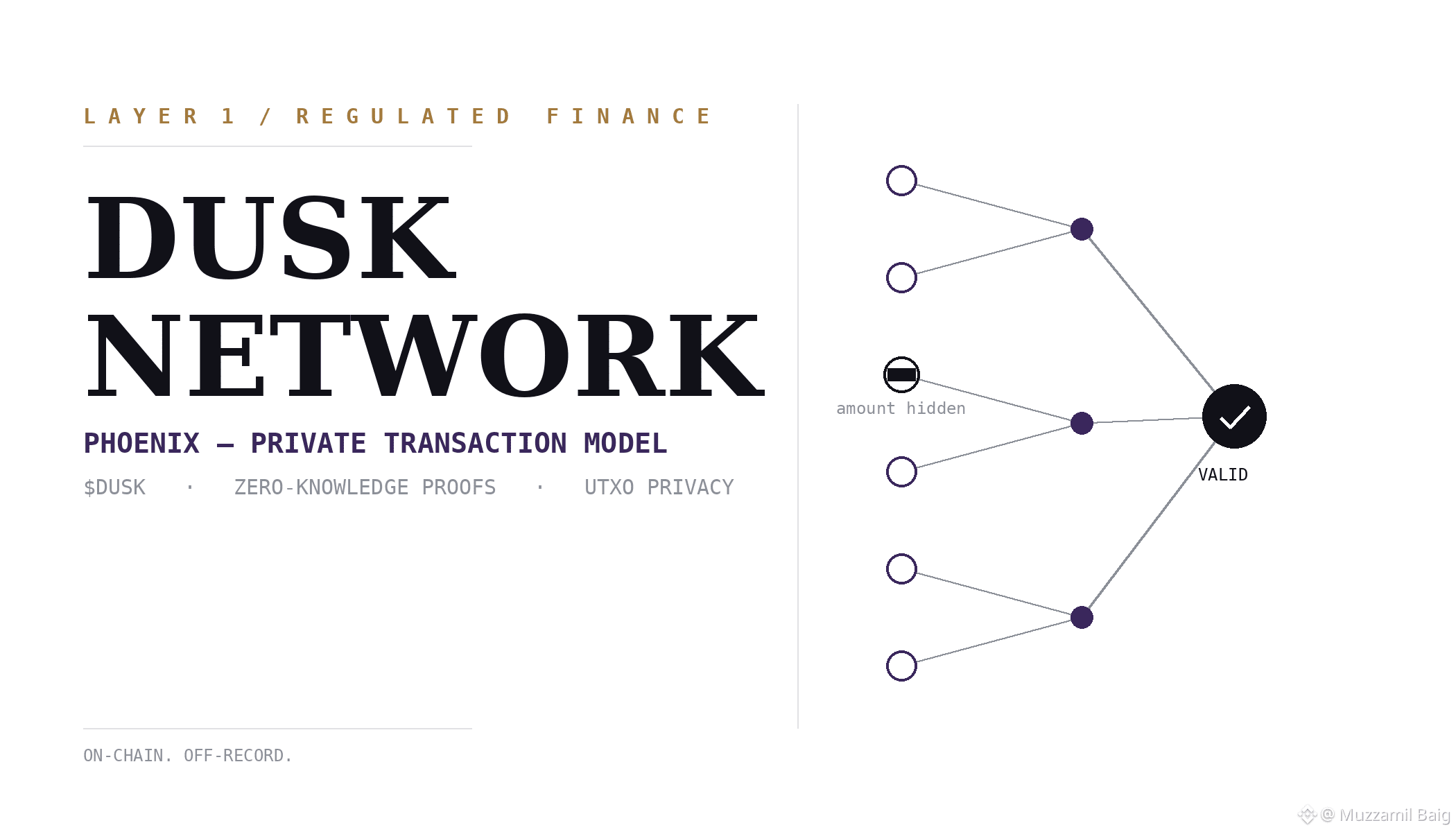
Turns out Phoenix works differently. It's a UTXO-based model where every spend gets nullified and every new output gets proven valid through a zero-knowledge proof — no double-spend, no missing funds — without the amount, sender, or receiver ever touching the public ledger.
That's a real structural choice, not a privacy feature bolted on top. Most chains start transparent and add obfuscation later. Phoenix treats confidentiality as the starting state.
Here's the tension though: proving correctness without revealing anything is heavier computation than a plain transfer. Every private note needs a proof generated and verified, and that has to stay fast enough for actual settlement volume, not just testnet throughput.
$DUSK is sitting around $0.06 today, with market cap somewhere in the $30-38M range depending on the source, and daily volume close to $3M.
@Dusk keeps leaning into the regulated-finance pitch, and Phoenix is arguably the piece that has to hold up if that pitch is going to mean anything beyond a whitepaper.
So the question I keep landing on: if privacy-by-default costs more to compute than privacy-as-an-add-on, does DUSK's whole edge come down to proving that extra cost is worth it for regulated markets?
#dusk
My first assumption was simple: private transactions just hide the amount and hope the math holds up somewhere behind the scenes.
Turns out Phoenix works differently. It's a UTXO-based model where every spend gets nullified and every new output gets proven valid through a zero-knowledge proof — no double-spend, no missing funds — without the amount, sender, or receiver ever touching the public ledger.
That's a real structural choice, not a privacy feature bolted on top. Most chains start transparent and add obfuscation later. Phoenix treats confidentiality as the starting state.
Here's the tension though: proving correctness without revealing anything is heavier computation than a plain transfer. Every private note needs a proof generated and verified, and that has to stay fast enough for actual settlement volume, not just testnet throughput.
$DUSK is sitting around $0.06 today, with market cap somewhere in the $30-38M range depending on the source, and daily volume close to $3M.
@Dusk keeps leaning into the regulated-finance pitch, and Phoenix is arguably the piece that has to hold up if that pitch is going to mean anything beyond a whitepaper.
So the question I keep landing on: if privacy-by-default costs more to compute than privacy-as-an-add-on, does DUSK's whole edge come down to proving that extra cost is worth it for regulated markets?
#dusk
Verified
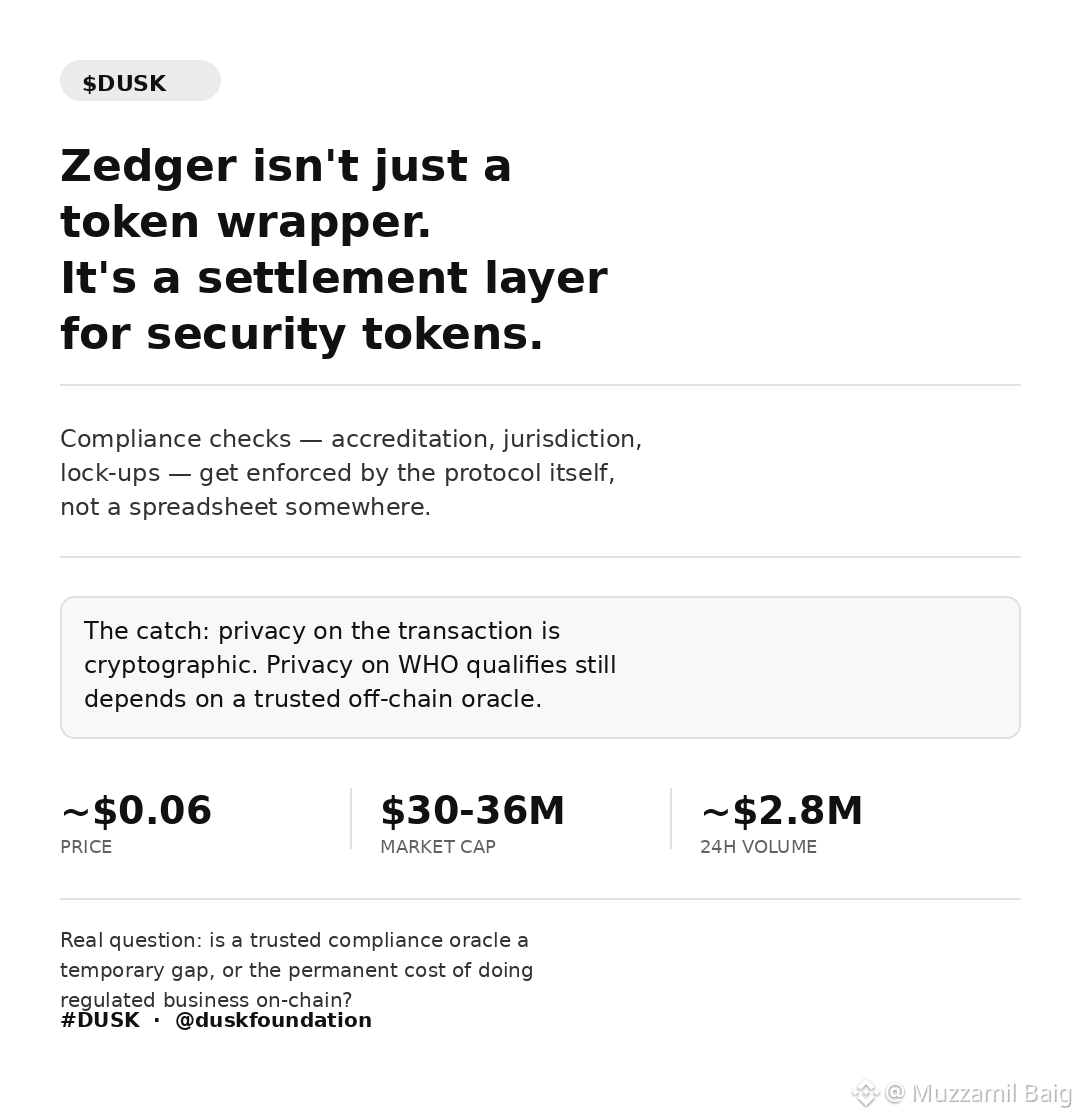
Pulled up the Dusk docs today instead of scrolling the timeline, and ended up down a rabbit hole on Zedger. Went in assuming it was just "another token standard" for wrapping securities on-chain. Turns out it's closer to a full settlement layer — it's built to handle share issuance, ownership transfers, and cap table logic the way a transfer agent would, except the compliance checks (accredited investor status, jurisdiction limits, lock-up periods) get enforced by the protocol itself rather than a spreadsheet somewhere.
$DUSK is sitting around $0.06 today, market cap somewhere in the $30-36M range depending on which supply figure you use, with roughly $2.8M in 24h volume — down slightly on the day. Small numbers next to what Zedger is actually trying to do.
Here's the part that nags at me though: Zedger can enforce those rules on-chain, but it still has to trust an off-chain source to tell it who's accredited and which jurisdiction someone's sitting in. So you get cryptographic privacy for the transaction itself, but the compliance layer still leans on a centralized oracle feeding it real-world facts. That's not a knock on Dusk Network specifically — it's the same wall every privacy-meets-regulation project runs into.
@Dusk whole pitch is regulated finance done right, which makes this the actual hard problem, not a side detail.
Genuinely curious — does anyone see a realistic path to decentralizing that compliance-oracle piece, or is a trusted off-chain layer just the permanent cost of doing regulated business on-chain?
#dusk
$DUSK is sitting around $0.06 today, market cap somewhere in the $30-36M range depending on which supply figure you use, with roughly $2.8M in 24h volume — down slightly on the day. Small numbers next to what Zedger is actually trying to do.
Here's the part that nags at me though: Zedger can enforce those rules on-chain, but it still has to trust an off-chain source to tell it who's accredited and which jurisdiction someone's sitting in. So you get cryptographic privacy for the transaction itself, but the compliance layer still leans on a centralized oracle feeding it real-world facts. That's not a knock on Dusk Network specifically — it's the same wall every privacy-meets-regulation project runs into.
@Dusk whole pitch is regulated finance done right, which makes this the actual hard problem, not a side detail.
Genuinely curious — does anyone see a realistic path to decentralizing that compliance-oracle piece, or is a trusted off-chain layer just the permanent cost of doing regulated business on-chain?
#dusk
Verified
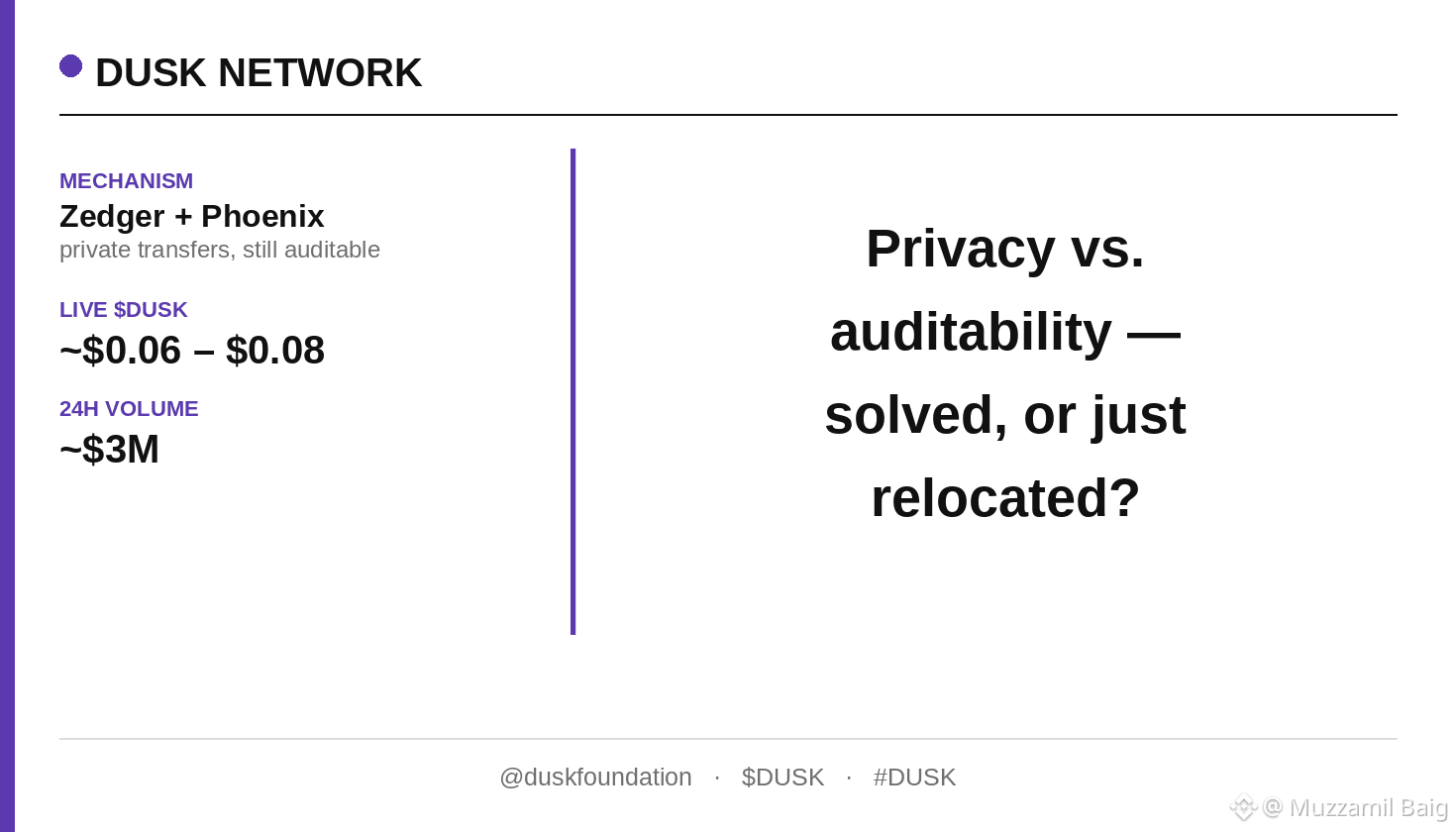
Was messing around with the Dusk documentation last night, specifically the part on Zedger. Assumed it was just another token standard wrapper, the kind every chain claims makes assets "compliant." Turns out it's built specifically for security tokens and works alongside Dusk's Phoenix transaction model to keep transfers private while still being auditable by regulators who need to see them.
That's actually the harder engineering problem. Anyone can bolt privacy onto a chain. Making privacy coexist with the kind of auditability that MiFID II or MiCA actually require is a different challenge entirely, and it's the reason Dusk Network keeps getting mentioned alongside regulated European market infrastructure instead of just DeFi Twitter.
$DUSK is sitting around $0.06-0.08 today with roughly $3M in 24h volume, which is modest next to the ambition here. Institutional adoption doesn't move at meme-coin speed. Partnerships with regulated exchanges take quarters, not days, and that mismatch between narrative timelines and real compliance timelines is probably why the price action looks unremarkable while the underlying work keeps shipping.
@Dusk seems comfortable building for that slower audience rather than chasing retail hype.
If privacy and regulatory auditability are fundamentally in tension, is DUSK actually solving that tradeoff, or just moving where the tradeoff sits?
#dusk
That's actually the harder engineering problem. Anyone can bolt privacy onto a chain. Making privacy coexist with the kind of auditability that MiFID II or MiCA actually require is a different challenge entirely, and it's the reason Dusk Network keeps getting mentioned alongside regulated European market infrastructure instead of just DeFi Twitter.
$DUSK is sitting around $0.06-0.08 today with roughly $3M in 24h volume, which is modest next to the ambition here. Institutional adoption doesn't move at meme-coin speed. Partnerships with regulated exchanges take quarters, not days, and that mismatch between narrative timelines and real compliance timelines is probably why the price action looks unremarkable while the underlying work keeps shipping.
@Dusk seems comfortable building for that slower audience rather than chasing retail hype.
If privacy and regulatory auditability are fundamentally in tension, is DUSK actually solving that tradeoff, or just moving where the tradeoff sits?
#dusk
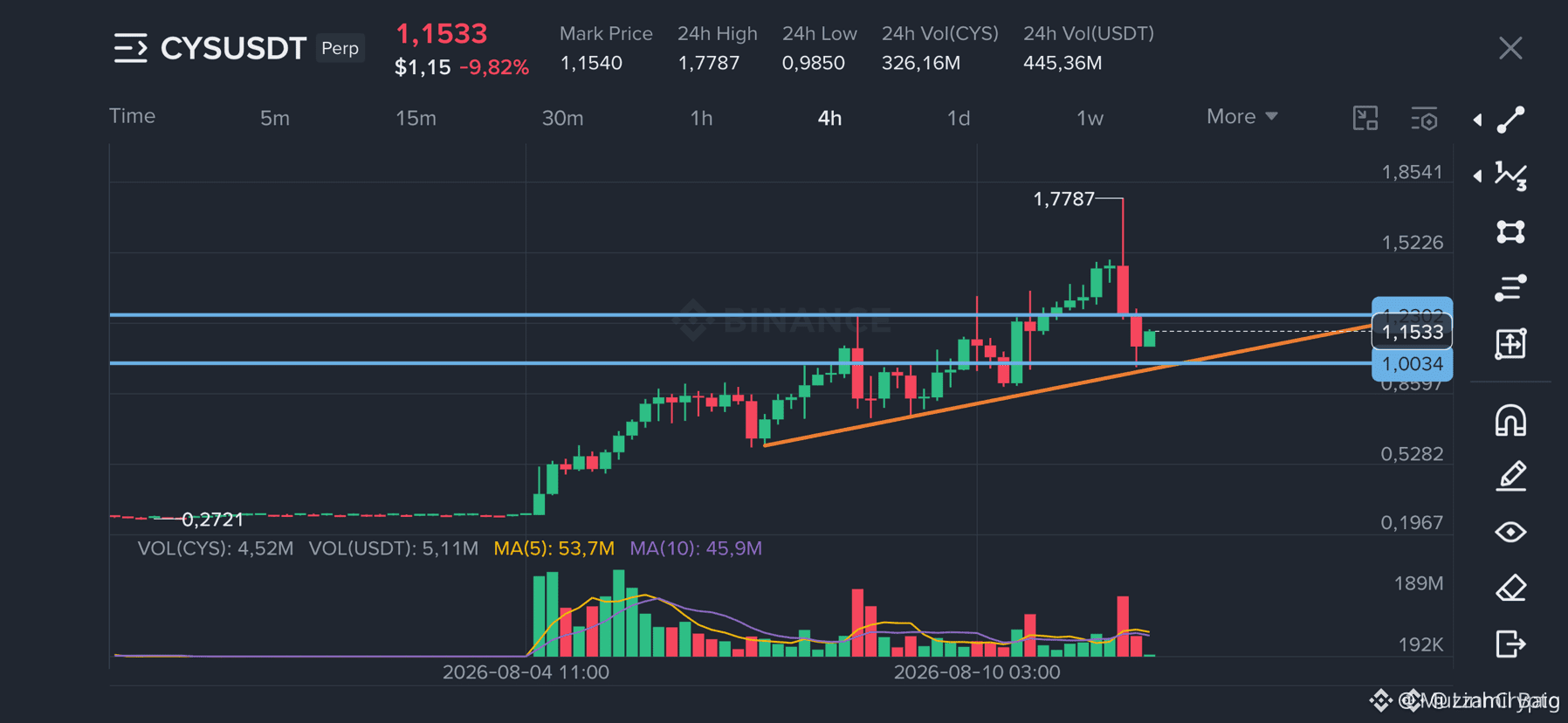
$CYS Is there still a chance to buy CYS at $1 again? I think there is, but it may take quite a while. For now, let’s see it rise to $2 first. Long setup.
Entry: $1.25 - $1.28
TP: $1.4 - $1.54 - $1.66 - $1.8 - $2
SL: $1.12
Entry: $1.25 - $1.28
TP: $1.4 - $1.54 - $1.66 - $1.8 - $2
SL: $1.12
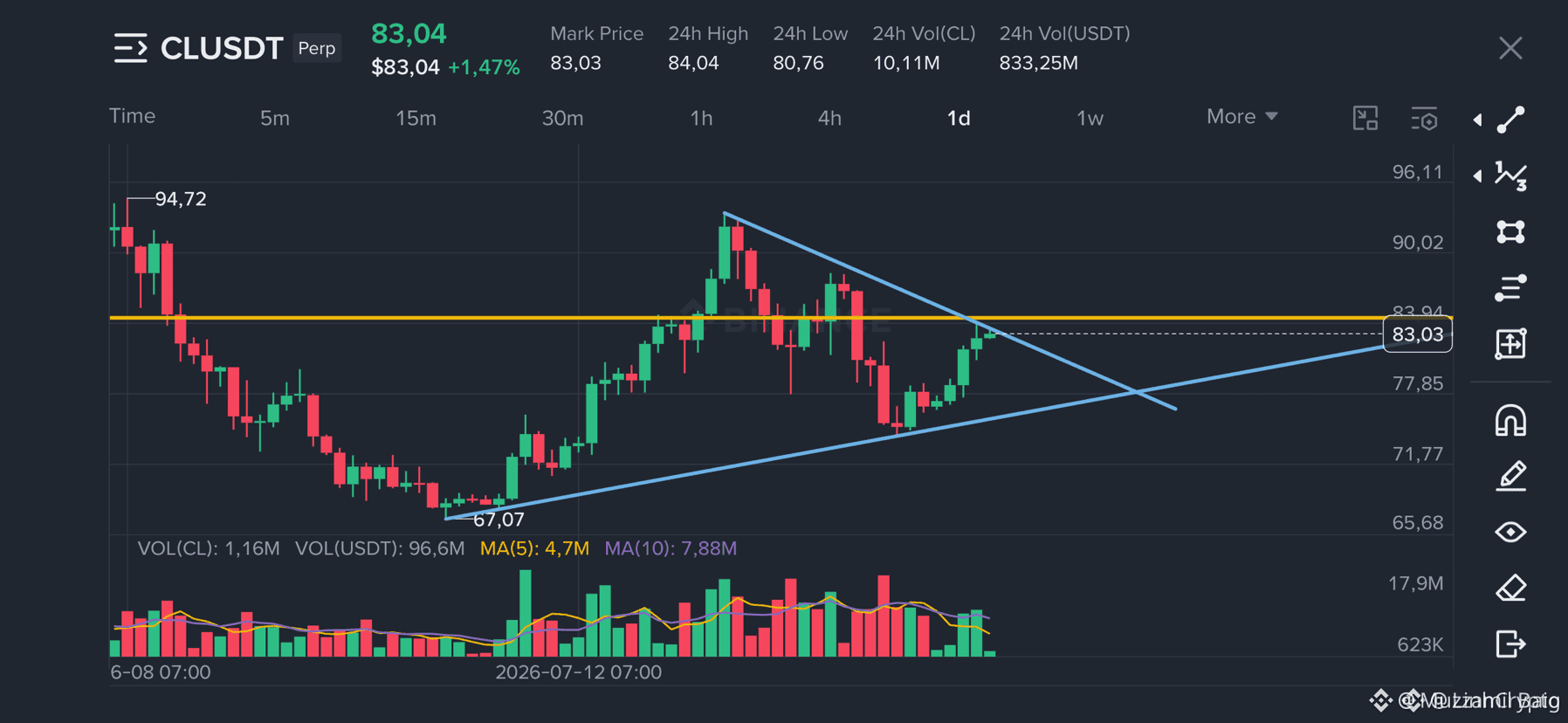
$CL Either it breaks out or it fails. I’m choosing option 2, so I’m going Short! Short setup.
Entry: $84 - $83
TP: $80 - $77 - $74
SL: $90
Entry: $84 - $83
TP: $80 - $77 - $74
SL: $90
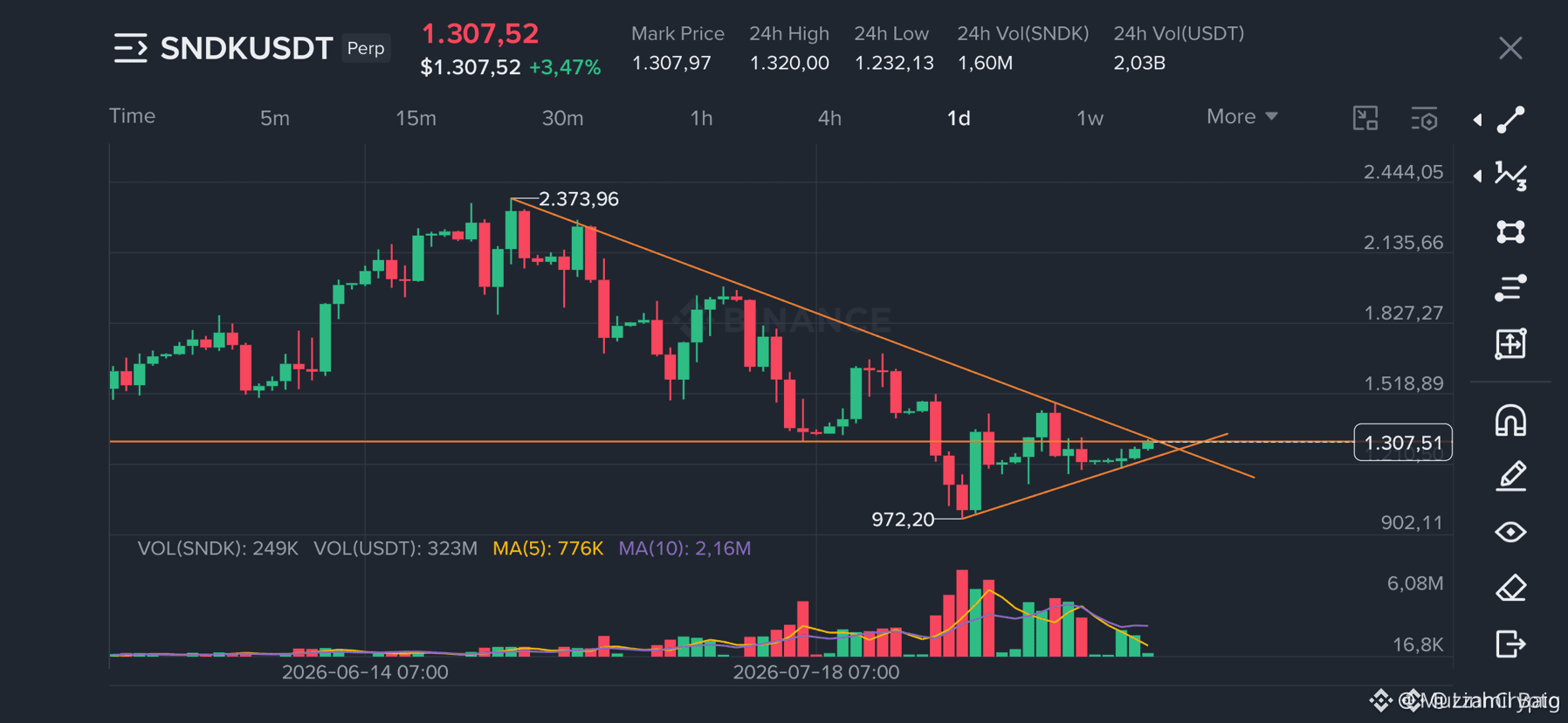
$SNDK Both the resistance and the downtrend line are here, so this is a good time to consider a Short position! I expect it to decline when the U.S. stock market opens tonight. Short setup.
Entry: $1320 - $1300
TP: $1270 - $1240 - $1200
SL: $1386
Entry: $1320 - $1300
TP: $1270 - $1240 - $1200
SL: $1386
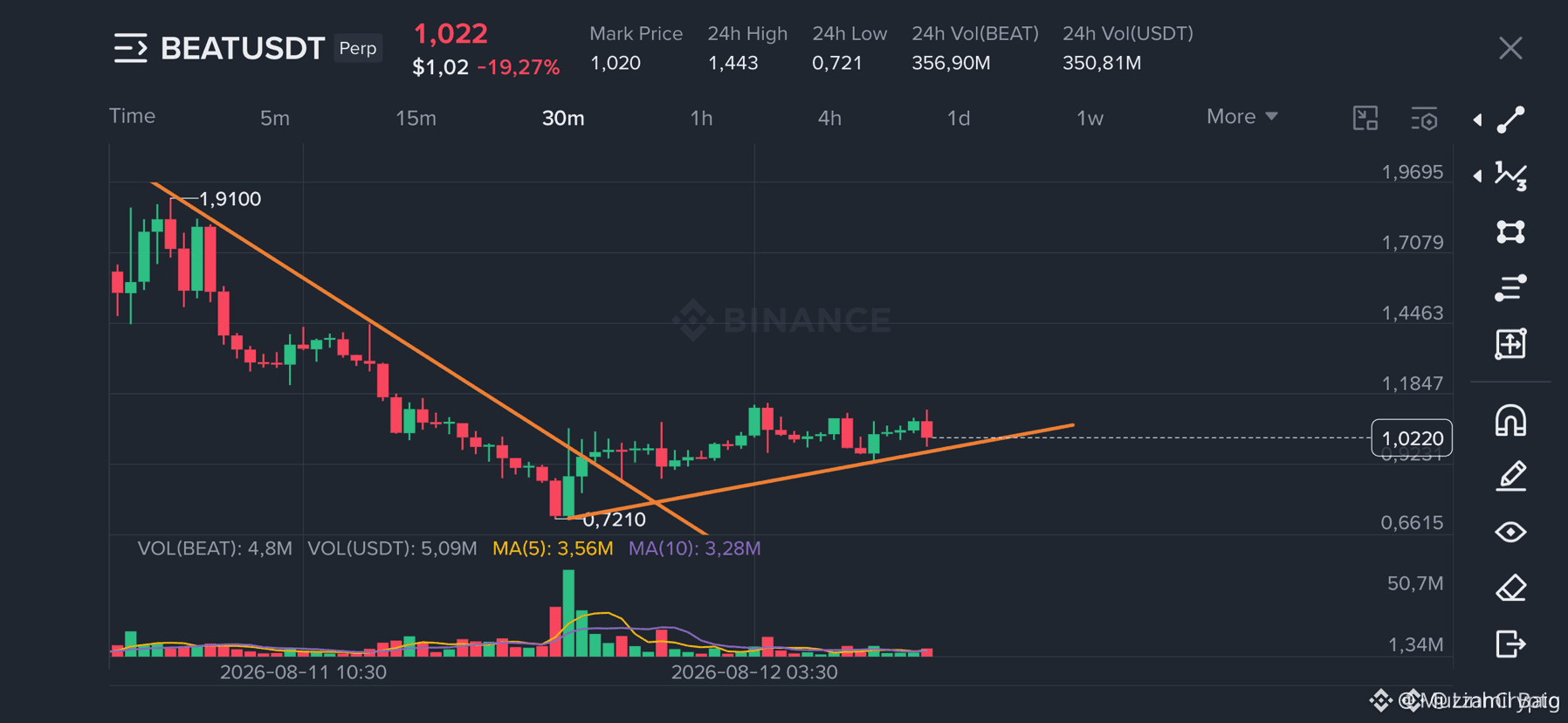
$BEAT If it dumps hard, it has to pump hard. For this recovery move, I expect BEAT to pump to around $1.4. Long setup.
Entry: $0.98 - $1
TP: $1.1 - $1.2 - $1.3 - $1.4
SL: $0.89
Entry: $0.98 - $1
TP: $1.1 - $1.2 - $1.3 - $1.4
SL: $0.89
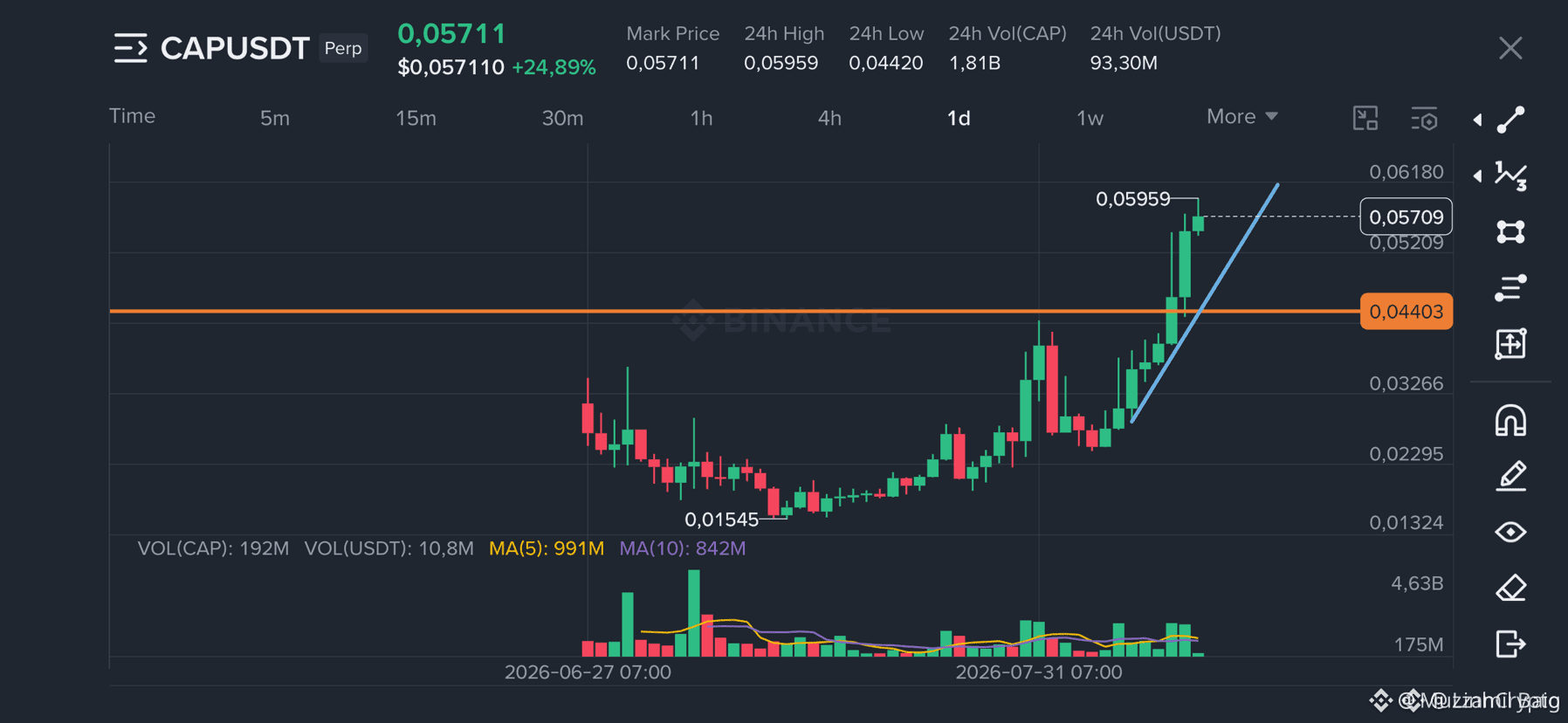
$CAP The uptrend continues, buying pressure remains strong, and CAP is continuously making new ATHs. Buy high, sell higher. Long setup.
Entry: $0.055 - $0.0555
TP: $0.06 - $0.065 - $0.07
SL: $0.0499
Entry: $0.055 - $0.0555
TP: $0.06 - $0.065 - $0.07
SL: $0.0499
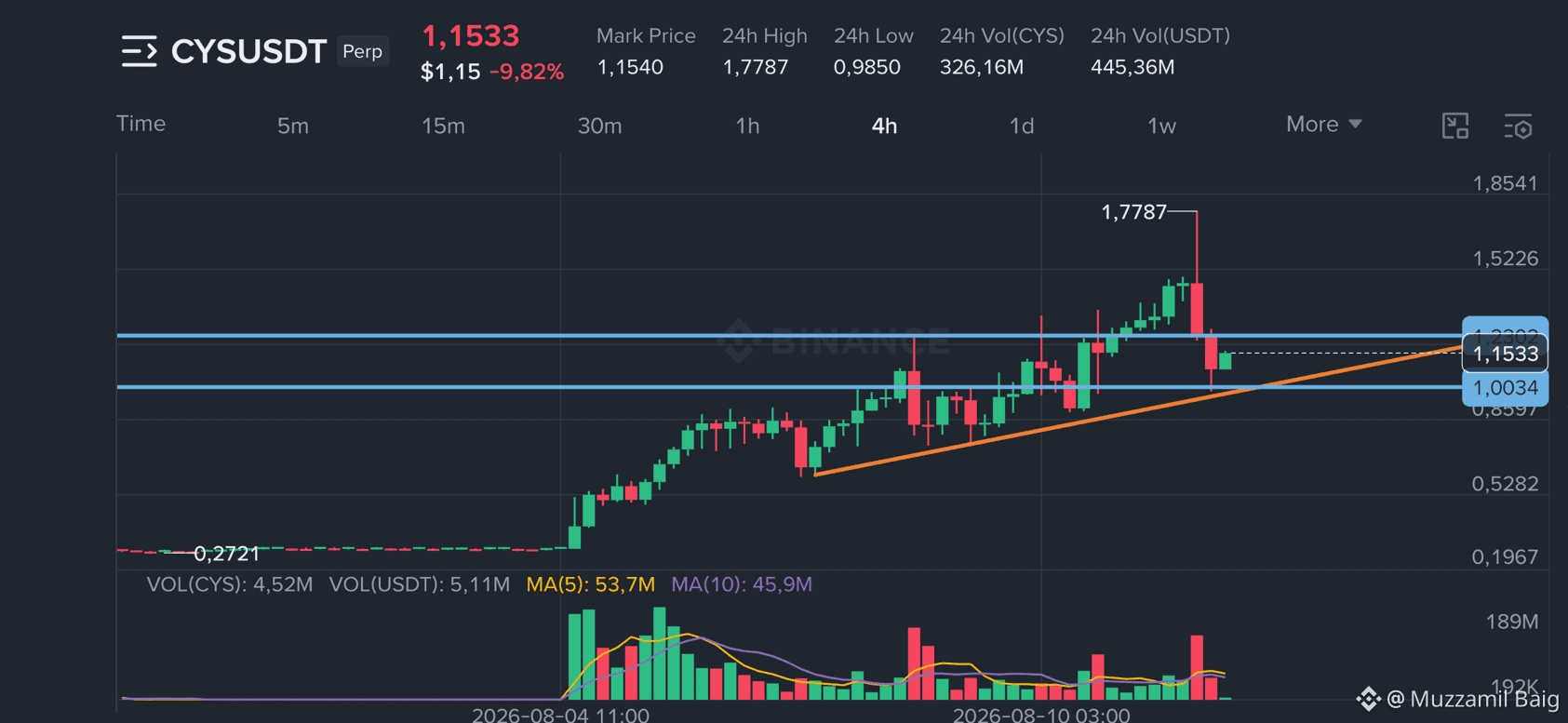
$CYS Once again, CYS has successfully retested the trendline support, it’s time for the price to continue pumping! Long setup.
Entry: $1.08 - $1.1
TP: $1.15 - $1.2 - $1.3 - $1.5 - $1.7 - $2
SL: $0.99
Entry: $1.08 - $1.1
TP: $1.15 - $1.2 - $1.3 - $1.5 - $1.7 - $2
SL: $0.99
Log in to explore more content