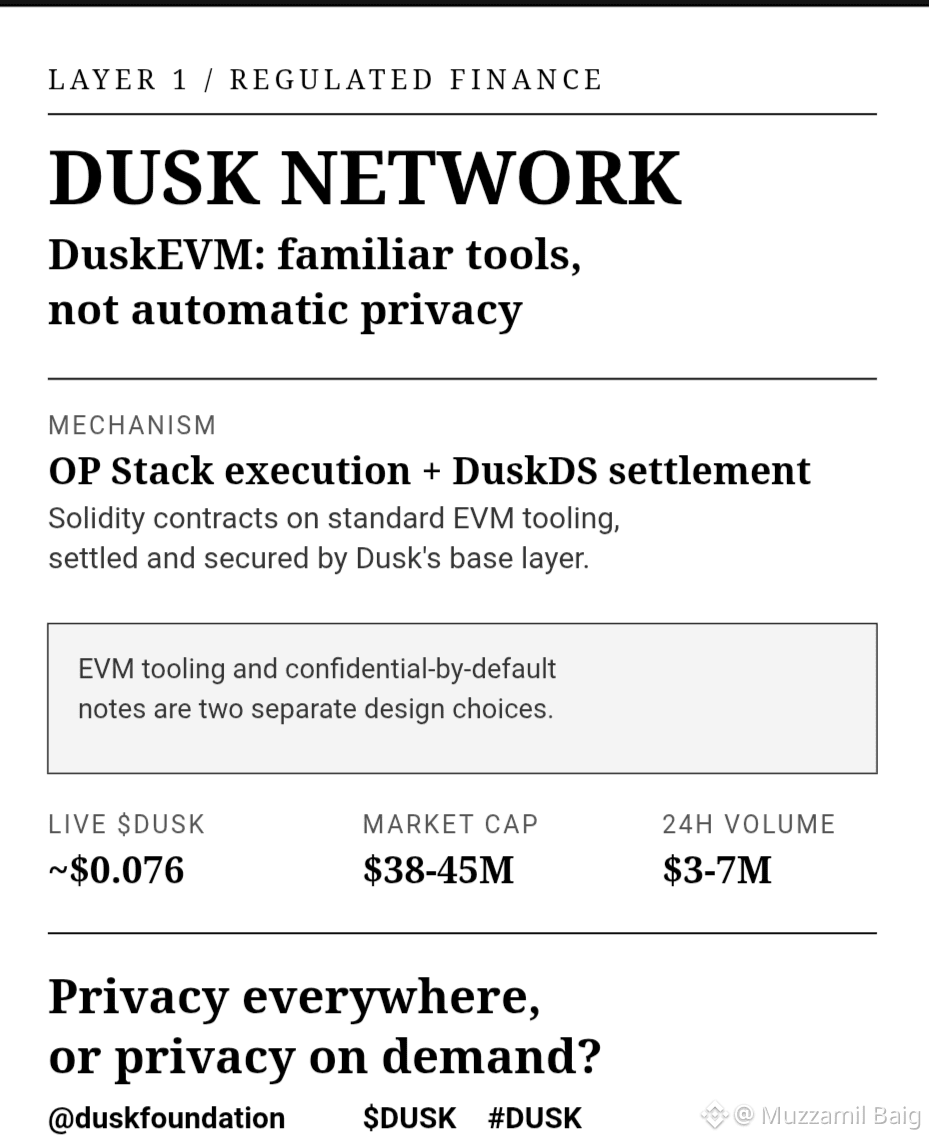
$DUSK sitting around $0.076 today, market cap somewhere in the $38-45M band depending on the tracker, daily volume in the $3-7M range. Small numbers. What actually caught my attention this week was a docs page, not the chart.
Was reading about DuskEVM expecting the usual "EVM-compatible chain" pitch — deploy your Solidity contracts, done, nothing to see here. That's not quite what it is. DuskEVM is an OP Stack-based execution environment sitting on top of DuskDS, meaning it settles and gets its data availability from Dusk's base layer while giving developers standard EVM tooling instead of forcing them to learn a new stack.
Compare that to how most privacy chains handle compatibility: they either stay isolated with custom tooling nobody outside the ecosystem wants to learn, or they go fully transparent to plug into existing DeFi. Dusk Network is trying a third path — keep the privacy-native settlement layer (Phoenix, shielded notes) underneath, but let Solidity contracts run in a familiar EVM-equivalent environment on top.
Here's what that actually means in practice: contracts deployed on DuskEVM don't automatically inherit the confidential-by-default treatment that Phoenix gives native Dusk transactions. You get familiar tooling, not automatic privacy — those are two separate design decisions, not one.
@Dusk is clearly betting compatibility gets more developers in the door faster than privacy purity would. Fair bet, maybe.
So which actually gets institutional dev teams building on regulated-finance infra faster — a chain that's privacy-native everywhere, or one that only guarantees it in specific execution environments?
#dusk
Was reading about DuskEVM expecting the usual "EVM-compatible chain" pitch — deploy your Solidity contracts, done, nothing to see here. That's not quite what it is. DuskEVM is an OP Stack-based execution environment sitting on top of DuskDS, meaning it settles and gets its data availability from Dusk's base layer while giving developers standard EVM tooling instead of forcing them to learn a new stack.
Compare that to how most privacy chains handle compatibility: they either stay isolated with custom tooling nobody outside the ecosystem wants to learn, or they go fully transparent to plug into existing DeFi. Dusk Network is trying a third path — keep the privacy-native settlement layer (Phoenix, shielded notes) underneath, but let Solidity contracts run in a familiar EVM-equivalent environment on top.
Here's what that actually means in practice: contracts deployed on DuskEVM don't automatically inherit the confidential-by-default treatment that Phoenix gives native Dusk transactions. You get familiar tooling, not automatic privacy — those are two separate design decisions, not one.
@Dusk is clearly betting compatibility gets more developers in the door faster than privacy purity would. Fair bet, maybe.
So which actually gets institutional dev teams building on regulated-finance infra faster — a chain that's privacy-native everywhere, or one that only guarantees it in specific execution environments?
#dusk