
Deader King
122 Posts

Deader King

#BinanceTurns7
Open Trade
Frequent Trader
4.6 Years
974 Following
165 Followers
25 Liked
1 Badges
Posts
Portfolio
All
Quotes
Live


MAYA_
·
--
#genius $GENIUS
Honestly : I'm wondering about the official Tokenomics of @GeniusOfficial Terminal's native utility token $GENIUS (BEP-20) - is $GENIUS actually just a token, or is behavior of the entire ecosystem hidden inside it ?
1 billion max supply = 100%.
Community & Airdrops = 31%.
Foundation & Ecosystem = 29%.
Team & Core Contributors = 20%.
Investors & Advisors = 20%.
At first glance, about 31% in circulation, plus burn - everything seems very - controlled model. But does controlled mean stable ?
Or is it just risk being shifted somewhere else ?
Community, Foundation, Team, Investors - everyone is divided neatly. But in reality, this distribution is not as clean as it seems. Because real story of tokens starts when they enter the utility, not trading. I think, I mean it makes me think..... no matter how tight the lockup or vesting is, the psychology in the market is diffarent. People don't always look at future supply, they look at what's liquid now. And burning? Yes, it reduces supply, but it doesn't guarantee value. It just changes the frame.
Yet at some point it seems that maybe the real test of this kind of tokenomics is not on paper, but rather the bigger the ecosystem, the more it will be understood - whether this balance really holds up, or if it slips somewhere under pressure..... Anyway, time will tell👍
Honestly : I'm wondering about the official Tokenomics of @GeniusOfficial Terminal's native utility token $GENIUS (BEP-20) - is $GENIUS actually just a token, or is behavior of the entire ecosystem hidden inside it ?
1 billion max supply = 100%.
Community & Airdrops = 31%.
Foundation & Ecosystem = 29%.
Team & Core Contributors = 20%.
Investors & Advisors = 20%.
At first glance, about 31% in circulation, plus burn - everything seems very - controlled model. But does controlled mean stable ?
Or is it just risk being shifted somewhere else ?
Community, Foundation, Team, Investors - everyone is divided neatly. But in reality, this distribution is not as clean as it seems. Because real story of tokens starts when they enter the utility, not trading. I think, I mean it makes me think..... no matter how tight the lockup or vesting is, the psychology in the market is diffarent. People don't always look at future supply, they look at what's liquid now. And burning? Yes, it reduces supply, but it doesn't guarantee value. It just changes the frame.
Yet at some point it seems that maybe the real test of this kind of tokenomics is not on paper, but rather the bigger the ecosystem, the more it will be understood - whether this balance really holds up, or if it slips somewhere under pressure..... Anyway, time will tell👍





SignOfficial
·
--
A compelling hook lmao

KING BREAKER 1
·
--
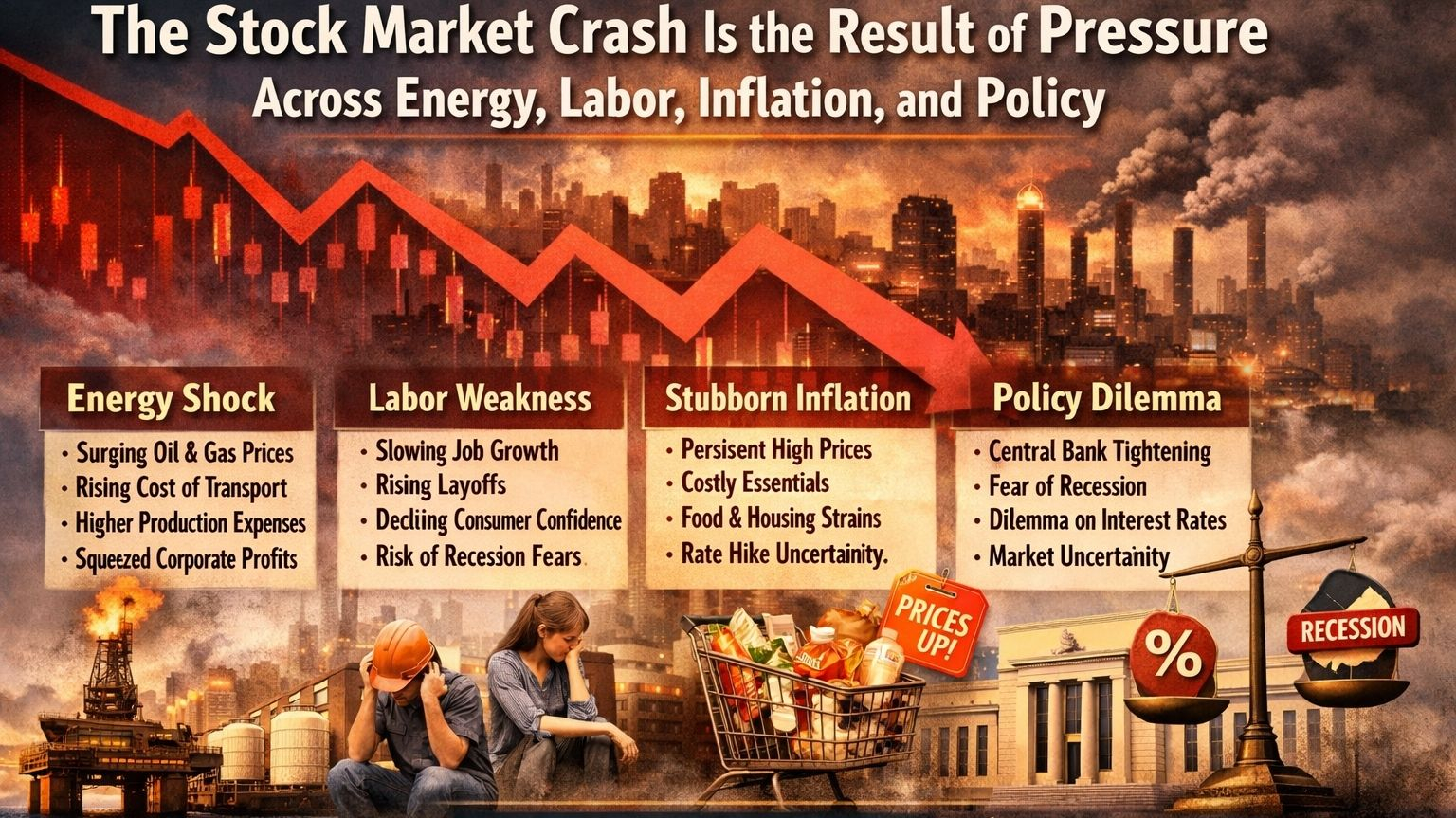
The Stock Market Crash Is the Result of Pressure Across Energy, Labor, Inflation, and Policy
There are times when the market falls because of a single shock, and then there are times when it falls because too much strain has been building beneath the surface for too long. This feels like the second kind. What people call a stock market crash often looks sudden on the screen, but in reality it usually begins much earlier, in places most people are not watching closely enough. By the time prices start dropping hard, the real pressure has already been there for a while.
That is what makes this moment different. It is not just about fear, and it is not just about investors overreacting to headlines. The deeper issue is that several important parts of the economy are starting to move in the wrong direction at the same time. Energy is becoming more expensive, labor is showing signs of strain, inflation still refuses to fade as cleanly as many hoped, and policy is no longer in a position where the answers feel simple. When all of that starts pressing together, markets do not just wobble. They begin to lose confidence in the story they were relying on.
A lot of people still think of the stock market as something separate from everyday life, as if it lives in its own world and crashes only because traders panic. But markets usually break when the real economy starts sending signals that growth may not be as durable as it looked. Prices react quickly because expectations react quickly. The market is always trying to price the future, and once that future starts looking heavier, more expensive, and less stable, the selling begins before the damage is fully visible everywhere else.
Energy sits at the center of that pressure more than most people realize. When oil, gas, or transportation costs rise sharply, the impact does not stay inside one sector. It moves through everything. It affects shipping, manufacturing, food, travel, logistics, and daily household spending. A rise in energy costs is not just an industry story. It is a system-wide burden. Companies feel it in their margins. Consumers feel it in everyday life. Investors feel it in the growing gap between what markets had priced in and what the economy may actually be able to carry.
That is where the mood begins to change. Growth can survive a lot of things, but it becomes more fragile when costs rise across the system. Businesses can handle weaker demand for a while. They can handle rising expenses for a while. But when those pressures begin arriving together, the room to absorb shocks gets much smaller. Markets understand this before most headlines fully explain it. They do not wait patiently for perfect confirmation. They move when enough pressure becomes visible to make the old optimism harder to defend.
Labor matters just as much. A strong job market gives people confidence, and confidence keeps money moving through the economy. When employment feels stable, households keep spending, companies keep hiring, and investors can still believe that any slowdown will remain contained. But once labor starts softening, the tone shifts quickly. It is not only about jobs themselves. It is about what weaker labor signals for everything connected to demand, consumption, and future growth.
I have spent enough time watching markets to notice that people often underestimate how much confidence is tied to employment. The moment labor starts looking less secure, the economy feels less anchored. It becomes easier to imagine weaker spending, slower company growth, and thinner earnings ahead. Even a small crack in labor can change the emotional temperature of the market, because investors know that strong employment has been one of the few things keeping broader confidence intact.
Then inflation adds its own pressure, and this is where things become harder to navigate. Inflation was supposed to cool, settle down, and slowly move into the background. Instead, it has remained stubborn in the places that matter most. Energy, housing, and core living costs continue to shape how people feel about the economy. That creates a difficult environment because growth may be losing momentum, but prices are still pressing high enough to keep everyone uncomfortable.
This is one of the worst combinations a market can face. If growth slows while inflation stays persistent, neither businesses nor policymakers get clean choices. A weak economy normally creates room for support. Persistent inflation normally forces restraint. When both show up together, every decision carries risk. That is why investors become uneasy. The market does not just fear bad conditions. It fears situations where there is no easy response.
That leads directly into policy, which is now part of the strain instead of a simple source of relief. Central banks are supposed to provide stability, or at least clarity. But when inflation remains sticky and growth starts weakening, policy becomes trapped between two uncomfortable outcomes. Cut rates too early, and inflation could reaccelerate. Keep rates too high for too long, and the economy could weaken more than expected. Investors see that tension clearly, and once they sense that policymakers are boxed in, confidence starts fading faster.
Markets can absorb a lot, but they hate uncertainty around the response. Bad news is one thing. A policy dilemma is something else. Once investors lose faith in the idea that central banks can step in cleanly and calm the situation, the psychology of the market changes. Selling becomes less about short-term fear and more about the realization that the usual safety net may not work the way it once did.
That becomes even more dangerous when valuations are already stretched. Expensive markets can hold up when optimism is strong and future growth still feels believable. But high valuations are built on trust. The moment that trust weakens, even a little, those prices begin to look too fragile for the environment underneath them. What once felt justified can suddenly feel exposed. And when that realization spreads across the market, declines stop looking like a temporary pullback and start feeling like a reset.
This is why stock market crashes rarely arrive out of nowhere. The surface can look calm even while the structure underneath is weakening. Investors stay hopeful longer than they should because markets have a habit of rewarding optimism until the moment they stop. But once risk has been mispriced for long enough, the correction can come fast. Prices do not gradually become honest again. They usually do it all at once, in a way that feels violent precisely because the adjustment had been delayed.
The modern market makes this worse because everything is tied together. Shocks do not stay local anymore. Rising energy costs can hit inflation expectations, inflation expectations can affect bond yields, bond yields can pressure stocks, and all of that can feed back into confidence almost immediately. Capital moves quickly. Sentiment moves even faster. A problem that begins in one part of the world can be repriced across global markets before most people have finished trying to understand it.
That is why a selloff like this spreads so broadly. It is not just one sector struggling. It is the entire market trying to reprice a world that suddenly feels less stable. Technology can suffer because growth expectations start slipping. Consumer businesses can weaken because households are more pressured. Industrials can struggle because input costs are rising. Financials can wobble because policy is less predictable. The weakness spreads because the cause is not isolated. The whole environment becomes harder to trust.
And once that happens, psychology starts doing as much work as economics. Investors become less patient. Institutions reduce risk. Traders cut exposure. Liquidity becomes thinner. Retail participants react more emotionally. The speed of the decline begins shaping decisions as much as the data itself. That is usually the stage where a market stops merely reflecting stress and starts amplifying it.
That emotional shift matters. Crashes are not just made of numbers. They are made of behavior. Once fear enters the system, people stop thinking in terms of long-term value and start thinking in terms of immediate protection. They stop asking whether the market is cheap relative to some future recovery and start asking how much more instability they may have to sit through before conditions improve. That change in thinking alone can deepen the decline.
Even so, moments like this are never driven by one force alone, and they are never solved by one force alone either. What happens next depends on whether the pressure begins to ease or continues to build. If energy stabilizes, some inflation pressure may soften. If labor holds up better than feared, demand may remain stronger than expected. If policymakers can restore some clarity, confidence may gradually return. But if these pressures continue feeding into each other, then the damage may last longer than many investors want to believe.
That is the real meaning of a stock market crash. It is not just falling prices. It is the moment when too many important supports start looking less reliable at once. It is the market admitting that the assumptions behind recent confidence were not as solid as they seemed. Energy, labor, inflation, and policy are not separate stories anymore. They are all pressing on the same system, and that system is beginning to show strain.
What markets are reacting to now is bigger than one bad day or one dramatic headline. They are reacting to a world that feels more expensive, less predictable, and harder to manage than the one investors thought they were pricing only a short while ago. And when that realization spreads, stability can disappear much faster than people expect.
#StockMarketCrash
That is what makes this moment different. It is not just about fear, and it is not just about investors overreacting to headlines. The deeper issue is that several important parts of the economy are starting to move in the wrong direction at the same time. Energy is becoming more expensive, labor is showing signs of strain, inflation still refuses to fade as cleanly as many hoped, and policy is no longer in a position where the answers feel simple. When all of that starts pressing together, markets do not just wobble. They begin to lose confidence in the story they were relying on.
A lot of people still think of the stock market as something separate from everyday life, as if it lives in its own world and crashes only because traders panic. But markets usually break when the real economy starts sending signals that growth may not be as durable as it looked. Prices react quickly because expectations react quickly. The market is always trying to price the future, and once that future starts looking heavier, more expensive, and less stable, the selling begins before the damage is fully visible everywhere else.
Energy sits at the center of that pressure more than most people realize. When oil, gas, or transportation costs rise sharply, the impact does not stay inside one sector. It moves through everything. It affects shipping, manufacturing, food, travel, logistics, and daily household spending. A rise in energy costs is not just an industry story. It is a system-wide burden. Companies feel it in their margins. Consumers feel it in everyday life. Investors feel it in the growing gap between what markets had priced in and what the economy may actually be able to carry.
That is where the mood begins to change. Growth can survive a lot of things, but it becomes more fragile when costs rise across the system. Businesses can handle weaker demand for a while. They can handle rising expenses for a while. But when those pressures begin arriving together, the room to absorb shocks gets much smaller. Markets understand this before most headlines fully explain it. They do not wait patiently for perfect confirmation. They move when enough pressure becomes visible to make the old optimism harder to defend.
Labor matters just as much. A strong job market gives people confidence, and confidence keeps money moving through the economy. When employment feels stable, households keep spending, companies keep hiring, and investors can still believe that any slowdown will remain contained. But once labor starts softening, the tone shifts quickly. It is not only about jobs themselves. It is about what weaker labor signals for everything connected to demand, consumption, and future growth.
I have spent enough time watching markets to notice that people often underestimate how much confidence is tied to employment. The moment labor starts looking less secure, the economy feels less anchored. It becomes easier to imagine weaker spending, slower company growth, and thinner earnings ahead. Even a small crack in labor can change the emotional temperature of the market, because investors know that strong employment has been one of the few things keeping broader confidence intact.
Then inflation adds its own pressure, and this is where things become harder to navigate. Inflation was supposed to cool, settle down, and slowly move into the background. Instead, it has remained stubborn in the places that matter most. Energy, housing, and core living costs continue to shape how people feel about the economy. That creates a difficult environment because growth may be losing momentum, but prices are still pressing high enough to keep everyone uncomfortable.
This is one of the worst combinations a market can face. If growth slows while inflation stays persistent, neither businesses nor policymakers get clean choices. A weak economy normally creates room for support. Persistent inflation normally forces restraint. When both show up together, every decision carries risk. That is why investors become uneasy. The market does not just fear bad conditions. It fears situations where there is no easy response.
That leads directly into policy, which is now part of the strain instead of a simple source of relief. Central banks are supposed to provide stability, or at least clarity. But when inflation remains sticky and growth starts weakening, policy becomes trapped between two uncomfortable outcomes. Cut rates too early, and inflation could reaccelerate. Keep rates too high for too long, and the economy could weaken more than expected. Investors see that tension clearly, and once they sense that policymakers are boxed in, confidence starts fading faster.
Markets can absorb a lot, but they hate uncertainty around the response. Bad news is one thing. A policy dilemma is something else. Once investors lose faith in the idea that central banks can step in cleanly and calm the situation, the psychology of the market changes. Selling becomes less about short-term fear and more about the realization that the usual safety net may not work the way it once did.
That becomes even more dangerous when valuations are already stretched. Expensive markets can hold up when optimism is strong and future growth still feels believable. But high valuations are built on trust. The moment that trust weakens, even a little, those prices begin to look too fragile for the environment underneath them. What once felt justified can suddenly feel exposed. And when that realization spreads across the market, declines stop looking like a temporary pullback and start feeling like a reset.
This is why stock market crashes rarely arrive out of nowhere. The surface can look calm even while the structure underneath is weakening. Investors stay hopeful longer than they should because markets have a habit of rewarding optimism until the moment they stop. But once risk has been mispriced for long enough, the correction can come fast. Prices do not gradually become honest again. They usually do it all at once, in a way that feels violent precisely because the adjustment had been delayed.
The modern market makes this worse because everything is tied together. Shocks do not stay local anymore. Rising energy costs can hit inflation expectations, inflation expectations can affect bond yields, bond yields can pressure stocks, and all of that can feed back into confidence almost immediately. Capital moves quickly. Sentiment moves even faster. A problem that begins in one part of the world can be repriced across global markets before most people have finished trying to understand it.
That is why a selloff like this spreads so broadly. It is not just one sector struggling. It is the entire market trying to reprice a world that suddenly feels less stable. Technology can suffer because growth expectations start slipping. Consumer businesses can weaken because households are more pressured. Industrials can struggle because input costs are rising. Financials can wobble because policy is less predictable. The weakness spreads because the cause is not isolated. The whole environment becomes harder to trust.
And once that happens, psychology starts doing as much work as economics. Investors become less patient. Institutions reduce risk. Traders cut exposure. Liquidity becomes thinner. Retail participants react more emotionally. The speed of the decline begins shaping decisions as much as the data itself. That is usually the stage where a market stops merely reflecting stress and starts amplifying it.
That emotional shift matters. Crashes are not just made of numbers. They are made of behavior. Once fear enters the system, people stop thinking in terms of long-term value and start thinking in terms of immediate protection. They stop asking whether the market is cheap relative to some future recovery and start asking how much more instability they may have to sit through before conditions improve. That change in thinking alone can deepen the decline.
Even so, moments like this are never driven by one force alone, and they are never solved by one force alone either. What happens next depends on whether the pressure begins to ease or continues to build. If energy stabilizes, some inflation pressure may soften. If labor holds up better than feared, demand may remain stronger than expected. If policymakers can restore some clarity, confidence may gradually return. But if these pressures continue feeding into each other, then the damage may last longer than many investors want to believe.
That is the real meaning of a stock market crash. It is not just falling prices. It is the moment when too many important supports start looking less reliable at once. It is the market admitting that the assumptions behind recent confidence were not as solid as they seemed. Energy, labor, inflation, and policy are not separate stories anymore. They are all pressing on the same system, and that system is beginning to show strain.
What markets are reacting to now is bigger than one bad day or one dramatic headline. They are reacting to a world that feels more expensive, less predictable, and harder to manage than the one investors thought they were pricing only a short while ago. And when that realization spreads, stability can disappear much faster than people expect.
#StockMarketCrash
Log in to explore more content