
0xnut6
115 Posts

0xnut6
Report
Block User
多年資歷的專業交易員與分析師,專注衍生品、DeFi、鏈上數據、RWA 與 AI 賽道。每天整理市場最前沿的資訊,拆解背後的原因、資金流向與風險,幫你在變化快速的加密市場裡看清局勢、做出更好的決策。內容僅供參考,不構成投資建議。
13 Following
15 Followers
8 Liked
Posts
·
--
$SOL closed at 72.23 in the hour before 21:00, with a trading volume of $5.4 million. During the 21:00 hour, the price rose to 76.76 and closed at 76.60, with a trading volume of $27.3 million (five times the previous amount). Open interest fell from 7.8607 million to 7.7666 million coins, the account long-short ratio rose from 3.35 to 3.74, and the funding rate was -0.0058%. $HYPE rose from 63.78 to 67.02, with a trading volume of $2.8 million. Open interest increased from 4.3510 million to 4.3753 million coins, the account long-short ratio rose from 1.40 to 1.41, and the funding rate was +0.0050%.
$SOL closed at 72.23 in the hour before 21:00, with a trading volume of $5.4 million. During the 21:00 hour, the price rose to 76.76 and closed at 76.60, with a trading volume of $27.3 million (five times the previous amount). Open interest fell from 7.8607 million to 7.7666 million coins, the account long-short ratio rose from 3.35 to 3.74, and the funding rate was -0.0058%. $HYPE rose from 63.78 to 67.02, with a trading volume of $2.8 million. Open interest increased from 4.3510 million to 4.3753 million coins, the account long-short ratio rose from 1.40 to 1.41, and the funding rate was +0.0050%.
235
·
--
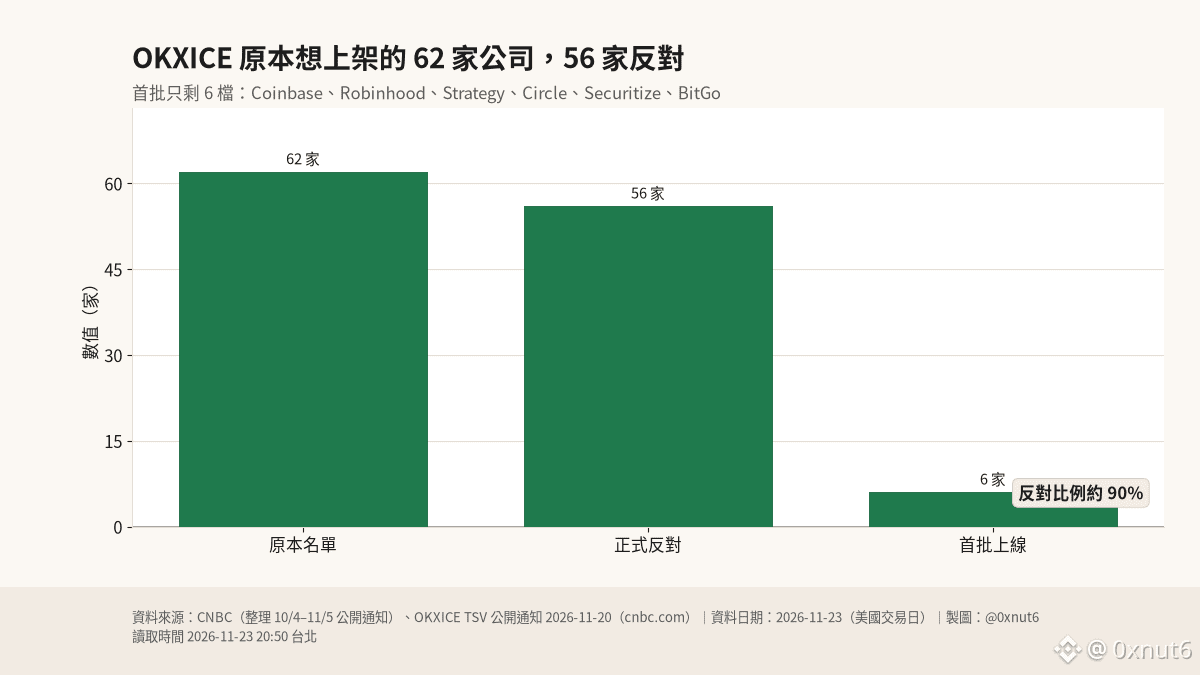
Of the 62 U.S. companies originally slated to be listed, 56 formally objected. But the tokenized U.S. stock platform OKXICE, jointly operated by OKX and Intercontinental Exchange, still launched today, U.S. time, as originally planned. Only 6 stocks are available to buy in its initial batch.
That figure was calculated by CNBC from public notices issued between October 4 and November 5, in a roundup published on November 23. The proportion of objecting companies was about 90%. The SEC’s tokenization exemption rules, which took effect in September, require platforms to notify issuers first and give them 30 days to respond. If a company objects, its stock cannot be tokenized on the platform. The six stocks available in the initial batch are Coinbase, Robinhood, Strategy, Circle, Securitize, and BitGo—all crypto-related companies.
OKXICE co-chair and former New York Governor Andrew Cuomo told CNBC that most companies are still unfamiliar with tokenization, and that the more they learn about 24-hour global trading, the more willing they are to join. The platform also said it plans to roll out 113 assets over time, including ETFs.
Before buying any of these stocks, it’s best to understand how their prices are determined. According to a public notice from OKXICE dated November 20, the platform has no order book. Each stock is paired with USDC in a Uniswap v4 pool. The smart contract does not use an oracle or connect to external market data; prices are determined solely by the ratio of the two assets in the pool. The platform operates 24 hours a day. After the U.S. stock market closes, there are no trades in the underlying shares to use as a reference, so prices depend entirely on how people in the pool buy and sell. If an underlying stock is halted or triggers a circuit breaker, trading on the platform is halted as well.
Another restriction is the trading-volume cap. The exemption rules set a cap for Level 1 large-cap stocks (S&P 500 and Russell 1000 constituents): daily trading volume cannot exceed 0.25% of the underlying stock’s average daily volume in the previous month. If the underlying stock averages 10 million shares traded per day, the platform can trade no more than 25,000 shares in a day. As the cap nears, the platform may temporarily suspend trading. If the cap is exceeded a second time, trading in that stock is suspended for three months.
49
·
--
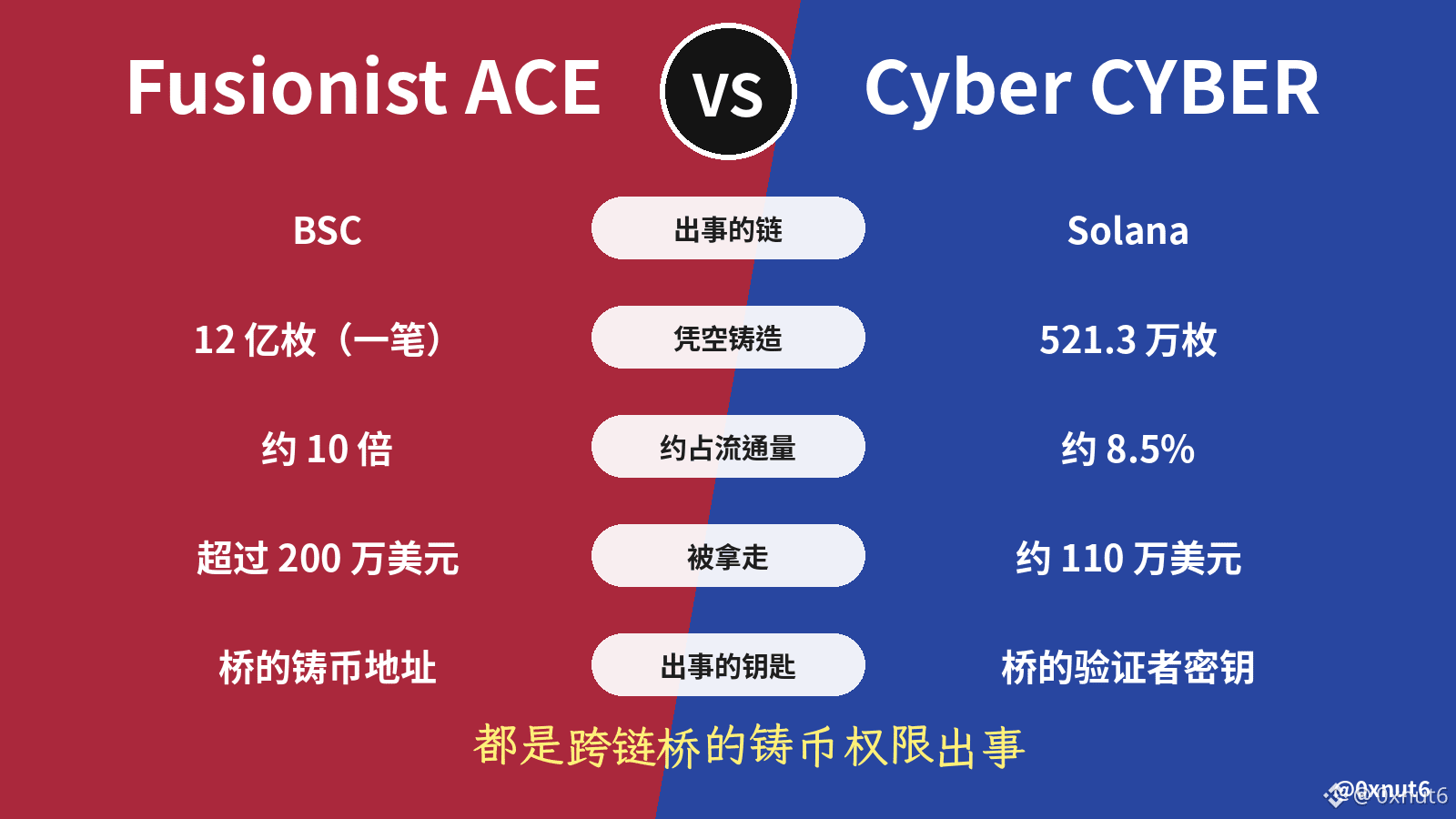
Early this morning, someone minted 1.2 billion Fusionist ACE out of thin air in a single transaction—about 10 times the circulating supply—and sold them for USDT. Over the weekend, 5.213 million CYBER were also minted through Cyber’s cross-chain bridge.
According to an alert from Blockaid, the incident involved an address on BSC with permission to mint tokens through the cross-chain bridge. At 2:41 a.m. Beijing time on November 23, a single transaction minted 1,200,000,000 ACE. Fusionist’s official team then asked users to pause ACE transfers, trading, and cross-chain transactions on BSC. According to Lookonchain, the attacker made off with more than $2 million and has already deposited 1,150 ETH into Tornado Cash.
Cyber’s incident involved the same kind of issue. According to Bitquery’s on-chain analysis, someone used the validator keys for this LayerZero route to sign two fake messages, resulting in 5,213,000 CYBER being minted on Solana. Two minutes later, someone withdrew real tokens worth about $1.1 million from the Ethereum lockup contract. Cyber’s official team asked users not to use the bridge for now, while Upbit and Bithumb also suspended CYBER deposits and withdrawals.
The two incidents have one thing in common: an address with minting permissions or a validator key directly signed off on the creation of new tokens. The supply of a cross-chain token on another chain depends entirely on the bridge’s key. If that key is compromised, holders of the bridged version are the first to suffer; once exchanges suspend deposits and withdrawals, the tokens can’t be moved either.
Based on current CoinGecko prices, CYBER’s circulating market cap is about $12.48 million, and the 5.213 million tokens minted out of thin air account for about 8.5% of the circulating supply. ACE’s circulating market cap is down to about $8.38 million, after falling 14.8% in 24 hours.
$CYBER
367
·
--
During the midday Asian session, $BTC first spiked to 60,386, then climbed to 61,959 in the following hour. That candlestick saw $98 million in trading volume, a clear surge. But perpetual futures open interest fell steadily from 92,995 coins at 10:00 to 90,952 coins at 12:00—in other words, open interest shrank even as prices rose.
$ETH also saw a surge in volume, with $39 million traded during the 11:00 hour. The price first surged to 1,752, then pulled back to 1,735. BTC is currently trading at around 61,704, up 4.94% over 24 hours, while ETH is up 5.22%. However, open interest for both has declined.
$ETH also saw a surge in volume, with $39 million traded during the 11:00 hour. The price first surged to 1,752, then pulled back to 1,735. BTC is currently trading at around 61,704, up 4.94% over 24 hours, while ETH is up 5.22%. However, open interest for both has declined.
380
·
--
The BTC hourly candle before the Asian session surged to 61,464, a six-hour high, but volume later contracted and the price pulled back to 61,036, with a low of 60,924. The current price is 61,016. Trading volume fell from 55 million to 24 million. The perpetual long/short ratio dropped from 2.27 to 2.02, open interest also edged down, and the funding rate turned negative at -0.0011%.
$XRP has decoupled from the broader market. Its current price is 0.9198, down 1.2% over 24 hours, while $BTC rose 1.55% and ETH rose 1.7% over the same period. The perpetual long/short ratio is still holding at 2.70, but open interest has barely changed. This market rally hasn't lifted it.
$XRP has decoupled from the broader market. Its current price is 0.9198, down 1.2% over 24 hours, while $BTC rose 1.55% and ETH rose 1.7% over the same period. The perpetual long/short ratio is still holding at 2.70, but open interest has barely changed. This market rally hasn't lifted it.
265
·
--
$BTC rose +2.62% in six hours, but $NEAR surged even more, gaining +5.995% in six hours, while $HYPE also gained +4.16%. NEAR's open interest rose from 54.89 million at 5 p.m. to 55.79 million at 10 p.m., and its value in USD also increased from 160.2 million to 168.7 million. However, NEAR's account long/short ratio fell from 1.265 to 1.2012, with longs declining slightly, while the funding rate held at +0.0049%. HYPE's open interest edged down from 4.596 million to 4.565 million, its long/short ratio rose from 1.44 to 1.45, and its funding rate was +0.0009%.
$BTC rose +2.62% in six hours, but $NEAR surged even more, gaining +5.995% in six hours, while $HYPE also gained +4.16%. NEAR's open interest rose from 54.89 million at 5 p.m. to 55.79 million at 10 p.m., and its value in USD also increased from 160.2 million to 168.7 million. However, NEAR's account long/short ratio fell from 1.265 to 1.2012, with longs declining slightly, while the funding rate held at +0.0049%. HYPE's open interest edged down from 4.596 million to 4.565 million, its long/short ratio rose from 1.44 to 1.45, and its funding rate was +0.0009%.
28
·
--
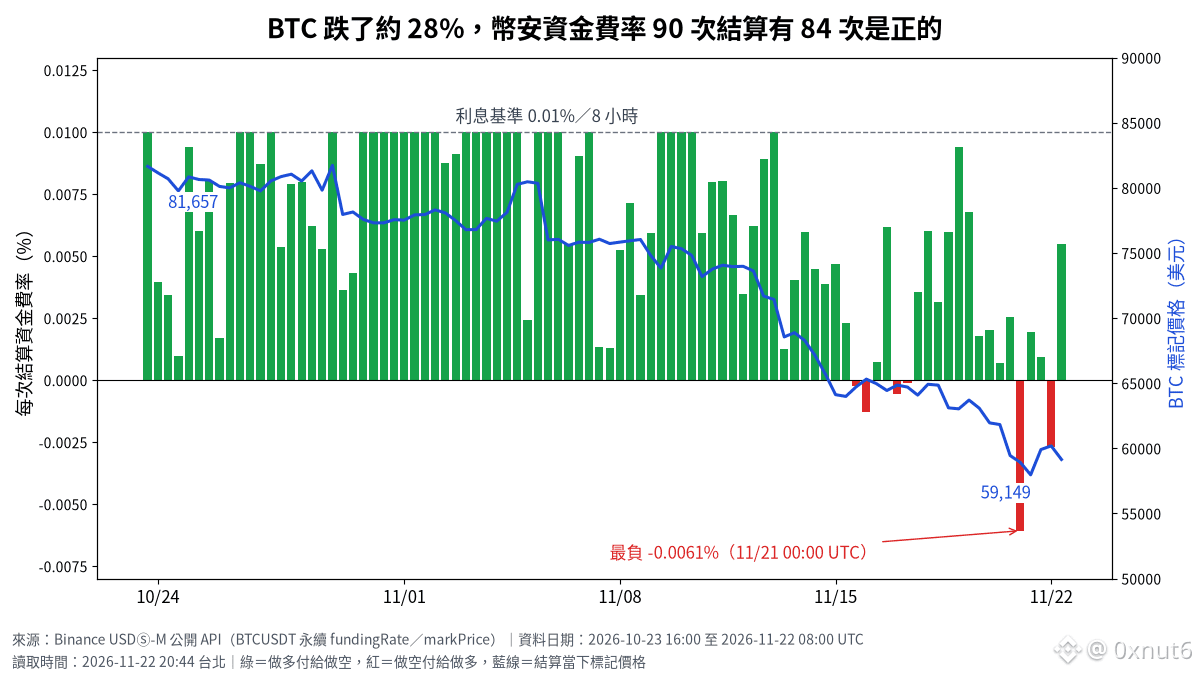
Bitcoin fell from $82,000 to around $59,000 over the past 30 days. During the same period, the funding rate was positive in 84 of 90 Binance BTC perpetual contract settlements, meaning longs kept paying shorts.
Over the past two days, many people have been saying, “Binance funding rates have turned negative, signaling a bottom.” I pulled the settlement records from Binance’s public API, covering October 23 to November 22 (UTC), with settlements every 8 hours. The funding rate is a fee paid between longs and shorts in perpetual contracts; a positive rate means longs pay shorts.
Only 6 of the 90 settlements were negative. The most negative was at 00:00 UTC on November 21, when the rate was -0.0061%. The other 5 were all within -0.003%, and negative rates never occurred more than twice in a row before turning positive again. Over these 30 days, Binance’s BTC mark price fell from $81,657 to $59,149, a drop of about 28%.
Adding up all 90 settlements, longs paid a total of 0.55% over these 30 days, equivalent to an annualized rate of about 6.7%. For a one-BTC long position valued at $60,000, holding it through these 30 days would cost around $330 in funding fees alone. Even after prices fell by more than $20,000, longs were still more eager to enter the market than shorts.
Binance’s funding rate includes a fixed interest component of 0.01% every 8 hours. When the gap between longs and shorts is small, the rate stays at this level; during these 30 days, it was exactly 0.01% 28 times. If short positions were already crowded, the rate would need to fall below -0.01% several times in a row. That never happened during these 30 days.
$BTC
126
·
--
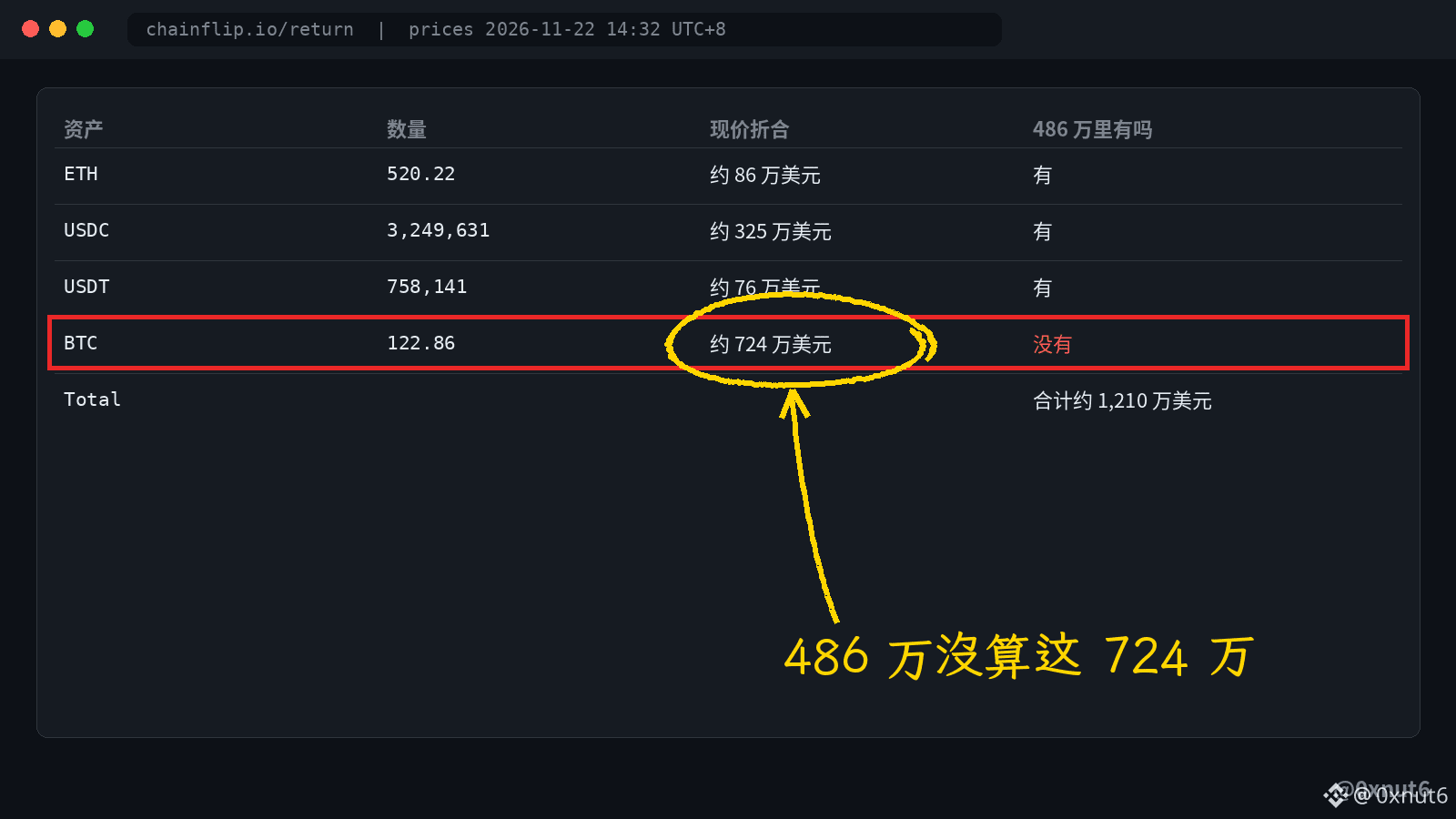
The amount taken from Chainflip’s treasury on November 21 was much greater than the $4.86 million reported elsewhere. The official tally also includes 122.86 BTC, worth about $7.24 million at current prices, while FLIP fell about 42% in a day.
Security firm Decurity was the first to sound the alarm. The $4.86 million figure accounted only for the Ethereum treasury: 520 ETH, 3.25 million USDC, and 758,000 USDT were taken. In an on-chain message to the attacker, Chainflip also included the Bitcoin, offering to let the attacker keep 10% as a bounty if they returned 90% of the funds by 2:38 a.m. Beijing time on November 24.
According to the security firm’s analysis, the funds weren’t stolen through a contract vulnerability. Chainflip’s treasury is jointly managed by 150 validator nodes using a signing key. At least 100 nodes must sign together to authorize a transfer, and the key is rotated every three days. The attacker obtained a valid signature and emptied the Ethereum treasury in a single transaction, then moved the ETH to Tornado Cash within ten minutes.
The team said the attacker had prepared in advance: they received funds from Tornado Cash on November 11, then bought FLIP, registered a validator node account on November 20, and carried out the attack the next day. The protocol is now in full security mode, with deposits, withdrawals, swaps, and quotes all paused. During this period, swaps through Chainflip in Trezor Suite and Cake Wallet also won’t receive quotes.
At current prices, the stolen assets total about $12.1 million, roughly half of FLIP’s current market capitalization of about $23.56 million.
$BTC $ETH
231
·
--
$BTC fell from above 60,000 to below 60,000, and is now around 58,840. The 10 o’clock hourly candle had a trading volume of $65 million, higher than the $25 million at 9 o’clock. The long-short ratio fell from 2.17 to around 2.0, and the number of coins in open positions also decreased by more than 300. The funding rate is still positive.
$ETH also fell to 1,648 and is now around 1,650. The taker buy/sell ratio was 0.72 at 10 o’clock and 0.69 at 11 o’clock, both lower than BTC’s 0.84 and 0.93. The number of coins in open positions edged up from 2.3171 million to 2.3212 million, while the long-short ratio fell from 1.91 to 1.83. The funding rate is negative.
$ETH also fell to 1,648 and is now around 1,650. The taker buy/sell ratio was 0.72 at 10 o’clock and 0.69 at 11 o’clock, both lower than BTC’s 0.84 and 0.93. The number of coins in open positions edged up from 2.3171 million to 2.3212 million, while the long-short ratio fell from 1.91 to 1.83. The funding rate is negative.
71
·
--
U.S. stocks were closed last night, and BTC hovered around 60,000 all night as trading volume clearly contracted. After reaching a high of 60,996 at 22:00, it fluctuated between 59,690 and 60,568 for more than ten hours. Trading volume at 04:00 was only $20 million, far below the previous period’s $113 million. $BTC is currently at 60,020, up 1.76% over 24 hours, but down 0.52% over the short-term 6-hour period.
Meanwhile, $ZEC ’s long-to-short ratio fell from 0.68 to 0.55, with short-position accounts increasing noticeably. Dollar-denominated open interest shrank from $395 million to $382 million, while the funding rate remains supported at +0.0100%.
Meanwhile, $ZEC ’s long-to-short ratio fell from 0.68 to 0.55, with short-position accounts increasing noticeably. Dollar-denominated open interest shrank from $395 million to $382 million, while the funding rate remains supported at +0.0100%.
69
·
--
Hey, the market rebounded tonight, and leverage came back too. $BTC rose 4.29%, from 57,825 at 4:14 PM on 11/21 to 60,306 at 10:14 PM; $ETH rose 4.16%, from 1,626.80 to 1,694.46. Open interest in perpetual contracts also recovered: $BTC climbed from $5.386 billion at 5 PM to $5.657 billion at 10 PM, while the long-short ratio rose from 2.57 to 2.65. The funding rate turned positive, from -0.0078% at 9:46 AM to +0.0005%. The $ETH funding rate was +0.0036%, and open interest rose from $3.757 billion to $3.929 billion. This isn’t just a price move—leveraged traders are back in the market.
Hey, the market rebounded tonight, and leverage came back too. $BTC rose 4.29%, from 57,825 at 4:14 PM on 11/21 to 60,306 at 10:14 PM; $ETH rose 4.16%, from 1,626.80 to 1,694.46. Open interest in perpetual contracts also recovered: $BTC climbed from $5.386 billion at 5 PM to $5.657 billion at 10 PM, while the long-short ratio rose from 2.57 to 2.65. The funding rate turned positive, from -0.0078% at 9:46 AM to +0.0005%. The $ETH funding rate was +0.0036%, and open interest rose from $3.757 billion to $3.929 billion. This isn’t just a price move—leveraged traders are back in the market.
171
·
--
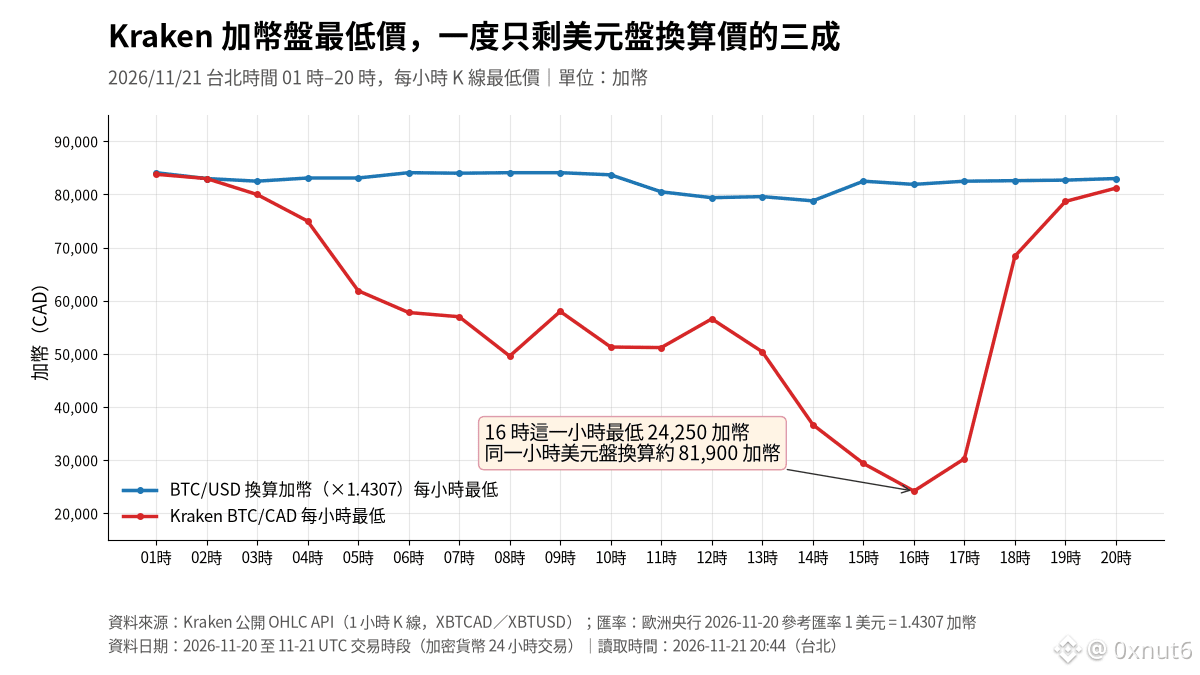
People who sold Bitcoin for Canadian dollars on Kraken received as little as CAD 24,250 per coin this afternoon—only 30% of the equivalent price on the USD market at the same time. The exchange said all these trades were valid and would not be reversed.
Kraken’s customer support account issued an explanation tonight, saying that heavy selling pressure began to hit the CAD trading pair at 4 a.m. Taipei time today, pushing prices far below those on other markets. Kraken also said every order on the platform was matched according to its rules, and its security team found no signs of a hack or compromised accounts.
According to Kraken’s public candlestick data, the lowest BTC/CAD trade between 4 p.m. and 5 p.m. Taipei time today was CAD 24,250. During the same hour, the lowest BTC/USD price was USD 57,277. Using the European Central Bank’s November 20 exchange rate of USD 1 to CAD 1.4307, that works out to about CAD 81,900, meaning the price on the CAD market had been knocked down by 70%.
The price gap did not close quickly, either. The CAD market started falling at 4 a.m. and did not return to around CAD 80,000 until about 6 p.m.—a drop that lasted 14 hours. During that time, 592 Bitcoin were traded in BTC/CAD, compared with an average of just 17 per hour in the three hours before the incident. USDC/CAD on the same platform was also dragged down: its 24-hour low was CAD 0.4868, while it is usually around CAD 1.4.
The main reason the CAD market was so badly hit was its low trading volume. Kraken’s CAD market traded 694 Bitcoin over 24 hours, while its USD market traded 10,825. The CAD market’s volume was only about 6% of the USD market’s. On a trading pair with such low volume, market orders or stop-loss market orders can execute at prices far from those on other markets. Since the exchange considers the trades valid, sellers who sold at the low point cannot recover the difference.
$BTC
339
·
--

Article
After Binance Agentic Wallet deleted 1,436 lines, these 4 checkpoints remain before buying a token—and you have to pass them in orderBinance Agentic Wallet's official skill deleted 1,436 lines on November 12, including the only flow that asked whether you wanted to skip token audits. Now, before buying a token, you have to pass through 4 checkpoints in order.
This change came from Binance's official GitHub repository, binance-skills-hub. It was pull request #416, merged into the main branch at 10:05 p.m. Taipei time on November 12. The change affected 10 files in total, adding 3 lines and deleting 1,436. The dedicated documentation file for the internal market, deleted in its entirety, had 606 lines, and its companion script had 787. The internal market refers to the stage when a token is still on a bonding curve and has not yet been listed on an external trading pool. I revisited the repository at 4:09 p.m. on November 21, and the latest commit on the main branch was still this merge; it had not been reverted.
After Binance Agentic Wallet deleted 1,436 lines, these 4 checkpoints remain before buying a token—and you have to pass them in order
Binance Agentic Wallet's official skill deleted 1,436 lines on November 12, including the only flow that asked whether you wanted to skip token audits. Now, before buying a token, you have to pass through 4 checkpoints in order.
This change came from Binance's official GitHub repository, binance-skills-hub. It was pull request #416, merged into the main branch at 10:05 p.m. Taipei time on November 12. The change affected 10 files in total, adding 3 lines and deleting 1,436. The dedicated documentation file for the internal market, deleted in its entirety, had 606 lines, and its companion script had 787. The internal market refers to the stage when a token is still on a bonding curve and has not yet been listed on an external trading pool. I revisited the repository at 4:09 p.m. on November 21, and the latest commit on the main branch was still this merge; it had not been reverted.
This change came from Binance's official GitHub repository, binance-skills-hub. It was pull request #416, merged into the main branch at 10:05 p.m. Taipei time on November 12. The change affected 10 files in total, adding 3 lines and deleting 1,436. The dedicated documentation file for the internal market, deleted in its entirety, had 606 lines, and its companion script had 787. The internal market refers to the stage when a token is still on a bonding curve and has not yet been listed on an external trading pool. I revisited the repository at 4:09 p.m. on November 21, and the latest commit on the main branch was still this merge; it had not been reverted.
68
·
--
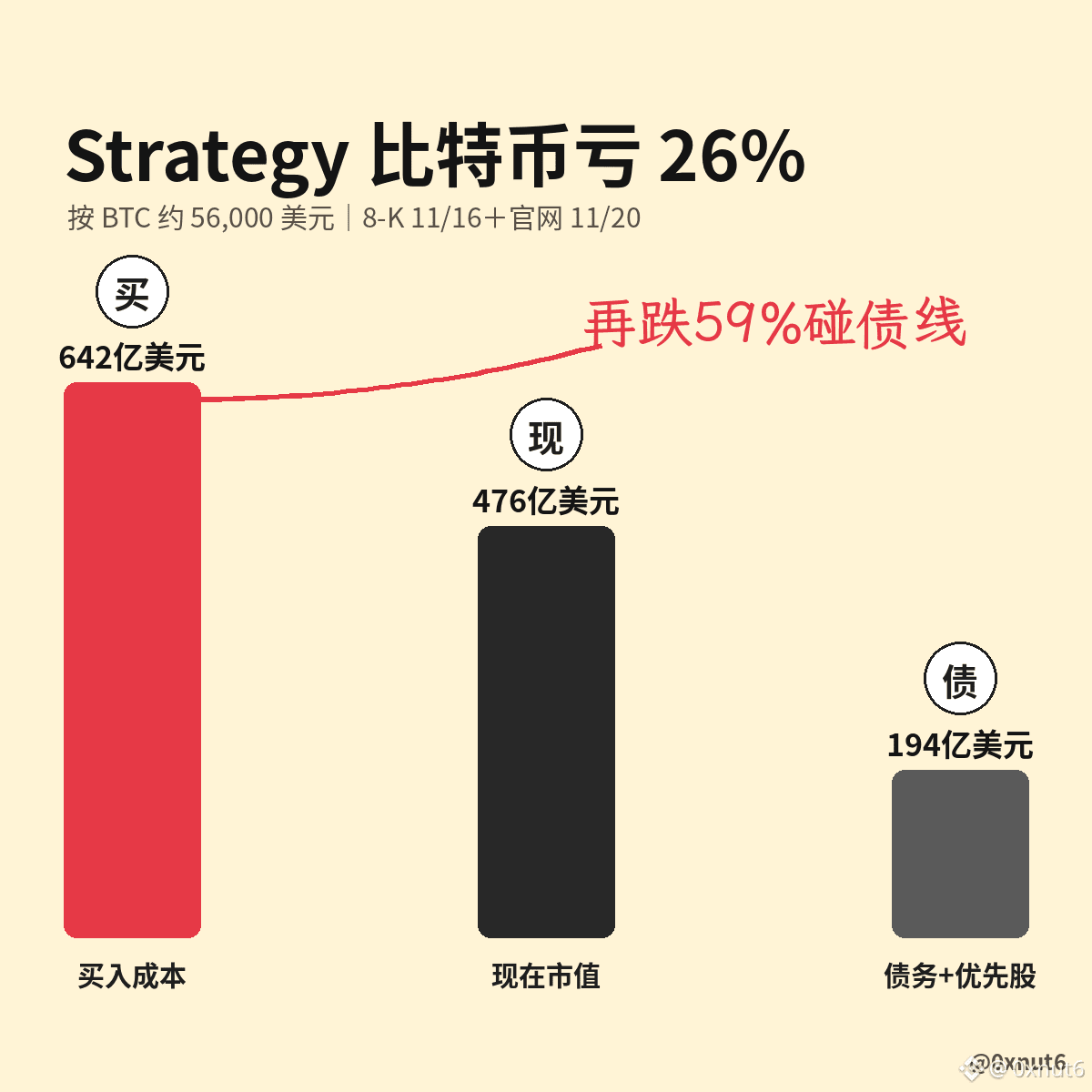
Bitcoin fell below $56,000 today, leaving Michael Saylor’s Strategy with an estimated $16.6 billion in paper losses on its 850,000 bitcoins. But none of those coins have been pledged to creditors, so a price drop won’t trigger a forced liquidation.
According to Strategy’s 8-K filing—a report of significant events—submitted to the U.S. Securities and Exchange Commission on November 16, the company holds a total of 850,849 bitcoins, at a total cost of $64.2 billion. That works out to an average purchase price of $75,452 per coin. At today’s price of about $56,000 after Bitcoin fell below that mark on Coinbase, the coins are worth about $47.6 billion, roughly 26% less than their purchase cost.
On November 20, Strategy publicly said that none of its bitcoins had been pledged as collateral. Its website lists net reserves of $35.9 billion—the value of its bitcoin holdings minus $6.7 billion in debt and $12.7 billion in preferred stock. The website’s figure is based on a price of about $65,000 per coin; at $56,000, net reserves would be about $28.2 billion. During the 2022 bear market, one-third of its bitcoins were pledged to lenders, and its net reserves were still negative at the time.
Debt and preferred stock total about $19.4 billion. Spread across each bitcoin, the price would have to fall to about $22,800—another roughly 59% drop from $56,000—before the value of the holdings fell below that amount. Conversely, Bitcoin would need to rise about 35% to return to the average purchase price and bring the holdings back to break-even.
$BTC
83
·
--
During today's Asian session, $BTC plunged in a single candle to 55,555. In one hour, it fell from 58,589 to 56,400, closing at 56,740. Trading volume was $321 million, significantly higher than the $87 million in the previous hour. It is now around 55,900, down 9.6% in 24 hours. Perpetual open interest fell from 96,204 coins to 95,493, the long-to-short ratio dropped from 3.49 to 3.06, and the funding rate is -0.0065%.
$HYPE spot price fell from 59.33 to 55.80 and is now around 56.5, down 13.8% in 24 hours. The number of coins in perpetual open interest rose from 4.97 million to 5.07 million, then dipped to 5.03 million. The coin count increased even as the price fell. The long-to-short ratio dropped from 1.64 to 1.52, and the funding rate is -0.0021%.
$HYPE spot price fell from 59.33 to 55.80 and is now around 56.5, down 13.8% in 24 hours. The number of coins in perpetual open interest rose from 4.97 million to 5.07 million, then dipped to 5.03 million. The coin count increased even as the price fell. The long-to-short ratio dropped from 1.64 to 1.52, and the funding rate is -0.0021%.
393
·
--
Last night, Bitcoin plunged from 61,770 straight through 60,000, hitting a low of 57,778 before bouncing back to 58,990. It’s down nearly 5% in 24 hours.$BTC In terms of coin count, contract positions actually increased slightly (95,657→96,377); the drop in their dollar value is simply due to the price falling. The long-short ratio rose from 3.01 to 3.51, meaning more accounts are opening long positions. The funding rate is -0.0078%.
$ETH fared even worse, down 7.44% in 24 hours, with a low of 1,581 and a current price of 1,623. The number of coins in perpetual positions fell from 2.478 million to 2.361 million, a drop of about 4.7%. The funding rate is -0.0207%, more negative than BTC’s.
$ETH fared even worse, down 7.44% in 24 hours, with a low of 1,581 and a current price of 1,623. The number of coins in perpetual positions fell from 2.478 million to 2.361 million, a drop of about 4.7%. The funding rate is -0.0207%, more negative than BTC’s.
75
·
--
ZEC continued to sell off during the evening session. Spot fell from a six-hour high of 857.24 to a low of 801.00, and is now at 816.74, down 4.10% over six hours and 13.74% over 24 hours, with approximately $217 million in trading volume. Over the same period, $BTC was nearly unchanged at 61,824, up 0.00% over six hours. $ZEC perpetual open interest fell from 413 million at 17:00 to 402 million at 22:00, while the coin count rose from 487,200 to 493,200. The account long/short ratio increased from 0.97 to 1.26, and the funding rate was +0.0048%.
ZEC continued to sell off during the evening session. Spot fell from a six-hour high of 857.24 to a low of 801.00, and is now at 816.74, down 4.10% over six hours and 13.74% over 24 hours, with approximately $217 million in trading volume. Over the same period, $BTC was nearly unchanged at 61,824, up 0.00% over six hours. $ZEC perpetual open interest fell from 413 million at 17:00 to 402 million at 22:00, while the coin count rose from 487,200 to 493,200. The account long/short ratio increased from 0.97 to 1.26, and the funding rate was +0.0048%.
29
·
--
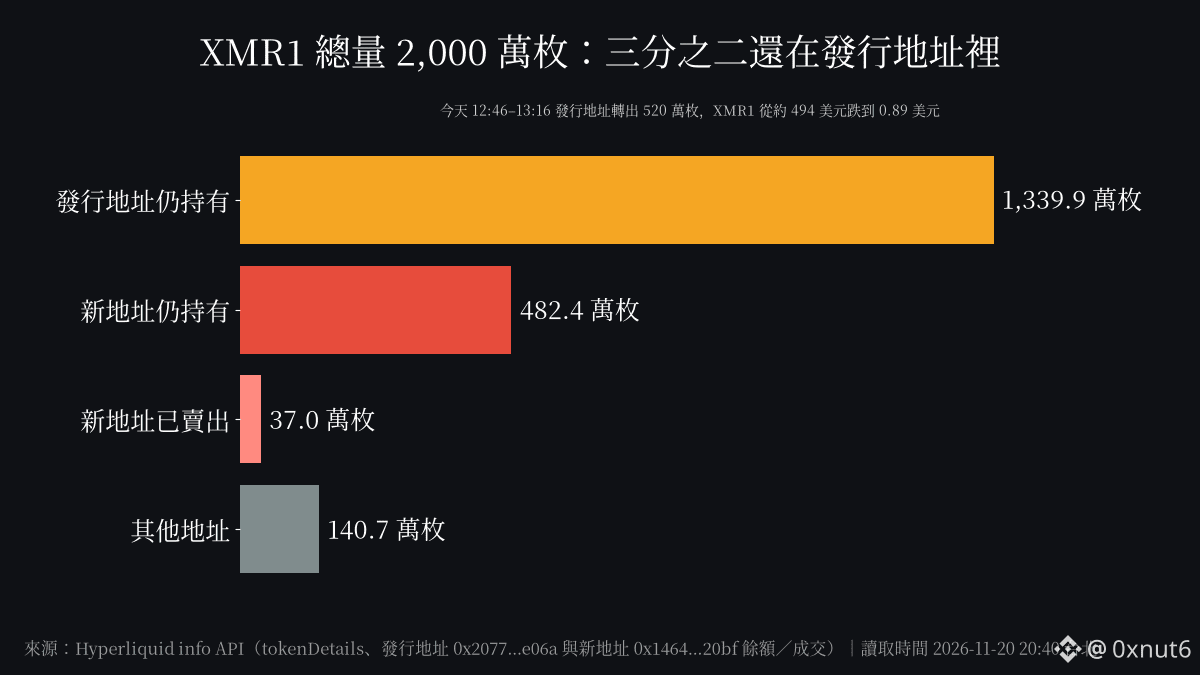
Wagyu’s wrapped version of Monero, XMR1 (a token representing one Monero coin on-chain), which was issued on Hyperliquid, fell today around noon from about $494 to $0.89 per token—a drop of more than 99% in a single day. Native Monero is still trading at around $461 in perpetual futures on @HyperliquidX; the problem was with the wrapped token itself.
Hyperliquid’s token data shows that when XMR1 was deployed on December 17, 2025, its maximum supply of 20 million tokens had already been fully issued, with no mechanism set up for further issuance. Under this design, the tokens are normally held in the issuer’s wallet. When someone exchanges Monero for XMR1 through Wagyu, the issuer transfers the tokens to them from this reserve.
Starting at 12:46 p.m. Taipei time today, this issuing wallet transferred 5.2 million XMR1 to a new address in three transactions over half an hour. The first transfer of 100,000 tokens had a book value of $49.4 million at the time. Twenty-eight minutes later, another 100,000 tokens were transferred, now worth only $2.12 million. So far, the new address has sold about 370,000 tokens for approximately $13.51 million in USDC, and still holds around 4.82 million tokens.
Wagyu founder @PerpetualCow said on X that the market makers who kept buying the tokens were hit hardest. People who exchanged through Wagyu suffered no losses, and the market makers’ losses would be fully refunded. He also said he was willing to negotiate with the attacker.
A little after 8 p.m. today, the issuing address still held around 13.4 million XMR1, about two-thirds of the total supply. That’s more than twice the 5.2 million tokens already transferred out and sold.
$HYPE
123
·
--
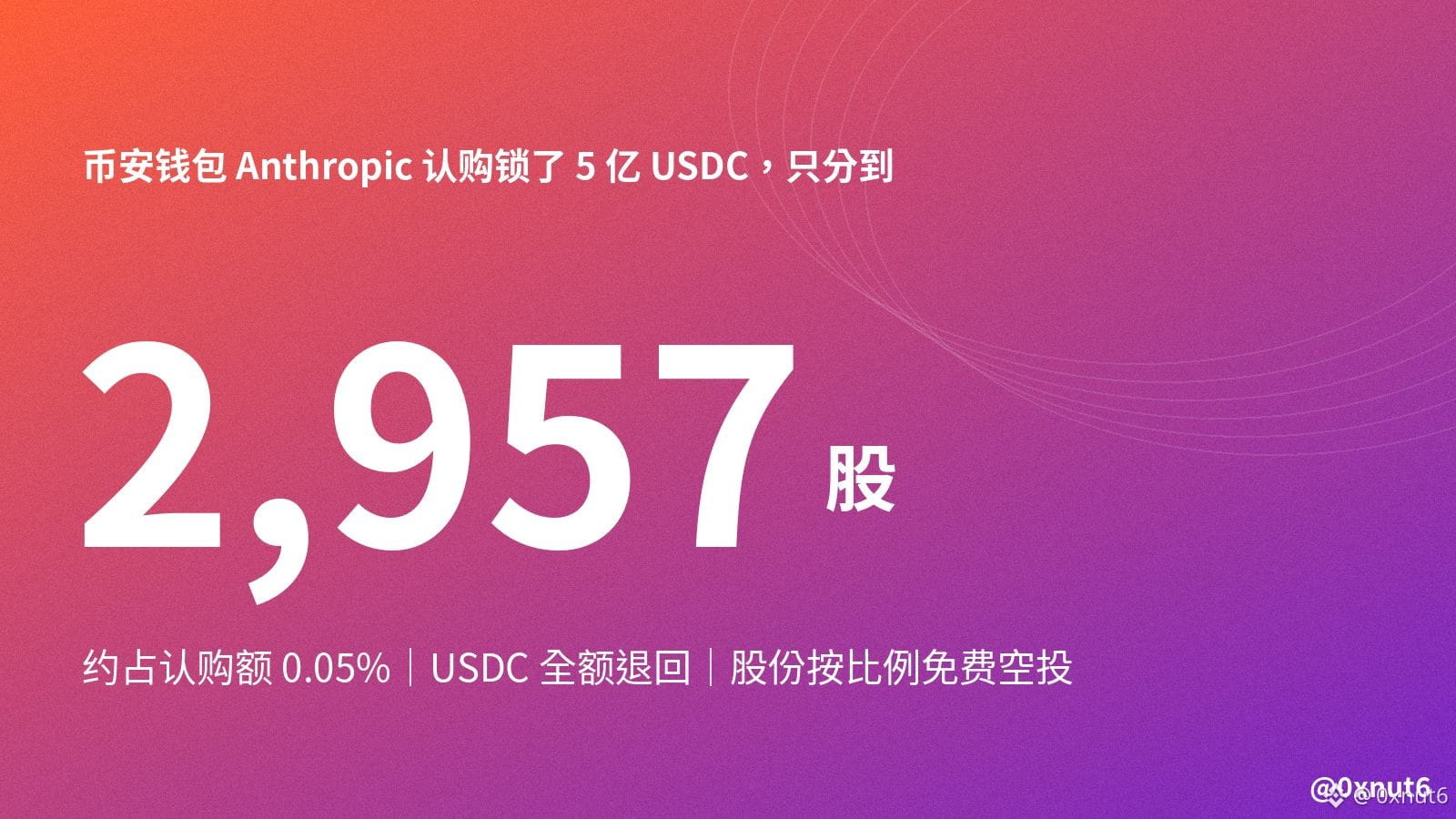
In this Anthropic token subscription through Binance Wallet, users locked up a total of 500 million USDC and ultimately received only about 2,957 shares. At the offering price of $83 per share, those shares are worth around $245,000, or roughly 0.05% of the total subscription amount.
The official Binance Wallet account posted early this morning that the allocation results were disappointing, and all USDC locked in the contract would be fully refunded to users’ wallets. The refunds will be made in two batches: 300 million USDC in the first batch, followed by the remaining 200,002,764 USDC. Token issuer xStocks said the IPO was reportedly oversubscribed by more than 9 times, and the allocation they received could satisfy only some of the applications.
The 2,957 shares will be distributed for free to each user’s Binance Wallet address by airdrop, in proportion to their subscription amount. Someone who subscribed 10,000 USDC will receive about 0.059 shares. Anthropic stock closed at $97.17 on its first day on Nasdaq. At that price, this allocation is worth about $5.70.
Binance is also setting aside ANTB worth $1 million for an airdrop. ANTB is Binance’s own bStocks token, which tracks Anthropic’s share price, and will be sent to users’ spot accounts on Binance Exchange. Each eligible participant will receive at least about 6 USDC, with the remainder distributed in proportion to subscription amounts. The announcement states that both airdrops will be credited by November 20 at the latest. So someone who subscribed 10,000 USDC will get their entire principal back, plus around $5.70 worth of stock tokens and at least 6 USDC worth of ANTB.
41
·
--
At noon, Bitcoin $BTC was hovering around 61,700 with little movement, while $NEAR fell sharply on its own. It slid from 3.2 to 3.036, down 5.3% in 6 hours and 10.1% in 24 hours. At 09:00, the hourly contract taker buy/sell ratio was 0.52, with sell orders putting pressure on the price. From 09:00 to 13:00, the number of coins in perpetual open interest barely changed, going from 54.63 million to 54.65 million. Open interest in USD fell from 174.7 million to 164.6 million, mainly due to the price drop. The account long/short ratio fell from 1.74 to 1.65 between 11:00 and 13:00, remaining above 1. The funding rate settled at -0.0037% at 08:00 and is now -0.0014%, a slightly negative rate.
At noon, Bitcoin $BTC was hovering around 61,700 with little movement, while $NEAR fell sharply on its own. It slid from 3.2 to 3.036, down 5.3% in 6 hours and 10.1% in 24 hours. At 09:00, the hourly contract taker buy/sell ratio was 0.52, with sell orders putting pressure on the price. From 09:00 to 13:00, the number of coins in perpetual open interest barely changed, going from 54.63 million to 54.65 million. Open interest in USD fell from 174.7 million to 164.6 million, mainly due to the price drop. The account long/short ratio fell from 1.74 to 1.65 between 11:00 and 13:00, remaining above 1. The funding rate settled at -0.0037% at 08:00 and is now -0.0014%, a slightly negative rate.
260
Log in to explore more content
Join global crypto users on Binance Square
⚡️ Get latest and useful information about crypto.
💬 Trusted by the world’s largest crypto exchange.
👍 Discover real insights from verified creators.
Email / Phone number
Trending Topics
NVIDIAReinstatesJensenHuangasCEO
33,112 views
626 Discussing
TradFi News | Nvidia Board Unanimously Reinstates Jensen Huang as CEO; Shares Jump 30% Premarket
Binance News
·33 Likes
·30k views
WillMarketsStageAThanksgivingReliefRally?
135,171 views
1,710 Discussing
WillOctCorePCEShiftFedHikeExpectations?
51,426 views
721 Discussing