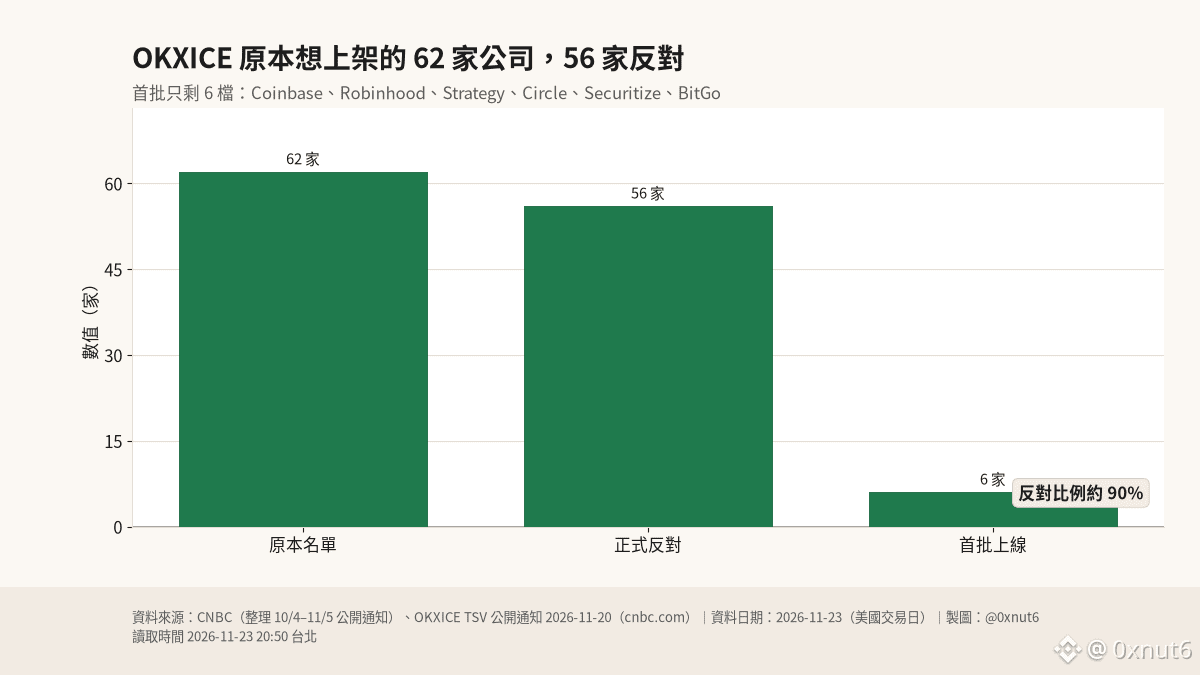
Of the 62 U.S. companies originally slated to be listed, 56 formally objected. But the tokenized U.S. stock platform OKXICE, jointly operated by OKX and Intercontinental Exchange, still launched today, U.S. time, as originally planned. Only 6 stocks are available to buy in its initial batch.
That figure was calculated by CNBC from public notices issued between October 4 and November 5, in a roundup published on November 23. The proportion of objecting companies was about 90%. The SEC’s tokenization exemption rules, which took effect in September, require platforms to notify issuers first and give them 30 days to respond. If a company objects, its stock cannot be tokenized on the platform. The six stocks available in the initial batch are Coinbase, Robinhood, Strategy, Circle, Securitize, and BitGo—all crypto-related companies.
OKXICE co-chair and former New York Governor Andrew Cuomo told CNBC that most companies are still unfamiliar with tokenization, and that the more they learn about 24-hour global trading, the more willing they are to join. The platform also said it plans to roll out 113 assets over time, including ETFs.
Before buying any of these stocks, it’s best to understand how their prices are determined. According to a public notice from OKXICE dated November 20, the platform has no order book. Each stock is paired with USDC in a Uniswap v4 pool. The smart contract does not use an oracle or connect to external market data; prices are determined solely by the ratio of the two assets in the pool. The platform operates 24 hours a day. After the U.S. stock market closes, there are no trades in the underlying shares to use as a reference, so prices depend entirely on how people in the pool buy and sell. If an underlying stock is halted or triggers a circuit breaker, trading on the platform is halted as well.
Another restriction is the trading-volume cap. The exemption rules set a cap for Level 1 large-cap stocks (S&P 500 and Russell 1000 constituents): daily trading volume cannot exceed 0.25% of the underlying stock’s average daily volume in the previous month. If the underlying stock averages 10 million shares traded per day, the platform can trade no more than 25,000 shares in a day. As the cap nears, the platform may temporarily suspend trading. If the cap is exceeded a second time, trading in that stock is suspended for three months.