

DaleepCryptoAnalyst
178 Posts

DaleepCryptoAnalyst
Report
Block User
Crypto Market Analyst • SMC & On-Chain Research • Educational Content • Not Financial Advisor
High-Frequency Trader
2.4 Years
51 Following
30 Followers
43 Liked
Posts
All
Quotes
·
--
Bullish
$POL looks bullish here 📈
I’m leaning long as the higher timeframes continue to show genuine strength. Price recently reclaimed a major resistance level and flipped it into clean support, while buyers continue to step in.
Funding remains neutral, and momentum is holding strong without clear bearish divergence. 👀
🎯 ENTRY: $0.09767
🛑 INVALIDATION: $0.0920
🏆 TP1: $0.1071
🏆 TP2: $0.1115
🏆 TP3: $0.1171
🏆 TP4: HOLD 🚀
If price loses the $0.0920 area with conviction, the bullish setup is invalidated.
If you like this setup, drop a follow — more trading logic coming.
⚠️ Manage your risk. Crypto remains highly volatile.
#trading #POL $POL
{spot}(POLUSDT)
$POL looks bullish here 📈
I’m leaning long as the higher timeframes continue to show genuine strength. Price recently reclaimed a major resistance level and flipped it into clean support, while buyers continue to step in.
Funding remains neutral, and momentum is holding strong without clear bearish divergence. 👀
🎯 ENTRY: $0.09767
🛑 INVALIDATION: $0.0920
🏆 TP1: $0.1071
🏆 TP2: $0.1115
🏆 TP3: $0.1171
🏆 TP4: HOLD 🚀
If price loses the $0.0920 area with conviction, the bullish setup is invalidated.
If you like this setup, drop a follow — more trading logic coming.
⚠️ Manage your risk. Crypto remains highly volatile.
#trading #POL $POL
I’m leaning long as the higher timeframes continue to show genuine strength. Price recently reclaimed a major resistance level and flipped it into clean support, while buyers continue to step in.
Funding remains neutral, and momentum is holding strong without clear bearish divergence. 👀
🎯 ENTRY: $0.09767
🛑 INVALIDATION: $0.0920
🏆 TP1: $0.1071
🏆 TP2: $0.1115
🏆 TP3: $0.1171
🏆 TP4: HOLD 🚀
If price loses the $0.0920 area with conviction, the bullish setup is invalidated.
If you like this setup, drop a follow — more trading logic coming.
⚠️ Manage your risk. Crypto remains highly volatile.
#trading #POL $POL

128
🚨 ONGUSDT — NO TRADE
Support: 0.1451
Resistance: 0.1738 / 0.1878
Bias: Bullish, but heavily pumped.
Plan: Wait for confirmation at 0.1451 or a breakout/retest above 0.1738.
Do not chase at 0.161.
#ONGUSDT🚨 $ONG
🚨 ONGUSDT — NO TRADE
Support: 0.1451
Resistance: 0.1738 / 0.1878
Bias: Bullish, but heavily pumped.
Plan: Wait for confirmation at 0.1451 or a breakout/retest above 0.1738.
Do not chase at 0.161.
#ONGUSDT🚨 $ONG
Support: 0.1451
Resistance: 0.1738 / 0.1878
Bias: Bullish, but heavily pumped.
Plan: Wait for confirmation at 0.1451 or a breakout/retest above 0.1738.
Do not chase at 0.161.
#ONGUSDT🚨 $ONG
179
🚨 TACUSDT LONG
Entry: 0.00445–0.00460
SL: 0.00415
TP1: 0.00512
TP2: 0.00550
TP3: 0.00593
Wait for confirmation before entry.
$TAC #Crypto #Binance #Trading #SMCTrader
🚨 TACUSDT LONG
Entry: 0.00445–0.00460
SL: 0.00415
TP1: 0.00512
TP2: 0.00550
TP3: 0.00593
Wait for confirmation before entry.
$TAC #Crypto #Binance #Trading #SMCTrader
Entry: 0.00445–0.00460
SL: 0.00415
TP1: 0.00512
TP2: 0.00550
TP3: 0.00593
Wait for confirmation before entry.
$TAC #Crypto #Binance #Trading #SMCTrader
60
🚨 MARKET ROTATION WATCH 🚨
$EDEN +18.74% 📈
$RE -7.20% 📉
$ACE -8.84% 📉
$EDEN is leading the move at $0.0575 with $7.4M volume, while $RE and $ACE are under pressure despite strong trading activity.
Could this be a rotation toward treasury-linked assets? 👀
Watch $EDEN closely — momentum is building.
#Binance #Write2Earn #EDEN
🚨 MARKET ROTATION WATCH 🚨
$EDEN +18.74% 📈
$RE -7.20% 📉
$ACE -8.84% 📉
$EDEN is leading the move at $0.0575 with $7.4M volume, while $RE and $ACE are under pressure despite strong trading activity.
Could this be a rotation toward treasury-linked assets? 👀
Watch $EDEN closely — momentum is building.
#Binance #Write2Earn #EDEN
$EDEN +18.74% 📈
$RE -7.20% 📉
$ACE -8.84% 📉
$EDEN is leading the move at $0.0575 with $7.4M volume, while $RE and $ACE are under pressure despite strong trading activity.
Could this be a rotation toward treasury-linked assets? 👀
Watch $EDEN closely — momentum is building.
#Binance #Write2Earn #EDEN
327
🚨 $BTR LONG SETUP 🚨
FOMO alert 👀🔥
$BTR is showing a strong setup. Big move could be coming soon.
📍 Entry: 0.117 – 0.102
🛑 SL: 0.098
🎯 TP: 0.129 – 0.150
I’m watching the LONG side closely. 📈
$BTR 👇
🚨 $BTR LONG SETUP 🚨
FOMO alert 👀🔥
$BTR is showing a strong setup. Big move could be coming soon.
📍 Entry: 0.117 – 0.102
🛑 SL: 0.098
🎯 TP: 0.129 – 0.150
I’m watching the LONG side closely. 📈
$BTR 👇
FOMO alert 👀🔥
$BTR is showing a strong setup. Big move could be coming soon.
📍 Entry: 0.117 – 0.102
🛑 SL: 0.098
🎯 TP: 0.129 – 0.150
I’m watching the LONG side closely. 📈
$BTR 👇
256
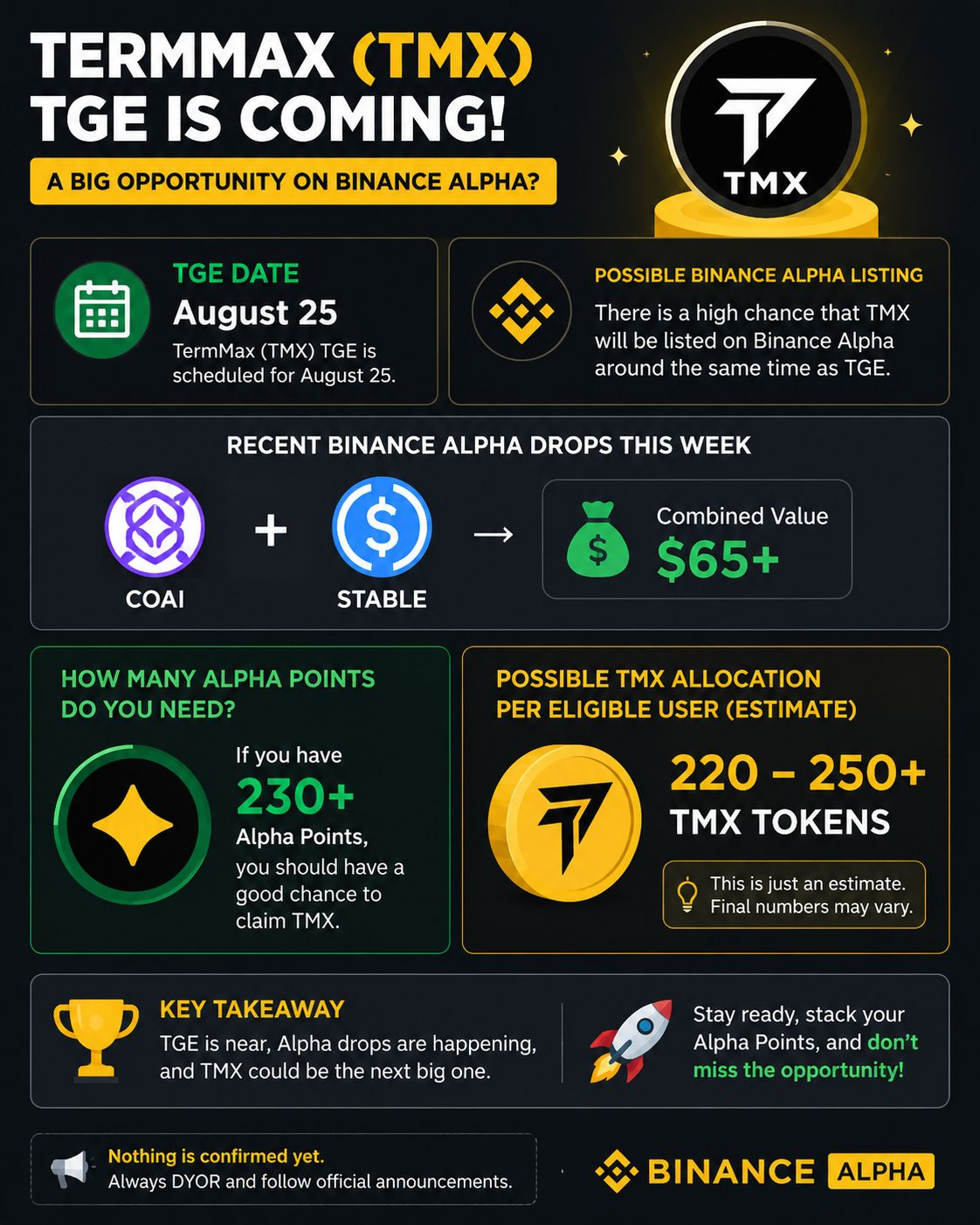
TermMax could be one of the next Alpha opportunities 👀
TMX is scheduled for its TGE on August 25, and I wouldn’t be surprised if Binance Alpha features TermMax around the same window.
The timing is interesting.
We’vke already seen two consecutive Alpha distributions this week — COAI and STABLE — worth roughly $65+ combined.
That makes the Alpha Points requirement worth watching closely.
If you’re sitting at 230+ Alpha Points, you may be in a strong position if TMX becomes an eligible Alpha claim.
My personal estimate is somewhere around 220–250+ TMX per eligible user, but that’s only a guess — the actual allocation will depend on Binance’s final rules.
TGE is getting close.
Now the real question is: will TMX be the next Alpha surprise? 👀
@termmax #TermMax #ALPHA
TermMax could be one of the next Alpha opportunities 👀
TMX is scheduled for its TGE on August 25, and I wouldn’t be surprised if Binance Alpha features TermMax around the same window.
The timing is interesting.
We’vke already seen two consecutive Alpha distributions this week — COAI and STABLE — worth roughly $65+ combined.
That makes the Alpha Points requirement worth watching closely.
If you’re sitting at 230+ Alpha Points, you may be in a strong position if TMX becomes an eligible Alpha claim.
My personal estimate is somewhere around 220–250+ TMX per eligible user, but that’s only a guess — the actual allocation will depend on Binance’s final rules.
TGE is getting close.
Now the real question is: will TMX be the next Alpha surprise? 👀
@TermMax #TermMax #ALPHA
TMX is scheduled for its TGE on August 25, and I wouldn’t be surprised if Binance Alpha features TermMax around the same window.
The timing is interesting.
We’vke already seen two consecutive Alpha distributions this week — COAI and STABLE — worth roughly $65+ combined.
That makes the Alpha Points requirement worth watching closely.
If you’re sitting at 230+ Alpha Points, you may be in a strong position if TMX becomes an eligible Alpha claim.
My personal estimate is somewhere around 220–250+ TMX per eligible user, but that’s only a guess — the actual allocation will depend on Binance’s final rules.
TGE is getting close.
Now the real question is: will TMX be the next Alpha surprise? 👀
@TermMax #TermMax #ALPHA
236
The biggest DeFi risk isn’t always the market.
Sometimes, it’s entering a position without fully understanding what you’re signing up for.
That’s why @termmax has caught my attention.
Its design combines isolated markets, fixed-rate borrowing, and one-click leverage. The interesting part isn’t simply having more ways to use leverage—it’s having clearer parameters around the position.
With fixed-rate borrowing, the financing cost is known through maturity. And with isolated markets, different positions can operate under different market conditions instead of everything sharing the same risk environment.
That changes the question I ask before entering:
Not just “How much can this make?”
But “What exactly am I paying, what can go wrong, and do I understand the position?”
DeFi will never remove uncertainty.
Good infrastructure should make that uncertainty easier to measure.
That’s the part of @TermMax I find most interesting. #TermMax #DEFİ #crypto
The biggest DeFi risk isn’t always the market.
Sometimes, it’s entering a position without fully understanding what you’re signing up for.
That’s why @TermMax has caught my attention.
Its design combines isolated markets, fixed-rate borrowing, and one-click leverage. The interesting part isn’t simply having more ways to use leverage—it’s having clearer parameters around the position.
With fixed-rate borrowing, the financing cost is known through maturity. And with isolated markets, different positions can operate under different market conditions instead of everything sharing the same risk environment.
That changes the question I ask before entering:
Not just “How much can this make?”
But “What exactly am I paying, what can go wrong, and do I understand the position?”
DeFi will never remove uncertainty.
Good infrastructure should make that uncertainty easier to measure.
That’s the part of @TermMax I find most interesting. #TermMax #DEFİ #crypto
Sometimes, it’s entering a position without fully understanding what you’re signing up for.
That’s why @TermMax has caught my attention.
Its design combines isolated markets, fixed-rate borrowing, and one-click leverage. The interesting part isn’t simply having more ways to use leverage—it’s having clearer parameters around the position.
With fixed-rate borrowing, the financing cost is known through maturity. And with isolated markets, different positions can operate under different market conditions instead of everything sharing the same risk environment.
That changes the question I ask before entering:
Not just “How much can this make?”
But “What exactly am I paying, what can go wrong, and do I understand the position?”
DeFi will never remove uncertainty.
Good infrastructure should make that uncertainty easier to measure.
That’s the part of @TermMax I find most interesting. #TermMax #DEFİ #crypto

102
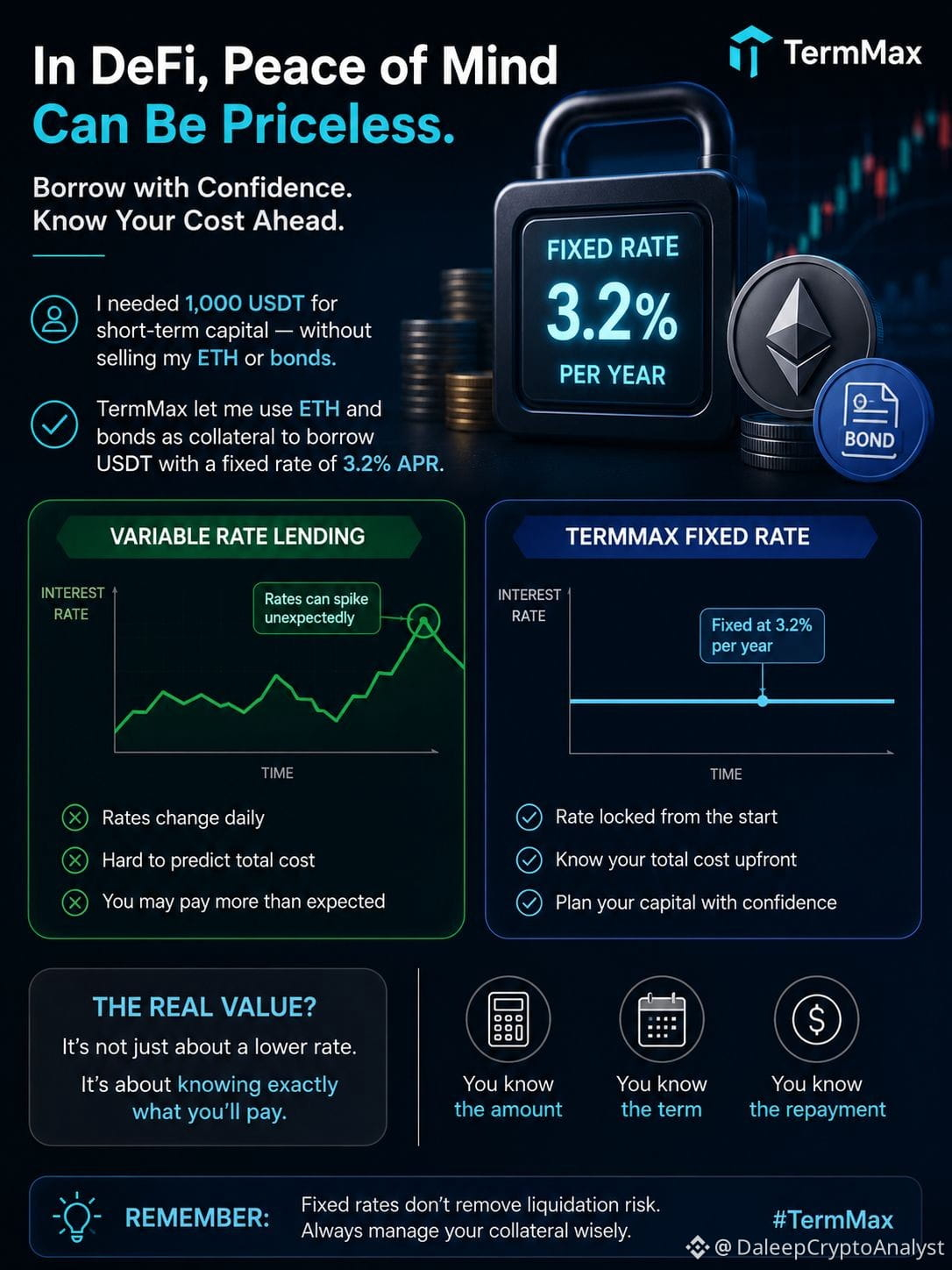
The biggest DeFi lending risk isn’t always liquidation. Sometimes, it’s not knowing what your loan will cost tomorrow.
I used to think borrowing was simple: lock ETH, take USDT, and keep an eye on the variable rate.
That works—until volatility hits.
I once needed 1,000 USDT for short-term liquidity without selling my ETH or bonds. With TermMax, I could use those assets as collateral and set the borrowing terms upfront at 3.2% APR.
That changed the way I looked at the loan.
I knew the principal.
I knew the rate.
I knew the maturity date.
And I could calculate the repayment amount before committing.
No daily guessing about where borrowing costs might move.
The interesting part is that 3.2% isn’t necessarily valuable because it’s the cheapest rate. Its real value is predictability.
If market lending rates suddenly rise, a variable-rate borrower absorbs that uncertainty. With a fixed-rate TermMax position, the interest component is already defined.
Of course, fixed-rate borrowing doesn’t remove the biggest collateral risk. ETH can still fall, and liquidation risk still exists.
But it made me realize something:
In DeFi, certainty can be an advantage of its own.
Sometimes the better question isn’t “What’s the lowest rate?”
It’s “Can I confidently calculate my cost before I borrow?”
#TermMax #TMX #DeFi #Crypto @termmax
The biggest DeFi lending risk isn’t always liquidation. Sometimes, it’s not knowing what your loan will cost tomorrow.
I used to think borrowing was simple: lock ETH, take USDT, and keep an eye on the variable rate.
That works—until volatility hits.
I once needed 1,000 USDT for short-term liquidity without selling my ETH or bonds. With TermMax, I could use those assets as collateral and set the borrowing terms upfront at 3.2% APR.
That changed the way I looked at the loan.
I knew the principal.
I knew the rate.
I knew the maturity date.
And I could calculate the repayment amount before committing.
No daily guessing about where borrowing costs might move.
The interesting part is that 3.2% isn’t necessarily valuable because it’s the cheapest rate. Its real value is predictability.
If market lending rates suddenly rise, a variable-rate borrower absorbs that uncertainty. With a fixed-rate TermMax position, the interest component is already defined.
Of course, fixed-rate borrowing doesn’t remove the biggest collateral risk. ETH can still fall, and liquidation risk still exists.
But it made me realize something:
In DeFi, certainty can be an advantage of its own.
Sometimes the better question isn’t “What’s the lowest rate?”
It’s “Can I confidently calculate my cost before I borrow?”
#TermMax #TMX #DeFi #Crypto @TermMax
I used to think borrowing was simple: lock ETH, take USDT, and keep an eye on the variable rate.
That works—until volatility hits.
I once needed 1,000 USDT for short-term liquidity without selling my ETH or bonds. With TermMax, I could use those assets as collateral and set the borrowing terms upfront at 3.2% APR.
That changed the way I looked at the loan.
I knew the principal.
I knew the rate.
I knew the maturity date.
And I could calculate the repayment amount before committing.
No daily guessing about where borrowing costs might move.
The interesting part is that 3.2% isn’t necessarily valuable because it’s the cheapest rate. Its real value is predictability.
If market lending rates suddenly rise, a variable-rate borrower absorbs that uncertainty. With a fixed-rate TermMax position, the interest component is already defined.
Of course, fixed-rate borrowing doesn’t remove the biggest collateral risk. ETH can still fall, and liquidation risk still exists.
But it made me realize something:
In DeFi, certainty can be an advantage of its own.
Sometimes the better question isn’t “What’s the lowest rate?”
It’s “Can I confidently calculate my cost before I borrow?”
#TermMax #TMX #DeFi #Crypto @TermMax
60
·
--
Bearish
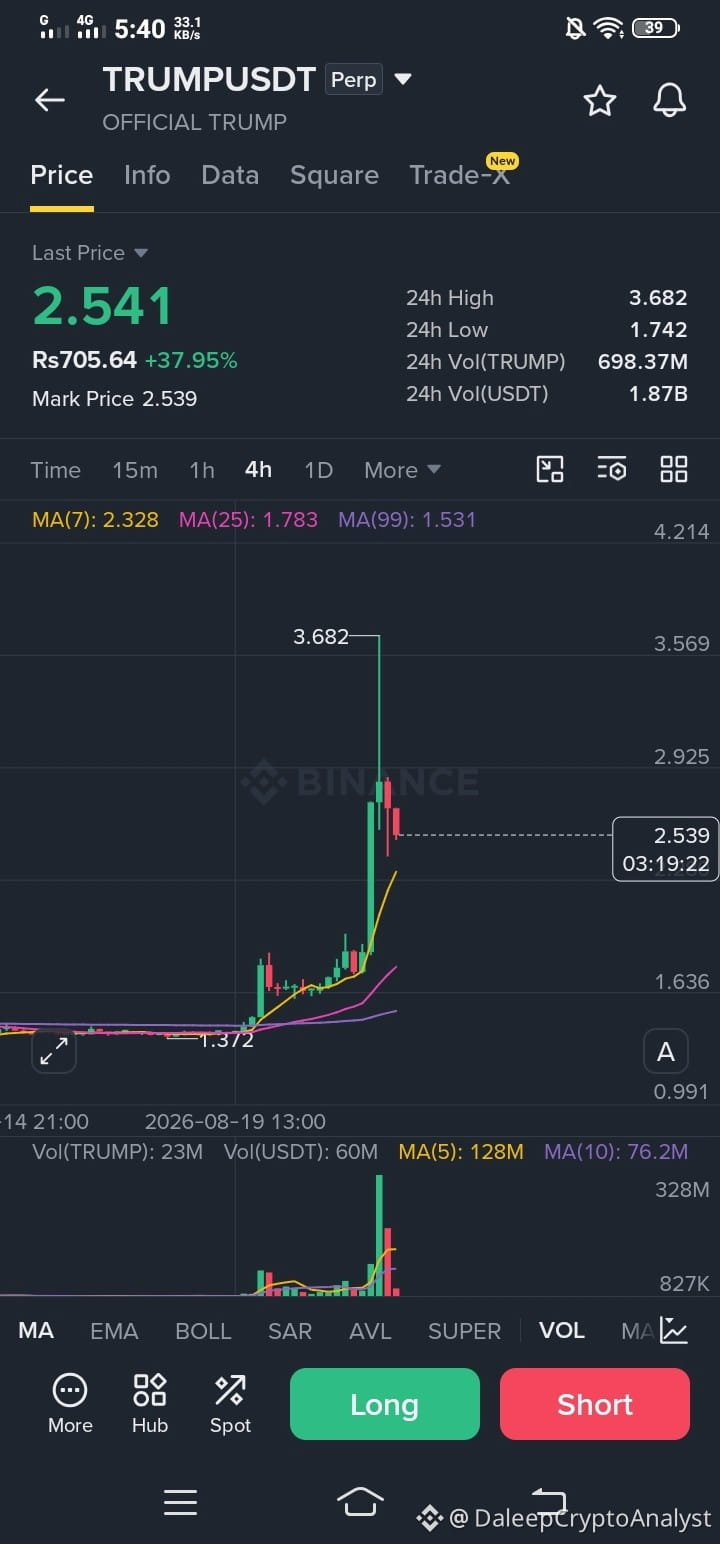
$TRUMP rebound? Or just another chance for the bears to reload? 👀
The $TRUMP meme coin has already attracted serious political and financial scrutiny. Senators have raised concerns about Trump-linked crypto ventures and the profits generated from them.
But there’s a bigger question for traders:
What happens to $TRUMP if the political attention and Trump narrative eventually fade?
That’s where the short thesis becomes interesting—but also dangerous.
A rebound doesn’t automatically mean the trend has reversed. Sometimes a bounce simply gives sellers a better entry.
I’d be watching volume, resistance, liquidity and momentum rather than blindly shorting every green candle.
Because with a meme coin, fundamentals can be thin and sentiment can change violently.
The setup may look bearish. The trade still needs confirmation.
Would you short the rebound, or wait for a clear breakdown first?
#TRUMP #Crypto #Trading #MEMECOİN
$TRUMP rebound? Or just another chance for the bears to reload? 👀
The $TRUMP meme coin has already attracted serious political and financial scrutiny. Senators have raised concerns about Trump-linked crypto ventures and the profits generated from them.
But there’s a bigger question for traders:
What happens to $TRUMP if the political attention and Trump narrative eventually fade?
That’s where the short thesis becomes interesting—but also dangerous.
A rebound doesn’t automatically mean the trend has reversed. Sometimes a bounce simply gives sellers a better entry.
I’d be watching volume, resistance, liquidity and momentum rather than blindly shorting every green candle.
Because with a meme coin, fundamentals can be thin and sentiment can change violently.
The setup may look bearish. The trade still needs confirmation.
Would you short the rebound, or wait for a clear breakdown first?
#TRUMP #Crypto #Trading #MEMECOİN
The $TRUMP meme coin has already attracted serious political and financial scrutiny. Senators have raised concerns about Trump-linked crypto ventures and the profits generated from them.
But there’s a bigger question for traders:
What happens to $TRUMP if the political attention and Trump narrative eventually fade?
That’s where the short thesis becomes interesting—but also dangerous.
A rebound doesn’t automatically mean the trend has reversed. Sometimes a bounce simply gives sellers a better entry.
I’d be watching volume, resistance, liquidity and momentum rather than blindly shorting every green candle.
Because with a meme coin, fundamentals can be thin and sentiment can change violently.
The setup may look bearish. The trade still needs confirmation.
Would you short the rebound, or wait for a clear breakdown first?
#TRUMP #Crypto #Trading #MEMECOİN
120
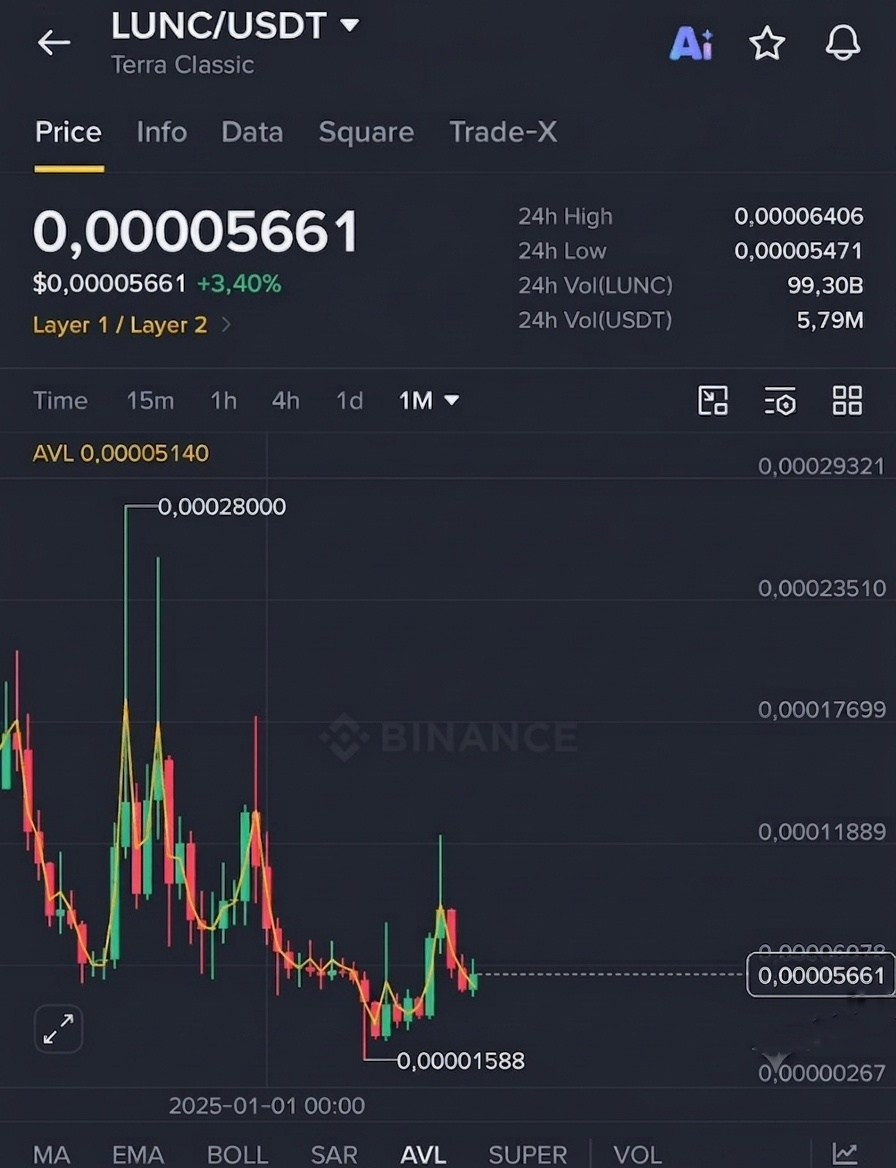
$LUNC at $1? I’d love to see it—but the math makes that dream a very different story. 😅
Crypto has surprised everyone before, so I won’t call anything absolutely impossible.
But with LUNC still trading around the $0.00005–$0.00006 area and a huge token supply, reaching $1 would require an extraordinary change in its supply, demand, and overall market value.
And then there’s my friend…
“Just put $100 into LUNC and forget about it.”
Bro, that sounds less like an investment strategy and more like a future “I told you so” waiting to happen. 😂
Maybe LUNC surprises everyone.
Maybe it doesn’t.
Personally, I’d rather miss a moonshot than buy something I don’t actually believe in just because someone else is convinced it will happen.
Conviction should come before the buy button.
Would you put $100 into LUNC and forget about it for years? 👀
#LUNC #TerraClassic #Crypto #Trading
$LUNC at $1? I’d love to see it—but the math makes that dream a very different story. 😅
Crypto has surprised everyone before, so I won’t call anything absolutely impossible.
But with LUNC still trading around the $0.00005–$0.00006 area and a huge token supply, reaching $1 would require an extraordinary change in its supply, demand, and overall market value.
And then there’s my friend…
“Just put $100 into LUNC and forget about it.”
Bro, that sounds less like an investment strategy and more like a future “I told you so” waiting to happen. 😂
Maybe LUNC surprises everyone.
Maybe it doesn’t.
Personally, I’d rather miss a moonshot than buy something I don’t actually believe in just because someone else is convinced it will happen.
Conviction should come before the buy button.
Would you put $100 into LUNC and forget about it for years? 👀
#LUNC #TerraClassic #Crypto #Trading
Crypto has surprised everyone before, so I won’t call anything absolutely impossible.
But with LUNC still trading around the $0.00005–$0.00006 area and a huge token supply, reaching $1 would require an extraordinary change in its supply, demand, and overall market value.
And then there’s my friend…
“Just put $100 into LUNC and forget about it.”
Bro, that sounds less like an investment strategy and more like a future “I told you so” waiting to happen. 😂
Maybe LUNC surprises everyone.
Maybe it doesn’t.
Personally, I’d rather miss a moonshot than buy something I don’t actually believe in just because someone else is convinced it will happen.
Conviction should come before the buy button.
Would you put $100 into LUNC and forget about it for years? 👀
#LUNC #TerraClassic #Crypto #Trading
282
BITCOIN IS RESTING AFTER AN EXPLOSIVE WEEK
• $BTC challenged $80K
• It is now consolidating near $77K
• Weekly gain: approximately 24%
• The 200-day average near $69K was recovered
• ETF demand remains positive
This is healthy so far—but weekend liquidity is thin.
After such a vertical rally, holding the breakout matters more than touching another headline price.
#BTC $BTC
{future}(BTCUSDT)
BITCOIN IS RESTING AFTER AN EXPLOSIVE WEEK
• $BTC challenged $80K
• It is now consolidating near $77K
• Weekly gain: approximately 24%
• The 200-day average near $69K was recovered
• ETF demand remains positive
This is healthy so far—but weekend liquidity is thin.
After such a vertical rally, holding the breakout matters more than touching another headline price.
#BTC $BTC
• $BTC challenged $80K
• It is now consolidating near $77K
• Weekly gain: approximately 24%
• The 200-day average near $69K was recovered
• ETF demand remains positive
This is healthy so far—but weekend liquidity is thin.
After such a vertical rally, holding the breakout matters more than touching another headline price.
#BTC $BTC
56
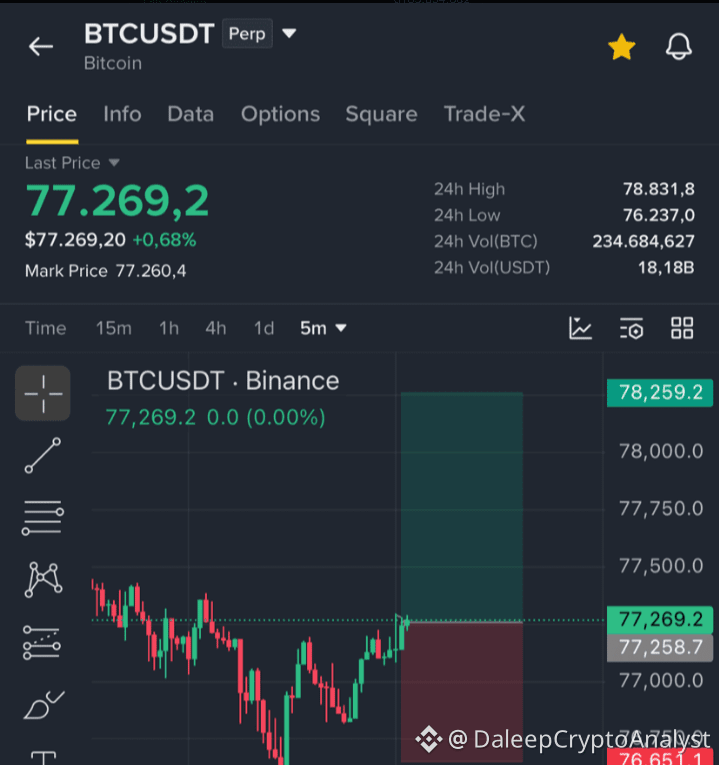
$BTC Trust me - Follow - Open big long now
Stoploss : 76600
Take profit : 78200
$BTC Trust me - Follow - Open big long now
Stoploss : 76600
Take profit : 78200
Stoploss : 76600
Take profit : 78200
22
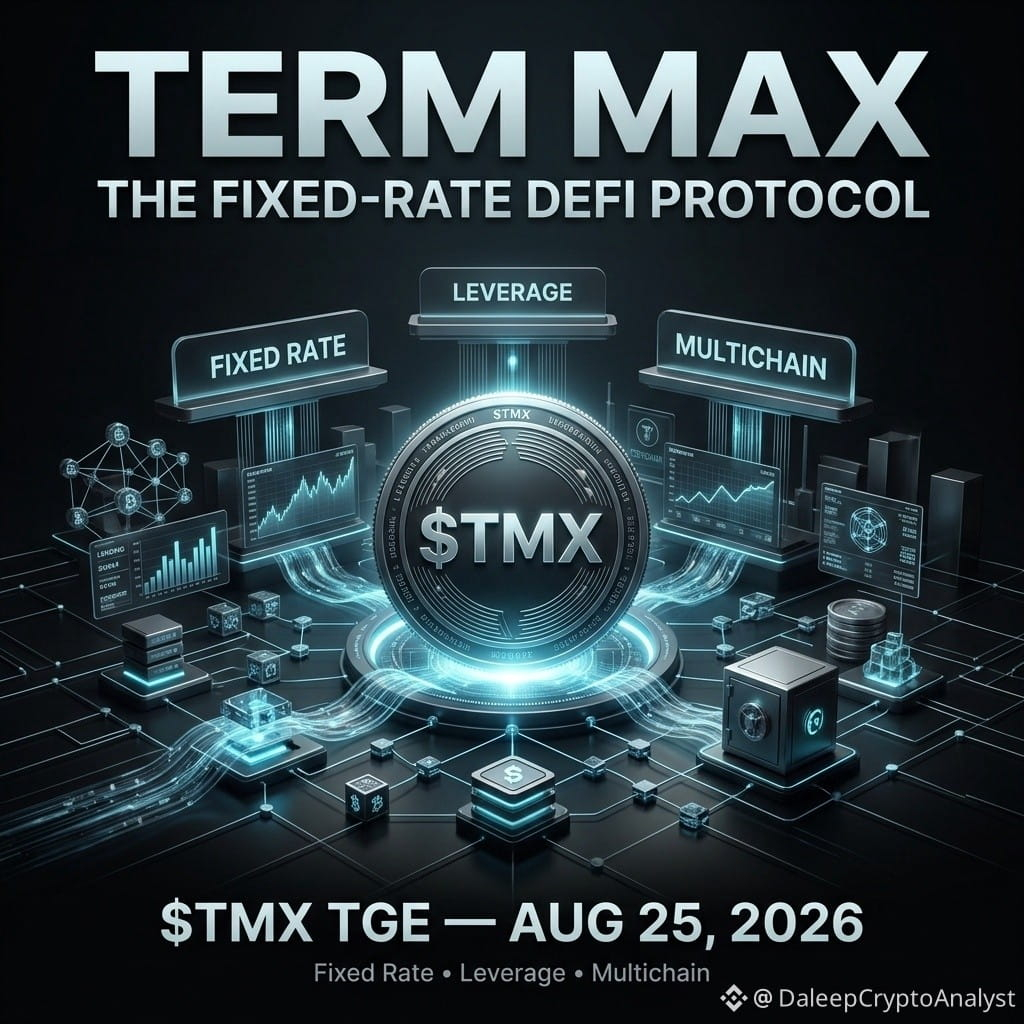
🚨 TERM MAX ($TMX) — THE QUICK EXPLAINER
Most people think TermMax is just another DeFi lending protocol.
It isn't that simple.
TermMax is building fixed-rate, fixed-term financial markets on-chain.
Here’s the simple breakdown 👇
🔹 Fixed-Rate Lending
Borrowers can lock borrowing costs instead of relying entirely on floating rates.
🔹 FT
Represents a fixed-rate claim that can be redeemed at maturity.
🔹 XT
Represents the financing/interest component of the fixed-term structure.
🔹 GT
Gearing Token — packages collateralized leveraged positions into a tokenized position.
🔹 Leverage
TermMax can simplify complex borrow → swap → collateral loops into a more streamlined transaction.
🔹 Vaults
Users can access managed strategies without manually handling every underlying position.
🔹 Multichain
TermMax is expanding across multiple EVM networks.
🔹 Institutional Direction
With TermPrime and its Canton integration, the project is also targeting larger financial players.
🪙 $TMX
Max supply: 1 BILLION TMX
Main utilities include:
• Governance
• Staking
• Protocol incentives
• Risk/parameter governance
📅 TGE: August 25, 2026
But here's the real question:
Can TermMax turn fixed-rate DeFi into a major financial market?
If YES → $TMX has a strong long-term narrative.
If NO → tokenomics alone won't save it.
Don't just watch the TGE chart. Watch the protocol growth. 👀
#TermMax #TMX #DeFi #TGE @termmax
🚨 TERM MAX ($TMX) — THE QUICK EXPLAINER
Most people think TermMax is just another DeFi lending protocol.
It isn't that simple.
TermMax is building fixed-rate, fixed-term financial markets on-chain.
Here’s the simple breakdown 👇
🔹 Fixed-Rate Lending
Borrowers can lock borrowing costs instead of relying entirely on floating rates.
🔹 FT
Represents a fixed-rate claim that can be redeemed at maturity.
🔹 XT
Represents the financing/interest component of the fixed-term structure.
🔹 GT
Gearing Token — packages collateralized leveraged positions into a tokenized position.
🔹 Leverage
TermMax can simplify complex borrow → swap → collateral loops into a more streamlined transaction.
🔹 Vaults
Users can access managed strategies without manually handling every underlying position.
🔹 Multichain
TermMax is expanding across multiple EVM networks.
🔹 Institutional Direction
With TermPrime and its Canton integration, the project is also targeting larger financial players.
🪙 $TMX
Max supply: 1 BILLION TMX
Main utilities include:
• Governance
• Staking
• Protocol incentives
• Risk/parameter governance
📅 TGE: August 25, 2026
But here's the real question:
Can TermMax turn fixed-rate DeFi into a major financial market?
If YES → $TMX has a strong long-term narrative.
If NO → tokenomics alone won't save it.
Don't just watch the TGE chart. Watch the protocol growth. 👀
#TermMax #TMX #DeFi #TGE @TermMax
Most people think TermMax is just another DeFi lending protocol.
It isn't that simple.
TermMax is building fixed-rate, fixed-term financial markets on-chain.
Here’s the simple breakdown 👇
🔹 Fixed-Rate Lending
Borrowers can lock borrowing costs instead of relying entirely on floating rates.
🔹 FT
Represents a fixed-rate claim that can be redeemed at maturity.
🔹 XT
Represents the financing/interest component of the fixed-term structure.
🔹 GT
Gearing Token — packages collateralized leveraged positions into a tokenized position.
🔹 Leverage
TermMax can simplify complex borrow → swap → collateral loops into a more streamlined transaction.
🔹 Vaults
Users can access managed strategies without manually handling every underlying position.
🔹 Multichain
TermMax is expanding across multiple EVM networks.
🔹 Institutional Direction
With TermPrime and its Canton integration, the project is also targeting larger financial players.
🪙 $TMX
Max supply: 1 BILLION TMX
Main utilities include:
• Governance
• Staking
• Protocol incentives
• Risk/parameter governance
📅 TGE: August 25, 2026
But here's the real question:
Can TermMax turn fixed-rate DeFi into a major financial market?
If YES → $TMX has a strong long-term narrative.
If NO → tokenomics alone won't save it.
Don't just watch the TGE chart. Watch the protocol growth. 👀
#TermMax #TMX #DeFi #TGE @TermMax
64
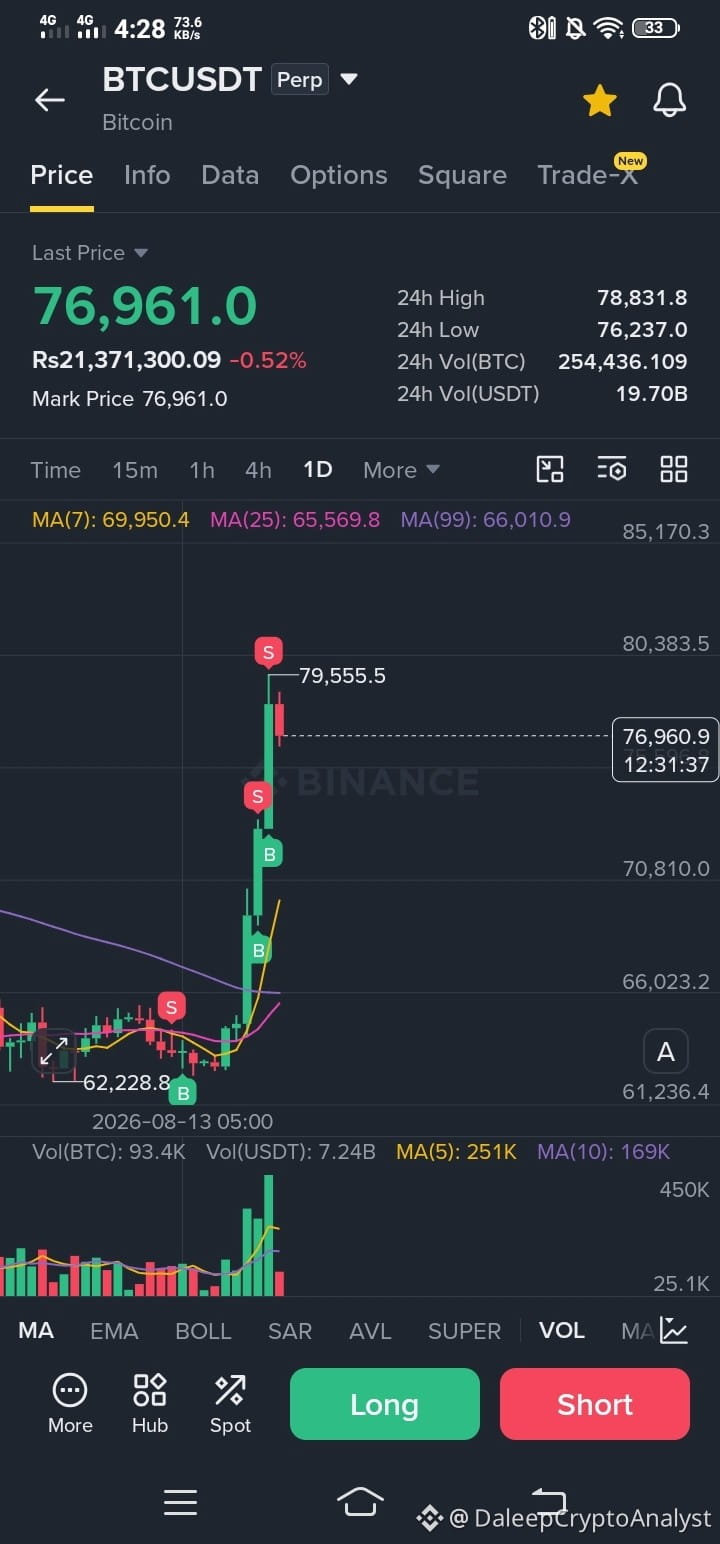
Bitcoin just turned a boring market into a very different story.
BTC has surged from roughly $62K to almost $79K, marking its strongest weekly move since March 2023.
At around $77K now, the bigger picture matters more than today’s small red candle. Bitcoin previously dropped toward $57.8K, climbed all the way to about $82.85K, and then pulled back into the upper-$70K range.
What changed underneath the price?
Lower yields, a weaker dollar, increased US Treasury bond buybacks, and renewed momentum around crypto legislation helped create a much friendlier backdrop for risk assets.
Market psychology moved just as quickly — Fear gave way to Greed.
So the current -0.84% daily move doesn’t necessarily change the bigger picture. After a move this aggressive, some cooling off is normal.
The real question now:
Is BTC building the next leg higher, or is this where traders start locking in gains?
#Bitcoin #BTC #CryptoRally #Trading #Binance
Bitcoin just turned a boring market into a very different story.
BTC has surged from roughly $62K to almost $79K, marking its strongest weekly move since March 2023.
At around $77K now, the bigger picture matters more than today’s small red candle. Bitcoin previously dropped toward $57.8K, climbed all the way to about $82.85K, and then pulled back into the upper-$70K range.
What changed underneath the price?
Lower yields, a weaker dollar, increased US Treasury bond buybacks, and renewed momentum around crypto legislation helped create a much friendlier backdrop for risk assets.
Market psychology moved just as quickly — Fear gave way to Greed.
So the current -0.84% daily move doesn’t necessarily change the bigger picture. After a move this aggressive, some cooling off is normal.
The real question now:
Is BTC building the next leg higher, or is this where traders start locking in gains?
#Bitcoin #BTC #CryptoRally #Trading #Binance
BTC has surged from roughly $62K to almost $79K, marking its strongest weekly move since March 2023.
At around $77K now, the bigger picture matters more than today’s small red candle. Bitcoin previously dropped toward $57.8K, climbed all the way to about $82.85K, and then pulled back into the upper-$70K range.
What changed underneath the price?
Lower yields, a weaker dollar, increased US Treasury bond buybacks, and renewed momentum around crypto legislation helped create a much friendlier backdrop for risk assets.
Market psychology moved just as quickly — Fear gave way to Greed.
So the current -0.84% daily move doesn’t necessarily change the bigger picture. After a move this aggressive, some cooling off is normal.
The real question now:
Is BTC building the next leg higher, or is this where traders start locking in gains?
#Bitcoin #BTC #CryptoRally #Trading #Binance
59
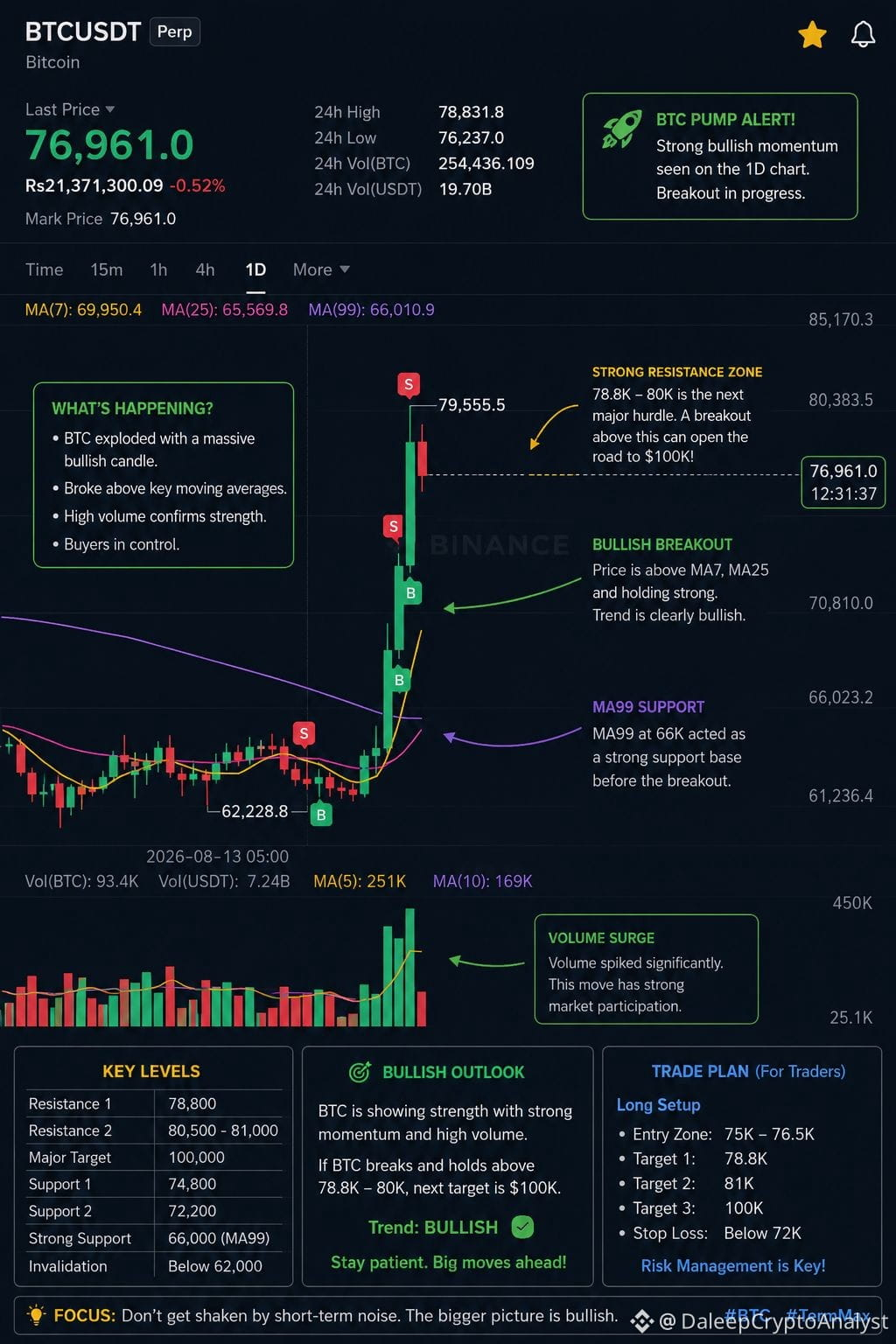
BTC at $100K isn’t the interesting part. The real question is what happens when the market starts believing it.
Bitcoin doesn’t move in a straight line. The closer $BTC gets to a major milestone, the more noise, doubt, and short-term reactions tend to show up.
That’s where conviction gets tested.
@termmax is part of the conversation, but the bigger picture is simple: don’t let every small move rewrite your long-term thesis.
If you think $BTC can reach $100K soon, save this one.
Maybe months from now, this post will look completely different in hindsight.
The market moves fast. Conviction should move slower.
#Btc100ksoon
$BTC #TermMax
BTC at $100K isn’t the interesting part. The real question is what happens when the market starts believing it.
Bitcoin doesn’t move in a straight line. The closer $BTC gets to a major milestone, the more noise, doubt, and short-term reactions tend to show up.
That’s where conviction gets tested.
@TermMax is part of the conversation, but the bigger picture is simple: don’t let every small move rewrite your long-term thesis.
If you think $BTC can reach $100K soon, save this one.
Maybe months from now, this post will look completely different in hindsight.
The market moves fast. Conviction should move slower.
#Btc100ksoon
$BTC #TermMax
Bitcoin doesn’t move in a straight line. The closer $BTC gets to a major milestone, the more noise, doubt, and short-term reactions tend to show up.
That’s where conviction gets tested.
@TermMax is part of the conversation, but the bigger picture is simple: don’t let every small move rewrite your long-term thesis.
If you think $BTC can reach $100K soon, save this one.
Maybe months from now, this post will look completely different in hindsight.
The market moves fast. Conviction should move slower.
#Btc100ksoon
$BTC #TermMax
79
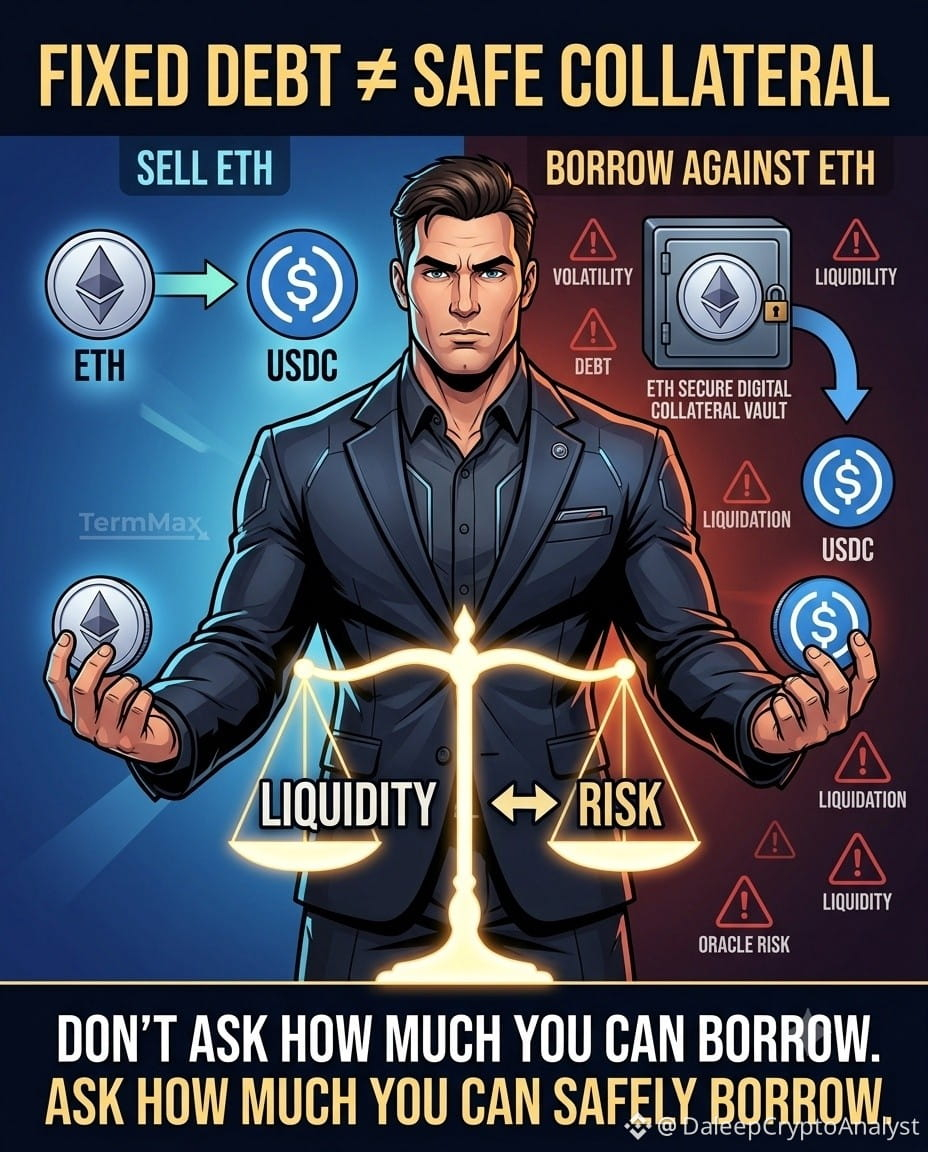
The most dangerous part of borrowing against ETH isn’t the interest rate. It’s forgetting what you’re still exposed to.
TermMax makes one part of the equation easier: you can borrow against collateral while keeping the underlying asset instead of selling it.
But keeping ETH also means keeping its downside.
A fixed borrowing rate can make the debt predictable. A fixed maturity can make the timeline predictable. Neither one protects the collateral from a sharp move.
That changes how I think about “liquidity without selling.”
You’re not removing risk. You’re converting some of your asset exposure into debt.
And the same idea gets more interesting with other collateral:
• Yield-bearing assets can continue generating returns, but leverage can amplify the downside.
• PTs may behave like fixed-income instruments, yet excessive borrowing can still create liquidation pressure.
• Tokenized equities bring on-chain borrowing together with traditional-market price discovery, liquidity constraints, and periods when the underlying market is closed.
So the real question isn’t:
“How much can I borrow?”
It’s:
“How much can I borrow before the extra liquidity makes my position less attractive than simply selling some collateral?”
That’s the risk boundary I’d watch.
TermMax may make borrowing cleaner. It doesn’t make leverage harmless.
#termmax @termmax
The most dangerous part of borrowing against ETH isn’t the interest rate. It’s forgetting what you’re still exposed to.
TermMax makes one part of the equation easier: you can borrow against collateral while keeping the underlying asset instead of selling it.
But keeping ETH also means keeping its downside.
A fixed borrowing rate can make the debt predictable. A fixed maturity can make the timeline predictable. Neither one protects the collateral from a sharp move.
That changes how I think about “liquidity without selling.”
You’re not removing risk. You’re converting some of your asset exposure into debt.
And the same idea gets more interesting with other collateral:
• Yield-bearing assets can continue generating returns, but leverage can amplify the downside.
• PTs may behave like fixed-income instruments, yet excessive borrowing can still create liquidation pressure.
• Tokenized equities bring on-chain borrowing together with traditional-market price discovery, liquidity constraints, and periods when the underlying market is closed.
So the real question isn’t:
“How much can I borrow?”
It’s:
“How much can I borrow before the extra liquidity makes my position less attractive than simply selling some collateral?”
That’s the risk boundary I’d watch.
TermMax may make borrowing cleaner. It doesn’t make leverage harmless.
#termmax @TermMax
TermMax makes one part of the equation easier: you can borrow against collateral while keeping the underlying asset instead of selling it.
But keeping ETH also means keeping its downside.
A fixed borrowing rate can make the debt predictable. A fixed maturity can make the timeline predictable. Neither one protects the collateral from a sharp move.
That changes how I think about “liquidity without selling.”
You’re not removing risk. You’re converting some of your asset exposure into debt.
And the same idea gets more interesting with other collateral:
• Yield-bearing assets can continue generating returns, but leverage can amplify the downside.
• PTs may behave like fixed-income instruments, yet excessive borrowing can still create liquidation pressure.
• Tokenized equities bring on-chain borrowing together with traditional-market price discovery, liquidity constraints, and periods when the underlying market is closed.
So the real question isn’t:
“How much can I borrow?”
It’s:
“How much can I borrow before the extra liquidity makes my position less attractive than simply selling some collateral?”
That’s the risk boundary I’d watch.
TermMax may make borrowing cleaner. It doesn’t make leverage harmless.
#termmax @TermMax
56
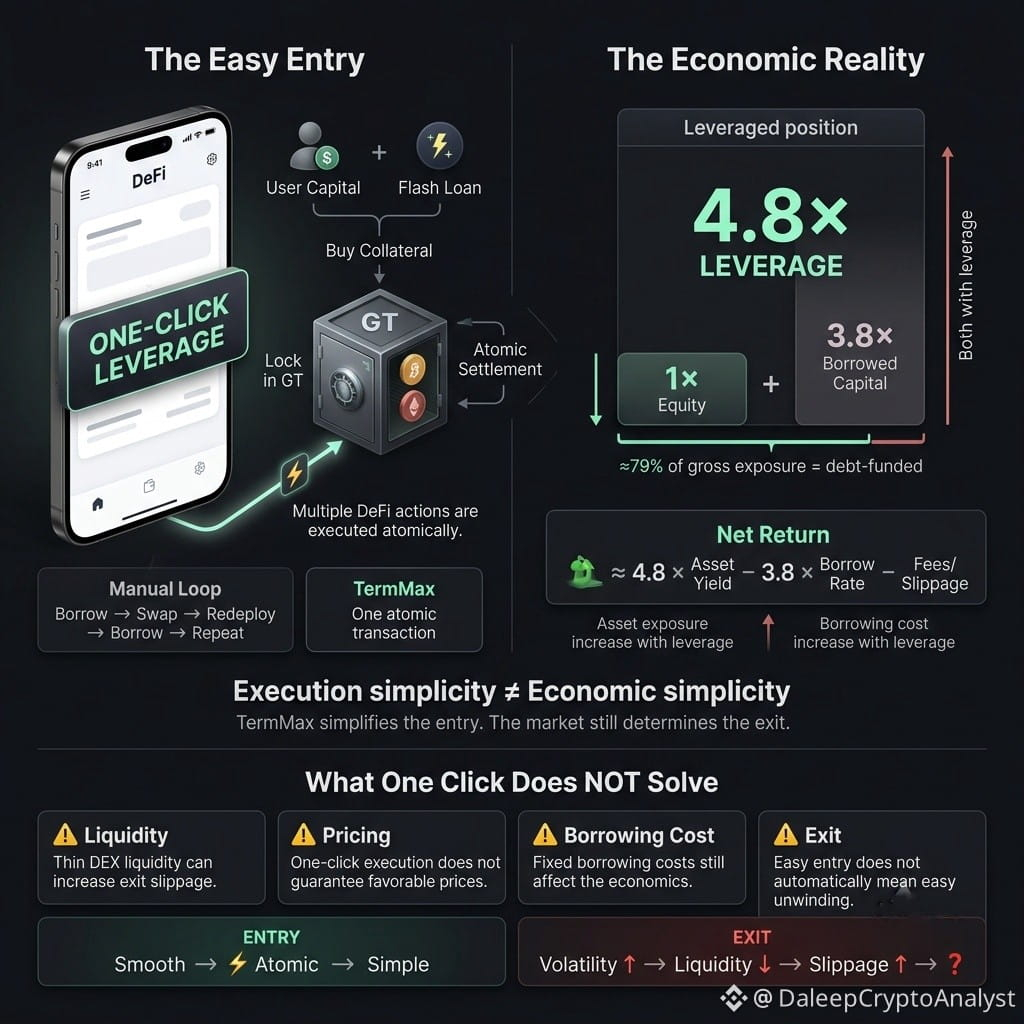
“One-click leverage” sounds simple—until you look at what happens after the click.
I dug into TermMax’s leverage flow and the engineering is genuinely neat.
A flash loan combines your capital with borrowed funds, buys the collateral, locks the position inside a Gearing Token (GT), and settles everything atomically.
Compared with manually borrowing, swapping, redepositing, and looping, that’s a much cleaner execution path.
But there’s an important distinction:
Simple execution ≠ simple economics.
At 4.8× leverage, around 3.8× your equity is borrowed capital. That means roughly 79% of the gross position is debt-funded.
So the real calculation becomes something like:
Net return ≈ 4.8 × asset yield − 3.8 × borrow rate − fees/slippage
If the underlying asset or Principal Token performs well, leverage amplifies the exposure.
But borrowing costs scale too.
And this is where the “one-click” experience has limits.
Atomic execution can reduce gas overhead, transaction sequencing issues, and failed multi-step transactions. What it can't promise is deep liquidity, favorable execution prices, or a painless exit.
The borrower gets a beautifully packaged entry.
But underneath it, lenders still have to supply the range liquidity that makes the whole mechanism possible.
So the question I keep coming back to is:
When volatility spikes and DEX liquidity gets thinner, does exit slippage become the hidden cost of easy leverage?
TermMax may have made entering a leveraged position much easier.
I’m not yet convinced it has made getting out just as easy.
#TermMax #TMX #DeFi @termmax
“One-click leverage” sounds simple—until you look at what happens after the click.
I dug into TermMax’s leverage flow and the engineering is genuinely neat.
A flash loan combines your capital with borrowed funds, buys the collateral, locks the position inside a Gearing Token (GT), and settles everything atomically.
Compared with manually borrowing, swapping, redepositing, and looping, that’s a much cleaner execution path.
But there’s an important distinction:
Simple execution ≠ simple economics.
At 4.8× leverage, around 3.8× your equity is borrowed capital. That means roughly 79% of the gross position is debt-funded.
So the real calculation becomes something like:
Net return ≈ 4.8 × asset yield − 3.8 × borrow rate − fees/slippage
If the underlying asset or Principal Token performs well, leverage amplifies the exposure.
But borrowing costs scale too.
And this is where the “one-click” experience has limits.
Atomic execution can reduce gas overhead, transaction sequencing issues, and failed multi-step transactions. What it can't promise is deep liquidity, favorable execution prices, or a painless exit.
The borrower gets a beautifully packaged entry.
But underneath it, lenders still have to supply the range liquidity that makes the whole mechanism possible.
So the question I keep coming back to is:
When volatility spikes and DEX liquidity gets thinner, does exit slippage become the hidden cost of easy leverage?
TermMax may have made entering a leveraged position much easier.
I’m not yet convinced it has made getting out just as easy.
#TermMax #TMX #DeFi @TermMax
I dug into TermMax’s leverage flow and the engineering is genuinely neat.
A flash loan combines your capital with borrowed funds, buys the collateral, locks the position inside a Gearing Token (GT), and settles everything atomically.
Compared with manually borrowing, swapping, redepositing, and looping, that’s a much cleaner execution path.
But there’s an important distinction:
Simple execution ≠ simple economics.
At 4.8× leverage, around 3.8× your equity is borrowed capital. That means roughly 79% of the gross position is debt-funded.
So the real calculation becomes something like:
Net return ≈ 4.8 × asset yield − 3.8 × borrow rate − fees/slippage
If the underlying asset or Principal Token performs well, leverage amplifies the exposure.
But borrowing costs scale too.
And this is where the “one-click” experience has limits.
Atomic execution can reduce gas overhead, transaction sequencing issues, and failed multi-step transactions. What it can't promise is deep liquidity, favorable execution prices, or a painless exit.
The borrower gets a beautifully packaged entry.
But underneath it, lenders still have to supply the range liquidity that makes the whole mechanism possible.
So the question I keep coming back to is:
When volatility spikes and DEX liquidity gets thinner, does exit slippage become the hidden cost of easy leverage?
TermMax may have made entering a leveraged position much easier.
I’m not yet convinced it has made getting out just as easy.
#TermMax #TMX #DeFi @TermMax
66
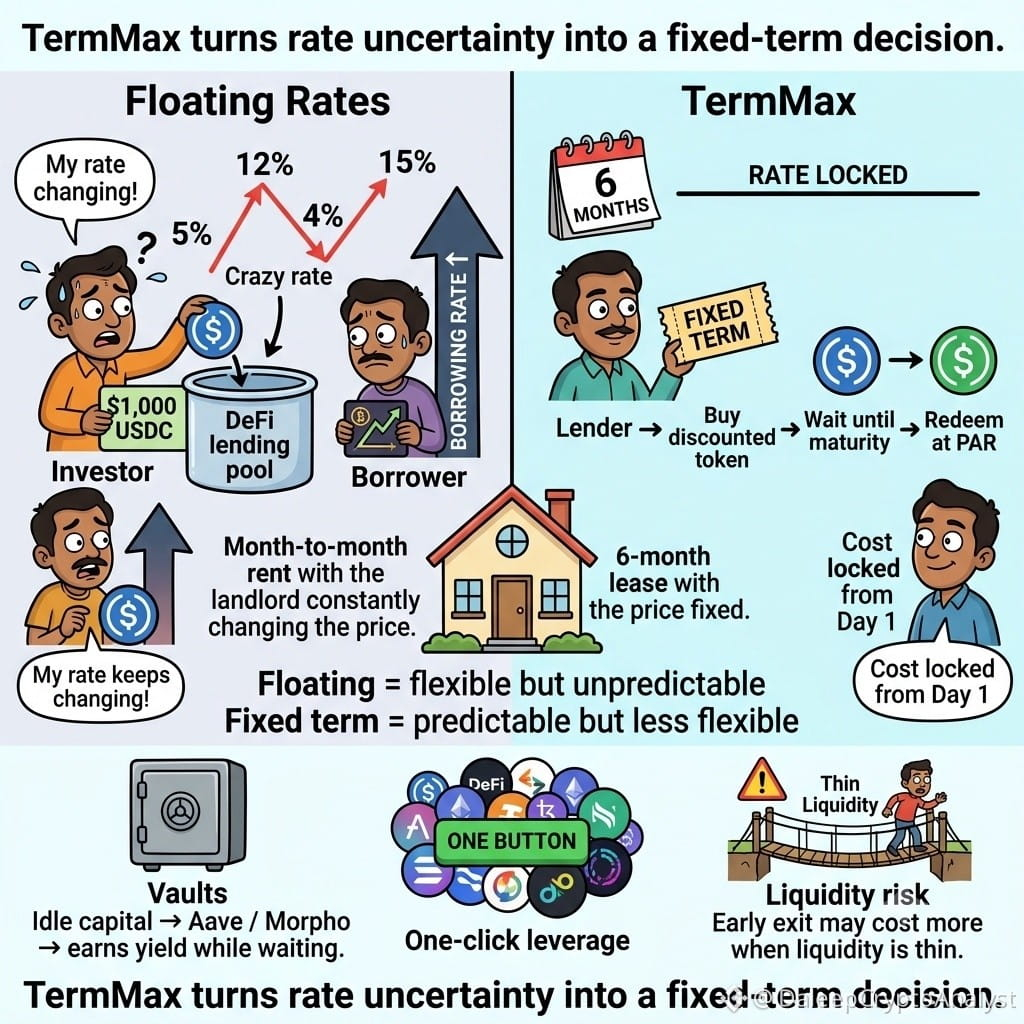
Floating yield looks great—until the market decides to rewrite your plan.
That’s the problem TermMax is trying to solve from a different direction.
With Aave or Morpho, rates move with utilization. A strategy that looks attractive today can become much less appealing after a sudden rate shift. For borrowers, the risk flips: a spike in borrowing costs can make a leveraged position far more fragile.
TermMax approaches the loan more like a bond with a fixed maturity.
Lenders buy discounted tokens and receive par at maturity, while borrowers know their financing cost upfront. Less guessing about where the rate will be six weeks from now.
There are some useful pieces around that core idea too.
TermMax vaults can put idle capital to work through Morpho or Aave while waiting for a matching opportunity, and its one-click leverage design removes much of the usual multi-protocol looping.
But there’s a trade-off.
Fixed rates are only as useful as the liquidity supporting them.
Thin maturities can make early exits expensive through the AMM, while isolated markets improve risk containment but can fragment liquidity. And, as with other DeFi systems, curators and oracles remain important points of trust.
Still, the usage of PT looping and tokenized stocks suggests there is demand for strategies where the future rate is known instead of constantly floating.
The bigger test may come when TMX incentives arrive.
Will fixed-term DeFi attract investors willing to lock capital for predictability—or will users keep choosing floating rates because flexibility matters more?
That trade-off could shape how TermMax grows.
@termmax
#TermMax #TMX #DeFi
Floating yield looks great—until the market decides to rewrite your plan.
That’s the problem TermMax is trying to solve from a different direction.
With Aave or Morpho, rates move with utilization. A strategy that looks attractive today can become much less appealing after a sudden rate shift. For borrowers, the risk flips: a spike in borrowing costs can make a leveraged position far more fragile.
TermMax approaches the loan more like a bond with a fixed maturity.
Lenders buy discounted tokens and receive par at maturity, while borrowers know their financing cost upfront. Less guessing about where the rate will be six weeks from now.
There are some useful pieces around that core idea too.
TermMax vaults can put idle capital to work through Morpho or Aave while waiting for a matching opportunity, and its one-click leverage design removes much of the usual multi-protocol looping.
But there’s a trade-off.
Fixed rates are only as useful as the liquidity supporting them.
Thin maturities can make early exits expensive through the AMM, while isolated markets improve risk containment but can fragment liquidity. And, as with other DeFi systems, curators and oracles remain important points of trust.
Still, the usage of PT looping and tokenized stocks suggests there is demand for strategies where the future rate is known instead of constantly floating.
The bigger test may come when TMX incentives arrive.
Will fixed-term DeFi attract investors willing to lock capital for predictability—or will users keep choosing floating rates because flexibility matters more?
That trade-off could shape how TermMax grows.
@TermMax
#TermMax #TMX #DeFi
That’s the problem TermMax is trying to solve from a different direction.
With Aave or Morpho, rates move with utilization. A strategy that looks attractive today can become much less appealing after a sudden rate shift. For borrowers, the risk flips: a spike in borrowing costs can make a leveraged position far more fragile.
TermMax approaches the loan more like a bond with a fixed maturity.
Lenders buy discounted tokens and receive par at maturity, while borrowers know their financing cost upfront. Less guessing about where the rate will be six weeks from now.
There are some useful pieces around that core idea too.
TermMax vaults can put idle capital to work through Morpho or Aave while waiting for a matching opportunity, and its one-click leverage design removes much of the usual multi-protocol looping.
But there’s a trade-off.
Fixed rates are only as useful as the liquidity supporting them.
Thin maturities can make early exits expensive through the AMM, while isolated markets improve risk containment but can fragment liquidity. And, as with other DeFi systems, curators and oracles remain important points of trust.
Still, the usage of PT looping and tokenized stocks suggests there is demand for strategies where the future rate is known instead of constantly floating.
The bigger test may come when TMX incentives arrive.
Will fixed-term DeFi attract investors willing to lock capital for predictability—or will users keep choosing floating rates because flexibility matters more?
That trade-off could shape how TermMax grows.
@TermMax
#TermMax #TMX #DeFi
98
Log in to explore more content
Join global crypto users on Binance Square
⚡️ Get latest and useful information about crypto.
💬 Trusted by the world’s largest crypto exchange.
👍 Discover real insights from verified creators.
Email / Phone number
Trending Topics
BinanceLaunchesBinanceIntelligence
197,245 views
1,776 Discussing
#BinanceLaunchesBinanceIntelligence
👉 WHEN AI STOPS JUST TALKING
For years, AI in crypto felt like a smart voice beside the chart. Useful, fast, sometimes impressive, but still separate from the actual machinery of trading.
Binance Intelligence feels like a different chapter.🧠
Binance AI brings market research closer to the user, while AI Pro can turn a plain-language trading idea into a structured workflow that can be tested before deployment. Agent OS pushes the idea further, connecting AI agents with market data, account information and supported trading capabilities. It has already passed 280,000 daily calls.
That creates a new sequence:
Think → research → design → test → approve → execute.
And that final word matters most.
Because the moment AI moves from explaining a market to interacting with it, the conversation changes from intelligence to trust.
A good AI can process information faster than I can. But faster does not automatically mean wiser.
Markets punish mistakes in real time.
So the question I find more interesting than “Can AI trade?” is:
How much authority should we ever give an algorithm over our money? 🤖📊
MoonlitQueen
·1 Likes
·280 views
StriveBuys2000BTCFor$169M
8,697 views
88 Discussing
EvernorthXRPTreasuryCompletesSPACMerger
108,916 views
1,075 Discussing