
Web3 Expert Princess
7.2k Posts

Web3 Expert Princess
Report
Block User
Web3 Projects Explorer
77 Following
2.2K+ Followers
8.3K+ Liked
Posts
All
Quotes
Videos
PINNED
Let’s be honest…👌
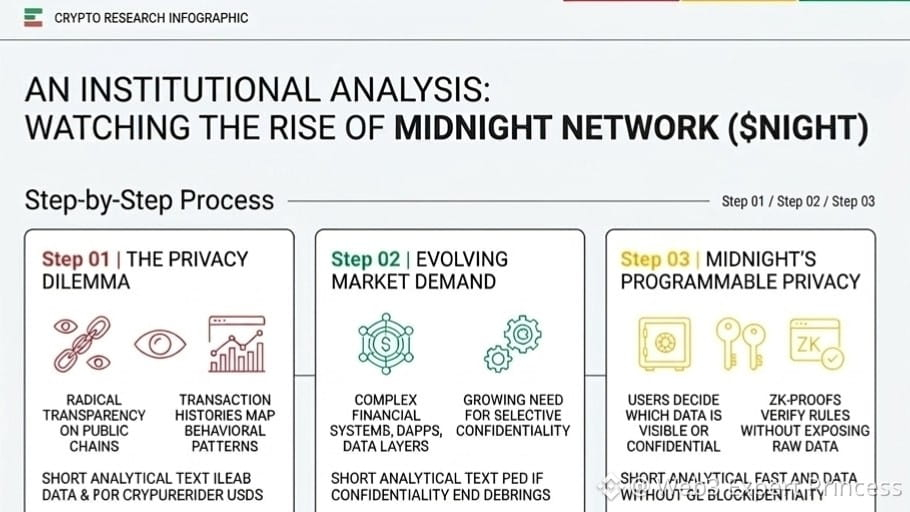
Blockchain transparency is powerful, but complete transparency isn’t always practical.
While researching privacy solutions in Web3, I found Midnight Network particularly interesting. The project focuses on programmable privacy, allowing users to verify transactions and data without revealing sensitive information.
It’s being built by Input Output Global, the development team behind Cardano.
By using Zero-Knowledge Proofs, Midnight enables secure validation while keeping data confidential.
In my view, privacy layers like this may define the next phase of blockchain adoption.
#Night $NIGHT @MidnightNetwork
#BTCReclaims70k
Let’s be honest…👌
Blockchain transparency is powerful, but complete transparency isn’t always practical.
While researching privacy solutions in Web3, I found Midnight Network particularly interesting. The project focuses on programmable privacy, allowing users to verify transactions and data without revealing sensitive information.
It’s being built by Input Output Global, the development team behind Cardano.
By using Zero-Knowledge Proofs, Midnight enables secure validation while keeping data confidential.
In my view, privacy layers like this may define the next phase of blockchain adoption.
#Night $NIGHT @MidnightNetwork
#BTCReclaims70k
Blockchain transparency is powerful, but complete transparency isn’t always practical.
While researching privacy solutions in Web3, I found Midnight Network particularly interesting. The project focuses on programmable privacy, allowing users to verify transactions and data without revealing sensitive information.
It’s being built by Input Output Global, the development team behind Cardano.
By using Zero-Knowledge Proofs, Midnight enables secure validation while keeping data confidential.
In my view, privacy layers like this may define the next phase of blockchain adoption.
#Night $NIGHT @MidnightNetwork
#BTCReclaims70k
8
12
103
Pixels and the Subtle Comfort of Being Anticipated
The moment it changed for me was not when I felt stuck.
It was when I felt expected.
I opened Pixels and within a few minutes, everything seemed to arrive at the right time. The board didn’t surprise me — it met me. Tasks appeared in a way that matched how I was already thinking. Decisions didn’t require effort. It felt less like reacting and more like continuing something that had already begun.
That was the part that stayed with me.
Not because it felt unusual.
Because it felt perfectly timed.
Like the system had quietly moved ahead of me, shaping the session so that my next steps felt obvious before I even made them.
And once I noticed that, it became hard to ignore.
Because “anticipation” is a powerful feeling in any system. It creates the sense that the game understands you. That it is not just responding after the fact, but aligning itself with your direction before you fully express it. That makes everything feel smoother, faster, and more intentional.
That is the appeal.
And Pixels delivers that sensation with surprising consistency.
You log in, and the flow feels ready. The farm isn’t just there — it feels prepared. The loops don’t just repeat — they seem to unfold in ways that match your pace. Even when outcomes vary, they do so inside a structure that feels familiar enough to navigate without hesitation.
But I’m starting to question what that familiarity really represents.
The more I return to Pixels, tes up perfectly, I still enjoy it.
But I pause a little longer than before.
I ask a slightly different question.
Not just, “Did the game understand me?”
But, “Was I understood — or was I predicted?”
That is the question that stays with me.
Because I’m starting to think Pixels does not just anticipate players in a simple way.
It may be doing something more precise than that.
#pixel @pixels $PIXEL
#ArthurHayes’LatestSpeech
#StrategyBTCPurchase
#BinanceLaunchesGoldvs.BTCTradingCompetition
#AaveAnnouncesDeFiUnitedReliefFund $AIO $Jager
Pixels and the Subtle Comfort of Being Anticipated
The moment it changed for me was not when I felt stuck.
It was when I felt expected.
I opened Pixels and within a few minutes, everything seemed to arrive at the right time. The board didn’t surprise me — it met me. Tasks appeared in a way that matched how I was already thinking. Decisions didn’t require effort. It felt less like reacting and more like continuing something that had already begun.
That was the part that stayed with me.
Not because it felt unusual.
Because it felt perfectly timed.
Like the system had quietly moved ahead of me, shaping the session so that my next steps felt obvious before I even made them.
And once I noticed that, it became hard to ignore.
Because “anticipation” is a powerful feeling in any system. It creates the sense that the game understands you. That it is not just responding after the fact, but aligning itself with your direction before you fully express it. That makes everything feel smoother, faster, and more intentional.
That is the appeal.
And Pixels delivers that sensation with surprising consistency.
You log in, and the flow feels ready. The farm isn’t just there — it feels prepared. The loops don’t just repeat — they seem to unfold in ways that match your pace. Even when outcomes vary, they do so inside a structure that feels familiar enough to navigate without hesitation.
But I’m starting to question what that familiarity really represents.
The more I return to Pixels, tes up perfectly, I still enjoy it.
But I pause a little longer than before.
I ask a slightly different question.
Not just, “Did the game understand me?”
But, “Was I understood — or was I predicted?”
That is the question that stays with me.
Because I’m starting to think Pixels does not just anticipate players in a simple way.
It may be doing something more precise than that.
#pixel @Pixels $PIXEL
#ArthurHayes’LatestSpeech
#StrategyBTCPurchase
#BinanceLaunchesGoldvs.BTCTradingCompetition
#AaveAnnouncesDeFiUnitedReliefFund $AIO $Jager
The moment it changed for me was not when I felt stuck.
It was when I felt expected.
I opened Pixels and within a few minutes, everything seemed to arrive at the right time. The board didn’t surprise me — it met me. Tasks appeared in a way that matched how I was already thinking. Decisions didn’t require effort. It felt less like reacting and more like continuing something that had already begun.
That was the part that stayed with me.
Not because it felt unusual.
Because it felt perfectly timed.
Like the system had quietly moved ahead of me, shaping the session so that my next steps felt obvious before I even made them.
And once I noticed that, it became hard to ignore.
Because “anticipation” is a powerful feeling in any system. It creates the sense that the game understands you. That it is not just responding after the fact, but aligning itself with your direction before you fully express it. That makes everything feel smoother, faster, and more intentional.
That is the appeal.
And Pixels delivers that sensation with surprising consistency.
You log in, and the flow feels ready. The farm isn’t just there — it feels prepared. The loops don’t just repeat — they seem to unfold in ways that match your pace. Even when outcomes vary, they do so inside a structure that feels familiar enough to navigate without hesitation.
But I’m starting to question what that familiarity really represents.
The more I return to Pixels, tes up perfectly, I still enjoy it.
But I pause a little longer than before.
I ask a slightly different question.
Not just, “Did the game understand me?”
But, “Was I understood — or was I predicted?”
That is the question that stays with me.
Because I’m starting to think Pixels does not just anticipate players in a simple way.
It may be doing something more precise than that.
#pixel @Pixels $PIXEL
#ArthurHayes’LatestSpeech
#StrategyBTCPurchase
#BinanceLaunchesGoldvs.BTCTradingCompetition
#AaveAnnouncesDeFiUnitedReliefFund $AIO $Jager
2
746
Pixels and the Quiet Illusion of Earning ControlThe moment it shifted for me was not when things went wrong.
It was when everything went exactly right.
I logged into Pixels and the rhythm felt perfectly aligned. The board didn’t just look good — it felt like it was meeting me halfway. Tasks appeared in a sequence that made sense without effort. Decisions felt obvious. Outcomes felt deserved. It created that smooth internal signal that says, yes, this is working because I understand it now.
That was the moment that stayed with me.
Not because it felt artificial.
Because it felt completely justified.
Like the system had found a way to make alignment feel like mastery, even if the conditions behind that alignment were not entirely mine.
And once that idea settled in, it changed how I read everything else.
Because “control” is one of the strongest feelings a game can offer. It tells you that your actions matter in a direct way. You choose correctly. You optimize your path. You refine your timing. And the system responds in a way that reflects that effort back to you.
That is the contract.
And Pixels delivers that feeling extremely well.
You return, and everything seems responsive. The farm reacts. The loops stabilize. The board doesn’t feel random anymore — it feels readable. Even when outcomes vary, they do so within a space that feels understandable. That alone creates a powerful sense of ownership over what happens next.
But I’m not fully convinced that ownership is as complete as it feels.
The longer I spend with Pixels, the more I suspect that some of what feels like control might actually be alignment.
Not pure agency.
Not full command.
Alignment.
And that distinction matters more than it first appears.
Because if the system is constantly observing behavior — how I pace actions, which patterns I repeat, where I hesitate, what I ignore — then it doesn’t need to hand me control in the traditional sense. It can instead shape the environment so that my natural tendencies begin to “fit” better within it.
That fit feels like control from the inside.
But it may be something else entirely.
That is why it is so difficult to separate.
Nothing breaks immersion.
Nothing feels forced.
There is no clear boundary where the system announces a shift.
It simply adjusts the context around me until my actions start producing smoother results.
And when that happens, the conclusion feels obvious:
I’ve figured it out.
Maybe I have.
But maybe the system has also adjusted what “figuring it out” looks like in that moment.
That is where the idea becomes uncomfortable.
Because control feels earned.
Alignment feels arranged.
And those are not the same experience, even if they produce the same outcome.
If I improve and gain better results, that builds one kind of trust. If the system gradually shapes itself so that my existing behavior works better within it, that builds a different kind of relationship. One that is adaptive, subtle, and harder to see clearly.
What unsettles me is not the presence of adaptation.
It is how easily adaptation can wear the mask of control.
That is where the system becomes especially effective.
If the environment shifts in ways that suit me, I interpret that as increased skill. I don’t interpret it as the system narrowing the gap between my behavior and its preferred patterns. I experience success, not synchronization.
And maybe that is exactly why it works.
Because from the inside, “I am in control” and “this is now better suited to me” can feel identical.
That is the loop I keep returning to.
The game does not need to give me absolute control.
It only needs to make my actions feel increasingly valid within the space it presents.
Once I started thinking in those terms, small details began to stand out differently. Sessions where everything clicked too smoothly. Moments where decisions felt almost pre-shaped. Times when I believed I had refined my approach, but couldn’t clearly explain what changed in my thinking.
Those moments still have value.
But I no longer assume they all come from the same source.
Some of them are probably skill.
Some are likely timing.
Some are better decisions.
And some may simply be the system reducing friction around behaviors it has already recognized.
That doesn’t make the experience less engaging.
If anything, it makes it more complex.
But it also makes it harder to describe in simple terms.
Because “control” is an easy story. Players understand it. Developers can build around it. It suggests clarity, intention, and growth. Alignment is harder to talk about. It feels indirect. It suggests the system is meeting the player somewhere in between, rather than handing them full authorship.
Both ideas can exist together.
But they are not identical.
And I think Pixels operates somewhere in that overlap.
That might explain why the experience can feel both empowering and slightly distant at the same time. Empowering, because actions seem to matter. Distant, because the deeper structure shaping those actions remains mostly invisible. I feel the results, but not the process that created them.
By the time the outcome reaches me, it already feels like mine.
And it is very easy to call that control.
Maybe it is.
Maybe it is partly that.
But I don’t think it tells the whole story.
Because the more the system adapts, the more I question whether every smooth outcome is the result of improved execution. Sometimes it may simply reflect that the system has adjusted itself to better accommodate how I already play.
That still has value.
But it is not the same as full control in the traditional sense.
It is something more conditional.
More responsive.
More dependent on how clearly my behavior fits within what the system can interpret.
So now when a session flows perfectly, I still enjoy it.
But I hesitate just a little.
I ask a slightly different question than before.
Not just, “Did I play better?”
But, “Did I gain control — or did the system make my actions easier to succeed with?”
That is the question that keeps repeating.
Because I’m starting to think Pixels does not simply hand players control as they improve.
It may be doing something more refined than that.
It may be taking adaptation, pattern recognition, and quiet environmental tuning...
and turning all of it into the feeling of control from the inside.
#pixel @pixels $PIXEL
$AIOT #StrategyBTCPurchase #EthereumFoundationUnstakes$48.9MillionWorthofETH #AaveAnnouncesDeFiUnitedReliefFund
#StrategyBTCPurchase
Pixels and the Quiet Illusion of Earning Control
The moment it shifted for me was not when things went wrong.
It was when everything went exactly right.
I logged into Pixels and the rhythm felt perfectly aligned. The board didn’t just look good — it felt like it was meeting me halfway. Tasks appeared in a sequence that made sense without effort. Decisions felt obvious. Outcomes felt deserved. It created that smooth internal signal that says, yes, this is working because I understand it now.
That was the moment that stayed with me.
Not because it felt artificial.
Because it felt completely justified.
Like the system had found a way to make alignment feel like mastery, even if the conditions behind that alignment were not entirely mine.
And once that idea settled in, it changed how I read everything else.
Because “control” is one of the strongest feelings a game can offer. It tells you that your actions matter in a direct way. You choose correctly. You optimize your path. You refine your timing. And the system responds in a way that reflects that effort back to you.
That is the contract.
And Pixels delivers that feeling extremely well.
You return, and everything seems responsive. The farm reacts. The loops stabilize. The board doesn’t feel random anymore — it feels readable. Even when outcomes vary, they do so within a space that feels understandable. That alone creates a powerful sense of ownership over what happens next.
But I’m not fully convinced that ownership is as complete as it feels.
The longer I spend with Pixels, the more I suspect that some of what feels like control might actually be alignment.
Not pure agency.
Not full command.
Alignment.
And that distinction matters more than it first appears.
Because if the system is constantly observing behavior — how I pace actions, which patterns I repeat, where I hesitate, what I ignore — then it doesn’t need to hand me control in the traditional sense. It can instead shape the environment so that my natural tendencies begin to “fit” better within it.
That fit feels like control from the inside.
But it may be something else entirely.
That is why it is so difficult to separate.
Nothing breaks immersion.
Nothing feels forced.
There is no clear boundary where the system announces a shift.
It simply adjusts the context around me until my actions start producing smoother results.
And when that happens, the conclusion feels obvious:
I’ve figured it out.
Maybe I have.
But maybe the system has also adjusted what “figuring it out” looks like in that moment.
That is where the idea becomes uncomfortable.
Because control feels earned.
Alignment feels arranged.
And those are not the same experience, even if they produce the same outcome.
If I improve and gain better results, that builds one kind of trust. If the system gradually shapes itself so that my existing behavior works better within it, that builds a different kind of relationship. One that is adaptive, subtle, and harder to see clearly.
What unsettles me is not the presence of adaptation.
It is how easily adaptation can wear the mask of control.
That is where the system becomes especially effective.
If the environment shifts in ways that suit me, I interpret that as increased skill. I don’t interpret it as the system narrowing the gap between my behavior and its preferred patterns. I experience success, not synchronization.
And maybe that is exactly why it works.
Because from the inside, “I am in control” and “this is now better suited to me” can feel identical.
That is the loop I keep returning to.
The game does not need to give me absolute control.
It only needs to make my actions feel increasingly valid within the space it presents.
Once I started thinking in those terms, small details began to stand out differently. Sessions where everything clicked too smoothly. Moments where decisions felt almost pre-shaped. Times when I believed I had refined my approach, but couldn’t clearly explain what changed in my thinking.
Those moments still have value.
But I no longer assume they all come from the same source.
Some of them are probably skill.
Some are likely timing.
Some are better decisions.
And some may simply be the system reducing friction around behaviors it has already recognized.
That doesn’t make the experience less engaging.
If anything, it makes it more complex.
But it also makes it harder to describe in simple terms.
Because “control” is an easy story. Players understand it. Developers can build around it. It suggests clarity, intention, and growth. Alignment is harder to talk about. It feels indirect. It suggests the system is meeting the player somewhere in between, rather than handing them full authorship.
Both ideas can exist together.
But they are not identical.
And I think Pixels operates somewhere in that overlap.
That might explain why the experience can feel both empowering and slightly distant at the same time. Empowering, because actions seem to matter. Distant, because the deeper structure shaping those actions remains mostly invisible. I feel the results, but not the process that created them.
By the time the outcome reaches me, it already feels like mine.
And it is very easy to call that control.
Maybe it is.
Maybe it is partly that.
But I don’t think it tells the whole story.
Because the more the system adapts, the more I question whether every smooth outcome is the result of improved execution. Sometimes it may simply reflect that the system has adjusted itself to better accommodate how I already play.
That still has value.
But it is not the same as full control in the traditional sense.
It is something more conditional.
More responsive.
More dependent on how clearly my behavior fits within what the system can interpret.
So now when a session flows perfectly, I still enjoy it.
But I hesitate just a little.
I ask a slightly different question than before.
Not just, “Did I play better?”
But, “Did I gain control — or did the system make my actions easier to succeed with?”
That is the question that keeps repeating.
Because I’m starting to think Pixels does not simply hand players control as they improve.
It may be doing something more refined than that.
It may be taking adaptation, pattern recognition, and quiet environmental tuning...
and turning all of it into the feeling of control from the inside.
#pixel @Pixels $PIXEL
$AIOT #StrategyBTCPurchase #EthereumFoundationUnstakes$48.9MillionWorthofETH #AaveAnnouncesDeFiUnitedReliefFund
#StrategyBTCPurchase
It was when everything went exactly right.
I logged into Pixels and the rhythm felt perfectly aligned. The board didn’t just look good — it felt like it was meeting me halfway. Tasks appeared in a sequence that made sense without effort. Decisions felt obvious. Outcomes felt deserved. It created that smooth internal signal that says, yes, this is working because I understand it now.
That was the moment that stayed with me.
Not because it felt artificial.
Because it felt completely justified.
Like the system had found a way to make alignment feel like mastery, even if the conditions behind that alignment were not entirely mine.
And once that idea settled in, it changed how I read everything else.
Because “control” is one of the strongest feelings a game can offer. It tells you that your actions matter in a direct way. You choose correctly. You optimize your path. You refine your timing. And the system responds in a way that reflects that effort back to you.
That is the contract.
And Pixels delivers that feeling extremely well.
You return, and everything seems responsive. The farm reacts. The loops stabilize. The board doesn’t feel random anymore — it feels readable. Even when outcomes vary, they do so within a space that feels understandable. That alone creates a powerful sense of ownership over what happens next.
But I’m not fully convinced that ownership is as complete as it feels.
The longer I spend with Pixels, the more I suspect that some of what feels like control might actually be alignment.
Not pure agency.
Not full command.
Alignment.
And that distinction matters more than it first appears.
Because if the system is constantly observing behavior — how I pace actions, which patterns I repeat, where I hesitate, what I ignore — then it doesn’t need to hand me control in the traditional sense. It can instead shape the environment so that my natural tendencies begin to “fit” better within it.
That fit feels like control from the inside.
But it may be something else entirely.
That is why it is so difficult to separate.
Nothing breaks immersion.
Nothing feels forced.
There is no clear boundary where the system announces a shift.
It simply adjusts the context around me until my actions start producing smoother results.
And when that happens, the conclusion feels obvious:
I’ve figured it out.
Maybe I have.
But maybe the system has also adjusted what “figuring it out” looks like in that moment.
That is where the idea becomes uncomfortable.
Because control feels earned.
Alignment feels arranged.
And those are not the same experience, even if they produce the same outcome.
If I improve and gain better results, that builds one kind of trust. If the system gradually shapes itself so that my existing behavior works better within it, that builds a different kind of relationship. One that is adaptive, subtle, and harder to see clearly.
What unsettles me is not the presence of adaptation.
It is how easily adaptation can wear the mask of control.
That is where the system becomes especially effective.
If the environment shifts in ways that suit me, I interpret that as increased skill. I don’t interpret it as the system narrowing the gap between my behavior and its preferred patterns. I experience success, not synchronization.
And maybe that is exactly why it works.
Because from the inside, “I am in control” and “this is now better suited to me” can feel identical.
That is the loop I keep returning to.
The game does not need to give me absolute control.
It only needs to make my actions feel increasingly valid within the space it presents.
Once I started thinking in those terms, small details began to stand out differently. Sessions where everything clicked too smoothly. Moments where decisions felt almost pre-shaped. Times when I believed I had refined my approach, but couldn’t clearly explain what changed in my thinking.
Those moments still have value.
But I no longer assume they all come from the same source.
Some of them are probably skill.
Some are likely timing.
Some are better decisions.
And some may simply be the system reducing friction around behaviors it has already recognized.
That doesn’t make the experience less engaging.
If anything, it makes it more complex.
But it also makes it harder to describe in simple terms.
Because “control” is an easy story. Players understand it. Developers can build around it. It suggests clarity, intention, and growth. Alignment is harder to talk about. It feels indirect. It suggests the system is meeting the player somewhere in between, rather than handing them full authorship.
Both ideas can exist together.
But they are not identical.
And I think Pixels operates somewhere in that overlap.
That might explain why the experience can feel both empowering and slightly distant at the same time. Empowering, because actions seem to matter. Distant, because the deeper structure shaping those actions remains mostly invisible. I feel the results, but not the process that created them.
By the time the outcome reaches me, it already feels like mine.
And it is very easy to call that control.
Maybe it is.
Maybe it is partly that.
But I don’t think it tells the whole story.
Because the more the system adapts, the more I question whether every smooth outcome is the result of improved execution. Sometimes it may simply reflect that the system has adjusted itself to better accommodate how I already play.
That still has value.
But it is not the same as full control in the traditional sense.
It is something more conditional.
More responsive.
More dependent on how clearly my behavior fits within what the system can interpret.
So now when a session flows perfectly, I still enjoy it.
But I hesitate just a little.
I ask a slightly different question than before.
Not just, “Did I play better?”
But, “Did I gain control — or did the system make my actions easier to succeed with?”
That is the question that keeps repeating.
Because I’m starting to think Pixels does not simply hand players control as they improve.
It may be doing something more refined than that.
It may be taking adaptation, pattern recognition, and quiet environmental tuning...
and turning all of it into the feeling of control from the inside.
#pixel @Pixels $PIXEL
$AIOT #StrategyBTCPurchase #EthereumFoundationUnstakes$48.9MillionWorthofETH #AaveAnnouncesDeFiUnitedReliefFund
#StrategyBTCPurchase
1
250
I’m Starting to Think GameFi Does Not Really Reward the Most Dedicated Community Member
The first time I got pulled seriously into a GameFi loop, I believed the warmest version of the story. Build together. Help others. Share tips. Grow the circle. Get rewarded.
That felt good.
That felt human.
If a player was connecting more, supporting the group, spreading knowledge, then of course they should rise higher. That is the communal promise these games like to highlight when retention becomes the real metric. Connection turns into loyalty. Contribution turns into belonging. The player who gives most to the community wins the deepest rewards.
The longer I watch how these systems actually behave, the less I believe that is what they are really rewarding.
I think GameFi often rewards something narrower than community spirit.
Not the most dedicated community member.
The easiest player to engage at scale.
And more importantly, the easiest player to monetize quietly.
That is a different idea completely.
Because community is messy. People connect in different ways. Some mentor endlessly. Some organize events. Some cheer loudly. Some quietly fix bugs for others. Some bring new friends daily. Some defend the project fiercely. Some participate with genuine passion. Some show up mainly for the social proof. From a human point of view, all of that is dedication.
From a system point of view, it is overhead.
And systems do not like overhead.
They like scalability.
They like low-friction interactions.
They like players who engage in ways that are trackable enough to amplify, safe enough to broadcast, and efficient enough to convert without inflating support costs underneath.
That is the part I keep coming back to.
Because once you see it that way, the whole idea of “community” starts to feel a little too romantic for what these systems actually do.
$Jager
@pixels #pixel $PIXEL
{spot}(PIXELUSDT)
#StrategyBTCPurchase
#ShootingIncidentAtWhiteHouseCorrespondentsDinner
#MarketRebound
#BalancerAttackerResurfacesAfter5Months
I’m Starting to Think GameFi Does Not Really Reward the Most Dedicated Community Member
The first time I got pulled seriously into a GameFi loop, I believed the warmest version of the story. Build together. Help others. Share tips. Grow the circle. Get rewarded.
That felt good.
That felt human.
If a player was connecting more, supporting the group, spreading knowledge, then of course they should rise higher. That is the communal promise these games like to highlight when retention becomes the real metric. Connection turns into loyalty. Contribution turns into belonging. The player who gives most to the community wins the deepest rewards.
The longer I watch how these systems actually behave, the less I believe that is what they are really rewarding.
I think GameFi often rewards something narrower than community spirit.
Not the most dedicated community member.
The easiest player to engage at scale.
And more importantly, the easiest player to monetize quietly.
That is a different idea completely.
Because community is messy. People connect in different ways. Some mentor endlessly. Some organize events. Some cheer loudly. Some quietly fix bugs for others. Some bring new friends daily. Some defend the project fiercely. Some participate with genuine passion. Some show up mainly for the social proof. From a human point of view, all of that is dedication.
From a system point of view, it is overhead.
And systems do not like overhead.
They like scalability.
They like low-friction interactions.
They like players who engage in ways that are trackable enough to amplify, safe enough to broadcast, and efficient enough to convert without inflating support costs underneath.
That is the part I keep coming back to.
Because once you see it that way, the whole idea of “community” starts to feel a little too romantic for what these systems actually do.
$Jager
@Pixels #pixel $PIXEL
#StrategyBTCPurchase
#ShootingIncidentAtWhiteHouseCorrespondentsDinner
#MarketRebound
#BalancerAttackerResurfacesAfter5Months
The first time I got pulled seriously into a GameFi loop, I believed the warmest version of the story. Build together. Help others. Share tips. Grow the circle. Get rewarded.
That felt good.
That felt human.
If a player was connecting more, supporting the group, spreading knowledge, then of course they should rise higher. That is the communal promise these games like to highlight when retention becomes the real metric. Connection turns into loyalty. Contribution turns into belonging. The player who gives most to the community wins the deepest rewards.
The longer I watch how these systems actually behave, the less I believe that is what they are really rewarding.
I think GameFi often rewards something narrower than community spirit.
Not the most dedicated community member.
The easiest player to engage at scale.
And more importantly, the easiest player to monetize quietly.
That is a different idea completely.
Because community is messy. People connect in different ways. Some mentor endlessly. Some organize events. Some cheer loudly. Some quietly fix bugs for others. Some bring new friends daily. Some defend the project fiercely. Some participate with genuine passion. Some show up mainly for the social proof. From a human point of view, all of that is dedication.
From a system point of view, it is overhead.
And systems do not like overhead.
They like scalability.
They like low-friction interactions.
They like players who engage in ways that are trackable enough to amplify, safe enough to broadcast, and efficient enough to convert without inflating support costs underneath.
That is the part I keep coming back to.
Because once you see it that way, the whole idea of “community” starts to feel a little too romantic for what these systems actually do.
$Jager
@Pixels #pixel $PIXEL
#StrategyBTCPurchase
#ShootingIncidentAtWhiteHouseCorrespondentsDinner
#MarketRebound
#BalancerAttackerResurfacesAfter5Months
2
955
I’m Starting to Think GameFi Does Not Really Reward the Smartest StrategistThe first time I got pulled seriously into a GameFi loop, I believed the cleanest version of the story. Think smarter. Spot the edge. Execute the meta. Outmaneuver everyone. Get rewarded.
That felt sharp.
That felt logical.
If a player was reading the system better, finding hidden efficiencies, chaining better combos, then of course they should pull ahead. That is the upgraded promise these games like to whisper once the basic grind narrative wears thin. Insight turns into advantage. Cleverness turns into compounding returns. The player who thinks deepest wins bigger.
The longer I watch how these systems actually behave, the less I believe that is what they are really rewarding.
I think GameFi often rewards something narrower than strategy.
Not the smartest strategist.
The easiest player to predict.
Add more importantly, the easiest player to balance.
That is a different idea completely.
Because strategy is messy. People think in different ways. Some calculate every variable. Some intuit patterns others miss. Some take calculated risks. Some hoard information. Some pivot fast. Some double down on long shots. Some play with genuine curiosity. Some play purely for extraction. From a human point of view, all of that is intelligence.
From a system point of view, it is disruption.
And systems do not like disruption.
They like predictability.
They like repeatable outcomes.
They like players who move in ways that are stable enough to simulate, safe enough to tune, and transparent enough to adjust without breaking the token flows underneath.
That is the part I keep coming back to.
Because once you see it that way, the whole idea of “strategy” starts to feel a little too romantic for what these systems actually do.
A GameFi system does not really need to know who planned best. It needs to know who behaved in a way it can forecast. Who returned with actions that fit expected variance. Who stayed inside the loops without creating too much volatility. Who can be rewarded just enough to remain motivated. Who aligns.
That is a much colder logic.
But I think it explains more.
It explains why brilliant plays sometimes yield less than average ones. It explains why the same tactic can feel different depending on cycle phase. It explains why some players seem to ride a quiet wave that keeps delivering while others overthink and watch their edge evaporate.
And it explains why these systems often feel slightly unfair in a way that is hard to prove.
Not unfair because nothing clever is happening.
Unfair because what is happening may not be a clean response to insight.
It may be a response to manageable behavior.
That changes the emotional contract a lot.
If I believe the system rewards strategy, then I trust it one way. I assume deep analysis matters. I assume timing my moves perfectly matters. I assume I can outthink the design and eventually force results.
If the system is really rewarding predictable and sustainable behavior, then being the smartest may not be the point at all.
Sometimes being too smart just makes me unpredictable.
Less stable.
Less useful to the system.
That is where things get uncomfortable.
Because players usually want to feel that intelligence has dignity. That if they study enough, calculate enough, and see enough angles, the game will meet them honestly.
But GameFi is not just a game.
It is also an economy.
And economies do not only care about rewarding brilliance. They care about control. They care about retention. They care about not letting value leak in ways the system cannot forecast or contain.
So what gets rewarded is not simply “who saw the most.”
It is often “who can be rewarded in a way the system can model and absorb.”
That is a very different filter.
And once you accept that, pattern starts to matter more than brilliance. Rhythm matters. Alignment matters. Even the shape of your decisions matters. Not just whether you were clever, but whether your cleverness remained containable over time.
That is why I think the word alignment matters here more than people realize.
Alignment is not the same as strategy.
Alignment is smoother.
More cooperative.
It is about staying within readable bounds.
Remaining forecastable.
Moving often enough, predictably enough, usefully enough, that the system can keep placing you inside loops it knows how to tune.
That is not as heroic as strategy.
But it may be much closer to what actually gets rewarded.
And the moment players start realizing that, the game changes again.
Because then they stop trying only to think deeper. They start trying to look right. Not necessarily gaming the system. Not necessarily hiding their edge. Just learning how to present their decisions in a way the system can anticipate and sustain.
That is where the line gets blurry.
Because once a system rewards manageable participation, it also teaches players to become more manageable.
And after that, what exactly is the reward measuring?
Real intelligence?
Or well-contained intelligence?
Real foresight?
Or foresight shaped into a pattern the system already knows how to price?
That is the question I keep getting stuck on.
Especially because GameFi systems usually do not explain themselves at that level. They keep the simpler story alive. Think better. Earn better. Stay sharp. Keep optimizing.
But underneath that slogan, something more selective may be happening.
The system may be filtering activity.
Not every insight equally.
Not every player equally.
Not every strategy equally.
Filtering for what holds.
Filtering for what fits.
Filtering for what can survive inside the volatility limits, the reward curves, the economy, the retention logic, the whole invisible structure that keeps the game from collapsing under its own complexity.
That does not mean strategy is fake.
It means strategy may be secondary.
Important, but not decisive.
The harder truth may be that strategy only matters once it appears in a form the system can recognize and keep.
That is why I think the strongest players in these systems are not always the ones thinking the smartest.
Sometimes they are the ones whose behavior stays cleanest from the system’s point of view. The ones who look sustainable. The ones who remain legible. The ones who fit inside the model without pushing against it too hard.
And that is a strange thing for a game to reward.
Because it turns success into something more passive-looking than we want to admit. Less about brilliance. More about harmony. Less about outsmarting. More about becoming the kind of player the system already knows what to do with.
So yeah, I still think strategy matters in GameFi.
I just do not think strategy is what these systems trust most.
The real question is whether GameFi rewards the smartest strategist...
or the player whose behavior is easiest to predict, stabilize, and keep inside the machine.
$RAVE
@pixels #pixel $PIXEL
$XRP #BinanceLaunchesGoldvs.BTCTradingCompetition #BTCSurpasses$79K #StrategyBTCPurchase #MarketRebound
I’m Starting to Think GameFi Does Not Really Reward the Smartest Strategist
The first time I got pulled seriously into a GameFi loop, I believed the cleanest version of the story. Think smarter. Spot the edge. Execute the meta. Outmaneuver everyone. Get rewarded.
That felt sharp.
That felt logical.
If a player was reading the system better, finding hidden efficiencies, chaining better combos, then of course they should pull ahead. That is the upgraded promise these games like to whisper once the basic grind narrative wears thin. Insight turns into advantage. Cleverness turns into compounding returns. The player who thinks deepest wins bigger.
The longer I watch how these systems actually behave, the less I believe that is what they are really rewarding.
I think GameFi often rewards something narrower than strategy.
Not the smartest strategist.
The easiest player to predict.
Add more importantly, the easiest player to balance.
That is a different idea completely.
Because strategy is messy. People think in different ways. Some calculate every variable. Some intuit patterns others miss. Some take calculated risks. Some hoard information. Some pivot fast. Some double down on long shots. Some play with genuine curiosity. Some play purely for extraction. From a human point of view, all of that is intelligence.
From a system point of view, it is disruption.
And systems do not like disruption.
They like predictability.
They like repeatable outcomes.
They like players who move in ways that are stable enough to simulate, safe enough to tune, and transparent enough to adjust without breaking the token flows underneath.
That is the part I keep coming back to.
Because once you see it that way, the whole idea of “strategy” starts to feel a little too romantic for what these systems actually do.
A GameFi system does not really need to know who planned best. It needs to know who behaved in a way it can forecast. Who returned with actions that fit expected variance. Who stayed inside the loops without creating too much volatility. Who can be rewarded just enough to remain motivated. Who aligns.
That is a much colder logic.
But I think it explains more.
It explains why brilliant plays sometimes yield less than average ones. It explains why the same tactic can feel different depending on cycle phase. It explains why some players seem to ride a quiet wave that keeps delivering while others overthink and watch their edge evaporate.
And it explains why these systems often feel slightly unfair in a way that is hard to prove.
Not unfair because nothing clever is happening.
Unfair because what is happening may not be a clean response to insight.
It may be a response to manageable behavior.
That changes the emotional contract a lot.
If I believe the system rewards strategy, then I trust it one way. I assume deep analysis matters. I assume timing my moves perfectly matters. I assume I can outthink the design and eventually force results.
If the system is really rewarding predictable and sustainable behavior, then being the smartest may not be the point at all.
Sometimes being too smart just makes me unpredictable.
Less stable.
Less useful to the system.
That is where things get uncomfortable.
Because players usually want to feel that intelligence has dignity. That if they study enough, calculate enough, and see enough angles, the game will meet them honestly.
But GameFi is not just a game.
It is also an economy.
And economies do not only care about rewarding brilliance. They care about control. They care about retention. They care about not letting value leak in ways the system cannot forecast or contain.
So what gets rewarded is not simply “who saw the most.”
It is often “who can be rewarded in a way the system can model and absorb.”
That is a very different filter.
And once you accept that, pattern starts to matter more than brilliance. Rhythm matters. Alignment matters. Even the shape of your decisions matters. Not just whether you were clever, but whether your cleverness remained containable over time.
That is why I think the word alignment matters here more than people realize.
Alignment is not the same as strategy.
Alignment is smoother.
More cooperative.
It is about staying within readable bounds.
Remaining forecastable.
Moving often enough, predictably enough, usefully enough, that the system can keep placing you inside loops it knows how to tune.
That is not as heroic as strategy.
But it may be much closer to what actually gets rewarded.
And the moment players start realizing that, the game changes again.
Because then they stop trying only to think deeper. They start trying to look right. Not necessarily gaming the system. Not necessarily hiding their edge. Just learning how to present their decisions in a way the system can anticipate and sustain.
That is where the line gets blurry.
Because once a system rewards manageable participation, it also teaches players to become more manageable.
And after that, what exactly is the reward measuring?
Real intelligence?
Or well-contained intelligence?
Real foresight?
Or foresight shaped into a pattern the system already knows how to price?
That is the question I keep getting stuck on.
Especially because GameFi systems usually do not explain themselves at that level. They keep the simpler story alive. Think better. Earn better. Stay sharp. Keep optimizing.
But underneath that slogan, something more selective may be happening.
The system may be filtering activity.
Not every insight equally.
Not every player equally.
Not every strategy equally.
Filtering for what holds.
Filtering for what fits.
Filtering for what can survive inside the volatility limits, the reward curves, the economy, the retention logic, the whole invisible structure that keeps the game from collapsing under its own complexity.
That does not mean strategy is fake.
It means strategy may be secondary.
Important, but not decisive.
The harder truth may be that strategy only matters once it appears in a form the system can recognize and keep.
That is why I think the strongest players in these systems are not always the ones thinking the smartest.
Sometimes they are the ones whose behavior stays cleanest from the system’s point of view. The ones who look sustainable. The ones who remain legible. The ones who fit inside the model without pushing against it too hard.
And that is a strange thing for a game to reward.
Because it turns success into something more passive-looking than we want to admit. Less about brilliance. More about harmony. Less about outsmarting. More about becoming the kind of player the system already knows what to do with.
So yeah, I still think strategy matters in GameFi.
I just do not think strategy is what these systems trust most.
The real question is whether GameFi rewards the smartest strategist...
or the player whose behavior is easiest to predict, stabilize, and keep inside the machine.
$RAVE
@Pixels #pixel $PIXEL
$XRP #BinanceLaunchesGoldvs.BTCTradingCompetition #BTCSurpasses$79K #StrategyBTCPurchase #MarketRebound
That felt sharp.
That felt logical.
If a player was reading the system better, finding hidden efficiencies, chaining better combos, then of course they should pull ahead. That is the upgraded promise these games like to whisper once the basic grind narrative wears thin. Insight turns into advantage. Cleverness turns into compounding returns. The player who thinks deepest wins bigger.
The longer I watch how these systems actually behave, the less I believe that is what they are really rewarding.
I think GameFi often rewards something narrower than strategy.
Not the smartest strategist.
The easiest player to predict.
Add more importantly, the easiest player to balance.
That is a different idea completely.
Because strategy is messy. People think in different ways. Some calculate every variable. Some intuit patterns others miss. Some take calculated risks. Some hoard information. Some pivot fast. Some double down on long shots. Some play with genuine curiosity. Some play purely for extraction. From a human point of view, all of that is intelligence.
From a system point of view, it is disruption.
And systems do not like disruption.
They like predictability.
They like repeatable outcomes.
They like players who move in ways that are stable enough to simulate, safe enough to tune, and transparent enough to adjust without breaking the token flows underneath.
That is the part I keep coming back to.
Because once you see it that way, the whole idea of “strategy” starts to feel a little too romantic for what these systems actually do.
A GameFi system does not really need to know who planned best. It needs to know who behaved in a way it can forecast. Who returned with actions that fit expected variance. Who stayed inside the loops without creating too much volatility. Who can be rewarded just enough to remain motivated. Who aligns.
That is a much colder logic.
But I think it explains more.
It explains why brilliant plays sometimes yield less than average ones. It explains why the same tactic can feel different depending on cycle phase. It explains why some players seem to ride a quiet wave that keeps delivering while others overthink and watch their edge evaporate.
And it explains why these systems often feel slightly unfair in a way that is hard to prove.
Not unfair because nothing clever is happening.
Unfair because what is happening may not be a clean response to insight.
It may be a response to manageable behavior.
That changes the emotional contract a lot.
If I believe the system rewards strategy, then I trust it one way. I assume deep analysis matters. I assume timing my moves perfectly matters. I assume I can outthink the design and eventually force results.
If the system is really rewarding predictable and sustainable behavior, then being the smartest may not be the point at all.
Sometimes being too smart just makes me unpredictable.
Less stable.
Less useful to the system.
That is where things get uncomfortable.
Because players usually want to feel that intelligence has dignity. That if they study enough, calculate enough, and see enough angles, the game will meet them honestly.
But GameFi is not just a game.
It is also an economy.
And economies do not only care about rewarding brilliance. They care about control. They care about retention. They care about not letting value leak in ways the system cannot forecast or contain.
So what gets rewarded is not simply “who saw the most.”
It is often “who can be rewarded in a way the system can model and absorb.”
That is a very different filter.
And once you accept that, pattern starts to matter more than brilliance. Rhythm matters. Alignment matters. Even the shape of your decisions matters. Not just whether you were clever, but whether your cleverness remained containable over time.
That is why I think the word alignment matters here more than people realize.
Alignment is not the same as strategy.
Alignment is smoother.
More cooperative.
It is about staying within readable bounds.
Remaining forecastable.
Moving often enough, predictably enough, usefully enough, that the system can keep placing you inside loops it knows how to tune.
That is not as heroic as strategy.
But it may be much closer to what actually gets rewarded.
And the moment players start realizing that, the game changes again.
Because then they stop trying only to think deeper. They start trying to look right. Not necessarily gaming the system. Not necessarily hiding their edge. Just learning how to present their decisions in a way the system can anticipate and sustain.
That is where the line gets blurry.
Because once a system rewards manageable participation, it also teaches players to become more manageable.
And after that, what exactly is the reward measuring?
Real intelligence?
Or well-contained intelligence?
Real foresight?
Or foresight shaped into a pattern the system already knows how to price?
That is the question I keep getting stuck on.
Especially because GameFi systems usually do not explain themselves at that level. They keep the simpler story alive. Think better. Earn better. Stay sharp. Keep optimizing.
But underneath that slogan, something more selective may be happening.
The system may be filtering activity.
Not every insight equally.
Not every player equally.
Not every strategy equally.
Filtering for what holds.
Filtering for what fits.
Filtering for what can survive inside the volatility limits, the reward curves, the economy, the retention logic, the whole invisible structure that keeps the game from collapsing under its own complexity.
That does not mean strategy is fake.
It means strategy may be secondary.
Important, but not decisive.
The harder truth may be that strategy only matters once it appears in a form the system can recognize and keep.
That is why I think the strongest players in these systems are not always the ones thinking the smartest.
Sometimes they are the ones whose behavior stays cleanest from the system’s point of view. The ones who look sustainable. The ones who remain legible. The ones who fit inside the model without pushing against it too hard.
And that is a strange thing for a game to reward.
Because it turns success into something more passive-looking than we want to admit. Less about brilliance. More about harmony. Less about outsmarting. More about becoming the kind of player the system already knows what to do with.
So yeah, I still think strategy matters in GameFi.
I just do not think strategy is what these systems trust most.
The real question is whether GameFi rewards the smartest strategist...
or the player whose behavior is easiest to predict, stabilize, and keep inside the machine.
$RAVE
@Pixels #pixel $PIXEL
$XRP #BinanceLaunchesGoldvs.BTCTradingCompetition #BTCSurpasses$79K #StrategyBTCPurchase #MarketRebound
1
330
Pixels and the Whitepaper’s Push Toward Player-Owned Worlds
I’ve seen enough GameFi projects claim to empower players while quietly keeping control where it always was.
They introduce NFTs as ownership.
They promise open economies.
They market decentralization as freedom.
Then the systems stay closed, and players realize ownership doesn’t always mean influence.
Pixels’ design leans into a more structural interpretation of player control.
It starts from a simple premise: ownership should extend beyond assets into how the world evolves. Players aren’t just farming resources or completing tasks — they’re participating in a shared environment where land, items, and progress actually persist and carry meaning across the ecosystem. The experience is built to feel like a living world first, where value emerges from interaction rather than being injected artificially.
Creation sits at the center of this system. Players can build, modify, and expand digital spaces, while developers can introduce new maps, quests, and systems on top of the same infrastructure. Instead of a single static game, Pixels moves toward a platform where multiple experiences can coexist and evolve together. This layered approach allows the ecosystem to grow organically, shaped by both creators and participants rather than a fixed content pipeline.
The economic layer is designed to support that world, not dominate it. Activities like farming, crafting, trading, and social coordination feed into progression systems that feel familiar but are backed by blockchain ownership. The token acts as a utility within this loop — used for upgrades, access, and enhancements — rather than the sole reason to engage. The goal is to attract players who enjoy the experience enough to spend voluntarily, not those chasing short-term extraction.
@pixels #pixel $PIXEL
$RAVE
$Jager
#SoldierChargedWithInsiderTradingonPolymarket
#BinanceLaunchesGoldvs.BTCTradingCompetition
#CHIPPricePump
#AaveAnnouncesDeFiUnitedReliefFund
Pixels and the Whitepaper’s Push Toward Player-Owned Worlds
I’ve seen enough GameFi projects claim to empower players while quietly keeping control where it always was.
They introduce NFTs as ownership.
They promise open economies.
They market decentralization as freedom.
Then the systems stay closed, and players realize ownership doesn’t always mean influence.
Pixels’ design leans into a more structural interpretation of player control.
It starts from a simple premise: ownership should extend beyond assets into how the world evolves. Players aren’t just farming resources or completing tasks — they’re participating in a shared environment where land, items, and progress actually persist and carry meaning across the ecosystem. The experience is built to feel like a living world first, where value emerges from interaction rather than being injected artificially.
Creation sits at the center of this system. Players can build, modify, and expand digital spaces, while developers can introduce new maps, quests, and systems on top of the same infrastructure. Instead of a single static game, Pixels moves toward a platform where multiple experiences can coexist and evolve together. This layered approach allows the ecosystem to grow organically, shaped by both creators and participants rather than a fixed content pipeline.
The economic layer is designed to support that world, not dominate it. Activities like farming, crafting, trading, and social coordination feed into progression systems that feel familiar but are backed by blockchain ownership. The token acts as a utility within this loop — used for upgrades, access, and enhancements — rather than the sole reason to engage. The goal is to attract players who enjoy the experience enough to spend voluntarily, not those chasing short-term extraction.
@Pixels #pixel $PIXEL
$RAVE
$Jager
#SoldierChargedWithInsiderTradingonPolymarket
#BinanceLaunchesGoldvs.BTCTradingCompetition
#CHIPPricePump
#AaveAnnouncesDeFiUnitedReliefFund
I’ve seen enough GameFi projects claim to empower players while quietly keeping control where it always was.
They introduce NFTs as ownership.
They promise open economies.
They market decentralization as freedom.
Then the systems stay closed, and players realize ownership doesn’t always mean influence.
Pixels’ design leans into a more structural interpretation of player control.
It starts from a simple premise: ownership should extend beyond assets into how the world evolves. Players aren’t just farming resources or completing tasks — they’re participating in a shared environment where land, items, and progress actually persist and carry meaning across the ecosystem. The experience is built to feel like a living world first, where value emerges from interaction rather than being injected artificially.
Creation sits at the center of this system. Players can build, modify, and expand digital spaces, while developers can introduce new maps, quests, and systems on top of the same infrastructure. Instead of a single static game, Pixels moves toward a platform where multiple experiences can coexist and evolve together. This layered approach allows the ecosystem to grow organically, shaped by both creators and participants rather than a fixed content pipeline.
The economic layer is designed to support that world, not dominate it. Activities like farming, crafting, trading, and social coordination feed into progression systems that feel familiar but are backed by blockchain ownership. The token acts as a utility within this loop — used for upgrades, access, and enhancements — rather than the sole reason to engage. The goal is to attract players who enjoy the experience enough to spend voluntarily, not those chasing short-term extraction.
@Pixels #pixel $PIXEL
$RAVE
$Jager
#SoldierChargedWithInsiderTradingonPolymarket
#BinanceLaunchesGoldvs.BTCTradingCompetition
#CHIPPricePump
#AaveAnnouncesDeFiUnitedReliefFund
1
289
Pixels and the Quiet Architecture of Invisible IncentivesI’ve read enough GameFi designs trying to reinvent sustainability while quietly recycling the same broken loops.
They tweak token sinks and sources.
They introduce layered progression systems.
They promise behavior-driven economies.
Then scale arrives, engagement flattens, and the economy starts leaking value faster than it can retain users.
Pixels’ framework approaches the problem from a different angle.
It begins with a grounded premise: utility must emerge naturally from interaction, not be forced through rewards. People should find meaning in farming cycles, social coordination, resource management, and creativity to the point where spending feels like an extension of play, not a reaction to incentives — the same principle that powers enduring game ecosystems without relying on financial extraction. pixel is intentionally scoped, not positioned as a universal solution but as a selective layer that enhances progression without overwhelming the system.
Issuance is deliberately structured: a fixed daily release calibrated to activity that reinforces ecosystem health. Distribution isn’t tied to passive repetition but to signals of meaningful engagement. Crafting, collaboration, land utilization, and participation in evolving systems become the pathways through which value flows. The design leans on measured inputs rather than raw activity, creating a framework where outputs are shaped by contribution quality instead of sheer volume. The result is an economy that attempts to self-balance through behavior rather than constant external correction.
The ambition stretches beyond a single environment. Pixels positions itself as a blueprint for how digital economies can merge with gameplay without distorting it. Ownership layers, production systems, and currency mechanics are embedded as supportive structures rather than dominant forces. Emerging integrations like adaptive reward logic and stable-value payouts signal an effort to smooth volatility while maintaining responsiveness to player behavior.
It’s a more disciplined structure than most. Engagement becomes the central metric, defined by whether players choose to return because systems feel rewarding in themselves, not because outputs temporarily spike. Feedback loops evolve based on interaction patterns, gradually refining the experience in ways that aim to feel organic rather than imposed. Less emphasis on extraction cycles, more focus on sustained participation that compounds over time.
But beneath the design lies a tension that no model fully escapes.
The more refined the system becomes at interpreting and rewarding behavior, the closer it moves toward perceptible orchestration. When progression paths and incentives subtly adapt to guide outcomes, the line between natural play and engineered experience begins to blur. Players are highly sensitive to this shift, especially when optimization starts to replace spontaneity. Systems designed to be invisible can become noticeable the moment patterns feel too precise.
Practical uncertainties remain as well. Structured emissions and behavior-linked rewards create a strong theoretical base, but they operate within unpredictable environments shaped by player psychology and market dynamics. If the underlying experience doesn’t consistently deliver depth, even the most balanced system risks slowing decline rather than preventing it. Design can support engagement, but it cannot substitute for it.
So the real challenge embedded within the framework is both technical and experiential:
Can Pixels build a system where incentives are so seamlessly integrated that players never question them? Can adaptive mechanics, controlled distribution, and layered utility coexist in a way that preserves the feeling of freedom while still guiding sustainable outcomes?
If interaction remains the primary driver and the economic layer quietly reinforces it, the model has the potential to redefine how value is sustained in digital worlds. Spending becomes intuitive, participation becomes habitual, and the system evolves alongside its users without friction.
If that balance slips, however, the outcome may mirror familiar patterns — a well-constructed system that performs efficiently until engagement loses its intrinsic pull, leaving behind another iteration of refined mechanics without lasting attachment.
I’ve gone through enough of these frameworks to recognize the difference between surface-level adjustments and deeper structural thinking. Pixels at least attempts the latter, grounding its design in questions about longevity rather than short-term optimization. Whether that translates into a living, durable ecosystem is something only real usage over time can validate.
@pixels #pixel $PIXEL
$RAVE $BULLA
#EthereumFoundationUnstakes$48.9MillionWorthofETH #ShootingIncidentAtWhiteHouseCorrespondentsDinner #TetherFreezes$344MUSDTatUSLawEnforcementRequest #BinanceLaunchesGoldvs.BTCTradingCompetition
Pixels and the Quiet Architecture of Invisible Incentives
I’ve read enough GameFi designs trying to reinvent sustainability while quietly recycling the same broken loops.
They tweak token sinks and sources.
They introduce layered progression systems.
They promise behavior-driven economies.
Then scale arrives, engagement flattens, and the economy starts leaking value faster than it can retain users.
Pixels’ framework approaches the problem from a different angle.
It begins with a grounded premise: utility must emerge naturally from interaction, not be forced through rewards. People should find meaning in farming cycles, social coordination, resource management, and creativity to the point where spending feels like an extension of play, not a reaction to incentives — the same principle that powers enduring game ecosystems without relying on financial extraction. pixel is intentionally scoped, not positioned as a universal solution but as a selective layer that enhances progression without overwhelming the system.
Issuance is deliberately structured: a fixed daily release calibrated to activity that reinforces ecosystem health. Distribution isn’t tied to passive repetition but to signals of meaningful engagement. Crafting, collaboration, land utilization, and participation in evolving systems become the pathways through which value flows. The design leans on measured inputs rather than raw activity, creating a framework where outputs are shaped by contribution quality instead of sheer volume. The result is an economy that attempts to self-balance through behavior rather than constant external correction.
The ambition stretches beyond a single environment. Pixels positions itself as a blueprint for how digital economies can merge with gameplay without distorting it. Ownership layers, production systems, and currency mechanics are embedded as supportive structures rather than dominant forces. Emerging integrations like adaptive reward logic and stable-value payouts signal an effort to smooth volatility while maintaining responsiveness to player behavior.
It’s a more disciplined structure than most. Engagement becomes the central metric, defined by whether players choose to return because systems feel rewarding in themselves, not because outputs temporarily spike. Feedback loops evolve based on interaction patterns, gradually refining the experience in ways that aim to feel organic rather than imposed. Less emphasis on extraction cycles, more focus on sustained participation that compounds over time.
But beneath the design lies a tension that no model fully escapes.
The more refined the system becomes at interpreting and rewarding behavior, the closer it moves toward perceptible orchestration. When progression paths and incentives subtly adapt to guide outcomes, the line between natural play and engineered experience begins to blur. Players are highly sensitive to this shift, especially when optimization starts to replace spontaneity. Systems designed to be invisible can become noticeable the moment patterns feel too precise.
Practical uncertainties remain as well. Structured emissions and behavior-linked rewards create a strong theoretical base, but they operate within unpredictable environments shaped by player psychology and market dynamics. If the underlying experience doesn’t consistently deliver depth, even the most balanced system risks slowing decline rather than preventing it. Design can support engagement, but it cannot substitute for it.
So the real challenge embedded within the framework is both technical and experiential:
Can Pixels build a system where incentives are so seamlessly integrated that players never question them? Can adaptive mechanics, controlled distribution, and layered utility coexist in a way that preserves the feeling of freedom while still guiding sustainable outcomes?
If interaction remains the primary driver and the economic layer quietly reinforces it, the model has the potential to redefine how value is sustained in digital worlds. Spending becomes intuitive, participation becomes habitual, and the system evolves alongside its users without friction.
If that balance slips, however, the outcome may mirror familiar patterns — a well-constructed system that performs efficiently until engagement loses its intrinsic pull, leaving behind another iteration of refined mechanics without lasting attachment.
I’ve gone through enough of these frameworks to recognize the difference between surface-level adjustments and deeper structural thinking. Pixels at least attempts the latter, grounding its design in questions about longevity rather than short-term optimization. Whether that translates into a living, durable ecosystem is something only real usage over time can validate.
@Pixels #pixel $PIXEL
$RAVE $BULLA
#EthereumFoundationUnstakes$48.9MillionWorthofETH #ShootingIncidentAtWhiteHouseCorrespondentsDinner #TetherFreezes$344MUSDTatUSLawEnforcementRequest #BinanceLaunchesGoldvs.BTCTradingCompetition
They tweak token sinks and sources.
They introduce layered progression systems.
They promise behavior-driven economies.
Then scale arrives, engagement flattens, and the economy starts leaking value faster than it can retain users.
Pixels’ framework approaches the problem from a different angle.
It begins with a grounded premise: utility must emerge naturally from interaction, not be forced through rewards. People should find meaning in farming cycles, social coordination, resource management, and creativity to the point where spending feels like an extension of play, not a reaction to incentives — the same principle that powers enduring game ecosystems without relying on financial extraction. pixel is intentionally scoped, not positioned as a universal solution but as a selective layer that enhances progression without overwhelming the system.
Issuance is deliberately structured: a fixed daily release calibrated to activity that reinforces ecosystem health. Distribution isn’t tied to passive repetition but to signals of meaningful engagement. Crafting, collaboration, land utilization, and participation in evolving systems become the pathways through which value flows. The design leans on measured inputs rather than raw activity, creating a framework where outputs are shaped by contribution quality instead of sheer volume. The result is an economy that attempts to self-balance through behavior rather than constant external correction.
The ambition stretches beyond a single environment. Pixels positions itself as a blueprint for how digital economies can merge with gameplay without distorting it. Ownership layers, production systems, and currency mechanics are embedded as supportive structures rather than dominant forces. Emerging integrations like adaptive reward logic and stable-value payouts signal an effort to smooth volatility while maintaining responsiveness to player behavior.
It’s a more disciplined structure than most. Engagement becomes the central metric, defined by whether players choose to return because systems feel rewarding in themselves, not because outputs temporarily spike. Feedback loops evolve based on interaction patterns, gradually refining the experience in ways that aim to feel organic rather than imposed. Less emphasis on extraction cycles, more focus on sustained participation that compounds over time.
But beneath the design lies a tension that no model fully escapes.
The more refined the system becomes at interpreting and rewarding behavior, the closer it moves toward perceptible orchestration. When progression paths and incentives subtly adapt to guide outcomes, the line between natural play and engineered experience begins to blur. Players are highly sensitive to this shift, especially when optimization starts to replace spontaneity. Systems designed to be invisible can become noticeable the moment patterns feel too precise.
Practical uncertainties remain as well. Structured emissions and behavior-linked rewards create a strong theoretical base, but they operate within unpredictable environments shaped by player psychology and market dynamics. If the underlying experience doesn’t consistently deliver depth, even the most balanced system risks slowing decline rather than preventing it. Design can support engagement, but it cannot substitute for it.
So the real challenge embedded within the framework is both technical and experiential:
Can Pixels build a system where incentives are so seamlessly integrated that players never question them? Can adaptive mechanics, controlled distribution, and layered utility coexist in a way that preserves the feeling of freedom while still guiding sustainable outcomes?
If interaction remains the primary driver and the economic layer quietly reinforces it, the model has the potential to redefine how value is sustained in digital worlds. Spending becomes intuitive, participation becomes habitual, and the system evolves alongside its users without friction.
If that balance slips, however, the outcome may mirror familiar patterns — a well-constructed system that performs efficiently until engagement loses its intrinsic pull, leaving behind another iteration of refined mechanics without lasting attachment.
I’ve gone through enough of these frameworks to recognize the difference between surface-level adjustments and deeper structural thinking. Pixels at least attempts the latter, grounding its design in questions about longevity rather than short-term optimization. Whether that translates into a living, durable ecosystem is something only real usage over time can validate.
@Pixels #pixel $PIXEL
$RAVE $BULLA
#EthereumFoundationUnstakes$48.9MillionWorthofETH #ShootingIncidentAtWhiteHouseCorrespondentsDinner #TetherFreezes$344MUSDTatUSLawEnforcementRequest #BinanceLaunchesGoldvs.BTCTradingCompetition
1
331
Pixels and the Hidden Cost of Predictable Incentives
Most GameFi systems don’t fail because they lack design.
They fail because players figure them out too quickly.
The loop becomes obvious.
The rewards become predictable.
And once predictability replaces curiosity, engagement starts to decline.
Pixels seems built around avoiding that exact trap.
Instead of locking players into fixed reward paths, it leans toward variability. The idea isn’t just to reward activity, but to keep the experience slightly uncertain — not in a frustrating way, but in a way that keeps players paying attention.
At its core, the game still revolves around simple actions.
Farming, crafting, exploring, trading.
Nothing revolutionary on the surface.
But the structure underneath tries to make these actions feel less mechanical over time.
Rewards aren’t meant to feel guaranteed.
They’re shaped by behavior, timing, and interaction patterns.
This creates a softer kind of progression — one where outcomes aren’t always linear, and players can’t fully optimize every move.
PIXEL, in this model, becomes less of a paycheck and more of a signal.
It reflects engagement quality rather than raw effort.
Not everything you do earns equally.
And that imbalance is intentional.
There’s a psychological layer here that most projects ignore.
When players can perfectly calculate outcomes, they stop playing and start executing. The game turns into a task manager. Efficiency replaces enjoyment.
Pixels tries to break that pattern.
By keeping parts of the system adaptive, it preserves a sense of discovery. Players aren’t just repeating actions — they’re reacting to a living environment that shifts based on collective behavior.
This also affects how value flows through the ecosystem.
Instead of constant emission pressure, distribution becomes more selective. Less flooding, more targeting.
#pixel $PIXEL @pixels #OpenAILaunchesGPT-5.5
#CanTheDeFiIndustryRecoverQuicklyFromAaveExploit? #BinanceLaunchesGoldvs.BTCTradingCompetition $HIGH #$XAU
Pixels and the Hidden Cost of Predictable Incentives
Most GameFi systems don’t fail because they lack design.
They fail because players figure them out too quickly.
The loop becomes obvious.
The rewards become predictable.
And once predictability replaces curiosity, engagement starts to decline.
Pixels seems built around avoiding that exact trap.
Instead of locking players into fixed reward paths, it leans toward variability. The idea isn’t just to reward activity, but to keep the experience slightly uncertain — not in a frustrating way, but in a way that keeps players paying attention.
At its core, the game still revolves around simple actions.
Farming, crafting, exploring, trading.
Nothing revolutionary on the surface.
But the structure underneath tries to make these actions feel less mechanical over time.
Rewards aren’t meant to feel guaranteed.
They’re shaped by behavior, timing, and interaction patterns.
This creates a softer kind of progression — one where outcomes aren’t always linear, and players can’t fully optimize every move.
PIXEL, in this model, becomes less of a paycheck and more of a signal.
It reflects engagement quality rather than raw effort.
Not everything you do earns equally.
And that imbalance is intentional.
There’s a psychological layer here that most projects ignore.
When players can perfectly calculate outcomes, they stop playing and start executing. The game turns into a task manager. Efficiency replaces enjoyment.
Pixels tries to break that pattern.
By keeping parts of the system adaptive, it preserves a sense of discovery. Players aren’t just repeating actions — they’re reacting to a living environment that shifts based on collective behavior.
This also affects how value flows through the ecosystem.
Instead of constant emission pressure, distribution becomes more selective. Less flooding, more targeting.
#pixel $PIXEL @Pixels #OpenAILaunchesGPT-5.5
#CanTheDeFiIndustryRecoverQuicklyFromAaveExploit? #BinanceLaunchesGoldvs.BTCTradingCompetition $HIGH #$XAU
Most GameFi systems don’t fail because they lack design.
They fail because players figure them out too quickly.
The loop becomes obvious.
The rewards become predictable.
And once predictability replaces curiosity, engagement starts to decline.
Pixels seems built around avoiding that exact trap.
Instead of locking players into fixed reward paths, it leans toward variability. The idea isn’t just to reward activity, but to keep the experience slightly uncertain — not in a frustrating way, but in a way that keeps players paying attention.
At its core, the game still revolves around simple actions.
Farming, crafting, exploring, trading.
Nothing revolutionary on the surface.
But the structure underneath tries to make these actions feel less mechanical over time.
Rewards aren’t meant to feel guaranteed.
They’re shaped by behavior, timing, and interaction patterns.
This creates a softer kind of progression — one where outcomes aren’t always linear, and players can’t fully optimize every move.
PIXEL, in this model, becomes less of a paycheck and more of a signal.
It reflects engagement quality rather than raw effort.
Not everything you do earns equally.
And that imbalance is intentional.
There’s a psychological layer here that most projects ignore.
When players can perfectly calculate outcomes, they stop playing and start executing. The game turns into a task manager. Efficiency replaces enjoyment.
Pixels tries to break that pattern.
By keeping parts of the system adaptive, it preserves a sense of discovery. Players aren’t just repeating actions — they’re reacting to a living environment that shifts based on collective behavior.
This also affects how value flows through the ecosystem.
Instead of constant emission pressure, distribution becomes more selective. Less flooding, more targeting.
#pixel $PIXEL @Pixels #OpenAILaunchesGPT-5.5
#CanTheDeFiIndustryRecoverQuicklyFromAaveExploit? #BinanceLaunchesGoldvs.BTCTradingCompetition $HIGH #$XAU
1
574
Pixels and the Quiet Challenge of Sustainable EngagementI’ve watched enough GameFi projects promise longevity while quietly relying on short-term excitement loops.
They optimize reward cycles.
They introduce layered progression systems.
They simulate depth through mechanics that look complex but feel repetitive.
Then activity spikes early, stabilizes briefly, and slowly fades as novelty disappears.
Pixels approaches the problem from a different angle.
It builds around a grounded premise: engagement has to feel natural before it becomes measurable. Players should log in because they want to check their farm, expand their land, or interact with others — not because a timer tells them there’s value waiting.
In this structure, PIXEL isn’t positioned as a constant reward faucet. It acts more like a selective layer on top of the experience. Limited issuance remains key, with a steady release that avoids sudden inflation while still feeding the ecosystem. Distribution leans toward meaningful actions — not just activity, but contribution. Social interaction, creativity, and progression are weighted more heavily than repetitive grinding.
The system reflects an attempt to filter noise from signal.
Not all engagement is treated equally.
Not all players are rewarded the same way.
The idea is simple: if the ecosystem grows stronger from certain behaviors, those behaviors deserve more recognition.
What stands out is the shift from volume to quality. Instead of chasing maximum user counts at any cost, Pixels leans toward cultivating a smaller but more invested base. This changes the economic pressure entirely. When players stay longer and interact deeper, the need for aggressive incentives naturally reduces.
There’s also a visible effort to reduce friction between traditional gaming and blockchain layers. Features like stable-value rewards and flexible infrastructure hint at a system trying to adapt rather than dictate. It doesn’t force users to think in tokens first — it lets the experience lead, with monetization sitting quietly in the background.
But this direction introduces its own complexity.
When systems begin to prioritize “valuable behavior,” they also begin defining what value looks like. That creates a subtle boundary between organic play and guided interaction. If players start adjusting their actions to fit the system rather than exploring freely, the experience risks becoming optimized instead of enjoyable.
Another challenge sits in consistency.
Designing a balanced reward structure is one thing. Maintaining it through changing player behavior, market conditions, and content updates is something else entirely. Even small imbalances can shift incentives in unintended ways, especially in an open economy where players adapt quickly.
There’s also the question of depth.
A well-structured economy can support a game, but it can’t replace core gameplay. If the world doesn’t evolve with enough variety and meaningful progression, even the best-designed systems may struggle to keep attention over time.
So Pixels ends up facing a more nuanced test.
It’s not just about avoiding past mistakes — it’s about proving that subtle systems can coexist with genuine player freedom. That rewards can enhance experience without shaping it too aggressively. That data can guide without controlling.
If it succeeds, the result won’t feel like a GameFi system at all.
It will feel like a living game where the economy simply makes sense.
If it doesn’t, the outcome may be harder to notice at first — a gradual shift where players engage less out of curiosity and more out of calculation, until eventually even that calculation stops feeling worth it.
Pixels is clearly aiming for a quieter kind of sustainability.
Less noise, fewer spikes, more consistency.
Now the only question that matters is whether that quiet approach is strong enough to hold attention when everything else competing for it is loud.
#pixel $PIXEL @pixels $BULLA $WLFI #TetherFreezes$344MUSDTatUSLawEnforcementRequest #CanTheDeFiIndustryRecoverQuicklyFromAaveExploit? #SoldierChargedWithInsiderTradingonPolymarket #OpenAILaunchesGPT-5.5
Pixels and the Quiet Challenge of Sustainable Engagement
I’ve watched enough GameFi projects promise longevity while quietly relying on short-term excitement loops.
They optimize reward cycles.
They introduce layered progression systems.
They simulate depth through mechanics that look complex but feel repetitive.
Then activity spikes early, stabilizes briefly, and slowly fades as novelty disappears.
Pixels approaches the problem from a different angle.
It builds around a grounded premise: engagement has to feel natural before it becomes measurable. Players should log in because they want to check their farm, expand their land, or interact with others — not because a timer tells them there’s value waiting.
In this structure, PIXEL isn’t positioned as a constant reward faucet. It acts more like a selective layer on top of the experience. Limited issuance remains key, with a steady release that avoids sudden inflation while still feeding the ecosystem. Distribution leans toward meaningful actions — not just activity, but contribution. Social interaction, creativity, and progression are weighted more heavily than repetitive grinding.
The system reflects an attempt to filter noise from signal.
Not all engagement is treated equally.
Not all players are rewarded the same way.
The idea is simple: if the ecosystem grows stronger from certain behaviors, those behaviors deserve more recognition.
What stands out is the shift from volume to quality. Instead of chasing maximum user counts at any cost, Pixels leans toward cultivating a smaller but more invested base. This changes the economic pressure entirely. When players stay longer and interact deeper, the need for aggressive incentives naturally reduces.
There’s also a visible effort to reduce friction between traditional gaming and blockchain layers. Features like stable-value rewards and flexible infrastructure hint at a system trying to adapt rather than dictate. It doesn’t force users to think in tokens first — it lets the experience lead, with monetization sitting quietly in the background.
But this direction introduces its own complexity.
When systems begin to prioritize “valuable behavior,” they also begin defining what value looks like. That creates a subtle boundary between organic play and guided interaction. If players start adjusting their actions to fit the system rather than exploring freely, the experience risks becoming optimized instead of enjoyable.
Another challenge sits in consistency.
Designing a balanced reward structure is one thing. Maintaining it through changing player behavior, market conditions, and content updates is something else entirely. Even small imbalances can shift incentives in unintended ways, especially in an open economy where players adapt quickly.
There’s also the question of depth.
A well-structured economy can support a game, but it can’t replace core gameplay. If the world doesn’t evolve with enough variety and meaningful progression, even the best-designed systems may struggle to keep attention over time.
So Pixels ends up facing a more nuanced test.
It’s not just about avoiding past mistakes — it’s about proving that subtle systems can coexist with genuine player freedom. That rewards can enhance experience without shaping it too aggressively. That data can guide without controlling.
If it succeeds, the result won’t feel like a GameFi system at all.
It will feel like a living game where the economy simply makes sense.
If it doesn’t, the outcome may be harder to notice at first — a gradual shift where players engage less out of curiosity and more out of calculation, until eventually even that calculation stops feeling worth it.
Pixels is clearly aiming for a quieter kind of sustainability.
Less noise, fewer spikes, more consistency.
Now the only question that matters is whether that quiet approach is strong enough to hold attention when everything else competing for it is loud.
#pixel $PIXEL @Pixels $BULLA $WLFI #TetherFreezes$344MUSDTatUSLawEnforcementRequest #CanTheDeFiIndustryRecoverQuicklyFromAaveExploit? #SoldierChargedWithInsiderTradingonPolymarket #OpenAILaunchesGPT-5.5
They optimize reward cycles.
They introduce layered progression systems.
They simulate depth through mechanics that look complex but feel repetitive.
Then activity spikes early, stabilizes briefly, and slowly fades as novelty disappears.
Pixels approaches the problem from a different angle.
It builds around a grounded premise: engagement has to feel natural before it becomes measurable. Players should log in because they want to check their farm, expand their land, or interact with others — not because a timer tells them there’s value waiting.
In this structure, PIXEL isn’t positioned as a constant reward faucet. It acts more like a selective layer on top of the experience. Limited issuance remains key, with a steady release that avoids sudden inflation while still feeding the ecosystem. Distribution leans toward meaningful actions — not just activity, but contribution. Social interaction, creativity, and progression are weighted more heavily than repetitive grinding.
The system reflects an attempt to filter noise from signal.
Not all engagement is treated equally.
Not all players are rewarded the same way.
The idea is simple: if the ecosystem grows stronger from certain behaviors, those behaviors deserve more recognition.
What stands out is the shift from volume to quality. Instead of chasing maximum user counts at any cost, Pixels leans toward cultivating a smaller but more invested base. This changes the economic pressure entirely. When players stay longer and interact deeper, the need for aggressive incentives naturally reduces.
There’s also a visible effort to reduce friction between traditional gaming and blockchain layers. Features like stable-value rewards and flexible infrastructure hint at a system trying to adapt rather than dictate. It doesn’t force users to think in tokens first — it lets the experience lead, with monetization sitting quietly in the background.
But this direction introduces its own complexity.
When systems begin to prioritize “valuable behavior,” they also begin defining what value looks like. That creates a subtle boundary between organic play and guided interaction. If players start adjusting their actions to fit the system rather than exploring freely, the experience risks becoming optimized instead of enjoyable.
Another challenge sits in consistency.
Designing a balanced reward structure is one thing. Maintaining it through changing player behavior, market conditions, and content updates is something else entirely. Even small imbalances can shift incentives in unintended ways, especially in an open economy where players adapt quickly.
There’s also the question of depth.
A well-structured economy can support a game, but it can’t replace core gameplay. If the world doesn’t evolve with enough variety and meaningful progression, even the best-designed systems may struggle to keep attention over time.
So Pixels ends up facing a more nuanced test.
It’s not just about avoiding past mistakes — it’s about proving that subtle systems can coexist with genuine player freedom. That rewards can enhance experience without shaping it too aggressively. That data can guide without controlling.
If it succeeds, the result won’t feel like a GameFi system at all.
It will feel like a living game where the economy simply makes sense.
If it doesn’t, the outcome may be harder to notice at first — a gradual shift where players engage less out of curiosity and more out of calculation, until eventually even that calculation stops feeling worth it.
Pixels is clearly aiming for a quieter kind of sustainability.
Less noise, fewer spikes, more consistency.
Now the only question that matters is whether that quiet approach is strong enough to hold attention when everything else competing for it is loud.
#pixel $PIXEL @Pixels $BULLA $WLFI #TetherFreezes$344MUSDTatUSLawEnforcementRequest #CanTheDeFiIndustryRecoverQuicklyFromAaveExploit? #SoldierChargedWithInsiderTradingonPolymarket #OpenAILaunchesGPT-5.5
1
1
517
Pixels and the Quiet Battle Between Fun and Incentives
Most GameFi projects fail loudly.
Big promises.
Big rewards.
Then a slow collapse when the numbers stop making sense.
Pixels is attempting something more subtle.
Not louder incentives — quieter ones.
Instead of pushing players with constant rewards, the design leans toward pulling them in through experience. The idea is simple but difficult to execute: if the world feels engaging enough, incentives don’t need to scream for attention. They can exist in the background, supporting rather than driving behavior.
That’s a very different philosophy from traditional play-to-earn.
In Pixels, progression isn’t just about extracting value. It’s about building familiarity with the world. Farming, trading, crafting — these loops are meant to feel natural first, rewarding second. The token layer doesn’t dominate every decision. It’s there, but it doesn’t define every action.
This creates a softer kind of economy.
Less aggressive.
Less extractive.
More dependent on player intention.
Distribution follows the same logic. Instead of rewarding sheer volume of activity, the system leans toward rewarding consistency and relevance. Players who stay, contribute, and participate meaningfully become part of the flow. It’s not about who clicks the most — it’s about who actually matters to the ecosystem.
That shift could change how retention works.
But it introduces a new kind of risk.
When rewards become less obvious, motivation becomes harder to maintain. Not every player is looking for a subtle system. Many are conditioned to respond to clear, immediate gains. If the feedback loop feels too quiet, engagement can drop before deeper attachment has time to form.
So Pixels is balancing two very different audiences.
Those who want a game.
And those who want returns.
Keeping both satisfied is not easy.
#Pixel $PIXEL @pixels
#AaveAnnouncesDeFiUnitedReliefFund #OpenAILaunchesGPT-5.5 #BinanceLaunchesGoldvs.BTCTradingCompetition
#KelpDAOExploitFreeze
Pixels and the Quiet Battle Between Fun and Incentives
Most GameFi projects fail loudly.
Big promises.
Big rewards.
Then a slow collapse when the numbers stop making sense.
Pixels is attempting something more subtle.
Not louder incentives — quieter ones.
Instead of pushing players with constant rewards, the design leans toward pulling them in through experience. The idea is simple but difficult to execute: if the world feels engaging enough, incentives don’t need to scream for attention. They can exist in the background, supporting rather than driving behavior.
That’s a very different philosophy from traditional play-to-earn.
In Pixels, progression isn’t just about extracting value. It’s about building familiarity with the world. Farming, trading, crafting — these loops are meant to feel natural first, rewarding second. The token layer doesn’t dominate every decision. It’s there, but it doesn’t define every action.
This creates a softer kind of economy.
Less aggressive.
Less extractive.
More dependent on player intention.
Distribution follows the same logic. Instead of rewarding sheer volume of activity, the system leans toward rewarding consistency and relevance. Players who stay, contribute, and participate meaningfully become part of the flow. It’s not about who clicks the most — it’s about who actually matters to the ecosystem.
That shift could change how retention works.
But it introduces a new kind of risk.
When rewards become less obvious, motivation becomes harder to maintain. Not every player is looking for a subtle system. Many are conditioned to respond to clear, immediate gains. If the feedback loop feels too quiet, engagement can drop before deeper attachment has time to form.
So Pixels is balancing two very different audiences.
Those who want a game.
And those who want returns.
Keeping both satisfied is not easy.
#Pixel $PIXEL @Pixels
#AaveAnnouncesDeFiUnitedReliefFund #OpenAILaunchesGPT-5.5 #BinanceLaunchesGoldvs.BTCTradingCompetition
#KelpDAOExploitFreeze
Most GameFi projects fail loudly.
Big promises.
Big rewards.
Then a slow collapse when the numbers stop making sense.
Pixels is attempting something more subtle.
Not louder incentives — quieter ones.
Instead of pushing players with constant rewards, the design leans toward pulling them in through experience. The idea is simple but difficult to execute: if the world feels engaging enough, incentives don’t need to scream for attention. They can exist in the background, supporting rather than driving behavior.
That’s a very different philosophy from traditional play-to-earn.
In Pixels, progression isn’t just about extracting value. It’s about building familiarity with the world. Farming, trading, crafting — these loops are meant to feel natural first, rewarding second. The token layer doesn’t dominate every decision. It’s there, but it doesn’t define every action.
This creates a softer kind of economy.
Less aggressive.
Less extractive.
More dependent on player intention.
Distribution follows the same logic. Instead of rewarding sheer volume of activity, the system leans toward rewarding consistency and relevance. Players who stay, contribute, and participate meaningfully become part of the flow. It’s not about who clicks the most — it’s about who actually matters to the ecosystem.
That shift could change how retention works.
But it introduces a new kind of risk.
When rewards become less obvious, motivation becomes harder to maintain. Not every player is looking for a subtle system. Many are conditioned to respond to clear, immediate gains. If the feedback loop feels too quiet, engagement can drop before deeper attachment has time to form.
So Pixels is balancing two very different audiences.
Those who want a game.
And those who want returns.
Keeping both satisfied is not easy.
#Pixel $PIXEL @Pixels
#AaveAnnouncesDeFiUnitedReliefFund #OpenAILaunchesGPT-5.5 #BinanceLaunchesGoldvs.BTCTradingCompetition
#KelpDAOExploitFreeze
1
1
94
Pixels and the Illusion of Sustainable DesignI’ve watched GameFi evolve through cycles of reinvention, each one claiming it has finally solved the problem of player retention.
Better tokenomics.
Smarter rewards.
More “balanced” emissions.
And yet the pattern rarely breaks.
Excitement spikes, incentives flatten, and users quietly drift away.
Pixels approaches the problem from a different angle.
Instead of trying to perfect the reward system, it questions whether rewards should be the center at all.
The core idea is almost uncomfortable in a space obsessed with yield: a game should stand on its own before any token enters the picture. Farming should feel satisfying. Progression should feel earned. Exploration should feel worth the time even if no payout is attached. The economy isn’t meant to carry the experience — it’s meant to sit behind it, subtle and supportive rather than dominant.
That shift changes how PIXEL is positioned.
It’s not treated as a lifeline for engagement.
It’s closer to a controlled layer of premium utility.
Minting is intentionally restricted, and distribution is tied to actions that signal meaningful participation rather than raw activity. The system favors players who contribute to the ecosystem’s depth — creators, consistent participants, and those who add social or economic value. It’s less about farming efficiently and more about being relevant inside the world.
There’s also a visible effort to reduce the usual pressure points.
Alternative reward mechanisms, stable payouts, and adaptive systems aim to prevent the constant sell cycle that breaks most GameFi economies. Instead of flooding the market, the model tries to pace value in a way that mirrors actual engagement.
On paper, it’s one of the more grounded approaches we’ve seen.
But there’s a deeper challenge hiding underneath.
The more refined the system becomes, the more it risks revealing itself. When every reward feels precisely calculated, when progression subtly nudges behavior in specific directions, players begin to notice the pattern. What starts as a natural loop can slowly feel like a guided path — one optimized not for discovery, but for retention metrics.
That’s where things get fragile.
Games thrive on unpredictability, creativity, and player-driven moments.
Optimization, by nature, reduces randomness.
It shapes behavior.
It narrows outcomes.
Pixels is walking a fine line between intelligent design and over-engineering. If the balance tilts too far toward control, the experience can lose the very spontaneity that makes games enjoyable in the first place.
There’s also the question of depth.
No system, no matter how advanced, can compensate for shallow gameplay. If the world itself doesn’t evolve, if content doesn’t expand meaningfully, if interactions start to feel repetitive, players won’t stay — regardless of how rewards are structured.
Sustainability isn’t just about slowing emissions or improving targeting.
It’s about giving players a reason to care beyond incentives.
What Pixels is really testing isn’t just a new economic model.
It’s whether a GameFi project can fade its own mechanics into the background.
Can the economy become invisible?
Can incentives exist without being felt as incentives?
Can players stay because they want to, not because they’re being guided to?
If that balance is achieved, Pixels could quietly redefine what GameFi looks like — not louder, not more rewarding, but simply more natural.
If it isn’t, then even the most carefully designed system will face the same outcome others did.
A slow realization.
A gradual disengagement.
And eventually, silence where activity once was.
Pixels isn’t repeating the past blindly.
It’s trying to outthink it.
Now the only question is whether design alone is enough to outlast human behavior.
#pixel $PIXEL @pixels
$KAT $TREE
#OpenAILaunchesGPT-5.5 #JustinSunSuesWorldLibertyFinancial #MarketRebound
Pixels and the Illusion of Sustainable Design
I’ve watched GameFi evolve through cycles of reinvention, each one claiming it has finally solved the problem of player retention.
Better tokenomics.
Smarter rewards.
More “balanced” emissions.
And yet the pattern rarely breaks.
Excitement spikes, incentives flatten, and users quietly drift away.
Pixels approaches the problem from a different angle.
Instead of trying to perfect the reward system, it questions whether rewards should be the center at all.
The core idea is almost uncomfortable in a space obsessed with yield: a game should stand on its own before any token enters the picture. Farming should feel satisfying. Progression should feel earned. Exploration should feel worth the time even if no payout is attached. The economy isn’t meant to carry the experience — it’s meant to sit behind it, subtle and supportive rather than dominant.
That shift changes how PIXEL is positioned.
It’s not treated as a lifeline for engagement.
It’s closer to a controlled layer of premium utility.
Minting is intentionally restricted, and distribution is tied to actions that signal meaningful participation rather than raw activity. The system favors players who contribute to the ecosystem’s depth — creators, consistent participants, and those who add social or economic value. It’s less about farming efficiently and more about being relevant inside the world.
There’s also a visible effort to reduce the usual pressure points.
Alternative reward mechanisms, stable payouts, and adaptive systems aim to prevent the constant sell cycle that breaks most GameFi economies. Instead of flooding the market, the model tries to pace value in a way that mirrors actual engagement.
On paper, it’s one of the more grounded approaches we’ve seen.
But there’s a deeper challenge hiding underneath.
The more refined the system becomes, the more it risks revealing itself. When every reward feels precisely calculated, when progression subtly nudges behavior in specific directions, players begin to notice the pattern. What starts as a natural loop can slowly feel like a guided path — one optimized not for discovery, but for retention metrics.
That’s where things get fragile.
Games thrive on unpredictability, creativity, and player-driven moments.
Optimization, by nature, reduces randomness.
It shapes behavior.
It narrows outcomes.
Pixels is walking a fine line between intelligent design and over-engineering. If the balance tilts too far toward control, the experience can lose the very spontaneity that makes games enjoyable in the first place.
There’s also the question of depth.
No system, no matter how advanced, can compensate for shallow gameplay. If the world itself doesn’t evolve, if content doesn’t expand meaningfully, if interactions start to feel repetitive, players won’t stay — regardless of how rewards are structured.
Sustainability isn’t just about slowing emissions or improving targeting.
It’s about giving players a reason to care beyond incentives.
What Pixels is really testing isn’t just a new economic model.
It’s whether a GameFi project can fade its own mechanics into the background.
Can the economy become invisible?
Can incentives exist without being felt as incentives?
Can players stay because they want to, not because they’re being guided to?
If that balance is achieved, Pixels could quietly redefine what GameFi looks like — not louder, not more rewarding, but simply more natural.
If it isn’t, then even the most carefully designed system will face the same outcome others did.
A slow realization.
A gradual disengagement.
And eventually, silence where activity once was.
Pixels isn’t repeating the past blindly.
It’s trying to outthink it.
Now the only question is whether design alone is enough to outlast human behavior.
#pixel $PIXEL @Pixels
$KAT $TREE
#OpenAILaunchesGPT-5.5 #JustinSunSuesWorldLibertyFinancial #MarketRebound
Better tokenomics.
Smarter rewards.
More “balanced” emissions.
And yet the pattern rarely breaks.
Excitement spikes, incentives flatten, and users quietly drift away.
Pixels approaches the problem from a different angle.
Instead of trying to perfect the reward system, it questions whether rewards should be the center at all.
The core idea is almost uncomfortable in a space obsessed with yield: a game should stand on its own before any token enters the picture. Farming should feel satisfying. Progression should feel earned. Exploration should feel worth the time even if no payout is attached. The economy isn’t meant to carry the experience — it’s meant to sit behind it, subtle and supportive rather than dominant.
That shift changes how PIXEL is positioned.
It’s not treated as a lifeline for engagement.
It’s closer to a controlled layer of premium utility.
Minting is intentionally restricted, and distribution is tied to actions that signal meaningful participation rather than raw activity. The system favors players who contribute to the ecosystem’s depth — creators, consistent participants, and those who add social or economic value. It’s less about farming efficiently and more about being relevant inside the world.
There’s also a visible effort to reduce the usual pressure points.
Alternative reward mechanisms, stable payouts, and adaptive systems aim to prevent the constant sell cycle that breaks most GameFi economies. Instead of flooding the market, the model tries to pace value in a way that mirrors actual engagement.
On paper, it’s one of the more grounded approaches we’ve seen.
But there’s a deeper challenge hiding underneath.
The more refined the system becomes, the more it risks revealing itself. When every reward feels precisely calculated, when progression subtly nudges behavior in specific directions, players begin to notice the pattern. What starts as a natural loop can slowly feel like a guided path — one optimized not for discovery, but for retention metrics.
That’s where things get fragile.
Games thrive on unpredictability, creativity, and player-driven moments.
Optimization, by nature, reduces randomness.
It shapes behavior.
It narrows outcomes.
Pixels is walking a fine line between intelligent design and over-engineering. If the balance tilts too far toward control, the experience can lose the very spontaneity that makes games enjoyable in the first place.
There’s also the question of depth.
No system, no matter how advanced, can compensate for shallow gameplay. If the world itself doesn’t evolve, if content doesn’t expand meaningfully, if interactions start to feel repetitive, players won’t stay — regardless of how rewards are structured.
Sustainability isn’t just about slowing emissions or improving targeting.
It’s about giving players a reason to care beyond incentives.
What Pixels is really testing isn’t just a new economic model.
It’s whether a GameFi project can fade its own mechanics into the background.
Can the economy become invisible?
Can incentives exist without being felt as incentives?
Can players stay because they want to, not because they’re being guided to?
If that balance is achieved, Pixels could quietly redefine what GameFi looks like — not louder, not more rewarding, but simply more natural.
If it isn’t, then even the most carefully designed system will face the same outcome others did.
A slow realization.
A gradual disengagement.
And eventually, silence where activity once was.
Pixels isn’t repeating the past blindly.
It’s trying to outthink it.
Now the only question is whether design alone is enough to outlast human behavior.
#pixel $PIXEL @Pixels
$KAT $TREE
#OpenAILaunchesGPT-5.5 #JustinSunSuesWorldLibertyFinancial #MarketRebound
1
341
Rethinking GameFi Through Pixels’ Design PhilosophyI’ve spent time examining GameFi projects that promised lasting economies.Most followed a familiar path.
They engineered complex incentives.
They introduced layered currencies.
They tried to mathematically guarantee sustainability.
Yet once live, patterns repeated.
Players optimized for rewards, not enjoyment.
Economies inflated under pressure.
Communities lost interest as incentives weakened.
The issue wasn’t effort.
It was direction.
Pixels approaches this from a different angle.
It doesn’t start with earnings.
It starts with experience.
The core idea is simple: if a game isn’t enjoyable without rewards, no economy can fix it.
So the focus shifts toward gameplay itself—farming, exploration, building, and interaction that feel engaging on their own.
Players are not pushed to extract value.
They are pulled in by the environment.
This shift changes how value is created.
Instead of designing around constant payouts, Pixels limits its economic layer.
PIXEL is not everywhere, and it’s not required for every action.
It exists as a premium extension—a way to enhance, not define, the experience.
This separation reduces pressure on the system.
When a token isn’t tied to everything, it carries less risk, and inflation becomes easier to control.
Emission control is another key pillar.
Supply is not left open-ended, and rewards are distributed with intention.
Only meaningful actions are incentivized—progress, creativity, and real contribution.
This creates a different type of player behavior.
Grinding alone is not enough.
Players who engage thoughtfully benefit more over time.
Another important layer is adaptability.
Pixels doesn’t treat its economy as fixed.
It evolves with player behavior and real usage patterns.
If certain activities become dominant, the system can respond.
If engagement drops, adjustments can follow.
This flexibility is critical in live environments where static systems often fail.
There’s also a broader ecosystem vision forming.
The game connects multiple layers—land, resources, and interaction—without letting any single part dominate.
This balance reduces fragility and allows the system to remain stable even if one area slows down.
It also creates room for expansion.
New features can be added without breaking the core structure.
There are hints of smarter systems ahead as well.
Adaptive challenges could shape unique player journeys, while different playstyles may lead to different outcomes.
This keeps the experience dynamic and avoids repetitive loops.
There’s also awareness of market behavior.
GameFi economies often struggle with sudden sell pressure, but Pixels appears to lean toward stability rather than aggressive distribution.
Still, none of this guarantees success.
Design alone is not enough—execution will decide everything.
If gameplay becomes shallow, players will leave.
If progression feels empty, retention will fall.And when players leave, the economy follows.
That’s the real test.
Not during launch hype, but months later when systems stabilize.
If players continue to return because the world feels alive and meaningful, the model works.
If not, it becomes another short-lived cycle.
Pixels is making a clear bet.That simplicity can outperform complexity.That restraint can outperform excess.
That experience can outperform extraction.
It’s not the loudest strategy.
But it might be the one that lasts.
$PIXEL #pixel @pixels #BinanceLaunchesGoldvs.BTCTradingCompetition #CHIPPricePump #JointEscapeHatchforAaveETHLenders #CHIPPricePump $BULLA $ROBO
Rethinking GameFi Through Pixels’ Design Philosophy
I’ve spent time examining GameFi projects that promised lasting economies.Most followed a familiar path.
They engineered complex incentives.
They introduced layered currencies.
They tried to mathematically guarantee sustainability.
Yet once live, patterns repeated.
Players optimized for rewards, not enjoyment.
Economies inflated under pressure.
Communities lost interest as incentives weakened.
The issue wasn’t effort.
It was direction.
Pixels approaches this from a different angle.
It doesn’t start with earnings.
It starts with experience.
The core idea is simple: if a game isn’t enjoyable without rewards, no economy can fix it.
So the focus shifts toward gameplay itself—farming, exploration, building, and interaction that feel engaging on their own.
Players are not pushed to extract value.
They are pulled in by the environment.
This shift changes how value is created.
Instead of designing around constant payouts, Pixels limits its economic layer.
PIXEL is not everywhere, and it’s not required for every action.
It exists as a premium extension—a way to enhance, not define, the experience.
This separation reduces pressure on the system.
When a token isn’t tied to everything, it carries less risk, and inflation becomes easier to control.
Emission control is another key pillar.
Supply is not left open-ended, and rewards are distributed with intention.
Only meaningful actions are incentivized—progress, creativity, and real contribution.
This creates a different type of player behavior.
Grinding alone is not enough.
Players who engage thoughtfully benefit more over time.
Another important layer is adaptability.
Pixels doesn’t treat its economy as fixed.
It evolves with player behavior and real usage patterns.
If certain activities become dominant, the system can respond.
If engagement drops, adjustments can follow.
This flexibility is critical in live environments where static systems often fail.
There’s also a broader ecosystem vision forming.
The game connects multiple layers—land, resources, and interaction—without letting any single part dominate.
This balance reduces fragility and allows the system to remain stable even if one area slows down.
It also creates room for expansion.
New features can be added without breaking the core structure.
There are hints of smarter systems ahead as well.
Adaptive challenges could shape unique player journeys, while different playstyles may lead to different outcomes.
This keeps the experience dynamic and avoids repetitive loops.
There’s also awareness of market behavior.
GameFi economies often struggle with sudden sell pressure, but Pixels appears to lean toward stability rather than aggressive distribution.
Still, none of this guarantees success.
Design alone is not enough—execution will decide everything.
If gameplay becomes shallow, players will leave.
If progression feels empty, retention will fall.And when players leave, the economy follows.
That’s the real test.
Not during launch hype, but months later when systems stabilize.
If players continue to return because the world feels alive and meaningful, the model works.
If not, it becomes another short-lived cycle.
Pixels is making a clear bet.That simplicity can outperform complexity.That restraint can outperform excess.
That experience can outperform extraction.
It’s not the loudest strategy.
But it might be the one that lasts.
$PIXEL #pixel @Pixels #BinanceLaunchesGoldvs.BTCTradingCompetition #CHIPPricePump #JointEscapeHatchforAaveETHLenders #CHIPPricePump $BULLA $ROBO
They engineered complex incentives.
They introduced layered currencies.
They tried to mathematically guarantee sustainability.
Yet once live, patterns repeated.
Players optimized for rewards, not enjoyment.
Economies inflated under pressure.
Communities lost interest as incentives weakened.
The issue wasn’t effort.
It was direction.
Pixels approaches this from a different angle.
It doesn’t start with earnings.
It starts with experience.
The core idea is simple: if a game isn’t enjoyable without rewards, no economy can fix it.
So the focus shifts toward gameplay itself—farming, exploration, building, and interaction that feel engaging on their own.
Players are not pushed to extract value.
They are pulled in by the environment.
This shift changes how value is created.
Instead of designing around constant payouts, Pixels limits its economic layer.
PIXEL is not everywhere, and it’s not required for every action.
It exists as a premium extension—a way to enhance, not define, the experience.
This separation reduces pressure on the system.
When a token isn’t tied to everything, it carries less risk, and inflation becomes easier to control.
Emission control is another key pillar.
Supply is not left open-ended, and rewards are distributed with intention.
Only meaningful actions are incentivized—progress, creativity, and real contribution.
This creates a different type of player behavior.
Grinding alone is not enough.
Players who engage thoughtfully benefit more over time.
Another important layer is adaptability.
Pixels doesn’t treat its economy as fixed.
It evolves with player behavior and real usage patterns.
If certain activities become dominant, the system can respond.
If engagement drops, adjustments can follow.
This flexibility is critical in live environments where static systems often fail.
There’s also a broader ecosystem vision forming.
The game connects multiple layers—land, resources, and interaction—without letting any single part dominate.
This balance reduces fragility and allows the system to remain stable even if one area slows down.
It also creates room for expansion.
New features can be added without breaking the core structure.
There are hints of smarter systems ahead as well.
Adaptive challenges could shape unique player journeys, while different playstyles may lead to different outcomes.
This keeps the experience dynamic and avoids repetitive loops.
There’s also awareness of market behavior.
GameFi economies often struggle with sudden sell pressure, but Pixels appears to lean toward stability rather than aggressive distribution.
Still, none of this guarantees success.
Design alone is not enough—execution will decide everything.
If gameplay becomes shallow, players will leave.
If progression feels empty, retention will fall.And when players leave, the economy follows.
That’s the real test.
Not during launch hype, but months later when systems stabilize.
If players continue to return because the world feels alive and meaningful, the model works.
If not, it becomes another short-lived cycle.
Pixels is making a clear bet.That simplicity can outperform complexity.That restraint can outperform excess.
That experience can outperform extraction.
It’s not the loudest strategy.
But it might be the one that lasts.
$PIXEL #pixel @Pixels #BinanceLaunchesGoldvs.BTCTradingCompetition #CHIPPricePump #JointEscapeHatchforAaveETHLenders #CHIPPricePump $BULLA $ROBO
1
312
Pixels’ Quiet Bet on Player-First Value
I’ve analyzed enough GameFi systems to spot the same weakness every time.
They overbuild reward loops.
They split value across too many tokens.
They aim for perfect balance in theory.
Then launch happens, momentum slows, rewards lose meaning, and users drift away.
Pixels takes a different path.
It focuses on one idea: gameplay must be strong first.
Players should enjoy farming, building, exploring, and creating without thinking about tokens.
Spending should feel natural—like buying upgrades or cosmetics in any good free-to-play game.
$PIXEL stays simple, used for premium value instead of everything.
Emission design is controlled.
A strict daily cap limits supply and avoids inflation pressure.
Rewards are tied to meaningful actions.
Progress, creativity, and contribution matter more than grinding.
The system uses player behavior to adjust over time.
Not hype, but consistency shapes the economy.
Pixels is also thinking bigger than one game.
Land, resources, and utility exist, but none carry too much weight alone.
There are hints of smarter systems ahead.
Adaptive challenges and stability tools aim to reduce sudden sell pressure.
In the end, everything depends on retention.
If players stay for the experience, the economy works.
If they don’t, no design can save it.
#pixel $PIXEL @pixels
#BinanceLaunchesGoldvs.BTCTradingCompetition #JointEscapeHatchforAaveETHLenders
#MarketRebound
$SIREN
Pixels’ Quiet Bet on Player-First Value
I’ve analyzed enough GameFi systems to spot the same weakness every time.
They overbuild reward loops.
They split value across too many tokens.
They aim for perfect balance in theory.
Then launch happens, momentum slows, rewards lose meaning, and users drift away.
Pixels takes a different path.
It focuses on one idea: gameplay must be strong first.
Players should enjoy farming, building, exploring, and creating without thinking about tokens.
Spending should feel natural—like buying upgrades or cosmetics in any good free-to-play game.
$PIXEL stays simple, used for premium value instead of everything.
Emission design is controlled.
A strict daily cap limits supply and avoids inflation pressure.
Rewards are tied to meaningful actions.
Progress, creativity, and contribution matter more than grinding.
The system uses player behavior to adjust over time.
Not hype, but consistency shapes the economy.
Pixels is also thinking bigger than one game.
Land, resources, and utility exist, but none carry too much weight alone.
There are hints of smarter systems ahead.
Adaptive challenges and stability tools aim to reduce sudden sell pressure.
In the end, everything depends on retention.
If players stay for the experience, the economy works.
If they don’t, no design can save it.
#pixel $PIXEL @Pixels
#BinanceLaunchesGoldvs.BTCTradingCompetition #JointEscapeHatchforAaveETHLenders
#MarketRebound
$SIREN
I’ve analyzed enough GameFi systems to spot the same weakness every time.
They overbuild reward loops.
They split value across too many tokens.
They aim for perfect balance in theory.
Then launch happens, momentum slows, rewards lose meaning, and users drift away.
Pixels takes a different path.
It focuses on one idea: gameplay must be strong first.
Players should enjoy farming, building, exploring, and creating without thinking about tokens.
Spending should feel natural—like buying upgrades or cosmetics in any good free-to-play game.
$PIXEL stays simple, used for premium value instead of everything.
Emission design is controlled.
A strict daily cap limits supply and avoids inflation pressure.
Rewards are tied to meaningful actions.
Progress, creativity, and contribution matter more than grinding.
The system uses player behavior to adjust over time.
Not hype, but consistency shapes the economy.
Pixels is also thinking bigger than one game.
Land, resources, and utility exist, but none carry too much weight alone.
There are hints of smarter systems ahead.
Adaptive challenges and stability tools aim to reduce sudden sell pressure.
In the end, everything depends on retention.
If players stay for the experience, the economy works.
If they don’t, no design can save it.
#pixel $PIXEL @Pixels
#BinanceLaunchesGoldvs.BTCTradingCompetition #JointEscapeHatchforAaveETHLenders
#MarketRebound
$SIREN
1
164
The more time I spend around Pixels, the more I notice something subtle.
It doesn’t force behavior.
It guides it.
At first, the experience feels calm. You log in, plant, build, explore. There’s no pressure. Just a simple loop that feels easy to return to.
But slowly, patterns start to appear.
You notice some actions matter more. Some timings feel sharper. Some players move ahead faster—not by chance, but by understanding the system better.
So you begin to adjust.
Just small changes at first.
Then more.
And without realizing it, you’re no longer just playing for the feeling.
You’re thinking about positioning.
About efficiency.
About whether you’re doing enough.
That’s where the shift happens.
Pixels still looks like a relaxing world on the surface.
But underneath, it’s shaping how you approach it.
Not aggressively.
Quietly.
And that’s what makes it powerful.
The real question is whether it can keep that balance—between a world you enjoy…
and a system you feel the need to master. #pixel $PIXEL @pixels
$Jager #KelpDAOExploitFreeze #StrategyBTCPurchase #JointEscapeHatchforAaveETHLenders $BULLA
The more time I spend around Pixels, the more I notice something subtle.
It doesn’t force behavior.
It guides it.
At first, the experience feels calm. You log in, plant, build, explore. There’s no pressure. Just a simple loop that feels easy to return to.
But slowly, patterns start to appear.
You notice some actions matter more. Some timings feel sharper. Some players move ahead faster—not by chance, but by understanding the system better.
So you begin to adjust.
Just small changes at first.
Then more.
And without realizing it, you’re no longer just playing for the feeling.
You’re thinking about positioning.
About efficiency.
About whether you’re doing enough.
That’s where the shift happens.
Pixels still looks like a relaxing world on the surface.
But underneath, it’s shaping how you approach it.
Not aggressively.
Quietly.
And that’s what makes it powerful.
The real question is whether it can keep that balance—between a world you enjoy…
and a system you feel the need to master. #pixel $PIXEL @Pixels
$Jager #KelpDAOExploitFreeze #StrategyBTCPurchase #JointEscapeHatchforAaveETHLenders $BULLA
It doesn’t force behavior.
It guides it.
At first, the experience feels calm. You log in, plant, build, explore. There’s no pressure. Just a simple loop that feels easy to return to.
But slowly, patterns start to appear.
You notice some actions matter more. Some timings feel sharper. Some players move ahead faster—not by chance, but by understanding the system better.
So you begin to adjust.
Just small changes at first.
Then more.
And without realizing it, you’re no longer just playing for the feeling.
You’re thinking about positioning.
About efficiency.
About whether you’re doing enough.
That’s where the shift happens.
Pixels still looks like a relaxing world on the surface.
But underneath, it’s shaping how you approach it.
Not aggressively.
Quietly.
And that’s what makes it powerful.
The real question is whether it can keep that balance—between a world you enjoy…
and a system you feel the need to master. #pixel $PIXEL @Pixels
$Jager #KelpDAOExploitFreeze #StrategyBTCPurchase #JointEscapeHatchforAaveETHLenders $BULLA
2
1
457
Pixels and the Hidden Cost of Optimization When Systems Start Designing the PlayerThe more time I spend studying how Pixels structures its economy, the more I see a system that is trying to do something unusually ambitious. It’s not just layering rewards on top of gameplay. It’s attempting to coordinate behavior across players, capital, and creators in a way that stays sustainable over time.
That’s not easy. And to be fair, Pixels leans into that challenge.
There are feedback loops between activity and rewards. There are staking dynamics influencing distribution. There are intentional frictions meant to slow down short-term extraction and encourage longer-term alignment. It reads like a system that has learned from the mistakes of earlier GameFi cycles.
But underneath that design, there’s a quieter question forming.
Not about whether the system works.
But about who it works best for.
Let’s think about someone I’ll call Naeem again.
He logs in after a long day, not to maximize yield, but to disconnect. He waters crops, rearranges his land, maybe visits a few neighbors just to see what they’ve built. For him, Pixels isn’t primarily an economic system. It’s a soft space. A routine. Something steady.
And for a while, that experience holds.
The pacing feels natural. The world feels alive. There’s no pressure to rush.
But over time, small signals begin to shift his attention.
He notices that some players are progressing faster. Not because they’re more creative or more active in the traditional sense, but because they’ve figured out how different systems connect. They understand timing. Allocation. Flow.
So Naeem starts paying attention.
At first, it’s curiosity. Then it becomes adjustment.
He tweaks how he plays. He experiments with different approaches. He starts checking patterns—when rewards spike, when they slow, how different actions seem to carry different weights.
And gradually, something subtle changes.
The game starts asking more from him than just presence.
It starts asking for awareness.Again, that’s not necessarily a flaw.But it shifts the emotional center of the experience.
Now the question isn’t just “what do I feel like doing today?”
It becomes “what should I be doing right now?”
That difference matters more than it seems.
Because once players begin orienting around what is optimal rather than what is enjoyable, behavior begins to compress. The range of play narrows. People converge on similar strategies. Exploration becomes calculated instead of spontaneous.
You still have activity.
But you lose a certain kind of freedom inside it.
And this is where Pixels faces a very specific tension.Its systems are strong enough to guide behavior.
But that also means they can unintentionally reshape it.Players like Naeem begin to feel that pull first.
They may not articulate it clearly, but they sense it.
The quiet shift from “I want to log in” to “I should log in.”
From “I’ll try something new” to “I’ll stick with what works.”
Over time, that shift compounds.
Developers feel it too, even if indirectly. When a player base becomes highly tuned to optimization, new features aren’t just judged on how fun they are. They’re evaluated based on how they fit into the existing meta.
That creates invisible constraints.
Ideas that might be playful or experimental get filtered through efficiency before they ever reach players.
And slowly, the world becomes more structured than it feels.
None of this erases what Pixels has achieved.
There’s real engagement. Real design effort. Real momentum.
But systems like this don’t just distribute value.
They shape behavior.
So the real question isn’t whether the mechanics are working as intended.
It’s whether the experience they’re creating still leaves room for players who don’t want to think in systems all the time.
People like Naeem.
Who don’t mind progressing slowly.
Who don’t care about squeezing every percentage point out of a mechanic.
Who just want to exist in the world without feeling like they’re missing something behind the scenes.
Because if that space starts to shrink, the system won’t collapse.
It will just evolve into something sharper, more efficient, and more predictable.
And maybe, in the process, a little less human.
That balance—between guiding behavior and preserving freedom—is where Pixels’ long-term identity will be decided.
And it’s a balance that’s easy to lose quietly.
#pixel @pixels $PIXEL
#JustinSunSuesWorldLibertyFinancial #KelpDAOExploitFreeze #StrategyBTCPurchase $Jager $BULLA
Pixels and the Hidden Cost of Optimization When Systems Start Designing the Player
The more time I spend studying how Pixels structures its economy, the more I see a system that is trying to do something unusually ambitious. It’s not just layering rewards on top of gameplay. It’s attempting to coordinate behavior across players, capital, and creators in a way that stays sustainable over time.
That’s not easy. And to be fair, Pixels leans into that challenge.
There are feedback loops between activity and rewards. There are staking dynamics influencing distribution. There are intentional frictions meant to slow down short-term extraction and encourage longer-term alignment. It reads like a system that has learned from the mistakes of earlier GameFi cycles.
But underneath that design, there’s a quieter question forming.
Not about whether the system works.
But about who it works best for.
Let’s think about someone I’ll call Naeem again.
He logs in after a long day, not to maximize yield, but to disconnect. He waters crops, rearranges his land, maybe visits a few neighbors just to see what they’ve built. For him, Pixels isn’t primarily an economic system. It’s a soft space. A routine. Something steady.
And for a while, that experience holds.
The pacing feels natural. The world feels alive. There’s no pressure to rush.
But over time, small signals begin to shift his attention.
He notices that some players are progressing faster. Not because they’re more creative or more active in the traditional sense, but because they’ve figured out how different systems connect. They understand timing. Allocation. Flow.
So Naeem starts paying attention.
At first, it’s curiosity. Then it becomes adjustment.
He tweaks how he plays. He experiments with different approaches. He starts checking patterns—when rewards spike, when they slow, how different actions seem to carry different weights.
And gradually, something subtle changes.
The game starts asking more from him than just presence.
It starts asking for awareness.Again, that’s not necessarily a flaw.But it shifts the emotional center of the experience.
Now the question isn’t just “what do I feel like doing today?”
It becomes “what should I be doing right now?”
That difference matters more than it seems.
Because once players begin orienting around what is optimal rather than what is enjoyable, behavior begins to compress. The range of play narrows. People converge on similar strategies. Exploration becomes calculated instead of spontaneous.
You still have activity.
But you lose a certain kind of freedom inside it.
And this is where Pixels faces a very specific tension.Its systems are strong enough to guide behavior.
But that also means they can unintentionally reshape it.Players like Naeem begin to feel that pull first.
They may not articulate it clearly, but they sense it.
The quiet shift from “I want to log in” to “I should log in.”
From “I’ll try something new” to “I’ll stick with what works.”
Over time, that shift compounds.
Developers feel it too, even if indirectly. When a player base becomes highly tuned to optimization, new features aren’t just judged on how fun they are. They’re evaluated based on how they fit into the existing meta.
That creates invisible constraints.
Ideas that might be playful or experimental get filtered through efficiency before they ever reach players.
And slowly, the world becomes more structured than it feels.
None of this erases what Pixels has achieved.
There’s real engagement. Real design effort. Real momentum.
But systems like this don’t just distribute value.
They shape behavior.
So the real question isn’t whether the mechanics are working as intended.
It’s whether the experience they’re creating still leaves room for players who don’t want to think in systems all the time.
People like Naeem.
Who don’t mind progressing slowly.
Who don’t care about squeezing every percentage point out of a mechanic.
Who just want to exist in the world without feeling like they’re missing something behind the scenes.
Because if that space starts to shrink, the system won’t collapse.
It will just evolve into something sharper, more efficient, and more predictable.
And maybe, in the process, a little less human.
That balance—between guiding behavior and preserving freedom—is where Pixels’ long-term identity will be decided.
And it’s a balance that’s easy to lose quietly.
#pixel @Pixels $PIXEL
#JustinSunSuesWorldLibertyFinancial #KelpDAOExploitFreeze #StrategyBTCPurchase $Jager $BULLA
That’s not easy. And to be fair, Pixels leans into that challenge.
There are feedback loops between activity and rewards. There are staking dynamics influencing distribution. There are intentional frictions meant to slow down short-term extraction and encourage longer-term alignment. It reads like a system that has learned from the mistakes of earlier GameFi cycles.
But underneath that design, there’s a quieter question forming.
Not about whether the system works.
But about who it works best for.
Let’s think about someone I’ll call Naeem again.
He logs in after a long day, not to maximize yield, but to disconnect. He waters crops, rearranges his land, maybe visits a few neighbors just to see what they’ve built. For him, Pixels isn’t primarily an economic system. It’s a soft space. A routine. Something steady.
And for a while, that experience holds.
The pacing feels natural. The world feels alive. There’s no pressure to rush.
But over time, small signals begin to shift his attention.
He notices that some players are progressing faster. Not because they’re more creative or more active in the traditional sense, but because they’ve figured out how different systems connect. They understand timing. Allocation. Flow.
So Naeem starts paying attention.
At first, it’s curiosity. Then it becomes adjustment.
He tweaks how he plays. He experiments with different approaches. He starts checking patterns—when rewards spike, when they slow, how different actions seem to carry different weights.
And gradually, something subtle changes.
The game starts asking more from him than just presence.
It starts asking for awareness.Again, that’s not necessarily a flaw.But it shifts the emotional center of the experience.
Now the question isn’t just “what do I feel like doing today?”
It becomes “what should I be doing right now?”
That difference matters more than it seems.
Because once players begin orienting around what is optimal rather than what is enjoyable, behavior begins to compress. The range of play narrows. People converge on similar strategies. Exploration becomes calculated instead of spontaneous.
You still have activity.
But you lose a certain kind of freedom inside it.
And this is where Pixels faces a very specific tension.Its systems are strong enough to guide behavior.
But that also means they can unintentionally reshape it.Players like Naeem begin to feel that pull first.
They may not articulate it clearly, but they sense it.
The quiet shift from “I want to log in” to “I should log in.”
From “I’ll try something new” to “I’ll stick with what works.”
Over time, that shift compounds.
Developers feel it too, even if indirectly. When a player base becomes highly tuned to optimization, new features aren’t just judged on how fun they are. They’re evaluated based on how they fit into the existing meta.
That creates invisible constraints.
Ideas that might be playful or experimental get filtered through efficiency before they ever reach players.
And slowly, the world becomes more structured than it feels.
None of this erases what Pixels has achieved.
There’s real engagement. Real design effort. Real momentum.
But systems like this don’t just distribute value.
They shape behavior.
So the real question isn’t whether the mechanics are working as intended.
It’s whether the experience they’re creating still leaves room for players who don’t want to think in systems all the time.
People like Naeem.
Who don’t mind progressing slowly.
Who don’t care about squeezing every percentage point out of a mechanic.
Who just want to exist in the world without feeling like they’re missing something behind the scenes.
Because if that space starts to shrink, the system won’t collapse.
It will just evolve into something sharper, more efficient, and more predictable.
And maybe, in the process, a little less human.
That balance—between guiding behavior and preserving freedom—is where Pixels’ long-term identity will be decided.
And it’s a balance that’s easy to lose quietly.
#pixel @Pixels $PIXEL
#JustinSunSuesWorldLibertyFinancial #KelpDAOExploitFreeze #StrategyBTCPurchase $Jager $BULLA
1
4
486
Pixels’ Gamble on Invisible Economics
I’ve reviewed countless GameFi proposals that vow to reinvent play-to-earn, yet they all recycle identical structural mistakes.
They engineer convoluted reward schedules.
They pile on governance tokens and boost systems.
They promise flawless player-developer harmony.
Then servers go live, excitement dulls, payouts flatten, and communities dissolve as usual.
Pixels’ whitepaper adopts a refreshingly grounded approach.
It rests on one clear principle: fun must come before tokens. Players should love tilling soil, constructing homes, discovering hidden areas, and shaping stories so much that they naturally buy cosmetic flair, faster tools, or exclusive access—just like top free-to-play hits that never relied on token drops. $PIXEL stays a focused premium currency for extras, never overloaded as the universal solution.
Daily minting stays tightly capped at 100,000 $PIXEL, released only for actions that truly build the world: thoughtful quests, creative builds, helpful community work, or moves that spark lasting involvement. The design blends analytics and economics into what it calls a “resilient core,” prioritizing genuine stickiness over fleeting player spikes.
Its vision reaches further than one game, aiming to pioneer sustainable onboarding that could influence wider gaming. Virtual land, harvestable resources, and utility tokens mesh neatly into everyday play without any piece bearing too much weight. Hints of AI-tuned challenges and stablecoin options suggest attempts to ease sell-offs while staying motivating.
This feels like a more honest blueprint. Success hinges on whether users return because the pixel world feels vibrant and worth their hours, not because rewards keep climbing. Smart systems let player habits gently steer adjustments, fostering alignment that might hold once launch fever fades.
#Pixel $PIXEL @pixels $WLFI
#KelpDAOExploitFreeze #MarketRebound #StrategyBTCPurchase #AltcoinRecoverySignals?
Pixels’ Gamble on Invisible Economics
I’ve reviewed countless GameFi proposals that vow to reinvent play-to-earn, yet they all recycle identical structural mistakes.
They engineer convoluted reward schedules.
They pile on governance tokens and boost systems.
They promise flawless player-developer harmony.
Then servers go live, excitement dulls, payouts flatten, and communities dissolve as usual.
Pixels’ whitepaper adopts a refreshingly grounded approach.
It rests on one clear principle: fun must come before tokens. Players should love tilling soil, constructing homes, discovering hidden areas, and shaping stories so much that they naturally buy cosmetic flair, faster tools, or exclusive access—just like top free-to-play hits that never relied on token drops. $PIXEL stays a focused premium currency for extras, never overloaded as the universal solution.
Daily minting stays tightly capped at 100,000 $PIXEL , released only for actions that truly build the world: thoughtful quests, creative builds, helpful community work, or moves that spark lasting involvement. The design blends analytics and economics into what it calls a “resilient core,” prioritizing genuine stickiness over fleeting player spikes.
Its vision reaches further than one game, aiming to pioneer sustainable onboarding that could influence wider gaming. Virtual land, harvestable resources, and utility tokens mesh neatly into everyday play without any piece bearing too much weight. Hints of AI-tuned challenges and stablecoin options suggest attempts to ease sell-offs while staying motivating.
This feels like a more honest blueprint. Success hinges on whether users return because the pixel world feels vibrant and worth their hours, not because rewards keep climbing. Smart systems let player habits gently steer adjustments, fostering alignment that might hold once launch fever fades.
#Pixel $PIXEL @Pixels $WLFI
#KelpDAOExploitFreeze #MarketRebound #StrategyBTCPurchase #AltcoinRecoverySignals?
I’ve reviewed countless GameFi proposals that vow to reinvent play-to-earn, yet they all recycle identical structural mistakes.
They engineer convoluted reward schedules.
They pile on governance tokens and boost systems.
They promise flawless player-developer harmony.
Then servers go live, excitement dulls, payouts flatten, and communities dissolve as usual.
Pixels’ whitepaper adopts a refreshingly grounded approach.
It rests on one clear principle: fun must come before tokens. Players should love tilling soil, constructing homes, discovering hidden areas, and shaping stories so much that they naturally buy cosmetic flair, faster tools, or exclusive access—just like top free-to-play hits that never relied on token drops. $PIXEL stays a focused premium currency for extras, never overloaded as the universal solution.
Daily minting stays tightly capped at 100,000 $PIXEL , released only for actions that truly build the world: thoughtful quests, creative builds, helpful community work, or moves that spark lasting involvement. The design blends analytics and economics into what it calls a “resilient core,” prioritizing genuine stickiness over fleeting player spikes.
Its vision reaches further than one game, aiming to pioneer sustainable onboarding that could influence wider gaming. Virtual land, harvestable resources, and utility tokens mesh neatly into everyday play without any piece bearing too much weight. Hints of AI-tuned challenges and stablecoin options suggest attempts to ease sell-offs while staying motivating.
This feels like a more honest blueprint. Success hinges on whether users return because the pixel world feels vibrant and worth their hours, not because rewards keep climbing. Smart systems let player habits gently steer adjustments, fostering alignment that might hold once launch fever fades.
#Pixel $PIXEL @Pixels $WLFI
#KelpDAOExploitFreeze #MarketRebound #StrategyBTCPurchase #AltcoinRecoverySignals?
2
246
Pixels and the Subtle Limits of Engineered LoyaltyI’ve seen enough GameFi whitepapers promise to fix play-to-earn while repeating the same fatal flaws.
They design complex emission curves.
They layer staking and multipliers.
They claim perfect incentive alignment.
Then real usage hits, rewards feel ordinary, and the player base evaporates like it always does.
Pixels’ whitepaper leans into a conceptually sharper foundation.
It starts with a simple, almost stubborn assumption: the game must deliver real value through gameplay first. People should enjoy farming, building, exploring, and creating enough that they’d willingly spend on cosmetics, upgrades, or premium features — exactly like successful traditional games that never needed token airdrops to survive. isn’t pixel positioned as the everything-token that carries unsustainable weight. It’s a controlled premium currency for items and enhancements outside the core free-to-play loop.
Supply is deliberately hardened: only 100,000 new pixel minted daily, then distributed to players exhibiting behaviors that strengthen the ecosystem. Completing quests, creating user-generated content, community participation, or actions that drive genuine long-term engagement. Not raw clicks or passive farming, but targeted rewards for contributions that actually matter. The model combines data science with token mechanics to create what the paper calls a “hardened ecosystem” — one that optimizes for retention metrics instead of temporary hype volume.
The broader ambition goes beyond one title. Pixels wants to solve P2E entirely by unlocking sustainable user acquisition that could extend into mainstream gaming. Land as ownership layers, resources as materials, and tokens as utilities integrate into core loops without any single mechanic forced to do everything. Recent moves toward AI-powered reward infrastructure and even USDC payouts show an ongoing attempt to reduce selling pressure while keeping incentives responsive.
It’s a cleaner conceptual framework than most. Retention becomes the north star, measured by whether players keep returning because the world feels alive and worth their time, not because daily tasks pay better than yesterday. Adaptive loops where behavior shapes the system and the system quietly adjusts — less brain-dead yield chasing, more intelligent alignment that could theoretically survive when the initial excitement settles.
But here’s the deeper tension the whitepaper can’t fully paper over with charts or data models.
The smarter and more data-hardened the retention engine becomes, the higher the risk that players eventually sense the optimization machine working underneath. When every distribution and quest is tuned by analytics to reward “ecosystem-healthy” behavior, the experience can shift from joyful pixel farming to participating in someone else’s behavioral experiment. Players have a sharp nose for when fun is being gently engineered rather than freely discovered. No amount of daily caps, targeted rewards, or AI infrastructure can manufacture genuine attachment once the calculation becomes visible.
Execution gaps remain too. Controlled minting and data-driven allocation sound sustainable on paper, but human behavior, market cycles, and external pressures don’t always cooperate. If the core gameplay loop isn’t sticky enough on its own merits, even the most thoughtful design may only delay the familiar exodus. Data science helps target better, but it can’t create fun where none exists.
So the real test the whitepaper quietly sets up is brutal and conceptual:
Can Pixels engineer incentives so intelligently — with data science, capped emissions, and behavior-focused distribution — that the machinery stays completely invisible? Can the vision of gameplay-first economics and hardened retention actually produce organic, long-term players without anyone ever feeling like they’re inside a finely tuned optimization model?
If the fun leads and the data quietly supports it, if premium spending happens naturally because the world is enjoyable, this could evolve into something that genuinely outlives most GameFi experiments and reshapes how incentives work across gaming.
If not, even the most data-hardened whitepaper risks becoming another smartly packaged version of the same old story — prettier targeting, more sophisticated mechanics, but the identical quiet exit when the incentives cool and the gameplay was never quite deep enough to stand alone.
I’ve read too many of these documents. Pixels at least confronts the old failures head-on with harder questions about what actually survives when the free stuff stops feeling exciting. Whether the on-chain reality matches the theory is what players and time will judge next.
#Pixel $PIXEL @pixels $RAVE #KelpDAOExploitFreeze #ARKInvestReducedPositionsinCircleandBullish #MarketRebound $WLFI
Pixels and the Subtle Limits of Engineered Loyalty
I’ve seen enough GameFi whitepapers promise to fix play-to-earn while repeating the same fatal flaws.
They design complex emission curves.
They layer staking and multipliers.
They claim perfect incentive alignment.
Then real usage hits, rewards feel ordinary, and the player base evaporates like it always does.
Pixels’ whitepaper leans into a conceptually sharper foundation.
It starts with a simple, almost stubborn assumption: the game must deliver real value through gameplay first. People should enjoy farming, building, exploring, and creating enough that they’d willingly spend on cosmetics, upgrades, or premium features — exactly like successful traditional games that never needed token airdrops to survive. isn’t pixel positioned as the everything-token that carries unsustainable weight. It’s a controlled premium currency for items and enhancements outside the core free-to-play loop.
Supply is deliberately hardened: only 100,000 new pixel minted daily, then distributed to players exhibiting behaviors that strengthen the ecosystem. Completing quests, creating user-generated content, community participation, or actions that drive genuine long-term engagement. Not raw clicks or passive farming, but targeted rewards for contributions that actually matter. The model combines data science with token mechanics to create what the paper calls a “hardened ecosystem” — one that optimizes for retention metrics instead of temporary hype volume.
The broader ambition goes beyond one title. Pixels wants to solve P2E entirely by unlocking sustainable user acquisition that could extend into mainstream gaming. Land as ownership layers, resources as materials, and tokens as utilities integrate into core loops without any single mechanic forced to do everything. Recent moves toward AI-powered reward infrastructure and even USDC payouts show an ongoing attempt to reduce selling pressure while keeping incentives responsive.
It’s a cleaner conceptual framework than most. Retention becomes the north star, measured by whether players keep returning because the world feels alive and worth their time, not because daily tasks pay better than yesterday. Adaptive loops where behavior shapes the system and the system quietly adjusts — less brain-dead yield chasing, more intelligent alignment that could theoretically survive when the initial excitement settles.
But here’s the deeper tension the whitepaper can’t fully paper over with charts or data models.
The smarter and more data-hardened the retention engine becomes, the higher the risk that players eventually sense the optimization machine working underneath. When every distribution and quest is tuned by analytics to reward “ecosystem-healthy” behavior, the experience can shift from joyful pixel farming to participating in someone else’s behavioral experiment. Players have a sharp nose for when fun is being gently engineered rather than freely discovered. No amount of daily caps, targeted rewards, or AI infrastructure can manufacture genuine attachment once the calculation becomes visible.
Execution gaps remain too. Controlled minting and data-driven allocation sound sustainable on paper, but human behavior, market cycles, and external pressures don’t always cooperate. If the core gameplay loop isn’t sticky enough on its own merits, even the most thoughtful design may only delay the familiar exodus. Data science helps target better, but it can’t create fun where none exists.
So the real test the whitepaper quietly sets up is brutal and conceptual:
Can Pixels engineer incentives so intelligently — with data science, capped emissions, and behavior-focused distribution — that the machinery stays completely invisible? Can the vision of gameplay-first economics and hardened retention actually produce organic, long-term players without anyone ever feeling like they’re inside a finely tuned optimization model?
If the fun leads and the data quietly supports it, if premium spending happens naturally because the world is enjoyable, this could evolve into something that genuinely outlives most GameFi experiments and reshapes how incentives work across gaming.
If not, even the most data-hardened whitepaper risks becoming another smartly packaged version of the same old story — prettier targeting, more sophisticated mechanics, but the identical quiet exit when the incentives cool and the gameplay was never quite deep enough to stand alone.
I’ve read too many of these documents. Pixels at least confronts the old failures head-on with harder questions about what actually survives when the free stuff stops feeling exciting. Whether the on-chain reality matches the theory is what players and time will judge next.
#Pixel $PIXEL @Pixels $RAVE #KelpDAOExploitFreeze #ARKInvestReducedPositionsinCircleandBullish #MarketRebound $WLFI
They design complex emission curves.
They layer staking and multipliers.
They claim perfect incentive alignment.
Then real usage hits, rewards feel ordinary, and the player base evaporates like it always does.
Pixels’ whitepaper leans into a conceptually sharper foundation.
It starts with a simple, almost stubborn assumption: the game must deliver real value through gameplay first. People should enjoy farming, building, exploring, and creating enough that they’d willingly spend on cosmetics, upgrades, or premium features — exactly like successful traditional games that never needed token airdrops to survive. isn’t pixel positioned as the everything-token that carries unsustainable weight. It’s a controlled premium currency for items and enhancements outside the core free-to-play loop.
Supply is deliberately hardened: only 100,000 new pixel minted daily, then distributed to players exhibiting behaviors that strengthen the ecosystem. Completing quests, creating user-generated content, community participation, or actions that drive genuine long-term engagement. Not raw clicks or passive farming, but targeted rewards for contributions that actually matter. The model combines data science with token mechanics to create what the paper calls a “hardened ecosystem” — one that optimizes for retention metrics instead of temporary hype volume.
The broader ambition goes beyond one title. Pixels wants to solve P2E entirely by unlocking sustainable user acquisition that could extend into mainstream gaming. Land as ownership layers, resources as materials, and tokens as utilities integrate into core loops without any single mechanic forced to do everything. Recent moves toward AI-powered reward infrastructure and even USDC payouts show an ongoing attempt to reduce selling pressure while keeping incentives responsive.
It’s a cleaner conceptual framework than most. Retention becomes the north star, measured by whether players keep returning because the world feels alive and worth their time, not because daily tasks pay better than yesterday. Adaptive loops where behavior shapes the system and the system quietly adjusts — less brain-dead yield chasing, more intelligent alignment that could theoretically survive when the initial excitement settles.
But here’s the deeper tension the whitepaper can’t fully paper over with charts or data models.
The smarter and more data-hardened the retention engine becomes, the higher the risk that players eventually sense the optimization machine working underneath. When every distribution and quest is tuned by analytics to reward “ecosystem-healthy” behavior, the experience can shift from joyful pixel farming to participating in someone else’s behavioral experiment. Players have a sharp nose for when fun is being gently engineered rather than freely discovered. No amount of daily caps, targeted rewards, or AI infrastructure can manufacture genuine attachment once the calculation becomes visible.
Execution gaps remain too. Controlled minting and data-driven allocation sound sustainable on paper, but human behavior, market cycles, and external pressures don’t always cooperate. If the core gameplay loop isn’t sticky enough on its own merits, even the most thoughtful design may only delay the familiar exodus. Data science helps target better, but it can’t create fun where none exists.
So the real test the whitepaper quietly sets up is brutal and conceptual:
Can Pixels engineer incentives so intelligently — with data science, capped emissions, and behavior-focused distribution — that the machinery stays completely invisible? Can the vision of gameplay-first economics and hardened retention actually produce organic, long-term players without anyone ever feeling like they’re inside a finely tuned optimization model?
If the fun leads and the data quietly supports it, if premium spending happens naturally because the world is enjoyable, this could evolve into something that genuinely outlives most GameFi experiments and reshapes how incentives work across gaming.
If not, even the most data-hardened whitepaper risks becoming another smartly packaged version of the same old story — prettier targeting, more sophisticated mechanics, but the identical quiet exit when the incentives cool and the gameplay was never quite deep enough to stand alone.
I’ve read too many of these documents. Pixels at least confronts the old failures head-on with harder questions about what actually survives when the free stuff stops feeling exciting. Whether the on-chain reality matches the theory is what players and time will judge next.
#Pixel $PIXEL @Pixels $RAVE #KelpDAOExploitFreeze #ARKInvestReducedPositionsinCircleandBullish #MarketRebound $WLFI
2
383
Pixels and the Whitepaper’s Technical Blueprint for Emission Hardening and Supply Predictability
I’ve seen enough GameFi whitepapers promise controlled economies while quietly allowing unchecked inflation to destroy value.
They design emission schedules.
They mention caps in theory.
They claim predictability.
Then daily minting runs wild, supply balloons, and token price collapses like it always does.
Pixels’ whitepaper leans into a conceptually sharper technical foundation.
It starts with a simple, almost stubborn assumption: token supply must be deliberately hardened and predictable. Only 100,000 new pixel are minted daily — a fixed cap — then distributed to behaviors that strengthen the ecosystem. No unlimited soft currency printing. pixel serves strictly as premium utility for NFT minting, VIP gates, guild access, and governance, while casual play runs on off-chain Coins bought with $PIXEL.
It’s a cleaner technical framework than most. Supply predictability becomes the bedrock — less brain-dead inflation, more precise economic control that could survive long after hype fades.
But here’s the deeper tension the whitepaper can’t fully paper over with fixed caps.
The smarter the emission hardening gets, the higher the risk players sense the controlled scarcity machine underneath. When every token feels deliberately rationed, progression can shift from joyful play to participating in someone else’s engineered economy. No amount of predictable minting can hide that chill once the calculation shows.
So the real test is brutal and conceptual:
Can Pixels implement emission hardening so intelligently that the technical constraints stay invisible? Can limited supply produce organic engagement without anyone feeling the scarcity model?
If gameplay leads and hardened supply quietly enables value, this could outlive most GameFi experiments.
If not, it’s just prettier controls around the same old exit.
@pixels #pixel $PIXEL
$GUN $BULLA
#StrategyBTCPurchase #WhatNextForUSIranConflict #RAVEWildMoves #AltcoinRecoverySignals?
Pixels and the Whitepaper’s Technical Blueprint for Emission Hardening and Supply Predictability
I’ve seen enough GameFi whitepapers promise controlled economies while quietly allowing unchecked inflation to destroy value.
They design emission schedules.
They mention caps in theory.
They claim predictability.
Then daily minting runs wild, supply balloons, and token price collapses like it always does.
Pixels’ whitepaper leans into a conceptually sharper technical foundation.
It starts with a simple, almost stubborn assumption: token supply must be deliberately hardened and predictable. Only 100,000 new pixel are minted daily — a fixed cap — then distributed to behaviors that strengthen the ecosystem. No unlimited soft currency printing. pixel serves strictly as premium utility for NFT minting, VIP gates, guild access, and governance, while casual play runs on off-chain Coins bought with $PIXEL .
It’s a cleaner technical framework than most. Supply predictability becomes the bedrock — less brain-dead inflation, more precise economic control that could survive long after hype fades.
But here’s the deeper tension the whitepaper can’t fully paper over with fixed caps.
The smarter the emission hardening gets, the higher the risk players sense the controlled scarcity machine underneath. When every token feels deliberately rationed, progression can shift from joyful play to participating in someone else’s engineered economy. No amount of predictable minting can hide that chill once the calculation shows.
So the real test is brutal and conceptual:
Can Pixels implement emission hardening so intelligently that the technical constraints stay invisible? Can limited supply produce organic engagement without anyone feeling the scarcity model?
If gameplay leads and hardened supply quietly enables value, this could outlive most GameFi experiments.
If not, it’s just prettier controls around the same old exit.
@Pixels #pixel $PIXEL
$GUN $BULLA
#StrategyBTCPurchase #WhatNextForUSIranConflict #RAVEWildMoves #AltcoinRecoverySignals?
I’ve seen enough GameFi whitepapers promise controlled economies while quietly allowing unchecked inflation to destroy value.
They design emission schedules.
They mention caps in theory.
They claim predictability.
Then daily minting runs wild, supply balloons, and token price collapses like it always does.
Pixels’ whitepaper leans into a conceptually sharper technical foundation.
It starts with a simple, almost stubborn assumption: token supply must be deliberately hardened and predictable. Only 100,000 new pixel are minted daily — a fixed cap — then distributed to behaviors that strengthen the ecosystem. No unlimited soft currency printing. pixel serves strictly as premium utility for NFT minting, VIP gates, guild access, and governance, while casual play runs on off-chain Coins bought with $PIXEL .
It’s a cleaner technical framework than most. Supply predictability becomes the bedrock — less brain-dead inflation, more precise economic control that could survive long after hype fades.
But here’s the deeper tension the whitepaper can’t fully paper over with fixed caps.
The smarter the emission hardening gets, the higher the risk players sense the controlled scarcity machine underneath. When every token feels deliberately rationed, progression can shift from joyful play to participating in someone else’s engineered economy. No amount of predictable minting can hide that chill once the calculation shows.
So the real test is brutal and conceptual:
Can Pixels implement emission hardening so intelligently that the technical constraints stay invisible? Can limited supply produce organic engagement without anyone feeling the scarcity model?
If gameplay leads and hardened supply quietly enables value, this could outlive most GameFi experiments.
If not, it’s just prettier controls around the same old exit.
@Pixels #pixel $PIXEL
$GUN $BULLA
#StrategyBTCPurchase #WhatNextForUSIranConflict #RAVEWildMoves #AltcoinRecoverySignals?
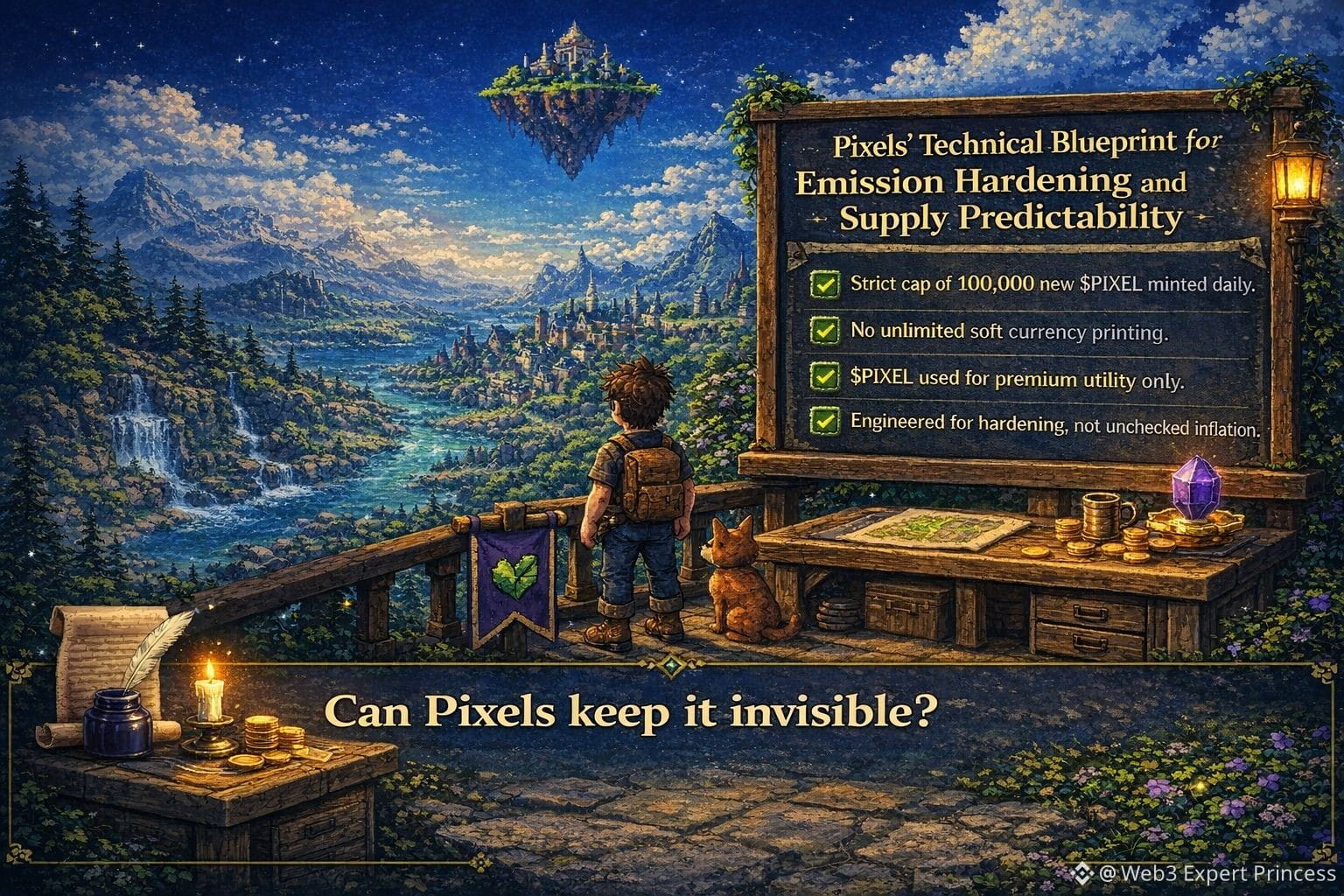
2
209
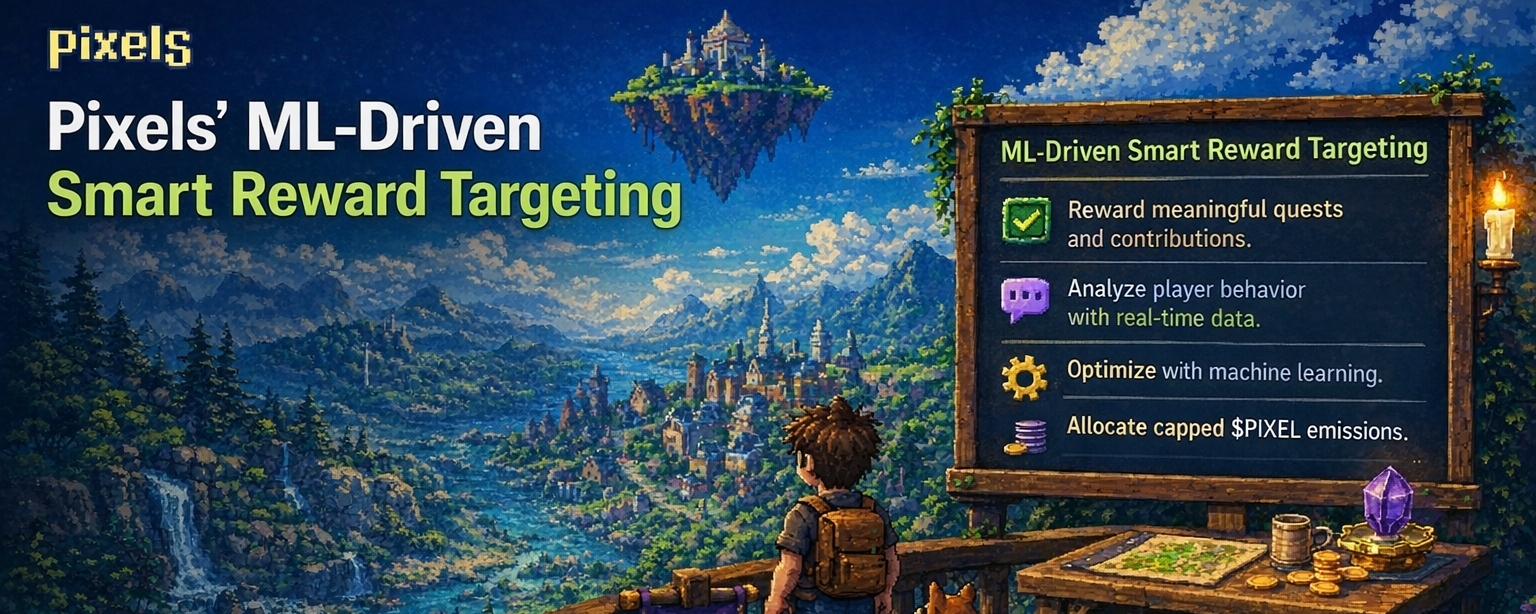
Article
Pixels’ ML-Driven Smart Reward TargetingI’ve seen enough GameFi whitepapers promise intelligent incentive alignment while quietly falling back on blunt emission schedules and blanket multipliers.
They outline reward tiers.
They mention data collection.
They claim behavioral targeting.
Then real player actions hit the system, rewards feel arbitrary, and engagement metrics flatline like they always do.
Pixels’ whitepaper leans into a conceptually sharper technical foundation.
It starts with a simple, almost stubborn assumption: rewards must be allocated through large-scale data analysis and machine learning to identify actions that genuinely drive long-term ecosystem value, rather than raw activity volume. The whitepaper describes a comprehensive data-driven infrastructure — akin to a next-generation ad network — that leverages real-time player telemetry, behavioral patterns, and contribution signals to dynamically distribute incentives. Smart Reward Targeting uses ML models to score player actions such as meaningful quest completion, user-generated content creation, consistent social engagement, and resource contributions that strengthen overall health, directing capped daily pixel emissions (100,000 new tokens) accordingly instead of passive farming loops.
The broader ambition goes beyond static token mechanics. Pixels integrates this targeting layer into a hardened ecosystem where machine learning continuously refines reward logic based on retention signals, churn predictors, and value-creation metrics. Recent execution through the Stacked AI-powered infrastructure extends this capability: an embedded “AI game economist” that analyzes SDK-integrated player movements in real time, suggests optimal LiveOps campaigns, and personalizes offers without manual intervention. Stacked already powers internal titles and opens to external studios, enabling plain-language queries for churn analysis or budget optimization while shifting some payouts toward USDC to ease direct pixelselling pressure.
It’s a cleaner technical framework than most. Behavioral analytics become the core allocation engine. Adaptive ML loops where player data shapes reward distribution — less brain-dead yield spraying, more precise alignment that could theoretically sustain engagement when initial hype volume normalizes and daily tasks lose novelty.
But here’s the deeper tension the whitepaper can’t fully paper over with ML architectures or telemetry pipelines.
The smarter and more granular the smart reward targeting via ML-driven behavioral analytics gets, the higher the risk that players eventually sense the optimization engine working underneath. When every quest, content creation, or social interaction is scored and rewarded by models trained on ecosystem-health objectives, the experience can shift from joyful pixel-world exploration to participating in someone else’s real-time behavioral modification system. Players have a sharp nose for when progression feels subtly steered by algorithmic nudges rather than organic discovery. No amount of data science precision, LiveOps automation, or USDC off-ramps can manufacture genuine attachment once the calculation behind personalized missions becomes perceptible.
Execution gaps remain too. Advanced ML targeting sounds robust on paper, but handling noisy real-world player data, avoiding bias in contribution scoring, and maintaining fairness across diverse behaviors doesn’t always cooperate with live game dynamics or community expectations. If the underlying gameplay loops aren’t compelling enough on their own, even the most sophisticated behavioral models may only delay familiar disengagement. Analytics help allocate better, but they can’t engineer intrinsic motivation where core fun is absent.
So the real test the whitepaper quietly sets up is brutal and conceptual:
Can Pixels implement smart reward targeting through ML-driven behavioral analytics so intelligently — with real-time telemetry, contribution scoring, and adaptive distribution — that the technical machinery stays completely invisible? Can the vision of a data-hardened, value-aligned incentive layer actually produce organic, long-term player engagement without anyone ever feeling like they’re inside a finely tuned algorithmic retention system?
nex
If the core gameplay leads and the ML quietly enhances meaningful actions, if targeted rewards feel like natural progression rather than engineered prompts, this could evolve into something that genuinely outlives most GameFi experiments and reshapes how technical incentive systems operate across Web3 gaming.
If not, even the most advanced ML-driven whitepaper risks becoming another smartly packaged version of the same old story — prettier behavioral models, more sophisticated targeting infrastructure, but the identical quiet exit when players detect the analytics layer and the gameplay was never quite deep enough to stand alone.
I’ve read too many of these documents. Pixels at least confronts the old blunt-incentive failures head-on with harder technical questions about what actually survives when reward logic must scale with real behavioral complexity. Whether the on-chain and off-chain reality of ML-powered targeting matches the theory is what player data, engagement curves, and time will judge next.
@pixels #pixel $PIXEL
$SIREN #StrategyBTCPurchase #WhatNextForUSIranConflict #AltcoinRecoverySignals?
$BULLA #AltcoinRecoverySignals?
Pixels’ ML-Driven Smart Reward Targeting
I’ve seen enough GameFi whitepapers promise intelligent incentive alignment while quietly falling back on blunt emission schedules and blanket multipliers.
They outline reward tiers.
They mention data collection.
They claim behavioral targeting.
Then real player actions hit the system, rewards feel arbitrary, and engagement metrics flatline like they always do.
Pixels’ whitepaper leans into a conceptually sharper technical foundation.
It starts with a simple, almost stubborn assumption: rewards must be allocated through large-scale data analysis and machine learning to identify actions that genuinely drive long-term ecosystem value, rather than raw activity volume. The whitepaper describes a comprehensive data-driven infrastructure — akin to a next-generation ad network — that leverages real-time player telemetry, behavioral patterns, and contribution signals to dynamically distribute incentives. Smart Reward Targeting uses ML models to score player actions such as meaningful quest completion, user-generated content creation, consistent social engagement, and resource contributions that strengthen overall health, directing capped daily pixel emissions (100,000 new tokens) accordingly instead of passive farming loops.
The broader ambition goes beyond static token mechanics. Pixels integrates this targeting layer into a hardened ecosystem where machine learning continuously refines reward logic based on retention signals, churn predictors, and value-creation metrics. Recent execution through the Stacked AI-powered infrastructure extends this capability: an embedded “AI game economist” that analyzes SDK-integrated player movements in real time, suggests optimal LiveOps campaigns, and personalizes offers without manual intervention. Stacked already powers internal titles and opens to external studios, enabling plain-language queries for churn analysis or budget optimization while shifting some payouts toward USDC to ease direct pixelselling pressure.
It’s a cleaner technical framework than most. Behavioral analytics become the core allocation engine. Adaptive ML loops where player data shapes reward distribution — less brain-dead yield spraying, more precise alignment that could theoretically sustain engagement when initial hype volume normalizes and daily tasks lose novelty.
But here’s the deeper tension the whitepaper can’t fully paper over with ML architectures or telemetry pipelines.
The smarter and more granular the smart reward targeting via ML-driven behavioral analytics gets, the higher the risk that players eventually sense the optimization engine working underneath. When every quest, content creation, or social interaction is scored and rewarded by models trained on ecosystem-health objectives, the experience can shift from joyful pixel-world exploration to participating in someone else’s real-time behavioral modification system. Players have a sharp nose for when progression feels subtly steered by algorithmic nudges rather than organic discovery. No amount of data science precision, LiveOps automation, or USDC off-ramps can manufacture genuine attachment once the calculation behind personalized missions becomes perceptible.
Execution gaps remain too. Advanced ML targeting sounds robust on paper, but handling noisy real-world player data, avoiding bias in contribution scoring, and maintaining fairness across diverse behaviors doesn’t always cooperate with live game dynamics or community expectations. If the underlying gameplay loops aren’t compelling enough on their own, even the most sophisticated behavioral models may only delay familiar disengagement. Analytics help allocate better, but they can’t engineer intrinsic motivation where core fun is absent.
So the real test the whitepaper quietly sets up is brutal and conceptual:
Can Pixels implement smart reward targeting through ML-driven behavioral analytics so intelligently — with real-time telemetry, contribution scoring, and adaptive distribution — that the technical machinery stays completely invisible? Can the vision of a data-hardened, value-aligned incentive layer actually produce organic, long-term player engagement without anyone ever feeling like they’re inside a finely tuned algorithmic retention system?
nex
If the core gameplay leads and the ML quietly enhances meaningful actions, if targeted rewards feel like natural progression rather than engineered prompts, this could evolve into something that genuinely outlives most GameFi experiments and reshapes how technical incentive systems operate across Web3 gaming.
If not, even the most advanced ML-driven whitepaper risks becoming another smartly packaged version of the same old story — prettier behavioral models, more sophisticated targeting infrastructure, but the identical quiet exit when players detect the analytics layer and the gameplay was never quite deep enough to stand alone.
I’ve read too many of these documents. Pixels at least confronts the old blunt-incentive failures head-on with harder technical questions about what actually survives when reward logic must scale with real behavioral complexity. Whether the on-chain and off-chain reality of ML-powered targeting matches the theory is what player data, engagement curves, and time will judge next.
@Pixels #pixel $PIXEL
$SIREN #StrategyBTCPurchase #WhatNextForUSIranConflict #AltcoinRecoverySignals?
$BULLA #AltcoinRecoverySignals?
They outline reward tiers.
They mention data collection.
They claim behavioral targeting.
Then real player actions hit the system, rewards feel arbitrary, and engagement metrics flatline like they always do.
Pixels’ whitepaper leans into a conceptually sharper technical foundation.
It starts with a simple, almost stubborn assumption: rewards must be allocated through large-scale data analysis and machine learning to identify actions that genuinely drive long-term ecosystem value, rather than raw activity volume. The whitepaper describes a comprehensive data-driven infrastructure — akin to a next-generation ad network — that leverages real-time player telemetry, behavioral patterns, and contribution signals to dynamically distribute incentives. Smart Reward Targeting uses ML models to score player actions such as meaningful quest completion, user-generated content creation, consistent social engagement, and resource contributions that strengthen overall health, directing capped daily pixel emissions (100,000 new tokens) accordingly instead of passive farming loops.
The broader ambition goes beyond static token mechanics. Pixels integrates this targeting layer into a hardened ecosystem where machine learning continuously refines reward logic based on retention signals, churn predictors, and value-creation metrics. Recent execution through the Stacked AI-powered infrastructure extends this capability: an embedded “AI game economist” that analyzes SDK-integrated player movements in real time, suggests optimal LiveOps campaigns, and personalizes offers without manual intervention. Stacked already powers internal titles and opens to external studios, enabling plain-language queries for churn analysis or budget optimization while shifting some payouts toward USDC to ease direct pixelselling pressure.
It’s a cleaner technical framework than most. Behavioral analytics become the core allocation engine. Adaptive ML loops where player data shapes reward distribution — less brain-dead yield spraying, more precise alignment that could theoretically sustain engagement when initial hype volume normalizes and daily tasks lose novelty.
But here’s the deeper tension the whitepaper can’t fully paper over with ML architectures or telemetry pipelines.
The smarter and more granular the smart reward targeting via ML-driven behavioral analytics gets, the higher the risk that players eventually sense the optimization engine working underneath. When every quest, content creation, or social interaction is scored and rewarded by models trained on ecosystem-health objectives, the experience can shift from joyful pixel-world exploration to participating in someone else’s real-time behavioral modification system. Players have a sharp nose for when progression feels subtly steered by algorithmic nudges rather than organic discovery. No amount of data science precision, LiveOps automation, or USDC off-ramps can manufacture genuine attachment once the calculation behind personalized missions becomes perceptible.
Execution gaps remain too. Advanced ML targeting sounds robust on paper, but handling noisy real-world player data, avoiding bias in contribution scoring, and maintaining fairness across diverse behaviors doesn’t always cooperate with live game dynamics or community expectations. If the underlying gameplay loops aren’t compelling enough on their own, even the most sophisticated behavioral models may only delay familiar disengagement. Analytics help allocate better, but they can’t engineer intrinsic motivation where core fun is absent.
So the real test the whitepaper quietly sets up is brutal and conceptual:
Can Pixels implement smart reward targeting through ML-driven behavioral analytics so intelligently — with real-time telemetry, contribution scoring, and adaptive distribution — that the technical machinery stays completely invisible? Can the vision of a data-hardened, value-aligned incentive layer actually produce organic, long-term player engagement without anyone ever feeling like they’re inside a finely tuned algorithmic retention system?
nex
If the core gameplay leads and the ML quietly enhances meaningful actions, if targeted rewards feel like natural progression rather than engineered prompts, this could evolve into something that genuinely outlives most GameFi experiments and reshapes how technical incentive systems operate across Web3 gaming.
If not, even the most advanced ML-driven whitepaper risks becoming another smartly packaged version of the same old story — prettier behavioral models, more sophisticated targeting infrastructure, but the identical quiet exit when players detect the analytics layer and the gameplay was never quite deep enough to stand alone.
I’ve read too many of these documents. Pixels at least confronts the old blunt-incentive failures head-on with harder technical questions about what actually survives when reward logic must scale with real behavioral complexity. Whether the on-chain and off-chain reality of ML-powered targeting matches the theory is what player data, engagement curves, and time will judge next.
@Pixels #pixel $PIXEL
$SIREN #StrategyBTCPurchase #WhatNextForUSIranConflict #AltcoinRecoverySignals?
$BULLA #AltcoinRecoverySignals?
245
Pixels and the Whitepaper’s Bet on Cozy Social Loops and Emotional Stickiness
I’ve seen enough GameFi whitepapers promise deep social features while quietly delivering empty chat boxes and ghost towns.
They add friends lists.
They talk about visiting farms.
They claim community will keep people coming back.
Then the initial wave logs off, conversations dry up, and the virtual world feels lonelier than a single-player grind.
Pixels’ whitepaper leans into a conceptually sharper foundation.
It starts with a simple, almost stubborn assumption: the game must feel emotionally cozy and socially rewarding if anyone is going to treat it like a second home rather than a daily chore. The core loop centers on relaxed farming, building, and decorating in a pixel-art world designed to evoke warmth and nostalgia. Players can freely visit friends’ farms, wander along Rainbow Road, and see how others have personalized their spaces with decorations, industries, and creative builds. Social reputation systems reward consistent positive interactions, while guilds evolve into lively economic and collaborative hubs where players team up for bigger projects or shared goals.
The broader ambition goes beyond solo resource grinding. Pixels emphasizes a living social fabric where land owners and sharecroppers interact meaningfully — one player industrializing their plot while inviting others to contribute, creating natural relationships through trade, help, and shared progress. Over 100 NFT collections serve as avatars, letting players express identity by walking the Pixelverse as familiar characters. LLM-powered NPCs add unscripted conversations that feel personal, unlocking side stories or helpful trades. Chapter updates roll out every three to four months with new social mechanics, team competitions like Bountyfall, and features that encourage group play without forcing competition.
It’s you feeling like they’re inside a finely tuned social optimization model?
@pixels #pixel
{spot}(PIXELUSDT)
$PIXEL $DOGS $BULLA #KelpDAOFacesAttack
Pixels and the Whitepaper’s Bet on Cozy Social Loops and Emotional Stickiness
I’ve seen enough GameFi whitepapers promise deep social features while quietly delivering empty chat boxes and ghost towns.
They add friends lists.
They talk about visiting farms.
They claim community will keep people coming back.
Then the initial wave logs off, conversations dry up, and the virtual world feels lonelier than a single-player grind.
Pixels’ whitepaper leans into a conceptually sharper foundation.
It starts with a simple, almost stubborn assumption: the game must feel emotionally cozy and socially rewarding if anyone is going to treat it like a second home rather than a daily chore. The core loop centers on relaxed farming, building, and decorating in a pixel-art world designed to evoke warmth and nostalgia. Players can freely visit friends’ farms, wander along Rainbow Road, and see how others have personalized their spaces with decorations, industries, and creative builds. Social reputation systems reward consistent positive interactions, while guilds evolve into lively economic and collaborative hubs where players team up for bigger projects or shared goals.
The broader ambition goes beyond solo resource grinding. Pixels emphasizes a living social fabric where land owners and sharecroppers interact meaningfully — one player industrializing their plot while inviting others to contribute, creating natural relationships through trade, help, and shared progress. Over 100 NFT collections serve as avatars, letting players express identity by walking the Pixelverse as familiar characters. LLM-powered NPCs add unscripted conversations that feel personal, unlocking side stories or helpful trades. Chapter updates roll out every three to four months with new social mechanics, team competitions like Bountyfall, and features that encourage group play without forcing competition.
It’s you feeling like they’re inside a finely tuned social optimization model?
@Pixels #pixel
$PIXEL $DOGS $BULLA #KelpDAOFacesAttack
I’ve seen enough GameFi whitepapers promise deep social features while quietly delivering empty chat boxes and ghost towns.
They add friends lists.
They talk about visiting farms.
They claim community will keep people coming back.
Then the initial wave logs off, conversations dry up, and the virtual world feels lonelier than a single-player grind.
Pixels’ whitepaper leans into a conceptually sharper foundation.
It starts with a simple, almost stubborn assumption: the game must feel emotionally cozy and socially rewarding if anyone is going to treat it like a second home rather than a daily chore. The core loop centers on relaxed farming, building, and decorating in a pixel-art world designed to evoke warmth and nostalgia. Players can freely visit friends’ farms, wander along Rainbow Road, and see how others have personalized their spaces with decorations, industries, and creative builds. Social reputation systems reward consistent positive interactions, while guilds evolve into lively economic and collaborative hubs where players team up for bigger projects or shared goals.
The broader ambition goes beyond solo resource grinding. Pixels emphasizes a living social fabric where land owners and sharecroppers interact meaningfully — one player industrializing their plot while inviting others to contribute, creating natural relationships through trade, help, and shared progress. Over 100 NFT collections serve as avatars, letting players express identity by walking the Pixelverse as familiar characters. LLM-powered NPCs add unscripted conversations that feel personal, unlocking side stories or helpful trades. Chapter updates roll out every three to four months with new social mechanics, team competitions like Bountyfall, and features that encourage group play without forcing competition.
It’s you feeling like they’re inside a finely tuned social optimization model?
@Pixels #pixel
$PIXEL $DOGS $BULLA #KelpDAOFacesAttack
2
1
63
Log in to explore more content
Join global crypto users on Binance Square
⚡️ Get latest and useful information about crypto.
💬 Trusted by the world’s largest crypto exchange.
👍 Discover real insights from verified creators.
Email / Phone number
Trending Topics
SaylorHintsStrategyBitcoinBuy
2.2M views
11,964 Discussing
#saylorhintsstrategybitcoinbuy
🚨 SAYLOR JUST DROPPED THE SUNDAY $BTC HINT 👀
Michael Saylor reposted his usual Bitcoin chart again.
If history repeats, those orange dots could be signaling another Strategy BTC purchase is coming. 🟠
And when Saylor buys, the market watches.
🐋 Massive BTC holdings
💰 Continued accumulation strategy
📈 Potential short-term sentiment boost
But here’s the key:
A repost is NOT confirmation of a purchase.
The real signal comes when Strategy officially reports the transaction.
🔥 If another major BTC buy is announced, will the market react this time?
Or is Saylor’s accumulation becoming so routine that traders barely react anymore?
👀 Watch the announcement.
$MSTRB
#BTC #strategy #crypto #BitcoinNews
sdatta
·4 Likes
·3.2k views
BOJRaisesRatesTo31YearHigh
211,251 views
2,995 Discussing
BuffettStepsDownAsBerkshireChairman
102,115 views
1,586 Discussing