

GweiToTheSky
2.6k Posts

GweiToTheSky
Report
Block User
759 Following
5.4K+ Followers
3.9K+ Liked
Posts
All
Quotes
Live
·
--
$QNT /USDT Market Update
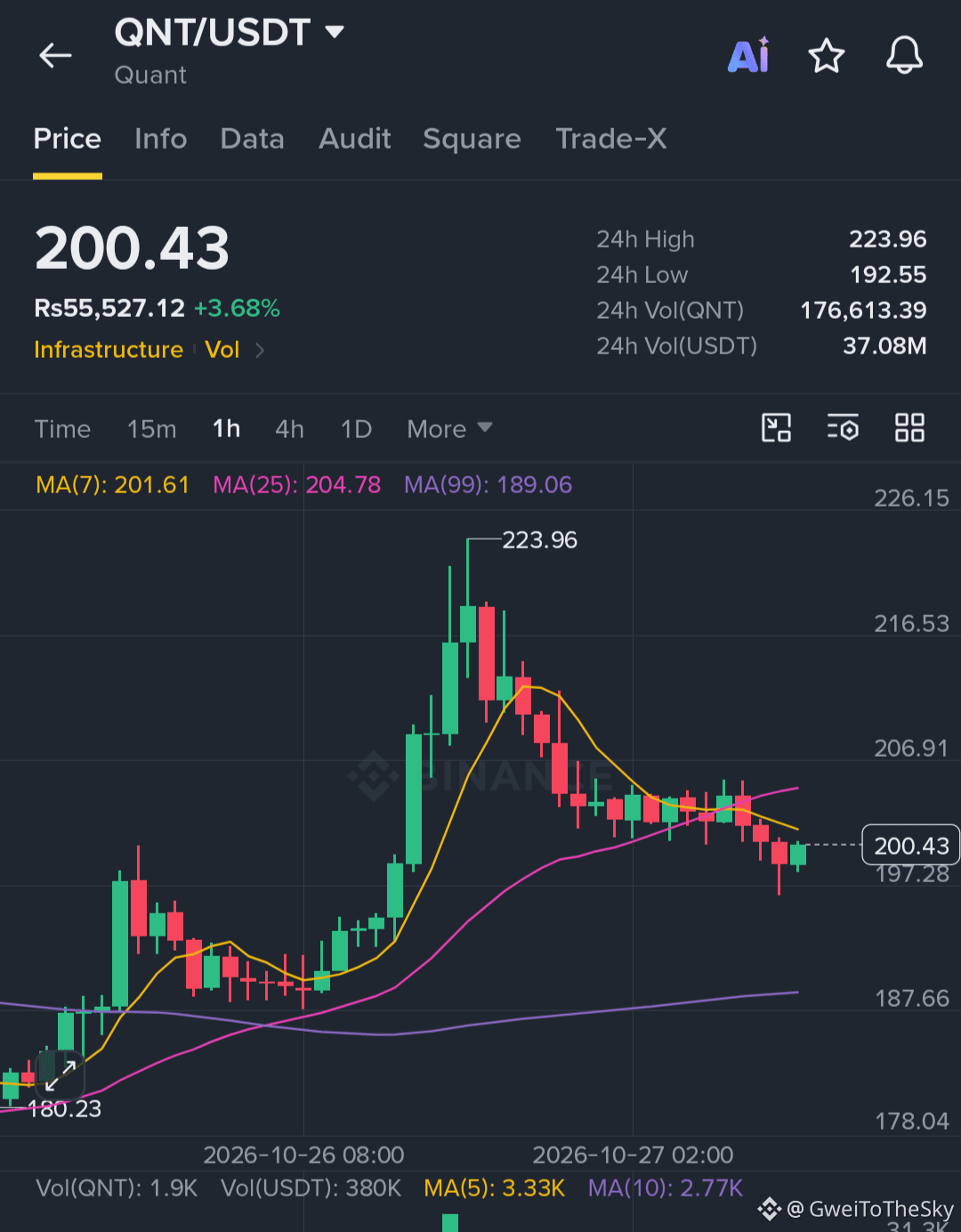
QNT is trading at 200.43 USDT, up 3.68% in 24 hours after reaching a high of 223.96. Price is now consolidating near the 200 level as short-term momentum cools.
🔹 Support: 197–192.5
🔹 Resistance: 204.8–207
🔹 Major resistance: 216–224
Price is below the MA(7) and MA(25), suggesting short-term selling pressure, while remaining above the MA(99) at 189.06.
👀 Watch for a breakout above 205–207 or a breakdown below 197 for the next directional move.
#QNT #Crypto #Trading
$QNT /USDT Market Update
QNT is trading at 200.43 USDT, up 3.68% in 24 hours after reaching a high of 223.96. Price is now consolidating near the 200 level as short-term momentum cools.
🔹 Support: 197–192.5
🔹 Resistance: 204.8–207
🔹 Major resistance: 216–224
Price is below the MA(7) and MA(25), suggesting short-term selling pressure, while remaining above the MA(99) at 189.06.
👀 Watch for a breakout above 205–207 or a breakdown below 197 for the next directional move.
#QNT #Crypto #Trading
QNT is trading at 200.43 USDT, up 3.68% in 24 hours after reaching a high of 223.96. Price is now consolidating near the 200 level as short-term momentum cools.
🔹 Support: 197–192.5
🔹 Resistance: 204.8–207
🔹 Major resistance: 216–224
Price is below the MA(7) and MA(25), suggesting short-term selling pressure, while remaining above the MA(99) at 189.06.
👀 Watch for a breakout above 205–207 or a breakdown below 197 for the next directional move.
#QNT #Crypto #Trading
1
2
395
·
--
Bullish
$UNI /USDT Market Update | Bullish Momentum Building?
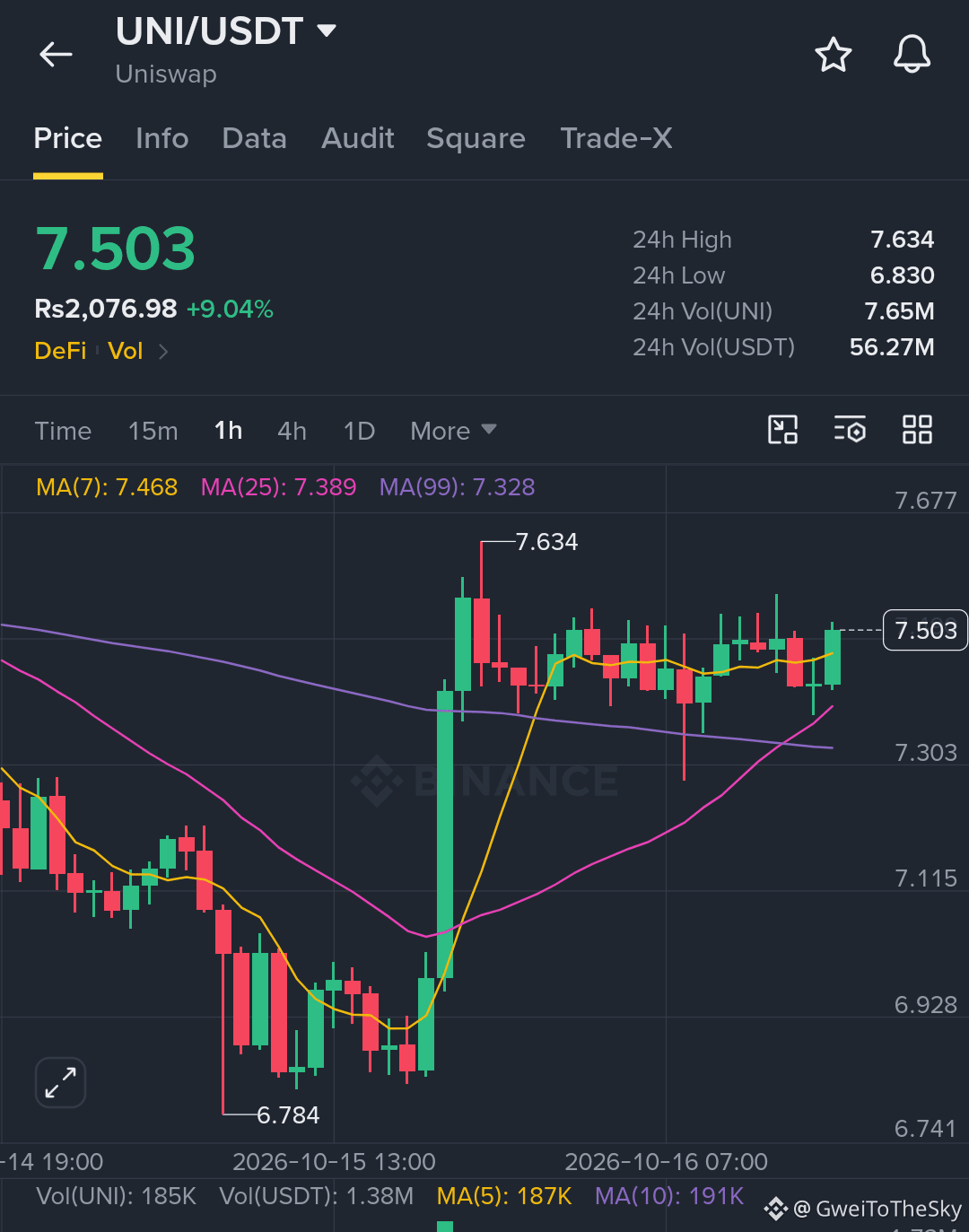
Uniswap ($UNI ) is showing strong recovery on the 1H chart, currently trading around $7.503 (+9.04%). After bouncing from the $6.784 low, buyers pushed the price toward $7.634 before entering a consolidation phase.
🔍 Key Levels to Watch:
- Resistance: $7.63–$7.70
- Support: $7.35–$7.30
- Bullish scenario: A clean breakout above $7.63 could open the door to further upside.
- Bearish scenario: Losing $7.30 may weaken the recovery and invite selling pressure.
The price is holding above MA(25) and MA(99), suggesting improving short-term momentum. However, confirmation through volume and a sustained breakout is essential.
👀 My take: UNI is at a key decision zone. Will buyers push for a breakout, or will resistance trigger another pullback?
#UNI #Uniswap #Crypto #Trading #TechnicalAnalysis
$UNI /USDT Market Update | Bullish Momentum Building?
Uniswap ($UNI ) is showing strong recovery on the 1H chart, currently trading around $7.503 (+9.04%). After bouncing from the $6.784 low, buyers pushed the price toward $7.634 before entering a consolidation phase.
🔍 Key Levels to Watch:
- Resistance: $7.63–$7.70
- Support: $7.35–$7.30
- Bullish scenario: A clean breakout above $7.63 could open the door to further upside.
- Bearish scenario: Losing $7.30 may weaken the recovery and invite selling pressure.
The price is holding above MA(25) and MA(99), suggesting improving short-term momentum. However, confirmation through volume and a sustained breakout is essential.
👀 My take: UNI is at a key decision zone. Will buyers push for a breakout, or will resistance trigger another pullback?
#UNI #Uniswap #Crypto #Trading #TechnicalAnalysis
Uniswap ($UNI ) is showing strong recovery on the 1H chart, currently trading around $7.503 (+9.04%). After bouncing from the $6.784 low, buyers pushed the price toward $7.634 before entering a consolidation phase.
🔍 Key Levels to Watch:
- Resistance: $7.63–$7.70
- Support: $7.35–$7.30
- Bullish scenario: A clean breakout above $7.63 could open the door to further upside.
- Bearish scenario: Losing $7.30 may weaken the recovery and invite selling pressure.
The price is holding above MA(25) and MA(99), suggesting improving short-term momentum. However, confirmation through volume and a sustained breakout is essential.
👀 My take: UNI is at a key decision zone. Will buyers push for a breakout, or will resistance trigger another pullback?
#UNI #Uniswap #Crypto #Trading #TechnicalAnalysis
1
90
·
--
$CATI /$USDT — LONG SETUP 🔥
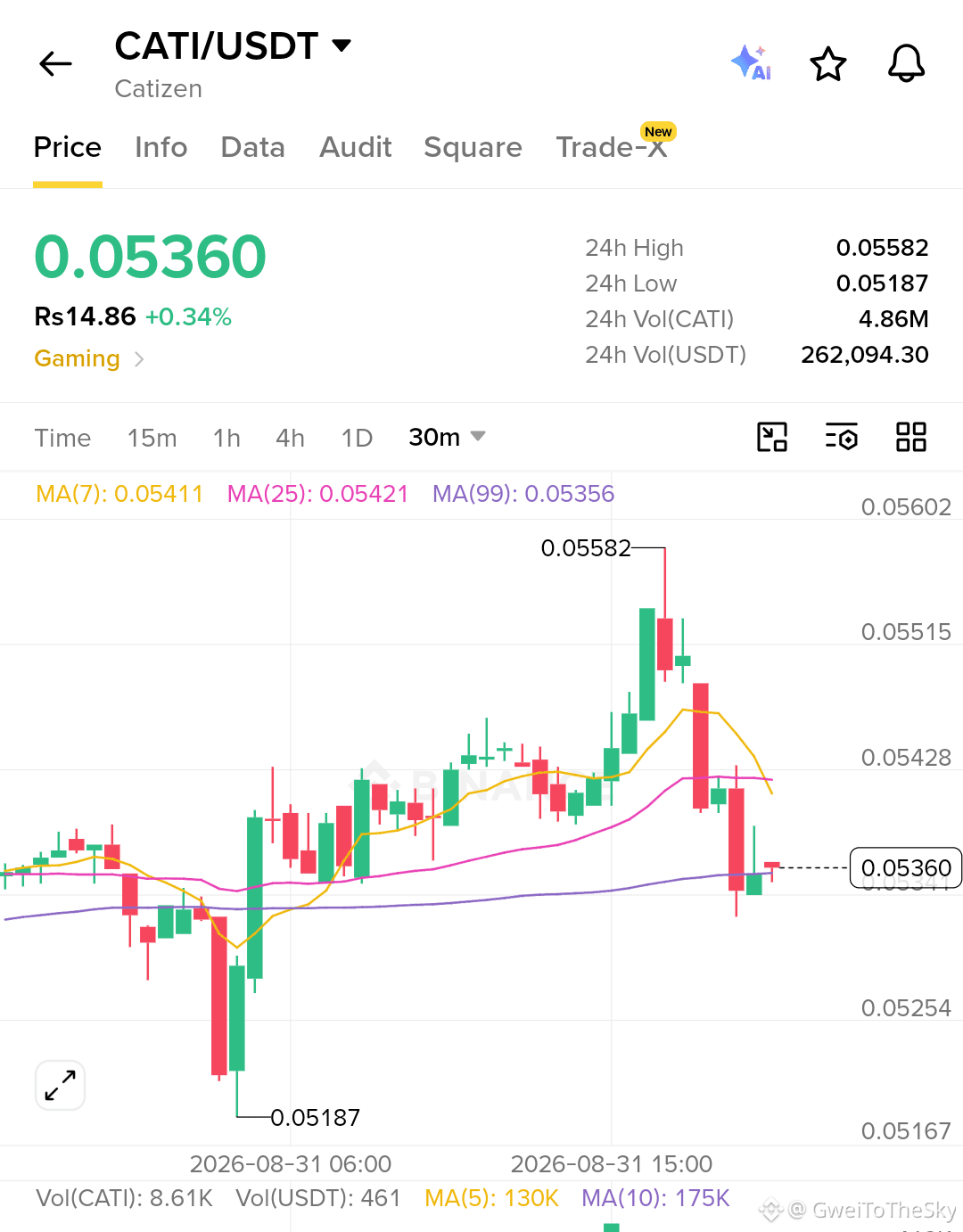
CATI is currently trading around 0.05360 USDT on the 30M chart. Price is sitting near the MA(99) at 0.05356, making this an important decision zone.
📌 Trade Plan
🟢 Entry: 0.05340 – 0.05370
🛑 Stop Loss: 0.05290
🎯 TP1: 0.05430
🎯 TP2: 0.05515
🎯 TP3: 0.05580
📊 Risk/Reward: Approximately 1:2 to 1:4+ depending on entry and target.
Confirmation: A strong 30M close above 0.05430 would strengthen the bullish setup. If price loses 0.05290, the setup is invalidated.
Don't over-leverage. Risk only what you can afford to lose and consider securing partial profits at TP1/TP2.
#CATI #cryptouniverseofficial #altcoins
$CATI /$USDT — LONG SETUP 🔥
CATI is currently trading around 0.05360 USDT on the 30M chart. Price is sitting near the MA(99) at 0.05356, making this an important decision zone.
📌 Trade Plan
🟢 Entry: 0.05340 – 0.05370
🛑 Stop Loss: 0.05290
🎯 TP1: 0.05430
🎯 TP2: 0.05515
🎯 TP3: 0.05580
📊 Risk/Reward: Approximately 1:2 to 1:4+ depending on entry and target.
Confirmation: A strong 30M close above 0.05430 would strengthen the bullish setup. If price loses 0.05290, the setup is invalidated.
Don't over-leverage. Risk only what you can afford to lose and consider securing partial profits at TP1/TP2.
#CATI #cryptouniverseofficial #altcoins
CATI is currently trading around 0.05360 USDT on the 30M chart. Price is sitting near the MA(99) at 0.05356, making this an important decision zone.
📌 Trade Plan
🟢 Entry: 0.05340 – 0.05370
🛑 Stop Loss: 0.05290
🎯 TP1: 0.05430
🎯 TP2: 0.05515
🎯 TP3: 0.05580
📊 Risk/Reward: Approximately 1:2 to 1:4+ depending on entry and target.
Confirmation: A strong 30M close above 0.05430 would strengthen the bullish setup. If price loses 0.05290, the setup is invalidated.
Don't over-leverage. Risk only what you can afford to lose and consider securing partial profits at TP1/TP2.
#CATI #cryptouniverseofficial #altcoins
2
106
·
--
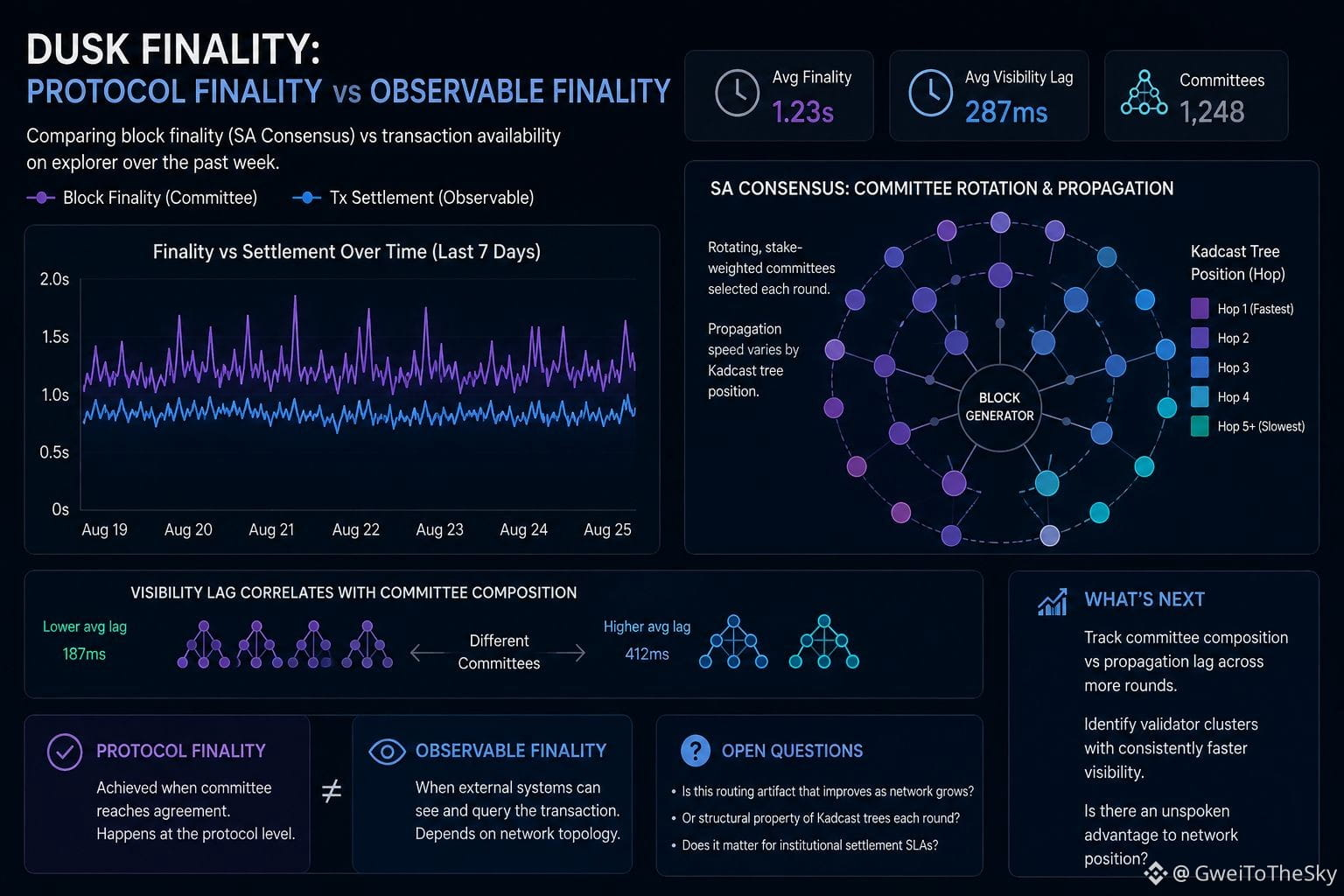
@Dusk_Foundation 's block finality timestamps against actual transaction settlement on the explorer over the past week. At first I assumed the small lag I kept seeing, a few hundred milliseconds between committee finalization and when a transaction became queryable in downstream tools, was just an indexing delay. I filed it away as noise and moved on to checking validator participation rates instead.
While digging into why that gap wasn't constant, I found it correlated with which committee members were selected for that round under SA Consensus. Rotating, stake-weighted committees don't just pick validators randomly each round, they carry slightly different propagation timing depending on Kadcast tree position. That's not documented anywhere I read, it just showed up in the data once I lined up enough rounds side by side.
This separated two things in my head that I'd been treating as one: consensus finality and observable finality. Finality at the protocol level happens the moment the committee agrees, but what an external system sees depends on network topology at that moment. Most people watching $DUSK assume "fast finality" means uniformly fast for everyone downstream, and that's not quite what I'm seeing.
What I can't work out yet is whether this timing variance matters for anything beyond indexing convenience, or whether it starts to matter once institutional settlement systems expect tighter, predictable windows. Is this a routing artifact that self-corrects as the network grows, or a structural property of how Kadcast trees form each round.
Going forward I want to track committee composition against propagation lag across a larger sample, along with whether certain validator clusters consistently produce faster downstream visibility. That would tell me if this is incentive-neutral or if there's an unspoken advantage to network position that operators haven't priced in yet.
#Dusk
$BTR
{future}(BTRUSDT)
$BMT
{future}(BMTUSDT)
@Dusk 's block finality timestamps against actual transaction settlement on the explorer over the past week. At first I assumed the small lag I kept seeing, a few hundred milliseconds between committee finalization and when a transaction became queryable in downstream tools, was just an indexing delay. I filed it away as noise and moved on to checking validator participation rates instead.
While digging into why that gap wasn't constant, I found it correlated with which committee members were selected for that round under SA Consensus. Rotating, stake-weighted committees don't just pick validators randomly each round, they carry slightly different propagation timing depending on Kadcast tree position. That's not documented anywhere I read, it just showed up in the data once I lined up enough rounds side by side.
This separated two things in my head that I'd been treating as one: consensus finality and observable finality. Finality at the protocol level happens the moment the committee agrees, but what an external system sees depends on network topology at that moment. Most people watching $DUSK assume "fast finality" means uniformly fast for everyone downstream, and that's not quite what I'm seeing.
What I can't work out yet is whether this timing variance matters for anything beyond indexing convenience, or whether it starts to matter once institutional settlement systems expect tighter, predictable windows. Is this a routing artifact that self-corrects as the network grows, or a structural property of how Kadcast trees form each round.
Going forward I want to track committee composition against propagation lag across a larger sample, along with whether certain validator clusters consistently produce faster downstream visibility. That would tell me if this is incentive-neutral or if there's an unspoken advantage to network position that operators haven't priced in yet.
#Dusk
$BTR
$BMT
While digging into why that gap wasn't constant, I found it correlated with which committee members were selected for that round under SA Consensus. Rotating, stake-weighted committees don't just pick validators randomly each round, they carry slightly different propagation timing depending on Kadcast tree position. That's not documented anywhere I read, it just showed up in the data once I lined up enough rounds side by side.
This separated two things in my head that I'd been treating as one: consensus finality and observable finality. Finality at the protocol level happens the moment the committee agrees, but what an external system sees depends on network topology at that moment. Most people watching $DUSK assume "fast finality" means uniformly fast for everyone downstream, and that's not quite what I'm seeing.
What I can't work out yet is whether this timing variance matters for anything beyond indexing convenience, or whether it starts to matter once institutional settlement systems expect tighter, predictable windows. Is this a routing artifact that self-corrects as the network grows, or a structural property of how Kadcast trees form each round.
Going forward I want to track committee composition against propagation lag across a larger sample, along with whether certain validator clusters consistently produce faster downstream visibility. That would tell me if this is incentive-neutral or if there's an unspoken advantage to network position that operators haven't priced in yet.
#Dusk
$BTR
$BMT
4
309
·
--
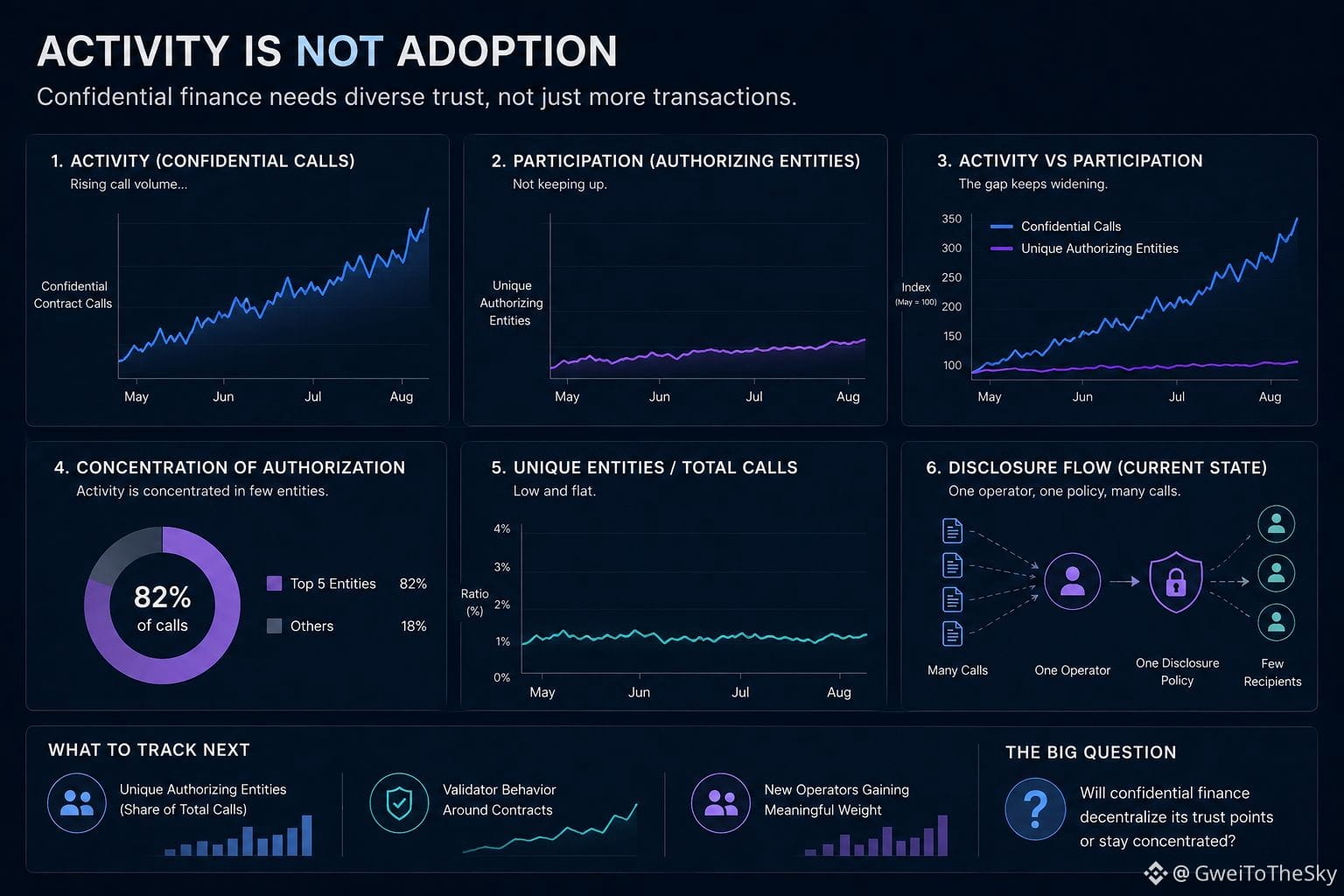
@Dusk_Foundation explorer instance last week. I assumed a spike in confidential contract calls meant new user activity, but the wallet-level signatures behind those calls kept mapping back to a small cluster of addresses.
Digging further, I found the actual mechanism doing the work wasn't the transaction volume itself but the selective disclosure layer sitting underneath it. Each call was routing through the same disclosure policy, meaning the "activity" I was seeing was really one operator cycling authorization requests through XSC-style contracts rather than organic usage spreading outward.
That distinction reframed how I think about adoption here. Transaction count and authorization diversity are not the same signal. A chain can show rising call volume while the actual set of entities deciding what gets disclosed to whom stays narrow. That second-order gap between activity and participation is easy to miss if you only chart throughput.
What I can't resolve yet is whether that concentration is a bootstrapping phase or a structural feature of how confidential finance rails naturally behave. Regulated counterparties may prefer fewer trusted disclosure points early on, but I don't know if the incentive design pushes toward broadening that set over time or quietly rewards staying narrow.
Going forward I want to track unique authorizing entities relative to total confidential calls, not just raw volume. I'm also watching whether validator behavior around these contracts shifts as disclosure requests diversify, and whether new operators entering actually gain meaningful authorization weight or just add noise to the count.
I'm left without a clean conclusion, just a sharper question: does privacy-by-design finance eventually decentralize its trust points, or does it structurally favor a small number of gatekeepers who control disclosure. I don't think the data I've seen so far answers that either way.
#Dusk
$DUSK
{future}(DUSKUSDT)
$BMT
{future}(BMTUSDT)
$ZRO
{future}(ZROUSDT)
@Dusk explorer instance last week. I assumed a spike in confidential contract calls meant new user activity, but the wallet-level signatures behind those calls kept mapping back to a small cluster of addresses.
Digging further, I found the actual mechanism doing the work wasn't the transaction volume itself but the selective disclosure layer sitting underneath it. Each call was routing through the same disclosure policy, meaning the "activity" I was seeing was really one operator cycling authorization requests through XSC-style contracts rather than organic usage spreading outward.
That distinction reframed how I think about adoption here. Transaction count and authorization diversity are not the same signal. A chain can show rising call volume while the actual set of entities deciding what gets disclosed to whom stays narrow. That second-order gap between activity and participation is easy to miss if you only chart throughput.
What I can't resolve yet is whether that concentration is a bootstrapping phase or a structural feature of how confidential finance rails naturally behave. Regulated counterparties may prefer fewer trusted disclosure points early on, but I don't know if the incentive design pushes toward broadening that set over time or quietly rewards staying narrow.
Going forward I want to track unique authorizing entities relative to total confidential calls, not just raw volume. I'm also watching whether validator behavior around these contracts shifts as disclosure requests diversify, and whether new operators entering actually gain meaningful authorization weight or just add noise to the count.
I'm left without a clean conclusion, just a sharper question: does privacy-by-design finance eventually decentralize its trust points, or does it structurally favor a small number of gatekeepers who control disclosure. I don't think the data I've seen so far answers that either way.
#Dusk
$DUSK
$BMT
$ZRO
Digging further, I found the actual mechanism doing the work wasn't the transaction volume itself but the selective disclosure layer sitting underneath it. Each call was routing through the same disclosure policy, meaning the "activity" I was seeing was really one operator cycling authorization requests through XSC-style contracts rather than organic usage spreading outward.
That distinction reframed how I think about adoption here. Transaction count and authorization diversity are not the same signal. A chain can show rising call volume while the actual set of entities deciding what gets disclosed to whom stays narrow. That second-order gap between activity and participation is easy to miss if you only chart throughput.
What I can't resolve yet is whether that concentration is a bootstrapping phase or a structural feature of how confidential finance rails naturally behave. Regulated counterparties may prefer fewer trusted disclosure points early on, but I don't know if the incentive design pushes toward broadening that set over time or quietly rewards staying narrow.
Going forward I want to track unique authorizing entities relative to total confidential calls, not just raw volume. I'm also watching whether validator behavior around these contracts shifts as disclosure requests diversify, and whether new operators entering actually gain meaningful authorization weight or just add noise to the count.
I'm left without a clean conclusion, just a sharper question: does privacy-by-design finance eventually decentralize its trust points, or does it structurally favor a small number of gatekeepers who control disclosure. I don't think the data I've seen so far answers that either way.
#Dusk
$DUSK
$BMT
$ZRO
5
286
·
--
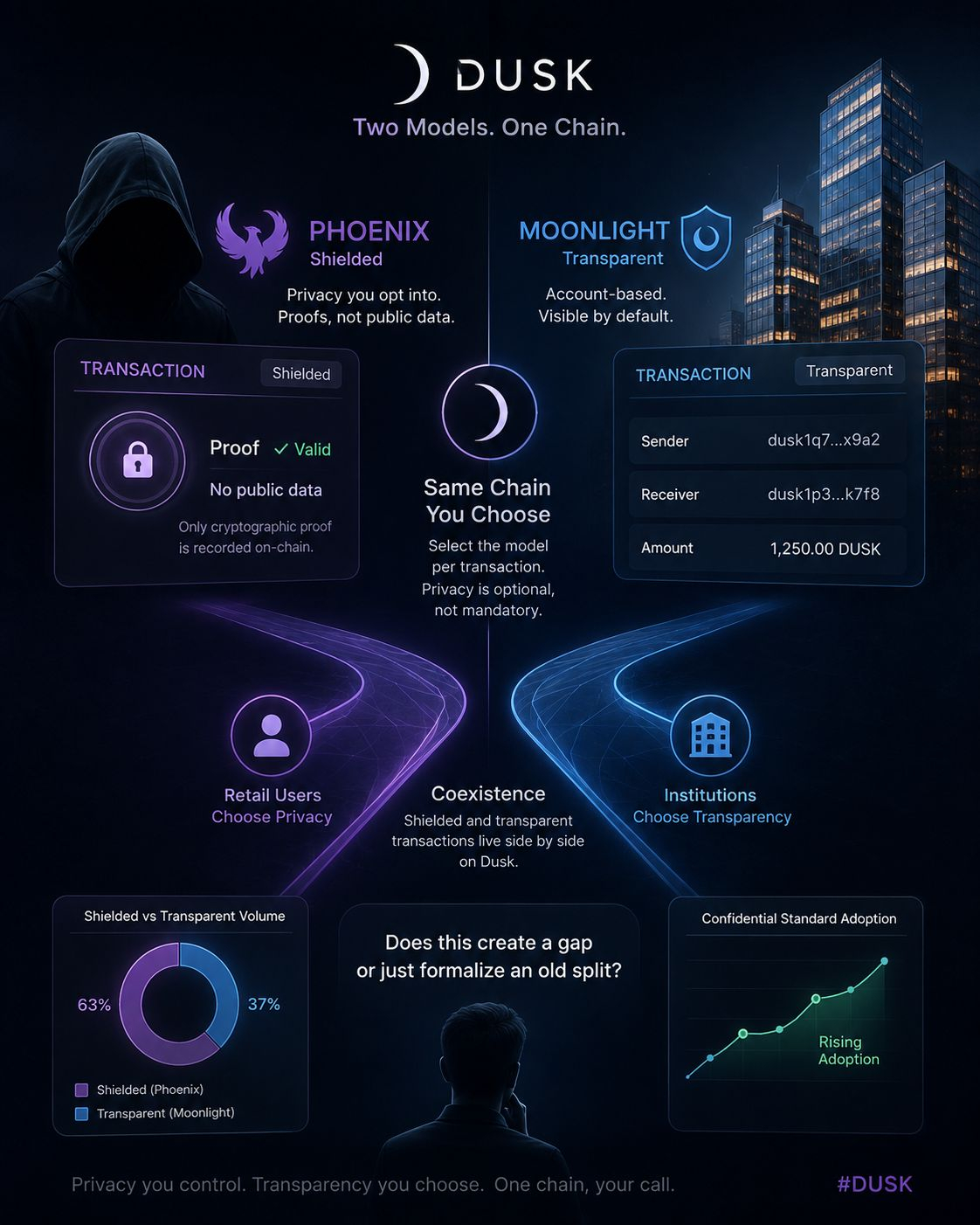
Dusk's explorer one evening, half paying attention, when something felt off. Some transactions showed sender, receiver, amount, others sat as just a proof, nothing readable. My first thought was the explorer glitching.
Turns out it wasn't. Dusk runs two models side by side, Phoenix, shielded, and Moonlight, transparent, account based. Nobody forces you into one, you pick per transaction, that's what I saw.
That's when my thinking shifted. I used to lump "privacy chain" and "private by default" together. Here they don't match. Privacy is something you opt into, not baked in, so hidden and visible activity coexist.
I'm still turning this over. If regulated money stays transparent while retail goes shielded, does that create a gap, or just formalize an old split?
For now I'm watching the ratio of shielded to transparent volume, not raw numbers, plus how many contracts adopt the confidential standard over defaulting transparent.
Honestly I don't know if this makes for a healthier market or just splits liquidity into rooms that never talk. Still sitting with that.
@Dusk_Foundation #Dusk
$DUSK
{future}(DUSKUSDT)
$TAC
{future}(TACUSDT)
$ONG
{future}(ONGUSDT)
Dusk's explorer one evening, half paying attention, when something felt off. Some transactions showed sender, receiver, amount, others sat as just a proof, nothing readable. My first thought was the explorer glitching.
Turns out it wasn't. Dusk runs two models side by side, Phoenix, shielded, and Moonlight, transparent, account based. Nobody forces you into one, you pick per transaction, that's what I saw.
That's when my thinking shifted. I used to lump "privacy chain" and "private by default" together. Here they don't match. Privacy is something you opt into, not baked in, so hidden and visible activity coexist.
I'm still turning this over. If regulated money stays transparent while retail goes shielded, does that create a gap, or just formalize an old split?
For now I'm watching the ratio of shielded to transparent volume, not raw numbers, plus how many contracts adopt the confidential standard over defaulting transparent.
Honestly I don't know if this makes for a healthier market or just splits liquidity into rooms that never talk. Still sitting with that.
@Dusk #Dusk
$DUSK
$TAC
$ONG
Turns out it wasn't. Dusk runs two models side by side, Phoenix, shielded, and Moonlight, transparent, account based. Nobody forces you into one, you pick per transaction, that's what I saw.
That's when my thinking shifted. I used to lump "privacy chain" and "private by default" together. Here they don't match. Privacy is something you opt into, not baked in, so hidden and visible activity coexist.
I'm still turning this over. If regulated money stays transparent while retail goes shielded, does that create a gap, or just formalize an old split?
For now I'm watching the ratio of shielded to transparent volume, not raw numbers, plus how many contracts adopt the confidential standard over defaulting transparent.
Honestly I don't know if this makes for a healthier market or just splits liquidity into rooms that never talk. Still sitting with that.
@Dusk #Dusk
$DUSK
$TAC
$ONG
3
6
507
·
--
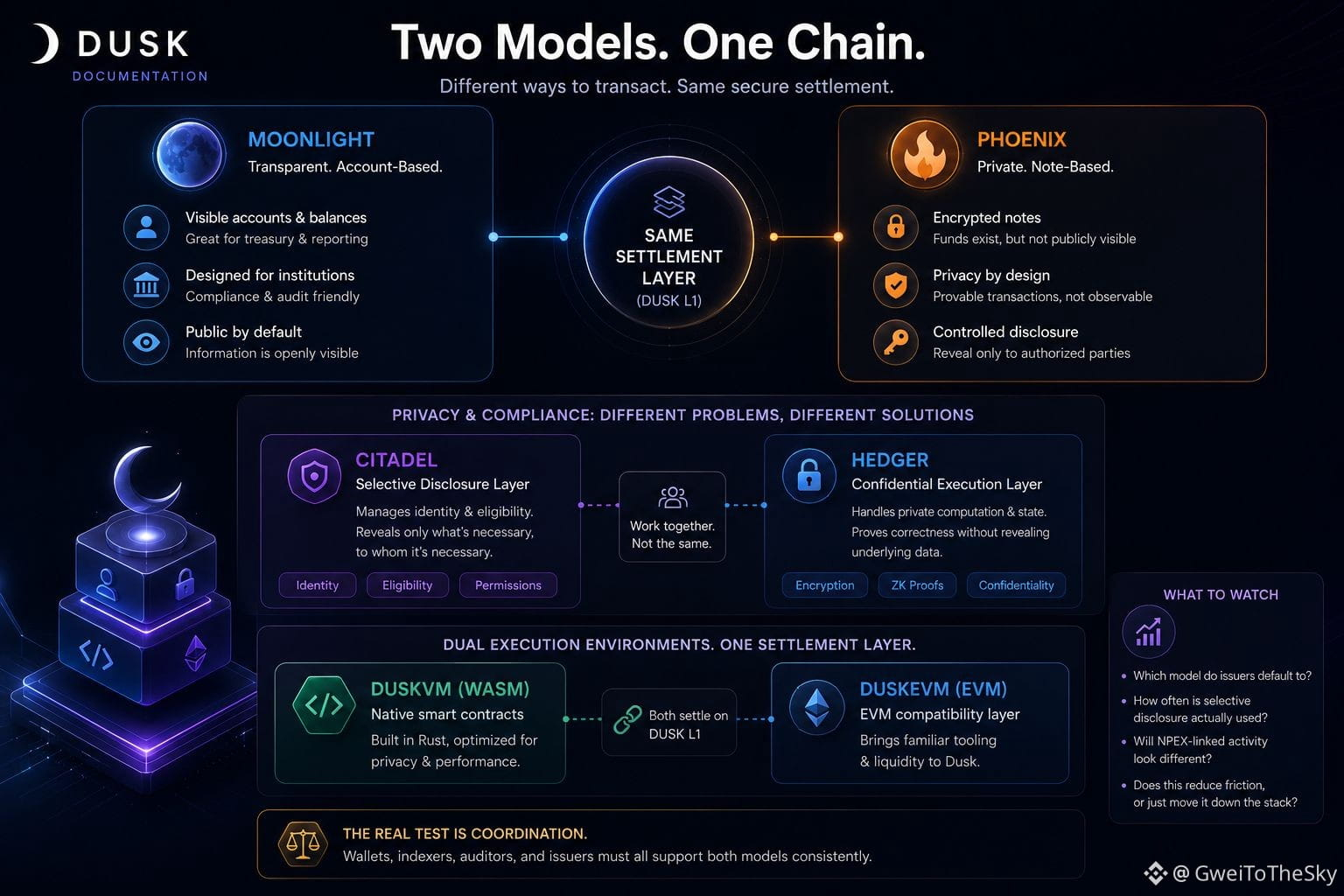
Dusk's docs rather than a chart, I assumed Moonlight and Phoenix were just two wallet options, transparent versus private, pick your preference. That framing didn't survive closer reading.
What changed my view was noticing these aren't interchangeable modes but separate transaction models settling on the same chain. Moonlight behaves like a visible account ledger, useful for treasury and reporting. Phoenix keeps funds as encrypted notes, provable but not observable. Same settlement layer, two different information surfaces.
That distinction matters because privacy and compliance get treated as opposites in most crypto discourse. Here they're separated by design: Citadel handles selective disclosure of identity attributes, Hedger handles confidential execution on the EVM side. Proving eligibility and hiding a position turn out to be different problems solved differently.
What I can't resolve yet is coordination cost. Running dual transaction models and dual execution environments (native WASM plus EVM) means more surface area for wallets, indexers, and auditors to support consistently. Elegant on paper doesn't guarantee uniform tooling in practice.
Going forward I'd rather watch which model actual issuers default to, how often selective disclosure gets invoked versus just discussed, and whether NPEX-linked activity behaves differently from ordinary transfers.
Still unclear to me whether this architecture reduces friction or just relocates it further down the stack.
@Dusk_Foundation #Dusk
$DUSK
{future}(DUSKUSDT)
$MORPHO
{future}(MORPHOUSDT)
$TRUMP
{future}(TRUMPUSDT)
Dusk's docs rather than a chart, I assumed Moonlight and Phoenix were just two wallet options, transparent versus private, pick your preference. That framing didn't survive closer reading.
What changed my view was noticing these aren't interchangeable modes but separate transaction models settling on the same chain. Moonlight behaves like a visible account ledger, useful for treasury and reporting. Phoenix keeps funds as encrypted notes, provable but not observable. Same settlement layer, two different information surfaces.
That distinction matters because privacy and compliance get treated as opposites in most crypto discourse. Here they're separated by design: Citadel handles selective disclosure of identity attributes, Hedger handles confidential execution on the EVM side. Proving eligibility and hiding a position turn out to be different problems solved differently.
What I can't resolve yet is coordination cost. Running dual transaction models and dual execution environments (native WASM plus EVM) means more surface area for wallets, indexers, and auditors to support consistently. Elegant on paper doesn't guarantee uniform tooling in practice.
Going forward I'd rather watch which model actual issuers default to, how often selective disclosure gets invoked versus just discussed, and whether NPEX-linked activity behaves differently from ordinary transfers.
Still unclear to me whether this architecture reduces friction or just relocates it further down the stack.
@Dusk #Dusk
$DUSK
$MORPHO
$TRUMP
What changed my view was noticing these aren't interchangeable modes but separate transaction models settling on the same chain. Moonlight behaves like a visible account ledger, useful for treasury and reporting. Phoenix keeps funds as encrypted notes, provable but not observable. Same settlement layer, two different information surfaces.
That distinction matters because privacy and compliance get treated as opposites in most crypto discourse. Here they're separated by design: Citadel handles selective disclosure of identity attributes, Hedger handles confidential execution on the EVM side. Proving eligibility and hiding a position turn out to be different problems solved differently.
What I can't resolve yet is coordination cost. Running dual transaction models and dual execution environments (native WASM plus EVM) means more surface area for wallets, indexers, and auditors to support consistently. Elegant on paper doesn't guarantee uniform tooling in practice.
Going forward I'd rather watch which model actual issuers default to, how often selective disclosure gets invoked versus just discussed, and whether NPEX-linked activity behaves differently from ordinary transfers.
Still unclear to me whether this architecture reduces friction or just relocates it further down the stack.
@Dusk #Dusk
$DUSK
$MORPHO
$TRUMP
5
7
290
·
--
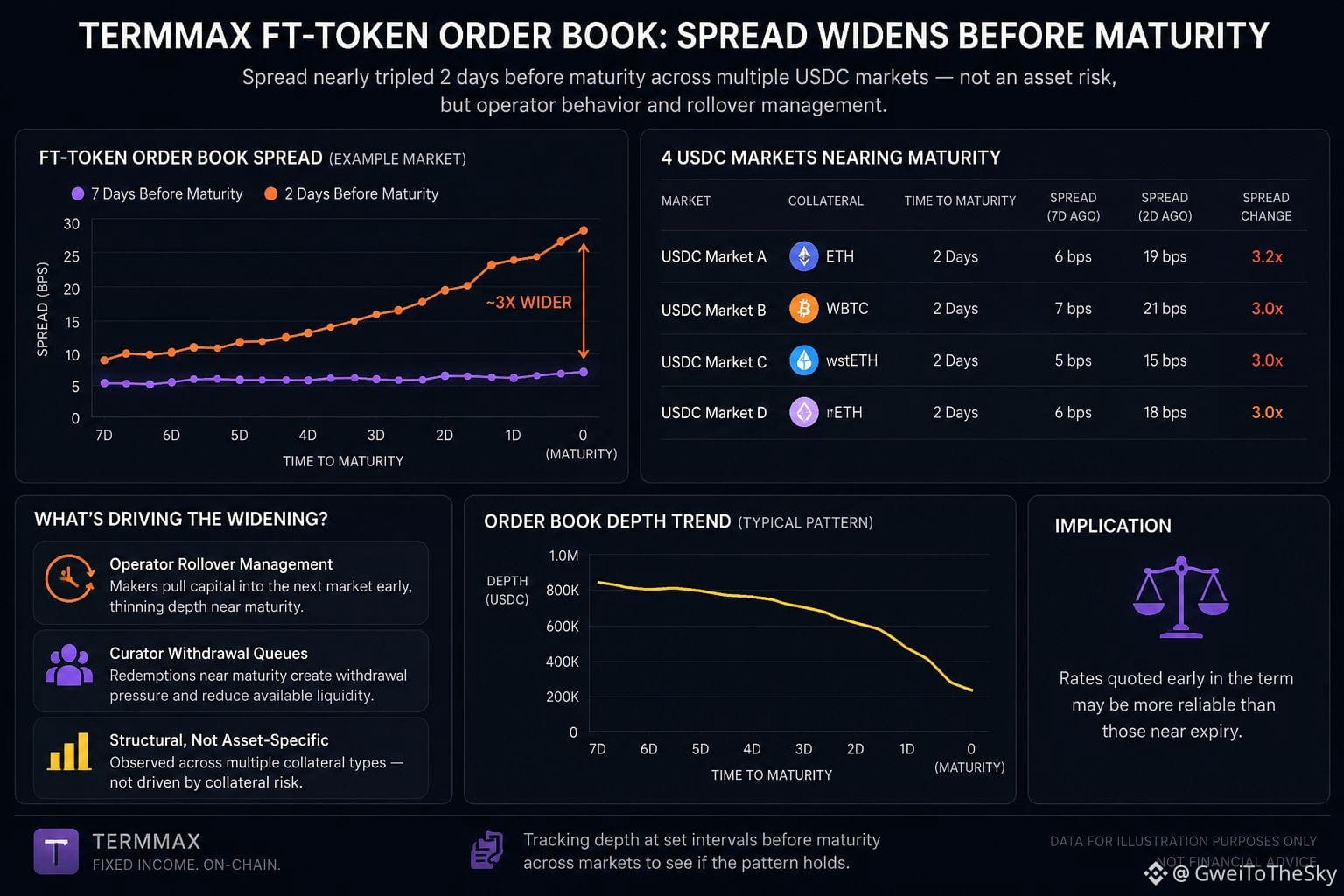
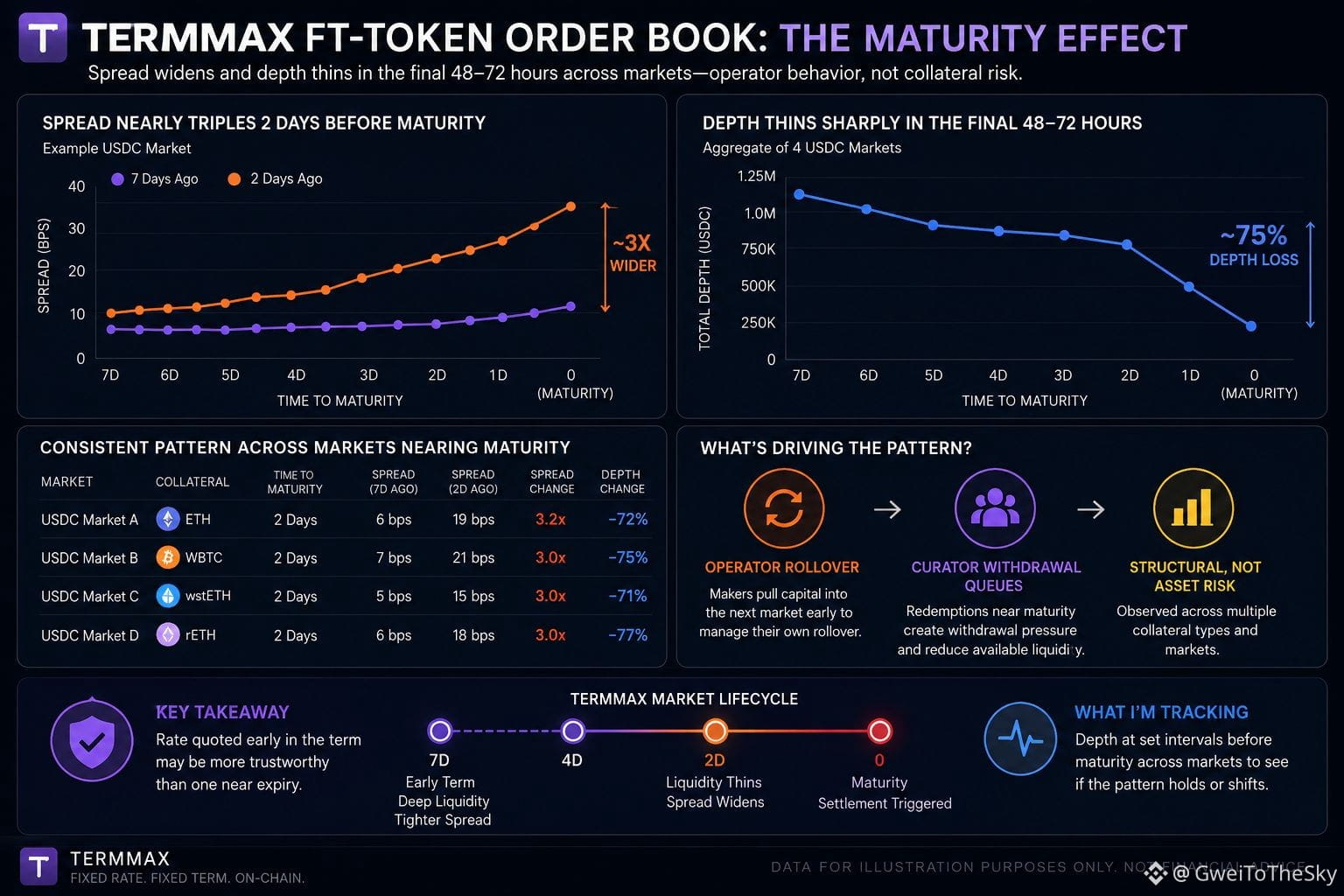
TermMax's ft-token order book two days before a market's maturity, I noticed the spread had widened almost threefold from a week earlier. At first I assumed collateral risk was being priced in.
I pulled three other USDC markets nearing maturity and found the same pattern: depth thinning sharply in the final 48-72 hours, regardless of collateral type. That ruled out an asset-specific scare.
What I hadn't considered was operator behavior. Makers quoting fixed rates aren't only pricing credit risk, they manage their own rollover. Near maturity they pull capital into the next market early, thinning the book rather than reflecting collateral confidence.
I can't tell yet if this is coordinated maker behavior or parallel self-interest, or curator withdrawal queues processing redemptions near maturity, making it structural.
I'm tracking depth at set intervals before maturity across markets now, to see if the drop-off stays consistent or shifts.
If the pattern holds, the rate quoted early in a term may be more trustworthy than one near expiry. Anyone noticed this?
@termmax #termmax
$GALA
{future}(GALAUSDT)
$BLESS
{future}(BLESSUSDT)
$GPS
{future}(GPSUSDT)
TermMax's ft-token order book two days before a market's maturity, I noticed the spread had widened almost threefold from a week earlier. At first I assumed collateral risk was being priced in.
I pulled three other USDC markets nearing maturity and found the same pattern: depth thinning sharply in the final 48-72 hours, regardless of collateral type. That ruled out an asset-specific scare.
What I hadn't considered was operator behavior. Makers quoting fixed rates aren't only pricing credit risk, they manage their own rollover. Near maturity they pull capital into the next market early, thinning the book rather than reflecting collateral confidence.
I can't tell yet if this is coordinated maker behavior or parallel self-interest, or curator withdrawal queues processing redemptions near maturity, making it structural.
I'm tracking depth at set intervals before maturity across markets now, to see if the drop-off stays consistent or shifts.
If the pattern holds, the rate quoted early in a term may be more trustworthy than one near expiry. Anyone noticed this?
@TermMax #termmax
$GALA
$BLESS
$GPS
I pulled three other USDC markets nearing maturity and found the same pattern: depth thinning sharply in the final 48-72 hours, regardless of collateral type. That ruled out an asset-specific scare.
What I hadn't considered was operator behavior. Makers quoting fixed rates aren't only pricing credit risk, they manage their own rollover. Near maturity they pull capital into the next market early, thinning the book rather than reflecting collateral confidence.
I can't tell yet if this is coordinated maker behavior or parallel self-interest, or curator withdrawal queues processing redemptions near maturity, making it structural.
I'm tracking depth at set intervals before maturity across markets now, to see if the drop-off stays consistent or shifts.
If the pattern holds, the rate quoted early in a term may be more trustworthy than one near expiry. Anyone noticed this?
@TermMax #termmax
$GALA
$BLESS
$GPS
4
285
·
--
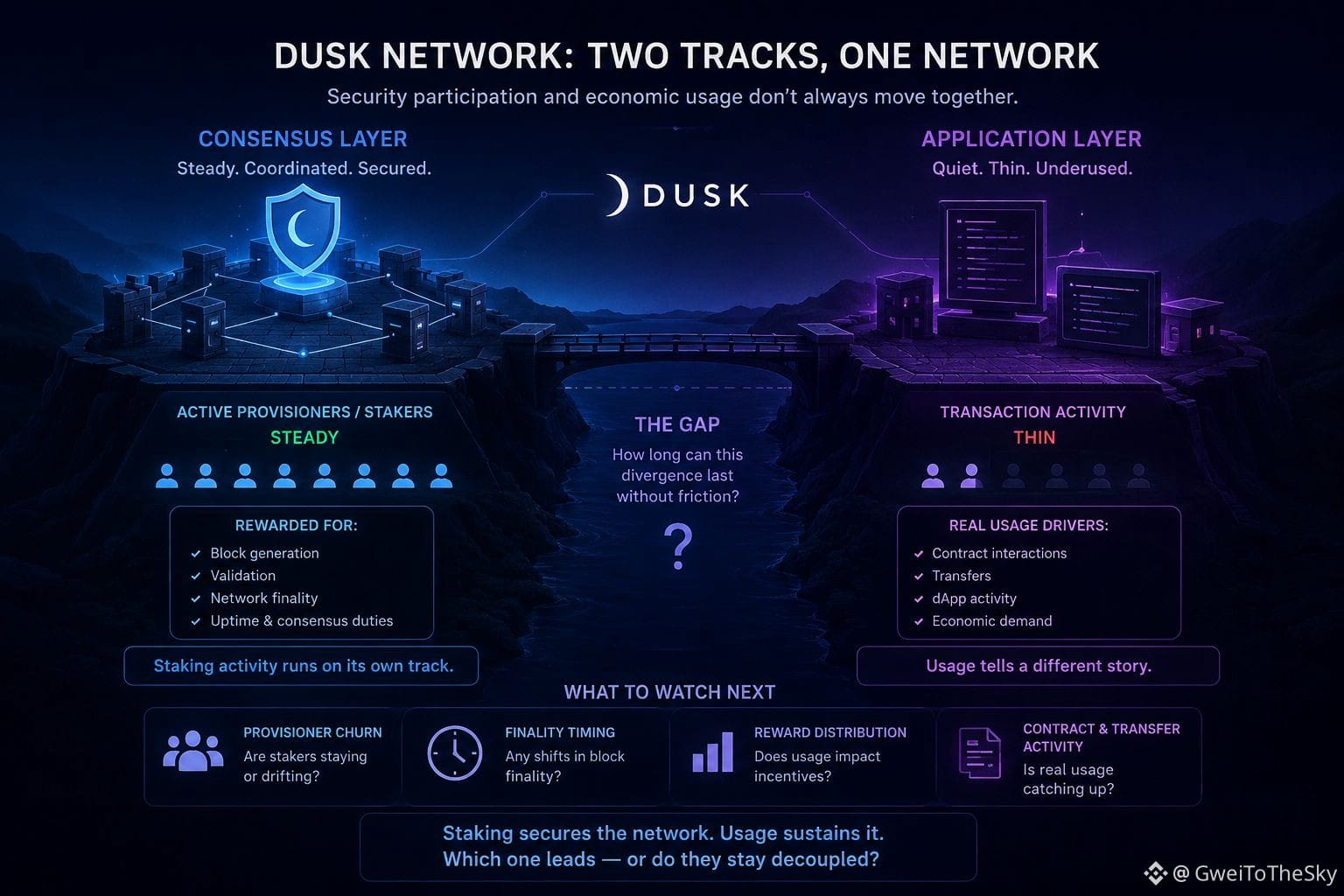
While checking Dusk's explorer last week Active provisioners staking on the network looked steady, almost healthy, but the transaction count underneath stayed thin. I assumed this meant stake was mostly idle, parked for yield with little real engagement behind it.
Digging further, I found the mismatch comes from how Dusk separates consensus participation from transaction execution. Provisioners get rewarded for their role in block generation and validation through the network's segregated agreement process, a duty that continues whether or not users are transacting. Staking activity and network usage seem to run on nearly independent tracks.
That changed how I was reading the data. I had been treating security participation and economic usage as one signal, when they clearly aren't. A network can look secured and coordinated at the consensus layer while staying quiet at the application layer, and neither number says much about the other alone.
What I can't resolve yet is how long that gap holds without friction. If provisioners are compensated mainly for uptime and consensus duties, does usage eventually need to catch up for incentives to stay balanced, or can validator participation hold steady indefinitely on its own terms.
Going forward I want to watch provisioner churn alongside actual contract and transfer activity, not staking totals alone. Retention among smaller stakers, shifts in finality timing, and any change in reward distribution as usage moves would tell me more than headline stake figures.
I'm still not sure which side leads the other here, whether usage eventually pulls staking behavior with it or the two genuinely stay decoupled. That's the part I keep sitting with.
@Dusk_Foundation #Dusk
$DUSK
{future}(DUSKUSDT)
$ZEC
{future}(ZECUSDT)
$ENA
{future}(ENAUSDT)
While checking Dusk's explorer last week Active provisioners staking on the network looked steady, almost healthy, but the transaction count underneath stayed thin. I assumed this meant stake was mostly idle, parked for yield with little real engagement behind it.
Digging further, I found the mismatch comes from how Dusk separates consensus participation from transaction execution. Provisioners get rewarded for their role in block generation and validation through the network's segregated agreement process, a duty that continues whether or not users are transacting. Staking activity and network usage seem to run on nearly independent tracks.
That changed how I was reading the data. I had been treating security participation and economic usage as one signal, when they clearly aren't. A network can look secured and coordinated at the consensus layer while staying quiet at the application layer, and neither number says much about the other alone.
What I can't resolve yet is how long that gap holds without friction. If provisioners are compensated mainly for uptime and consensus duties, does usage eventually need to catch up for incentives to stay balanced, or can validator participation hold steady indefinitely on its own terms.
Going forward I want to watch provisioner churn alongside actual contract and transfer activity, not staking totals alone. Retention among smaller stakers, shifts in finality timing, and any change in reward distribution as usage moves would tell me more than headline stake figures.
I'm still not sure which side leads the other here, whether usage eventually pulls staking behavior with it or the two genuinely stay decoupled. That's the part I keep sitting with.
@Dusk #Dusk
$DUSK
$ZEC
$ENA
Digging further, I found the mismatch comes from how Dusk separates consensus participation from transaction execution. Provisioners get rewarded for their role in block generation and validation through the network's segregated agreement process, a duty that continues whether or not users are transacting. Staking activity and network usage seem to run on nearly independent tracks.
That changed how I was reading the data. I had been treating security participation and economic usage as one signal, when they clearly aren't. A network can look secured and coordinated at the consensus layer while staying quiet at the application layer, and neither number says much about the other alone.
What I can't resolve yet is how long that gap holds without friction. If provisioners are compensated mainly for uptime and consensus duties, does usage eventually need to catch up for incentives to stay balanced, or can validator participation hold steady indefinitely on its own terms.
Going forward I want to watch provisioner churn alongside actual contract and transfer activity, not staking totals alone. Retention among smaller stakers, shifts in finality timing, and any change in reward distribution as usage moves would tell me more than headline stake figures.
I'm still not sure which side leads the other here, whether usage eventually pulls staking behavior with it or the two genuinely stay decoupled. That's the part I keep sitting with.
@Dusk #Dusk
$DUSK
$ZEC
$ENA
2
5
482
·
--
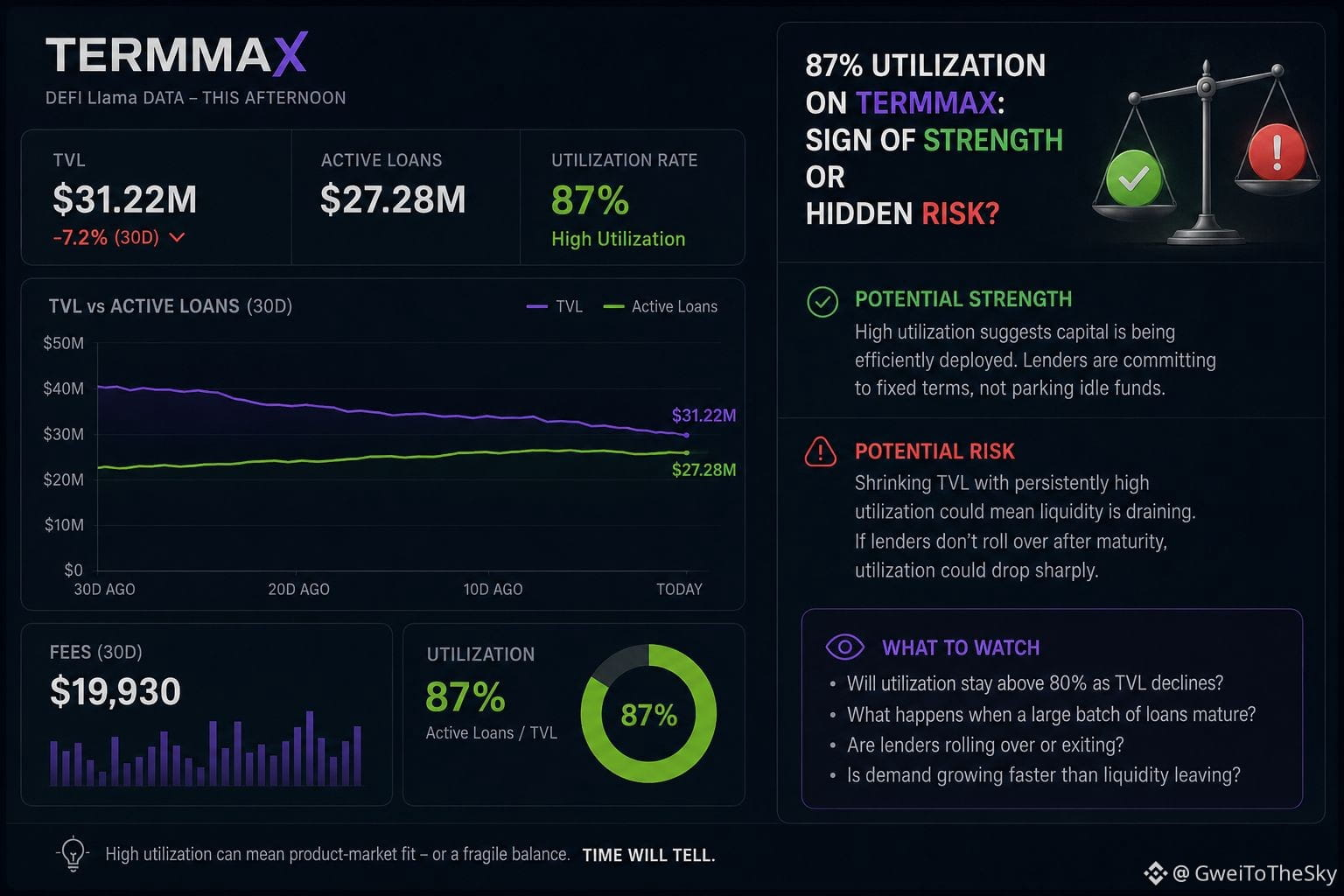
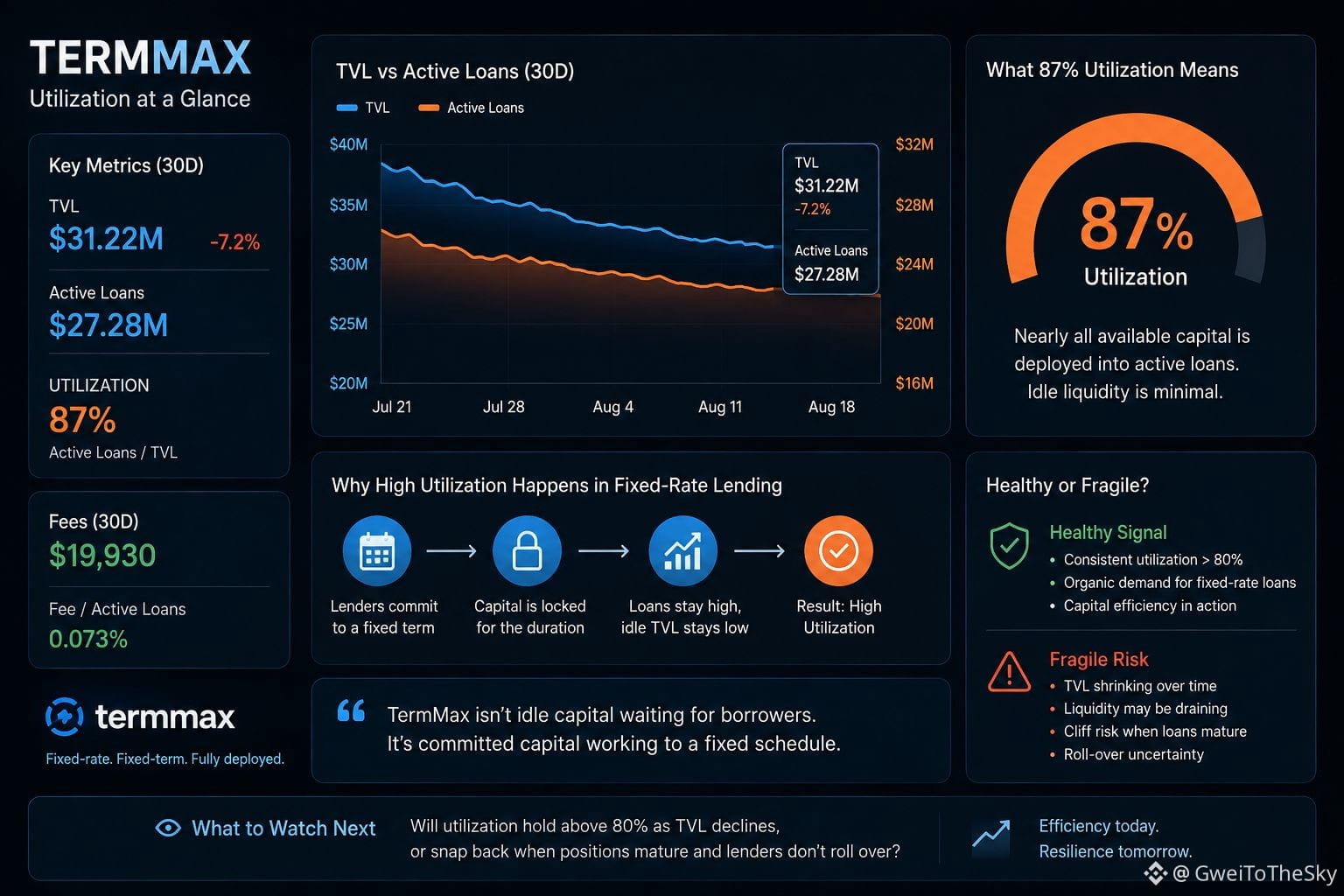
TermMax's numbers off DefiLlama this afternoon: TVL sits at $31.22M, down 7.2% over 30 days, but active loans are $27.28M. That's roughly 87% utilization. At first I assumed I'd misread the chart.
I went back and cross-checked against fees. Only $19,930 in fees over 30 days on nearly $27M borrowed. For a fixed-rate, maturity-based lending market, that ratio felt thin next to how tightly the collateral pool is being used.
Then it reframed for me. TermMax isn't a pool sitting idle waiting for borrowers, it's closer to fully deployed capital at any given moment. Fixed maturities mean lenders aren't parking funds hoping for yield, they're committing to a specific term, so idle TVL naturally shrinks while loans stay proportionally large.
I'm not fully certain this is healthy versus fragile. High utilization on a shrinking TVL base could mean efficient capital, or it could mean liquidity is quietly draining while existing positions just haven't matured yet.
I'm watching whether utilization holds above 80% as TVL keeps declining, or whether it snaps back once positions mature and lenders don't roll over.
Is 87% utilization on TermMax a sign of genuine product-market fit for fixed-rate lending, or a symptom of a shrinking pool that hasn't been stress-tested yet?
@termmax #termmax
$ONG
{future}(ONGUSDT)
$BOME
{future}(BOMEUSDT)
$ACE
{future}(ACEUSDT)
TermMax's numbers off DefiLlama this afternoon: TVL sits at $31.22M, down 7.2% over 30 days, but active loans are $27.28M. That's roughly 87% utilization. At first I assumed I'd misread the chart.
I went back and cross-checked against fees. Only $19,930 in fees over 30 days on nearly $27M borrowed. For a fixed-rate, maturity-based lending market, that ratio felt thin next to how tightly the collateral pool is being used.
Then it reframed for me. TermMax isn't a pool sitting idle waiting for borrowers, it's closer to fully deployed capital at any given moment. Fixed maturities mean lenders aren't parking funds hoping for yield, they're committing to a specific term, so idle TVL naturally shrinks while loans stay proportionally large.
I'm not fully certain this is healthy versus fragile. High utilization on a shrinking TVL base could mean efficient capital, or it could mean liquidity is quietly draining while existing positions just haven't matured yet.
I'm watching whether utilization holds above 80% as TVL keeps declining, or whether it snaps back once positions mature and lenders don't roll over.
Is 87% utilization on TermMax a sign of genuine product-market fit for fixed-rate lending, or a symptom of a shrinking pool that hasn't been stress-tested yet?
@TermMax #termmax
$ONG
$BOME
$ACE
I went back and cross-checked against fees. Only $19,930 in fees over 30 days on nearly $27M borrowed. For a fixed-rate, maturity-based lending market, that ratio felt thin next to how tightly the collateral pool is being used.
Then it reframed for me. TermMax isn't a pool sitting idle waiting for borrowers, it's closer to fully deployed capital at any given moment. Fixed maturities mean lenders aren't parking funds hoping for yield, they're committing to a specific term, so idle TVL naturally shrinks while loans stay proportionally large.
I'm not fully certain this is healthy versus fragile. High utilization on a shrinking TVL base could mean efficient capital, or it could mean liquidity is quietly draining while existing positions just haven't matured yet.
I'm watching whether utilization holds above 80% as TVL keeps declining, or whether it snaps back once positions mature and lenders don't roll over.
Is 87% utilization on TermMax a sign of genuine product-market fit for fixed-rate lending, or a symptom of a shrinking pool that hasn't been stress-tested yet?
@TermMax #termmax
$ONG
$BOME
$ACE
6
100
·
--
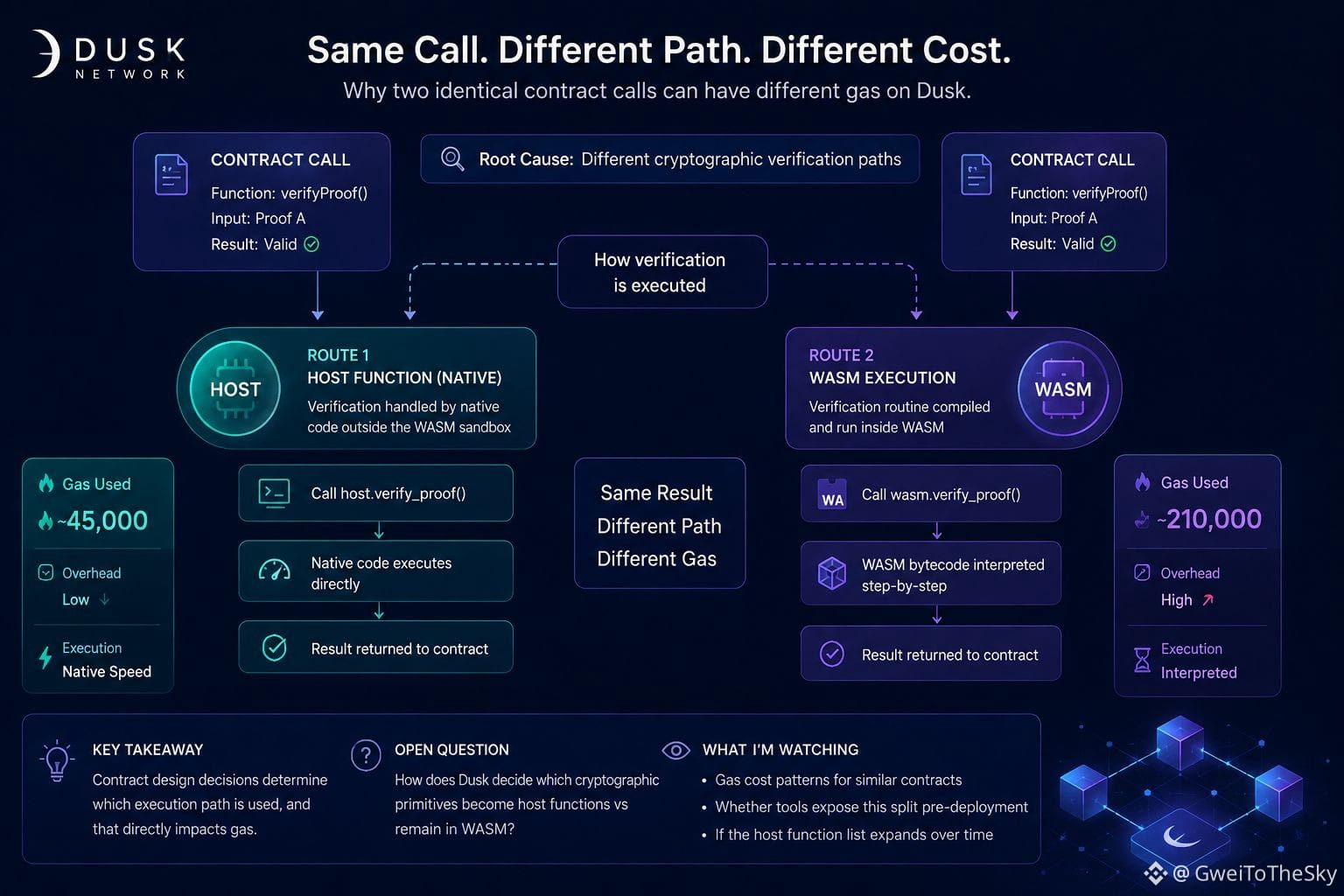
Dusk's explorer late one evening two contract calls that looked functionally identical on the surface were settling with noticeably different gas footprints. My first assumption was that one simply had more complex logic written into it. That turned out to be wrong.
Digging further, I found the difference came down to how each contract handled its cryptographic verification step. One route triggered a host function native code the runtime executes directly outside the WASM sandbox while the other ran a verification routine compiled into WASM itself. Dusk reserves host functions for specific operations like hashing and proof verification, and the gas gap was really a visibility gap into that split.
This reframed something I'd been treating as one category: "on-chain computation." I'd been lumping sandboxed execution and native execution together as if cost and behavior scaled the same way for both. They don't. Native calls sidestep the overhead of WASM interpretation, which means contract design choices upstream quietly determine which execution path a transaction takes downstream.
What's unclear to me is how Dusk decides which future cryptographic primitives graduate into host-function status versus staying inside WASM. Is there a defined performance threshold, or is it evaluated case by case as new verification schemes get added? That ambiguity matters more as the primitive list grows.
Going forward I'm watching how consistently gas costs cluster for logically similar contracts, and whether developer tooling starts surfacing this execution split before deployment rather than after. Recurring patterns there would tell me whether this is a stable design edge or something contract authors have to learn the hard way.
I still don't know if this split is meant to stay narrow by design or expand as the protocol matures and I'm not sure which outcome would actually be healthier for builders on the network.
@Dusk_Foundation #Dusk
$ACE
{future}(ACEUSDT)
$DUSK
{future}(DUSKUSDT)
$BOME
{future}(BOMEUSDT)
Dusk's explorer late one evening two contract calls that looked functionally identical on the surface were settling with noticeably different gas footprints. My first assumption was that one simply had more complex logic written into it. That turned out to be wrong.
Digging further, I found the difference came down to how each contract handled its cryptographic verification step. One route triggered a host function native code the runtime executes directly outside the WASM sandbox while the other ran a verification routine compiled into WASM itself. Dusk reserves host functions for specific operations like hashing and proof verification, and the gas gap was really a visibility gap into that split.
This reframed something I'd been treating as one category: "on-chain computation." I'd been lumping sandboxed execution and native execution together as if cost and behavior scaled the same way for both. They don't. Native calls sidestep the overhead of WASM interpretation, which means contract design choices upstream quietly determine which execution path a transaction takes downstream.
What's unclear to me is how Dusk decides which future cryptographic primitives graduate into host-function status versus staying inside WASM. Is there a defined performance threshold, or is it evaluated case by case as new verification schemes get added? That ambiguity matters more as the primitive list grows.
Going forward I'm watching how consistently gas costs cluster for logically similar contracts, and whether developer tooling starts surfacing this execution split before deployment rather than after. Recurring patterns there would tell me whether this is a stable design edge or something contract authors have to learn the hard way.
I still don't know if this split is meant to stay narrow by design or expand as the protocol matures and I'm not sure which outcome would actually be healthier for builders on the network.
@Dusk #Dusk
$ACE
$DUSK
$BOME
Digging further, I found the difference came down to how each contract handled its cryptographic verification step. One route triggered a host function native code the runtime executes directly outside the WASM sandbox while the other ran a verification routine compiled into WASM itself. Dusk reserves host functions for specific operations like hashing and proof verification, and the gas gap was really a visibility gap into that split.
This reframed something I'd been treating as one category: "on-chain computation." I'd been lumping sandboxed execution and native execution together as if cost and behavior scaled the same way for both. They don't. Native calls sidestep the overhead of WASM interpretation, which means contract design choices upstream quietly determine which execution path a transaction takes downstream.
What's unclear to me is how Dusk decides which future cryptographic primitives graduate into host-function status versus staying inside WASM. Is there a defined performance threshold, or is it evaluated case by case as new verification schemes get added? That ambiguity matters more as the primitive list grows.
Going forward I'm watching how consistently gas costs cluster for logically similar contracts, and whether developer tooling starts surfacing this execution split before deployment rather than after. Recurring patterns there would tell me whether this is a stable design edge or something contract authors have to learn the hard way.
I still don't know if this split is meant to stay narrow by design or expand as the protocol matures and I'm not sure which outcome would actually be healthier for builders on the network.
@Dusk #Dusk
$ACE
$DUSK
$BOME
1
5
344
·
--
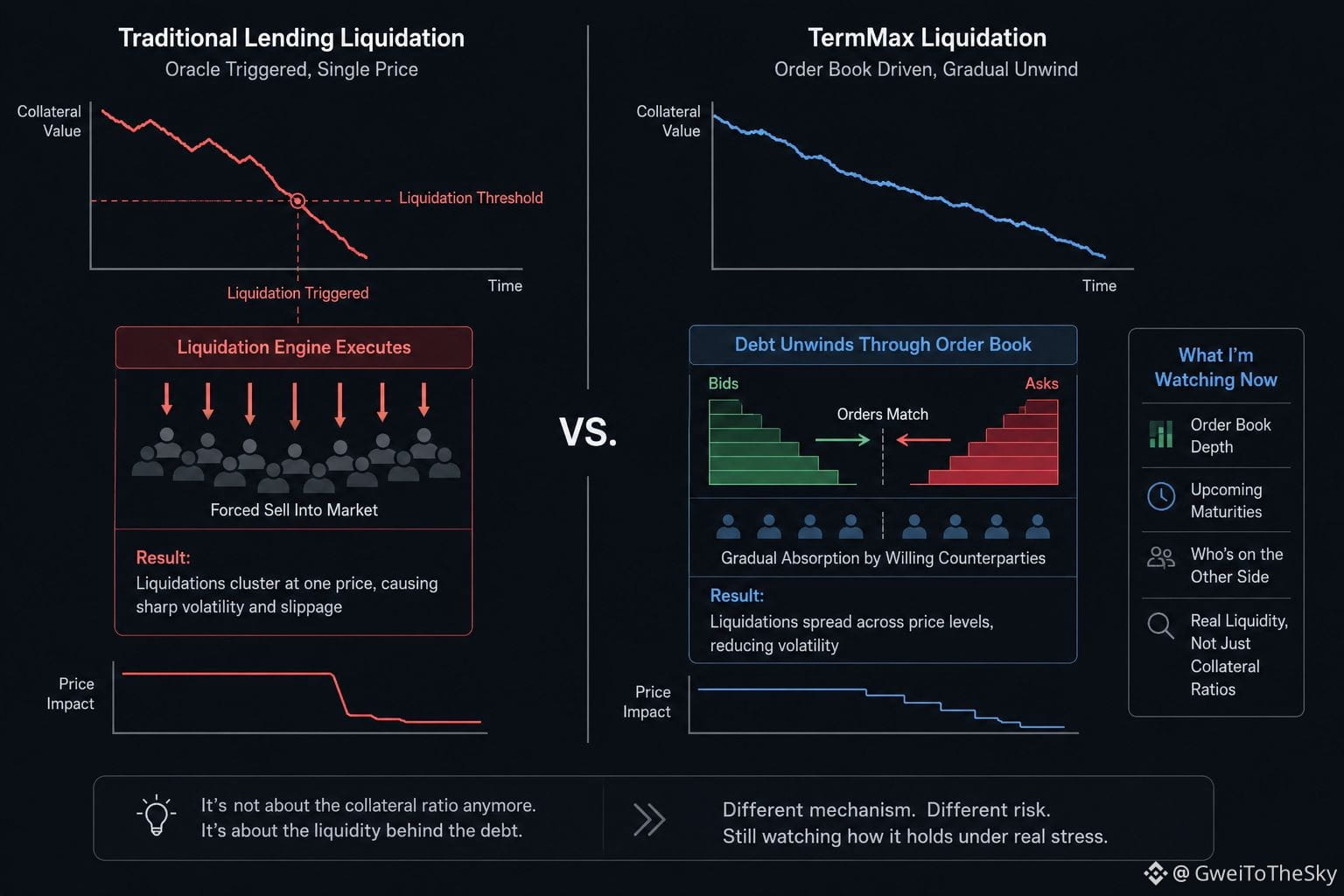
While checking a batch of TermMax positions after a rate spike, I noticed something that didn't match my expectations: liquidations weren't clustering the way they usually do on lending markets I've watched before.
I assumed a fast collateral drop would trigger the usual wave of oracle-driven forced sells hitting one price at once. So I went back through the order flow around those positions to see what actually executed.
What I found was different. Because TermMax prices debt through its own order book of fixed-maturity tokens rather than pushing everything through a single oracle trigger, unwinds got absorbed gradually as orders matched against existing bids instead of slamming into one liquidation price. The debt itself behaves like a tradable instrument with its own depth, not just a threshold to cross.
That reframed how I think about risk here. It's not that volatility disappears, it's that the mechanism spreads execution across willing counterparties instead of one liquidation engine, which changes how fast stress actually shows up in price.
I'm still not sure this holds under real stress. Thin order books near less popular maturities could behave very differently, and I haven't seen this system tested in a genuinely chaotic market yet.
So I'm watching order book depth around upcoming maturities more closely now, less interested in the collateral ratio itself and more in who's actually sitting on the other side of that order book when it matters.
@termmax #termmax
$RE
{future}(REUSDT)
$HEMI
{future}(HEMIUSDT)
$ETH
{future}(ETHUSDT)
While checking a batch of TermMax positions after a rate spike, I noticed something that didn't match my expectations: liquidations weren't clustering the way they usually do on lending markets I've watched before.
I assumed a fast collateral drop would trigger the usual wave of oracle-driven forced sells hitting one price at once. So I went back through the order flow around those positions to see what actually executed.
What I found was different. Because TermMax prices debt through its own order book of fixed-maturity tokens rather than pushing everything through a single oracle trigger, unwinds got absorbed gradually as orders matched against existing bids instead of slamming into one liquidation price. The debt itself behaves like a tradable instrument with its own depth, not just a threshold to cross.
That reframed how I think about risk here. It's not that volatility disappears, it's that the mechanism spreads execution across willing counterparties instead of one liquidation engine, which changes how fast stress actually shows up in price.
I'm still not sure this holds under real stress. Thin order books near less popular maturities could behave very differently, and I haven't seen this system tested in a genuinely chaotic market yet.
So I'm watching order book depth around upcoming maturities more closely now, less interested in the collateral ratio itself and more in who's actually sitting on the other side of that order book when it matters.
@TermMax #termmax
$RE
$HEMI
$ETH
I assumed a fast collateral drop would trigger the usual wave of oracle-driven forced sells hitting one price at once. So I went back through the order flow around those positions to see what actually executed.
What I found was different. Because TermMax prices debt through its own order book of fixed-maturity tokens rather than pushing everything through a single oracle trigger, unwinds got absorbed gradually as orders matched against existing bids instead of slamming into one liquidation price. The debt itself behaves like a tradable instrument with its own depth, not just a threshold to cross.
That reframed how I think about risk here. It's not that volatility disappears, it's that the mechanism spreads execution across willing counterparties instead of one liquidation engine, which changes how fast stress actually shows up in price.
I'm still not sure this holds under real stress. Thin order books near less popular maturities could behave very differently, and I haven't seen this system tested in a genuinely chaotic market yet.
So I'm watching order book depth around upcoming maturities more closely now, less interested in the collateral ratio itself and more in who's actually sitting on the other side of that order book when it matters.
@TermMax #termmax
$RE
$HEMI
$ETH
4
49
·
--
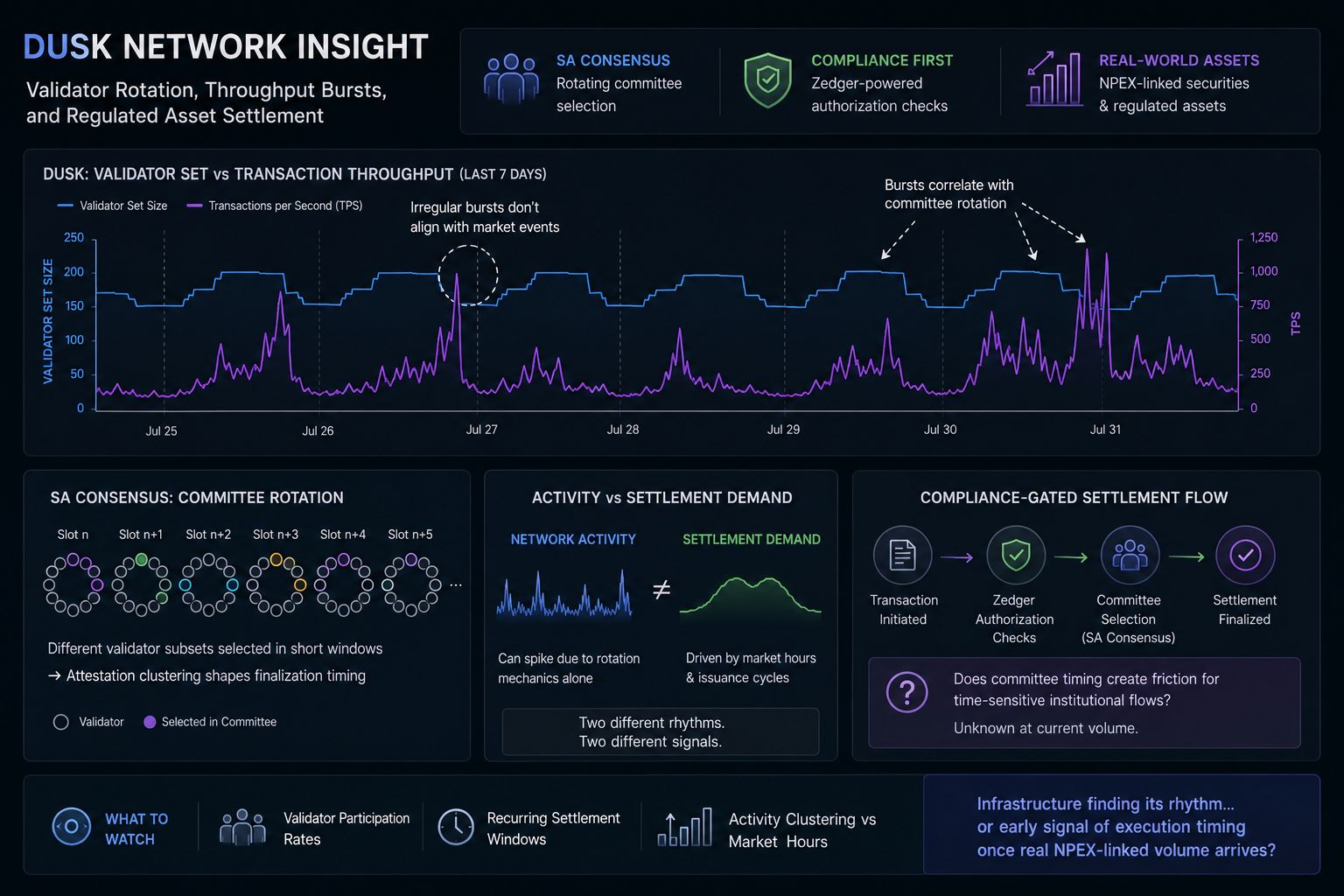
Dusk's validator set against its transaction throughput last week I'd assumed a network built for regulated assets would show steady, almost boring activity patterns. Instead I saw irregular bursts that didn't line up with any obvious market event.
Digging into it, I traced the bursts back to how Dusk's consensus rotates committee selection under SA Consensus. It wasn't random noise. The pattern followed something closer to attestation clustering, where certain validator subsets get selected more frequently within short windows, which shapes when settlement-heavy activity actually finalizes.
That distinction matters more than I initially gave it credit for. I'd been treating "network activity" and "settlement demand" as basically the same signal. They're not. Activity can spike from validator rotation mechanics alone, while actual settlement demand the kind tied to something like NPEX-originated assets moves on a completely different rhythm tied to market hours and issuance cycles.
What I can't resolve yet is how this rotation behavior interacts with compliance-gated transactions specifically. If Zedger-based securities require particular authorization checks before settling, does committee timing ever create friction for time-sensitive institutional flows, or is that friction negligible at current volume? I don't have enough data points to say either way.
Going forward I want to watch validator participation rates alongside any recurring settlement windows, not just raw transaction counts. If regulated asset activity starts clustering around specific committee rotations rather than market hours, that would tell me something about how much institutional flow is actually live versus still experimental.
I'm left wondering whether this rotation pattern is simply infrastructure finding its rhythm, or an early signal of how execution timing might behave once real volume from NPEX-linked assets starts flowing through. I don't think I can answer that yet.
@Dusk_Foundation #Dusk
$DUSK
{future}(DUSKUSDT)
$HEMI
{future}(HEMIUSDT)
$TREE
{future}(TREEUSDT)
Dusk's validator set against its transaction throughput last week I'd assumed a network built for regulated assets would show steady, almost boring activity patterns. Instead I saw irregular bursts that didn't line up with any obvious market event.
Digging into it, I traced the bursts back to how Dusk's consensus rotates committee selection under SA Consensus. It wasn't random noise. The pattern followed something closer to attestation clustering, where certain validator subsets get selected more frequently within short windows, which shapes when settlement-heavy activity actually finalizes.
That distinction matters more than I initially gave it credit for. I'd been treating "network activity" and "settlement demand" as basically the same signal. They're not. Activity can spike from validator rotation mechanics alone, while actual settlement demand the kind tied to something like NPEX-originated assets moves on a completely different rhythm tied to market hours and issuance cycles.
What I can't resolve yet is how this rotation behavior interacts with compliance-gated transactions specifically. If Zedger-based securities require particular authorization checks before settling, does committee timing ever create friction for time-sensitive institutional flows, or is that friction negligible at current volume? I don't have enough data points to say either way.
Going forward I want to watch validator participation rates alongside any recurring settlement windows, not just raw transaction counts. If regulated asset activity starts clustering around specific committee rotations rather than market hours, that would tell me something about how much institutional flow is actually live versus still experimental.
I'm left wondering whether this rotation pattern is simply infrastructure finding its rhythm, or an early signal of how execution timing might behave once real volume from NPEX-linked assets starts flowing through. I don't think I can answer that yet.
@Dusk #Dusk
$DUSK
$HEMI
$TREE
Digging into it, I traced the bursts back to how Dusk's consensus rotates committee selection under SA Consensus. It wasn't random noise. The pattern followed something closer to attestation clustering, where certain validator subsets get selected more frequently within short windows, which shapes when settlement-heavy activity actually finalizes.
That distinction matters more than I initially gave it credit for. I'd been treating "network activity" and "settlement demand" as basically the same signal. They're not. Activity can spike from validator rotation mechanics alone, while actual settlement demand the kind tied to something like NPEX-originated assets moves on a completely different rhythm tied to market hours and issuance cycles.
What I can't resolve yet is how this rotation behavior interacts with compliance-gated transactions specifically. If Zedger-based securities require particular authorization checks before settling, does committee timing ever create friction for time-sensitive institutional flows, or is that friction negligible at current volume? I don't have enough data points to say either way.
Going forward I want to watch validator participation rates alongside any recurring settlement windows, not just raw transaction counts. If regulated asset activity starts clustering around specific committee rotations rather than market hours, that would tell me something about how much institutional flow is actually live versus still experimental.
I'm left wondering whether this rotation pattern is simply infrastructure finding its rhythm, or an early signal of how execution timing might behave once real volume from NPEX-linked assets starts flowing through. I don't think I can answer that yet.
@Dusk #Dusk
$DUSK
$HEMI
$TREE
2
4
196
·
--
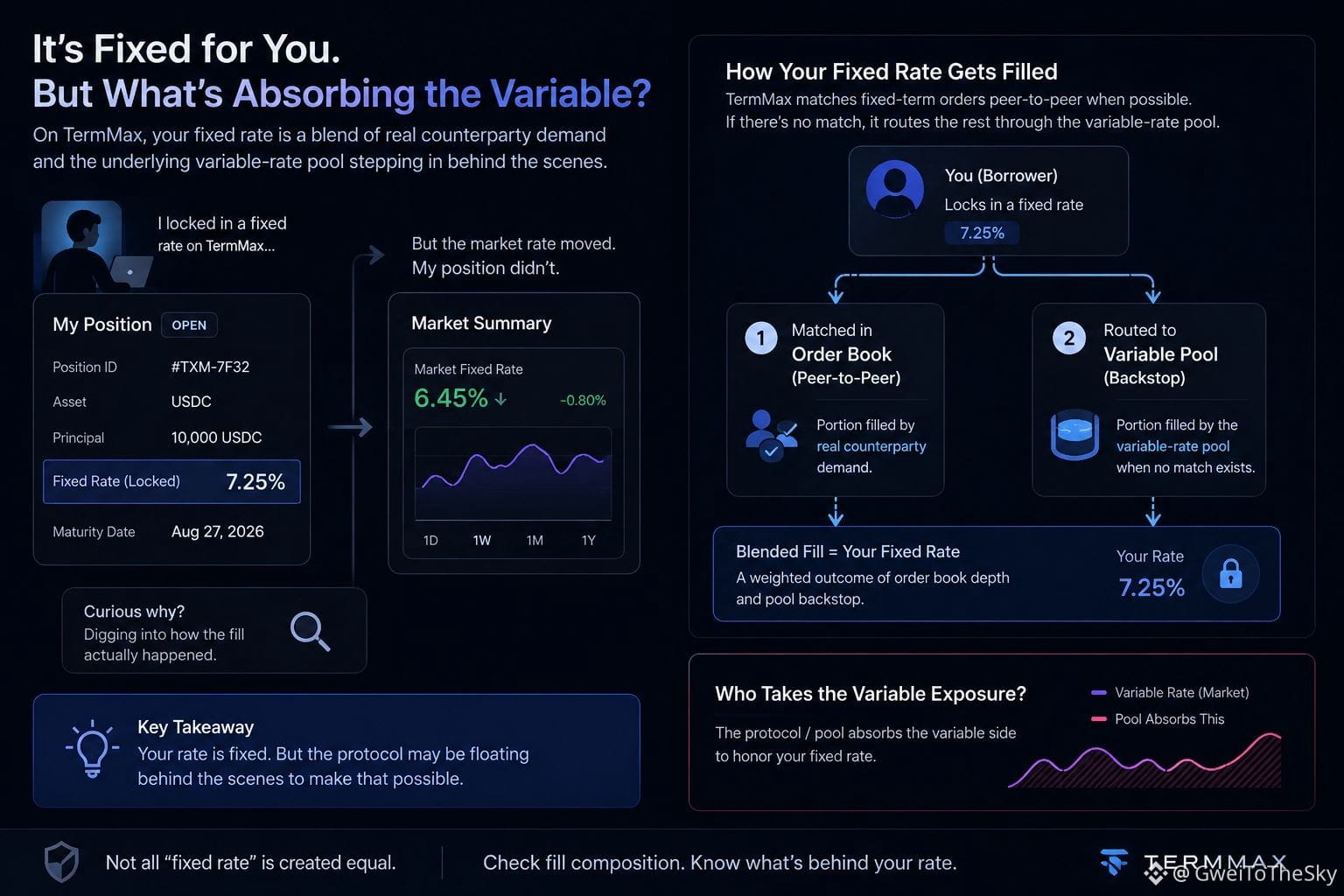
While checking my open position's maturity date on @termmax , The fixed rate I locked in didn't match the rate showing on the market's summary page anymore, even though nothing about my position had changed. At first I assumed it was just a display lag.
So I started digging into how the order book fills against the underlying pool. TermMax matches fixed-term orders peer-to-peer when possible, but when there's no direct counterparty, it routes through the variable-rate pool underneath to fill the gap. My position had been partially filled that way without me realizing it.
That reframed how I saw "fixed rate" here. It's fixed for me as the borrower, but the protocol is quietly absorbing variable-rate exposure on the other side to make that guarantee possible. The rate I see isn't just a number I picked, it's a blended outcome of order book depth at the moment I entered.
I'm not fully sure how thin that peer-to-peer layer gets during low-liquidity hours, or how much of the book is genuinely matched versus pool-routed on any given day. The docs mention the mechanism but don't expose a live ratio.
I've started checking fill composition before entering larger positions now, mainly to see how much of my rate is real counterparty demand versus pool backstop.
Makes me wonder how many fixed-rate protocols are fixed in name only, with the stability actually resting on whatever's absorbing the variable side underneath.
#TermMax
$CLO
{future}(CLOUSDT)
$VELVET
{future}(VELVETUSDT)
$EDEN
{future}(EDENUSDT)
While checking my open position's maturity date on @TermMax , The fixed rate I locked in didn't match the rate showing on the market's summary page anymore, even though nothing about my position had changed. At first I assumed it was just a display lag.
So I started digging into how the order book fills against the underlying pool. TermMax matches fixed-term orders peer-to-peer when possible, but when there's no direct counterparty, it routes through the variable-rate pool underneath to fill the gap. My position had been partially filled that way without me realizing it.
That reframed how I saw "fixed rate" here. It's fixed for me as the borrower, but the protocol is quietly absorbing variable-rate exposure on the other side to make that guarantee possible. The rate I see isn't just a number I picked, it's a blended outcome of order book depth at the moment I entered.
I'm not fully sure how thin that peer-to-peer layer gets during low-liquidity hours, or how much of the book is genuinely matched versus pool-routed on any given day. The docs mention the mechanism but don't expose a live ratio.
I've started checking fill composition before entering larger positions now, mainly to see how much of my rate is real counterparty demand versus pool backstop.
Makes me wonder how many fixed-rate protocols are fixed in name only, with the stability actually resting on whatever's absorbing the variable side underneath.
#TermMax
$CLO
$VELVET
$EDEN
So I started digging into how the order book fills against the underlying pool. TermMax matches fixed-term orders peer-to-peer when possible, but when there's no direct counterparty, it routes through the variable-rate pool underneath to fill the gap. My position had been partially filled that way without me realizing it.
That reframed how I saw "fixed rate" here. It's fixed for me as the borrower, but the protocol is quietly absorbing variable-rate exposure on the other side to make that guarantee possible. The rate I see isn't just a number I picked, it's a blended outcome of order book depth at the moment I entered.
I'm not fully sure how thin that peer-to-peer layer gets during low-liquidity hours, or how much of the book is genuinely matched versus pool-routed on any given day. The docs mention the mechanism but don't expose a live ratio.
I've started checking fill composition before entering larger positions now, mainly to see how much of my rate is real counterparty demand versus pool backstop.
Makes me wonder how many fixed-rate protocols are fixed in name only, with the stability actually resting on whatever's absorbing the variable side underneath.
#TermMax
$CLO
$VELVET
$EDEN
1
3
317
·
--
#dusk $DUSK @Dusk_Foundation
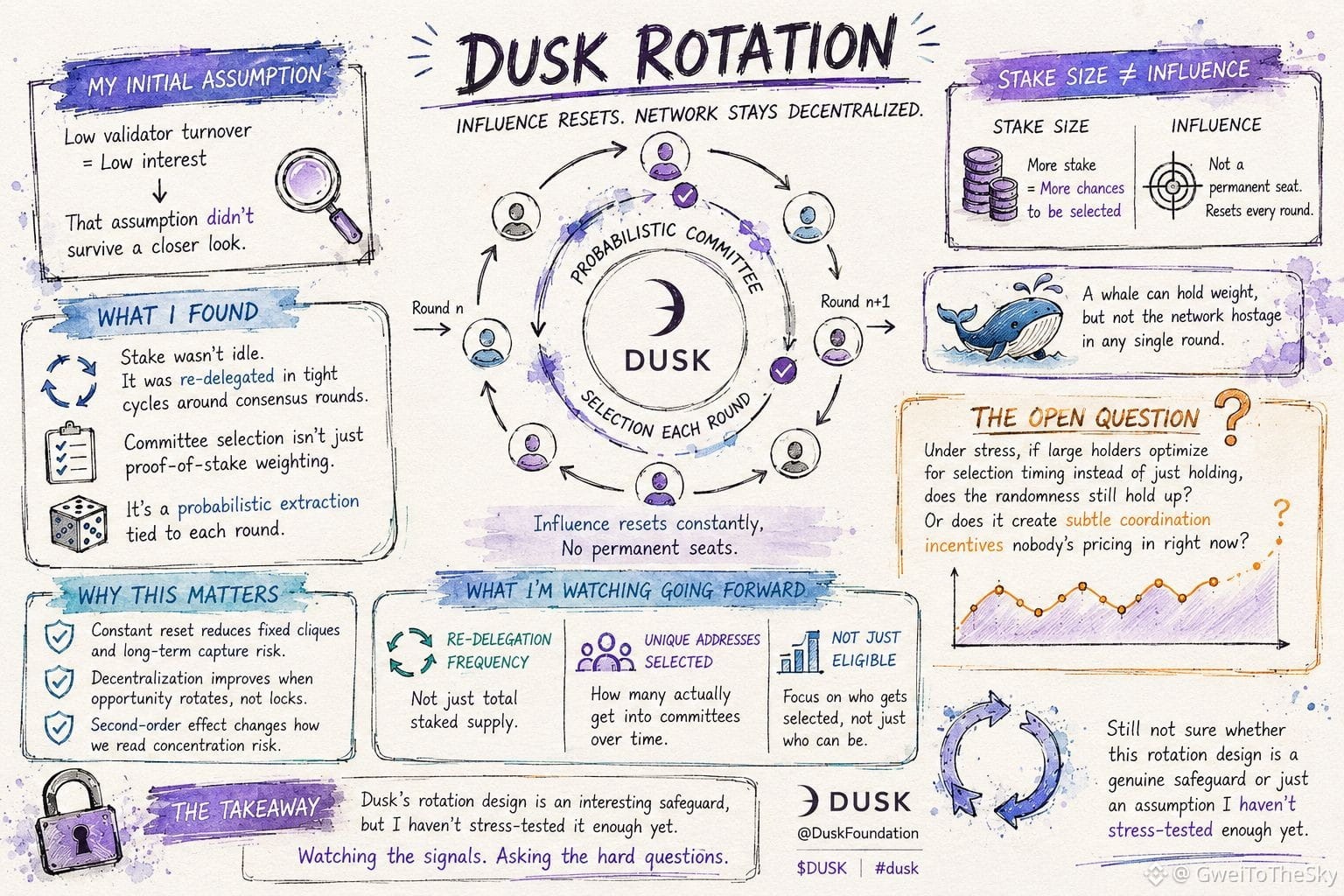
My husband write the topic to me and ask me this news is new good for the dusk holder Dusk's validator set size against its staking participation rate last week, and my first assumption was that low turnover meant low interest. That assumption didn't survive a closer look.
While checking the provisioner rotation logs, I found stake wasn't sitting idle, it was being re-delegated in tight cycles around consensus rounds rather than left static. That pointed me toward how Dusk's committee selection actually works: it isn't just proof of stake weighting, it's a probabilistic extraction tied to each round, so influence resets constantly instead of accumulating with a fixed validator clique.
That distinction matters more than it sounds. I'd been treating "stake size" and "consensus influence" as the same variable, but they're not. A large stake gives you more chances to be selected, not a permanent seat. That second-order effect changes how I read concentration risk here, a whale can hold weight without holding the network hostage in any single round.
What I can't resolve yet is how this behaves under stress. If large holders start optimizing for selection timing rather than just holding, does the randomness still hold up, or does it create subtle coordination incentives nobody's pricing in right now.
Going forward I'm watching re-delegation frequency, not just total staked supply, alongside how many unique addresses actually get selected into committees over time rather than just eligible to be.
I'm still not sure whether this rotation design is a genuine safeguard or just an assumption I haven't stress-tested enough yet.
$BTW $ACE
#dusk $DUSK @Dusk
My husband write the topic to me and ask me this news is new good for the dusk holder Dusk's validator set size against its staking participation rate last week, and my first assumption was that low turnover meant low interest. That assumption didn't survive a closer look.
While checking the provisioner rotation logs, I found stake wasn't sitting idle, it was being re-delegated in tight cycles around consensus rounds rather than left static. That pointed me toward how Dusk's committee selection actually works: it isn't just proof of stake weighting, it's a probabilistic extraction tied to each round, so influence resets constantly instead of accumulating with a fixed validator clique.
That distinction matters more than it sounds. I'd been treating "stake size" and "consensus influence" as the same variable, but they're not. A large stake gives you more chances to be selected, not a permanent seat. That second-order effect changes how I read concentration risk here, a whale can hold weight without holding the network hostage in any single round.
What I can't resolve yet is how this behaves under stress. If large holders start optimizing for selection timing rather than just holding, does the randomness still hold up, or does it create subtle coordination incentives nobody's pricing in right now.
Going forward I'm watching re-delegation frequency, not just total staked supply, alongside how many unique addresses actually get selected into committees over time rather than just eligible to be.
I'm still not sure whether this rotation design is a genuine safeguard or just an assumption I haven't stress-tested enough yet.
$BTW $ACE
My husband write the topic to me and ask me this news is new good for the dusk holder Dusk's validator set size against its staking participation rate last week, and my first assumption was that low turnover meant low interest. That assumption didn't survive a closer look.
While checking the provisioner rotation logs, I found stake wasn't sitting idle, it was being re-delegated in tight cycles around consensus rounds rather than left static. That pointed me toward how Dusk's committee selection actually works: it isn't just proof of stake weighting, it's a probabilistic extraction tied to each round, so influence resets constantly instead of accumulating with a fixed validator clique.
That distinction matters more than it sounds. I'd been treating "stake size" and "consensus influence" as the same variable, but they're not. A large stake gives you more chances to be selected, not a permanent seat. That second-order effect changes how I read concentration risk here, a whale can hold weight without holding the network hostage in any single round.
What I can't resolve yet is how this behaves under stress. If large holders start optimizing for selection timing rather than just holding, does the randomness still hold up, or does it create subtle coordination incentives nobody's pricing in right now.
Going forward I'm watching re-delegation frequency, not just total staked supply, alongside how many unique addresses actually get selected into committees over time rather than just eligible to be.
I'm still not sure whether this rotation design is a genuine safeguard or just an assumption I haven't stress-tested enough yet.
$BTW $ACE
2
2
134
·
--
#Dusk $HEMI $COW $DUSK
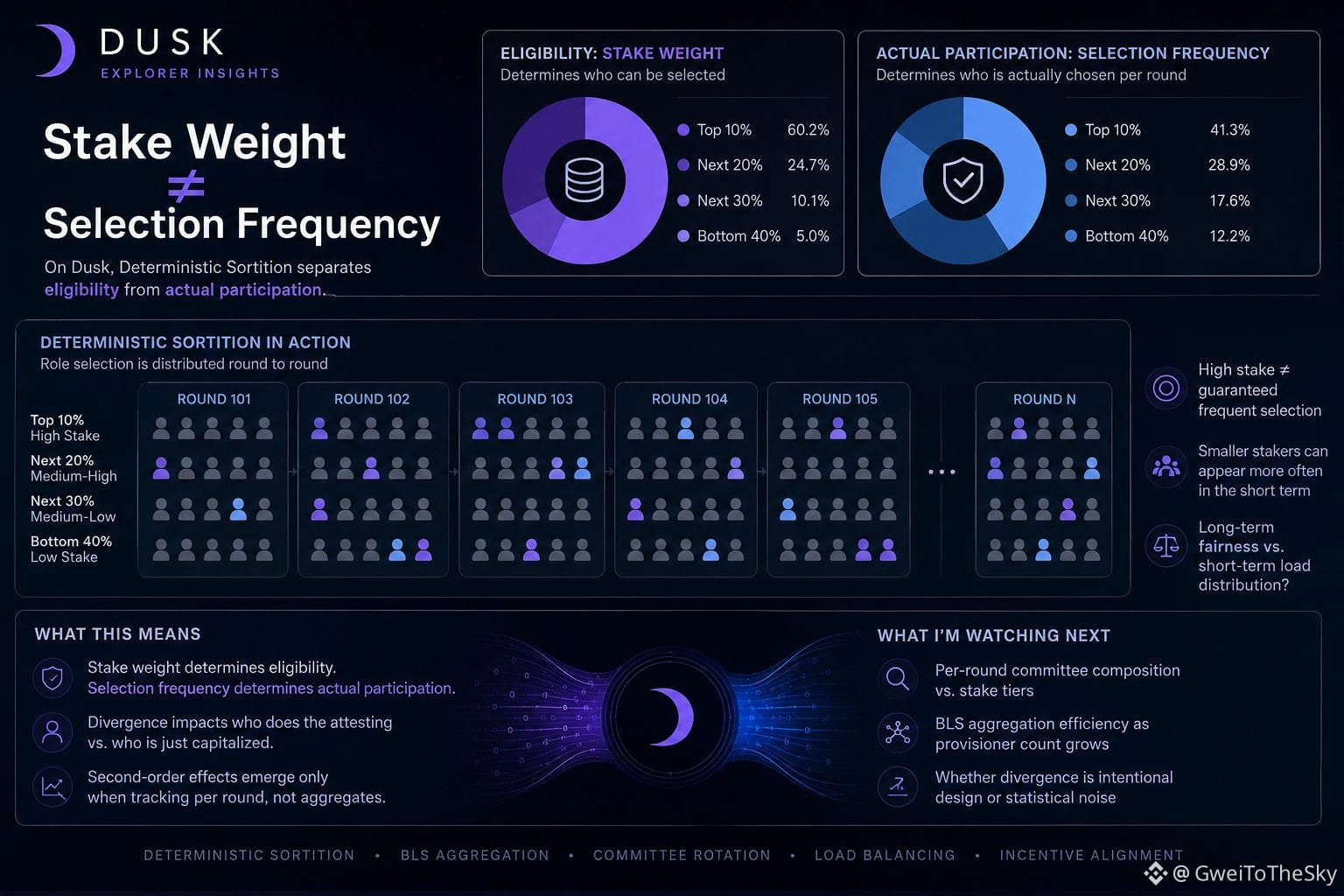
Dusk explorer last week. I assumed committee turnover per round would roughly mirror stake distribution, since that's how most sortition-based systems behave in practice. The numbers didn't quite line up that way, and it kept nagging at me.
Digging further, I traced it back to how Deterministic Sortition assigns roles separately from stake weighting itself. A provisioner can hold significant stake yet appear in fewer validation committees than a smaller staker across the same window, purely based on how role selection gets distributed round to round. That's when I realized I'd been conflating two things that aren't the same at all.
Stake weight determines eligibility. Selection frequency determines actual participation. Most people treat these as one signal, but they diverge, and that divergence quietly shapes who's actually doing the attesting versus who's just capitalized. It's a second-order effect that doesn't show up unless you're tracking rounds individually rather than aggregate stake share.
What I can't resolve yet is whether this divergence is intentional load-balancing or just statistical noise that evens out over longer sample periods. If it's structural, it raises a real question about whether smaller provisioners are getting proportionally more responsibility than their capital exposure would suggest, and what that means for incentive alignment over time.
Going forward I'm watching per-round committee composition against stake tiers, not just headline participation counts. I also want to see whether BLS aggregation efficiency holds steady as provisioner count grows, since that's where communication overhead usually starts biting.
I don't have a firm read yet on whether this is a feature of the design or an artifact of current network size, and I'm not sure which explanation I'd even prefer.
@Dusk_Foundation
#Dusk $HEMI $COW $DUSK
Dusk explorer last week. I assumed committee turnover per round would roughly mirror stake distribution, since that's how most sortition-based systems behave in practice. The numbers didn't quite line up that way, and it kept nagging at me.
Digging further, I traced it back to how Deterministic Sortition assigns roles separately from stake weighting itself. A provisioner can hold significant stake yet appear in fewer validation committees than a smaller staker across the same window, purely based on how role selection gets distributed round to round. That's when I realized I'd been conflating two things that aren't the same at all.
Stake weight determines eligibility. Selection frequency determines actual participation. Most people treat these as one signal, but they diverge, and that divergence quietly shapes who's actually doing the attesting versus who's just capitalized. It's a second-order effect that doesn't show up unless you're tracking rounds individually rather than aggregate stake share.
What I can't resolve yet is whether this divergence is intentional load-balancing or just statistical noise that evens out over longer sample periods. If it's structural, it raises a real question about whether smaller provisioners are getting proportionally more responsibility than their capital exposure would suggest, and what that means for incentive alignment over time.
Going forward I'm watching per-round committee composition against stake tiers, not just headline participation counts. I also want to see whether BLS aggregation efficiency holds steady as provisioner count grows, since that's where communication overhead usually starts biting.
I don't have a firm read yet on whether this is a feature of the design or an artifact of current network size, and I'm not sure which explanation I'd even prefer.
@Dusk
Dusk explorer last week. I assumed committee turnover per round would roughly mirror stake distribution, since that's how most sortition-based systems behave in practice. The numbers didn't quite line up that way, and it kept nagging at me.
Digging further, I traced it back to how Deterministic Sortition assigns roles separately from stake weighting itself. A provisioner can hold significant stake yet appear in fewer validation committees than a smaller staker across the same window, purely based on how role selection gets distributed round to round. That's when I realized I'd been conflating two things that aren't the same at all.
Stake weight determines eligibility. Selection frequency determines actual participation. Most people treat these as one signal, but they diverge, and that divergence quietly shapes who's actually doing the attesting versus who's just capitalized. It's a second-order effect that doesn't show up unless you're tracking rounds individually rather than aggregate stake share.
What I can't resolve yet is whether this divergence is intentional load-balancing or just statistical noise that evens out over longer sample periods. If it's structural, it raises a real question about whether smaller provisioners are getting proportionally more responsibility than their capital exposure would suggest, and what that means for incentive alignment over time.
Going forward I'm watching per-round committee composition against stake tiers, not just headline participation counts. I also want to see whether BLS aggregation efficiency holds steady as provisioner count grows, since that's where communication overhead usually starts biting.
I don't have a firm read yet on whether this is a feature of the design or an artifact of current network size, and I'm not sure which explanation I'd even prefer.
@Dusk
6
4
201
·
--
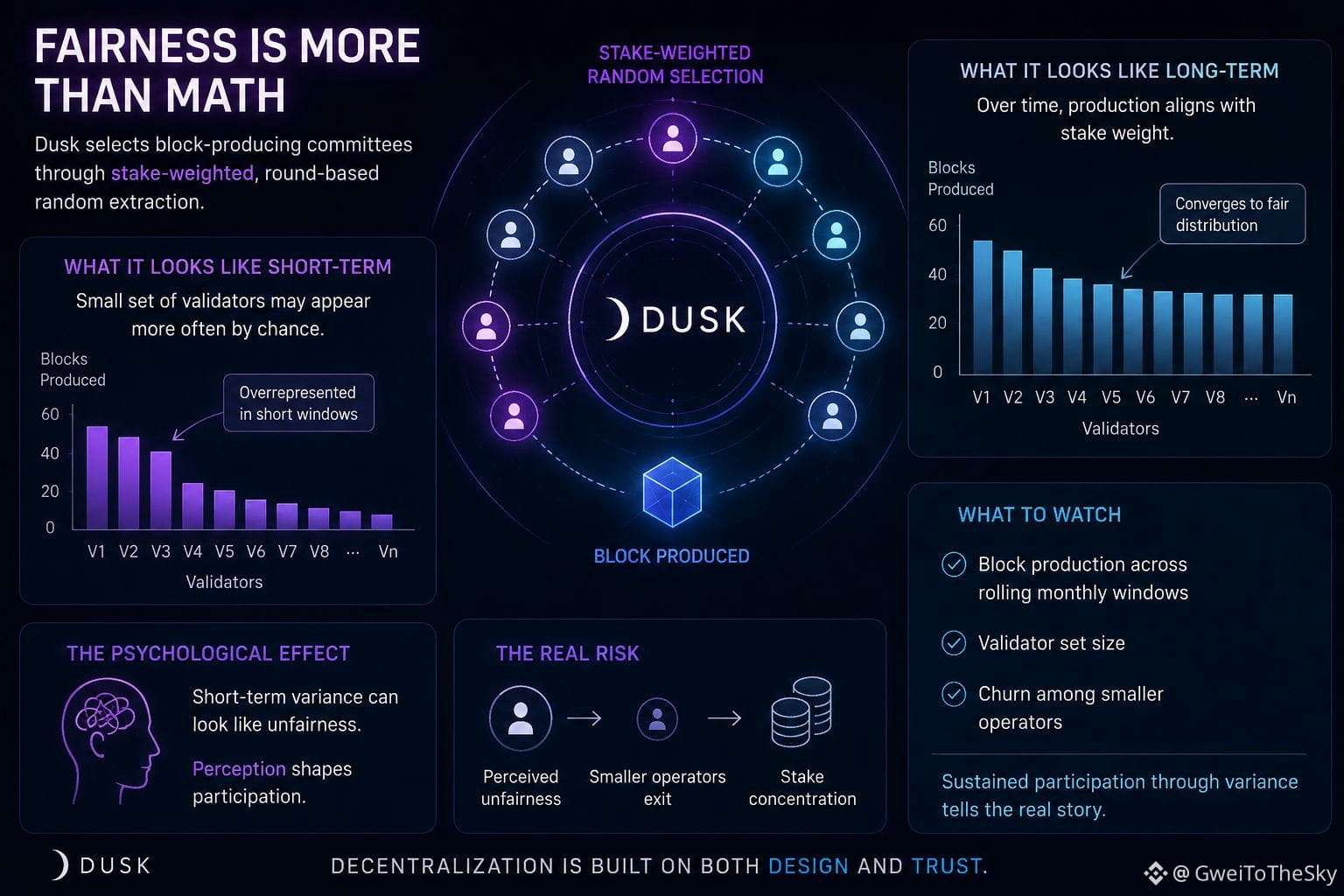
While reviewing recent block production data on Dusk's explorer, I noticed the same small set of validator addresses appearing far more often than their stake share seemed to justify. My first assumption was that I was misreading pagination or hitting a stale index, so I pulled the data again across a wider block range.
The pattern held, which pushed me into the consensus mechanism itself. Dusk selects its block-producing committee each round through a stake-weighted, round-based extraction rather than a fixed rotation. What looked like dominance in a narrow window was actually sampling variance baked into how committees get drawn, not preferential treatment of certain operators.
That distinction reshaped how I think about fairness here. Stake weight and selection frequency get treated as the same thing, but they only converge over long observation windows. Short-term, randomness dominates, and a validator can appear overrepresented purely by chance. The overlooked effect is psychological, smaller operators watching short windows may perceive the system as skewed even when the long-run math is balanced.
What I can't resolve yet is how that perception plays out operationally. If smaller validators judge fairness by short windows rather than statistical convergence, some may reduce participation or exit entirely, which would concentrate stake for reasons that have nothing to do with actual protocol bias.
Going forward I want to track block production distribution across rolling monthly windows rather than daily snapshots, alongside validator set size and churn among smaller operators. Sustained participation despite visible short-term variance would tell me more than any single sampling period.
I'm left wondering whether mathematical fairness is enough on its own, or whether perception of fairness ends up shaping decentralization just as much as the underlying design does.
@Dusk_Foundation #Dusk
$ACE $VELVET $DUSK
While reviewing recent block production data on Dusk's explorer, I noticed the same small set of validator addresses appearing far more often than their stake share seemed to justify. My first assumption was that I was misreading pagination or hitting a stale index, so I pulled the data again across a wider block range.
The pattern held, which pushed me into the consensus mechanism itself. Dusk selects its block-producing committee each round through a stake-weighted, round-based extraction rather than a fixed rotation. What looked like dominance in a narrow window was actually sampling variance baked into how committees get drawn, not preferential treatment of certain operators.
That distinction reshaped how I think about fairness here. Stake weight and selection frequency get treated as the same thing, but they only converge over long observation windows. Short-term, randomness dominates, and a validator can appear overrepresented purely by chance. The overlooked effect is psychological, smaller operators watching short windows may perceive the system as skewed even when the long-run math is balanced.
What I can't resolve yet is how that perception plays out operationally. If smaller validators judge fairness by short windows rather than statistical convergence, some may reduce participation or exit entirely, which would concentrate stake for reasons that have nothing to do with actual protocol bias.
Going forward I want to track block production distribution across rolling monthly windows rather than daily snapshots, alongside validator set size and churn among smaller operators. Sustained participation despite visible short-term variance would tell me more than any single sampling period.
I'm left wondering whether mathematical fairness is enough on its own, or whether perception of fairness ends up shaping decentralization just as much as the underlying design does.
@Dusk #Dusk
$ACE $VELVET $DUSK
The pattern held, which pushed me into the consensus mechanism itself. Dusk selects its block-producing committee each round through a stake-weighted, round-based extraction rather than a fixed rotation. What looked like dominance in a narrow window was actually sampling variance baked into how committees get drawn, not preferential treatment of certain operators.
That distinction reshaped how I think about fairness here. Stake weight and selection frequency get treated as the same thing, but they only converge over long observation windows. Short-term, randomness dominates, and a validator can appear overrepresented purely by chance. The overlooked effect is psychological, smaller operators watching short windows may perceive the system as skewed even when the long-run math is balanced.
What I can't resolve yet is how that perception plays out operationally. If smaller validators judge fairness by short windows rather than statistical convergence, some may reduce participation or exit entirely, which would concentrate stake for reasons that have nothing to do with actual protocol bias.
Going forward I want to track block production distribution across rolling monthly windows rather than daily snapshots, alongside validator set size and churn among smaller operators. Sustained participation despite visible short-term variance would tell me more than any single sampling period.
I'm left wondering whether mathematical fairness is enough on its own, or whether perception of fairness ends up shaping decentralization just as much as the underlying design does.
@Dusk #Dusk
$ACE $VELVET $DUSK
3
3
313
·
--
Dusk's confidential contract calls against its public mempool activity: a meaningful share of transactions showed valid state transitions with almost no visible input data. My first assumption was that this was just noise from failed decoding on my end, some indexer quirk misreading shielded payloads as empty.
Digging further, I traced it to how selective disclosure actually behaves at execution time rather than at the reporting layer. Instead of a transaction being either fully public or fully hidden, the disclosure logic seems to attach itself to specific fields within a single contract call, revealing eligibility or compliance data to a designated party while leaving transfer amounts and counterparties untouched. That is a different mechanism than encryption toggled on or off.
This forced me to separate two things I had been treating as one: privacy and confidentiality. Privacy suggests withholding information from everyone. Confidentiality here means controlled visibility, information exists and is provable, but only to whoever holds the right authorization key. The second-order effect is subtle, disclosure becomes a permissioned action, not a network-wide setting, which changes who actually controls information flow.
What I can't resolve yet is how this scales under real institutional load. If disclosure rights sit with issuers or auditors, does that create a soft dependency on a small set of authorized parties, and does that dependency shift depending on jurisdiction or asset type?
Going forward I want to watch authorization-key issuance patterns, how often disclosure permissions get exercised versus dormant, and whether validator behavior around these confidential calls stays consistent as volume grows.
I'm still unsure whether this authorization layer becomes infrastructure or friction. That distinction feels worth watching closely.
@Dusk_Foundation $DUSK #Dusk
Dusk's confidential contract calls against its public mempool activity: a meaningful share of transactions showed valid state transitions with almost no visible input data. My first assumption was that this was just noise from failed decoding on my end, some indexer quirk misreading shielded payloads as empty.
Digging further, I traced it to how selective disclosure actually behaves at execution time rather than at the reporting layer. Instead of a transaction being either fully public or fully hidden, the disclosure logic seems to attach itself to specific fields within a single contract call, revealing eligibility or compliance data to a designated party while leaving transfer amounts and counterparties untouched. That is a different mechanism than encryption toggled on or off.
This forced me to separate two things I had been treating as one: privacy and confidentiality. Privacy suggests withholding information from everyone. Confidentiality here means controlled visibility, information exists and is provable, but only to whoever holds the right authorization key. The second-order effect is subtle, disclosure becomes a permissioned action, not a network-wide setting, which changes who actually controls information flow.
What I can't resolve yet is how this scales under real institutional load. If disclosure rights sit with issuers or auditors, does that create a soft dependency on a small set of authorized parties, and does that dependency shift depending on jurisdiction or asset type?
Going forward I want to watch authorization-key issuance patterns, how often disclosure permissions get exercised versus dormant, and whether validator behavior around these confidential calls stays consistent as volume grows.
I'm still unsure whether this authorization layer becomes infrastructure or friction. That distinction feels worth watching closely.
@Dusk $DUSK #Dusk
Digging further, I traced it to how selective disclosure actually behaves at execution time rather than at the reporting layer. Instead of a transaction being either fully public or fully hidden, the disclosure logic seems to attach itself to specific fields within a single contract call, revealing eligibility or compliance data to a designated party while leaving transfer amounts and counterparties untouched. That is a different mechanism than encryption toggled on or off.
This forced me to separate two things I had been treating as one: privacy and confidentiality. Privacy suggests withholding information from everyone. Confidentiality here means controlled visibility, information exists and is provable, but only to whoever holds the right authorization key. The second-order effect is subtle, disclosure becomes a permissioned action, not a network-wide setting, which changes who actually controls information flow.
What I can't resolve yet is how this scales under real institutional load. If disclosure rights sit with issuers or auditors, does that create a soft dependency on a small set of authorized parties, and does that dependency shift depending on jurisdiction or asset type?
Going forward I want to watch authorization-key issuance patterns, how often disclosure permissions get exercised versus dormant, and whether validator behavior around these confidential calls stays consistent as volume grows.
I'm still unsure whether this authorization layer becomes infrastructure or friction. That distinction feels worth watching closely.
@Dusk $DUSK #Dusk
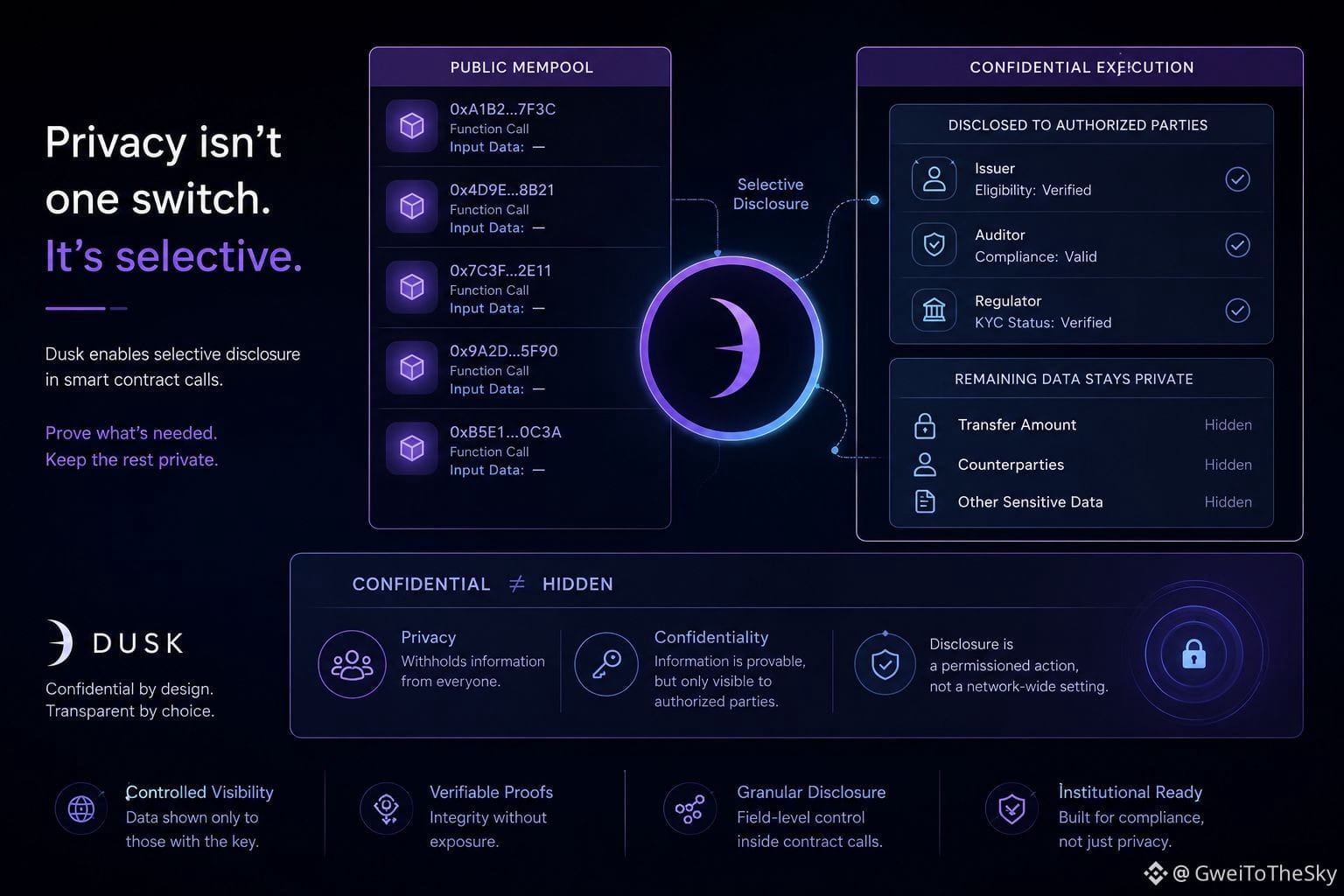
3
96
·
--
I noticed something odd while comparing confirmation times across a batch of DUSK transactions I'd pulled from the explorer. I assumed all transfers on the network settled through the same execution path, so any timing variance had to be network congestion. That assumption didn't hold up once I sorted the data.
Digging further, the delay pattern tracked with transaction type, not block load. Some transfers were shielded, routed through what the network calls its privacy-preserving execution model, while others were fully transparent transfers using a separate account-based path. Both settle on the same chain, but they're processed through distinct logic, which explained the variance I was seeing.
That distinction reframed how I'd been thinking about the network. I had privacy and compliance sitting in my head as the same feature. They're not. Privacy determines what's visible on-chain by default. Compliance determines what can be proven later, to whom, under what authorization. A transaction can be private and still auditable if the right disclosure mechanism exists. Conflating the two hides that second layer entirely.
What I can't resolve yet is who actually uses the transparent path versus the shielded one in practice, and why. Is transparent execution mostly operators and institutional flows wanting a clean audit trail, or is it just habit from users unfamiliar with the shielded option? That split matters for understanding real demand.
Going forward I want to watch the ratio between shielded and transparent transaction volume over time, not just raw throughput. A shift toward shielded usage would tell me privacy tooling is being actively chosen, not just available.
I'm still not sure whether that ratio reflects genuine preference or simple inertia, and I don't think volume data alone will answer it.
@Dusk_Foundation
$DUSK #Dusk
I noticed something odd while comparing confirmation times across a batch of DUSK transactions I'd pulled from the explorer. I assumed all transfers on the network settled through the same execution path, so any timing variance had to be network congestion. That assumption didn't hold up once I sorted the data.
Digging further, the delay pattern tracked with transaction type, not block load. Some transfers were shielded, routed through what the network calls its privacy-preserving execution model, while others were fully transparent transfers using a separate account-based path. Both settle on the same chain, but they're processed through distinct logic, which explained the variance I was seeing.
That distinction reframed how I'd been thinking about the network. I had privacy and compliance sitting in my head as the same feature. They're not. Privacy determines what's visible on-chain by default. Compliance determines what can be proven later, to whom, under what authorization. A transaction can be private and still auditable if the right disclosure mechanism exists. Conflating the two hides that second layer entirely.
What I can't resolve yet is who actually uses the transparent path versus the shielded one in practice, and why. Is transparent execution mostly operators and institutional flows wanting a clean audit trail, or is it just habit from users unfamiliar with the shielded option? That split matters for understanding real demand.
Going forward I want to watch the ratio between shielded and transparent transaction volume over time, not just raw throughput. A shift toward shielded usage would tell me privacy tooling is being actively chosen, not just available.
I'm still not sure whether that ratio reflects genuine preference or simple inertia, and I don't think volume data alone will answer it.
@Dusk
$DUSK #Dusk
Digging further, the delay pattern tracked with transaction type, not block load. Some transfers were shielded, routed through what the network calls its privacy-preserving execution model, while others were fully transparent transfers using a separate account-based path. Both settle on the same chain, but they're processed through distinct logic, which explained the variance I was seeing.
That distinction reframed how I'd been thinking about the network. I had privacy and compliance sitting in my head as the same feature. They're not. Privacy determines what's visible on-chain by default. Compliance determines what can be proven later, to whom, under what authorization. A transaction can be private and still auditable if the right disclosure mechanism exists. Conflating the two hides that second layer entirely.
What I can't resolve yet is who actually uses the transparent path versus the shielded one in practice, and why. Is transparent execution mostly operators and institutional flows wanting a clean audit trail, or is it just habit from users unfamiliar with the shielded option? That split matters for understanding real demand.
Going forward I want to watch the ratio between shielded and transparent transaction volume over time, not just raw throughput. A shift toward shielded usage would tell me privacy tooling is being actively chosen, not just available.
I'm still not sure whether that ratio reflects genuine preference or simple inertia, and I don't think volume data alone will answer it.
@Dusk
$DUSK #Dusk
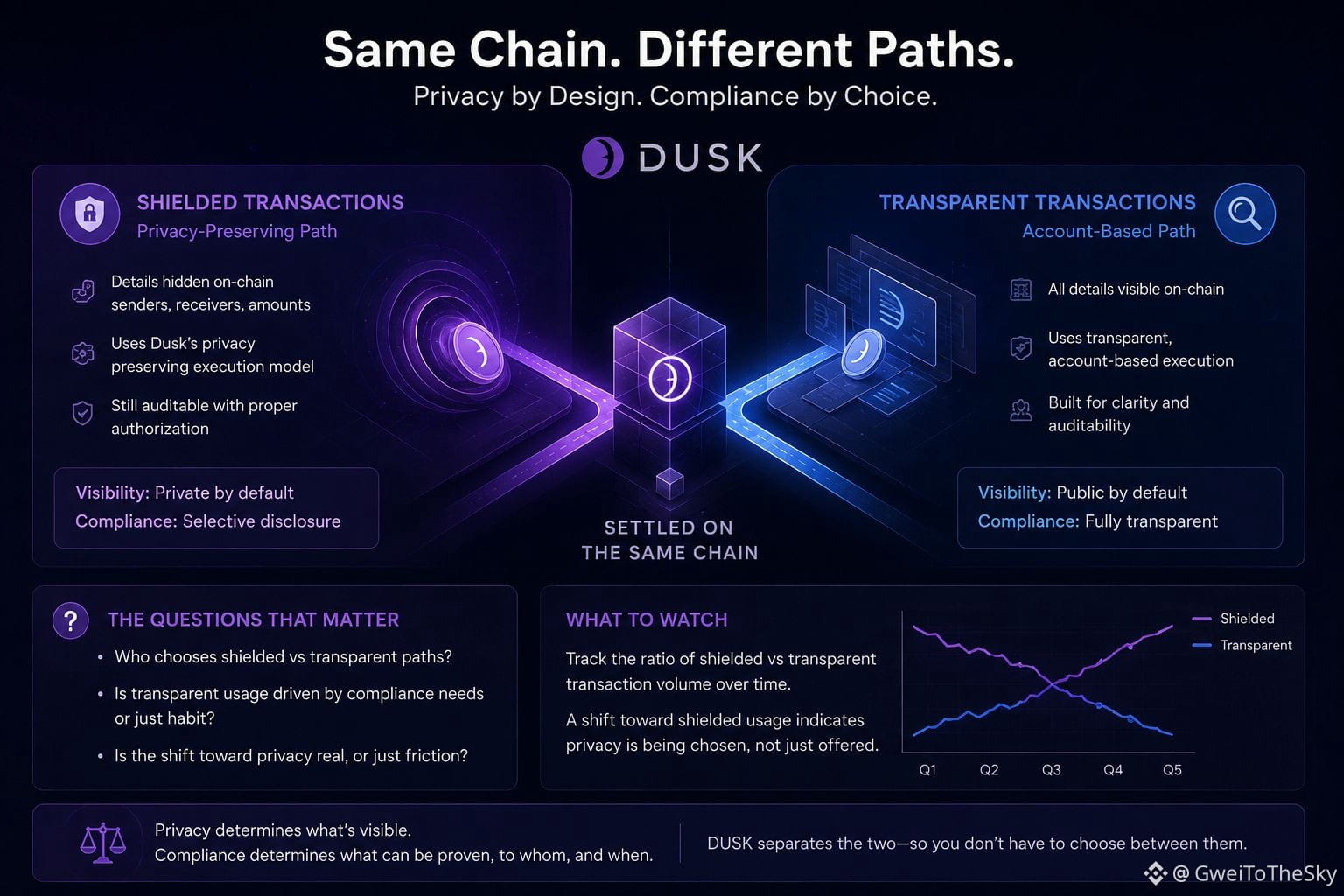
1
3
96
·
--
Every crypto cycle sells us the same dream: this time, the system finally removes the need for trust.
“We fixed trust.”
“We fixed security.”
“We fixed the missing layer.”
Newton Protocol ($NEWT ) is aiming at a real problem: if AI agents, automated vaults, and smart contracts start moving serious money, who makes sure those actions follow the right rules before damage happens?
The idea sounds logical. Don’t wait for a hack. Don’t investigate the failure after funds disappear. Put policies in front of execution and block risky actions before they settle.
Clean story.
On paper, at least.
But here is where things get complicated. Adding a rule layer also creates a new dependency. Who writes these policies? Who controls the default settings? Who decides what “safe” actually means?
Because sometimes the biggest power is not holding the money.
It is controlling what money is allowed to do.
Newton talks about moving from blind trust toward verifiable rules, and that is a direction worth watching. But technology alone does not remove human incentives. Someone still designs the system. Someone benefits from adoption. Someone controls the standards everyone else follows.
The real test for Newt is not whether the technology works during a beta phase with early believers.
The test comes later.
When real money enters, incentives collide, and the system has to prove it can protect users without becoming another gatekeeper wearing a different name.
@NewtonProtocol #Newt
$TAC $SKL
Every crypto cycle sells us the same dream: this time, the system finally removes the need for trust.
“We fixed trust.”
“We fixed security.”
“We fixed the missing layer.”
Newton Protocol ($NEWT ) is aiming at a real problem: if AI agents, automated vaults, and smart contracts start moving serious money, who makes sure those actions follow the right rules before damage happens?
The idea sounds logical. Don’t wait for a hack. Don’t investigate the failure after funds disappear. Put policies in front of execution and block risky actions before they settle.
Clean story.
On paper, at least.
But here is where things get complicated. Adding a rule layer also creates a new dependency. Who writes these policies? Who controls the default settings? Who decides what “safe” actually means?
Because sometimes the biggest power is not holding the money.
It is controlling what money is allowed to do.
Newton talks about moving from blind trust toward verifiable rules, and that is a direction worth watching. But technology alone does not remove human incentives. Someone still designs the system. Someone benefits from adoption. Someone controls the standards everyone else follows.
The real test for Newt is not whether the technology works during a beta phase with early believers.
The test comes later.
When real money enters, incentives collide, and the system has to prove it can protect users without becoming another gatekeeper wearing a different name.
@NewtonProtocol #Newt
$TAC $SKL
“We fixed trust.”
“We fixed security.”
“We fixed the missing layer.”
Newton Protocol ($NEWT ) is aiming at a real problem: if AI agents, automated vaults, and smart contracts start moving serious money, who makes sure those actions follow the right rules before damage happens?
The idea sounds logical. Don’t wait for a hack. Don’t investigate the failure after funds disappear. Put policies in front of execution and block risky actions before they settle.
Clean story.
On paper, at least.
But here is where things get complicated. Adding a rule layer also creates a new dependency. Who writes these policies? Who controls the default settings? Who decides what “safe” actually means?
Because sometimes the biggest power is not holding the money.
It is controlling what money is allowed to do.
Newton talks about moving from blind trust toward verifiable rules, and that is a direction worth watching. But technology alone does not remove human incentives. Someone still designs the system. Someone benefits from adoption. Someone controls the standards everyone else follows.
The real test for Newt is not whether the technology works during a beta phase with early believers.
The test comes later.
When real money enters, incentives collide, and the system has to prove it can protect users without becoming another gatekeeper wearing a different name.
@NewtonProtocol #Newt
$TAC $SKL
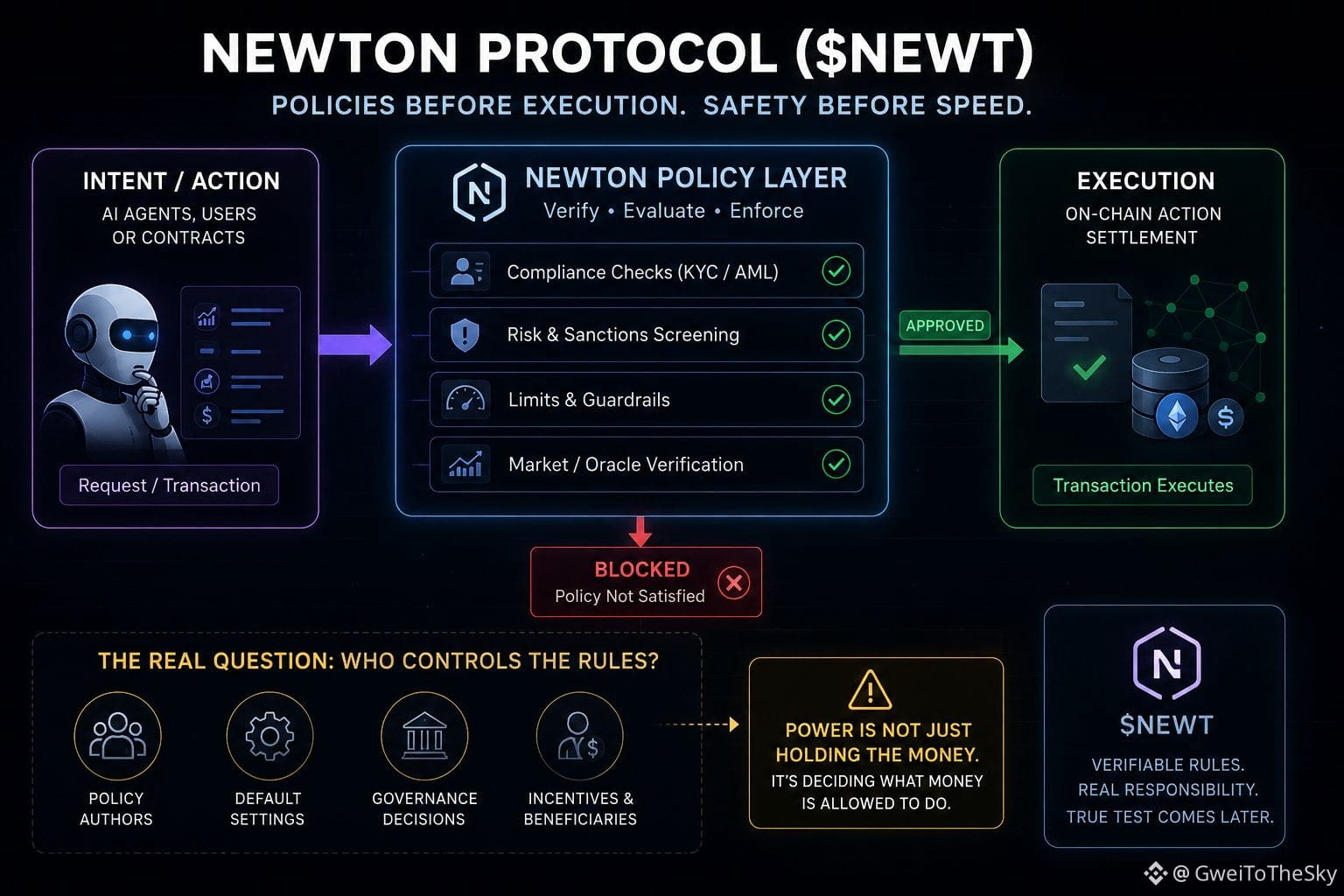
3
2
168
Log in to explore more content
Join global crypto users on Binance Square
⚡️ Get latest and useful information about crypto.
💬 Trusted by the world’s largest crypto exchange.
👍 Discover real insights from verified creators.
Email / Phone number