
Anl_
128 Posts

Anl_
Web3 😎
Open Trade
Frequent Trader
3.4 Months
32 Following
31 Followers
127 Liked
Posts
Portfolio
All
Quotes
#dusk $DUSK @Dusk
So who decides whether you may hold a tokenized asset, and how is that checked without knowing everything about you?
I never thought about either half. I assumed the asset gets created, people buy it, and the paperwork happens somewhere out of sight.
The sequence runs the other way. Before anything trades, the issuer defines the asset, the eligibility requirements, and the rules governing its life. Only then does anything move. Issuance is really an act of rule-writing, and the token is close to a by-product.
That creates a problem I had not connected to it. If the rules depend on facts about a person, checking them normally means storing those facts. And in Europe, personal information carries rights, including in some cases the right to be erased. A ledger built so nothing can ever be erased sits awkwardly beside that.
The only clean resolution is to keep the personal data off the permanent record entirely and put a proof there instead. If the information was never written, the erasure question mostly answers itself.
Which brings in the third piece, and it decides whether any of this is realistic. Proofs are only useful if checking them is affordable. I had assumed serious cryptography and smart contracts were a bad match — possible, but too expensive for ordinary use. Dusk treats proof verification as a native capability rather than something each contract rebuilds.
What I still cannot judge is how this holds when an application genuinely needs to know something about a person to serve them, which describes most of regulated finance.
From here I read privacy claims differently. The strongest version is not stronger encryption. It is arranging things so the sensitive data was never recorded at all.
So who decides whether you may hold a tokenized asset, and how is that checked without knowing everything about you?
I never thought about either half. I assumed the asset gets created, people buy it, and the paperwork happens somewhere out of sight.
The sequence runs the other way. Before anything trades, the issuer defines the asset, the eligibility requirements, and the rules governing its life. Only then does anything move. Issuance is really an act of rule-writing, and the token is close to a by-product.
That creates a problem I had not connected to it. If the rules depend on facts about a person, checking them normally means storing those facts. And in Europe, personal information carries rights, including in some cases the right to be erased. A ledger built so nothing can ever be erased sits awkwardly beside that.
The only clean resolution is to keep the personal data off the permanent record entirely and put a proof there instead. If the information was never written, the erasure question mostly answers itself.
Which brings in the third piece, and it decides whether any of this is realistic. Proofs are only useful if checking them is affordable. I had assumed serious cryptography and smart contracts were a bad match — possible, but too expensive for ordinary use. Dusk treats proof verification as a native capability rather than something each contract rebuilds.
What I still cannot judge is how this holds when an application genuinely needs to know something about a person to serve them, which describes most of regulated finance.
From here I read privacy claims differently. The strongest version is not stronger encryption. It is arranging things so the sensitive data was never recorded at all.
#dusk $DUSK @Dusk
So when you buy something on-chain, who are you buying it from?
In ordinary crypto, the answer is nobody in particular, and that is treated as a feature. You interact with a contract, the trade executes, and the identity of the other party is irrelevant.
In regulated markets, that answer is unacceptable, and I did not appreciate how deeply until recently.
Institutions are required to know who they are dealing with. Not out of curiosity — because they carry obligations about who they are permitted to transact with, and those obligations do not disappear because the trade happened on a blockchain. An anonymous counterparty is not an efficiency for them. It is a compliance failure.
What caught my attention is how much this reshapes what a financial chain has to provide. It cannot only prove that a transaction is valid. It has to allow participants to establish that the other party is someone they are allowed to trade with, without exposing that person to everyone else watching the chain.
That is a harder problem than privacy alone, and a harder problem than transparency alone. It sits awkwardly between them.
I am still working out how much of that is genuinely solvable with cryptography and how much simply moves the question to whoever issued the credentials.
From here I stopped thinking about anonymity as the default good in finance. Sometimes the ability to know who is on the other side is exactly what makes the market possible.
So when you buy something on-chain, who are you buying it from?
In ordinary crypto, the answer is nobody in particular, and that is treated as a feature. You interact with a contract, the trade executes, and the identity of the other party is irrelevant.
In regulated markets, that answer is unacceptable, and I did not appreciate how deeply until recently.
Institutions are required to know who they are dealing with. Not out of curiosity — because they carry obligations about who they are permitted to transact with, and those obligations do not disappear because the trade happened on a blockchain. An anonymous counterparty is not an efficiency for them. It is a compliance failure.
What caught my attention is how much this reshapes what a financial chain has to provide. It cannot only prove that a transaction is valid. It has to allow participants to establish that the other party is someone they are allowed to trade with, without exposing that person to everyone else watching the chain.
That is a harder problem than privacy alone, and a harder problem than transparency alone. It sits awkwardly between them.
I am still working out how much of that is genuinely solvable with cryptography and how much simply moves the question to whoever issued the credentials.
From here I stopped thinking about anonymity as the default good in finance. Sometimes the ability to know who is on the other side is exactly what makes the market possible.
#dusk $DUSK @Dusk
So when a transaction is "confirmed," what has actually happened?
In the past, I used to treat confirmation and finality as the same word. I would see a transaction go through, wait a little, and consider the matter closed. If someone had asked me whether it could still be reversed, I would have said no without really thinking about why.
But the more I looked into how Dusk describes settlement, the more I realized I had been merging two different ideas.
On most chains, a transaction becomes safer the longer you wait. Nothing declares it permanent. You simply reach a point where reversing it would be so expensive that nobody reasonably would. That is a probability, not a promise.
Dusk approaches it differently. Its consensus is designed so that a block is settled by the rules of the protocol itself, rather than becoming gradually safer over time.
What I found particularly notable is why that distinction matters far more in finance than in ordinary crypto use. If I send someone money and it takes another minute to feel safe, nothing important happens. But a settlement system cannot operate on "very likely permanent." Somebody has to be accountable for the moment a transfer becomes irreversible, and that moment has to be a fact rather than an estimate.
This also explains something that puzzled me earlier. Building a settlement layer from scratch is enormous work when faster options already exist. It only makes sense if the guarantee itself is the product.
I am still not in a position to say how this behaves when the network is under real pressure rather than normal conditions. That is where designs usually reveal what they actually promised.
But from here I stopped reading "confirmed" as a single idea. There is the moment a transaction happens, and there is the moment it stops being reversible, and those two are not always the same thing.
So when a transaction is "confirmed," what has actually happened?
In the past, I used to treat confirmation and finality as the same word. I would see a transaction go through, wait a little, and consider the matter closed. If someone had asked me whether it could still be reversed, I would have said no without really thinking about why.
But the more I looked into how Dusk describes settlement, the more I realized I had been merging two different ideas.
On most chains, a transaction becomes safer the longer you wait. Nothing declares it permanent. You simply reach a point where reversing it would be so expensive that nobody reasonably would. That is a probability, not a promise.
Dusk approaches it differently. Its consensus is designed so that a block is settled by the rules of the protocol itself, rather than becoming gradually safer over time.
What I found particularly notable is why that distinction matters far more in finance than in ordinary crypto use. If I send someone money and it takes another minute to feel safe, nothing important happens. But a settlement system cannot operate on "very likely permanent." Somebody has to be accountable for the moment a transfer becomes irreversible, and that moment has to be a fact rather than an estimate.
This also explains something that puzzled me earlier. Building a settlement layer from scratch is enormous work when faster options already exist. It only makes sense if the guarantee itself is the product.
I am still not in a position to say how this behaves when the network is under real pressure rather than normal conditions. That is where designs usually reveal what they actually promised.
But from here I stopped reading "confirmed" as a single idea. There is the moment a transaction happens, and there is the moment it stops being reversible, and those two are not always the same thing.
#dusk $DUSK @Dusk Previously, I thought a blockchain had to choose a side. Either it is permissionless, where anyone can transact and nobody is gatekept, or it is permissioned, where a consortium decides who participates. Public or private. One or the other.
But the more I read about Dusk, the less that division seemed to describe what is actually being built.
The base layer is open. Anyone can run a node, anyone can stake, the code is public, and no committee approves your participation. Meanwhile, the assets intended to live on that layer are the opposite: eligibility-restricted, transfer-controlled, and only holdable by verified parties.
What I found particularly notable is that these are not in conflict, because they operate at different layers. The network does not need to know who you are to include your transaction. The asset needs to know who you are before it will let you hold it. Openness at the settlement layer, restriction at the instrument layer.
Traditional markets already work this way, and we rarely notice. Internet infrastructure carries an equity trade without any opinion about whether you are allowed to own that equity. The transport is neutral. The instrument is not.
What makes this hard on-chain is that most people evaluate a chain as a single object. So they ask whether Dusk is permissionless, get a partial answer, and take away the wrong conclusion in either direction.
I am still uncertain how this holds up when a restricted asset ends up somewhere the restriction cannot follow it — that seems like the genuinely difficult case.
From here, I stopped asking whether the chain is open or closed. The more useful question is which layer the openness lives on, and whether the restrictions at the layer above are enforced by code or only by agreement.
But the more I read about Dusk, the less that division seemed to describe what is actually being built.
The base layer is open. Anyone can run a node, anyone can stake, the code is public, and no committee approves your participation. Meanwhile, the assets intended to live on that layer are the opposite: eligibility-restricted, transfer-controlled, and only holdable by verified parties.
What I found particularly notable is that these are not in conflict, because they operate at different layers. The network does not need to know who you are to include your transaction. The asset needs to know who you are before it will let you hold it. Openness at the settlement layer, restriction at the instrument layer.
Traditional markets already work this way, and we rarely notice. Internet infrastructure carries an equity trade without any opinion about whether you are allowed to own that equity. The transport is neutral. The instrument is not.
What makes this hard on-chain is that most people evaluate a chain as a single object. So they ask whether Dusk is permissionless, get a partial answer, and take away the wrong conclusion in either direction.
I am still uncertain how this holds up when a restricted asset ends up somewhere the restriction cannot follow it — that seems like the genuinely difficult case.
From here, I stopped asking whether the chain is open or closed. The more useful question is which layer the openness lives on, and whether the restrictions at the layer above are enforced by code or only by agreement.
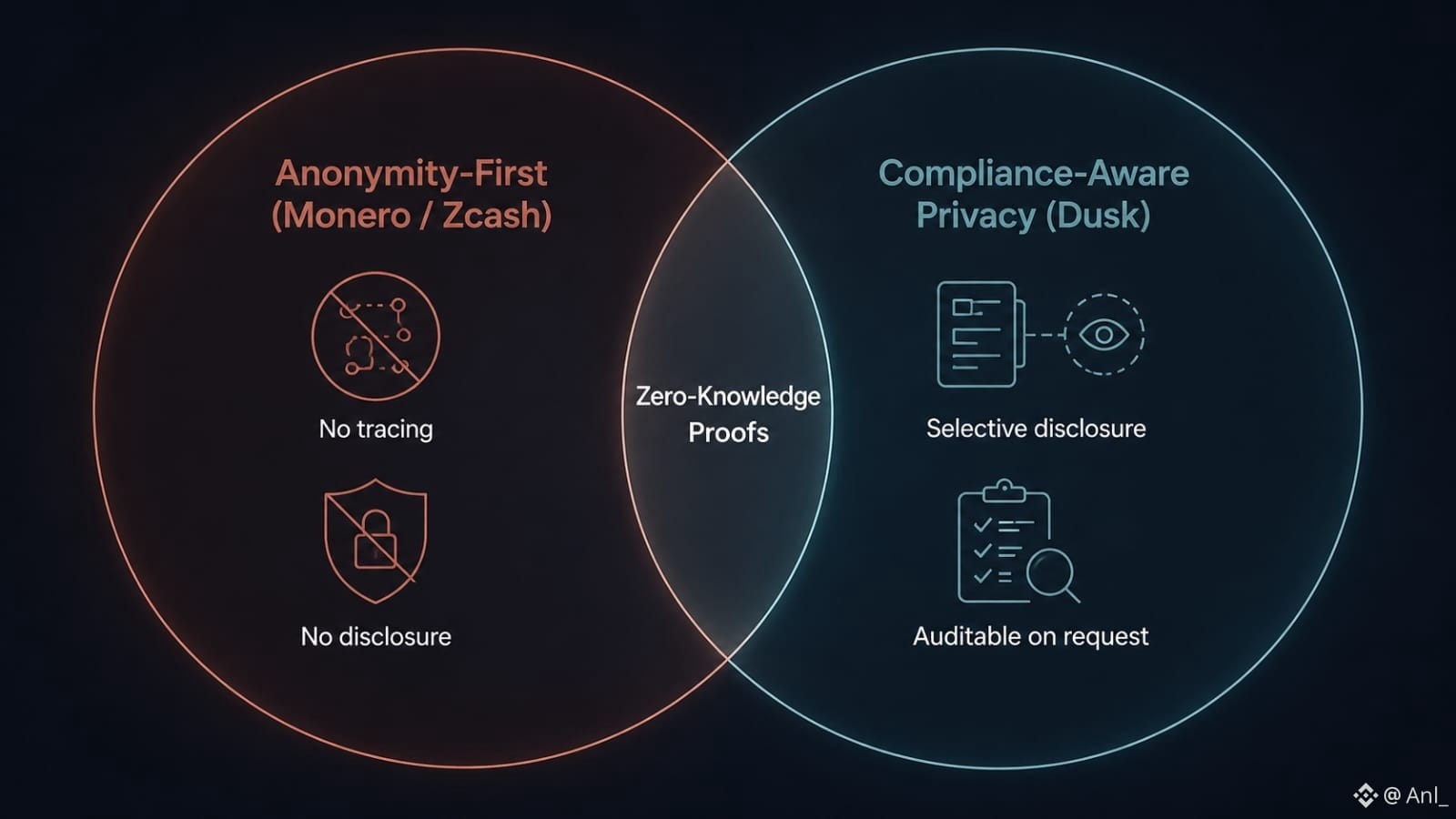
#dusk $DUSK @Dusk When you hear “privacy coin,” do you think of Monero or Zcash?
I did. But the comparison gets more interesting once you ask what “privacy” is supposed to achieve.
Monero takes the hard line: privacy is mandatory. Sender, receiver and amount are hidden by default. Zcash is more flexible, with shielded transactions and viewing keys that can selectively reveal information.
Dusk pushes that second philosophy directly into regulated finance.
The idea is privacy with selective disclosure: your financial activity does not need to be public, but an authorized party — an auditor, supervisor or institution — can receive the specific evidence it needs without seeing everything else.
I can see why institutions would prefer this.
Banks, issuers and regulated markets need confidentiality, but they also cannot operate in a system where compliance becomes impossible to prove.
The controversy is obvious too.
For a crypto-native privacy advocate, “authorized visibility” can sound less like privacy and more like a controlled backdoor. If someone can be given access, the argument becomes about who controls that access and under what rules.
Then there is adoption.
Regulatory pressure on anonymity-focused assets is no longer theoretical. Kraken removed Monero for EEA clients, explicitly citing regulatory changes.
That makes Dusk's compromise look more commercially survivable: hide information from the public while still allowing regulated verification.
But “more adoptable” does not automatically mean “better privacy.”
Maybe pure anonymity protects the principle better but struggles with institutional access. Maybe selective disclosure sacrifices ideological purity to make privacy usable inside the financial system.
And that leaves the uncomfortable question:
If privacy can still be shown to “someone,” is it really privacy — or just regulated visibility?
I did. But the comparison gets more interesting once you ask what “privacy” is supposed to achieve.
Monero takes the hard line: privacy is mandatory. Sender, receiver and amount are hidden by default. Zcash is more flexible, with shielded transactions and viewing keys that can selectively reveal information.
Dusk pushes that second philosophy directly into regulated finance.
The idea is privacy with selective disclosure: your financial activity does not need to be public, but an authorized party — an auditor, supervisor or institution — can receive the specific evidence it needs without seeing everything else.
I can see why institutions would prefer this.
Banks, issuers and regulated markets need confidentiality, but they also cannot operate in a system where compliance becomes impossible to prove.
The controversy is obvious too.
For a crypto-native privacy advocate, “authorized visibility” can sound less like privacy and more like a controlled backdoor. If someone can be given access, the argument becomes about who controls that access and under what rules.
Then there is adoption.
Regulatory pressure on anonymity-focused assets is no longer theoretical. Kraken removed Monero for EEA clients, explicitly citing regulatory changes.
That makes Dusk's compromise look more commercially survivable: hide information from the public while still allowing regulated verification.
But “more adoptable” does not automatically mean “better privacy.”
Maybe pure anonymity protects the principle better but struggles with institutional access. Maybe selective disclosure sacrifices ideological purity to make privacy usable inside the financial system.
And that leaves the uncomfortable question:
If privacy can still be shown to “someone,” is it really privacy — or just regulated visibility?
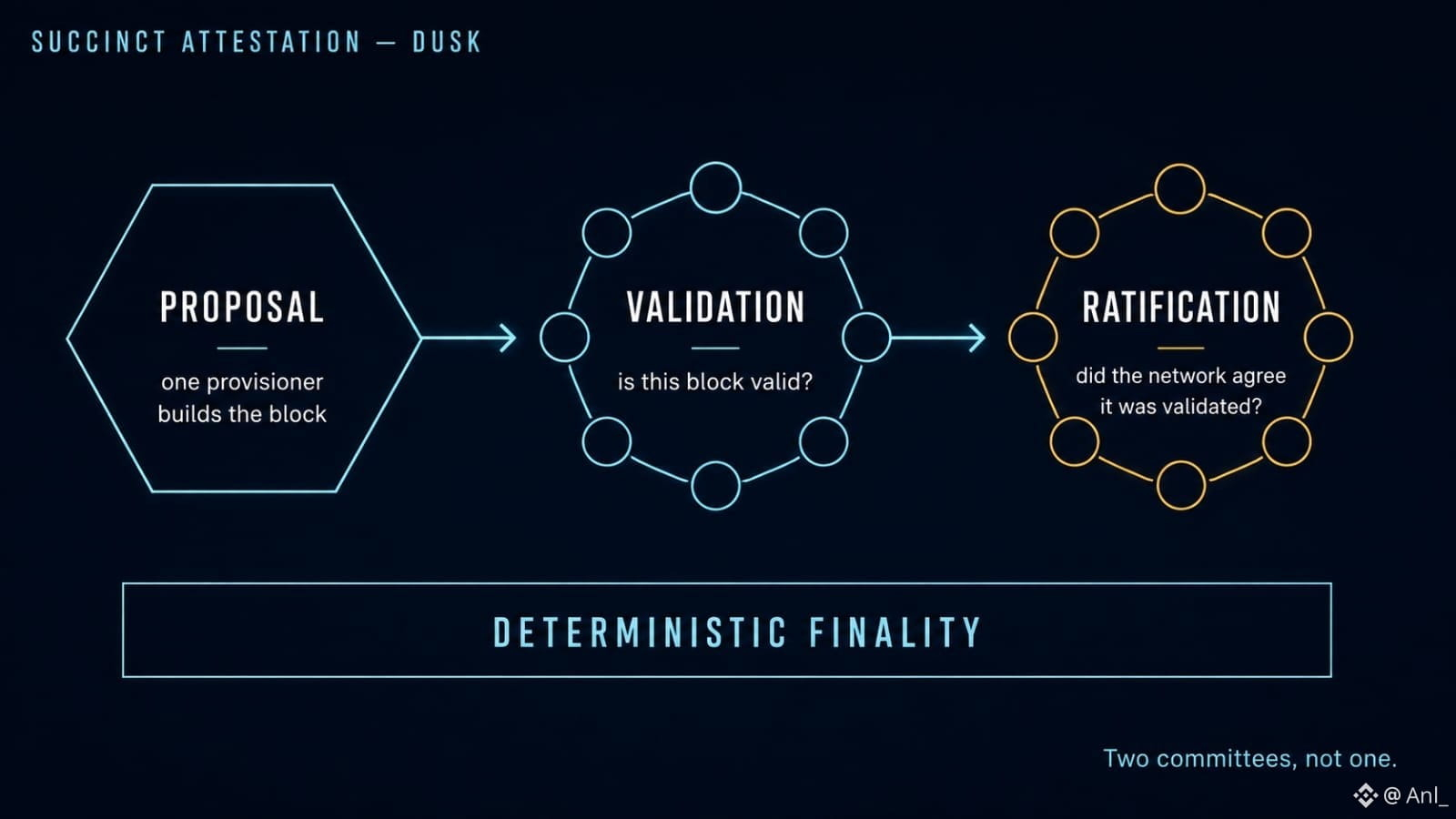
Most proof-of-stake chains do one thing after a block is proposed: a committee votes, and if enough votes land, the block counts.
@Dusk does it twice, and the second round is the one nobody explains.
Succinct Attestation runs every round in three steps. A provisioner proposes a candidate block. A randomly selected committee validates it. Then a second committee ratifies — and what it confirms isn't the block. It confirms the validation outcome.
That distinction took me a while to see properly.
Validation answers "is this block valid?" Ratification answers "did the network actually agree that it was validated?" Those are different questions, and the second one is where deterministic finality comes from. Without it you have a committee's opinion, propagated across a network, arriving at different nodes at different times. With it you have an attested record that the agreement itself happened.
That's the difference between "this block is very probably final" and "this block is final." For a chain aiming at securities settlement, that gap isn't philosophical. It's the difference between a settlement guarantee and a settlement estimate.
The cost is real too. Two committees means two rounds of signatures, two chances for participation to fall short, and reward splits that reflect it — validation and ratification each take a slice of the block reward, separate from the block generator.
Whether that extra round is worth the latency and coordination overhead is exactly the kind of thing an audit can't tell you. Oak Security's review called the protocol well designed. Well designed and well suited to real load are different claims.
Genuine question for the node operators here: has anyone measured how often ratification is the step that stalls, rather than validation?
#dusk $DUSK #block
@Dusk does it twice, and the second round is the one nobody explains.
Succinct Attestation runs every round in three steps. A provisioner proposes a candidate block. A randomly selected committee validates it. Then a second committee ratifies — and what it confirms isn't the block. It confirms the validation outcome.
That distinction took me a while to see properly.
Validation answers "is this block valid?" Ratification answers "did the network actually agree that it was validated?" Those are different questions, and the second one is where deterministic finality comes from. Without it you have a committee's opinion, propagated across a network, arriving at different nodes at different times. With it you have an attested record that the agreement itself happened.
That's the difference between "this block is very probably final" and "this block is final." For a chain aiming at securities settlement, that gap isn't philosophical. It's the difference between a settlement guarantee and a settlement estimate.
The cost is real too. Two committees means two rounds of signatures, two chances for participation to fall short, and reward splits that reflect it — validation and ratification each take a slice of the block reward, separate from the block generator.
Whether that extra round is worth the latency and coordination overhead is exactly the kind of thing an audit can't tell you. Oak Security's review called the protocol well designed. Well designed and well suited to real load are different claims.
Genuine question for the node operators here: has anyone measured how often ratification is the step that stalls, rather than validation?
#dusk $DUSK #block
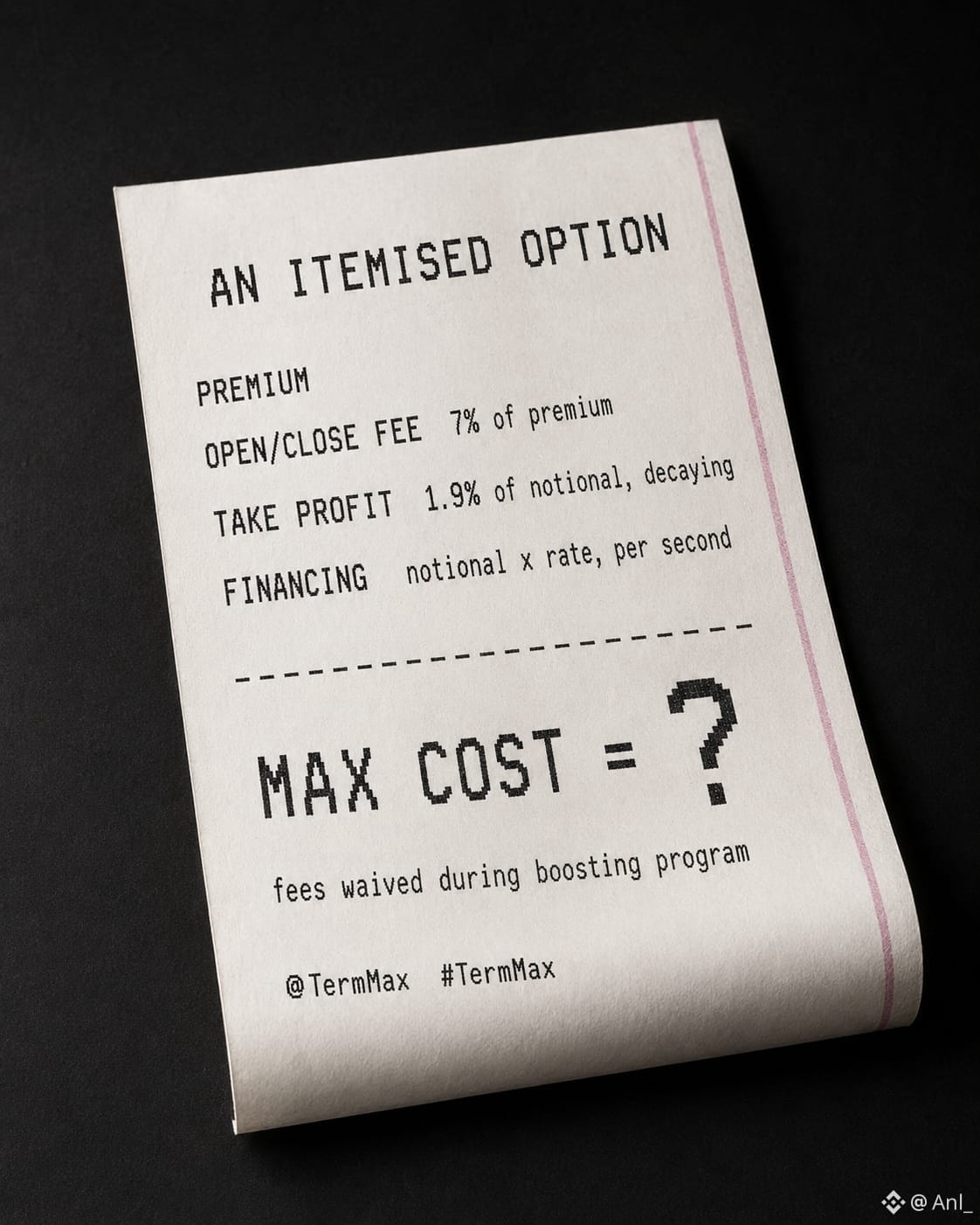
@TermMax The Alpha option page says your maximum loss is the premium. The fees page adds three more lines to that.
Opening or closing a Long or Short costs 7% of the premium paid.
Taking profit is charged on notional, not premium — 1.9% at day one, decaying linearly toward maturity. The docs' own example: a 16-day contract closed on day 10 with 10,000 USDT notional pays 47.5 USDT.
Then financing. You pay interest on notional for every second you hold the position. Their example uses a 100% annualised rate and produces roughly 1.37 USDT per day on 100 USDT of notional. About 10% of that interest goes to the platform, the rest to the Dual Investment depositors.
None of this is buried, and transaction fees are waived during the boosting program.
But "max cost is the premium" and "interest accrues per second on notional" are two different sentences about the same trade.
When you price one of these, are you pricing the premium or the premium plus carry?
#termmax @TermMax
Opening or closing a Long or Short costs 7% of the premium paid.
Taking profit is charged on notional, not premium — 1.9% at day one, decaying linearly toward maturity. The docs' own example: a 16-day contract closed on day 10 with 10,000 USDT notional pays 47.5 USDT.
Then financing. You pay interest on notional for every second you hold the position. Their example uses a 100% annualised rate and produces roughly 1.37 USDT per day on 100 USDT of notional. About 10% of that interest goes to the platform, the rest to the Dual Investment depositors.
None of this is buried, and transaction fees are waived during the boosting program.
But "max cost is the premium" and "interest accrues per second on notional" are two different sentences about the same trade.
When you price one of these, are you pricing the premium or the premium plus carry?
#termmax @TermMax
#dusk $DUSK
Everyone argues about consensus. Almost nobody looks one layer below it.
@Dusk doesn't use random gossip to move blocks between nodes. It uses Kadcast — a structured overlay, where each node's position determines who it forwards to. The docs give the reason in one line: less bandwidth, and more predictable latency.
Predictable is the word that matters here.
Random gossip is robust but noisy. A message might reach you in 200ms or 900ms depending on luck. For most chains that's fine. For a chain selling ~10 second deterministic finality to institutions, propagation variance is not a cosmetic detail — it's part of the settlement promise. You can't guarantee finality timing on top of a transport layer that shrugs.
The second half is the audit. Blaize reviewed the Rust implementation and scored it 9.8 out of 10, but the findings are the interesting part: deviations from the original Kadcast specification, missed edge cases in idle-node processing, and ambiguous handling of reserved fields in message headers. All resolved or verified except two informational items.
Reserved fields and idle nodes. Not glamorous. Exactly the kind of thing that turns into a weird production incident three years later.
The open question I keep sitting with: a structured overlay means the topology is derivable rather than random. That's what buys the predictability. Does it also make traffic patterns easier to observe for a chain whose entire value proposition is confidentiality? I genuinely don't know, and I haven't found a public analysis that answers it.
For a privacy chain — would you trade some propagation predictability for a messier, harder-to-map network?
Everyone argues about consensus. Almost nobody looks one layer below it.
@Dusk doesn't use random gossip to move blocks between nodes. It uses Kadcast — a structured overlay, where each node's position determines who it forwards to. The docs give the reason in one line: less bandwidth, and more predictable latency.
Predictable is the word that matters here.
Random gossip is robust but noisy. A message might reach you in 200ms or 900ms depending on luck. For most chains that's fine. For a chain selling ~10 second deterministic finality to institutions, propagation variance is not a cosmetic detail — it's part of the settlement promise. You can't guarantee finality timing on top of a transport layer that shrugs.
The second half is the audit. Blaize reviewed the Rust implementation and scored it 9.8 out of 10, but the findings are the interesting part: deviations from the original Kadcast specification, missed edge cases in idle-node processing, and ambiguous handling of reserved fields in message headers. All resolved or verified except two informational items.
Reserved fields and idle nodes. Not glamorous. Exactly the kind of thing that turns into a weird production incident three years later.
The open question I keep sitting with: a structured overlay means the topology is derivable rather than random. That's what buys the predictability. Does it also make traffic patterns easier to observe for a chain whose entire value proposition is confidentiality? I genuinely don't know, and I haven't found a public analysis that answers it.
For a privacy chain — would you trade some propagation predictability for a messier, harder-to-map network?
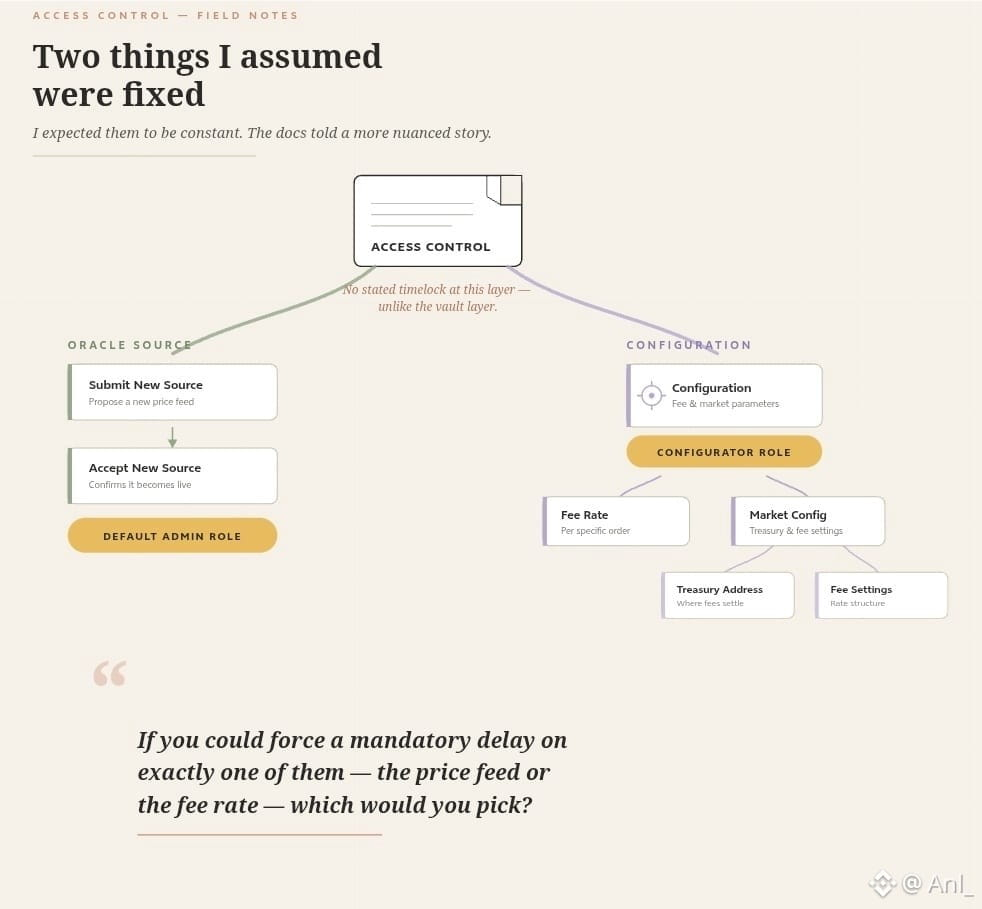
Two things I assumed were fixed
I went into the access-control docs looking for something else and came out with a shorter list of things I'd call constants.
The oracle first. There are two functions, one that submits a new price source for an asset and one that accepts it. Both sit under the default admin role. So the feed deciding whether your position is healthy is a parameter.
Then fees. A configurator role can update the fee rate on a specific order, and update market config including the treasury address and fee settings.
Neither of these is unusual. Every lending protocol has switches like this, and you want them the day a feed starts printing garbage. Morpho, Aave, all of them.
What I couldn't find on that page is a stated waiting period between submitting one of these and accepting it. The vault layer documents its timelock clearly. This layer, I'm not sure — and I'd rather say I'm not sure than guess.
If you could force a mandatory delay on exactly one of them, would you pick the price feed or the fee rate?
#termmax @TermMax $AAVE
I went into the access-control docs looking for something else and came out with a shorter list of things I'd call constants.
The oracle first. There are two functions, one that submits a new price source for an asset and one that accepts it. Both sit under the default admin role. So the feed deciding whether your position is healthy is a parameter.
Then fees. A configurator role can update the fee rate on a specific order, and update market config including the treasury address and fee settings.
Neither of these is unusual. Every lending protocol has switches like this, and you want them the day a feed starts printing garbage. Morpho, Aave, all of them.
What I couldn't find on that page is a stated waiting period between submitting one of these and accepting it. The vault layer documents its timelock clearly. This layer, I'm not sure — and I'd rather say I'm not sure than guess.
If you could force a mandatory delay on exactly one of them, would you pick the price feed or the fee rate?
#termmax @TermMax $AAVE
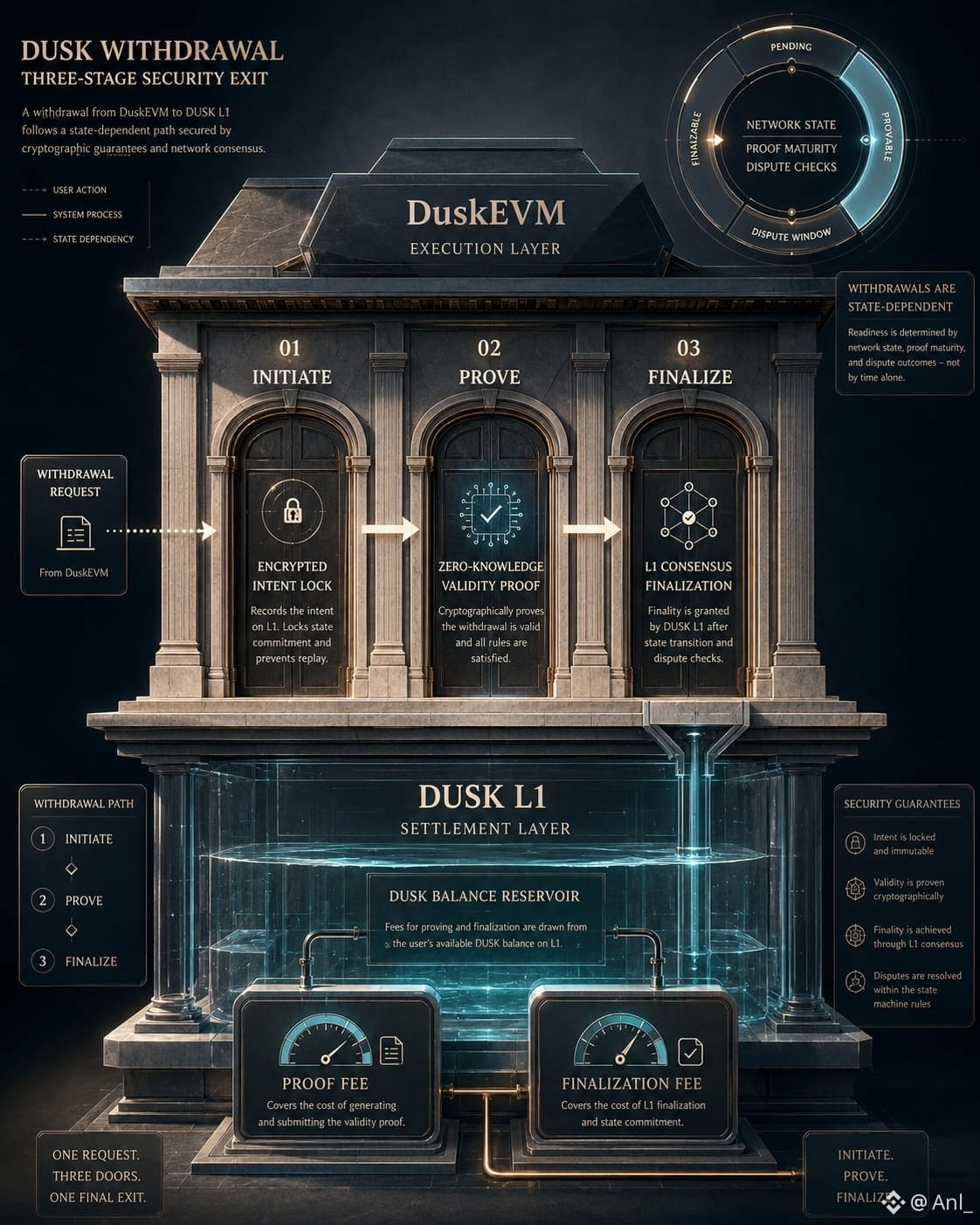
I expected one transaction. I counted three.
That's a DuskEVM bridge withdrawal, straight from Dusk's own guide:
1. Initiate the withdrawal on DuskEVM
2. Prove it on the Dusk L1
3. Finalize it on the Dusk L1
Three on-chain actions, and fees on both sides: the source transaction, then two more on L1.
The instruction I respect most is the one about timing. The docs say withdrawal readiness depends on published network state, proof maturity and dispute-game checks, and that the wallet's status field is authoritative — do not infer readiness from elapsed time. That line exists because rollup withdrawal windows are not clocks, they are state machines. Every integration that hardcoded "wait N minutes, then finalize" eventually breaks: a proposal lands late, a check runs long, and your finalizer submits into a state that isn't ready.
The second detail says more than the step count. The guide tells you to keep enough unshielded DUSK on the L1 to pay for both the proof and the finalization transaction. Sit with that on a chain whose core pitch is confidential transfers: the exit path from its own EVM layer is denominated in transparent balance. Caveat, and it matters — this is the testnet guide, DuskEVM is still labelled Testnet, so the mainnet shape could change.
To be fair, none of this is a Dusk invention. It is standard optimistic-rollup design inherited from the OP Stack, and every OP chain asks the same three actions of you. So the question isn't whether Dusk got something wrong. It's what standard rollup UX does to a chain whose entire differentiator is privacy.
Do privacy-first chains need a fundamentally different bridge design? Or is transparent gas at the settlement layer a fair price to pay for a familiar developer stack?
#dusk $DUSK @Dusk
That's a DuskEVM bridge withdrawal, straight from Dusk's own guide:
1. Initiate the withdrawal on DuskEVM
2. Prove it on the Dusk L1
3. Finalize it on the Dusk L1
Three on-chain actions, and fees on both sides: the source transaction, then two more on L1.
The instruction I respect most is the one about timing. The docs say withdrawal readiness depends on published network state, proof maturity and dispute-game checks, and that the wallet's status field is authoritative — do not infer readiness from elapsed time. That line exists because rollup withdrawal windows are not clocks, they are state machines. Every integration that hardcoded "wait N minutes, then finalize" eventually breaks: a proposal lands late, a check runs long, and your finalizer submits into a state that isn't ready.
The second detail says more than the step count. The guide tells you to keep enough unshielded DUSK on the L1 to pay for both the proof and the finalization transaction. Sit with that on a chain whose core pitch is confidential transfers: the exit path from its own EVM layer is denominated in transparent balance. Caveat, and it matters — this is the testnet guide, DuskEVM is still labelled Testnet, so the mainnet shape could change.
To be fair, none of this is a Dusk invention. It is standard optimistic-rollup design inherited from the OP Stack, and every OP chain asks the same three actions of you. So the question isn't whether Dusk got something wrong. It's what standard rollup UX does to a chain whose entire differentiator is privacy.
Do privacy-first chains need a fundamentally different bridge design? Or is transparent gas at the settlement layer a fair price to pay for a familiar developer stack?
#dusk $DUSK @Dusk
Verified
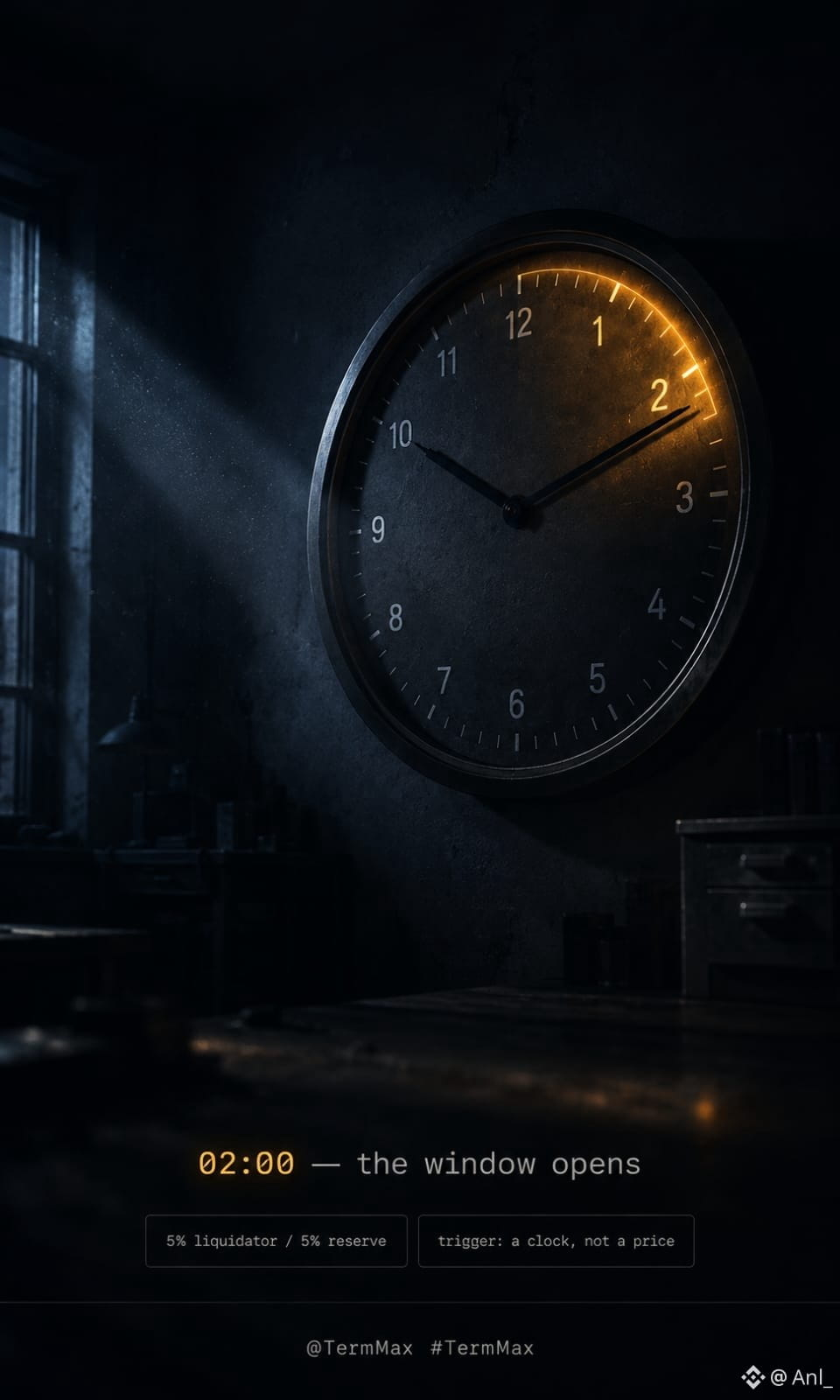
It's 2 a.m. and a @TermMax loan just matured. No repayment came in. For the next two hours, anyone can liquidate it — then the window shuts.
That's odd if you're used to LTV-triggered liquidations. Here the trigger is a clock, not a price. The 10% penalty on liquidated debt isn't really a fee — half goes to whoever closes the position, half to the protocol reserve. It's a bounty for making sure a bot is awake at that exact hour, not whenever price happens to move.
Fine for ETH or a stablecoin. Different story for a PT token or a thin LRT. Two hours is plenty of time to route through a deep pool. It's not much time to unwind real size in collateral that barely trades on a normal day.
TermMax's physical delivery mechanism is supposed to hand lenders a pro-rata slice of collateral if the window closes without a clean liquidation. What I'm not sure of is how automatic that handoff actually is — that's the part of the docs I keep rereading.
Either way, the risk doesn't vanish at the two-hour mark. It moves from the liquidator to the lender.
Which collateral would you not want to be holding when that window opens, and why?
#termmax @TermMax
That's odd if you're used to LTV-triggered liquidations. Here the trigger is a clock, not a price. The 10% penalty on liquidated debt isn't really a fee — half goes to whoever closes the position, half to the protocol reserve. It's a bounty for making sure a bot is awake at that exact hour, not whenever price happens to move.
Fine for ETH or a stablecoin. Different story for a PT token or a thin LRT. Two hours is plenty of time to route through a deep pool. It's not much time to unwind real size in collateral that barely trades on a normal day.
TermMax's physical delivery mechanism is supposed to hand lenders a pro-rata slice of collateral if the window closes without a clean liquidation. What I'm not sure of is how automatic that handoff actually is — that's the part of the docs I keep rereading.
Either way, the risk doesn't vanish at the two-hour mark. It moves from the liquidator to the lender.
Which collateral would you not want to be holding when that window opens, and why?
#termmax @TermMax
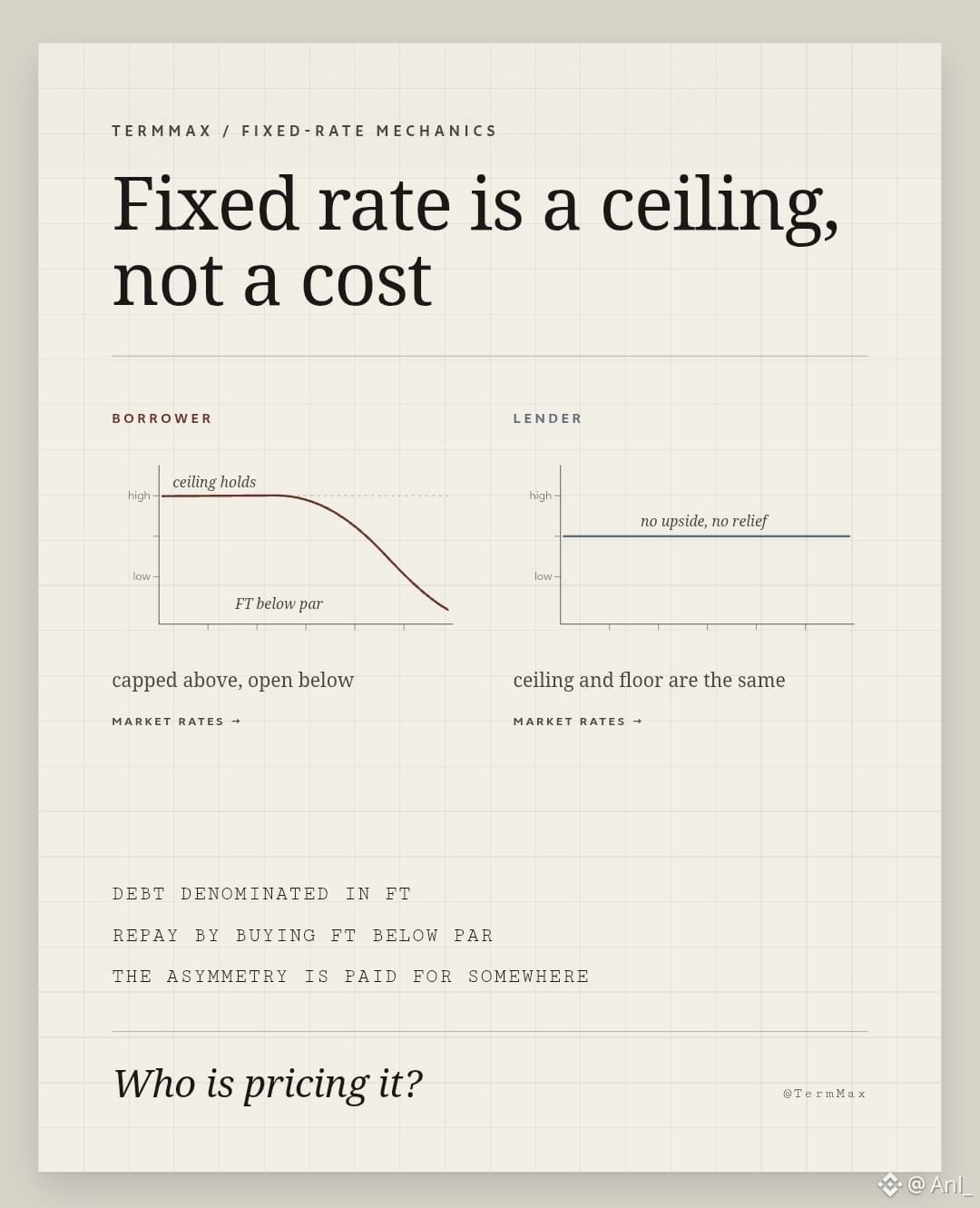
Everyone sells fixed-rate borrowing as certainty. After a few hours in the docs I think that framing actually undersells what @TermMax built — and it hides a question nobody in this campaign is asking.
Here's the line I got stuck on. On #termmax your debt isn't just a number sitting in a contract. It's denominated in FT, the fixed-rate token, and repayment can be settled by buying FT off the open market instead of paying face value.
Sit with that for a second.
You lock collateral into a Gearing Token, mint FT against it, sell the interest leg, and walk away with liquidity at a rate agreed on day one. The entire term's interest is baked into the debt from the first block. No accrual, no resets, nothing drifting while you sleep.
Then market rates rise. Every FT in that market — including the one representing your own liability — starts trading at a deeper discount. And because the debt is FT, you can buy it back below par and settle for less than the rate you originally locked.
So the fixed rate isn't a fixed cost. It's a ceiling. Locked at the top, open underneath.
Now flip to the lender. They hold a zero-coupon claim that redeems 1:1 at maturity. Rates rise, their FT is worth less if they want an early exit, and holding to maturity returns exactly par. Ceiling and floor are the same number. The borrower has convexity. The lender doesn't.
That asymmetry doesn't disappear just because no dashboard displays it. It gets paid for somewhere. Either it's already inside the discount lenders demand at issuance meaning the fixed rate borrowers see is quietly carrying an option premium - or it isn't priced at all, and borrowers hold a free rate option that curators and order makers are funding without labelling it.
The second version is the one I'd want ruled out before scaling size into a vault. Rate curves in DeFi usually get set from utilisation and yield expectations, not from optionality.
So a real question for anyone placing lending range orders here do you widen your curve for borrowers buying their debt back cheap, or is that still invisible in your pricing?
Here's the line I got stuck on. On #termmax your debt isn't just a number sitting in a contract. It's denominated in FT, the fixed-rate token, and repayment can be settled by buying FT off the open market instead of paying face value.
Sit with that for a second.
You lock collateral into a Gearing Token, mint FT against it, sell the interest leg, and walk away with liquidity at a rate agreed on day one. The entire term's interest is baked into the debt from the first block. No accrual, no resets, nothing drifting while you sleep.
Then market rates rise. Every FT in that market — including the one representing your own liability — starts trading at a deeper discount. And because the debt is FT, you can buy it back below par and settle for less than the rate you originally locked.
So the fixed rate isn't a fixed cost. It's a ceiling. Locked at the top, open underneath.
Now flip to the lender. They hold a zero-coupon claim that redeems 1:1 at maturity. Rates rise, their FT is worth less if they want an early exit, and holding to maturity returns exactly par. Ceiling and floor are the same number. The borrower has convexity. The lender doesn't.
That asymmetry doesn't disappear just because no dashboard displays it. It gets paid for somewhere. Either it's already inside the discount lenders demand at issuance meaning the fixed rate borrowers see is quietly carrying an option premium - or it isn't priced at all, and borrowers hold a free rate option that curators and order makers are funding without labelling it.
The second version is the one I'd want ruled out before scaling size into a vault. Rate curves in DeFi usually get set from utilisation and yield expectations, not from optionality.
So a real question for anyone placing lending range orders here do you widen your curve for borrowers buying their debt back cheap, or is that still invisible in your pricing?
#dusk $DUSK @Dusk Dusk's confidentiality setup actually runs in two separate tracks. On DuskDS, the Phoenix model represents value as notes committed into a Merkle tree — spending a note doesn't point to which note is being spent. Instead, the sender publishes a nullifier and a zero-knowledge proof showing the spend is valid, ownership is real, and no value was created out of nothing, without revealing the underlying note. Alongside it, Moonlight runs as a transparent, account-based model on the same chain.
On DuskEVM, though, privacy comes from a completely different toolset — a module called Hedger, which combines ElGamal-based homomorphic encryption with zero-knowledge proofs, plus a hybrid UTXO/account structure. Here a user interacts with contracts through a standard EVM address, while a separate Hedger address handles encrypted balances, with compliance enforced through allowlisting.
These aren't two versions of the same idea. Phoenix is a note-based proof system; Hedger computes directly on encrypted balances, verified through zero-knowledge proofs. The likely reason for the split is that note-based privacy doesn't fit naturally into an account-based EVM structure, so a different approach was needed there.
Running two independent cryptographic privacy stacks in parallel means a larger attack surface and a heavier audit burden. It's also not clear how the privacy guarantee is preserved when value moves between the two layers.
Does maintaining two separate confidentiality engines multiply the audit burden proportionally, or does the shared reliance on zero-knowledge proofs mean the second engine's incremental cost is actually lower than it looks?
On DuskEVM, though, privacy comes from a completely different toolset — a module called Hedger, which combines ElGamal-based homomorphic encryption with zero-knowledge proofs, plus a hybrid UTXO/account structure. Here a user interacts with contracts through a standard EVM address, while a separate Hedger address handles encrypted balances, with compliance enforced through allowlisting.
These aren't two versions of the same idea. Phoenix is a note-based proof system; Hedger computes directly on encrypted balances, verified through zero-knowledge proofs. The likely reason for the split is that note-based privacy doesn't fit naturally into an account-based EVM structure, so a different approach was needed there.
Running two independent cryptographic privacy stacks in parallel means a larger attack surface and a heavier audit burden. It's also not clear how the privacy guarantee is preserved when value moves between the two layers.
Does maintaining two separate confidentiality engines multiply the audit burden proportionally, or does the shared reliance on zero-knowledge proofs mean the second engine's incremental cost is actually lower than it looks?
#dusk $DUSK @Dusk
I went looking for how DUSK's staking rewards are actually funded, expecting something similar to most PoS chains I've seen — either a fixed high inflation rate early on, or rewards funded almost entirely by transaction fees from day one. What Dusk does is neither.
Rewards are funded by an emission of 500 million DUSK released over 36 years, following a geometric decay curve that halves roughly every four years. It's a long, slow taper rather than a front-loaded reward pool or an aggressive early cliff.
What made me pause is the mismatch between that emission horizon and the pace crypto usually runs at. Most token reward schedules are built around getting through the first few volatile years — bootstrap fast, taper fast, let fees take over quickly. A 36-year curve is closer to the timeline of a pension fund than a typical validator incentive program, and that seems less like an oversight and more like a signal about what kind of adoption the protocol is actually betting on: regulated financial infrastructure, which tends to move in years and decades rather than in market cycles.
The tension is in the gap between now and later. Institutional adoption of tokenized securities and compliant on-chain settlement doesn't happen overnight, and transaction fee revenue from that kind of activity is presumably still early relative to where the protocol eventually wants it to be. In the meantime, validators are being paid mostly from emissions rather than usage, which is a normal early-stage state for a PoS chain but a strange thing to reconcile with a 36-year design horizon.
I don't think a long emission curve is inherently a weakness — long timelines are honest about how slowly regulated finance actually moves. But it does raise the question of whether staking economics built for a decades-long institutional adoption curve can keep validators engaged during the years before that adoption curve actually shows up in fee revenue.
I went looking for how DUSK's staking rewards are actually funded, expecting something similar to most PoS chains I've seen — either a fixed high inflation rate early on, or rewards funded almost entirely by transaction fees from day one. What Dusk does is neither.
Rewards are funded by an emission of 500 million DUSK released over 36 years, following a geometric decay curve that halves roughly every four years. It's a long, slow taper rather than a front-loaded reward pool or an aggressive early cliff.
What made me pause is the mismatch between that emission horizon and the pace crypto usually runs at. Most token reward schedules are built around getting through the first few volatile years — bootstrap fast, taper fast, let fees take over quickly. A 36-year curve is closer to the timeline of a pension fund than a typical validator incentive program, and that seems less like an oversight and more like a signal about what kind of adoption the protocol is actually betting on: regulated financial infrastructure, which tends to move in years and decades rather than in market cycles.
The tension is in the gap between now and later. Institutional adoption of tokenized securities and compliant on-chain settlement doesn't happen overnight, and transaction fee revenue from that kind of activity is presumably still early relative to where the protocol eventually wants it to be. In the meantime, validators are being paid mostly from emissions rather than usage, which is a normal early-stage state for a PoS chain but a strange thing to reconcile with a 36-year design horizon.
I don't think a long emission curve is inherently a weakness — long timelines are honest about how slowly regulated finance actually moves. But it does raise the question of whether staking economics built for a decades-long institutional adoption curve can keep validators engaged during the years before that adoption curve actually shows up in fee revenue.
There's a particular kind of quiet that shows up in infrastructure projects, and it's worth learning to read correctly. It's not the same as failure. But it's not obviously success either.
Dusk has been on mainnet for a while now. The technical case is coherent confidential smart contracts, the XSC standard, selective disclosure all built around a specific, real problem that regulated finance genuinely has. And yet, when you look at actual network activity, most of what's happening is staking. Confidential contracts, real securities issuance — still uncommon, by most available signals.
That gap between what the infrastructure is capable of and what's actually running on it deserves to be sat with, rather than explained away too quickly.
A few things do work in its favor, and they're worth naming plainly. Early vesting has already run its course, so there isn't a looming unlock event distorting supply expectations. Partnerships with licensed venues give the regulatory positioning something closer to grounding than aspiration. And by most technical accounts, the infrastructure layer itself isn't the weak point this doesn't read as a story
The harder question is about incentive alignment. The institutions best positioned to actually use this kind of privacy-and-compliance infrastructure may never need to hold large amounts of the token itself their exposure could stay minimal, just enough for operational use. Meanwhile, the people who do hold the token are absorbing ongoing emissions, waiting on volume that hasn't shown up yet in meaningful size. Two very different relationships to the same asset, without an obvious mechanism pulling them into alignment
That's not a criticism of the design. It's just an honest description of where things currently stand technically capable, financially still waiting on proof.
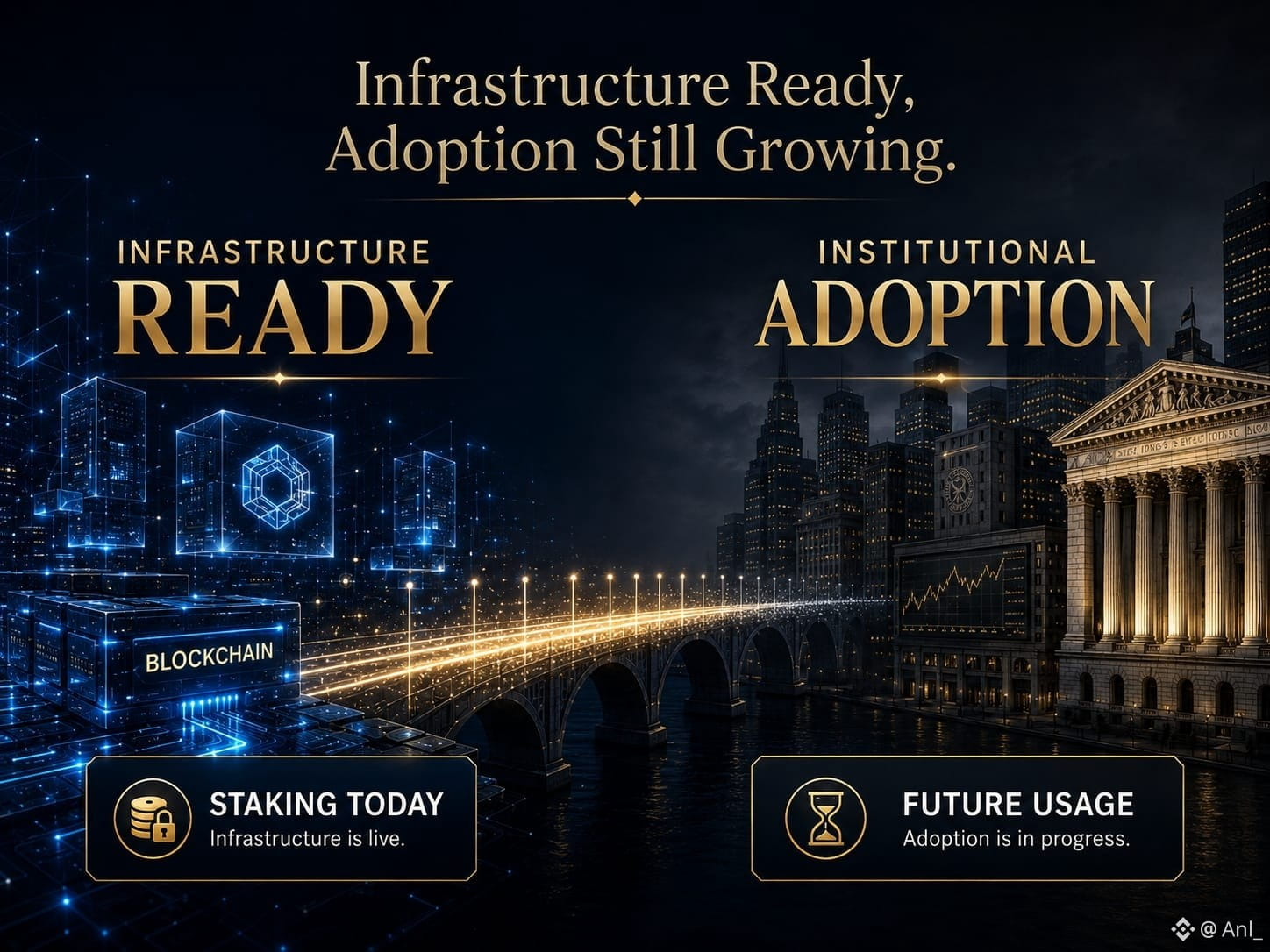
The question no one can really answer yet, including the project itself, is how long "the infrastructure is ready can remain a satisfying answer before the market starts demanding the infrastructure is being used.
@Dusk #dusk $DUSK
Dusk has been on mainnet for a while now. The technical case is coherent confidential smart contracts, the XSC standard, selective disclosure all built around a specific, real problem that regulated finance genuinely has. And yet, when you look at actual network activity, most of what's happening is staking. Confidential contracts, real securities issuance — still uncommon, by most available signals.
That gap between what the infrastructure is capable of and what's actually running on it deserves to be sat with, rather than explained away too quickly.
A few things do work in its favor, and they're worth naming plainly. Early vesting has already run its course, so there isn't a looming unlock event distorting supply expectations. Partnerships with licensed venues give the regulatory positioning something closer to grounding than aspiration. And by most technical accounts, the infrastructure layer itself isn't the weak point this doesn't read as a story
The harder question is about incentive alignment. The institutions best positioned to actually use this kind of privacy-and-compliance infrastructure may never need to hold large amounts of the token itself their exposure could stay minimal, just enough for operational use. Meanwhile, the people who do hold the token are absorbing ongoing emissions, waiting on volume that hasn't shown up yet in meaningful size. Two very different relationships to the same asset, without an obvious mechanism pulling them into alignment
That's not a criticism of the design. It's just an honest description of where things currently stand technically capable, financially still waiting on proof.
The question no one can really answer yet, including the project itself, is how long "the infrastructure is ready can remain a satisfying answer before the market starts demanding the infrastructure is being used.
@Dusk #dusk $DUSK
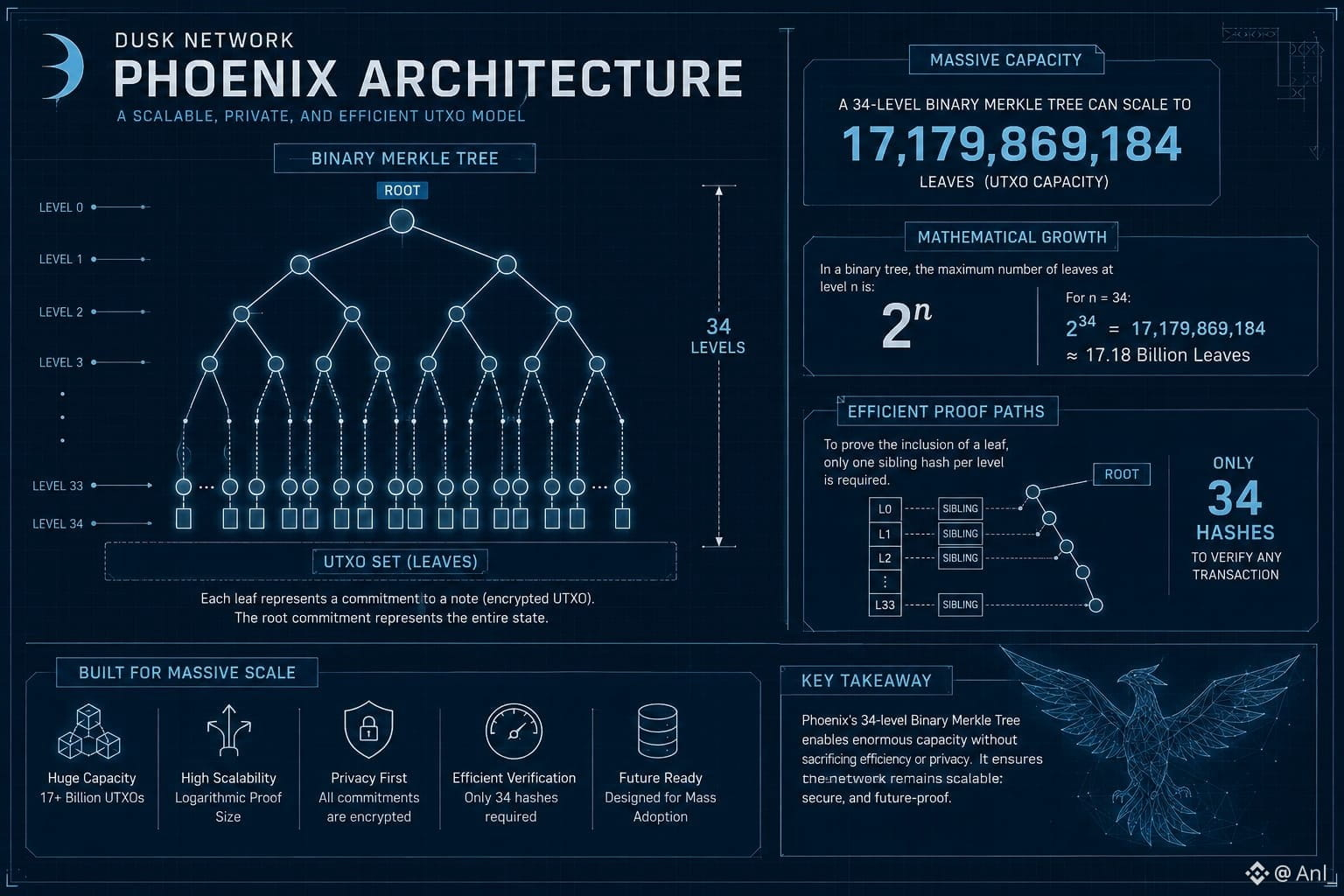
One number stopped me: capacity for over 17 billion leaves, from a tree that's only 34 levels deep.
Dusk's Phoenix model uses a binary Merkle tree to hold the proof for every note, and that's where the real trick sits — capacity grows exponentially while the inclusion path only grows linearly. Go from depth 34 to 35 and capacity doubles, but the proof path only gets a few percent longer. That asymmetry matters a lot for a privacy-focused chain, since every transaction carries a zero-knowledge proof, and the smaller that proof stays, the better.
But the size of the number is only a theoretical ceiling. What actually determines how long that capacity lasts is how fast new notes are being created in practice. At low transaction throughput, the tree could take decades to fill. If adoption spikes, that same capacity could come under real pressure in a matter of months.
That raises the more interesting question — what happens as the tree fills up? Archival storage, proving costs, state sync — do these scale gracefully alongside note creation, or does something start to strain first? A huge number looks impressive on paper, but long-term usability depends on how that number gets used, not just how big it is.
Is having a mathematically enormous capacity the same thing as staying comfortable to operate under years of real usage?
#dusk $DUSK @Dusk
Dusk's Phoenix model uses a binary Merkle tree to hold the proof for every note, and that's where the real trick sits — capacity grows exponentially while the inclusion path only grows linearly. Go from depth 34 to 35 and capacity doubles, but the proof path only gets a few percent longer. That asymmetry matters a lot for a privacy-focused chain, since every transaction carries a zero-knowledge proof, and the smaller that proof stays, the better.
But the size of the number is only a theoretical ceiling. What actually determines how long that capacity lasts is how fast new notes are being created in practice. At low transaction throughput, the tree could take decades to fill. If adoption spikes, that same capacity could come under real pressure in a matter of months.
That raises the more interesting question — what happens as the tree fills up? Archival storage, proving costs, state sync — do these scale gracefully alongside note creation, or does something start to strain first? A huge number looks impressive on paper, but long-term usability depends on how that number gets used, not just how big it is.
Is having a mathematically enormous capacity the same thing as staying comfortable to operate under years of real usage?
#dusk $DUSK @Dusk
Pulled current numbers before writing this, so here's what's actually on the tape today: DUSK trading around $0.065–0.066, roughly $32–33M market cap on CoinMarketCap's read, with 24h volume sitting in the $3.5–4.8M range depending on which aggregator you trust — CoinGecko's pulling from 45 exchanges and 51 markets, CoinCodex is closer to $4.8M. That spread alone tells you something: liquidity is thin enough that which data source you check changes the story by 30%.
Circulating supply estimates also disagree — CMC has it near 497M, CoinGecko closer to 590M — against a 1B max supply, meaning somewhere between half and 60% of total supply is already unlocked and trading.
Zoom out and the price action tells a rougher story than the fundamentals narrative. DUSK broke an 8-month downtrend in January 2026, spiked over $0.30 post-mainnet, then gave almost all of it back — trading down near $0.10 by late April, and now consolidating in the $0.06 range. That's a roughly 80%+ retrace from the January high while the actual development narrative — mainnet live, DuskEVM testnet progressing, NPEX tokenization ongoing — kept moving forward largely uninterrupted.
That divergence is the actual story, not the price itself. Development velocity and price velocity decoupled hard sometime around Q1, and they haven't reconverged. Either the market already priced in everything the roadmap promises and is now waiting for delivered TVL, or the RWA narrative simply isn't liquid enough yet to move a $32M-cap asset on fundamentals alone.
Which side of that gap do you think closes first — does real NPEX volume finally show up on-chain, or does the price just keep drifting until it does?
#dusk $DUSK @Dusk
Circulating supply estimates also disagree — CMC has it near 497M, CoinGecko closer to 590M — against a 1B max supply, meaning somewhere between half and 60% of total supply is already unlocked and trading.
Zoom out and the price action tells a rougher story than the fundamentals narrative. DUSK broke an 8-month downtrend in January 2026, spiked over $0.30 post-mainnet, then gave almost all of it back — trading down near $0.10 by late April, and now consolidating in the $0.06 range. That's a roughly 80%+ retrace from the January high while the actual development narrative — mainnet live, DuskEVM testnet progressing, NPEX tokenization ongoing — kept moving forward largely uninterrupted.
That divergence is the actual story, not the price itself. Development velocity and price velocity decoupled hard sometime around Q1, and they haven't reconverged. Either the market already priced in everything the roadmap promises and is now waiting for delivered TVL, or the RWA narrative simply isn't liquid enough yet to move a $32M-cap asset on fundamentals alone.
Which side of that gap do you think closes first — does real NPEX volume finally show up on-chain, or does the price just keep drifting until it does?
#dusk $DUSK @Dusk
I was ready to invest, but I backed off after seeing the warning signs.

bro_sf
·
--
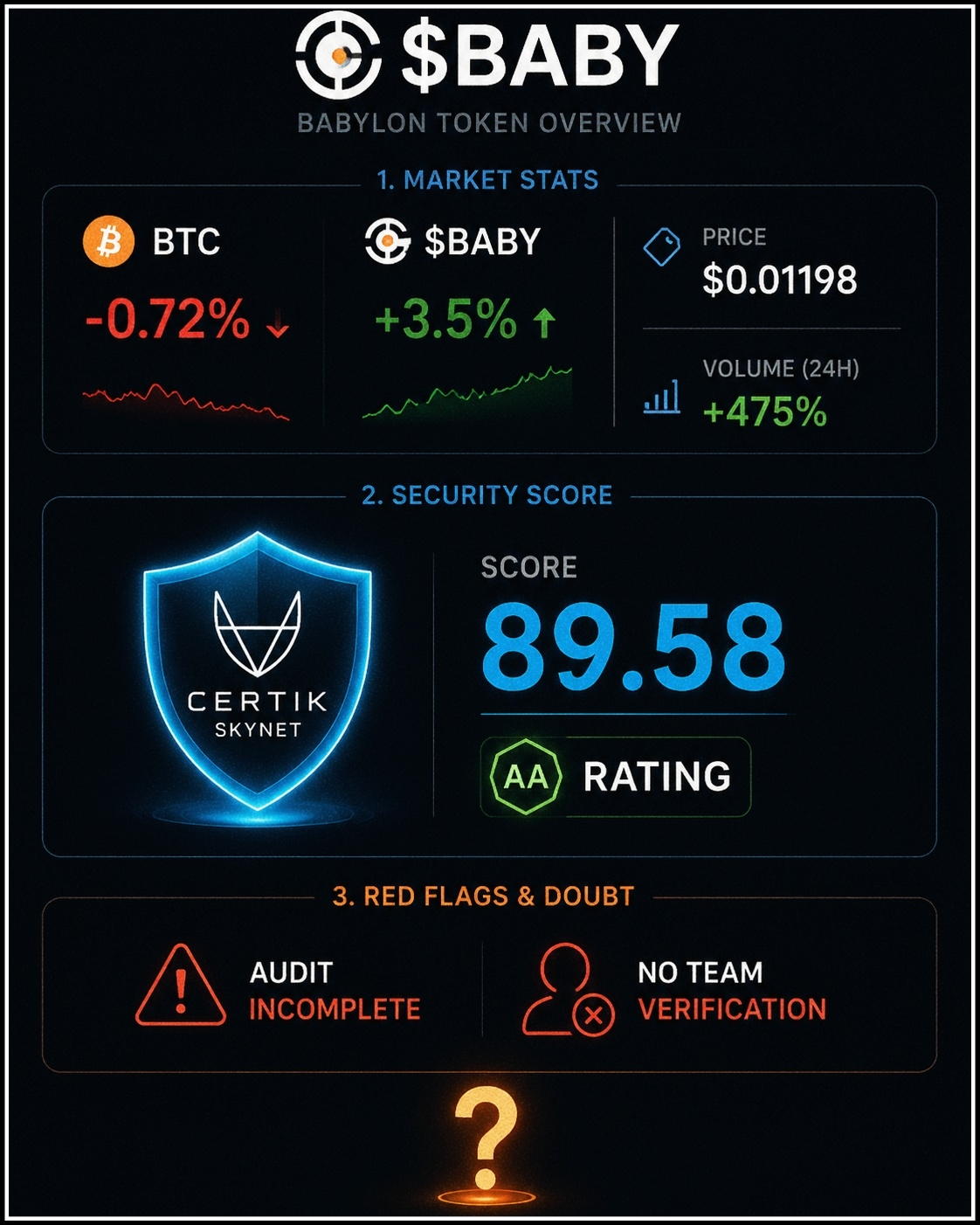
I couldn't sleep last night, so I was wondering what to do, should I watch a movie or do some work? Then I thought I would take a look at the crypto market, then I opened the coinmarketcap apps, then I saw that today the btc market is down 0.72%, then I saw that $BABY token is up 3.5% at 0.01199$, the price is going up market cap 51.22m 24h volume 52.11m which is 24th 475% volume up. I was thinking that I would get out just by looking at the price. But for a few days, @BabylonLabs_io has been coming up in front of my eyes again and again, so I wanted to see more details about the project, then I went to the Certik.Skynet audit page. After that, I was shocked to see the score. The 89.58 AA rating score seemed to be in good condition in the security section. There are also some third-party audits. Looking a little further down on the Certik page, I see that the Certik audit has not been completed yet, there is no team verification, and the rating is also showing as partial. So a question arose in my mind. It sounds quite strong. But I still have doubts in my mind why these are not completed despite being such a good project. I saw from the Certik page that the audit has not been completed yet. Maybe there are enough reasons behind this, which we do not know, but as a common user, this thing has aroused my curiosity, now do you think it would have been better if there were these on this subject? Or is the little that is there enough?
#baby $BABY
#baby $BABY
?
bro_sf
·
--
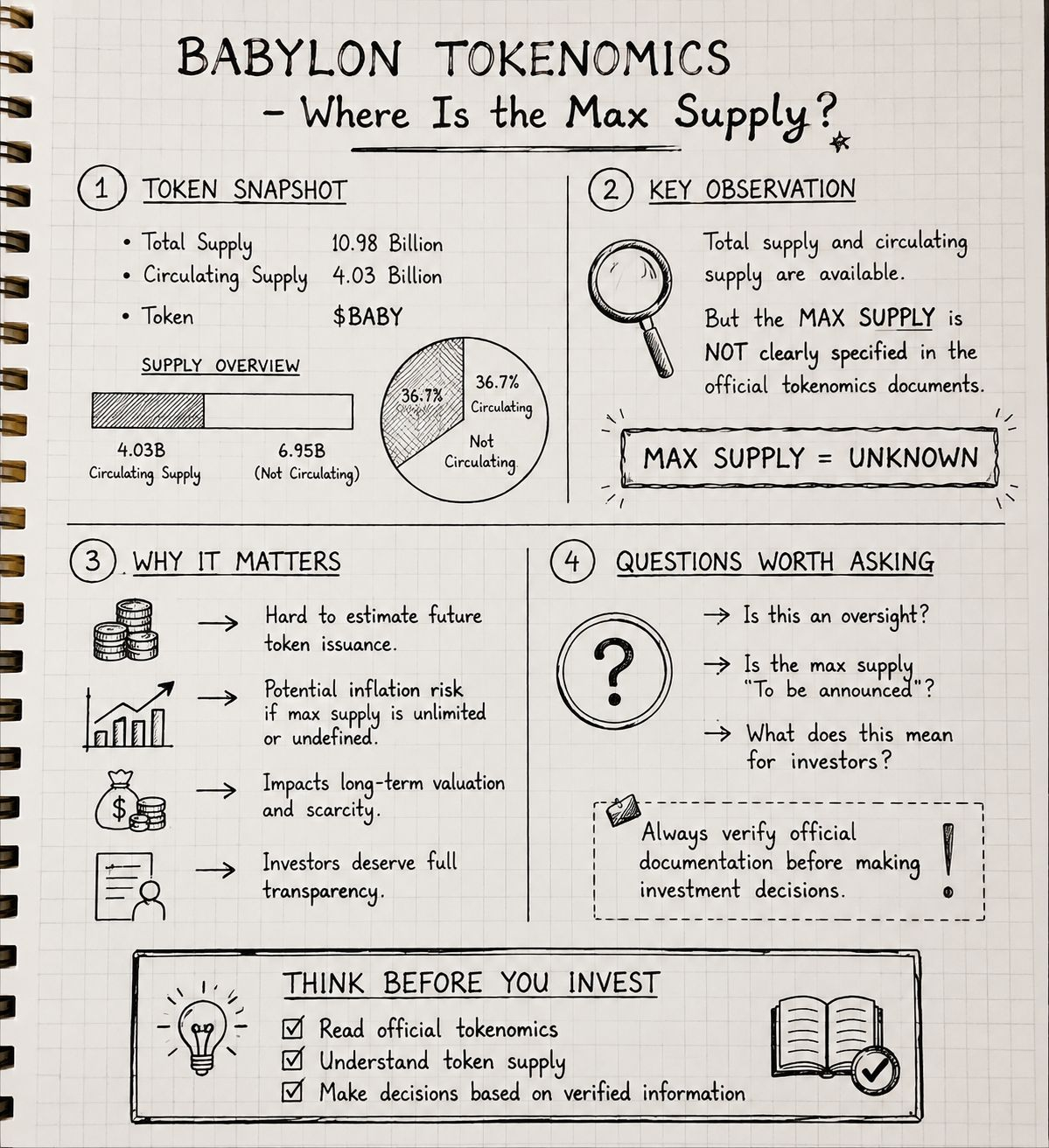
BearishWhile looking through Babylon’s tokenomics, one thing really caught my attention. According to the available information, the total supply is 10.98 billion, with roughly4.03 billion tokens in circulation. But for a project of this scale, it’s surprising that there’s no clear mention of the maximum supply in the official tokenomics. That makes me wonder, is this simply an oversight or is there a reason why this information hasn’t been clearly disclosed yet? Knowing the max supply matters because it helps investors assess future token issuance, possible inflation, and long-term valuation. That’s why it’s always worth taking the time to dig through official documents instead of relying on hype. What’s your take? Do you think the missing max supply is just an oversight or could there be another explanation?
@BabylonLabs_io #baby $BABY $BTC
@BabylonLabs_io #baby $BABY $BTC
good 😊
bro_sf
·
--
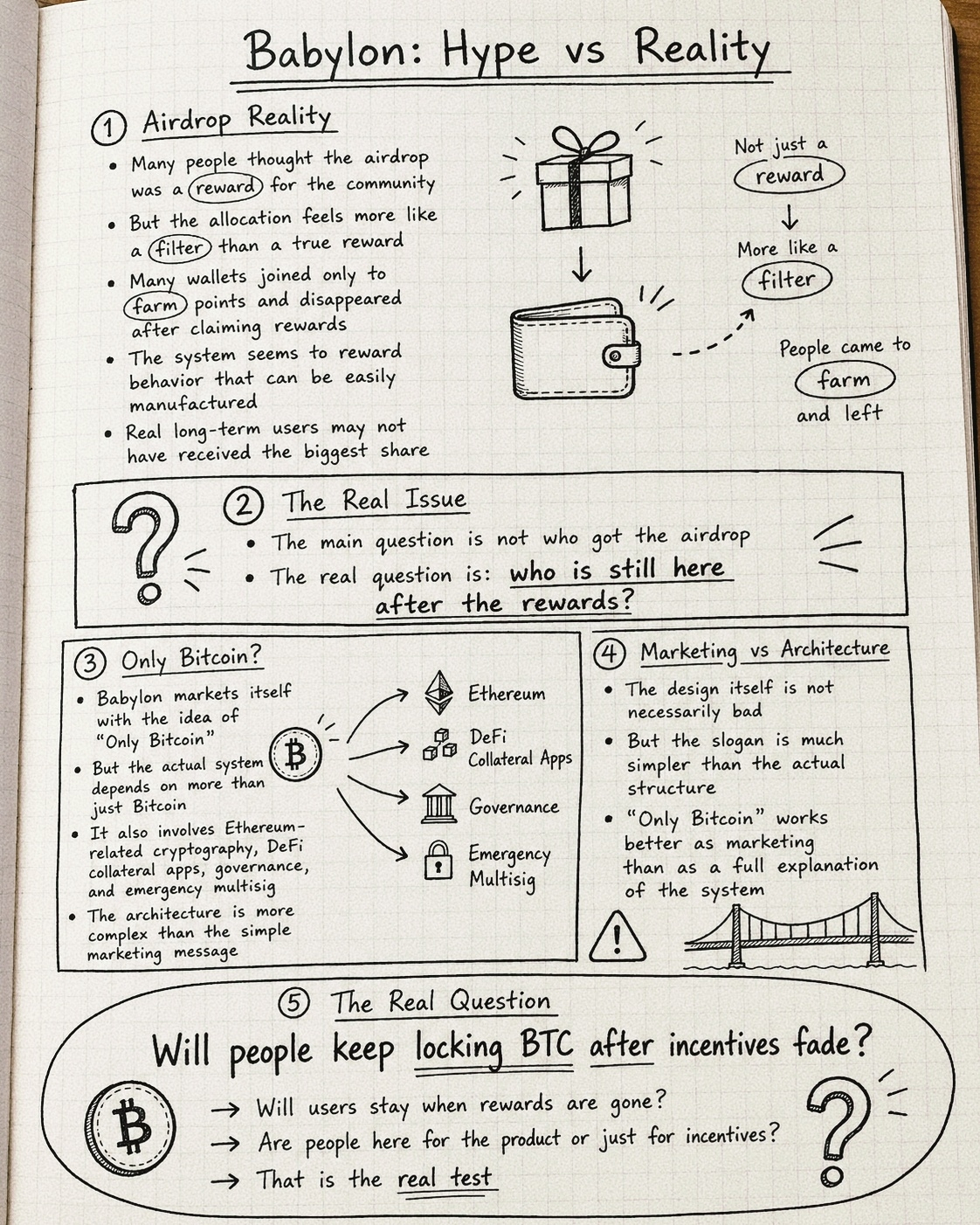
There are some questions that keep coming to my mind about Babylon. What is shown on the outside and what is going on inside are not the same. Many people thought this airdrop was a reward for the community, but when you look at the allocation, it looks a little different. Many wallets have left with the rewards after farming for a short time, and those who have actually been there for a long time have not received much. So my question is not who got it, but who is actually staying after the rewards are over. Another thing is the word "only Bitcoin". It sounds good, but looking at the documents, it is clear that in addition to Bitcoin, Ethereum and some DeFi apps are also being relied on here. Governance and emergency multisig are still there. I am not saying that the design is bad, but there is a slight difference between marketing and reality. In the end, the question is, will people keep locking up Bitcoin despite knowing all this, or will interest also disappear when profits decrease. I think that is where the real test lies.
@BabylonLabs_io #baby $BABY
@BabylonLabs_io #baby $BABY
Log in to explore more content