
AL Roo
4.7k Posts

AL Roo
 Square Verified+
Crypto Trader | Web3 Enthusiast | Binance Square KoL
54 Following
31.2K+ Followers
40.9K+ Liked
Posts
All
Live
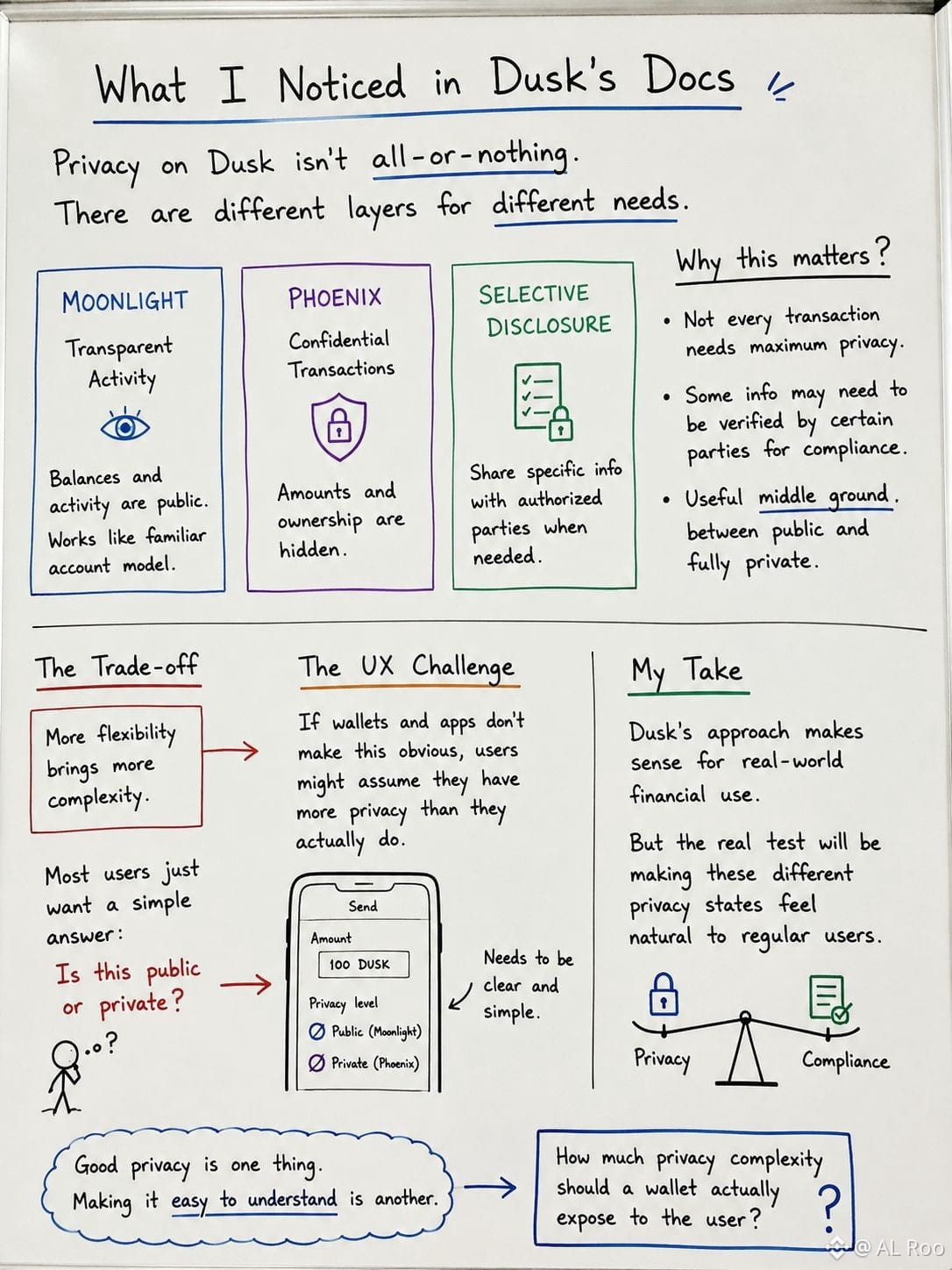
I was reading through Dusk’s docs again and one small detail ended up being more interesting to me than the bigger “privacy blockchain” narrative.
Privacy on Dusk isn’t really one fixed mode.
There’s Moonlight for transparent activity and Phoenix for confidential transactions. At first I wondered why they’d bother keeping both. If privacy is such a big part of Dusk, wouldn’t it make more sense to just hide everything?
After reading a bit more, the reasoning started to make sense.
Financial applications don’t always need maximum privacy. Sometimes a transaction can be public. Other times the amount or ownership information shouldn’t be visible to everyone, but certain details may still need to be disclosed to an authorized party for compliance.
That middle ground is probably more useful in practice than simply making everything public or everything private.
But I can also see where this could get confusing.
Most people using a wallet aren't going to study the difference between Moonlight and Phoenix before sending something. They’ll probably just want a clear answer to a basic question: is what I’m doing public or private?
So for me, the interesting part isn’t only whether Dusk’s privacy technology works underneath. It’s whether wallets and apps built on it can make these choices obvious without forcing users to understand the technical architecture.
Good privacy can get surprisingly complicated when you also need compliance.
Maybe the real UX test for Dusk will be making that complexity something users barely notice.
Would you rather choose your privacy level manually, or have the application handle it automatically?
@Dusk #dusk $DUSK
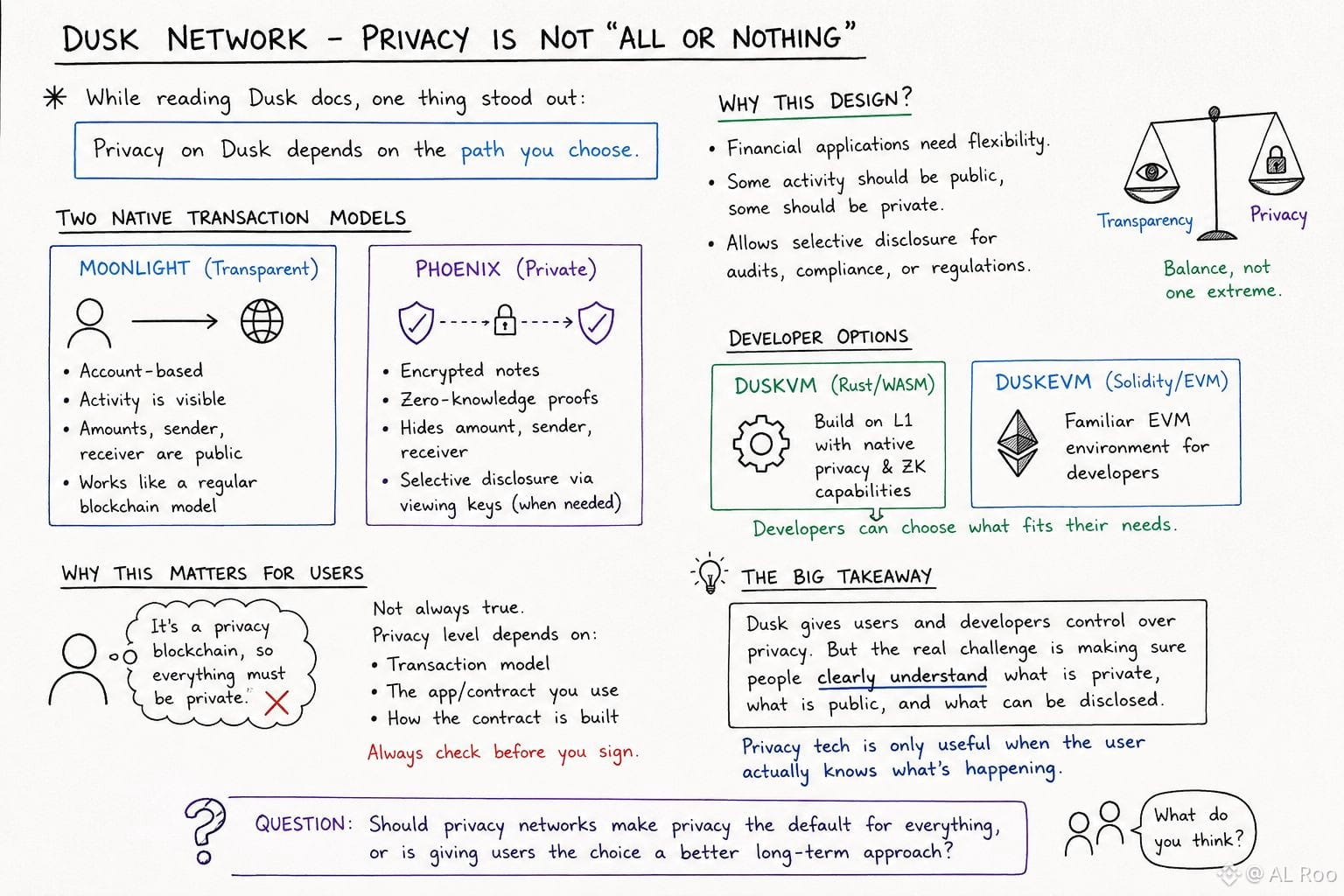
Privacy on Dusk isn’t really one fixed mode.
There’s Moonlight for transparent activity and Phoenix for confidential transactions. At first I wondered why they’d bother keeping both. If privacy is such a big part of Dusk, wouldn’t it make more sense to just hide everything?
After reading a bit more, the reasoning started to make sense.
Financial applications don’t always need maximum privacy. Sometimes a transaction can be public. Other times the amount or ownership information shouldn’t be visible to everyone, but certain details may still need to be disclosed to an authorized party for compliance.
That middle ground is probably more useful in practice than simply making everything public or everything private.
But I can also see where this could get confusing.
Most people using a wallet aren't going to study the difference between Moonlight and Phoenix before sending something. They’ll probably just want a clear answer to a basic question: is what I’m doing public or private?
So for me, the interesting part isn’t only whether Dusk’s privacy technology works underneath. It’s whether wallets and apps built on it can make these choices obvious without forcing users to understand the technical architecture.
Good privacy can get surprisingly complicated when you also need compliance.
Maybe the real UX test for Dusk will be making that complexity something users barely notice.
Would you rather choose your privacy level manually, or have the application handle it automatically?
@Dusk #dusk $DUSK
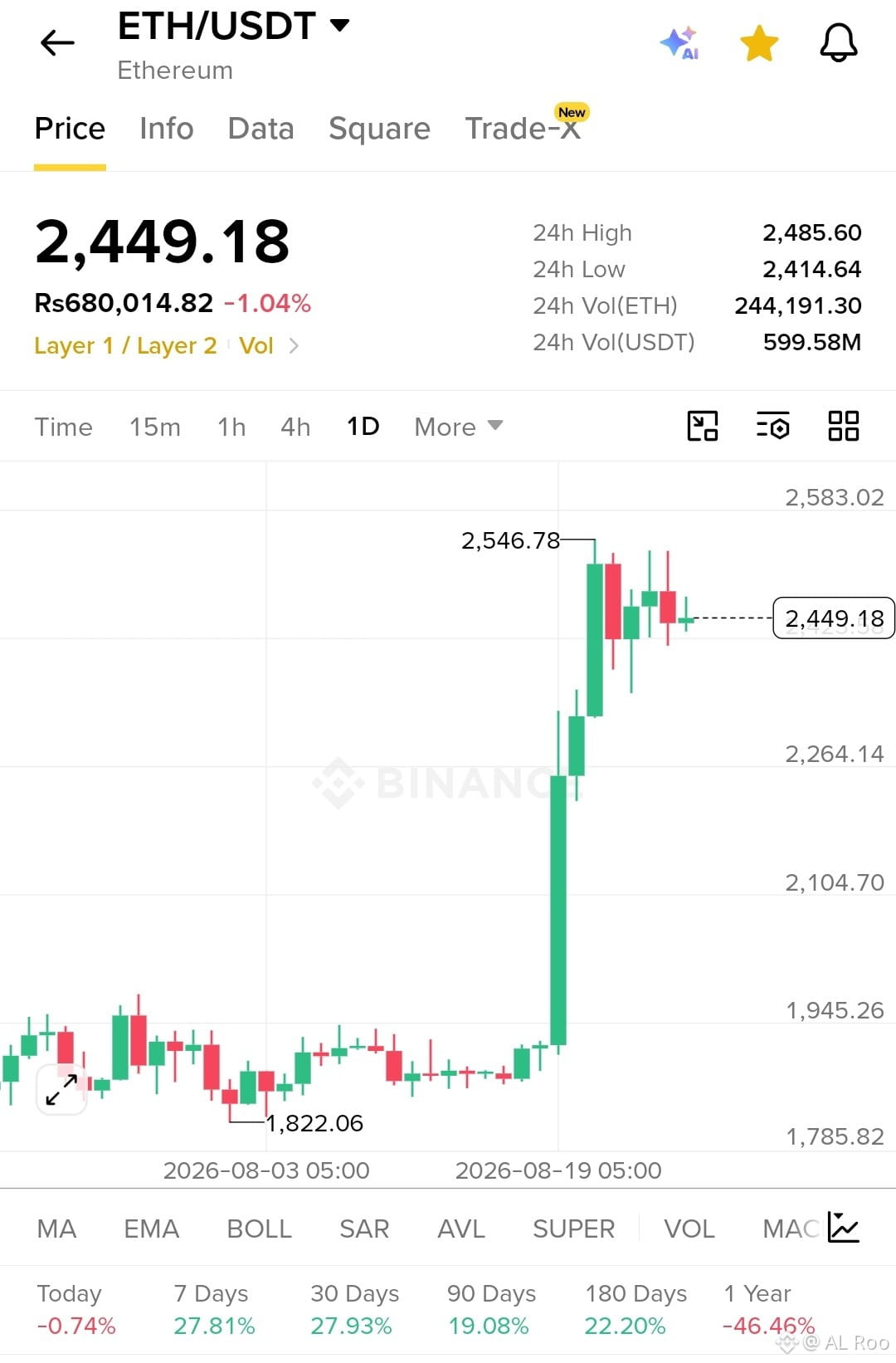
$ETH is showing strong momentum.
Buyers are still holding control of the structure.
EP
$2,420 - $2,455
TP
$2,485
$2,545
$2,580
SL
$2,385
Liquidity is building above the current range. A strong reaction from the entry zone can keep the bullish structure intact and open the way toward the recent high and upper liquidity levels.
Let’s go $ETH
Buyers are still holding control of the structure.
EP
$2,420 - $2,455
TP
$2,485
$2,545
$2,580
SL
$2,385
Liquidity is building above the current range. A strong reaction from the entry zone can keep the bullish structure intact and open the way toward the recent high and upper liquidity levels.
Let’s go $ETH
Verified
I was reading through Dusk’s docs and one thing made me look at the whole “privacy blockchain” description a little differently.
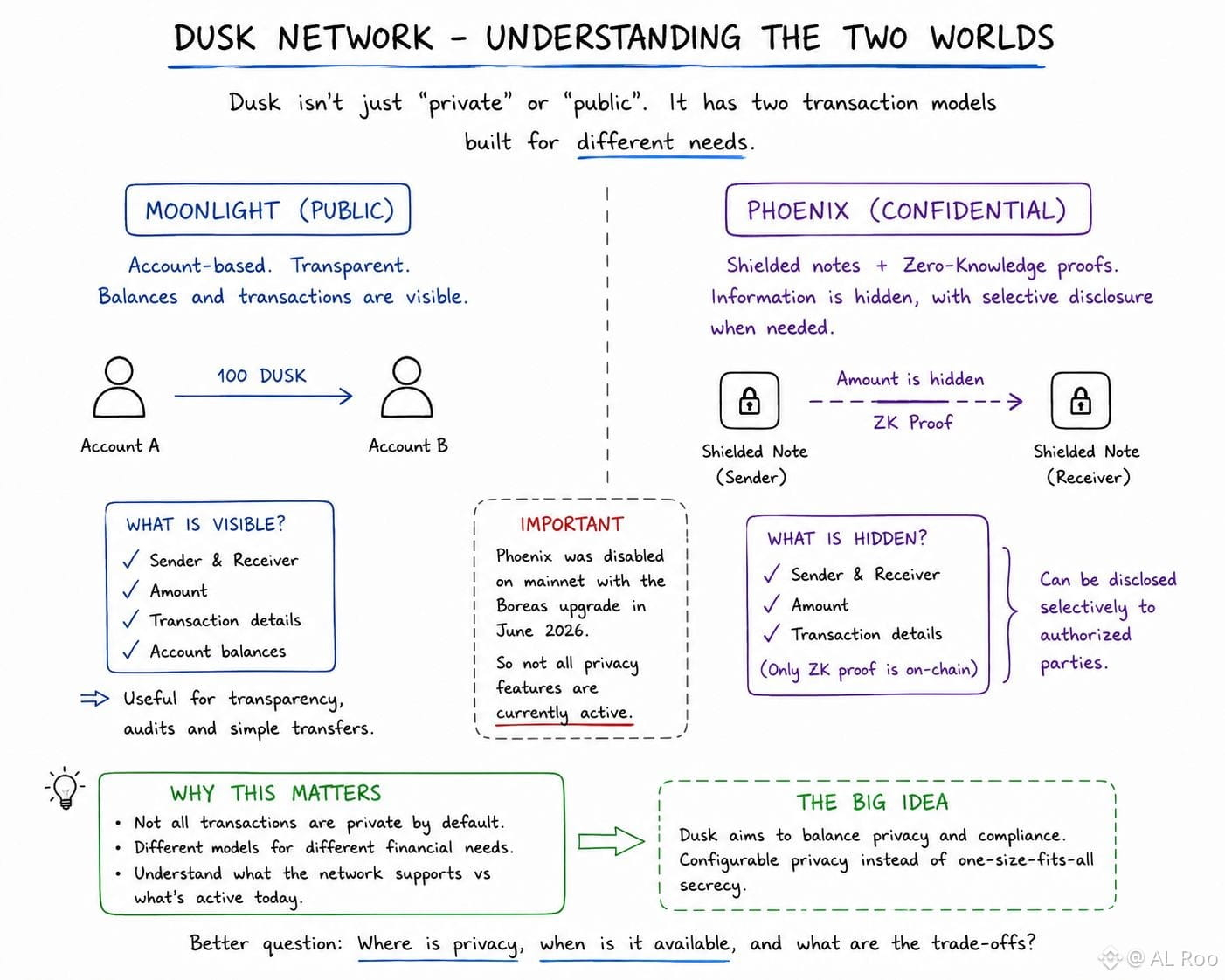
Dusk actually separates transactions into different models. Moonlight is public and account-based, while Phoenix was built around shielded notes and zero-knowledge proofs. I initially assumed privacy would simply be the default across the network, so this distinction was interesting.
And honestly, the reasoning makes sense for something focused on financial applications. Not every financial transaction needs the same level of privacy. Sometimes transparency is useful, while in other cases you want sensitive information hidden without making verification impossible.
But there’s another detail I think is easy to miss if you’re just reading an overview of Dusk.
Phoenix was disabled on mainnet with the Boreas upgrade in June 2026. So there’s a difference between understanding what Dusk’s architecture was designed to support and understanding what users can actually use on the network right now.
That might sound like a small technical detail, but it changes how I interpret discussions around Dusk. When someone says a chain supports privacy, I now want to know exactly where that privacy happens and whether that feature is currently active.
I actually prefer looking at networks this way instead of reducing them to labels like “privacy chain” or “RWA chain.” The implementation usually tells you much more than the category.
Curious whether people following Dusk closely see Moonlight and Phoenix as two sides of the same system, or think the current setup changes that original idea.
@Dusk #dusk $DUSK
Dusk actually separates transactions into different models. Moonlight is public and account-based, while Phoenix was built around shielded notes and zero-knowledge proofs. I initially assumed privacy would simply be the default across the network, so this distinction was interesting.
And honestly, the reasoning makes sense for something focused on financial applications. Not every financial transaction needs the same level of privacy. Sometimes transparency is useful, while in other cases you want sensitive information hidden without making verification impossible.
But there’s another detail I think is easy to miss if you’re just reading an overview of Dusk.
Phoenix was disabled on mainnet with the Boreas upgrade in June 2026. So there’s a difference between understanding what Dusk’s architecture was designed to support and understanding what users can actually use on the network right now.
That might sound like a small technical detail, but it changes how I interpret discussions around Dusk. When someone says a chain supports privacy, I now want to know exactly where that privacy happens and whether that feature is currently active.
I actually prefer looking at networks this way instead of reducing them to labels like “privacy chain” or “RWA chain.” The implementation usually tells you much more than the category.
Curious whether people following Dusk closely see Moonlight and Phoenix as two sides of the same system, or think the current setup changes that original idea.
@Dusk #dusk $DUSK
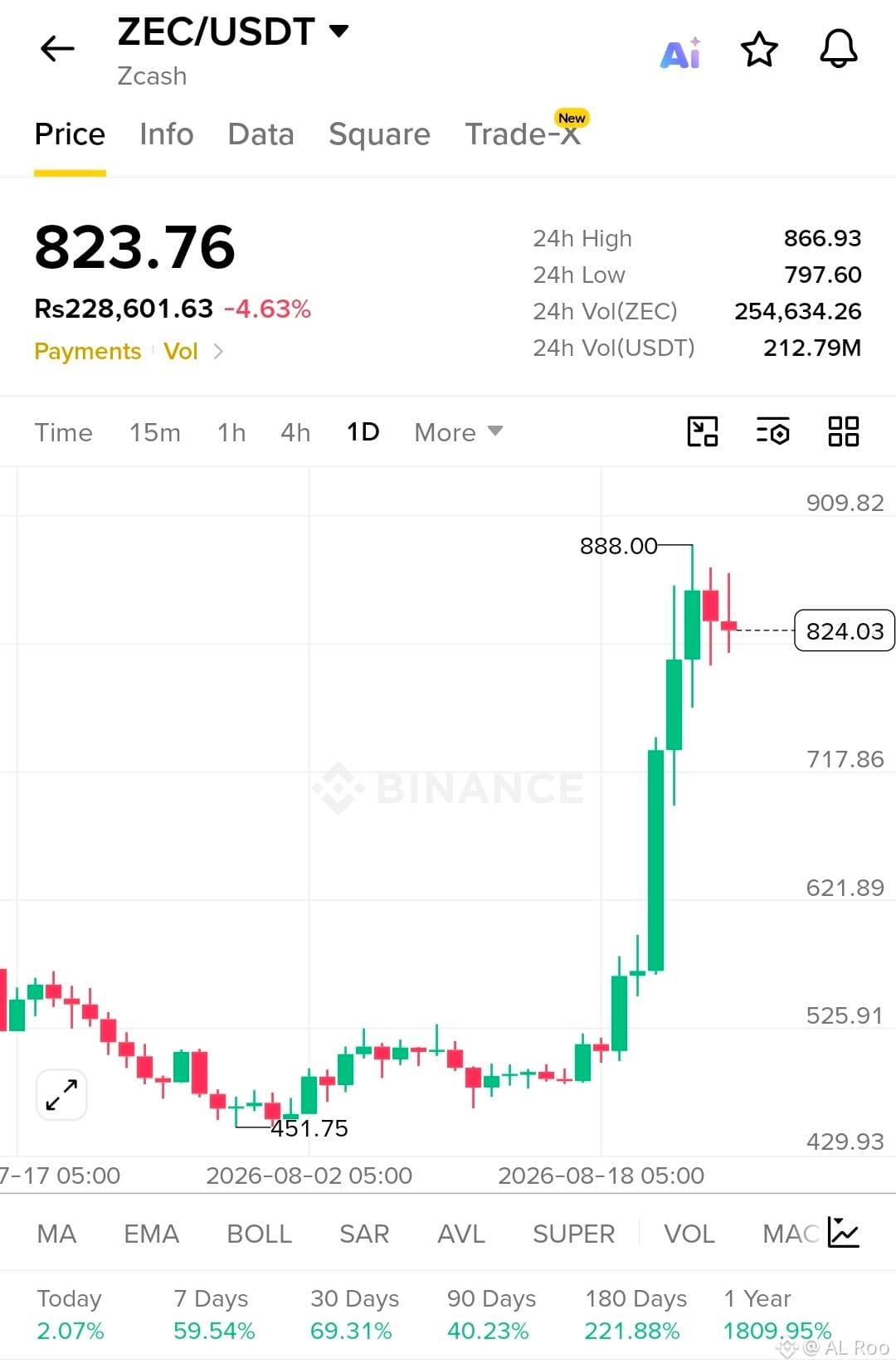
$ZEC showing serious strength after an explosive breakout.
Bulls remain in control while structure holds above the breakout zone.
EP
810 - 825
TP
TP1 850
TP2 888
TP3 920
SL
785
Liquidity above has already triggered a strong reaction, while buyers continue defending the breakout structure. Holding this zone keeps momentum intact for another push into higher liquidity.
Let’s go $ZEC
Guys long
Bulls remain in control while structure holds above the breakout zone.
EP
810 - 825
TP
TP1 850
TP2 888
TP3 920
SL
785
Liquidity above has already triggered a strong reaction, while buyers continue defending the breakout structure. Holding this zone keeps momentum intact for another push into higher liquidity.
Let’s go $ZEC
Guys long
I was reading through Dusk’s docs and one thing surprised me a bit.
I went in thinking the privacy side would be pretty straightforward: use Dusk, get private transactions. But that’s not exactly how it works.
Dusk has two different transaction models. Moonlight is transparent, while Phoenix is built for shielded transactions using zero-knowledge proofs. So simply using the network doesn’t automatically mean everything you do is private.
I actually think that makes sense when you look at what Dusk is trying to build for. Financial applications don’t always need complete secrecy. Sometimes information needs to be visible for auditing or compliance, while other details probably shouldn’t be sitting publicly on-chain for anyone to inspect.
What I find interesting is the user experience this creates.
Most people probably won’t care about the technical difference between Moonlight and Phoenix. They’ll just want to know one thing: is this transaction private or not?
That puts a lot of responsibility on wallets and apps built on Dusk. If they clearly show what is public and what is confidential before someone signs a transaction, the two-model approach could feel pretty natural.
If they don’t, I can see people assuming they have more privacy than they actually do.
Maybe the harder problem for privacy-focused chains isn’t only building the cryptography. It’s making privacy obvious enough that regular users understand what they’re getting.
Curious how Dusk apps will handle that as more people actually use them.
$DUSK #dusk @Dusk
I went in thinking the privacy side would be pretty straightforward: use Dusk, get private transactions. But that’s not exactly how it works.
Dusk has two different transaction models. Moonlight is transparent, while Phoenix is built for shielded transactions using zero-knowledge proofs. So simply using the network doesn’t automatically mean everything you do is private.
I actually think that makes sense when you look at what Dusk is trying to build for. Financial applications don’t always need complete secrecy. Sometimes information needs to be visible for auditing or compliance, while other details probably shouldn’t be sitting publicly on-chain for anyone to inspect.
What I find interesting is the user experience this creates.
Most people probably won’t care about the technical difference between Moonlight and Phoenix. They’ll just want to know one thing: is this transaction private or not?
That puts a lot of responsibility on wallets and apps built on Dusk. If they clearly show what is public and what is confidential before someone signs a transaction, the two-model approach could feel pretty natural.
If they don’t, I can see people assuming they have more privacy than they actually do.
Maybe the harder problem for privacy-focused chains isn’t only building the cryptography. It’s making privacy obvious enough that regular users understand what they’re getting.
Curious how Dusk apps will handle that as more people actually use them.
$DUSK #dusk @Dusk
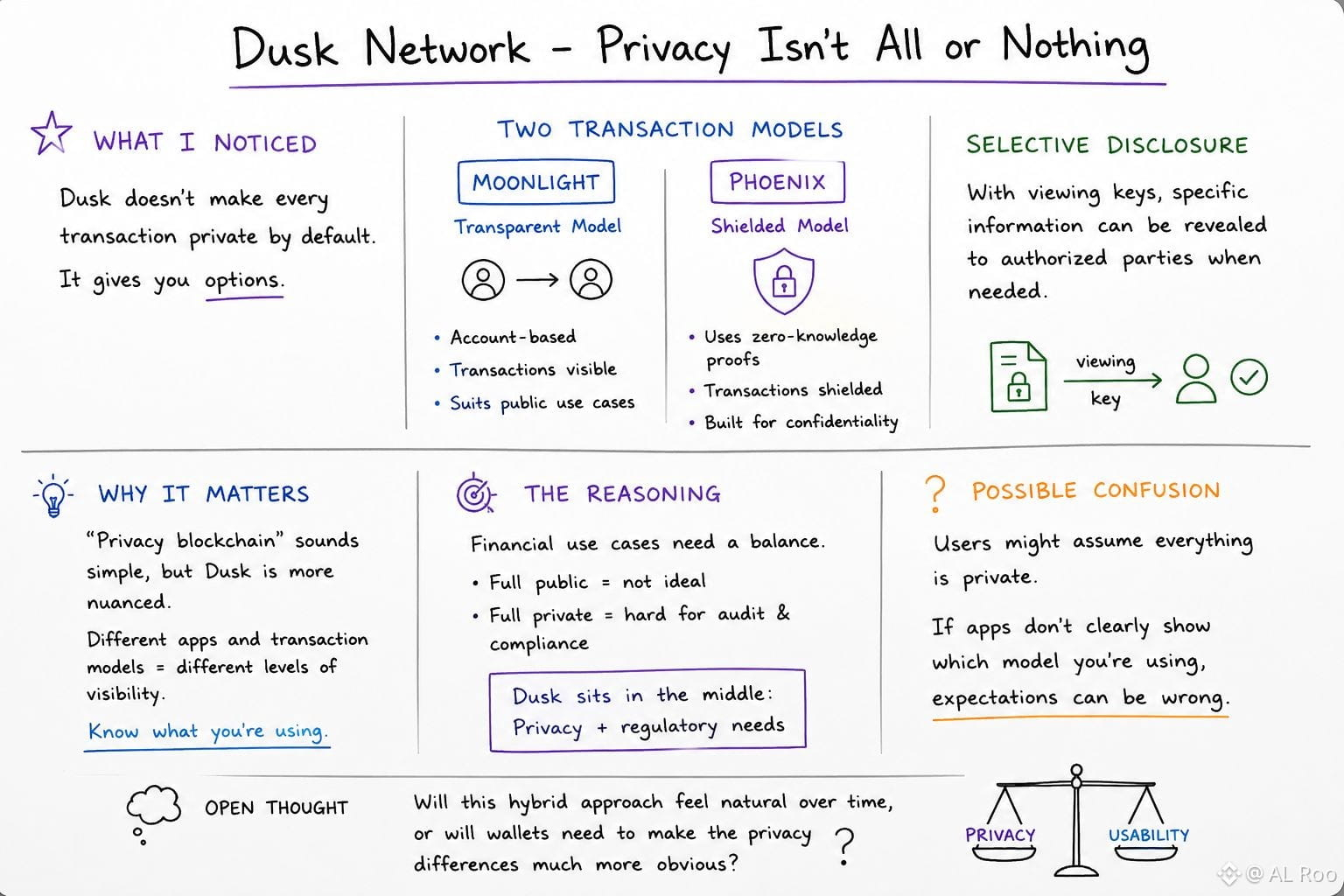
$TUT is holding strong after the volatility.
Structure remains controlled above the key reaction zone.
EP
0.0460 – 0.0500
TP
TP1 0.0550
TP2 0.0620
TP3 0.0750
SL
0.0420
Liquidity has been swept after the sharp expansion, with price reacting around the lower structure. Holding this zone keeps the short-term setup intact and opens room for another liquidity push higher.
Let’s go $TUT
Structure remains controlled above the key reaction zone.
EP
0.0460 – 0.0500
TP
TP1 0.0550
TP2 0.0620
TP3 0.0750
SL
0.0420
Liquidity has been swept after the sharp expansion, with price reacting around the lower structure. Holding this zone keeps the short-term setup intact and opens room for another liquidity push higher.
Let’s go $TUT
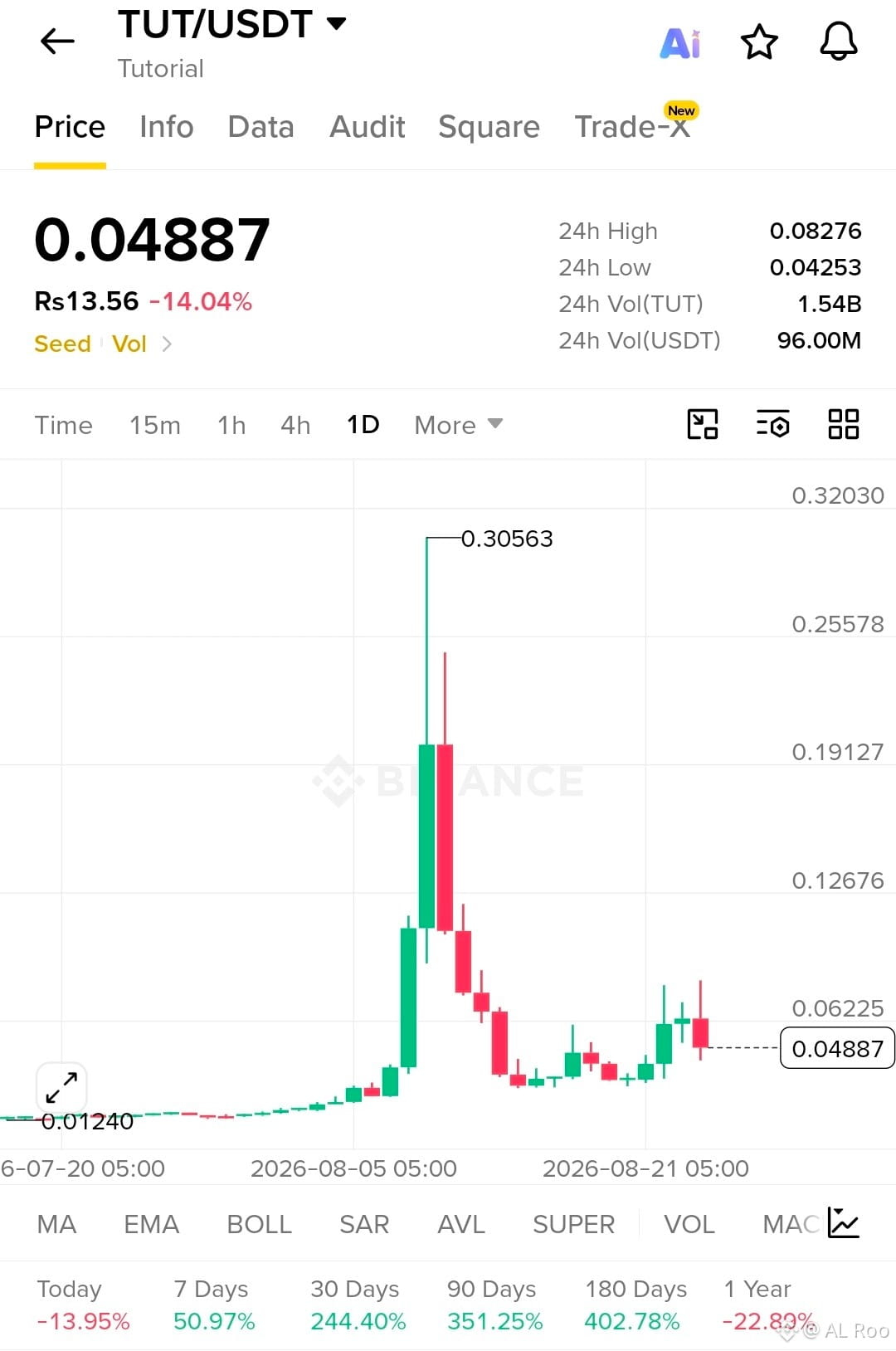
I was reading through Dusk’s docs and one detail made me rethink the usual “privacy blockchain” description.
I assumed privacy would basically be the default for everything happening on the network. But Dusk actually has two different transaction models.
Moonlight is the more familiar account-based side, where activity is transparent. Phoenix works differently. It uses encrypted notes and zero-knowledge proofs, so a transaction can be verified without publicly exposing the same information.
I think that distinction matters more than it sounds.
If I’m just a normal user and someone tells me a blockchain is built around privacy, my natural assumption is that whatever I do there is private. With Dusk, it’s more nuanced than that. What other people can see depends on how you’re interacting with the network.
At the same time, I can see why they designed it this way. Financial applications don’t always have the same requirements. Sometimes confidentiality matters a lot; in other situations, having a transparent record can actually be useful. Forcing everything into one model would probably create its own limitations.
The part I’m less sure about is how clearly this will translate to the user experience. Most people aren’t going to read documentation about Phoenix and Moonlight before making a transaction. They’ll just use whatever an app puts in front of them.
So maybe the interesting challenge for Dusk isn’t only building privacy at the protocol level. It’s making sure users actually understand when they’re getting it.
Would you rather choose between private and transparent transactions yourself, or have applications make that decision in the background?
@Dusk #dusk $DUSK
I assumed privacy would basically be the default for everything happening on the network. But Dusk actually has two different transaction models.
Moonlight is the more familiar account-based side, where activity is transparent. Phoenix works differently. It uses encrypted notes and zero-knowledge proofs, so a transaction can be verified without publicly exposing the same information.
I think that distinction matters more than it sounds.
If I’m just a normal user and someone tells me a blockchain is built around privacy, my natural assumption is that whatever I do there is private. With Dusk, it’s more nuanced than that. What other people can see depends on how you’re interacting with the network.
At the same time, I can see why they designed it this way. Financial applications don’t always have the same requirements. Sometimes confidentiality matters a lot; in other situations, having a transparent record can actually be useful. Forcing everything into one model would probably create its own limitations.
The part I’m less sure about is how clearly this will translate to the user experience. Most people aren’t going to read documentation about Phoenix and Moonlight before making a transaction. They’ll just use whatever an app puts in front of them.
So maybe the interesting challenge for Dusk isn’t only building privacy at the protocol level. It’s making sure users actually understand when they’re getting it.
Would you rather choose between private and transparent transactions yourself, or have applications make that decision in the background?
@Dusk #dusk $DUSK
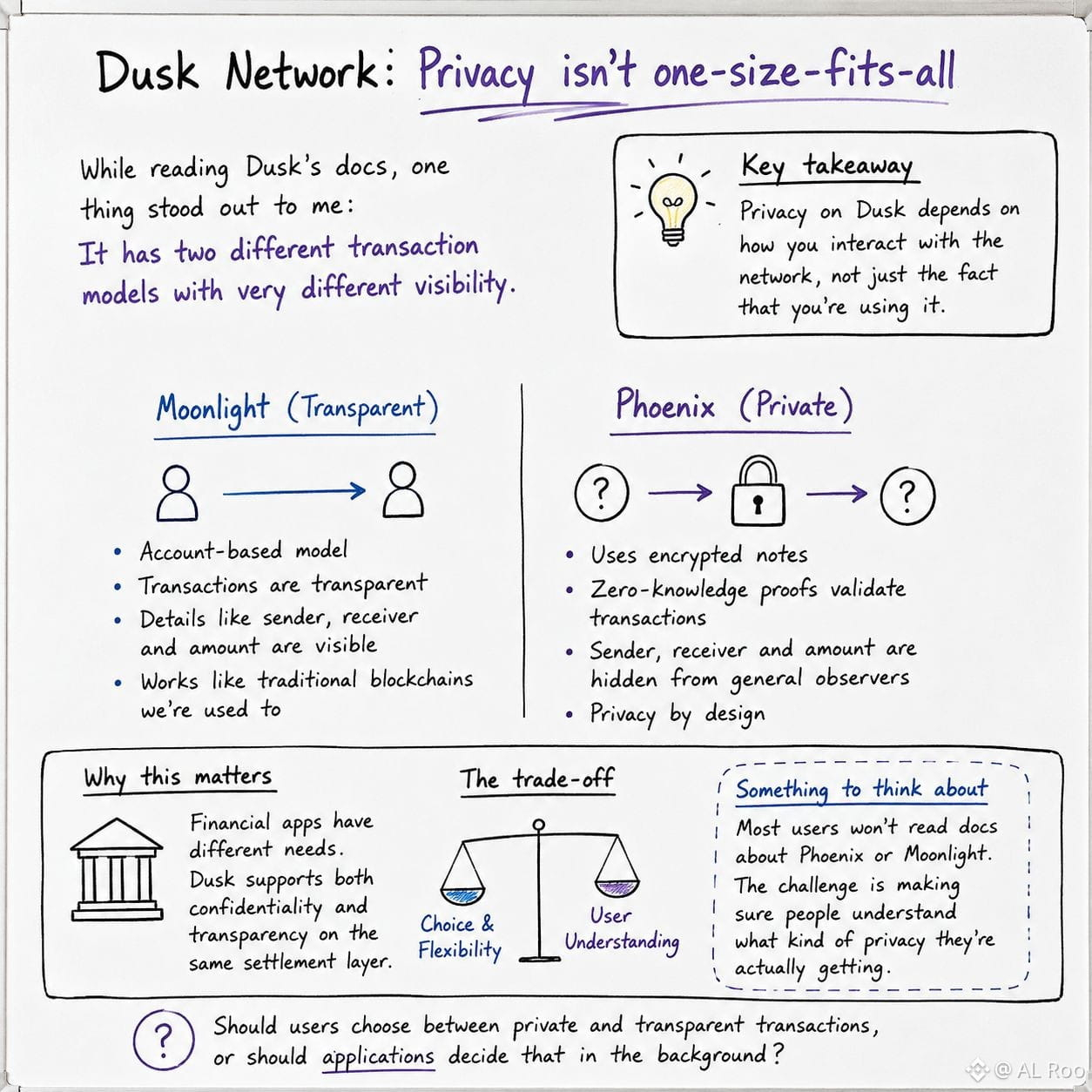
$ETH is showing strong momentum.
Buyers are still holding control after the breakout.
EP
2,420 - 2,465
TP
2,500
2,547
2,585
SL
2,350
Liquidity above the recent high remains the key target. A strong reaction from the entry zone keeps the bullish structure intact.
Let’s go $ETH
Buyers are still holding control after the breakout.
EP
2,420 - 2,465
TP
2,500
2,547
2,585
SL
2,350
Liquidity above the recent high remains the key target. A strong reaction from the entry zone keeps the bullish structure intact.
Let’s go $ETH
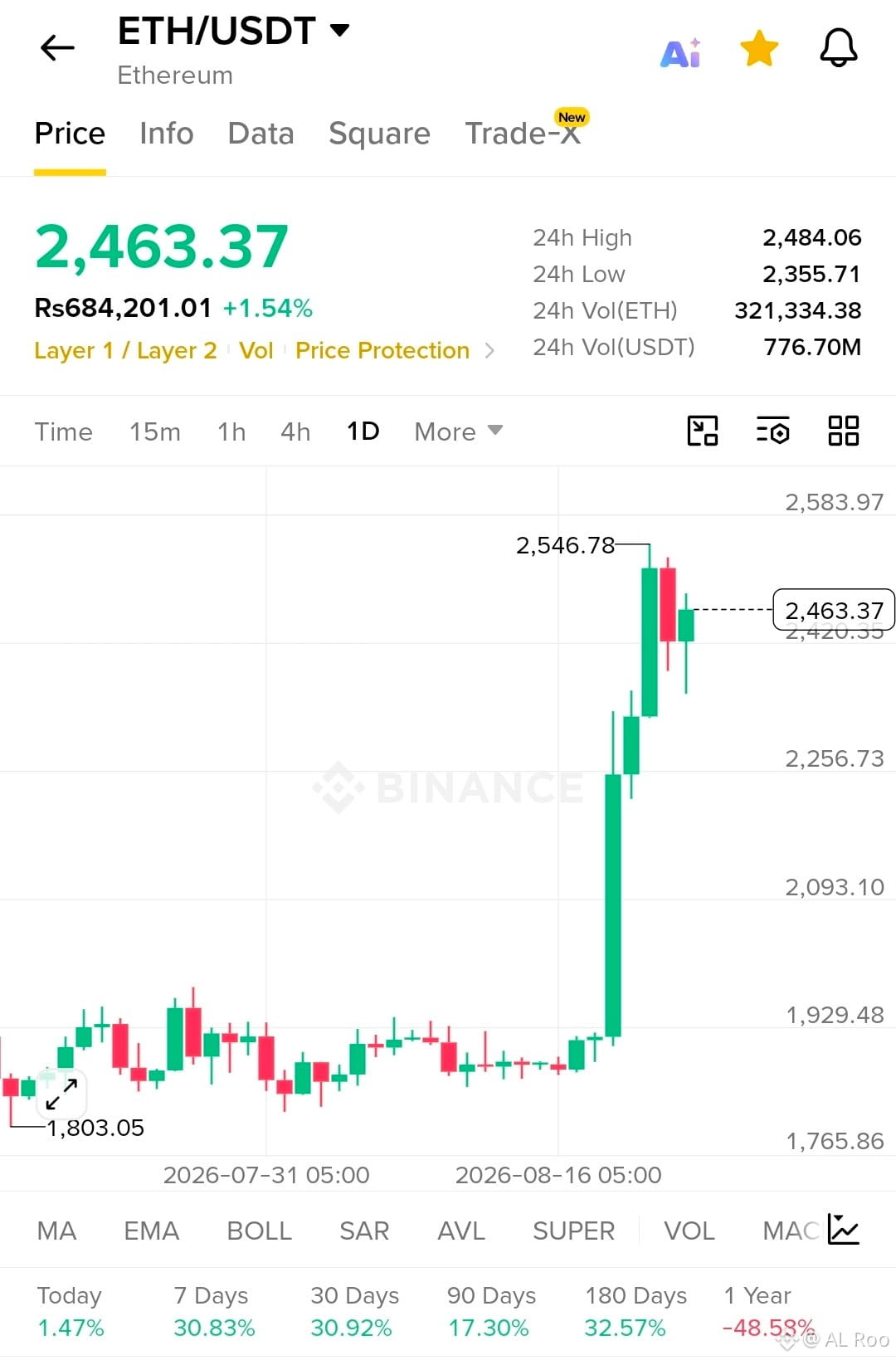
I was reading through Dusk’s docs and one thing genuinely made me stop for a bit.
When people hear “privacy blockchain,” I think the natural assumption is that everything happening on the network is private. But Dusk doesn’t really work that way.
There are different ways to transact.
Moonlight is the more familiar, transparent account model. Phoenix works differently, using encrypted notes and zero-knowledge proofs to keep things like transaction amounts and the parties involved private.
At first I wondered why a privacy-focused network would even need a transparent option. But the more I thought about financial applications, the more it made sense.
Not every transaction needs to disappear from public view. Sometimes transparency is useful or even necessary. Other situations need privacy, while still allowing certain information to be disclosed when required.
The part I think could get tricky is simply communicating this to regular users.
Most people aren't going to read documentation before using a wallet or interacting with an app. If they see Dusk associated with privacy, they may assume their activity is automatically confidential without checking which transaction model they're actually using.
So for me, the interesting question isn't just whether Dusk's privacy technology works.
It's whether wallets and apps can make these differences clear enough that someone understands what is private and what isn't before clicking confirm.
That might sound like a small UX detail, but with financial privacy, expectations matter a lot.
I'm curious whether giving users this choice is ultimately better than making privacy the default for everything.
#dusk @Dusk $DUSK
When people hear “privacy blockchain,” I think the natural assumption is that everything happening on the network is private. But Dusk doesn’t really work that way.
There are different ways to transact.
Moonlight is the more familiar, transparent account model. Phoenix works differently, using encrypted notes and zero-knowledge proofs to keep things like transaction amounts and the parties involved private.
At first I wondered why a privacy-focused network would even need a transparent option. But the more I thought about financial applications, the more it made sense.
Not every transaction needs to disappear from public view. Sometimes transparency is useful or even necessary. Other situations need privacy, while still allowing certain information to be disclosed when required.
The part I think could get tricky is simply communicating this to regular users.
Most people aren't going to read documentation before using a wallet or interacting with an app. If they see Dusk associated with privacy, they may assume their activity is automatically confidential without checking which transaction model they're actually using.
So for me, the interesting question isn't just whether Dusk's privacy technology works.
It's whether wallets and apps can make these differences clear enough that someone understands what is private and what isn't before clicking confirm.
That might sound like a small UX detail, but with financial privacy, expectations matter a lot.
I'm curious whether giving users this choice is ultimately better than making privacy the default for everything.
#dusk @Dusk $DUSK
$XRP is holding strong after an explosive move.
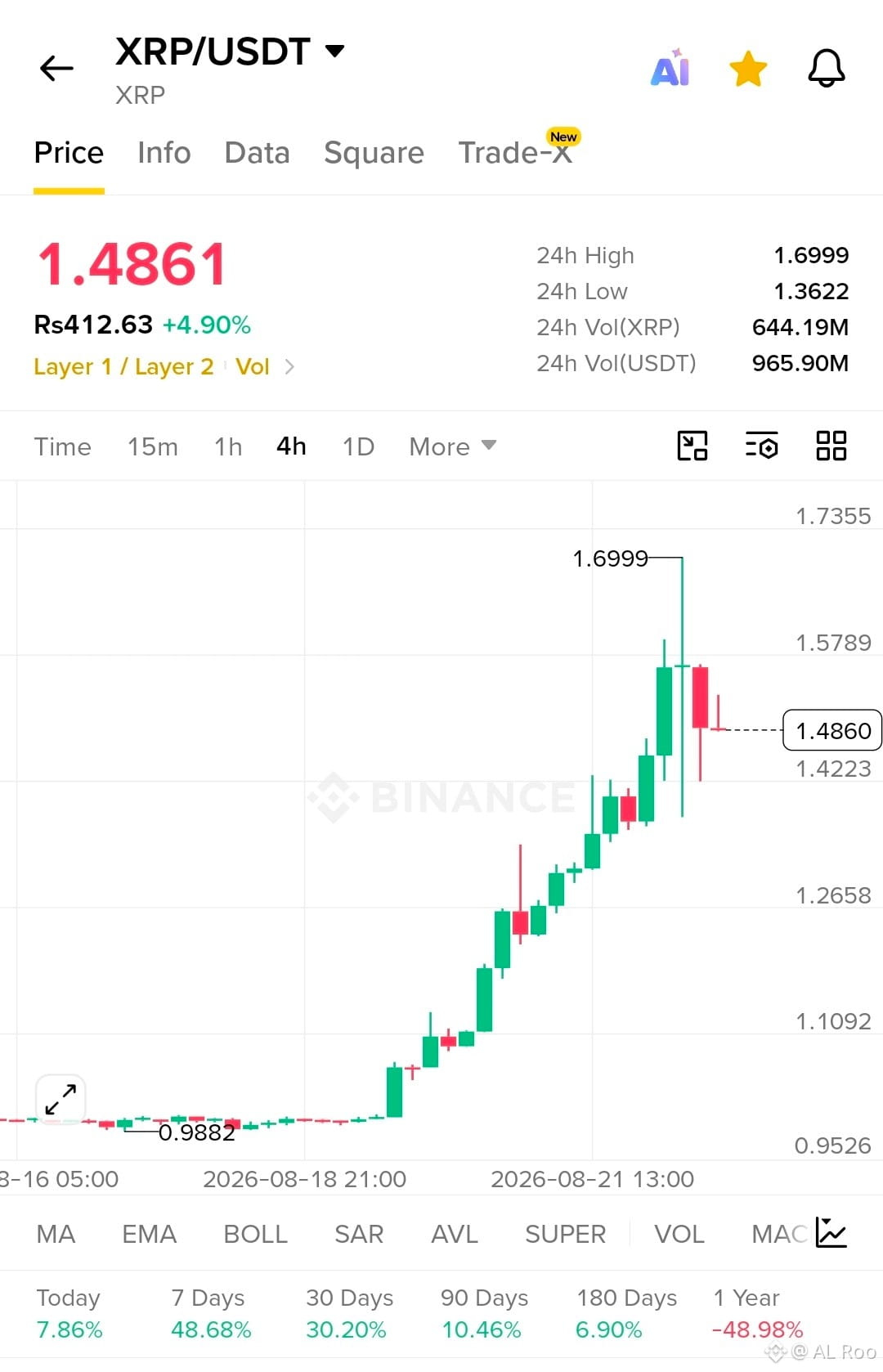
Bullish structure remains intact with buyers still in control.
EP
1.44 - 1.49
TP
1.55
1.62
1.69
SL
1.39
Liquidity above remains attractive while the current pullback is showing a controlled reaction. As long as support holds, the structure favors another push toward the recent highs.
Let’s go $XRP
Bullish structure remains intact with buyers still in control.
EP
1.44 - 1.49
TP
1.55
1.62
1.69
SL
1.39
Liquidity above remains attractive while the current pullback is showing a controlled reaction. As long as support holds, the structure favors another push toward the recent highs.
Let’s go $XRP
Verified
While reading through Dusk’s docs, I noticed something I’d honestly overlooked before. Dusk being focused on privacy doesn’t mean every transaction on the network works privately in exactly the same way.
There are actually two different approaches.
Moonlight is the more familiar transparent account model, while Phoenix is built for confidential transactions. With Phoenix, details like who sent funds, who received them, and how much was transferred can stay hidden.
That changed how I looked at Dusk a little.
When people hear “privacy blockchain,” it’s easy to assume everything happening on-chain is automatically hidden. Dusk seems to be taking a more practical route: sometimes transparency is useful, and sometimes confidentiality is necessary. For financial applications, especially ones dealing with compliance, having both options makes some sense.
The same thinking shows up around XSC. The goal isn’t simply to hide information. Confidential smart contracts can be built around different privacy and compliance requirements, so certain information can remain protected without making the whole system a black box.
I like the reasoning behind this, but I can also see where users could get confused.
Most people won’t spend time reading technical documentation before using an app. They’ll probably just want to know one thing: “Is what I’m doing right now private or public?”
So maybe the bigger challenge for Dusk isn’t only building the privacy technology. It’s making those privacy choices obvious enough that regular users understand what they’re actually getting.
I wonder how much of that responsibility should sit with Dusk itself, and how much should fall on the applications being built on top of it.
@Dusk #dusk $DUSK
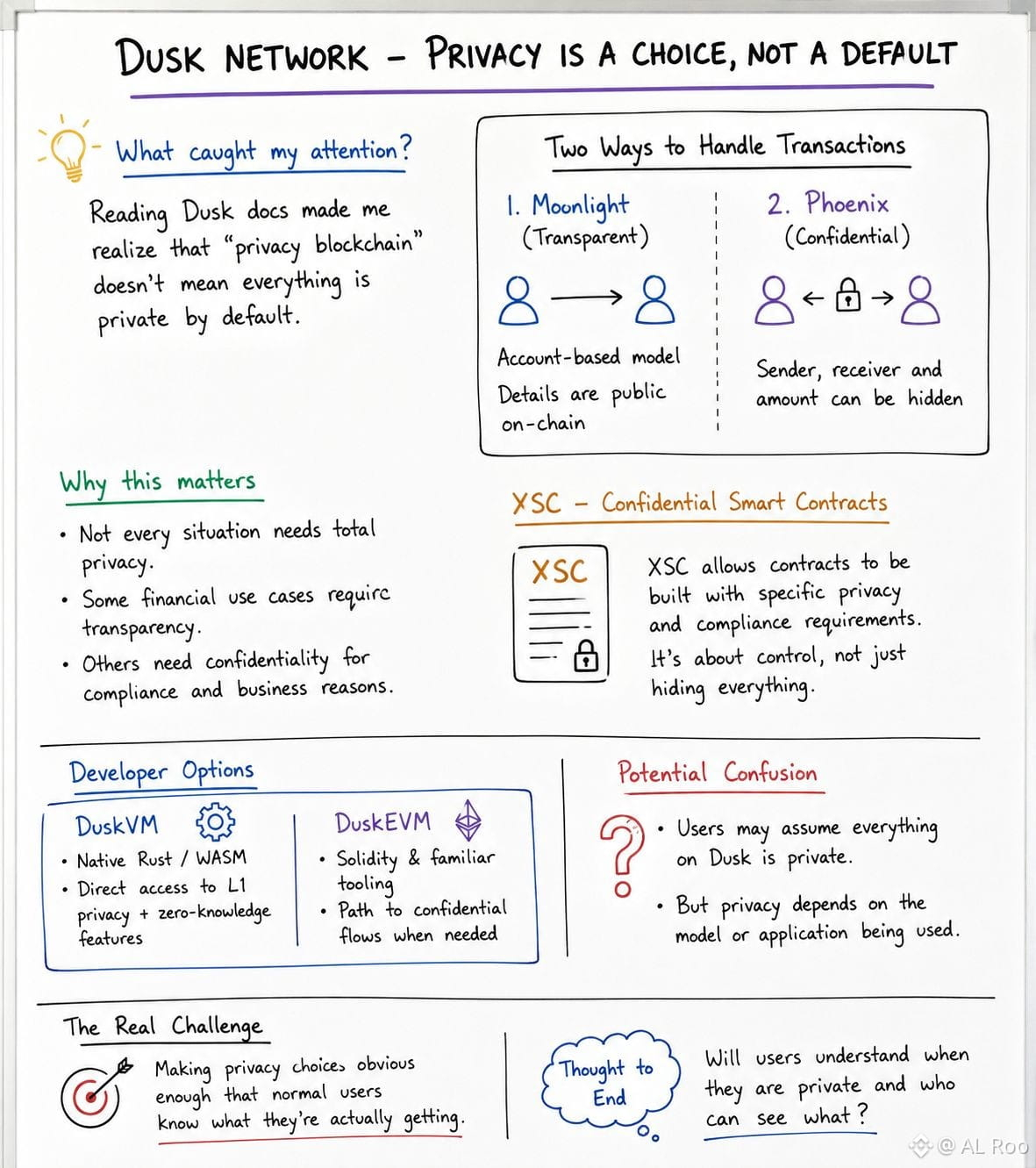
There are actually two different approaches.
Moonlight is the more familiar transparent account model, while Phoenix is built for confidential transactions. With Phoenix, details like who sent funds, who received them, and how much was transferred can stay hidden.
That changed how I looked at Dusk a little.
When people hear “privacy blockchain,” it’s easy to assume everything happening on-chain is automatically hidden. Dusk seems to be taking a more practical route: sometimes transparency is useful, and sometimes confidentiality is necessary. For financial applications, especially ones dealing with compliance, having both options makes some sense.
The same thinking shows up around XSC. The goal isn’t simply to hide information. Confidential smart contracts can be built around different privacy and compliance requirements, so certain information can remain protected without making the whole system a black box.
I like the reasoning behind this, but I can also see where users could get confused.
Most people won’t spend time reading technical documentation before using an app. They’ll probably just want to know one thing: “Is what I’m doing right now private or public?”
So maybe the bigger challenge for Dusk isn’t only building the privacy technology. It’s making those privacy choices obvious enough that regular users understand what they’re actually getting.
I wonder how much of that responsibility should sit with Dusk itself, and how much should fall on the applications being built on top of it.
@Dusk #dusk $DUSK
I was reading through the TermMax docs and one small detail made me rethink what “fixed-rate borrowing” actually means here.
At first, I assumed it worked like a simple lending market: there’s a rate on the screen, you borrow, and that’s basically the end of it.
But TermMax is a little different.
The liquidity can sit across a range of rates. So the rate you end up getting also depends on how much liquidity is available and how large your order is. A smaller borrow might get filled around the better part of that range, while a bigger one can reach liquidity priced at a higher rate.
That sounds obvious once you understand the system, but I don’t think it’s obvious when you first see the words “fixed rate.”
The important part is that the rate becomes fixed after the trade is executed. From a borrower’s perspective, that’s useful because you can actually know your borrowing cost instead of constantly watching a variable APY move around.
The other side is that users still need to pay attention before entering the position. The displayed rate and the rate you actually execute at aren’t necessarily the same thing for every order size.
I can understand why TermMax works this way. Liquidity isn’t unlimited, and different amounts have to be priced somehow. But I also think this is the kind of detail that needs to be very clear in the interface, especially for people coming from normal lending pools.
Makes me curious: when people hear “fixed-rate DeFi,” do they expect a fixed market price, or just a fixed cost once their position is open?
@TermMax #TermMax
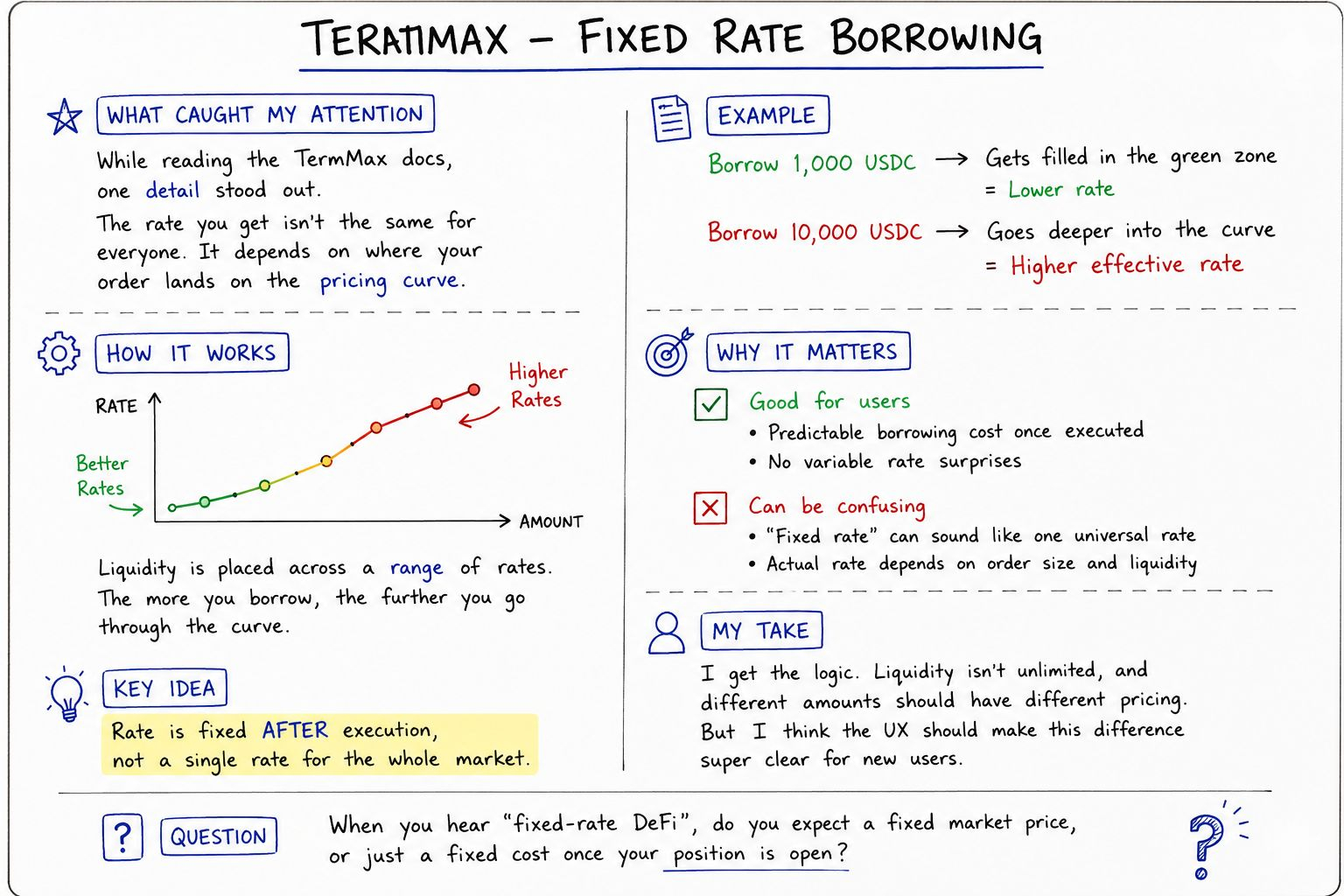
At first, I assumed it worked like a simple lending market: there’s a rate on the screen, you borrow, and that’s basically the end of it.
But TermMax is a little different.
The liquidity can sit across a range of rates. So the rate you end up getting also depends on how much liquidity is available and how large your order is. A smaller borrow might get filled around the better part of that range, while a bigger one can reach liquidity priced at a higher rate.
That sounds obvious once you understand the system, but I don’t think it’s obvious when you first see the words “fixed rate.”
The important part is that the rate becomes fixed after the trade is executed. From a borrower’s perspective, that’s useful because you can actually know your borrowing cost instead of constantly watching a variable APY move around.
The other side is that users still need to pay attention before entering the position. The displayed rate and the rate you actually execute at aren’t necessarily the same thing for every order size.
I can understand why TermMax works this way. Liquidity isn’t unlimited, and different amounts have to be priced somehow. But I also think this is the kind of detail that needs to be very clear in the interface, especially for people coming from normal lending pools.
Makes me curious: when people hear “fixed-rate DeFi,” do they expect a fixed market price, or just a fixed cost once their position is open?
@TermMax #TermMax
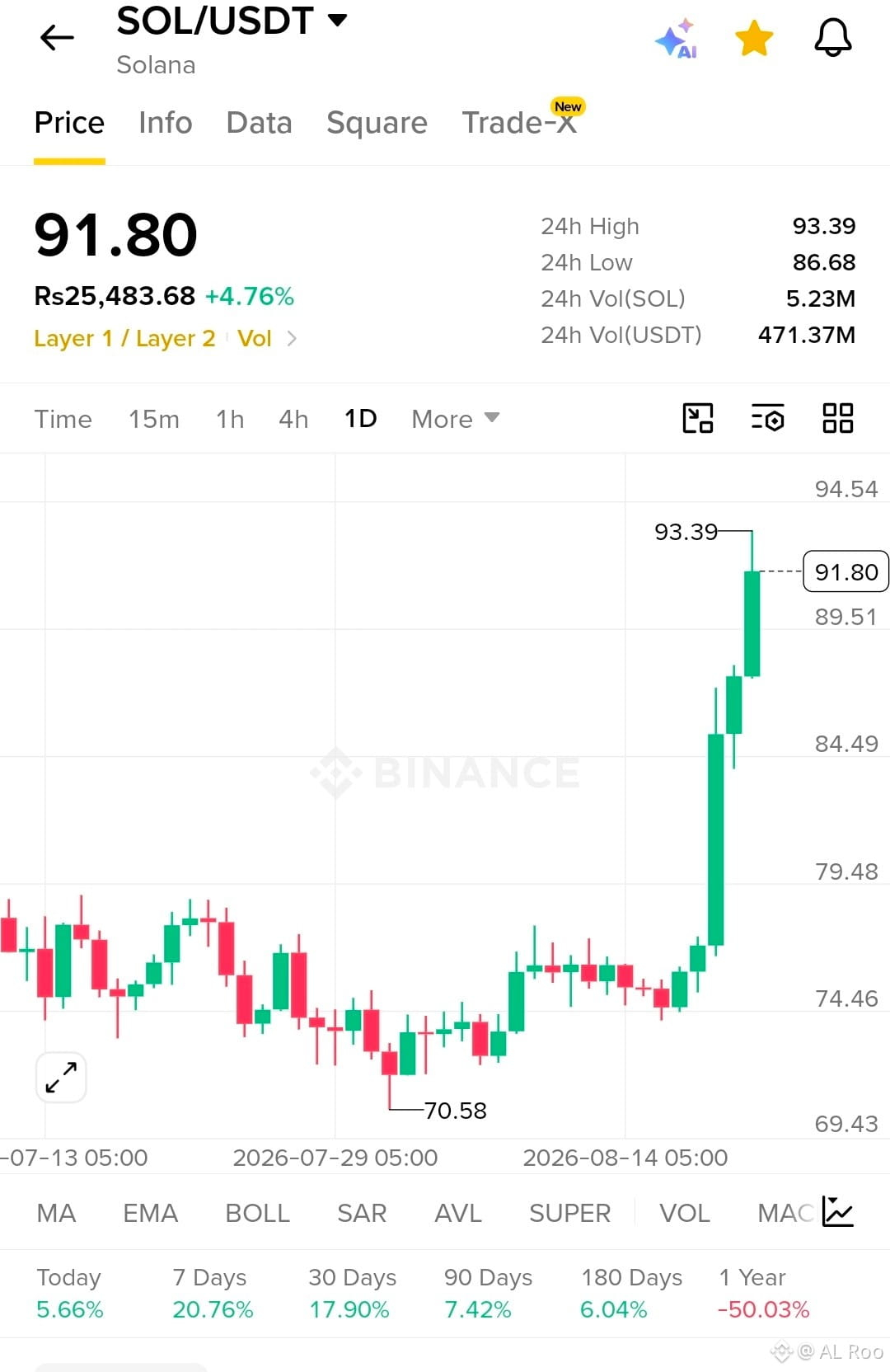
$SOL is showing strong bullish momentum.
Buyers remain in control as the structure continues to hold.
EP
$89.50 - $91.80
TP
$94.50
$98.00
$102.00
SL
$86.50
Liquidity above the recent high remains the key target. A clean reaction from the entry zone could keep the bullish structure intact and open the path toward the upper levels.
Let’s go $SOL
Buyers remain in control as the structure continues to hold.
EP
$89.50 - $91.80
TP
$94.50
$98.00
$102.00
SL
$86.50
Liquidity above the recent high remains the key target. A clean reaction from the entry zone could keep the bullish structure intact and open the path toward the upper levels.
Let’s go $SOL
I was reading through Dusk’s docs and one thing stood out to me that I hadn’t really thought about before.
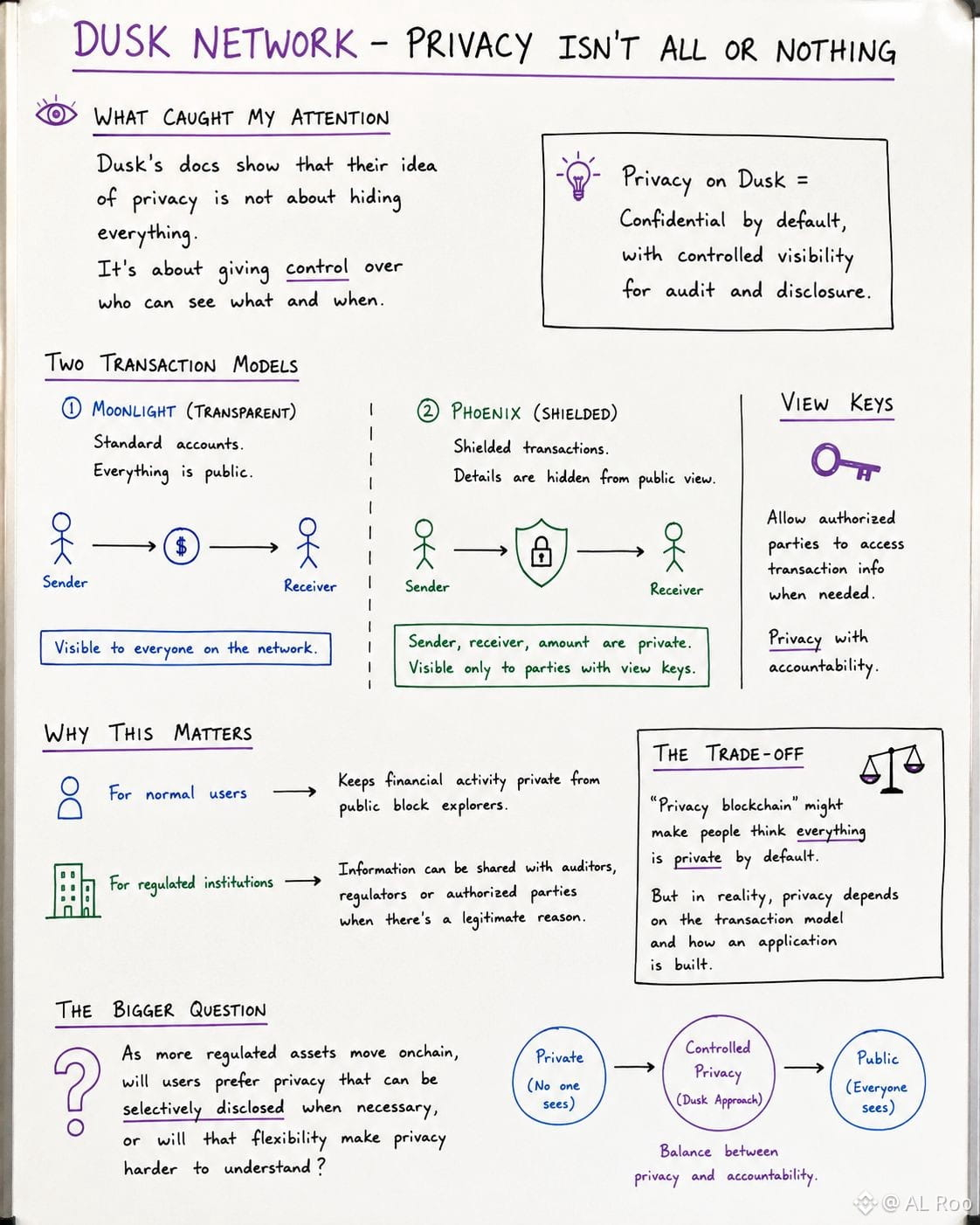
Privacy on Dusk doesn’t necessarily mean hiding everything from everyone.
There are actually different ways transactions can work. Moonlight is the transparent account model, while Phoenix is designed for shielded transactions. With Phoenix, details like who sent funds, who received them and how much was transferred aren’t simply sitting there for everyone to see.
But there’s another part that I found more interesting: view keys.
They basically create a way for transaction information to stay private publicly while still being accessible to an authorized party when there’s a legitimate reason to see it.
At first that sounds like a small technical detail, but for financial applications it makes quite a bit of sense. A person probably doesn’t want their financial history visible to random people on a block explorer. At the same time, a company dealing with regulated assets may still need to provide certain information to auditors or other authorized parties.
I can see why Dusk has taken this middle-ground approach.
The confusing part is that someone hearing “privacy blockchain” could easily assume everything on Dusk has the same level of privacy automatically. That’s not really how it works. The transaction model and the way an application is built still matter.
Maybe that’s actually the more useful way to think about blockchain privacy: not “can anyone see this?” but “who should be able to see it, and under what circumstances?”
Curious whether that distinction will matter more as regulated assets continue moving onchain.
$DUSK #dusk @Dusk
Privacy on Dusk doesn’t necessarily mean hiding everything from everyone.
There are actually different ways transactions can work. Moonlight is the transparent account model, while Phoenix is designed for shielded transactions. With Phoenix, details like who sent funds, who received them and how much was transferred aren’t simply sitting there for everyone to see.
But there’s another part that I found more interesting: view keys.
They basically create a way for transaction information to stay private publicly while still being accessible to an authorized party when there’s a legitimate reason to see it.
At first that sounds like a small technical detail, but for financial applications it makes quite a bit of sense. A person probably doesn’t want their financial history visible to random people on a block explorer. At the same time, a company dealing with regulated assets may still need to provide certain information to auditors or other authorized parties.
I can see why Dusk has taken this middle-ground approach.
The confusing part is that someone hearing “privacy blockchain” could easily assume everything on Dusk has the same level of privacy automatically. That’s not really how it works. The transaction model and the way an application is built still matter.
Maybe that’s actually the more useful way to think about blockchain privacy: not “can anyone see this?” but “who should be able to see it, and under what circumstances?”
Curious whether that distinction will matter more as regulated assets continue moving onchain.
$DUSK #dusk @Dusk
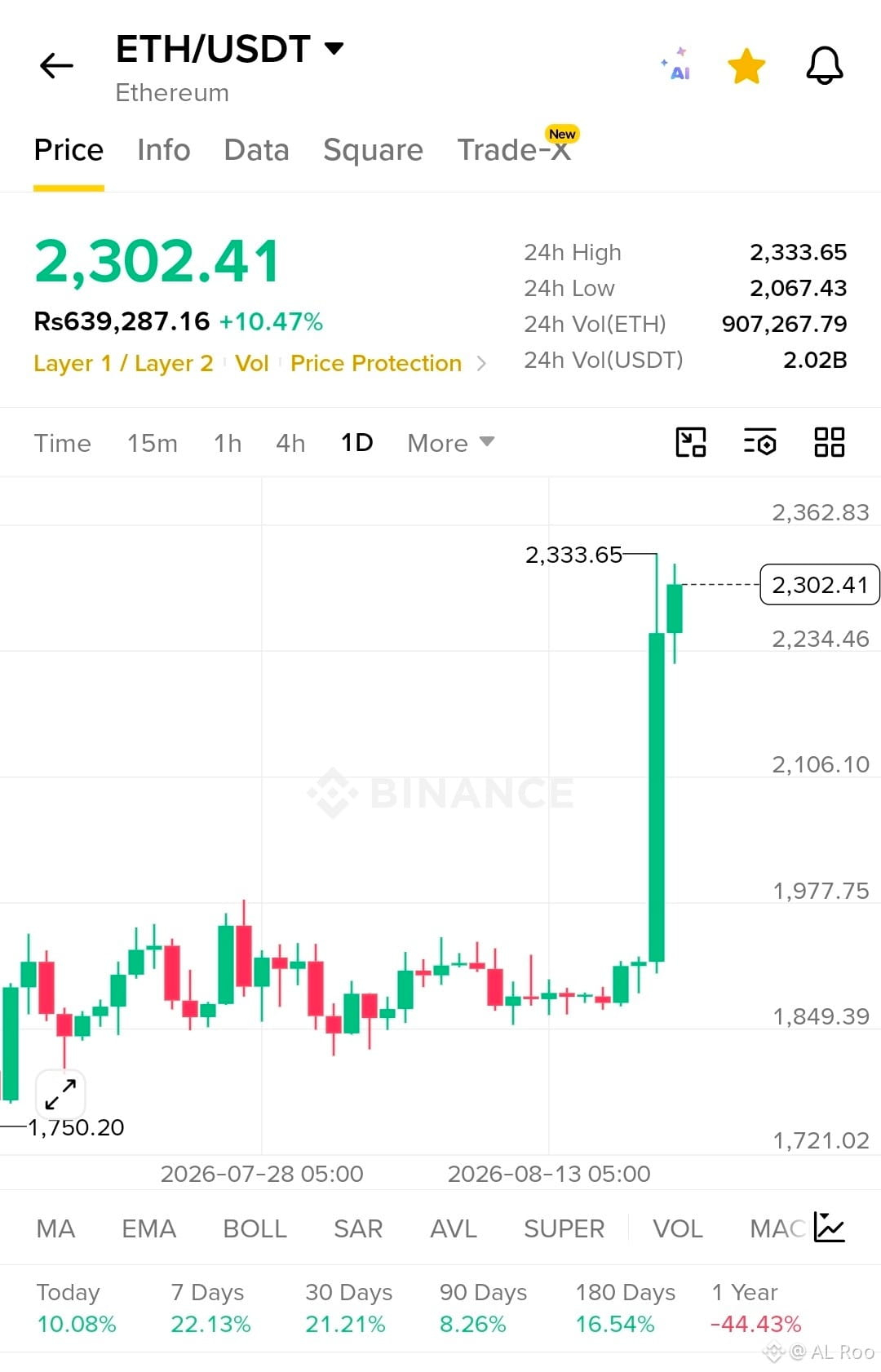
$ETH is showing serious strength here.
Bulls remain firmly in control after the breakout.
EP
$2,270 - $2,305
TP
$2,335
$2,365
$2,420
SL
$2,220
Liquidity above the recent high is now in focus. A clean reaction around the breakout zone keeps the bullish structure intact and gives buyers room to extend the move.
Let’s go $ETH
Bulls remain firmly in control after the breakout.
EP
$2,270 - $2,305
TP
$2,335
$2,365
$2,420
SL
$2,220
Liquidity above the recent high is now in focus. A clean reaction around the breakout zone keeps the bullish structure intact and gives buyers room to extend the move.
Let’s go $ETH
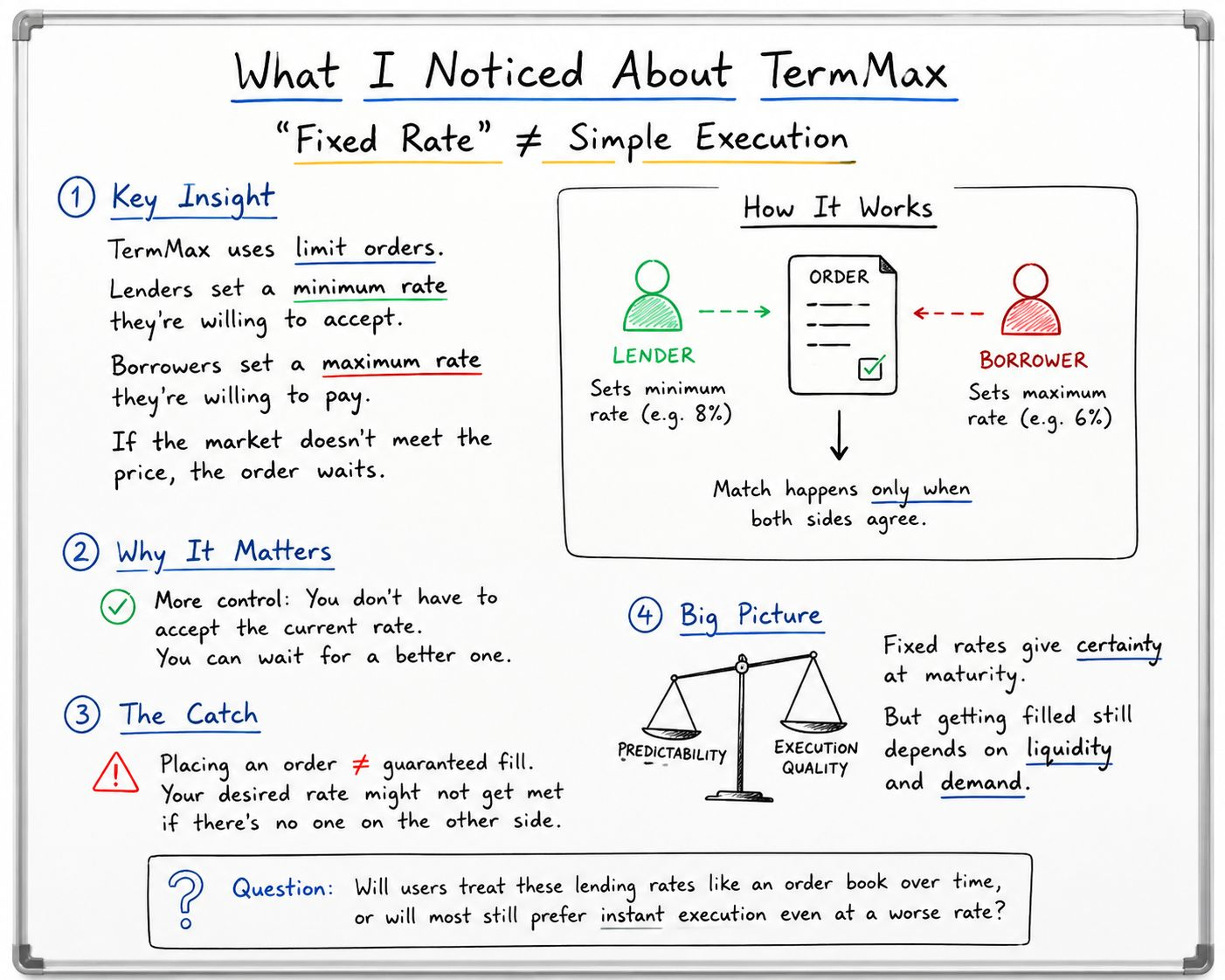
Something I noticed while reading through TermMax’s docs is that “fixed rate” sounds much simpler than what’s actually happening underneath.
The part that stood out to me was limit orders.
Instead of just taking whatever rate is available, lenders can set the minimum rate they’re willing to lend at, while borrowers can set the maximum they’re willing to pay. If the market doesn’t meet that price, the order can simply sit there waiting for someone on the other side.
I actually like this because it gives users a choice that you don’t always get with DeFi lending. Maybe I’m happy to lend at 8%, but not at 6%. I don’t necessarily want to keep checking the market until the rate moves. I can put my terms out there and wait.
But there’s a small learning curve here too.
Someone coming from a normal lending pool might assume that placing an order means their funds are basically earning already. That isn’t necessarily the case. A limit order still needs someone willing to take the other side, so the rate you want and the rate you actually get can be two different things.
It made me think about TermMax less as a typical lending pool and more as a market for borrowing costs.
Fixed rates give you certainty once the position is established, but getting that position filled still comes down to liquidity and what other users are willing to accept.
Curious which side people actually prefer in practice: waiting for their rate or taking the available rate and moving on?
#TermMax @TermMax
The part that stood out to me was limit orders.
Instead of just taking whatever rate is available, lenders can set the minimum rate they’re willing to lend at, while borrowers can set the maximum they’re willing to pay. If the market doesn’t meet that price, the order can simply sit there waiting for someone on the other side.
I actually like this because it gives users a choice that you don’t always get with DeFi lending. Maybe I’m happy to lend at 8%, but not at 6%. I don’t necessarily want to keep checking the market until the rate moves. I can put my terms out there and wait.
But there’s a small learning curve here too.
Someone coming from a normal lending pool might assume that placing an order means their funds are basically earning already. That isn’t necessarily the case. A limit order still needs someone willing to take the other side, so the rate you want and the rate you actually get can be two different things.
It made me think about TermMax less as a typical lending pool and more as a market for borrowing costs.
Fixed rates give you certainty once the position is established, but getting that position filled still comes down to liquidity and what other users are willing to accept.
Curious which side people actually prefer in practice: waiting for their rate or taking the available rate and moving on?
#TermMax @TermMax
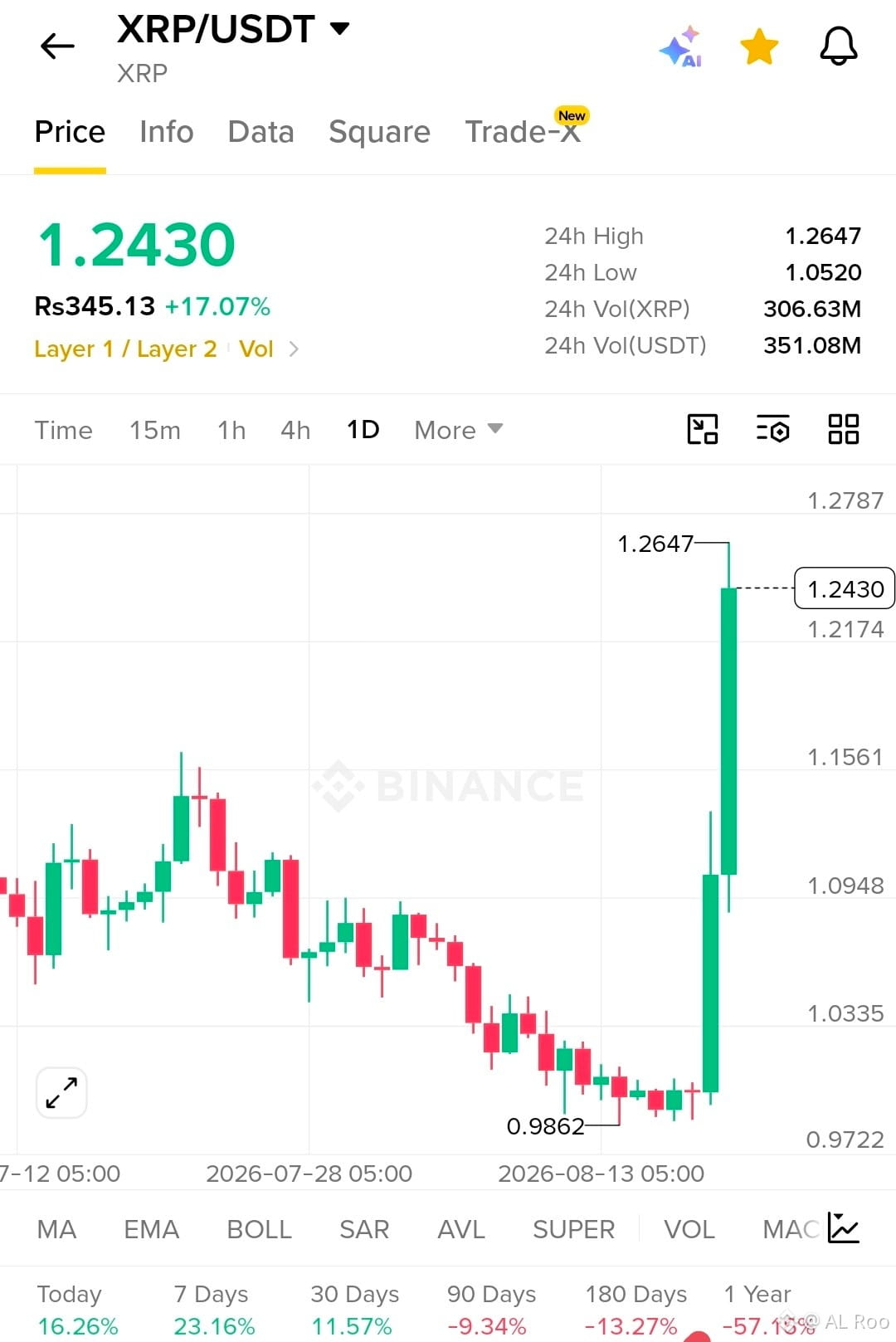
$XRP is showing serious strength after a powerful breakout.
Price has reclaimed structure and buyers remain in control.
EP
1.2150 - 1.2400
TP
1.2650
1.3000
1.3500
SL
1.1850
Liquidity above the recent high remains the immediate target. Strong reaction from the lower range confirms demand, while the breakout keeps the bullish structure intact.
Let’s go $XRP
Price has reclaimed structure and buyers remain in control.
EP
1.2150 - 1.2400
TP
1.2650
1.3000
1.3500
SL
1.1850
Liquidity above the recent high remains the immediate target. Strong reaction from the lower range confirms demand, while the breakout keeps the bullish structure intact.
Let’s go $XRP
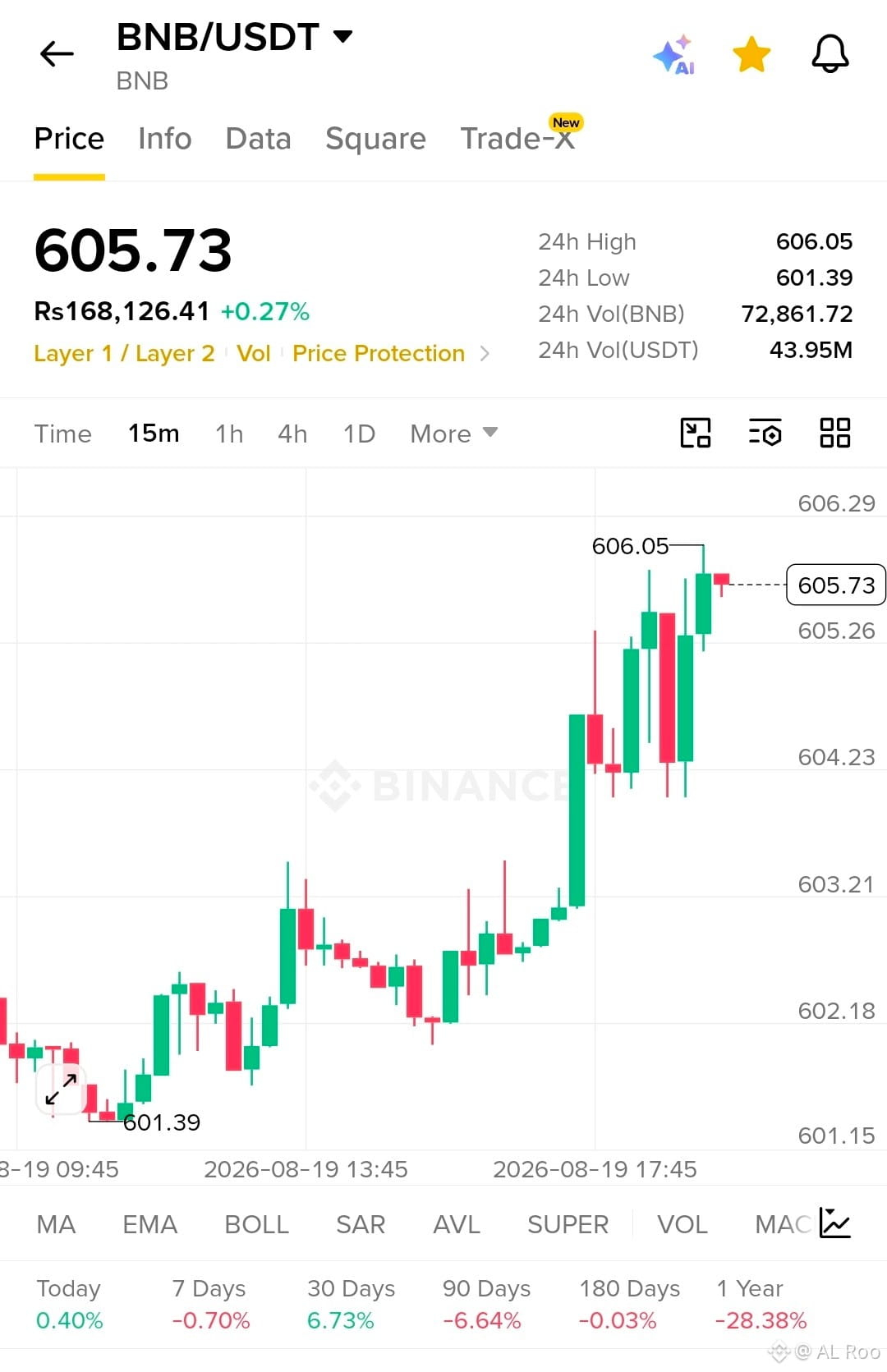
I was reading through Dusk’s docs and one small detail made me stop for a bit.
Dusk is usually described as a privacy-focused blockchain, so I assumed privacy would basically be the default for everything. But that’s not really how it works.
Dusk has Moonlight for public, account-based transactions and Phoenix for shielded transactions. With Phoenix, details like the sender, receiver and amount can stay private instead of being visible to everyone on-chain.
At first, having a public option on a privacy chain felt a little strange to me. The more I thought about financial applications, though, the more reasonable it seemed.
Not every transaction needs to be hidden. And businesses may need to prove certain information to auditors, regulators or other specific parties without putting the same information in front of the entire network. So the interesting part of Dusk isn’t simply “privacy.” It’s having some control over when privacy is actually needed.
The part I think could confuse normal users is expectations.
If someone hears “privacy blockchain,” they might assume anything they do on Dusk is automatically private. In reality, the transaction model and the application they’re using still matter.
I don’t necessarily see that as a bad design choice. It just means users need to understand what kind of transaction they’re making instead of relying on the privacy label alone.
I’m curious whether this balance between public and shielded activity will feel natural once more people actually use financial apps on Dusk, or whether it adds another layer users have to think about.
@Dusk $DUSK #dusk
Dusk is usually described as a privacy-focused blockchain, so I assumed privacy would basically be the default for everything. But that’s not really how it works.
Dusk has Moonlight for public, account-based transactions and Phoenix for shielded transactions. With Phoenix, details like the sender, receiver and amount can stay private instead of being visible to everyone on-chain.
At first, having a public option on a privacy chain felt a little strange to me. The more I thought about financial applications, though, the more reasonable it seemed.
Not every transaction needs to be hidden. And businesses may need to prove certain information to auditors, regulators or other specific parties without putting the same information in front of the entire network. So the interesting part of Dusk isn’t simply “privacy.” It’s having some control over when privacy is actually needed.
The part I think could confuse normal users is expectations.
If someone hears “privacy blockchain,” they might assume anything they do on Dusk is automatically private. In reality, the transaction model and the application they’re using still matter.
I don’t necessarily see that as a bad design choice. It just means users need to understand what kind of transaction they’re making instead of relying on the privacy label alone.
I’m curious whether this balance between public and shielded activity will feel natural once more people actually use financial apps on Dusk, or whether it adds another layer users have to think about.
@Dusk $DUSK #dusk
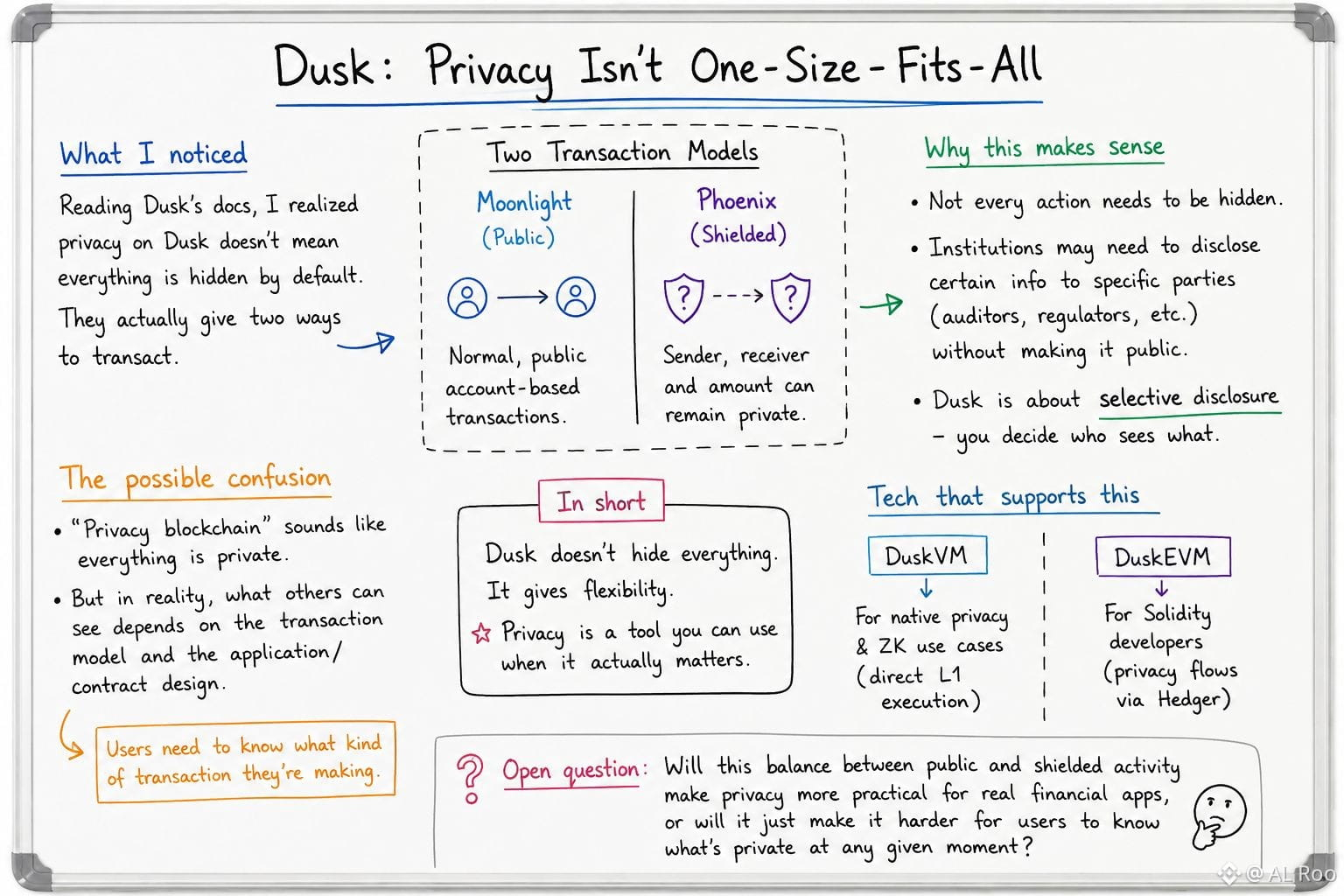
$BNB is showing strong momentum.
Buyers remain in control as structure holds bullish.
EP
604.80 - 605.40
TP
TP1 606.05
TP2 607.20
TP3 608.50
SL
603.80
Liquidity above 606.05 remains the key target. A clean reaction from the entry zone can keep the bullish structure intact and open continuation toward higher levels.
Let’s go $BNB
Buyers remain in control as structure holds bullish.
EP
604.80 - 605.40
TP
TP1 606.05
TP2 607.20
TP3 608.50
SL
603.80
Liquidity above 606.05 remains the key target. A clean reaction from the entry zone can keep the bullish structure intact and open continuation toward higher levels.
Let’s go $BNB
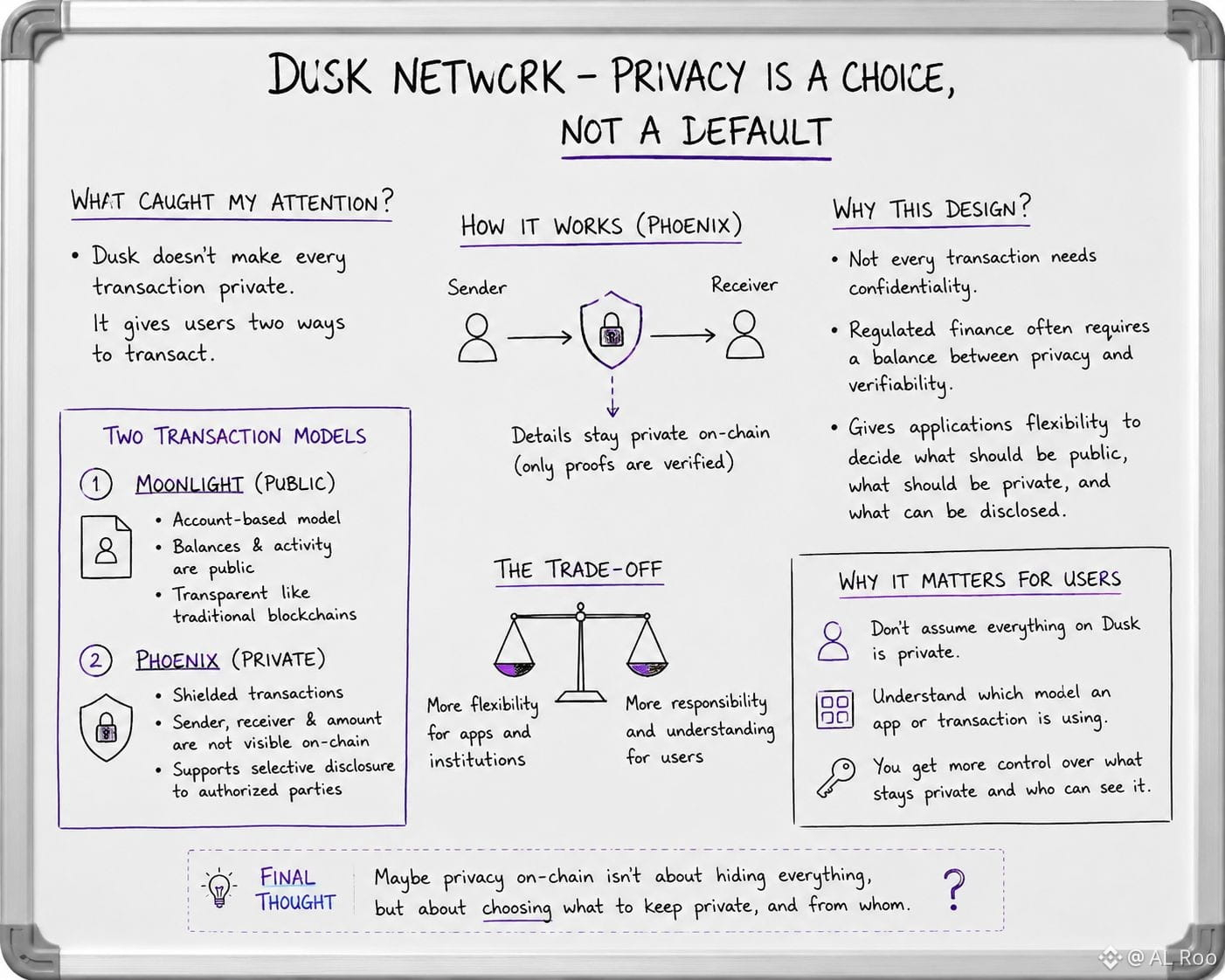
I was reading through Dusk’s docs and one small detail made me look at the whole “privacy blockchain” label a bit differently.
Dusk doesn’t make everything private by default.
There are actually two transaction models. Moonlight is the more familiar public account model, while Phoenix handles shielded transactions. With Phoenix, things like the sender, receiver and amount aren’t openly visible on-chain.
At first I found that a little confusing. If privacy is such a big part of Dusk, why have a public transaction model at all?
The more I read, though, the more the reasoning started to make sense. Financial activity isn’t always a simple choice between showing everything and hiding everything. Some transactions are fine being public, while others involve information that probably shouldn’t be visible to anyone with a block explorer.
And when regulated assets are involved, there can also be situations where certain information needs to be verified or disclosed without making it public to everyone.
I think the confusing part for regular users is the word “private.” Someone could easily assume that using Dusk automatically means whatever they do is confidential. In reality, it depends on which transaction model or application they’re using.
That feels like an important distinction that doesn’t get talked about much.
Maybe privacy on-chain will eventually be less about hiding everything and more about giving users control over what becomes public in the first place.
@Dusk #dusk $DUSK
Dusk doesn’t make everything private by default.
There are actually two transaction models. Moonlight is the more familiar public account model, while Phoenix handles shielded transactions. With Phoenix, things like the sender, receiver and amount aren’t openly visible on-chain.
At first I found that a little confusing. If privacy is such a big part of Dusk, why have a public transaction model at all?
The more I read, though, the more the reasoning started to make sense. Financial activity isn’t always a simple choice between showing everything and hiding everything. Some transactions are fine being public, while others involve information that probably shouldn’t be visible to anyone with a block explorer.
And when regulated assets are involved, there can also be situations where certain information needs to be verified or disclosed without making it public to everyone.
I think the confusing part for regular users is the word “private.” Someone could easily assume that using Dusk automatically means whatever they do is confidential. In reality, it depends on which transaction model or application they’re using.
That feels like an important distinction that doesn’t get talked about much.
Maybe privacy on-chain will eventually be less about hiding everything and more about giving users control over what becomes public in the first place.
@Dusk #dusk $DUSK
Log in to explore more content