

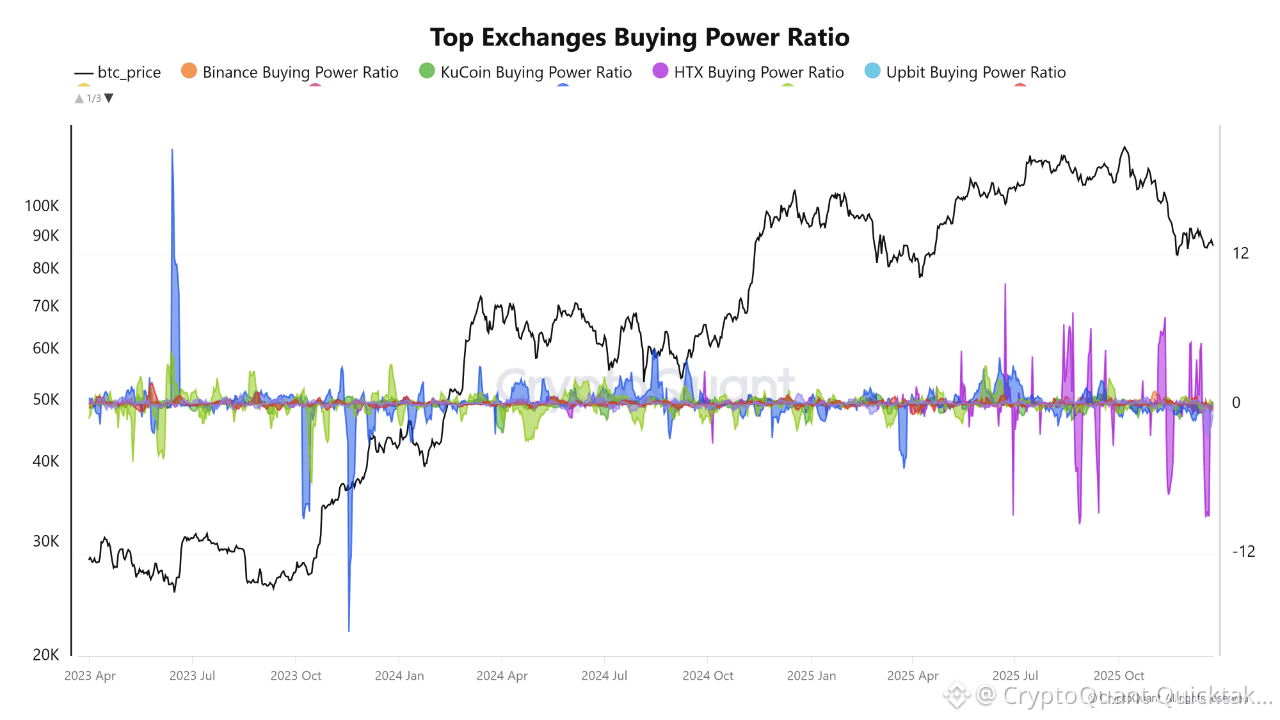
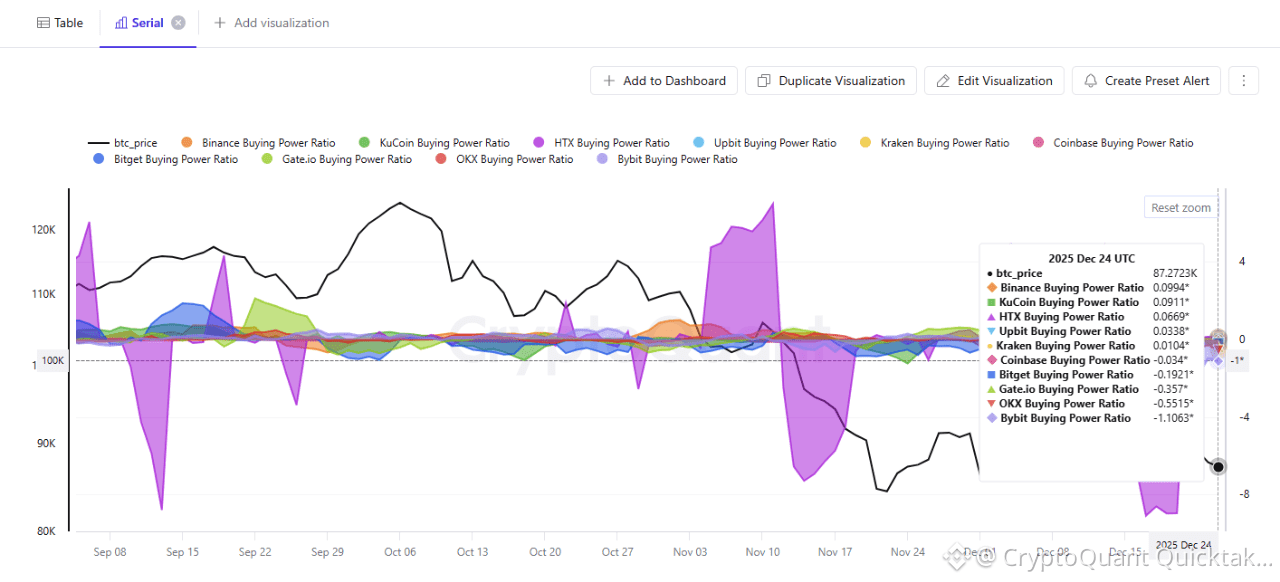
The Buying Power Ratio used in this analysis is defined as the 7-day net stablecoin inflow divided by the 7-day BTC outflow on each exchange. In simple terms, it measures how much “dry powder” is entering an exchange relative to the amount of BTC being distributed. A higher or stable ratio indicates stronger absorption capacity, while persistently negative values reflect capital exhaustion and reactive selling.
Across the dataset, Binance consistently exhibits a structurally stronger buying power profile compared to other major exchanges. While most venues show deeply negative ratios—often below -0.5 and, in several cases, below -1—Binance remains relatively stable, fluctuating in a narrow range around neutral to mildly positive values. This suggests that even as BTC leaves Binance, stablecoin capital continues to rotate in, partially offsetting sell-side pressure.
By contrast, exchanges such as Bybit, OKX, and Bitfinex display prolonged negative buying power regimes, where BTC outflows are accompanied by accelerating stablecoin exits. This pattern implies that selling pressure on those venues is not being met with replenishing capital, increasing the risk of price dislocation. Coinbase Advanced and Kraken show occasional positive spikes, but these are short-lived and inconsistent, pointing to event-driven or region-specific flows rather than sustained demand.
Importantly, this behavior is observed while BTC price remains elevated, indicating that Binance’s role is not aggressive accumulation but liquidity stabilization. The exchange functions as a primary venue where distribution is met with sufficient counterflow, reducing the likelihood of disorderly downside moves.
From a market-structure perspective, sustained price resilience is less about the absence of sellers and more about where selling can be absorbed without draining liquidity. The data suggests that, in the current regime, Binance
Written by Crazzyblockk
