
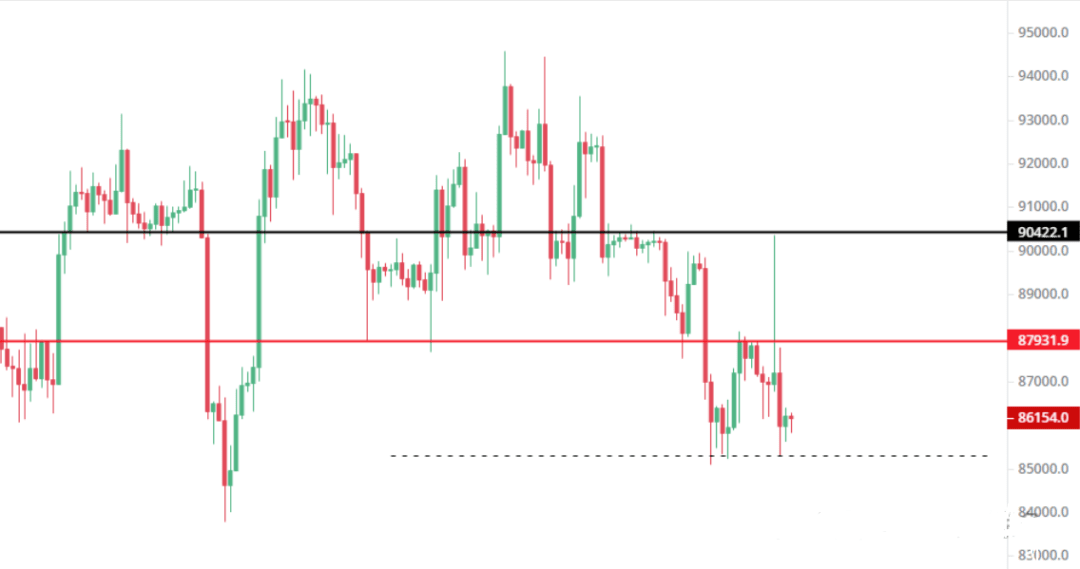
As of December 18 morning, Bitcoin quickly fell back after briefly spiking above $90,000 last night, with the price once again dropping below the $86,000 round figure, down more than 2% within 24 hours. The intraday low briefly dipped below $85,000, refreshing the stage low.
This round of 'high-low' movement is not an incidental fluctuation but a concentrated reflection of the current crypto market acting under rising macro uncertainty, structural fragility, and tightening sentiment before key data is released. In the short term, Bitcoin is likely to maintain a weak oscillation rhythm.

Core Market Dynamics: The Real Driving Force Behind the Sharp Decline
Leveraged liquidation and liquidity sweep
Last night's rapid decline was accompanied by significant concentrated liquidation of leveraged positions. Data shows that during a recent similar fluctuation, more than $520 million worth of long positions were forcibly liquidated across the market within 24 hours, with long liquidations accounting for as much as 87%.
It is worth noting that this round of decline did not correspond to a clear unexpected negative event, but rather, in the context of weak market liquidity, the price slightly breached key support (such as $86,000), triggering a chain stop-loss among highly leveraged longs, resulting in a typical 'internal stampede-like decline.' This also exposes the current rebound foundation as not being solid, with the market being extremely sensitive to structural imbalances.
Continuous selling pressure from the spot side
Deeper pressure comes from the spot side. On-chain data shows that **addresses holding more than 1 BTC (Wholecoiner)** have seen their recharge scale to exchanges drop to a low level not seen since 2018. On the surface, this seems like a supply contraction, but it does not mean that selling pressure has disappeared.
The real resistance comes from a group of investors who built positions near the historical high in October (around $126,000) and have an average cost of around $103,000. Whenever the price rebounds close to their cost area, this portion of 'trapped chips' will concentrate on cashing out, forming a key force that suppresses the market, repeatedly interrupting the rebound rhythm.
Multi-dimensional Influence Factor Breakdown
Macroeconomic Level: Inflation data becomes a dominant variable
After the Federal Reserve's December 'dovish actions and hawkish guidance,' market expectations for future policy paths have clearly diverged. The U.S. CPI and PCE inflation data to be released this week have become the core variables influencing year-end risk appetite.
If inflation data exceeds expectations, it may further strengthen the narrative of 'high interest rates lasting longer,' putting pressure on risk assets including Bitcoin.
Policy Risk of the Bank of Japan
At the same time, the market remains highly vigilant about the potential tightening actions of the Bank of Japan. Historical experience shows that during the rate hike cycle of the Bank of Japan, Bitcoin has experienced an average phase adjustment of about 20%. Once the 'yen carry trade' funds flow back, the global liquidity environment may tighten further.
Capital and Sentiment Level
Institutional funds tend to be cautious: Bitcoin spot ETFs have recently shown a continuous net outflow of funds, reflecting the profit-taking and wait-and-see mentality of institutions.
Downward revision: Standard Chartered Bank has lowered its target price for BTC at the end of 2025 from $200,000 to $100,000, further affecting the market's medium to long-term expectations.
Long-term capital is still positioning: long-term holders represented by MicroStrategy continue to increase their holdings against the trend, purchasing nearly $1 billion worth of BTC in the past two weeks, but this force is still insufficient to reverse the overall weak sentiment.
Technical Structure Level
Key Support Lost: Bitcoin has effectively broken below the short-term defense line of $86,000–$87,000, currently testing around $85,000 repeatedly. This position is also the Fibonacci 0.786 retracement level since the rise in April, viewed as an important pivot point for the medium term.
Momentum indicators are bearish: 4-hour RSI, MACD, and other indicators continue to operate in a weak range, showing that bears still hold the initiative.
Rebound pressure is evident: The upper levels of $91,000 (previous oscillation midpoint) and $94,700 form an important resistance zone, making it challenging to break through in the short term.
Trend Forecast and Key Nodes
In summary, Bitcoin has clearly shifted to a defensive posture under multiple pressures. Today (December 18) and throughout this week, the market will mainly be influenced by technical repair demands and macro level tension.
1. Short-term Trend (next 24-48 hours)
It is expected to oscillate around the core area of $85,000-$86,000 for consolidation. After recently experiencing a leveraged liquidation, there is a technical demand for a rebound from oversold conditions, but the upside space will be strictly limited. The first resistance level is near $86,500, with stronger resistance at $88,000. Without significant positive news, the rebound is unlikely to sustain.
2. Core Observation Nodes
Downside risk: $85,000 is the last line of defense that must be maintained. Once the daily closing price confirms a drop below this level, it may trigger broader stop-loss and panic selling, with downside targets directly pointing to the $78,000-$80,000 area.
Turning point for upward movement: To reverse the current slump, Bitcoin must first recover and stabilize above the $91,000 mark. However, this requires significantly positive macro data or large-scale spot buying, which is challenging to achieve in the current environment.
Strategy Recommendation:
The recent high and fall of Bitcoin is an inevitable result of the market operating under weak liquidity, high macro uncertainty, and weakening technical structure. The current market has completely shifted from the trading logic of 'Federal Reserve rate cuts' to pricing in concerns over 'inflation data' and 'central bank policy independence.' Before the release of key economic data, the market will maintain a highly sensitive and fragile state.
For investors, the importance of capital preservation currently far exceeds aggressive tactical play. It is advised to closely monitor the gains and losses at the $85,000 support level and the upcoming U.S. inflation data, as these will be key to determining Bitcoin's year-end closing trend.

