

@Lorenzo Protocol There’s a particular kind of friction you feel when money has to cross boundaries. Not just national borders, but the smaller ones too: between apps, between banks, between trading venues, between “business hours” and the rest of your life. The internet trained us to expect everything to be instant, searchable, and always on. Finance didn’t get the memo. That mismatch is a big part of why on-chain finance is trending again, and why it feels different this time. It wears on people, quietly.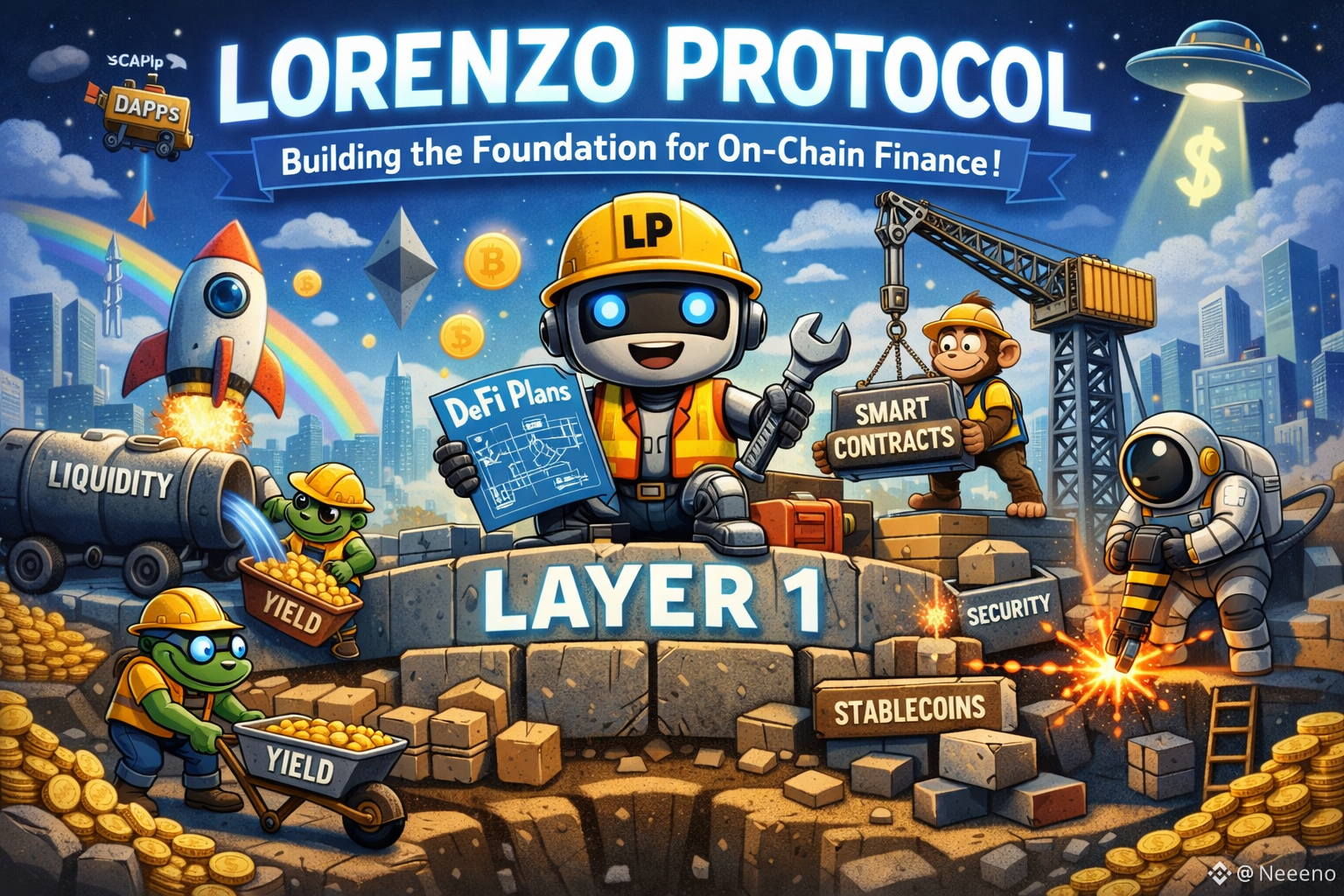
In 2025, the conversation has shifted from “can crypto do finance?” to “what parts of finance can actually be rebuilt as software?” Stablecoins sit at the center of that shift. They’re no longer just a trading convenience; they’re increasingly treated as settlement infrastructure that can move 24/7. Regulatory momentum has helped too. In the United States, the GENIUS Act passed in July 2025 to create a federal framework for payment stablecoins. Around the same time, pilots and announcements from big payment networks and banks made the whole space feel less hypothetical. You can see the same gravity in how quickly tokenized money-market and Treasury-like products have become part of the mainstream on-chain conversation. People aren’t only asking what’s possible anymore. They’re asking what’s dependable.
That’s the environment Lorenzo Protocol is trying to serve. Lorenzo describes itself as an institutional-grade on-chain asset management platform, but the interesting part is what that implies. Instead of building one more isolated yield app, it aims to create a standard way to package strategies into on-chain products that other apps can plug into. The team calls this a “financial abstraction layer.” In plain terms, it’s an attempt to move the hard parts—capital routing, performance accounting, share issuance, and strategy operations—into a set of building blocks that feel consistent and auditable.
The clearest expression of that idea is Lorenzo’s On-Chain Traded Funds, or OTFs. The name is a little stiff, but the concept is familiar: a rule-driven vehicle that issues shares and follows a defined strategy. The difference is that the rules, the inflows and outflows, and the resulting positions are visible on-chain. In July 2025, Lorenzo launched its flagship stablecoin product, USD1+ OTF, on BNB Chain mainnet. Moving from test environments to mainnet matters because it forces a project to deal with reality: slippage, user behavior, operational constraints, and the kinds of edge cases that don’t show up in demos.
If you’ve watched DeFi up close, you can probably guess why structured products are getting more attention now. Many people are tired of yields that exist mostly because tokens are being emitted to attract deposits. The phrase “real yield” is overused, but the underlying desire is reasonable: returns should come from something you can point to, like fees, spreads, interest on underlying assets, or a well-defined strategy that has to earn its keep. When yield is packaged into an OTF, the promise is not magic. It’s clarity. You can ask: what is this strategy actually doing, and does it still make sense when the market changes?
Lorenzo’s path into this newer asset-management framing also runs through Bitcoin, which is another reason the protocol shows up in current discussions. For years, Bitcoin was mostly financially inert: powerful as a store of value, awkward as productive capital. Over the last year or two, “BTCfi” has matured, especially with self-custodial Bitcoin staking gaining visibility through systems like Babylon. Lorenzo started by focusing on Bitcoin liquidity: token standards like enzoBTC as a wrapped BTC representation, and stBTC as a staking receipt that can still move through DeFi. It’s a simple idea with big consequences: if people can earn on BTC while keeping flexibility, Bitcoin stops being a spectator and becomes part of an on-chain balance sheet.
The bigger idea Lorenzo is betting on is interoperability. A lot of DeFi still feels like a collection of clever one-offs. Asset management, when it’s done well, is the opposite: repeatable processes, defined constraints, and risk controls that are built for the bad days, not just the good ones. If strategy products become standardized tokens, they can be integrated the way payment rails or lending markets are integrated: as components. That’s what “foundational layer” means in practice. It’s less about a single app being famous, and more about many apps quietly becoming more capable because the underlying primitives are stable.
None of this removes risk. On-chain transparency doesn’t automatically mean safety. Smart contracts can have bugs. Strategies can behave strangely in stressed markets. And any time a product touches the off-chain world—through custodians, regulated instruments, or external venues—it inherits some of that world’s constraints and failure modes. Governance matters too. Lorenzo’s BANK token and vote-escrow style governance model shape incentives and decision-making, but governance is only as good as the participation and the alignment behind it. In my view, the healthiest projects are the ones that treat these points as part of the work, not as footnotes.
If Lorenzo succeeds, it probably won’t look like one app taking over. It will look like quiet integrations: a yield option inside a wallet, a treasury tool for a small business, a portfolio component that can be inspected in public. That kind of progress doesn’t come with fireworks. It comes with fewer steps, fewer intermediaries, and fewer surprises. And in finance, fewer surprises is a pretty good north star.
@Lorenzo Protocol #lorenzoprotocol $BANK


