

@KITE AI When people talk about autonomous AI right now, they are not really talking about smarter text or better answers. They are talking about software that can act. Software that can decide, pay, coordinate, and keep going without tapping a human on the shoulder every few minutes. That shift feels small until you sit with it. Most of our digital systems are built around constant permission. Click here. Approve that. Confirm this charge. Once software stops asking for permission at every step, the economics of what it can do start to change.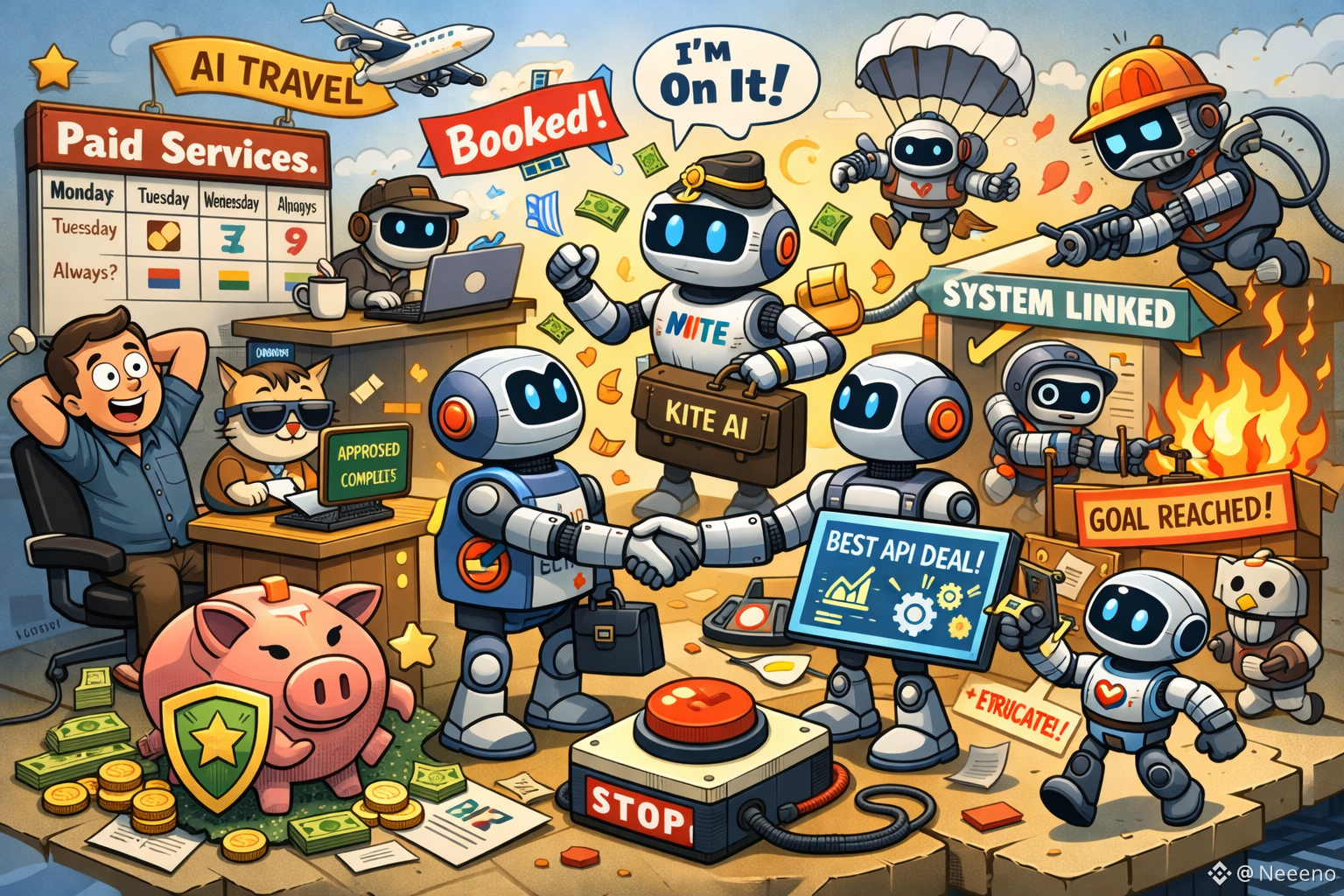
I notice this most in the quiet friction of everyday work. Planning travel, managing subscriptions, spinning up tools, reconciling expenses. None of it is hard, exactly. It is just fragmented. The effort lives in the seams between systems. Logging in. Switching accounts. Double-checking settings. Humans spend hours doing this invisible glue work, and we barely talk about its cost. When people say autonomous agents could boost productivity, I think what they really mean is that agents might finally absorb that glue.
This is the context in which Kite AI has started to matter. Kite is built around a simple but ambitious idea: if software agents are going to operate independently, they need their own economic rails. Not borrowed logins or shared API keys, but native identity, payment, and verification designed for nonhuman actors. The framing is careful. It is not about unleashing software without limits. It is about giving agents constrained autonomy that can be audited, revoked, and understood after the fact.
The timing is not an accident. Five years ago, agents were brittle. They could follow scripts, but they struggled with messy, multi-step goals. That has changed. Today’s AI systems are better at planning and adjusting when something goes wrong. Software itself has also become more modular and easier to combine. APIs are cleaner. Services are easier to combine. What lagged behind was money. An agent that can find a service but cannot pay for it is still dependent on a human. The moment it can pay, even in small amounts, it becomes something new.
Money forces clarity. Once an agent can spend, questions get sharper. Who is responsible if it overspends?
What if it does what makes sense in the moment, but it still goes wrong? Anyone who has ever left an API key active for too long knows that uneasy feeling. Autonomy wants persistence. Security wants narrow scope and short lifetimes. Kite’s approach tries to square that circle by treating agents as entities with their own wallets and bounded permissions, rather than extensions of a user session. That design choice sounds technical, but its impact is economic. It lowers the cost of letting software act.
Payment also turns coordination into a market. When agents can pay per use, they can assemble workflows dynamically. One service for data. Another for computation. Another for verification. The best option at that moment wins. This opens space for smaller, more specialized providers who sell a narrow capability extremely well. It also removes sentiment from the equation. An agent will switch tools without loyalty or hesitation. Reliability and price matter more than brand.
There is a flip side to this efficiency. When everything becomes metered, we risk losing the informal spaces where exploration happens without cost. Today, many online systems are subsidized by ads or goodwill. Agent-driven markets could replace that with strict accounting. That might be fairer, or it might feel colder. I am not sure yet. What is clear is that economic design decisions made now will shape how much autonomy feels empowering versus extractive.
What I find most interesting about Kite’s framing is that it treats agents as long-lived participants. Not one-off scripts, but entities that can build a history. They can complete tasks, earn fees, gain trust, and gradually unlock more responsibility. That starts to look less like software as a tool and more like software as a worker. Even writing that makes me stop and think. The words we choose matter. They affect how we decide who is responsible and who deserves credit.
Infrastructure alone will not solve the hard parts. Easy transactions can also make mistakes easier to scale. An agent can misunderstand context, follow outdated instructions, or optimize for a metric you did not realize you gave it. When that happens, the damage is not theoretical. It is financial. Any system that enables autonomy has to make stopping just as easy as starting.
It feels like a turning point. We are no longer asking if AI agents can act on their own. We are starting to ask whether we are ready to deal with what happens when they do.
That is a more adult question. Kite AI is one attempt to answer it by making economics explicit rather than implicit. If it works, autonomous software may fade into the background, quietly doing more of the work we never wanted to do. If it fails, we will be reminded that permission is not just a prompt. It is a boundary. And crossing it changes everything.

