

The recent digital assets and global financial markets can be described as 'half water, half flame.' On one side, Bitcoin has dropped from $95,000 to $85,000, with 200,000 people liquidated and $600 million vanished in 24 hours; on the other side, U.S. stocks in the crypto sector have collectively rebounded, with Circle surging nearly 10% in a single day, and JD.com restarting its digital collectibles business, injecting confidence into the industry. Additionally, the controversy over the Federal Reserve's interest rate cuts and Trump's dual pressures (blocking Venezuela + interviewing candidates for the Federal Reserve Chair) are intertwining multiple variables in the market. Below, we will clearly outline the key events that influence investment decisions.
1. Crypto Market: A coexistence of sharp declines and opportunities, with institutional movements hiding signals.
The recent fluctuations in the crypto market can be described as 'heart-pounding'; on one side is the panic of a liquidation wave, and on the other is the continued positioning by institutions, with the battle between bulls and bears becoming increasingly intense.
1. Behind Bitcoin's plunge: Three major factors lead to a 'fatal triangle kill'.
The recent plunge in Bitcoin is not coincidental; market analysis indicates that the combination of the Federal Reserve's interest rate cuts, Japan's rate hikes, and the Christmas holiday has formed a 'fatal triangle kill.'
After the Federal Reserve's interest rate cut on December 11, Powell released hawkish signals, causing the market's previous aggressive rate cut expectations to fall short, and risk assets lost liquidity support.
On December 19, the Bank of Japan is about to raise interest rates, which may trigger large-scale liquidation of yen arbitrage trades, withdrawing liquidity from global markets.
As the Christmas holiday approaches on December 23, market trading willingness has cooled, and liquidity has dried up, further amplifying price fluctuations.
As of now, Bitcoin's current price is approximately $87,548, and the total liquidation amount across the network in the past 24 hours reached $258 million. More critically, below the key support level of $87,000, there are still latent risks of massive long liquidations, and the short-term market is still under considerable pressure.
2. Institutions not in a panic? BlackRock transfers a large amount of ETH, publicly traded companies increase their Bitcoin positions.
Just as market panic sets in, institutional actions hide positive signals:
Global asset management giant BlackRock transferred approximately 47,000 ETH to Coinbase, valued at $140 million at current prices, sparking speculation about institutional positioning in the Ethereum ecosystem.
Canadian public company Matador spent $10.5 million to purchase Bitcoin, continuing the trend of companies increasing their holdings of crypto assets.
CME Group (Chicago Mercantile Exchange) announced that futures for cryptocurrencies such as SOL and XRP will support TAS trading functionality (instant execution feature), which means that the convenience of institutional participation in the trading of these tokens has been further enhanced, potentially improving market liquidity.
Optimistic signals also come from institutional predictions—Bitwise clearly states that Bitcoin will reach an all-time high in 2026, injecting confidence into long-term investors.
3. US crypto stocks rebound against the trend, Circle surges 9.99% in a single day.
Unlike the fluctuations in cryptocurrencies, US stocks related to crypto experienced a general rebound on December 17. On that day, the US stock market closed with the Dow down 0.6%, the S&P 500 down 0.2%, and the Nasdaq up 0.2%, while crypto stocks performed brilliantly:
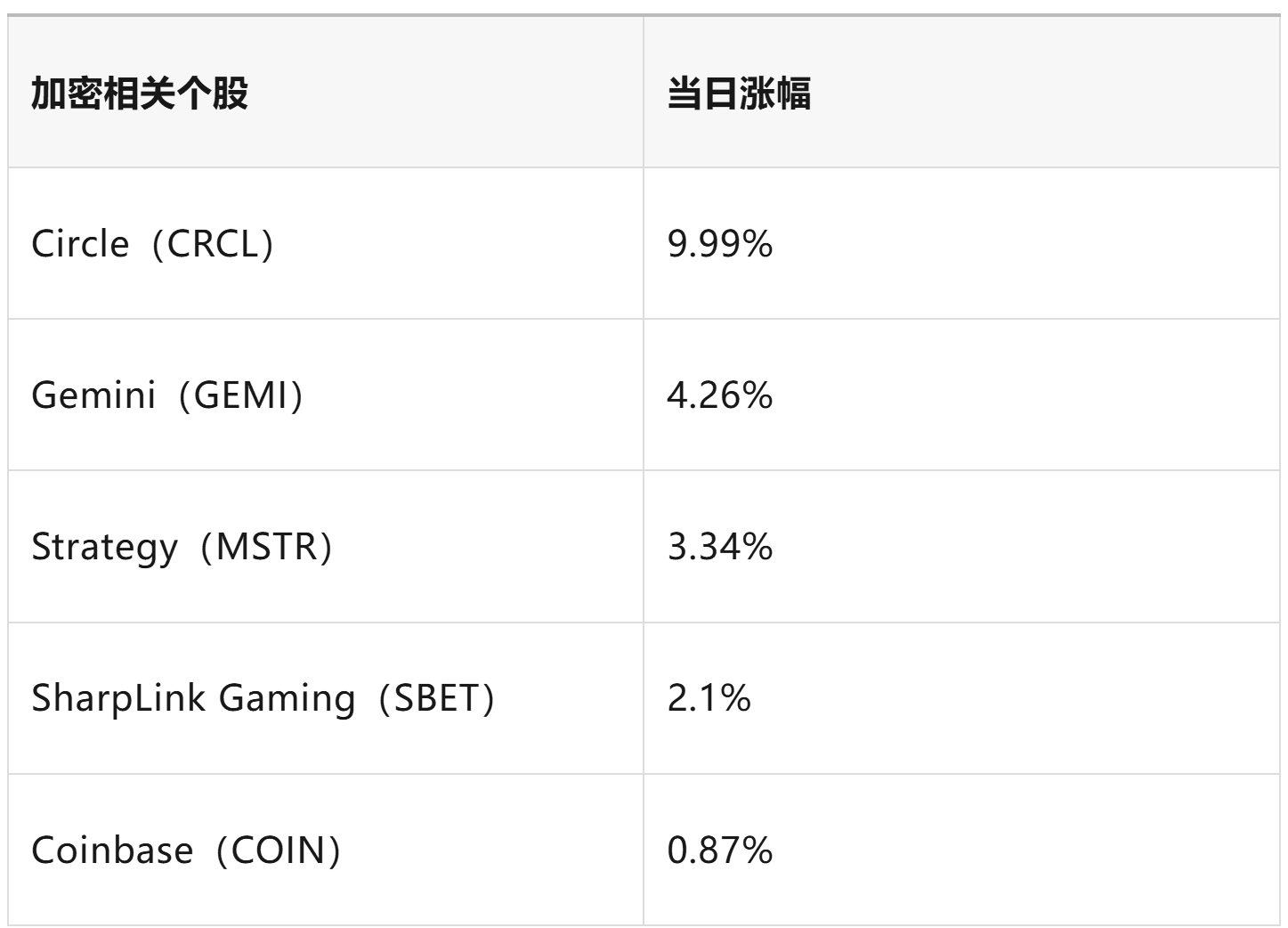
Among them, Circle's surge is particularly notable. As the issuer of the USDC stablecoin, its stock price strength may be related to Visa's latest actions—Visa announced that US banks can use USDC for transaction settlements through the Solana chain, which means that the application scenarios for stablecoins are further expanding, accelerating the industry's compliance process.
2. Industry Milestone: SEC ends four-year investigation into Aave, JD.com restarts digital asset collection, bringing warmth back to the industry.
Recently, the crypto and digital asset industry has welcomed multiple milestones in compliance and ecology, particularly the alleviation of regulatory pressures in the DeFi sector, as well as the regulatory restart of China's digital collectibles industry, which has given the market hope for long-term development.
1. Major breakthrough in DeFi: SEC ends nearly four-year investigation into Aave.
On December 17, Aave founder Stani.eth announced a significant piece of news: the US SEC has concluded its four-year investigation into the Aave protocol. This result has relieved the Aave team and brought hope to the entire DeFi industry.
In recent years, the DeFi sector has faced uncertain regulatory pressures, and Aave's successful escape from investigation is seen as the 'beginning of a new era where developers can truly build the financial future.' Notably, Aave token holders had previously proposed merging with Aave Labs to further integrate ecological resources. With the lifting of this regulatory pressure, this integration plan may be advanced.
2. China's digital collectibles industry recovers: JD.com restarts 'Lingxi' and opens transfer services.
Domestically, the digital collectibles industry has reached an important turning point. On December 16, JD.com's digital collection platform 'Lingxi' announced that starting from December 15, new digital assets will officially open transfer services, while the opening time for existing assets is to be determined, just one day after Lingxi's public test began.
Looking back in history, Lingxi was launched as early as December 2021, with the first batch of digital collectibles based on JD.com's mascot 'Joy' selling out quickly. However, with tightening policies in 2022, Lingxi, which had not opened secondary trading, was once on the verge of 'stopping'. At that time, the entire industry also entered a winter, with Tencent's 'Phantom Core', Tencent Music's digital collection, and other businesses shutting down one after another.
The key to this industry's recovery is the formal implementation of two national standards in December this year (Asset Management Culture Digital Asset Trading Implementation Guidelines) and (Cultural Digital Asset Valuation Guidelines), marking a new stage of 'normative guidance' for the digital collectibles industry after moving from 'spontaneous exploration'. Zhu Youping, rotating chairman of the Blockchain Special Committee of the China Communications Industry Association, stated that JD.com’s Lingxi restart verified the core logic: the essence of digital collectibles is digital rights certificates, which are goods rather than financial assets.
3. Other industry dynamics: hacking attacks and innovative applications coexist.
In addition to compliance progress, the industry also faces dual challenges of security and innovation:
The DeFi protocol Yearn Finance V1 was hacked, resulting in a loss of about $300,000, reminding the industry once again of the importance of security protection.
The Marshall Islands launched a blockchain-based universal basic income program, combining blockchain technology with social security to explore innovative applications of digital assets.
The UK has begun reviewing cryptocurrency party donations to further improve the regulatory framework in the crypto field.
3. Macroeconomic and Global Dynamics: Federal Reserve policy becomes the focus, Trump's actions draw attention.
Global macro policies and geopolitical events are profoundly affecting the direction of crypto and financial markets, especially the Federal Reserve's path of interest rate cuts and Trump's series of actions, which have become the core of market attention.
1. Federal Reserve policy game: Goldman Sachs predicts more aggressive rate cuts next year, focusing on unemployment rates.
Regarding the Federal Reserve's interest rate cut pace, market and institutional speculation has never stopped. Goldman Sachs' latest forecast indicates that the Federal Reserve may be more willing to cut rates further next year than the market previously expected, with the easing cycle possibly extending to 2026, and the federal funds target rate potentially dropping to 3% or lower.
Josh Schiffrin, Chief Strategist of Goldman Sachs Global Banking and Markets, pointed out that Powell's press conference released key signals: the Federal Reserve is increasingly concerned about the sustainability of employment conditions. Future employment reports will be crucial for policy adjustments, and the market should focus on the unemployment rate rather than the overall growth in non-farm employment numbers. The previously released US November non-farm employment figure was 64,000, with an unemployment rate of 4.6%, which has become an important reference for interpreting Federal Reserve policy.
2. The selection of Federal Reserve chair candidates becomes clearer: Trump will interview Governor Waller.
The competition for the position of Federal Reserve chair has also entered a critical stage. According to insiders, Trump will interview current Federal Reserve Governor Waller on Wednesday local time regarding the chair position. Previously, Trump had interviewed former Federal Reserve Governor Kevin Warsh and clearly stated that Warsh and Hassett are currently his two favored candidates.
Notably, Waller has been a major voice advocating for interest rate cuts within the Federal Reserve this year. He voted against maintaining rates at the July meeting to support cuts. He is not only favored by economists but also well-regarded on Wall Street, with many of his proposed rate cut arguments adopted by current chair Powell, and he is viewed as capable of bridging the divisions within the Federal Reserve. Waller is scheduled to speak on the economic outlook on Wednesday evening Beijing time, and his statements may further influence market expectations for Federal Reserve policy.
3. Trump intensifies geopolitical pressure: comprehensive blockade of sanctioned oil tankers in Venezuela.
In addition to domestic policies, Trump's actions internationally have also drawn attention. On December 17, Trump posted on social media that Venezuela has been completely surrounded by the largest fleet in South American history and will implement a complete blockade on all sanctioned oil tankers entering and leaving Venezuela until Venezuela returns the 'stolen' oil, land, and other assets.
Trump also designated the Venezuelan regime as a foreign terrorist organization, accusing it of using oil from stolen oil fields to fund terrorism, human trafficking, and other illegal activities. This move marks an escalation in the Trump administration's pressure on Maduro's regime. Last week, the US had already seized a sanctioned oil tanker near the coast of Venezuela, and the rise in geopolitical risks may trigger fluctuations in market risk aversion.
4. Other macro and market insights.
The US FDIC (Federal Deposit Insurance Corporation) proposed to establish a stablecoin application framework to further improve regulation in the stablecoin field, promoting the compliant development of the industry.
The Russian State Duma clearly stated that cryptocurrencies can only be used as investment tools in Russia and cannot circulate as currency, defining the legal positioning of crypto assets.
A report from Coinbase (the state of the crypto industry in the fourth quarter of 2025) shows that 45% of young investors in the US already hold cryptocurrencies, while the proportion of older investors is only 18%, indicating that the younger group has become an important participant in the crypto market.
Michael Saylor, founder of MicroStrategy, stated on the X platform that quantum computing will not undermine Bitcoin; instead, it will enhance its security—network upgrades and Bitcoin migrations will improve security, and the freezing of lost Bitcoins will reduce supply and make Bitcoin stronger.
4. Voices from industry figures: He Yi shares the founding journey of Binance, with the original intention of becoming the world's top.
The development of the crypto industry cannot be separated from the promotion of key figures. Recently, Binance co-founder He Yi shared her growth and entrepreneurial experience: coming out of a poor village, gradually entering the crypto space, and during the process of cooperating with CZ to establish Binance, she once declined CZ and bluntly said, 'You can't afford me.' She also discussed her insights on success, women's empowerment, and family balance, showcasing the struggles behind the industry's core figures.
Summary: The market seeks direction amid volatility, with compliance and innovation becoming the main line of growth.
The current global financial and crypto markets are in a critical period of intertwining multiple variables: the short-term volatility of BTC comes from the combination of liquidity expectations and holiday effects, while the continuous positioning of institutions and the industry's compliance breakthroughs (such as Aave's end of SEC investigation and the advancement of stablecoin regulatory frameworks) highlight the long-term development potential. The regulatory restart of the domestic digital collectibles industry has also anchored compliance and materialization as the core logic for industry development.
For investors, short-term vigilance is needed regarding changes in Federal Reserve policy expectations and market volatility caused by geopolitical risks; in the long run, the institutionalization of crypto assets, the scenario-based application of digital collectibles, and the improvement of global regulatory frameworks will be key to determining the industry's direction. In this market of 'ice and fire,' only by grasping the compliance main line and focusing on core values can one find genuine investment opportunities amid volatility.
Disclaimer: The content mentioned in this article is for reference only and does not constitute any investment advice. Investors should consider their own risk tolerance and investment goals, view cryptocurrency investments rationally, and avoid blindly following trends.


