

When I first heard about @Yield Guild Games (YGG) back in 2021, it was often described in the same breath as “play-to-earn hype” and “crypto gaming experiment.” At the time that felt accurate: a few passionate founders lending digital game characters to players in the Philippines and elsewhere so they could earn tokens sounded novel, even noble, but somewhat nebulous. What makes this project trend again today isn’t nostalgia or token prices. It’s that YGG has quietly shifted from a quirky scholarship program to something akin to Web3 gaming infrastructure a framework of communities, incentives, and shared ownership that others are starting to replicate and that evolution is worth understanding not because of buzz, but because it points to what’s actually happening at the intersection of games and decentralized tech. 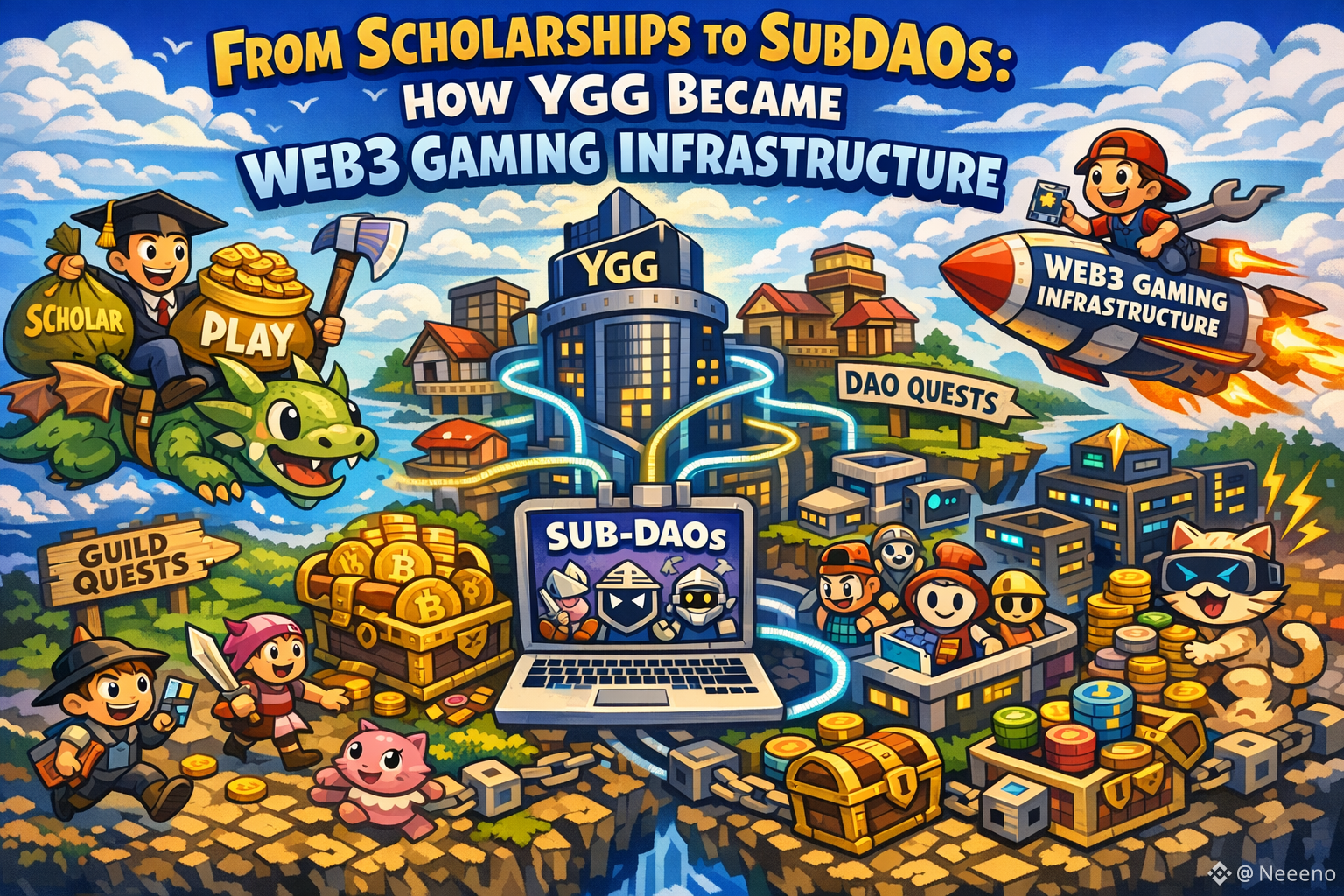
Let’s start with the familiar story: scholarships. In the early days of blockchain games like Axie Infinity, the biggest barrier to play was cost. To participate, you needed NFT characters. If you had to buy them yourself, you were blocked at the gate. YGG’s founders recognized that barrier not just as a financial problem, but as a structural one. They began lending NFTs to players who could not afford them, in exchange for a simple split of rewards — typically a share for the player, a share for the guild, and a slice for the person managing that scholar relationship. That sounds prosaic, but it mattered: suddenly people who had the time and skill but not the capital could join the emerging play-to-earn ecosystem.
For months I’d witnessed this model called a “scholarship program,” but what it actually was — when you strip away the jargon — was a community credit system. YGG didn’t just distribute assets; it mentored new players, built trust networks, and aligned incentives between people who owned resources and people who wanted to build skills. Early on, the numbers were striking: thousands of active scholars, millions in shared earnings, and a sense that this was proof of concept, not just gimmick.
But simple scholarship programs aren’t infrastructure. You can fund apprenticeships in an industry without becoming a core part of that industry’s plumbing. What happened next was subtle and structural: YGG began to formalize the very ways it organized, governed, and scaled these efforts. The key was decentralization — but not as a slogan. I mean real delegation of decision-making and accountability into smaller, distinct units called SubDAOs.
Imagine YGG as a federation rather than a monolith. Instead of every decision being made at a central level, discrete communities — sometimes oriented around a specific game like Splinterlands, sometimes around regions like Southeast Asia — operate with their own governance, their own treasury priorities, and their own local strategies. These SubDAOs aren’t franchises; they’re autonomous corners of the broader guild that can experiment and iterate independently. That’s a meaningful shift: it transforms YGG from being an organizer of opportunities to being a platform for coordinated, distributed action.
This matters because Web3 gaming isn’t smooth or settled yet. Games often hit the same loop: players want a finished, exciting experience, while developers need an active community early on to try features, report problems, and confirm the game is sustainable. YGG’s structure helps address this by bringing players and assets together at scale, offering immediate user bases to fledgling titles, and giving developers early signals about what works and what doesn’t in live environments. In other words, YGG’s communities provide real user feedback, not just speculative capital.
I’ve talked with developers and community leaders who express a kind of cautious admiration for this model. They’ll say, “It’s not perfect, and it won’t fix every problem in Web3 gaming. But having a network of players and invested communities — that’s something most blockchain games haven’t found.” That’s an important distinction: players who earn with assets behave differently than consumers who buy tokens hoping for price appreciation. They give you engagement, retention, and actionable feedback. That’s the sort of infrastructure most blockchain games painfully lack.
Still, YGG’s journey hasn’t been linear.Play-to-earn exploded, then trust dropped. Some people felt it was unfair or “extractive,” others pointed to unstable token prices, and a lot of traditional gamers were openly hostile to blockchain in games.
In that situation, YGG building a layered network of DAOs and SubDAOs doesn’t feel like hype — it feels like a smarter structure. It allows for different rules and needs in different regions, and it accepts that one universal model won’t hold up.
It matters now because blockchain gaming is starting to look normal, not fringe.. Whether it succeeds widely or not, the idea of gaming economies with shared ownership, decentralized governance, and direct player incentives is being explored seriously in studios and indie teams alike. YGG isn’t the only actor in that space, but its development from granting access to assets into enabling governed, distributed communities offers a template for how Web3 systems might realistically integrate into creative ecosystems.
It’s worth asking, as we look to the future: Is decentralized governance the same as meaningful infrastructure for creative economies? Or is it just a fancy form of sticker governance layered on top of old problems? The answer likely sits somewhere in between. But what YGG’s transformation shows is that infrastructure isn’t built overnight — it’s stitched together through repeated trials, local solutions, and the willingness to hand off some authority to the people closest to the problems.
In that sense, YGG’s journey from scholarships to SubDAOs isn’t just a report on institutional evolution. It’s a reminder that the future of collaborative economies — whether in games, art, or digital communities — is being shaped not by single platforms, but by the networks of people who choose to organize differently. That, to me, is the real trend we’re witnessing.
@Yield Guild Games #YGGPlay $YGG
