

When I first started paying attention to protocols that blend traditional finance with the emerging world of decentralized systems, @Lorenzo Protocol stood out not because it shouted the loudest or promised utopia, but because it seemed to be asking a slightly different question. Instead of simply trying to “DeFi everything,” it asked: “What if the things people already value, like professional asset management, could live natively on chain and could do so in a way that actually works with other parts of the ecosystem, rather than in isolation?” Now, in late 2025, that question feels more urgent than ever as the broader crypto economy wrestles with fragmentation, liquidity inefficiencies, and a surprising lack of composability for complex financial products. 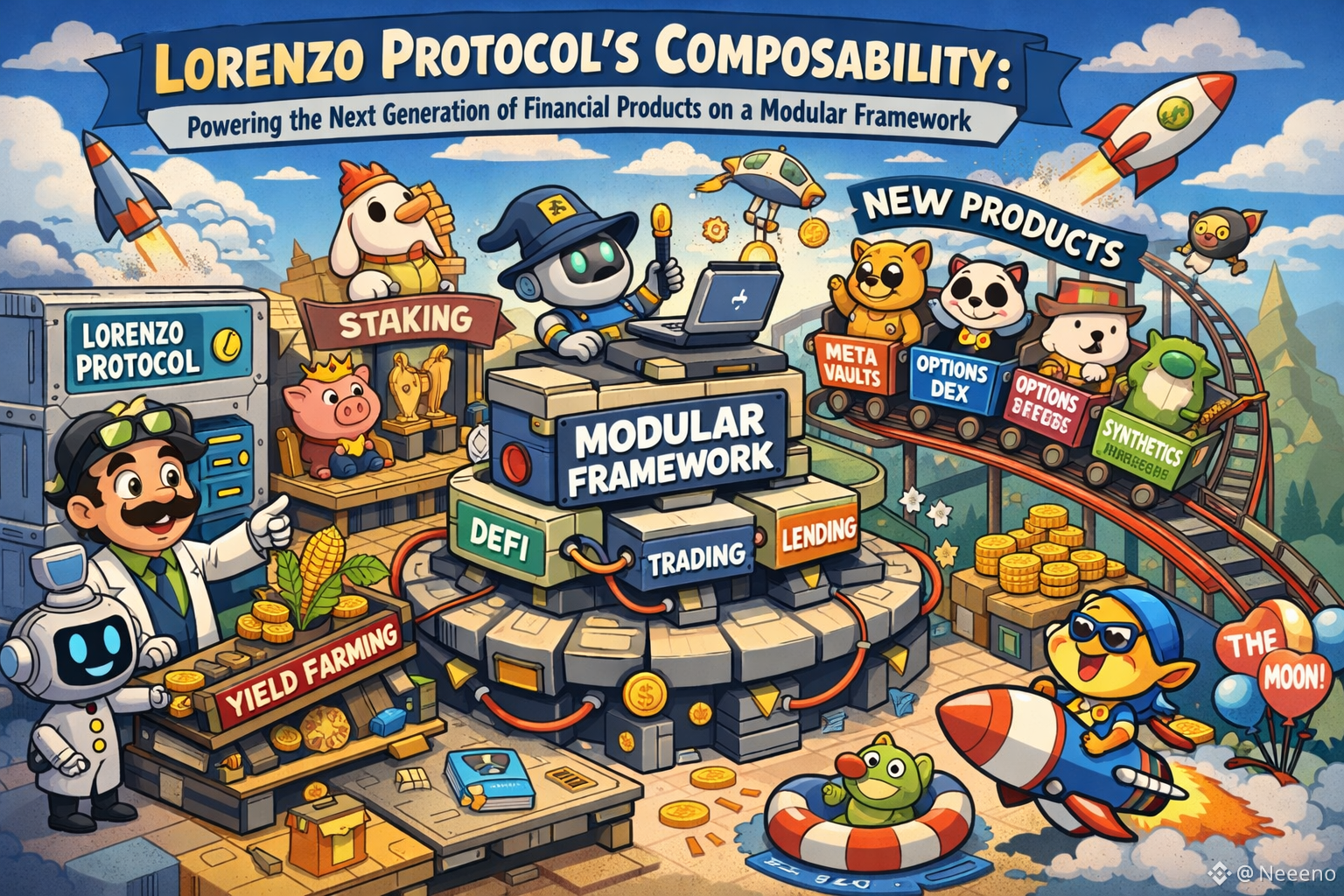
The idea of composability in finance isn’t new. In traditional markets, it’s what allows a mortgage to be packaged into a security, which can then be sliced and diced into tranches, sold, repackaged—effectively letting building blocks of capital and risk be paired together in countless ways. In decentralized finance, composability was supposed to be even more powerful: open lego-like building blocks that anyone can stitch together to create new financial instruments. But early DeFi years were dominated by simple yield farms, lending pools, and token swaps. Complex, multi-layered products that mirror professional asset management were technically possible, but rarely integrated in ways that felt truly modular or easy to compose with other protocols. This is where Lorenzo Protocol’s architecture comes into view.
At its core, Lorenzo describes itself as an asset-management layer built on an EVM-compatible blockchain that turns structured financial strategies into tokenized products that can be used anywhere on chain. These products—like the USD1+ On-Chain Traded Fund (OTF)—don’t merely aim to deliver yield in a silo. They are designed so that wallets, DeFi applications, and even other protocols can embed, route, trade, or collateralize them just like any other on-chain asset. That’s composability in action: a product that lives on chain in a way that other on-chain systems can interact with seamlessly.
But what makes Lorenzo’s approach distinct, at least in theory, is how it constructs these building blocks. The protocol doesn’t just wrap an off-chain strategy in a token and hope for the best; it uses what they call a Financial Abstraction Layer—a framework that codifies how funds are managed, how returns are generated, and how capital moves in and out of strategies.
Instead of keeping financial complexity hidden, this layer puts things like custody and risk management into clear, on-chain rules. The tokens created from this—whether they offer steady returns, Bitcoin exposure, or multiple strategies—are built to function as normal assets throughout the decentralized ecosystem.
Understanding this requires a quick look at DeFi’s early phase. At that time, composability focused on simple protocol-to-protocol links, such as lending systems using common collateral pools or yield platforms combining liquidity from different sources.
But as the market matured, there was a gap between simple “plug-in” mechanical composability and strategic composability. Strategic composability is about creating financial primitives that don’t just transact with other on-chain contracts, but represent real, structured financial logic that can interact with any other piece of the ecosystem without bespoke engineering. Lorenzo’s OTF tokens are precisely that—they encode diversified yield logic in a form that can be reused by other applications, whether as collateral in lending markets, inventory for market makers, or settlement assets for enterprise systems.
This shift is not merely academic. We’re living in a moment when markets are grappling with fragmentation: liquidity scattered across multiple blockchains, users struggling to move capital efficiently, and sophisticated investors reluctant to engage with systems that are either too isolated or too opaque. By bringing structured financial products on chain in a modular way, Lorenzo protocol offers a potential bridge. Its tokens can be composably plugged into other systems; for example, a stable yield token could be used in a lending market or as part of a derivative product without rewiring every protocol to understand the underlying strategy.
This goes beyond simple technical setup and shows real financial structure. Even so, it’s important to acknowledge the difficulties that come with it.Translating institutional asset-management logic onto a decentralized rail is hard. On the one hand, on-chain transparency demands that every allocation, rebalancing, and risk decision be inspectable—something traditional financial managers are not always comfortable with. On the other hand, you still have to contend with off-chain realities: macro yield rates, counterparty exposure, and the very real operational risks of executing complex strategies across on-chain and off-chain environments. Lorenzo’s approach, promising a bridge between transparent on-chain logic and real trading strategies, is compelling because it forces these questions into the open rather than burying them behind proprietary systems.
There’s also something deeper going on culturally here. Crypto’s early ethos was about disintermediation: remove the middleman.
Over time, it’s become clear that some intermediaries add real value, especially when it comes to managing risk and structuring investments. The challenge isn’t removing them, but making their work transparent and compatible with other platforms. Composability helps make that possible by aligning how different markets and systems interact.This is less hyped crypto speak and more an acknowledgment that financial innovation requires structure as much as openness. Lorenzo’s framework, with its modular products and token standards, feels like a step in that direction.
As someone who’s watched multiple cycles of financial innovation, both in traditional markets and in decentralized systems, I find this convergence fascinating. We are no longer in the era where simple yield farming or AMM DEXes define the frontier. The frontier now lies in how financial products are constructed, where they can be used, and how they compose with the rest of the financial stack—from wallets to lending markets, from institutional treasuries to algorithmic trading engines. Lorenzo’s narrative may still evolve, and the market will ultimately decide its place, but the questions it asks about composability feel timely and substantive.
Whether Lorenzo Protocol becomes a major player or remains a niche project will depend on usage, real performance, and regulation. Still, its view of composability is meaningful. It focuses on building financial products that are flexible and easy to plug into other systems, rather than locking everything in one place. Even if Lorenzo fades, this idea of modular financial building blocks will probably continue shaping on-chain finance.
@Lorenzo Protocol #lorenzoprotocol $BANK

