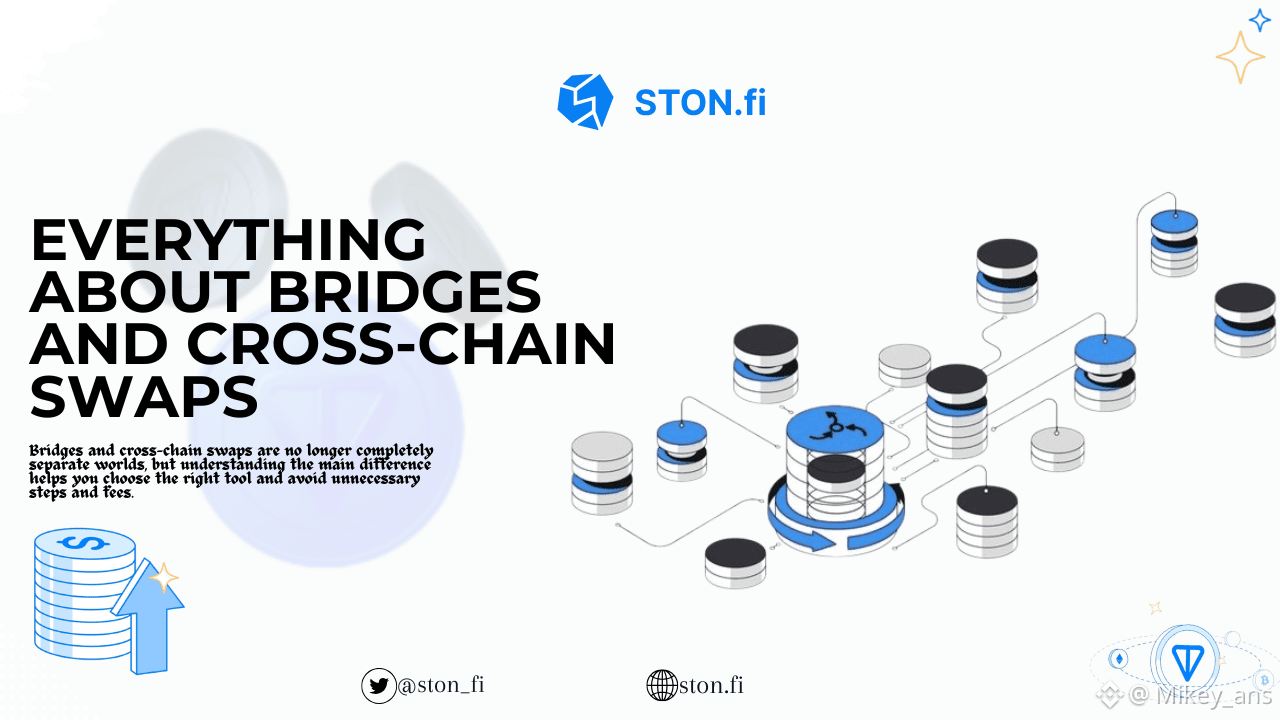
I used to think Bridges and Cross-Chain Swaps were the same thing.
Then one transaction taught me an expensive lesson.
I wanted to move funds to TON and participate in opportunities on STON.fi. I had USDT on another chain, so I quickly used a bridge.
The transfer worked perfectly.
The problem?
I actually needed ETH on TON, not USDT.
That meant another swap, additional fees, extra slippage, and more time spent fixing a mistake that could have been avoided.
That's when I finally learned the difference:
🔹 A Bridge moves the same asset from one blockchain to another.
Example:
USDT (Ethereum) ➜ USDT (TON)
🔹 A Cross-Chain Swap moves value across chains while also converting it into the asset you want.
Example:
USDT (Ethereum) ➜ ETH (TON)
It sounds like a small distinction, but it completely changed how I move capital across ecosystems.
Today, before every transfer, I ask myself one simple question:
"Do I want the same asset on the destination chain, or do I want a different one?"
If it's the same asset, I bridge.
If it's a different asset, I use a cross-chain swap.
That habit alone has saved me unnecessary fees, reduced slippage, and simplified my workflow.
As blockchain infrastructure continues to evolve, tools like STON.fi and Omniston are making cross-chain interactions significantly smoother. But understanding the fundamentals still matters.
Technology can optimize execution.
Knowledge helps you avoid mistakes.
What's one crypto lesson that cost you money before you fully understood it?
I'd love to hear your experience below.
#Ton #STONfi #defi #Web3 #blockchain
Then one transaction taught me an expensive lesson.
I wanted to move funds to TON and participate in opportunities on STON.fi. I had USDT on another chain, so I quickly used a bridge.
The transfer worked perfectly.
The problem?
I actually needed ETH on TON, not USDT.
That meant another swap, additional fees, extra slippage, and more time spent fixing a mistake that could have been avoided.
That's when I finally learned the difference:
🔹 A Bridge moves the same asset from one blockchain to another.
Example:
USDT (Ethereum) ➜ USDT (TON)
🔹 A Cross-Chain Swap moves value across chains while also converting it into the asset you want.
Example:
USDT (Ethereum) ➜ ETH (TON)
It sounds like a small distinction, but it completely changed how I move capital across ecosystems.
Today, before every transfer, I ask myself one simple question:
"Do I want the same asset on the destination chain, or do I want a different one?"
If it's the same asset, I bridge.
If it's a different asset, I use a cross-chain swap.
That habit alone has saved me unnecessary fees, reduced slippage, and simplified my workflow.
As blockchain infrastructure continues to evolve, tools like STON.fi and Omniston are making cross-chain interactions significantly smoother. But understanding the fundamentals still matters.
Technology can optimize execution.
Knowledge helps you avoid mistakes.
What's one crypto lesson that cost you money before you fully understood it?
I'd love to hear your experience below.
#Ton #STONfi #defi #Web3 #blockchain