
The ancestor put it straightforwardly: BTCFi truly needs to scale, not through on-chain players educating each other, but by getting 'exchanges and custodians'—these giants of traffic—to willingly direct the idle balances of BTC toward a clear, risk-manageable, and settleable revenue pipeline. The past failures of CeFi wealth management were not because users didn't want returns, but rather because users were forced to believe in a black box that 'the platform says it's profitable, so it is'. The counterattack from DeFi is not because it understands finance better, but because it writes the rules on-chain, allowing you to at least see what is happening; it's just that the thresholds are too high and the processes too fragmented, making ordinary people reluctant to turn their BTC into a task of 'constantly monitoring the liquidation line'.
If protocols like Lorenzo want to tell their story to the mainstream, they must translate 'DeFi's transparency' into 'CeFi's product forms.' The temptation of assets like stBTC is very clear: it gives BTC a closer identity to 'interest-bearing underlying assets,' meaning you don't necessarily have to sell BTC, nor do you have to lock BTC into an invisible pool to gamble on platform credit; instead, you can extract yields from the underlying pledge or strategy, turning it into a financial raw material that can be packaged, collateralized, and used cross-chain. The problem is that ordinary users do not want to care about details like bridges, Gas, signatures, whitelists, and redemption queues; they simply want to click 'activate yield' in the exchange and then see 'BTC balance + today's yield' on the asset page.

So how will exchanges and custodians 'connect' this pipeline? I prefer to think of it as three productization paths, all aiming for the same goal: to make stBTC a 'standard interface for yield layers,' rather than a token that only circulates within the on-chain player community.
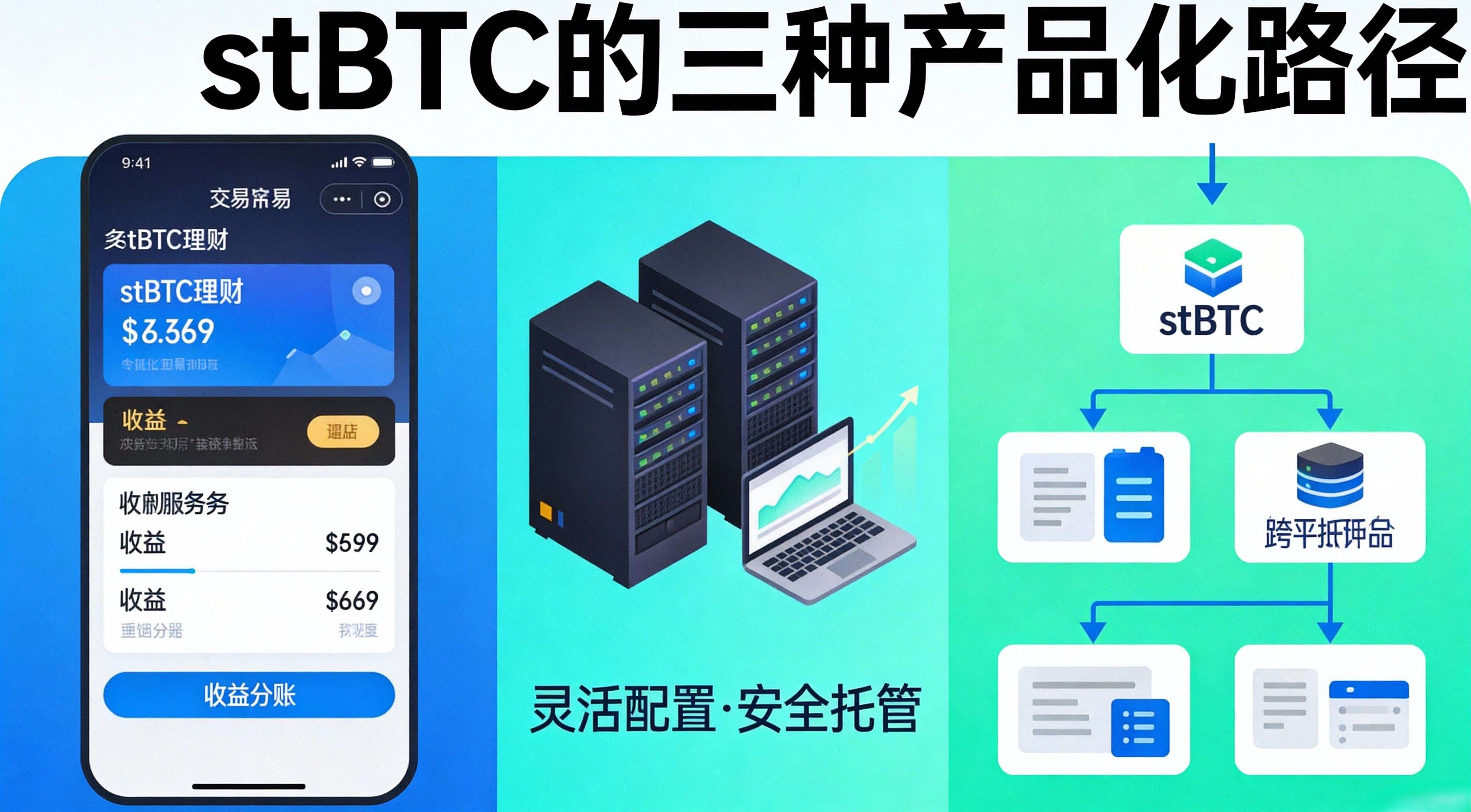
The first path is the most like what exchanges would do: making the stBTC strategy a 'position option' in Earn/wealth management. What users see on the interface may still be BTC, or they may see a labeled 'BTC yield account,' but the underlying structure managed by the platform uses its own custodial wallet or accounting system to invest some BTC (or equivalent assets like BTCB) into Lorenzo's stBTC path according to rules, and then returns the earnings proportionally to the user's account. For exchanges, the value of this model lies in that it does not require users to learn on-chain operations; the user experience is close to 'fixed-term/current wealth management,' while the platform earns product management fees, channel fees, or revenue sharing with protocols; the risks are also more concentrated because the primary responsible party users face is still the platform itself, which must bear the compliance pressure of strategy selection, counterparty, clearing, and operational risk control. You can think of it as 'DeFi at the bottom, CeFi at the front,' where one-click is very convenient, but trust still primarily rests on the platform's risk control.
The second path leans more towards 'institutional custody practices': converting Lorenzo into a configurable yield channel within the custody system. For example, the custodian manages keys using MPC (Multi-Party Computation) or multi-signature to separate BTC assets into different sub-accounts or strategy baskets, and connects to Lorenzo's pledge and yield structure, providing institutional or high-net-worth clients with 'auditable yield reports + clear redemption windows + risk parameter descriptions.' The key phrase of this model is not 'how high the yield is,' but 'can the risk boundaries be written into the contract,' especially concerning whitelists, single strategy exposure, redemption delays, and the handling process in exceptional circumstances. It resembles the language of traditional finance more: treating on-chain yields as a configurable asset class rather than a 'stimulating game for on-chain players.'
The third path is the most imaginative and the most likely to provoke controversy: treating stBTC as a 'universal collateral/universal margin' across platforms, allowing exchanges, brokers, and derivatives platforms to include it in their margin systems, even turning it into structured notes or yield certificates as underlying assets. The benefit of this approach is that the capital efficiency of BTC will be amplified: holding stBTC allows you to enjoy the underlying yields while also serving as collateral in certain scenarios to obtain stablecoin liquidity, hedge, or provide cover, even as a unified asset that can migrate across multiple chains. The downsides are equally apparent: this would upgrade the risk from 'is there any yield' to 'will systemic leverage pile up.' Once collateral, liquidation lines, cross-chain channels, and market liquidity become tightly stretched simultaneously, the risk transmission can be very rapid. In other words, it can place stBTC on a larger stage while also pulling it into more brutal stress tests.

Putting these paths together, you will find that the difference between CeFi and DeFi becomes very specific here: CeFi excels at swallowing complexity and handing the button to users; DeFi excels at making rules public and handing the choice to users. Lorenzo's opportunity is to preserve the underlying logic of 'verifiable yield' while allowing the upper layer to accommodate different crowds with different product forms. What it truly wants to compete for is not the deposits brought by a single event, but to become the underlying component of BTC yields that can be 'long-term listed, long-term maintained, and long-term explained' in the eyes of exchanges and custodians.
The change in rules can be summarized in one sentence: the BTC yield market is transitioning from 'platform credit-driven' to 'mechanism and interface-driven.' In the past, when you selected financial products, you were essentially choosing a platform's endorsement; moving forward, you will increasingly be selecting 'which yield pipeline is more transparent, which asset form is more standardized, and which risk control boundaries resemble those of institutions.' The impact on users is also direct: you will have a lower threshold for 'one-click yield' while frequently facing a question—are you taking on platform risk, protocol risk, or the leverage risk you've compounded yourself? Yields do not appear out of thin air; they will only charge you risk costs in another way.
Azu provides a guide for those who 'just want to get started,' and I wrote it like a very realistic self-check: when you see a product in the exchange that says 'one-click invest idle BTC into stBTC strategy,' don’t rush to confirm; first, clarify whether the yield source is sufficiently clear, whether the redemption has a defined waiting mechanism, whether the platform has disclosed the strategy and counterparty boundaries, and whether you might face suspended redemptions or forced liquidations in extreme market conditions; if you are using a custodian's channel, focus on risk control parameters, whitelist mechanisms, report frequency, and responsibility allocation; if you plan to use stBTC as collateral for borrowing or derivatives, be sure to keep the collateral ratio buffer thick and prioritize 'can I survive a major fluctuation' over 'can I squeeze out an extra 2% annualized.'
Ultimately, CeFi will turn stBTC into a button, while DeFi will turn stBTC into Lego pieces. What Lorenzo wants to do is: ensure that there are reliable components behind this button, allowing these components to eventually be used as standard parts by more platforms. Only when transferring BTC yields between different platforms becomes as natural as changing bank cards will BTCFi have truly emerged from the laboratories of a few.
@Lorenzo Protocol #LorenzoProtocol $BANK



