

In most crypto cycles, liquidity feels like weather. It comes and goes, often suddenly, and most people just react to it. @Lorenzo Protocol is trying to do something different with its ecosystem: turn liquidity from a passing storm into infrastructure. That’s really what sits underneath the recent growth of its liquidity pools and the introduction of more structured strategies around them.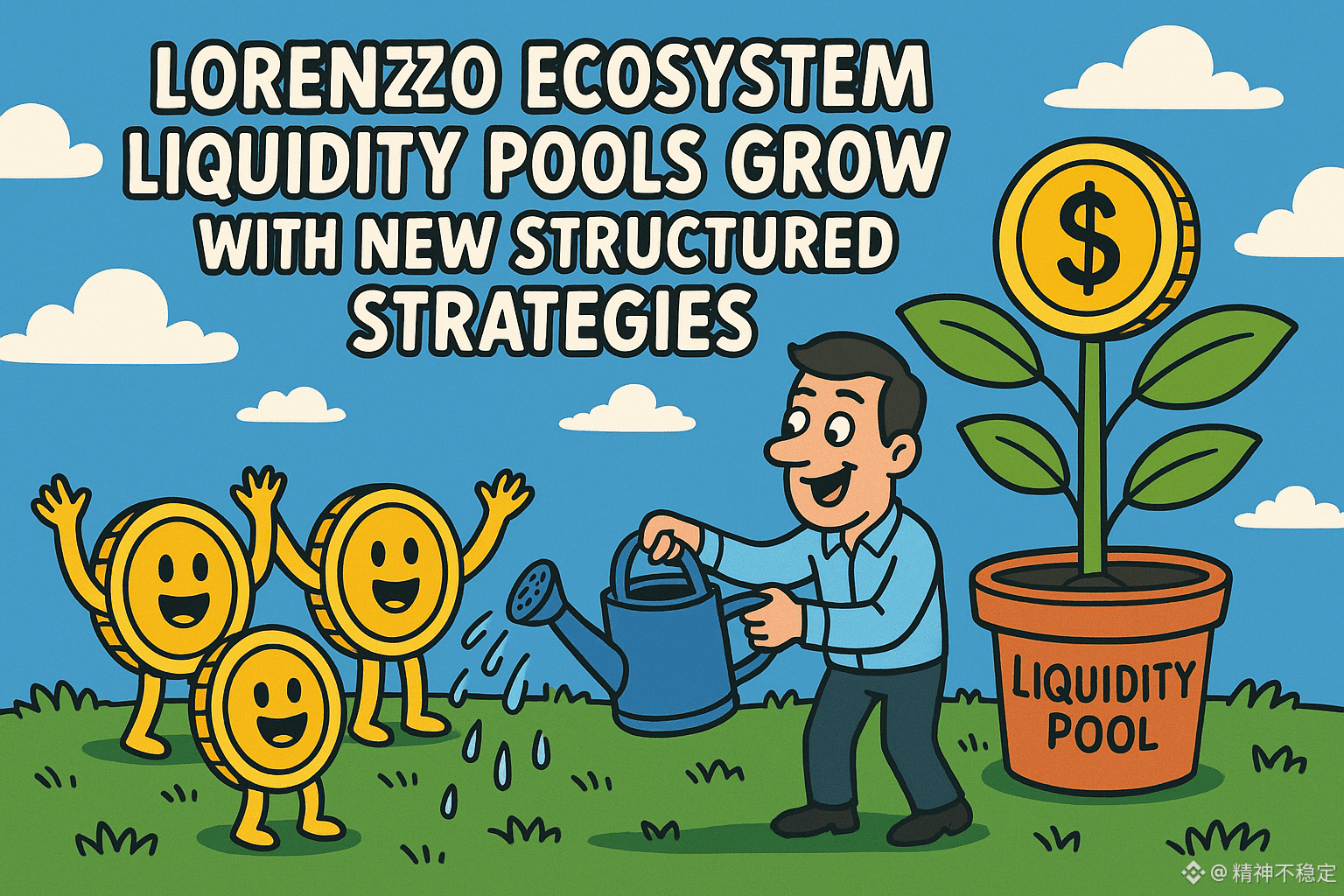
At a basic level, Lorenzo is an on-chain asset management and liquid restaking platform that wraps complex trading and yield ideas into tokenized products and vaults that regular users can hold. Instead of asking people to chase individual farms or obscure strategies across chains, it packages those into things like on-chain traded funds, structured yield products, and BTC or ETH-based vaults behind a simple deposit interface. Under the hood, those pools route capital into curated strategies: market-neutral trades, restaking flows, basis trades, and volatility harvesting that look closer to traditional finance than to DeFi’s early yield experiments.
What’s changed recently is not just that there are more vaults or tokens, but that the ecosystem’s liquidity pools are starting to behave less like isolated pots of TVL and more like connected strategy rails. Lorenzo’s products and restaking pools are designed so that the liquidity inside them is already “spoken for” by a defined strategy, not just parked in a farm waiting for emissions. That leads to a different kind of growth: slower, more intentional, and arguably healthier.
I find that shift important because DeFi has a long history of confusing “big numbers” with actual resilience. Massive TVL can evaporate once incentives turn off, or once traders move on to the next shiny thing. Structured liquidity, by contrast, is capital that’s committed to a path: a hedged portfolio, a restaking route, a defined risk envelope. In Lorenzo’s case, that’s visible in how its products represent specific exposures—like yield-bearing BTC, liquid restaking tokens, or dollar strategies tied to real-world yield—rather than just generalized “earn” pools hoping for volume.
That doesn’t magically remove risk.
This makes the risk easier to figure out. When a pool works by clear rules, you can look at it and ask: what does it do when the market goes down?
What does it do when funding flips negative, or when gas spikes, or when a restaking AVS underperforms? Those questions are a lot more constructive than the usual “Is the APY still high?” that dominated earlier phases of DeFi.
The other thing happening in Lorenzo’s ecosystem is that liquidity is increasingly multi-purpose. A token like stBTC or a structured fund token isn’t dead weight. It can be used as collateral, traded, or plugged into other protocols while still sitting inside a defined strategy. That kind of composability is where DeFi is quietly at its best. When a single unit of liquidity can support a strategy, secure a network, and back some lending market at the same time, you’re no longer just chasing yield—you’re helping build actual financial plumbing.
Of course, structure can also give a false sense of comfort. I’ve seen this pattern in other protocols: as soon as a product is wrapped in professional language—“institutional grade,” “risk-adjusted,” “market neutral”—people have a tendency to stop reading the fine print. Lorenzo’s pools are still exposed to smart contract risk, market dislocations, liquidity crunches, and, in the case of restaking, correlated slashing or AVS underperformance. None of that disappears just because the user interface feels polished or the documentation references familiar finance terminology.
For me, the healthier way to look at Lorenzo’s expanding liquidity pools is as an experiment in discipline. Rather than letting liquidity slosh around wherever emissions are highest, the protocol is trying to tie capital to specific, rule-based strategies and then make those strategies transparent and composable. If the experiment works, the ecosystem ends up with deeper, more reliable liquidity that doesn’t vanish the moment a farm turns off. If it fails, at least the postmortem will have clear data: how strategies behaved, where assumptions broke, and what users actually did under stress.
There’s also a quieter cultural question here. DeFi has always attracted two broad types of participants: people who want to speculate as aggressively as possible, and people who want to rebuild financial infrastructure in a new way. Lorenzo’s structured approach to liquidity doesn’t really cater to the first group; it doesn’t promise lottery-ticket upside. Instead, it leans into something slower: yield profiles that might look boring on any given day but compound in a more predictable way over time.
In that sense, the recent growth of Lorenzo’s ecosystem liquidity pools is less about numbers going up and more about a kind of alignment. Capital is flowing toward strategies that admit what they are, outline how they work, and accept that risk can be shaped but not erased. For users, the challenge is to decide what kind of risk they actually want, what time horizon they have, and whether a structured pool fits that picture better than yet another anonymous farm.
If anything, I hope experiments like this slowly reset expectations. It would be good if “sustainable yield” stopped being a marketing phrase and started being something you can inspect on-chain in real time: positions, hedges, stress behavior, all visible. Lorenzo isn’t the only project moving in that direction, but its approach—growing liquidity pools around defined strategies rather than chasing TVL at any cost—is a tangible step toward that future. And even if the market continues to swing between fear and euphoria, having more of that kind of structure in the middle might make the ride a little less wild.
@Lorenzo Protocol #lorenzoprotocol $BANK

