
On Thursday, the Federal Reserve announced a 25 basis point rate cut, which was in line with market expectations. However, at the same time, the guidance provided by the Fed was interpreted by analysts as cautious—despite a brief rebound before the meeting, risk assets still declined as a result.
Before the announcement, Bitcoin's price briefly rose to $94,500, then sharply declined, continuing the trend of the past year, where Bitcoin's price has fallen after seven out of the last eight FOMC meetings.
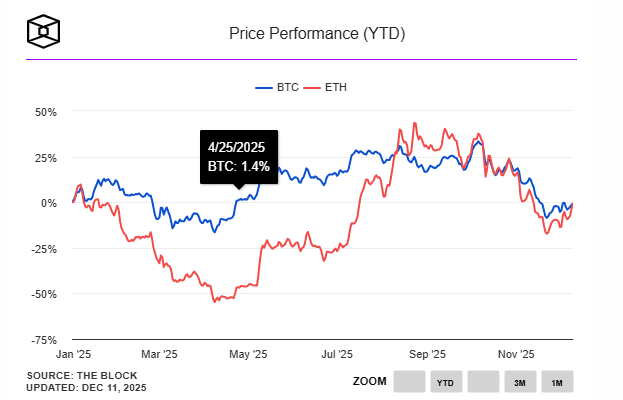
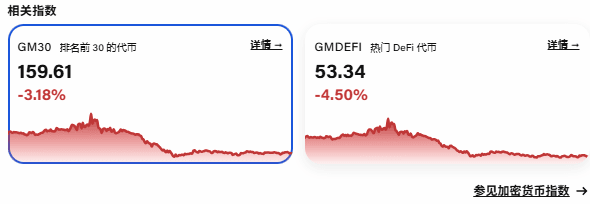
The latest trends have led to a decline in Bitcoin prices, which had previously attempted to return to the mid-$90,000 range but failed to succeed. Ethereum's trading price has dropped below $3,200, and with the decline in altcoin prices, the entire cryptocurrency market has also seen a downturn, according to The Block's price page. This also means that Bitcoin and Ethereum have both shown negative performance over the past 12 months and so far this year.
Powell's tone: superficially dovish, but in reality hawkish.
While the Federal Reserve cuts interest rates, the message it conveys sometimes appears dovish, but overall reinforces a cautious policy stance.
Federal Reserve Chairman Jerome Powell issued a statement acknowledging that the cooling labor market is the reason for the Fed's monetary policy expansion, stating that the policy rate is currently in a 'neutral range'. However, he emphasized that future decisions will largely depend on upcoming data and noted that the risks of unemployment and inflation still lean towards the upside.
The committee's forecast indicates that only one cut is planned for 2026, the same as the forecast in September. Additionally, the 9 to 3 vote result is also the highest number of opposing votes since 2018, highlighting the divisions within the committee and the challenges faced in what Powell described as a 'very challenging' environment.
Several analysts noted in analyses reviewed by (The Block) that this policy adjustment by the Federal Reserve is less of a policy shift and more of a carefully considered signal. They believe that this shift by the Federal Reserve is similar to the cautious stance taken after the last rate cut cycle. They also noted that the Federal Reserve has raised its economic growth expectations and lowered its inflation expectations, but at the same time indicated that the threshold for further easing policies is higher.
Nick Parkerlin, co-founder of Coin Bureau, stated that this rate cut 'was not as hawkish as some anticipated', but there is significant opposition, and the Fed's decision to only cut rates once next year 'injects new uncertainty into risk assets'. He remarked, 'This is not enough to trigger a Christmas rally for Bitcoin.'
"It's not enough to set a new historical high before Easter."
While cutting interest rates, the Federal Reserve announced that starting December 12, it would purchase $40 billion in government bonds over the next 30 days to maintain ample reserves in the financial system. Officials emphasized that this move is not quantitative easing, but analysts stated that it will undoubtedly enhance liquidity.
Matt Howells-Barby, Kraken's growth director, stated that a neutral interest rate stance combined with reserve management purchases could support the cryptocurrency market into early 2026. However, he also warned that the upcoming rotation of the Federal Reserve may tilt the balance towards a hawkish stance, which could limit the possibility of aggressive easing measures early next year.
Paul Howard from Wincent added that the Federal Reserve's 'wait-and-see' attitude has kept cryptocurrency prices largely stable. 'Any easing of monetary policy is welcome,' he stated, but the magnitude of the rate cut and the contradictory messages from the committee 'are not enough to set a new historical high before Easter.'
Despite ETF inflows supporting the market, confidence remains weak.
Despite the policy outcome, ETF capital flows still demonstrate positive potential trends.
On Tuesday, the net inflow for the U.S. spot Bitcoin ETF was $224 million, with BlackRock's IBIT fund seeing a net inflow of $193 million. In comparison, Ethereum products saw a net inflow of $57.6 million, and Solana and XRP funds together had a net inflow of $15 million (data from The Block). Despite stable demand, price movements remain subdued.
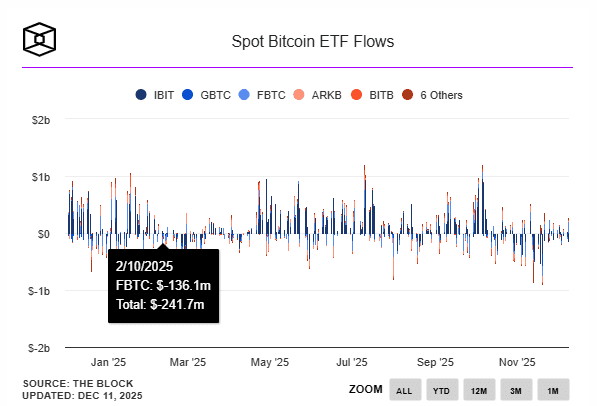
Timothy Misir, head of research at BRN, believes that the pullback after the price cut reflects the market's 'welcome of the price cut but rejection of the guidance'; he described the day's movement as another version of the 'hawkish price cut' that traders had previously anticipated. He also added that demand from institutional investors remains strong, noting that since December 1, smart money wallets holding 10 to 10,000 Bitcoins have accumulated approximately 42,565 Bitcoins. However, retail investors' deleveraging continues to suppress the upward momentum.
Exchange balances continue to decline, exacerbating structural scarcity. BRN analysts noted that despite this, short-term holders are still reducing their positions, which is resulting in a continued narrowing of Bitcoin prices.
"The rate cut is supported but conditional," Misir said. "Institutional investors are buying on dips, while retail investors are selling under pressure. The question is whether ETF demand can continue to absorb supply before the macroeconomic situation becomes clear."


