

@Injective doesn’t draw the kind of attention that lights up social feeds or sends retail rushing in. It’s quieter than that, almost to the point of being overlooked. Yet while the big narratives in crypto orbit around institutional adoption and layer-2 throughput races, Injective has been carving out a different kind of lane one that sits squarely in the middle of the on-chain derivatives revival. It isn’t trying to dethrone centralized exchanges. It’s doing something less flashy but arguably more interesting: building the infrastructure that lets derivatives actually work on-chain without feeling like a compromise.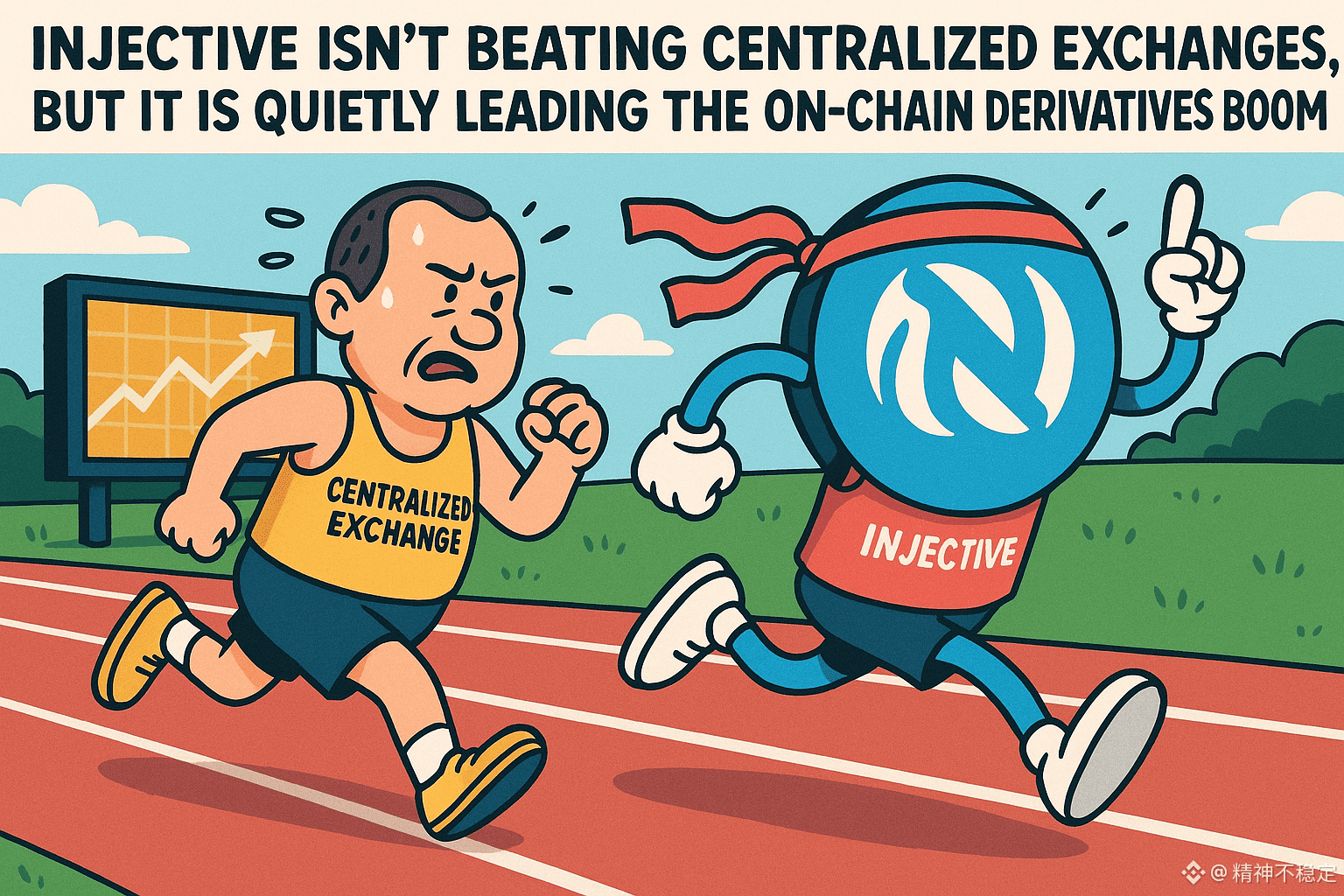
The irony is hard to miss. For years, decentralized derivatives were dismissed as an architectural dead-end. Too slow, too expensive, too clunky, too easy for traders to abandon in favor of Binance or Bybit. But markets have a habit of circling back to unfinished business when conditions change, and that’s exactly what’s happening. Liquidity is migrating on-chain again, not because traders suddenly grew allergic to centralized venues, but because they’re being presented with on-chain tools that no longer force them to trade performance for principles. Injective has been one of the few chains designed from the ground up to make that feel realistic rather than idealistic.
Its role becomes clearer when you stop thinking of it as a competitor to centralized platforms and more as an ecosystem that optimizes for the mechanics of trading itself. Order execution on Injective is fast, reliable, and intentionally familiar. The chain borrows the best parts of traditional market structure and blends them with the transparency and composability traders expect from open systems. It doesn’t shout about decentralization; it quietly embeds it. That subtle distinction is part of why developers gravitate toward it. They aren’t being asked to reinvent the wheel. They’re being offered a venue where derivatives logic can run without friction.
Derivatives demand more from infrastructure than most crypto applications. Latency matters. Predictability matters even more. Market makers need assurances that the ground underneath them won’t shift mid-trade. Traders want to know that liquidations will behave as expected. These are not glamorous concerns, but they are the foundations of any derivatives venue worth using. Injective’s architecture—built around a fast execution environment and an orderbook-centric design—caters to them with almost monastic focus. It doesn’t chase generality. It chases precision.
What’s interesting is how this posture is translating into actual volume growth. On-chain trading has had bursts of excitement before, but derivatives liquidity rarely stuck around long enough to matter. This time, however, you can see a slow but steady expansion across perpetuals platforms building on Injective. It’s not explosive, and maybe that’s the point. The liquidity accretes instead of spikes. The users are less speculative tourists and more the type who stick with tools that feel dependable. In a market flooded with protocols stretching for attention, that kind of organic retention is notable.
Even more telling is how developers have approached Injective as a canvas for specialized derivatives markets. Exotic instruments that would be cumbersome to launch anywhere else feel more workable here. That includes structured perps, unique index products, and experimental markets that traditional venues wouldn’t bother listing. Injective doesn’t rely on a single flagship product to justify its existence. It thrives on optionality—the freedom for builders to express new ideas in market form without worrying that the underlying chain will become the bottleneck.
Of course, none of this means centralized exchanges are losing sleep. They remain the gravitational center of crypto trading, with liquidity that no on-chain environment can match in the near term. But Injective isn’t trying to outmuscle them. Its relevance comes from the realization that the future of trading won’t be won through a single model. It’ll be a spectrum, with centralized venues dominating mass-market activity while specialized, programmable, trust-minimized environments like Injective carve out space for the kinds of markets that flourish only when traders can audit the rules themselves.
There’s also a broader cultural shift underway. Traders who once viewed decentralization as an ideological tax now see it as a practical hedge. The more the industry learns from exchange blowups, opaque risk practices, and jurisdictional uncertainty, the more appealing it becomes to have a venue where the logic is visible and failure modes are predictable. Injective benefits from that shift not because it markets itself aggressively, but because its design philosophy aligns with what a more mature derivatives market actually needs.
Still, the real story isn’t in the buzzwords or the branding. It’s in the slow accumulation of infrastructure that makes previously impossible things feel normal. An orderbook that behaves like it should. A chain that doesn’t collapse under load. Tooling that lets developers ship markets without contorting their designs around protocol limitations. Injective excels in these unglamorous details. It builds the rails so others can build the trains.
Crypto tends to reward the loudest players, the ones who promise seismic change. Injective is playing a different game, content to stay in the background while derivatives trading finds its on-chain footing. It may never dominate headlines or threaten the scale of centralized exchanges. But it doesn’t need to. Its influence shows up in the way builders talk about what’s feasible now, in the kinds of markets that are emerging, and in the confidence traders have when they engage with a system that doesn’t treat performance and decentralization as mutually exclusive.
Quiet leadership often looks like this: not a sprint for attention, but a steady reshaping of what people assume is possible. Injective isn’t beating centralized exchanges. It’s redefining the parts of the market that don’t need to be centralized at all.
@Injective #injective #Injective $INJ

