

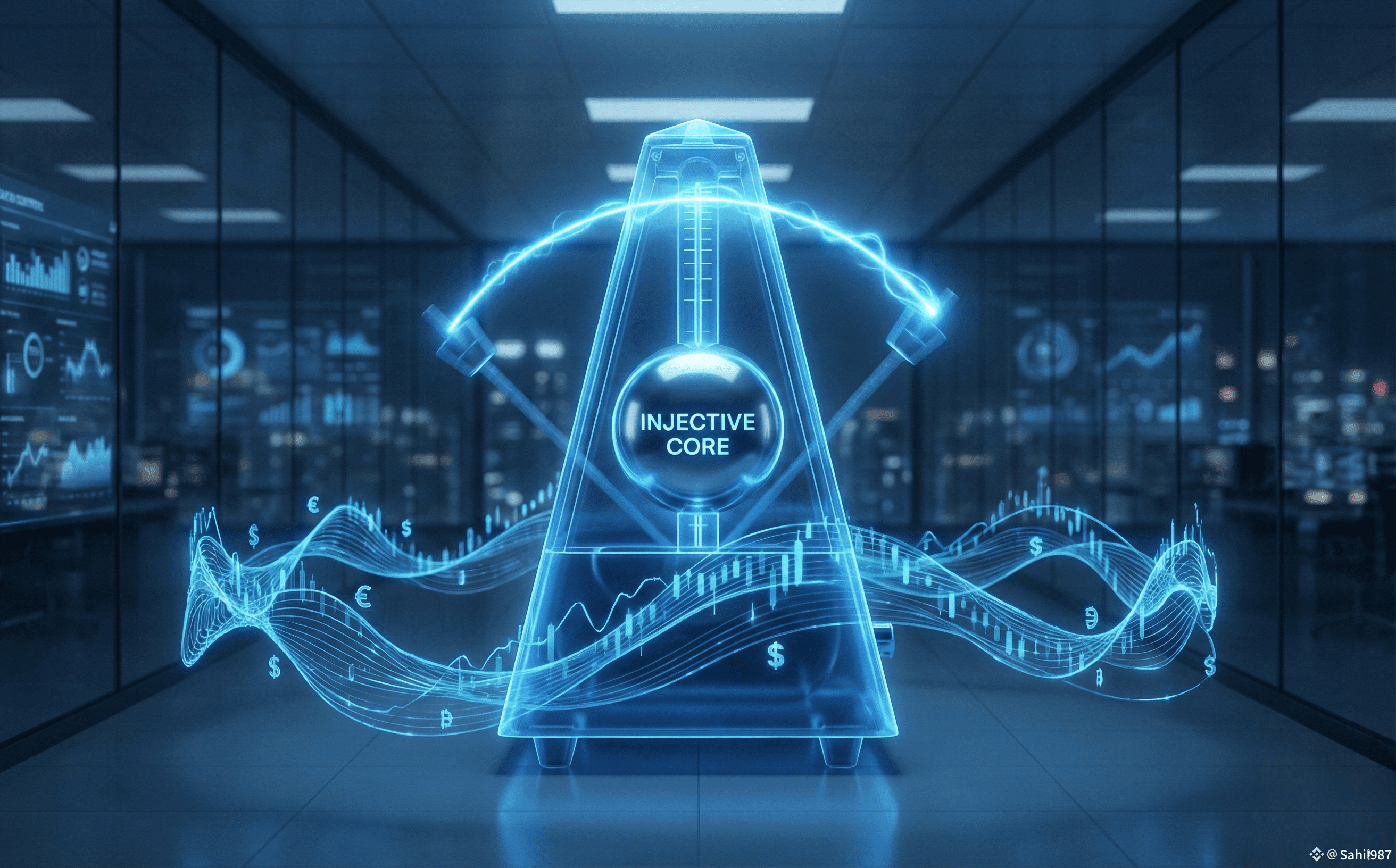
 There is a rhythm to real markets that most people never notice until it disappears. It’s not the rhythm of price movement or trading volume, nor the predictable rise and fall of liquidity across time zones. It’s deeper than that almost biological. Traditional financial systems breathe. They inhale liquidity, exhale risk, pulse steadily through cycles of settlement and clearing, and move with a kind of intention shaped by decades of engineering discipline. Markets don’t thrive on speed; they thrive on rhythm. They need predictable beats, steady timing, consistent reactions, and infrastructure that doesn’t falter under pressure. But when blockchains arrived, they did something unintentionally disruptive: they broke that rhythm. They introduced jitter into time, noise into execution, volatility into cost structures, and unpredictability into settlement. Markets that once relied on cadence were suddenly forced to improvise. And improvisation is expensive.
This is why Injective feels so different from the rest of the industry. While other chains chased throughput or universality or cultural relevance, Injective focused on something far more fundamental: restoring rhythm. It asked a question few others dared to: What if a blockchain behaved the way real financial infrastructure already expects the world to behave? What if timing didn’t drift? What if fees didn’t spike? What if execution didn’t wobble? What if the chain didn’t panic during volatility? What if it simply kept breathing at the same tempo, regardless of conditions? That is the quiet genius of Injective. It doesn’t merely optimize performance it reintroduces cadence. It replaces the noise of most blockchain execution environments with something that feels more like a steady pulse. And when markets find a pulse they can rely on, everything built atop that pulse becomes more stable, more efficient, and more rational.
The first sign of that restored rhythm appears in how Injective treats time. Blockchains often describe their block times as “fast,” but fast is meaningless without consistency. A one-second block time that sometimes becomes three seconds under load is not rhythm it’s turbulence. A cheap transaction that becomes expensive under volatility is not efficiency it’s noise. Injective understands this distinction at a structural level. Its sub-second blocks don’t merely execute quickly; they execute predictably. They land with the regularity of a metronome, not the improvisation of a drummer warming up. You can model them. You can trust them. You can build systems that behave correctly because the ground beneath those systems doesn’t shift unexpectedly. Time becomes a stable resource instead of an unpredictable adversary. Rhythm returns.
But rhythm is not merely temporal it is also behavioral. Markets rely on systems that react to stress in ways that preserve structure rather than collapse it. Most blockchains behave emotionally under pressure. They congest, reorder transactions inconsistently, inflate fees dramatically, or introduce jitter into their pipeline. These reactions break rhythm at the very moment rhythm becomes essential. Injective refuses to behave emotionally. Under heavy load, it doesn’t gasp for breath or stagger. Its execution remains clean, its settlement remains coherent, and its fee environment remains strangely calm. This is not softness it’s discipline. Markets reward discipline. Liquidity providers widen spreads when infrastructure becomes erratic; they relax when infrastructure behaves predictably. Injective’s discipline becomes economic gravity. Traders and automated agents gravitate toward environments where rhythm survives volatility.
The cross-chain dimension reveals an even more striking rhythm-based insight. In a multi-chain world, liquidity doesn’t live in one place it travels. But travel introduces irregularity. Packets arrive out of order, timing breaks across ecosystems, and settlement noise accumulates. Injective approaches this differently. When assets arrive from Ethereum or Solana or any Cosmos chain, they enter a rhythmic environment. Whatever chaos existed externally is neutralized internally. Injective absorbs the irregularities and converts them into a predictable settlement cadence. This is something no other chain does with such subtlety. Cross-chain liquidity is normally at the mercy of infrastructure noise. Injective transforms that noise into music coherent, recognizable, dependable. The rhythm holds.
Builders feel this rhythm before anyone else. When they describe Injective, they rarely talk about hype or culture or speculative waves. They talk about reliability, timing clarity, ease of modeling, confidence in settlement windows, and the peace that comes from architecture that doesn’t fight itself. Developers who build liquidation engines or derivatives systems or autonomous trading agents talk about Injective as if they’ve finally found a system that listens. A system that doesn’t improvise, doesn’t jitter, doesn’t surprise them. When your code relies on timing assumptions that must remain intact across market cycles, you build differently. You build with confidence rather than caution. You design for growth rather than for failure. That shift from defensive engineering to generative engineering is the direct result of rhythm returning to infrastructure that has been noisy for too long.
The long-term implications of this are profound, especially when considering where financial markets are heading. As autonomous agents enter the ecosystem, rhythm will matter more than speed. Machines do not navigate emotional infrastructure well. They cannot improvise during latency spikes or fee distortions. They require environments that behave like clocks, not like weather systems. Injective already behaves like clockwork. As institutions explore on-chain settlement, rhythm becomes a prerequisite. No regulated entity will base clearing logic on infrastructure that changes tempo under stress. Injective’s tempo does not drift. As real-world assets move on-chain, pricing and collateral frameworks depend on cadence. Injective provides that cadence. And as crypto slowly transitions from speculative theater to financial architecture, rhythm may become the dividing line between systems that mature and systems that fade.
But the most interesting part of Injective’s rhythm is its restraint. Rhythm cannot emerge in systems that constantly reinvent themselves, constantly patch over design mistakes, or constantly chase features with unclear purposes. Rhythm requires boundaries. Injective’s architecture is narrow, intentional, and disciplined. It does not conflate complexity with innovation. It does not attempt to be everything for everyone. It does not pretend to be a cultural moment or a universal computation layer. It behaves like a chain designed by people who believe financial systems deserve consistency more than novelty. This restraint creates space for rhythm to appear and rhythm creates space for reliability to flourish.
When history looks back on the evolution of blockchain infrastructure, the differentiator may not be speed or throughput or trendy features. It may be rhythm the chains that restored it versus the chains that broke it. Injective belongs unmistakably to the former category. It does not shout. It does not stumble. It moves with intention. And in doing so, it offers a glimpse of a future where decentralized finance feels less like improvisation and more like the steady pulse of a mature global market.
In a world full of turbulence, Injective is the chain that found its rhythm and taught the market how to breathe again.


