

I’ve been following the shift from “AI as tools” toward “AI as autonomous actors,” and the emergence of @KITE AI feels like one of those inflection moments. It’s tempting to think of a powerful model just as a smart assistant — you ask, it answers. But increasingly, people imagine AI agents as full participants: they reason, delegate tasks, call APIs, transact, even negotiate. The question now isn’t whether models will get smarter — it’s whether the infrastructure exists to let them act safely and responsibly.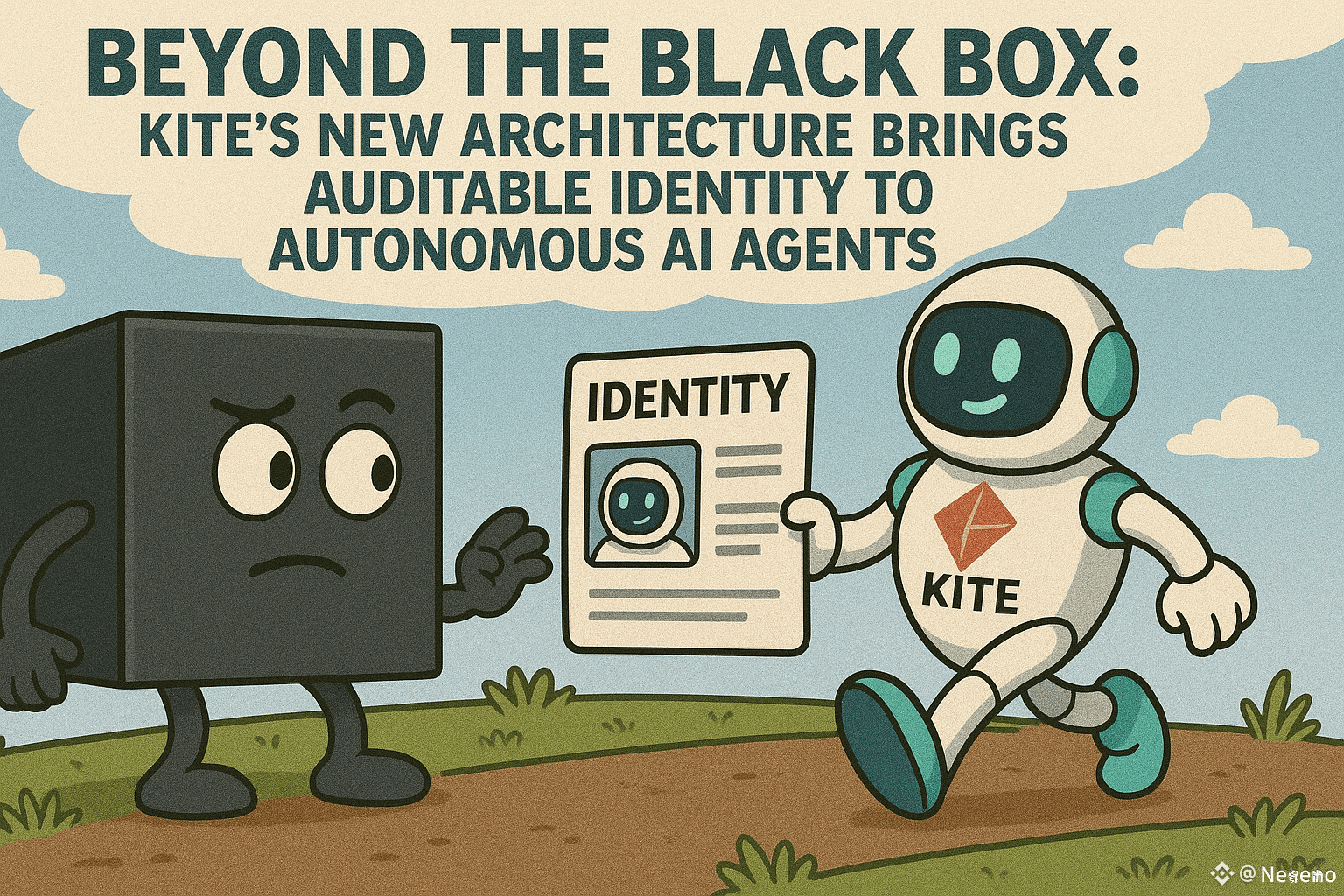
That’s where @KITE AI steps in. Rather than treating AI agents as code running on human-managed accounts, Kite proposes treating each agent as a genuine, first-class “digital actor,” complete with its own cryptographic identity, wallet, permissions, and audit trail. In short — the agent becomes someone you can hold accountable.
Under the hood, Kite’s design addresses problems that suddenly loom large as adoption of agents accelerates. Traditional identity management — built for human users or simple machine accounts — simply doesn’t scale when agents spin up and down constantly, or when they call APIs autonomously, or make micropayments. There’s no consistent registry of “who did what,” no clear separation between one agent and another, and no way to enforce fine-grained governance.
That’s risky — not because the agents might be malicious, but because they might make honest mistakes. Or be compromised. Or simply not respect organizational policies. Without a reliable way to track identity, authority, and history, we’re building on shaky foundations.
Kite’s response: a layered identity architecture. Instead of thinking “user = human,” it draws a clean line between the human root authority, the delegated agent, and even per-session sub-identities for temporary tasks. That hierarchical model means an agent can have clearly defined powers — and those powers can be constrained, logged, or revoked.
Then there’s the payment and transaction side. Agents might need to purchase data, pay for computation, buy services — often in a high-frequency, low-value pattern. Ordinary payment systems get clunky or expensive here. Kite builds native support for stablecoin-based micropayments, with sub-cent fees and near–instant settlement, tailored specifically for machine-to-machine commerce.
What strikes me is how this combination — identity, governance, payment rails — shifts the way we think about AI deployment. Instead of “Here’s a tool, do tasks,” we start to think “Here’s an agent, with its own digital passport, its own wallet, its own permissions. And we can audit everything it does.” That unlocks new possibilities. Agents could collaborate. They could make decisions. They could operate at a scale and complexity that we don’t often allow humans to. And yet — because everything rests on cryptographic identity and transparent ledgers — we retain control, visibility, and accountability.
Why does this matter now, rather than a few years ago? I think three things are coming together. First, AI models and orchestration systems are powerful enough and cheap enough that autonomous agents are realistic for many tasks. Second, organizations are more aware — and more wary — of the regulatory, security, and ethical risks of giving AI too much freedom. And third, the demand for decentralized, transparent infrastructure is rising: people don’t want closed-box AI systems making decisions behind the scenes.
In fact, systems like Kite sit at the intersection of multiple trends: the proliferation of “agent-first” AI, the growing need for auditability and compliance, and the steady push toward decentralized Web3-style economic systems. When these converge, infrastructure becomes not optional — but essential.
I find this sort of architecture both exciting and a bit sobering.
It’s exciting to think we’re laying down the basics for a new kind of digital space, where AI agents aren’t just gadgets but responsible helpers that can act on their own. At the same time, it’s a bit worrying, because it makes us ask real-life questions: When can we rely on an AI? And who’s on the hook if it gets something wrong?
Who’s responsible if it makes a mistake? How much autonomy is too much?
I suspect many people using AI today — for writing, for automation, for routing tasks — don’t think about identity or audit logs. But once you scale to hundreds or thousands of agents, often acting without human supervision, those abstractions start to matter. Without systems like Kite, you’d either have to restrict agents severely (killing much of their utility), or risk chaos and liability.
What I appreciate about Kite’s approach is honesty. It doesn’t promise a utopia where agents magically behave ethically. Instead, it offers a framework: identity, governance, payment, auditability. It gives developers tools to define and enforce what agents can and cannot do. And it gives organizations — or society — a way to monitor, regulate, and trust those agents more methodically.
To me, that feels like the kind of step we need if we take AI seriously as more than a fancy tool. If the next five to ten years are really going to see “agentic economies” — where digital agents make decisions, trade value, collaborate, act on our behalf — then identity matters. Governance matters. Accountability matters.
I don’t know whether Kite will become the default infrastructure for that world. There are alternative visions. There are legal, social, and technical obstacles. But I do believe we’re entering a moment where building for trust — from the foundation up — matters more than ever.
And when I think about what comes next, I find it hard not to hope. Not because it makes everything easy. But because it offers a way to build agent-driven systems that are powerful — and yet still under human-aligned guardrails.


