

@Injective started out wanting to be more than “just another blockchain.” The aim was simple, but bold: build a place where financial markets trading, lending, real-world assets, derivatives could be recreated on-chain, without many of the friction and high costs that plague traditional systems. 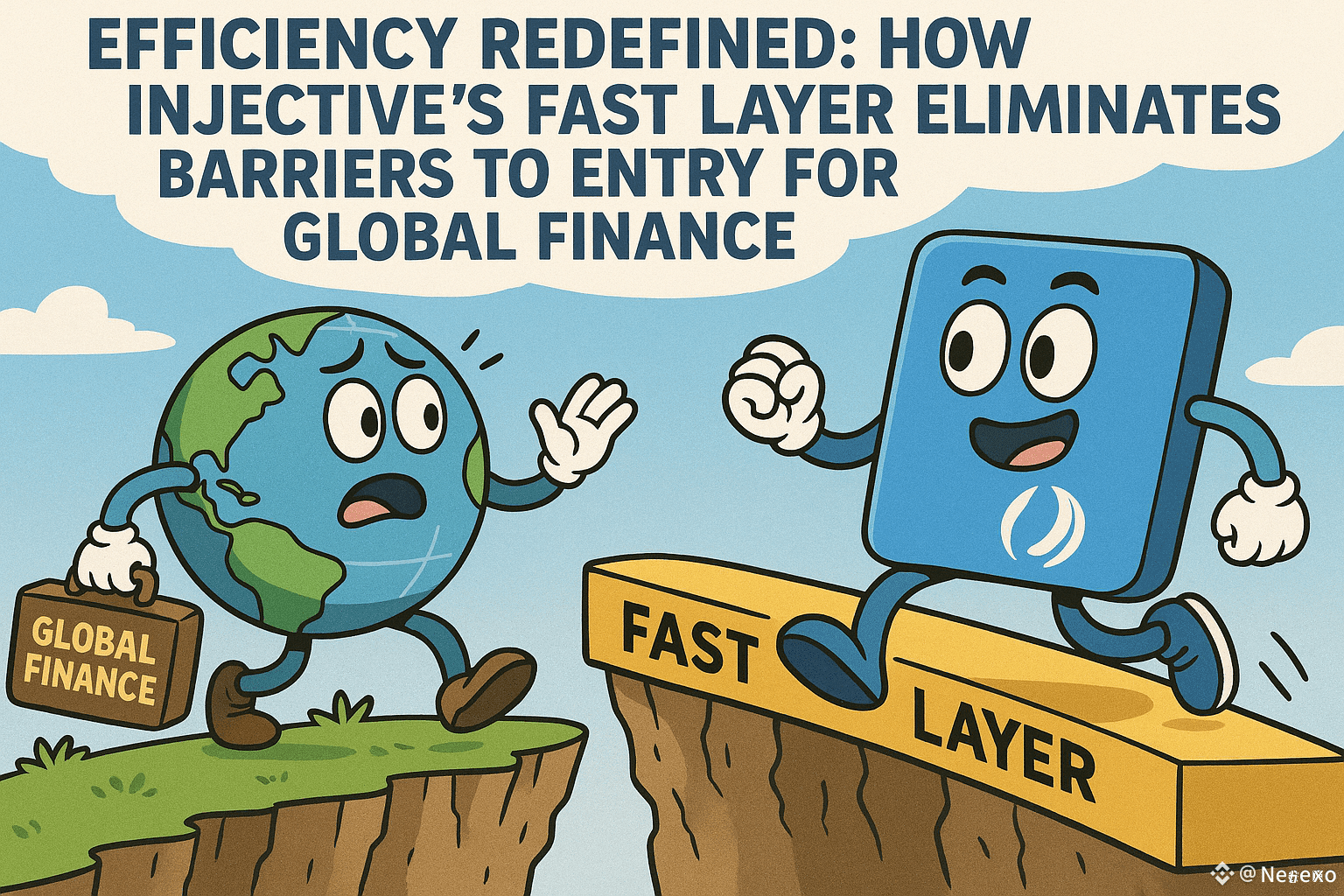
A few years ago that sounded almost like wishful thinking — decentralized finance (DeFi) was still finding its feet, many blockchains were stress-tested mostly through simple token swaps or basic lending. But @Injective tried something different. It built its infrastructure around a design tailored for finance. Instead of sticking with general-purpose blockchain tools, it offered ready-made financial “building blocks” — pre-built modules such as an on-chain order book, derivatives support, and even tokenization of real-world assets (RWAs). That means developers don’t have to reinvent foundational elements every time they build.
Technically this translates into speed and efficiency that matter a lot when you talk finance. Injective achieves near-instant transaction finality and very high throughput — recent figures suggest it can handle tens of thousands of transactions per second. And because the system is built to minimize (or even eliminate) typical “gas” fees associated with many blockchains, it lowers a major barrier for widespread use.
As Injective grew, it stopped looking like a risky experiment and started looking like a strong option. With the new EVM layer launched in late 2025, developers who know Ethereum don’t need to learn anything new to build on Injective. That opens the door for more apps and faster growth.
.
I often think about what this means for people outside the bubble: maybe someone in Karachi, São Paulo, Nairobi — someone without access to traditional financial infrastructure or expensive brokerages — could someday access derivatives markets, invest in tokenized real-world assets, or get yield from global capital flows, all via a smartphone. Injective doesn’t need to re-create “Wall Street.” It’s trying to build a new global infrastructure, one that says: finance doesn’t have to look the same everywhere.
Part of what makes this moment feel different than five years ago is that the wider world seems — finally — ready for change. Traditional finance has grown rigid in many places: high fees, limited access, bureaucracy, exclusion. People globally are more comfortable with digital money. Regulators (to varying degrees) are warming up to blockchain-based systems. At the same time, tech maturity has reached a point where you can build financial products on-chain that are not just experimental, but robust and scalable.
Injective’s updates point to a shift toward supporting heavier, more real-world financial activity. But we should keep our expectations grounded. Blockchains offer big possibilities, yet they can also run into problems
. Speed and scalability are impressive — but what happens when there’s heavy network load? What about regulatory pushback if derivatives trading becomes global and decentralized, with participants from jurisdictions where such trading is unregulated or restricted? And for users in parts of the world with limited internet access or regulatory uncertainty: will this truly deliver, or will the promise remain mostly theoretical?
I don’t have answers for all that. But I do see that Injective isn’t just tinkering at the edges. It’s trying to reimagine the plumbing of finance — not with flashy hype, but with plumbing that works: fast, efficient, interoperable, open. For people who care about financial inclusion, or about reducing friction and costs in global money flows — this kind of infrastructure matters.
In a world rapidly shifting under our feet, where money and wealth are increasingly digital — it feels essential to question whether our current financial rails still make sense. Injective, for better or worse, is building one possible alternative.
For this to become a common part of everyday finance, it needs users, it needs to hold up under pressure, and it needs the right support from communities and regulators. But it’s worth watching.
At the end of the day, Injective reminds us that finance doesn’t have to be locked behind institutions — maybe it can be open, egalitarian, and accessible. Maybe it can work for more people. And maybe it’s a small but meaningful step toward rethinking what global finance could really be.
@Injective #injective #Injective $INJ
