

Original title: (Mikami Yua's $Mikami Coin Launch Plummets 85%, Is the Tuition Paid by Fans Worth It?)
Original author: Luke, Mars Finance
On the fervent stage of cryptocurrency, celebrity meme coins blaze like meteors—brilliant yet fleeting. On May 8, 2025, Japanese entertainment star Mikami Yua's personal meme coin $Mikami launched prominently on the Solana chain, carrying the hopes of 17.5 million fans and raising $3.46 million, vowing to initiate a revolution in fan economy. However, just hours later, the token's price plummeted 85%, with the market value shrinking from $16.9 million to $7.8 million, leaving presale investors with nothing and the community in mourning. This is not only a 'sneak attack' in the crypto circle but also a microcosm of the celebrity meme coin craze.
From idol to crypto circle: Mikami's Web3 ambitions
Mikami Yua, a name well-known in the Japanese and even Asian entertainment industry. From debuting as an SKE48 idol in 2009 to transforming into an adult entertainment superstar, she has repeatedly reshaped herself with keen business acumen. In 2021, her 28 NFT 'art photos' were sold for as much as 170,000 yuan each, proving fans' enthusiasm for digital assets. When she previewed the $Mikami token plan through the X platform at the end of April 2025, both the crypto and fan communities erupted.
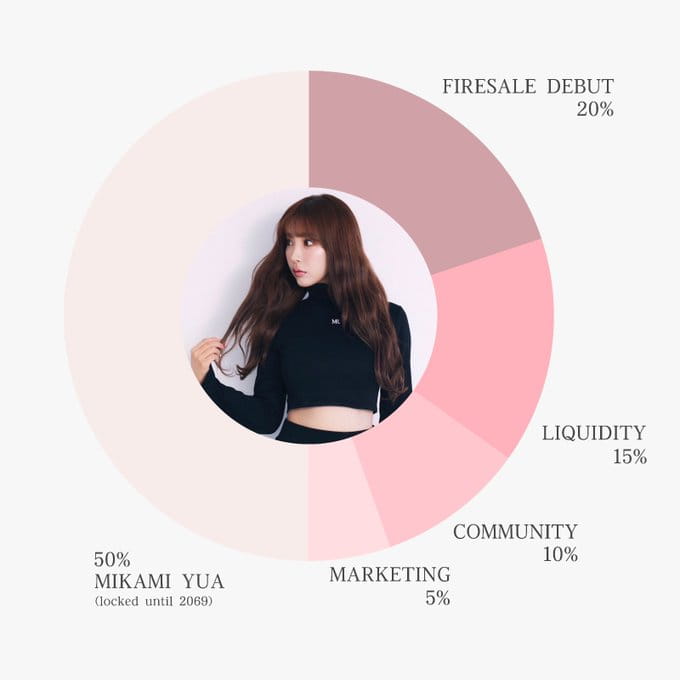
$Mikami's vision is grand: relying on the low fees and high efficiency of the Solana blockchain, to create an ecosystem that integrates 'temple economy', AI virtual images, DAO governance, and exclusive fan experiences (meetings, concerts, etc.). The white paper outlines a clear allocation: a total supply of 69 million tokens, with 50% allocated to Mikami (locked until 2069), 20% for presale, 15% injected into liquidity, 10% distributed to the community, and 5% for marketing. At the launch, the circulating market value was expected to be $8.45 million, igniting fan enthusiasm for 'scarcity' and 'future value'.
Presale frenzy: A $3.46 million fan carnival
On April 30, the presale of $Mikami kicked off, attracting 10,461 addresses to invest 23,333 SOL, approximately $3.46 million, within 72 hours. Solscan data shows that 94.4% of investors contributed less than 1 SOL (about $150), indicating a retail-led pattern. However, 0.1% of large holders—including a whale who spent 574 SOL (about $84,000)—accounted for 17.8% of the funding pool. The average investment per person was 1.35 SOL, about $200, making it a typical 'fan economy' feast.
Mikami herself ignited the fire on X: "Beauty fades, scarcity lasts. The future belongs to the believers." The official account further fanned the flames, announcing that the presale cost is 0.00169 SOL to exchange for 1 $Mikami, with a single price of about $0.245. A 50% token lockup means limited circulation, theoretically supporting price stability. However, alarms have already sounded in the X community. Some question the purchasing power of Mikami's fans: "Most of her fans are 'free content' enthusiasts; expecting them to drive up meme coins is a bit naive." Others speculate that there are Asian market operators behind the project, with Mikami merely having 'sold her name' for quick profits.
Midnight crash: A retail investor's 'sneak attack' nightmare
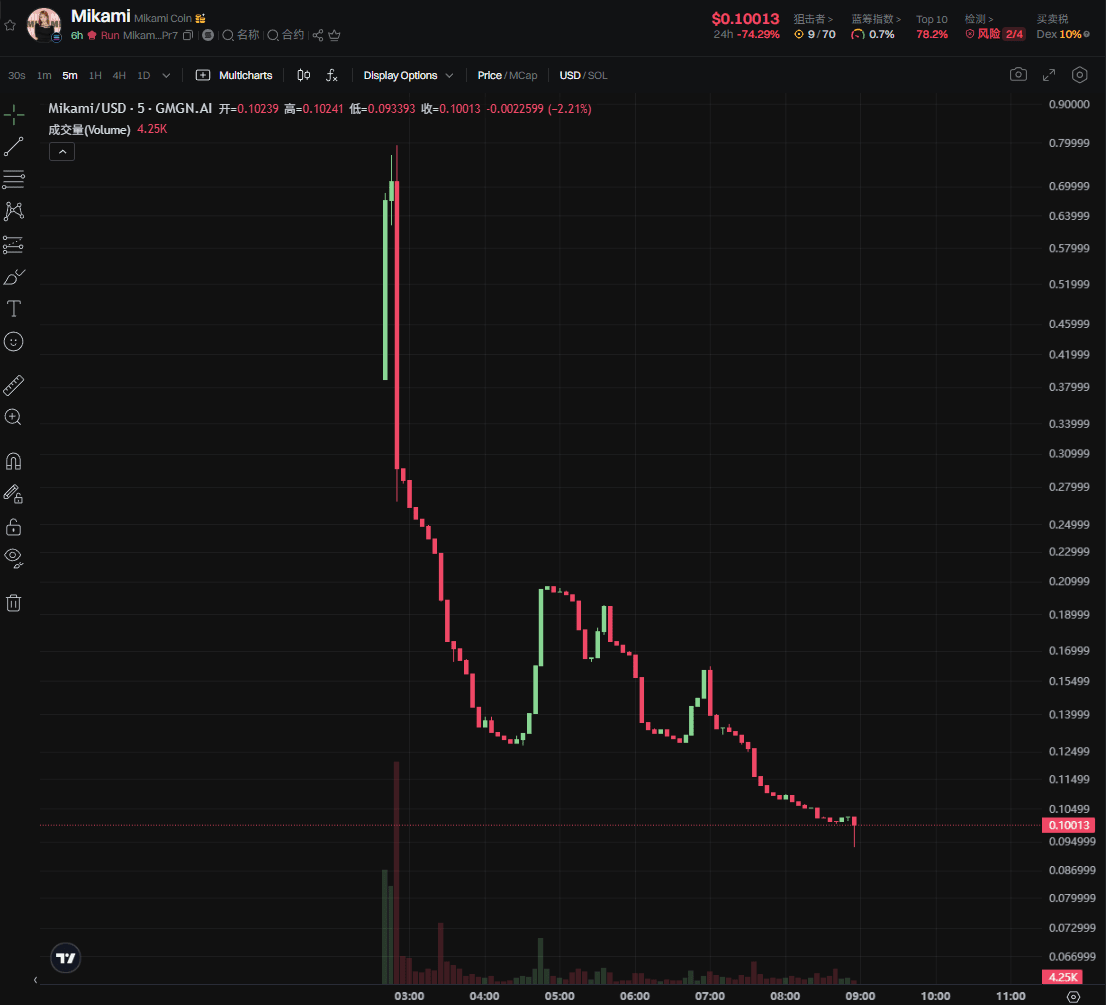
In the early hours of May 8, 2025, the $Mikami token quietly launched on the Solana chain. The official account announced the token's on-chain status on the X platform, with airdrops distributed in the order of presale, an initial market value of $16.9 million, and a circulating market value of $8.45 million. However, before the midnight bell chimed, joy turned to nightmare. By 4 am, X community members exclaimed that the token had 'collapsed', with the price dropping from the presale $0.245 to $0.1, a 60% plunge. By morning, the market value further shrank to $7.8 million, down 85% from its peak, nearly 'tenfold to zero'. 'This is simply a sneak attack!' one community member scolded, as the timing of the midnight launch seemed meticulously designed to catch retail investors off guard while 'the leaders left first'.
The brutality of the data is suffocating: presale investors' $3.46 million is now worth only $1.56 million, and to break even, the market value needs to rise to $17.5 million—more than doubling the current price. Liquidity accounts for only 15%, and in the low trading volume DEX pool, prices run wild like a runaway horse. The X community has pointed fingers at the project's 'domestic manipulation' attributes, suspecting that the operating team behind it meticulously planned a 'harvest' of retail investors. 'Launching at midnight, retail investors are still dreaming, while large holders have already cleared their positions,' one user scolded, 'This is a typical domestic project tactic: driving up prices to unload, leaving retail investors to take the fall.'
The conspiracy of 'domestic manipulation'?
In the heated discussions within the X community, 'domestic manipulation' has become the keyword for the collapse of $Mikami. Community members speculate that the project team might be led by manipulators with Chinese backgrounds, with Mikami Yua merely serving as the brand facade, while actual operations are handled by a team familiar with the crypto tricks. One piece of evidence supporting this speculation is the precise design of fundraising and launch. During the presale phase, a $3.46 million funding pool seemed large, but a 20% token allocation only corresponded to 13.8 million $Mikami, implying that the team quickly cashed out through high premiums. In comparison, the 15% liquidity allocation (about 10.35 million tokens) is far from sufficient to support market trading, making the liquidity pool as thin as a cicada's wing, easily manipulated.
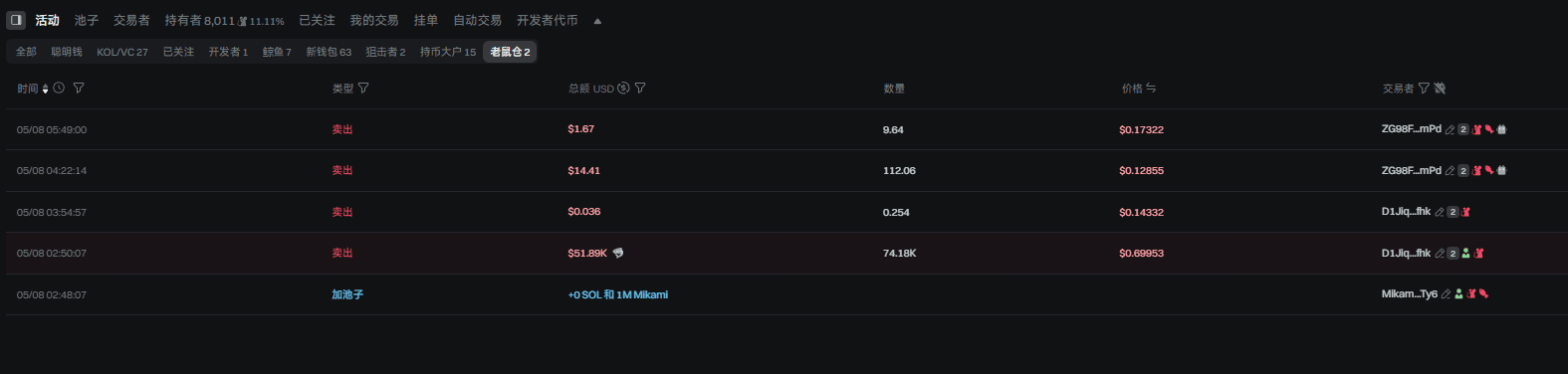
Even more striking is the choice of launch time. Launched at midnight Beijing time, coinciding with the rest period of retail investors, while investors from other regions in Asia (like Japan) and the US and Europe also struggled to react instantly due to the time difference. This 'time difference tactic' is not new in crypto. Community members recalled that multiple Solana meme coin projects in 2024 also utilized similar methods, launching late at night to create information asymmetry, allowing insider traders to unload ahead. One user analyzed: 'Launching at dawn, bots and internal addresses can clear positions in seconds, leaving retail investors with only the aftermath when they wake up.' Solscan data shows that within minutes of $Mikami's launch, several large addresses sold millions of tokens, leading to a price collapse, indirectly supporting this speculation.
The token distribution structure further exacerbates the fermentation of conspiracy theories. 50% of tokens are locked up for Mikami until 2069, ostensibly a commitment to 'long-termism', but in reality compressing the circulating supply by half, raising initial price expectations. However, the community questions the authenticity of this lockup: 'Who can guarantee that it won't be secretly unlocked before 2069?' Even more unsettling is the lack of transparent usage records for the 5% marketing budget and 10% community allocation. Some have revealed that the $Mikami trending searches and paid comments on the X platform are likely driven by marketing funds, creating a false prosperity. 'This 5% is probably used to buy bots and KOLs to shout orders,' one user sarcastically noted, 'What about the community's 10%? Probably went into the team's pocket.'
The 'tuition' of retail investors and the tricks of manipulation
Criticism of 'domestic manipulation' is not unfounded. Chinese crypto projects are known globally for 'efficient execution' and 'strong community mobilization', but they are also often criticized for 'scalping'. Meme coins like $NEIRO and $SPX6900 in 2024, operated by Chinese teams, surged at launch and quickly returned to zero, leaving retail investors in disarray. The model of $Mikami is similar: high-profile presales to raise funds, thin liquidity to boost volatility, midnight launches to create panic selling. Community members lament: 'Domestic projects dare to show their faces, at least they should have some dignity, but retail investors are always the last link.'
It is worth noting that the collapse of $Mikami was not entirely intentional. The meme coin ecosystem on the Solana chain is inherently speculative, with thin liquidity being a common issue, and retail investors' FOMO sentiment laid a foundation for price bubbles. One user reflected: 'We chased the highs ourselves; who can we blame? Mikami's name was just a hook; the real fish hook is the market.' However, the chaos of airdrop distribution—some users did not receive tokens or received only part of them—exacerbated the crisis of trust. The community speculates that the delay in airdrops may have been a deliberate tactic by the team to repurchase tokens at low prices, further suppressing the circulating price.
The calculations of manipulation and the ruthlessness of the market
From a manipulation perspective, the midnight collapse of $Mikami is a 'textbook' unloading. The team cashed out 3.46 million SOL through the presale, and after deducting Mikami's share (estimated at $2.5-3.11 million), the remaining funds are sufficient to cover development and marketing costs. Even if the market value falls to $7.8 million, the team's actual loss is minimal, while retail investors' $3.46 million investment has nearly halved. The community calculates that for presale investors to break even, $Mikami needs to rise above $0.5, and the market value must return to $17.5 million—this is nearly impossible under the current market sentiment.
The conspiracy theory of 'domestic manipulation' has not been officially confirmed, but the community's anger reflects retail investors' deep distrust of opaque operations. One user summarized: 'It's not Mikami's fault; it's our fault for believing too much in the wealth myth of meme coins.' Another user joked: 'Teacher Mikami taught us a lesson: there are no free lunches in crypto, only expensive tuition.'
Mikami's 'laying down to win' and fans' 'tuition'
For Mikami Yua, the financial impact of this incident is negligible. It is estimated that, assuming the usual split between stars and agencies, she profited between $2.5 million and $3.11 million from the presale, far exceeding her usual fee of 100,000 yen per appearance. The community sighs: 'Wealth in the crypto circle comes too suddenly; fans have paid 'tuition' to the 'enlightenment teacher'.' Whether she manipulated the market or merely provided brand authorization, Mikami's personal image remains intact, and fan loyalty is still strong.
In terms of cultural impact, $Mikami ignited a wonderful chemical reaction between fans and speculation. The exclusive benefits promised by the token—signed posters, VIP events, etc.—have made fans flock to it. The community speculates that Asian investors might drive up the coin price due to Mikami's appeal, especially if exclusive benefits become widely known. Some jokingly asked: "Is 1 fan worth $1 or $10?" implying the potential value of Mikami's 8.23 million X fans.
The 2025 of celebrity meme coins: Revelry and traps
$Mikami's rise and fall is just the tip of the iceberg of the celebrity meme coin wave in 2025. From Caitlyn Jenner's $JENNER to Iggy Azalea's $MOTHER, stars flocked to Solana, chasing the dual win of fan economy and high profits. However, the reality is harsh. $JENNER's market value plummeted from $42 million to $357,000, and Jason Derulo's $JASON and Waka Flocka's $FLOCKA fell by 97-99%. In November 2024, Jenner was sued for false advertising, highlighting the legal risks.
Data shows that the average lifespan of meme coins is only 27 days, with most lacking intrinsic value, surviving on hype and market sentiment. The total market value of Solana's meme coins reached $93.9 billion in 2025, but with extreme volatility. Projects like $Mikami, with low liquidity and centralized internal distribution, are particularly prone to manipulation. Bubblemaps found that sniper bots seized 20% of the supply when $MOTHER launched, and $Mikami may not have been spared.
Critics argue that celebrity meme coins exploit fan loyalty, turning emotions into speculative traps. Nick Vaiman from Bubblemaps told PANews: 'Failed projects suck dry retail liquidity but fail to deliver on promises.' However, there are also optimists. Iggy Azalea has built trust by interacting with fans on X, and the $Mikami DAO and AI plans also hint at similar potential, although execution is in question.
$Mikami's revelations and future
$Mikami's collapse serves as a wake-up call for investors and stars. For fans, meme coins are entertainment, not investment, and investments should be as cautious as giving 'tips to streamers'. For stars, the temptation of high profits must be balanced against the risks to their reputation—Mikami's silence after the crash does not help restore trust. For the crypto circle, transparency, sufficient liquidity, and practical utility are key to shedding the 'quantum scam' label.
Currently, the fate of $Mikami is uncertain. Whether it can rebound to the break-even point of $17.5 million depends on whether Mikami fulfills her promises—fan activities, DAO governance, or a virtual 'temple'. For now, it remains a fleeting illusion amidst the frenzy of the crypto circle. As the community says: 'Beauty fades, scarcity lasts—provided the market buys it.'
Original link

