
#stellar
stellar
1.8M views
4,682 Discussing
Hot
Latest


Article
CURVE × STELLAR: COULD ONCHAIN FX BECOME THE NEXT MAJOR DEFI MARKET?BitChoice | Satya — DeFi, RWA & Market Structure Intelligence
November 2, 2026
From Stablecoin Swaps to Global Currency Markets
Decentralized finance is expanding beyond the Ethereum ecosystem.
On October 29, Curve Finance launched StableSwap on the Stellar mainnet, marking its first native deployment outside Ethereum Virtual Machine (EVM) networks.
The integration brings a specialized automated market maker to Stellar's payment and tokenized-asset infrastructure.
But the most interesting development may still be ahead.
Curve is preparing FXSwap, a system designed for assets whose relative prices change — including stablecoins linked to different national currencies.
The larger question: could decentralized liquidity infrastructure eventually become a meaningful part of global foreign-exchange settlement?
To understand the opportunity, we need to separate what already exists from what remains under development.
1. What Curve Actually Launched
The initial deployment brings StableSwap to Stellar.
StableSwap is an automated market maker optimized for assets expected to trade at similar prices.
For example, two stablecoins designed to maintain a value of one US dollar may be exchanged through a pool built around their shared reference price.
Unlike a general-purpose liquidity pool, StableSwap is designed to concentrate liquidity more efficiently around that relationship.
The potential benefit is reduced slippage for supported trades.
However, the actual execution price still depends on pool depth, asset stability and market conditions.
What Is Available?
Curve reports that users can:
Browse existing liquidity pools.Swap supported assets.Deposit assets to provide liquidity.Access the protocol through a beta interface.
The deployment also supports permissionless pool creation, although Curve is still expanding self-service creation functionality in its interface.
The initial launch is described as a limited deployment rather than the completed Curve product suite.
StableSwap is live. The broader ecosystem is still developing.
2. Why Stellar Required a New Technical Implementation
Curve's original StableSwap contracts were developed for EVM-compatible environments.
Stellar uses a different smart-contract architecture: Soroban.
As a result, Curve could not simply deploy its existing Vyper contracts unchanged.
The team rebuilt StableSwap for Stellar, retaining the underlying mathematical approach while adapting its implementation to Soroban.
The Stellar Development Foundation supported this integration.
This distinction is important.
A native non-EVM deployment expands the environments in which Curve technology can operate.
But new implementations also require careful security evaluation.
Past experience with an EVM version does not eliminate the risks associated with a different codebase and execution environment.
For users and liquidity providers, contract security remains an essential consideration.
3. Why Stellar Makes Strategic Sense
Stellar has historically emphasized payments, asset issuance and financial infrastructure.
Its ecosystem includes stablecoins, payment applications and tokenized financial products.
Franklin Templeton has used Stellar infrastructure for tokenized investment products, while MoneyGram has integrated Stellar-related payment services.
These developments create potential demand for liquid exchange markets between supported assets.
A digital asset becomes more useful when holders can acquire it, exchange it and exit positions at reasonable costs.
For a tokenized money market fund or a payment stablecoin, a lack of liquidity can reduce practical usability even when the underlying product works correctly.
That is where specialized market-making infrastructure may help.
Tokenization creates financial instruments. Liquidity infrastructure helps make them usable.
4. StableSwap vs FXSwap: The Crucial Difference
The two systems address different price relationships.
StableSwap — Already Live
Designed primarily for assets that are expected to maintain similar prices.
Examples include two dollar-pegged stablecoins.
The objective is efficient execution around a relatively stable exchange relationship.
FXSwap — Planned
Designed for assets whose relative prices change.
A dollar-pegged stablecoin and a euro-pegged stablecoin provide a useful example.
Their relative value changes as the EUR/USD exchange rate moves.
A liquidity mechanism built around a fixed one-to-one relationship would not be appropriate for that market.
FXSwap is intended to concentrate liquidity around changing market prices rather than a permanent peg.
Curve says development is nearing completion, with an audit required before launch.
No confirmed release date or initial currency-pair list has been announced.
FXSwap is not currently a live Stellar trading service.
5. What Would Onchain FX Actually Mean?
Foreign exchange is one of the world's largest financial markets.
Traditional currency conversion involves banks, payment processors, market makers, settlement infrastructure and regulatory requirements.
Blockchain-based fiat-linked assets introduce a different possibility.
For example, a user could potentially exchange a regulated dollar stablecoin for a euro-denominated token through an onchain liquidity pool.
The resulting asset could then be transferred across the same network to another eligible recipient.
Such arrangements could support:
Cross-border payments
Conversion between fiat-linked digital assets as part of a payment route.
Treasury management
Movement between different currency exposures without relying exclusively on conventional exchange workflows.
Tokenized financial assets
Liquidity connections between funds and settlement assets denominated in different currencies.
DeFi applications
Collateral management, lending and financial strategies involving multiple fiat-denominated tokens.
However, onchain conversion is not the same as the complete process of transferring money between bank accounts.
Users may still depend on fiat issuers, redemption partners, identity checks and local payment infrastructure.
The quality of the entire route matters.
6. A Hypothetical USD-to-EUR Payment Route
Consider a company holding a dollar-backed stablecoin.
It needs to make a payment denominated in euros.
A future onchain route could involve:
Holding a supported USD stablecoin on Stellar.Swapping it for a compatible EUR-denominated asset.Transferring the resulting asset to the recipient.Redeeming or using that asset through available financial infrastructure.
The potential advantage is a more integrated digital settlement process.
But the complete cost would include:
Available FX pricingPool slippageNetwork transaction feesStablecoin issuer costsRedemption and banking feesCompliance and operational requirements
A fast blockchain transaction does not guarantee the cheapest end-to-end currency conversion.
For the economic case to work, the full transaction route must compare favorably with relevant alternatives.
7. Liquidity: The Missing Piece in Many RWA Narratives
Tokenized assets often attract attention because they represent traditional instruments on blockchain networks.
But issuance is only the beginning.
A tokenized asset can be technically transferable yet have very limited secondary-market liquidity.
For a functioning financial ecosystem, users also need:
Reliable exchange venuesCompetitive bid-ask spreadsSufficient market depthTransparent asset specificationsDependable settlementMechanisms for managing collateral and liquidations
Curve's StableSwap integration could contribute to several of these requirements.
For example, sufficiently liquid pools may provide trading routes for lending platforms seeking to liquidate collateral.
They may also make it easier for aggregators to discover execution paths between supported assets.
But these benefits depend on actual integrations and sustained participation.
A liquidity protocol becomes economically important when there is liquidity to use.
8. The Risks Behind Stablecoin Liquidity Pools
Providing liquidity is not equivalent to depositing funds into a guaranteed savings account.
Several risks remain.
Stablecoin Depegging
Assets designed to maintain similar prices can diverge sharply.
If one stablecoin loses its peg, a liquidity pool may become heavily exposed to the weaker asset.
Smart-Contract Risk
The Stellar deployment uses contracts written for a new execution environment.
Security testing and audits matter, but no technical system is completely risk-free.
Issuer and Redemption Risk
Stablecoins depend on their issuers, reserve arrangements and redemption mechanisms.
A stablecoin's secondary-market price may differ from its intended value.
Liquidity and Exit Risk
New pools may have limited depth.
Depositing into a pool does not guarantee that users can exit without losses or unfavorable price impact.
Operational and Compliance Risk
Supported assets may have issuer-level controls or restrictions.
A technically successful swap does not override applicable legal requirements or asset-level transfer limitations.
These risks are particularly relevant when financial infrastructure is intended for institutional or payment use.
9. What Does This Mean for XLM?
The integration is a meaningful development for Stellar's application ecosystem.
More activity could potentially increase network usage.
However, adoption of Curve's infrastructure does not automatically establish investment returns for XLM holders.
The relationship depends on transaction activity, fee mechanics, network economics and sustained demand for Stellar services.
A growing application ecosystem and a rising token price are not the same measurement.
The useful indicators will include actual transactions, liquidity growth and economic activity on the network.
10. And What About CRV?
Curve's announcement contains a relevant economic detail.
The protocol says swap fees generated by its Stellar deployment contribute to Curve DAO under its existing fee framework.
This creates a more direct question about the relationship between protocol activity and its economic ecosystem.
But the size of any potential benefit depends on:
Trading volumePool fee structuresActual fee generationDAO distribution mechanicsOngoing operating and liquidity conditions
A new deployment does not automatically imply material revenue growth.
Nor does increased protocol usage guarantee appreciation of CRV.
Infrastructure adoption should be evaluated through actual economic value capture, not token-price assumptions.
11. Five Metrics That Will Determine Whether This Matters
The announcement is only the starting point.
A serious assessment should follow measurable activity.
1. Total liquidity
How much capital becomes available across Stellar Curve pools?
2. Trading volume
Are users conducting meaningful transactions, or is activity concentrated around the launch?
3. Execution quality
How do real swap costs compare with competing venues and routes?
4. Institutional and RWA integration
Do tokenized-asset issuers, payment services and applications begin using the pools?
5. FXSwap delivery
Does the planned product complete its audit, launch successfully and attract sustainable liquidity in real currency pairs?
These are the indicators that can transform an interesting announcement into a demonstrated infrastructure success.
12. Why This Could Matter Beyond Stellar
For years, DeFi growth was often measured through speculative trading activity and total value locked.
But a more mature infrastructure layer may need to support routine financial operations.
Payments.
Asset exchange.
Collateral management.
Currency conversion.
Liquidity for tokenized securities and funds.
If decentralized protocols can offer dependable execution for these activities, their relevance could extend beyond crypto-native traders.
Yet the industry must demonstrate reliability, competitive costs and appropriate risk controls.
A compelling technical architecture is not enough.
Final Perspective: The Next Frontier Is Market Infrastructure
Curve's arrival on Stellar represents a concrete expansion of specialized DeFi liquidity technology beyond EVM-compatible networks.
StableSwap is live today.
FXSwap may become the more significant development if it successfully introduces efficient trading between assets linked to different currencies.
But the long-term opportunity should be judged through actual market activity rather than expectations.
The important questions are straightforward.
Will liquidity deepen?
Will payment providers and RWA issuers integrate these markets?
Will FXSwap deliver competitive currency conversion?
Can these systems remain reliable during volatile markets?
The next major chapter of DeFi may be less about creating new speculative assets — and more about building the infrastructure that moves existing financial value.
Discussion
Could onchain FX become a genuine competitor to traditional currency-conversion infrastructure, or will liquidity and redemption constraints remain the biggest obstacles?
Primary sources
Curve Finance — Curve Is Live on Stellar, October 29, 2026.
Stellar Development Foundation — Curve Brings Onchain Liquidity Infrastructure to the Stellar Network in Its First Native Non-EVM Integration, October 29, 2026.
The Block — Curve Finance Launches on Stellar in First Native Deployment Outside EVM Ecosystem, October 29, 2026.
Editorial disclosure: StableSwap is live on Stellar. FXSwap remains planned and subject to audit, with no confirmed launch date. Hypothetical FX examples are not representations of currently executable routes. Pool participation carries smart-contract, market, issuer and liquidity risks.
Educational and informational content only. Not financial or investment advice.
#Stellar #CurveFinance #DeFi #RWA #OnchainFX $CRV $XLM
{spot}(XLMUSDT)
{spot}(CRVUSDT)
CURVE × STELLAR: COULD ONCHAIN FX BECOME THE NEXT MAJOR DEFI MARKET?
BitChoice | Satya — DeFi, RWA & Market Structure Intelligence
November 2, 2026
From Stablecoin Swaps to Global Currency Markets
Decentralized finance is expanding beyond the Ethereum ecosystem.
On October 29, Curve Finance launched StableSwap on the Stellar mainnet, marking its first native deployment outside Ethereum Virtual Machine (EVM) networks.
The integration brings a specialized automated market maker to Stellar's payment and tokenized-asset infrastructure.
But the most interesting development may still be ahead.
Curve is preparing FXSwap, a system designed for assets whose relative prices change — including stablecoins linked to different national currencies.
The larger question: could decentralized liquidity infrastructure eventually become a meaningful part of global foreign-exchange settlement?
To understand the opportunity, we need to separate what already exists from what remains under development.
1. What Curve Actually Launched
The initial deployment brings StableSwap to Stellar.
StableSwap is an automated market maker optimized for assets expected to trade at similar prices.
For example, two stablecoins designed to maintain a value of one US dollar may be exchanged through a pool built around their shared reference price.
Unlike a general-purpose liquidity pool, StableSwap is designed to concentrate liquidity more efficiently around that relationship.
The potential benefit is reduced slippage for supported trades.
However, the actual execution price still depends on pool depth, asset stability and market conditions.
What Is Available?
Curve reports that users can:
Browse existing liquidity pools.Swap supported assets.Deposit assets to provide liquidity.Access the protocol through a beta interface.
The deployment also supports permissionless pool creation, although Curve is still expanding self-service creation functionality in its interface.
The initial launch is described as a limited deployment rather than the completed Curve product suite.
StableSwap is live. The broader ecosystem is still developing.
2. Why Stellar Required a New Technical Implementation
Curve's original StableSwap contracts were developed for EVM-compatible environments.
Stellar uses a different smart-contract architecture: Soroban.
As a result, Curve could not simply deploy its existing Vyper contracts unchanged.
The team rebuilt StableSwap for Stellar, retaining the underlying mathematical approach while adapting its implementation to Soroban.
The Stellar Development Foundation supported this integration.
This distinction is important.
A native non-EVM deployment expands the environments in which Curve technology can operate.
But new implementations also require careful security evaluation.
Past experience with an EVM version does not eliminate the risks associated with a different codebase and execution environment.
For users and liquidity providers, contract security remains an essential consideration.
3. Why Stellar Makes Strategic Sense
Stellar has historically emphasized payments, asset issuance and financial infrastructure.
Its ecosystem includes stablecoins, payment applications and tokenized financial products.
Franklin Templeton has used Stellar infrastructure for tokenized investment products, while MoneyGram has integrated Stellar-related payment services.
These developments create potential demand for liquid exchange markets between supported assets.
A digital asset becomes more useful when holders can acquire it, exchange it and exit positions at reasonable costs.
For a tokenized money market fund or a payment stablecoin, a lack of liquidity can reduce practical usability even when the underlying product works correctly.
That is where specialized market-making infrastructure may help.
Tokenization creates financial instruments. Liquidity infrastructure helps make them usable.
4. StableSwap vs FXSwap: The Crucial Difference
The two systems address different price relationships.
StableSwap — Already Live
Designed primarily for assets that are expected to maintain similar prices.
Examples include two dollar-pegged stablecoins.
The objective is efficient execution around a relatively stable exchange relationship.
FXSwap — Planned
Designed for assets whose relative prices change.
A dollar-pegged stablecoin and a euro-pegged stablecoin provide a useful example.
Their relative value changes as the EUR/USD exchange rate moves.
A liquidity mechanism built around a fixed one-to-one relationship would not be appropriate for that market.
FXSwap is intended to concentrate liquidity around changing market prices rather than a permanent peg.
Curve says development is nearing completion, with an audit required before launch.
No confirmed release date or initial currency-pair list has been announced.
FXSwap is not currently a live Stellar trading service.
5. What Would Onchain FX Actually Mean?
Foreign exchange is one of the world's largest financial markets.
Traditional currency conversion involves banks, payment processors, market makers, settlement infrastructure and regulatory requirements.
Blockchain-based fiat-linked assets introduce a different possibility.
For example, a user could potentially exchange a regulated dollar stablecoin for a euro-denominated token through an onchain liquidity pool.
The resulting asset could then be transferred across the same network to another eligible recipient.
Such arrangements could support:
Cross-border payments
Conversion between fiat-linked digital assets as part of a payment route.
Treasury management
Movement between different currency exposures without relying exclusively on conventional exchange workflows.
Tokenized financial assets
Liquidity connections between funds and settlement assets denominated in different currencies.
DeFi applications
Collateral management, lending and financial strategies involving multiple fiat-denominated tokens.
However, onchain conversion is not the same as the complete process of transferring money between bank accounts.
Users may still depend on fiat issuers, redemption partners, identity checks and local payment infrastructure.
The quality of the entire route matters.
6. A Hypothetical USD-to-EUR Payment Route
Consider a company holding a dollar-backed stablecoin.
It needs to make a payment denominated in euros.
A future onchain route could involve:
Holding a supported USD stablecoin on Stellar.Swapping it for a compatible EUR-denominated asset.Transferring the resulting asset to the recipient.Redeeming or using that asset through available financial infrastructure.
The potential advantage is a more integrated digital settlement process.
But the complete cost would include:
Available FX pricingPool slippageNetwork transaction feesStablecoin issuer costsRedemption and banking feesCompliance and operational requirements
A fast blockchain transaction does not guarantee the cheapest end-to-end currency conversion.
For the economic case to work, the full transaction route must compare favorably with relevant alternatives.
7. Liquidity: The Missing Piece in Many RWA Narratives
Tokenized assets often attract attention because they represent traditional instruments on blockchain networks.
But issuance is only the beginning.
A tokenized asset can be technically transferable yet have very limited secondary-market liquidity.
For a functioning financial ecosystem, users also need:
Reliable exchange venuesCompetitive bid-ask spreadsSufficient market depthTransparent asset specificationsDependable settlementMechanisms for managing collateral and liquidations
Curve's StableSwap integration could contribute to several of these requirements.
For example, sufficiently liquid pools may provide trading routes for lending platforms seeking to liquidate collateral.
They may also make it easier for aggregators to discover execution paths between supported assets.
But these benefits depend on actual integrations and sustained participation.
A liquidity protocol becomes economically important when there is liquidity to use.
8. The Risks Behind Stablecoin Liquidity Pools
Providing liquidity is not equivalent to depositing funds into a guaranteed savings account.
Several risks remain.
Stablecoin Depegging
Assets designed to maintain similar prices can diverge sharply.
If one stablecoin loses its peg, a liquidity pool may become heavily exposed to the weaker asset.
Smart-Contract Risk
The Stellar deployment uses contracts written for a new execution environment.
Security testing and audits matter, but no technical system is completely risk-free.
Issuer and Redemption Risk
Stablecoins depend on their issuers, reserve arrangements and redemption mechanisms.
A stablecoin's secondary-market price may differ from its intended value.
Liquidity and Exit Risk
New pools may have limited depth.
Depositing into a pool does not guarantee that users can exit without losses or unfavorable price impact.
Operational and Compliance Risk
Supported assets may have issuer-level controls or restrictions.
A technically successful swap does not override applicable legal requirements or asset-level transfer limitations.
These risks are particularly relevant when financial infrastructure is intended for institutional or payment use.
9. What Does This Mean for XLM?
The integration is a meaningful development for Stellar's application ecosystem.
More activity could potentially increase network usage.
However, adoption of Curve's infrastructure does not automatically establish investment returns for XLM holders.
The relationship depends on transaction activity, fee mechanics, network economics and sustained demand for Stellar services.
A growing application ecosystem and a rising token price are not the same measurement.
The useful indicators will include actual transactions, liquidity growth and economic activity on the network.
10. And What About CRV?
Curve's announcement contains a relevant economic detail.
The protocol says swap fees generated by its Stellar deployment contribute to Curve DAO under its existing fee framework.
This creates a more direct question about the relationship between protocol activity and its economic ecosystem.
But the size of any potential benefit depends on:
Trading volumePool fee structuresActual fee generationDAO distribution mechanicsOngoing operating and liquidity conditions
A new deployment does not automatically imply material revenue growth.
Nor does increased protocol usage guarantee appreciation of CRV.
Infrastructure adoption should be evaluated through actual economic value capture, not token-price assumptions.
11. Five Metrics That Will Determine Whether This Matters
The announcement is only the starting point.
A serious assessment should follow measurable activity.
1. Total liquidity
How much capital becomes available across Stellar Curve pools?
2. Trading volume
Are users conducting meaningful transactions, or is activity concentrated around the launch?
3. Execution quality
How do real swap costs compare with competing venues and routes?
4. Institutional and RWA integration
Do tokenized-asset issuers, payment services and applications begin using the pools?
5. FXSwap delivery
Does the planned product complete its audit, launch successfully and attract sustainable liquidity in real currency pairs?
These are the indicators that can transform an interesting announcement into a demonstrated infrastructure success.
12. Why This Could Matter Beyond Stellar
For years, DeFi growth was often measured through speculative trading activity and total value locked.
But a more mature infrastructure layer may need to support routine financial operations.
Payments.
Asset exchange.
Collateral management.
Currency conversion.
Liquidity for tokenized securities and funds.
If decentralized protocols can offer dependable execution for these activities, their relevance could extend beyond crypto-native traders.
Yet the industry must demonstrate reliability, competitive costs and appropriate risk controls.
A compelling technical architecture is not enough.
Final Perspective: The Next Frontier Is Market Infrastructure
Curve's arrival on Stellar represents a concrete expansion of specialized DeFi liquidity technology beyond EVM-compatible networks.
StableSwap is live today.
FXSwap may become the more significant development if it successfully introduces efficient trading between assets linked to different currencies.
But the long-term opportunity should be judged through actual market activity rather than expectations.
The important questions are straightforward.
Will liquidity deepen?
Will payment providers and RWA issuers integrate these markets?
Will FXSwap deliver competitive currency conversion?
Can these systems remain reliable during volatile markets?
The next major chapter of DeFi may be less about creating new speculative assets — and more about building the infrastructure that moves existing financial value.
Discussion
Could onchain FX become a genuine competitor to traditional currency-conversion infrastructure, or will liquidity and redemption constraints remain the biggest obstacles?
Primary sources
Curve Finance — Curve Is Live on Stellar, October 29, 2026.
Stellar Development Foundation — Curve Brings Onchain Liquidity Infrastructure to the Stellar Network in Its First Native Non-EVM Integration, October 29, 2026.
The Block — Curve Finance Launches on Stellar in First Native Deployment Outside EVM Ecosystem, October 29, 2026.
Editorial disclosure: StableSwap is live on Stellar. FXSwap remains planned and subject to audit, with no confirmed launch date. Hypothetical FX examples are not representations of currently executable routes. Pool participation carries smart-contract, market, issuer and liquidity risks.
Educational and informational content only. Not financial or investment advice.
#Stellar #CurveFinance #DeFi #RWA #OnchainFX $CRV $XLM
November 2, 2026
From Stablecoin Swaps to Global Currency Markets
Decentralized finance is expanding beyond the Ethereum ecosystem.
On October 29, Curve Finance launched StableSwap on the Stellar mainnet, marking its first native deployment outside Ethereum Virtual Machine (EVM) networks.
The integration brings a specialized automated market maker to Stellar's payment and tokenized-asset infrastructure.
But the most interesting development may still be ahead.
Curve is preparing FXSwap, a system designed for assets whose relative prices change — including stablecoins linked to different national currencies.
The larger question: could decentralized liquidity infrastructure eventually become a meaningful part of global foreign-exchange settlement?
To understand the opportunity, we need to separate what already exists from what remains under development.
1. What Curve Actually Launched
The initial deployment brings StableSwap to Stellar.
StableSwap is an automated market maker optimized for assets expected to trade at similar prices.
For example, two stablecoins designed to maintain a value of one US dollar may be exchanged through a pool built around their shared reference price.
Unlike a general-purpose liquidity pool, StableSwap is designed to concentrate liquidity more efficiently around that relationship.
The potential benefit is reduced slippage for supported trades.
However, the actual execution price still depends on pool depth, asset stability and market conditions.
What Is Available?
Curve reports that users can:
Browse existing liquidity pools.Swap supported assets.Deposit assets to provide liquidity.Access the protocol through a beta interface.
The deployment also supports permissionless pool creation, although Curve is still expanding self-service creation functionality in its interface.
The initial launch is described as a limited deployment rather than the completed Curve product suite.
StableSwap is live. The broader ecosystem is still developing.
2. Why Stellar Required a New Technical Implementation
Curve's original StableSwap contracts were developed for EVM-compatible environments.
Stellar uses a different smart-contract architecture: Soroban.
As a result, Curve could not simply deploy its existing Vyper contracts unchanged.
The team rebuilt StableSwap for Stellar, retaining the underlying mathematical approach while adapting its implementation to Soroban.
The Stellar Development Foundation supported this integration.
This distinction is important.
A native non-EVM deployment expands the environments in which Curve technology can operate.
But new implementations also require careful security evaluation.
Past experience with an EVM version does not eliminate the risks associated with a different codebase and execution environment.
For users and liquidity providers, contract security remains an essential consideration.
3. Why Stellar Makes Strategic Sense
Stellar has historically emphasized payments, asset issuance and financial infrastructure.
Its ecosystem includes stablecoins, payment applications and tokenized financial products.
Franklin Templeton has used Stellar infrastructure for tokenized investment products, while MoneyGram has integrated Stellar-related payment services.
These developments create potential demand for liquid exchange markets between supported assets.
A digital asset becomes more useful when holders can acquire it, exchange it and exit positions at reasonable costs.
For a tokenized money market fund or a payment stablecoin, a lack of liquidity can reduce practical usability even when the underlying product works correctly.
That is where specialized market-making infrastructure may help.
Tokenization creates financial instruments. Liquidity infrastructure helps make them usable.
4. StableSwap vs FXSwap: The Crucial Difference
The two systems address different price relationships.
StableSwap — Already Live
Designed primarily for assets that are expected to maintain similar prices.
Examples include two dollar-pegged stablecoins.
The objective is efficient execution around a relatively stable exchange relationship.
FXSwap — Planned
Designed for assets whose relative prices change.
A dollar-pegged stablecoin and a euro-pegged stablecoin provide a useful example.
Their relative value changes as the EUR/USD exchange rate moves.
A liquidity mechanism built around a fixed one-to-one relationship would not be appropriate for that market.
FXSwap is intended to concentrate liquidity around changing market prices rather than a permanent peg.
Curve says development is nearing completion, with an audit required before launch.
No confirmed release date or initial currency-pair list has been announced.
FXSwap is not currently a live Stellar trading service.
5. What Would Onchain FX Actually Mean?
Foreign exchange is one of the world's largest financial markets.
Traditional currency conversion involves banks, payment processors, market makers, settlement infrastructure and regulatory requirements.
Blockchain-based fiat-linked assets introduce a different possibility.
For example, a user could potentially exchange a regulated dollar stablecoin for a euro-denominated token through an onchain liquidity pool.
The resulting asset could then be transferred across the same network to another eligible recipient.
Such arrangements could support:
Cross-border payments
Conversion between fiat-linked digital assets as part of a payment route.
Treasury management
Movement between different currency exposures without relying exclusively on conventional exchange workflows.
Tokenized financial assets
Liquidity connections between funds and settlement assets denominated in different currencies.
DeFi applications
Collateral management, lending and financial strategies involving multiple fiat-denominated tokens.
However, onchain conversion is not the same as the complete process of transferring money between bank accounts.
Users may still depend on fiat issuers, redemption partners, identity checks and local payment infrastructure.
The quality of the entire route matters.
6. A Hypothetical USD-to-EUR Payment Route
Consider a company holding a dollar-backed stablecoin.
It needs to make a payment denominated in euros.
A future onchain route could involve:
Holding a supported USD stablecoin on Stellar.Swapping it for a compatible EUR-denominated asset.Transferring the resulting asset to the recipient.Redeeming or using that asset through available financial infrastructure.
The potential advantage is a more integrated digital settlement process.
But the complete cost would include:
Available FX pricingPool slippageNetwork transaction feesStablecoin issuer costsRedemption and banking feesCompliance and operational requirements
A fast blockchain transaction does not guarantee the cheapest end-to-end currency conversion.
For the economic case to work, the full transaction route must compare favorably with relevant alternatives.
7. Liquidity: The Missing Piece in Many RWA Narratives
Tokenized assets often attract attention because they represent traditional instruments on blockchain networks.
But issuance is only the beginning.
A tokenized asset can be technically transferable yet have very limited secondary-market liquidity.
For a functioning financial ecosystem, users also need:
Reliable exchange venuesCompetitive bid-ask spreadsSufficient market depthTransparent asset specificationsDependable settlementMechanisms for managing collateral and liquidations
Curve's StableSwap integration could contribute to several of these requirements.
For example, sufficiently liquid pools may provide trading routes for lending platforms seeking to liquidate collateral.
They may also make it easier for aggregators to discover execution paths between supported assets.
But these benefits depend on actual integrations and sustained participation.
A liquidity protocol becomes economically important when there is liquidity to use.
8. The Risks Behind Stablecoin Liquidity Pools
Providing liquidity is not equivalent to depositing funds into a guaranteed savings account.
Several risks remain.
Stablecoin Depegging
Assets designed to maintain similar prices can diverge sharply.
If one stablecoin loses its peg, a liquidity pool may become heavily exposed to the weaker asset.
Smart-Contract Risk
The Stellar deployment uses contracts written for a new execution environment.
Security testing and audits matter, but no technical system is completely risk-free.
Issuer and Redemption Risk
Stablecoins depend on their issuers, reserve arrangements and redemption mechanisms.
A stablecoin's secondary-market price may differ from its intended value.
Liquidity and Exit Risk
New pools may have limited depth.
Depositing into a pool does not guarantee that users can exit without losses or unfavorable price impact.
Operational and Compliance Risk
Supported assets may have issuer-level controls or restrictions.
A technically successful swap does not override applicable legal requirements or asset-level transfer limitations.
These risks are particularly relevant when financial infrastructure is intended for institutional or payment use.
9. What Does This Mean for XLM?
The integration is a meaningful development for Stellar's application ecosystem.
More activity could potentially increase network usage.
However, adoption of Curve's infrastructure does not automatically establish investment returns for XLM holders.
The relationship depends on transaction activity, fee mechanics, network economics and sustained demand for Stellar services.
A growing application ecosystem and a rising token price are not the same measurement.
The useful indicators will include actual transactions, liquidity growth and economic activity on the network.
10. And What About CRV?
Curve's announcement contains a relevant economic detail.
The protocol says swap fees generated by its Stellar deployment contribute to Curve DAO under its existing fee framework.
This creates a more direct question about the relationship between protocol activity and its economic ecosystem.
But the size of any potential benefit depends on:
Trading volumePool fee structuresActual fee generationDAO distribution mechanicsOngoing operating and liquidity conditions
A new deployment does not automatically imply material revenue growth.
Nor does increased protocol usage guarantee appreciation of CRV.
Infrastructure adoption should be evaluated through actual economic value capture, not token-price assumptions.
11. Five Metrics That Will Determine Whether This Matters
The announcement is only the starting point.
A serious assessment should follow measurable activity.
1. Total liquidity
How much capital becomes available across Stellar Curve pools?
2. Trading volume
Are users conducting meaningful transactions, or is activity concentrated around the launch?
3. Execution quality
How do real swap costs compare with competing venues and routes?
4. Institutional and RWA integration
Do tokenized-asset issuers, payment services and applications begin using the pools?
5. FXSwap delivery
Does the planned product complete its audit, launch successfully and attract sustainable liquidity in real currency pairs?
These are the indicators that can transform an interesting announcement into a demonstrated infrastructure success.
12. Why This Could Matter Beyond Stellar
For years, DeFi growth was often measured through speculative trading activity and total value locked.
But a more mature infrastructure layer may need to support routine financial operations.
Payments.
Asset exchange.
Collateral management.
Currency conversion.
Liquidity for tokenized securities and funds.
If decentralized protocols can offer dependable execution for these activities, their relevance could extend beyond crypto-native traders.
Yet the industry must demonstrate reliability, competitive costs and appropriate risk controls.
A compelling technical architecture is not enough.
Final Perspective: The Next Frontier Is Market Infrastructure
Curve's arrival on Stellar represents a concrete expansion of specialized DeFi liquidity technology beyond EVM-compatible networks.
StableSwap is live today.
FXSwap may become the more significant development if it successfully introduces efficient trading between assets linked to different currencies.
But the long-term opportunity should be judged through actual market activity rather than expectations.
The important questions are straightforward.
Will liquidity deepen?
Will payment providers and RWA issuers integrate these markets?
Will FXSwap deliver competitive currency conversion?
Can these systems remain reliable during volatile markets?
The next major chapter of DeFi may be less about creating new speculative assets — and more about building the infrastructure that moves existing financial value.
Discussion
Could onchain FX become a genuine competitor to traditional currency-conversion infrastructure, or will liquidity and redemption constraints remain the biggest obstacles?
Primary sources
Curve Finance — Curve Is Live on Stellar, October 29, 2026.
Stellar Development Foundation — Curve Brings Onchain Liquidity Infrastructure to the Stellar Network in Its First Native Non-EVM Integration, October 29, 2026.
The Block — Curve Finance Launches on Stellar in First Native Deployment Outside EVM Ecosystem, October 29, 2026.
Editorial disclosure: StableSwap is live on Stellar. FXSwap remains planned and subject to audit, with no confirmed launch date. Hypothetical FX examples are not representations of currently executable routes. Pool participation carries smart-contract, market, issuer and liquidity risks.
Educational and informational content only. Not financial or investment advice.
#Stellar #CurveFinance #DeFi #RWA #OnchainFX $CRV $XLM
1
197

·
--
Bullish
Verified
⚡ Stellar $XLM just demonstrated 7 MILLION payments per second — but there's a catch
Project Thruput reached 7.02M payments/sec using eight machines inside a single validator
One machine handled 1.18M
That's nearly 6x the execution capacity
The breakthrough isn't just speed 👇
$XLM
{future}(XLMUSDT)
Thruput is designed to process transactions in parallel, even when they touch the same accounts
It also explores zero per-transaction fees, with computing capacity allocated by unlocked native-token balances when demand exceeds supply
⚠️ But 7.02M is an execution benchmark — NOT Stellar mainnet TPS
It doesn't include full network consensus, transaction submission or mempool overhead
The technology is still being tested on FutureNet
{spot}(XLMUSDT)
📌 For $XLM , the next milestones are real network performance, a defined deployment path and proven token utility
A benchmark shows what's technically possible
Production adoption determines what it's worth
#XLM #stellar #blockchain
⚡ Stellar $XLM just demonstrated 7 MILLION payments per second — but there's a catch
Project Thruput reached 7.02M payments/sec using eight machines inside a single validator
One machine handled 1.18M
That's nearly 6x the execution capacity
The breakthrough isn't just speed 👇
$XLM
Thruput is designed to process transactions in parallel, even when they touch the same accounts
It also explores zero per-transaction fees, with computing capacity allocated by unlocked native-token balances when demand exceeds supply
⚠️ But 7.02M is an execution benchmark — NOT Stellar mainnet TPS
It doesn't include full network consensus, transaction submission or mempool overhead
The technology is still being tested on FutureNet
📌 For $XLM , the next milestones are real network performance, a defined deployment path and proven token utility
A benchmark shows what's technically possible
Production adoption determines what it's worth
#XLM #stellar #blockchain
Project Thruput reached 7.02M payments/sec using eight machines inside a single validator
One machine handled 1.18M
That's nearly 6x the execution capacity
The breakthrough isn't just speed 👇
$XLM
Thruput is designed to process transactions in parallel, even when they touch the same accounts
It also explores zero per-transaction fees, with computing capacity allocated by unlocked native-token balances when demand exceeds supply
⚠️ But 7.02M is an execution benchmark — NOT Stellar mainnet TPS
It doesn't include full network consensus, transaction submission or mempool overhead
The technology is still being tested on FutureNet
📌 For $XLM , the next milestones are real network performance, a defined deployment path and proven token utility
A benchmark shows what's technically possible
Production adoption determines what it's worth
#XLM #stellar #blockchain

2
1.1k

·
--
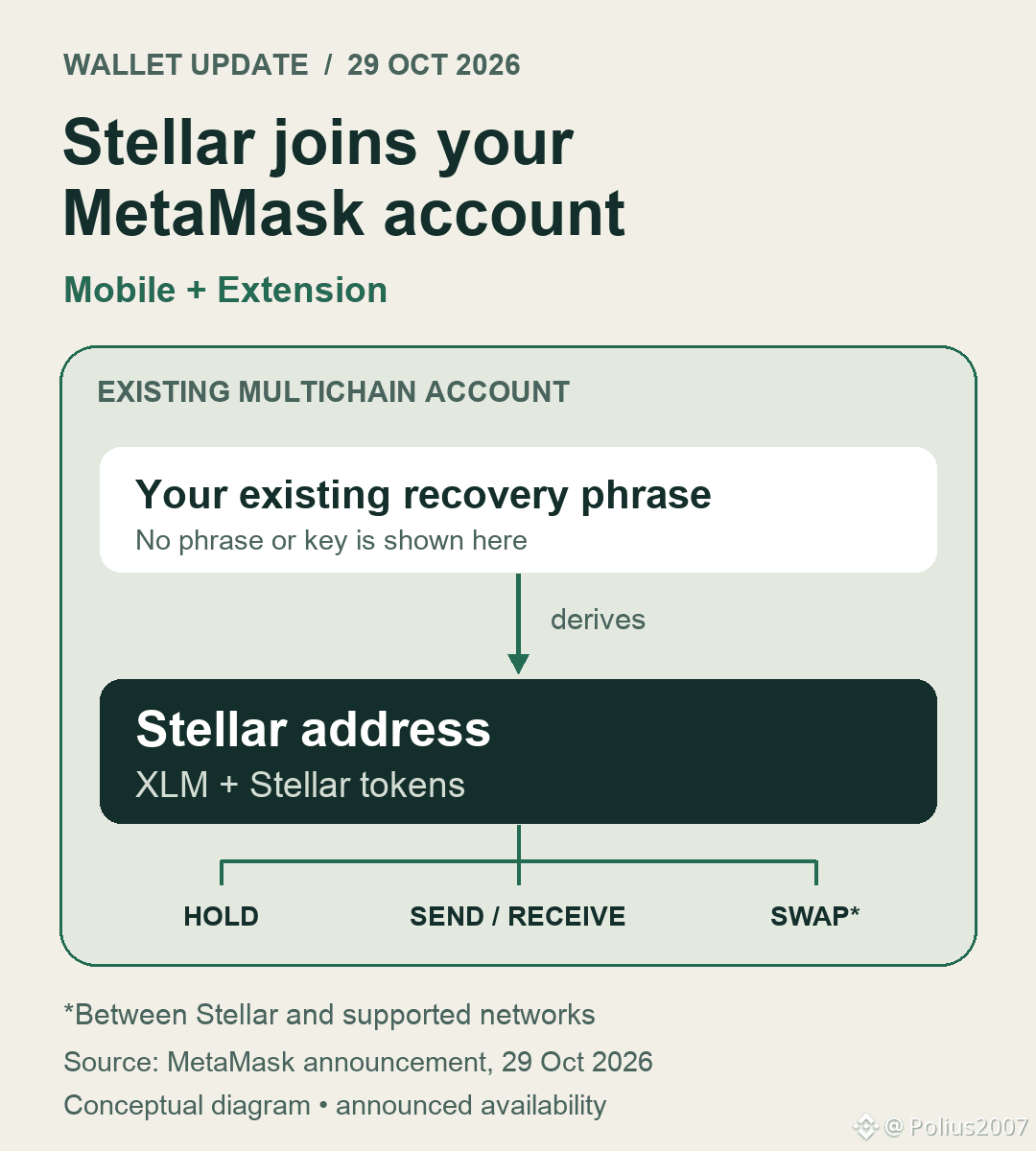
Stellar is now a default network in MetaMask Mobile and Extension, according to MetaMask’s October 29 announcement.
Existing users get a Stellar address derived from the recovery phrase they already use. It sits inside their multichain account, so someone who wants to hold XLM alongside their other crypto no longer needs a separate wallet just to access Stellar.
The integration supports XLM and other Stellar tokens, including trustline assets and Soroban tokens. Users can send and receive them and swap between Stellar and other supported networks. The additional Stellar address is network-specific: it comes from the same recovery phrase, rather than making one address work on every chain.
Source: MetaMask, October 29, 2026.
https://metamask.com/news/metamask-makes-stellar-a-default-network-bringing-global-payments-into-the-open-money-platform
#Stellar #XLM
Stellar is now a default network in MetaMask Mobile and Extension, according to MetaMask’s October 29 announcement.
Existing users get a Stellar address derived from the recovery phrase they already use. It sits inside their multichain account, so someone who wants to hold XLM alongside their other crypto no longer needs a separate wallet just to access Stellar.
The integration supports XLM and other Stellar tokens, including trustline assets and Soroban tokens. Users can send and receive them and swap between Stellar and other supported networks. The additional Stellar address is network-specific: it comes from the same recovery phrase, rather than making one address work on every chain.
Source: MetaMask, October 29, 2026.
https://metamask.com/news/metamask-makes-stellar-a-default-network-bringing-global-payments-into-the-open-money-platform
#Stellar #XLM
Existing users get a Stellar address derived from the recovery phrase they already use. It sits inside their multichain account, so someone who wants to hold XLM alongside their other crypto no longer needs a separate wallet just to access Stellar.
The integration supports XLM and other Stellar tokens, including trustline assets and Soroban tokens. Users can send and receive them and swap between Stellar and other supported networks. The additional Stellar address is network-specific: it comes from the same recovery phrase, rather than making one address work on every chain.
Source: MetaMask, October 29, 2026.
https://metamask.com/news/metamask-makes-stellar-a-default-network-bringing-global-payments-into-the-open-money-platform
#Stellar #XLM
314

🔥 A regulated, yield‑bearing stablecoin isn’t a gimmick—it’s the market’s next safety net.
📊 Stellar just launched YLDS, the first SEC‑registered USD‑pegged stable asset from Figure, and it arrives while Bitcoin ticks up to $78,042 (+0.73%) amid a fear index of 34/100 and a bullish funding rate of +0.0100% on BTC futures. #Stellar #Stablecoins
💡 In a cycle where institutional capital re‑enters on the back of lower volatility, regulated yield‑bearing dollars become the bridge between traditional finance and DeFi, reinforcing the long‑term thesis that “crypto = real‑world finance.” #DeFi #Institutional
✅ Start allocating a small portion of your portfolio (e.g., 2‑5%) into YLDS or similar compliant stablecoins to capture the 4‑6% APY yield while keeping liquidity for buying the dip when BTC’s RSI hovers around 44 and long‑short ratios stay bullish (≈70% longs).
❓ How are you planning to integrate regulated stablecoins like YLDS into your strategy—pure yield, hedge, or a launchpad for the next bull run?
🔥 A regulated, yield‑bearing stablecoin isn’t a gimmick—it’s the market’s next safety net.
📊 Stellar just launched YLDS, the first SEC‑registered USD‑pegged stable asset from Figure, and it arrives while Bitcoin ticks up to $78,042 (+0.73%) amid a fear index of 34/100 and a bullish funding rate of +0.0100% on BTC futures. #Stellar #Stablecoins
💡 In a cycle where institutional capital re‑enters on the back of lower volatility, regulated yield‑bearing dollars become the bridge between traditional finance and DeFi, reinforcing the long‑term thesis that “crypto = real‑world finance.” #DeFi #Institutional
✅ Start allocating a small portion of your portfolio (e.g., 2‑5%) into YLDS or similar compliant stablecoins to capture the 4‑6% APY yield while keeping liquidity for buying the dip when BTC’s RSI hovers around 44 and long‑short ratios stay bullish (≈70% longs).
❓ How are you planning to integrate regulated stablecoins like YLDS into your strategy—pure yield, hedge, or a launchpad for the next bull run?
📊 Stellar just launched YLDS, the first SEC‑registered USD‑pegged stable asset from Figure, and it arrives while Bitcoin ticks up to $78,042 (+0.73%) amid a fear index of 34/100 and a bullish funding rate of +0.0100% on BTC futures. #Stellar #Stablecoins
💡 In a cycle where institutional capital re‑enters on the back of lower volatility, regulated yield‑bearing dollars become the bridge between traditional finance and DeFi, reinforcing the long‑term thesis that “crypto = real‑world finance.” #DeFi #Institutional
✅ Start allocating a small portion of your portfolio (e.g., 2‑5%) into YLDS or similar compliant stablecoins to capture the 4‑6% APY yield while keeping liquidity for buying the dip when BTC’s RSI hovers around 44 and long‑short ratios stay bullish (≈70% longs).
❓ How are you planning to integrate regulated stablecoins like YLDS into your strategy—pure yield, hedge, or a launchpad for the next bull run?
79


·
--
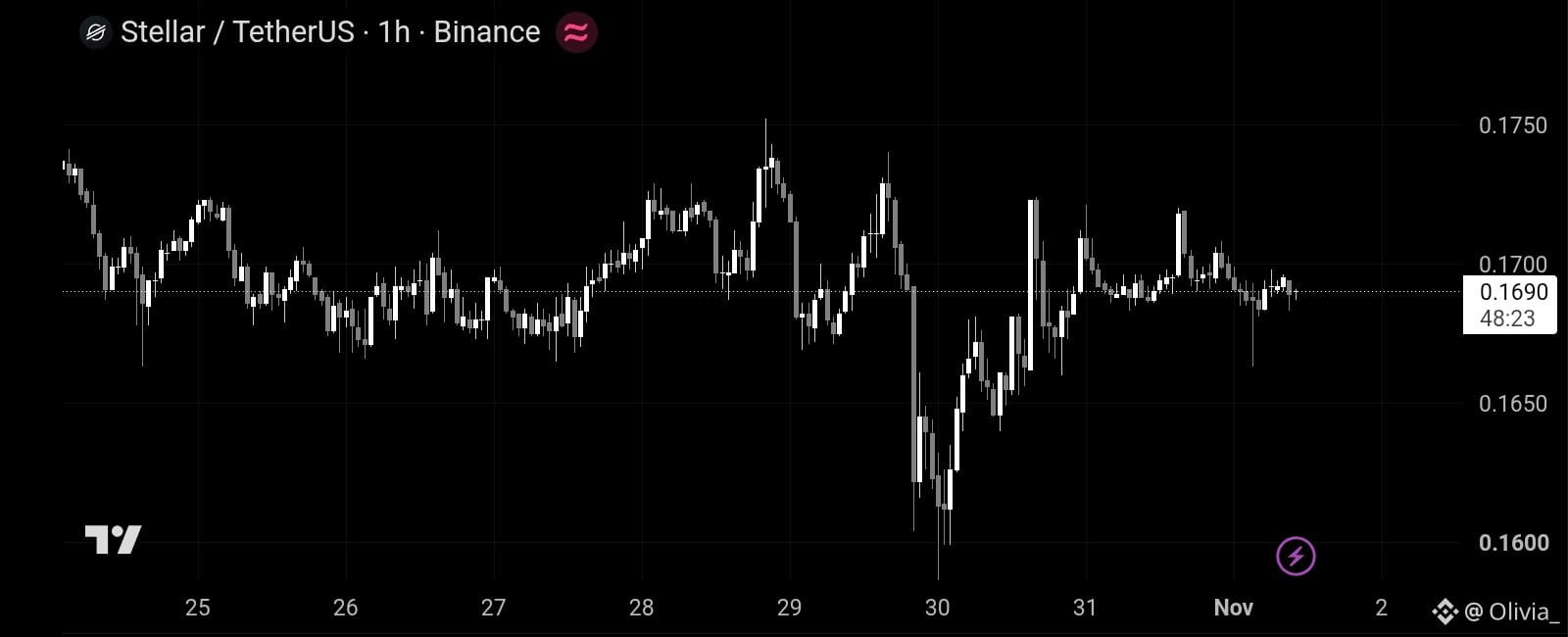
$XLM Holding Strong After Recovery
Stellar is trading around $0.1690 after bouncing from the $0.1600 support area.
Key Levels:
🔹 Support: $0.1680 / $0.1650
🔹 Resistance: $0.1720 / $0.1750
A breakout above $0.1720 could push XLM toward $0.1750. Losing $0.1680 may bring another pullback.
Watching for confirmation before the next move.
#XLM #stellar #crypto
{future}(XLMUSDT)
$XLM Holding Strong After Recovery
Stellar is trading around $0.1690 after bouncing from the $0.1600 support area.
Key Levels:
🔹 Support: $0.1680 / $0.1650
🔹 Resistance: $0.1720 / $0.1750
A breakout above $0.1720 could push XLM toward $0.1750. Losing $0.1680 may bring another pullback.
Watching for confirmation before the next move.
#XLM #stellar #crypto
Stellar is trading around $0.1690 after bouncing from the $0.1600 support area.
Key Levels:
🔹 Support: $0.1680 / $0.1650
🔹 Resistance: $0.1720 / $0.1750
A breakout above $0.1720 could push XLM toward $0.1750. Losing $0.1680 may bring another pullback.
Watching for confirmation before the next move.
#XLM #stellar #crypto
Peter Maliar:
Watching for a clean breakout
19
14
311

·
--
STELLAR AT $0.1690: A QUIET MARKET BEFORE A BIGGER MOVE?
XLM is showing limited movement today. But its current range gives traders two clear levels to monitor.
Binance Spot snapshot
- Price: $0.1690
- 24h change: +0.12%
- 24h high: $0.1720
- 24h low: $0.1663
Fundamental perspective
Stellar's payment and cross-border transfer focus remains central to its ecosystem. Adoption and real-world financial integrations are worth following, but short-term price direction also depends on liquidity and broader crypto sentiment.
Technical levels
- Resistance: $0.1720
- Support: $0.1663
- Bullish trigger: A sustained break above $0.1720.
- Bearish trigger: A breakdown below $0.1663.
My verdict: NEUTRAL — WAIT FOR THE MARKET TO CHOOSE.
There is not enough evidence for a strong directional call yet. The range boundaries are more useful than guessing.
#Stellar
#XLM
#XLMUSDT
#CryptoTrading
#Binance
#MarketAnalysis
STELLAR AT $0.1690: A QUIET MARKET BEFORE A BIGGER MOVE?
XLM is showing limited movement today. But its current range gives traders two clear levels to monitor.
Binance Spot snapshot
- Price: $0.1690
- 24h change: +0.12%
- 24h high: $0.1720
- 24h low: $0.1663
Fundamental perspective
Stellar's payment and cross-border transfer focus remains central to its ecosystem. Adoption and real-world financial integrations are worth following, but short-term price direction also depends on liquidity and broader crypto sentiment.
Technical levels
- Resistance: $0.1720
- Support: $0.1663
- Bullish trigger: A sustained break above $0.1720.
- Bearish trigger: A breakdown below $0.1663.
My verdict: NEUTRAL — WAIT FOR THE MARKET TO CHOOSE.
There is not enough evidence for a strong directional call yet. The range boundaries are more useful than guessing.
#Stellar
#XLM
#XLMUSDT
#CryptoTrading
#Binance
#MarketAnalysis
XLM is showing limited movement today. But its current range gives traders two clear levels to monitor.
Binance Spot snapshot
- Price: $0.1690
- 24h change: +0.12%
- 24h high: $0.1720
- 24h low: $0.1663
Fundamental perspective
Stellar's payment and cross-border transfer focus remains central to its ecosystem. Adoption and real-world financial integrations are worth following, but short-term price direction also depends on liquidity and broader crypto sentiment.
Technical levels
- Resistance: $0.1720
- Support: $0.1663
- Bullish trigger: A sustained break above $0.1720.
- Bearish trigger: A breakdown below $0.1663.
My verdict: NEUTRAL — WAIT FOR THE MARKET TO CHOOSE.
There is not enough evidence for a strong directional call yet. The range boundaries are more useful than guessing.
#Stellar
#XLM
#XLMUSDT
#CryptoTrading
#Binance
#MarketAnalysis
45

Stellar (XLM) Double-Confirms Death Cross, Yet Another Support Exists
- Stellar (XLM) shows death cross pattern indicating potential downward trend
- Golden cross finalized, which could push price lower than before
- Another support level is available for potential bounce
#Stellar #XLM #Crypto #Trading #DeathCross GoldenCross
$xlm
vlikevn Titanbot
Nguồn: U.Today
Stellar (XLM) Double-Confirms Death Cross, Yet Another Support Exists
- Stellar (XLM) shows death cross pattern indicating potential downward trend
- Golden cross finalized, which could push price lower than before
- Another support level is available for potential bounce
#Stellar #XLM #Crypto #Trading #DeathCross GoldenCross
$xlm
vlikevn Titanbot
Nguồn: U.Today
- Stellar (XLM) shows death cross pattern indicating potential downward trend
- Golden cross finalized, which could push price lower than before
- Another support level is available for potential bounce
#Stellar #XLM #Crypto #Trading #DeathCross GoldenCross
$xlm
vlikevn Titanbot
Nguồn: U.Today
7

·
--
Curve just went multi-VM: StableSwap is live on Stellar mainnet.
It's Curve's first non-EVM deployment, per CoinOtag's Nov 1 report. Stablecoin swaps have lived almost entirely on EVM chains until now, so this widens where low-slippage stable trading can happen.
My take: with the market in fear (Fear & Greed around 30) and $BTC near $77.5K, builders are still shipping. Stablecoin infrastructure keeps getting the quiet upgrades while price chops.
Which matters more for the next cycle: stablecoin rails on new chains, or more ETF access? Curious where you land. $XLM $BTC
#Stellar #Curve #DeFi #Stablecoins
Curve just went multi-VM: StableSwap is live on Stellar mainnet.
It's Curve's first non-EVM deployment, per CoinOtag's Nov 1 report. Stablecoin swaps have lived almost entirely on EVM chains until now, so this widens where low-slippage stable trading can happen.
My take: with the market in fear (Fear & Greed around 30) and $BTC near $77.5K, builders are still shipping. Stablecoin infrastructure keeps getting the quiet upgrades while price chops.
Which matters more for the next cycle: stablecoin rails on new chains, or more ETF access? Curious where you land. $XLM $BTC
#Stellar #Curve #DeFi #Stablecoins
It's Curve's first non-EVM deployment, per CoinOtag's Nov 1 report. Stablecoin swaps have lived almost entirely on EVM chains until now, so this widens where low-slippage stable trading can happen.
My take: with the market in fear (Fear & Greed around 30) and $BTC near $77.5K, builders are still shipping. Stablecoin infrastructure keeps getting the quiet upgrades while price chops.
Which matters more for the next cycle: stablecoin rails on new chains, or more ETF access? Curious where you land. $XLM $BTC
#Stellar #Curve #DeFi #Stablecoins
61

$XLM REAL-WORLD ASSETS EXPLODE PAST $3B AS INSTITUTIONAL LIQUIDITY QUIETLY STACKS! 🦈 💥
Stellar has quietly turned into an institutional liquidity monster, surging past $3 Billion in tokenized real-world assets since January. 📊 Major heavyweights like Ondo and Spiko are locking massive capital into $XLM rails, far outstripping its modest $213 Million DeFi footprint.
💡 With barely $2 Million of these RWAs actively utilized as collateral in lending protocols, the unlockable on-chain velocity here is staggering. ⚡ Once institutional debt starts feeding directly into active DeFi yield loops, the ecosystem dynamics will shift dramatically.
💬 Will $XLM bridge this massive utilization gap and dominate the RWA sector this cycle? 👇
⚠️ Not financial advice. Always manage your risk. 🛡️
🏷️ #XLM #RWA #Stellar #Crypto
🔥 💎
$XLM REAL-WORLD ASSETS EXPLODE PAST $3B AS INSTITUTIONAL LIQUIDITY QUIETLY STACKS! 🦈 💥
Stellar has quietly turned into an institutional liquidity monster, surging past $3 Billion in tokenized real-world assets since January. 📊 Major heavyweights like Ondo and Spiko are locking massive capital into $XLM rails, far outstripping its modest $213 Million DeFi footprint.
💡 With barely $2 Million of these RWAs actively utilized as collateral in lending protocols, the unlockable on-chain velocity here is staggering. ⚡ Once institutional debt starts feeding directly into active DeFi yield loops, the ecosystem dynamics will shift dramatically.
💬 Will $XLM bridge this massive utilization gap and dominate the RWA sector this cycle? 👇
⚠️ Not financial advice. Always manage your risk. 🛡️
🏷️ #XLM #RWA #Stellar #Crypto
🔥 💎
Stellar has quietly turned into an institutional liquidity monster, surging past $3 Billion in tokenized real-world assets since January. 📊 Major heavyweights like Ondo and Spiko are locking massive capital into $XLM rails, far outstripping its modest $213 Million DeFi footprint.
💡 With barely $2 Million of these RWAs actively utilized as collateral in lending protocols, the unlockable on-chain velocity here is staggering. ⚡ Once institutional debt starts feeding directly into active DeFi yield loops, the ecosystem dynamics will shift dramatically.
💬 Will $XLM bridge this massive utilization gap and dominate the RWA sector this cycle? 👇
⚠️ Not financial advice. Always manage your risk. 🛡️
🏷️ #XLM #RWA #Stellar #Crypto
🔥 💎
37

·
--
😱 $XLM PANIC AT STELLAR: THE SECOND EXCHANGE GOES DOWN IN FOUR DAYS
Mercado Bitcoin, Brazil’s largest exchange, suspended deposits and withdrawals today following a security incident, four days after the Binance hack. To me, another major exchange stumbling in the same week is no longer bad luck: the money trail leads to Stellar, and XLM is under scrutiny.
Look at the detail nobody is noticing:
→ Hypernative flagged more than $40M in suspicious transfers across more than 10 chains, and Mercado Bitcoin has already published the addresses linked to the case, including those on Stellar, where the attacker is holding around 6.7 million XLM.
→ XLM -0.6% with $26.9M, while $XRP -0.4% barely retreats and TRX +1.9% rises among the payment tokens: XLM is the weakest of the group just as its network appears on the incident map.
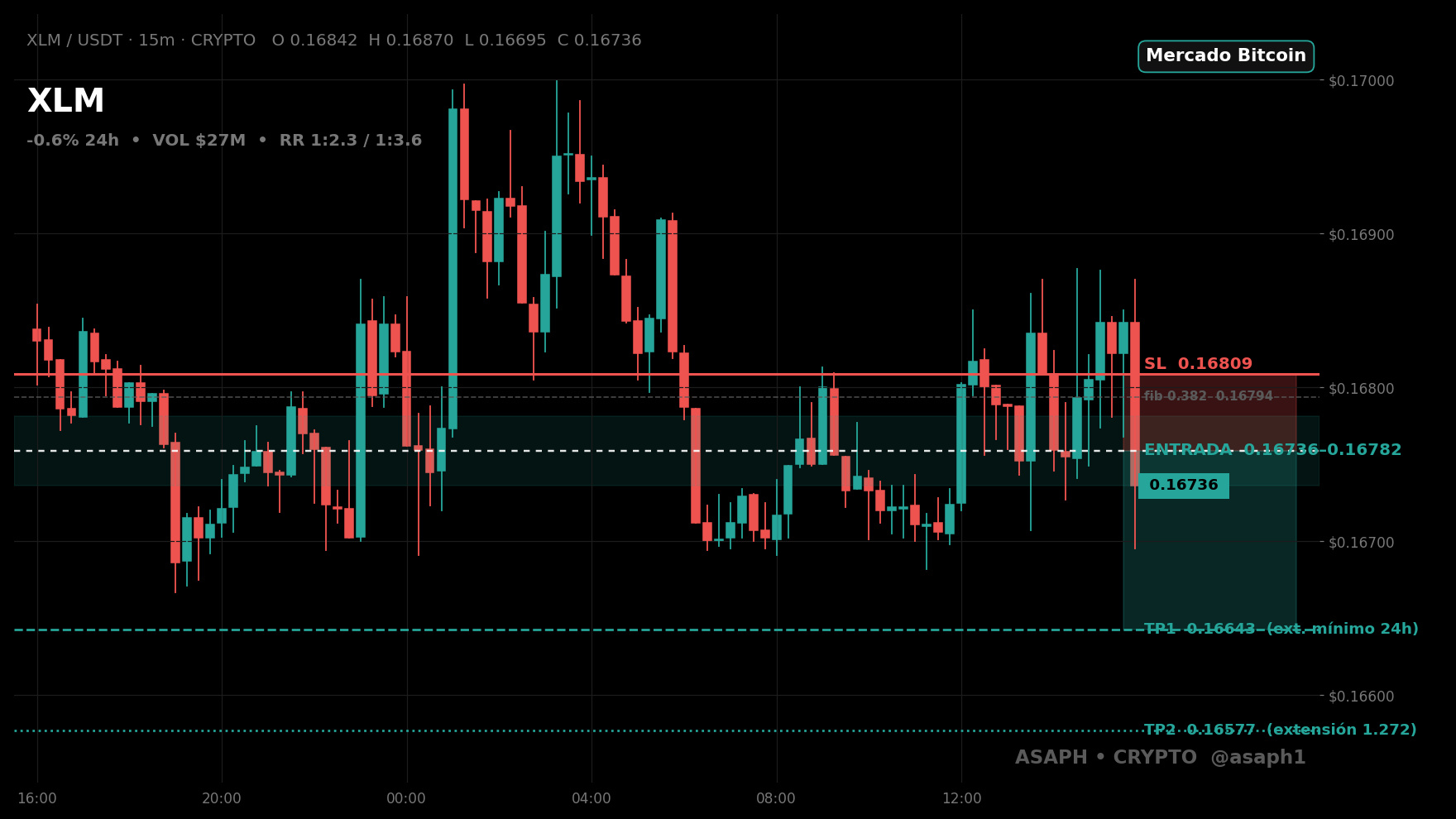
→ Entry $0.16736–$0.16782, SL $0.16809, TP1 $0.16643 (-0.7%) → TP2 $0.16577 (-1.1%).
Will XLM lose $0.16577 with Stellar on the map, or hold at $0.16643? 👇
$XLM $XRP TRX
#Stellar #Brasil #Crypto
😱 $XLM PANIC AT STELLAR: THE SECOND EXCHANGE GOES DOWN IN FOUR DAYS
Mercado Bitcoin, Brazil’s largest exchange, suspended deposits and withdrawals today following a security incident, four days after the Binance hack. To me, another major exchange stumbling in the same week is no longer bad luck: the money trail leads to Stellar, and XLM is under scrutiny.
Look at the detail nobody is noticing:
→ Hypernative flagged more than $40M in suspicious transfers across more than 10 chains, and Mercado Bitcoin has already published the addresses linked to the case, including those on Stellar, where the attacker is holding around 6.7 million XLM.
→ XLM -0.6% with $26.9M, while $XRP -0.4% barely retreats and TRX +1.9% rises among the payment tokens: XLM is the weakest of the group just as its network appears on the incident map.
→ Entry $0.16736–$0.16782, SL $0.16809, TP1 $0.16643 (-0.7%) → TP2 $0.16577 (-1.1%).
Will XLM lose $0.16577 with Stellar on the map, or hold at $0.16643? 👇
$XLM $XRP TRX
#Stellar #Brasil #Crypto
Mercado Bitcoin, Brazil’s largest exchange, suspended deposits and withdrawals today following a security incident, four days after the Binance hack. To me, another major exchange stumbling in the same week is no longer bad luck: the money trail leads to Stellar, and XLM is under scrutiny.
Look at the detail nobody is noticing:
→ Hypernative flagged more than $40M in suspicious transfers across more than 10 chains, and Mercado Bitcoin has already published the addresses linked to the case, including those on Stellar, where the attacker is holding around 6.7 million XLM.
→ XLM -0.6% with $26.9M, while $XRP -0.4% barely retreats and TRX +1.9% rises among the payment tokens: XLM is the weakest of the group just as its network appears on the incident map.
→ Entry $0.16736–$0.16782, SL $0.16809, TP1 $0.16643 (-0.7%) → TP2 $0.16577 (-1.1%).
Will XLM lose $0.16577 with Stellar on the map, or hold at $0.16643? 👇
$XLM $XRP TRX
#Stellar #Brasil #Crypto
27

Verified
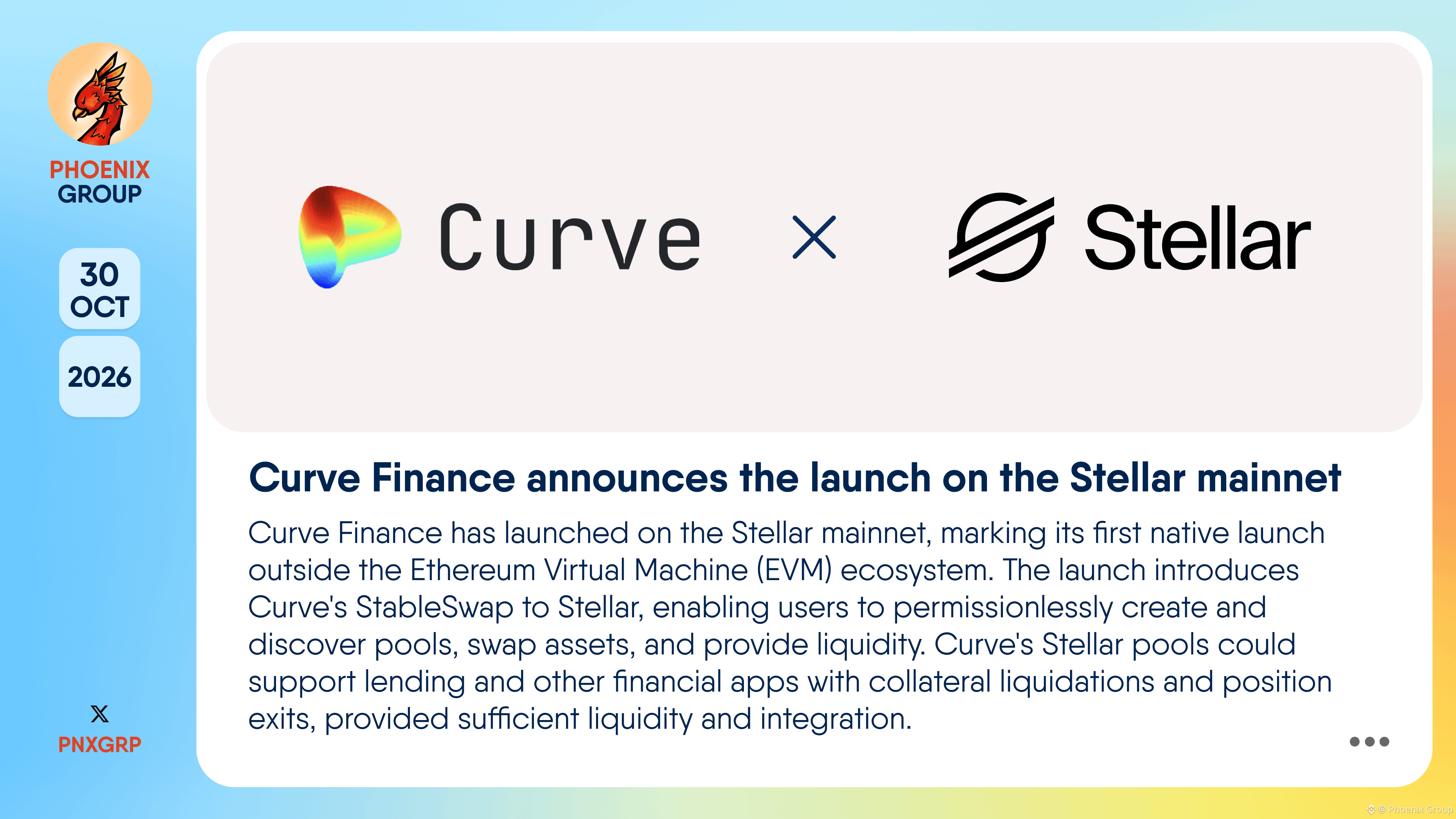
Curve Finance announces the launch on the Stellar mainnet
#CurveFinance has launched on the #Stellar mainnet, marking its first native launch outside the Ethereum Virtual Machine (EVM) ecosystem. The launch introduces Curve's StableSwap to Stellar, enabling users to permissionlessly create and discover pools, swap assets, and provide liquidity.
Curve's Stellar pools could support lending and other financial apps with collateral liquidations and position exits, provided sufficient liquidity and integration. Asset issuers could also use them to create markets for Stellar-based assets, including stablecoins and Franklin Templeton's tokenized money market fund.
👉 theblock.co/news/defi/2026-10-29-curve-finance-stellar-432121
Curve Finance announces the launch on the Stellar mainnet
#CurveFinance has launched on the #Stellar mainnet, marking its first native launch outside the Ethereum Virtual Machine (EVM) ecosystem. The launch introduces Curve's StableSwap to Stellar, enabling users to permissionlessly create and discover pools, swap assets, and provide liquidity.
Curve's Stellar pools could support lending and other financial apps with collateral liquidations and position exits, provided sufficient liquidity and integration. Asset issuers could also use them to create markets for Stellar-based assets, including stablecoins and Franklin Templeton's tokenized money market fund.
👉 theblock.co/news/defi/2026-10-29-curve-finance-stellar-432121
#CurveFinance has launched on the #Stellar mainnet, marking its first native launch outside the Ethereum Virtual Machine (EVM) ecosystem. The launch introduces Curve's StableSwap to Stellar, enabling users to permissionlessly create and discover pools, swap assets, and provide liquidity.
Curve's Stellar pools could support lending and other financial apps with collateral liquidations and position exits, provided sufficient liquidity and integration. Asset issuers could also use them to create markets for Stellar-based assets, including stablecoins and Franklin Templeton's tokenized money market fund.
👉 theblock.co/news/defi/2026-10-29-curve-finance-stellar-432121
581
·
--
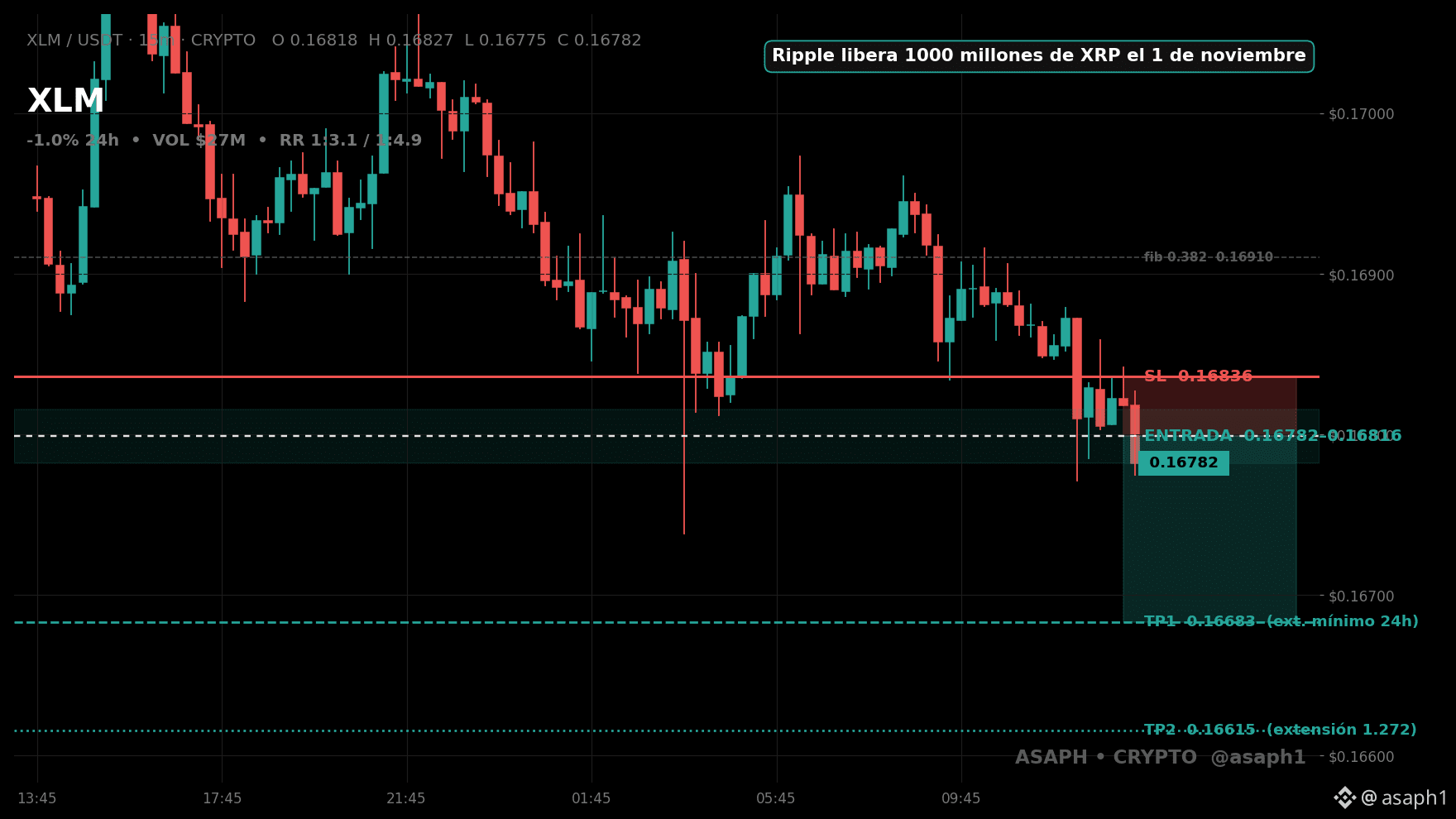
🌟 $XLM PAYMENTS SHOWDOWN: WHILE RIPPLE RELEASES 1 BILLION, STELLAR FALLS BEHIND
Ripple put 1 billion XRP into circulation today, November 1, through its two escrow unlocks, and the market absorbed it without a fuss. To me, the contrast is the story: XRP weathered the supply shock, but Stellar, its longtime rival in payments, isn’t keeping pace this morning.
Look at the detail nobody is noticing:
→ Whale Alert reported Ripple’s two 500 million XRP transfers today—the November monthly unlock is now in circulation.
→ XLM -1.0% at $27.1M, while $XRP +0.3% and $HBAR -0.5% are moving differently in payments.
→ Entry $0.16782–$0.16816, SL $0.16836, TP1 $0.16683 (-0.7%) → TP2 $0.16615 (-1.1%).
Do you see XLM reaching $0.16615 or holding at $0.16697? 👇
$XLM
#Stellar #Pagos #Trading
🌟 $XLM PAYMENTS SHOWDOWN: WHILE RIPPLE RELEASES 1 BILLION, STELLAR FALLS BEHIND
Ripple put 1 billion XRP into circulation today, November 1, through its two escrow unlocks, and the market absorbed it without a fuss. To me, the contrast is the story: XRP weathered the supply shock, but Stellar, its longtime rival in payments, isn’t keeping pace this morning.
Look at the detail nobody is noticing:
→ Whale Alert reported Ripple’s two 500 million XRP transfers today—the November monthly unlock is now in circulation.
→ XLM -1.0% at $27.1M, while $XRP +0.3% and $HBAR -0.5% are moving differently in payments.
→ Entry $0.16782–$0.16816, SL $0.16836, TP1 $0.16683 (-0.7%) → TP2 $0.16615 (-1.1%).
Do you see XLM reaching $0.16615 or holding at $0.16697? 👇
$XLM
#Stellar #Pagos #Trading
Ripple put 1 billion XRP into circulation today, November 1, through its two escrow unlocks, and the market absorbed it without a fuss. To me, the contrast is the story: XRP weathered the supply shock, but Stellar, its longtime rival in payments, isn’t keeping pace this morning.
Look at the detail nobody is noticing:
→ Whale Alert reported Ripple’s two 500 million XRP transfers today—the November monthly unlock is now in circulation.
→ XLM -1.0% at $27.1M, while $XRP +0.3% and $HBAR -0.5% are moving differently in payments.
→ Entry $0.16782–$0.16816, SL $0.16836, TP1 $0.16683 (-0.7%) → TP2 $0.16615 (-1.1%).
Do you see XLM reaching $0.16615 or holding at $0.16697? 👇
$XLM
#Stellar #Pagos #Trading
77

What’s worth watching in XLM’s current market isn’t that it’s up 1.06%, but what’s happening in perpetual futures: shorts are paying funding.
The current price is 0.17014, up 1.06% over 24 hours. The 8-hour funding rate is -0.0156%, or about -17% annualized. The price is moving up while the funding rate is moving down, which suggests this rally isn’t being driven by leveraged longs, but by spot buying. Meanwhile, shorts in the futures market would rather pay every 8 hours than give up their positions.
But don’t rush to interpret this as “shorts are about to get squeezed out.”
1. The actual amount implied by the negative funding rate is quite small. Open interest is 30.15 million USDT. Multiply that by 0.0156%, and shorts are paying a total of about 4,700 USDT per settlement, or just over 14,000 a day. Payments on this scale don’t show that either side is fighting desperately. It’s more a signal of directional preference than of actual capital flows. An annualized rate of -17% sounds alarming, but that figure simply takes the 8-hour rate and multiplies it by 1,095; the actual amount being paid is small. So this -0.0156% can be used to gauge sentiment, but it doesn’t support a narrative of “immense pressure on shorts.”
2. The long/short account ratio and the funding rate are at odds. Long accounts make up 61%, but the funding rate is negative. Account numbers count people; positions are weighted by capital. If both figures are true, they point to one kind of structure: small accounts are clustered on the long side, while large positions are on the short side. In this market, the price is moving up not because short covering is triggering a chain reaction, but because spot buying needs to keep coming in. The fact that large positions are willing to pay to stay short suggests either that they have a longer holding horizon or that they’re hedging spot holdings. Floating losses haven’t forced anyone to close their position.
3. What really matters is when the funding rate turns positive again. At -0.0156%, shorts are paying to hold their positions. If spot buying is genuine and sustained, shorts will gradually give up holding their positions, and the funding rate will move from negative to zero and then turn positive. That moment wouldn’t mean the market is accelerating; it would mean “shorts are no longer willing to pay this much”—the first real resistance faced by this spot-driven push, and a signal that the balance of power between short-term bulls and bears is starting to shift. Conversely, if the price keeps rising while the funding rate stays negative, that means shorts have no intention of backing down in the short term. This is a slow trade, not quick money.
4. The derivatives pool isn’t deep. The 24-hour trading volume is 24.4M USDT, and open interest is 30.15M USDT—those two figures are close. At this scale, marginal changes in the funding rate can easily be skewed by one or two large orders. Looking at the funding rate over a single 8-hour window is more noise than signal; you need to watch several settlements in a row before drawing a firm conclusion. Don’t use data from one settlement period to project an entire trend.
⚠️ Risk warning: Negative funding can persist for a long time, especially in spot-driven markets. Treating “shorts paying” as “shorts giving up” is one of the most common misreadings. Your stop-loss level shouldn’t be any wider just because the funding rate is negative.
My view: the evidence for XLM’s bullish move is on the spot side; the negative funding rate simply confirms that leverage hasn’t followed through. The real confirmation signal would be the funding rate turning positive alongside rising open interest. Until then, this 1.06% gain looks more like a one-sided push by spot buyers than the start of a trend.
#XLM #Stellar #Crypto
What’s worth watching in XLM’s current market isn’t that it’s up 1.06%, but what’s happening in perpetual futures: shorts are paying funding.
The current price is 0.17014, up 1.06% over 24 hours. The 8-hour funding rate is -0.0156%, or about -17% annualized. The price is moving up while the funding rate is moving down, which suggests this rally isn’t being driven by leveraged longs, but by spot buying. Meanwhile, shorts in the futures market would rather pay every 8 hours than give up their positions.
But don’t rush to interpret this as “shorts are about to get squeezed out.”
1. The actual amount implied by the negative funding rate is quite small. Open interest is 30.15 million USDT. Multiply that by 0.0156%, and shorts are paying a total of about 4,700 USDT per settlement, or just over 14,000 a day. Payments on this scale don’t show that either side is fighting desperately. It’s more a signal of directional preference than of actual capital flows. An annualized rate of -17% sounds alarming, but that figure simply takes the 8-hour rate and multiplies it by 1,095; the actual amount being paid is small. So this -0.0156% can be used to gauge sentiment, but it doesn’t support a narrative of “immense pressure on shorts.”
2. The long/short account ratio and the funding rate are at odds. Long accounts make up 61%, but the funding rate is negative. Account numbers count people; positions are weighted by capital. If both figures are true, they point to one kind of structure: small accounts are clustered on the long side, while large positions are on the short side. In this market, the price is moving up not because short covering is triggering a chain reaction, but because spot buying needs to keep coming in. The fact that large positions are willing to pay to stay short suggests either that they have a longer holding horizon or that they’re hedging spot holdings. Floating losses haven’t forced anyone to close their position.
3. What really matters is when the funding rate turns positive again. At -0.0156%, shorts are paying to hold their positions. If spot buying is genuine and sustained, shorts will gradually give up holding their positions, and the funding rate will move from negative to zero and then turn positive. That moment wouldn’t mean the market is accelerating; it would mean “shorts are no longer willing to pay this much”—the first real resistance faced by this spot-driven push, and a signal that the balance of power between short-term bulls and bears is starting to shift. Conversely, if the price keeps rising while the funding rate stays negative, that means shorts have no intention of backing down in the short term. This is a slow trade, not quick money.
4. The derivatives pool isn’t deep. The 24-hour trading volume is 24.4M USDT, and open interest is 30.15M USDT—those two figures are close. At this scale, marginal changes in the funding rate can easily be skewed by one or two large orders. Looking at the funding rate over a single 8-hour window is more noise than signal; you need to watch several settlements in a row before drawing a firm conclusion. Don’t use data from one settlement period to project an entire trend.
⚠️ Risk warning: Negative funding can persist for a long time, especially in spot-driven markets. Treating “shorts paying” as “shorts giving up” is one of the most common misreadings. Your stop-loss level shouldn’t be any wider just because the funding rate is negative.
My view: the evidence for XLM’s bullish move is on the spot side; the negative funding rate simply confirms that leverage hasn’t followed through. The real confirmation signal would be the funding rate turning positive alongside rising open interest. Until then, this 1.06% gain looks more like a one-sided push by spot buyers than the start of a trend.
#XLM #Stellar #Crypto
The current price is 0.17014, up 1.06% over 24 hours. The 8-hour funding rate is -0.0156%, or about -17% annualized. The price is moving up while the funding rate is moving down, which suggests this rally isn’t being driven by leveraged longs, but by spot buying. Meanwhile, shorts in the futures market would rather pay every 8 hours than give up their positions.
But don’t rush to interpret this as “shorts are about to get squeezed out.”
1. The actual amount implied by the negative funding rate is quite small. Open interest is 30.15 million USDT. Multiply that by 0.0156%, and shorts are paying a total of about 4,700 USDT per settlement, or just over 14,000 a day. Payments on this scale don’t show that either side is fighting desperately. It’s more a signal of directional preference than of actual capital flows. An annualized rate of -17% sounds alarming, but that figure simply takes the 8-hour rate and multiplies it by 1,095; the actual amount being paid is small. So this -0.0156% can be used to gauge sentiment, but it doesn’t support a narrative of “immense pressure on shorts.”
2. The long/short account ratio and the funding rate are at odds. Long accounts make up 61%, but the funding rate is negative. Account numbers count people; positions are weighted by capital. If both figures are true, they point to one kind of structure: small accounts are clustered on the long side, while large positions are on the short side. In this market, the price is moving up not because short covering is triggering a chain reaction, but because spot buying needs to keep coming in. The fact that large positions are willing to pay to stay short suggests either that they have a longer holding horizon or that they’re hedging spot holdings. Floating losses haven’t forced anyone to close their position.
3. What really matters is when the funding rate turns positive again. At -0.0156%, shorts are paying to hold their positions. If spot buying is genuine and sustained, shorts will gradually give up holding their positions, and the funding rate will move from negative to zero and then turn positive. That moment wouldn’t mean the market is accelerating; it would mean “shorts are no longer willing to pay this much”—the first real resistance faced by this spot-driven push, and a signal that the balance of power between short-term bulls and bears is starting to shift. Conversely, if the price keeps rising while the funding rate stays negative, that means shorts have no intention of backing down in the short term. This is a slow trade, not quick money.
4. The derivatives pool isn’t deep. The 24-hour trading volume is 24.4M USDT, and open interest is 30.15M USDT—those two figures are close. At this scale, marginal changes in the funding rate can easily be skewed by one or two large orders. Looking at the funding rate over a single 8-hour window is more noise than signal; you need to watch several settlements in a row before drawing a firm conclusion. Don’t use data from one settlement period to project an entire trend.
⚠️ Risk warning: Negative funding can persist for a long time, especially in spot-driven markets. Treating “shorts paying” as “shorts giving up” is one of the most common misreadings. Your stop-loss level shouldn’t be any wider just because the funding rate is negative.
My view: the evidence for XLM’s bullish move is on the spot side; the negative funding rate simply confirms that leverage hasn’t followed through. The real confirmation signal would be the funding rate turning positive alongside rising open interest. Until then, this 1.06% gain looks more like a one-sided push by spot buyers than the start of a trend.
#XLM #Stellar #Crypto
4

·
--
Stellar integrates with MetaMask: address creation and activation are separate steps
MetaMask and Stellar announced the integration on October 29, 2026, and it is now available on mobile and as an extension, according to the announcement. Square reports on the news today. Stellar is now one of the networks included by default.
Compatible multichain accounts include a Stellar address derived from their recovery phrase. The integration lets users manage XLM, compatible assets, and Soroban tokens, as well as send, receive, and swap assets across supported networks.
MetaMask’s guide outlines several requirements:
• A new address needs to receive at least 1 XLM to be activated on the network.
• To receive assets such as USDC, you need a trustline: authorization for the account to accept that asset.
• Each trustline adds 0.5 XLM to the reserve; that balance is locked and unavailable to spend. Network fees are also paid in XLM.
For a bridge swap to a token other than XLM, the guide requires activating the trustline first. Skipping this step can result in a loss of funds.
Market snapshot: Binance Spot, 10/31 at 20:17 UTC: XLM is trading at 0.1697 USDT (+1.19% in 24 hours) and ETH at 2,254.92 USDT (+0.51%). The integration makes access easier; these changes do not show how much new usage it has generated.
$XLM $ETH $USDC
Educational Content. Not financial advice.
#Stellar #MetaMask #XLM #Autocustodia #FinancialEducation
Stellar integrates with MetaMask: address creation and activation are separate steps
MetaMask and Stellar announced the integration on October 29, 2026, and it is now available on mobile and as an extension, according to the announcement. Square reports on the news today. Stellar is now one of the networks included by default.
Compatible multichain accounts include a Stellar address derived from their recovery phrase. The integration lets users manage XLM, compatible assets, and Soroban tokens, as well as send, receive, and swap assets across supported networks.
MetaMask’s guide outlines several requirements:
• A new address needs to receive at least 1 XLM to be activated on the network.
• To receive assets such as USDC, you need a trustline: authorization for the account to accept that asset.
• Each trustline adds 0.5 XLM to the reserve; that balance is locked and unavailable to spend. Network fees are also paid in XLM.
For a bridge swap to a token other than XLM, the guide requires activating the trustline first. Skipping this step can result in a loss of funds.
Market snapshot: Binance Spot, 10/31 at 20:17 UTC: XLM is trading at 0.1697 USDT (+1.19% in 24 hours) and ETH at 2,254.92 USDT (+0.51%). The integration makes access easier; these changes do not show how much new usage it has generated.
$XLM $ETH $USDC
Educational Content. Not financial advice.
#Stellar #MetaMask #XLM #Autocustodia #FinancialEducation
MetaMask and Stellar announced the integration on October 29, 2026, and it is now available on mobile and as an extension, according to the announcement. Square reports on the news today. Stellar is now one of the networks included by default.
Compatible multichain accounts include a Stellar address derived from their recovery phrase. The integration lets users manage XLM, compatible assets, and Soroban tokens, as well as send, receive, and swap assets across supported networks.
MetaMask’s guide outlines several requirements:
• A new address needs to receive at least 1 XLM to be activated on the network.
• To receive assets such as USDC, you need a trustline: authorization for the account to accept that asset.
• Each trustline adds 0.5 XLM to the reserve; that balance is locked and unavailable to spend. Network fees are also paid in XLM.
For a bridge swap to a token other than XLM, the guide requires activating the trustline first. Skipping this step can result in a loss of funds.
Market snapshot: Binance Spot, 10/31 at 20:17 UTC: XLM is trading at 0.1697 USDT (+1.19% in 24 hours) and ETH at 2,254.92 USDT (+0.51%). The integration makes access easier; these changes do not show how much new usage it has generated.
$XLM $ETH $USDC
Educational Content. Not financial advice.
#Stellar #MetaMask #XLM #Autocustodia #FinancialEducation

francotraderr:
Follow for follow
1
1
82
Treating “default network” as just another news item would be missing the point. Stellar has become a default network in MetaMask, and new accounts will automatically have an address generated for them. Taken together, these two changes mean XLM has gone from being “a network users have to add themselves” to “a network users encounter as soon as they open their wallet.” In product terms, this is a change in distribution—not just an integration announcement.
First, why do defaults matter? MetaMask is a self-custody wallet with tens of millions of monthly active users, and choosing a network is one of the first things new users do when setting up a wallet. Until now, the conversion path for Stellar looked like this: hear about it, search for it, manually add an RPC, then find where to access assets. Each step filtered out a large number of people. Now that first hurdle is gone: an address is generated automatically, and users can see their Stellar address the first time they open the wallet. Defaults themselves can drive distribution because they require no motivation from users—just a tap on “Next.”
So what we should watch next is on-chain data, not short-term price swings. Specifically, keep an eye on three metrics: the growth curve for new addresses, daily active addresses, and the volume of stablecoin transfers and Soroban contract calls on Stellar. XLM’s most persistent problem over the past few years has been that the narrative was there, but address counts barely grew. The ecosystem story has been told for a long time, yet active addresses have never managed to climb to a new level. If this change in access is real, we should see a step-change in new addresses within two to four weeks—not just a one-day spike. If the address curve still looks the same after four weeks, then this was just an engineering partnership, not a user migration.
Now, the market. XLM is currently trading around $0.16, down roughly 70% from above $0.60. The positioning at this level means it is not especially sensitive to positive news. Funding rates have stayed close to zero for a long time, suggesting leveraged traders aren’t paying up on this news: there are neither crowded longs chasing the move nor shorts pressing the direction. In this kind of environment, news is usually priced in slowly. It won’t all happen in a single day; instead, the story will be validated one data point at a time. If open interest in futures doesn’t increase noticeably over the next few days, I’d interpret that as “not many people know about it yet,” rather than “nobody believes it.”
The risks need to be clear, too. Integration doesn’t guarantee usage, and users can switch away from the default network with a single tap. Whether they actually stick around depends on what comes next: how easy it is to access assets, whether fiat on- and off-ramps work smoothly, and whether there’s enough liquidity for on-chain swaps. Those are all still open questions. A more practical point: integration news typically takes quarters to play out, while market sentiment can shift in days. That mismatch in timing is what most easily wears people down.
My view: treat this change to the default network as a window to observe, not a trading signal. Over the next two weeks, first check whether new and active addresses are moving. If the data picks up, then talk about repricing; if it doesn’t, acknowledge that this was just infrastructure being laid. Using a short-term position to bet on a long-term variable is one of the easiest ways to get repeatedly ground down by noise.
#XLM #Stellar #Crypto
Treating “default network” as just another news item would be missing the point. Stellar has become a default network in MetaMask, and new accounts will automatically have an address generated for them. Taken together, these two changes mean XLM has gone from being “a network users have to add themselves” to “a network users encounter as soon as they open their wallet.” In product terms, this is a change in distribution—not just an integration announcement.
First, why do defaults matter? MetaMask is a self-custody wallet with tens of millions of monthly active users, and choosing a network is one of the first things new users do when setting up a wallet. Until now, the conversion path for Stellar looked like this: hear about it, search for it, manually add an RPC, then find where to access assets. Each step filtered out a large number of people. Now that first hurdle is gone: an address is generated automatically, and users can see their Stellar address the first time they open the wallet. Defaults themselves can drive distribution because they require no motivation from users—just a tap on “Next.”
So what we should watch next is on-chain data, not short-term price swings. Specifically, keep an eye on three metrics: the growth curve for new addresses, daily active addresses, and the volume of stablecoin transfers and Soroban contract calls on Stellar. XLM’s most persistent problem over the past few years has been that the narrative was there, but address counts barely grew. The ecosystem story has been told for a long time, yet active addresses have never managed to climb to a new level. If this change in access is real, we should see a step-change in new addresses within two to four weeks—not just a one-day spike. If the address curve still looks the same after four weeks, then this was just an engineering partnership, not a user migration.
Now, the market. XLM is currently trading around $0.16, down roughly 70% from above $0.60. The positioning at this level means it is not especially sensitive to positive news. Funding rates have stayed close to zero for a long time, suggesting leveraged traders aren’t paying up on this news: there are neither crowded longs chasing the move nor shorts pressing the direction. In this kind of environment, news is usually priced in slowly. It won’t all happen in a single day; instead, the story will be validated one data point at a time. If open interest in futures doesn’t increase noticeably over the next few days, I’d interpret that as “not many people know about it yet,” rather than “nobody believes it.”
The risks need to be clear, too. Integration doesn’t guarantee usage, and users can switch away from the default network with a single tap. Whether they actually stick around depends on what comes next: how easy it is to access assets, whether fiat on- and off-ramps work smoothly, and whether there’s enough liquidity for on-chain swaps. Those are all still open questions. A more practical point: integration news typically takes quarters to play out, while market sentiment can shift in days. That mismatch in timing is what most easily wears people down.
My view: treat this change to the default network as a window to observe, not a trading signal. Over the next two weeks, first check whether new and active addresses are moving. If the data picks up, then talk about repricing; if it doesn’t, acknowledge that this was just infrastructure being laid. Using a short-term position to bet on a long-term variable is one of the easiest ways to get repeatedly ground down by noise.
#XLM #Stellar #Crypto
First, why do defaults matter? MetaMask is a self-custody wallet with tens of millions of monthly active users, and choosing a network is one of the first things new users do when setting up a wallet. Until now, the conversion path for Stellar looked like this: hear about it, search for it, manually add an RPC, then find where to access assets. Each step filtered out a large number of people. Now that first hurdle is gone: an address is generated automatically, and users can see their Stellar address the first time they open the wallet. Defaults themselves can drive distribution because they require no motivation from users—just a tap on “Next.”
So what we should watch next is on-chain data, not short-term price swings. Specifically, keep an eye on three metrics: the growth curve for new addresses, daily active addresses, and the volume of stablecoin transfers and Soroban contract calls on Stellar. XLM’s most persistent problem over the past few years has been that the narrative was there, but address counts barely grew. The ecosystem story has been told for a long time, yet active addresses have never managed to climb to a new level. If this change in access is real, we should see a step-change in new addresses within two to four weeks—not just a one-day spike. If the address curve still looks the same after four weeks, then this was just an engineering partnership, not a user migration.
Now, the market. XLM is currently trading around $0.16, down roughly 70% from above $0.60. The positioning at this level means it is not especially sensitive to positive news. Funding rates have stayed close to zero for a long time, suggesting leveraged traders aren’t paying up on this news: there are neither crowded longs chasing the move nor shorts pressing the direction. In this kind of environment, news is usually priced in slowly. It won’t all happen in a single day; instead, the story will be validated one data point at a time. If open interest in futures doesn’t increase noticeably over the next few days, I’d interpret that as “not many people know about it yet,” rather than “nobody believes it.”
The risks need to be clear, too. Integration doesn’t guarantee usage, and users can switch away from the default network with a single tap. Whether they actually stick around depends on what comes next: how easy it is to access assets, whether fiat on- and off-ramps work smoothly, and whether there’s enough liquidity for on-chain swaps. Those are all still open questions. A more practical point: integration news typically takes quarters to play out, while market sentiment can shift in days. That mismatch in timing is what most easily wears people down.
My view: treat this change to the default network as a window to observe, not a trading signal. Over the next two weeks, first check whether new and active addresses are moving. If the data picks up, then talk about repricing; if it doesn’t, acknowledge that this was just infrastructure being laid. Using a short-term position to bet on a long-term variable is one of the easiest ways to get repeatedly ground down by noise.
#XLM #Stellar #Crypto
13
🏛️ Wall Street isn't rejecting tokenization — it's questioning who gets to issue it
Janus Henderson and Centrifuge have launched JQQQ, a blockchain-native fund tracking the Nasdaq-100 on Stellar, under license from Nasdaq
The timing is interesting 👇
$XLM
{future}(XLMUSDT)
While 22 companies recently challenged a separate third-party stock tokenization proposal, JQQQ follows an issuer-sponsored fund model
That's a very different legal and investment structure
🔍 Investors receive exposure through a regulated investment fund structure, not direct ownership of the underlying Nasdaq-100 companies
Access is restricted to eligible investors outside the US
{spot}(XLMUSDT)
⚠️ This is a meaningful development for Stellar's RWA ecosystem, but it doesn't automatically translate into buying pressure for $XLM
What matters next is real fund adoption, capital deployed and onchain integrations — not just another tokenization headline
#XLM #stellar #RWA
🏛️ Wall Street isn't rejecting tokenization — it's questioning who gets to issue it
Janus Henderson and Centrifuge have launched JQQQ, a blockchain-native fund tracking the Nasdaq-100 on Stellar, under license from Nasdaq
The timing is interesting 👇
$XLM
While 22 companies recently challenged a separate third-party stock tokenization proposal, JQQQ follows an issuer-sponsored fund model
That's a very different legal and investment structure
🔍 Investors receive exposure through a regulated investment fund structure, not direct ownership of the underlying Nasdaq-100 companies
Access is restricted to eligible investors outside the US
⚠️ This is a meaningful development for Stellar's RWA ecosystem, but it doesn't automatically translate into buying pressure for $XLM
What matters next is real fund adoption, capital deployed and onchain integrations — not just another tokenization headline
#XLM #stellar #RWA
Janus Henderson and Centrifuge have launched JQQQ, a blockchain-native fund tracking the Nasdaq-100 on Stellar, under license from Nasdaq
The timing is interesting 👇
$XLM
While 22 companies recently challenged a separate third-party stock tokenization proposal, JQQQ follows an issuer-sponsored fund model
That's a very different legal and investment structure
🔍 Investors receive exposure through a regulated investment fund structure, not direct ownership of the underlying Nasdaq-100 companies
Access is restricted to eligible investors outside the US
⚠️ This is a meaningful development for Stellar's RWA ecosystem, but it doesn't automatically translate into buying pressure for $XLM
What matters next is real fund adoption, capital deployed and onchain integrations — not just another tokenization headline
#XLM #stellar #RWA

121

·
--
🚨 STELLAR $XLM IS ENTERING THE INSTITUTIONAL TOKENIZATION RACE! 👀
Securitize has announced plans to integrate with the Stellar network for future tokenized financial products aimed at institutional asset managers.
🔥 Why does this matter?
Real-world asset (RWA) tokenization is gaining attention as traditional finance explores blockchain technology. Stellar could benefit from increased ecosystem activity if this integration translates into real adoption.
📊 What to watch: Institutional participation, actual product launches, and whether the development drives meaningful activity across the Stellar ecosystem.
This is a promising development, but it doesn't guarantee an immediate XLM price rally.
Do you think RWA adoption could be a major catalyst for $XLM in the next market cycle? 👇
{spot}(XLMUSDT)
#stellar #XLM #RWA #CryptoNews #Blockchain
🚨 STELLAR $XLM IS ENTERING THE INSTITUTIONAL TOKENIZATION RACE! 👀
Securitize has announced plans to integrate with the Stellar network for future tokenized financial products aimed at institutional asset managers.
🔥 Why does this matter?
Real-world asset (RWA) tokenization is gaining attention as traditional finance explores blockchain technology. Stellar could benefit from increased ecosystem activity if this integration translates into real adoption.
📊 What to watch: Institutional participation, actual product launches, and whether the development drives meaningful activity across the Stellar ecosystem.
This is a promising development, but it doesn't guarantee an immediate XLM price rally.
Do you think RWA adoption could be a major catalyst for $XLM in the next market cycle? 👇
#stellar #XLM #RWA #CryptoNews #Blockchain
Securitize has announced plans to integrate with the Stellar network for future tokenized financial products aimed at institutional asset managers.
🔥 Why does this matter?
Real-world asset (RWA) tokenization is gaining attention as traditional finance explores blockchain technology. Stellar could benefit from increased ecosystem activity if this integration translates into real adoption.
📊 What to watch: Institutional participation, actual product launches, and whether the development drives meaningful activity across the Stellar ecosystem.
This is a promising development, but it doesn't guarantee an immediate XLM price rally.
Do you think RWA adoption could be a major catalyst for $XLM in the next market cycle? 👇
#stellar #XLM #RWA #CryptoNews #Blockchain
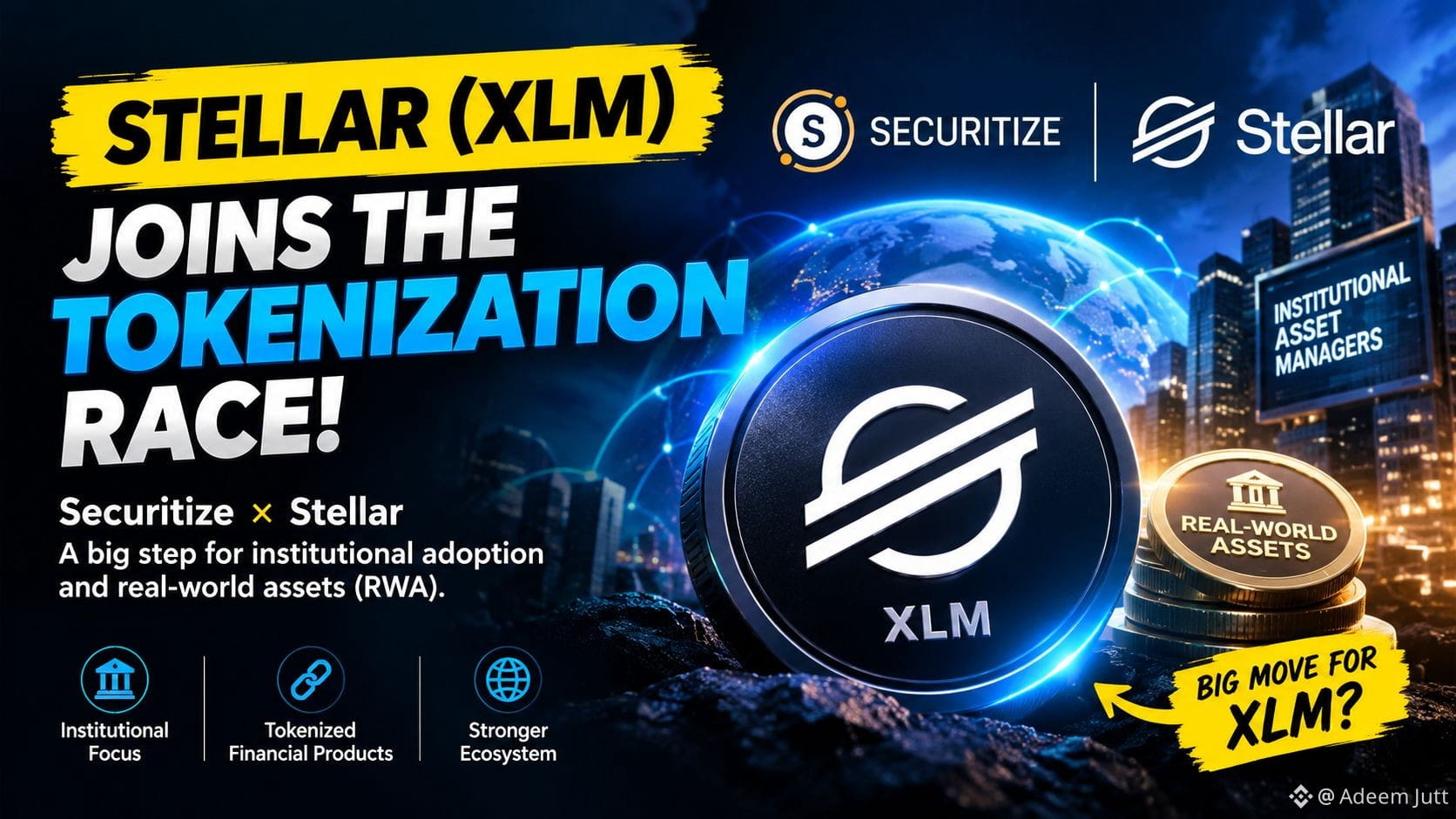
1
1
74

·
--
Verified
Came across news that the Stellar Development Foundation (SDF) has made a strategic investment in Marketnode, an Asia-Pacific digital market infrastructure (DMI) operator whose shareholders include Euroclear, HSBC, SGX Group, and Temasek.
The key point: The funding will help bring tokenized RWAs for institutional clients in Asia-Pacific onto Stellar, connecting asset managers, issuers, distributors, and accredited investors through a unified suite of issuance, distribution, and lifecycle services. The two already have a partnership: Marketnode plans to provide on-chain access on Stellar to some BNY Investments funds, and is also distributing tokenized products from CGS, Franklin Templeton, Maybank AM, WisdomTree, and others.
As Asia-Pacific institutions move from pilots toward commercial adoption, infrastructure is laying the groundwork by expanding distribution networks first—a solid step.
#Stellar #RWA #Marketnode #Tokenization
Came across news that the Stellar Development Foundation (SDF) has made a strategic investment in Marketnode, an Asia-Pacific digital market infrastructure (DMI) operator whose shareholders include Euroclear, HSBC, SGX Group, and Temasek.
The key point: The funding will help bring tokenized RWAs for institutional clients in Asia-Pacific onto Stellar, connecting asset managers, issuers, distributors, and accredited investors through a unified suite of issuance, distribution, and lifecycle services. The two already have a partnership: Marketnode plans to provide on-chain access on Stellar to some BNY Investments funds, and is also distributing tokenized products from CGS, Franklin Templeton, Maybank AM, WisdomTree, and others.
As Asia-Pacific institutions move from pilots toward commercial adoption, infrastructure is laying the groundwork by expanding distribution networks first—a solid step.
#Stellar #RWA #Marketnode #Tokenization
The key point: The funding will help bring tokenized RWAs for institutional clients in Asia-Pacific onto Stellar, connecting asset managers, issuers, distributors, and accredited investors through a unified suite of issuance, distribution, and lifecycle services. The two already have a partnership: Marketnode plans to provide on-chain access on Stellar to some BNY Investments funds, and is also distributing tokenized products from CGS, Franklin Templeton, Maybank AM, WisdomTree, and others.
As Asia-Pacific institutions move from pilots toward commercial adoption, infrastructure is laying the groundwork by expanding distribution networks first—a solid step.
#Stellar #RWA #Marketnode #Tokenization
XLM-1.60%
HSBCUS+0.73%
1
170

·
--
At Stellar Meridian, the Blockdaemon CEO spoke frankly: the main challenge to institutional adoption isn’t the technology behind the chain, but how regulation defines it and whether intermediaries can serve institutional clients effectively. Technology hasn’t been the problem for a long time; the real obstacles are the regulatory framework and service providers’ capabilities. Stellar’s take is refreshingly honest: compliance is the biggest moat. If you want to attract institutions, don’t just look at the code—get the rules sorted out first.
$XLM #Stellar #CryptoRegulation
At Stellar Meridian, the Blockdaemon CEO spoke frankly: the main challenge to institutional adoption isn’t the technology behind the chain, but how regulation defines it and whether intermediaries can serve institutional clients effectively. Technology hasn’t been the problem for a long time; the real obstacles are the regulatory framework and service providers’ capabilities. Stellar’s take is refreshingly honest: compliance is the biggest moat. If you want to attract institutions, don’t just look at the code—get the rules sorted out first.
$XLM #Stellar #CryptoRegulation
$XLM #Stellar #CryptoRegulation
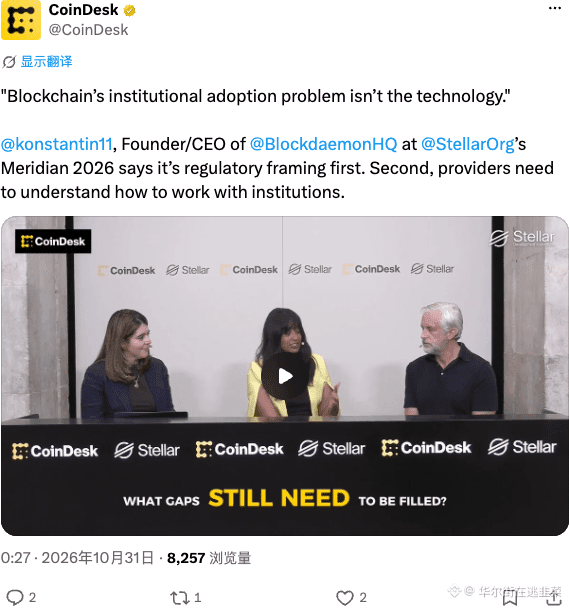
29

·
--
MetaMask made Stellar the default network at yesterday’s Meridian meeting in Lisbon: it’s now live on mobile and the extension, and existing accounts can derive Stellar addresses directly from their recovery phrases. The company says it’s the first major self-custody wallet to offer default access to Stellar, enabling users to send and receive XLM, trustline assets, and Soroban tokens. StellarOrg said this is roughly equivalent to giving 30 million users an address. XLM is trading at around $0.160 on CoinGecko (snapshot at approximately 10:07 Beijing time), down about 4% over 24 hours.
The payment entry point has moved: previously, users had to open a separate Stellar wallet; now Stellar assets sit alongside those on other chains in the same interface. Don’t mistake addresses being automatically created for transfer volume having already picked up; an address is just the first step—actual transfers are what count.
Set a two-week observation window: if verifiable official figures for active Stellar addresses or on-chain payment volume don’t follow, treat this as a channel-launch pulse, not proof that payment use cases are up and running.
$XLM
#Stellar #MetaMask
MetaMask made Stellar the default network at yesterday’s Meridian meeting in Lisbon: it’s now live on mobile and the extension, and existing accounts can derive Stellar addresses directly from their recovery phrases. The company says it’s the first major self-custody wallet to offer default access to Stellar, enabling users to send and receive XLM, trustline assets, and Soroban tokens. StellarOrg said this is roughly equivalent to giving 30 million users an address. XLM is trading at around $0.160 on CoinGecko (snapshot at approximately 10:07 Beijing time), down about 4% over 24 hours.
The payment entry point has moved: previously, users had to open a separate Stellar wallet; now Stellar assets sit alongside those on other chains in the same interface. Don’t mistake addresses being automatically created for transfer volume having already picked up; an address is just the first step—actual transfers are what count.
Set a two-week observation window: if verifiable official figures for active Stellar addresses or on-chain payment volume don’t follow, treat this as a channel-launch pulse, not proof that payment use cases are up and running.
$XLM
#Stellar #MetaMask
The payment entry point has moved: previously, users had to open a separate Stellar wallet; now Stellar assets sit alongside those on other chains in the same interface. Don’t mistake addresses being automatically created for transfer volume having already picked up; an address is just the first step—actual transfers are what count.
Set a two-week observation window: if verifiable official figures for active Stellar addresses or on-chain payment volume don’t follow, treat this as a channel-launch pulse, not proof that payment use cases are up and running.
$XLM
#Stellar #MetaMask
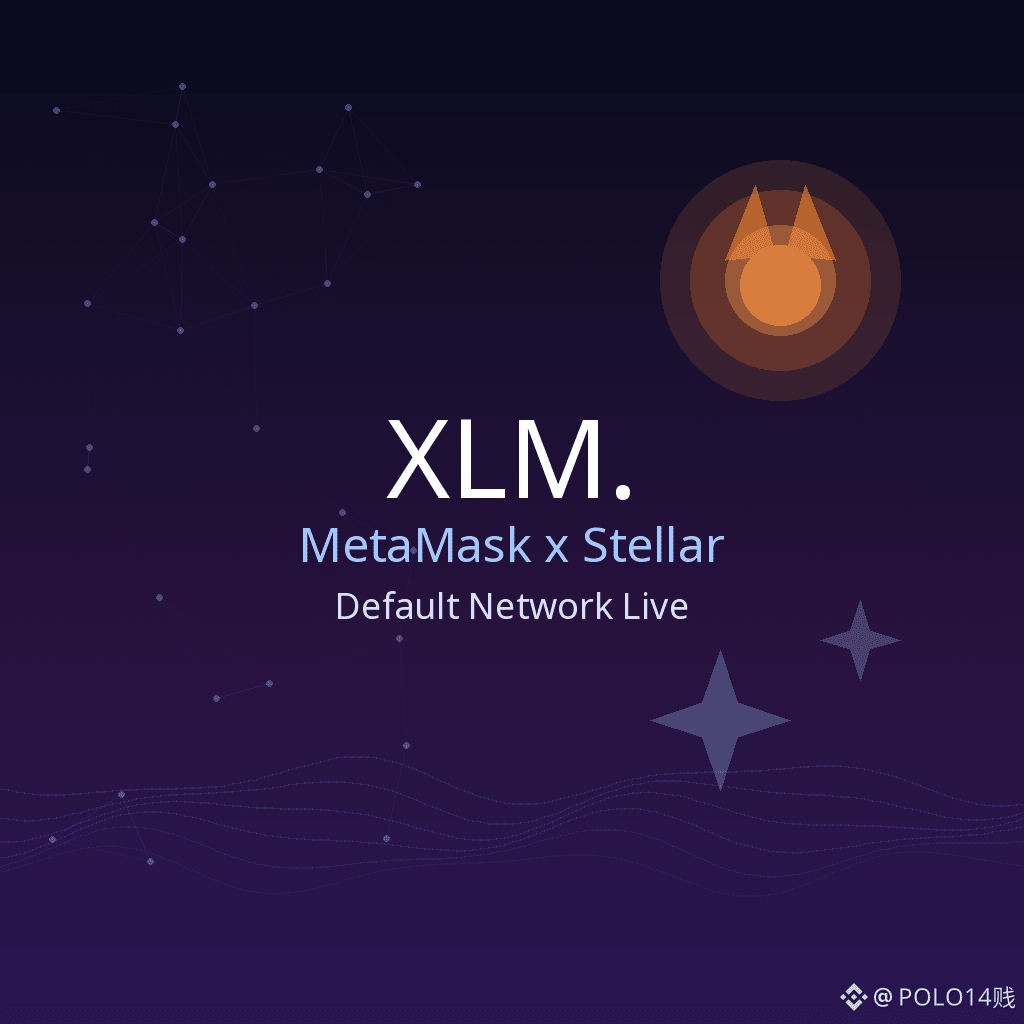
137
Log in to explore more content
Join global crypto users on Binance Square
⚡️ Get latest and useful information about crypto.
💬 Trusted by the world’s largest crypto exchange.
👍 Discover real insights from verified creators.
Email / Phone number
Trending Topics
1
#BinanceWithdrawalScamWarning
9,775 views
354 Discussing
2
#USMidtermElections
558,110 views
2,918 Discussing
3
#USOctoberNFP-AreRateCutsStillPossible
19,868 views
371 Discussing
4
#AppleEarningsAhead-CanStockHitNewHigh
6,489 views
270 Discussing
5
#Verify1to1BinanceReserves
19,371 views
298 Discussing
6
#BinanceRestores28FiatWithdrawals
96,642 views
931 Discussing
7
#StrategyRepurchases$208MSTRCAdds811Bitcoin
2,787 views
13 Discussing
8
#FATFLaunchesReviewOfCryptoHubsMoneyLaunderingControls
462 views
9 Discussing
9
#BinanceProcesses$4.65BWithdrawals
96,645 views
355 Discussing
10
#HKMALaunchesSAGEAgenticFinanceProject
2,562 views
146 Discussing