
#stablecoinmarketshrinksatfastestpacesinceterraluna
stablecoinmarketshrinksatfastestpacesinceterraluna
Hot
Latest

·
--
Article
💵📉 Stablecoin Market Shrinks at Its Fastest Pace Since Terra-Luna: Should Crypto Investors Worry?#CypherpunkReports$306MQ3NetProfit
Stablecoins are the cash of the crypto world, so when their supply falls, traders pay attention. 👀 The market has just posted its sharpest contraction since the **Terra-Luna collapse of 2022**. 🚨 This guide explains what the data shows, what it does and doesn't mean, and what to watch next. 🧠
## 📊 What the Numbers Say
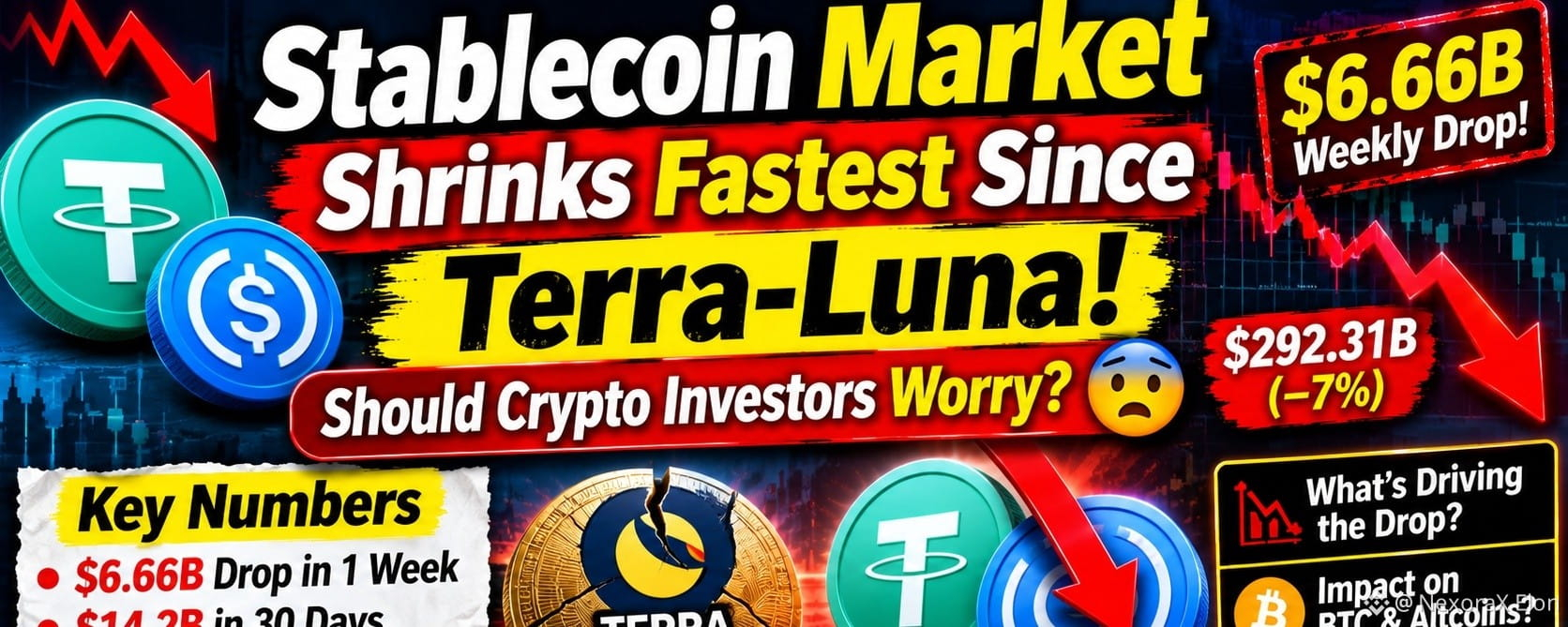
- 📆 **Biggest weekly drop of 2026:** Stablecoin supply fell **$6.66 billion** in the seven days to November 7, to about **$292.31 billion**, according to DefiLlama data. Some reports call it the deepest weekly drop since the week UST collapsed in May 2022. 😮
- 🗓️ **30-day contraction:** Glassnode reported that supply fell **$14.2 billion** over the 30 days to November 10, the largest monthly decline since June 2022.
- 🏔️ **From the peak:** Supply reached about **$315.5 billion on May 17, 2026**. It has since fallen by roughly **$21–23 billion, or about 7%**.
- 🪙 **USDT and USDC lead the drop:** In the week to November 7, USDT fell about **$3.1 billion** to around $177 billion, and USDC fell about **$1.3 billion** to around $70.6 billion. Together they make up roughly 85–88% of the market. 🏦
## ✅ Both Major Coins Kept Their Peg
This is not a Terra-style panic. 🛡️ Neither USDT nor USDC lost its dollar peg. On November 8, USDT traded at about $0.9989 and USDC at about $0.9995. 💵 The shrinkage comes from **redemptions** (people cashing out), not from a failure of the coins. 💡
## 🆚 How Does It Compare With 2022?
The headline is accurate on **pace**, but **not on scale**. ⚖️
- 🌋 **2022:** Terra-Luna, FTX, Celsius and BlockFi wiped out about **26%** of the stablecoin market (roughly $166B down to $122B). The TerraUSD collapse alone erased about $18B.
- 📉 **June 2022** saw a 30-day stablecoin supply drop of nearly **$30 billion**.
- 📉 **Today:** The decline is about **7%** from the peak. It is large, but far smaller than the 2022 crash. 🙌
So "fastest since Terra" is true for some recent measures, but there is no sign of a systemic collapse. 🧩
## 🔎 Why Is Supply Falling?
Analysts point to several factors: 🕵️
1. 💸 **Cash leaving crypto.** Santiment notes that a falling stablecoin market cap suggests many investors are cashing out to fiat instead of preparing to buy dips.
2. 📉 **A weak Bitcoin market.** BTC is trading around $64,000–$65,000, so traders have less appetite to keep dry powder on exchanges.
3. 🏛️ **Regulation.** Earlier reporting linked the 2026 decline partly to MiCA enforcement and regulatory pressure in some markets.
4. 🔄 **Competition and rotation.** Newer regulated stablecoins such as USDG and Open USD (backed by firms including Visa, Stripe, Mastercard and BlackRock, launched June 30) are taking some share from the USDT and USDC duopoly.
5. 🧾 **Reduced on-chain liquidity** as the market cools.
## 🤔 Why Does It Matter for Bitcoin and Altcoins?
Stablecoins are the **fuel** for crypto trading. ⛽ When supply grows, there is more buying power ready to enter the market. When it shrinks, there is less. Analysts flagged that shrinking supply could mean **less buying power for a rebound**. 📉
Shrinking supply can also hurt DeFi. 🏗️ Lending slows, yields can fall, and protocol activity can drop, which weakens recovery momentum.
## 🐂 The Optimistic Case
Not everyone is alarmed. 🌈
- 📈 **Transaction volume stayed strong.** Adjusted stablecoin transaction volume hit a record **$1.79 trillion in June 2026**, even as market cap fell. The "pipes" are working harder than ever.
- 🌍 **Long-term growth trend.** One analyst called an earlier decline "a relatively small pullback in a long-term growth market."
- 🔁 **Supply rotation.** Some funds are moving to newer stablecoins, so not all supply is simply disappearing.
## 🐻 The Cautious Case
- 🔻 The contraction is **accelerating**, with early November the steepest stretch of the year.
- 💔 **Capital leaving** can mean fewer buyers when prices fall.
- 🏦 **High concentration risk:** USDT holds roughly 63% of supply and USDC about 25%, so large moves in those two shape the whole market.
## 🔭 What to Watch Next
- 📈 **A reading above $300 billion** would end the current 10-day decline, according to DefiLlama-based reporting.
- 📉 **A reading below $291.68 billion** would set a new 2026 low. 🔻
- 🪙 **USDT and USDC redemptions** in the coming weeks.
- 🏛️ **Regulatory news** in the US and Europe.
- 📊 **Bitcoin's price action**, since stablecoin flows and BTC often move together. 🔗
## 🛡️ Smart Tips for Investors
1. 🧠 **Watch the trend, not one number.** A single weekly drop doesn't define a bear market.
2. 🪙 **Spread your stablecoin risk** across more than one reputable issuer and avoid keeping everything in one place.
3. 🔐 **Prefer self-custody or trusted platforms** for large balances, and understand how each coin is backed.
4. ⚖️ **Manage leverage carefully** in a fragile market.
5. 📰 **Verify claims.** Dramatic headlines can mix up pace and scale. Check the data on DefiLlama, Glassnode or similar trackers.
## 🎯 Final Thoughts
The stablecoin market is shrinking at a pace not seen since 2022, and that is a real warning sign for crypto liquidity. 🚨 But there is **no depeg, no collapse and no Terra-style crisis**, and the current drop is about 7% from the peak, not 26%. 🌤️ The real question is whether cash is merely resting on the sidelines or leaving the market for good. Stay informed, stay diversified and avoid panic decisions. 💪📊
*⚠️
#XRPFallsTo$0.89LowestSinceNovember2024 #BitcoinExtendsLosingStreakToSixWeeks #StablecoinMarketShrinksAtFastestPaceSinceTerraLuna #OPTIMJACKAttackInfectsAtLeast186Websites
**:** #Stablecoins #USDT #USDC #CryptoMarket #TerraLuna
*
💵📉 Stablecoin Market Shrinks at Its Fastest Pace Since Terra-Luna: Should Crypto Investors Worry?
#CypherpunkReports$306MQ3NetProfit
Stablecoins are the cash of the crypto world, so when their supply falls, traders pay attention. 👀 The market has just posted its sharpest contraction since the **Terra-Luna collapse of 2022**. 🚨 This guide explains what the data shows, what it does and doesn't mean, and what to watch next. 🧠
## 📊 What the Numbers Say
- 📆 **Biggest weekly drop of 2026:** Stablecoin supply fell **$6.66 billion** in the seven days to November 7, to about **$292.31 billion**, according to DefiLlama data. Some reports call it the deepest weekly drop since the week UST collapsed in May 2022. 😮
- 🗓️ **30-day contraction:** Glassnode reported that supply fell **$14.2 billion** over the 30 days to November 10, the largest monthly decline since June 2022.
- 🏔️ **From the peak:** Supply reached about **$315.5 billion on May 17, 2026**. It has since fallen by roughly **$21–23 billion, or about 7%**.
- 🪙 **USDT and USDC lead the drop:** In the week to November 7, USDT fell about **$3.1 billion** to around $177 billion, and USDC fell about **$1.3 billion** to around $70.6 billion. Together they make up roughly 85–88% of the market. 🏦
## ✅ Both Major Coins Kept Their Peg
This is not a Terra-style panic. 🛡️ Neither USDT nor USDC lost its dollar peg. On November 8, USDT traded at about $0.9989 and USDC at about $0.9995. 💵 The shrinkage comes from **redemptions** (people cashing out), not from a failure of the coins. 💡
## 🆚 How Does It Compare With 2022?
The headline is accurate on **pace**, but **not on scale**. ⚖️
- 🌋 **2022:** Terra-Luna, FTX, Celsius and BlockFi wiped out about **26%** of the stablecoin market (roughly $166B down to $122B). The TerraUSD collapse alone erased about $18B.
- 📉 **June 2022** saw a 30-day stablecoin supply drop of nearly **$30 billion**.
- 📉 **Today:** The decline is about **7%** from the peak. It is large, but far smaller than the 2022 crash. 🙌
So "fastest since Terra" is true for some recent measures, but there is no sign of a systemic collapse. 🧩
## 🔎 Why Is Supply Falling?
Analysts point to several factors: 🕵️
1. 💸 **Cash leaving crypto.** Santiment notes that a falling stablecoin market cap suggests many investors are cashing out to fiat instead of preparing to buy dips.
2. 📉 **A weak Bitcoin market.** BTC is trading around $64,000–$65,000, so traders have less appetite to keep dry powder on exchanges.
3. 🏛️ **Regulation.** Earlier reporting linked the 2026 decline partly to MiCA enforcement and regulatory pressure in some markets.
4. 🔄 **Competition and rotation.** Newer regulated stablecoins such as USDG and Open USD (backed by firms including Visa, Stripe, Mastercard and BlackRock, launched June 30) are taking some share from the USDT and USDC duopoly.
5. 🧾 **Reduced on-chain liquidity** as the market cools.
## 🤔 Why Does It Matter for Bitcoin and Altcoins?
Stablecoins are the **fuel** for crypto trading. ⛽ When supply grows, there is more buying power ready to enter the market. When it shrinks, there is less. Analysts flagged that shrinking supply could mean **less buying power for a rebound**. 📉
Shrinking supply can also hurt DeFi. 🏗️ Lending slows, yields can fall, and protocol activity can drop, which weakens recovery momentum.
## 🐂 The Optimistic Case
Not everyone is alarmed. 🌈
- 📈 **Transaction volume stayed strong.** Adjusted stablecoin transaction volume hit a record **$1.79 trillion in June 2026**, even as market cap fell. The "pipes" are working harder than ever.
- 🌍 **Long-term growth trend.** One analyst called an earlier decline "a relatively small pullback in a long-term growth market."
- 🔁 **Supply rotation.** Some funds are moving to newer stablecoins, so not all supply is simply disappearing.
## 🐻 The Cautious Case
- 🔻 The contraction is **accelerating**, with early November the steepest stretch of the year.
- 💔 **Capital leaving** can mean fewer buyers when prices fall.
- 🏦 **High concentration risk:** USDT holds roughly 63% of supply and USDC about 25%, so large moves in those two shape the whole market.
## 🔭 What to Watch Next
- 📈 **A reading above $300 billion** would end the current 10-day decline, according to DefiLlama-based reporting.
- 📉 **A reading below $291.68 billion** would set a new 2026 low. 🔻
- 🪙 **USDT and USDC redemptions** in the coming weeks.
- 🏛️ **Regulatory news** in the US and Europe.
- 📊 **Bitcoin's price action**, since stablecoin flows and BTC often move together. 🔗
## 🛡️ Smart Tips for Investors
1. 🧠 **Watch the trend, not one number.** A single weekly drop doesn't define a bear market.
2. 🪙 **Spread your stablecoin risk** across more than one reputable issuer and avoid keeping everything in one place.
3. 🔐 **Prefer self-custody or trusted platforms** for large balances, and understand how each coin is backed.
4. ⚖️ **Manage leverage carefully** in a fragile market.
5. 📰 **Verify claims.** Dramatic headlines can mix up pace and scale. Check the data on DefiLlama, Glassnode or similar trackers.
## 🎯 Final Thoughts
The stablecoin market is shrinking at a pace not seen since 2022, and that is a real warning sign for crypto liquidity. 🚨 But there is **no depeg, no collapse and no Terra-style crisis**, and the current drop is about 7% from the peak, not 26%. 🌤️ The real question is whether cash is merely resting on the sidelines or leaving the market for good. Stay informed, stay diversified and avoid panic decisions. 💪📊
*⚠️
#XRPFallsTo$0.89LowestSinceNovember2024 #BitcoinExtendsLosingStreakToSixWeeks #StablecoinMarketShrinksAtFastestPaceSinceTerraLuna #OPTIMJACKAttackInfectsAtLeast186Websites
**:** #Stablecoins #USDT #USDC #CryptoMarket #TerraLuna
*
Stablecoins are the cash of the crypto world, so when their supply falls, traders pay attention. 👀 The market has just posted its sharpest contraction since the **Terra-Luna collapse of 2022**. 🚨 This guide explains what the data shows, what it does and doesn't mean, and what to watch next. 🧠
## 📊 What the Numbers Say
- 📆 **Biggest weekly drop of 2026:** Stablecoin supply fell **$6.66 billion** in the seven days to November 7, to about **$292.31 billion**, according to DefiLlama data. Some reports call it the deepest weekly drop since the week UST collapsed in May 2022. 😮
- 🗓️ **30-day contraction:** Glassnode reported that supply fell **$14.2 billion** over the 30 days to November 10, the largest monthly decline since June 2022.
- 🏔️ **From the peak:** Supply reached about **$315.5 billion on May 17, 2026**. It has since fallen by roughly **$21–23 billion, or about 7%**.
- 🪙 **USDT and USDC lead the drop:** In the week to November 7, USDT fell about **$3.1 billion** to around $177 billion, and USDC fell about **$1.3 billion** to around $70.6 billion. Together they make up roughly 85–88% of the market. 🏦
## ✅ Both Major Coins Kept Their Peg
This is not a Terra-style panic. 🛡️ Neither USDT nor USDC lost its dollar peg. On November 8, USDT traded at about $0.9989 and USDC at about $0.9995. 💵 The shrinkage comes from **redemptions** (people cashing out), not from a failure of the coins. 💡
## 🆚 How Does It Compare With 2022?
The headline is accurate on **pace**, but **not on scale**. ⚖️
- 🌋 **2022:** Terra-Luna, FTX, Celsius and BlockFi wiped out about **26%** of the stablecoin market (roughly $166B down to $122B). The TerraUSD collapse alone erased about $18B.
- 📉 **June 2022** saw a 30-day stablecoin supply drop of nearly **$30 billion**.
- 📉 **Today:** The decline is about **7%** from the peak. It is large, but far smaller than the 2022 crash. 🙌
So "fastest since Terra" is true for some recent measures, but there is no sign of a systemic collapse. 🧩
## 🔎 Why Is Supply Falling?
Analysts point to several factors: 🕵️
1. 💸 **Cash leaving crypto.** Santiment notes that a falling stablecoin market cap suggests many investors are cashing out to fiat instead of preparing to buy dips.
2. 📉 **A weak Bitcoin market.** BTC is trading around $64,000–$65,000, so traders have less appetite to keep dry powder on exchanges.
3. 🏛️ **Regulation.** Earlier reporting linked the 2026 decline partly to MiCA enforcement and regulatory pressure in some markets.
4. 🔄 **Competition and rotation.** Newer regulated stablecoins such as USDG and Open USD (backed by firms including Visa, Stripe, Mastercard and BlackRock, launched June 30) are taking some share from the USDT and USDC duopoly.
5. 🧾 **Reduced on-chain liquidity** as the market cools.
## 🤔 Why Does It Matter for Bitcoin and Altcoins?
Stablecoins are the **fuel** for crypto trading. ⛽ When supply grows, there is more buying power ready to enter the market. When it shrinks, there is less. Analysts flagged that shrinking supply could mean **less buying power for a rebound**. 📉
Shrinking supply can also hurt DeFi. 🏗️ Lending slows, yields can fall, and protocol activity can drop, which weakens recovery momentum.
## 🐂 The Optimistic Case
Not everyone is alarmed. 🌈
- 📈 **Transaction volume stayed strong.** Adjusted stablecoin transaction volume hit a record **$1.79 trillion in June 2026**, even as market cap fell. The "pipes" are working harder than ever.
- 🌍 **Long-term growth trend.** One analyst called an earlier decline "a relatively small pullback in a long-term growth market."
- 🔁 **Supply rotation.** Some funds are moving to newer stablecoins, so not all supply is simply disappearing.
## 🐻 The Cautious Case
- 🔻 The contraction is **accelerating**, with early November the steepest stretch of the year.
- 💔 **Capital leaving** can mean fewer buyers when prices fall.
- 🏦 **High concentration risk:** USDT holds roughly 63% of supply and USDC about 25%, so large moves in those two shape the whole market.
## 🔭 What to Watch Next
- 📈 **A reading above $300 billion** would end the current 10-day decline, according to DefiLlama-based reporting.
- 📉 **A reading below $291.68 billion** would set a new 2026 low. 🔻
- 🪙 **USDT and USDC redemptions** in the coming weeks.
- 🏛️ **Regulatory news** in the US and Europe.
- 📊 **Bitcoin's price action**, since stablecoin flows and BTC often move together. 🔗
## 🛡️ Smart Tips for Investors
1. 🧠 **Watch the trend, not one number.** A single weekly drop doesn't define a bear market.
2. 🪙 **Spread your stablecoin risk** across more than one reputable issuer and avoid keeping everything in one place.
3. 🔐 **Prefer self-custody or trusted platforms** for large balances, and understand how each coin is backed.
4. ⚖️ **Manage leverage carefully** in a fragile market.
5. 📰 **Verify claims.** Dramatic headlines can mix up pace and scale. Check the data on DefiLlama, Glassnode or similar trackers.
## 🎯 Final Thoughts
The stablecoin market is shrinking at a pace not seen since 2022, and that is a real warning sign for crypto liquidity. 🚨 But there is **no depeg, no collapse and no Terra-style crisis**, and the current drop is about 7% from the peak, not 26%. 🌤️ The real question is whether cash is merely resting on the sidelines or leaving the market for good. Stay informed, stay diversified and avoid panic decisions. 💪📊
*⚠️
#XRPFallsTo$0.89LowestSinceNovember2024 #BitcoinExtendsLosingStreakToSixWeeks #StablecoinMarketShrinksAtFastestPaceSinceTerraLuna #OPTIMJACKAttackInfectsAtLeast186Websites
**:** #Stablecoins #USDT #USDC #CryptoMarket #TerraLuna
*
25

·
--
Bearish
#stablecoinmarketshrinksatfastestpacesinceterraluna
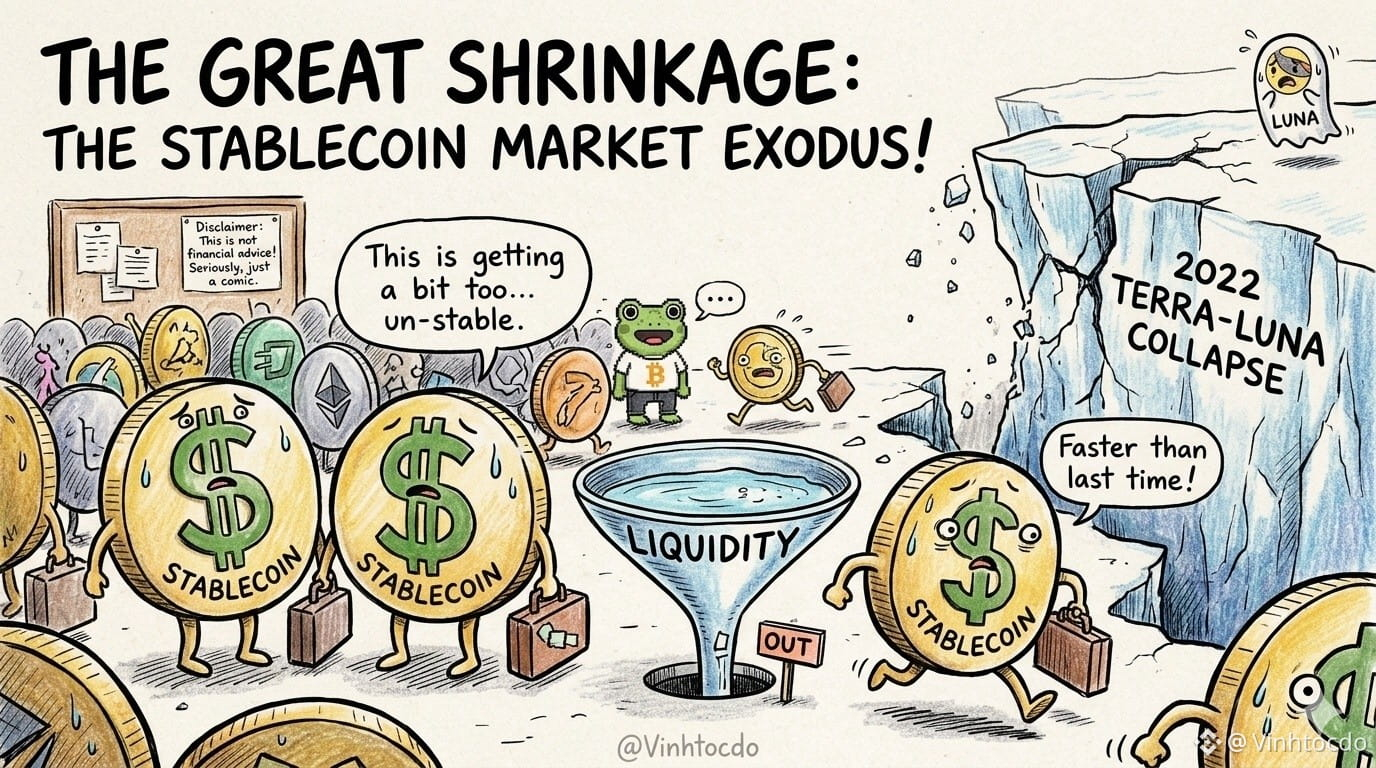
🚨 RUNNING OUT OF STEAM LIKE DURING TERRA-LUNA? 🚨
The stablecoin market has just "evaporated" at its fastest pace since the 2022 crash! Instead of seeking shelter in USDT or USDC as before, money is quietly flowing out of the market altogether.
Why? Attractive traditional interest rates, combined with profit-taking pressure, are prompting the "whales" to swap coins for cash and put it in savings accounts for a safer return.
What should traders do now? Don’t FOMO into blindly buying the dip! Manage your capital carefully, prioritize liquidity in top coins, and patiently wait for money to flow back in.
⚠️ This is not financial advice.
👇 Click below to trade and support me:
$BTC
{spot}(BTCUSDT)
$ETH
{spot}(ETHUSDT)
$EVAA
{future}(EVAAUSDT)
#CryptoMarket #Stablecoins #TradingTips #BinanceSquare #RiskManagement #VINHTOCDO
#stablecoinmarketshrinksatfastestpacesinceterraluna
🚨 RUNNING OUT OF STEAM LIKE DURING TERRA-LUNA? 🚨
The stablecoin market has just "evaporated" at its fastest pace since the 2022 crash! Instead of seeking shelter in USDT or USDC as before, money is quietly flowing out of the market altogether.
Why? Attractive traditional interest rates, combined with profit-taking pressure, are prompting the "whales" to swap coins for cash and put it in savings accounts for a safer return.
What should traders do now? Don’t FOMO into blindly buying the dip! Manage your capital carefully, prioritize liquidity in top coins, and patiently wait for money to flow back in.
⚠️ This is not financial advice.
👇 Click below to trade and support me:
$BTC
$ETH
$EVAA
#CryptoMarket #Stablecoins #TradingTips #BinanceSquare #RiskManagement #VINHTOCDO
🚨 RUNNING OUT OF STEAM LIKE DURING TERRA-LUNA? 🚨
The stablecoin market has just "evaporated" at its fastest pace since the 2022 crash! Instead of seeking shelter in USDT or USDC as before, money is quietly flowing out of the market altogether.
Why? Attractive traditional interest rates, combined with profit-taking pressure, are prompting the "whales" to swap coins for cash and put it in savings accounts for a safer return.
What should traders do now? Don’t FOMO into blindly buying the dip! Manage your capital carefully, prioritize liquidity in top coins, and patiently wait for money to flow back in.
⚠️ This is not financial advice.
👇 Click below to trade and support me:
$BTC
$ETH
$EVAA
#CryptoMarket #Stablecoins #TradingTips #BinanceSquare #RiskManagement #VINHTOCDO
3
1.2k

·
--
Bullish
$HUMA IS EXPLODING! BULLS ARE TAKING OVER! 🔥
HUMA is stealing the spotlight with an impressive 45.98% surge, pushing its price to $0.00927!
Buyers are showing serious strength, and the momentum is getting difficult to ignore. If bulls maintain control and break through the next resistance zone, another explosive move could be on the table.
🎯 Key Levels:
- Support 1: $0.00850
- Strong Support: $0.00800
- Resistance 1: $0.00980
- Major Resistance: $0.01080
- Next Target: $0.01150–$0.01350
🔥 A confirmed breakout above $0.01080 could open the door to another powerful rally.
Watch the volume, protect your capital, and don't chase green candles blindly.
HUMA is on the radar!
{spot}(HUMAUSDT)
#AnthropicIPOTestsInvestorAppetiteForAI #NvidiaBoardNotConsideringHuang’sReturnasCEO #OPTIMJACKAttackInfectsAtLeast186Websites #StablecoinMarketShrinksAtFastestPaceSinceTerraLuna #BitcoinExtendsLosingStreakToSixWeeks
$HUMA IS EXPLODING! BULLS ARE TAKING OVER! 🔥
HUMA is stealing the spotlight with an impressive 45.98% surge, pushing its price to $0.00927!
Buyers are showing serious strength, and the momentum is getting difficult to ignore. If bulls maintain control and break through the next resistance zone, another explosive move could be on the table.
🎯 Key Levels:
- Support 1: $0.00850
- Strong Support: $0.00800
- Resistance 1: $0.00980
- Major Resistance: $0.01080
- Next Target: $0.01150–$0.01350
🔥 A confirmed breakout above $0.01080 could open the door to another powerful rally.
Watch the volume, protect your capital, and don't chase green candles blindly.
HUMA is on the radar!
#AnthropicIPOTestsInvestorAppetiteForAI #NvidiaBoardNotConsideringHuang’sReturnasCEO #OPTIMJACKAttackInfectsAtLeast186Websites #StablecoinMarketShrinksAtFastestPaceSinceTerraLuna #BitcoinExtendsLosingStreakToSixWeeks
HUMA is stealing the spotlight with an impressive 45.98% surge, pushing its price to $0.00927!
Buyers are showing serious strength, and the momentum is getting difficult to ignore. If bulls maintain control and break through the next resistance zone, another explosive move could be on the table.
🎯 Key Levels:
- Support 1: $0.00850
- Strong Support: $0.00800
- Resistance 1: $0.00980
- Major Resistance: $0.01080
- Next Target: $0.01150–$0.01350
🔥 A confirmed breakout above $0.01080 could open the door to another powerful rally.
Watch the volume, protect your capital, and don't chase green candles blindly.
HUMA is on the radar!
#AnthropicIPOTestsInvestorAppetiteForAI #NvidiaBoardNotConsideringHuang’sReturnasCEO #OPTIMJACKAttackInfectsAtLeast186Websites #StablecoinMarketShrinksAtFastestPaceSinceTerraLuna #BitcoinExtendsLosingStreakToSixWeeks
1
73


·
--
🚀 TOP 3 CRYPTO GAINERS – BLESS, HUMA & CROSS: WHAT'S NEXT?
Three coins are showing strong market momentum today. BLESS is leading with an 84.24% gain, followed by HUMA at 43.72% and CROSS at 29.91%. But after such sharp moves, chasing green candles can be risky. Here are my trading levels to watch.
🔥 1. BLESS/USDT
Current Price: $0.016858
Buy Zone: $0.01580–$0.01630
Target 1: $0.01750
Target 2: $0.01850
Target 3: $0.02000
Stop Loss: $0.01500
🔥 2. HUMA/USDT
Current Price: $0.009276
Buy Zone: $0.00880–$0.00905
Target 1: $0.00960
Target 2: $0.01000
Target 3: $0.01080
Stop Loss: $0.00840
🔥 3. CROSS/USDT
Current Price: $0.15060
Buy Zone: $0.14400–$0.14800
Target 1: $0.15500
Target 2: $0.16200
Target 3: $0.17200
Stop Loss: $0.13900
My Trading Strategy:
I would not rush into any of these coins after a big pump. Wait for a healthy pullback, bullish confirmation, and strong buying volume. Take profits step by step and respect your stop loss.
Remember, momentum creates opportunities, but risk management protects your capital. These levels are estimates, not guaranteed outcomes.#StablecoinMarketShrinksAtFastestPaceSinceTerraLuna #InvescoStablecoinReservesFundLaunchesOnEthereum #NvidiaBoardNotConsideringHuang’sReturnasCEO #AnthropicIPOTestsInvestorAppetiteForAI $BLESS
{future}(BLESSUSDT)
$HUMA
{spot}(HUMAUSDT)
$CROSS
{future}(CROSSUSDT)
🚀 TOP 3 CRYPTO GAINERS – BLESS, HUMA & CROSS: WHAT'S NEXT?
Three coins are showing strong market momentum today. BLESS is leading with an 84.24% gain, followed by HUMA at 43.72% and CROSS at 29.91%. But after such sharp moves, chasing green candles can be risky. Here are my trading levels to watch.
🔥 1. BLESS/USDT
Current Price: $0.016858
Buy Zone: $0.01580–$0.01630
Target 1: $0.01750
Target 2: $0.01850
Target 3: $0.02000
Stop Loss: $0.01500
🔥 2. HUMA/USDT
Current Price: $0.009276
Buy Zone: $0.00880–$0.00905
Target 1: $0.00960
Target 2: $0.01000
Target 3: $0.01080
Stop Loss: $0.00840
🔥 3. CROSS/USDT
Current Price: $0.15060
Buy Zone: $0.14400–$0.14800
Target 1: $0.15500
Target 2: $0.16200
Target 3: $0.17200
Stop Loss: $0.13900
My Trading Strategy:
I would not rush into any of these coins after a big pump. Wait for a healthy pullback, bullish confirmation, and strong buying volume. Take profits step by step and respect your stop loss.
Remember, momentum creates opportunities, but risk management protects your capital. These levels are estimates, not guaranteed outcomes.#StablecoinMarketShrinksAtFastestPaceSinceTerraLuna #InvescoStablecoinReservesFundLaunchesOnEthereum #NvidiaBoardNotConsideringHuang’sReturnasCEO #AnthropicIPOTestsInvestorAppetiteForAI $BLESS
$HUMA
$CROSS
Three coins are showing strong market momentum today. BLESS is leading with an 84.24% gain, followed by HUMA at 43.72% and CROSS at 29.91%. But after such sharp moves, chasing green candles can be risky. Here are my trading levels to watch.
🔥 1. BLESS/USDT
Current Price: $0.016858
Buy Zone: $0.01580–$0.01630
Target 1: $0.01750
Target 2: $0.01850
Target 3: $0.02000
Stop Loss: $0.01500
🔥 2. HUMA/USDT
Current Price: $0.009276
Buy Zone: $0.00880–$0.00905
Target 1: $0.00960
Target 2: $0.01000
Target 3: $0.01080
Stop Loss: $0.00840
🔥 3. CROSS/USDT
Current Price: $0.15060
Buy Zone: $0.14400–$0.14800
Target 1: $0.15500
Target 2: $0.16200
Target 3: $0.17200
Stop Loss: $0.13900
My Trading Strategy:
I would not rush into any of these coins after a big pump. Wait for a healthy pullback, bullish confirmation, and strong buying volume. Take profits step by step and respect your stop loss.
Remember, momentum creates opportunities, but risk management protects your capital. These levels are estimates, not guaranteed outcomes.#StablecoinMarketShrinksAtFastestPaceSinceTerraLuna #InvescoStablecoinReservesFundLaunchesOnEthereum #NvidiaBoardNotConsideringHuang’sReturnasCEO #AnthropicIPOTestsInvestorAppetiteForAI $BLESS
$HUMA
$CROSS
BLESS💪🕺💙🪻
HUMA🌹🪻💝
CROSS🌹🪻💙
23 hr(s) left
289

·
--
Bullish
$HUMA WAKES UP! Bulls Are Taking Control! HUMAUSDT is showing impressive strength with a +43.82% gain, trading around 0.009236. The strong upward move puts this token on the momentum watchlist, but buyers must defend the latest gains to keep the bullish structure alive. Support: Exact support requires chart confirmation. Resistance: Watch the recent high and next rejection zone. 🎯 Targets: Next upside targets should be mapped using confirmed resistance levels. Next Move: Holding the current momentum could open the door for another bullish leg, while weakness may invite a retracement. Pro Tip: Watch for a successful retest instead of entering after an extended pump.
#BitcoinExtendsLosingStreakToSixWeeks #StablecoinMarketShrinksAtFastestPaceSinceTerraLuna #WhatInvestmentSignalsDo13FFilingsReveal?
{spot}(HUMAUSDT)
$HUMA WAKES UP! Bulls Are Taking Control! HUMAUSDT is showing impressive strength with a +43.82% gain, trading around 0.009236. The strong upward move puts this token on the momentum watchlist, but buyers must defend the latest gains to keep the bullish structure alive. Support: Exact support requires chart confirmation. Resistance: Watch the recent high and next rejection zone. 🎯 Targets: Next upside targets should be mapped using confirmed resistance levels. Next Move: Holding the current momentum could open the door for another bullish leg, while weakness may invite a retracement. Pro Tip: Watch for a successful retest instead of entering after an extended pump.
#BitcoinExtendsLosingStreakToSixWeeks #StablecoinMarketShrinksAtFastestPaceSinceTerraLuna #WhatInvestmentSignalsDo13FFilingsReveal?
#BitcoinExtendsLosingStreakToSixWeeks #StablecoinMarketShrinksAtFastestPaceSinceTerraLuna #WhatInvestmentSignalsDo13FFilingsReveal?
130

·
--
$SIREN
{alpha}(560x997a58129890bbda032231a52ed1ddc845fc18e1)
Social Media Post (X / Binance Square / Telegram)
🚨 $SIREN Market Update & Next Price Targets 🚨
$SIREN is currently consolidating around $0.026 – $0.027 after heavy volatility. While the broader crypto market sits in Extreme Fear, traders are watching key technical levels for the next breakout or breakdown. [1, 2, 3, 4]
📊 Key Levels to Watch:
🟢 Immediate Resistance (Upside Targets): $0.0278 – $0.0285
A clean break and hold above the 50-day moving average opens the door toward $0.0350. [1, 2]
🔴 Key Support (Downside Risk): $0.0241 – $0.0247
Losing this zone could drag price back toward the $0.0208 – $0.0226 range. [1, 2]
⚠️ Keep in Mind:
• AI + Meme Narrative: Upcoming AI trading agent tools remain "coming soon"—actual product launches will be the real catalyst.
• High Concentration: Over 50% of the circulating supply sits in a single custody wallet, meaning whale moves can trigger sharp swings. [1, 2, 3]
#StablecoinMarketShrinksAtFastestPaceSinceTerraLuna #OPTIMJACKAttackInfectsAtLeast186Websites
$SIREN
Social Media Post (X / Binance Square / Telegram)
🚨 $SIREN Market Update & Next Price Targets 🚨
$SIREN is currently consolidating around $0.026 – $0.027 after heavy volatility. While the broader crypto market sits in Extreme Fear, traders are watching key technical levels for the next breakout or breakdown. [1, 2, 3, 4]
📊 Key Levels to Watch:
🟢 Immediate Resistance (Upside Targets): $0.0278 – $0.0285
A clean break and hold above the 50-day moving average opens the door toward $0.0350. [1, 2]
🔴 Key Support (Downside Risk): $0.0241 – $0.0247
Losing this zone could drag price back toward the $0.0208 – $0.0226 range. [1, 2]
⚠️ Keep in Mind:
• AI + Meme Narrative: Upcoming AI trading agent tools remain "coming soon"—actual product launches will be the real catalyst.
• High Concentration: Over 50% of the circulating supply sits in a single custody wallet, meaning whale moves can trigger sharp swings. [1, 2, 3]
#StablecoinMarketShrinksAtFastestPaceSinceTerraLuna #OPTIMJACKAttackInfectsAtLeast186Websites
Social Media Post (X / Binance Square / Telegram)
🚨 $SIREN Market Update & Next Price Targets 🚨
$SIREN is currently consolidating around $0.026 – $0.027 after heavy volatility. While the broader crypto market sits in Extreme Fear, traders are watching key technical levels for the next breakout or breakdown. [1, 2, 3, 4]
📊 Key Levels to Watch:
🟢 Immediate Resistance (Upside Targets): $0.0278 – $0.0285
A clean break and hold above the 50-day moving average opens the door toward $0.0350. [1, 2]
🔴 Key Support (Downside Risk): $0.0241 – $0.0247
Losing this zone could drag price back toward the $0.0208 – $0.0226 range. [1, 2]
⚠️ Keep in Mind:
• AI + Meme Narrative: Upcoming AI trading agent tools remain "coming soon"—actual product launches will be the real catalyst.
• High Concentration: Over 50% of the circulating supply sits in a single custody wallet, meaning whale moves can trigger sharp swings. [1, 2, 3]
#StablecoinMarketShrinksAtFastestPaceSinceTerraLuna #OPTIMJACKAttackInfectsAtLeast186Websites
97

·
--
Bullish
Hi, my dear friend! ❤️ I'm back after a long time. We're now building a team of 10 people who will become the Kings of the Stock Market in 2027. So, will you stand by my side on this journey?" 🚀📈 #AnthropicIPOTestsInvestorAppetiteForAI #NvidiaBoardNotConsideringHuang’sReturnasCEO #WhatInvestmentSignalsDo13FFilingsReveal? #StablecoinMarketShrinksAtFastestPaceSinceTerraLuna
Hi, my dear friend! ❤️ I'm back after a long time. We're now building a team of 10 people who will become the Kings of the Stock Market in 2027. So, will you stand by my side on this journey?" 🚀📈 #AnthropicIPOTestsInvestorAppetiteForAI #NvidiaBoardNotConsideringHuang’sReturnasCEO #WhatInvestmentSignalsDo13FFilingsReveal? #StablecoinMarketShrinksAtFastestPaceSinceTerraLuna
1
·
--

Article
🟠📉 Strategy Bought 485 BTC but Spent 7x More on Its Own Preferred Shares: Dip-Buying or Balance-.#StrategySells2.09MMSTRSharesFor$244.7M
The headline reads "Saylor buys the dip." 🗞️ The filing tells a more complicated story. Strategy (MSTR), the world's largest corporate Bitcoin holder, reportedly added **485 BTC** last week but spent far more repurchasing its own preferred stock. 💸 Here is what the numbers say, why it matters, and what to watch next. 👀
## 📊 The Numbers From the Latest Filing
According to a summary of the 8-K for **November 9–15** (cited in the post you shared), the key figures were: 🧾
- 🪙 **$33.4 million** went into **485 BTC** at an average of about **$68,887** per coin.
- 🔁 **$228.1 million** went to buying back **STRC** preferred stock, nearly **7 times** the Bitcoin spend.
- 💵 **$244.7 million** of new **MSTR** common shares were sold to fund it all.
I couldn't independently confirm these exact figures from the filing itself, so check the 8-K before publishing. ⚠️ The pattern, however, matches what Strategy reported in earlier weeks. 📉
## 🔁 This Is Not a One-Week Pattern
- 📅 **Week of Oct 26–Nov 1:** Strategy bought 811 BTC for about $65.5M but repurchased **$208.2M of STRC**, more than triple its Bitcoin spend.
- 📅 **Week of Nov 2–8:** It bought 1,036 BTC (about $82M) while spending **$188.3M on STRC** repurchases.
- 📅 **Oct 1–25:** About **$664M** went to STRC buybacks versus roughly **$72M** in Bitcoin purchases.
Strategy has also sold some Bitcoin this year. One analysis counted about 6,948 BTC sold in 2026, mainly to fund preferred dividends and STRC buybacks. 🔄 Holdings were about **850,000 BTC** as of early November. 🏦
## 🧠 What Is STRC, and Why Does It Matter?
STRC is Strategy's **variable-rate perpetual preferred stock**, designed to trade near its **$100 par value**. 💳 The company has kept the dividend at **12%** to support that price. Strategy's policy is **not to issue new STRC below $100**, so when STRC trades under par, the company can't easily raise money by selling it. 🚧 STRC was about $99.22 in early November. 📉
That makes the buybacks significant. ⚖️ By repurchasing STRC, Strategy may be:
1. 🛡️ **Defending the price** so STRC can trade near par again.
2. 🔓 **Protecting a funding channel** that has helped pay for Bitcoin purchases and dividends.
3. 💸 **Reducing outstanding preferred obligations**, which carry heavy dividend costs.
## 🏛️ The MSCI Factor
Another big pressure point: **MSCI will remove Strategy from its USA Index at the close of November 30.** 📆 MSCI reportedly classified the company as a "non-operating" issuer under a new screen, which also takes it out of the MSCI World and ACWI indexes. Metaplanet was dropped from a Japan small-cap index in the same review. 🌍
- 🧮 JPMorgan estimated that exclusion could mean about **$2.8 billion** of passive selling, and up to **$8.8 billion more** if other index providers follow. These estimates were made earlier, so the real impact may differ.
- ✅ A removal does **not** delist the stock, and nothing forces Strategy to sell Bitcoin. The pressure lands on the shares and the premium the company uses to fund purchases. 📉
## 🏢 The Wider Market Backdrop
The post also cites Lookonchain data saying public companies **net sold 11,647 BTC** in the week to November 8. I couldn't verify that figure, so treat it as unconfirmed. 🕵️ Still, other treasury firms have also slowed purchases this year. 🐢
Meanwhile, Bitcoin itself is weak. 📉 The post notes BTC near **$64,716**, down about **13.7% over 7 days**. That is below Strategy's overall average purchase price of roughly **$75,450 per BTC**, so the company's Bitcoin stack is currently showing a paper loss. 😬
## ⚖️ Two Ways to Read It
**🐂 The "dip-buying" view**
- Strategy kept buying BTC even in a falling market.
- It bought 485 BTC at roughly $68,887, and holdings keep growing.
- Supporters see this as evidence of long-term conviction. 💎
**🐻 The "balance-sheet triage" view**
- The money spent on preferred buybacks dwarfed the Bitcoin purchase.
- New common shares were sold to fund the buybacks, which dilutes common shareholders.
- With the MSCI removal approaching, the buybacks look like protecting funding more than accumulating coins. 🚑
Both views can be partly true. The company may be buying Bitcoin while also managing a tricky capital structure. 🧩
## 🔭 What Would Change the Picture?
- 📈 **STRC returning near $100 par**, so new preferred sales can fund Bitcoin again, as the post suggests.
- 🗓️ **How MSTR trades around the November 30 MSCI deadline.**
- 🧾 **Whether weekly 8-K filings show Bitcoin purchases growing** compared with buybacks.
- 🌐 **Bitcoin's price**, since a rebound would ease pressure on the whole structure.
## ⚠️ Risks to Keep in Mind
- 🔗 MSTR trades like a leveraged bet on Bitcoin, so moves can be sharp in both directions.
- 🧱 Funding relies on capital markets staying open and share prices staying healthy.
- 💥 Dividend obligations on preferred stock are a recurring cash cost.
- 🌪️ Index removals can create temporary selling pressure and lower liquidity.
## 🎯 Final Thoughts
A weekly Bitcoin purchase makes a great headline, but the real story is where the money went. 💡 The "marginal corporate buyer" may be smaller than it looks, and the company's attention appears focused on defending its funding machine as much as stacking coins. 🏗️ Whether you see dip-buying or triage, watch the filings, STRC's price, and the MSCI deadline, and don't trade on headlines alone. 🧠💪
#StablecoinMarketShrinksAtFastestPaceSinceTerraLuna #BitcoinExtendsLosingStreakToSixWeeks #XRPFallsTo$0.89LowestSinceNovember2024 #A Packed Week of Earnings and Data Tests Markets
*⚠️
**** #Strategy #MSTR #Bitcoin #MichaelSaylor #STRC
🟠📉 Strategy Bought 485 BTC but Spent 7x More on Its Own Preferred Shares: Dip-Buying or Balance-.
#StrategySells2.09MMSTRSharesFor$244.7M
The headline reads "Saylor buys the dip." 🗞️ The filing tells a more complicated story. Strategy (MSTR), the world's largest corporate Bitcoin holder, reportedly added **485 BTC** last week but spent far more repurchasing its own preferred stock. 💸 Here is what the numbers say, why it matters, and what to watch next. 👀
## 📊 The Numbers From the Latest Filing
According to a summary of the 8-K for **November 9–15** (cited in the post you shared), the key figures were: 🧾
- 🪙 **$33.4 million** went into **485 BTC** at an average of about **$68,887** per coin.
- 🔁 **$228.1 million** went to buying back **STRC** preferred stock, nearly **7 times** the Bitcoin spend.
- 💵 **$244.7 million** of new **MSTR** common shares were sold to fund it all.
I couldn't independently confirm these exact figures from the filing itself, so check the 8-K before publishing. ⚠️ The pattern, however, matches what Strategy reported in earlier weeks. 📉
## 🔁 This Is Not a One-Week Pattern
- 📅 **Week of Oct 26–Nov 1:** Strategy bought 811 BTC for about $65.5M but repurchased **$208.2M of STRC**, more than triple its Bitcoin spend.
- 📅 **Week of Nov 2–8:** It bought 1,036 BTC (about $82M) while spending **$188.3M on STRC** repurchases.
- 📅 **Oct 1–25:** About **$664M** went to STRC buybacks versus roughly **$72M** in Bitcoin purchases.
Strategy has also sold some Bitcoin this year. One analysis counted about 6,948 BTC sold in 2026, mainly to fund preferred dividends and STRC buybacks. 🔄 Holdings were about **850,000 BTC** as of early November. 🏦
## 🧠 What Is STRC, and Why Does It Matter?
STRC is Strategy's **variable-rate perpetual preferred stock**, designed to trade near its **$100 par value**. 💳 The company has kept the dividend at **12%** to support that price. Strategy's policy is **not to issue new STRC below $100**, so when STRC trades under par, the company can't easily raise money by selling it. 🚧 STRC was about $99.22 in early November. 📉
That makes the buybacks significant. ⚖️ By repurchasing STRC, Strategy may be:
1. 🛡️ **Defending the price** so STRC can trade near par again.
2. 🔓 **Protecting a funding channel** that has helped pay for Bitcoin purchases and dividends.
3. 💸 **Reducing outstanding preferred obligations**, which carry heavy dividend costs.
## 🏛️ The MSCI Factor
Another big pressure point: **MSCI will remove Strategy from its USA Index at the close of November 30.** 📆 MSCI reportedly classified the company as a "non-operating" issuer under a new screen, which also takes it out of the MSCI World and ACWI indexes. Metaplanet was dropped from a Japan small-cap index in the same review. 🌍
- 🧮 JPMorgan estimated that exclusion could mean about **$2.8 billion** of passive selling, and up to **$8.8 billion more** if other index providers follow. These estimates were made earlier, so the real impact may differ.
- ✅ A removal does **not** delist the stock, and nothing forces Strategy to sell Bitcoin. The pressure lands on the shares and the premium the company uses to fund purchases. 📉
## 🏢 The Wider Market Backdrop
The post also cites Lookonchain data saying public companies **net sold 11,647 BTC** in the week to November 8. I couldn't verify that figure, so treat it as unconfirmed. 🕵️ Still, other treasury firms have also slowed purchases this year. 🐢
Meanwhile, Bitcoin itself is weak. 📉 The post notes BTC near **$64,716**, down about **13.7% over 7 days**. That is below Strategy's overall average purchase price of roughly **$75,450 per BTC**, so the company's Bitcoin stack is currently showing a paper loss. 😬
## ⚖️ Two Ways to Read It
**🐂 The "dip-buying" view**
- Strategy kept buying BTC even in a falling market.
- It bought 485 BTC at roughly $68,887, and holdings keep growing.
- Supporters see this as evidence of long-term conviction. 💎
**🐻 The "balance-sheet triage" view**
- The money spent on preferred buybacks dwarfed the Bitcoin purchase.
- New common shares were sold to fund the buybacks, which dilutes common shareholders.
- With the MSCI removal approaching, the buybacks look like protecting funding more than accumulating coins. 🚑
Both views can be partly true. The company may be buying Bitcoin while also managing a tricky capital structure. 🧩
## 🔭 What Would Change the Picture?
- 📈 **STRC returning near $100 par**, so new preferred sales can fund Bitcoin again, as the post suggests.
- 🗓️ **How MSTR trades around the November 30 MSCI deadline.**
- 🧾 **Whether weekly 8-K filings show Bitcoin purchases growing** compared with buybacks.
- 🌐 **Bitcoin's price**, since a rebound would ease pressure on the whole structure.
## ⚠️ Risks to Keep in Mind
- 🔗 MSTR trades like a leveraged bet on Bitcoin, so moves can be sharp in both directions.
- 🧱 Funding relies on capital markets staying open and share prices staying healthy.
- 💥 Dividend obligations on preferred stock are a recurring cash cost.
- 🌪️ Index removals can create temporary selling pressure and lower liquidity.
## 🎯 Final Thoughts
A weekly Bitcoin purchase makes a great headline, but the real story is where the money went. 💡 The "marginal corporate buyer" may be smaller than it looks, and the company's attention appears focused on defending its funding machine as much as stacking coins. 🏗️ Whether you see dip-buying or triage, watch the filings, STRC's price, and the MSCI deadline, and don't trade on headlines alone. 🧠💪
#StablecoinMarketShrinksAtFastestPaceSinceTerraLuna #BitcoinExtendsLosingStreakToSixWeeks #XRPFallsTo$0.89LowestSinceNovember2024 #A Packed Week of Earnings and Data Tests Markets
*⚠️
**** #Strategy #MSTR #Bitcoin #MichaelSaylor #STRC
The headline reads "Saylor buys the dip." 🗞️ The filing tells a more complicated story. Strategy (MSTR), the world's largest corporate Bitcoin holder, reportedly added **485 BTC** last week but spent far more repurchasing its own preferred stock. 💸 Here is what the numbers say, why it matters, and what to watch next. 👀
## 📊 The Numbers From the Latest Filing
According to a summary of the 8-K for **November 9–15** (cited in the post you shared), the key figures were: 🧾
- 🪙 **$33.4 million** went into **485 BTC** at an average of about **$68,887** per coin.
- 🔁 **$228.1 million** went to buying back **STRC** preferred stock, nearly **7 times** the Bitcoin spend.
- 💵 **$244.7 million** of new **MSTR** common shares were sold to fund it all.
I couldn't independently confirm these exact figures from the filing itself, so check the 8-K before publishing. ⚠️ The pattern, however, matches what Strategy reported in earlier weeks. 📉
## 🔁 This Is Not a One-Week Pattern
- 📅 **Week of Oct 26–Nov 1:** Strategy bought 811 BTC for about $65.5M but repurchased **$208.2M of STRC**, more than triple its Bitcoin spend.
- 📅 **Week of Nov 2–8:** It bought 1,036 BTC (about $82M) while spending **$188.3M on STRC** repurchases.
- 📅 **Oct 1–25:** About **$664M** went to STRC buybacks versus roughly **$72M** in Bitcoin purchases.
Strategy has also sold some Bitcoin this year. One analysis counted about 6,948 BTC sold in 2026, mainly to fund preferred dividends and STRC buybacks. 🔄 Holdings were about **850,000 BTC** as of early November. 🏦
## 🧠 What Is STRC, and Why Does It Matter?
STRC is Strategy's **variable-rate perpetual preferred stock**, designed to trade near its **$100 par value**. 💳 The company has kept the dividend at **12%** to support that price. Strategy's policy is **not to issue new STRC below $100**, so when STRC trades under par, the company can't easily raise money by selling it. 🚧 STRC was about $99.22 in early November. 📉
That makes the buybacks significant. ⚖️ By repurchasing STRC, Strategy may be:
1. 🛡️ **Defending the price** so STRC can trade near par again.
2. 🔓 **Protecting a funding channel** that has helped pay for Bitcoin purchases and dividends.
3. 💸 **Reducing outstanding preferred obligations**, which carry heavy dividend costs.
## 🏛️ The MSCI Factor
Another big pressure point: **MSCI will remove Strategy from its USA Index at the close of November 30.** 📆 MSCI reportedly classified the company as a "non-operating" issuer under a new screen, which also takes it out of the MSCI World and ACWI indexes. Metaplanet was dropped from a Japan small-cap index in the same review. 🌍
- 🧮 JPMorgan estimated that exclusion could mean about **$2.8 billion** of passive selling, and up to **$8.8 billion more** if other index providers follow. These estimates were made earlier, so the real impact may differ.
- ✅ A removal does **not** delist the stock, and nothing forces Strategy to sell Bitcoin. The pressure lands on the shares and the premium the company uses to fund purchases. 📉
## 🏢 The Wider Market Backdrop
The post also cites Lookonchain data saying public companies **net sold 11,647 BTC** in the week to November 8. I couldn't verify that figure, so treat it as unconfirmed. 🕵️ Still, other treasury firms have also slowed purchases this year. 🐢
Meanwhile, Bitcoin itself is weak. 📉 The post notes BTC near **$64,716**, down about **13.7% over 7 days**. That is below Strategy's overall average purchase price of roughly **$75,450 per BTC**, so the company's Bitcoin stack is currently showing a paper loss. 😬
## ⚖️ Two Ways to Read It
**🐂 The "dip-buying" view**
- Strategy kept buying BTC even in a falling market.
- It bought 485 BTC at roughly $68,887, and holdings keep growing.
- Supporters see this as evidence of long-term conviction. 💎
**🐻 The "balance-sheet triage" view**
- The money spent on preferred buybacks dwarfed the Bitcoin purchase.
- New common shares were sold to fund the buybacks, which dilutes common shareholders.
- With the MSCI removal approaching, the buybacks look like protecting funding more than accumulating coins. 🚑
Both views can be partly true. The company may be buying Bitcoin while also managing a tricky capital structure. 🧩
## 🔭 What Would Change the Picture?
- 📈 **STRC returning near $100 par**, so new preferred sales can fund Bitcoin again, as the post suggests.
- 🗓️ **How MSTR trades around the November 30 MSCI deadline.**
- 🧾 **Whether weekly 8-K filings show Bitcoin purchases growing** compared with buybacks.
- 🌐 **Bitcoin's price**, since a rebound would ease pressure on the whole structure.
## ⚠️ Risks to Keep in Mind
- 🔗 MSTR trades like a leveraged bet on Bitcoin, so moves can be sharp in both directions.
- 🧱 Funding relies on capital markets staying open and share prices staying healthy.
- 💥 Dividend obligations on preferred stock are a recurring cash cost.
- 🌪️ Index removals can create temporary selling pressure and lower liquidity.
## 🎯 Final Thoughts
A weekly Bitcoin purchase makes a great headline, but the real story is where the money went. 💡 The "marginal corporate buyer" may be smaller than it looks, and the company's attention appears focused on defending its funding machine as much as stacking coins. 🏗️ Whether you see dip-buying or triage, watch the filings, STRC's price, and the MSCI deadline, and don't trade on headlines alone. 🧠💪
#StablecoinMarketShrinksAtFastestPaceSinceTerraLuna #BitcoinExtendsLosingStreakToSixWeeks #XRPFallsTo$0.89LowestSinceNovember2024 #A Packed Week of Earnings and Data Tests Markets
*⚠️
**** #Strategy #MSTR #Bitcoin #MichaelSaylor #STRC
21


·
--

Article
📊🔍 What Investment Signals Do 13F Filings Reveal? A Complete Guide for Smart Investors 💼#WhatInvestmentSignalsDo13FFilingsReveal?
Every quarter, investors around the world wait for one thing: a glimpse into what the biggest money managers are buying and selling. 👀 That glimpse comes from **Form 13F**. Filings for the latest quarter have just landed, so now is a good time to understand what they can and can't tell you. 🧠
## 📄 What Is a 13F Filing?
A 13F is a quarterly report filed with the US Securities and Exchange Commission (SEC). 🏛️ Institutional investment managers who oversee **$100 million or more** in qualifying securities must file one. That includes:
- 🏦 Hedge funds
- 🏢 Mutual fund companies
- 🛡️ Pension funds
- 🎓 University endowments
- 💎 Large asset managers
The report lists the manager's **long positions** in US-listed stocks, ETFs, certain options and some convertible securities as of the last day of the quarter. 📅 Filings are due within **45 days** after the quarter ends. Third-quarter reports therefore arrive around mid-November. ⏰
## 🔎 Signals a 13F Can Reveal
### 1️⃣ 🧭 Where Big Money Is Concentrated
Large positions show which companies and sectors institutions have conviction in. If many funds are heavily invested in AI, energy or healthcare, that tells you where professional capital is flowing. 🌊
### 2️⃣ 🔄 Changes From Quarter to Quarter
Often the change matters more than the holding. Comparing two filings shows whether a fund:
- ➕ Opened a new position
- 📈 Added to an existing one
- 📉 Trimmed its stake
- 🚪 Exited completely
A big new stake from a respected investor can signal fresh interest. A full exit can signal doubt. 🤔
### 3️⃣ 🤝 Crowded Trades
When dozens of funds hold the same stock, it becomes a "crowded trade." ⚠️ This can mean strong consensus, but it can also mean sharp selloffs if everyone heads for the exit at once.
### 4️⃣ 🎯 Conviction Level
Position size relative to the portfolio matters. A stock making up 10% of a fund's holdings shows far more conviction than one at 0.1%. 💪
### 5️⃣ 🌍 Sector Rotation
When many managers shift from growth to value, or from tech to defensives, it hints at changing views on rates, the economy or valuations. 🔁
### 6️⃣ 🧪 Interest in Smaller Stocks
When institutions start building positions in lesser-known companies, it can bring attention and liquidity to names retail investors haven't noticed yet. 🔦
## 🚧 Important Limitations of 13F Data
This is where many investors go wrong. A 13F is useful, but it is **not** a full picture. ⚠️
- ⏳ **It is delayed.** Data can be up to 45 days old when published, and the manager may have changed positions since.
- 📉 **It excludes short positions.** A fund that looks bullish may have bets against the stock.
- 🛡️ **It doesn't show hedges.** Derivatives and offsetting trades are mostly invisible.
- 🌏 **It covers mainly US-listed securities.** Foreign stocks, most bonds, cash and many other assets are missing.
- 💰 **It doesn't show cost or timing.** You don't know the entry price or why the manager bought.
- 🙈 **Confidential treatment exists.** Some positions can be temporarily withheld.
In short, it is a **snapshot of the past**, not a live trading signal. 📸
## 🛠️ How to Use 13F Data Wisely
1. **🔬 Treat it as a research starting point.** Use it to find ideas, then study the company's financials yourself.
2. **📚 Look for patterns, not single trades.** Several respected funds building the same position is more meaningful than one filing.
3. **🧮 Check position size.** A tiny stake may just be a small experiment.
4. **⏱️ Consider your time horizon.** Long-term investors can use 13Fs more easily than short-term traders.
5. **🧱 Do your own valuation work.** A famous investor owning a stock doesn't make it a good price today.
## 🚫 Common Mistakes to Avoid
- ❌ **Blindly copying famous investors.** You don't know their full strategy, risk limits or exit plan.
- ❌ **Ignoring the delay.** The price may already have moved a lot.
- ❌ **Assuming institutions are always right.** Professionals lose money too.
- ❌ **Overlooking risk management.** Position sizing and diversification still matter.
## 💡 Why 13F Season Matters
13F season gives markets a burst of fresh information. 🌟 It gets people talking about institutional sentiment, sector trends and conviction picks. It also reminds investors that "smart money" leaves a trail, but the trail is incomplete and old. 🧩
## 🎯 Final Thoughts
13F filings are a valuable tool for understanding how major investors are positioned. 🧰 They can reveal conviction, sector shifts, crowded trades and emerging ideas. But they are delayed and incomplete, so they work best as one piece of a larger research process, not a buy or sell button. Combine them with company fundamentals, valuation, macro conditions and strict risk control. 💪📈
#CypherpunkReports$306MQ3NetProfit #StrategySells2.09MMSTRSharesFor$244.7M #StablecoinMarketShrinksAtFastestPaceSinceTerraLuna #BitcoinExtendsLosingStreakToSixWeeks
*⚠️
**:** #13F #InvestmentSignals #SmartMoney #StockMarket #Investing
📊🔍 What Investment Signals Do 13F Filings Reveal? A Complete Guide for Smart Investors 💼
#WhatInvestmentSignalsDo13FFilingsReveal?
Every quarter, investors around the world wait for one thing: a glimpse into what the biggest money managers are buying and selling. 👀 That glimpse comes from **Form 13F**. Filings for the latest quarter have just landed, so now is a good time to understand what they can and can't tell you. 🧠
## 📄 What Is a 13F Filing?
A 13F is a quarterly report filed with the US Securities and Exchange Commission (SEC). 🏛️ Institutional investment managers who oversee **$100 million or more** in qualifying securities must file one. That includes:
- 🏦 Hedge funds
- 🏢 Mutual fund companies
- 🛡️ Pension funds
- 🎓 University endowments
- 💎 Large asset managers
The report lists the manager's **long positions** in US-listed stocks, ETFs, certain options and some convertible securities as of the last day of the quarter. 📅 Filings are due within **45 days** after the quarter ends. Third-quarter reports therefore arrive around mid-November. ⏰
## 🔎 Signals a 13F Can Reveal
### 1️⃣ 🧭 Where Big Money Is Concentrated
Large positions show which companies and sectors institutions have conviction in. If many funds are heavily invested in AI, energy or healthcare, that tells you where professional capital is flowing. 🌊
### 2️⃣ 🔄 Changes From Quarter to Quarter
Often the change matters more than the holding. Comparing two filings shows whether a fund:
- ➕ Opened a new position
- 📈 Added to an existing one
- 📉 Trimmed its stake
- 🚪 Exited completely
A big new stake from a respected investor can signal fresh interest. A full exit can signal doubt. 🤔
### 3️⃣ 🤝 Crowded Trades
When dozens of funds hold the same stock, it becomes a "crowded trade." ⚠️ This can mean strong consensus, but it can also mean sharp selloffs if everyone heads for the exit at once.
### 4️⃣ 🎯 Conviction Level
Position size relative to the portfolio matters. A stock making up 10% of a fund's holdings shows far more conviction than one at 0.1%. 💪
### 5️⃣ 🌍 Sector Rotation
When many managers shift from growth to value, or from tech to defensives, it hints at changing views on rates, the economy or valuations. 🔁
### 6️⃣ 🧪 Interest in Smaller Stocks
When institutions start building positions in lesser-known companies, it can bring attention and liquidity to names retail investors haven't noticed yet. 🔦
## 🚧 Important Limitations of 13F Data
This is where many investors go wrong. A 13F is useful, but it is **not** a full picture. ⚠️
- ⏳ **It is delayed.** Data can be up to 45 days old when published, and the manager may have changed positions since.
- 📉 **It excludes short positions.** A fund that looks bullish may have bets against the stock.
- 🛡️ **It doesn't show hedges.** Derivatives and offsetting trades are mostly invisible.
- 🌏 **It covers mainly US-listed securities.** Foreign stocks, most bonds, cash and many other assets are missing.
- 💰 **It doesn't show cost or timing.** You don't know the entry price or why the manager bought.
- 🙈 **Confidential treatment exists.** Some positions can be temporarily withheld.
In short, it is a **snapshot of the past**, not a live trading signal. 📸
## 🛠️ How to Use 13F Data Wisely
1. **🔬 Treat it as a research starting point.** Use it to find ideas, then study the company's financials yourself.
2. **📚 Look for patterns, not single trades.** Several respected funds building the same position is more meaningful than one filing.
3. **🧮 Check position size.** A tiny stake may just be a small experiment.
4. **⏱️ Consider your time horizon.** Long-term investors can use 13Fs more easily than short-term traders.
5. **🧱 Do your own valuation work.** A famous investor owning a stock doesn't make it a good price today.
## 🚫 Common Mistakes to Avoid
- ❌ **Blindly copying famous investors.** You don't know their full strategy, risk limits or exit plan.
- ❌ **Ignoring the delay.** The price may already have moved a lot.
- ❌ **Assuming institutions are always right.** Professionals lose money too.
- ❌ **Overlooking risk management.** Position sizing and diversification still matter.
## 💡 Why 13F Season Matters
13F season gives markets a burst of fresh information. 🌟 It gets people talking about institutional sentiment, sector trends and conviction picks. It also reminds investors that "smart money" leaves a trail, but the trail is incomplete and old. 🧩
## 🎯 Final Thoughts
13F filings are a valuable tool for understanding how major investors are positioned. 🧰 They can reveal conviction, sector shifts, crowded trades and emerging ideas. But they are delayed and incomplete, so they work best as one piece of a larger research process, not a buy or sell button. Combine them with company fundamentals, valuation, macro conditions and strict risk control. 💪📈
#CypherpunkReports$306MQ3NetProfit #StrategySells2.09MMSTRSharesFor$244.7M #StablecoinMarketShrinksAtFastestPaceSinceTerraLuna #BitcoinExtendsLosingStreakToSixWeeks
*⚠️
**:** #13F #InvestmentSignals #SmartMoney #StockMarket #Investing
Every quarter, investors around the world wait for one thing: a glimpse into what the biggest money managers are buying and selling. 👀 That glimpse comes from **Form 13F**. Filings for the latest quarter have just landed, so now is a good time to understand what they can and can't tell you. 🧠
## 📄 What Is a 13F Filing?
A 13F is a quarterly report filed with the US Securities and Exchange Commission (SEC). 🏛️ Institutional investment managers who oversee **$100 million or more** in qualifying securities must file one. That includes:
- 🏦 Hedge funds
- 🏢 Mutual fund companies
- 🛡️ Pension funds
- 🎓 University endowments
- 💎 Large asset managers
The report lists the manager's **long positions** in US-listed stocks, ETFs, certain options and some convertible securities as of the last day of the quarter. 📅 Filings are due within **45 days** after the quarter ends. Third-quarter reports therefore arrive around mid-November. ⏰
## 🔎 Signals a 13F Can Reveal
### 1️⃣ 🧭 Where Big Money Is Concentrated
Large positions show which companies and sectors institutions have conviction in. If many funds are heavily invested in AI, energy or healthcare, that tells you where professional capital is flowing. 🌊
### 2️⃣ 🔄 Changes From Quarter to Quarter
Often the change matters more than the holding. Comparing two filings shows whether a fund:
- ➕ Opened a new position
- 📈 Added to an existing one
- 📉 Trimmed its stake
- 🚪 Exited completely
A big new stake from a respected investor can signal fresh interest. A full exit can signal doubt. 🤔
### 3️⃣ 🤝 Crowded Trades
When dozens of funds hold the same stock, it becomes a "crowded trade." ⚠️ This can mean strong consensus, but it can also mean sharp selloffs if everyone heads for the exit at once.
### 4️⃣ 🎯 Conviction Level
Position size relative to the portfolio matters. A stock making up 10% of a fund's holdings shows far more conviction than one at 0.1%. 💪
### 5️⃣ 🌍 Sector Rotation
When many managers shift from growth to value, or from tech to defensives, it hints at changing views on rates, the economy or valuations. 🔁
### 6️⃣ 🧪 Interest in Smaller Stocks
When institutions start building positions in lesser-known companies, it can bring attention and liquidity to names retail investors haven't noticed yet. 🔦
## 🚧 Important Limitations of 13F Data
This is where many investors go wrong. A 13F is useful, but it is **not** a full picture. ⚠️
- ⏳ **It is delayed.** Data can be up to 45 days old when published, and the manager may have changed positions since.
- 📉 **It excludes short positions.** A fund that looks bullish may have bets against the stock.
- 🛡️ **It doesn't show hedges.** Derivatives and offsetting trades are mostly invisible.
- 🌏 **It covers mainly US-listed securities.** Foreign stocks, most bonds, cash and many other assets are missing.
- 💰 **It doesn't show cost or timing.** You don't know the entry price or why the manager bought.
- 🙈 **Confidential treatment exists.** Some positions can be temporarily withheld.
In short, it is a **snapshot of the past**, not a live trading signal. 📸
## 🛠️ How to Use 13F Data Wisely
1. **🔬 Treat it as a research starting point.** Use it to find ideas, then study the company's financials yourself.
2. **📚 Look for patterns, not single trades.** Several respected funds building the same position is more meaningful than one filing.
3. **🧮 Check position size.** A tiny stake may just be a small experiment.
4. **⏱️ Consider your time horizon.** Long-term investors can use 13Fs more easily than short-term traders.
5. **🧱 Do your own valuation work.** A famous investor owning a stock doesn't make it a good price today.
## 🚫 Common Mistakes to Avoid
- ❌ **Blindly copying famous investors.** You don't know their full strategy, risk limits or exit plan.
- ❌ **Ignoring the delay.** The price may already have moved a lot.
- ❌ **Assuming institutions are always right.** Professionals lose money too.
- ❌ **Overlooking risk management.** Position sizing and diversification still matter.
## 💡 Why 13F Season Matters
13F season gives markets a burst of fresh information. 🌟 It gets people talking about institutional sentiment, sector trends and conviction picks. It also reminds investors that "smart money" leaves a trail, but the trail is incomplete and old. 🧩
## 🎯 Final Thoughts
13F filings are a valuable tool for understanding how major investors are positioned. 🧰 They can reveal conviction, sector shifts, crowded trades and emerging ideas. But they are delayed and incomplete, so they work best as one piece of a larger research process, not a buy or sell button. Combine them with company fundamentals, valuation, macro conditions and strict risk control. 💪📈
#CypherpunkReports$306MQ3NetProfit #StrategySells2.09MMSTRSharesFor$244.7M #StablecoinMarketShrinksAtFastestPaceSinceTerraLuna #BitcoinExtendsLosingStreakToSixWeeks
*⚠️
**:** #13F #InvestmentSignals #SmartMoney #StockMarket #Investing
1
10
·
--

Article
🚨💼 Nvidia Shake-Up: Board Reportedly Rules Out Jensen Huang's Return as Support Grows 🔥#NvidiaBoardNotConsideringHuang’sReturnasCEO
One of the biggest corporate stories in tech has taken a new turn. 😲 According to a Reuters report shown in your screenshot, **Nvidia's board is not considering bringing Jensen Huang back as CEO**, even as a public campaign for his return gains momentum. 📢
## 📰 What the Latest Report Says
Three people familiar with the matter told Reuters that the board is not weighing a return. One of them said plainly: *"The Nvidia board is not considering bringing Jensen back."* 🗣️
Meanwhile, public pressure is growing:
- ✍️ **Over 180,200 people** have reportedly signed a petition demanding his return.
- 🚀 **Elon Musk** has backed the effort.
- 🇺🇸 **President Donald Trump** reportedly said he would not mind seeing Huang reinstated.
- 👷 **Thousands of people identifying as Nvidia employees** have joined the petition. These identities are self-reported and unverified.
- ⚖️ **Governance experts and some investors** warn that bringing him back before the investigations conclude could expose the company to fresh risks.
## 🕰️ How We Got Here
The timeline moved fast. ⏩
- 📅 On October 29, The New York Times reported that a Chinese woman named Alice Huang sought to cultivate close ties with Jensen Huang to glean information about Nvidia's technology. She is not related to him and is an executive at Singapore-based Megaspeed, which bought more than $4.8 billion in Nvidia chips over two years.
- 💬 Days later, Huang emailed employees admitting an intimate relationship, apologizing to his family and staff, and promising to cooperate with an independent investigation.
- 🔍 The board backed the review and Huang's commitment to cooperate. It also initially said it had confidence in him.
- 📉 Then the pressure escalated. The Wall Street Journal reported the board was preparing to oust him, citing a second extramarital affair and a suspected Chinese spy link.
- 🚪 Finally, Nvidia announced that Huang had resigned as President, CEO and board member, effective immediately, with CFO Colette Kress named interim CEO. Harvey C. Jones was appointed Chair of the Board.
## 🕵️ The Allegations: What Is Proven and What Isn't
This is the most sensitive part of the story, so accuracy matters. ⚠️
- 🟢 **Confirmed:** Huang has admitted to an extramarital affair, and the board accepted his resignation.
- 🟡 **Reported but not proven:** Nvidia's board says it has no reason to believe secrets were compromised, and China's government has publicly denied the claims, calling them "unsubstantiated."
- 🟡 **Still unanswered:** Key questions remain, including whether Alice Huang passed information to Chinese intelligence, and if so what and when.
The US intelligence assessments rely on anonymous sources, and nothing has been publicly established. Readers should treat them as allegations, not facts. 🧐
## 📊 Why Investors Are Nervous
Nvidia is one of the most valuable companies in the world, and leadership uncertainty is hitting the stock hard. 💥
- 💸 Reuters reported that Nvidia lost around $430 billion in market value over two trading sessions.
- 🧱 Analysts noted the company had no succession plan in place. That makes an abrupt leadership change especially difficult.
- 🌐 Huang was the face of the AI boom. His exit raises questions about strategy, culture and China policy.
- ⚖️ A proposed shareholder class action lawsuit also alleges Nvidia and Huang misled investors about the relationship.
## 🤔 Why the Board May Be Holding Firm
From a governance view, the board's reported position makes sense. 🏛️
1. 🔎 **Investigations are still ongoing.** Reinstating a CEO mid-probe could look like ignoring the findings.
2. 🛡️ **National security scrutiny is intense.** Lawmakers from both parties have criticized the situation.
3. 📜 **Legal exposure is rising.** Shareholder litigation makes every decision riskier.
4. 🧭 **Credibility matters.** The board must show regulators, customers and investors that it takes the issue seriously.
## ❤️ Why Supporters Want Him Back
The other side has a strong emotional case too. 🙌
- 🏗️ Huang co-founded Nvidia and led it for more than three decades. The company itself praised the "extraordinary foundation" he created over 33 years.
- 🧑💻 Many employees and fans see him as the architect of Nvidia's rise to AI dominance.
- 🗳️ High-profile backing from Musk and Trump gives the campaign political weight.
Still, a petition is not a boardroom vote, and online support doesn't resolve a serious investigation. ⚖️
## 🎯 What to Watch Next
- 🏛️ The **House committees' briefing** that Republican chairs requested for **November 18** about his ties to Alice Huang.
- 🕵️ The **independent investigation's findings**.
- 🔍 The **search for a permanent CEO**, including whether outside names emerge.
- 📈 **NVDA's stock reaction** and market sentiment toward AI shares.
## 🧠 Final Thoughts
This story combines corporate governance, national security, public opinion and personal scandal, and the facts are still unfolding. 🎢 Whether you see Huang as a visionary who made a serious mistake or as a leader who lost the board's trust, the outcome will shape Nvidia and the wider AI industry. Avoid rumors, wait for verified findings, and manage your risk carefully. 💪📉
**#CypherpunkReports$306MQ3NetProfit #OPTIMJACKAttackInfectsAtLeast186Websites #CypherpunkReports$306MQ3NetProfit #StablecoinMarketShrinksAtFastestPaceSinceTerraLuna #BitcoinExtendsLosingStreakToSixWeeks
**:** #Nvidia #JensenHuang #NVDA #AIStocks #BreakingNews
🚨💼 Nvidia Shake-Up: Board Reportedly Rules Out Jensen Huang's Return as Support Grows 🔥
#NvidiaBoardNotConsideringHuang’sReturnasCEO
One of the biggest corporate stories in tech has taken a new turn. 😲 According to a Reuters report shown in your screenshot, **Nvidia's board is not considering bringing Jensen Huang back as CEO**, even as a public campaign for his return gains momentum. 📢
## 📰 What the Latest Report Says
Three people familiar with the matter told Reuters that the board is not weighing a return. One of them said plainly: *"The Nvidia board is not considering bringing Jensen back."* 🗣️
Meanwhile, public pressure is growing:
- ✍️ **Over 180,200 people** have reportedly signed a petition demanding his return.
- 🚀 **Elon Musk** has backed the effort.
- 🇺🇸 **President Donald Trump** reportedly said he would not mind seeing Huang reinstated.
- 👷 **Thousands of people identifying as Nvidia employees** have joined the petition. These identities are self-reported and unverified.
- ⚖️ **Governance experts and some investors** warn that bringing him back before the investigations conclude could expose the company to fresh risks.
## 🕰️ How We Got Here
The timeline moved fast. ⏩
- 📅 On October 29, The New York Times reported that a Chinese woman named Alice Huang sought to cultivate close ties with Jensen Huang to glean information about Nvidia's technology. She is not related to him and is an executive at Singapore-based Megaspeed, which bought more than $4.8 billion in Nvidia chips over two years.
- 💬 Days later, Huang emailed employees admitting an intimate relationship, apologizing to his family and staff, and promising to cooperate with an independent investigation.
- 🔍 The board backed the review and Huang's commitment to cooperate. It also initially said it had confidence in him.
- 📉 Then the pressure escalated. The Wall Street Journal reported the board was preparing to oust him, citing a second extramarital affair and a suspected Chinese spy link.
- 🚪 Finally, Nvidia announced that Huang had resigned as President, CEO and board member, effective immediately, with CFO Colette Kress named interim CEO. Harvey C. Jones was appointed Chair of the Board.
## 🕵️ The Allegations: What Is Proven and What Isn't
This is the most sensitive part of the story, so accuracy matters. ⚠️
- 🟢 **Confirmed:** Huang has admitted to an extramarital affair, and the board accepted his resignation.
- 🟡 **Reported but not proven:** Nvidia's board says it has no reason to believe secrets were compromised, and China's government has publicly denied the claims, calling them "unsubstantiated."
- 🟡 **Still unanswered:** Key questions remain, including whether Alice Huang passed information to Chinese intelligence, and if so what and when.
The US intelligence assessments rely on anonymous sources, and nothing has been publicly established. Readers should treat them as allegations, not facts. 🧐
## 📊 Why Investors Are Nervous
Nvidia is one of the most valuable companies in the world, and leadership uncertainty is hitting the stock hard. 💥
- 💸 Reuters reported that Nvidia lost around $430 billion in market value over two trading sessions.
- 🧱 Analysts noted the company had no succession plan in place. That makes an abrupt leadership change especially difficult.
- 🌐 Huang was the face of the AI boom. His exit raises questions about strategy, culture and China policy.
- ⚖️ A proposed shareholder class action lawsuit also alleges Nvidia and Huang misled investors about the relationship.
## 🤔 Why the Board May Be Holding Firm
From a governance view, the board's reported position makes sense. 🏛️
1. 🔎 **Investigations are still ongoing.** Reinstating a CEO mid-probe could look like ignoring the findings.
2. 🛡️ **National security scrutiny is intense.** Lawmakers from both parties have criticized the situation.
3. 📜 **Legal exposure is rising.** Shareholder litigation makes every decision riskier.
4. 🧭 **Credibility matters.** The board must show regulators, customers and investors that it takes the issue seriously.
## ❤️ Why Supporters Want Him Back
The other side has a strong emotional case too. 🙌
- 🏗️ Huang co-founded Nvidia and led it for more than three decades. The company itself praised the "extraordinary foundation" he created over 33 years.
- 🧑💻 Many employees and fans see him as the architect of Nvidia's rise to AI dominance.
- 🗳️ High-profile backing from Musk and Trump gives the campaign political weight.
Still, a petition is not a boardroom vote, and online support doesn't resolve a serious investigation. ⚖️
## 🎯 What to Watch Next
- 🏛️ The **House committees' briefing** that Republican chairs requested for **November 18** about his ties to Alice Huang.
- 🕵️ The **independent investigation's findings**.
- 🔍 The **search for a permanent CEO**, including whether outside names emerge.
- 📈 **NVDA's stock reaction** and market sentiment toward AI shares.
## 🧠 Final Thoughts
This story combines corporate governance, national security, public opinion and personal scandal, and the facts are still unfolding. 🎢 Whether you see Huang as a visionary who made a serious mistake or as a leader who lost the board's trust, the outcome will shape Nvidia and the wider AI industry. Avoid rumors, wait for verified findings, and manage your risk carefully. 💪📉
**#CypherpunkReports$306MQ3NetProfit #OPTIMJACKAttackInfectsAtLeast186Websites #CypherpunkReports$306MQ3NetProfit #StablecoinMarketShrinksAtFastestPaceSinceTerraLuna #BitcoinExtendsLosingStreakToSixWeeks
**:** #Nvidia #JensenHuang #NVDA #AIStocks #BreakingNews
One of the biggest corporate stories in tech has taken a new turn. 😲 According to a Reuters report shown in your screenshot, **Nvidia's board is not considering bringing Jensen Huang back as CEO**, even as a public campaign for his return gains momentum. 📢
## 📰 What the Latest Report Says
Three people familiar with the matter told Reuters that the board is not weighing a return. One of them said plainly: *"The Nvidia board is not considering bringing Jensen back."* 🗣️
Meanwhile, public pressure is growing:
- ✍️ **Over 180,200 people** have reportedly signed a petition demanding his return.
- 🚀 **Elon Musk** has backed the effort.
- 🇺🇸 **President Donald Trump** reportedly said he would not mind seeing Huang reinstated.
- 👷 **Thousands of people identifying as Nvidia employees** have joined the petition. These identities are self-reported and unverified.
- ⚖️ **Governance experts and some investors** warn that bringing him back before the investigations conclude could expose the company to fresh risks.
## 🕰️ How We Got Here
The timeline moved fast. ⏩
- 📅 On October 29, The New York Times reported that a Chinese woman named Alice Huang sought to cultivate close ties with Jensen Huang to glean information about Nvidia's technology. She is not related to him and is an executive at Singapore-based Megaspeed, which bought more than $4.8 billion in Nvidia chips over two years.
- 💬 Days later, Huang emailed employees admitting an intimate relationship, apologizing to his family and staff, and promising to cooperate with an independent investigation.
- 🔍 The board backed the review and Huang's commitment to cooperate. It also initially said it had confidence in him.
- 📉 Then the pressure escalated. The Wall Street Journal reported the board was preparing to oust him, citing a second extramarital affair and a suspected Chinese spy link.
- 🚪 Finally, Nvidia announced that Huang had resigned as President, CEO and board member, effective immediately, with CFO Colette Kress named interim CEO. Harvey C. Jones was appointed Chair of the Board.
## 🕵️ The Allegations: What Is Proven and What Isn't
This is the most sensitive part of the story, so accuracy matters. ⚠️
- 🟢 **Confirmed:** Huang has admitted to an extramarital affair, and the board accepted his resignation.
- 🟡 **Reported but not proven:** Nvidia's board says it has no reason to believe secrets were compromised, and China's government has publicly denied the claims, calling them "unsubstantiated."
- 🟡 **Still unanswered:** Key questions remain, including whether Alice Huang passed information to Chinese intelligence, and if so what and when.
The US intelligence assessments rely on anonymous sources, and nothing has been publicly established. Readers should treat them as allegations, not facts. 🧐
## 📊 Why Investors Are Nervous
Nvidia is one of the most valuable companies in the world, and leadership uncertainty is hitting the stock hard. 💥
- 💸 Reuters reported that Nvidia lost around $430 billion in market value over two trading sessions.
- 🧱 Analysts noted the company had no succession plan in place. That makes an abrupt leadership change especially difficult.
- 🌐 Huang was the face of the AI boom. His exit raises questions about strategy, culture and China policy.
- ⚖️ A proposed shareholder class action lawsuit also alleges Nvidia and Huang misled investors about the relationship.
## 🤔 Why the Board May Be Holding Firm
From a governance view, the board's reported position makes sense. 🏛️
1. 🔎 **Investigations are still ongoing.** Reinstating a CEO mid-probe could look like ignoring the findings.
2. 🛡️ **National security scrutiny is intense.** Lawmakers from both parties have criticized the situation.
3. 📜 **Legal exposure is rising.** Shareholder litigation makes every decision riskier.
4. 🧭 **Credibility matters.** The board must show regulators, customers and investors that it takes the issue seriously.
## ❤️ Why Supporters Want Him Back
The other side has a strong emotional case too. 🙌
- 🏗️ Huang co-founded Nvidia and led it for more than three decades. The company itself praised the "extraordinary foundation" he created over 33 years.
- 🧑💻 Many employees and fans see him as the architect of Nvidia's rise to AI dominance.
- 🗳️ High-profile backing from Musk and Trump gives the campaign political weight.
Still, a petition is not a boardroom vote, and online support doesn't resolve a serious investigation. ⚖️
## 🎯 What to Watch Next
- 🏛️ The **House committees' briefing** that Republican chairs requested for **November 18** about his ties to Alice Huang.
- 🕵️ The **independent investigation's findings**.
- 🔍 The **search for a permanent CEO**, including whether outside names emerge.
- 📈 **NVDA's stock reaction** and market sentiment toward AI shares.
## 🧠 Final Thoughts
This story combines corporate governance, national security, public opinion and personal scandal, and the facts are still unfolding. 🎢 Whether you see Huang as a visionary who made a serious mistake or as a leader who lost the board's trust, the outcome will shape Nvidia and the wider AI industry. Avoid rumors, wait for verified findings, and manage your risk carefully. 💪📉
**#CypherpunkReports$306MQ3NetProfit #OPTIMJACKAttackInfectsAtLeast186Websites #CypherpunkReports$306MQ3NetProfit #StablecoinMarketShrinksAtFastestPaceSinceTerraLuna #BitcoinExtendsLosingStreakToSixWeeks
**:** #Nvidia #JensenHuang #NVDA #AIStocks #BreakingNews
2
64
·
--

Article
🤖📉 Does Anyone Still Care About Anthropic's IPO? Investor Confidence Under the Microscope 🔍#AnthropicIPOTestsInvestorAppetiteForAI
The AI boom has produced plenty of big headlines, but few topics are as hotly debated as the possible **Anthropic IPO**. 😅 Online, many traders and investors are asking whether market confidence has hit rock bottom, or whether the market is simply taking a breath. 💭
## 🗣️ What Was Said
According to the viral post, Anthropic CEO **Dario Amodei** said a couple of days ago: *"We're not particularly concerned about which month we go public or what market conditions look like."* 🎤
Reactions split into two camps:
- **😎 Supporters** see a founder who is focused on long-term growth instead of chasing a perfect listing window.
- **😒 Skeptics** read it as a leader trying to look unbothered while the market mood is uncertain. Some even call the tone arrogant.
Tone is subjective, and it is hard to judge a company's prospects from one sentence. 🧐
## 📊 Why Sentiment Matters So Much
An IPO is about more than the company. It is also about **timing, appetite and trust**. 💼 Investors usually ask:
1. **💰 Is the valuation realistic?** AI companies have been priced for huge growth, and any gap between hype and revenue can hurt.
2. **🌍 What is the macro backdrop?** Interest rates, inflation and Fed policy all affect appetite for risky assets.
3. **🏁 How crowded is the AI field?** Competition among major tech giants and startups keeps rising.
4. **⚖️ What are the risks?** Regulation, huge computing costs and fast-changing technology all weigh on the story.
## 🎭 The Meme Factor
The post also included a meme showing famous tech leaders gathered around a table in the style of a classic painting. 😂 It captures how the AI race feels to many people: a handful of powerful names competing for the future of the industry. Memes aren't analysis, but they show where public sentiment is heading. 📱
## 🧠 Is Confidence Really at Rock Bottom?
Honestly, it's hard to say. 🤔 Social media tends to amplify extreme opinions. A few negative posts don't mean the whole market has lost interest. Still, there are some real signals to watch:
- 📉 **Market volatility:** Uncertain conditions make investors cautious about new listings.
- 🏦 **Rate expectations:** Higher-for-longer rates can cool enthusiasm for growth stocks.
- 🔥 **AI fatigue:** After a long rally, some investors want proof of profits, not just promises.
- 🌟 **Long-term belief:** Many still think AI is one of the biggest trends of this decade.
## 🛡️ What Should Investors Do?
The author of the post says they "wouldn't touch it." That is one personal view, not a rule. 🙋 Smart investors usually:
- ✅ Read the official filings and financial disclosures carefully once they are available.
- ✅ Avoid decisions based on hype, fear or social media drama.
- ✅ Diversify and never put in more than they can afford to lose.
- ✅ Think about their time horizon, because IPOs can be very volatile in the early days.
## 🎯 Final Thoughts
The conversation around Anthropic's IPO shows how emotional the AI market has become. 🎢 Some see opportunity, others see risk, and a CEO's comments can be read as confidence or as bravado. What matters most are the fundamentals: revenue growth, costs, competition and the wider economy. 📈 Whether you are bullish, bearish or just watching, do your own research and stay disciplined. 💪
*⚠️ .*
#XRPFallsTo$0.89LowestSinceNovember2024 #BitcoinExtendsLosingStreakToSixWeeks #StablecoinMarketShrinksAtFastestPaceSinceTerraLuna #StrategySells2.09MMSTRSharesFor$244.7M
**:** #Anthropic #AIStocks #IPO #DarioAmodei #InvestorSentiment
🤖📉 Does Anyone Still Care About Anthropic's IPO? Investor Confidence Under the Microscope 🔍
#AnthropicIPOTestsInvestorAppetiteForAI
The AI boom has produced plenty of big headlines, but few topics are as hotly debated as the possible **Anthropic IPO**. 😅 Online, many traders and investors are asking whether market confidence has hit rock bottom, or whether the market is simply taking a breath. 💭
## 🗣️ What Was Said
According to the viral post, Anthropic CEO **Dario Amodei** said a couple of days ago: *"We're not particularly concerned about which month we go public or what market conditions look like."* 🎤
Reactions split into two camps:
- **😎 Supporters** see a founder who is focused on long-term growth instead of chasing a perfect listing window.
- **😒 Skeptics** read it as a leader trying to look unbothered while the market mood is uncertain. Some even call the tone arrogant.
Tone is subjective, and it is hard to judge a company's prospects from one sentence. 🧐
## 📊 Why Sentiment Matters So Much
An IPO is about more than the company. It is also about **timing, appetite and trust**. 💼 Investors usually ask:
1. **💰 Is the valuation realistic?** AI companies have been priced for huge growth, and any gap between hype and revenue can hurt.
2. **🌍 What is the macro backdrop?** Interest rates, inflation and Fed policy all affect appetite for risky assets.
3. **🏁 How crowded is the AI field?** Competition among major tech giants and startups keeps rising.
4. **⚖️ What are the risks?** Regulation, huge computing costs and fast-changing technology all weigh on the story.
## 🎭 The Meme Factor
The post also included a meme showing famous tech leaders gathered around a table in the style of a classic painting. 😂 It captures how the AI race feels to many people: a handful of powerful names competing for the future of the industry. Memes aren't analysis, but they show where public sentiment is heading. 📱
## 🧠 Is Confidence Really at Rock Bottom?
Honestly, it's hard to say. 🤔 Social media tends to amplify extreme opinions. A few negative posts don't mean the whole market has lost interest. Still, there are some real signals to watch:
- 📉 **Market volatility:** Uncertain conditions make investors cautious about new listings.
- 🏦 **Rate expectations:** Higher-for-longer rates can cool enthusiasm for growth stocks.
- 🔥 **AI fatigue:** After a long rally, some investors want proof of profits, not just promises.
- 🌟 **Long-term belief:** Many still think AI is one of the biggest trends of this decade.
## 🛡️ What Should Investors Do?
The author of the post says they "wouldn't touch it." That is one personal view, not a rule. 🙋 Smart investors usually:
- ✅ Read the official filings and financial disclosures carefully once they are available.
- ✅ Avoid decisions based on hype, fear or social media drama.
- ✅ Diversify and never put in more than they can afford to lose.
- ✅ Think about their time horizon, because IPOs can be very volatile in the early days.
## 🎯 Final Thoughts
The conversation around Anthropic's IPO shows how emotional the AI market has become. 🎢 Some see opportunity, others see risk, and a CEO's comments can be read as confidence or as bravado. What matters most are the fundamentals: revenue growth, costs, competition and the wider economy. 📈 Whether you are bullish, bearish or just watching, do your own research and stay disciplined. 💪
*⚠️ .*
#XRPFallsTo$0.89LowestSinceNovember2024 #BitcoinExtendsLosingStreakToSixWeeks #StablecoinMarketShrinksAtFastestPaceSinceTerraLuna #StrategySells2.09MMSTRSharesFor$244.7M
**:** #Anthropic #AIStocks #IPO #DarioAmodei #InvestorSentiment
The AI boom has produced plenty of big headlines, but few topics are as hotly debated as the possible **Anthropic IPO**. 😅 Online, many traders and investors are asking whether market confidence has hit rock bottom, or whether the market is simply taking a breath. 💭
## 🗣️ What Was Said
According to the viral post, Anthropic CEO **Dario Amodei** said a couple of days ago: *"We're not particularly concerned about which month we go public or what market conditions look like."* 🎤
Reactions split into two camps:
- **😎 Supporters** see a founder who is focused on long-term growth instead of chasing a perfect listing window.
- **😒 Skeptics** read it as a leader trying to look unbothered while the market mood is uncertain. Some even call the tone arrogant.
Tone is subjective, and it is hard to judge a company's prospects from one sentence. 🧐
## 📊 Why Sentiment Matters So Much
An IPO is about more than the company. It is also about **timing, appetite and trust**. 💼 Investors usually ask:
1. **💰 Is the valuation realistic?** AI companies have been priced for huge growth, and any gap between hype and revenue can hurt.
2. **🌍 What is the macro backdrop?** Interest rates, inflation and Fed policy all affect appetite for risky assets.
3. **🏁 How crowded is the AI field?** Competition among major tech giants and startups keeps rising.
4. **⚖️ What are the risks?** Regulation, huge computing costs and fast-changing technology all weigh on the story.
## 🎭 The Meme Factor
The post also included a meme showing famous tech leaders gathered around a table in the style of a classic painting. 😂 It captures how the AI race feels to many people: a handful of powerful names competing for the future of the industry. Memes aren't analysis, but they show where public sentiment is heading. 📱
## 🧠 Is Confidence Really at Rock Bottom?
Honestly, it's hard to say. 🤔 Social media tends to amplify extreme opinions. A few negative posts don't mean the whole market has lost interest. Still, there are some real signals to watch:
- 📉 **Market volatility:** Uncertain conditions make investors cautious about new listings.
- 🏦 **Rate expectations:** Higher-for-longer rates can cool enthusiasm for growth stocks.
- 🔥 **AI fatigue:** After a long rally, some investors want proof of profits, not just promises.
- 🌟 **Long-term belief:** Many still think AI is one of the biggest trends of this decade.
## 🛡️ What Should Investors Do?
The author of the post says they "wouldn't touch it." That is one personal view, not a rule. 🙋 Smart investors usually:
- ✅ Read the official filings and financial disclosures carefully once they are available.
- ✅ Avoid decisions based on hype, fear or social media drama.
- ✅ Diversify and never put in more than they can afford to lose.
- ✅ Think about their time horizon, because IPOs can be very volatile in the early days.
## 🎯 Final Thoughts
The conversation around Anthropic's IPO shows how emotional the AI market has become. 🎢 Some see opportunity, others see risk, and a CEO's comments can be read as confidence or as bravado. What matters most are the fundamentals: revenue growth, costs, competition and the wider economy. 📈 Whether you are bullish, bearish or just watching, do your own research and stay disciplined. 💪
*⚠️ .*
#XRPFallsTo$0.89LowestSinceNovember2024 #BitcoinExtendsLosingStreakToSixWeeks #StablecoinMarketShrinksAtFastestPaceSinceTerraLuna #StrategySells2.09MMSTRSharesFor$244.7M
**:** #Anthropic #AIStocks #IPO #DarioAmodei #InvestorSentiment
1
68
·
--
Bullish
$CROSS IS BUILDING MOMENTUM! Is Another Leg Coming?
CROSSUSDT is gaining attention with a +28.70% increase, currently trading at 0.14840. Bulls have delivered a strong move, and the next challenge is maintaining buying pressure rather than allowing sellers to take control. Support: Needs confirmation from the price chart. Resistance: Monitor the nearest previous swing high. 🎯 Targets: Look toward successive confirmed resistance zones for potential upside objectives. Next Move: A sustained hold above the breakout area could support continuation, while rejection may lead to consolidation. Pro Tip: Watch volume and candle closes before treating a breakout as confirmed.
#AnthropicIPOTestsInvestorAppetiteForAI #StablecoinMarketShrinksAtFastestPaceSinceTerraLuna #BitcoinExtendsLosingStreakToSixWeeks
{future}(CROSSUSDT)
$CROSS IS BUILDING MOMENTUM! Is Another Leg Coming?
CROSSUSDT is gaining attention with a +28.70% increase, currently trading at 0.14840. Bulls have delivered a strong move, and the next challenge is maintaining buying pressure rather than allowing sellers to take control. Support: Needs confirmation from the price chart. Resistance: Monitor the nearest previous swing high. 🎯 Targets: Look toward successive confirmed resistance zones for potential upside objectives. Next Move: A sustained hold above the breakout area could support continuation, while rejection may lead to consolidation. Pro Tip: Watch volume and candle closes before treating a breakout as confirmed.
#AnthropicIPOTestsInvestorAppetiteForAI #StablecoinMarketShrinksAtFastestPaceSinceTerraLuna #BitcoinExtendsLosingStreakToSixWeeks
CROSSUSDT is gaining attention with a +28.70% increase, currently trading at 0.14840. Bulls have delivered a strong move, and the next challenge is maintaining buying pressure rather than allowing sellers to take control. Support: Needs confirmation from the price chart. Resistance: Monitor the nearest previous swing high. 🎯 Targets: Look toward successive confirmed resistance zones for potential upside objectives. Next Move: A sustained hold above the breakout area could support continuation, while rejection may lead to consolidation. Pro Tip: Watch volume and candle closes before treating a breakout as confirmed.
#AnthropicIPOTestsInvestorAppetiteForAI #StablecoinMarketShrinksAtFastestPaceSinceTerraLuna #BitcoinExtendsLosingStreakToSixWeeks
73
·
--
Bullish
$MMT IS BUILDING SERIOUS MOMENTUM!
MMT has entered the spotlight with an impressive 11.69% jump, currently trading around $0.1137.
The bullish pressure is attracting attention, and the next resistance test could determine whether this rally has more fuel.
🎯 Key Trading Levels:
- Immediate Support: $0.1080
- Strong Support: $0.1020
- Immediate Resistance: $0.1190
- Major Resistance: $0.1250
- Next Target: $0.1380–$0.1500
🚀 If buyers secure a breakout above $0.1250, MMT could start building momentum toward $0.1380 and beyond.
However, losing $0.1080 could invite short-term selling pressure.
MMT is heating up. Watch those resistance levels!
{spot}(MMTUSDT)
#BitcoinExtendsLosingStreakToSixWeeks #StablecoinMarketShrinksAtFastestPaceSinceTerraLuna #WhatInvestmentSignalsDo13FFilingsReveal? #AnthropicIPOTestsInvestorAppetiteForAI #StablecoinMarketShrinksAtFastestPaceSinceTerraLuna
$MMT IS BUILDING SERIOUS MOMENTUM!
MMT has entered the spotlight with an impressive 11.69% jump, currently trading around $0.1137.
The bullish pressure is attracting attention, and the next resistance test could determine whether this rally has more fuel.
🎯 Key Trading Levels:
- Immediate Support: $0.1080
- Strong Support: $0.1020
- Immediate Resistance: $0.1190
- Major Resistance: $0.1250
- Next Target: $0.1380–$0.1500
🚀 If buyers secure a breakout above $0.1250, MMT could start building momentum toward $0.1380 and beyond.
However, losing $0.1080 could invite short-term selling pressure.
MMT is heating up. Watch those resistance levels!
#BitcoinExtendsLosingStreakToSixWeeks #StablecoinMarketShrinksAtFastestPaceSinceTerraLuna #WhatInvestmentSignalsDo13FFilingsReveal? #AnthropicIPOTestsInvestorAppetiteForAI #StablecoinMarketShrinksAtFastestPaceSinceTerraLuna
MMT has entered the spotlight with an impressive 11.69% jump, currently trading around $0.1137.
The bullish pressure is attracting attention, and the next resistance test could determine whether this rally has more fuel.
🎯 Key Trading Levels:
- Immediate Support: $0.1080
- Strong Support: $0.1020
- Immediate Resistance: $0.1190
- Major Resistance: $0.1250
- Next Target: $0.1380–$0.1500
🚀 If buyers secure a breakout above $0.1250, MMT could start building momentum toward $0.1380 and beyond.
However, losing $0.1080 could invite short-term selling pressure.
MMT is heating up. Watch those resistance levels!
#BitcoinExtendsLosingStreakToSixWeeks #StablecoinMarketShrinksAtFastestPaceSinceTerraLuna #WhatInvestmentSignalsDo13FFilingsReveal? #AnthropicIPOTestsInvestorAppetiteForAI #StablecoinMarketShrinksAtFastestPaceSinceTerraLuna
38
·
--
Bullish
$UVXYB IS MAKING A POWERFUL MOVE!
UVXYB is climbing aggressively, currently trading around 20.03, with an impressive 12.91% gain.
Volatility is heating up, and traders should pay close attention to the next breakout or rejection. Remember, UVXYB is a leveraged volatility ETF, not a cryptocurrency, and its price can move sharply in both directions.
🎯 Key Levels:
- Support: 19.20
- Strong Support: 18.50
- Resistance: 20.80
- Major Resistance: 21.50
- Next Target: 22.50–23.00
🔥 A sustained move above 21.50 could trigger another bullish extension.
⚠️ Leveraged volatility products carry significant risk and can lose value rapidly.
Keep your risk management tight!
{spot}(UVXYBUSDT)
#AnthropicIPOTestsInvestorAppetiteForAI #NvidiaBoardNotConsideringHuang’sReturnasCEO #WhatInvestmentSignalsDo13FFilingsReveal? #StablecoinMarketShrinksAtFastestPaceSinceTerraLuna #BitcoinExtendsLosingStreakToSixWeeks
$UVXYB IS MAKING A POWERFUL MOVE!
UVXYB is climbing aggressively, currently trading around 20.03, with an impressive 12.91% gain.
Volatility is heating up, and traders should pay close attention to the next breakout or rejection. Remember, UVXYB is a leveraged volatility ETF, not a cryptocurrency, and its price can move sharply in both directions.
🎯 Key Levels:
- Support: 19.20
- Strong Support: 18.50
- Resistance: 20.80
- Major Resistance: 21.50
- Next Target: 22.50–23.00
🔥 A sustained move above 21.50 could trigger another bullish extension.
⚠️ Leveraged volatility products carry significant risk and can lose value rapidly.
Keep your risk management tight!
#AnthropicIPOTestsInvestorAppetiteForAI #NvidiaBoardNotConsideringHuang’sReturnasCEO #WhatInvestmentSignalsDo13FFilingsReveal? #StablecoinMarketShrinksAtFastestPaceSinceTerraLuna #BitcoinExtendsLosingStreakToSixWeeks
UVXYB is climbing aggressively, currently trading around 20.03, with an impressive 12.91% gain.
Volatility is heating up, and traders should pay close attention to the next breakout or rejection. Remember, UVXYB is a leveraged volatility ETF, not a cryptocurrency, and its price can move sharply in both directions.
🎯 Key Levels:
- Support: 19.20
- Strong Support: 18.50
- Resistance: 20.80
- Major Resistance: 21.50
- Next Target: 22.50–23.00
🔥 A sustained move above 21.50 could trigger another bullish extension.
⚠️ Leveraged volatility products carry significant risk and can lose value rapidly.
Keep your risk management tight!
#AnthropicIPOTestsInvestorAppetiteForAI #NvidiaBoardNotConsideringHuang’sReturnasCEO #WhatInvestmentSignalsDo13FFilingsReveal? #StablecoinMarketShrinksAtFastestPaceSinceTerraLuna #BitcoinExtendsLosingStreakToSixWeeks
22
·
--
Bullish
$ASTER IS SHOWING ITS BULLISH TEETH! 🔥
ASTER is gaining serious attention after climbing 11.38% to $0.5783.
The buyers are showing strength, and the next major challenge is breaking through the $0.60 resistance zone.
🎯 Important Price Levels:
- Support 1: $0.5500
- Strong Support: $0.5250
- Resistance 1: $0.6000
- Major Resistance: $0.6300
- Next Target: $0.6800–$0.7200
🔥 A convincing breakout above $0.6300 could create an opportunity for a stronger bullish continuation.
If ASTER loses $0.5500, however, expect buyers to face a tougher battle.
$ASTER is heating up. Can bulls push it toward $0.70? 👀
{spot}(ASTERUSDT)
#AnthropicIPOTestsInvestorAppetiteForAI #BitcoinExtendsLosingStreakToSixWeeks #NvidiaBoardNotConsideringHuang’sReturnasCEO #StablecoinMarketShrinksAtFastestPaceSinceTerraLuna #OPTIMJACKAttackInfectsAtLeast186Websites
$ASTER IS SHOWING ITS BULLISH TEETH! 🔥
ASTER is gaining serious attention after climbing 11.38% to $0.5783.
The buyers are showing strength, and the next major challenge is breaking through the $0.60 resistance zone.
🎯 Important Price Levels:
- Support 1: $0.5500
- Strong Support: $0.5250
- Resistance 1: $0.6000
- Major Resistance: $0.6300
- Next Target: $0.6800–$0.7200
🔥 A convincing breakout above $0.6300 could create an opportunity for a stronger bullish continuation.
If ASTER loses $0.5500, however, expect buyers to face a tougher battle.
$ASTER is heating up. Can bulls push it toward $0.70? 👀
#AnthropicIPOTestsInvestorAppetiteForAI #BitcoinExtendsLosingStreakToSixWeeks #NvidiaBoardNotConsideringHuang’sReturnasCEO #StablecoinMarketShrinksAtFastestPaceSinceTerraLuna #OPTIMJACKAttackInfectsAtLeast186Websites
ASTER is gaining serious attention after climbing 11.38% to $0.5783.
The buyers are showing strength, and the next major challenge is breaking through the $0.60 resistance zone.
🎯 Important Price Levels:
- Support 1: $0.5500
- Strong Support: $0.5250
- Resistance 1: $0.6000
- Major Resistance: $0.6300
- Next Target: $0.6800–$0.7200
🔥 A convincing breakout above $0.6300 could create an opportunity for a stronger bullish continuation.
If ASTER loses $0.5500, however, expect buyers to face a tougher battle.
$ASTER is heating up. Can bulls push it toward $0.70? 👀
#AnthropicIPOTestsInvestorAppetiteForAI #BitcoinExtendsLosingStreakToSixWeeks #NvidiaBoardNotConsideringHuang’sReturnasCEO #StablecoinMarketShrinksAtFastestPaceSinceTerraLuna #OPTIMJACKAttackInfectsAtLeast186Websites
59
·
--
Bullish
$EVAA IS HEATING UP! Bulls Have Something to Prove!
EVAAUSDT is trading at 3.4915 after gaining +28.23%. The positive momentum is attracting attention, but the important question now is whether buyers can sustain the move and push through the next resistance zone. Support: Requires timeframe-specific chart confirmation. Resistance: Watch the latest swing high for a possible breakout or rejection. 🎯 Targets: Map the next three targets from confirmed resistance levels. Next Move: A strong close above resistance could strengthen the bullish outlook, while a failed breakout may bring a pullback. Pro Tip: Don't confuse a strong daily percentage gain with a confirmed entry signal. Wait for price-action confirmation.
#OPTIMJACKAttackInfectsAtLeast186Websites #StablecoinMarketShrinksAtFastestPaceSinceTerraLuna #BitcoinExtendsLosingStreakToSixWeeks
$EVAA IS HEATING UP! Bulls Have Something to Prove!
EVAAUSDT is trading at 3.4915 after gaining +28.23%. The positive momentum is attracting attention, but the important question now is whether buyers can sustain the move and push through the next resistance zone. Support: Requires timeframe-specific chart confirmation. Resistance: Watch the latest swing high for a possible breakout or rejection. 🎯 Targets: Map the next three targets from confirmed resistance levels. Next Move: A strong close above resistance could strengthen the bullish outlook, while a failed breakout may bring a pullback. Pro Tip: Don't confuse a strong daily percentage gain with a confirmed entry signal. Wait for price-action confirmation.
#OPTIMJACKAttackInfectsAtLeast186Websites #StablecoinMarketShrinksAtFastestPaceSinceTerraLuna #BitcoinExtendsLosingStreakToSixWeeks
EVAAUSDT is trading at 3.4915 after gaining +28.23%. The positive momentum is attracting attention, but the important question now is whether buyers can sustain the move and push through the next resistance zone. Support: Requires timeframe-specific chart confirmation. Resistance: Watch the latest swing high for a possible breakout or rejection. 🎯 Targets: Map the next three targets from confirmed resistance levels. Next Move: A strong close above resistance could strengthen the bullish outlook, while a failed breakout may bring a pullback. Pro Tip: Don't confuse a strong daily percentage gain with a confirmed entry signal. Wait for price-action confirmation.
#OPTIMJACKAttackInfectsAtLeast186Websites #StablecoinMarketShrinksAtFastestPaceSinceTerraLuna #BitcoinExtendsLosingStreakToSixWeeks
1
37

·
--
$AKE USDT is showing signs of a recovery, but one important resistance level could decide its next move.
AKE is trading around $0.010205, up 7.59%, after bouncing strongly from the $0.009733 low. Buyers have stepped in after a clear period of selling pressure, pushing price back above the $0.0100 zone.
Here’s what I’m watching:
Key Support: $0.01012 – $0.00990
Major Support: $0.009733
Immediate Resistance: $0.01034
Next Resistance: $0.01056 – $0.01078
The 15-minute chart shows a strong recovery candle, but sellers have already reacted around the $0.01030–$0.01034 area. The latest pullback makes this level even more important.
Bullish Scenario: If buyers defend $0.01012 and reclaim $0.01034, AKE could attempt another move toward $0.01056, followed by $0.01078.
Bearish Scenario: If price loses $0.01012, the recovery could weaken and open the door toward $0.00990 and potentially $0.009733.
Volume is already notable, with 24-hour trading volume around 179.39M USDT. That makes this move worth watching, but confirmation is still needed.
I'm not chasing the green candles here. I want to see buyers hold support and break resistance with strength.
The big question: Is AKE preparing for another leg up, or will sellers reject this recovery again?
Cash is a position. Let the market confirm first.
$ZEC $LAB
#AnthropicIPOTestsInvestorAppetiteForAI #BitcoinExtendsLosingStreakToSixWeeks #StablecoinMarketShrinksAtFastestPaceSinceTerraLuna #OPTIMJACKAttackInfectsAtLeast186Websites
$AKE USDT is showing signs of a recovery, but one important resistance level could decide its next move.
AKE is trading around $0.010205, up 7.59%, after bouncing strongly from the $0.009733 low. Buyers have stepped in after a clear period of selling pressure, pushing price back above the $0.0100 zone.
Here’s what I’m watching:
Key Support: $0.01012 – $0.00990
Major Support: $0.009733
Immediate Resistance: $0.01034
Next Resistance: $0.01056 – $0.01078
The 15-minute chart shows a strong recovery candle, but sellers have already reacted around the $0.01030–$0.01034 area. The latest pullback makes this level even more important.
Bullish Scenario: If buyers defend $0.01012 and reclaim $0.01034, AKE could attempt another move toward $0.01056, followed by $0.01078.
Bearish Scenario: If price loses $0.01012, the recovery could weaken and open the door toward $0.00990 and potentially $0.009733.
Volume is already notable, with 24-hour trading volume around 179.39M USDT. That makes this move worth watching, but confirmation is still needed.
I'm not chasing the green candles here. I want to see buyers hold support and break resistance with strength.
The big question: Is AKE preparing for another leg up, or will sellers reject this recovery again?
Cash is a position. Let the market confirm first.
$ZEC $LAB
#AnthropicIPOTestsInvestorAppetiteForAI #BitcoinExtendsLosingStreakToSixWeeks #StablecoinMarketShrinksAtFastestPaceSinceTerraLuna #OPTIMJACKAttackInfectsAtLeast186Websites
AKE is trading around $0.010205, up 7.59%, after bouncing strongly from the $0.009733 low. Buyers have stepped in after a clear period of selling pressure, pushing price back above the $0.0100 zone.
Here’s what I’m watching:
Key Support: $0.01012 – $0.00990
Major Support: $0.009733
Immediate Resistance: $0.01034
Next Resistance: $0.01056 – $0.01078
The 15-minute chart shows a strong recovery candle, but sellers have already reacted around the $0.01030–$0.01034 area. The latest pullback makes this level even more important.
Bullish Scenario: If buyers defend $0.01012 and reclaim $0.01034, AKE could attempt another move toward $0.01056, followed by $0.01078.
Bearish Scenario: If price loses $0.01012, the recovery could weaken and open the door toward $0.00990 and potentially $0.009733.
Volume is already notable, with 24-hour trading volume around 179.39M USDT. That makes this move worth watching, but confirmation is still needed.
I'm not chasing the green candles here. I want to see buyers hold support and break resistance with strength.
The big question: Is AKE preparing for another leg up, or will sellers reject this recovery again?
Cash is a position. Let the market confirm first.
$ZEC $LAB
#AnthropicIPOTestsInvestorAppetiteForAI #BitcoinExtendsLosingStreakToSixWeeks #StablecoinMarketShrinksAtFastestPaceSinceTerraLuna #OPTIMJACKAttackInfectsAtLeast186Websites
LONG
SHORT
23 hr(s) left
160

·
--
🚨The websites didn't need to be hacked...
#optimjackattackinfectsatleast186websites
Their trusted JavaScript did the damage.
On November 16, malicious code was served through Optimizely Web snippets to visitors of 178 organisations. Security researcher Scott Helme found 188 infected customer snippets; one scan caught 186 of 1,611 checked. StepSecurity independently reported 186 affected sites on November 17.
The crucial correction: this was not CDN cache poisoning. Attackers inserted code into customers' optional projectJS fields. How they obtained write access across so many unrelated projects remains unexplained.
The payload replaced copied wallet addresses across BTC, ETH/EVM, TRON, Solana, TON and other chains. It also skimmed payment-card details from certain website forms and targeted cookies, screenshots and iOS devices.
Known cryptocurrency receipts were approximately $7,040 in Report URI's November 16 snapshot. StepSecurity's later estimate was around $6,600. These are different investigation snapshots, not amounts to add together.
The bigger damage may extend beyond visible blockchain transactions: stolen payment details, cookies and potential device compromises cannot be measured through on-chain balances.
The real lesson: a secure blockchain cannot protect a transaction when malware silently replaces the address before it reaches the wallet.
Not financial advice.
$BTC $ETH $BNB
{future}(BNBUSDT)
{future}(ETHUSDT)
{future}(BTCUSDT)
#OPTIMJACKAttackInfectsAtLeast186Websites #StablecoinMarketShrinksAtFastestPaceSinceTerraLuna #OptimJack #Web3Security #SupplyChainAttack #StrategySells2.09MMSTRSharesFor$244.7M
🚨The websites didn't need to be hacked...
#optimjackattackinfectsatleast186websites
Their trusted JavaScript did the damage.
On November 16, malicious code was served through Optimizely Web snippets to visitors of 178 organisations. Security researcher Scott Helme found 188 infected customer snippets; one scan caught 186 of 1,611 checked. StepSecurity independently reported 186 affected sites on November 17.
The crucial correction: this was not CDN cache poisoning. Attackers inserted code into customers' optional projectJS fields. How they obtained write access across so many unrelated projects remains unexplained.
The payload replaced copied wallet addresses across BTC, ETH/EVM, TRON, Solana, TON and other chains. It also skimmed payment-card details from certain website forms and targeted cookies, screenshots and iOS devices.
Known cryptocurrency receipts were approximately $7,040 in Report URI's November 16 snapshot. StepSecurity's later estimate was around $6,600. These are different investigation snapshots, not amounts to add together.
The bigger damage may extend beyond visible blockchain transactions: stolen payment details, cookies and potential device compromises cannot be measured through on-chain balances.
The real lesson: a secure blockchain cannot protect a transaction when malware silently replaces the address before it reaches the wallet.
Not financial advice.
$BTC $ETH $BNB
#OPTIMJACKAttackInfectsAtLeast186Websites #StablecoinMarketShrinksAtFastestPaceSinceTerraLuna #OptimJack #Web3Security #SupplyChainAttack #StrategySells2.09MMSTRSharesFor$244.7M
#optimjackattackinfectsatleast186websites
Their trusted JavaScript did the damage.
On November 16, malicious code was served through Optimizely Web snippets to visitors of 178 organisations. Security researcher Scott Helme found 188 infected customer snippets; one scan caught 186 of 1,611 checked. StepSecurity independently reported 186 affected sites on November 17.
The crucial correction: this was not CDN cache poisoning. Attackers inserted code into customers' optional projectJS fields. How they obtained write access across so many unrelated projects remains unexplained.
The payload replaced copied wallet addresses across BTC, ETH/EVM, TRON, Solana, TON and other chains. It also skimmed payment-card details from certain website forms and targeted cookies, screenshots and iOS devices.
Known cryptocurrency receipts were approximately $7,040 in Report URI's November 16 snapshot. StepSecurity's later estimate was around $6,600. These are different investigation snapshots, not amounts to add together.
The bigger damage may extend beyond visible blockchain transactions: stolen payment details, cookies and potential device compromises cannot be measured through on-chain balances.
The real lesson: a secure blockchain cannot protect a transaction when malware silently replaces the address before it reaches the wallet.
Not financial advice.
$BTC $ETH $BNB
#OPTIMJACKAttackInfectsAtLeast186Websites #StablecoinMarketShrinksAtFastestPaceSinceTerraLuna #OptimJack #Web3Security #SupplyChainAttack #StrategySells2.09MMSTRSharesFor$244.7M
1
124
Log in to explore more content
Join global crypto users on Binance Square
⚡️ Get latest and useful information about crypto.
💬 Trusted by the world’s largest crypto exchange.
👍 Discover real insights from verified creators.
Email / Phone number
Trending Topics
1
#A Packed Week of Earnings and Data Tests Markets
67,161 views
427 Discussing
2
#AnthropicIPOTestsInvestorAppetiteForAI
130,965 views
1,461 Discussing
3
#NvidiaBoardNotConsideringHuang’sReturnasCEO
1,137 views
47 Discussing
4
#WhatInvestmentSignalsDo13FFilingsReveal?
609 views
24 Discussing
5
#SevenUSBanksDisclose$29.4MInXRPETFHoldings
0 views
1 Discussing
6
#InvescoStablecoinReservesFundLaunchesOnEthereum
0 views
2 Discussing
7
#CypherpunkReports$306MQ3NetProfit
300 views
8 Discussing
8
#OPTIMJACKAttackInfectsAtLeast186Websites
963 views
30 Discussing
9
#StrategySells2.09MMSTRSharesFor$244.7M
539 views
13 Discussing
10
#StablecoinMarketShrinksAtFastestPaceSinceTerraLuna
610 views
26 Discussing