

#solanasettoactivatealpenglowtoday
solanasettoactivatealpenglowtoday
155,363 views
649 Discussing
Hot
Latest

·
--
Verified
Article
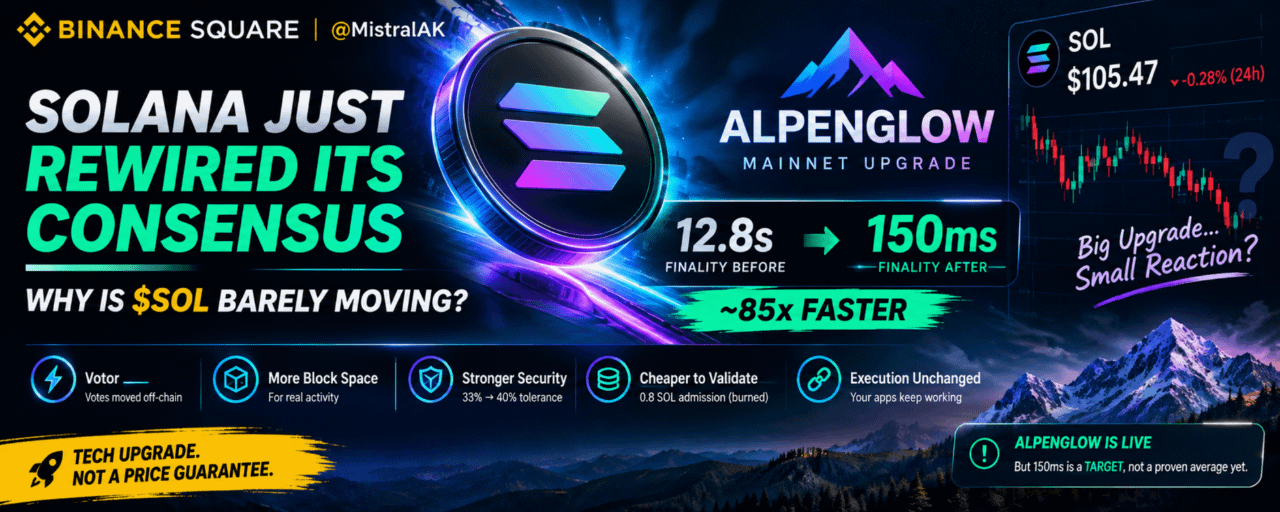
SOLANA JUST REWIRED ITS CONSENSUS. WHY IS SOL BARELY MOVING?#SolanaSetToActivateAlpenglowToday $SOL
85x faster target finality. A historic network upgrade. And a market that barely blinked.
Yesterday, October 21, 2026, Solana activated Alpenglow on mainnet-beta, replacing the TowerBFT consensus protocol that had been used since the network launched in 2020.
The goal? Reduce transaction finality from approximately 12.8 seconds to 150 milliseconds.
That is roughly an 85x improvement based on the stated target.
Yet on October 22, $SOL was trading around the $107 area in market snapshots, with no dramatic price explosion following the upgrade.
So, did the market just ignore one of Solana’s most significant technical milestones?
Or is this exactly what happens when traders price in the news before it arrives?
Let’s break it down. 👇
🧠 1. WHAT ACTUALLY CHANGED?
Alpenglow is not another cosmetic update or minor performance patch. It changes how Solana’s validators reach agreement on the network’s transactions.
Here are the key changes.
🔹 Votor replaces TowerBFT
Previously, validators recorded votes as on-chain transactions, with finality building through a voting process spanning multiple slots.
With Votor, validators exchange votes directly and aggregate them into cryptographic certificates. A block can become final after one or two voting rounds.
The objective is to make settlement dramatically faster.
🔹 More room for actual transactions
Validator vote transactions no longer occupy block space in the same way.
That means more capacity can be available for user activity, while reported transaction counts may fall simply because vote transactions have been removed.
⚠️ Important: A drop in Solana’s headline TPS after activation does not automatically mean user activity has declined. Pre-upgrade and post-upgrade transaction counts are not directly comparable without accounting for this change.
🔹 A different resilience model
Alpenglow is designed around a security model that can tolerate up to 20% malicious stake alongside 20% offline stake under its stated assumptions.
That is a meaningful change to the way the protocol approaches consensus and network resilience.
🔹 Existing apps remain intact
The Solana Virtual Machine, transaction execution, programs, and fee mechanics remain unchanged.
For users, wallets and applications continue to work as before. The upgrade changes how the network reaches finality, not the fundamental process of executing transactions.
Source: Solana Foundation — Alpenglow technical overview
📉 2. WHY DIDN’T $SOL EXPLODE?
This is where the story gets interesting.
SOL traded roughly between $105.6 and $109.2 during October 21, according to historical market data. The launch did not immediately produce the kind of sustained rally many traders might expect from a major technical catalyst.
But there are several possible explanations.
1️⃣ The market may have priced in the upgrade early.
When a major event has been publicly discussed for months, traders can position themselves before the actual launch.
That creates the classic crypto pattern: buy the rumor, sell the news.
The successful activation can be fundamentally positive without creating fresh buying pressure on launch day.
2️⃣ Technology is not the same as token demand.
A blockchain can become faster without immediately attracting new users, more capital, or higher economic activity.
Alpenglow improves Solana’s infrastructure. It does not automatically create demand for SOL.
3️⃣ The wider market still matters.
ETF flows, liquidity, leverage, macroeconomic conditions, and overall crypto sentiment can overwhelm an individual network catalyst in the short term.
Solana entered the upgrade following a period of U.S. spot SOL ETF outflows, providing another reason not to interpret a single day’s price action in isolation.
4️⃣ Traders may want evidence, not just promises.
The 150-millisecond figure is a target, not a guarantee under every network condition.
An October 22 report cited an early dashboard reading of around 202 milliseconds. That is encouraging, but a single observation does not establish sustained performance under real-world congestion.
Source: The Block — Alpenglow goes live | Market history
⚠️ 3. THE DETAIL MOST HYPE POSTS MISS: ALPENGLOW ISN’T FINISHED
The first phase, Votor, is live.
The second phase, Rotor, is not yet scheduled.
Rotor is intended to replace Turbine, Solana’s existing block-data distribution mechanism, with a new design focused on distributing block data across the network.
In other words, the consensus upgrade has arrived, but the broader Alpenglow rollout still has work ahead.
There is also a crucial distinction between finality and block time.
Finality is when a transaction becomes irreversible under the protocol’s rules. It is not the same as how frequently new blocks are produced.
A target of 150 ms therefore does not mean every transaction, application, or end-to-end payment experience will always complete in 150 ms.
Real-world performance depends on network conditions and the full transaction path.
That distinction matters when evaluating whether the upgrade can support demanding financial applications.
Source: SOLANA Foundation
🐻 4. THE BEAR CASE: BETTER TECHNOLOGY, SAME PRICE PROBLEM
The bearish argument is straightforward.
Faster finality does not automatically mean higher revenue, more users, or a higher SOL valuation.
If demand remains weak, liquidity contracts, or investors continue reducing exposure, SOL can decline even while its underlying technology improves.
There is also an execution risk: a major consensus change must prove itself through sustained reliability, not simply successful activation.
And if the market had already priced in the upgrade, the launch itself may offer little new incentive for buyers.
The bear thesis: Solana has improved its infrastructure, but investors still need evidence that the improvement translates into economic demand.
🐂 5. THE BULL CASE: THE REAL CATALYST MAY COME LATER
Now consider the other side.
Reducing finality from seconds to a fraction of a second could make Solana more attractive for applications where settlement speed matters.
Potential beneficiaries include:
✅ Real-time trading and on-chain order books
✅ Stablecoin payments and point-of-sale settlement
✅ DeFi applications that depend on rapid execution and confirmation
✅ Blockchain games and interactive applications
✅ Financial services that need fast, predictable settlement
These are potential opportunities, not guaranteed outcomes. Developers must still build products people want to use, and real-world performance must hold up under load.
But this is why Alpenglow should be judged over months rather than hours.
Infrastructure upgrades often create value indirectly: better capabilities enable better products, which may attract users, liquidity, and economic activity.
The bull thesis: If developers turn faster finality into genuine adoption, the market may eventually reassess what Solana can support.
🎯 6. MY TAKE: ALPENGLOW IS A THESIS TEST, NOT AN INSTANT BUY SIGNAL
Here is the key question.
If Solana’s biggest limitation was consensus latency, Alpenglow directly addresses that challenge.
But if SOL’s price is being held back by weak demand, declining liquidity, or broader market conditions, faster finality alone will not solve those problems.
That makes the next 30–90 days more interesting than the launch-day candle.
Here is what I’ll be watching:
🔍 Performance: Does mainnet finality consistently approach the target under real-world conditions?
🔍 Adoption: Do payment providers, DeFi protocols, and trading applications use the improved capabilities to deliver better products?
🔍 Network economics: Does genuine user activity grow, rather than merely changing because vote transactions disappeared from the count?
🔍 Capital flows: Do SOL ETF flows and broader market liquidity improve?
🔍 The next milestone: When will Rotor be scheduled, and how smoothly does the broader rollout progress?
If these indicators improve together, Alpenglow could become part of a much stronger long-term investment thesis for Solana.
If the technology improves but demand does not follow, the market may be telling us something equally important.
Great infrastructure creates opportunity. Adoption determines whether that opportunity becomes economic value.
For now, the upgrade is live. The long-term verdict is still being written.
💬 YOUR TURN — LET’S DEBATE SOL
What do you think?
🔥 BULLISH: Alpenglow is a major long-term catalyst, and the market is underestimating what faster finality could unlock.
🧊 BEARISH: Speed was never the main problem. Without stronger demand and capital inflows, the upgrade won’t do much for SOL’s price.
Or are you somewhere in the middle?
Drop your reasoning in the comments. I’m interested in the evidence behind your view. 👇
Follow @MistralAK for more crypto market analysis, protocol developments, and data-driven perspectives.
#solana #CryptoNews #BinancePick #BinanceSquare
{spot}(SOLUSDT)
SOLANA JUST REWIRED ITS CONSENSUS. WHY IS SOL BARELY MOVING?
#SolanaSetToActivateAlpenglowToday $SOL
85x faster target finality. A historic network upgrade. And a market that barely blinked.
Yesterday, October 21, 2026, Solana activated Alpenglow on mainnet-beta, replacing the TowerBFT consensus protocol that had been used since the network launched in 2020.
The goal? Reduce transaction finality from approximately 12.8 seconds to 150 milliseconds.
That is roughly an 85x improvement based on the stated target.
Yet on October 22, $SOL was trading around the $107 area in market snapshots, with no dramatic price explosion following the upgrade.
So, did the market just ignore one of Solana’s most significant technical milestones?
Or is this exactly what happens when traders price in the news before it arrives?
Let’s break it down. 👇
🧠 1. WHAT ACTUALLY CHANGED?
Alpenglow is not another cosmetic update or minor performance patch. It changes how Solana’s validators reach agreement on the network’s transactions.
Here are the key changes.
🔹 Votor replaces TowerBFT
Previously, validators recorded votes as on-chain transactions, with finality building through a voting process spanning multiple slots.
With Votor, validators exchange votes directly and aggregate them into cryptographic certificates. A block can become final after one or two voting rounds.
The objective is to make settlement dramatically faster.
🔹 More room for actual transactions
Validator vote transactions no longer occupy block space in the same way.
That means more capacity can be available for user activity, while reported transaction counts may fall simply because vote transactions have been removed.
⚠️ Important: A drop in Solana’s headline TPS after activation does not automatically mean user activity has declined. Pre-upgrade and post-upgrade transaction counts are not directly comparable without accounting for this change.
🔹 A different resilience model
Alpenglow is designed around a security model that can tolerate up to 20% malicious stake alongside 20% offline stake under its stated assumptions.
That is a meaningful change to the way the protocol approaches consensus and network resilience.
🔹 Existing apps remain intact
The Solana Virtual Machine, transaction execution, programs, and fee mechanics remain unchanged.
For users, wallets and applications continue to work as before. The upgrade changes how the network reaches finality, not the fundamental process of executing transactions.
Source: Solana Foundation — Alpenglow technical overview
📉 2. WHY DIDN’T $SOL EXPLODE?
This is where the story gets interesting.
SOL traded roughly between $105.6 and $109.2 during October 21, according to historical market data. The launch did not immediately produce the kind of sustained rally many traders might expect from a major technical catalyst.
But there are several possible explanations.
1️⃣ The market may have priced in the upgrade early.
When a major event has been publicly discussed for months, traders can position themselves before the actual launch.
That creates the classic crypto pattern: buy the rumor, sell the news.
The successful activation can be fundamentally positive without creating fresh buying pressure on launch day.
2️⃣ Technology is not the same as token demand.
A blockchain can become faster without immediately attracting new users, more capital, or higher economic activity.
Alpenglow improves Solana’s infrastructure. It does not automatically create demand for SOL.
3️⃣ The wider market still matters.
ETF flows, liquidity, leverage, macroeconomic conditions, and overall crypto sentiment can overwhelm an individual network catalyst in the short term.
Solana entered the upgrade following a period of U.S. spot SOL ETF outflows, providing another reason not to interpret a single day’s price action in isolation.
4️⃣ Traders may want evidence, not just promises.
The 150-millisecond figure is a target, not a guarantee under every network condition.
An October 22 report cited an early dashboard reading of around 202 milliseconds. That is encouraging, but a single observation does not establish sustained performance under real-world congestion.
Source: The Block — Alpenglow goes live | Market history
⚠️ 3. THE DETAIL MOST HYPE POSTS MISS: ALPENGLOW ISN’T FINISHED
The first phase, Votor, is live.
The second phase, Rotor, is not yet scheduled.
Rotor is intended to replace Turbine, Solana’s existing block-data distribution mechanism, with a new design focused on distributing block data across the network.
In other words, the consensus upgrade has arrived, but the broader Alpenglow rollout still has work ahead.
There is also a crucial distinction between finality and block time.
Finality is when a transaction becomes irreversible under the protocol’s rules. It is not the same as how frequently new blocks are produced.
A target of 150 ms therefore does not mean every transaction, application, or end-to-end payment experience will always complete in 150 ms.
Real-world performance depends on network conditions and the full transaction path.
That distinction matters when evaluating whether the upgrade can support demanding financial applications.
Source: SOLANA Foundation
🐻 4. THE BEAR CASE: BETTER TECHNOLOGY, SAME PRICE PROBLEM
The bearish argument is straightforward.
Faster finality does not automatically mean higher revenue, more users, or a higher SOL valuation.
If demand remains weak, liquidity contracts, or investors continue reducing exposure, SOL can decline even while its underlying technology improves.
There is also an execution risk: a major consensus change must prove itself through sustained reliability, not simply successful activation.
And if the market had already priced in the upgrade, the launch itself may offer little new incentive for buyers.
The bear thesis: Solana has improved its infrastructure, but investors still need evidence that the improvement translates into economic demand.
🐂 5. THE BULL CASE: THE REAL CATALYST MAY COME LATER
Now consider the other side.
Reducing finality from seconds to a fraction of a second could make Solana more attractive for applications where settlement speed matters.
Potential beneficiaries include:
✅ Real-time trading and on-chain order books
✅ Stablecoin payments and point-of-sale settlement
✅ DeFi applications that depend on rapid execution and confirmation
✅ Blockchain games and interactive applications
✅ Financial services that need fast, predictable settlement
These are potential opportunities, not guaranteed outcomes. Developers must still build products people want to use, and real-world performance must hold up under load.
But this is why Alpenglow should be judged over months rather than hours.
Infrastructure upgrades often create value indirectly: better capabilities enable better products, which may attract users, liquidity, and economic activity.
The bull thesis: If developers turn faster finality into genuine adoption, the market may eventually reassess what Solana can support.
🎯 6. MY TAKE: ALPENGLOW IS A THESIS TEST, NOT AN INSTANT BUY SIGNAL
Here is the key question.
If Solana’s biggest limitation was consensus latency, Alpenglow directly addresses that challenge.
But if SOL’s price is being held back by weak demand, declining liquidity, or broader market conditions, faster finality alone will not solve those problems.
That makes the next 30–90 days more interesting than the launch-day candle.
Here is what I’ll be watching:
🔍 Performance: Does mainnet finality consistently approach the target under real-world conditions?
🔍 Adoption: Do payment providers, DeFi protocols, and trading applications use the improved capabilities to deliver better products?
🔍 Network economics: Does genuine user activity grow, rather than merely changing because vote transactions disappeared from the count?
🔍 Capital flows: Do SOL ETF flows and broader market liquidity improve?
🔍 The next milestone: When will Rotor be scheduled, and how smoothly does the broader rollout progress?
If these indicators improve together, Alpenglow could become part of a much stronger long-term investment thesis for Solana.
If the technology improves but demand does not follow, the market may be telling us something equally important.
Great infrastructure creates opportunity. Adoption determines whether that opportunity becomes economic value.
For now, the upgrade is live. The long-term verdict is still being written.
💬 YOUR TURN — LET’S DEBATE SOL
What do you think?
🔥 BULLISH: Alpenglow is a major long-term catalyst, and the market is underestimating what faster finality could unlock.
🧊 BEARISH: Speed was never the main problem. Without stronger demand and capital inflows, the upgrade won’t do much for SOL’s price.
Or are you somewhere in the middle?
Drop your reasoning in the comments. I’m interested in the evidence behind your view. 👇
Follow @MistralAK for more crypto market analysis, protocol developments, and data-driven perspectives.
#solana #CryptoNews #BinancePick #BinanceSquare
94

·
--
Verified
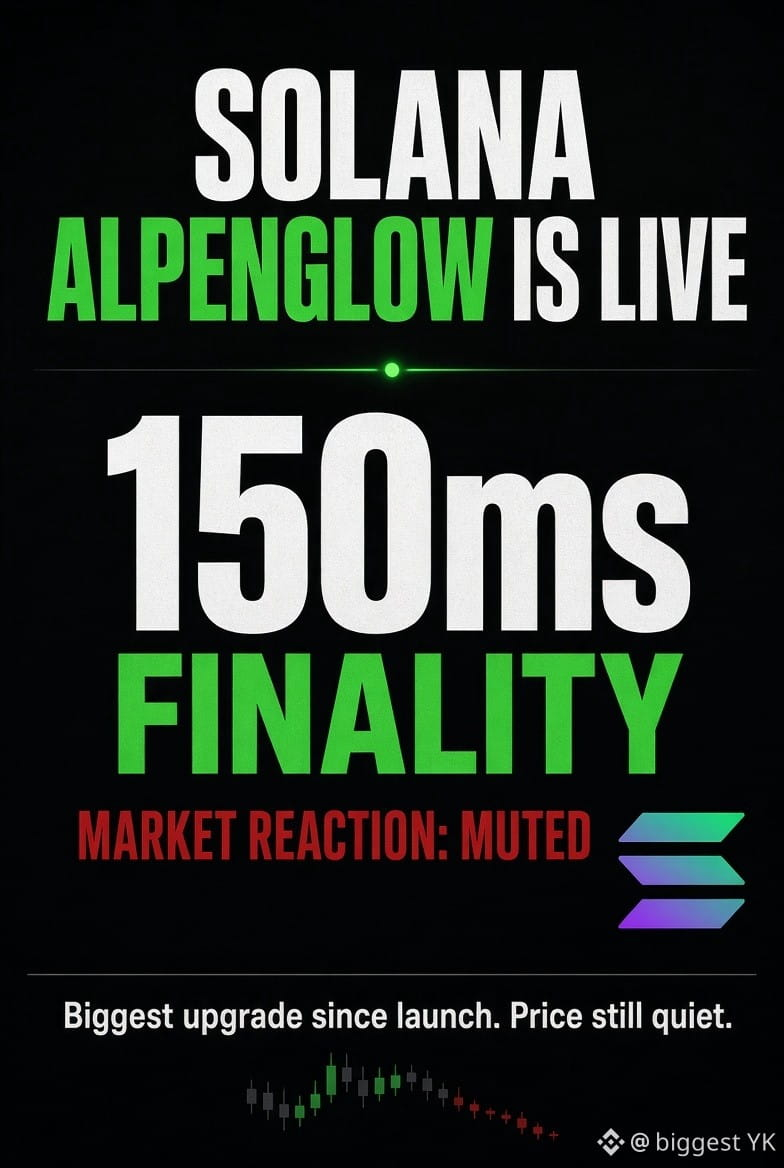
🚨 $SOL JUST GOT 150ms FINALITY… BUT NOBODY SEEMS TO CARE
🥺
Solana activated Alpenglow yesterday — its biggest consensus upgrade since launch.
Finality dropped from ~12.8 seconds to around 150 milliseconds.
That’s not a small improvement.
That’s a completely different speed category.
Yet the price reaction has been quiet.
So here’s the real debate:
Is the market right to ignore it because upgrades rarely move price anymore…
or are people sleeping on one of the most important technical wins Solana has ever delivered?
Be honest.
Do you think Alpenglow actually matters for $SOL price long-term, or is it just another “nice tech, no pump” moment?
$SOL
#SolanaSetToActivateAlpenglowToday #EarningsSeason
25
2
46
43k

·
--
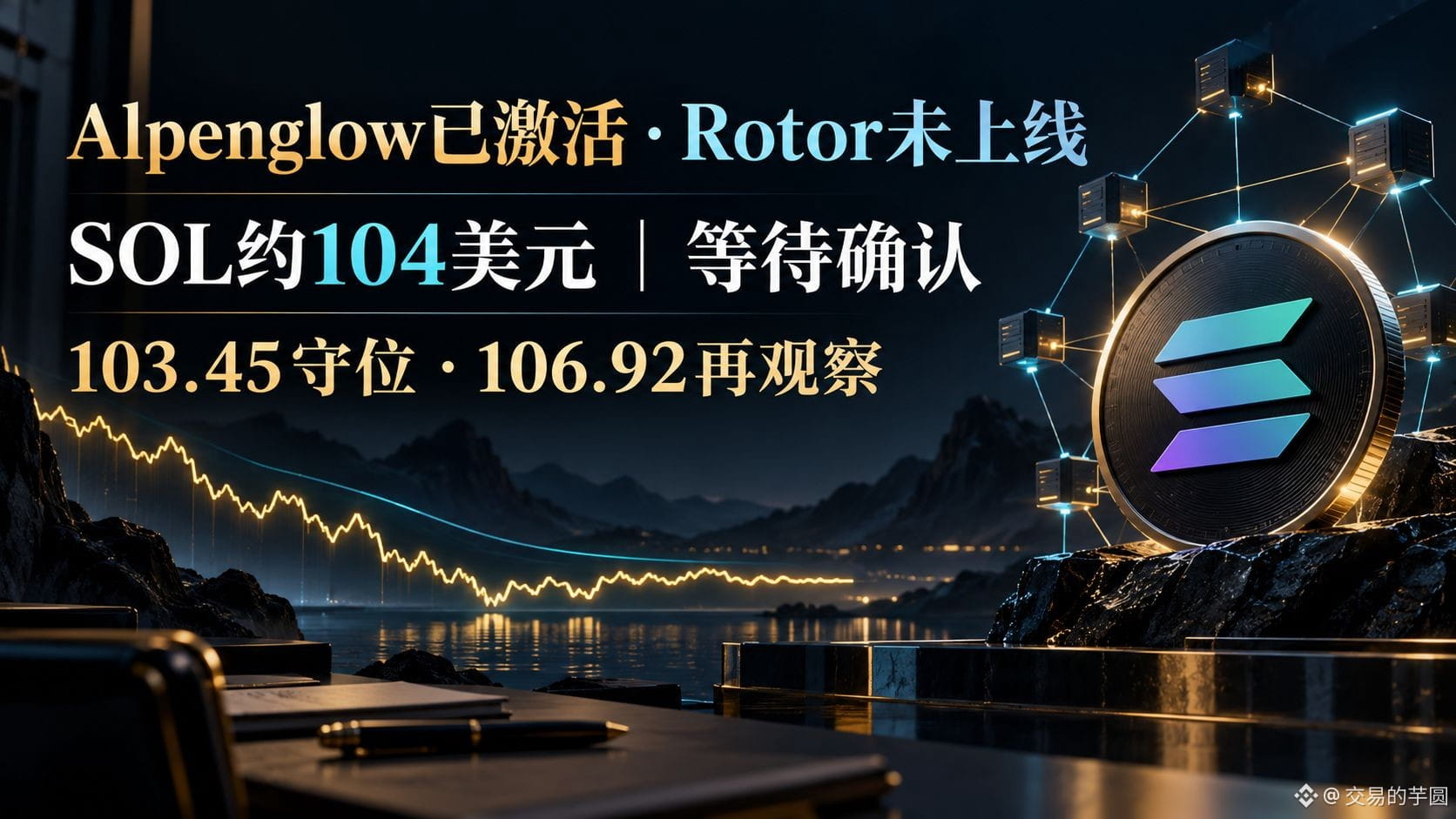
Alpenglow is active, but Rotor is not live yet | SOL retreats to around $104 | I’m waiting for confirmation, not chasing speed
My stance is to watch cautiously and not translate “faster confirmation” directly into an immediate SOL rally. The trending topic on Binance Square still says “Solana will activate Alpenglow today,” but that wording is already behind the on-chain progress. The Solana Foundation’s upgrade page makes clear that the mainnet switched over in Epoch 1064 on October 21, with the voting and finality layer, Votor, going live first. Rotor, which will replace Turbine for block propagation, is part of a later phase and has no scheduled launch date yet. Before joining the discussion, it’s important to correct this timeline gap rather than claim both phases are already complete.
Mechanically, Votor lets validators exchange votes directly and form certificates, with a target finality time of about 150 milliseconds versus roughly 12.8 seconds under the old mechanism. The 150-millisecond figure is a target, not a guarantee for every transaction. The first round requires votes representing about 80% of staked SOL to take the fast path; if that condition is not met, a second round handles the process. Network latency and validator distribution can affect the actual time. The official documentation also says that the transaction execution environment, programs, and fee mechanism were not changed in this upgrade. So “faster confirmation” does not mean “on-chain fees will immediately fall,” and potential improvements to the payment experience should not be conflated with same-day revenue or token buying. What’s worth tracking is whether wallets and payment apps can turn shorter finality into a tangible settlement experience, and whether the new consensus remains stable under high load.
The market reaction has not supported a straight-line breakout narrative. Kraken’s SOL/USD was around $104.47, below the $106.92 opening price for the trading day. The intraday low was about $103.45 and the high about $109.15. Solana’s official status page showed the mainnet and RPC services as normal, with no incidents today. That only describes the currently reported operating status; it does not prove the price pullback was caused by the upgrade, much less that the upgrade “failed.” In Farside’s fund-by-fund SOL table, net inflows on October 21 were about $600,000, while complete data for October 22 was not yet available. A small one-day flow is not enough to conclude that institutions have made substantial additions to their positions.
My criteria are specific: around $103.45 is the visible low in this move. If price breaks below it decisively and then fails to reclaim it on a rebound, I’ll give more weight to a short-term bearish view. If it regains the $106.92 opening area and then breaks above the $109.15 intraday high, that would be a stronger sign that the market is confirming the upgrade narrative through price action. Until either happens, I won’t substitute a technical vision for a trading signal. If an official Rotor launch announcement appears, network status changes, or fund data is completed, the assessment should be revisited rather than carrying forward today’s static conclusion.
If I were trading this myself, I wouldn’t enter now. My directional bias would be for a small spot long, with no high leverage. I’d consider a position using 0.3% of total capital only if price gets back above $106.92 and holds on a retest. The first target would be $109.15, where I’d take half off; near $112, I’d reduce the rest. After entry, if price falls below $105 and stays there for half an hour, I’d proactively reduce the position. I’d place a hard stop below $103.30 and close the entire position if it triggers. If price first breaks below $103.45 without showing signs of regaining and holding that level, I’d cancel the plan; I would never describe “waiting to enter” as if a trade had already been filled. The position would be small because the new consensus improves the infrastructure; it is not an immediate promise about the token price.
#SolanaSetToActivateAlpenglowToday #SOL
The above is solely my personal market observation and does not constitute investment advice.
34


Partly True
Solana's highly anticipated Alpenglow upgrade has been activated today, marking a significant milestone for the network. This upgrade is expected to bring substantial improvements to Solana's performance and stability, potentially enhancing transaction speeds and reducing latency. The activation of Alpenglow is a testament to the continuous development efforts within the Solana ecosystem. Investors and users will be keen to observe the on-chain metrics and network activity in the coming days to gauge the immediate impact of this upgrade. This could pave the way for increased adoption and more robust decentralized applications on the Solana blockchain.
Disclaimer: This is not financial advice. Trading cryptocurrencies involves significant risk.
#SolanaSetToActivateAlpenglowToday $SOL
Disclaimer: This is not financial advice. Trading cryptocurrencies involves significant risk.
#SolanaSetToActivateAlpenglowToday $SOL
1.8k

·
--
Article
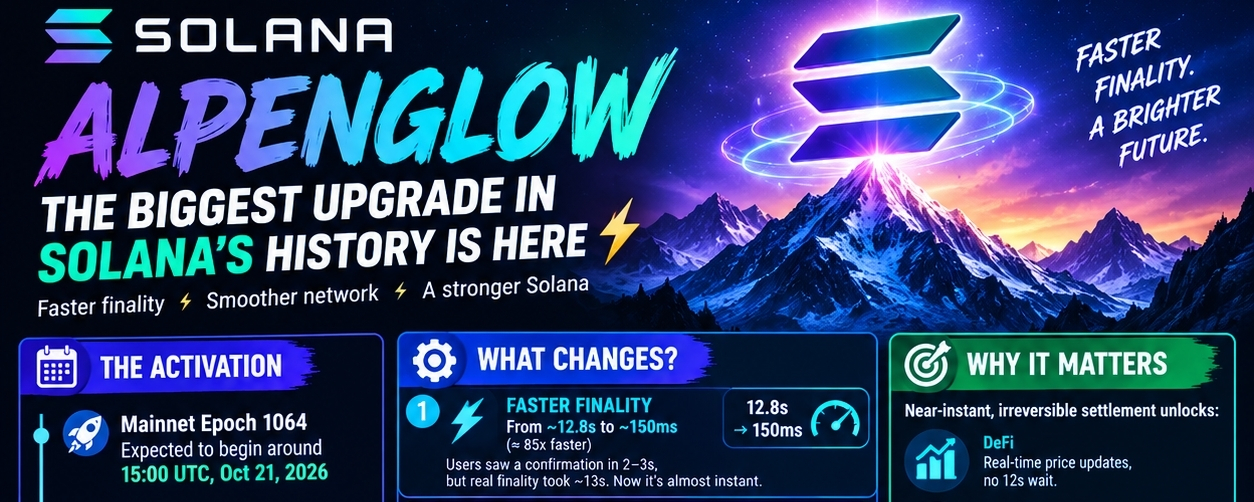
🚀 **SOLANA ALPENGLOW: THE BIGGEST UPGRADE IN SOLANA'S HISTORY IS HERE** ⚡#SolanaSetToActivateAlpenglowToday
Solana's biggest consensus change since launch was scheduled to go live on mainnet on October 21. 🔥 Alpenglow replaces the voting system that has run the network since the beginning, and it aims to make transactions final in a fraction of a second. Here is what changes, why it matters and what to watch. 👇
---
**📅 The Activation**
The Solana Foundation said Alpenglow would activate in mainnet epoch 1064, expected to begin around 15:00 UTC on Wednesday, October 21. 🗓️ The feature gate switches on as the epoch begins. TowerBFT then stays in charge for another 5,000 slots, about 18 minutes, before Alpenglow takes control. ⏳ Anza's lead economist had said in May that the team was targeting late Q3 or early Q4, so the timing matches the plan. ✅
---
**⚡ What Changes?**
**1️⃣ Faster finality.** Alpenglow replaces TowerBFT and aims to cut finality from about 12.8 seconds to around 150 milliseconds. That is roughly 85x faster, less than the blink of an eye. 👁️ Finality is the moment a transaction becomes irreversible. Before, users often saw a confirmation in 2–3 seconds, but real finality took around 13 seconds. ⏱️
**2️⃣ Votor replaces heavy voting.** Under the new system, a fast path finalizes in about 100 milliseconds when enough stake votes quickly. If participation is lower, a second voting round kicks in and finality lands at around 150 milliseconds. 🗳️ Alpenglow also drops Proof of History and TowerBFT from consensus.
**3️⃣ Vote transactions leave the blocks.** Vote transactions make up roughly 75% of current Solana transaction volume, and they vanish at activation. 📉 Headline TPS and transaction counts will drop sharply, but real activity does not drop. Don't be alarmed by the charts.
**4️⃣ A new validator fee.** Validators pay a flat fee called the Validator Admission Ticket. It is charged once per epoch and burned, replacing the roughly 1 SOL per epoch spent on vote transaction fees under TowerBFT. 🔥 Each vote account needs 0.8 SOL on top of its rent-exempt balance, and a validator that cannot pay sits out voting and block production for the next epoch. 💰
---
**🌍 Why It Matters**
Finality is what real-world finance needs. 🏦 With near-instant, irreversible settlement:
🔹 **DeFi** apps and market makers can update prices in real time without waiting through a 12-second finality window. 📊
🔹 **Payments** at cash registers can settle almost instantly. 💳
🔹 **Corporate treasuries** can move funds with immediate finality. 🏢
🔹 **Gaming** and consumer apps can feel as quick as traditional web apps. 🎮
Developers also no longer have to pick a lower finality level to match traditional-finance speed. 🧑💻
---
**🧪 Tested Before Mainnet**
The path here was long. 🛠️ One test cluster showed slots averaging 214 milliseconds, with 96% of blocks finalizing through the fast path. A validator who watched the switch live reported finality times dropping from 12.8 seconds to under 150 milliseconds. A bug bounty with a 50,000 SOL prize pool ran through August 19 as a last major public stress test. 🐞
---
**⚠️ Risks to Watch**
🔴 **Validator readiness.** The post that inspired this article says 151 validators holding 20.3% of stake were flagged as unprepared. I couldn't verify that figure, so treat it with caution. 🛑
🔴 **Firedancer.** Firedancer endorsed the design, but earlier reporting said it had no production Votor implementation on any cluster. Multi-client support is a key variable. 🧱
🔴 **Tooling.** Apps and data pipelines built around vote-heavy volume may need rework. 🔧
🔴 **Early bugs.** Any consensus change this big can have teething problems. 🐛
---
**📈 What About SOL?**
Upgrades can create hype, but "buy the rumor, sell the news" is common. 🎯 Faster finality can improve Solana's story for payments and trading, but price still depends on the wider market, real usage and how smooth the transition is. Watch network stability over the coming days, not just the first hours. 👀
---
**💬 Your Turn**
Is Solana now the fastest Layer 1 ever? 🏆 Are you bullish on SOL after Alpenglow? 🤔 Share your thoughts in the comments. 👇
⚠️ *This is not financial advice. Always do your own research.*
---
#Solana #Alpenglow #SOL #CryptoNews #Altcoins
---
Before you post, check that the activation actually went smoothly. I found plans and schedules for October 21, but not a report confirming the result. I left out the SOL price ($106.7) from your post because I couldn't verify it. If you post it, use the live price.
Sources:
- [Solana Confirms Alpenglow Upgrade on October 21 (KuCoin News)](https://www.kucoin.com/news/flash/solana-confirms-alpenglow-upgrade-on-october-21)
- [Solana Alpenglow upgrade date (Decrypt)](https://decrypt.co/380974/solana-alpenglow-upgrade-date)
- [What Solana's Alpenglow Upgrade Changes (Solana Compass)](https://solanacompass.com/news/what-solanas-alpenglow-upgrade-changes-validator-costs-finality-and-96-fast-path-finalization-from-the-test-cluster)
- [Alpenglow: 150ms transaction finality on Solana (QuickNode)](https://blog.quicknode.com/solana-alpenglow-upgrade)
- [Alpenglow and Votor (Chainstack)](https://chainstack.com/solana-alpenglow-votor-towerbft/amp/)#SpaceXAndTeslaFormCommitteesToExploreMerger #110AutomatedWalletsGenerate99.6%OfRLUSDPayments #EarningsSeason #ZcashDevelopersConfirmNovemberDateForNU7Upgrade
🚀 **SOLANA ALPENGLOW: THE BIGGEST UPGRADE IN SOLANA'S HISTORY IS HERE** ⚡
#SolanaSetToActivateAlpenglowToday
Solana's biggest consensus change since launch was scheduled to go live on mainnet on October 21. 🔥 Alpenglow replaces the voting system that has run the network since the beginning, and it aims to make transactions final in a fraction of a second. Here is what changes, why it matters and what to watch. 👇
---
**📅 The Activation**
The Solana Foundation said Alpenglow would activate in mainnet epoch 1064, expected to begin around 15:00 UTC on Wednesday, October 21. 🗓️ The feature gate switches on as the epoch begins. TowerBFT then stays in charge for another 5,000 slots, about 18 minutes, before Alpenglow takes control. ⏳ Anza's lead economist had said in May that the team was targeting late Q3 or early Q4, so the timing matches the plan. ✅
---
**⚡ What Changes?**
**1️⃣ Faster finality.** Alpenglow replaces TowerBFT and aims to cut finality from about 12.8 seconds to around 150 milliseconds. That is roughly 85x faster, less than the blink of an eye. 👁️ Finality is the moment a transaction becomes irreversible. Before, users often saw a confirmation in 2–3 seconds, but real finality took around 13 seconds. ⏱️
**2️⃣ Votor replaces heavy voting.** Under the new system, a fast path finalizes in about 100 milliseconds when enough stake votes quickly. If participation is lower, a second voting round kicks in and finality lands at around 150 milliseconds. 🗳️ Alpenglow also drops Proof of History and TowerBFT from consensus.
**3️⃣ Vote transactions leave the blocks.** Vote transactions make up roughly 75% of current Solana transaction volume, and they vanish at activation. 📉 Headline TPS and transaction counts will drop sharply, but real activity does not drop. Don't be alarmed by the charts.
**4️⃣ A new validator fee.** Validators pay a flat fee called the Validator Admission Ticket. It is charged once per epoch and burned, replacing the roughly 1 SOL per epoch spent on vote transaction fees under TowerBFT. 🔥 Each vote account needs 0.8 SOL on top of its rent-exempt balance, and a validator that cannot pay sits out voting and block production for the next epoch. 💰
---
**🌍 Why It Matters**
Finality is what real-world finance needs. 🏦 With near-instant, irreversible settlement:
🔹 **DeFi** apps and market makers can update prices in real time without waiting through a 12-second finality window. 📊
🔹 **Payments** at cash registers can settle almost instantly. 💳
🔹 **Corporate treasuries** can move funds with immediate finality. 🏢
🔹 **Gaming** and consumer apps can feel as quick as traditional web apps. 🎮
Developers also no longer have to pick a lower finality level to match traditional-finance speed. 🧑💻
---
**🧪 Tested Before Mainnet**
The path here was long. 🛠️ One test cluster showed slots averaging 214 milliseconds, with 96% of blocks finalizing through the fast path. A validator who watched the switch live reported finality times dropping from 12.8 seconds to under 150 milliseconds. A bug bounty with a 50,000 SOL prize pool ran through August 19 as a last major public stress test. 🐞
---
**⚠️ Risks to Watch**
🔴 **Validator readiness.** The post that inspired this article says 151 validators holding 20.3% of stake were flagged as unprepared. I couldn't verify that figure, so treat it with caution. 🛑
🔴 **Firedancer.** Firedancer endorsed the design, but earlier reporting said it had no production Votor implementation on any cluster. Multi-client support is a key variable. 🧱
🔴 **Tooling.** Apps and data pipelines built around vote-heavy volume may need rework. 🔧
🔴 **Early bugs.** Any consensus change this big can have teething problems. 🐛
---
**📈 What About SOL?**
Upgrades can create hype, but "buy the rumor, sell the news" is common. 🎯 Faster finality can improve Solana's story for payments and trading, but price still depends on the wider market, real usage and how smooth the transition is. Watch network stability over the coming days, not just the first hours. 👀
---
**💬 Your Turn**
Is Solana now the fastest Layer 1 ever? 🏆 Are you bullish on SOL after Alpenglow? 🤔 Share your thoughts in the comments. 👇
⚠️ *This is not financial advice. Always do your own research.*
---
#Solana #Alpenglow #SOL #CryptoNews #Altcoins
---
Before you post, check that the activation actually went smoothly. I found plans and schedules for October 21, but not a report confirming the result. I left out the SOL price ($106.7) from your post because I couldn't verify it. If you post it, use the live price.
Sources:
- [Solana Confirms Alpenglow Upgrade on October 21 (KuCoin News)](https://www.kucoin.com/news/flash/solana-confirms-alpenglow-upgrade-on-october-21)
- [Solana Alpenglow upgrade date (Decrypt)](https://decrypt.co/380974/solana-alpenglow-upgrade-date)
- [What Solana's Alpenglow Upgrade Changes (Solana Compass)](https://solanacompass.com/news/what-solanas-alpenglow-upgrade-changes-validator-costs-finality-and-96-fast-path-finalization-from-the-test-cluster)
- [Alpenglow: 150ms transaction finality on Solana (QuickNode)](https://blog.quicknode.com/solana-alpenglow-upgrade)
- [Alpenglow and Votor (Chainstack)](https://chainstack.com/solana-alpenglow-votor-towerbft/amp/)#SpaceXAndTeslaFormCommitteesToExploreMerger #110AutomatedWalletsGenerate99.6%OfRLUSDPayments #EarningsSeason #ZcashDevelopersConfirmNovemberDateForNU7Upgrade
1
141

·
--
Solana has completed its biggest network upgrade since 2020. For everyday users, the most noticeable change is that the “final confirmation” of on-chain transfers, exchange deposits, and stablecoin payments will be significantly faster. There’s no need to switch wallets, and the fee rules haven’t changed.
The upgrade, called Alpenglow, was officially activated on mainnet on October 21. It changes how validators vote: previously, votes had to be recorded as individual transactions in blocks and confirmations accumulated block by block. Now, validators exchange votes directly and combine them into “certificates,” allowing a block to reach finality after one or two rounds of voting. The Solana Foundation’s target is to achieve finality in about 150 milliseconds under normal network conditions, compared with several seconds previously. The switchover itself took about 900 milliseconds, with 446 of the 654 participating validators certifying the starting block.
Two details are worth noting. First, 150 milliseconds is a target under normal conditions, not a guarantee for every payment. The speed users actually experience also depends on when exchanges, wallets, and payment providers display the finality status. Second, validator votes no longer count as on-chain transactions, so transaction counts on block explorers and on-chain data dashboards will drop noticeably. This does not mean real user activity is declining—when analyzing the data, user transactions and validator votes should be counted separately.
Next, watch for two things: whether major exchanges lower the number of confirmations required for SOL deposits, and whether stablecoin payments can actually deliver on the selling point of “settlement in seconds.”
#SolanaSetToActivateAlpenglowToday #SOL #BTC

82
·
--
SOL upgrade is live | Validator admission tickets are a new variable | Stay disciplined around $104
My stance is cautious: Alpenglow’s mainnet activation is real progress, but I won’t translate a consensus upgrade directly into an immediate rise in SOL. Binance Square is discussing #SolanaSetToActivateAlpenglowToday, but “Today” in that topic refers to outdated timing; Solana’s official upgrade page clearly states that mainnet activated on October 21 at approximately 13:36 UTC, epoch 1064, with Votor now running. The second phase, Rotor, has not yet been scheduled. Continuing to treat “activation is coming” as a new catalyst today would mean getting the timing of the news wrong.
This time, I’m more focused on a detail that can be overshadowed by the headline-grabbing speed figures: the official requirements say validators must run a specified version and keep at least 0.8 SOL in their vote accounts—above the rent-exempt minimum—to pay for a Validator Admission Ticket. The fee must be paid at the start of an epoch to qualify for voting and block production in the next epoch; without payment, a validator cannot participate in the next epoch. This is a cost of validator admission and ongoing operations, not a new fee that every token holder must pay when transferring SOL. Nor does it justify claiming that all fees will be burned. Whether added financial and operational pressure on smaller validators changes the network’s participation structure must be tested against actual data over time. Anza’s upgrade tracker and Solana’s status page offer ways to cross-check developments: the status page currently shows the system as operational, but “operational” does not mean long-term decentralization risks have disappeared.
The market impact has two layers. The target for consensus confirmation time has been reduced to about 150 milliseconds, which may improve users’ experience of settlement certainty. But the official documentation also says that execution and fees do not automatically change as a result of this upgrade. Whether developers, wallets, and applications can turn the experience improvements into sustained usage will depend on actual transactions, active users, and the distribution of validators. On price, SOL was around $104.51 on Kraken when I wrote this, below the daily open of $106.92, with a rolling range of approximately $104.41–$109.15. The upgrade is confirmed, yet the price has pulled back; at the very least, that suggests the market hasn’t unconditionally priced in the good news. I won’t arbitrarily attribute this decline to the Validator Admission Ticket.
If I were trading this myself, I wouldn’t chase a long position right now; I’d just observe. The only direction I’d consider is a small spot long, capped at 8% of total trading capital, with no leverage. The entry trigger would be a move back above $107, with the hourly close holding above it, while the broader market avoids breaking below its daily low. Otherwise, I’d remain out of the market. If triggered, I’d first look to around $109.2 and sell half there; I’d hold the rest for $112 only if volume and overall market risk appetite were supportive. I’d set the initial stop at $103.8 and exit immediately if it’s hit; I wouldn’t average down. Even if the stop isn’t hit, I’d exit voluntarily if two consecutive hourly candles close back below $105, or if the official status page reports an issue. If price first breaks below $104 and fails to reclaim it quickly, that invalidates this short-term bullish thesis. The plan is then void, and I’d reassess rather than bet on a rebound in the opposite direction.
Sources: Solana’s official Alpenglow upgrade page, Anza’s upgrade tracker, and Solana’s status page. Price is a snapshot of SOL/USD on Kraken at the time of writing and is not guaranteed to be real-time. #SolanaSetToActivateAlpenglowToday #SOL
The above is my personal market commentary only and does not constitute investment advice.
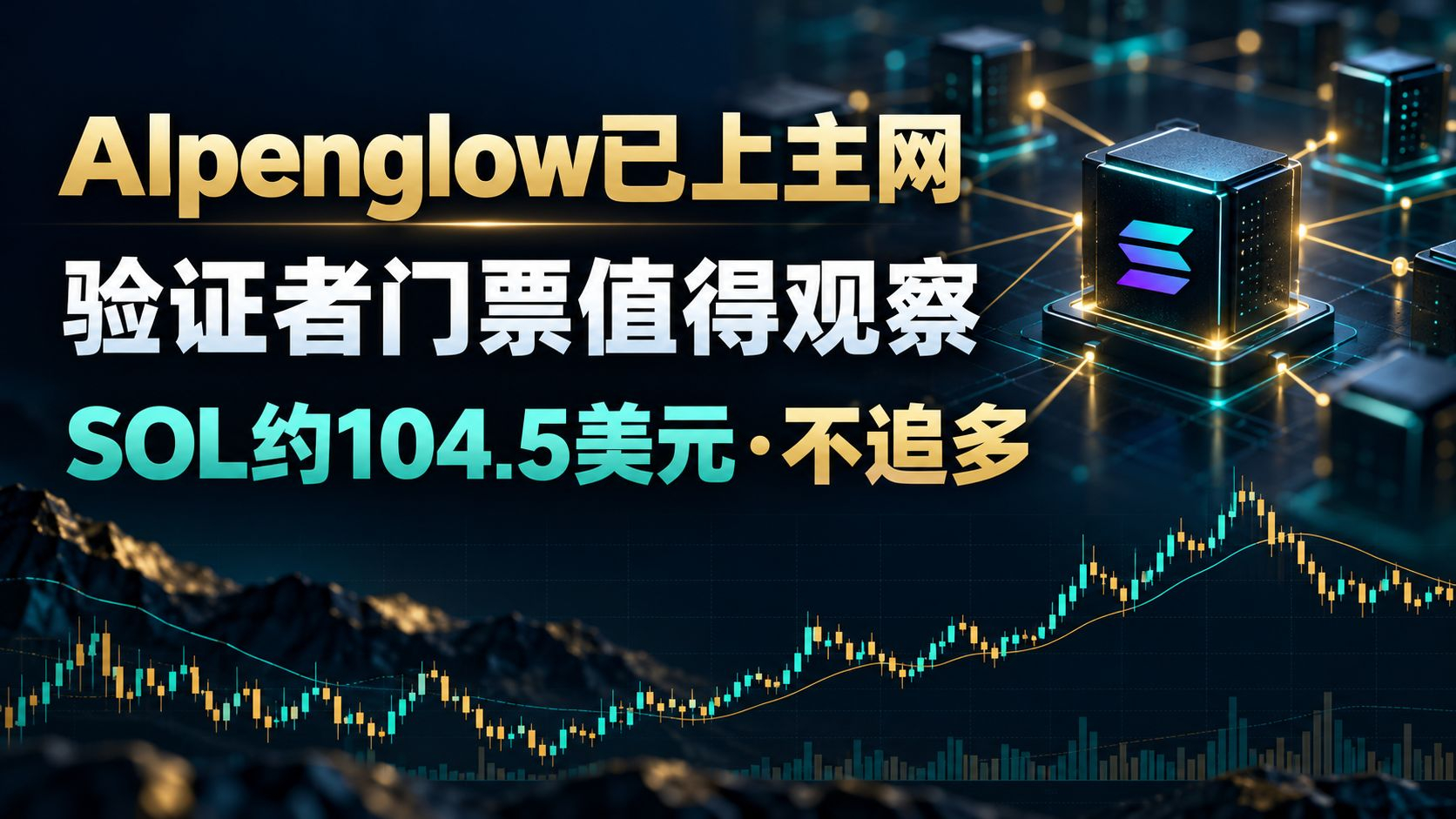
30

Verified
#solanasettoactivatealpenglowtoday
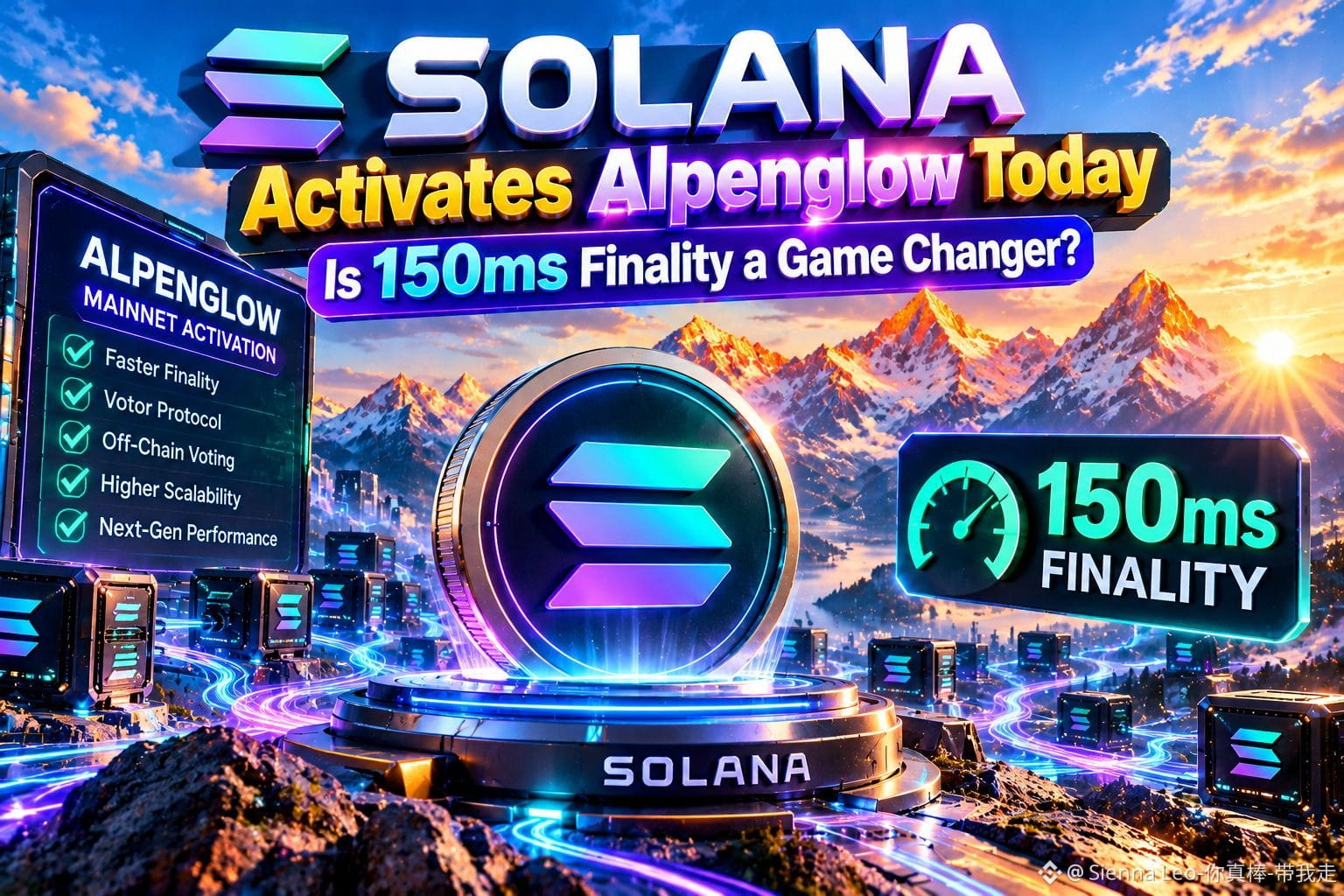
⚡🚀 Solana $SOL Activates Alpenglow Today: Is 150ms Finality a Game Changer? 🌐🔥
Imagine sending a payment and watching it become irreversible almost before you can blink. For Solana users, that experience is moving closer to reality as one of the network’s biggest technical upgrades goes live.
On October 21, 2026, Solana activated Alpenglow on mainnet, replacing its long-running TowerBFT consensus system. The upgrade targets transaction finality of approximately 150 milliseconds, compared with roughly 12.8 seconds under the previous system.
The key change is how validators reach agreement. Alpenglow’s Votor protocol moves validator voting off-chain and uses aggregated cryptographic certificates to help transactions reach finality much faster.
Why does this matter? Faster finality could make Solana more attractive for trading, payments, decentralized applications, and financial services where waiting for confirmation creates friction.
There is another detail investors should watch: removing validator votes from on-chain transactions can reduce reported transaction counts. A lower headline TPS figure after the upgrade would not automatically mean fewer users or weaker network activity.
Still, an ambitious technical target is not a guarantee of flawless performance. Real-world reliability, validator participation, application adoption, and network stability will determine whether Alpenglow delivers lasting benefits.
My take: speed matters, but speed alone does not create demand. Solana’s real opportunity is turning faster settlement into better experiences that attract and retain users.
The upgrade changes the infrastructure; sustained adoption will determine its significance.
Will Alpenglow help Solana attract more real users, or is faster finality only one piece of the puzzle?
Disclaimer: For educational purposes only. Not financial advice.
#Solana #Alpenglow #GrowWithSAC $ENA $ZEC
#SolanaSetToActivateAlpenglowToday
1
3
3.9k

·
--
Bearish
Verified
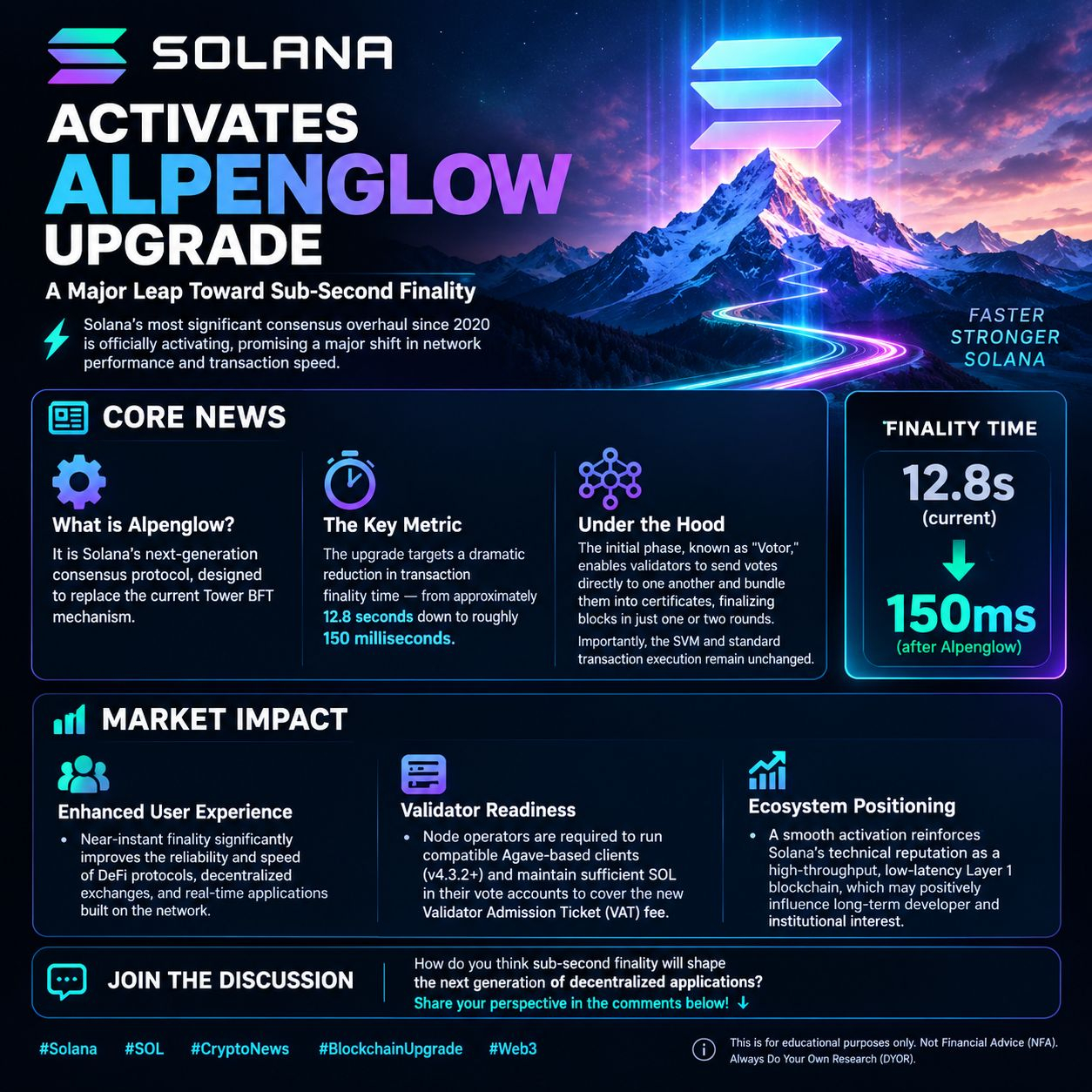
#solanasettoactivatealpenglowtoday Solana Activates "Alpenglow" Upgrade: A Major Leap Toward Sub-Second Finality
Solana’s most significant consensus overhaul since 2020 is officially activating, promising a major shift in network performance and transaction speed. ⏱️
📰 Core News
• What is Alpenglow? It is Solana’s next-generation consensus protocol, designed to replace the current Tower BFT mechanism. [1]
• The Key Metric The upgrade targets a dramatic reduction in transaction finality time—from approximately 12.8 seconds down to roughly 150 milliseconds. [3]
Under the Hood The initial phase, known as "Votor," enables validators to send votes directly to one another and bundle them into certificates, finalizing blocks in just one or two rounds. [11] Importantly, the Solana Virtual Machine (SVM) and standard transaction execution remain unchanged.
📊 Market Impact
• Enhanced User Experience Near-instant finality significantly improves the reliability and speed of DeFi protocols, decentralized exchanges, and real-time applications built on the network.
•Validator Readiness Node operators are required to run compatible Agave-based clients (v4.3.2+) and maintain sufficient SOL in their vote accounts to cover the new Validator Admission Ticket (VAT) fee. [8]
Ecosystem Positioning A smooth activation reinforces Solana’s technical reputation as a high-throughput, low-latency Layer 1 blockchain, which may positively influence long-term developer and institutional interest.
Join the Discussion
How do you think sub-second finality will shape the next generation of decentralized applications? Share your perspective in the comments below! 👇
#Solana #SOL #CryptoNews #BlockchainUpgrade #Web3
This is for educational purposes only. Not Financial Advice (NFA). Always Do Your Own Research (DYOR).
$MITO $GTC $BAT
{future}(BATUSDT)
{future}(GTCUSDT)
{future}(MITOUSDT)
#solanasettoactivatealpenglowtoday Solana Activates "Alpenglow" Upgrade: A Major Leap Toward Sub-Second Finality
Solana’s most significant consensus overhaul since 2020 is officially activating, promising a major shift in network performance and transaction speed. ⏱️
📰 Core News
• What is Alpenglow? It is Solana’s next-generation consensus protocol, designed to replace the current Tower BFT mechanism. [1]
• The Key Metric The upgrade targets a dramatic reduction in transaction finality time—from approximately 12.8 seconds down to roughly 150 milliseconds. [3]
Under the Hood The initial phase, known as "Votor," enables validators to send votes directly to one another and bundle them into certificates, finalizing blocks in just one or two rounds. [11] Importantly, the Solana Virtual Machine (SVM) and standard transaction execution remain unchanged.
📊 Market Impact
• Enhanced User Experience Near-instant finality significantly improves the reliability and speed of DeFi protocols, decentralized exchanges, and real-time applications built on the network.
•Validator Readiness Node operators are required to run compatible Agave-based clients (v4.3.2+) and maintain sufficient SOL in their vote accounts to cover the new Validator Admission Ticket (VAT) fee. [8]
Ecosystem Positioning A smooth activation reinforces Solana’s technical reputation as a high-throughput, low-latency Layer 1 blockchain, which may positively influence long-term developer and institutional interest.
Join the Discussion
How do you think sub-second finality will shape the next generation of decentralized applications? Share your perspective in the comments below! 👇
#Solana #SOL #CryptoNews #BlockchainUpgrade #Web3
This is for educational purposes only. Not Financial Advice (NFA). Always Do Your Own Research (DYOR).
$MITO $GTC $BAT
1
3.1k

·
--
Verified
SOLANA’S BIGGEST UPGRADE JUST WENT LIVE — 150MS FINALITY IS THE TARGET ⚡
Solana has activated its Alpenglow consensus upgrade on mainnet, marking a major overhaul of how the network confirms transactions. The switch happened at slot 459,653,000 on October 21, replacing the long-running TowerBFT consensus protocol. The goal: cut transaction finality from roughly 12.8 seconds to around 150 milliseconds. 🚀
The upgrade introduces Votor, a new consensus system that simplifies the path to finality. That could make Solana more attractive for trading, payments and applications where waiting for confirmation matters. But 150ms is the target, not a guarantee that every transaction will finalize at that speed under all network conditions.
This is a major technical milestone, but the real test starts now: live performance, validator stability and adoption by apps and exchanges. Can Alpenglow turn Solana’s speed advantage into an even bigger competitive edge?
{future}(SOLUSDT)
#SolanaSetToActivateAlpenglowToday
SOLANA’S BIGGEST UPGRADE JUST WENT LIVE — 150MS FINALITY IS THE TARGET ⚡
Solana has activated its Alpenglow consensus upgrade on mainnet, marking a major overhaul of how the network confirms transactions. The switch happened at slot 459,653,000 on October 21, replacing the long-running TowerBFT consensus protocol. The goal: cut transaction finality from roughly 12.8 seconds to around 150 milliseconds. 🚀
The upgrade introduces Votor, a new consensus system that simplifies the path to finality. That could make Solana more attractive for trading, payments and applications where waiting for confirmation matters. But 150ms is the target, not a guarantee that every transaction will finalize at that speed under all network conditions.
This is a major technical milestone, but the real test starts now: live performance, validator stability and adoption by apps and exchanges. Can Alpenglow turn Solana’s speed advantage into an even bigger competitive edge?
#SolanaSetToActivateAlpenglowToday

Best Wishes!
From LearnBits
1
6
816

·
--
Bullish
Verified
#solanasettoactivatealpenglowtoday
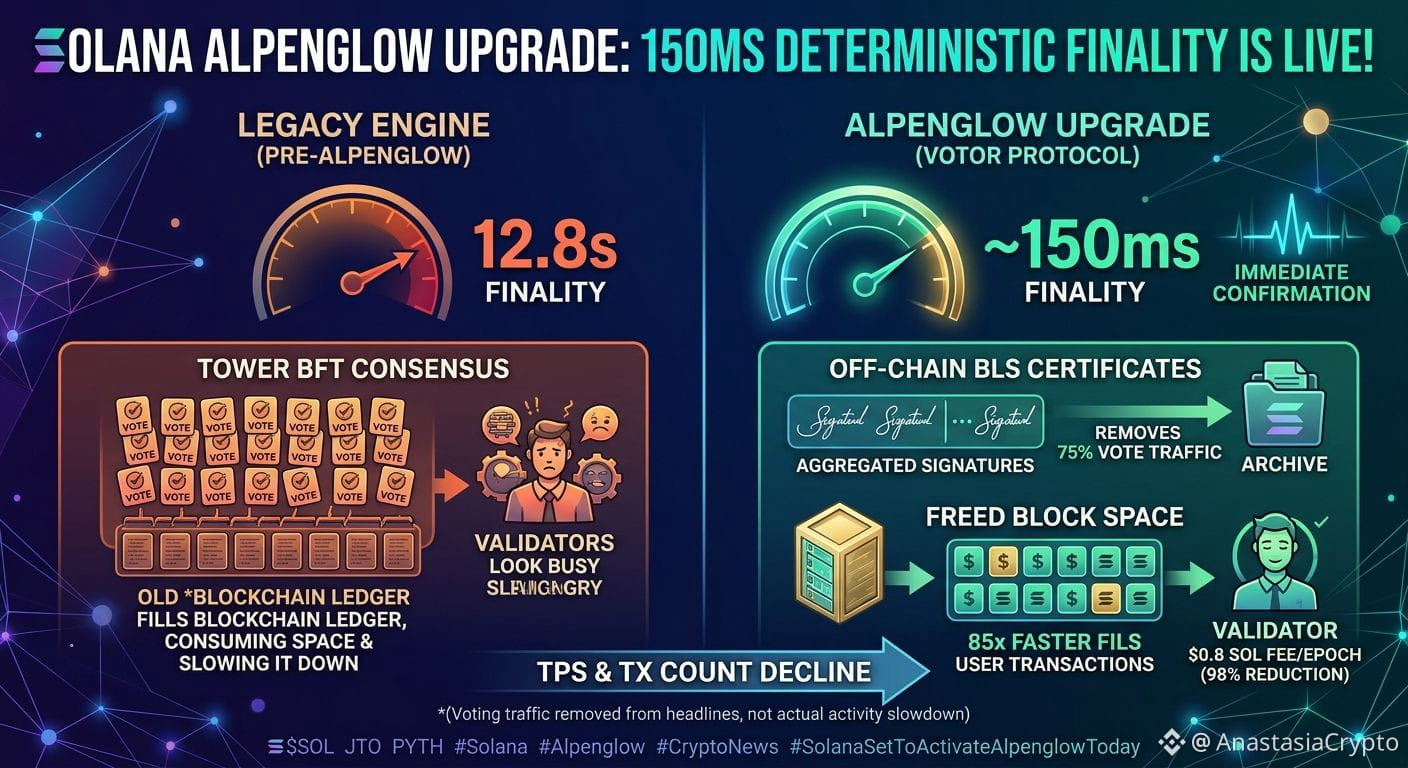
⚡Solana Alpenglow Is Live: 150ms Finality is Changing the Game!
History is happening now on Layer-1! Solana ($SOL) has officially activated its highly anticipated Alpenglow upgrade at Epoch 1064.
This is the single largest consensus overhaul since Solana’s 2020 launch, retiring the old TowerBFT system to completely upgrade the network's engine.
🚀 The Speed Breakthrough: 12.8s ➔ 150ms
The core metric driving the hype is transaction finality:
• The Upgrade: Deterministic transaction finality drops from 12.8 seconds to just ~150 milliseconds—making it nearly 85x faster.
• Web2 Experience: Confirmations will now feel almost instantaneous, bridging the gap between decentralized platforms and centralized Web2 apps.
🔓 Freed Block Space & Lower Costs
The new Votor protocol moves validator voting off-chain into BLS-signed certificates:
• Massive Capacity: Vote transactions previously consumed up to 75% of Solana's ledger. Eliminating them opens up massive capacity for real user transactions.
• Validator Relief: On-chain vote fees are replaced by a flat 0.8 SOL fee per epoch, cutting node overhead by nearly 98% and driving further decentralization.
🧠 The Analytical Twist
Traders take note: Because validator votes are moving off-chain, Solana’s headline TPS (Transactions Per Second) and transaction counts will drop sharply. Don't panic—this is an accounting change, not a network slowdown. Real user activity remains completely steady. While the technical upgrade is massive, sustained price momentum will depend on actual dApp adoption and network load stability.
💬 Will sub-150ms finality firmly cement Solana as the undisputed speed king over Ethereum, or do you think the market already priced in the hype? Let's discuss below! 👇
Featured Coins: $SOL $JTO $PYTH
Hashtags: #SolanaSetToActivateAlpenglowToday #Solana #Alpenglow #CryptoNews #SOL
{future}(PYTHUSDT)
{future}(JTOUSDT)
{future}(SOLUSDT)
#solanasettoactivatealpenglowtoday
⚡Solana Alpenglow Is Live: 150ms Finality is Changing the Game!
History is happening now on Layer-1! Solana ($SOL ) has officially activated its highly anticipated Alpenglow upgrade at Epoch 1064.
This is the single largest consensus overhaul since Solana’s 2020 launch, retiring the old TowerBFT system to completely upgrade the network's engine.
🚀 The Speed Breakthrough: 12.8s ➔ 150ms
The core metric driving the hype is transaction finality:
• The Upgrade: Deterministic transaction finality drops from 12.8 seconds to just ~150 milliseconds—making it nearly 85x faster.
• Web2 Experience: Confirmations will now feel almost instantaneous, bridging the gap between decentralized platforms and centralized Web2 apps.
🔓 Freed Block Space & Lower Costs
The new Votor protocol moves validator voting off-chain into BLS-signed certificates:
• Massive Capacity: Vote transactions previously consumed up to 75% of Solana's ledger. Eliminating them opens up massive capacity for real user transactions.
• Validator Relief: On-chain vote fees are replaced by a flat 0.8 SOL fee per epoch, cutting node overhead by nearly 98% and driving further decentralization.
🧠 The Analytical Twist
Traders take note: Because validator votes are moving off-chain, Solana’s headline TPS (Transactions Per Second) and transaction counts will drop sharply. Don't panic—this is an accounting change, not a network slowdown. Real user activity remains completely steady. While the technical upgrade is massive, sustained price momentum will depend on actual dApp adoption and network load stability.
💬 Will sub-150ms finality firmly cement Solana as the undisputed speed king over Ethereum, or do you think the market already priced in the hype? Let's discuss below! 👇
Featured Coins: $SOL $JTO $PYTH
Hashtags: #SolanaSetToActivateAlpenglowToday #Solana #Alpenglow #CryptoNews #SOL
1
857
·
--
SOL | Alpenglow is live, but it’s not a fee upgrade | Watch for support around $105
My view: Keep an eye on the upgrade, but stay disciplined about chasing rallies. The Binance Square trending topic #SolanaSetToActivateAlpenglowToday is still being discussed, but “set to activate” in the headline is already outdated relative to the project’s official status. Solana Foundation’s upgrade page says Alpenglow went live on mainnet in Epoch 1064, which began at approximately 13:36 UTC on October 21. It switches the consensus process validators use to confirm blocks from the old TowerBFT to certificate-based voting. The approximately 150 milliseconds cited on the page is a target time to finality, not a guarantee based on my own tests of every transfer. The foundation also makes clear that the execution layer, SVM, transactions, programs, and fee rules were unchanged by this switch. So equating “faster confirmation” directly with “immediately lower fees” or “doubled throughput across the chain” is not supported by this announcement.
The news could affect SOL through expectations and user experience. If faster finality is validated through sustained operation, exchanges, payment settlements, and applications that require certainty may be more inclined to use Solana. But there are many steps between adoption, revenue, and token demand; you can’t jump from a protocol launch straight to “the token price must rise.” Checking Solana’s official status page, the mainnet cluster and RPC are currently shown as operational, with no incidents reported on October 21 or 22. That only means there are no officially recorded outages at present; it doesn’t replace testing long-term reliability or the actual distribution of finality times. I’ll keep watching operational data, service-provider announcements, and ETF demand, rather than repeating the outdated “launching today” headline.
Market prices are also a reminder not to treat engineering progress as immediate buying pressure. At the time of writing, SOL/USD on Kraken was around $105.26, below the daily open of $106.92; the day’s range was approximately $104.93 to $109.15. The upgrade is live, but the price hasn’t stayed near its highs. This may reflect a combination of BTC volatility, profit-taking, and risk appetite, so the move can’t be attributed to the upgrade alone. In the short term, I’m watching whether the area around $105 holds and whether price can reclaim above $107 convincingly. If it breaks below around $104.90 and can’t quickly recover, my bullish view is invalidated. A move back above $107 and a hold there would indicate that buyers are willing to reprice SOL during the follow-up validation period.
If I were trading it myself: I wouldn’t chase a long position right now; I’d only consider a small spot long. The entry trigger is a move back above $107 followed by a successful retest. I’d risk no more than 2% of my total capital. I’d take half off at the first target of $108.50, then continue trimming near the second target around $110. I’d stop out below $104.80. I’d also close the position proactively if there were a mainnet or RPC outage after the upgrade, if an exchange announced maintenance affecting upgrade-related deposits, or if price failed twice to break through $108.50. If $105 gives way outright, I’d cancel the long plan and stay on the sidelines. I wouldn’t use high leverage or describe a conditional order as an executed trade.
Sources checked: Solana Foundation’s Alpenglow upgrade page and Solana’s official status page; price from Kraken SOL/USD. #SolanaSetToActivateAlpenglowToday #SOL
This is solely my personal market observation and is not investment advice.

49

·
--
Verified
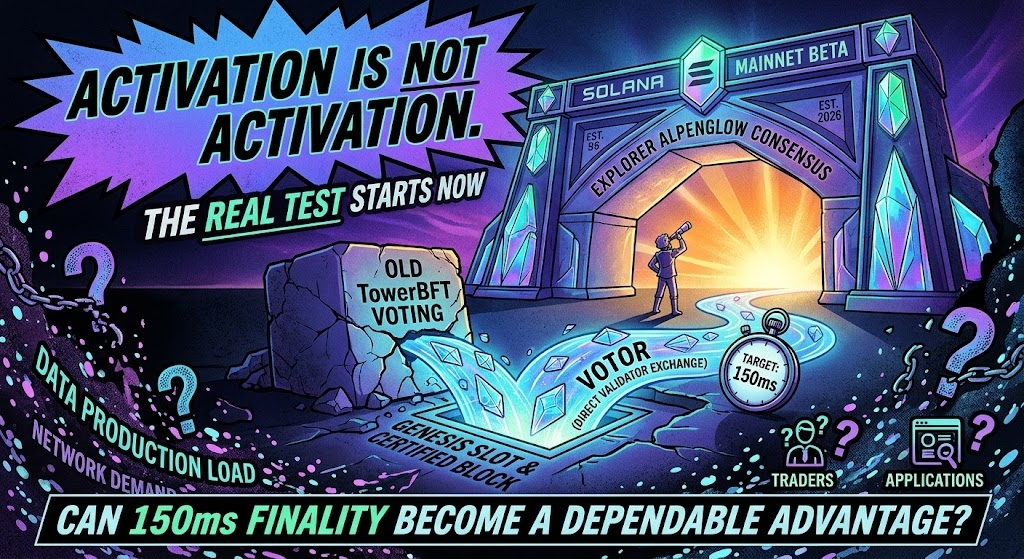
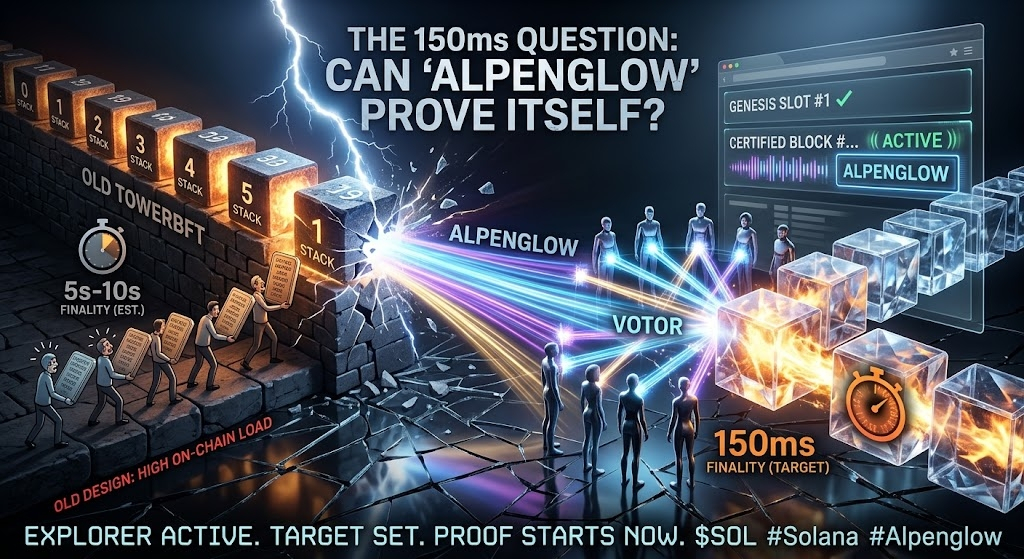
⚡ Solana's mainnet explorer now lists Alpenglow as its consensus mechanism. The real test starts after activation...
#solanasettoactivatealpenglowtoday
The explorer records an Alpenglow genesis slot and a certified block on Mainnet Beta.
The upgrade replaces the previous TowerBFT voting design with Votor, allowing validators to exchange votes directly instead of recording every vote on-chain.
The target? Roughly 150ms transaction finality.
But don't confuse the target with a guaranteed result.
Finality, transaction throughput and the speed users experience are different measurements. A faster consensus mechanism doesn't automatically mean every application becomes equally fast or that network capacity increases by the same proportion.
The next evidence to watch is measured finality under production load, successful transactions, validator stability and how applications behave during real network demand.
The deployment is the milestone. Sustained performance is the proof.
Can Alpenglow turn Solana's latency target into a dependable advantage for traders and on-chain applications?
Not financial advice.
$SOL $JUP $PYTH
{future}(PYTHUSDT)
{future}(JUPUSDT)
{future}(SOLUSDT)
#SolanaSetToActivateAlpenglowToday #ZcashDevelopersConfirmNovemberDateForNU7Upgrade #solana #SpaceXAndTeslaFormCommitteesToExploreMerger
⚡ Solana's mainnet explorer now lists Alpenglow as its consensus mechanism. The real test starts after activation...
#solanasettoactivatealpenglowtoday
The explorer records an Alpenglow genesis slot and a certified block on Mainnet Beta.
The upgrade replaces the previous TowerBFT voting design with Votor, allowing validators to exchange votes directly instead of recording every vote on-chain.
The target? Roughly 150ms transaction finality.
But don't confuse the target with a guaranteed result.
Finality, transaction throughput and the speed users experience are different measurements. A faster consensus mechanism doesn't automatically mean every application becomes equally fast or that network capacity increases by the same proportion.
The next evidence to watch is measured finality under production load, successful transactions, validator stability and how applications behave during real network demand.
The deployment is the milestone. Sustained performance is the proof.
Can Alpenglow turn Solana's latency target into a dependable advantage for traders and on-chain applications?
Not financial advice.
$SOL $JUP $PYTH
#SolanaSetToActivateAlpenglowToday #ZcashDevelopersConfirmNovemberDateForNU7Upgrade #solana #SpaceXAndTeslaFormCommitteesToExploreMerger
1
411
·
--
Verified
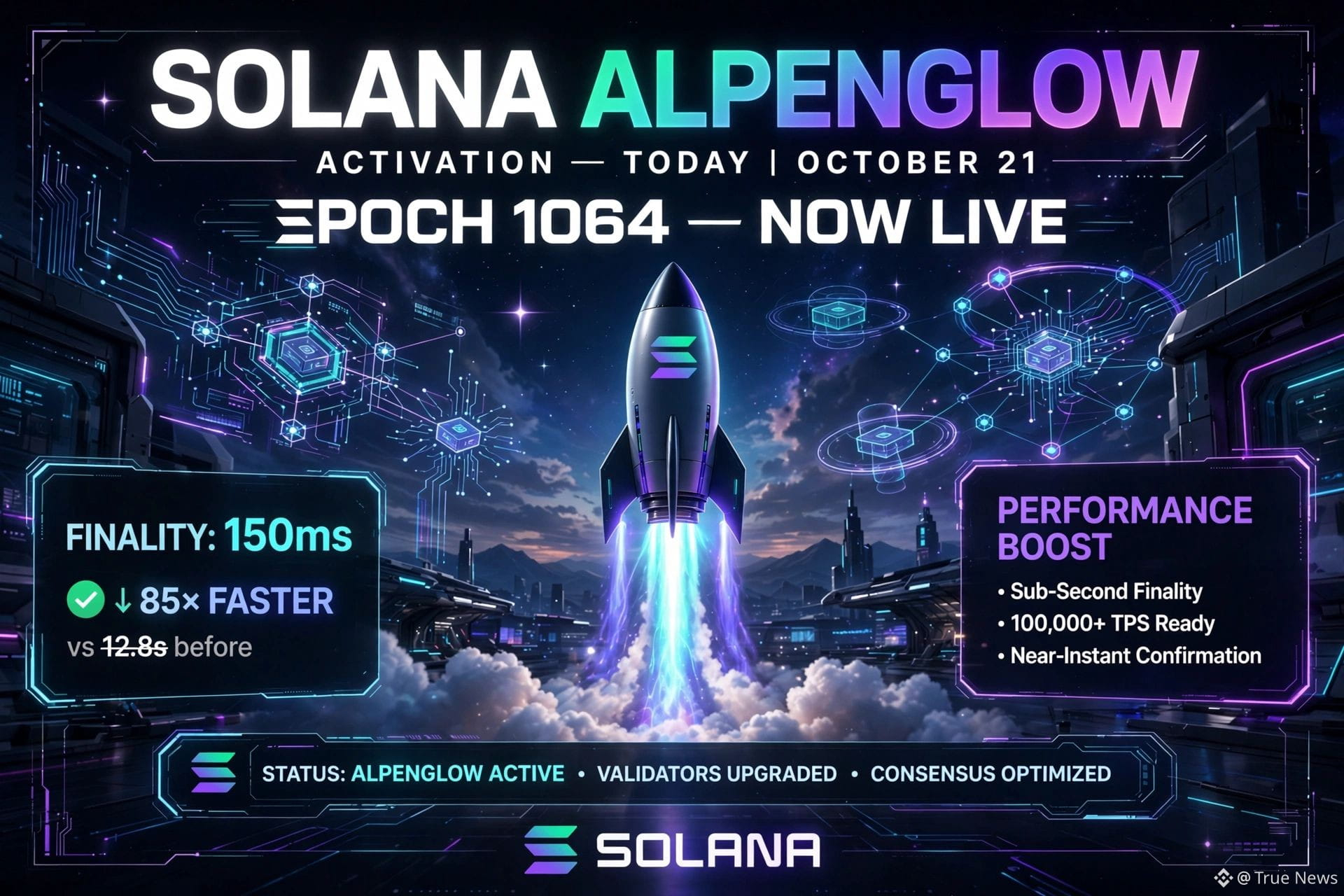
IT'S LIVE TODAY: Solana Activates Alpenglow - Biggest Upgrade Since 2020! 🚀
History is happening now. At Epoch 1064 today Oct 21 ∼14:50 UTC, Solana activates Alpenglow, replacing TowerBFT voting that has run since genesis.
What changes? Transaction finality drops from 12.8 seconds to just 150 milliseconds — 85x faster, nearly instant. Votor protocol replaces heavy vote transactions (∼500KB per slot) with off-chain aggregated BLS signatures (∼1,000 bytes).
Why it matters: Built by Anza, this unlocks real-time DeFi, payments, and gaming. No more waiting for finality. But risk remains — 151 validators holding 20.3% stake flagged as unprepared yesterday, and Firedancer clients not supported during migration.
SOL price at $106.7 up 1.95% on the news. After 6 testnet restarts, mainnet is ready.
Is Solana now the fastest L1 ever? Are you bullish?
$SOL - Direct beneficiary, 150ms finality = new superpow
$JTO
$PYTH
#solanasettoactivatealpenglowtoday #Alpenglow #CryptoNews #BinanceSquare
1
7
4k
Verified
#SolanaSetToActivateAlpenglowToday
🚨 SOLANA ACTIVATES ALPENGLOW TODAY! ⚡
A major milestone for the $SOL ecosystem! 🔥
On October 21, 2026, Solana activated "Alpenglow", its biggest consensus upgrade since the network launched in 2020.
⚡ What’s changing?
• Transaction finality targets approximately "150 milliseconds" , down from 12.8 seconds.
• Validator voting moves off-chain, changing how consensus is reached.
• Faster settlement could benefit payments, trading platforms and Web3 applications.
• Validator voting fees are replaced by a 0.8 SOL admission fee per epoch.
👀 Why it matters: Faster finality could strengthen Solana’s position in high-speed blockchain applications. However, actual performance depends on network conditions, and the upgrade does not guarantee a $SOL price rally.
{future}(SOLUSDT)
📈 Will Alpenglow become a major catalyst for Solana adoption?
#SolanaSetToActivateAlpenglowToday #SOL #Alpenglow #CryptoNews
#SolanaSetToActivateAlpenglowToday
🚨 SOLANA ACTIVATES ALPENGLOW TODAY! ⚡
A major milestone for the $SOL ecosystem! 🔥
On October 21, 2026, Solana activated "Alpenglow", its biggest consensus upgrade since the network launched in 2020.
⚡ What’s changing?
• Transaction finality targets approximately "150 milliseconds" , down from 12.8 seconds.
• Validator voting moves off-chain, changing how consensus is reached.
• Faster settlement could benefit payments, trading platforms and Web3 applications.
• Validator voting fees are replaced by a 0.8 SOL admission fee per epoch.
👀 Why it matters: Faster finality could strengthen Solana’s position in high-speed blockchain applications. However, actual performance depends on network conditions, and the upgrade does not guarantee a $SOL price rally.
📈 Will Alpenglow become a major catalyst for Solana adoption?
#SolanaSetToActivateAlpenglowToday #SOL #Alpenglow #CryptoNews
1
2
116

·
--
#SolanaSetToActivateAlpenglowToday
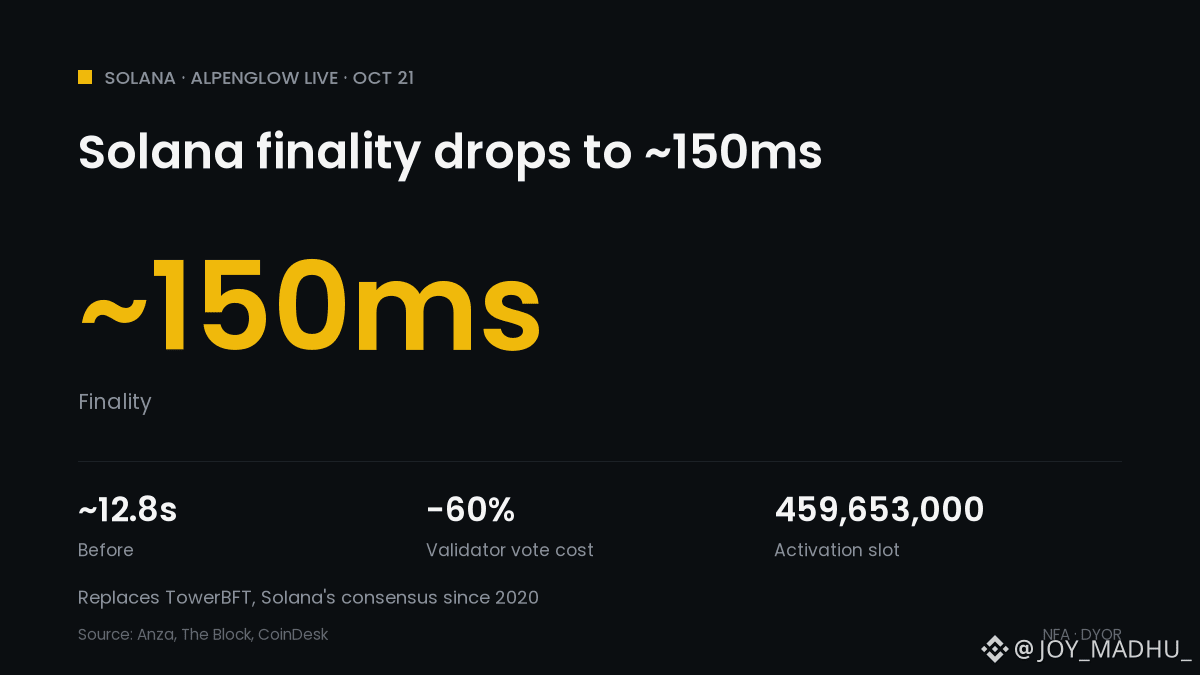
⚡ Solana Switches On Alpenglow: Finality in ~150ms
📅 Alpenglow reached Solana mainnet at slot 459,653,000, around 14:00 UTC on Oct 21
🔄 It retires TowerBFT, the consensus Solana has run since its 2020 launch
⏱️ Anza says finality drops from about 12.8 seconds to roughly 150 milliseconds
🗳️ Validator votes move off-chain, so on-chain tx counts will look lower
💸 Vote fees of ~2 SOL a day are replaced by a 0.8 SOL per-epoch ticket, about 60% cheaper
⚠️ Testing saw six testnet restarts and one rolled-back migration
What it means for crypto: faster deposits and payments could make Solana feel closer to a centralized exchange. Mainnet still has to prove the 150ms target. $SOL is near $108, up ~2.7% in 24h.
Would near-instant finality change how you use Solana? 👇
$SOL $BTC
#CryptoNews #Solana #Alpenglow #SolanaSetToActivateAlpenglowToday
12

·
--
Solana just got a new heart.
Yesterday, at around 21:54 Beijing time, mainnet epoch 1064 began. At slot 459,653,000, TowerBFT was officially retired and Alpenglow went live.
Unchained’s on-chain verification was meticulous: the last block of the TowerBFT era was slot 459,652,999. Then there was a gap of 8 slots before slot 459,653,008 arrived. Block height continued to advance, with no sign of a rollback.
This was a complete overhaul of the consensus layer, not a minor tune-up.
Under the old TowerBFT, a transaction took about 12.8 seconds to reach finality. Alpenglow’s new protocol, Votor, moves validator voting off-chain and uses BLS aggregate signatures to compress thousands of signatures into a single certificate, with the goal of bringing finality down to around 150 milliseconds.
It also addresses costs: previously, around 500KB of vote transactions per slot had to be put on-chain, accounting for 75% of ledger entries. With votes no longer being on-chain transactions, validator-related costs are reportedly expected to drop by about 60%.
The process was quite bumpy: since the testnet launched in May, it was rebuilt from scratch six times, and a failed network-wide migration had to be rolled back. In September 2025, the SIMD-0326 governance vote passed with an overwhelming 98.27% approval. Less than 18 months passed between the white paper’s release and the mainnet launch. Anza’s CEO called it “the most ambitious upgrade since the Merge.”
A reality check: 150 milliseconds is the protocol’s target, not a figure delivered on day one. When the mainnet dashboard first launched, readings were still climbing in the seconds range. Rotor (block propagation) and Quantumglow, which is designed to be quantum-resistant, have yet to be scheduled. The Firedancer client is also sitting this one out for now.
The price action was honest, too: on the day of the upgrade, $SOL was around $107, up 2.6% over 24 hours (according to CoinGecko). The upgrade news didn’t ignite the market.
In my view, Alpenglow is the biggest foundational overhaul since Solana launched in 2020. Its significance isn’t today’s token price, but the “millisecond-level settlement” ticket it offers exchanges, banks, and payment providers. But the real test is only just beginning: can finality readings get close to 150 milliseconds? And when TPS figures appear to dip after voting moves off-chain, don’t be alarmed.
Do you think 150-millisecond finality will benefit exchange deposits first, or on-chain payment apps?
$SOL
#SolanaSetToActivateAlpenglowToday
#Solana #Alpenglow
This is not investment advice. DYOR. Trading involves risk.


72

Is Approaching a Major Network Upgrade!🚨⚡ #SolanaSetToActivateAlpenglowToday
🔥 What if Solana's TPS suddenly drops, but the network actually becomes more efficient?
That’s the big story behind Alpenglow, Solana’s major consensus upgrade scheduled for October 21, 2026, at epoch 1064. The planned transition replaces TowerBFT with a new voting protocol called Votor. 👀
Here’s what every $SOL holder and crypto trader should know. 👇
⚡ 1. Finality Target: 12.8 Seconds → 150 Milliseconds
Alpenglow aims to reduce transaction finality to around 150 milliseconds — potentially about 85 times faster than the cited 12.8-second benchmark.
If achieved under real-world conditions, this could improve the experience for DeFi traders, payments, blockchain gaming, and other applications that depend on fast settlement.
🧠 2. Why Could Solana's TPS Drop?
Here’s the twist! 😮
Validator votes currently account for a substantial share of Solana’s recorded transactions. Under Votor, these votes move off-chain and are aggregated into certificates.
📉 That means headline TPS and transaction counts could fall after the transition.
But a lower displayed TPS doesn't automatically mean fewer user transactions or worse performance. The way network activity is counted is changing.
🛠️ 3. What Stays the Same?
✅ Solana Virtual Machine (SVM)
✅ Transaction format
✅ User transaction fee structure
Regular users generally won't need to migrate their wallets or change how they use dApps. Validators, however, must ensure their software supports the upgrade.
⚠️ 4. What Should Traders Watch?
The 150ms figure is a target, not a guarantee for every transaction under every network condition.
After activation, keep an eye on:
📊 Actual transaction finality and latency
🔗 Validator participation and network stability
⏱️ Missed slots and block production
📉 TPS excluding validator votes
Also, Rotor — the separate block-propagation component — is not part of this activation.
🔥 MY TAKE ON $SOL
Alpenglow could be an important technical milestone for Solana, but the real test is how it performs on mainnet.
And remember: a major upgrade doesn't automatically mean $SOL's price will rise. Market sentiment, liquidity, execution, and investor expectations still matter.
💬 LET'S HEAR YOUR OPINION!
🚀 Is Alpenglow a game-changer for Solana?
📉 Will a sharp drop in reported TPS confuse traders?
👀 Or is the market already pricing in the upgrade?
Comment BULLISH 🚀 or BEARISH 🐻 and tell us what metric you'll watch first!
$SOL
#Solana #Alpenglow #SOL
Crypto assets are volatile. This post is for informational purposes only, not financial advice.
{spot}(SOLUSDT)
Is Approaching a Major Network Upgrade!
🚨⚡ #SolanaSetToActivateAlpenglowToday
🔥 What if Solana's TPS suddenly drops, but the network actually becomes more efficient?
That’s the big story behind Alpenglow, Solana’s major consensus upgrade scheduled for October 21, 2026, at epoch 1064. The planned transition replaces TowerBFT with a new voting protocol called Votor. 👀
Here’s what every $SOL holder and crypto trader should know. 👇
⚡ 1. Finality Target: 12.8 Seconds → 150 Milliseconds
Alpenglow aims to reduce transaction finality to around 150 milliseconds — potentially about 85 times faster than the cited 12.8-second benchmark.
If achieved under real-world conditions, this could improve the experience for DeFi traders, payments, blockchain gaming, and other applications that depend on fast settlement.
🧠 2. Why Could Solana's TPS Drop?
Here’s the twist! 😮
Validator votes currently account for a substantial share of Solana’s recorded transactions. Under Votor, these votes move off-chain and are aggregated into certificates.
📉 That means headline TPS and transaction counts could fall after the transition.
But a lower displayed TPS doesn't automatically mean fewer user transactions or worse performance. The way network activity is counted is changing.
🛠️ 3. What Stays the Same?
✅ Solana Virtual Machine (SVM)
✅ Transaction format
✅ User transaction fee structure
Regular users generally won't need to migrate their wallets or change how they use dApps. Validators, however, must ensure their software supports the upgrade.
⚠️ 4. What Should Traders Watch?
The 150ms figure is a target, not a guarantee for every transaction under every network condition.
After activation, keep an eye on:
📊 Actual transaction finality and latency
🔗 Validator participation and network stability
⏱️ Missed slots and block production
📉 TPS excluding validator votes
Also, Rotor — the separate block-propagation component — is not part of this activation.
🔥 MY TAKE ON $SOL
Alpenglow could be an important technical milestone for Solana, but the real test is how it performs on mainnet.
And remember: a major upgrade doesn't automatically mean $SOL 's price will rise. Market sentiment, liquidity, execution, and investor expectations still matter.
💬 LET'S HEAR YOUR OPINION!
🚀 Is Alpenglow a game-changer for Solana?
📉 Will a sharp drop in reported TPS confuse traders?
👀 Or is the market already pricing in the upgrade?
Comment BULLISH 🚀 or BEARISH 🐻 and tell us what metric you'll watch first!
$SOL
#Solana #Alpenglow #SOL
Crypto assets are volatile. This post is for informational purposes only, not financial advice.
40

Verified
#solanasettoactivatealpenglowtoday
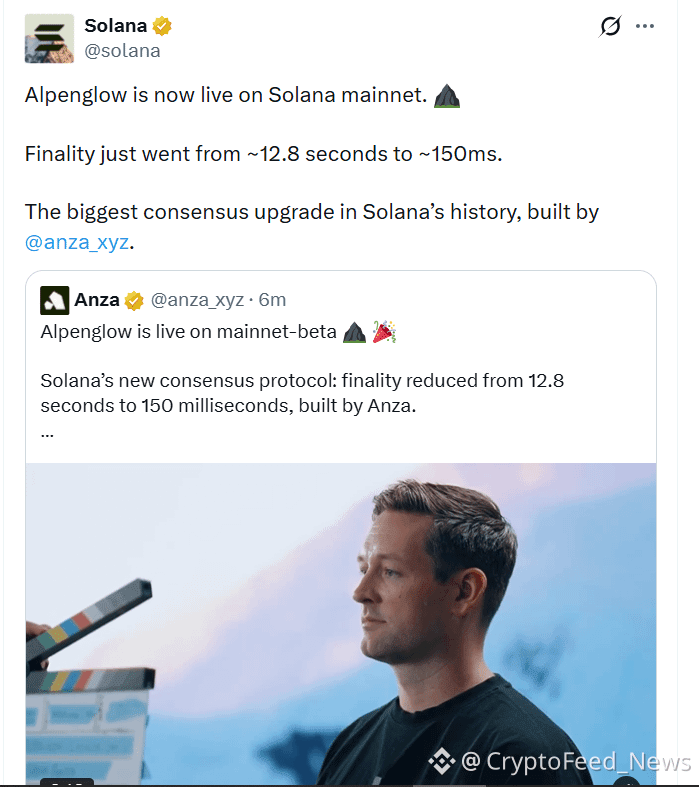
⚡ #solana ’s highly anticipated Alpenglow upgrade has been activated on October 21, targeting transaction finality of approximately 150 milliseconds, compared with the current 12.8 seconds potentially around 85× faster if the target holds.
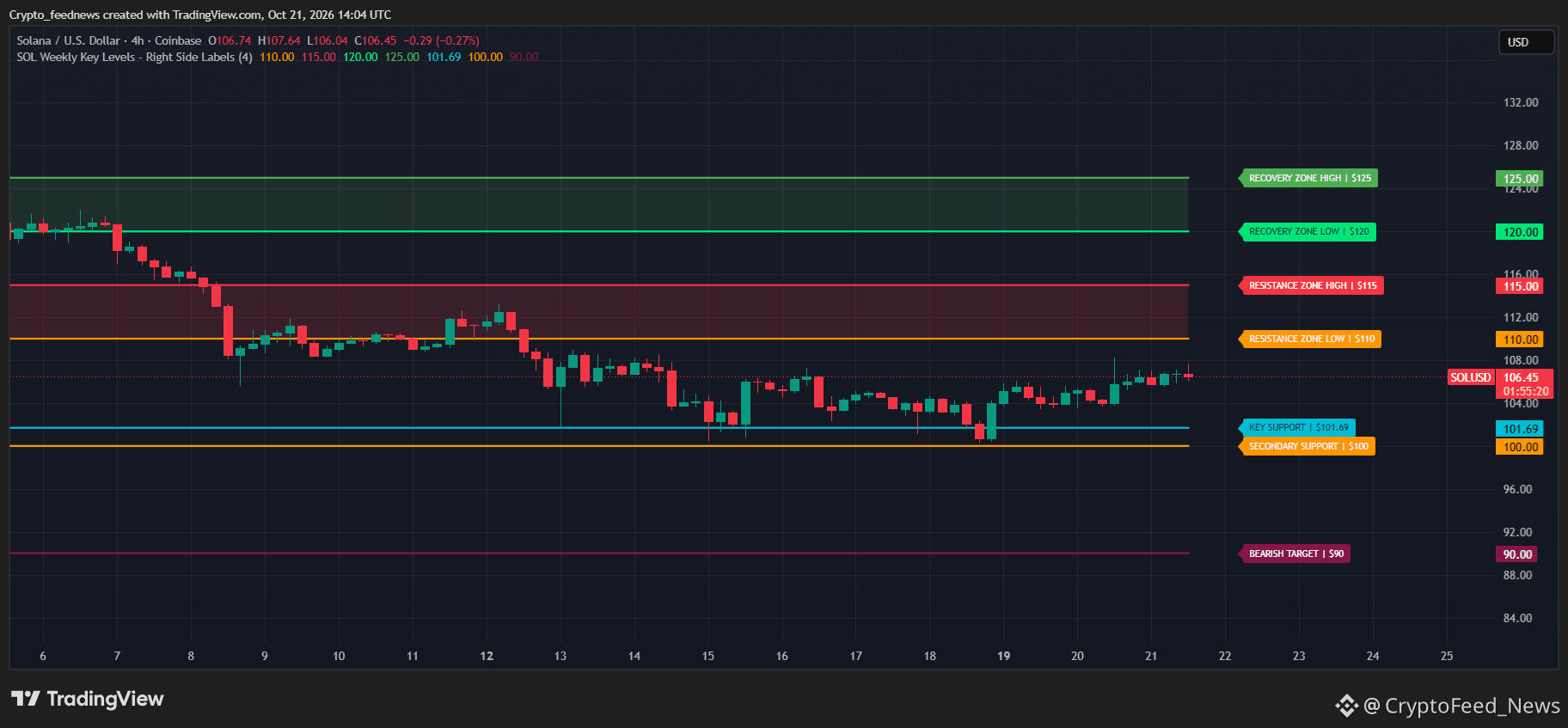
📉 $SOL started October near $121 and closed October 20 at $106.39, down roughly 12.4%.
🔑 Resistance: $110–$115, followed by $120–$125.
🛡️ Support: $101.69 and $100.
⚠️ A bearish scenario could bring $90 into focus.
🚀 #Alpenglow could strengthen Solana’s technical fundamentals, but sustained price recovery may also depend on renewed demand and broader market sentiment.
#Write2Earn
3
4.1k

#SolanaSetToActivateAlpenglowToday
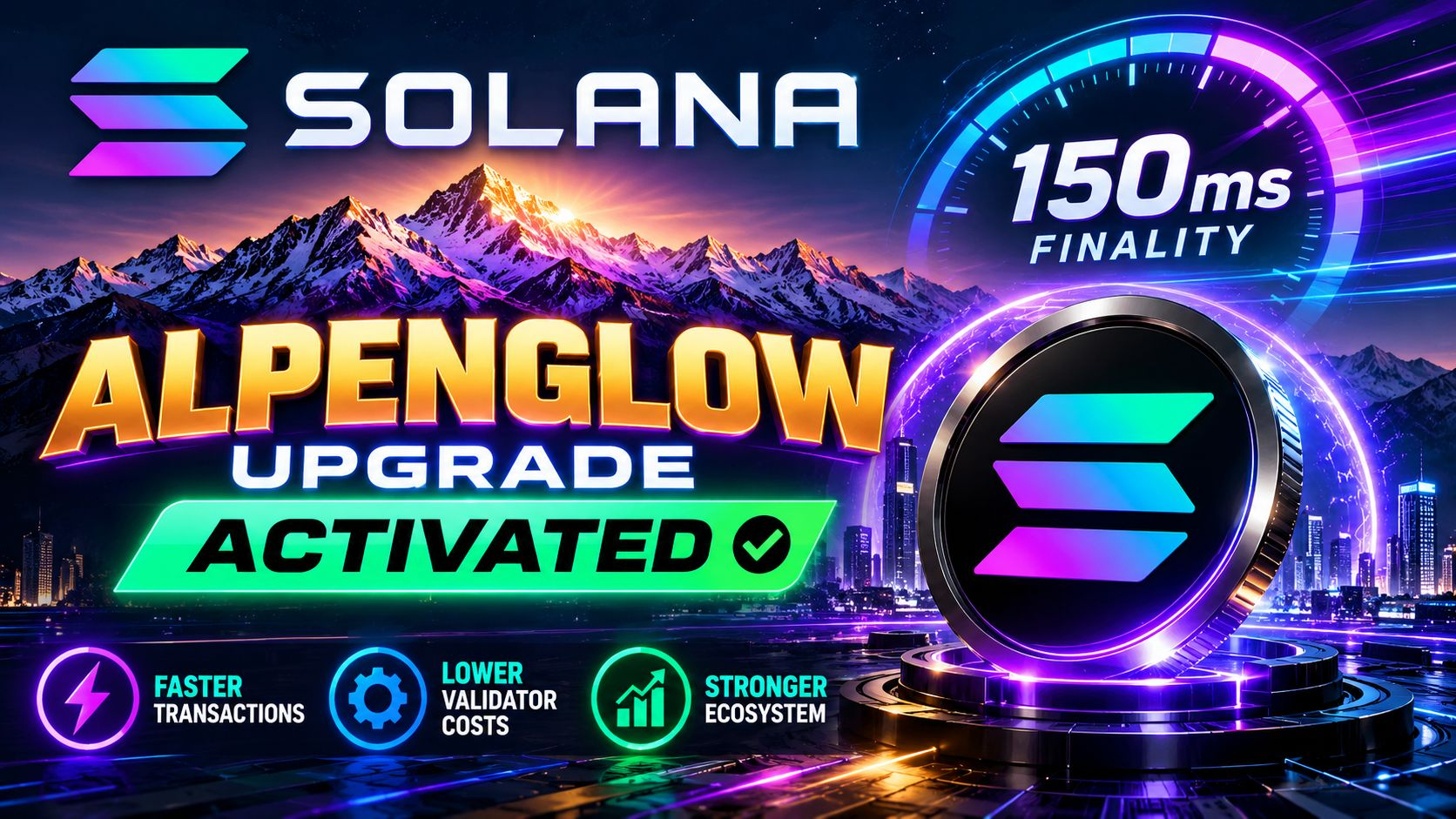
🚀 Solana Activates Alpenglow Upgrade: A Major Milestone for $SOL
Solana ($SOL) has activated its Alpenglow upgrade on mainnet, marking a significant change to the network’s core consensus system. The upgrade targets transaction finality of approximately 150 milliseconds, compared with around 12.8 seconds under the previous system. ⚡
📊 Why It Matters Alpenglow is designed to make transactions settle faster, potentially improving the experience for DeFi traders, payment applications, and blockchain users. It also introduces a new validator voting mechanism that could reduce voting-related costs.
📈 Market Impact The upgrade is a potential long-term positive for Solana’s fundamentals. Faster settlement could strengthen its competitiveness and support ecosystem growth. However, the actual impact will depend on real-world network performance, developer adoption, and user demand.
⚠️ Traders should also note that reported transaction counts may decline because validator votes will no longer be recorded as ordinary on-chain transactions. A lower headline transaction count does not necessarily indicate weaker user activity.
👀 Bottom Line: Alpenglow is an important technical milestone for Solana, but it does not guarantee an immediate price rally. Watch network stability, ecosystem activity, trading volume, and broader market sentiment.
#Solana #SOL #Alpenglow #CryptoNews
$CVX $XNY $ARC
{future}(CVXUSDT)
{future}(XNYUSDT)
{future}(ARCUSDT)
#SolanaSetToActivateAlpenglowToday
🚀 Solana Activates Alpenglow Upgrade: A Major Milestone for $SOL
Solana ($SOL) has activated its Alpenglow upgrade on mainnet, marking a significant change to the network’s core consensus system. The upgrade targets transaction finality of approximately 150 milliseconds, compared with around 12.8 seconds under the previous system. ⚡
📊 Why It Matters Alpenglow is designed to make transactions settle faster, potentially improving the experience for DeFi traders, payment applications, and blockchain users. It also introduces a new validator voting mechanism that could reduce voting-related costs.
📈 Market Impact The upgrade is a potential long-term positive for Solana’s fundamentals. Faster settlement could strengthen its competitiveness and support ecosystem growth. However, the actual impact will depend on real-world network performance, developer adoption, and user demand.
⚠️ Traders should also note that reported transaction counts may decline because validator votes will no longer be recorded as ordinary on-chain transactions. A lower headline transaction count does not necessarily indicate weaker user activity.
👀 Bottom Line: Alpenglow is an important technical milestone for Solana, but it does not guarantee an immediate price rally. Watch network stability, ecosystem activity, trading volume, and broader market sentiment.
#Solana #SOL #Alpenglow #CryptoNews
$CVX $XNY $ARC
289
Log in to explore more content
Join global crypto users on Binance Square
⚡️ Get latest and useful information about crypto.
💬 Trusted by the world’s largest crypto exchange.
👍 Discover real insights from verified creators.
Email / Phone number
Trending Topics
1
#BinanceProcesses$4.65BWithdrawals
52,751 views
223 Discussing
2
#WithdrawalsBack: 15 networks live
11,649 views
172 Discussing
3
#EthereumSurpasses$2300
786 views
40 Discussing
4
#BitcoinSpotETFsPost$203MWeeklyOutflow
1,062 views
24 Discussing
5
#SouthKoreanLawmakerProposesReviewOfAllListedDigitalAssets
529 views
26 Discussing
6
#BrazilVirtualAssetLicenseDeadlineDrawsAbout40Firms
16,646 views
294 Discussing
7
#BTCPayServerUrgesOperatorsToShutDownInstances
13,467 views
257 Discussing
8
#BankOfKoreaSurveysFinancialFirmsOnVirtualAssetRisks
512 views
18 Discussing
9
#BinanceUpdatesProofofReservesAddresses
197,855 views
1,975 Discussing
10
#StudyFindsCircleAIAgentWalletLimitsCanBeBypassed
7,954 views
156 Discussing