
#solanagovernancevotetodoubledeflationrate
solanagovernancevotetodoubledeflationrate
46,500 views
736 Discussing
Hot
Latest

Verified
#solanagovernancevotetodoubledeflationrate
🚨 SOLANA SUPPLY SHOCK IN FOCUS! ⚡
A Solana governance vote is reportedly considering a change that could increase SOL’s deflationary pressure from -15% to -30%, potentially reducing supply growth if approved.
📊 Validators may face lower staking rewards, while SOL holders could benefit from greater scarcity. A successful vote could become a bullish catalyst, but volatility may rise sharply around the decision.
🎯 TRADING VIEW: BUY 📈
A positive governance outcome could strengthen SOL’s bullish case. Watch the vote result and price reaction closely before increasing exposure.
❓ Could this vote trigger SOL’s next major rally? "CLICK ON THE BELOW YELLOW COIN TAG TO GO TO DESIRED TRADING PAGE TO GET BENEFIT TRADE"$PROM $SOL $UAI
🚨 SOLANA SUPPLY SHOCK IN FOCUS! ⚡
A Solana governance vote is reportedly considering a change that could increase SOL’s deflationary pressure from -15% to -30%, potentially reducing supply growth if approved.
📊 Validators may face lower staking rewards, while SOL holders could benefit from greater scarcity. A successful vote could become a bullish catalyst, but volatility may rise sharply around the decision.
🎯 TRADING VIEW: BUY 📈
A positive governance outcome could strengthen SOL’s bullish case. Watch the vote result and price reaction closely before increasing exposure.
❓ Could this vote trigger SOL’s next major rally? "CLICK ON THE BELOW YELLOW COIN TAG TO GO TO DESIRED TRADING PAGE TO GET BENEFIT TRADE"$PROM $SOL $UAI

Verified
Solana Governance Vote to Double Deflation Rate 🤯
Solana’s governance vote for SGP-0002 (doubling the annual disinflation/deflation rate from 15% to 30%) is live. It cuts token issuance speed, reducing supply by 18.9 million $SOL over six years and accelerating the target 1.5% inflation floor from 5.7 to 2.8 years.
Supply Path (6-Yr Projection):
Current (-15%): |██████████████| 708.5M SOL
Proposed (-30%):|████████████| 689.6M SOL
Impact on SOL Price:
- Bullish (Long-Term): Reduced token dilution creates structural scarcity, driving upward price pressure as annual issuance drops faster.
- Bearish/Neutral (Short-Term): Staking yields decrease rapidly, causing short-term friction with validators/stakers preferring steady rewards.
#solanagovernancevotetodoubledeflationrate
Solana’s governance vote for SGP-0002 (doubling the annual disinflation/deflation rate from 15% to 30%) is live. It cuts token issuance speed, reducing supply by 18.9 million $SOL over six years and accelerating the target 1.5% inflation floor from 5.7 to 2.8 years.
Supply Path (6-Yr Projection):
Current (-15%): |██████████████| 708.5M SOL
Proposed (-30%):|████████████| 689.6M SOL
Impact on SOL Price:
- Bullish (Long-Term): Reduced token dilution creates structural scarcity, driving upward price pressure as annual issuance drops faster.
- Bearish/Neutral (Short-Term): Staking yields decrease rapidly, causing short-term friction with validators/stakers preferring steady rewards.
#solanagovernancevotetodoubledeflationrate

📈 Less SOL Issuance — Bullish or Complicated?
Solana governance is considering a major change to its inflation schedule. The proposal would double the disinflation rate to 30%, potentially reducing future SOL emissions by around 18.9 million tokens over six years.
That creates an interesting trade-off:
🔻 Lower future issuance
🔻 Lower nominal staking rewards
🔺 Potentially tighter long-term supply dynamics
📊 Trading effect: The proposal could become an important catalyst for $SOL, but traders should not assume approval or a guaranteed price increase.
Watch governance developments + volume + price structure before taking a spot position.
#solanagovernancevotetodoubledeflationrate
Solana governance is considering a major change to its inflation schedule. The proposal would double the disinflation rate to 30%, potentially reducing future SOL emissions by around 18.9 million tokens over six years.
That creates an interesting trade-off:
🔻 Lower future issuance
🔻 Lower nominal staking rewards
🔺 Potentially tighter long-term supply dynamics
📊 Trading effect: The proposal could become an important catalyst for $SOL, but traders should not assume approval or a guaranteed price increase.
Watch governance developments + volume + price structure before taking a spot position.
#solanagovernancevotetodoubledeflationrate

Verified
#solanagovernancevotetodoubledeflationrate
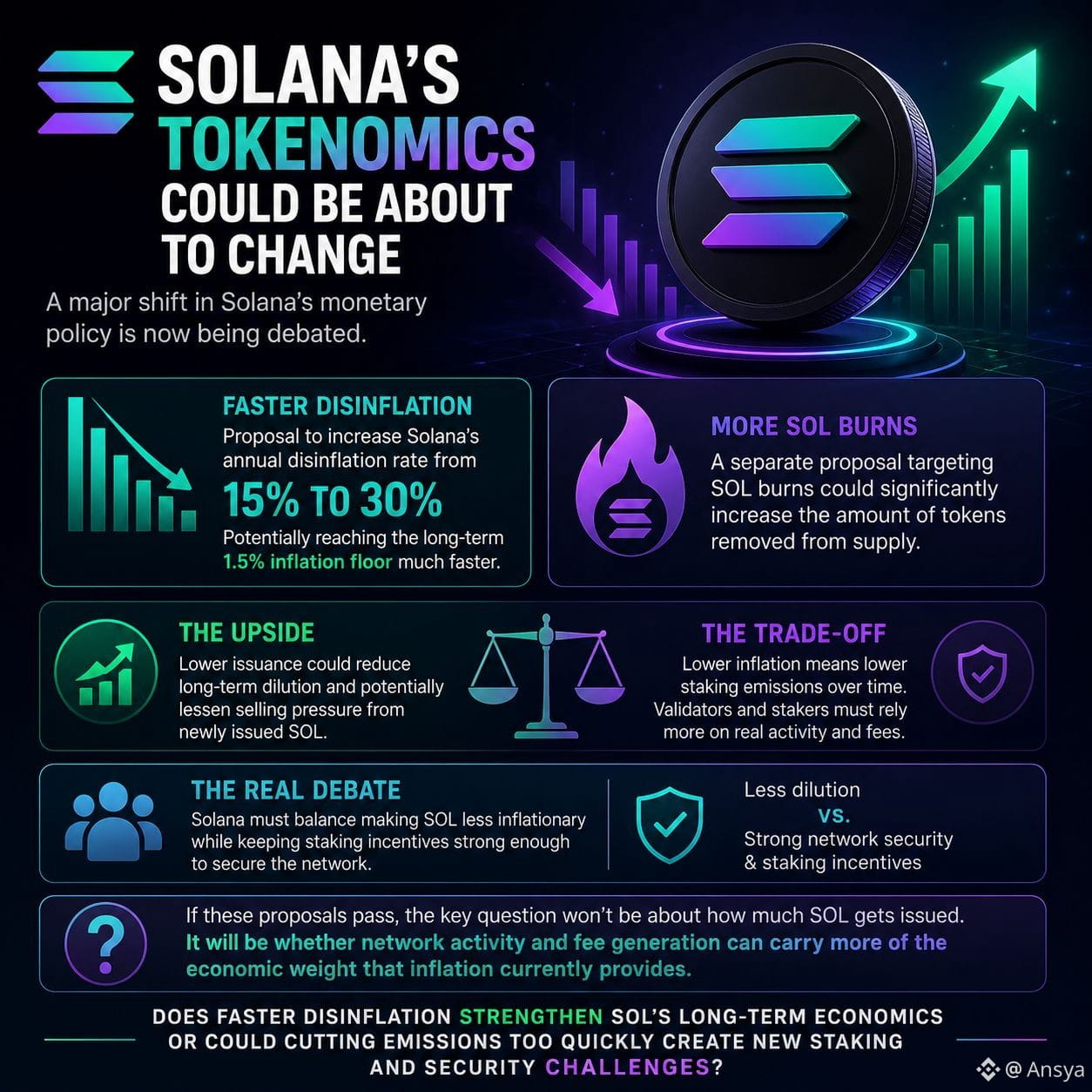
🪙 Solana’s Tokenomics Could Be About to Change
A major shift in Solana’s monetary policy is now being debated, with validators considering a proposal that could accelerate the network’s path toward lower inflation.
The proposal would increase Solana’s annual disinflation rate from 15% to 30%, meaning the network could reach its long-term 1.5% inflation floor much faster than under the current schedule.
There’s also a separate proposal targeting SOL burns that could significantly increase the amount of tokens removed from supply.
That makes this more than a technical parameter change.
The potential upside: lower issuance could reduce long-term dilution and potentially lessen some of the selling pressure associated with newly issued SOL.
The trade-off: lower inflation also means lower staking emissions over time. Validators and stakers would have to adjust to a network where rewards depend more heavily on actual activity rather than token issuance.
And that creates the real debate.
Solana has to balance two competing goals: making SOL less inflationary while keeping staking incentives strong enough to secure the network.
If the proposals pass, the interesting part won't just be the reduction in new SOL.
It will be whether network activity and fee generation can eventually carry more of the economic weight that inflation currently provides.
Does faster disinflation strengthen SOL's long-term economics — or could cutting emissions too quickly create new security and staking challenges?
$SOL $PROM $TUT
🪙 Solana’s Tokenomics Could Be About to Change
A major shift in Solana’s monetary policy is now being debated, with validators considering a proposal that could accelerate the network’s path toward lower inflation.
The proposal would increase Solana’s annual disinflation rate from 15% to 30%, meaning the network could reach its long-term 1.5% inflation floor much faster than under the current schedule.
There’s also a separate proposal targeting SOL burns that could significantly increase the amount of tokens removed from supply.
That makes this more than a technical parameter change.
The potential upside: lower issuance could reduce long-term dilution and potentially lessen some of the selling pressure associated with newly issued SOL.
The trade-off: lower inflation also means lower staking emissions over time. Validators and stakers would have to adjust to a network where rewards depend more heavily on actual activity rather than token issuance.
And that creates the real debate.
Solana has to balance two competing goals: making SOL less inflationary while keeping staking incentives strong enough to secure the network.
If the proposals pass, the interesting part won't just be the reduction in new SOL.
It will be whether network activity and fee generation can eventually carry more of the economic weight that inflation currently provides.
Does faster disinflation strengthen SOL's long-term economics — or could cutting emissions too quickly create new security and staking challenges?
$SOL $PROM $TUT
Verified
👀 30% Disinflation? SOL Traders Have a New Catalyst
Solana developers have proposed doubling the pace at which SOL's inflation rate declines—from 15% to 30% annually.
If implemented, the network could reach its 1.5% terminal inflation rate in the first half of 2029, compared with the current path toward 2032.
🔥 Trading effect: This could become an important long-term tokenomics catalyst for $SOL. But lower issuance does not guarantee a higher price—demand, network activity and overall market conditions still matter.
Spot traders should watch the governance process and price confirmation before entering.
#solanagovernancevotetodoubledeflationrate
Solana developers have proposed doubling the pace at which SOL's inflation rate declines—from 15% to 30% annually.
If implemented, the network could reach its 1.5% terminal inflation rate in the first half of 2029, compared with the current path toward 2032.
🔥 Trading effect: This could become an important long-term tokenomics catalyst for $SOL. But lower issuance does not guarantee a higher price—demand, network activity and overall market conditions still matter.
Spot traders should watch the governance process and price confirmation before entering.
#solanagovernancevotetodoubledeflationrate

Verified
#SolanaGovernanceVoteToDoubleDeflationRate
🚨 SOLANA JUST PUT VALIDATORS’ PAY UP FOR A VOTE. 👀
Solana has opened its first formal on-chain governance votes, and this isn't just a procedural update.
Three proposals are on the table:
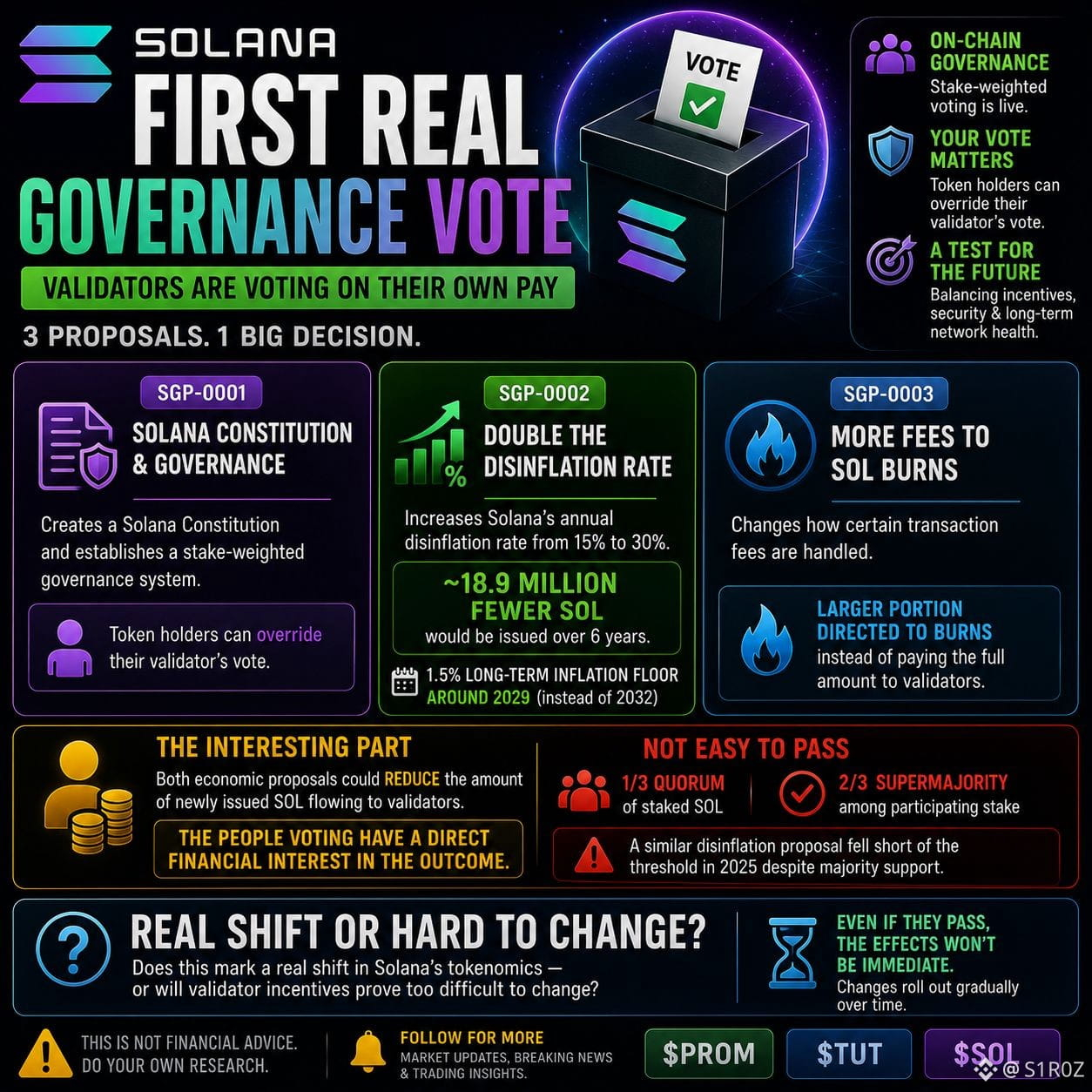
🗳️ SGP-0001 would establish a Solana Constitution and formalize stake-weighted governance.
📉 SGP-0002 would double the annual disinflation rate from 15% to 30%, potentially reaching Solana's 1.5% long-term inflation floor around 2029 instead of 2032.
🔥 SGP-0003 would redirect more transaction fees toward SOL burns rather than paying the full amount to validators.
Here's the interesting part: the economic proposals could reduce newly issued SOL going to validators — meaning some of the people voting have a direct financial interest in the outcome.
The vote requires one-third quorum and a two-thirds supermajority.
Is Solana entering a new era of governance, or will validator incentives make these changes harder to pass?
$SOL $PROM $TUT
#solana #SOL #Crypto #governance #DeFi
🚨 SOLANA JUST PUT VALIDATORS’ PAY UP FOR A VOTE. 👀
Solana has opened its first formal on-chain governance votes, and this isn't just a procedural update.
Three proposals are on the table:
🗳️ SGP-0001 would establish a Solana Constitution and formalize stake-weighted governance.
📉 SGP-0002 would double the annual disinflation rate from 15% to 30%, potentially reaching Solana's 1.5% long-term inflation floor around 2029 instead of 2032.
🔥 SGP-0003 would redirect more transaction fees toward SOL burns rather than paying the full amount to validators.
Here's the interesting part: the economic proposals could reduce newly issued SOL going to validators — meaning some of the people voting have a direct financial interest in the outcome.
The vote requires one-third quorum and a two-thirds supermajority.
Is Solana entering a new era of governance, or will validator incentives make these changes harder to pass?
$SOL $PROM $TUT
#solana #SOL #Crypto #governance #DeFi

Verified
#solanagovernancevotetodoubledeflationrate
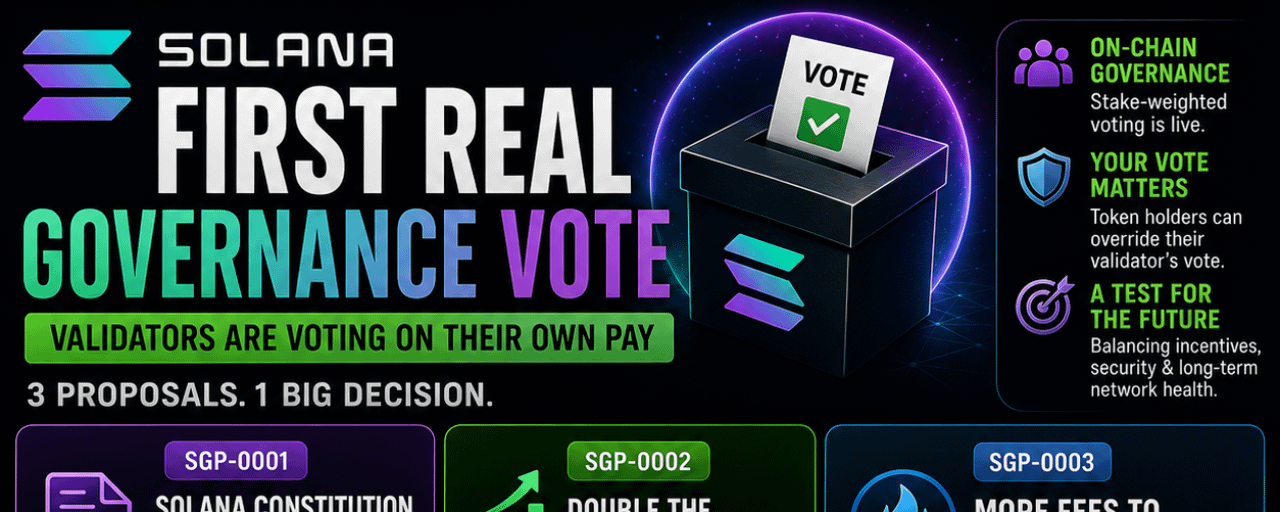
🗳️ Solana Just Opened Its First Real Governance Vote — And Validators Are Voting on Their Own Pay
Some governance votes are procedural. This one is different.
Solana has opened its first formal on-chain governance votes, covering three proposals that put both the network's governance structure and token economics under the spotlight.
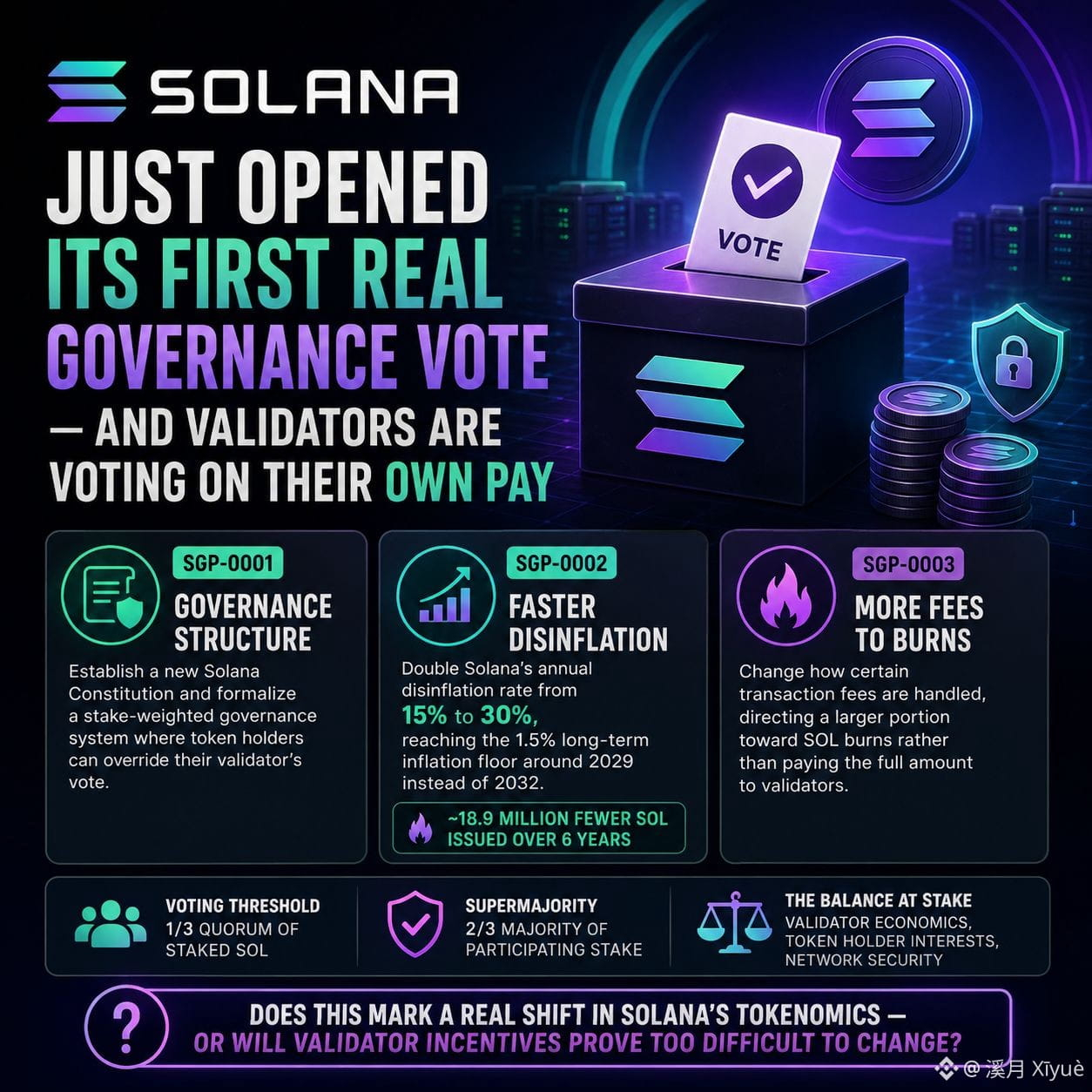
SGP-0001 would establish a new Solana Constitution and formalize a stake-weighted governance system where individual token holders can override their validator's vote.
SGP-0002 would double Solana's annual disinflation rate from 15% to 30%, potentially bringing the network to its 1.5% long-term inflation floor around 2029 instead of 2032. The proposal estimates roughly 18.9 million fewer SOL would be issued over six years.
SGP-0003 would change how certain transaction fees are handled, directing a larger portion toward SOL burns rather than paying the full amount to validators.
That's where the vote gets especially interesting.
Both economic proposals could reduce the amount of newly issued SOL flowing to validators. In other words, the people voting on the changes have a direct financial interest in the outcome.
There's also a governance test happening underneath the tokenomics debate.
The proposals require one-third quorum of staked SOL and a two-thirds supermajority among participating stake. A similar disinflation proposal fell short of that threshold in 2025 despite receiving majority support.
So this isn't simply a vote about whether SOL should become less inflationary.
It's a test of whether Solana's new governance system can balance validator economics, token-holder interests, and long-term network security.
And even if the proposals pass, the economic effects wouldn't appear overnight.
Does this mark a real shift in Solana's tokenomics — or will validator incentives prove too difficult to change?
$PROM $TUT $SOL
🗳️ Solana Just Opened Its First Real Governance Vote — And Validators Are Voting on Their Own Pay
Some governance votes are procedural. This one is different.
Solana has opened its first formal on-chain governance votes, covering three proposals that put both the network's governance structure and token economics under the spotlight.
SGP-0001 would establish a new Solana Constitution and formalize a stake-weighted governance system where individual token holders can override their validator's vote.
SGP-0002 would double Solana's annual disinflation rate from 15% to 30%, potentially bringing the network to its 1.5% long-term inflation floor around 2029 instead of 2032. The proposal estimates roughly 18.9 million fewer SOL would be issued over six years.
SGP-0003 would change how certain transaction fees are handled, directing a larger portion toward SOL burns rather than paying the full amount to validators.
That's where the vote gets especially interesting.
Both economic proposals could reduce the amount of newly issued SOL flowing to validators. In other words, the people voting on the changes have a direct financial interest in the outcome.
There's also a governance test happening underneath the tokenomics debate.
The proposals require one-third quorum of staked SOL and a two-thirds supermajority among participating stake. A similar disinflation proposal fell short of that threshold in 2025 despite receiving majority support.
So this isn't simply a vote about whether SOL should become less inflationary.
It's a test of whether Solana's new governance system can balance validator economics, token-holder interests, and long-term network security.
And even if the proposals pass, the economic effects wouldn't appear overnight.
Does this mark a real shift in Solana's tokenomics — or will validator incentives prove too difficult to change?
$PROM $TUT $SOL

#solanagovernancevotetodoubledeflationrate
One of the most important SOL stories is being misunderstood.
The proposal is called SIMD-0550: Double Disinflation.
It proposes increasing Solana’s annual disinflation rate from 15% to 30%, accelerating the path toward the 1.5% terminal inflation rate.
Important:
Disinflation ≠ deflation.
SOL supply would still grow; new issuance would simply decline faster.
The estimated effect could reduce future issuance by roughly 18.9M SOL over six years.
Why it matters:
Lower future issuance can improve SOL’s supply economics, especially if network demand and fee burns continue growing.
But governance approval ≠ instant price appreciation.
Investor play: Watch:
• Validator vote
• Final implementation
• SOL issuance
• Fee burn
• Network activity
• Staking economics
Don’t buy because someone says “SOL is becoming deflationary.”
Understand the supply curve first.
$SOL
$PENGU
$TRUMP
#Solana #SOL #Tokenomics #Crypto
One of the most important SOL stories is being misunderstood.
The proposal is called SIMD-0550: Double Disinflation.
It proposes increasing Solana’s annual disinflation rate from 15% to 30%, accelerating the path toward the 1.5% terminal inflation rate.
Important:
Disinflation ≠ deflation.
SOL supply would still grow; new issuance would simply decline faster.
The estimated effect could reduce future issuance by roughly 18.9M SOL over six years.
Why it matters:
Lower future issuance can improve SOL’s supply economics, especially if network demand and fee burns continue growing.
But governance approval ≠ instant price appreciation.
Investor play: Watch:
• Validator vote
• Final implementation
• SOL issuance
• Fee burn
• Network activity
• Staking economics
Don’t buy because someone says “SOL is becoming deflationary.”
Understand the supply curve first.
$SOL
$PENGU
$TRUMP
#Solana #SOL #Tokenomics #Crypto

Partly True
#solanagovernancevotetodoubledeflationrate
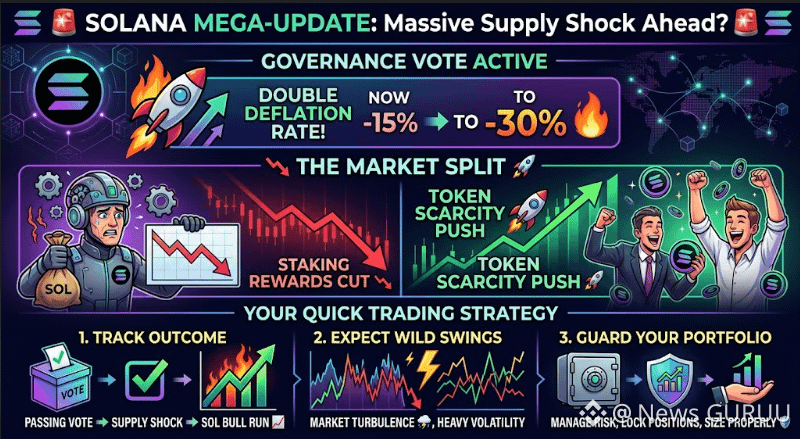
🚨 SOLANA MEGA-UPDATE: Massive Supply Shock Ahead? 🚨
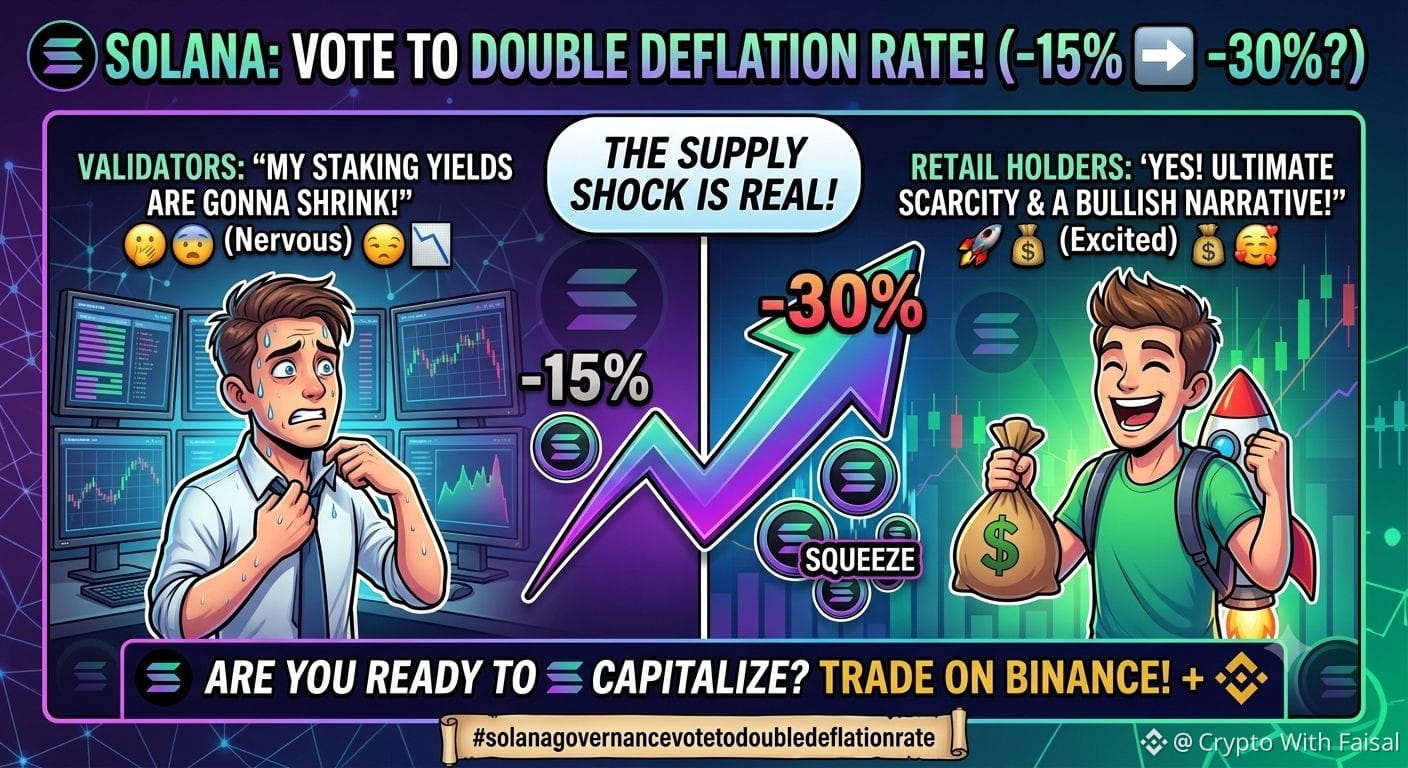
A critical governance vote is currently active on the Solana network to double the deflation rate—cranking it from -15% to an aggressive -30%!
The Market Split:
📉 Validators are stressed about massive cuts to their staking rewards.
🚀 Retail Holders are celebrating the push for ultimate token scarcity.
Your Quick Trading Strategy:
Track the Outcome: A passing vote triggers a fierce supply shock, potentially fueling a massive bullish run for SOL.
Expect Wild Swings: Brace for heavy market turbulence as traders react to the news.
Guard Your Portfolio: Manage your risk tightly and lock in proper position sizing.
(⚠️ Reminder: This is NOT financial advice!)
Want to capitalize on the incoming SOL price action? Jump onto Binance today and ride the volatility! 🌊🚀
$SOL $UAI $PROM
🚨 SOLANA MEGA-UPDATE: Massive Supply Shock Ahead? 🚨
A critical governance vote is currently active on the Solana network to double the deflation rate—cranking it from -15% to an aggressive -30%!
The Market Split:
📉 Validators are stressed about massive cuts to their staking rewards.
🚀 Retail Holders are celebrating the push for ultimate token scarcity.
Your Quick Trading Strategy:
Track the Outcome: A passing vote triggers a fierce supply shock, potentially fueling a massive bullish run for SOL.
Expect Wild Swings: Brace for heavy market turbulence as traders react to the news.
Guard Your Portfolio: Manage your risk tightly and lock in proper position sizing.
(⚠️ Reminder: This is NOT financial advice!)
Want to capitalize on the incoming SOL price action? Jump onto Binance today and ride the volatility! 🌊🚀
$SOL $UAI $PROM

Verified
#solanagovernancevotetodoubledeflationrate — Solana Votes to Double Its Disinflation
What's live. Solana's on-chain vote on SGP-0002 is open (epoch 1023) and closes Aug 26, 15:30 UTC . The proposal doubles the network's disinflation rate from -15% to -30% per year , pulling the 1.5% minimum inflation floor forward from 2032 to 2029 . Estimated impact: ~18.9M $SOL cut from issuance over six years — worth roughly $1.8B at current prices. Modeled staking yield would drift from ~5.84% today to ~4.34% after a year, ~2.25% after three.
It's one of three. SGP-0001 (the Solana Constitution — governance framework), SGP-0002 (double disinflation), SGP-0003 (fee overhaul: fixed inclusion fee + floating resource fee, lifting daily burns from ~650 $SOL ≈ $47K to 7,500–9,000 $SOL ≈ $650K, a 14x jump ). They pass only with one-third stake participation and two-thirds support — DFDV has reportedly cast the largest weighted vote so far, and some non-activated staked accounts couldn't vote.
The pushback is timing, not direction. HSDT, a $SOL treasury firm, backs the Constitution but opposes SGP-0002/0003 for now — arguing institutions entering Solana need rule stability first, and that inflation/fee tweaks should wait for sustained net capital inflows. Classic "sooner vs. later" tension.
Why it matters: Even at max burn, $SOL stays net inflationary (~9,000/day burned vs. ~60,000/day issued) — so the real tightening story is the disinflation curve + burn mechanism combined . $SOL is at ~$94, +25% on the week after a $4.6B short squeeze, and this vote is the next catalyst on the tape.
#SamsungFalls6.4%OnReturnPlanMiss #CanadaUSTradeTalksCollapse #BitcoinStrongestWeekSinceMarch2023 #GoldNearsThreeMonthHigh $XRP $SUI
What's live. Solana's on-chain vote on SGP-0002 is open (epoch 1023) and closes Aug 26, 15:30 UTC . The proposal doubles the network's disinflation rate from -15% to -30% per year , pulling the 1.5% minimum inflation floor forward from 2032 to 2029 . Estimated impact: ~18.9M $SOL cut from issuance over six years — worth roughly $1.8B at current prices. Modeled staking yield would drift from ~5.84% today to ~4.34% after a year, ~2.25% after three.
It's one of three. SGP-0001 (the Solana Constitution — governance framework), SGP-0002 (double disinflation), SGP-0003 (fee overhaul: fixed inclusion fee + floating resource fee, lifting daily burns from ~650 $SOL ≈ $47K to 7,500–9,000 $SOL ≈ $650K, a 14x jump ). They pass only with one-third stake participation and two-thirds support — DFDV has reportedly cast the largest weighted vote so far, and some non-activated staked accounts couldn't vote.
The pushback is timing, not direction. HSDT, a $SOL treasury firm, backs the Constitution but opposes SGP-0002/0003 for now — arguing institutions entering Solana need rule stability first, and that inflation/fee tweaks should wait for sustained net capital inflows. Classic "sooner vs. later" tension.
Why it matters: Even at max burn, $SOL stays net inflationary (~9,000/day burned vs. ~60,000/day issued) — so the real tightening story is the disinflation curve + burn mechanism combined . $SOL is at ~$94, +25% on the week after a $4.6B short squeeze, and this vote is the next catalyst on the tape.
#SamsungFalls6.4%OnReturnPlanMiss #CanadaUSTradeTalksCollapse #BitcoinStrongestWeekSinceMarch2023 #GoldNearsThreeMonthHigh $XRP $SUI

Partly True
#solanagovernancevotetodoubledeflationrate 3 major SOL
proposals just went LIVE
If all three pass, the combined impact is massive
SGP-2 cuts future emissions by 18.9M SOL over 6 years
SGP-3 jumps daily burns from 650 to 9K SOL that’s another 18.3M gone over the same period
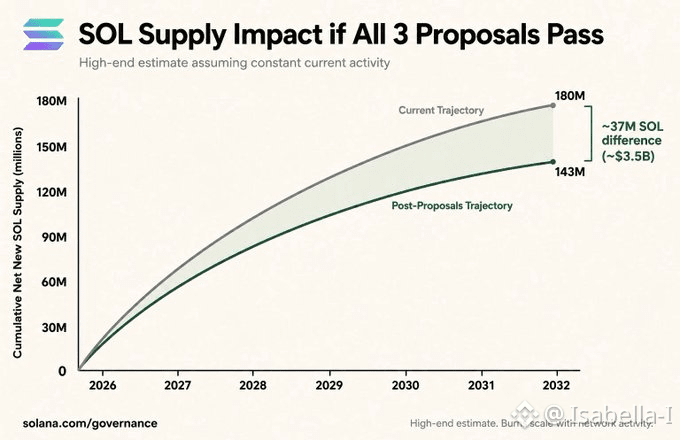
Combined that’s 37M less SOL in existence by 2032, worth roughly $3.5B today
SGP-1 makes it all permanent
Biggest supply-side vote in Solana history$SOL $OG $FF
proposals just went LIVE
If all three pass, the combined impact is massive
SGP-2 cuts future emissions by 18.9M SOL over 6 years
SGP-3 jumps daily burns from 650 to 9K SOL that’s another 18.3M gone over the same period
Combined that’s 37M less SOL in existence by 2032, worth roughly $3.5B today
SGP-1 makes it all permanent
Biggest supply-side vote in Solana history$SOL $OG $FF
ABO3ZAM:
تقليل المعروض بهذا الحجم سيخلق ندرة حقيقية لعملة SOL وتأثيره سيكون وقوداً لصعود انفجاري مستقبلاً. 🚀💡

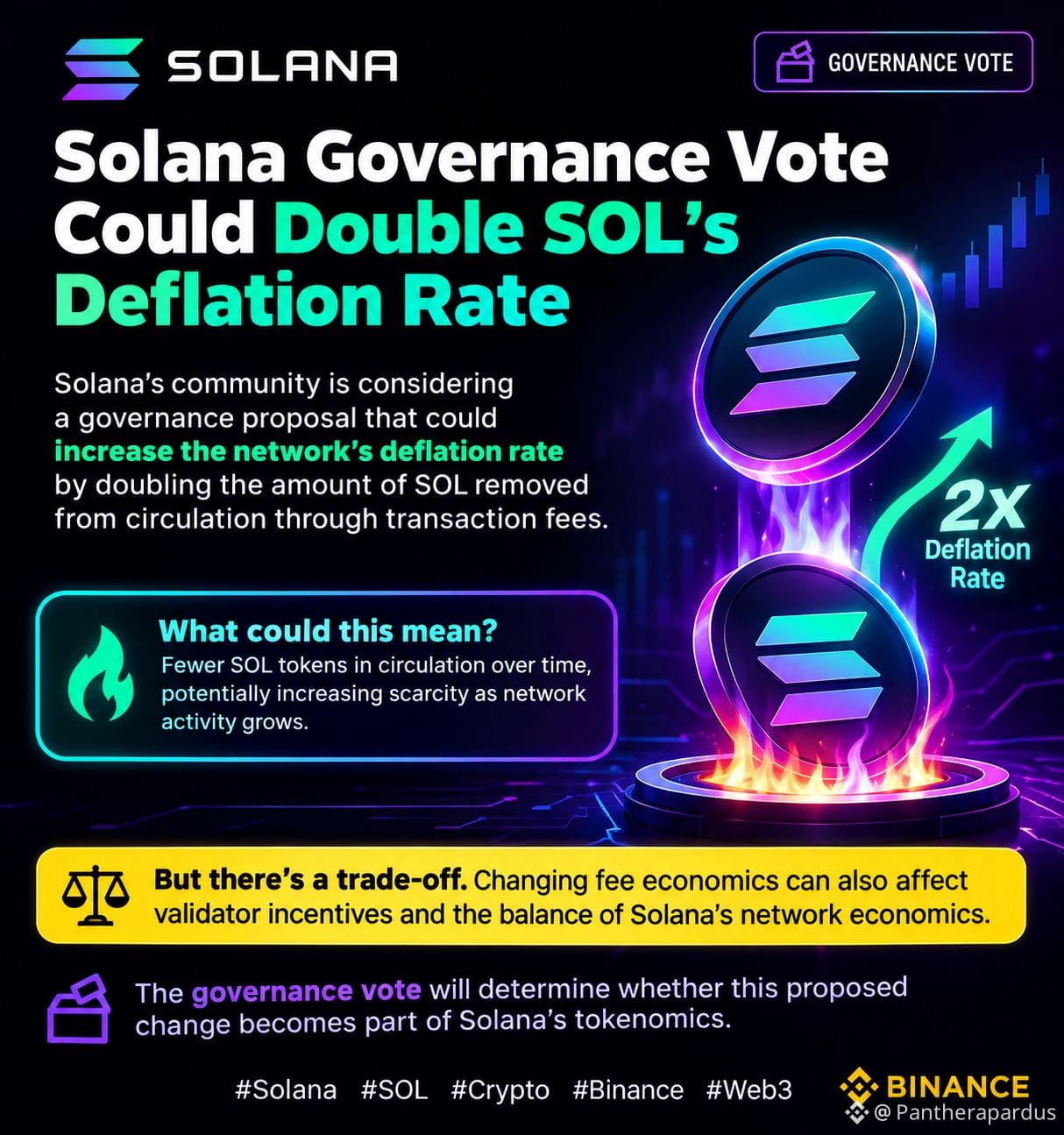
🚨 Solana Governance Vote Could Double SOL’s Deflation Rate
Solana’s community is considering a governance proposal that could increase the network’s deflation rate by doubling the amount of SOL removed from circulation through transaction fees.
If approved, the change could strengthen SOL’s long-term scarcity, but it also raises questions about validator economics and network incentives.
The vote could become an important milestone for Solana’s tokenomics. 👀
#SolanaGovernanceVoteToDoubleDeflationRate #SOL #SolanaStrong
$SOL
Solana’s community is considering a governance proposal that could increase the network’s deflation rate by doubling the amount of SOL removed from circulation through transaction fees.
If approved, the change could strengthen SOL’s long-term scarcity, but it also raises questions about validator economics and network incentives.
The vote could become an important milestone for Solana’s tokenomics. 👀
#SolanaGovernanceVoteToDoubleDeflationRate #SOL #SolanaStrong
$SOL


Verified
#solanagovernancevotetodoubledeflationrate
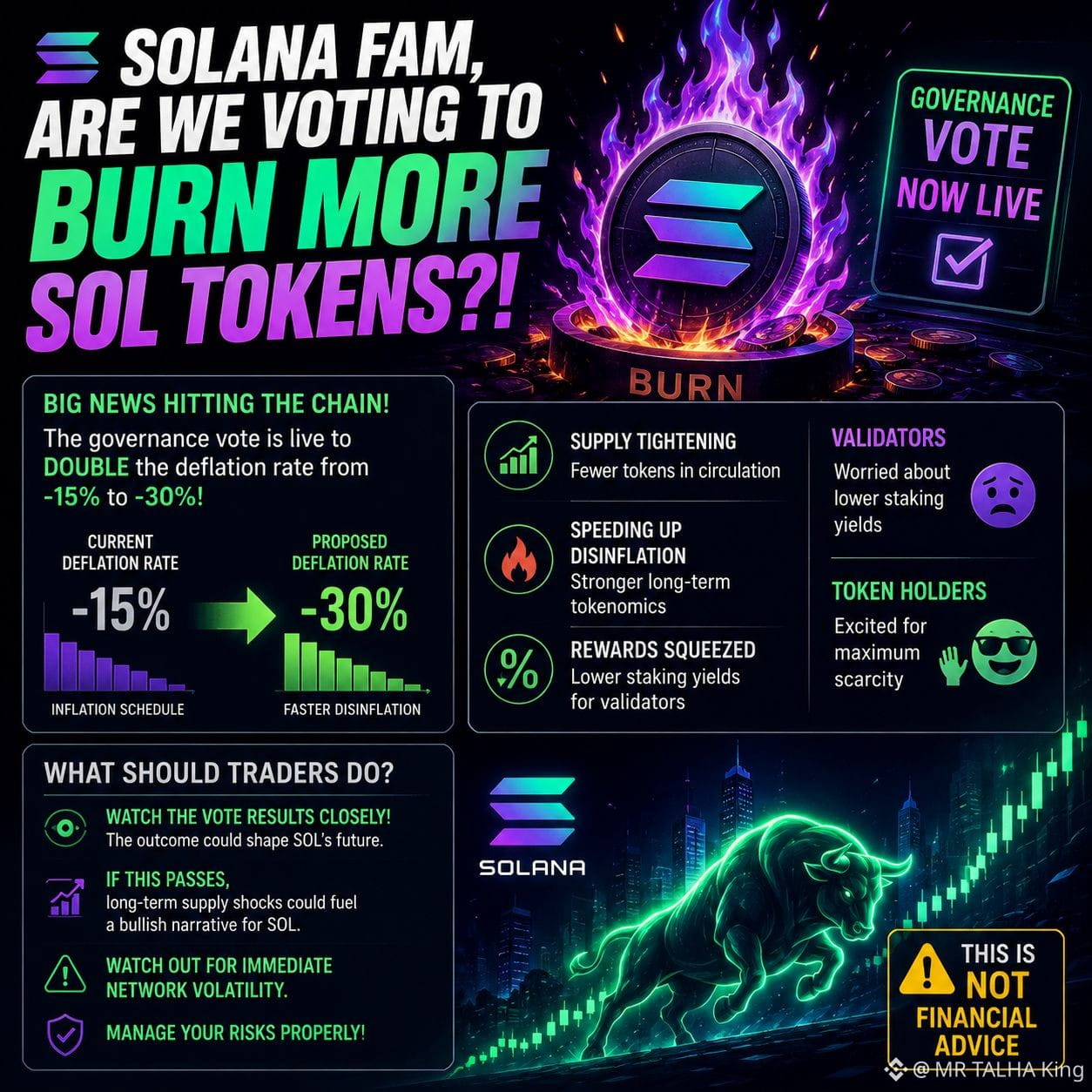
🔥 Solana Fam — Is SOL About to Get Scarcer? 🚀
A major governance vote is reportedly underway that could double the deflation rate from 15% to 30%. 👀
The goal?
📉 Tighten token supply
🔥 Accelerate disinflation
💰 Potentially reduce staking rewards
Validators may face pressure from lower yields, while SOL holders could welcome a stronger scarcity narrative.
🧐 What should traders watch?
Keep an eye on the vote outcome, network reaction, and short-term volatility. If the proposal passes, the long-term supply story could become an important bullish catalyst — but risk management still comes first. 📊
⚠️ Not financial advice. Do your own research.
#Solana #SOL #Crypto #DeFi
$SOL
$BNB
$BTC
🔥 Solana Fam — Is SOL About to Get Scarcer? 🚀
A major governance vote is reportedly underway that could double the deflation rate from 15% to 30%. 👀
The goal?
📉 Tighten token supply
🔥 Accelerate disinflation
💰 Potentially reduce staking rewards
Validators may face pressure from lower yields, while SOL holders could welcome a stronger scarcity narrative.
🧐 What should traders watch?
Keep an eye on the vote outcome, network reaction, and short-term volatility. If the proposal passes, the long-term supply story could become an important bullish catalyst — but risk management still comes first. 📊
⚠️ Not financial advice. Do your own research.
#Solana #SOL #Crypto #DeFi
$SOL
$BNB
$BTC
⚡ Solana Wants to Cut New SOL Emissions Faster
A new governance proposal would change Solana's disinflation rate from 15% to 30%—effectively accelerating the reduction in new SOL issuance.
The proposal targets the same 1.5% terminal inflation rate, but could reach it roughly three years earlier.
🎯 Why traders care: Fewer newly issued tokens can create a tighter supply outlook over time. However, reduced issuance also means lower nominal staking rewards, so the impact isn't automatically bullish.
Watch $SOL price action, volume and governance developments before making a spot trade.
#solanagovernancevotetodoubledeflationrate
A new governance proposal would change Solana's disinflation rate from 15% to 30%—effectively accelerating the reduction in new SOL issuance.
The proposal targets the same 1.5% terminal inflation rate, but could reach it roughly three years earlier.
🎯 Why traders care: Fewer newly issued tokens can create a tighter supply outlook over time. However, reduced issuance also means lower nominal staking rewards, so the impact isn't automatically bullish.
Watch $SOL price action, volume and governance developments before making a spot trade.
#solanagovernancevotetodoubledeflationrate

#SolanaGovernanceVoteToDoubleDeflationRate
🚨 SOLANA GOVERNANCE VOTE COULD ACCELERATE SOL’S DISINFLATION
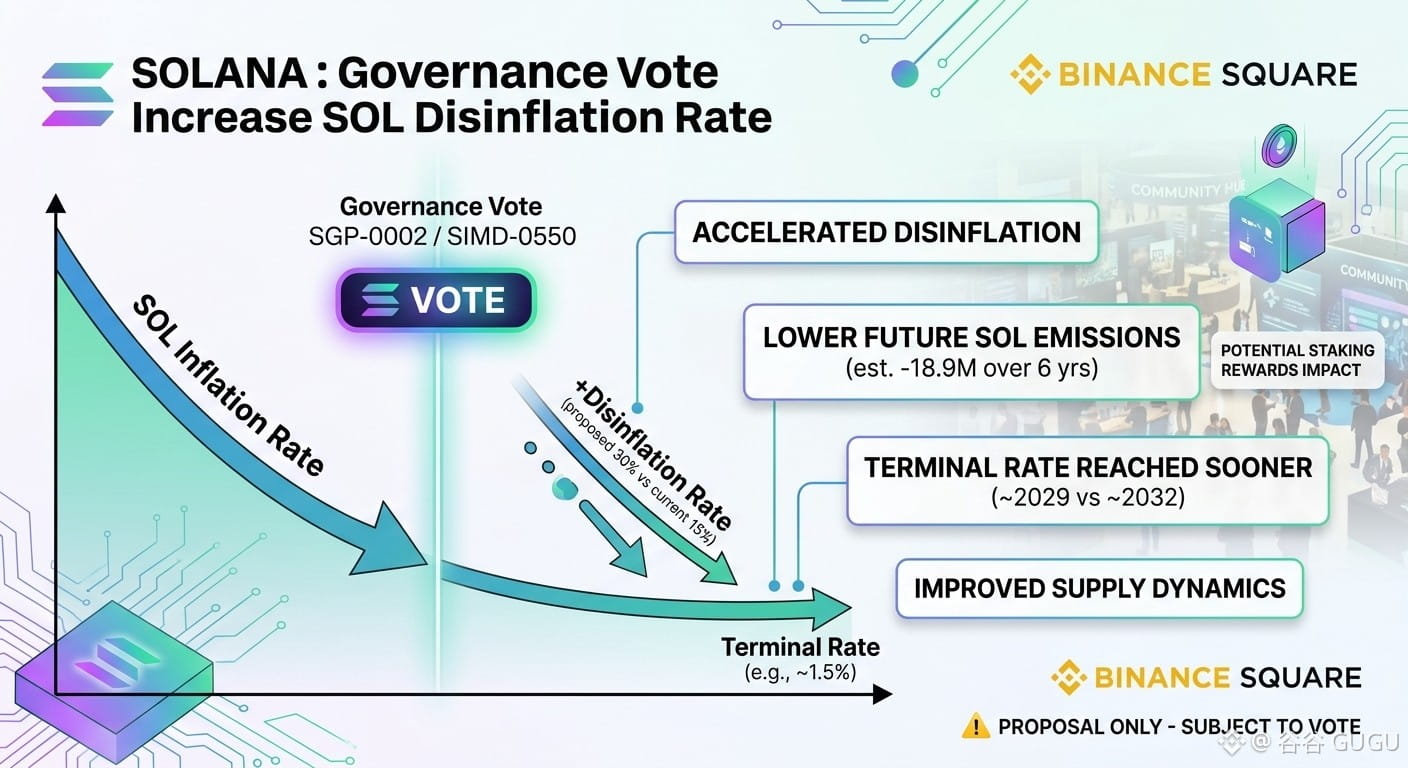
A new Solana governance vote is now live on a proposal that could double the network’s disinflation rate from 15% to 30% annually.
The proposal, known as SGP-0002 / SIMD-0550, does not mean SOL instantly becomes deflationary. Instead, it would accelerate the pace at which SOL inflation declines.
📊 What could change if approved?
🔹 Disinflation rate: 15% → 30%
🔹 The 1.5% terminal inflation rate could be reached around 2029 instead of 2032
🔹 Estimated SOL emissions could be reduced by roughly 18.9 million SOL over six years
🔹 Lower future issuance could improve SOL’s long-term supply dynamics
🔹 However, staking rewards could also decline as emissions fall
⚠️ Important: This is a governance proposal currently being voted on, not a confirmed tokenomics change yet. The final outcome will depend on the governance process and vote results.
This makes the proposal an important development for Solana’s long-term tokenomics.
👀 If approved, will lower future SOL issuance strengthen the long-term supply narrative?
$SOL $UAI $PROM
🚨 SOLANA GOVERNANCE VOTE COULD ACCELERATE SOL’S DISINFLATION
A new Solana governance vote is now live on a proposal that could double the network’s disinflation rate from 15% to 30% annually.
The proposal, known as SGP-0002 / SIMD-0550, does not mean SOL instantly becomes deflationary. Instead, it would accelerate the pace at which SOL inflation declines.
📊 What could change if approved?
🔹 Disinflation rate: 15% → 30%
🔹 The 1.5% terminal inflation rate could be reached around 2029 instead of 2032
🔹 Estimated SOL emissions could be reduced by roughly 18.9 million SOL over six years
🔹 Lower future issuance could improve SOL’s long-term supply dynamics
🔹 However, staking rewards could also decline as emissions fall
⚠️ Important: This is a governance proposal currently being voted on, not a confirmed tokenomics change yet. The final outcome will depend on the governance process and vote results.
This makes the proposal an important development for Solana’s long-term tokenomics.
👀 If approved, will lower future SOL issuance strengthen the long-term supply narrative?
$SOL $UAI $PROM

#SolanaGovernanceVoteToDoubleDeflationRate
📰 SOLANA GOVERNANCE: DOUBLE DISINFLATION VOTE IS LIVE
Solana’s new governance system is now testing a major change to SOL tokenomics.
🔹 SGP-0002 / Double Disinflation proposes increasing Solana’s annual disinflation rate from 15% to 30%.
If approved, Solana would reach its existing 1.5% terminal inflation rate sooner, reducing projected SOL issuance by approximately 18.9 million SOL over six years compared with the current schedule.
📊 Why it matters
• Less new SOL entering circulation over time
• Potentially lower inflation-driven selling pressure
• Lower issuance could also mean reduced staking rewards
• The proposal does not remove Solana’s 1.5% long-term inflation floor
🗳️ Current status: The network voting window is scheduled across Aug. 23–29, with results expected after the voting period.
⚠️ This is a governance proposal, not a guaranteed change. The final outcome depends on the stake-weighted vote.
The key question for the SOL ecosystem is simple:
Will lower future issuance strengthen SOL’s long-term supply dynamics, or could reduced staking rewards create new challenges for validators and stakers?
What’s your view?
$UAI $SPK $1000RATS
📰 SOLANA GOVERNANCE: DOUBLE DISINFLATION VOTE IS LIVE
Solana’s new governance system is now testing a major change to SOL tokenomics.
🔹 SGP-0002 / Double Disinflation proposes increasing Solana’s annual disinflation rate from 15% to 30%.
If approved, Solana would reach its existing 1.5% terminal inflation rate sooner, reducing projected SOL issuance by approximately 18.9 million SOL over six years compared with the current schedule.
📊 Why it matters
• Less new SOL entering circulation over time
• Potentially lower inflation-driven selling pressure
• Lower issuance could also mean reduced staking rewards
• The proposal does not remove Solana’s 1.5% long-term inflation floor
🗳️ Current status: The network voting window is scheduled across Aug. 23–29, with results expected after the voting period.
⚠️ This is a governance proposal, not a guaranteed change. The final outcome depends on the stake-weighted vote.
The key question for the SOL ecosystem is simple:
Will lower future issuance strengthen SOL’s long-term supply dynamics, or could reduced staking rewards create new challenges for validators and stakers?
What’s your view?
$UAI $SPK $1000RATS


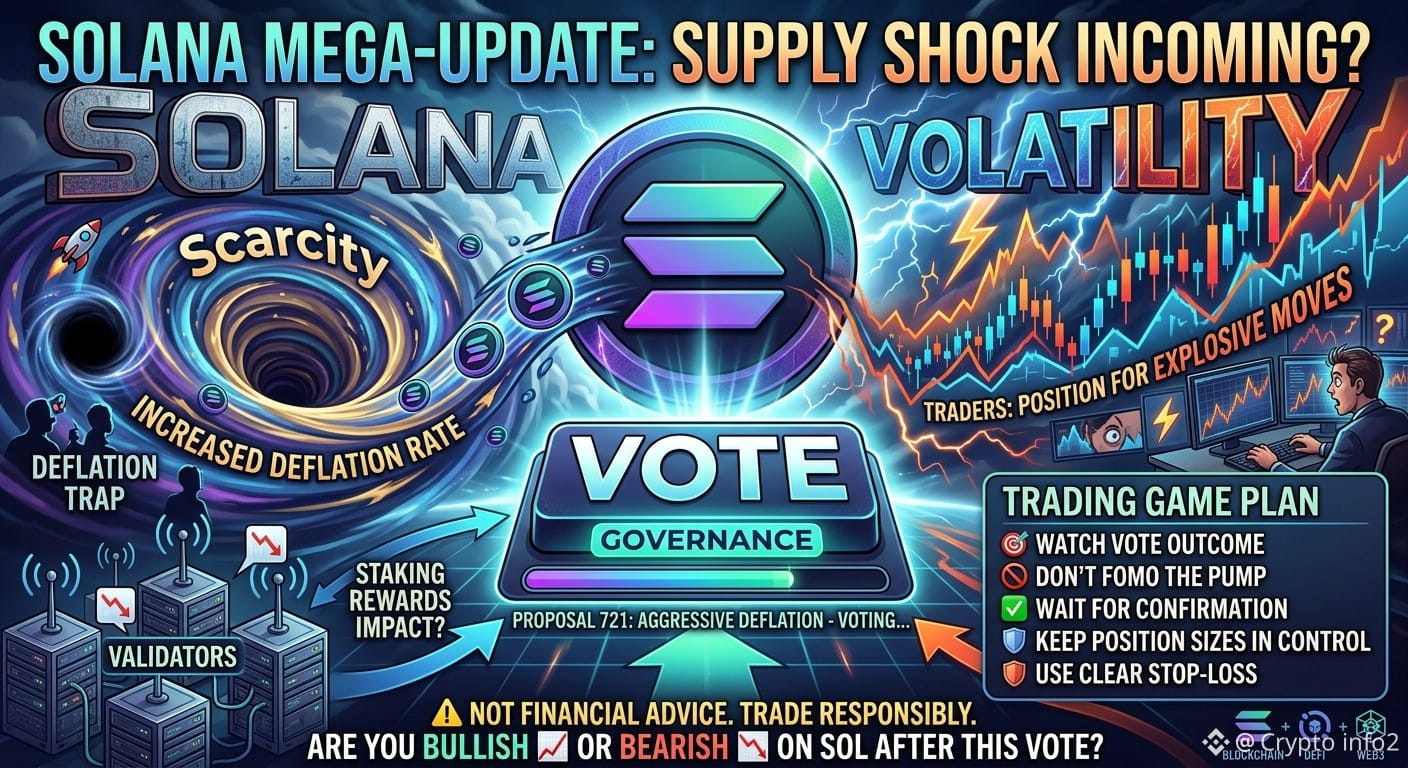
#solanagovernancevotetodoubledeflationrate 🚨 SOLANA MEGA-UPDATE: SUPPLY SHOCK INCOMING? 🚨
A major governance vote on Solana (SOL) could reshape its token economics, with a proposal targeting a more aggressive deflation rate. 🔥
📉 Validators: Concerned about the potential impact on staking rewards.
🚀 SOL Holders: Watching closely for a stronger scarcity narrative.
⚡ Traders: Preparing for potentially explosive volatility.
🎯 Trading Game Plan:
• Watch the governance vote outcome closely.
• Don’t FOMO into the first pump.
• Look for confirmation after the news.
• Keep position sizes under control.
• Use a clear stop-loss and protect your capital.
If the proposal passes, market expectations could shift quickly—but remember, bullish news doesn’t guarantee a bullish price move.
⚠️ Not financial advice. Trade responsibly.
🔥 Are you bullish or bearish on SOL after this vote?
#Solana #SOL #Crypto #Altcoins
CLICK TO BELOW TRADE👇
$PROM $UAI $SOL
A major governance vote on Solana (SOL) could reshape its token economics, with a proposal targeting a more aggressive deflation rate. 🔥
📉 Validators: Concerned about the potential impact on staking rewards.
🚀 SOL Holders: Watching closely for a stronger scarcity narrative.
⚡ Traders: Preparing for potentially explosive volatility.
🎯 Trading Game Plan:
• Watch the governance vote outcome closely.
• Don’t FOMO into the first pump.
• Look for confirmation after the news.
• Keep position sizes under control.
• Use a clear stop-loss and protect your capital.
If the proposal passes, market expectations could shift quickly—but remember, bullish news doesn’t guarantee a bullish price move.
⚠️ Not financial advice. Trade responsibly.
🔥 Are you bullish or bearish on SOL after this vote?
#Solana #SOL #Crypto #Altcoins
CLICK TO BELOW TRADE👇
$PROM $UAI $SOL

#SolanaGovernanceVoteToDoubleDeflationRate Solana Governance Vote Could Double the Deflation Rate
Solana’s latest governance proposal is drawing attention as validators consider a change that could double SOL’s deflationary rate.
If approved, the move could reduce the effective supply growth of SOL and potentially strengthen the long-term tokenomics by increasing the impact of network activity on supply.
🔥 For the Solana ecosystem, this is more than just a governance vote — it could become an important shift in SOL’s monetary dynamics.#SolanaGovernanceVoteToDoubleDeflationRate $SOL
$SPK
$ETH
Solana’s latest governance proposal is drawing attention as validators consider a change that could double SOL’s deflationary rate.
If approved, the move could reduce the effective supply growth of SOL and potentially strengthen the long-term tokenomics by increasing the impact of network activity on supply.
🔥 For the Solana ecosystem, this is more than just a governance vote — it could become an important shift in SOL’s monetary dynamics.#SolanaGovernanceVoteToDoubleDeflationRate $SOL
$SPK
$ETH

Log in to explore more content