

#bedrock
bedrock
7.3M views
89,865 Discussing
Hot
Latest


·
--
Bullish
crypto fatigue is real these days.
you sit through enough cycles and the pattern starts feeling personal. same hype waves, same influencers shouting about the next yield trick, same recycled stories dressed up as something fresh. after a while you just get tired of pretending each one is different.
and then restaking shows up again.
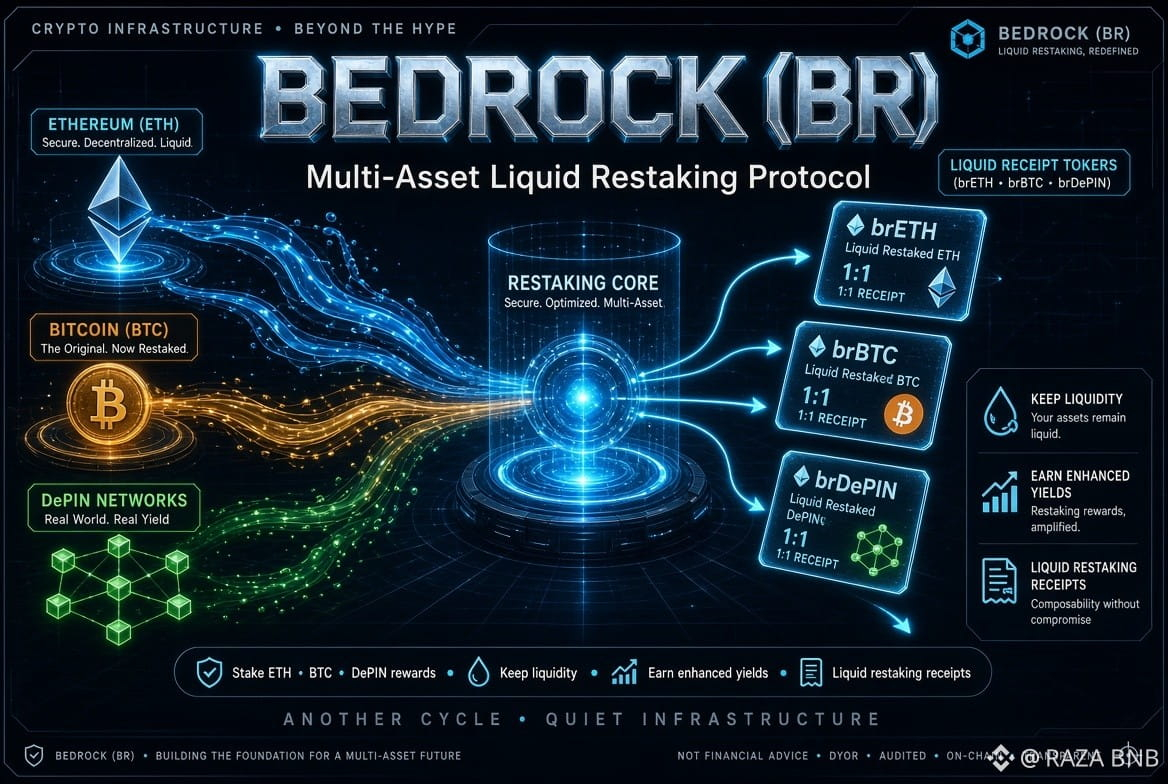
only now it’s multi-asset. eth. bitcoin. even those depin rewards that still feel half imaginary most of the time. the basic frustration never really left: you want the extra yield but you hate locking everything up. need the money and you’re stuck waiting. so the liquid versions appeared. receipts you can still move. bedrock is one of the ones that caught my eye for that reason.
the idea is pretty straightforward. you put the assets in, get something liquid back, and that something keeps collecting the restaked upside while you can still use it elsewhere. like leaving your claim in a group chat that keeps fighting over the rewards while you hold the receipt and walk around with it.
still.
most people already struggle with one restaking setup. stacking eth, btc and depin on top means more bridges, more contracts, more places for friction or delays. attention in this market is short. one quiet stretch and the liquidity just leaves. and the token will get speculated on long before any real usage settles in. that part is almost guaranteed.
it could fade the second yields tighten or the next shiny narrative arrives.
or it could just sit there as quiet plumbing that a handful of people keep using because the receipts stay liquid enough. boring infrastructure has a way of outlasting the loud stuff sometimes.
hard to know which way this one goes. most don’t last. a few just keep working without anyone making a big deal about it.
@Bedrock #Bedrock $BR $GRVT $FARTCOIN
{future}(FARTCOINUSDT)
{future}(GRVTUSDT)
{future}(BRUSDT)
crypto fatigue is real these days.
you sit through enough cycles and the pattern starts feeling personal. same hype waves, same influencers shouting about the next yield trick, same recycled stories dressed up as something fresh. after a while you just get tired of pretending each one is different.
and then restaking shows up again.
only now it’s multi-asset. eth. bitcoin. even those depin rewards that still feel half imaginary most of the time. the basic frustration never really left: you want the extra yield but you hate locking everything up. need the money and you’re stuck waiting. so the liquid versions appeared. receipts you can still move. bedrock is one of the ones that caught my eye for that reason.
the idea is pretty straightforward. you put the assets in, get something liquid back, and that something keeps collecting the restaked upside while you can still use it elsewhere. like leaving your claim in a group chat that keeps fighting over the rewards while you hold the receipt and walk around with it.
still.
most people already struggle with one restaking setup. stacking eth, btc and depin on top means more bridges, more contracts, more places for friction or delays. attention in this market is short. one quiet stretch and the liquidity just leaves. and the token will get speculated on long before any real usage settles in. that part is almost guaranteed.
it could fade the second yields tighten or the next shiny narrative arrives.
or it could just sit there as quiet plumbing that a handful of people keep using because the receipts stay liquid enough. boring infrastructure has a way of outlasting the loud stuff sometimes.
hard to know which way this one goes. most don’t last. a few just keep working without anyone making a big deal about it.
@Bedrock #Bedrock $BR $GRVT $FARTCOIN
you sit through enough cycles and the pattern starts feeling personal. same hype waves, same influencers shouting about the next yield trick, same recycled stories dressed up as something fresh. after a while you just get tired of pretending each one is different.
and then restaking shows up again.
only now it’s multi-asset. eth. bitcoin. even those depin rewards that still feel half imaginary most of the time. the basic frustration never really left: you want the extra yield but you hate locking everything up. need the money and you’re stuck waiting. so the liquid versions appeared. receipts you can still move. bedrock is one of the ones that caught my eye for that reason.
the idea is pretty straightforward. you put the assets in, get something liquid back, and that something keeps collecting the restaked upside while you can still use it elsewhere. like leaving your claim in a group chat that keeps fighting over the rewards while you hold the receipt and walk around with it.
still.
most people already struggle with one restaking setup. stacking eth, btc and depin on top means more bridges, more contracts, more places for friction or delays. attention in this market is short. one quiet stretch and the liquidity just leaves. and the token will get speculated on long before any real usage settles in. that part is almost guaranteed.
it could fade the second yields tighten or the next shiny narrative arrives.
or it could just sit there as quiet plumbing that a handful of people keep using because the receipts stay liquid enough. boring infrastructure has a way of outlasting the loud stuff sometimes.
hard to know which way this one goes. most don’t last. a few just keep working without anyone making a big deal about it.
@Bedrock #Bedrock $BR $GRVT $FARTCOIN
1
1k

·
--
Bullish
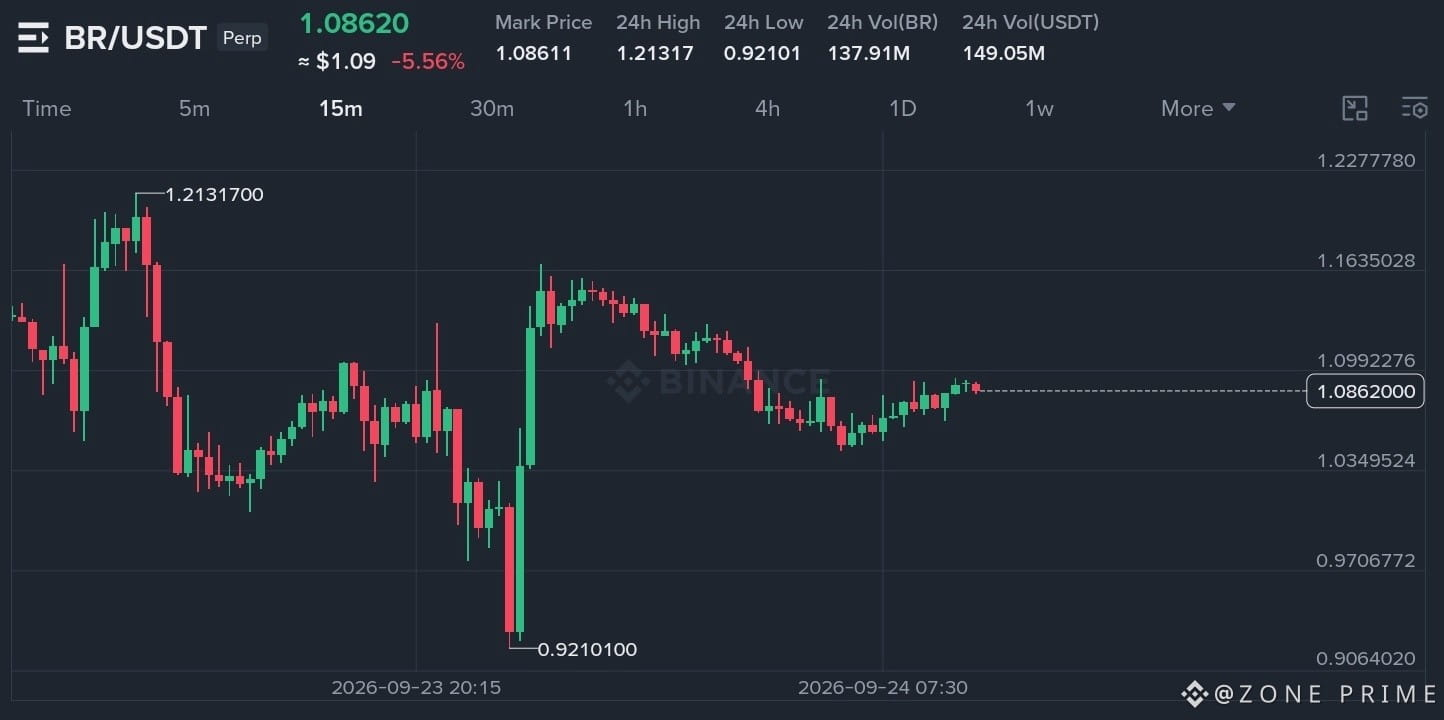
$BR /USDT — LONG SETUP Go 📈 🚀 💯 😱
Entry: 1.03495 - 1.08620
TP1: 1.09922
TP2: 1.16350
TP3: 1.21317
Stop: 0.99500
After sweeping liquidity down to 0.92101, price bounced sharply and is now forming a constructive consolidation floor.
Growing buyer delta volume signals strong interest in driving a secondary leg upward.
#BR #brusdt #bedrock #crypto #Write2Earn $BR
{future}(BRUSDT)
$BR /USDT — LONG SETUP Go 📈 🚀 💯 😱
Entry: 1.03495 - 1.08620
TP1: 1.09922
TP2: 1.16350
TP3: 1.21317
Stop: 0.99500
After sweeping liquidity down to 0.92101, price bounced sharply and is now forming a constructive consolidation floor.
Growing buyer delta volume signals strong interest in driving a secondary leg upward.
#BR #brusdt #bedrock #crypto #Write2Earn $BR
Entry: 1.03495 - 1.08620
TP1: 1.09922
TP2: 1.16350
TP3: 1.21317
Stop: 0.99500
After sweeping liquidity down to 0.92101, price bounced sharply and is now forming a constructive consolidation floor.
Growing buyer delta volume signals strong interest in driving a secondary leg upward.
#BR #brusdt #bedrock #crypto #Write2Earn $BR
264
·
--
Bullish
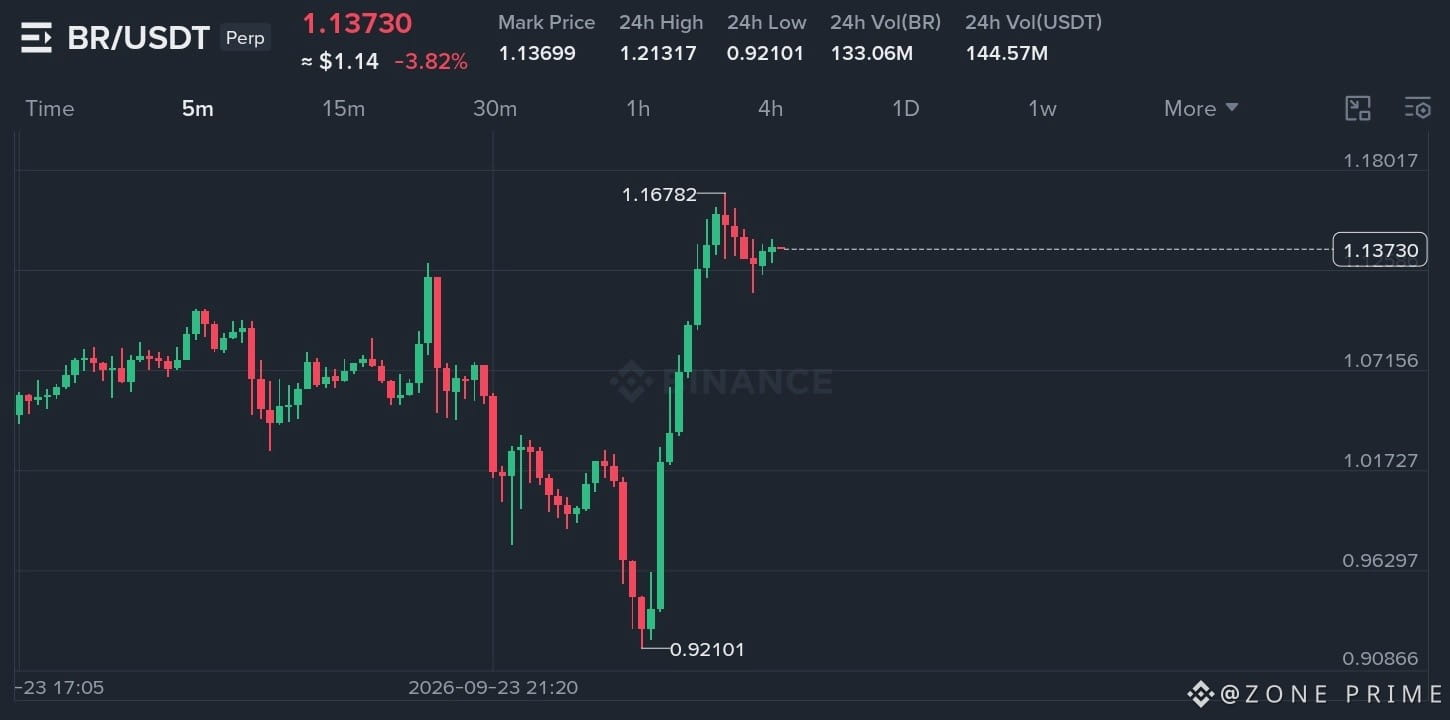
$BR /USDT — LONG SETUP Go Everyone 📈 🚀 💯
Entry: 1.07156 - 1.13730
TP1: 1.16782
TP2: 1.18017
TP3: 1.21317
Stop: 1.01727
Price initiated an aggressive impulse bounce from the 0.92101 trough, signaling strong institutional interest.
Robust limit bid clustering and diminishing sell volume point toward continuation momentum targeting higher resistance zones.
#br #brusdt #bedrock #crypto #Write2Earn $BR
{future}(BRUSDT)
$BR /USDT — LONG SETUP Go Everyone 📈 🚀 💯
Entry: 1.07156 - 1.13730
TP1: 1.16782
TP2: 1.18017
TP3: 1.21317
Stop: 1.01727
Price initiated an aggressive impulse bounce from the 0.92101 trough, signaling strong institutional interest.
Robust limit bid clustering and diminishing sell volume point toward continuation momentum targeting higher resistance zones.
#br #brusdt #bedrock #crypto #Write2Earn $BR
Entry: 1.07156 - 1.13730
TP1: 1.16782
TP2: 1.18017
TP3: 1.21317
Stop: 1.01727
Price initiated an aggressive impulse bounce from the 0.92101 trough, signaling strong institutional interest.
Robust limit bid clustering and diminishing sell volume point toward continuation momentum targeting higher resistance zones.
#br #brusdt #bedrock #crypto #Write2Earn $BR
1.3k

·
--
Bearish
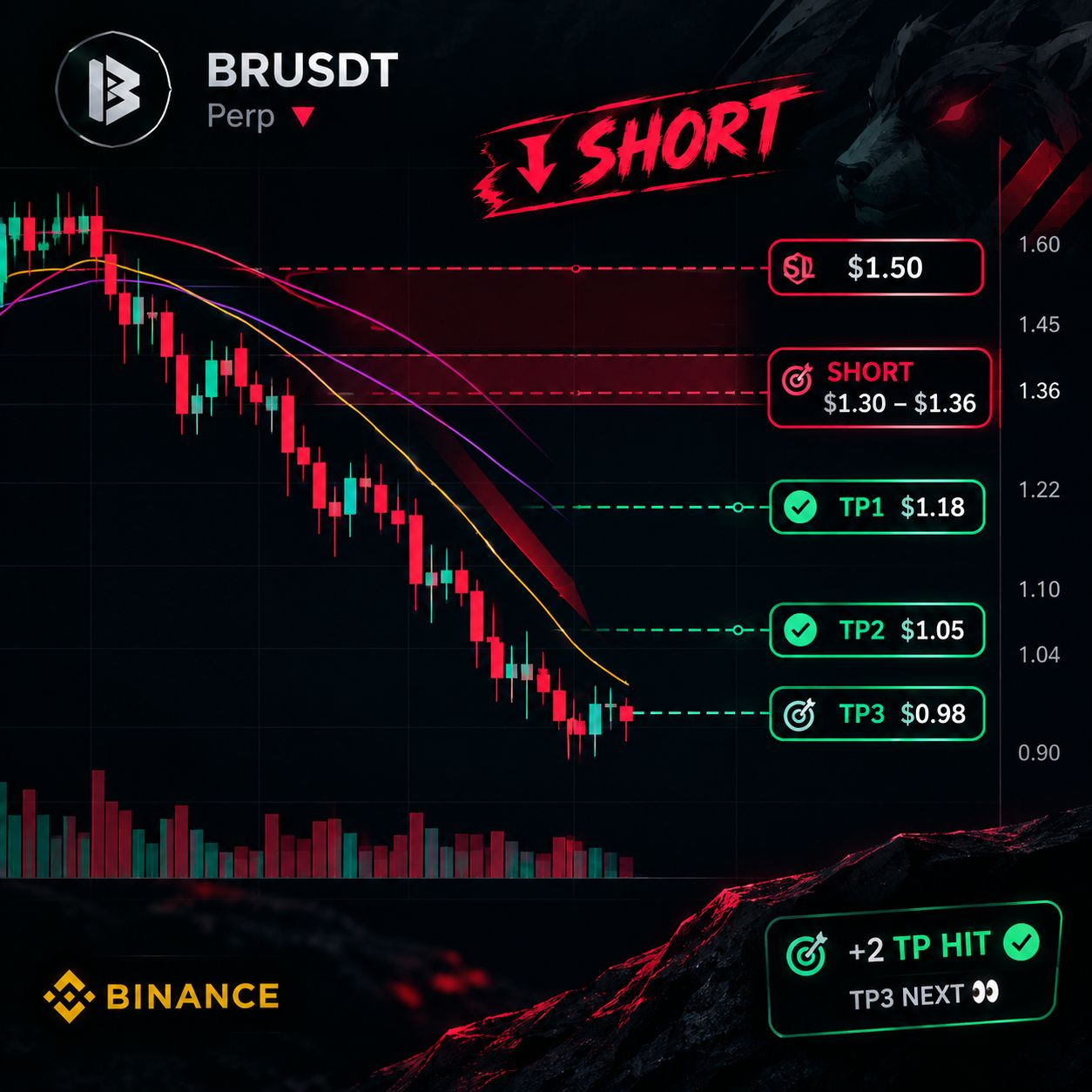
🤑UPDATE — $BR SHORT 🎯
2 TAKE-PROFIT levels already hit.
And TP3 is getting closer. 👀
The setup was clear from the beginning:
wait for the liquidity grab → rejection → follow the move.
No chasing. No guessing. Just patience and execution.
This is exactly why I share these setups early.
If you want to catch more opportunities like this, follow me — more setups are coming. 🚀
DYOR. Manage your risk.
$BR
#BR #Bedrock #Crypto #BinanceFutures #Trading
🤑UPDATE — $BR SHORT 🎯
2 TAKE-PROFIT levels already hit.
And TP3 is getting closer. 👀
The setup was clear from the beginning:
wait for the liquidity grab → rejection → follow the move.
No chasing. No guessing. Just patience and execution.
This is exactly why I share these setups early.
If you want to catch more opportunities like this, follow me — more setups are coming. 🚀
DYOR. Manage your risk.
$BR
#BR #Bedrock #Crypto #BinanceFutures #Trading
2 TAKE-PROFIT levels already hit.
And TP3 is getting closer. 👀
The setup was clear from the beginning:
wait for the liquidity grab → rejection → follow the move.
No chasing. No guessing. Just patience and execution.
This is exactly why I share these setups early.
If you want to catch more opportunities like this, follow me — more setups are coming. 🚀
DYOR. Manage your risk.
$BR
#BR #Bedrock #Crypto #BinanceFutures #Trading
362

·
--
It is clear that @Bedrock with Bedrock 2.0 is trying to redefine how to make use of assets within DeFi through a model that focuses on capital efficiency, liquidity, and practical use of pledged collateral. This kind of development is important because it does not just offer a theoretical idea, but seeks to build a more effective ecosystem for users. I believe that $BR could strongly benefit from this expansion if the project continues to execute its vision with this momentum. #Bedrock
$BR
{future}(BRUSDT)
$BTC
{spot}(BTCUSDT)
It is clear that @Bedrock with Bedrock 2.0 is trying to redefine how to make use of assets within DeFi through a model that focuses on capital efficiency, liquidity, and practical use of pledged collateral. This kind of development is important because it does not just offer a theoretical idea, but seeks to build a more effective ecosystem for users. I believe that $BR could strongly benefit from this expansion if the project continues to execute its vision with this momentum. #Bedrock
$BR
$BTC
$BR
$BTC
236

·
--
🚨 $BR TRADERS — 40.63M TOKENS UNLOCK TODAY! 👀
Bedrock is seeing strong momentum, but this unlock could bring serious volatility. ⚠️
The key question: will buyers absorb the new supply or will sellers take control?
Watch volume and price reaction around the unlock before chasing. 📊
A strong breakout needs confirmation — not FOMO.
Are you watching $BR today? 👇
#BR #Bedrock #Crypto #Binance #trading
{future}(BRUSDT)
🚨 $BR TRADERS — 40.63M TOKENS UNLOCK TODAY! 👀
Bedrock is seeing strong momentum, but this unlock could bring serious volatility. ⚠️
The key question: will buyers absorb the new supply or will sellers take control?
Watch volume and price reaction around the unlock before chasing. 📊
A strong breakout needs confirmation — not FOMO.
Are you watching $BR today? 👇
#BR #Bedrock #Crypto #Binance #trading
Bedrock is seeing strong momentum, but this unlock could bring serious volatility. ⚠️
The key question: will buyers absorb the new supply or will sellers take control?
Watch volume and price reaction around the unlock before chasing. 📊
A strong breakout needs confirmation — not FOMO.
Are you watching $BR today? 👇
#BR #Bedrock #Crypto #Binance #trading
186

{future}(BRUSDT)
$BR is moving hard, but I wouldn’t chase this pump blindly. 👀
BR is around $1.09, up more than 18% in 24H, after touching $1.24. On the 1H chart, price is still holding above the MA25 around $1.07 and comfortably above the MA99 near $0.76, so the bigger structure still looks strong.
But momentum has cooled. RSI(6) is around 40, and volume is dropping after the big move. That tells me buyers aren’t pushing with the same strength right now.
The interesting part is the $BR unlock scheduled for today, which could add selling pressure.
For me, $1.07 is the key short-term support, while $1.16–$1.24 is the zone bulls need to reclaim.
I’d watch price + volume before making any move. 🔎
#BR #Bedrock #Crypto #BinanceSquare #defi
$BR is moving hard, but I wouldn’t chase this pump blindly. 👀
BR is around $1.09, up more than 18% in 24H, after touching $1.24. On the 1H chart, price is still holding above the MA25 around $1.07 and comfortably above the MA99 near $0.76, so the bigger structure still looks strong.
But momentum has cooled. RSI(6) is around 40, and volume is dropping after the big move. That tells me buyers aren’t pushing with the same strength right now.
The interesting part is the $BR unlock scheduled for today, which could add selling pressure.
For me, $1.07 is the key short-term support, while $1.16–$1.24 is the zone bulls need to reclaim.
I’d watch price + volume before making any move. 🔎
#BR #Bedrock #Crypto #BinanceSquare #defi
BR is around $1.09, up more than 18% in 24H, after touching $1.24. On the 1H chart, price is still holding above the MA25 around $1.07 and comfortably above the MA99 near $0.76, so the bigger structure still looks strong.
But momentum has cooled. RSI(6) is around 40, and volume is dropping after the big move. That tells me buyers aren’t pushing with the same strength right now.
The interesting part is the $BR unlock scheduled for today, which could add selling pressure.
For me, $1.07 is the key short-term support, while $1.16–$1.24 is the zone bulls need to reclaim.
I’d watch price + volume before making any move. 🔎
#BR #Bedrock #Crypto #BinanceSquare #defi
277

·
--
Bullish
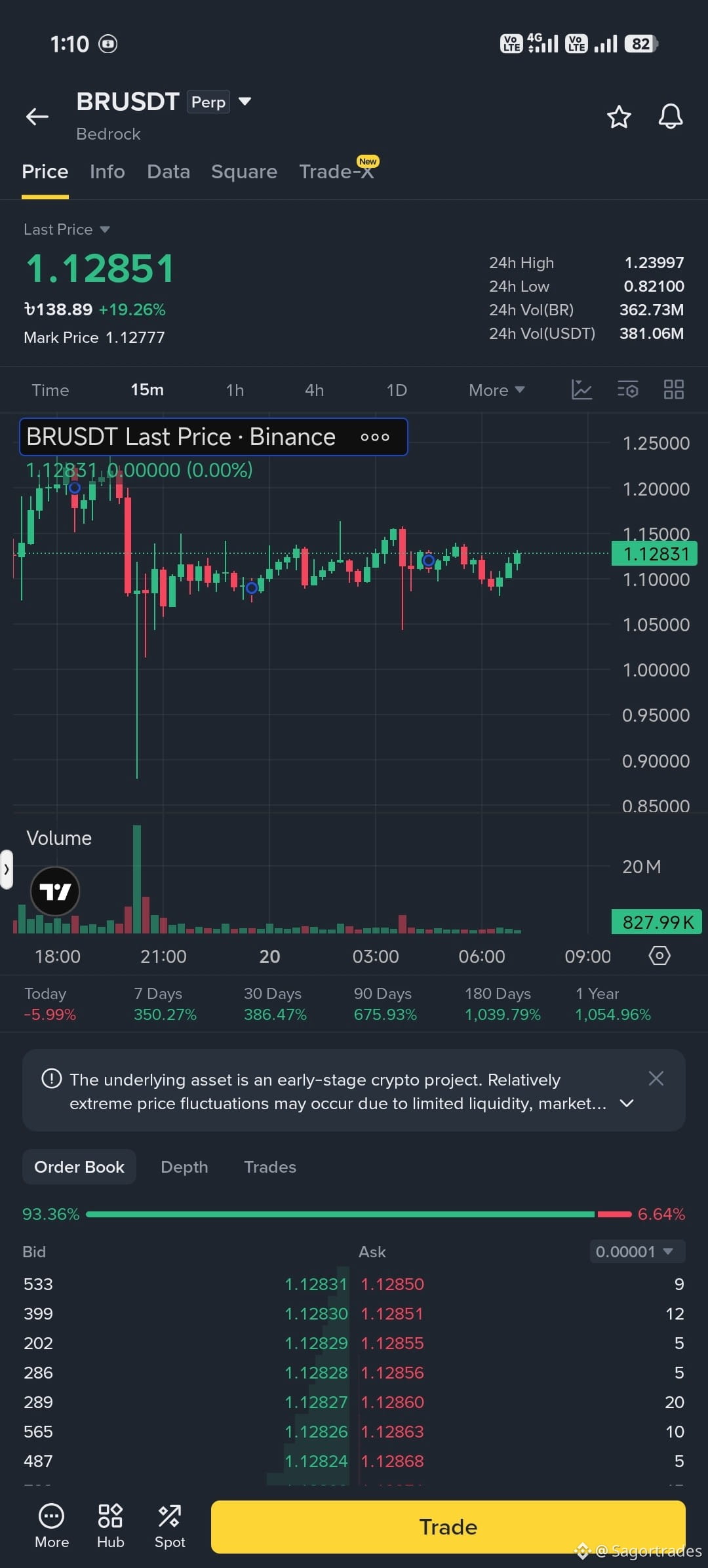
🔥 /USDT Market Update & Signal 🔥
📊 Current Price: $1.120
📈 Trading Setup:
• Entry Zone: $1.095 - $1.130
• Target 1: $1.175
• Target 2: $1.240
• Target 3: $1.320
• Stop Loss: $1.045
💡 Analysis:
BR (Bedrock) is holding strong bullish momentum, consolidating firmly above the $1.090 pivot support zone following a clean market structure shift. Holding above this level maintains buyer dominance for a push toward upper liquidity targets up to $1.320. Maintain strict risk management.
#BR #Bedrock #Crypto #Binance
🔥 /USDT Market Update & Signal 🔥
📊 Current Price: $1.120
📈 Trading Setup:
• Entry Zone: $1.095 - $1.130
• Target 1: $1.175
• Target 2: $1.240
• Target 3: $1.320
• Stop Loss: $1.045
💡 Analysis:
BR (Bedrock) is holding strong bullish momentum, consolidating firmly above the $1.090 pivot support zone following a clean market structure shift. Holding above this level maintains buyer dominance for a push toward upper liquidity targets up to $1.320. Maintain strict risk management.
#BR #Bedrock #Crypto #Binance
📊 Current Price: $1.120
📈 Trading Setup:
• Entry Zone: $1.095 - $1.130
• Target 1: $1.175
• Target 2: $1.240
• Target 3: $1.320
• Stop Loss: $1.045
💡 Analysis:
BR (Bedrock) is holding strong bullish momentum, consolidating firmly above the $1.090 pivot support zone following a clean market structure shift. Holding above this level maintains buyer dominance for a push toward upper liquidity targets up to $1.320. Maintain strict risk management.
#BR #Bedrock #Crypto #Binance
57

The $BR Parabolic Surge: Shaking Out Weak Longs Before the Next Macro Expansion? 🚀📊
🕒 Timestamp: Sept 20, 2026 | 15:12 UTC
The price action surrounding Bedrock ($BR ) has officially entered high-velocity territory! After a staggering +40.23% vertical explosion pushing up to an all-time high of $1.23, the market is witnessing heavy capital restructuring.
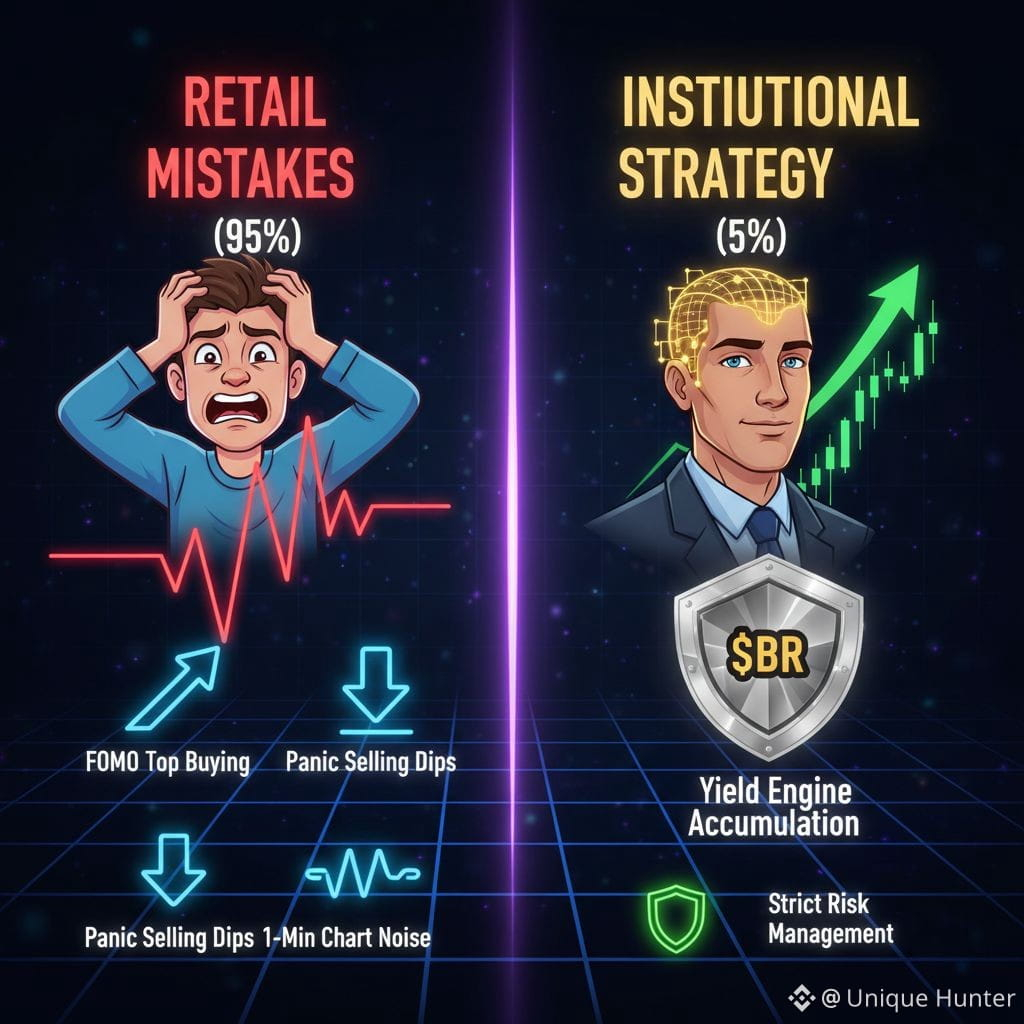
While the 95% retail crowd is reacting with pure panic to minor local pullbacks on 1-minute charts, Smart Money is executing a highly calculated allocation blueprint.
🔍 The Institutional Strategy vs. Retail Panic:
The Retail Mistake: FOMO buying at the exact peak of local resistance, panicking over minor margin flushes down to $1.11, and getting trapped by short-term leverage sweeps.
The Smart Money Edge: Identifying Bedrock 2.0’s core systemic updates (including the Intelligent Yield Engine and BRClaw AI automation) and systematically scaling spot positions at heavy institutional demand shelves.
💡 Market Insight:
Volatile assets do not move upward in straight lines. The sudden shakeouts are classic market-maker clearing runs designed to wipe out late-to-the-party leverage before the next distribution wave. The massive expansion in spot volume proves this is authentic institutional ecosystem rotation into Bitcoin capital-efficiency primitives rather than short-term retail speculation.
⚠️ Risk Warning: Sharp price discovery phases naturally invite severe funding rate spikes and localized long squeezes. Protect your trading margin, deploy strict trailing stop-losses, and always do your own research.
👇 Traders Corner: Did you lock in profits at the $1.23 peak, or are you accumulating spot bags on the current demand shelf? Drop your trade setups below! 💬📈
#Bedrock #BR #cryptotrading #TechnicalAnalysiss #Write2Earn
{future}(BRUSDT)
The $BR Parabolic Surge: Shaking Out Weak Longs Before the Next Macro Expansion? 🚀📊
🕒 Timestamp: Sept 20, 2026 | 15:12 UTC
The price action surrounding Bedrock ($BR ) has officially entered high-velocity territory! After a staggering +40.23% vertical explosion pushing up to an all-time high of $1.23, the market is witnessing heavy capital restructuring.
While the 95% retail crowd is reacting with pure panic to minor local pullbacks on 1-minute charts, Smart Money is executing a highly calculated allocation blueprint.
🔍 The Institutional Strategy vs. Retail Panic:
The Retail Mistake: FOMO buying at the exact peak of local resistance, panicking over minor margin flushes down to $1.11, and getting trapped by short-term leverage sweeps.
The Smart Money Edge: Identifying Bedrock 2.0’s core systemic updates (including the Intelligent Yield Engine and BRClaw AI automation) and systematically scaling spot positions at heavy institutional demand shelves.
💡 Market Insight:
Volatile assets do not move upward in straight lines. The sudden shakeouts are classic market-maker clearing runs designed to wipe out late-to-the-party leverage before the next distribution wave. The massive expansion in spot volume proves this is authentic institutional ecosystem rotation into Bitcoin capital-efficiency primitives rather than short-term retail speculation.
⚠️ Risk Warning: Sharp price discovery phases naturally invite severe funding rate spikes and localized long squeezes. Protect your trading margin, deploy strict trailing stop-losses, and always do your own research.
👇 Traders Corner: Did you lock in profits at the $1.23 peak, or are you accumulating spot bags on the current demand shelf? Drop your trade setups below! 💬📈
#Bedrock #BR #cryptotrading #TechnicalAnalysiss #Write2Earn
🕒 Timestamp: Sept 20, 2026 | 15:12 UTC
The price action surrounding Bedrock ($BR ) has officially entered high-velocity territory! After a staggering +40.23% vertical explosion pushing up to an all-time high of $1.23, the market is witnessing heavy capital restructuring.
While the 95% retail crowd is reacting with pure panic to minor local pullbacks on 1-minute charts, Smart Money is executing a highly calculated allocation blueprint.
🔍 The Institutional Strategy vs. Retail Panic:
The Retail Mistake: FOMO buying at the exact peak of local resistance, panicking over minor margin flushes down to $1.11, and getting trapped by short-term leverage sweeps.
The Smart Money Edge: Identifying Bedrock 2.0’s core systemic updates (including the Intelligent Yield Engine and BRClaw AI automation) and systematically scaling spot positions at heavy institutional demand shelves.
💡 Market Insight:
Volatile assets do not move upward in straight lines. The sudden shakeouts are classic market-maker clearing runs designed to wipe out late-to-the-party leverage before the next distribution wave. The massive expansion in spot volume proves this is authentic institutional ecosystem rotation into Bitcoin capital-efficiency primitives rather than short-term retail speculation.
⚠️ Risk Warning: Sharp price discovery phases naturally invite severe funding rate spikes and localized long squeezes. Protect your trading margin, deploy strict trailing stop-losses, and always do your own research.
👇 Traders Corner: Did you lock in profits at the $1.23 peak, or are you accumulating spot bags on the current demand shelf? Drop your trade setups below! 💬📈
#Bedrock #BR #cryptotrading #TechnicalAnalysiss #Write2Earn

216

$BR The key to this round of upside isn’t “unlocking bad news,” but the fact that the bad news is being traded in reverse.
From September 16 to 20, Bedrock rebounded about 389% over four days. The apparent catalyst is that Bitcoin’s recovery has driven the DeFi sector, with capital flowing back into high-volatility assets. What truly amplifies the move, however, is the token unlock on September 20 equivalent to 18.68% of the circulating supply.
The market had originally worried about selling pressure, but speculators used the relatively tight liquidity to push prices higher, forcing short sellers to cover and creating a chain of “forced short-covering before the unlock—chasing the rally—amplified volatility.” At present, the 24-hour trading volume is about $30 million and market cap about $332 million. Momentum is still high, but the upside has already substantially priced in the unlock expectations.
Next, what to watch is: whether the unlocked holdings truly turn into selling pressure, and whether the new buy orders can absorb it. If volume and price diverge, the pullback after the sharp rally could be equally brutal.
#Bedrock #DeFi #BR
$BR The key to this round of upside isn’t “unlocking bad news,” but the fact that the bad news is being traded in reverse.
From September 16 to 20, Bedrock rebounded about 389% over four days. The apparent catalyst is that Bitcoin’s recovery has driven the DeFi sector, with capital flowing back into high-volatility assets. What truly amplifies the move, however, is the token unlock on September 20 equivalent to 18.68% of the circulating supply.
The market had originally worried about selling pressure, but speculators used the relatively tight liquidity to push prices higher, forcing short sellers to cover and creating a chain of “forced short-covering before the unlock—chasing the rally—amplified volatility.” At present, the 24-hour trading volume is about $30 million and market cap about $332 million. Momentum is still high, but the upside has already substantially priced in the unlock expectations.
Next, what to watch is: whether the unlocked holdings truly turn into selling pressure, and whether the new buy orders can absorb it. If volume and price diverge, the pullback after the sharp rally could be equally brutal.
#Bedrock #DeFi #BR
From September 16 to 20, Bedrock rebounded about 389% over four days. The apparent catalyst is that Bitcoin’s recovery has driven the DeFi sector, with capital flowing back into high-volatility assets. What truly amplifies the move, however, is the token unlock on September 20 equivalent to 18.68% of the circulating supply.
The market had originally worried about selling pressure, but speculators used the relatively tight liquidity to push prices higher, forcing short sellers to cover and creating a chain of “forced short-covering before the unlock—chasing the rally—amplified volatility.” At present, the 24-hour trading volume is about $30 million and market cap about $332 million. Momentum is still high, but the upside has already substantially priced in the unlock expectations.
Next, what to watch is: whether the unlocked holdings truly turn into selling pressure, and whether the new buy orders can absorb it. If volume and price diverge, the pullback after the sharp rally could be equally brutal.
#Bedrock #DeFi #BR
1
172

·
--
Bullish
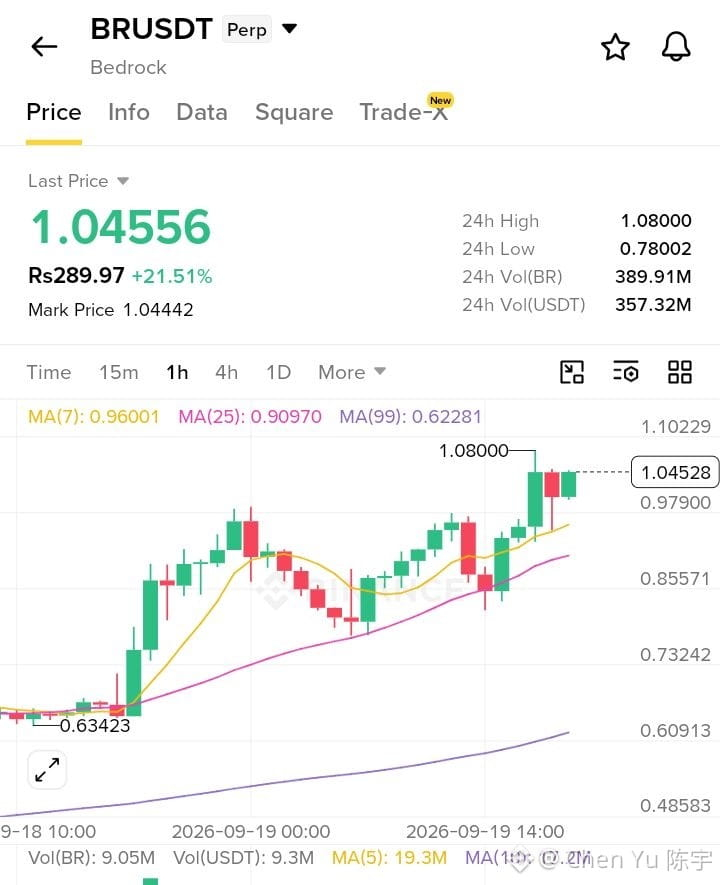
$BR USDT looks stretched after a sharp +21% move. Price is near the $1.08 resistance, so I’m watching for rejection and a breakdown.
Entry: 1.035–1.050
TP1: 0.995
TP2: 0.960
TP3: 0.910
SL: 1.085
No chase here — confirmation matters. If BR holds above $1.08, the short setup is invalid.
#BR #Bedrock #Crypto #Trading $BR
{future}(BRUSDT)
$BR USDT looks stretched after a sharp +21% move. Price is near the $1.08 resistance, so I’m watching for rejection and a breakdown.
Entry: 1.035–1.050
TP1: 0.995
TP2: 0.960
TP3: 0.910
SL: 1.085
No chase here — confirmation matters. If BR holds above $1.08, the short setup is invalid.
#BR #Bedrock #Crypto #Trading $BR
Entry: 1.035–1.050
TP1: 0.995
TP2: 0.960
TP3: 0.910
SL: 1.085
No chase here — confirmation matters. If BR holds above $1.08, the short setup is invalid.
#BR #Bedrock #Crypto #Trading $BR
485

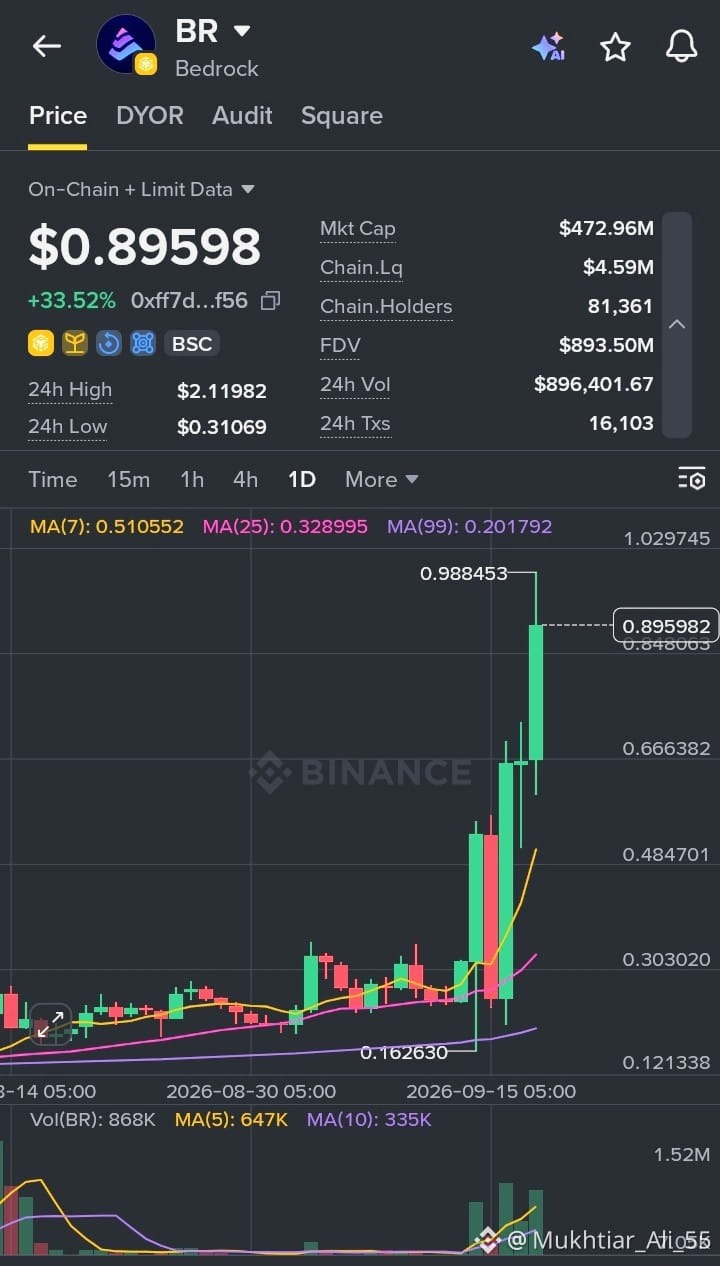
🚀 BEDROCK ($BR) EXPLODES +33.52% — MASSIVE PARABOLIC BREAKOUT UNDERWAY 📈🔥
$BR | BR/USDT
💰 Price: 0.89598
📈 24H Change: +33.52%
📊 24H High: 2.11982
📉 24H Low: 0.31069
💵 24H Vol: $896.40K
🏦 Mkt Cap: $472.96M
⚠️ Market Breakdown (1D Timeframe):
Bedrock delivered a violent bullish expansion, breaking out of a long-term accumulation base 🧨
🔻 Price launched vertically off the 0.16263 low, driving through multiple overhead resistances
🔻 The rally wicked to 2.11982 before pulling back to consolidate near current levels
🔻 Long green daily candles confirm intense buying activity and major trend acceleration
📈 Moving Averages Tell the Story:
📌 MA(7): 0.510552
📌 MA(25): 0.328995
📌 MA(99): 0.201792
✅ Price trades far above all major moving averages, reflecting strong momentum
✅ MA(7) sloped sharply upward, creating a wide bullish gap above MA(25) and MA(99)
✅ Bullish structural alignment confirms heavy buyer control over the daily timeframe 🐂
📊 Volume & On-Chain Insight:
🟢 24H volume stands at $896.40K across 16,103 recorded transactions
💥 On-chain data indicates 81,361 holders backing liquidity across the ecosystem
⚠️ High volatility following parabolic expansion suggests elevated risk near resistance
🧠 What This Means:
This is a powerful breakout rally shifting macro market structure firmly upward ❌
🔹 Trend: Strong Bullish Breakout
🔹 Momentum: Parabolic / High Volatility
🔹 Market emotion: Aggressive buyer expansion 🚀
🎯 Key Levels to Watch:
🟢 Support: 0.5105 – 0.6663 zone
🔴 Resistance: 0.9884 – 2.1198 zone
📌 Holding above MA(7) support at 0.5105 keeps macro upside structure intact
📌 Reclaiming above 0.9884 opens the path toward retesting the 2.1198 high ⬆️
💡 Final Take:
🧨 BR is demonstrating massive momentum and elevated market activity
🧘 Avoid chasing parabolic candles; look for healthy consolidation before taking positions
🛡️ Always enforce strict risk management on every trade
#BR #Bedrock #CryptoMarket
$BR
{future}(BRUSDT)
🚀 BEDROCK ($BR ) EXPLODES +33.52% — MASSIVE PARABOLIC BREAKOUT UNDERWAY 📈🔥
$BR | BR/USDT
💰 Price: 0.89598
📈 24H Change: +33.52%
📊 24H High: 2.11982
📉 24H Low: 0.31069
💵 24H Vol: $896.40K
🏦 Mkt Cap: $472.96M
⚠️ Market Breakdown (1D Timeframe):
Bedrock delivered a violent bullish expansion, breaking out of a long-term accumulation base 🧨
🔻 Price launched vertically off the 0.16263 low, driving through multiple overhead resistances
🔻 The rally wicked to 2.11982 before pulling back to consolidate near current levels
🔻 Long green daily candles confirm intense buying activity and major trend acceleration
📈 Moving Averages Tell the Story:
📌 MA(7): 0.510552
📌 MA(25): 0.328995
📌 MA(99): 0.201792
✅ Price trades far above all major moving averages, reflecting strong momentum
✅ MA(7) sloped sharply upward, creating a wide bullish gap above MA(25) and MA(99)
✅ Bullish structural alignment confirms heavy buyer control over the daily timeframe 🐂
📊 Volume & On-Chain Insight:
🟢 24H volume stands at $896.40K across 16,103 recorded transactions
💥 On-chain data indicates 81,361 holders backing liquidity across the ecosystem
⚠️ High volatility following parabolic expansion suggests elevated risk near resistance
🧠 What This Means:
This is a powerful breakout rally shifting macro market structure firmly upward ❌
🔹 Trend: Strong Bullish Breakout
🔹 Momentum: Parabolic / High Volatility
🔹 Market emotion: Aggressive buyer expansion 🚀
🎯 Key Levels to Watch:
🟢 Support: 0.5105 – 0.6663 zone
🔴 Resistance: 0.9884 – 2.1198 zone
📌 Holding above MA(7) support at 0.5105 keeps macro upside structure intact
📌 Reclaiming above 0.9884 opens the path toward retesting the 2.1198 high ⬆️
💡 Final Take:
🧨 BR is demonstrating massive momentum and elevated market activity
🧘 Avoid chasing parabolic candles; look for healthy consolidation before taking positions
🛡️ Always enforce strict risk management on every trade
#BR #Bedrock #CryptoMarket
$BR
$BR | BR/USDT
💰 Price: 0.89598
📈 24H Change: +33.52%
📊 24H High: 2.11982
📉 24H Low: 0.31069
💵 24H Vol: $896.40K
🏦 Mkt Cap: $472.96M
⚠️ Market Breakdown (1D Timeframe):
Bedrock delivered a violent bullish expansion, breaking out of a long-term accumulation base 🧨
🔻 Price launched vertically off the 0.16263 low, driving through multiple overhead resistances
🔻 The rally wicked to 2.11982 before pulling back to consolidate near current levels
🔻 Long green daily candles confirm intense buying activity and major trend acceleration
📈 Moving Averages Tell the Story:
📌 MA(7): 0.510552
📌 MA(25): 0.328995
📌 MA(99): 0.201792
✅ Price trades far above all major moving averages, reflecting strong momentum
✅ MA(7) sloped sharply upward, creating a wide bullish gap above MA(25) and MA(99)
✅ Bullish structural alignment confirms heavy buyer control over the daily timeframe 🐂
📊 Volume & On-Chain Insight:
🟢 24H volume stands at $896.40K across 16,103 recorded transactions
💥 On-chain data indicates 81,361 holders backing liquidity across the ecosystem
⚠️ High volatility following parabolic expansion suggests elevated risk near resistance
🧠 What This Means:
This is a powerful breakout rally shifting macro market structure firmly upward ❌
🔹 Trend: Strong Bullish Breakout
🔹 Momentum: Parabolic / High Volatility
🔹 Market emotion: Aggressive buyer expansion 🚀
🎯 Key Levels to Watch:
🟢 Support: 0.5105 – 0.6663 zone
🔴 Resistance: 0.9884 – 2.1198 zone
📌 Holding above MA(7) support at 0.5105 keeps macro upside structure intact
📌 Reclaiming above 0.9884 opens the path toward retesting the 2.1198 high ⬆️
💡 Final Take:
🧨 BR is demonstrating massive momentum and elevated market activity
🧘 Avoid chasing parabolic candles; look for healthy consolidation before taking positions
🛡️ Always enforce strict risk management on every trade
#BR #Bedrock #CryptoMarket
$BR
1
151

·
--
Another important factor: 40.63M $BR tokens (~$33.9M), representing approximately 4.1% of the total supply, are scheduled to be unlocked on September 20.
#BEDROCK $BR
Another important factor: 40.63M $BR tokens (~$33.9M), representing approximately 4.1% of the total supply, are scheduled to be unlocked on September 20.
#BEDROCK $BR
#BEDROCK $BR
517

·
--
Bearish
⚠️ URGENT WARNING: Sudden drop begins on coin $BR ! 🚨
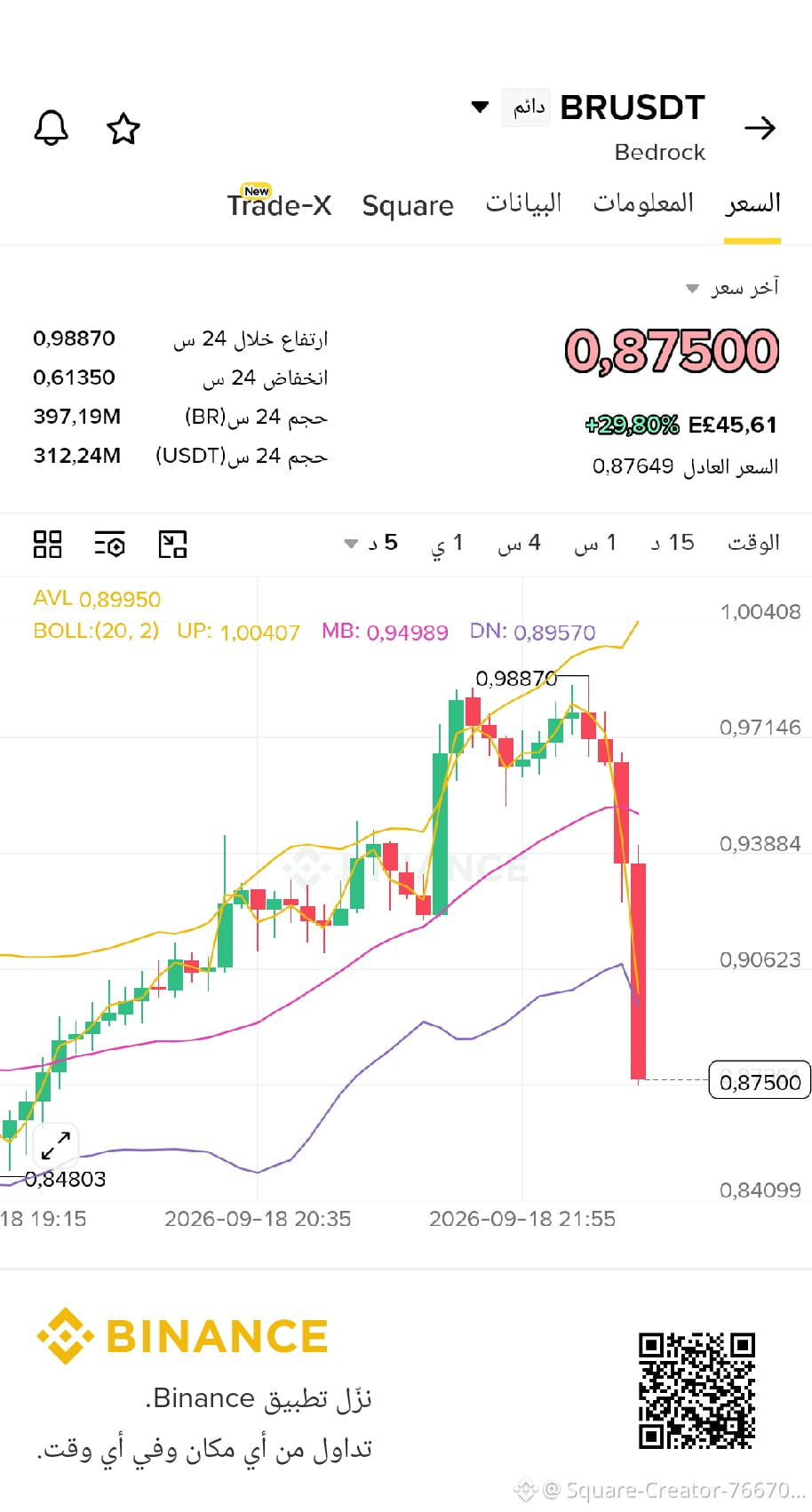
As we warned earlier, the expected scenario has started and the price of Bedrock ($BR) has sharply and directly fallen to currently reach the 0.87500 level after being near the peak at 0.98870!
Current technical price action read:
* Break of the middle Bollinger band line (MB): the strong red candle clearly broke it, heading toward the lower limit (DN), confirming sellers’ dominance and intense profit-taking pressure.
* Decline in the rise percentage: today’s gains have shrunk to +29.80% after being above 43%, indicating the speed at which positions are being liquidated.
🔻 Urgent trading tips:
* Avoid impulsive buying (FOMO): don’t enter a buy trade during the sharp candle drop; wait until the price stabilizes and clear reversal signs appear.
* Enable stop-loss: if you’re still in a buy position, make sure to protect the rest of your capital.
📲 Follow moves moment by moment through the Binance platform.
#BR #Bedrock
#CryptoTrading
#Binance
#TechnicalAnalysis
NFA. DYOR.
⚠️ URGENT WARNING: Sudden drop begins on coin $BR ! 🚨
As we warned earlier, the expected scenario has started and the price of Bedrock ($BR ) has sharply and directly fallen to currently reach the 0.87500 level after being near the peak at 0.98870!
Current technical price action read:
* Break of the middle Bollinger band line (MB): the strong red candle clearly broke it, heading toward the lower limit (DN), confirming sellers’ dominance and intense profit-taking pressure.
* Decline in the rise percentage: today’s gains have shrunk to +29.80% after being above 43%, indicating the speed at which positions are being liquidated.
🔻 Urgent trading tips:
* Avoid impulsive buying (FOMO): don’t enter a buy trade during the sharp candle drop; wait until the price stabilizes and clear reversal signs appear.
* Enable stop-loss: if you’re still in a buy position, make sure to protect the rest of your capital.
📲 Follow moves moment by moment through the Binance platform.
#BR #Bedrock
#CryptoTrading
#Binance
#TechnicalAnalysis
NFA. DYOR.
As we warned earlier, the expected scenario has started and the price of Bedrock ($BR ) has sharply and directly fallen to currently reach the 0.87500 level after being near the peak at 0.98870!
Current technical price action read:
* Break of the middle Bollinger band line (MB): the strong red candle clearly broke it, heading toward the lower limit (DN), confirming sellers’ dominance and intense profit-taking pressure.
* Decline in the rise percentage: today’s gains have shrunk to +29.80% after being above 43%, indicating the speed at which positions are being liquidated.
🔻 Urgent trading tips:
* Avoid impulsive buying (FOMO): don’t enter a buy trade during the sharp candle drop; wait until the price stabilizes and clear reversal signs appear.
* Enable stop-loss: if you’re still in a buy position, make sure to protect the rest of your capital.
📲 Follow moves moment by moment through the Binance platform.
#BR #Bedrock
#CryptoTrading
#Binance
#TechnicalAnalysis
NFA. DYOR.
256
30D trade $BR 57.5 USDT
🚀 A dream realized on the Bedrock coin ($BR ).. But beware before you reap your profits! 🚀 The rally is still ongoing, but don’t get greedy.
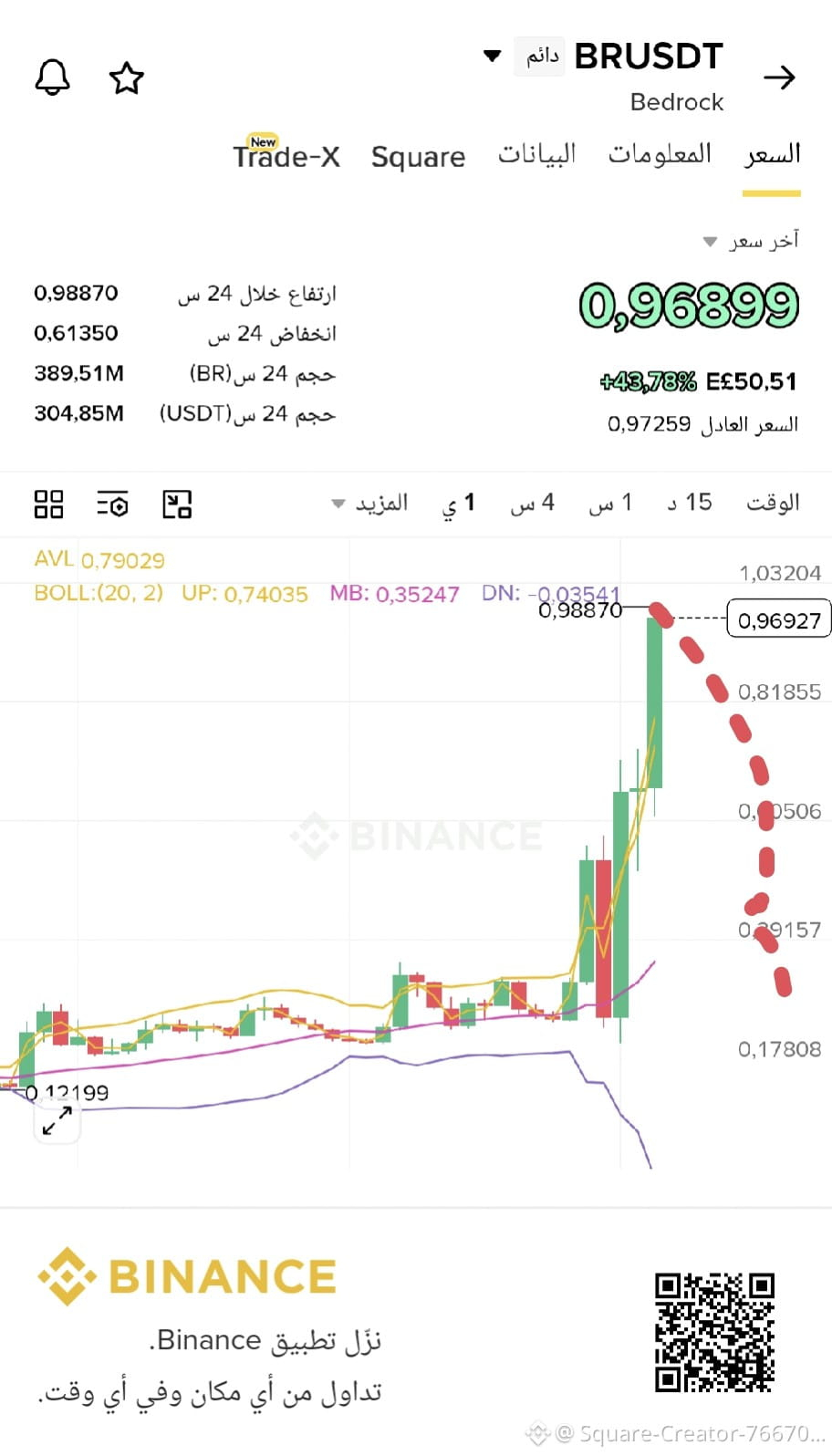
The BRUSDT coin continues to explode in price and hit record levels after reaching 0.98870, with its leaders climbing by about +43.78% in just 24 hours! If you entered from the lower levels, this is already an excellent achievement and an incredible profit 💥.
⚠️ But.. pay close attention before deciding to take profits:
* Breaking the upper Bollinger Band (UP): The price is currently sharply breaking above the upper Bollinger Bands at the 0.96899 level, which indicates high buying saturation and a high likelihood that a corrective move may begin.
* Manage risk wisely: Instead of rushing or leaving the trade to chance, you can use a Moving Trailing Stop-Loss strategy to secure the profits you’ve already earned.
🔻 Important and warning alert:
Extreme and fast rises are often followed by sudden and sharp drops that liquidate positions quickly and lead to rapid profit-taking. Don’t let excitement make you forget to protect your capital—and watch out for this sudden drop!
📲 Follow the market movement step by step and execute your trades cautiously through the Binance platform.
#BR
#Bedrock
#CryptoTrading #Binance
#TechnicalAnalysis
NFA. DYOR.
🚀 A dream realized on the Bedrock coin ($BR ).. But beware before you reap your profits! 🚀 The rally is still ongoing, but don’t get greedy.
The BRUSDT coin continues to explode in price and hit record levels after reaching 0.98870, with its leaders climbing by about +43.78% in just 24 hours! If you entered from the lower levels, this is already an excellent achievement and an incredible profit 💥.
⚠️ But.. pay close attention before deciding to take profits:
* Breaking the upper Bollinger Band (UP): The price is currently sharply breaking above the upper Bollinger Bands at the 0.96899 level, which indicates high buying saturation and a high likelihood that a corrective move may begin.
* Manage risk wisely: Instead of rushing or leaving the trade to chance, you can use a Moving Trailing Stop-Loss strategy to secure the profits you’ve already earned.
🔻 Important and warning alert:
Extreme and fast rises are often followed by sudden and sharp drops that liquidate positions quickly and lead to rapid profit-taking. Don’t let excitement make you forget to protect your capital—and watch out for this sudden drop!
📲 Follow the market movement step by step and execute your trades cautiously through the Binance platform.
#BR
#Bedrock
#CryptoTrading #Binance
#TechnicalAnalysis
NFA. DYOR.
The BRUSDT coin continues to explode in price and hit record levels after reaching 0.98870, with its leaders climbing by about +43.78% in just 24 hours! If you entered from the lower levels, this is already an excellent achievement and an incredible profit 💥.
⚠️ But.. pay close attention before deciding to take profits:
* Breaking the upper Bollinger Band (UP): The price is currently sharply breaking above the upper Bollinger Bands at the 0.96899 level, which indicates high buying saturation and a high likelihood that a corrective move may begin.
* Manage risk wisely: Instead of rushing or leaving the trade to chance, you can use a Moving Trailing Stop-Loss strategy to secure the profits you’ve already earned.
🔻 Important and warning alert:
Extreme and fast rises are often followed by sudden and sharp drops that liquidate positions quickly and lead to rapid profit-taking. Don’t let excitement make you forget to protect your capital—and watch out for this sudden drop!
📲 Follow the market movement step by step and execute your trades cautiously through the Binance platform.
#BR
#Bedrock
#CryptoTrading #Binance
#TechnicalAnalysis
NFA. DYOR.
130
·
--
Bullish
$BR /USDT — LONG SETUP Go 📈 🚀 💯
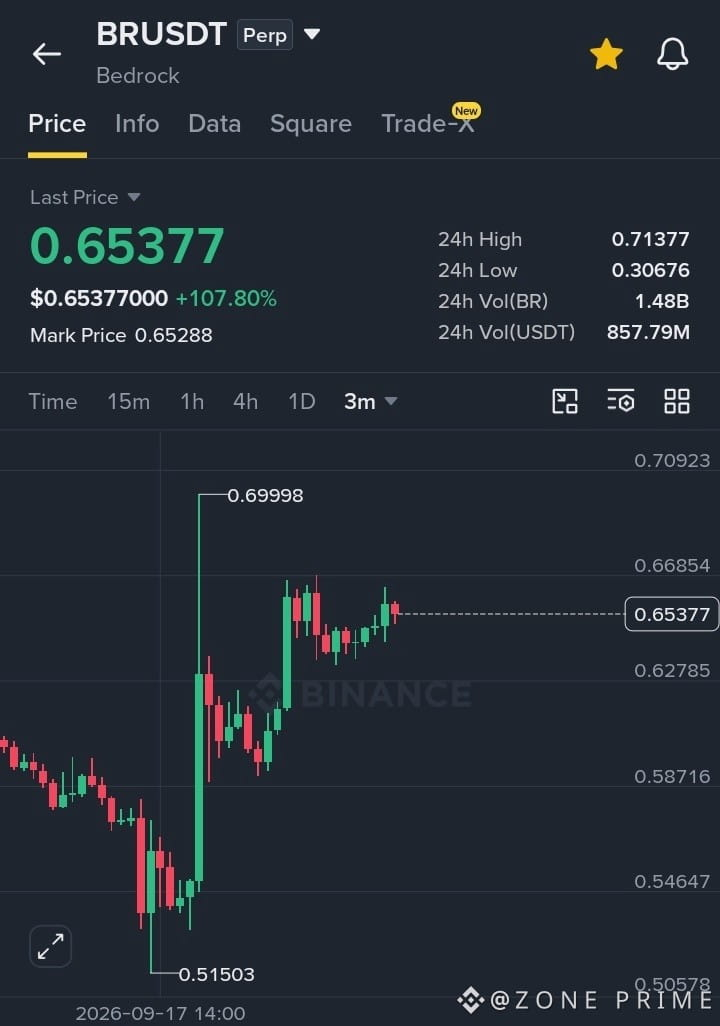
Entry: 0.62785 - 0.65377
TP1: 0.66854
TP2: 0.69998
TP3: 0.71377
Stop: 0.58700
Massive parabolic surge establishing a stable continuation base above 0.62785.
Persistent limit order bid stacking and high buying volume keep the broader bias strongly bullish for secondary price expansion.
#br #brusdt #bedrock #crypto $BR
{future}(BRUSDT)
$BR /USDT — LONG SETUP Go 📈 🚀 💯
Entry: 0.62785 - 0.65377
TP1: 0.66854
TP2: 0.69998
TP3: 0.71377
Stop: 0.58700
Massive parabolic surge establishing a stable continuation base above 0.62785.
Persistent limit order bid stacking and high buying volume keep the broader bias strongly bullish for secondary price expansion.
#br #brusdt #bedrock #crypto $BR
Entry: 0.62785 - 0.65377
TP1: 0.66854
TP2: 0.69998
TP3: 0.71377
Stop: 0.58700
Massive parabolic surge establishing a stable continuation base above 0.62785.
Persistent limit order bid stacking and high buying volume keep the broader bias strongly bullish for secondary price expansion.
#br #brusdt #bedrock #crypto $BR
301

·
--
🚨 BRUSDT : after +184%, the market is starting to cool off! 🔥
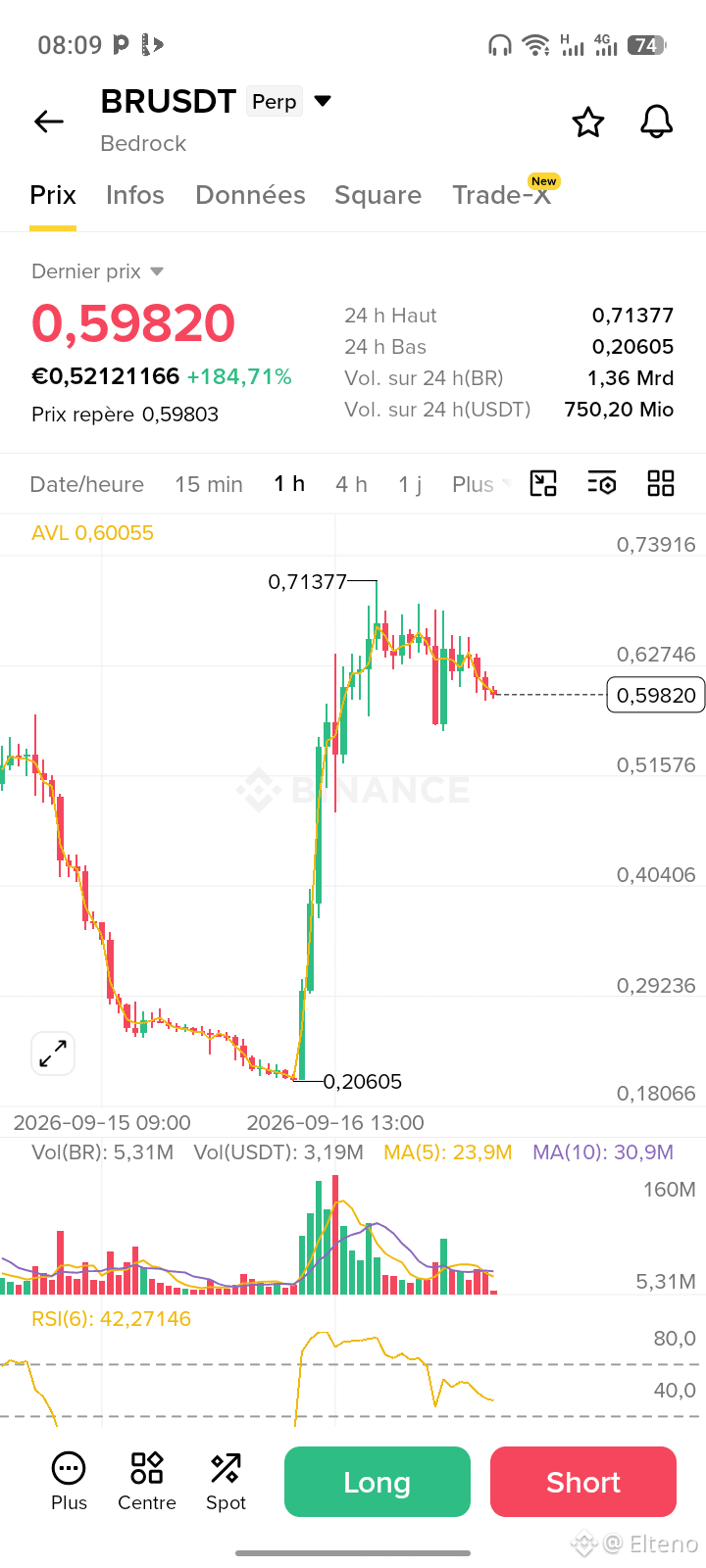
BR (Bedrock) is up +184.71% over 24H and hit a high of $0.71377 before pulling back to around $0.598.
📊 We’re now seeing a consolidation phase with slight selling pressure. Volume remains very high, but it’s down compared to the initial surge.
👀 Levels to watch:
🟢 $0.598 → current zone
🟢 $0.516 → major support
🔴 $0.627 → immediate resistance
🚀 $0.7138 → level to reclaim
RSI(6) ≈ 42 shows that the previous overheating has cooled off significantly.
🔥 $BR
{future}(BRUSDT)
Will it regain momentum to target $0.71, or will the correction continue?
#BR #Bedrock
🚨 BRUSDT : after +184%, the market is starting to cool off! 🔥
BR (Bedrock) is up +184.71% over 24H and hit a high of $0.71377 before pulling back to around $0.598.
📊 We’re now seeing a consolidation phase with slight selling pressure. Volume remains very high, but it’s down compared to the initial surge.
👀 Levels to watch:
🟢 $0.598 → current zone
🟢 $0.516 → major support
🔴 $0.627 → immediate resistance
🚀 $0.7138 → level to reclaim
RSI(6) ≈ 42 shows that the previous overheating has cooled off significantly.
🔥 $BR
Will it regain momentum to target $0.71, or will the correction continue?
#BR #Bedrock
BR (Bedrock) is up +184.71% over 24H and hit a high of $0.71377 before pulling back to around $0.598.
📊 We’re now seeing a consolidation phase with slight selling pressure. Volume remains very high, but it’s down compared to the initial surge.
👀 Levels to watch:
🟢 $0.598 → current zone
🟢 $0.516 → major support
🔴 $0.627 → immediate resistance
🚀 $0.7138 → level to reclaim
RSI(6) ≈ 42 shows that the previous overheating has cooled off significantly.
🔥 $BR
Will it regain momentum to target $0.71, or will the correction continue?
#BR #Bedrock
2
1
48

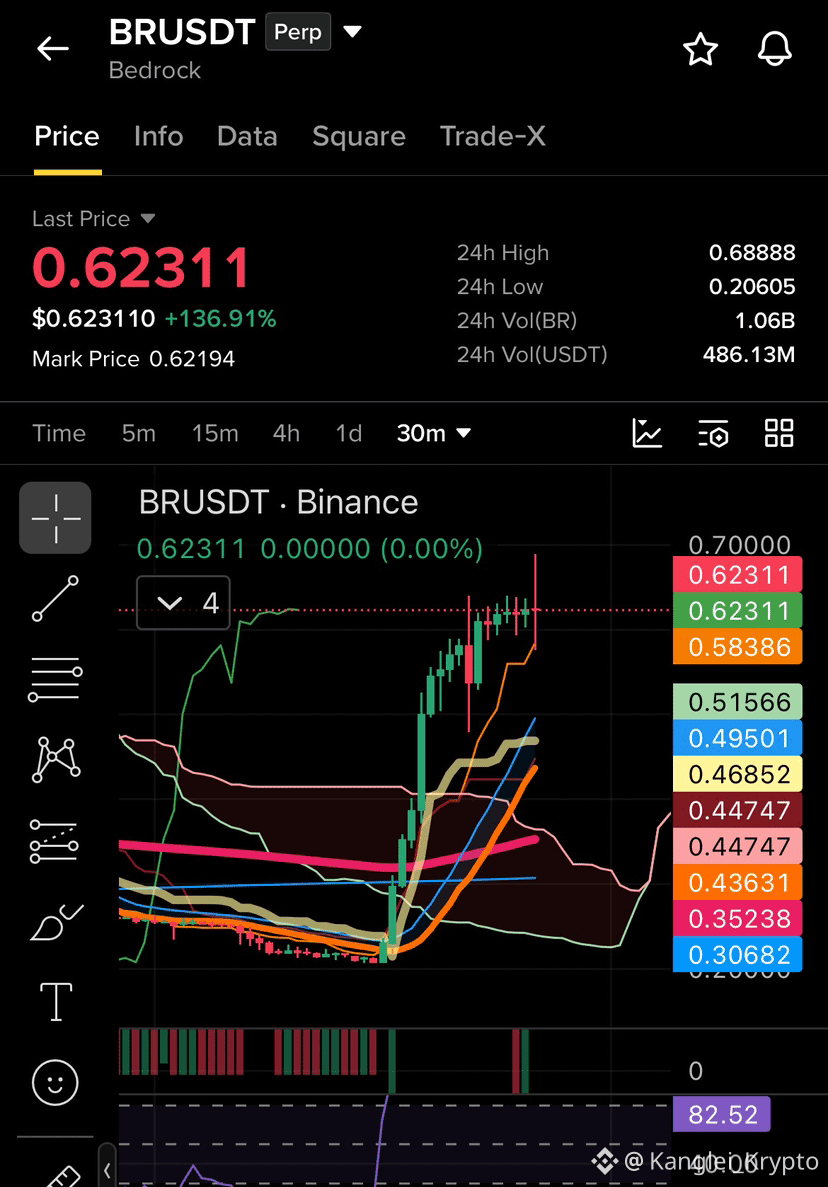
🚀 #BRUSDT (Bedrock) 30m Chart Deep Dive 📈📉
Massive +137% pump in 24h… but is the real move just starting or already overextended?
Current price: 0.623
24h range: 0.206 → 0.688
Volume is insane (486M USDT). This is classic early-stage volatility.
Technical Snapshot:
Price blasted through every MA after the low and is now riding the upper bands.
RSI-style oscillator sitting at 82.5 → clearly overbought on the 30m.
Strong higher-highs / higher-lows structure still intact, but we’re extended.
Perfect Long Entries (High-probability pullback zones):
1. Aggressive Long: 0.580 – 0.595 (orange MA + previous breakout zone)
2. Safer Long: 0.510 – 0.530 (blue + green MA confluence + volume support)
3. Deep discount: 0.440 – 0.460 (major structure support)
Long invalidation: Clean break and close below 0.430
Targets: 0.70 → 0.85 → 1.00+ (if momentum continues)
Perfect Short Entries (Counter-trend / take-profit zones)
1. Aggressive Short: 0.670 – 0.690 (recent high rejection zone)
2. Better Short: Rejection from 0.700 – 0.720 with volume drop
3. Confirmation Short: Breakdown below 0.580 with increasing sell volume
Short invalidation: Strong reclaim and close above 0.720
Targets: 0.55 → 0.48 → 0.40
This coin is still in pure discovery mode. One more vertical leg is possible… or a brutal 40-50% wipe can happen in hours.
What are you doing here?
Long the dip or fading the top? Drop your entry & leverage below 👇
#BRUSDT #Bedrock #FedRateWatch
⚠️ High-risk early-stage token. Extreme volatility. Never risk more than you can afford to lose. This is not financial advice.
{future}(BRUSDT)
$BR $BTC
🚀 #BRUSDT (Bedrock) 30m Chart Deep Dive 📈📉
Massive +137% pump in 24h… but is the real move just starting or already overextended?
Current price: 0.623
24h range: 0.206 → 0.688
Volume is insane (486M USDT). This is classic early-stage volatility.
Technical Snapshot:
Price blasted through every MA after the low and is now riding the upper bands.
RSI-style oscillator sitting at 82.5 → clearly overbought on the 30m.
Strong higher-highs / higher-lows structure still intact, but we’re extended.
Perfect Long Entries (High-probability pullback zones):
1. Aggressive Long: 0.580 – 0.595 (orange MA + previous breakout zone)
2. Safer Long: 0.510 – 0.530 (blue + green MA confluence + volume support)
3. Deep discount: 0.440 – 0.460 (major structure support)
Long invalidation: Clean break and close below 0.430
Targets: 0.70 → 0.85 → 1.00+ (if momentum continues)
Perfect Short Entries (Counter-trend / take-profit zones)
1. Aggressive Short: 0.670 – 0.690 (recent high rejection zone)
2. Better Short: Rejection from 0.700 – 0.720 with volume drop
3. Confirmation Short: Breakdown below 0.580 with increasing sell volume
Short invalidation: Strong reclaim and close above 0.720
Targets: 0.55 → 0.48 → 0.40
This coin is still in pure discovery mode. One more vertical leg is possible… or a brutal 40-50% wipe can happen in hours.
What are you doing here?
Long the dip or fading the top? Drop your entry & leverage below 👇
#BRUSDT #Bedrock #FedRateWatch
⚠️ High-risk early-stage token. Extreme volatility. Never risk more than you can afford to lose. This is not financial advice.
$BR $BTC
Massive +137% pump in 24h… but is the real move just starting or already overextended?
Current price: 0.623
24h range: 0.206 → 0.688
Volume is insane (486M USDT). This is classic early-stage volatility.
Technical Snapshot:
Price blasted through every MA after the low and is now riding the upper bands.
RSI-style oscillator sitting at 82.5 → clearly overbought on the 30m.
Strong higher-highs / higher-lows structure still intact, but we’re extended.
Perfect Long Entries (High-probability pullback zones):
1. Aggressive Long: 0.580 – 0.595 (orange MA + previous breakout zone)
2. Safer Long: 0.510 – 0.530 (blue + green MA confluence + volume support)
3. Deep discount: 0.440 – 0.460 (major structure support)
Long invalidation: Clean break and close below 0.430
Targets: 0.70 → 0.85 → 1.00+ (if momentum continues)
Perfect Short Entries (Counter-trend / take-profit zones)
1. Aggressive Short: 0.670 – 0.690 (recent high rejection zone)
2. Better Short: Rejection from 0.700 – 0.720 with volume drop
3. Confirmation Short: Breakdown below 0.580 with increasing sell volume
Short invalidation: Strong reclaim and close above 0.720
Targets: 0.55 → 0.48 → 0.40
This coin is still in pure discovery mode. One more vertical leg is possible… or a brutal 40-50% wipe can happen in hours.
What are you doing here?
Long the dip or fading the top? Drop your entry & leverage below 👇
#BRUSDT #Bedrock #FedRateWatch
⚠️ High-risk early-stage token. Extreme volatility. Never risk more than you can afford to lose. This is not financial advice.
$BR $BTC
1
2
444
Short $BR 3.2 USDT
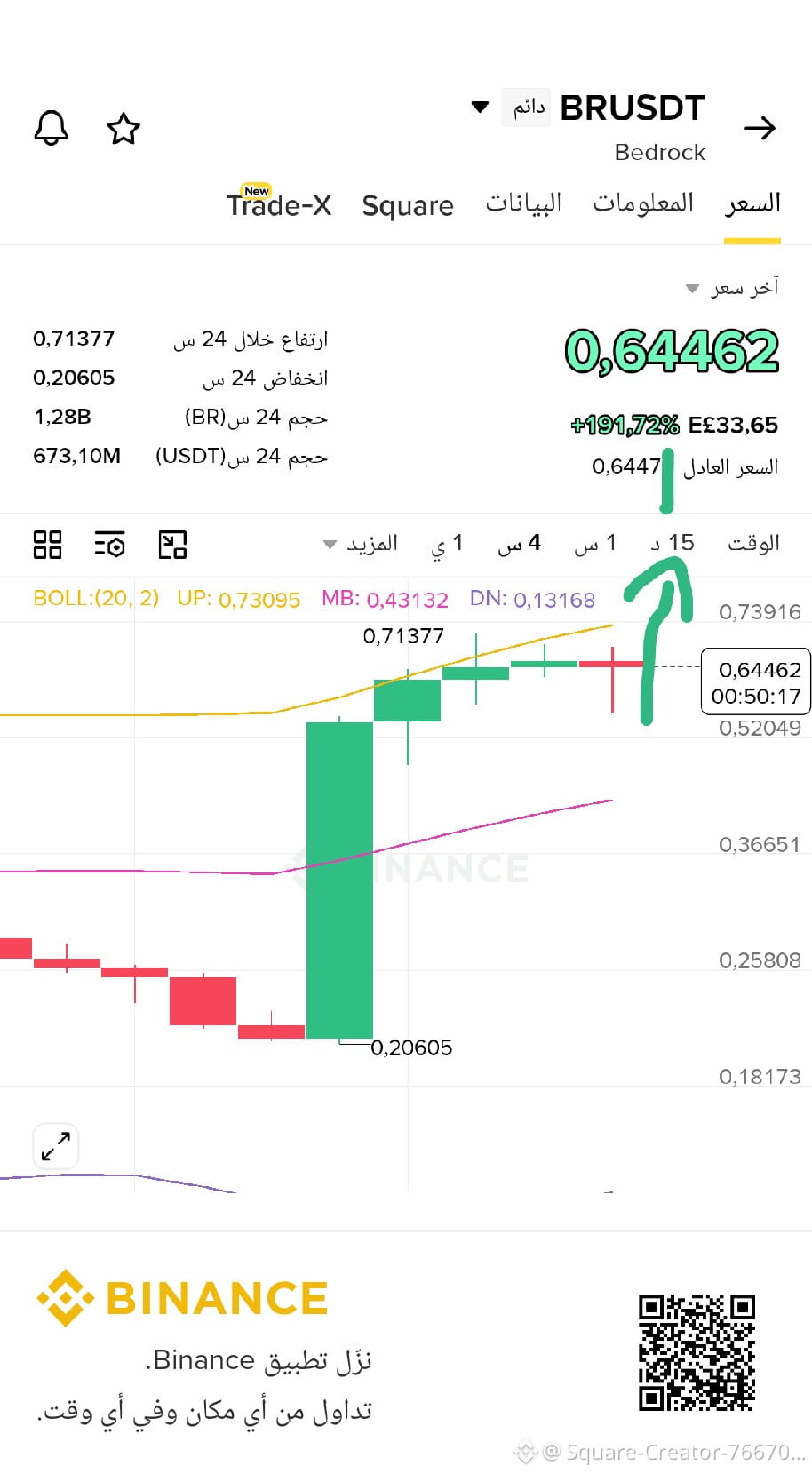
🚨 Are you falling for the $1 trap with the coin $BR ? 🛑
Everyone is talking about Bedrock ($BR) surging toward $1 after a terrifying price explosion that surpassed 190% and a peak at $0.713! 🔥
But before you rush in because of FOMO (fear of missing out), look clearly at the chart:
* Sharp overbought: the price brutally breaks through the upper Bollinger Band limit (UP: $0.730).
* Correction gap: the current trade at $0.644 is far away from the middle average (MB: $0.431), which increases the likelihood of a sudden corrective drop to lock in profits!
💡 Beware: the dream is very close, but buying at the tops without a retest is the favorite spot for trap-setters.
Will the coin return to gather more strength, or will it keep flying straight to $1? Share your take in the comments! 👇
#BR
#Bedrock #Binance
#Crypto
#Trading
NFA. DYOR.
🚨 Are you falling for the $1 trap with the coin $BR ? 🛑
Everyone is talking about Bedrock ($BR ) surging toward $1 after a terrifying price explosion that surpassed 190% and a peak at $0.713! 🔥
But before you rush in because of FOMO (fear of missing out), look clearly at the chart:
* Sharp overbought: the price brutally breaks through the upper Bollinger Band limit (UP: $0.730).
* Correction gap: the current trade at $0.644 is far away from the middle average (MB: $0.431), which increases the likelihood of a sudden corrective drop to lock in profits!
💡 Beware: the dream is very close, but buying at the tops without a retest is the favorite spot for trap-setters.
Will the coin return to gather more strength, or will it keep flying straight to $1? Share your take in the comments! 👇
#BR
#Bedrock #Binance
#Crypto
#Trading
NFA. DYOR.
Everyone is talking about Bedrock ($BR ) surging toward $1 after a terrifying price explosion that surpassed 190% and a peak at $0.713! 🔥
But before you rush in because of FOMO (fear of missing out), look clearly at the chart:
* Sharp overbought: the price brutally breaks through the upper Bollinger Band limit (UP: $0.730).
* Correction gap: the current trade at $0.644 is far away from the middle average (MB: $0.431), which increases the likelihood of a sudden corrective drop to lock in profits!
💡 Beware: the dream is very close, but buying at the tops without a retest is the favorite spot for trap-setters.
Will the coin return to gather more strength, or will it keep flying straight to $1? Share your take in the comments! 👇
#BR
#Bedrock #Binance
#Crypto
#Trading
NFA. DYOR.
4
1.2k
·
--
Bullish
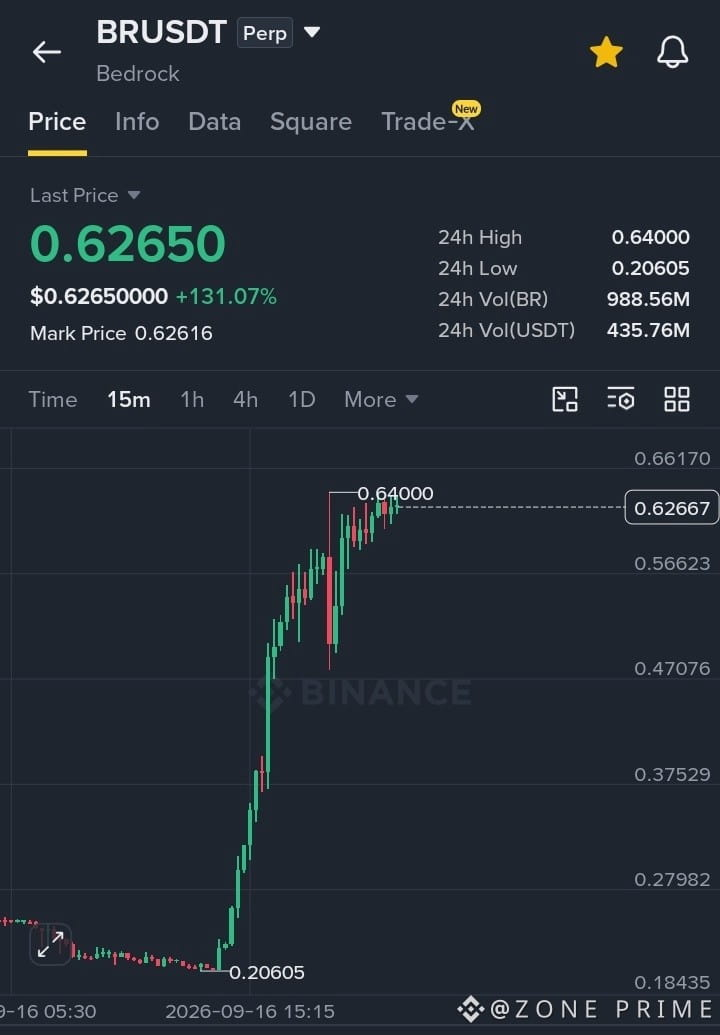
$BR /USDT — LONG SETUP Go 📈 🚀 💯
Entry: 0.56623 - 0.62650
TP1: 0.64000
TP2: 0.66170
TP3: 0.70000
Stop: 0.52500
Explosive impulse momentum breaking through previous structural levels with strong volume.
Sustained spot demand expansion and tight price consolidation favor further bullish price discovery.
#BR #brusdt #bedrock #crypto $BR
{future}(BRUSDT)
$BR /USDT — LONG SETUP Go 📈 🚀 💯
Entry: 0.56623 - 0.62650
TP1: 0.64000
TP2: 0.66170
TP3: 0.70000
Stop: 0.52500
Explosive impulse momentum breaking through previous structural levels with strong volume.
Sustained spot demand expansion and tight price consolidation favor further bullish price discovery.
#BR #brusdt #bedrock #crypto $BR
Entry: 0.56623 - 0.62650
TP1: 0.64000
TP2: 0.66170
TP3: 0.70000
Stop: 0.52500
Explosive impulse momentum breaking through previous structural levels with strong volume.
Sustained spot demand expansion and tight price consolidation favor further bullish price discovery.
#BR #brusdt #bedrock #crypto $BR
1
149
Log in to explore more content
Join global crypto users on Binance Square
⚡️ Get latest and useful information about crypto.
💬 Trusted by the world’s largest crypto exchange.
👍 Discover real insights from verified creators.
Email / Phone number
Trending Topics
1
#CircleMints500MUSDCOnSolana
6,355 views
377 Discussing
2
#PolymarketBankFailureBetsDrawFDICConcern
19,683 views
582 Discussing
3
#BlackRockBuildsTokenizedPortfoliosForOndo
15,145 views
398 Discussing
4
#BitwiseFilesToListNEARETFOnNYSEArca
16,231 views
380 Discussing
5
#SECCommissionerPeirceToLeaveOct2
17,517 views
317 Discussing
6
#SECSaysBuybacksUpgradesDontMakeTokenSecurity
18,069 views
291 Discussing
7
#StrategyProposesDailyDividendsForPreferreds
2,464 views
79 Discussing
8
#CircleTetherFreezeBitgetHackerWallet
1,322 views
51 Discussing
9
#CoinMarketCapCompletesCoinglassAcquisition
4,978 views
72 Discussing
10
#QNTRises39%
81,322 views
1,395 Discussing