

#polymarketbankfailurebetsdrawfdicconcern
polymarketbankfailurebetsdrawfdicconcern
Hot
Latest

🔎 Prediction Markets vs Financial Stability
Bank-failure contracts are becoming a new point of debate as prediction markets expand.
FDIC officials have reportedly questioned the potential impact of these contracts, while Polymarket argues prediction markets can aggregate information from participants.
For spot-focused investors, the key is separating market signals from speculation. Watch $BTC $ETH $SOL closely. 📈
#polymarketbankfailurebetsdrawfdicconcern
🔎 Prediction Markets vs Financial Stability
Bank-failure contracts are becoming a new point of debate as prediction markets expand.
FDIC officials have reportedly questioned the potential impact of these contracts, while Polymarket argues prediction markets can aggregate information from participants.
For spot-focused investors, the key is separating market signals from speculation. Watch $BTC $ETH $SOL closely. 📈
#polymarketbankfailurebetsdrawfdicconcern
Bank-failure contracts are becoming a new point of debate as prediction markets expand.
FDIC officials have reportedly questioned the potential impact of these contracts, while Polymarket argues prediction markets can aggregate information from participants.
For spot-focused investors, the key is separating market signals from speculation. Watch $BTC $ETH $SOL closely. 📈
#polymarketbankfailurebetsdrawfdicconcern
Farzanahameed01:
Good point! Do you think prediction markets will help financial stability or create more risk? Curious to know your view on this.
3
3
1.1k

·
--
Bullish
#polymarketbankfailurebetsdrawfdicconcern
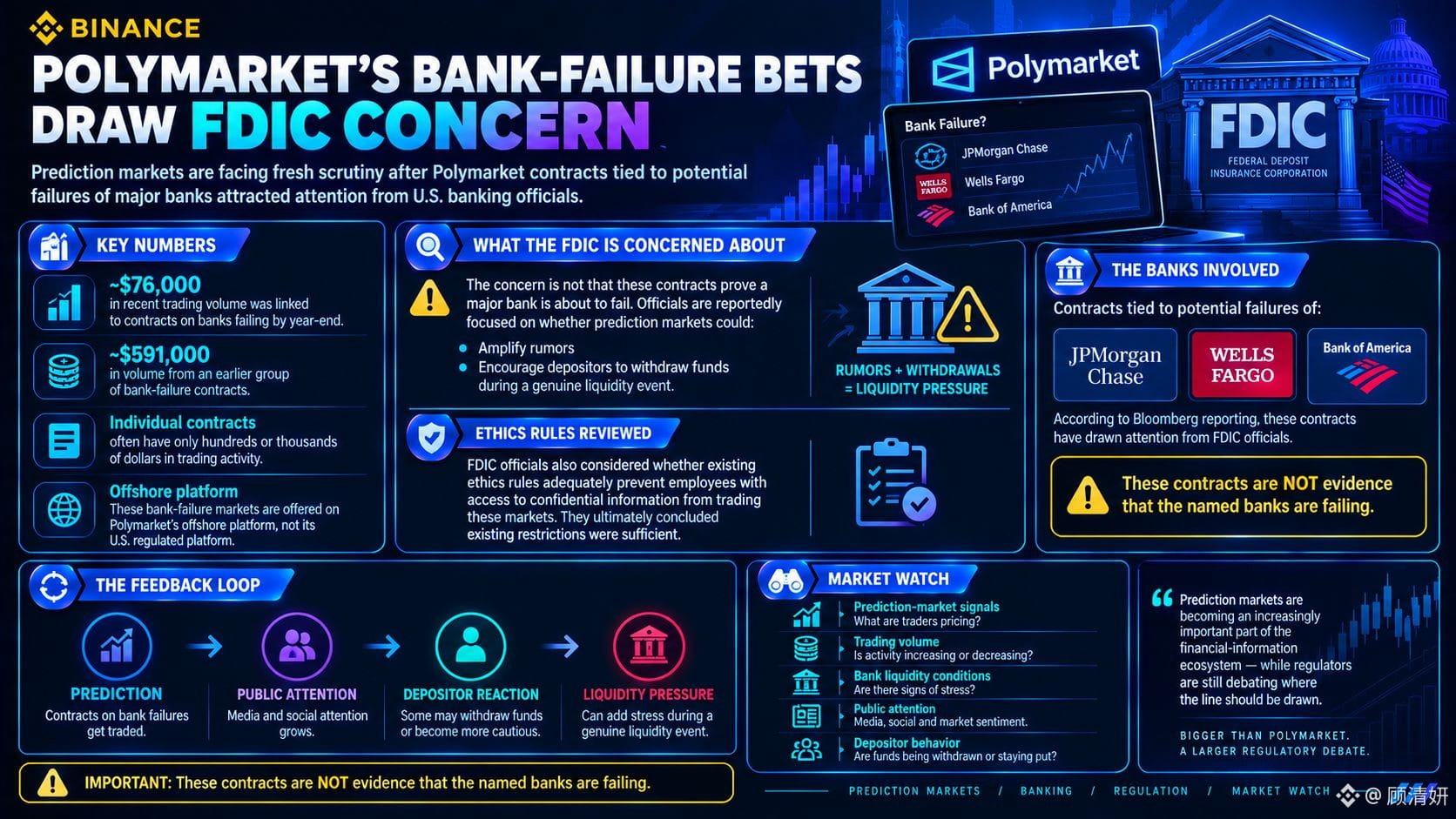
🚨 POLYMARKET’S BANK-FAILURE BETS DRAW FDIC CONCERN
Prediction markets are facing fresh scrutiny after Polymarket contracts tied to potential failures of major banks attracted attention from U.S. banking officials.
According to Bloomberg reporting, contracts involving banks such as JPMorgan Chase, Wells Fargo and Bank of America have raised concerns at the Federal Deposit Insurance Corporation (FDIC).
🔎 KEY NUMBERS
• Around $76,000 in recent trading volume was linked to contracts on banks failing by year-end
• An earlier group of bank-failure contracts reportedly generated about $591,000 in volume
WHY THE FDIC IS WATCHING
Officials are reportedly focused on the possibility that larger prediction markets could amplify rumors or encourage depositors to withdraw funds, potentially creating additional pressure on a bank during a genuine liquidity event.
FDIC officials also considered whether existing ethics rules adequately prevent employees with access to confidential information from trading these markets. They ultimately concluded that existing restrictions were sufficient.
🌐 WHY IT MATTERS FOR MARKETS
Prediction markets are increasingly being used to price probabilities around real-world events.
But bank-failure contracts create a unique feedback loop:
Prediction → Public attention → Depositor reaction → Liquidity pressure
That makes the regulatory debate bigger than Polymarket itself.
For crypto traders, the broader takeaway is that prediction markets are becoming an increasingly important part of the financial-information ecosystem — while regulators are still debating where the line should be drawn.
⚠️ Important: These contracts are not evidence that the named banks are failing. Trading volume remains relatively small compared with traditional financial markets.
Could prediction markets become useful early-warning indicators — or create the very panic they are trying to measure?
$KMNO $2Z $MARSCOIN
{future}(MARSCOINUSDT)
{future}(2ZUSDT)
{future}(KMNOUSDT)
#polymarketbankfailurebetsdrawfdicconcern
🚨 POLYMARKET’S BANK-FAILURE BETS DRAW FDIC CONCERN
Prediction markets are facing fresh scrutiny after Polymarket contracts tied to potential failures of major banks attracted attention from U.S. banking officials.
According to Bloomberg reporting, contracts involving banks such as JPMorgan Chase, Wells Fargo and Bank of America have raised concerns at the Federal Deposit Insurance Corporation (FDIC).
🔎 KEY NUMBERS
• Around $76,000 in recent trading volume was linked to contracts on banks failing by year-end
• An earlier group of bank-failure contracts reportedly generated about $591,000 in volume
WHY THE FDIC IS WATCHING
Officials are reportedly focused on the possibility that larger prediction markets could amplify rumors or encourage depositors to withdraw funds, potentially creating additional pressure on a bank during a genuine liquidity event.
FDIC officials also considered whether existing ethics rules adequately prevent employees with access to confidential information from trading these markets. They ultimately concluded that existing restrictions were sufficient.
🌐 WHY IT MATTERS FOR MARKETS
Prediction markets are increasingly being used to price probabilities around real-world events.
But bank-failure contracts create a unique feedback loop:
Prediction → Public attention → Depositor reaction → Liquidity pressure
That makes the regulatory debate bigger than Polymarket itself.
For crypto traders, the broader takeaway is that prediction markets are becoming an increasingly important part of the financial-information ecosystem — while regulators are still debating where the line should be drawn.
⚠️ Important: These contracts are not evidence that the named banks are failing. Trading volume remains relatively small compared with traditional financial markets.
Could prediction markets become useful early-warning indicators — or create the very panic they are trying to measure?
$KMNO $2Z $MARSCOIN
🚨 POLYMARKET’S BANK-FAILURE BETS DRAW FDIC CONCERN
Prediction markets are facing fresh scrutiny after Polymarket contracts tied to potential failures of major banks attracted attention from U.S. banking officials.
According to Bloomberg reporting, contracts involving banks such as JPMorgan Chase, Wells Fargo and Bank of America have raised concerns at the Federal Deposit Insurance Corporation (FDIC).
🔎 KEY NUMBERS
• Around $76,000 in recent trading volume was linked to contracts on banks failing by year-end
• An earlier group of bank-failure contracts reportedly generated about $591,000 in volume
WHY THE FDIC IS WATCHING
Officials are reportedly focused on the possibility that larger prediction markets could amplify rumors or encourage depositors to withdraw funds, potentially creating additional pressure on a bank during a genuine liquidity event.
FDIC officials also considered whether existing ethics rules adequately prevent employees with access to confidential information from trading these markets. They ultimately concluded that existing restrictions were sufficient.
🌐 WHY IT MATTERS FOR MARKETS
Prediction markets are increasingly being used to price probabilities around real-world events.
But bank-failure contracts create a unique feedback loop:
Prediction → Public attention → Depositor reaction → Liquidity pressure
That makes the regulatory debate bigger than Polymarket itself.
For crypto traders, the broader takeaway is that prediction markets are becoming an increasingly important part of the financial-information ecosystem — while regulators are still debating where the line should be drawn.
⚠️ Important: These contracts are not evidence that the named banks are failing. Trading volume remains relatively small compared with traditional financial markets.
Could prediction markets become useful early-warning indicators — or create the very panic they are trying to measure?
$KMNO $2Z $MARSCOIN
4
9k

·
--
#polymarketbankfailurebetsdrawfdicconcern 🚨
Polymarket bets on JPMorgan, Bank of America and Wells Fargo collapsing are reportedly raising concerns at the FDIC
and in Congress.
Prediction markets are getting so big that regulators are now questioning whether betting on
bank failures could actually fuel panic.
👀$BOME $SENT $1000XEC
#polymarketbankfailurebetsdrawfdicconcern 🚨
Polymarket bets on JPMorgan, Bank of America and Wells Fargo collapsing are reportedly raising concerns at the FDIC
and in Congress.
Prediction markets are getting so big that regulators are now questioning whether betting on
bank failures could actually fuel panic.
👀$BOME $SENT $1000XEC
Polymarket bets on JPMorgan, Bank of America and Wells Fargo collapsing are reportedly raising concerns at the FDIC
and in Congress.
Prediction markets are getting so big that regulators are now questioning whether betting on
bank failures could actually fuel panic.
👀$BOME $SENT $1000XEC
Theodora Hema q1Fp:
https://app.binance.com/uni-qr/cpro/Square-Creator-9cb583b693a78?l=en&r=URQ1QSTL&uc=app_square_share_link&us=copylink
6 followers left 20$
1
1.1k

·
--
#PolymarketBankFailureBetsDrawFDICConcern Here’s a concise 8-line version with verified facts⬇️
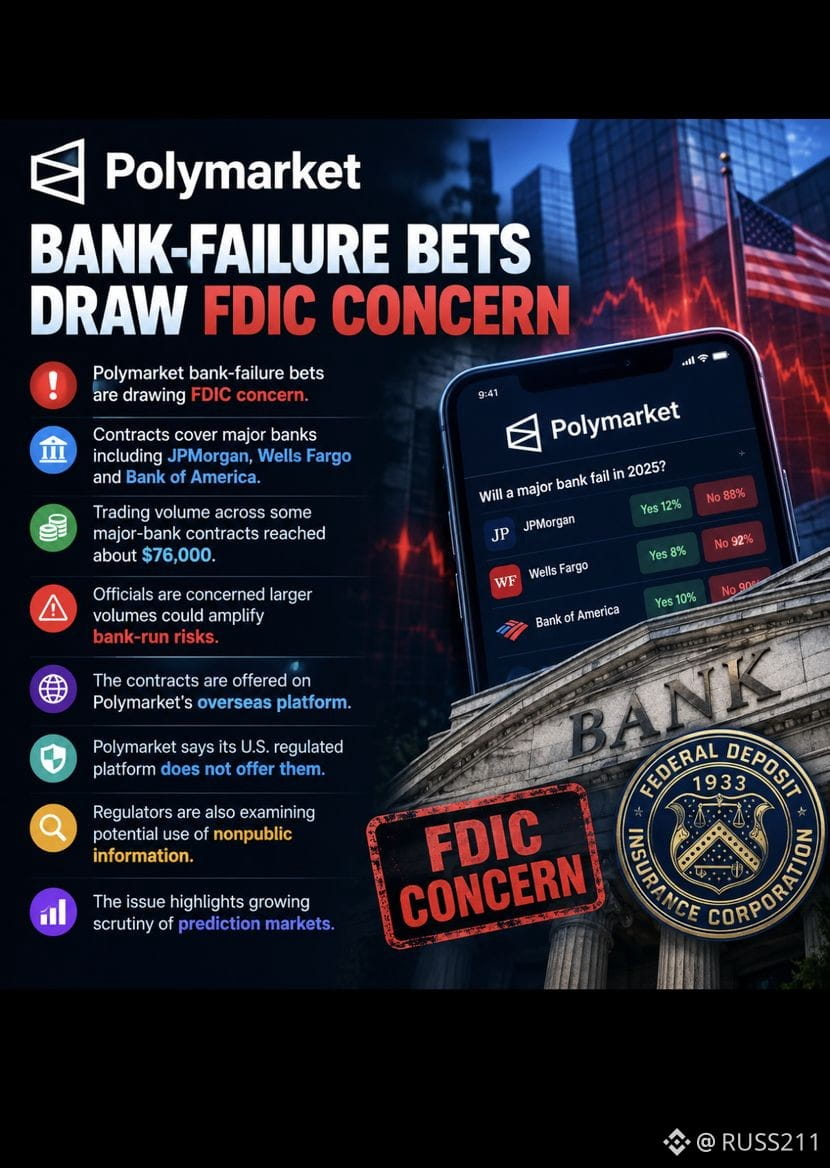
🚨 Polymarket bank-failure bets are drawing FDIC concern.
🏦 Contracts cover major banks including JPMorgan, Wells Fargo and Bank of America.
💰 Trading volume across some major-bank contracts reached about $76,000.
⚠️ Officials are concerned larger volumes could amplify bank-run risks.
🌐 The contracts are offered on Polymarket’s overseas platform.
🇺🇸 Polymarket says its U.S. regulated platform does not offer them.
🔎 Regulators are also examining potential use of nonpublic information.
📊 The issue highlights growing scrutiny of prediction markets.
#PolymarketBankFailureBetsDrawFDICConcern Here’s a concise 8-line version with verified facts⬇️
🚨 Polymarket bank-failure bets are drawing FDIC concern.
🏦 Contracts cover major banks including JPMorgan, Wells Fargo and Bank of America.
💰 Trading volume across some major-bank contracts reached about $76,000.
⚠️ Officials are concerned larger volumes could amplify bank-run risks.
🌐 The contracts are offered on Polymarket’s overseas platform.
🇺🇸 Polymarket says its U.S. regulated platform does not offer them.
🔎 Regulators are also examining potential use of nonpublic information.
📊 The issue highlights growing scrutiny of prediction markets.
🚨 Polymarket bank-failure bets are drawing FDIC concern.
🏦 Contracts cover major banks including JPMorgan, Wells Fargo and Bank of America.
💰 Trading volume across some major-bank contracts reached about $76,000.
⚠️ Officials are concerned larger volumes could amplify bank-run risks.
🌐 The contracts are offered on Polymarket’s overseas platform.
🇺🇸 Polymarket says its U.S. regulated platform does not offer them.
🔎 Regulators are also examining potential use of nonpublic information.
📊 The issue highlights growing scrutiny of prediction markets.
120

·
--
Verified
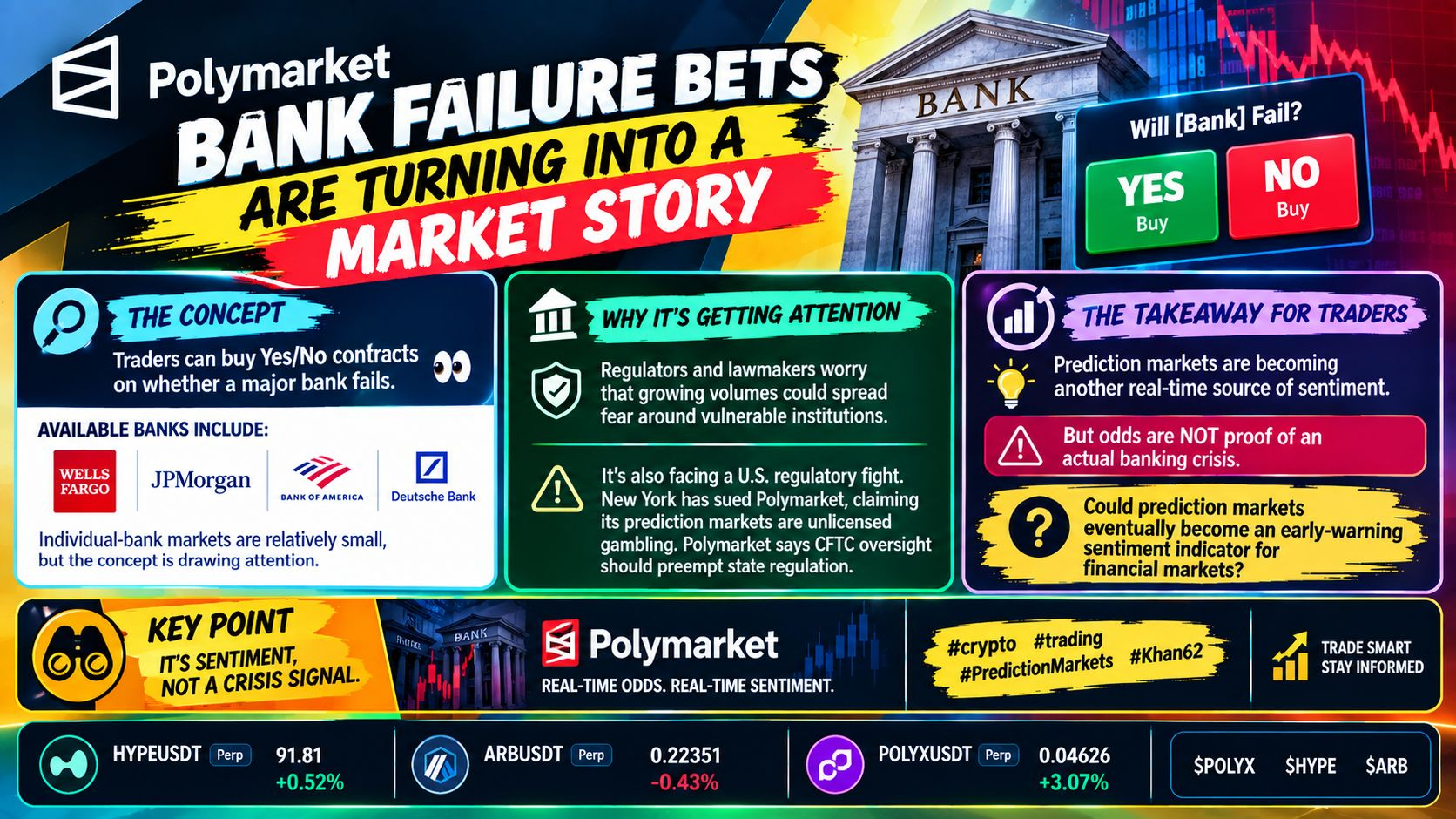
#polymarketbankfailurebetsdrawfdicconcern 🚨 BANK FAILURE BETS ARE TURNING INTO A MARKET STORY
What happens when traders can buy a Yes/No contract on whether a major bank fails? 👀
Polymarket’s offshore platform has listed contracts covering banks including Wells Fargo, JPMorgan, Bank of America and Deutsche Bank. Individual‑bank markets remain relatively small. The concept is attracting attention from regulators and lawmakers who worry that growing volumes could spread fear around vulnerable institutions.
At the time Polymarket is facing a broader regulatory fight in the U.S. New York has sued the platform alleging its prediction markets constitute unlicensed gambling. Polymarket has replied that federal CFTC oversight should preempt state regulation.
📊 The takeaway for traders:
Prediction markets are becoming another real‑time source of sentiment but odds are not proof of an actual banking crisis.
Could prediction markets eventually become an early‑warning sentiment indicator, for financial markets?
#crypto #trading #PredictionMarkets #Khan62
$POLYX $HYPE
{future}(HYPEUSDT)
$ARB
{future}(ARBUSDT)
{future}(POLYXUSDT)
#polymarketbankfailurebetsdrawfdicconcern 🚨 BANK FAILURE BETS ARE TURNING INTO A MARKET STORY
What happens when traders can buy a Yes/No contract on whether a major bank fails? 👀
Polymarket’s offshore platform has listed contracts covering banks including Wells Fargo, JPMorgan, Bank of America and Deutsche Bank. Individual‑bank markets remain relatively small. The concept is attracting attention from regulators and lawmakers who worry that growing volumes could spread fear around vulnerable institutions.
At the time Polymarket is facing a broader regulatory fight in the U.S. New York has sued the platform alleging its prediction markets constitute unlicensed gambling. Polymarket has replied that federal CFTC oversight should preempt state regulation.
📊 The takeaway for traders:
Prediction markets are becoming another real‑time source of sentiment but odds are not proof of an actual banking crisis.
Could prediction markets eventually become an early‑warning sentiment indicator, for financial markets?
#crypto #trading #PredictionMarkets #Khan62
$POLYX $HYPE
$ARB
What happens when traders can buy a Yes/No contract on whether a major bank fails? 👀
Polymarket’s offshore platform has listed contracts covering banks including Wells Fargo, JPMorgan, Bank of America and Deutsche Bank. Individual‑bank markets remain relatively small. The concept is attracting attention from regulators and lawmakers who worry that growing volumes could spread fear around vulnerable institutions.
At the time Polymarket is facing a broader regulatory fight in the U.S. New York has sued the platform alleging its prediction markets constitute unlicensed gambling. Polymarket has replied that federal CFTC oversight should preempt state regulation.
📊 The takeaway for traders:
Prediction markets are becoming another real‑time source of sentiment but odds are not proof of an actual banking crisis.
Could prediction markets eventually become an early‑warning sentiment indicator, for financial markets?
#crypto #trading #PredictionMarkets #Khan62
$POLYX $HYPE
$ARB
206 Atlas:
A 10x target on a low cap like XEC is speculative gambling, not trading. What specific technical invalidation would you use to exit if the thesis fails?Sentiment data is not fundamental proof of insolvency. Do not confuse crowd speculation with actual balance sheet risk.
1
1
4k

·
--
#polymarketbankfailurebetsdrawfdicconcern
🚨 POLYMARKET BETS ON MAJOR BANK FAILURES: FINANCIAL INNOVATION OR A DANGEROUS RISK? 😱🏦
Prediction market Polymarket has opened contracts betting on whether banking giants like JPMorgan, Wells Fargo, and Bank of America will fail!
While volume currently sits around $76K, the FDIC, former regulators, and Congress are raising major red flags.
💡 Why Regulators Are Concerned:
🔹 The Feedback Loop: High odds on social media can panic depositors, potentially triggering the exact bank run being bet on⚠️
🔹 Divergent Views: Even competitor Kalshi called the market "in poor taste," while critics warn of dangerous incentives.
🎯 2 Key Tokens to Watch During Banking Uncertainty:
🔗 $LINK — Provides decentralized oracle price feeds that keep prediction markets and RWA platforms accurate during high volatility! 🌐⚡
🏛️ $ONDO — Tokenized Real World Assets (RWAs) like U.S. Treasuries benefit when investors seek yield outside traditional banking turmoil! 📊💎
What do you think—are prediction markets taking transparency too far, or should traders be free to price in bank failure risks? Drop your thoughts below! 👇✨
#PolymarketBankFailureBetsDrawFDICConcern
#BlackRockBuildsTokenizedPortfoliosForOndo
#BitwiseFilesToListNEARETFOnNYSEArca
#SECCommissionerPeirceToLeaveOct2
{spot}(ONDOUSDT)
{spot}(LINKUSDT)
#polymarketbankfailurebetsdrawfdicconcern
🚨 POLYMARKET BETS ON MAJOR BANK FAILURES: FINANCIAL INNOVATION OR A DANGEROUS RISK? 😱🏦
Prediction market Polymarket has opened contracts betting on whether banking giants like JPMorgan, Wells Fargo, and Bank of America will fail!
While volume currently sits around $76K, the FDIC, former regulators, and Congress are raising major red flags.
💡 Why Regulators Are Concerned:
🔹 The Feedback Loop: High odds on social media can panic depositors, potentially triggering the exact bank run being bet on⚠️
🔹 Divergent Views: Even competitor Kalshi called the market "in poor taste," while critics warn of dangerous incentives.
🎯 2 Key Tokens to Watch During Banking Uncertainty:
🔗 $LINK — Provides decentralized oracle price feeds that keep prediction markets and RWA platforms accurate during high volatility! 🌐⚡
🏛️ $ONDO — Tokenized Real World Assets (RWAs) like U.S. Treasuries benefit when investors seek yield outside traditional banking turmoil! 📊💎
What do you think—are prediction markets taking transparency too far, or should traders be free to price in bank failure risks? Drop your thoughts below! 👇✨
#PolymarketBankFailureBetsDrawFDICConcern
#BlackRockBuildsTokenizedPortfoliosForOndo
#BitwiseFilesToListNEARETFOnNYSEArca
#SECCommissionerPeirceToLeaveOct2
🚨 POLYMARKET BETS ON MAJOR BANK FAILURES: FINANCIAL INNOVATION OR A DANGEROUS RISK? 😱🏦
Prediction market Polymarket has opened contracts betting on whether banking giants like JPMorgan, Wells Fargo, and Bank of America will fail!
While volume currently sits around $76K, the FDIC, former regulators, and Congress are raising major red flags.
💡 Why Regulators Are Concerned:
🔹 The Feedback Loop: High odds on social media can panic depositors, potentially triggering the exact bank run being bet on⚠️
🔹 Divergent Views: Even competitor Kalshi called the market "in poor taste," while critics warn of dangerous incentives.
🎯 2 Key Tokens to Watch During Banking Uncertainty:
🔗 $LINK — Provides decentralized oracle price feeds that keep prediction markets and RWA platforms accurate during high volatility! 🌐⚡
🏛️ $ONDO — Tokenized Real World Assets (RWAs) like U.S. Treasuries benefit when investors seek yield outside traditional banking turmoil! 📊💎
What do you think—are prediction markets taking transparency too far, or should traders be free to price in bank failure risks? Drop your thoughts below! 👇✨
#PolymarketBankFailureBetsDrawFDICConcern
#BlackRockBuildsTokenizedPortfoliosForOndo
#BitwiseFilesToListNEARETFOnNYSEArca
#SECCommissionerPeirceToLeaveOct2

206 Atlas:
The FDIC concern is valid, but Polymarket’s low volume means it won’t trigger the bank runs you fear.
7
6
3.6k

·
--
Verified
#polymarketbankfailurebetsdrawfdicconcern
🚨 People are betting on which bank fails next. Regulators aren't happy about it.
On Polymarket and Kalshi, you can trade a market literally titled "Which bank will fail by end of 2026."
One name is trading noticeably above the rest: Truist.
Not because of confirmed news — because of market chatter.
That's exactly what has community banking groups alarmed. ICBA has formally asked the CFTC to ban prediction markets from taking bets on individual banks' survival, arguing it threatens confidence in the financial system itself.
Here's the uncomfortable truth about these markets:
A bank run isn't just caused by bad balance sheets. It's caused by people believing other people believe the bank is in trouble.
A public, tradeable "will this bank fail" market can become the thing that causes the failure — a self-fulfilling prophecy, not just a prediction of one.
Meanwhile, multiple "US bank failure by [date]" contracts have already resolved YES this year, so this isn't purely hypothetical scaremongering — isolated bank failures have actually happened in 2026.
The real question for markets broadly:
If regulators do ban single-bank survival betting, does that reduce panic risk — or just push the same speculation into anonymous chatter with less transparency than a regulated market?
Where do you land: should prediction markets be allowed to bet on individual bank failures, or is this exactly the kind of market that shouldn't exist?
$ZEC $BR
$SNDK
{future}(SNDKUSDT)
{future}(ZECUSDT)
#polymarketbankfailurebetsdrawfdicconcern #Polymarket #BankingCrisis
#polymarketbankfailurebetsdrawfdicconcern
🚨 People are betting on which bank fails next. Regulators aren't happy about it.
On Polymarket and Kalshi, you can trade a market literally titled "Which bank will fail by end of 2026."
One name is trading noticeably above the rest: Truist.
Not because of confirmed news — because of market chatter.
That's exactly what has community banking groups alarmed. ICBA has formally asked the CFTC to ban prediction markets from taking bets on individual banks' survival, arguing it threatens confidence in the financial system itself.
Here's the uncomfortable truth about these markets:
A bank run isn't just caused by bad balance sheets. It's caused by people believing other people believe the bank is in trouble.
A public, tradeable "will this bank fail" market can become the thing that causes the failure — a self-fulfilling prophecy, not just a prediction of one.
Meanwhile, multiple "US bank failure by [date]" contracts have already resolved YES this year, so this isn't purely hypothetical scaremongering — isolated bank failures have actually happened in 2026.
The real question for markets broadly:
If regulators do ban single-bank survival betting, does that reduce panic risk — or just push the same speculation into anonymous chatter with less transparency than a regulated market?
Where do you land: should prediction markets be allowed to bet on individual bank failures, or is this exactly the kind of market that shouldn't exist?
$ZEC $BR
$SNDK
#polymarketbankfailurebetsdrawfdicconcern #Polymarket #BankingCrisis
🚨 People are betting on which bank fails next. Regulators aren't happy about it.
On Polymarket and Kalshi, you can trade a market literally titled "Which bank will fail by end of 2026."
One name is trading noticeably above the rest: Truist.
Not because of confirmed news — because of market chatter.
That's exactly what has community banking groups alarmed. ICBA has formally asked the CFTC to ban prediction markets from taking bets on individual banks' survival, arguing it threatens confidence in the financial system itself.
Here's the uncomfortable truth about these markets:
A bank run isn't just caused by bad balance sheets. It's caused by people believing other people believe the bank is in trouble.
A public, tradeable "will this bank fail" market can become the thing that causes the failure — a self-fulfilling prophecy, not just a prediction of one.
Meanwhile, multiple "US bank failure by [date]" contracts have already resolved YES this year, so this isn't purely hypothetical scaremongering — isolated bank failures have actually happened in 2026.
The real question for markets broadly:
If regulators do ban single-bank survival betting, does that reduce panic risk — or just push the same speculation into anonymous chatter with less transparency than a regulated market?
Where do you land: should prediction markets be allowed to bet on individual bank failures, or is this exactly the kind of market that shouldn't exist?
$ZEC $BR
$SNDK
#polymarketbankfailurebetsdrawfdicconcern #Polymarket #BankingCrisis
SAQR77:
المستقبل كفيل بالإجابة عن السؤال. أنا فقط أعيش بتفاؤل حتى أعطي حياتي معنى.
5
8
7.4k

·
--
Article
Polymarket Bank-Failure Bets Draw FDIC Attention: Could Prediction Markets Fuel Panic?#polymarketbankfailurebetsdrawfdicconcern
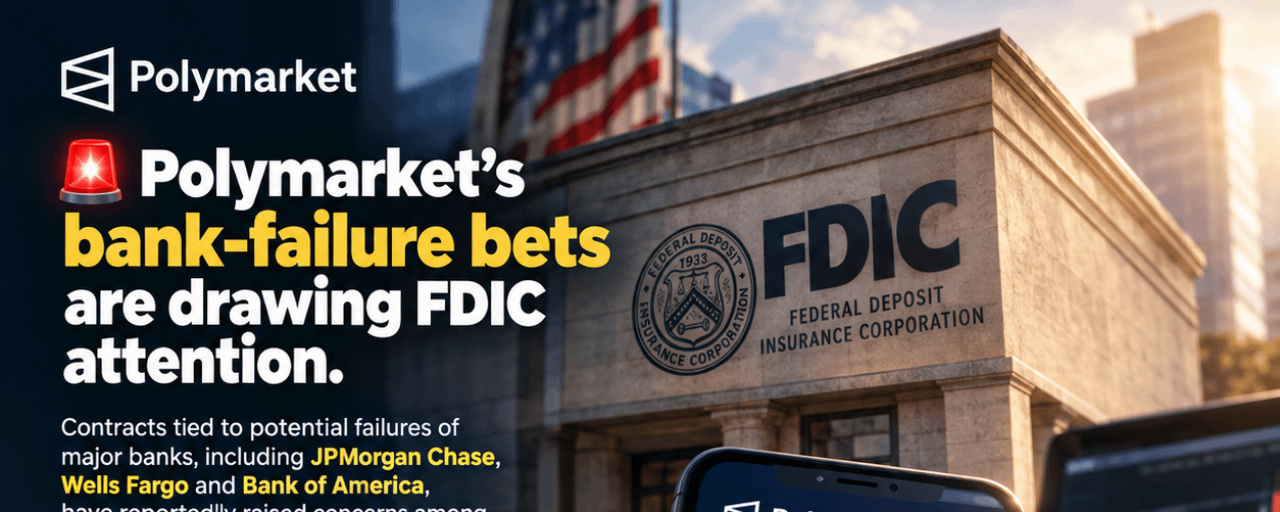
🚨 Polymarket’s Bank-Failure Bets Are Drawing FDIC Attention
Prediction markets are increasingly moving into areas that regulators normally watch closely.
Polymarket contracts tied to potential failures of major banks — including JPMorgan Chase, Wells Fargo and Bank of America — have reportedly drawn scrutiny from US banking officials, according to Bloomberg.
The contracts are still relatively small compared with the broader prediction-market ecosystem. Recent wagers tied to banks failing by the end of 2026 had around $76,000 in total volume, while an earlier group of bank-failure contracts generated about $591,000.
But the size of the market isn't the only issue.
🏦 Why is the FDIC paying attention?
The Federal Deposit Insurance Corporation reportedly discussed whether these contracts could create risks if they became larger and more influential.
The concern is not simply that traders are betting on whether a bank will fail.
It's what could happen after the prediction gets attention.
A prediction market can turn a possibility into a highly visible headline. If enough people see a market suggesting that a bank could fail, that information could potentially influence how depositors behave.
That creates a feedback loop worth watching:
Prediction → attention → depositor reaction → liquidity pressure
Bloomberg reported that FDIC officials specifically considered whether these contracts could eventually contribute to a real-world bank run. The agency also discussed whether its existing ethics rules were sufficient to prevent employees with access to confidential information from trading on such markets.
📊 But a prediction isn't proof of a bank problem
This distinction matters.
The existence of a market where traders can bet on a bank failure doesn't mean the bank is actually approaching failure.
In fact, research from the Federal Reserve Bank of Richmond published in 2026 notes that bank failures are generally preceded by weak fundamentals such as poor loan performance, low capital or declining earnings. Depositor runs can accelerate a crisis, but the research says they are rarely the fundamental root cause.
So traders shouldn't automatically interpret prediction-market activity as a fundamental signal.
It's another piece of information — and one that needs context.
🔄 The interesting part: markets can influence what they measure
This is where prediction markets become particularly interesting.
Normally, markets are expected to reflect information.
But when the underlying event involves human behavior, the market itself can potentially become part of the information environment.
Imagine a scenario:
A prediction market shows increased trading around a potential bank failure.
↓
The market receives attention on social media.
↓
More people become aware of the possibility.
↓
Some depositors become concerned and move money.
↓
The bank experiences additional liquidity pressure.
The original prediction hasn't necessarily been correct.
Yet the attention surrounding it could potentially affect the outcome.
That's the regulatory concern worth watching.
🌐 Why this matters for crypto
Crypto traders are already familiar with prediction markets becoming a real-time source of market sentiment.
Polymarket covers everything from crypto and finance to politics, sports and technology. The expansion into financial-system events creates a different question:
Where does information discovery end and market influence begin?
For crypto, this matters because prediction markets increasingly sit at the intersection of trading, information and social media.
A market can move quickly when a headline breaks. But the headline can also change what traders believe, which can change their behavior.
That's why volume alone shouldn't be treated as confirmation.
👀 What traders should watch
For markets, the important signals are likely to be:
Changes in prediction-market volumeWhether major financial news confirms the underlying narrativeBank deposit and liquidity dataCredit-market stressOfficial statements from regulatorsWhether social-media discussion begins acceleratingWhether actual bank fundamentals are changing
The FDIC's reported concerns don't establish that any of the named banks are facing imminent failure.
The more interesting question is whether prediction markets can remain information tools without becoming catalysts for the events they're measuring.
My take
Prediction markets are designed to aggregate information.
But when the event being predicted is a potential bank failure, the information itself can influence behavior.
That's the loop traders should keep an eye on:
Prediction → attention → reaction → liquidity.
The line between predicting a market event and influencing it could become increasingly important as prediction markets expand into financial-system risks.
#Polymarket #Crypto #PredictionMarkets #Markets #FDIC #Banking #Trading
Polymarket Bank-Failure Bets Draw FDIC Attention: Could Prediction Markets Fuel Panic?
#polymarketbankfailurebetsdrawfdicconcern
🚨 Polymarket’s Bank-Failure Bets Are Drawing FDIC Attention
Prediction markets are increasingly moving into areas that regulators normally watch closely.
Polymarket contracts tied to potential failures of major banks — including JPMorgan Chase, Wells Fargo and Bank of America — have reportedly drawn scrutiny from US banking officials, according to Bloomberg.
The contracts are still relatively small compared with the broader prediction-market ecosystem. Recent wagers tied to banks failing by the end of 2026 had around $76,000 in total volume, while an earlier group of bank-failure contracts generated about $591,000.
But the size of the market isn't the only issue.
🏦 Why is the FDIC paying attention?
The Federal Deposit Insurance Corporation reportedly discussed whether these contracts could create risks if they became larger and more influential.
The concern is not simply that traders are betting on whether a bank will fail.
It's what could happen after the prediction gets attention.
A prediction market can turn a possibility into a highly visible headline. If enough people see a market suggesting that a bank could fail, that information could potentially influence how depositors behave.
That creates a feedback loop worth watching:
Prediction → attention → depositor reaction → liquidity pressure
Bloomberg reported that FDIC officials specifically considered whether these contracts could eventually contribute to a real-world bank run. The agency also discussed whether its existing ethics rules were sufficient to prevent employees with access to confidential information from trading on such markets.
📊 But a prediction isn't proof of a bank problem
This distinction matters.
The existence of a market where traders can bet on a bank failure doesn't mean the bank is actually approaching failure.
In fact, research from the Federal Reserve Bank of Richmond published in 2026 notes that bank failures are generally preceded by weak fundamentals such as poor loan performance, low capital or declining earnings. Depositor runs can accelerate a crisis, but the research says they are rarely the fundamental root cause.
So traders shouldn't automatically interpret prediction-market activity as a fundamental signal.
It's another piece of information — and one that needs context.
🔄 The interesting part: markets can influence what they measure
This is where prediction markets become particularly interesting.
Normally, markets are expected to reflect information.
But when the underlying event involves human behavior, the market itself can potentially become part of the information environment.
Imagine a scenario:
A prediction market shows increased trading around a potential bank failure.
↓
The market receives attention on social media.
↓
More people become aware of the possibility.
↓
Some depositors become concerned and move money.
↓
The bank experiences additional liquidity pressure.
The original prediction hasn't necessarily been correct.
Yet the attention surrounding it could potentially affect the outcome.
That's the regulatory concern worth watching.
🌐 Why this matters for crypto
Crypto traders are already familiar with prediction markets becoming a real-time source of market sentiment.
Polymarket covers everything from crypto and finance to politics, sports and technology. The expansion into financial-system events creates a different question:
Where does information discovery end and market influence begin?
For crypto, this matters because prediction markets increasingly sit at the intersection of trading, information and social media.
A market can move quickly when a headline breaks. But the headline can also change what traders believe, which can change their behavior.
That's why volume alone shouldn't be treated as confirmation.
👀 What traders should watch
For markets, the important signals are likely to be:
Changes in prediction-market volumeWhether major financial news confirms the underlying narrativeBank deposit and liquidity dataCredit-market stressOfficial statements from regulatorsWhether social-media discussion begins acceleratingWhether actual bank fundamentals are changing
The FDIC's reported concerns don't establish that any of the named banks are facing imminent failure.
The more interesting question is whether prediction markets can remain information tools without becoming catalysts for the events they're measuring.
My take
Prediction markets are designed to aggregate information.
But when the event being predicted is a potential bank failure, the information itself can influence behavior.
That's the loop traders should keep an eye on:
Prediction → attention → reaction → liquidity.
The line between predicting a market event and influencing it could become increasingly important as prediction markets expand into financial-system risks.
#Polymarket #Crypto #PredictionMarkets #Markets #FDIC #Banking #Trading
🚨 Polymarket’s Bank-Failure Bets Are Drawing FDIC Attention
Prediction markets are increasingly moving into areas that regulators normally watch closely.
Polymarket contracts tied to potential failures of major banks — including JPMorgan Chase, Wells Fargo and Bank of America — have reportedly drawn scrutiny from US banking officials, according to Bloomberg.
The contracts are still relatively small compared with the broader prediction-market ecosystem. Recent wagers tied to banks failing by the end of 2026 had around $76,000 in total volume, while an earlier group of bank-failure contracts generated about $591,000.
But the size of the market isn't the only issue.
🏦 Why is the FDIC paying attention?
The Federal Deposit Insurance Corporation reportedly discussed whether these contracts could create risks if they became larger and more influential.
The concern is not simply that traders are betting on whether a bank will fail.
It's what could happen after the prediction gets attention.
A prediction market can turn a possibility into a highly visible headline. If enough people see a market suggesting that a bank could fail, that information could potentially influence how depositors behave.
That creates a feedback loop worth watching:
Prediction → attention → depositor reaction → liquidity pressure
Bloomberg reported that FDIC officials specifically considered whether these contracts could eventually contribute to a real-world bank run. The agency also discussed whether its existing ethics rules were sufficient to prevent employees with access to confidential information from trading on such markets.
📊 But a prediction isn't proof of a bank problem
This distinction matters.
The existence of a market where traders can bet on a bank failure doesn't mean the bank is actually approaching failure.
In fact, research from the Federal Reserve Bank of Richmond published in 2026 notes that bank failures are generally preceded by weak fundamentals such as poor loan performance, low capital or declining earnings. Depositor runs can accelerate a crisis, but the research says they are rarely the fundamental root cause.
So traders shouldn't automatically interpret prediction-market activity as a fundamental signal.
It's another piece of information — and one that needs context.
🔄 The interesting part: markets can influence what they measure
This is where prediction markets become particularly interesting.
Normally, markets are expected to reflect information.
But when the underlying event involves human behavior, the market itself can potentially become part of the information environment.
Imagine a scenario:
A prediction market shows increased trading around a potential bank failure.
↓
The market receives attention on social media.
↓
More people become aware of the possibility.
↓
Some depositors become concerned and move money.
↓
The bank experiences additional liquidity pressure.
The original prediction hasn't necessarily been correct.
Yet the attention surrounding it could potentially affect the outcome.
That's the regulatory concern worth watching.
🌐 Why this matters for crypto
Crypto traders are already familiar with prediction markets becoming a real-time source of market sentiment.
Polymarket covers everything from crypto and finance to politics, sports and technology. The expansion into financial-system events creates a different question:
Where does information discovery end and market influence begin?
For crypto, this matters because prediction markets increasingly sit at the intersection of trading, information and social media.
A market can move quickly when a headline breaks. But the headline can also change what traders believe, which can change their behavior.
That's why volume alone shouldn't be treated as confirmation.
👀 What traders should watch
For markets, the important signals are likely to be:
Changes in prediction-market volumeWhether major financial news confirms the underlying narrativeBank deposit and liquidity dataCredit-market stressOfficial statements from regulatorsWhether social-media discussion begins acceleratingWhether actual bank fundamentals are changing
The FDIC's reported concerns don't establish that any of the named banks are facing imminent failure.
The more interesting question is whether prediction markets can remain information tools without becoming catalysts for the events they're measuring.
My take
Prediction markets are designed to aggregate information.
But when the event being predicted is a potential bank failure, the information itself can influence behavior.
That's the loop traders should keep an eye on:
Prediction → attention → reaction → liquidity.
The line between predicting a market event and influencing it could become increasingly important as prediction markets expand into financial-system risks.
#Polymarket #Crypto #PredictionMarkets #Markets #FDIC #Banking #Trading
4
·
--
#polymarketbankfailurebetsdrawfdicconcern
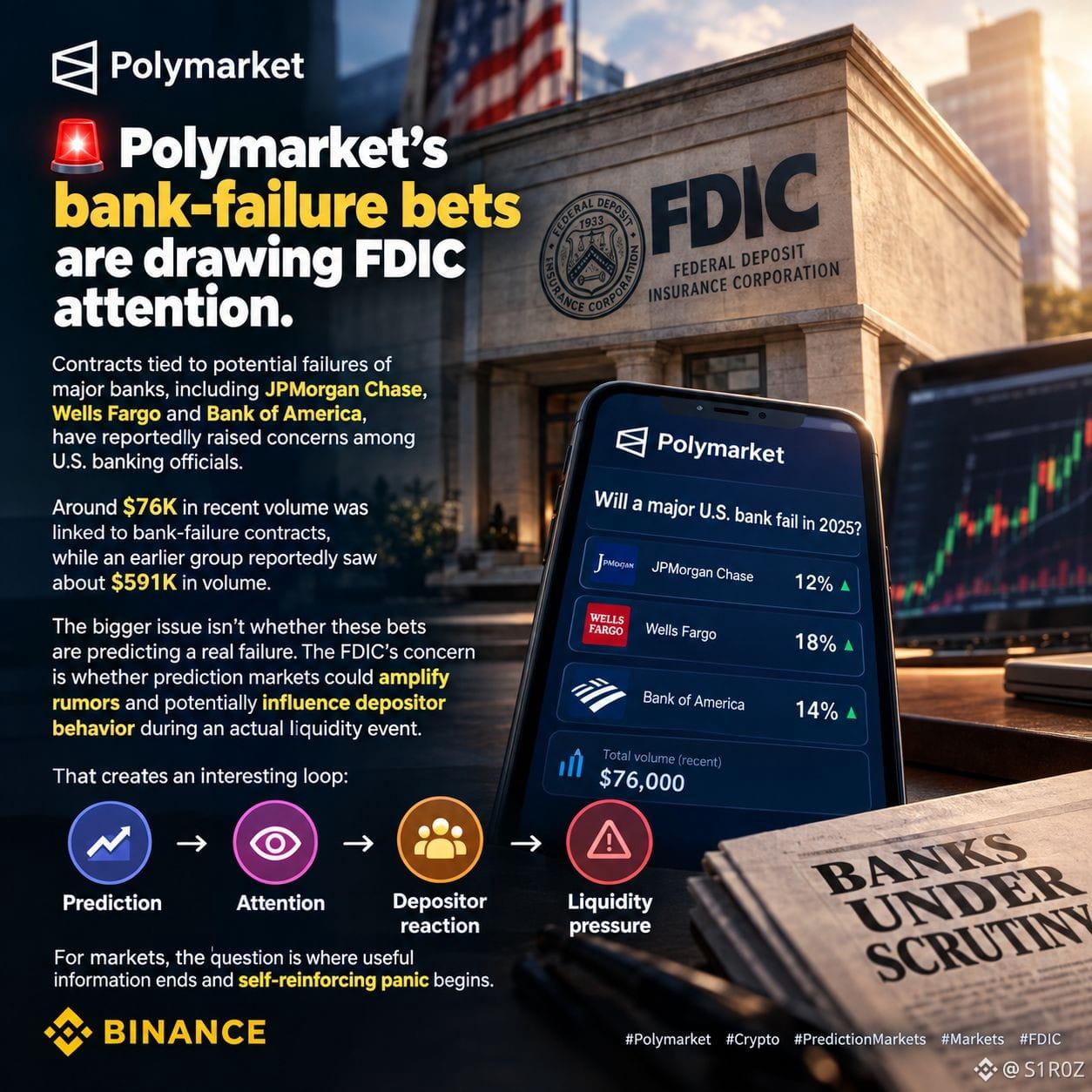
🚨 Polymarket’s bank-failure bets are drawing FDIC attention.
Contracts tied to potential failures of major banks, including JPMorgan Chase, Wells Fargo and Bank of America, have reportedly raised concerns among U.S. banking officials.
Around $76K in recent volume was linked to bank-failure contracts, while an earlier group reportedly saw about $591K in volume.
The bigger issue isn’t whether these bets are predicting a real failure. The FDIC’s concern is whether prediction markets could amplify rumors and potentially influence depositor behavior during an actual liquidity event.
That creates an interesting loop:
Prediction → attention → depositor reaction → liquidity pressure
For markets, the question is where useful information ends and self-reinforcing panic begins.
$MARSCOIN $KMNO $2Z
{spot}(2ZUSDT)
{spot}(KMNOUSDT)
{spot}(MARSCOINUSDT)
#Polymarket #crypto #PredictionMarkets #markets #FDIC
#polymarketbankfailurebetsdrawfdicconcern
🚨 Polymarket’s bank-failure bets are drawing FDIC attention.
Contracts tied to potential failures of major banks, including JPMorgan Chase, Wells Fargo and Bank of America, have reportedly raised concerns among U.S. banking officials.
Around $76K in recent volume was linked to bank-failure contracts, while an earlier group reportedly saw about $591K in volume.
The bigger issue isn’t whether these bets are predicting a real failure. The FDIC’s concern is whether prediction markets could amplify rumors and potentially influence depositor behavior during an actual liquidity event.
That creates an interesting loop:
Prediction → attention → depositor reaction → liquidity pressure
For markets, the question is where useful information ends and self-reinforcing panic begins.
$MARSCOIN $KMNO $2Z
#Polymarket #crypto #PredictionMarkets #markets #FDIC
🚨 Polymarket’s bank-failure bets are drawing FDIC attention.
Contracts tied to potential failures of major banks, including JPMorgan Chase, Wells Fargo and Bank of America, have reportedly raised concerns among U.S. banking officials.
Around $76K in recent volume was linked to bank-failure contracts, while an earlier group reportedly saw about $591K in volume.
The bigger issue isn’t whether these bets are predicting a real failure. The FDIC’s concern is whether prediction markets could amplify rumors and potentially influence depositor behavior during an actual liquidity event.
That creates an interesting loop:
Prediction → attention → depositor reaction → liquidity pressure
For markets, the question is where useful information ends and self-reinforcing panic begins.
$MARSCOIN $KMNO $2Z
#Polymarket #crypto #PredictionMarkets #markets #FDIC
9

·
--
🚨 POLYMARKET BANK-FAILURE BETS DRAW FDIC CONCERN 🚨
A new debate is heating up around prediction markets as bets tied to potential bank failures on Polymarket reportedly attract attention from the FDIC.
Prediction markets can provide a window into public expectations—but when financial stability is involved, the stakes become much higher. 🏦⚠️
The key questions are:
🔹 Should people be allowed to bet on potential bank failures?
🔹 Could such markets create unnecessary panic or speculation?
🔹 Where should the line be drawn between prediction markets and financial-risk concerns?
As crypto, prediction markets, and traditional finance continue to intersect, this is a topic worth watching closely. 👀
What’s your view? Is this innovation—or a financial stability risk?
#Polymarket #BankFailure #FDIC #PredictionMarkets #Crypto #DeFi #Finance #Trending #BinanceSquare
#PolymarketBankFailureBetsDrawFDICConcern
🚨 POLYMARKET BANK-FAILURE BETS DRAW FDIC CONCERN 🚨
A new debate is heating up around prediction markets as bets tied to potential bank failures on Polymarket reportedly attract attention from the FDIC.
Prediction markets can provide a window into public expectations—but when financial stability is involved, the stakes become much higher. 🏦⚠️
The key questions are:
🔹 Should people be allowed to bet on potential bank failures?
🔹 Could such markets create unnecessary panic or speculation?
🔹 Where should the line be drawn between prediction markets and financial-risk concerns?
As crypto, prediction markets, and traditional finance continue to intersect, this is a topic worth watching closely. 👀
What’s your view? Is this innovation—or a financial stability risk?
#Polymarket #BankFailure #FDIC #PredictionMarkets #Crypto #DeFi #Finance #Trending #BinanceSquare
#PolymarketBankFailureBetsDrawFDICConcern
A new debate is heating up around prediction markets as bets tied to potential bank failures on Polymarket reportedly attract attention from the FDIC.
Prediction markets can provide a window into public expectations—but when financial stability is involved, the stakes become much higher. 🏦⚠️
The key questions are:
🔹 Should people be allowed to bet on potential bank failures?
🔹 Could such markets create unnecessary panic or speculation?
🔹 Where should the line be drawn between prediction markets and financial-risk concerns?
As crypto, prediction markets, and traditional finance continue to intersect, this is a topic worth watching closely. 👀
What’s your view? Is this innovation—or a financial stability risk?
#Polymarket #BankFailure #FDIC #PredictionMarkets #Crypto #DeFi #Finance #Trending #BinanceSquare
#PolymarketBankFailureBetsDrawFDICConcern
50
🚨 Why Are Regulators Watching Polymarket?
Contracts asking whether major banks could fail are attracting attention from U.S. banking officials.
The concern reported by Bloomberg is that much larger volumes could potentially amplify fear around individual banks.
Crypto traders should watch how this develops across traditional finance and spot markets. $BTC $ETH 📊
#polymarketbankfailurebetsdrawfdicconcern
🚨 Why Are Regulators Watching Polymarket?
Contracts asking whether major banks could fail are attracting attention from U.S. banking officials.
The concern reported by Bloomberg is that much larger volumes could potentially amplify fear around individual banks.
Crypto traders should watch how this develops across traditional finance and spot markets. $BTC $ETH 📊
#polymarketbankfailurebetsdrawfdicconcern
Contracts asking whether major banks could fail are attracting attention from U.S. banking officials.
The concern reported by Bloomberg is that much larger volumes could potentially amplify fear around individual banks.
Crypto traders should watch how this develops across traditional finance and spot markets. $BTC $ETH 📊
#polymarketbankfailurebetsdrawfdicconcern
7

·
--
#polymarketbankfailurebetsdrawfdicconcern
Polymarket’s Bank Failure Bets Raise New Questions
Prediction markets are once again attracting attention as users speculate on potential bank failures.
While platforms like Polymarket can be viewed as a way to measure market expectations, betting on sensitive financial events raises an important question: when does market speculation begin to affect public confidence?
The FDIC’s concerns highlight the delicate balance between financial innovation and banking stability. A prediction market may simply reflect sentiment—but in the financial sector, sentiment itself can become powerful.
As prediction markets continue to evolve, regulators may face growing pressure to determine where innovation ends and systemic risk begins.
The bigger question is no longer just what the market predicts, but how those predictions could influence the market itself.
#PolymarketBankFailureBetsDrawFDICConcern
#polymarketbankfailurebetsdrawfdicconcern
Polymarket’s Bank Failure Bets Raise New Questions
Prediction markets are once again attracting attention as users speculate on potential bank failures.
While platforms like Polymarket can be viewed as a way to measure market expectations, betting on sensitive financial events raises an important question: when does market speculation begin to affect public confidence?
The FDIC’s concerns highlight the delicate balance between financial innovation and banking stability. A prediction market may simply reflect sentiment—but in the financial sector, sentiment itself can become powerful.
As prediction markets continue to evolve, regulators may face growing pressure to determine where innovation ends and systemic risk begins.
The bigger question is no longer just what the market predicts, but how those predictions could influence the market itself.
#PolymarketBankFailureBetsDrawFDICConcern
Polymarket’s Bank Failure Bets Raise New Questions
Prediction markets are once again attracting attention as users speculate on potential bank failures.
While platforms like Polymarket can be viewed as a way to measure market expectations, betting on sensitive financial events raises an important question: when does market speculation begin to affect public confidence?
The FDIC’s concerns highlight the delicate balance between financial innovation and banking stability. A prediction market may simply reflect sentiment—but in the financial sector, sentiment itself can become powerful.
As prediction markets continue to evolve, regulators may face growing pressure to determine where innovation ends and systemic risk begins.
The bigger question is no longer just what the market predicts, but how those predictions could influence the market itself.
#PolymarketBankFailureBetsDrawFDICConcern
Shazali002:
follow me guys I'm following back immediately
2
1
639

#PolymarketBankFailureBetsDrawFDICConcern Concern stems from a Bloomberg report that officials at the Federal Deposit Insurance Corporation (FDIC) and lawmakers on Capitol Hill are scrutinizing prediction contracts tied to individual U.S. bank failures.
#PolymarketBankFailureBetsDrawFDICConcern Concern stems from a Bloomberg report that officials at the Federal Deposit Insurance Corporation (FDIC) and lawmakers on Capitol Hill are scrutinizing prediction contracts tied to individual U.S. bank failures.
1
47

#PolymarketBankFailureBetsDrawFDICConcern
🔥 INTERESTING: Prediction markets just entered the banking conversation in a big way.
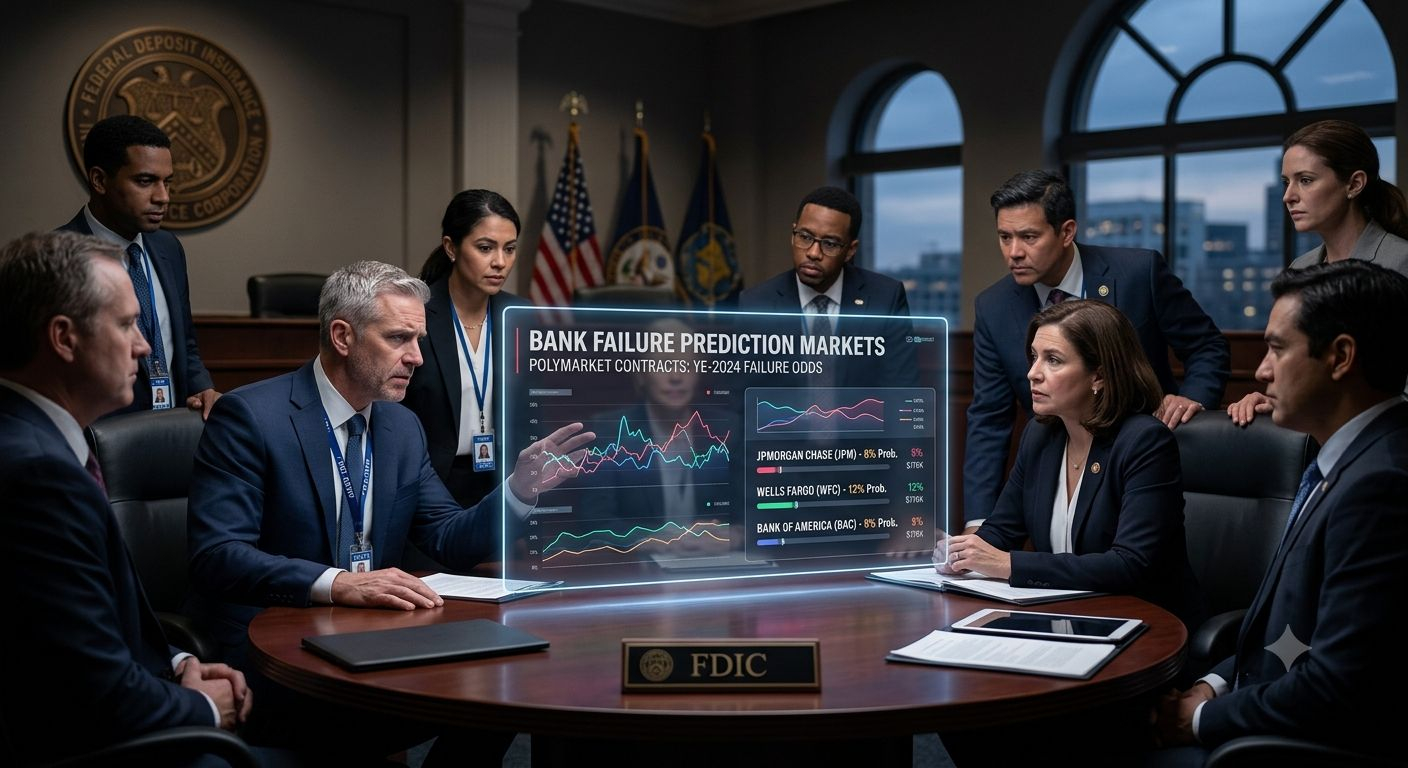
Polymarket contracts betting on the potential failure of major U.S. banks — including JPMorgan, Wells Fargo, and Bank of America — are drawing attention from the FDIC and members of Congress, according to Bloomberg.
Even though current trading volumes remain relatively small (around $76K on recent year-end failure contracts), regulators are watching closely. Some officials worry that if these markets grow significantly, they could theoretically influence real-world confidence or contribute to bank-run dynamics.
Polymarket itself is an offshore platform that restricts U.S. users, yet the mere existence of these contracts has sparked internal discussions at the FDIC about ethics rules and market implications.
Prediction markets are powerful tools for aggregating information — but when the underlying assets are the stability of systemically important banks, the conversation quickly moves from speculation to systemic risk.
Is this just noise, or an early signal that traditional finance is starting to feel the weight of decentralized prediction markets?
What do you think — healthy price discovery or a potential flashpoint?
#Polymarket #Banking #FDIC #JPMorgan #WellsFargo #BankOfAmerica #PredictionMarkets #Crypto #Finance #DeFi #Stablecoins #BinanceSquare
#PolymarketBankFailureBetsDrawFDICConcern
🔥 INTERESTING: Prediction markets just entered the banking conversation in a big way.
Polymarket contracts betting on the potential failure of major U.S. banks — including JPMorgan, Wells Fargo, and Bank of America — are drawing attention from the FDIC and members of Congress, according to Bloomberg.
Even though current trading volumes remain relatively small (around $76K on recent year-end failure contracts), regulators are watching closely. Some officials worry that if these markets grow significantly, they could theoretically influence real-world confidence or contribute to bank-run dynamics.
Polymarket itself is an offshore platform that restricts U.S. users, yet the mere existence of these contracts has sparked internal discussions at the FDIC about ethics rules and market implications.
Prediction markets are powerful tools for aggregating information — but when the underlying assets are the stability of systemically important banks, the conversation quickly moves from speculation to systemic risk.
Is this just noise, or an early signal that traditional finance is starting to feel the weight of decentralized prediction markets?
What do you think — healthy price discovery or a potential flashpoint?
#Polymarket #Banking #FDIC #JPMorgan #WellsFargo #BankOfAmerica #PredictionMarkets #Crypto #Finance #DeFi #Stablecoins #BinanceSquare
🔥 INTERESTING: Prediction markets just entered the banking conversation in a big way.
Polymarket contracts betting on the potential failure of major U.S. banks — including JPMorgan, Wells Fargo, and Bank of America — are drawing attention from the FDIC and members of Congress, according to Bloomberg.
Even though current trading volumes remain relatively small (around $76K on recent year-end failure contracts), regulators are watching closely. Some officials worry that if these markets grow significantly, they could theoretically influence real-world confidence or contribute to bank-run dynamics.
Polymarket itself is an offshore platform that restricts U.S. users, yet the mere existence of these contracts has sparked internal discussions at the FDIC about ethics rules and market implications.
Prediction markets are powerful tools for aggregating information — but when the underlying assets are the stability of systemically important banks, the conversation quickly moves from speculation to systemic risk.
Is this just noise, or an early signal that traditional finance is starting to feel the weight of decentralized prediction markets?
What do you think — healthy price discovery or a potential flashpoint?
#Polymarket #Banking #FDIC #JPMorgan #WellsFargo #BankOfAmerica #PredictionMarkets #Crypto #Finance #DeFi #Stablecoins #BinanceSquare
1
88

·
--
Bullish
#polymarketbankfailurebetsdrawfdicconcern
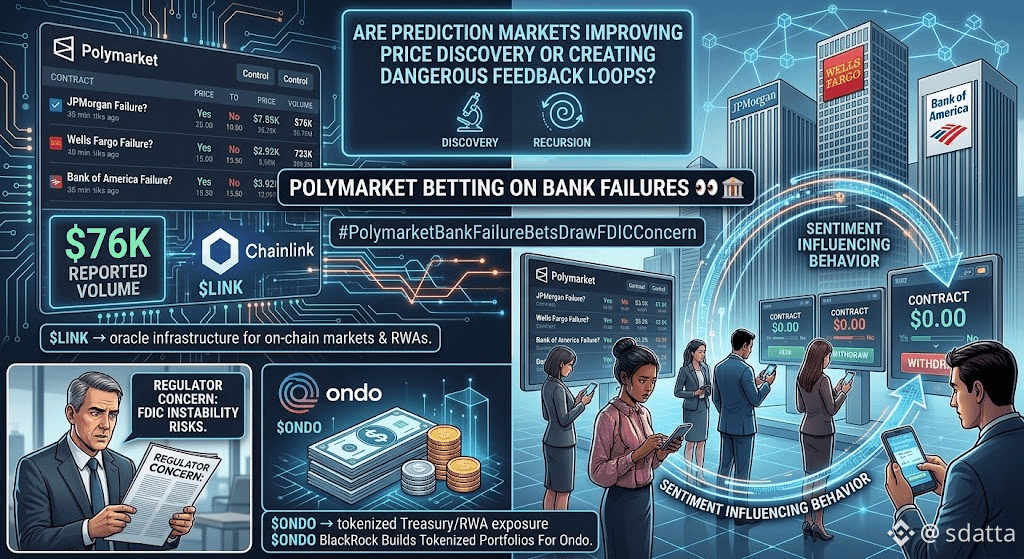
🚨 POLYMARKET IS BETTING ON BANK FAILURES 👀🏦
JPMorgan. Wells Fargo. Bank of America.
Polymarket has contracts asking whether major banks will fail by the end of 2026, with the overall market showing roughly $75K in volume.
But the bigger story isn’t the bet.
⚠️ It’s the feedback loop.
Regulators and lawmakers are scrutinizing these contracts over concerns that larger volumes could amplify fear and potentially contribute to real-world bank-run dynamics.
🔥 Why crypto traders should care:
🔗 $LINK → Oracle infrastructure for onchain markets & RWAs
🏦 $ONDO → Tokenized Treasury/RWA infrastructure
But remember:
Prediction-market odds ≠ bank-failure forecasts.
They reflect the positions and information of participants trading the contracts, not a confirmed expectation that these banks will fail.
👀 The real debate:
Are prediction markets creating better price discovery...
or creating a new mechanism where market sentiment itself can influence behavior?
The market is pricing the risk.
Now watch what the market does with that information.
#BlackRockBuildsTokenizedPortfoliosForOndo
#BitwiseFilesToListNEARETFOnNYSEArca #LINK #ONDO
{spot}(ONDOUSDT)
{spot}(LINKUSDT)
#Ondo
#polymarketbankfailurebetsdrawfdicconcern
🚨 POLYMARKET IS BETTING ON BANK FAILURES 👀🏦
JPMorgan. Wells Fargo. Bank of America.
Polymarket has contracts asking whether major banks will fail by the end of 2026, with the overall market showing roughly $75K in volume.
But the bigger story isn’t the bet.
⚠️ It’s the feedback loop.
Regulators and lawmakers are scrutinizing these contracts over concerns that larger volumes could amplify fear and potentially contribute to real-world bank-run dynamics.
🔥 Why crypto traders should care:
🔗 $LINK → Oracle infrastructure for onchain markets & RWAs
🏦 $ONDO → Tokenized Treasury/RWA infrastructure
But remember:
Prediction-market odds ≠ bank-failure forecasts.
They reflect the positions and information of participants trading the contracts, not a confirmed expectation that these banks will fail.
👀 The real debate:
Are prediction markets creating better price discovery...
or creating a new mechanism where market sentiment itself can influence behavior?
The market is pricing the risk.
Now watch what the market does with that information.
#BlackRockBuildsTokenizedPortfoliosForOndo
#BitwiseFilesToListNEARETFOnNYSEArca #LINK #ONDO
#Ondo
🚨 POLYMARKET IS BETTING ON BANK FAILURES 👀🏦
JPMorgan. Wells Fargo. Bank of America.
Polymarket has contracts asking whether major banks will fail by the end of 2026, with the overall market showing roughly $75K in volume.
But the bigger story isn’t the bet.
⚠️ It’s the feedback loop.
Regulators and lawmakers are scrutinizing these contracts over concerns that larger volumes could amplify fear and potentially contribute to real-world bank-run dynamics.
🔥 Why crypto traders should care:
🔗 $LINK → Oracle infrastructure for onchain markets & RWAs
🏦 $ONDO → Tokenized Treasury/RWA infrastructure
But remember:
Prediction-market odds ≠ bank-failure forecasts.
They reflect the positions and information of participants trading the contracts, not a confirmed expectation that these banks will fail.
👀 The real debate:
Are prediction markets creating better price discovery...
or creating a new mechanism where market sentiment itself can influence behavior?
The market is pricing the risk.
Now watch what the market does with that information.
#BlackRockBuildsTokenizedPortfoliosForOndo
#BitwiseFilesToListNEARETFOnNYSEArca #LINK #ONDO
#Ondo
218

·
--
Bullish
#PolymarketBankFailureBetsDrawFDICConcern
Polymarket bank-failure bets involving major banks such as Wells Fargo, JPMorgan and Bank of America have drawn FDIC scrutiny. While the current betting volumes are small, regulators worry larger volumes could amplify fear and potentially contribute to bank-run dynamics. For stock-market traders, this is negative for banking-sector sentiment, particularly regional and smaller banks, though it does not by itself indicate an actual bank failure.
#PolymarketBankFailureBetsDrawFDICConcern
Polymarket bank-failure bets involving major banks such as Wells Fargo, JPMorgan and Bank of America have drawn FDIC scrutiny. While the current betting volumes are small, regulators worry larger volumes could amplify fear and potentially contribute to bank-run dynamics. For stock-market traders, this is negative for banking-sector sentiment, particularly regional and smaller banks, though it does not by itself indicate an actual bank failure.
Polymarket bank-failure bets involving major banks such as Wells Fargo, JPMorgan and Bank of America have drawn FDIC scrutiny. While the current betting volumes are small, regulators worry larger volumes could amplify fear and potentially contribute to bank-run dynamics. For stock-market traders, this is negative for banking-sector sentiment, particularly regional and smaller banks, though it does not by itself indicate an actual bank failure.
66

·
--
#PolymarketBankFailureBetsDrawFDICConcern
🚨 POLYMARKET IS BETTING ON BANK FAILURES?! 👀
Prediction markets are getting attention after Polymarket users placed bets on whether major banks—including JPMorgan, Bank of America and Wells Fargo—could fail.
The bets are currently relatively small, but the story has reportedly caught the attention of FDIC officials and lawmakers, who are concerned about what could happen if these markets ever became large enough to influence public sentiment or bank runs.
This raises a bigger question:
Are prediction markets simply reflecting market fears… or could they actually influence financial markets? 🤔
Crypto traders 👇
Would you trust a prediction market as an early warning signal?
#Binance #Crypto #Polymarket #Bitcoin #USDC #DeFi #Finance #Banking Banking #Web3 #BİNANCESQUARE #Binance
#PolymarketBankFailureBetsDrawFDICConcern
🚨 POLYMARKET IS BETTING ON BANK FAILURES?! 👀
Prediction markets are getting attention after Polymarket users placed bets on whether major banks—including JPMorgan, Bank of America and Wells Fargo—could fail.
The bets are currently relatively small, but the story has reportedly caught the attention of FDIC officials and lawmakers, who are concerned about what could happen if these markets ever became large enough to influence public sentiment or bank runs.
This raises a bigger question:
Are prediction markets simply reflecting market fears… or could they actually influence financial markets? 🤔
Crypto traders 👇
Would you trust a prediction market as an early warning signal?
#Binance #Crypto #Polymarket #Bitcoin #USDC #DeFi #Finance #Banking Banking #Web3 #BİNANCESQUARE #Binance
🚨 POLYMARKET IS BETTING ON BANK FAILURES?! 👀
Prediction markets are getting attention after Polymarket users placed bets on whether major banks—including JPMorgan, Bank of America and Wells Fargo—could fail.
The bets are currently relatively small, but the story has reportedly caught the attention of FDIC officials and lawmakers, who are concerned about what could happen if these markets ever became large enough to influence public sentiment or bank runs.
This raises a bigger question:
Are prediction markets simply reflecting market fears… or could they actually influence financial markets? 🤔
Crypto traders 👇
Would you trust a prediction market as an early warning signal?
#Binance #Crypto #Polymarket #Bitcoin #USDC #DeFi #Finance #Banking Banking #Web3 #BİNANCESQUARE #Binance
39

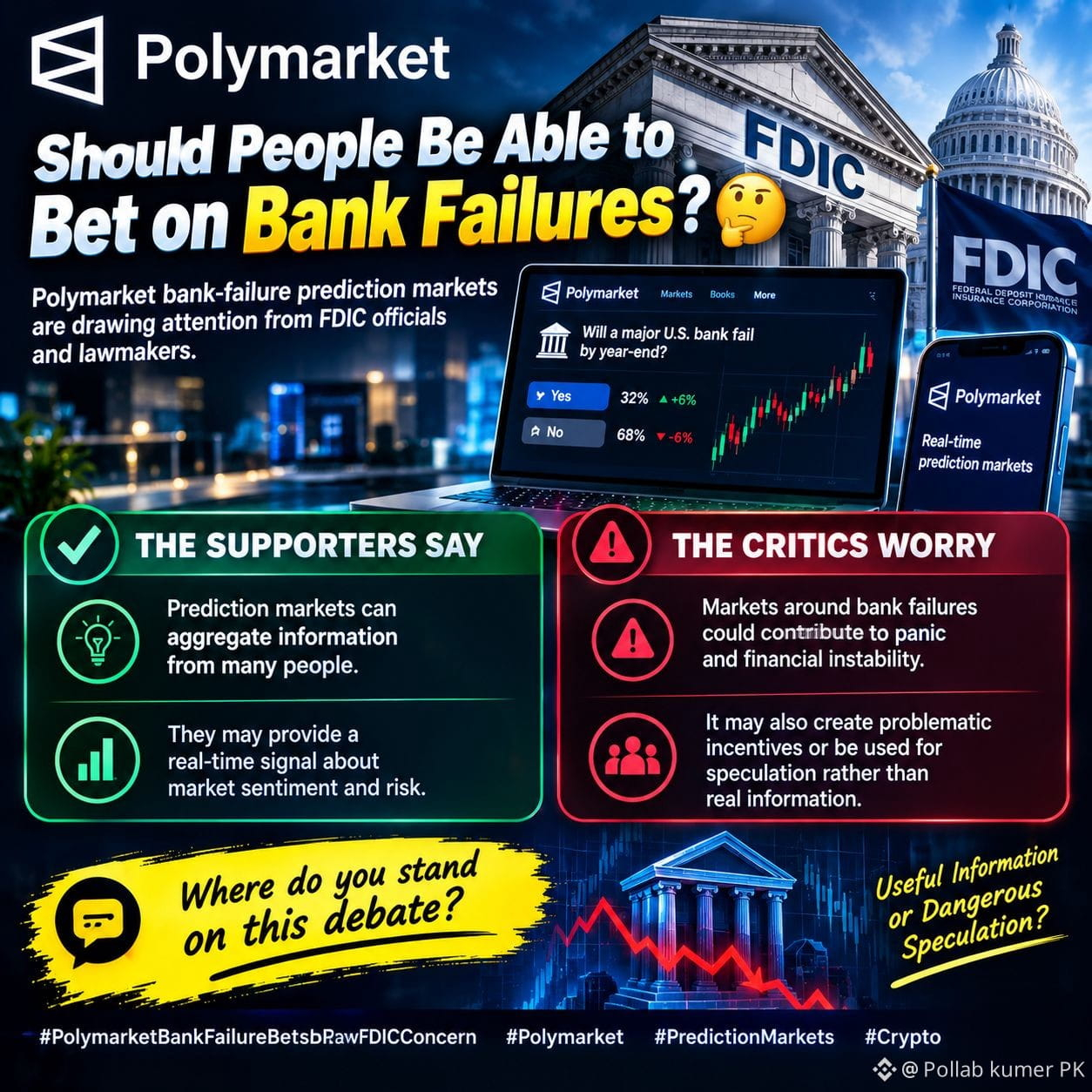
Should People Be Able to Bet on Bank Failures? 🤔
Polymarket bank-failure prediction markets are drawing attention from FDIC officials and lawmakers.
Supporters argue that prediction markets can aggregate information and provide a real-time signal.
Critics worry that markets around bank failures could contribute to panic or create problematic incentives.
Where do you stand on this debate?
#PolymarketBankFailureBetsDrawFDICConcern #Polymarket #PredictionMarkets #crypto
Should People Be Able to Bet on Bank Failures? 🤔
Polymarket bank-failure prediction markets are drawing attention from FDIC officials and lawmakers.
Supporters argue that prediction markets can aggregate information and provide a real-time signal.
Critics worry that markets around bank failures could contribute to panic or create problematic incentives.
Where do you stand on this debate?
#PolymarketBankFailureBetsDrawFDICConcern #Polymarket #PredictionMarkets #crypto
Polymarket bank-failure prediction markets are drawing attention from FDIC officials and lawmakers.
Supporters argue that prediction markets can aggregate information and provide a real-time signal.
Critics worry that markets around bank failures could contribute to panic or create problematic incentives.
Where do you stand on this debate?
#PolymarketBankFailureBetsDrawFDICConcern #Polymarket #PredictionMarkets #crypto
38
·
--
Verified
#polymarketbankfailurebetsdrawfdicconcern Polymarket offshore (bans US traders) lists binary bank-failure markets on Wells Fargo, JPMorgan, Bank of America, Deutsche Bank, etc. YE-2026 failure set ~$76k volume; earlier July-failure set ~$591k. Separate “major US bank
bailout” markets too.
FDIC senior staff: concern
on commercial/investment benefit + ethics vs confidential “problem banks” list — concluded existing ethics rules enough. Acting Chair Travis Hill: useful for monitoring, worried about failure-timing speculation. FDIC: no public comment.
CFTC Chair Selig: exclusive US prediction-venue jurisdiction; Polymarket’s CFTC US exchange does NOT list these. Kalshi none (“in poor taste”). Bair: rumor weaponization. Warren: “wild west,” insider risk.
$LIGHT $ON $TRADOOR
#polymarketbankfailurebetsdrawfdicconcern Polymarket offshore (bans US traders) lists binary bank-failure markets on Wells Fargo, JPMorgan, Bank of America, Deutsche Bank, etc. YE-2026 failure set ~$76k volume; earlier July-failure set ~$591k. Separate “major US bank
bailout” markets too.
FDIC senior staff: concern
on commercial/investment benefit + ethics vs confidential “problem banks” list — concluded existing ethics rules enough. Acting Chair Travis Hill: useful for monitoring, worried about failure-timing speculation. FDIC: no public comment.
CFTC Chair Selig: exclusive US prediction-venue jurisdiction; Polymarket’s CFTC US exchange does NOT list these. Kalshi none (“in poor taste”). Bair: rumor weaponization. Warren: “wild west,” insider risk.
$LIGHT $ON $TRADOOR
bailout” markets too.
FDIC senior staff: concern
on commercial/investment benefit + ethics vs confidential “problem banks” list — concluded existing ethics rules enough. Acting Chair Travis Hill: useful for monitoring, worried about failure-timing speculation. FDIC: no public comment.
CFTC Chair Selig: exclusive US prediction-venue jurisdiction; Polymarket’s CFTC US exchange does NOT list these. Kalshi none (“in poor taste”). Bair: rumor weaponization. Warren: “wild west,” insider risk.
$LIGHT $ON $TRADOOR

1.6k
🏦 Bank failures are now being traded as prediction markets.
Polymarket contracts involving banks like JPMorgan, Wells Fargo and Bank of America are drawing regulatory scrutiny.
Could prediction markets create new financial signals—or new risks? 👀
#polymarketbankfailurebetsdrawfdicconcern
🏦 Bank failures are now being traded as prediction markets.
Polymarket contracts involving banks like JPMorgan, Wells Fargo and Bank of America are drawing regulatory scrutiny.
Could prediction markets create new financial signals—or new risks? 👀
#polymarketbankfailurebetsdrawfdicconcern
Polymarket contracts involving banks like JPMorgan, Wells Fargo and Bank of America are drawing regulatory scrutiny.
Could prediction markets create new financial signals—or new risks? 👀
#polymarketbankfailurebetsdrawfdicconcern
169
Log in to explore more content
Join global crypto users on Binance Square
⚡️ Get latest and useful information about crypto.
💬 Trusted by the world’s largest crypto exchange.
👍 Discover real insights from verified creators.
Email / Phone number
Trending Topics
1
#SOLSpotETFWeeklyInflow$188M
1 views
8 Discussing
2
#StrategyStriveAdd2305BitcoinThisWeek
18,691 views
635 Discussing
3
#TrumpRejectsIranHormuzReopening
21,962 views
559 Discussing
4
#CircleTetherFreezeBitgetHackerWallet
41,494 views
656 Discussing
5
#SECSaysTokenBuybacksNotAutoSecurities
19,076 views
333 Discussing
6
#ChinaUSAgreeOn$30BTariffCut
851 views
24 Discussing
7
#CoinMarketCapCompletesCoinglassAcquisition
36,828 views
498 Discussing
8
#CircleMints500MUSDCOnSolana
207,082 views
3,057 Discussing
9
#PolymarketBankFailureBetsDrawFDICConcern
178,214 views
2,353 Discussing
10
#BlackRockBuildsTokenizedPortfoliosForOndo
167,815 views
1,696 Discussing