

ASHFAQ NAEEM
628 Posts

ASHFAQ NAEEM
Report
Block User
Market Analyst | Spot Trader | Investor | Passionate About Crypto | ashfaqNaeem45🚀✨🍀
Open Trade

ZEN Holder
Frequent Trader
2.4 Years
121 Following
1.1K+ Followers
1.6K+ Liked
Posts
Portfolio
All
Live
·
--
See translation
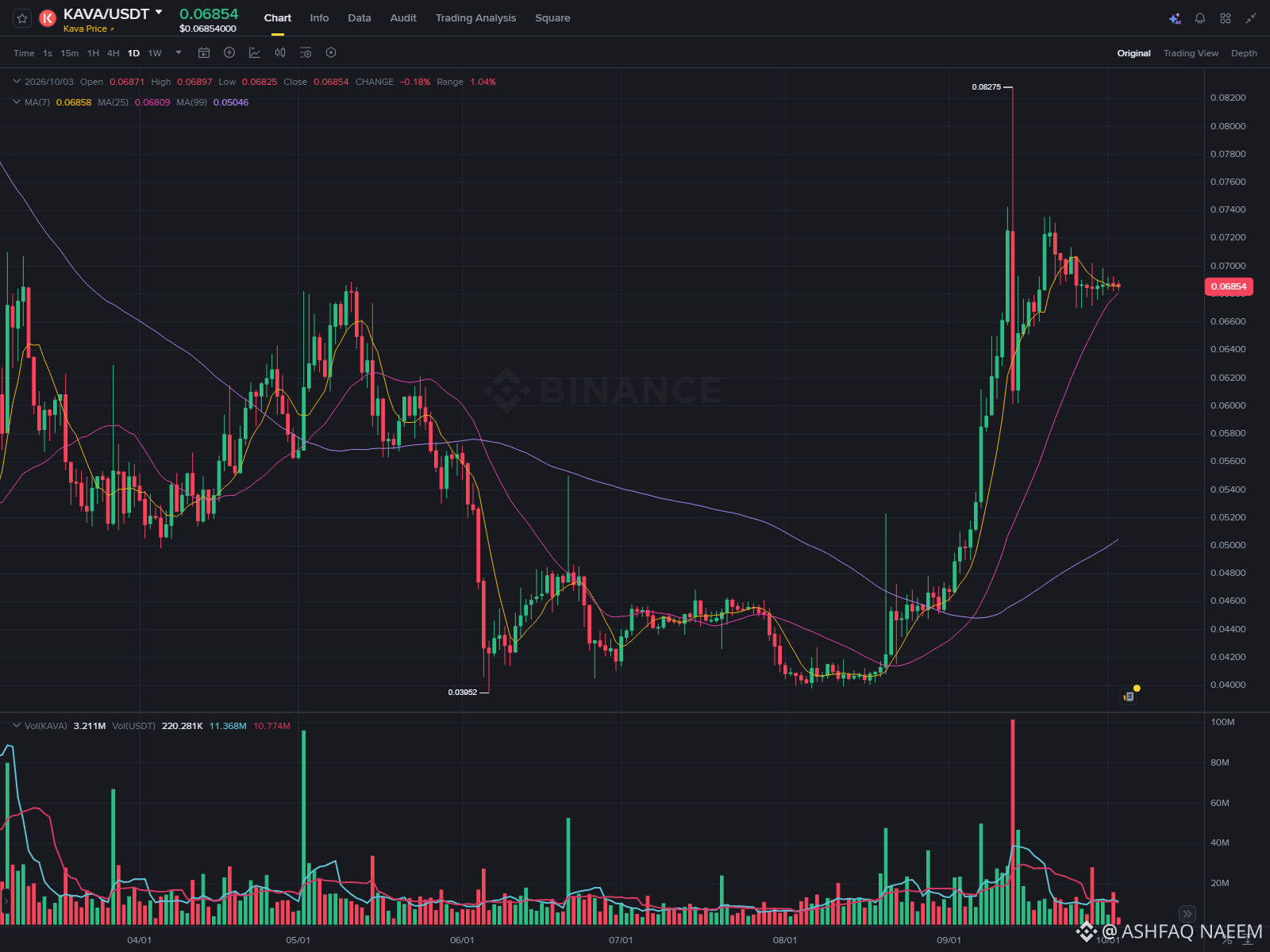
$KAVA is holding near $0.0685 after a sharp breakout. Strong volume fueled the rally, while consolidation suggests traders are watching $0.070 resistance closely.
$KAVA #KAVA
{future}(KAVAUSDT)
$KAVA is holding near $0.0685 after a sharp breakout. Strong volume fueled the rally, while consolidation suggests traders are watching $0.070 resistance closely.
$KAVA #KAVA
$KAVA #KAVA
1
40
·
--
Bearish
Verified
See translation
🚨 $ZEC ETF SHOCK: $93.6 MILLION GONE IN ONE WEEK! 🐻
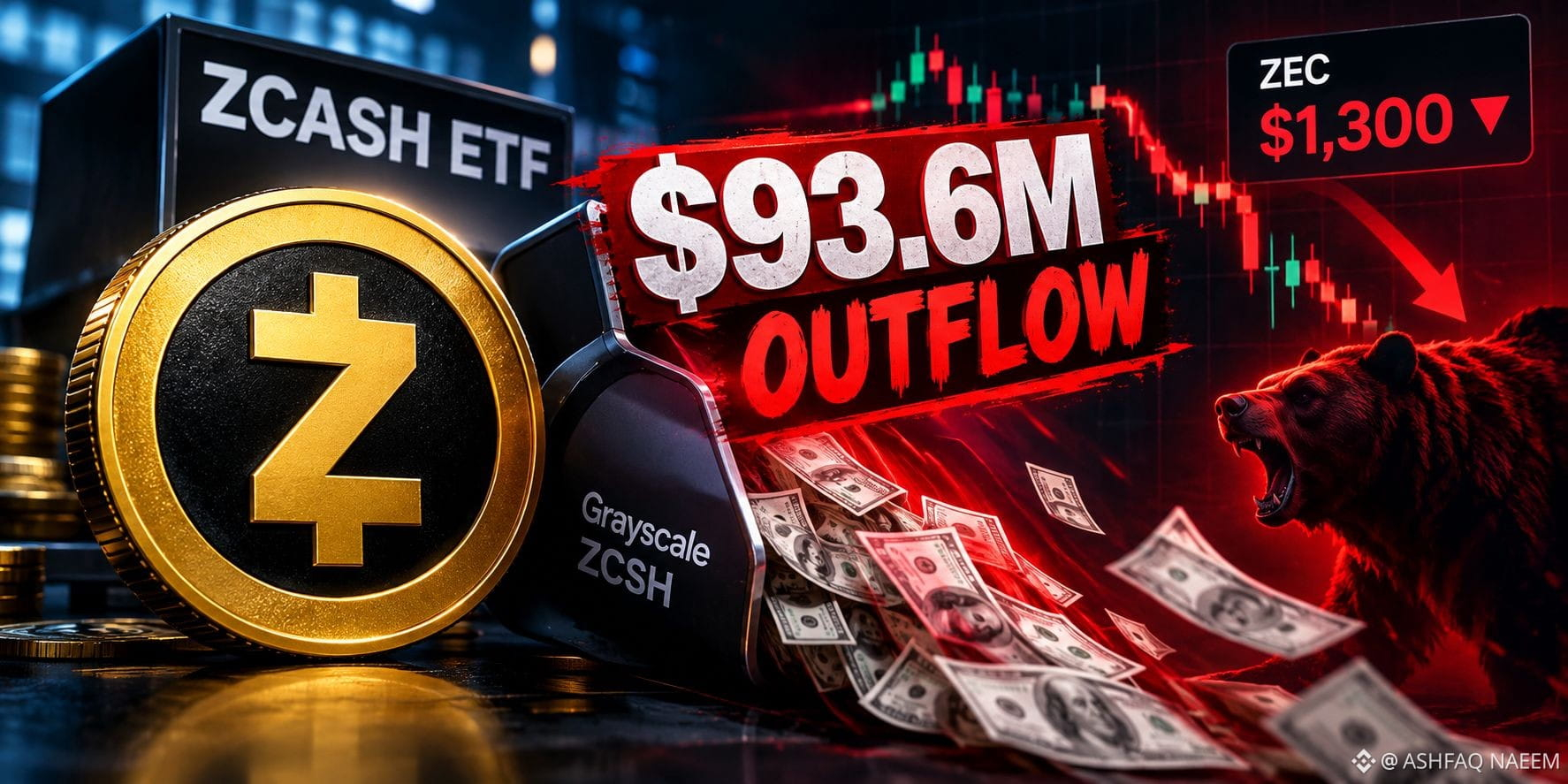
Zcash’s ETF has recorded its first weekly net outflow since launching in August, with $93.6M withdrawn from Grayscale’s ZCSH fund. Meanwhile, ZEC dropped toward $1,300, raising fresh concerns about investor demand. [Source](https://www.binance.com/en/square/post/10-03-2026-zcash-etf-posts-first-week-of-net-outflows-since-august-launch-373313068166210)
📉 Bears gaining control—or just a temporary shakeout?
⚠️ Trader watch: Monitor ETF flows, trading volume, and key support levels. Continued outflows alongside a price breakdown could increase downside risk, while renewed inflows and a confirmed price recovery may signal stabilization.
🔥 Your take: Is $ZEC heading lower, or could bulls stage a comeback?
#ZcashETFPostsFirstWeeklyOutflow$93.6M
$ZEC
{future}(ZECUSDT)
🚨 $ZEC ETF SHOCK: $93.6 MILLION GONE IN ONE WEEK! 🐻
Zcash’s ETF has recorded its first weekly net outflow since launching in August, with $93.6M withdrawn from Grayscale’s ZCSH fund. Meanwhile, ZEC dropped toward $1,300, raising fresh concerns about investor demand. Source
📉 Bears gaining control—or just a temporary shakeout?
⚠️ Trader watch: Monitor ETF flows, trading volume, and key support levels. Continued outflows alongside a price breakdown could increase downside risk, while renewed inflows and a confirmed price recovery may signal stabilization.
🔥 Your take: Is $ZEC heading lower, or could bulls stage a comeback?
#ZcashETFPostsFirstWeeklyOutflow$93.6M
$ZEC
Zcash’s ETF has recorded its first weekly net outflow since launching in August, with $93.6M withdrawn from Grayscale’s ZCSH fund. Meanwhile, ZEC dropped toward $1,300, raising fresh concerns about investor demand. Source
📉 Bears gaining control—or just a temporary shakeout?
⚠️ Trader watch: Monitor ETF flows, trading volume, and key support levels. Continued outflows alongside a price breakdown could increase downside risk, while renewed inflows and a confirmed price recovery may signal stabilization.
🔥 Your take: Is $ZEC heading lower, or could bulls stage a comeback?
#ZcashETFPostsFirstWeeklyOutflow$93.6M
$ZEC
1
83
·
--
See translation
🚨 CRYPTO SCAM ALERT! 🇬🇷 Greek Police Arrest 17 Suspects!
Greek police have reportedly dismantled a crypto investment scam network, arresting 17 suspects. Authorities allege the group promised investors they could double their money in just 50 days! 💰
🔥 Reports suggest around 10,000 people may have been recruited, with approximately $8 million in suspected illicit proceeds. The scheme allegedly used recruitment-based rewards and froze withdrawals.
⚠️ TRADER WARNING: Guaranteed profits are a major red flag. Always verify platforms before investing.
#greekpolicebustcryptoscamringarrest17
$BTC
{future}(BTCUSDT)
🚨 CRYPTO SCAM ALERT! 🇬🇷 Greek Police Arrest 17 Suspects!
Greek police have reportedly dismantled a crypto investment scam network, arresting 17 suspects. Authorities allege the group promised investors they could double their money in just 50 days! 💰
🔥 Reports suggest around 10,000 people may have been recruited, with approximately $8 million in suspected illicit proceeds. The scheme allegedly used recruitment-based rewards and froze withdrawals.
⚠️ TRADER WARNING: Guaranteed profits are a major red flag. Always verify platforms before investing.
#greekpolicebustcryptoscamringarrest17
$BTC
Greek police have reportedly dismantled a crypto investment scam network, arresting 17 suspects. Authorities allege the group promised investors they could double their money in just 50 days! 💰
🔥 Reports suggest around 10,000 people may have been recruited, with approximately $8 million in suspected illicit proceeds. The scheme allegedly used recruitment-based rewards and froze withdrawals.
⚠️ TRADER WARNING: Guaranteed profits are a major red flag. Always verify platforms before investing.
#greekpolicebustcryptoscamringarrest17
$BTC

1
1
2
·
--
See translation
📌 Key levels to watch:
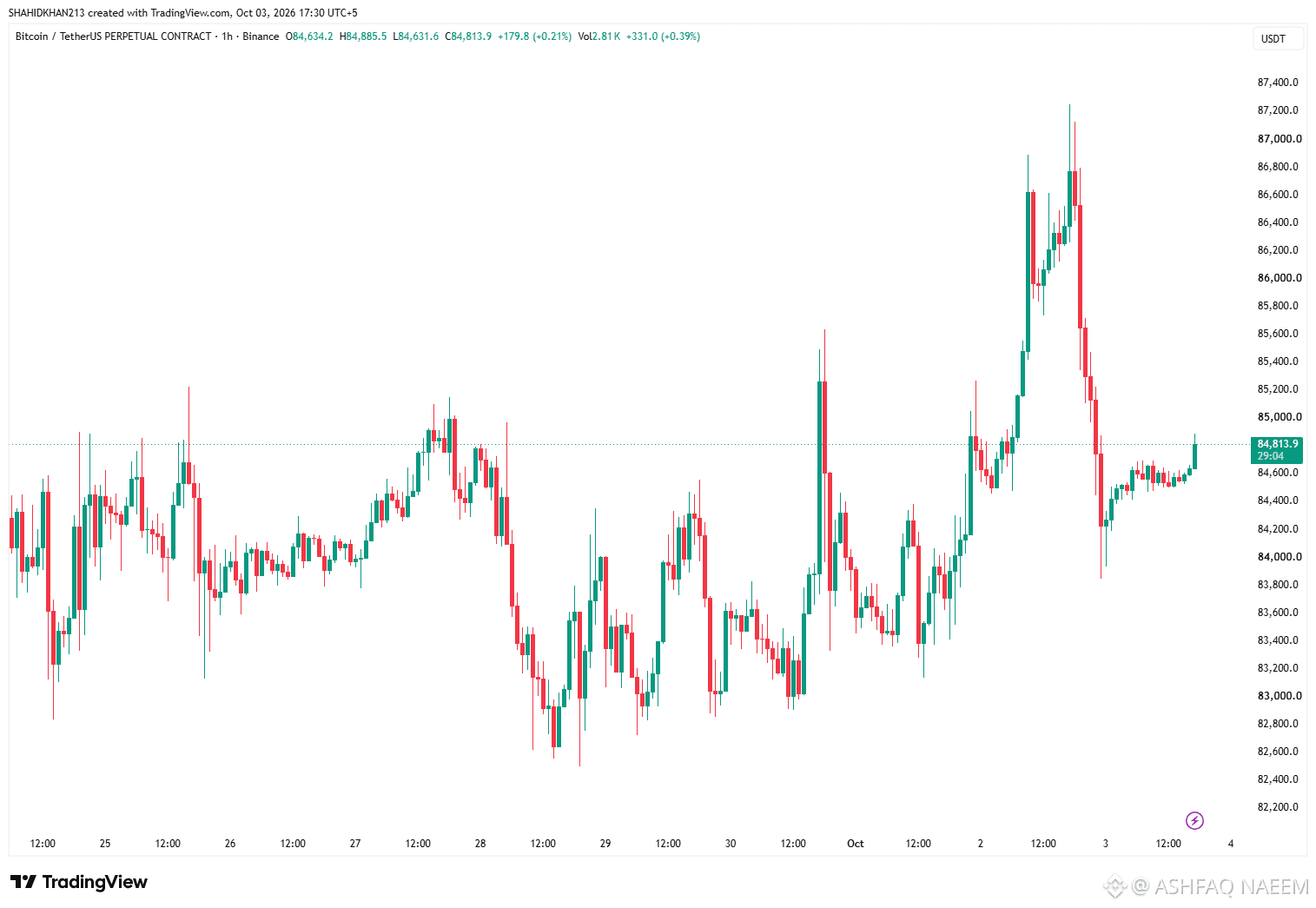
🔴 Resistance: $87K–$87.4K
🟢 Support: $82.5K–$84K 🚀
A sustained breakout above $87K could change the short-term structure.
⚠️ Losing $82.5K would put more downside pressure on BTC.
Is Bitcoin preparing for another $87K breakout attempt? 👀
#BitcoinRejectedAt$87K $BTC
{future}(BTCUSDT)
📌 Key levels to watch:
🔴 Resistance: $87K–$87.4K
🟢 Support: $82.5K–$84K 🚀
A sustained breakout above $87K could change the short-term structure.
⚠️ Losing $82.5K would put more downside pressure on BTC.
Is Bitcoin preparing for another $87K breakout attempt? 👀
#BitcoinRejectedAt$87K $BTC
🔴 Resistance: $87K–$87.4K
🟢 Support: $82.5K–$84K 🚀
A sustained breakout above $87K could change the short-term structure.
⚠️ Losing $82.5K would put more downside pressure on BTC.
Is Bitcoin preparing for another $87K breakout attempt? 👀
#BitcoinRejectedAt$87K $BTC
18
·
--
Bearish
See translation
🚨 Fed October Rate Hike Odds Fall to 17%
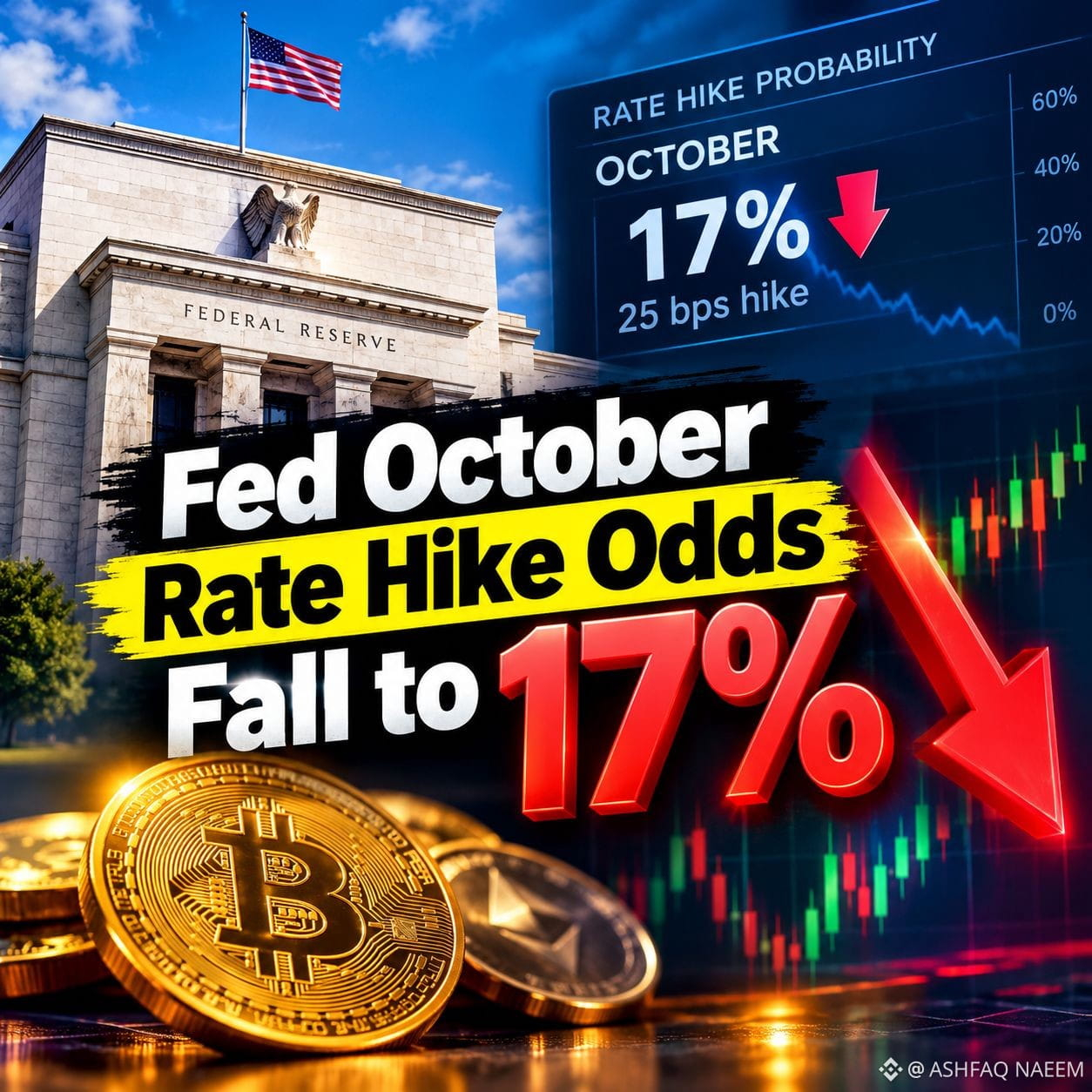
Markets are rapidly pricing out an October Federal Reserve rate hike. Current prediction-market data puts the probability of a 25 bps hike around 17%, while weaker-than-expected September jobs data has reduced expectations for near-term tightening.
For crypto, a lower near-term hike probability can ease macro pressure on Bitcoin and other risk assets, although inflation and upcoming Fed communication remain key risks.
Could this shift strengthen the crypto market in October? 👀
#fedoctoberratehikeoddsfallto17% $BTC #BTC
{future}(BTCUSDT)
🚨 Fed October Rate Hike Odds Fall to 17%
Markets are rapidly pricing out an October Federal Reserve rate hike. Current prediction-market data puts the probability of a 25 bps hike around 17%, while weaker-than-expected September jobs data has reduced expectations for near-term tightening.
For crypto, a lower near-term hike probability can ease macro pressure on Bitcoin and other risk assets, although inflation and upcoming Fed communication remain key risks.
Could this shift strengthen the crypto market in October? 👀
#fedoctoberratehikeoddsfallto17% $BTC #BTC
Markets are rapidly pricing out an October Federal Reserve rate hike. Current prediction-market data puts the probability of a 25 bps hike around 17%, while weaker-than-expected September jobs data has reduced expectations for near-term tightening.
For crypto, a lower near-term hike probability can ease macro pressure on Bitcoin and other risk assets, although inflation and upcoming Fed communication remain key risks.
Could this shift strengthen the crypto market in October? 👀
#fedoctoberratehikeoddsfallto17% $BTC #BTC
1
1
3.5k
·
--
Verified
See translation
🚨 NVIDIA JUST HIT AN ALL-TIME HIGH!
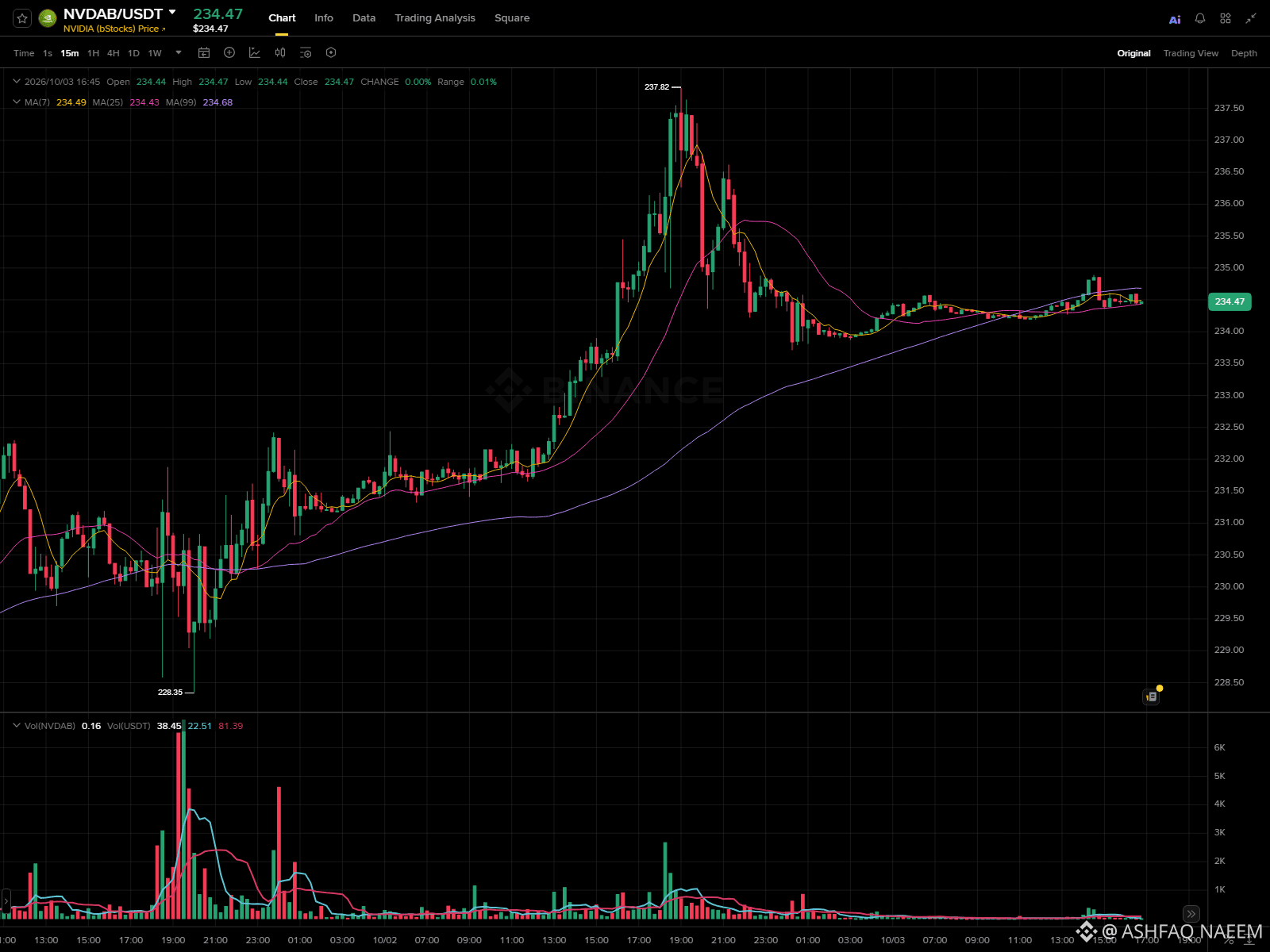
NVIDIA ($NVDA) surged to a fresh record as AI optimism and easing rate-hike expectations pushed tech stocks higher. NVDA briefly traded above $237, with its market value approaching $5.7T.
🔥 AI trade is back in full force.
📈 New ATH = breakout territory
⚠️ Traders should watch whether NVDA can hold above the previous high or face profit-taking.
Is NVIDIA heading toward $250 next? 👀
#nvidiahitsrecordhighup2.4%
$NVDA.US $NVDAB
{spot}(NVDABUSDT)
{stock_us}(NVDA.US)
🚨 NVIDIA JUST HIT AN ALL-TIME HIGH!
NVIDIA ($NVDA) surged to a fresh record as AI optimism and easing rate-hike expectations pushed tech stocks higher. NVDA briefly traded above $237, with its market value approaching $5.7T.
🔥 AI trade is back in full force.
📈 New ATH = breakout territory
⚠️ Traders should watch whether NVDA can hold above the previous high or face profit-taking.
Is NVIDIA heading toward $250 next? 👀
#nvidiahitsrecordhighup2.4%
$NVDA.US $NVDAB
NVIDIA ($NVDA) surged to a fresh record as AI optimism and easing rate-hike expectations pushed tech stocks higher. NVDA briefly traded above $237, with its market value approaching $5.7T.
🔥 AI trade is back in full force.
📈 New ATH = breakout territory
⚠️ Traders should watch whether NVDA can hold above the previous high or face profit-taking.
Is NVIDIA heading toward $250 next? 👀
#nvidiahitsrecordhighup2.4%
$NVDA.US $NVDAB
NVDAB+0.08%
NVDAUS+1.45%
2
6
10.9k
·
--
See translation
Analysis: Stablecoin Market Cap Rebounds by $4 Billion, but Liquidity Recovery Remains Limited
The market capitalization of stablecoins, a gauge of liquidity in the digital-asset market, has recently rebounded. But the scale of inflows is still too small to drive Bitcoin to a new record high, according to an analysis.
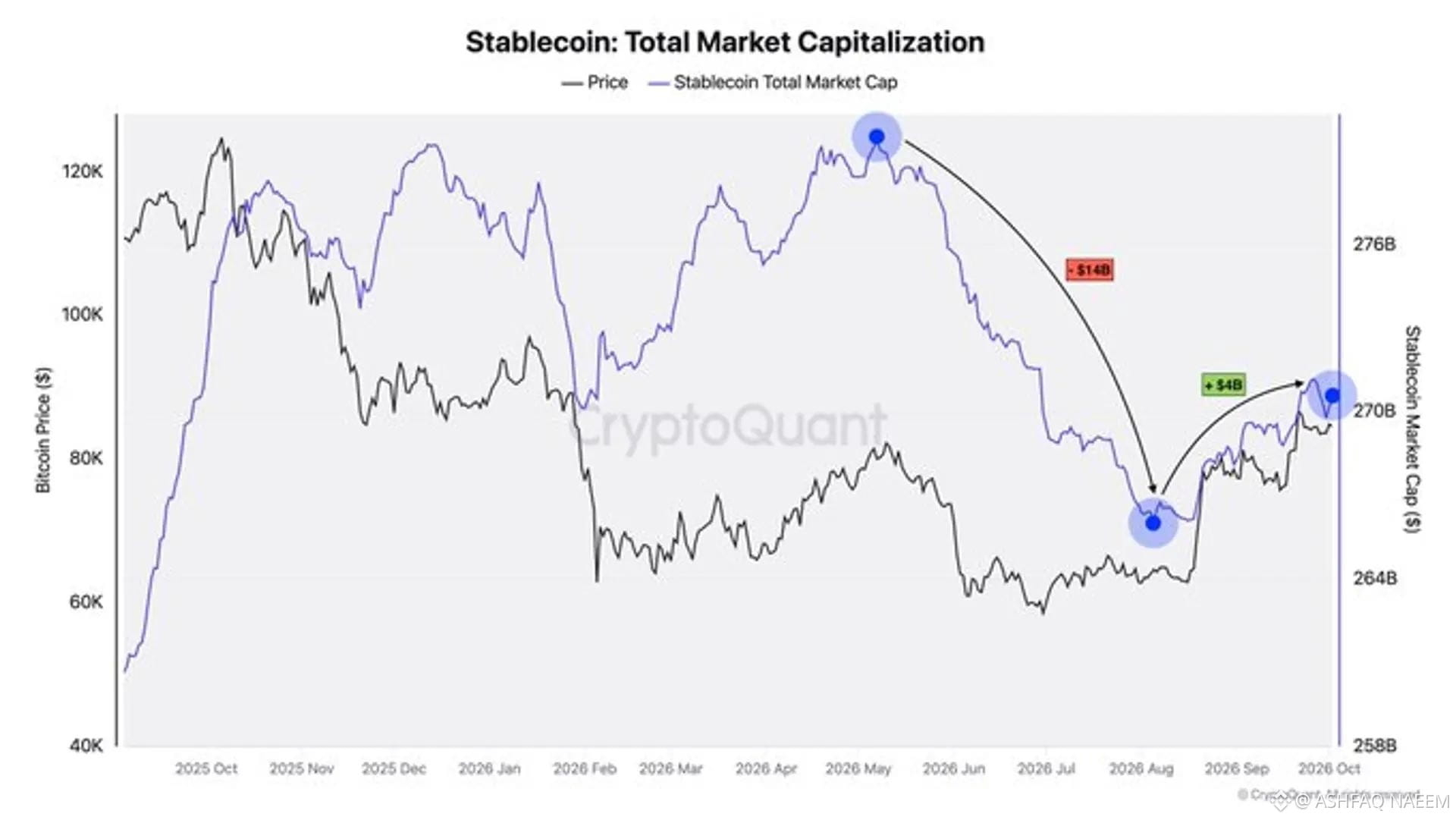
CryptoQuant contributor Darkfost wrote on Oct. 3 that stablecoin market capitalization has increased by about $4 billion since September, recovering to roughly $270 billion.
Still, that rebound is modest compared with the liquidity that had previously left the market. Stablecoin market capitalization has fallen by about $14 billion since its peak in May. The increase since September amounts to about 29% of that decline.
Darkfost wrote that stablecoin market capitalization is struggling to recover, meaning liquidity flowing into the crypto market remains insufficient.
While recent trends show signs of reversing, the recovery is still weak, he added. More liquidity needs to enter the market for Bitcoin to reach a new high.
#BTC $BTC
{future}(BTCUSDT)
Analysis: Stablecoin Market Cap Rebounds by $4 Billion, but Liquidity Recovery Remains Limited
The market capitalization of stablecoins, a gauge of liquidity in the digital-asset market, has recently rebounded. But the scale of inflows is still too small to drive Bitcoin to a new record high, according to an analysis.
CryptoQuant contributor Darkfost wrote on Oct. 3 that stablecoin market capitalization has increased by about $4 billion since September, recovering to roughly $270 billion.
Still, that rebound is modest compared with the liquidity that had previously left the market. Stablecoin market capitalization has fallen by about $14 billion since its peak in May. The increase since September amounts to about 29% of that decline.
Darkfost wrote that stablecoin market capitalization is struggling to recover, meaning liquidity flowing into the crypto market remains insufficient.
While recent trends show signs of reversing, the recovery is still weak, he added. More liquidity needs to enter the market for Bitcoin to reach a new high.
#BTC $BTC
The market capitalization of stablecoins, a gauge of liquidity in the digital-asset market, has recently rebounded. But the scale of inflows is still too small to drive Bitcoin to a new record high, according to an analysis.
CryptoQuant contributor Darkfost wrote on Oct. 3 that stablecoin market capitalization has increased by about $4 billion since September, recovering to roughly $270 billion.
Still, that rebound is modest compared with the liquidity that had previously left the market. Stablecoin market capitalization has fallen by about $14 billion since its peak in May. The increase since September amounts to about 29% of that decline.
Darkfost wrote that stablecoin market capitalization is struggling to recover, meaning liquidity flowing into the crypto market remains insufficient.
While recent trends show signs of reversing, the recovery is still weak, he added. More liquidity needs to enter the market for Bitcoin to reach a new high.
#BTC $BTC
4
·
--
Verified
See translation
🚨 LUKOIL DEAL STATUS: STILL ONLY REPORTED, NOT FINAL!
Reports say the U.S.–Russia talks include discussions around a multibillion-dollar Lukoil asset deal. But there is no confirmed completed transaction yet; any sale remains subject to U.S. and Kremlin approvals.
📊 Markets are watching the talks — not pricing in a done deal yet.
#usrussiaukrainetalksreportedlyincludelukoiloildeal $ZEN
🚨 LUKOIL DEAL STATUS: STILL ONLY REPORTED, NOT FINAL!
Reports say the U.S.–Russia talks include discussions around a multibillion-dollar Lukoil asset deal. But there is no confirmed completed transaction yet; any sale remains subject to U.S. and Kremlin approvals.
📊 Markets are watching the talks — not pricing in a done deal yet.
#usrussiaukrainetalksreportedlyincludelukoiloildeal $ZEN
Reports say the U.S.–Russia talks include discussions around a multibillion-dollar Lukoil asset deal. But there is no confirmed completed transaction yet; any sale remains subject to U.S. and Kremlin approvals.
📊 Markets are watching the talks — not pricing in a done deal yet.
#usrussiaukrainetalksreportedlyincludelukoiloildeal $ZEN

1
8
13.5k
·
--
See translation
🚨 BITCOIN’S NEXT BIG MOVE IS HERE?
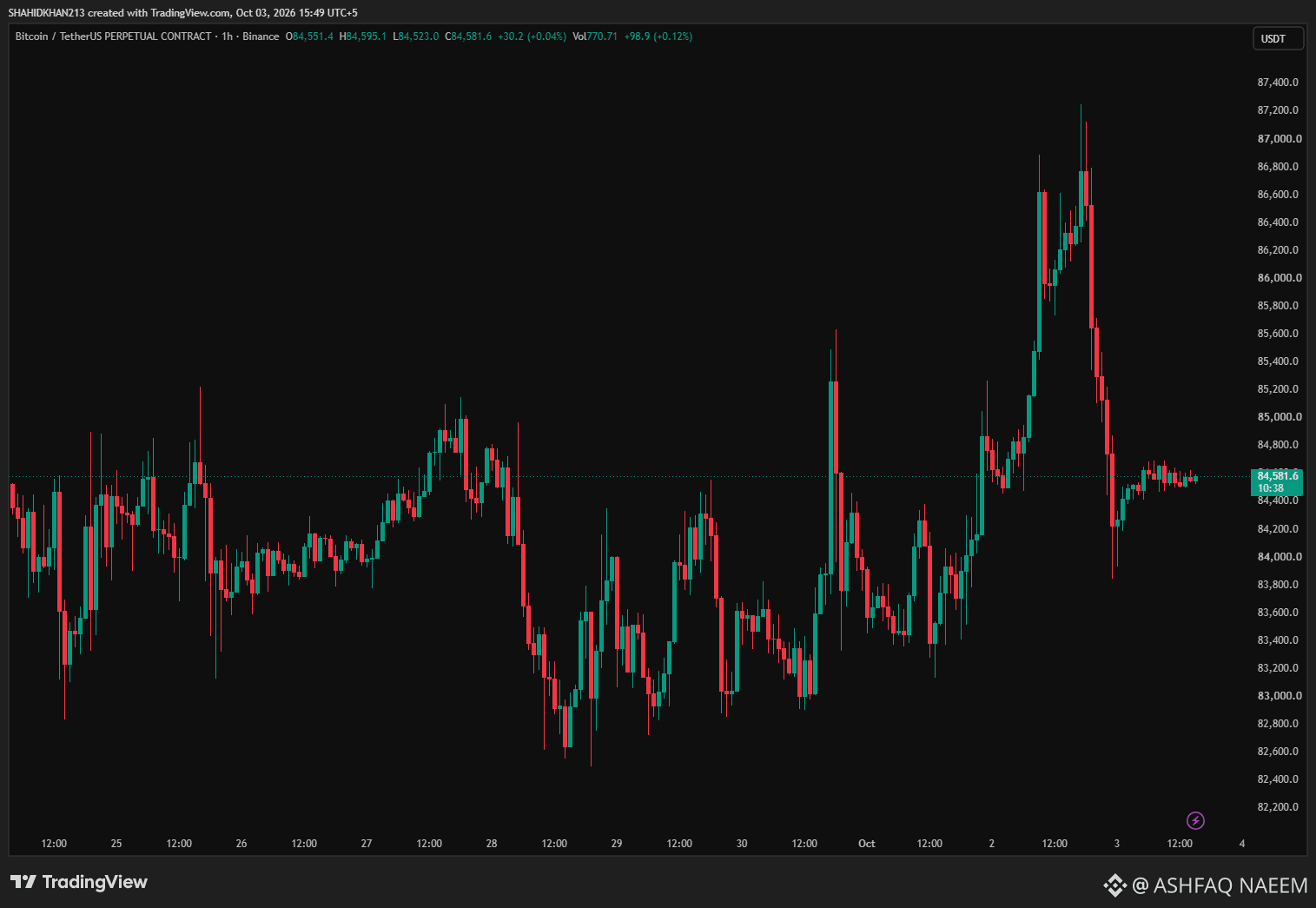
$BTC is fighting around the $84K–$85K zone. If bulls reclaim $87K, could the next breakout target be $90K+? Or does rejection trigger another move toward $80K–$82K?
🎯 Your $BTC call?
🟢 $90K+ 🚀
🔴 $80K–82K 📉
⚡ $100K NEXT?
#BitcoinParesGainsAfterRallyTo$86.5K #BTC $BTC
{future}(BTCUSDT)
🚨 BITCOIN’S NEXT BIG MOVE IS HERE?
$BTC is fighting around the $84K–$85K zone. If bulls reclaim $87K, could the next breakout target be $90K+? Or does rejection trigger another move toward $80K–$82K?
🎯 Your $BTC call?
🟢 $90K+ 🚀
🔴 $80K–82K 📉
⚡ $100K NEXT?
#BitcoinParesGainsAfterRallyTo$86.5K #BTC $BTC
$BTC is fighting around the $84K–$85K zone. If bulls reclaim $87K, could the next breakout target be $90K+? Or does rejection trigger another move toward $80K–$82K?
🎯 Your $BTC call?
🟢 $90K+ 🚀
🔴 $80K–82K 📉
⚡ $100K NEXT?
#BitcoinParesGainsAfterRallyTo$86.5K #BTC $BTC
21
·
--
Bullish
See translation
🚨 API3 is showing strong recovery momentum!
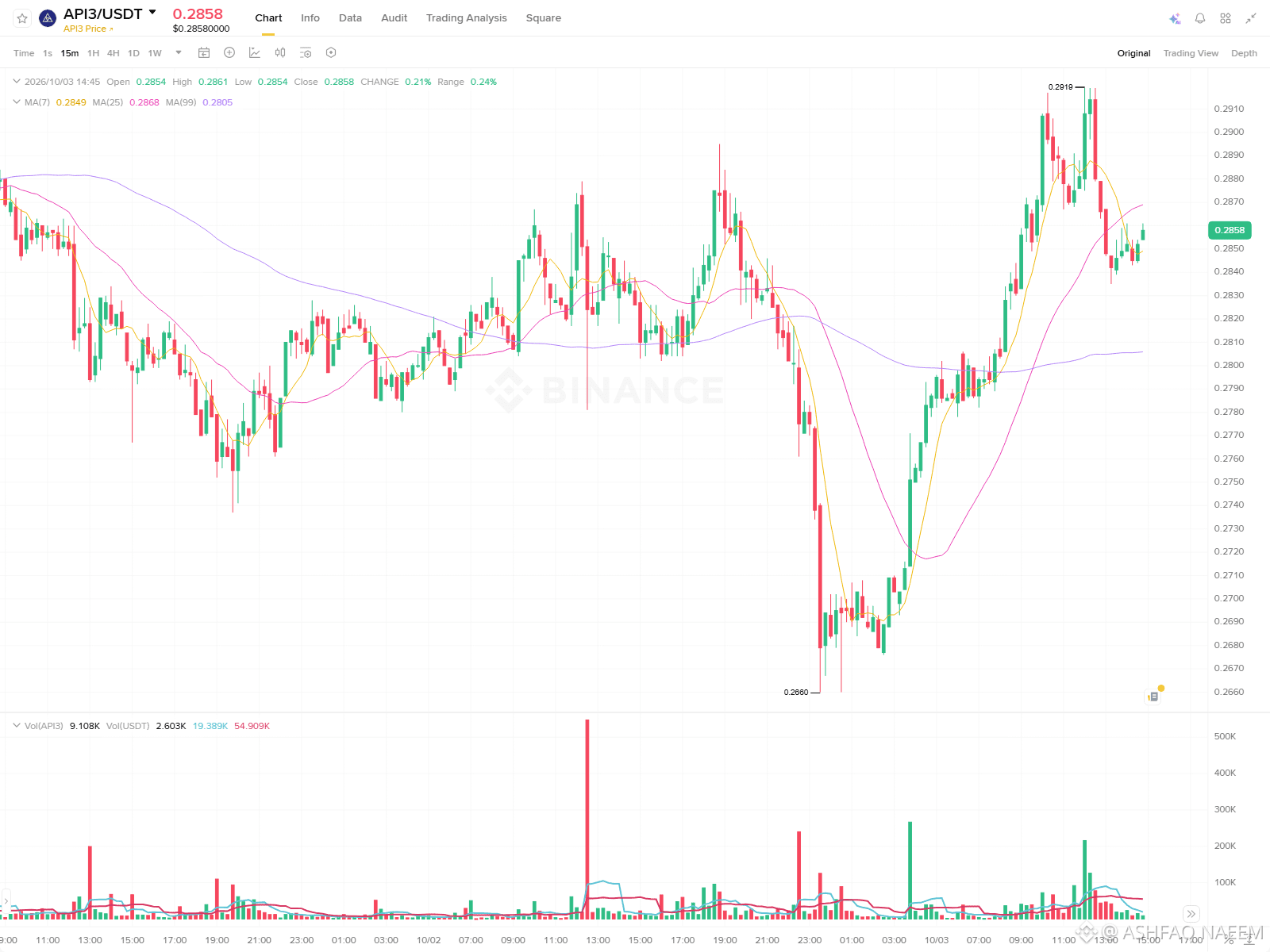
Price surged from $0.2680 to $0.2919 before pulling back toward $0.2858. Traders are watching $0.2920 for a potential breakout. Holding $0.2840 could support another recovery attempt, while a breakdown may trigger further downside. Will API3 break resistance or face another rejection? 🔥
#API3 $API3
{future}(API3USDT)
🚨 API3 is showing strong recovery momentum!
Price surged from $0.2680 to $0.2919 before pulling back toward $0.2858. Traders are watching $0.2920 for a potential breakout. Holding $0.2840 could support another recovery attempt, while a breakdown may trigger further downside. Will API3 break resistance or face another rejection? 🔥
#API3 $API3
Price surged from $0.2680 to $0.2919 before pulling back toward $0.2858. Traders are watching $0.2920 for a potential breakout. Holding $0.2840 could support another recovery attempt, while a breakdown may trigger further downside. Will API3 break resistance or face another rejection? 🔥
#API3 $API3
85
·
--
See translation
🚀 ICP Bulls Are Fighting Back!
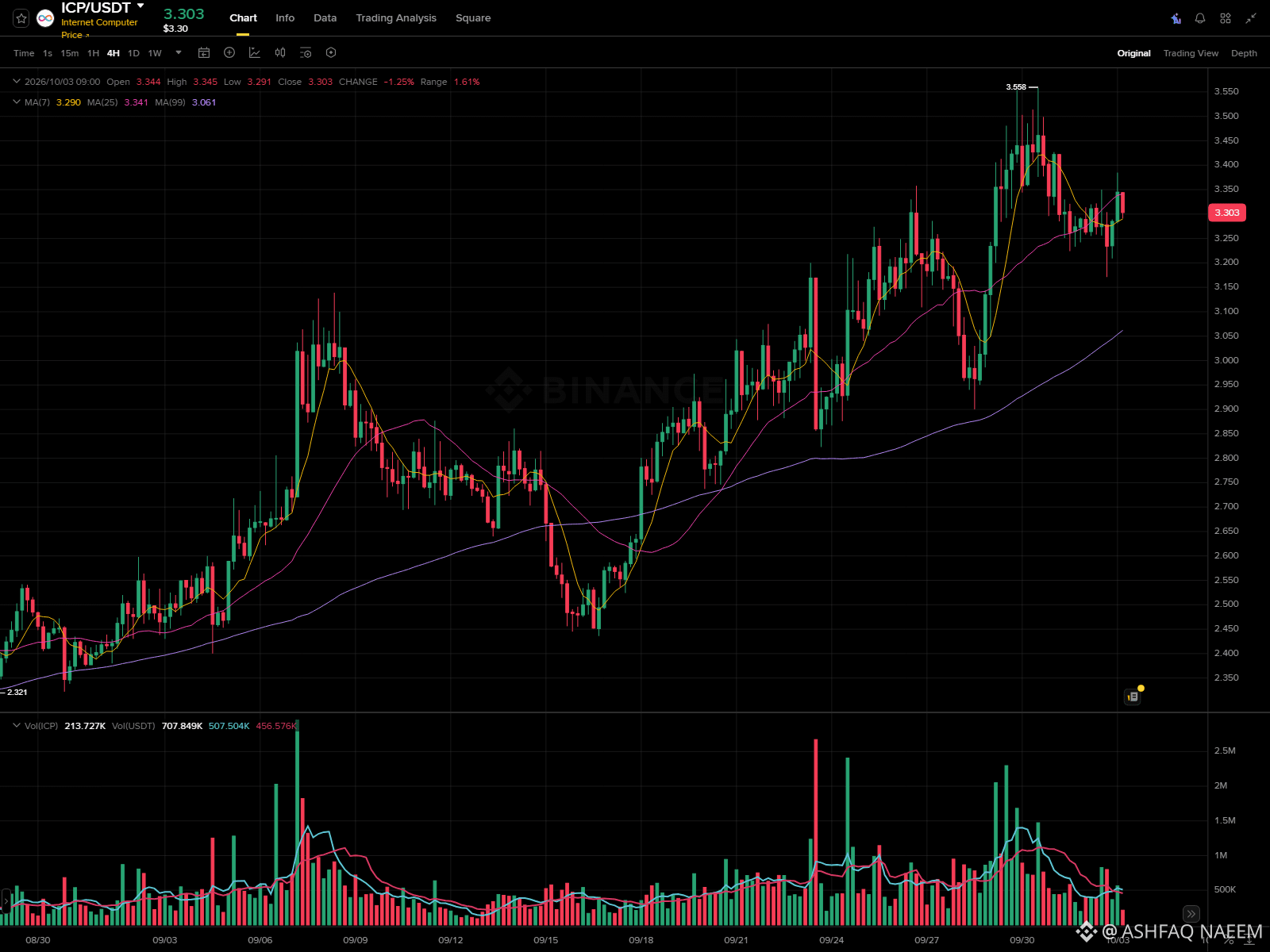
ICP/USDT is trading near $3.303 after pulling back from $3.558. Bulls are defending support around $3.25, while $3.35 is the immediate resistance. A breakout could target $3.45–$3.55, but losing $3.25 may trigger another dip. 📊 Watch volume before entering!
#icp #cryptotrading $ICP
{future}(ICPUSDT)
🚀 ICP Bulls Are Fighting Back!
ICP/USDT is trading near $3.303 after pulling back from $3.558. Bulls are defending support around $3.25, while $3.35 is the immediate resistance. A breakout could target $3.45–$3.55, but losing $3.25 may trigger another dip. 📊 Watch volume before entering!
#icp #cryptotrading $ICP
ICP/USDT is trading near $3.303 after pulling back from $3.558. Bulls are defending support around $3.25, while $3.35 is the immediate resistance. A breakout could target $3.45–$3.55, but losing $3.25 may trigger another dip. 📊 Watch volume before entering!
#icp #cryptotrading $ICP
1
189
·
--
Article
See translation
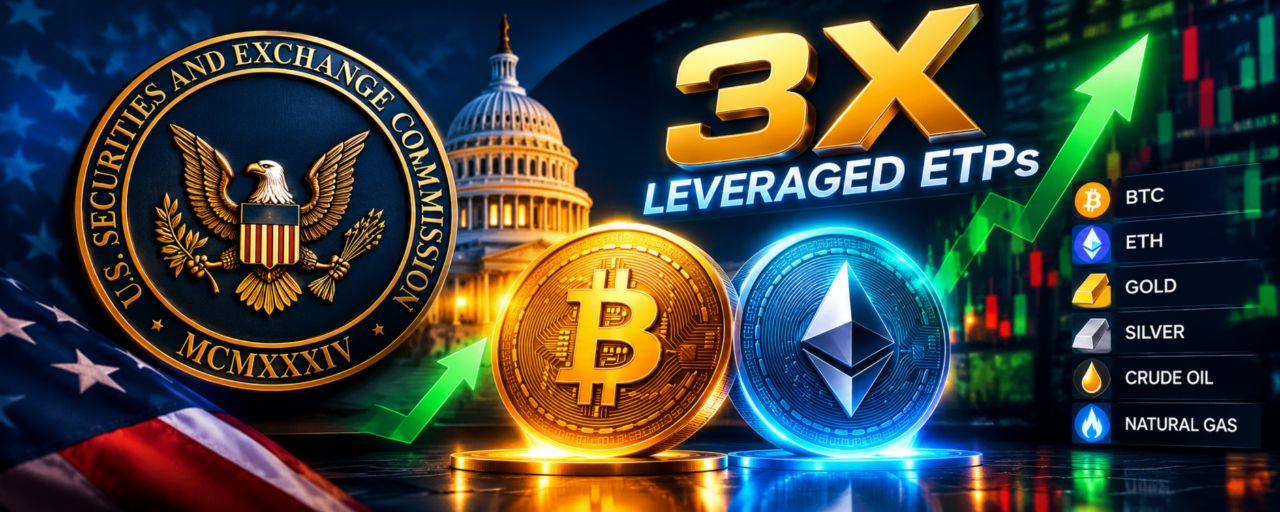
BREAKING: SEC APPROVES 3X LEVERAGED BITCOIN & ETHEREUM ETPs — CRYPTO TRADERS, PAY ATTENTION!🚨 The U.S. Securities and Exchange Commission (SEC) has approved the listing and trading of new 3X leveraged Bitcoin and Ethereum exchange-traded products (ETPs), alongside similar products linked to gold, silver, crude oil, and natural gas. The approval order was issued on October 2, 2026, for products listed on Cboe BZX Exchange. This is a major development for traders seeking leveraged exposure through traditional financial markets.
🔥 WHAT DOES 3X LEVERAGE MEAN?
These products aim to deliver three times the DAILY performance of their respective underlying benchmarks before fees and expenses. If the benchmark rises 1% in a day, the product targets a gain of approximately 3%. But if the benchmark falls 1%, the product may lose approximately 3%.
⚡ WHY SHOULD CRYPTO TRADERS CARE?
✅ More leveraged exposure to Bitcoin and Ethereum through exchange-traded products.
✅ Potentially greater trading activity and new ways for traditional-market investors to express short-term market views.
✅ Increased attention on BTC and ETH price movements, volatility, and risk management.
⚠️ THE BIG WARNING: A 3X ETP is not a guaranteed profit machine! Daily leverage resets can cause returns to diverge significantly from three times the underlying asset’s performance over longer periods. Volatile, sideways markets can also erode returns.
📊 TRADER WATCHLIST
• Bitcoin (BTC): Watch key support and resistance levels, volume, and breakout confirmation.
• Ethereum (ETH): Monitor momentum, market structure, and relative strength against BTC.
• Risk management: Avoid chasing sudden pumps. Use predefined stop-loss levels and understand the product’s fees and risks before trading.
🚀 THE BIG QUESTION: Will these leveraged products attract more traditional-market participation in crypto, or will volatility make them too risky for many traders?
Share your thoughts below! 👇
#bitcoin #Ethereum #CryptoNews #cryptotrading #secapproves3xlongcryptocommodityetps
$BTC
$ETH
$XAU
{future}(XAUUSDT)
BREAKING: SEC APPROVES 3X LEVERAGED BITCOIN & ETHEREUM ETPs — CRYPTO TRADERS, PAY ATTENTION!
🚨 The U.S. Securities and Exchange Commission (SEC) has approved the listing and trading of new 3X leveraged Bitcoin and Ethereum exchange-traded products (ETPs), alongside similar products linked to gold, silver, crude oil, and natural gas. The approval order was issued on October 2, 2026, for products listed on Cboe BZX Exchange. This is a major development for traders seeking leveraged exposure through traditional financial markets.
🔥 WHAT DOES 3X LEVERAGE MEAN?
These products aim to deliver three times the DAILY performance of their respective underlying benchmarks before fees and expenses. If the benchmark rises 1% in a day, the product targets a gain of approximately 3%. But if the benchmark falls 1%, the product may lose approximately 3%.
⚡ WHY SHOULD CRYPTO TRADERS CARE?
✅ More leveraged exposure to Bitcoin and Ethereum through exchange-traded products.
✅ Potentially greater trading activity and new ways for traditional-market investors to express short-term market views.
✅ Increased attention on BTC and ETH price movements, volatility, and risk management.
⚠️ THE BIG WARNING: A 3X ETP is not a guaranteed profit machine! Daily leverage resets can cause returns to diverge significantly from three times the underlying asset’s performance over longer periods. Volatile, sideways markets can also erode returns.
📊 TRADER WATCHLIST
• Bitcoin (BTC): Watch key support and resistance levels, volume, and breakout confirmation.
• Ethereum (ETH): Monitor momentum, market structure, and relative strength against BTC.
• Risk management: Avoid chasing sudden pumps. Use predefined stop-loss levels and understand the product’s fees and risks before trading.
🚀 THE BIG QUESTION: Will these leveraged products attract more traditional-market participation in crypto, or will volatility make them too risky for many traders?
Share your thoughts below! 👇
#bitcoin #Ethereum #CryptoNews #cryptotrading #secapproves3xlongcryptocommodityetps
$BTC
$ETH
$XAU
🔥 WHAT DOES 3X LEVERAGE MEAN?
These products aim to deliver three times the DAILY performance of their respective underlying benchmarks before fees and expenses. If the benchmark rises 1% in a day, the product targets a gain of approximately 3%. But if the benchmark falls 1%, the product may lose approximately 3%.
⚡ WHY SHOULD CRYPTO TRADERS CARE?
✅ More leveraged exposure to Bitcoin and Ethereum through exchange-traded products.
✅ Potentially greater trading activity and new ways for traditional-market investors to express short-term market views.
✅ Increased attention on BTC and ETH price movements, volatility, and risk management.
⚠️ THE BIG WARNING: A 3X ETP is not a guaranteed profit machine! Daily leverage resets can cause returns to diverge significantly from three times the underlying asset’s performance over longer periods. Volatile, sideways markets can also erode returns.
📊 TRADER WATCHLIST
• Bitcoin (BTC): Watch key support and resistance levels, volume, and breakout confirmation.
• Ethereum (ETH): Monitor momentum, market structure, and relative strength against BTC.
• Risk management: Avoid chasing sudden pumps. Use predefined stop-loss levels and understand the product’s fees and risks before trading.
🚀 THE BIG QUESTION: Will these leveraged products attract more traditional-market participation in crypto, or will volatility make them too risky for many traders?
Share your thoughts below! 👇
#bitcoin #Ethereum #CryptoNews #cryptotrading #secapproves3xlongcryptocommodityetps
$BTC
$ETH
$XAU
1
205
·
--
See translation
🚨 Bitcoin Pares Gains After Rally to $86.5K! ₿
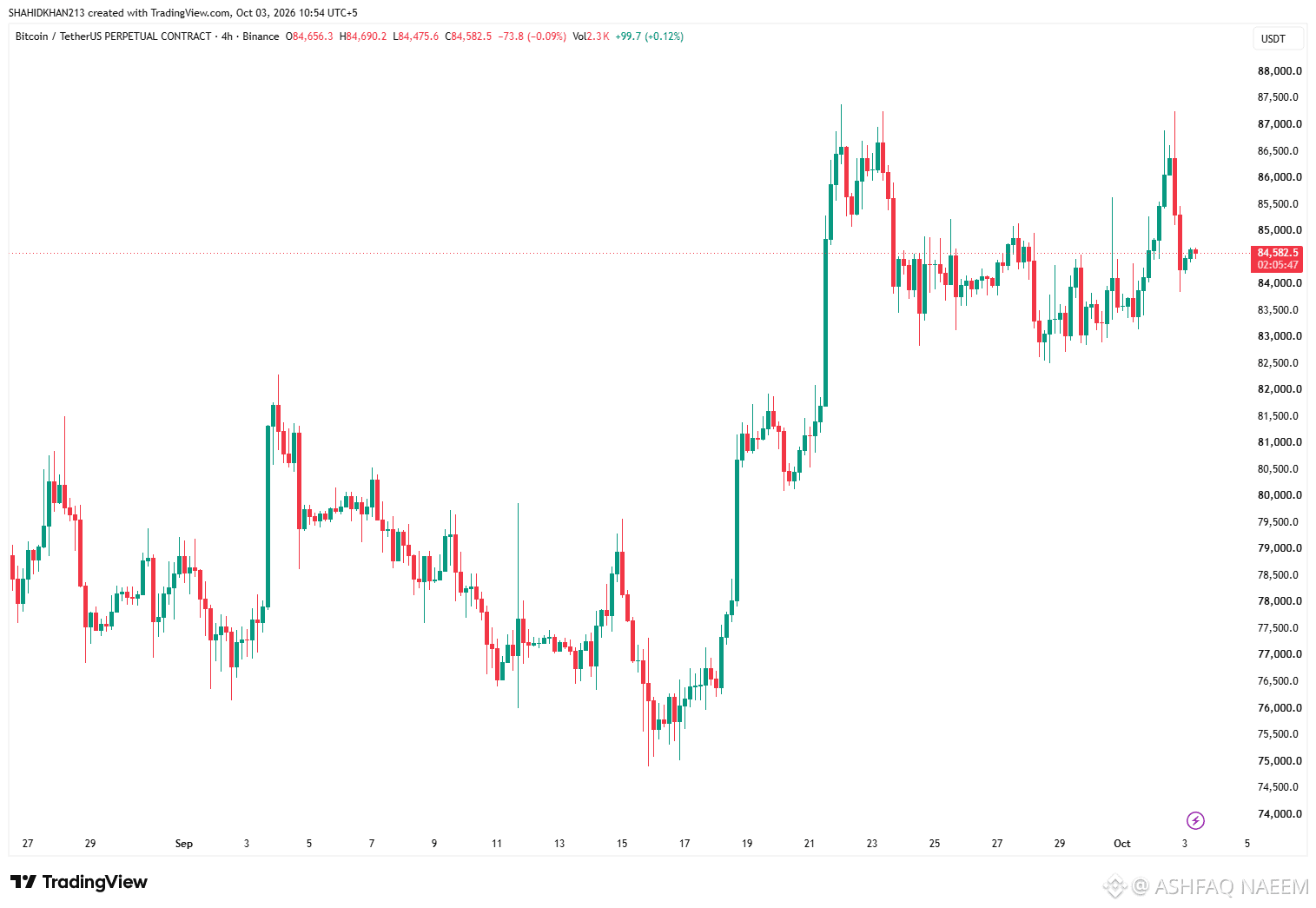
Bitcoin pulled back after briefly reaching $86,500, as traders took profits following the sharp rally. The key question now: can $BTC hold its momentum or face deeper consolidation? 👀
#BitcoinParesGainsAfterRallyTo$86.5K
$BTC
{future}(BTCUSDT)
🚨 Bitcoin Pares Gains After Rally to $86.5K! ₿
Bitcoin pulled back after briefly reaching $86,500, as traders took profits following the sharp rally. The key question now: can $BTC hold its momentum or face deeper consolidation? 👀
#BitcoinParesGainsAfterRallyTo$86.5K
$BTC
Bitcoin pulled back after briefly reaching $86,500, as traders took profits following the sharp rally. The key question now: can $BTC hold its momentum or face deeper consolidation? 👀
#BitcoinParesGainsAfterRallyTo$86.5K
$BTC
97
·
--
Verified
See translation
🚨 CEREBRAS STOCK CRASHES NEARLY 20%! 📉🔥
Cerebras ($CBRS) shares plunged nearly 20% this week, hitting their lowest level since the company’s May IPO. The selloff followed a SemiAnalysis report claiming OpenAI may use Nvidia GPUs instead of Cerebras hardware for the “Ultrafast” mode of GPT-6.1 Sol.
But there’s another factor: 19.4 million shares became eligible for trading after post-IPO lockup restrictions expired, adding potential selling pressure.
OpenAI has previously announced a 750MW Cerebras partnership, so investors are now watching closely to see how the two companies’ relationship develops.
⚡ AI chip competition is heating up — Nvidia vs. Cerebras could become a major battleground.
Do you think this is a temporary selloff or a bigger warning for CBRS? 👇
#cerebrassinksnearly20%onreportnvidiatopoweropenai
$NVDA.US $SOL $NEAR
{future}(NEARUSDT)
{future}(SOLUSDT)
{stock_us}(NVDA.US)
🚨 CEREBRAS STOCK CRASHES NEARLY 20%! 📉🔥
Cerebras ($CBRS) shares plunged nearly 20% this week, hitting their lowest level since the company’s May IPO. The selloff followed a SemiAnalysis report claiming OpenAI may use Nvidia GPUs instead of Cerebras hardware for the “Ultrafast” mode of GPT-6.1 Sol.
But there’s another factor: 19.4 million shares became eligible for trading after post-IPO lockup restrictions expired, adding potential selling pressure.
OpenAI has previously announced a 750MW Cerebras partnership, so investors are now watching closely to see how the two companies’ relationship develops.
⚡ AI chip competition is heating up — Nvidia vs. Cerebras could become a major battleground.
Do you think this is a temporary selloff or a bigger warning for CBRS? 👇
#cerebrassinksnearly20%onreportnvidiatopoweropenai
$NVDA.US $SOL $NEAR
Cerebras ($CBRS) shares plunged nearly 20% this week, hitting their lowest level since the company’s May IPO. The selloff followed a SemiAnalysis report claiming OpenAI may use Nvidia GPUs instead of Cerebras hardware for the “Ultrafast” mode of GPT-6.1 Sol.
But there’s another factor: 19.4 million shares became eligible for trading after post-IPO lockup restrictions expired, adding potential selling pressure.
OpenAI has previously announced a 750MW Cerebras partnership, so investors are now watching closely to see how the two companies’ relationship develops.
⚡ AI chip competition is heating up — Nvidia vs. Cerebras could become a major battleground.
Do you think this is a temporary selloff or a bigger warning for CBRS? 👇
#cerebrassinksnearly20%onreportnvidiatopoweropenai
$NVDA.US $SOL $NEAR

2
1
13
20.6k
·
--

Article
See translation
SEC PROPOSES NEW CRYPTO CUSTODY RULES: A MAJOR SHIFT FOR INSTITUTIONAL DIGITAL ASSETSThe U.S. Securities and Exchange Commission (SEC) has proposed a new regulatory framework for how registered investment advisers and regulated funds can custody crypto assets. The proposal, announced on October 1, 2026, is designed to modernize decades-old custody requirements and create clearer pathways for institutions holding digital assets.
🔐 What Is the SEC Proposing?
One of the biggest changes is the introduction of additional custody options for crypto assets.
Under the proposal, advisers could potentially self-custody certain crypto assets under specific conditions, particularly when an eligible permitted custodian is unavailable. The adviser would need to establish that no permitted custodian can hold the particular asset and reassess that determination periodically.
The proposal would also allow state-chartered trust companies to serve as custodians for certain client and regulated-fund crypto assets, provided they meet specified requirements designed to protect assets against theft, loss, misuse and misappropriation.
🏦 Why Does This Matter for Institutions?
Crypto custody has been a major operational and regulatory issue for institutional investors. Traditional custody rules were designed long before blockchain networks existed, while the availability of qualified custodians for some digital assets has not always kept pace with the market.
The SEC says its proposal is intended to remove regulatory barriers, expand investor choice and give advisers and regulated funds a more clearly defined compliance framework for crypto-related investment activity.
If finalized, the framework could affect how investment firms structure their digital-asset operations, custody arrangements, risk controls and institutional crypto strategies.
⚠️ Important: This Is Still a Proposal
The new framework does not immediately become law or replace existing requirements. The SEC's proposal will go through the public-comment and rulemaking process.
The SEC says the public comment period will remain open for 60 days after the proposing release is published in the Federal Register.
That means the final rules could change significantly depending on feedback from investment advisers, funds, custodians, investors and other market participants.
📈 What Could It Mean for Crypto?
The proposal represents another important step in the SEC's evolving approach to digital assets. It focuses specifically on the custody problem rather than creating a complete regulatory framework for the entire crypto industry.
For institutional investors, the key issues to watch are:
🔹 Availability of qualified crypto custodians
🔹 Conditions surrounding adviser self-custody
🔹 Expansion of state trust-company custody
🔹 Private-key and cybersecurity safeguards
🔹 Asset segregation and investor protection
🔹 Future SEC changes following public comments
The SEC's proposal therefore has implications beyond custody itself: clearer institutional custody infrastructure can influence how easily regulated investment firms participate in crypto markets. However, the eventual impact will depend on the final rules and how institutions implement them.
🔥 Bottom Line
The SEC's proposed crypto custody framework could mark a significant change in how regulated investment advisers and funds handle digital assets. It introduces potential self-custody pathways and expands the types of institutions that may provide crypto custody, while adding conditions intended to protect investors.
The big question now is not whether the SEC has proposed the framework — it has. The next question is what the final rules will look like after the 60-day comment process.
#secproposescryptocustodyrules
$BTC $ETH $SOL
{future}(SOLUSDT)
{future}(ETHUSDT)
{future}(BTCUSDT)
SEC PROPOSES NEW CRYPTO CUSTODY RULES: A MAJOR SHIFT FOR INSTITUTIONAL DIGITAL ASSETS
The U.S. Securities and Exchange Commission (SEC) has proposed a new regulatory framework for how registered investment advisers and regulated funds can custody crypto assets. The proposal, announced on October 1, 2026, is designed to modernize decades-old custody requirements and create clearer pathways for institutions holding digital assets.
🔐 What Is the SEC Proposing?
One of the biggest changes is the introduction of additional custody options for crypto assets.
Under the proposal, advisers could potentially self-custody certain crypto assets under specific conditions, particularly when an eligible permitted custodian is unavailable. The adviser would need to establish that no permitted custodian can hold the particular asset and reassess that determination periodically.
The proposal would also allow state-chartered trust companies to serve as custodians for certain client and regulated-fund crypto assets, provided they meet specified requirements designed to protect assets against theft, loss, misuse and misappropriation.
🏦 Why Does This Matter for Institutions?
Crypto custody has been a major operational and regulatory issue for institutional investors. Traditional custody rules were designed long before blockchain networks existed, while the availability of qualified custodians for some digital assets has not always kept pace with the market.
The SEC says its proposal is intended to remove regulatory barriers, expand investor choice and give advisers and regulated funds a more clearly defined compliance framework for crypto-related investment activity.
If finalized, the framework could affect how investment firms structure their digital-asset operations, custody arrangements, risk controls and institutional crypto strategies.
⚠️ Important: This Is Still a Proposal
The new framework does not immediately become law or replace existing requirements. The SEC's proposal will go through the public-comment and rulemaking process.
The SEC says the public comment period will remain open for 60 days after the proposing release is published in the Federal Register.
That means the final rules could change significantly depending on feedback from investment advisers, funds, custodians, investors and other market participants.
📈 What Could It Mean for Crypto?
The proposal represents another important step in the SEC's evolving approach to digital assets. It focuses specifically on the custody problem rather than creating a complete regulatory framework for the entire crypto industry.
For institutional investors, the key issues to watch are:
🔹 Availability of qualified crypto custodians
🔹 Conditions surrounding adviser self-custody
🔹 Expansion of state trust-company custody
🔹 Private-key and cybersecurity safeguards
🔹 Asset segregation and investor protection
🔹 Future SEC changes following public comments
The SEC's proposal therefore has implications beyond custody itself: clearer institutional custody infrastructure can influence how easily regulated investment firms participate in crypto markets. However, the eventual impact will depend on the final rules and how institutions implement them.
🔥 Bottom Line
The SEC's proposed crypto custody framework could mark a significant change in how regulated investment advisers and funds handle digital assets. It introduces potential self-custody pathways and expands the types of institutions that may provide crypto custody, while adding conditions intended to protect investors.
The big question now is not whether the SEC has proposed the framework — it has. The next question is what the final rules will look like after the 60-day comment process.
#secproposescryptocustodyrules
$BTC $ETH $SOL
🔐 What Is the SEC Proposing?
One of the biggest changes is the introduction of additional custody options for crypto assets.
Under the proposal, advisers could potentially self-custody certain crypto assets under specific conditions, particularly when an eligible permitted custodian is unavailable. The adviser would need to establish that no permitted custodian can hold the particular asset and reassess that determination periodically.
The proposal would also allow state-chartered trust companies to serve as custodians for certain client and regulated-fund crypto assets, provided they meet specified requirements designed to protect assets against theft, loss, misuse and misappropriation.
🏦 Why Does This Matter for Institutions?
Crypto custody has been a major operational and regulatory issue for institutional investors. Traditional custody rules were designed long before blockchain networks existed, while the availability of qualified custodians for some digital assets has not always kept pace with the market.
The SEC says its proposal is intended to remove regulatory barriers, expand investor choice and give advisers and regulated funds a more clearly defined compliance framework for crypto-related investment activity.
If finalized, the framework could affect how investment firms structure their digital-asset operations, custody arrangements, risk controls and institutional crypto strategies.
⚠️ Important: This Is Still a Proposal
The new framework does not immediately become law or replace existing requirements. The SEC's proposal will go through the public-comment and rulemaking process.
The SEC says the public comment period will remain open for 60 days after the proposing release is published in the Federal Register.
That means the final rules could change significantly depending on feedback from investment advisers, funds, custodians, investors and other market participants.
📈 What Could It Mean for Crypto?
The proposal represents another important step in the SEC's evolving approach to digital assets. It focuses specifically on the custody problem rather than creating a complete regulatory framework for the entire crypto industry.
For institutional investors, the key issues to watch are:
🔹 Availability of qualified crypto custodians
🔹 Conditions surrounding adviser self-custody
🔹 Expansion of state trust-company custody
🔹 Private-key and cybersecurity safeguards
🔹 Asset segregation and investor protection
🔹 Future SEC changes following public comments
The SEC's proposal therefore has implications beyond custody itself: clearer institutional custody infrastructure can influence how easily regulated investment firms participate in crypto markets. However, the eventual impact will depend on the final rules and how institutions implement them.
🔥 Bottom Line
The SEC's proposed crypto custody framework could mark a significant change in how regulated investment advisers and funds handle digital assets. It introduces potential self-custody pathways and expands the types of institutions that may provide crypto custody, while adding conditions intended to protect investors.
The big question now is not whether the SEC has proposed the framework — it has. The next question is what the final rules will look like after the 60-day comment process.
#secproposescryptocustodyrules
$BTC $ETH $SOL
2
1
21
28.8k
·
--

Article
See translation
BITCOIN FUNDING RATES TRIPLE TO 10% — BTC BULL RUN OR A MASSIVE LONG TRAP?Bitcoin is heating up, but the derivatives market is flashing a warning traders cannot afford to ignore. 🔥
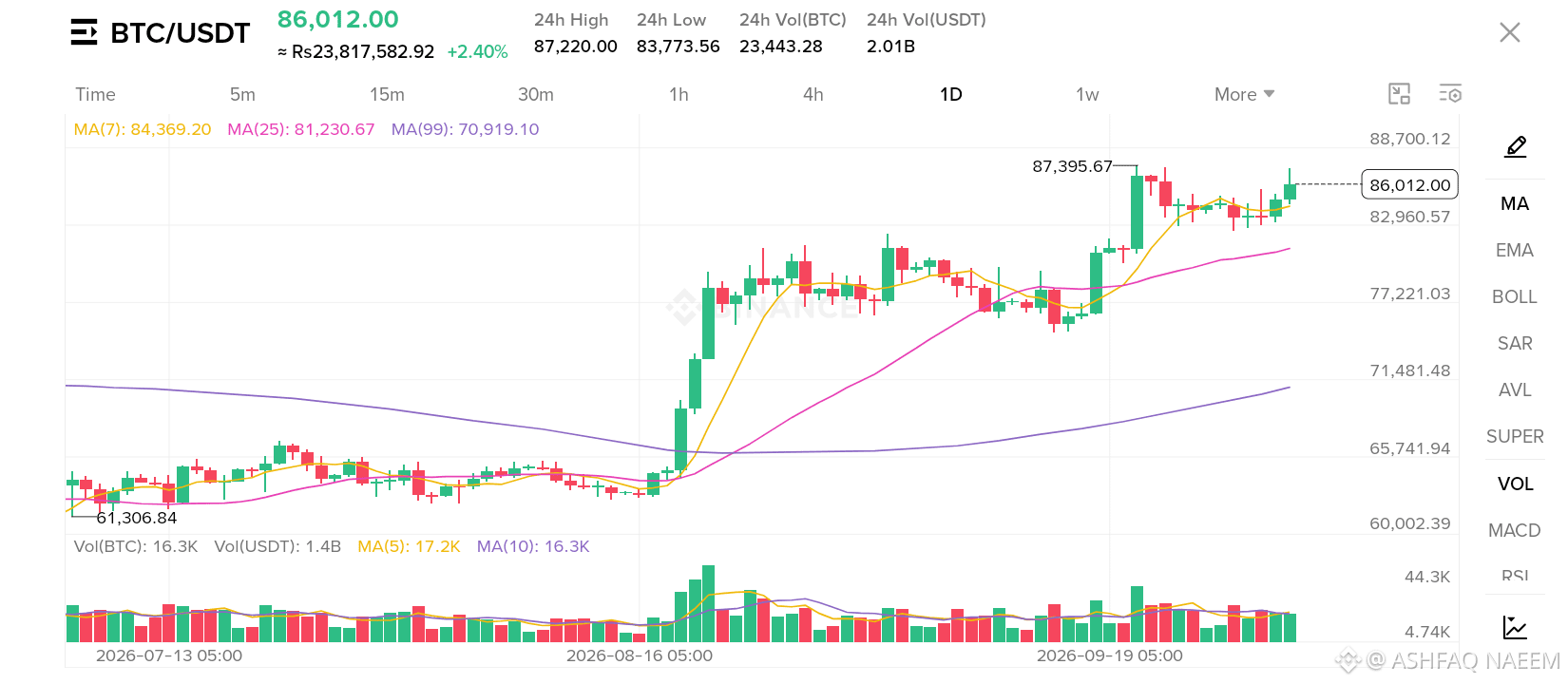
BTC has pushed back above $86,000, and bullish sentiment is returning across the crypto market. But behind the green candles, one major signal is attracting attention: Bitcoin perpetual futures funding rates have surged from approximately 3% to 10% annualized on some venues.
At the same time, open interest has climbed, suggesting traders are adding fresh positions as Bitcoin rises. This combination can fuel a powerful continuation — or create the conditions for a sharp liquidation-driven reversal.
The critical question: Is fresh capital supporting this rally, or are leveraged traders becoming dangerously crowded on one side?
📊 1. THE FUNDING RATE SURGE: WHY IT MATTERS
Funding rates are periodic payments exchanged between long and short traders in perpetual futures markets. When funding is positive, longs generally pay shorts.
A jump from roughly 3% to 10% annualized signals stronger demand for bullish leveraged exposure on the venues reporting the increase.
But remember: 10% annualized does NOT mean traders pay 10% every funding period. Actual payments depend on the contract, exchange, funding interval, and position size.
Why should traders care?
When too many traders use leverage to chase the same move, the market can become vulnerable to sudden price swings. If Bitcoin reverses, leveraged longs may face margin calls or liquidation, adding selling pressure to an already falling market.
High funding is not an automatic sell signal. It is a risk indicator that deserves attention.
🐋 2. OPEN INTEREST IS RISING — AND THAT CHANGES THE PICTURE
Market reporting on October 2 highlighted a rise in Bitcoin open interest alongside its recovery from approximately $83,500 to $86,500.
Open interest measures outstanding derivatives contracts. Rising open interest means positions are being added or maintained as new contracts enter the market.
Combined with rising prices and positive funding, this suggests bullish leveraged positioning is increasing.
However, there is an important distinction:
Price up + open interest up: New exposure is entering; leverage may be amplifying the move.Price up + open interest down: Positions may be closing, including shorts being squeezed.Price down + open interest up: Fresh positions are entering during weakness; the direction of those positions needs further confirmation.Price down + open interest down: Positions are being unwound, potentially through liquidations or voluntary closures.
These combinations are clues, not guarantees. Open interest alone cannot tell us whether every new position is bullish or bearish.
🚀 3. THE BULLISH SCENARIO: CAN BTC TARGET $90,000?
Bitcoin's recovery above $86,000 puts the market's ability to sustain higher prices in focus.
For bulls, the setup becomes more constructive if BTC holds above its recent breakout area, buying volume expands, and spot demand confirms the futures rally.
Bullish confirmation checklist:
BTC maintains support above the reclaimed price zone.Spot buying volume strengthens rather than futures leverage doing all the work.Funding remains positive without accelerating excessively.Open interest rises alongside sustained price progress.Bitcoin breaks resistance and holds it on a retest.
If these conditions develop, traders may watch the $87,400 area highlighted in a reported Binance liquidation heatmap, followed by the psychological $90,000 level.
These are monitoring levels, not guaranteed targets. A liquidation heatmap identifies estimated areas of potential liquidation activity; it does not predict that price must reach them.
⚠️ 4. THE BEARISH SCENARIO: HOW A LONG SQUEEZE COULD DEVELOP
Here is where the funding-rate spike becomes particularly important.
Imagine Bitcoin continues rising while funding and open interest climb rapidly. More traders chase the rally using leverage, expecting an immediate breakout.
Then BTC fails to clear resistance.
If selling pressure increases, leveraged longs may begin closing their positions. Liquidations can accelerate the decline, pushing price toward lower liquidity zones and triggering further forced selling.
Bearish warning signals:
BTC repeatedly fails to hold above resistance.Funding stays elevated while price momentum weakens.Open interest rises but price stops making meaningful progress.Spot buying volume fades.Price breaks support while liquidations and selling volume increase.
A sustained breakdown under the recent recovery zone could bring $83,500 back into focus, followed by the $80,000–$82,000 region if broader selling pressure intensifies.
These levels are conditional reference zones, not confirmed support or predictions.
🎯 5. THE PRO TRADER'S PLAYBOOK
Instead of blindly buying or shorting because funding has reached 10%, traders can use a confirmation-based approach.
Setup A — Bullish continuation
Wait for BTC to break above a clearly defined resistance level, close above it on your chosen timeframe, and successfully retest that level. Look for spot volume confirmation and monitor whether funding becomes excessively crowded.
Setup B — Failed breakout
If BTC rejects resistance and loses its reclaimed support, watch for a failed retest before considering a short setup. Confirm with price structure, volume, and changes in open interest rather than relying on funding alone.
Setup C — No-trade zone
If BTC moves sideways while funding stays elevated and the market provides no clear directional confirmation, staying out may be preferable to forcing a leveraged trade.
For every setup, define the invalidation level before entry, size the position according to your risk limit, and avoid placing a stop-loss where ordinary market noise can easily trigger it.
🌍 6. THE MACRO FACTOR: DON'T IGNORE U.S. ECONOMIC DATA
Crypto derivatives do not trade in isolation.
On October 2, traders were also watching U.S. employment data and its potential impact on Treasury yields and Federal Reserve rate expectations. Stronger-than-expected economic data can alter interest-rate expectations, while weaker data can produce a different reaction depending on the broader economic outlook.
That matters because Bitcoin's short-term direction can change quickly when macroeconomic news collides with crowded futures positioning.
A technical breakout without supportive market conditions can fail. Equally, a heavily leveraged market can squeeze higher if price continues advancing and short sellers are forced to cover.
🔥 FINAL VERDICT: WATCH THE LEVERAGE, NOT JUST THE GREEN CANDLES
Bitcoin's funding-rate surge is a sign that bullish derivatives positioning is becoming more expensive on certain exchanges. Rising open interest adds another layer of risk and opportunity.
But neither signal independently proves that BTC is about to crash or that a major breakout is guaranteed.
The decisive evidence will come from price acceptance above resistance, spot-market demand, changes in open interest, funding-rate persistence, and the market's reaction to macroeconomic data.
The biggest mistake traders can make right now is confusing bullish sentiment with a confirmed trading signal.
BTC bulls need follow-through. Bears need a confirmed breakdown. Everyone else needs a plan.
👇 YOUR TURN: What happens next?
🚀 A: BTC breaks higher toward $90,000.
🐻 B: Overleveraged longs get squeezed and BTC retests lower support.
⏳ C: Bitcoin consolidates before choosing a direction.
Share your scenario and explain which price level would confirm it.
#BTC #FundingRates #BitcoinAnalysis #BinanceSquare #bitcoinfundingratetriplesto10%
$BTC
{future}(BTCUSDT)
BITCOIN FUNDING RATES TRIPLE TO 10% — BTC BULL RUN OR A MASSIVE LONG TRAP?
Bitcoin is heating up, but the derivatives market is flashing a warning traders cannot afford to ignore. 🔥
BTC has pushed back above $86,000, and bullish sentiment is returning across the crypto market. But behind the green candles, one major signal is attracting attention: Bitcoin perpetual futures funding rates have surged from approximately 3% to 10% annualized on some venues.
At the same time, open interest has climbed, suggesting traders are adding fresh positions as Bitcoin rises. This combination can fuel a powerful continuation — or create the conditions for a sharp liquidation-driven reversal.
The critical question: Is fresh capital supporting this rally, or are leveraged traders becoming dangerously crowded on one side?
📊 1. THE FUNDING RATE SURGE: WHY IT MATTERS
Funding rates are periodic payments exchanged between long and short traders in perpetual futures markets. When funding is positive, longs generally pay shorts.
A jump from roughly 3% to 10% annualized signals stronger demand for bullish leveraged exposure on the venues reporting the increase.
But remember: 10% annualized does NOT mean traders pay 10% every funding period. Actual payments depend on the contract, exchange, funding interval, and position size.
Why should traders care?
When too many traders use leverage to chase the same move, the market can become vulnerable to sudden price swings. If Bitcoin reverses, leveraged longs may face margin calls or liquidation, adding selling pressure to an already falling market.
High funding is not an automatic sell signal. It is a risk indicator that deserves attention.
🐋 2. OPEN INTEREST IS RISING — AND THAT CHANGES THE PICTURE
Market reporting on October 2 highlighted a rise in Bitcoin open interest alongside its recovery from approximately $83,500 to $86,500.
Open interest measures outstanding derivatives contracts. Rising open interest means positions are being added or maintained as new contracts enter the market.
Combined with rising prices and positive funding, this suggests bullish leveraged positioning is increasing.
However, there is an important distinction:
Price up + open interest up: New exposure is entering; leverage may be amplifying the move.Price up + open interest down: Positions may be closing, including shorts being squeezed.Price down + open interest up: Fresh positions are entering during weakness; the direction of those positions needs further confirmation.Price down + open interest down: Positions are being unwound, potentially through liquidations or voluntary closures.
These combinations are clues, not guarantees. Open interest alone cannot tell us whether every new position is bullish or bearish.
🚀 3. THE BULLISH SCENARIO: CAN BTC TARGET $90,000?
Bitcoin's recovery above $86,000 puts the market's ability to sustain higher prices in focus.
For bulls, the setup becomes more constructive if BTC holds above its recent breakout area, buying volume expands, and spot demand confirms the futures rally.
Bullish confirmation checklist:
BTC maintains support above the reclaimed price zone.Spot buying volume strengthens rather than futures leverage doing all the work.Funding remains positive without accelerating excessively.Open interest rises alongside sustained price progress.Bitcoin breaks resistance and holds it on a retest.
If these conditions develop, traders may watch the $87,400 area highlighted in a reported Binance liquidation heatmap, followed by the psychological $90,000 level.
These are monitoring levels, not guaranteed targets. A liquidation heatmap identifies estimated areas of potential liquidation activity; it does not predict that price must reach them.
⚠️ 4. THE BEARISH SCENARIO: HOW A LONG SQUEEZE COULD DEVELOP
Here is where the funding-rate spike becomes particularly important.
Imagine Bitcoin continues rising while funding and open interest climb rapidly. More traders chase the rally using leverage, expecting an immediate breakout.
Then BTC fails to clear resistance.
If selling pressure increases, leveraged longs may begin closing their positions. Liquidations can accelerate the decline, pushing price toward lower liquidity zones and triggering further forced selling.
Bearish warning signals:
BTC repeatedly fails to hold above resistance.Funding stays elevated while price momentum weakens.Open interest rises but price stops making meaningful progress.Spot buying volume fades.Price breaks support while liquidations and selling volume increase.
A sustained breakdown under the recent recovery zone could bring $83,500 back into focus, followed by the $80,000–$82,000 region if broader selling pressure intensifies.
These levels are conditional reference zones, not confirmed support or predictions.
🎯 5. THE PRO TRADER'S PLAYBOOK
Instead of blindly buying or shorting because funding has reached 10%, traders can use a confirmation-based approach.
Setup A — Bullish continuation
Wait for BTC to break above a clearly defined resistance level, close above it on your chosen timeframe, and successfully retest that level. Look for spot volume confirmation and monitor whether funding becomes excessively crowded.
Setup B — Failed breakout
If BTC rejects resistance and loses its reclaimed support, watch for a failed retest before considering a short setup. Confirm with price structure, volume, and changes in open interest rather than relying on funding alone.
Setup C — No-trade zone
If BTC moves sideways while funding stays elevated and the market provides no clear directional confirmation, staying out may be preferable to forcing a leveraged trade.
For every setup, define the invalidation level before entry, size the position according to your risk limit, and avoid placing a stop-loss where ordinary market noise can easily trigger it.
🌍 6. THE MACRO FACTOR: DON'T IGNORE U.S. ECONOMIC DATA
Crypto derivatives do not trade in isolation.
On October 2, traders were also watching U.S. employment data and its potential impact on Treasury yields and Federal Reserve rate expectations. Stronger-than-expected economic data can alter interest-rate expectations, while weaker data can produce a different reaction depending on the broader economic outlook.
That matters because Bitcoin's short-term direction can change quickly when macroeconomic news collides with crowded futures positioning.
A technical breakout without supportive market conditions can fail. Equally, a heavily leveraged market can squeeze higher if price continues advancing and short sellers are forced to cover.
🔥 FINAL VERDICT: WATCH THE LEVERAGE, NOT JUST THE GREEN CANDLES
Bitcoin's funding-rate surge is a sign that bullish derivatives positioning is becoming more expensive on certain exchanges. Rising open interest adds another layer of risk and opportunity.
But neither signal independently proves that BTC is about to crash or that a major breakout is guaranteed.
The decisive evidence will come from price acceptance above resistance, spot-market demand, changes in open interest, funding-rate persistence, and the market's reaction to macroeconomic data.
The biggest mistake traders can make right now is confusing bullish sentiment with a confirmed trading signal.
BTC bulls need follow-through. Bears need a confirmed breakdown. Everyone else needs a plan.
👇 YOUR TURN: What happens next?
🚀 A: BTC breaks higher toward $90,000.
🐻 B: Overleveraged longs get squeezed and BTC retests lower support.
⏳ C: Bitcoin consolidates before choosing a direction.
Share your scenario and explain which price level would confirm it.
#BTC #FundingRates #BitcoinAnalysis #BinanceSquare #bitcoinfundingratetriplesto10%
$BTC
BTC has pushed back above $86,000, and bullish sentiment is returning across the crypto market. But behind the green candles, one major signal is attracting attention: Bitcoin perpetual futures funding rates have surged from approximately 3% to 10% annualized on some venues.
At the same time, open interest has climbed, suggesting traders are adding fresh positions as Bitcoin rises. This combination can fuel a powerful continuation — or create the conditions for a sharp liquidation-driven reversal.
The critical question: Is fresh capital supporting this rally, or are leveraged traders becoming dangerously crowded on one side?
📊 1. THE FUNDING RATE SURGE: WHY IT MATTERS
Funding rates are periodic payments exchanged between long and short traders in perpetual futures markets. When funding is positive, longs generally pay shorts.
A jump from roughly 3% to 10% annualized signals stronger demand for bullish leveraged exposure on the venues reporting the increase.
But remember: 10% annualized does NOT mean traders pay 10% every funding period. Actual payments depend on the contract, exchange, funding interval, and position size.
Why should traders care?
When too many traders use leverage to chase the same move, the market can become vulnerable to sudden price swings. If Bitcoin reverses, leveraged longs may face margin calls or liquidation, adding selling pressure to an already falling market.
High funding is not an automatic sell signal. It is a risk indicator that deserves attention.
🐋 2. OPEN INTEREST IS RISING — AND THAT CHANGES THE PICTURE
Market reporting on October 2 highlighted a rise in Bitcoin open interest alongside its recovery from approximately $83,500 to $86,500.
Open interest measures outstanding derivatives contracts. Rising open interest means positions are being added or maintained as new contracts enter the market.
Combined with rising prices and positive funding, this suggests bullish leveraged positioning is increasing.
However, there is an important distinction:
Price up + open interest up: New exposure is entering; leverage may be amplifying the move.Price up + open interest down: Positions may be closing, including shorts being squeezed.Price down + open interest up: Fresh positions are entering during weakness; the direction of those positions needs further confirmation.Price down + open interest down: Positions are being unwound, potentially through liquidations or voluntary closures.
These combinations are clues, not guarantees. Open interest alone cannot tell us whether every new position is bullish or bearish.
🚀 3. THE BULLISH SCENARIO: CAN BTC TARGET $90,000?
Bitcoin's recovery above $86,000 puts the market's ability to sustain higher prices in focus.
For bulls, the setup becomes more constructive if BTC holds above its recent breakout area, buying volume expands, and spot demand confirms the futures rally.
Bullish confirmation checklist:
BTC maintains support above the reclaimed price zone.Spot buying volume strengthens rather than futures leverage doing all the work.Funding remains positive without accelerating excessively.Open interest rises alongside sustained price progress.Bitcoin breaks resistance and holds it on a retest.
If these conditions develop, traders may watch the $87,400 area highlighted in a reported Binance liquidation heatmap, followed by the psychological $90,000 level.
These are monitoring levels, not guaranteed targets. A liquidation heatmap identifies estimated areas of potential liquidation activity; it does not predict that price must reach them.
⚠️ 4. THE BEARISH SCENARIO: HOW A LONG SQUEEZE COULD DEVELOP
Here is where the funding-rate spike becomes particularly important.
Imagine Bitcoin continues rising while funding and open interest climb rapidly. More traders chase the rally using leverage, expecting an immediate breakout.
Then BTC fails to clear resistance.
If selling pressure increases, leveraged longs may begin closing their positions. Liquidations can accelerate the decline, pushing price toward lower liquidity zones and triggering further forced selling.
Bearish warning signals:
BTC repeatedly fails to hold above resistance.Funding stays elevated while price momentum weakens.Open interest rises but price stops making meaningful progress.Spot buying volume fades.Price breaks support while liquidations and selling volume increase.
A sustained breakdown under the recent recovery zone could bring $83,500 back into focus, followed by the $80,000–$82,000 region if broader selling pressure intensifies.
These levels are conditional reference zones, not confirmed support or predictions.
🎯 5. THE PRO TRADER'S PLAYBOOK
Instead of blindly buying or shorting because funding has reached 10%, traders can use a confirmation-based approach.
Setup A — Bullish continuation
Wait for BTC to break above a clearly defined resistance level, close above it on your chosen timeframe, and successfully retest that level. Look for spot volume confirmation and monitor whether funding becomes excessively crowded.
Setup B — Failed breakout
If BTC rejects resistance and loses its reclaimed support, watch for a failed retest before considering a short setup. Confirm with price structure, volume, and changes in open interest rather than relying on funding alone.
Setup C — No-trade zone
If BTC moves sideways while funding stays elevated and the market provides no clear directional confirmation, staying out may be preferable to forcing a leveraged trade.
For every setup, define the invalidation level before entry, size the position according to your risk limit, and avoid placing a stop-loss where ordinary market noise can easily trigger it.
🌍 6. THE MACRO FACTOR: DON'T IGNORE U.S. ECONOMIC DATA
Crypto derivatives do not trade in isolation.
On October 2, traders were also watching U.S. employment data and its potential impact on Treasury yields and Federal Reserve rate expectations. Stronger-than-expected economic data can alter interest-rate expectations, while weaker data can produce a different reaction depending on the broader economic outlook.
That matters because Bitcoin's short-term direction can change quickly when macroeconomic news collides with crowded futures positioning.
A technical breakout without supportive market conditions can fail. Equally, a heavily leveraged market can squeeze higher if price continues advancing and short sellers are forced to cover.
🔥 FINAL VERDICT: WATCH THE LEVERAGE, NOT JUST THE GREEN CANDLES
Bitcoin's funding-rate surge is a sign that bullish derivatives positioning is becoming more expensive on certain exchanges. Rising open interest adds another layer of risk and opportunity.
But neither signal independently proves that BTC is about to crash or that a major breakout is guaranteed.
The decisive evidence will come from price acceptance above resistance, spot-market demand, changes in open interest, funding-rate persistence, and the market's reaction to macroeconomic data.
The biggest mistake traders can make right now is confusing bullish sentiment with a confirmed trading signal.
BTC bulls need follow-through. Bears need a confirmed breakdown. Everyone else needs a plan.
👇 YOUR TURN: What happens next?
🚀 A: BTC breaks higher toward $90,000.
🐻 B: Overleveraged longs get squeezed and BTC retests lower support.
⏳ C: Bitcoin consolidates before choosing a direction.
Share your scenario and explain which price level would confirm it.
#BTC #FundingRates #BitcoinAnalysis #BinanceSquare #bitcoinfundingratetriplesto10%
$BTC
36
·
--
See translation
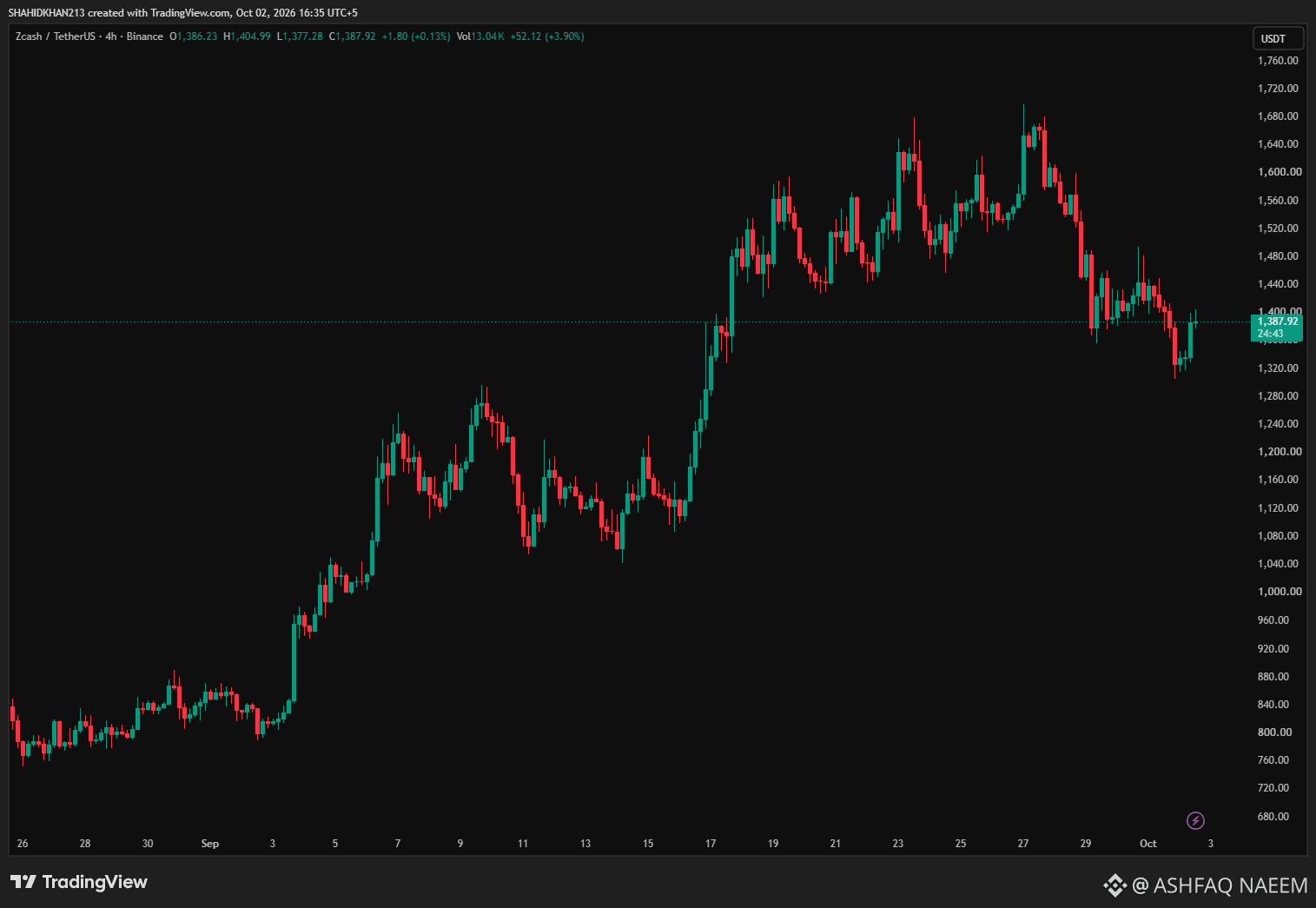
#zcashfalls21%fromseptemberpeak
Zcash ($ZEC ) has pulled back sharply after its explosive September rally, falling about 21% from the late-September peak near $1,698. On October 1, ZEC dropped more than 7%, trading around $1,335 at the time.
📉 What’s driving the pullback?
💰 ETF outflows: Grayscale’s Zcash ETF recorded about $30.25M in net outflows on September 30.
🔥 Profit-taking: $ZEC had rallied roughly 253% from its late-August/early-September base, making a correction unsurprising after such a vertical move.
⚠️ Market uncertainty: Concerns surrounding stolen crypto moving through privacy-focused networks have also added pressure to sentiment.
The key question now: Is this simply a cooldown after a massive rally, or the start of a deeper correction? 👀
$ZEC
{future}(ZECUSDT)
#zcashfalls21%fromseptemberpeak
Zcash ($ZEC ) has pulled back sharply after its explosive September rally, falling about 21% from the late-September peak near $1,698. On October 1, ZEC dropped more than 7%, trading around $1,335 at the time.
📉 What’s driving the pullback?
💰 ETF outflows: Grayscale’s Zcash ETF recorded about $30.25M in net outflows on September 30.
🔥 Profit-taking: $ZEC had rallied roughly 253% from its late-August/early-September base, making a correction unsurprising after such a vertical move.
⚠️ Market uncertainty: Concerns surrounding stolen crypto moving through privacy-focused networks have also added pressure to sentiment.
The key question now: Is this simply a cooldown after a massive rally, or the start of a deeper correction? 👀
$ZEC
Zcash ($ZEC ) has pulled back sharply after its explosive September rally, falling about 21% from the late-September peak near $1,698. On October 1, ZEC dropped more than 7%, trading around $1,335 at the time.
📉 What’s driving the pullback?
💰 ETF outflows: Grayscale’s Zcash ETF recorded about $30.25M in net outflows on September 30.
🔥 Profit-taking: $ZEC had rallied roughly 253% from its late-August/early-September base, making a correction unsurprising after such a vertical move.
⚠️ Market uncertainty: Concerns surrounding stolen crypto moving through privacy-focused networks have also added pressure to sentiment.
The key question now: Is this simply a cooldown after a massive rally, or the start of a deeper correction? 👀
$ZEC
1
2
6
9.2k
·
--
Bullish
See translation
🚨 XRP JUST MADE HISTORY! 🔥
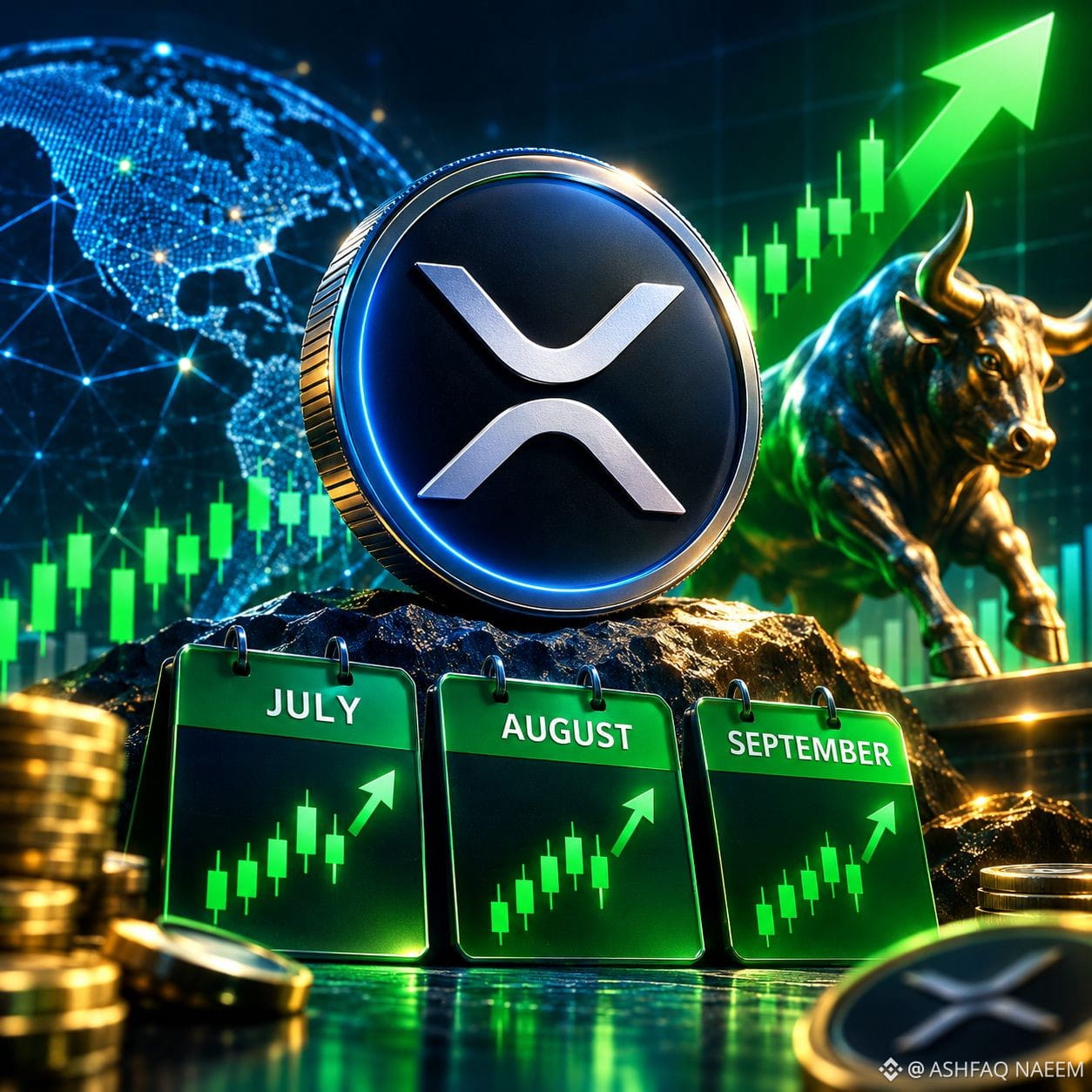
XRP closed July, August, and September 2026 in the green — its first-ever three-consecutive-green-month Q3! 📈
• July: +2%
• August: +30%
• September: +7.95%
• Q3 gain: 40%+
The rally was supported by U.S. spot XRP ETF demand, short covering and falling exchange balances. XRP is now trading around $1.50.
🔥 Three green months. One big question: Can XRP keep the momentum in Q4?
#xrp #Ripple #CryptoNews #altcoins
#xrppostsfirstthreegreenmonthsinq3
$XRP
{future}(XRPUSDT)
🚨 XRP JUST MADE HISTORY! 🔥
XRP closed July, August, and September 2026 in the green — its first-ever three-consecutive-green-month Q3! 📈
• July: +2%
• August: +30%
• September: +7.95%
• Q3 gain: 40%+
The rally was supported by U.S. spot XRP ETF demand, short covering and falling exchange balances. XRP is now trading around $1.50.
🔥 Three green months. One big question: Can XRP keep the momentum in Q4?
#xrp #Ripple #CryptoNews #altcoins
#xrppostsfirstthreegreenmonthsinq3
$XRP
XRP closed July, August, and September 2026 in the green — its first-ever three-consecutive-green-month Q3! 📈
• July: +2%
• August: +30%
• September: +7.95%
• Q3 gain: 40%+
The rally was supported by U.S. spot XRP ETF demand, short covering and falling exchange balances. XRP is now trading around $1.50.
🔥 Three green months. One big question: Can XRP keep the momentum in Q4?
#xrp #Ripple #CryptoNews #altcoins
#xrppostsfirstthreegreenmonthsinq3
$XRP
99
·
--
See translation
🚨 #NFPWatch — ALL EYES ON US JOBS DATA! 🇺🇸📊
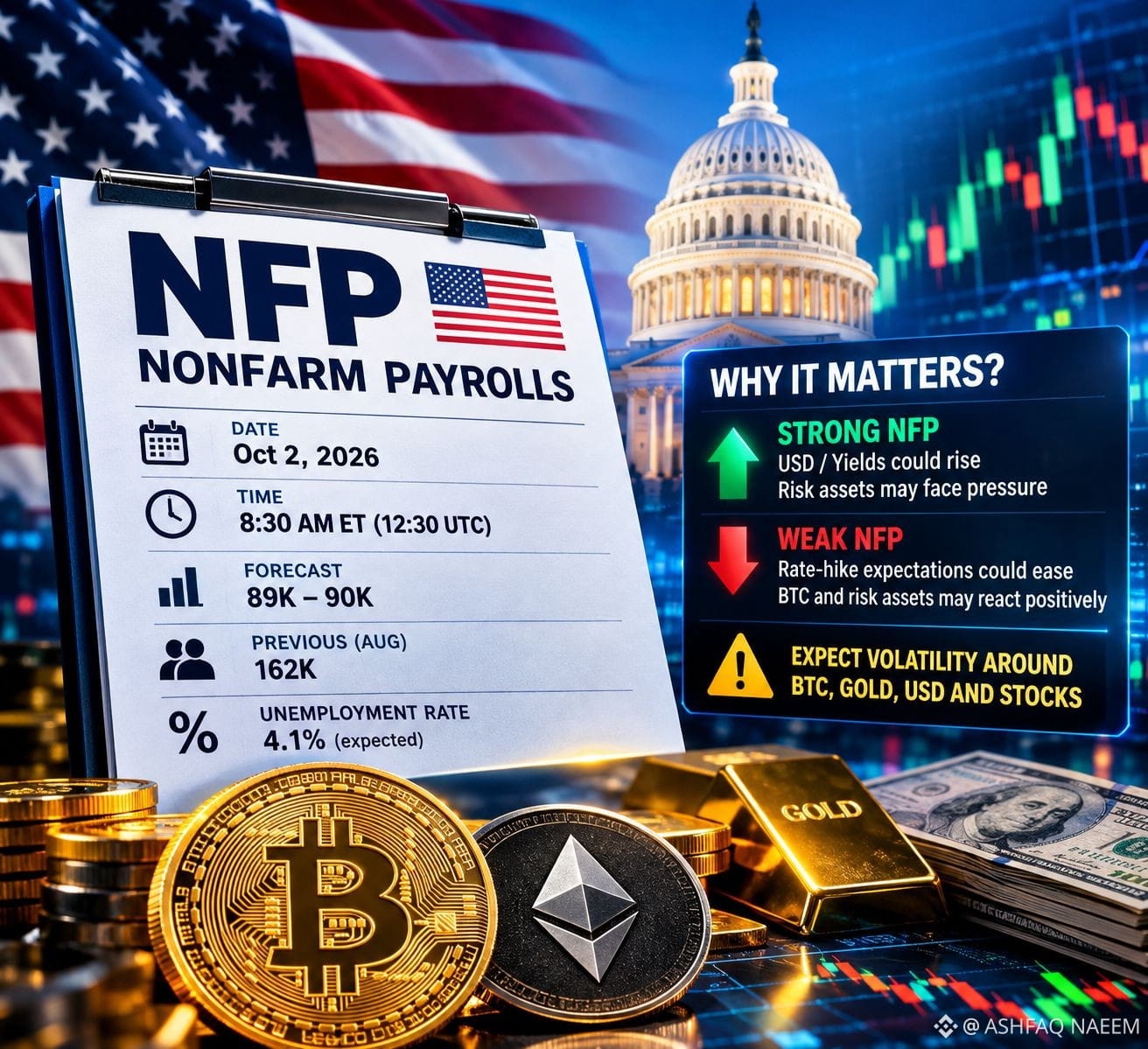
The September Nonfarm Payrolls (NFP) report is due today, October 2, 2026, at 8:30 AM ET (12:30 UTC). Markets are watching closely after August payrolls jumped 162K. Current forecasts are around 89K–90K jobs, with unemployment expected to remain near 4.1%.
🔥 Why it matters for crypto
📈 Strong NFP → USD/yields could rise → risk assets may face pressure
📉 Weak NFP → rate-hike expectations could ease → BTC and risk assets could react positively
⚡ Expect volatility around BTC, Gold, USD and stocks
NFP = volatility. Stay alert. 👀
$BTC
{future}(BTCUSDT)
🚨 #NFPWatch — ALL EYES ON US JOBS DATA! 🇺🇸📊
The September Nonfarm Payrolls (NFP) report is due today, October 2, 2026, at 8:30 AM ET (12:30 UTC). Markets are watching closely after August payrolls jumped 162K. Current forecasts are around 89K–90K jobs, with unemployment expected to remain near 4.1%.
🔥 Why it matters for crypto
📈 Strong NFP → USD/yields could rise → risk assets may face pressure
📉 Weak NFP → rate-hike expectations could ease → BTC and risk assets could react positively
⚡ Expect volatility around BTC, Gold, USD and stocks
NFP = volatility. Stay alert. 👀
$BTC
The September Nonfarm Payrolls (NFP) report is due today, October 2, 2026, at 8:30 AM ET (12:30 UTC). Markets are watching closely after August payrolls jumped 162K. Current forecasts are around 89K–90K jobs, with unemployment expected to remain near 4.1%.
🔥 Why it matters for crypto
📈 Strong NFP → USD/yields could rise → risk assets may face pressure
📉 Weak NFP → rate-hike expectations could ease → BTC and risk assets could react positively
⚡ Expect volatility around BTC, Gold, USD and stocks
NFP = volatility. Stay alert. 👀
$BTC
90
Log in to explore more content
Join global crypto users on Binance Square
⚡️ Get latest and useful information about crypto.
💬 Trusted by the world’s largest crypto exchange.
👍 Discover real insights from verified creators.
Email / Phone number
Trending Topics
SECHaltsCryptoETFReviewsAmidFundingLapse
579 views
45 Discussing
Everyone Was Waiting for the Next Crypto ETF… Then Washington Hit PAUSE 👀
This one caught my attention this morning.
The SEC has paused reviews of new crypto ETFs during the U.S. funding lapse.
Important part: this is not a rejection.
Existing ETFs keep trading.
New applications are basically stuck waiting for the SEC machinery to restart.
And reportedly 90+ applications were sitting in the pipeline as October began.
So I’m not watching this as bearish news.
I’m watching what happens when that pipeline starts moving again. 👀
Sometimes the bigger move comes after the pause, not during it.
—Master CX
$BTC $ETH
#SECHaltsCryptoETFReviewsAmidFundingLapse
Master CX
·2 Likes
·37 views
ZcashETFPostsFirstWeeklyOutflow$93.6M
53,348 views
157 Discussing
GreekPoliceBustCryptoScamRingArrest17
152,084 views
1,077 Discussing