
QubicNews
384 منشورات

QubicNews
إبلاغ
حظر المُستخدم
🚀 Qubic redefines blockchain with uPoW, turning computing power into AI training. Enjoy feeless txs, sub-second finality, & bare-metal smart contracts.
فتح تداول
مُتداول عرضي
6.9 سنوات
546 تتابع
164 المتابعون
196 إعجاب
منشورات
الحافظة الاستثمارية
الكل
اقتباسات
مقاطع فيديو
PINNED
·
--
مقالة
عرض الترجمة
Who Designs the Brain? Neural Architecture Search in Game of Life, ARC-AGI-3 and Neuraxon 3.0What Is Neural Architecture Search (NAS)?
In every neural network we need to distinguish two levels of design. One is what it learns, the strength of its connections. The other is how it is built, which means how many units it has, how they connect and by what rules they change. Neural architecture search, known by its acronym #NAS (Neural Architecture Search), automates that second level.
Think of a high-quality restaurant. The chef learns recipes through practice, and this resembles the training of a network. The chef keeps adjusting millions of nuances until the result comes out right. But before anything was cooked, someone had to design the kitchen. How many burners, where the oven goes, how much space there is between the fridge and the plating table, how many tables, how supplies arrive, at what temperature to freeze which foods. That design is not learned by cooking, but it influences which dishes can be made and how fast. In a neural network, the kitchen is, so to speak, the architecture.
The Three Components of Neural Architecture Search
NAS is the set of methods that search for that architecture automatically. Any method of this kind has three components (Elsken, 2019).
The first is the search space. It is the catalogue of possible designs, for example how many layers, which operations or which connections are allowed.
The second is the search strategy, that is, how that catalogue is explored.
The third is performance estimation. How do we decide whether a design is good without having to train it fully? That is what takes the most time.
Figure 1. Every neural architecture search method has the same three parts: a search space of possible designs, a search strategy that picks candidates from it, and a performance estimate that tells the strategy how good each candidate is. Image: Neural Architecture Search: A Survey, Figure 1, by Thomas Elsken, Jan Hendrik Metzen and Frank Hutter, Journal of Machine Learning Research (CC BY 4.0)
Four Neural Architecture Search Strategies
The best-known strategies are four.
The simplest is to try designs at random, an idea that seems naive but turns out to be surprisingly hard to beat (Bergstra & Bengio, 2012).The evolutionary strategy treats each design as a genome, keeps the best, mutates them and repeats; it has a long tradition in neuroevolution (Stanley & Miikkulainen, 2002) and produced the first evolved image classifier to outperform hand-designed ones (Real et al., 2019).The reinforcement learning strategy trains a second network to propose architectures and rewards it when they succeed (Zoph & Le, 2017).The differentiable strategy turns the choice between options into a continuous mixture that can be optimised with gradients, just like the weights themselves (Liu, Simonyan & Yang, 2019).
Neural Architecture Search vs Hyperparameter Optimization
NAS should not be confused with hyperparameter tuning.
Adjusting the learning rate of an already designed network is fine-tuning. Deciding what kind of network it is, and by what internal rules it operates, is searching for its architecture. In fact, one of the most useful conclusions in the field is that NAS behaves as a particular case of hyperparameter optimization, and that it should therefore always be compared with a random search carried out on the same budget (Li & Talwalkar, 2020).
Where Is Neural Architecture Search Needed in Everyday Life?
The closest case is the mobile phone.
When the phone camera recognizes that we are photographing a plate of food or a document, and adjusts the image without connecting to the internet, a neural network is running on a small processor, with little battery and no room to wait. MobileNetV3, one of the most widely used network families in phones, was obtained through an architecture search that took into account the actual response time on a phone processor. The result was more accurate and 15% faster than its hand-designed predecessor (Howard et al., 2019).
That is the general pattern. NAS becomes necessary when the same task has to be solved under very different conditions, and designing a network by hand for each condition is unfeasible. Think of a hearing aid that has to separate the voice of the person talking to us from the noise of a bar. The task is similar to that of a voice assistant, but the hearing aid has a tiny battery and only a few milliseconds before the delay becomes noticeable. Or of a watch that monitors heart rate for days without recharging. Or of a car's emergency braking system, which has to decide before the obstacle is upon it. Or of a robot vacuum with a cheap chip that must recognise a cable on the floor. In all these cases the question is not only which network is most accurate, but which network is accurate enough within limits of energy, memory and time. With dozens of devices and combined limits, the number of possible designs grows quickly.
There is a second kind of situation, closer to our own work. Sometimes we do not know what architecture a problem needs because the problem is new. No one has ever designed a network to play games whose rules are discovered by playing. In that case NAS is not a way of saving engineering work. It is a way of asking the problem what structure suits it.
How Evolution Solved Architecture Search, and What Large Language Models Do
The brain also has two levels of design, and it keeps them clearly separate.
What we learn throughout life changes the strength of synapses.
But the architecture on which that learning takes place, which regions exist, how they connect to one another, what types of neurons there are and by what rules they change, has been searched for by evolution over hundreds of millions of years. Evolution is, in this sense, the longest architecture search we know of.
Zador (2019) pointed out that the genome lacks the capacity to specify every connection in the brain because it falls several orders of magnitude short in information. What it transmits is not a wiring diagram, but rules for building one. Zador called this limitation the genomic bottleneck and proposed that it is not a defect but an advantage, since it forces evolution to select compact architectures that generalise well and learn quickly. That is why many animals are born knowing how to do complex things, and why they learn others in just a few attempts.
Hinton and Nowlan (1987) added the other half of the idea, in what became the classic demonstration of the Baldwin effect. In a simulation they showed that learning during life guides evolution, since an organism capable of learning survives even if its initial design is not perfect, and that gives natural selection something to work on. The consequence is important for any bio-inspired NAS. What evolution selects is not just good built-in behaviour, but a good capacity to learn.
Figure 2. When instinct and learning end at the same level of performance, the strongly innate strategy wins (a). Learning pays off when it lets a species climb higher than instinct alone (b), the trade-off behind evolution selecting a good capacity to learn. Image: A critique of pure learning and what artificial neural networks can learn from animal brains, Figure 2, by Anthony M. Zador, Nature Communications (CC BY 4.0)
Large language models follow a different path. Their architecture, the Transformer, was designed by hand and has changed relatively little in its essentials since 2017. There have been automated searches over it (So, 2019), but the bulk of progress has come from increasing size, data and compute, not from searching for new structures. And, once trained, the model does not change while it is used. It has an architecture and it has weights, but it lacks what evolution selected in animals: an architecture chosen precisely to keep learning.
What Can Go Wrong? Three Traps in Neural Architecture Search
NAS has three well-known traps, and all three have affected us.
The first is the winner's curse.
When thousands of designs are tested and the best one is chosen, part of its advantage is luck. For example, it happened to get a favourable game, a lucky random seed. When it is tested under new conditions, that part disappears and performance drops. It is the same problem that in psychometrics leads us not to validate a test with the sample used to build it. In machine learning it is well documented. It is the bias of selecting with the same data that are later used for reporting, which can be as large as the differences between methods (Cawley & Talbot, 2010). The solution is always to separate the data used for selection from the data used for reporting.
The second is the lack of a baseline.
A NAS result means nothing unless it is compared with what a random search would have achieved on the same budget, and with what a brainless agent acting at random achieves. Li and Talwalkar (2020) showed that well-executed random searches matched methods published as advances, and that almost no work in the field could be reproduced exactly because the seeds were not reported.
The third is optimising what does not matter.
The search finds exactly what the evaluation function rewards. If that function measures something different from what we want, the search will exploit it efficiently. It is Goodhart's law (1984) applied to the design of brains.
NAS in the Game of Life: Evolutionary Neural Architecture Search
Neuraxon's Game of Life is an artificial world in which hundreds of agents, each with a #Neuraxon brain organised into functional spheres, look for food, reproduce and die. Each agent inherits from its parents the parameters with which its brain is built: how long a neuron takes to fire again, what threshold it needs to become active, how its synapses change. Those parameters are its genome, and reproduction with mutation is an evolutionary neural architecture search that runs non-stop, around the clock. It is the version of NAS closest to what biological evolution did.
Figure 3. A round of Neuraxon’s Game of Life: each agent on the globe carries its own Neuraxon brain, built from parameters it inherits from its parents, and the population evolves as agents find food, reproduce and die. Image: Neuraxon Game of Life 4.0 by David Vivancos and Jose Sánchez, GitHub (MIT License)
The first lesson was about what gets selected.
For several versions, selective pressure came from ecological success: food found, territory explored, offspring left behind. When heritability was measured using almost thirty thousand parent-offspring pairs, the correlation of ecological success across generations turned out to be practically zero, at 0.02.
Success depended on where food appeared and on who arrived first, and luck is not inherited. By contrast, a set of internal criteria for brain function that we had defined on the basis of neuroscience, such as maintaining a balance between excitation and inhibition or activity close to the critical regime, showed a correlation of 0.56 across generations, stable across five different populations. When we selected for those criteria, the population changed within days. Selection can only act on what is inherited, and a world that is too noisy turns any search into a random walk.
The second lesson was about the search space.
Of the nineteen parameters that evolution could modify, only two had a noticeable effect: the refractory period and the activation threshold of excitatory neurons. The remaining seventeen, including all the plasticity parameters, showed correlations with the outcome below 0.05. A large search space is not a rich search space. Much of it was noise that the search had to cross without gaining anything.
The third lesson is the most uncomfortable. Selecting brains that meet our criteria for good functioning does not show that those brains learn from the world. To know that, behaviour has to be measured, that is, whether the agent approaches food because it perceives it, and whether it changes what it does after making a mistake. That direct measure of learning is the piece we are still missing in the Game of Life, and without it we will not consider anything about learning to be demonstrated. Part of this work has been presented at the 17th International Conference on Artificial Evolution (Nice, 27 to 29 October 2026).
NAS in ARC-AGI-3: Breeding Brains for Games Without Instructions
#ARC -#AGI -3 is a set of interactive games in which no one explains the rules. The player sees a grid of colours, presses a key or clicks, observes what changes and has to work out what is being asked. The score rewards clearing levels with few actions, compared with what a person needs. There are 25 public games for development and 55 hidden ones used for evaluation at the end of the competition.
Our agent is a Neuraxon brain that receives the grid as numbers, chooses an action and learns during the game thanks to its plasticity.
What NAS decides is how that brain is built before it starts playing: which part of the screen it attends to, how it translates colours into inputs, how much it explores versus how much it repeats what worked, what range of clicks it considers. The process has three phases. First, brains are bred by evolution on a specific game. Then, thousands of them sit a short exam with few games and few seeds, that is, variants of the same game with a different initial layout. Finally, the best ones sit a long exam with all 25 games and seeds that were not used to select them. In total we have tested more than 110 search configurations and millions of evolved brains, on a cluster of about 500 processor cores and without a single GPU, and the best score on the offline Kaggle version has reached 0.38.
Studying the public games, watching human playthroughs and reading analyses in order to decide which search space and which selection criterion to use is legitimate. It is what evolution does with a species, in which the design of the brain incorporates regularities of the environment in which its ancestors lived. What would not be legitimate is giving that information to the agent while it plays. NAS may know things about the genre of the games, but the brain that plays must know nothing about the specific game.
The results have taught us the three traps we discussed.
The winner's curse appeared clearly. There was a group of brains that cleared a game on every seed used to select them and did not clear it on any of the new seeds. Successes were concentrated in a few games and almost always at the first level, which forces a comparison with an agent that presses keys at random with the same number of actions, in order to distinguish generalisation from the mere ease of a game. And what cleared a level was not always learning the rules. In simple games, a fixed policy and some exploration can be enough, like a bird pecking until it finds something. From this we drew three rules for everything ahead, which are to select with some seeds and report with others, to set aside public games that the search never touches, and always to subtract the random baseline.
The underlying lesson is the same as in the Game of Life, seen from the opposite side. There we knew how the brain worked inside, but not what it did in the world. Here we see what it does in the game, but NAS selects the final result and does not tell us whether there is learning inside. The teams that have performed best in the preliminary phases of the competition agree in that they predict what will change on the screen before acting and learn from their errors. That is the direction we are taking.
NAS in Neuraxon 3.0: Searching for Brain-Inspired Learning Mechanisms
Neuraxon 3.0 is the architectural response to what ARC-AGI-3 showed us. Our brains explore and adapt within a game, but they do not set themselves goals or chain actions together to reach them. The new version, still in design, adds biologically grounded mechanisms that operate on different timescales. These are a plasticity that depends on the order of spikes, synaptic tags that wait for a neuromodulatory signal for seconds before consolidating, a behavioural-timescale plasticity inspired by the hippocampus, astrocytic domains that decide how much a group of synapses can change, and a multi-scale homeostasis that keeps the network stable without freezing it.
In this context NAS changes its role. It no longer looks for a network that wins a game, but answers a scientific question: which mechanisms and which time constants are necessary to learn in new environments.
The two previous lessons shape that search. From the Game of Life we take that a search space with many inert parameters only adds noise. That is why the search in 3.0 is set over mechanisms, each with a range of values bounded by physiology, and each mechanism can be switched off to measure what it contributes. From ARC-AGI-3 we take that the selection criterion has to measure learning and not just outcome. The proposal is to reward how quickly the brain reduces its prediction error per action in games it has not seen. A brain that succeeds by luck has no advantage under that criterion; one that learns does.
The experimental design is fixed before looking at the data. The architecture selection is sealed, recorded with a digital fingerprint (a cryptographic hash), before the test set is generated, so that it cannot be adjusted after the fact. Every search is compared with a random search on the same budget. Comparisons use paired seeds, are corrected for multiple comparisons and have a minimum effect size declared in advance, without stopping experiments when the result looks favourable.
Neuraxon 3.0 is today an architecture in design with preliminary tests, and the architecture search protocol is a protocol, not a result. We will publish it when the full experiments are done, whatever their conclusion.
Why Neural Architecture Search Matters for Qubic: Decentralized AI and Blockchain Security
NAS is usually presented as an engineering tool for saving human work, and it is one. In our case it is also something more: the evolutionary part of a system that aims to resemble an organism. An organism does not come into the world as a blank slate. It arrives with an architecture that millions of generations tuned so that learning would be easy, and with it, it learns what its particular life demands of it.
What we have learned in the Game of Life and in ARC-AGI-3 can be summed up in an idea from Hinton and Nowlan (1987): architecture search and learning do not compete, they need each other. That is why this form of NAS fits with #Qubic . An evolutionary search is a massively parallel process, in which each processor evaluates its own candidates without needing the others. With the evolutionary component already deployed on the network's own compute, that search can be distributed across thousands of nodes that no one controls exclusively. The same Byzantine fault-tolerant quorum that provides Qubic's blockchain security can verify each result. We do not yet know what architectures it will find. We know what questions it has to answer and how to check honestly whether it has answered them.
References
Bergstra, J., & Bengio, Y. (2012). Random search for hyper-parameter optimization. Journal of Machine Learning Research, 13, 281-305. https://www.jmlr.org/papers/v13/bergstra12a.htmlCawley, G. C., & Talbot, N. L. C. (2010). On over-fitting in model selection and subsequent selection bias in performance evaluation. Journal of Machine Learning Research, 11, 2079-2107. https://www.jmlr.org/papers/v11/cawley10a.htmlElsken, T., Metzen, J. H., & Hutter, F. (2019). Neural architecture search: A survey. Journal of Machine Learning Research, 20(55), 1-21. https://www.jmlr.org/papers/v20/18-598.htmlGoodhart, C. A. E. (1984). Problems of monetary management: The UK experience. In Monetary theory and practice (pp. 91-121). Macmillan. https://doi.org/10.1007/978-1-349-17295-5_4Hinton, G. E., & Nowlan, S. J. (1987). How learning can guide evolution. Complex Systems, 1(3), 495-502. https://www.complex-systems.com/abstracts/v01_i03_a06/Howard, A., Sandler, M., Chu, G., Chen, L.-C., Chen, B., Tan, M., Wang, W., Zhu, Y., Pang, R., Vasudevan, V., Le, Q. V., & Adam, H. (2019). Searching for MobileNetV3. In Proceedings of the IEEE/CVF International Conference on Computer Vision (pp. 1314-1324). https://doi.org/10.1109/ICCV.2019.00140Li, L., & Talwalkar, A. (2020). Random search and reproducibility for neural architecture search. In Proceedings of the 35th Uncertainty in Artificial Intelligence Conference (PMLR 115, pp. 367-377). https://proceedings.mlr.press/v115/li20c.htmlLiu, H., Simonyan, K., & Yang, Y. (2019). DARTS: Differentiable architecture search. In International Conference on Learning Representations. https://doi.org/10.48550/arXiv.1806.09055Real, E., Aggarwal, A., Huang, Y., & Le, Q. V. (2019). Regularized evolution for image classifier architecture search. Proceedings of the AAAI Conference on Artificial Intelligence, 33(01), 4780-4789. https://doi.org/10.1609/aaai.v33i01.33014780So, D. R., Liang, C., & Le, Q. V. (2019). The evolved transformer. In Proceedings of the 36th International Conference on Machine Learning (PMLR 97, pp. 5877-5886). https://proceedings.mlr.press/v97/so19a.htmlStanley, K. O., & Miikkulainen, R. (2002). Evolving neural networks through augmenting topologies. Evolutionary Computation, 10(2), 99-127. https://doi.org/10.1162/106365602320169811Zador, A. M. (2019). A critique of pure learning and what artificial neural networks can learn from animal brains. Nature Communications, 10, 3770. https://doi.org/10.1038/s41467-019-11786-6Zoph, B., & Le, Q. V. (2017). Neural architecture search with reinforcement learning. In International Conference on Learning Representations. https://doi.org/10.48550/arXiv.1611.01578
Explore the Neuraxon Intelligence Academy Series
The Neuraxon Intelligence Academy (NIA) is Qubic's ongoing research series on brain-inspired, decentralized artificial general intelligence. Catch up on the previous thirteen volumes:
[NIA Volume 1](https://www.binance.com/en/square/post/295315343732018): Why Intelligence Is Not Computed in Steps, but in Time — Explores why biological intelligence operates in continuous time rather than discrete computational steps like traditional LLMs.[NIA Volume 2](https://www.binance.com/en/square/post/295304276561778): Ternary Dynamics as a Model of Living Intelligence — Explains ternary dynamics and why three-state logic (excitatory, neutral, inhibitory) matters for modeling living systems.[NIA Volume 3](https://www.binance.com/en/square/post/295306656801506): Neuromodulation and Brain-Inspired AI — Covers neuromodulation and how the brain's chemical signaling (dopamine, serotonin, acetylcholine, norepinephrine) inspires Neuraxon's architecture.[NIA Volume 4](https://www.binance.com/en/square/post/295302152913618): Neural Networks in AI and Neuroscience — A deep comparison of biological neural networks, artificial neural networks, and Neuraxon's third-path approach.[NIA Volume 5](https://www.binance.com/en/square/post/302913958960674): Astrocytes and Brain-Inspired AI — How astrocytic gating transforms neural network plasticity through the AGMP framework in Neuraxon.[NIA Volume 6](https://www.binance.com/en/square/post/310198879866145): Conscious Machines vs Intelligent Organisms: AI Consciousness Explained — Explores AI consciousness through the lens of Global Workspace Theory, Integrated Information Theory, and predictive coding.[NIA Volume 7](https://www.binance.com/en/square/post/321350661453970): Conway's Game of Life, Artificial Life, and Digital Ecosystems — The science behind Qubic, Aigarth, and Neuraxon's emergent complexity and self-organized criticality.[NIA Volume 8](https://www.binance.com/en/square/post/322900066069841): Brain Criticality and the Branching Ratio in Neural and Artificial Networks — Why a branching ratio near 1 and self-organized criticality are bioinspired design principles in Neuraxon.[NIA Volume 9](https://www.binance.com/en/square/post/328379422341521): The Origins of the g Factor: From Education and Neuroscience to Artificial Intelligence — Explores the origins of the g factor across education, neuroscience, and AI.[NIA Volume 10](https://www.binance.com/en/square/post/332806106415490): How Do We Measure the Intelligence of a Machine? The g Factor, ARC-AGI, and the Future of AI Evaluation — The g factor, François Chollet's ARC-AGI benchmark, data contamination in LLM evaluation, and why skill-acquisition efficiency is the real test of intelligence.[NIA Volume 11](https://www.binance.com/en/square/post/342567558192178): What Is AGI? The Limits, Visions & Definitions of Artificial General IntelligenceNIA Vol. 12: [How Does the Brain Handle Time: Distributed Clocks & AI Limits](https://www.binance.com/en/square/post/367122949308226)NIA Vol. 13: OpenAI Says "AGI Is Here": What GPT-6 Astra Actually Proves
You are reading NIA Vol. 14: Who Designs the Brain? Neural Architecture Search in Game of Life, ARC-AGI-3 and Neuraxon 3.0.
Further Reading: Authoritative External Sources
Neural Architecture Search: A Survey, Elsken, Metzen and Hutter (JMLR): the survey that sets out the three components of NAS used in this volume.A Critique of Pure Learning, Anthony Zador (Nature Communications): the genomic bottleneck and what artificial neural networks can learn from animal brains.ARC-AGI-3: A New Challenge for Frontier Agentic Intelligence, ARC Prize Foundation (arXiv): how the benchmark's games are built and scored against human action efficiency.Attention Is All You Need, Vaswani et al. (arXiv): the 2017 paper that introduced the Transformer architecture.Synaptic Modifications in Cultured Hippocampal Neurons, Bi and Poo (Journal of Neuroscience): the classic study showing that plasticity depends on the order of spikes.Synaptic Tagging and Long-Term Potentiation, Frey and Morris (Nature): the original study of synaptic tags that wait for a later signal before consolidating.Behavioral Time Scale Synaptic Plasticity Underlies CA1 Place Fields, Bittner et al. (Science): hippocampal plasticity that links events seconds apart.Useful Proof of Work (UPoW) and AI, Qubic Docs: how Qubic directs mining power toward training neural networks.Quorum Consensus Explained: How Qubic Makes Blockchain Decisions Without a Central Authority, Qubic: how 451 of 676 Computors keep the network safe even if up to 225 of them fail or act maliciously.Quantum Proof Crypto: Threats, Standards and Qubic Security, Qubic: how quantum computing could threaten crypto security, and what protects Qubic today.Hash Functions, NIST Computer Security Resource Center: the standards behind the cryptographic hashes used to seal data and secure blockchains.Neuraxon at AMLDS Osaka and AGI-26 San Francisco: Trinary Neurons, Criticality, and Brain-Inspired AGI, Qubic: Qubic's companion piece on Multi-Neuraxon, an architecture found by evolutionary search.
Who Designs the Brain? Neural Architecture Search in Game of Life, ARC-AGI-3 and Neuraxon 3.0
What Is Neural Architecture Search (NAS)?
In every neural network we need to distinguish two levels of design. One is what it learns, the strength of its connections. The other is how it is built, which means how many units it has, how they connect and by what rules they change. Neural architecture search, known by its acronym #NAS (Neural Architecture Search), automates that second level.
Think of a high-quality restaurant. The chef learns recipes through practice, and this resembles the training of a network. The chef keeps adjusting millions of nuances until the result comes out right. But before anything was cooked, someone had to design the kitchen. How many burners, where the oven goes, how much space there is between the fridge and the plating table, how many tables, how supplies arrive, at what temperature to freeze which foods. That design is not learned by cooking, but it influences which dishes can be made and how fast. In a neural network, the kitchen is, so to speak, the architecture.
The Three Components of Neural Architecture Search
NAS is the set of methods that search for that architecture automatically. Any method of this kind has three components (Elsken, 2019).
The first is the search space. It is the catalogue of possible designs, for example how many layers, which operations or which connections are allowed.
The second is the search strategy, that is, how that catalogue is explored.
The third is performance estimation. How do we decide whether a design is good without having to train it fully? That is what takes the most time.
Figure 1. Every neural architecture search method has the same three parts: a search space of possible designs, a search strategy that picks candidates from it, and a performance estimate that tells the strategy how good each candidate is. Image: Neural Architecture Search: A Survey, Figure 1, by Thomas Elsken, Jan Hendrik Metzen and Frank Hutter, Journal of Machine Learning Research (CC BY 4.0)
Four Neural Architecture Search Strategies
The best-known strategies are four.
The simplest is to try designs at random, an idea that seems naive but turns out to be surprisingly hard to beat (Bergstra & Bengio, 2012).The evolutionary strategy treats each design as a genome, keeps the best, mutates them and repeats; it has a long tradition in neuroevolution (Stanley & Miikkulainen, 2002) and produced the first evolved image classifier to outperform hand-designed ones (Real et al., 2019).The reinforcement learning strategy trains a second network to propose architectures and rewards it when they succeed (Zoph & Le, 2017).The differentiable strategy turns the choice between options into a continuous mixture that can be optimised with gradients, just like the weights themselves (Liu, Simonyan & Yang, 2019).
Neural Architecture Search vs Hyperparameter Optimization
NAS should not be confused with hyperparameter tuning.
Adjusting the learning rate of an already designed network is fine-tuning. Deciding what kind of network it is, and by what internal rules it operates, is searching for its architecture. In fact, one of the most useful conclusions in the field is that NAS behaves as a particular case of hyperparameter optimization, and that it should therefore always be compared with a random search carried out on the same budget (Li & Talwalkar, 2020).
Where Is Neural Architecture Search Needed in Everyday Life?
The closest case is the mobile phone.
When the phone camera recognizes that we are photographing a plate of food or a document, and adjusts the image without connecting to the internet, a neural network is running on a small processor, with little battery and no room to wait. MobileNetV3, one of the most widely used network families in phones, was obtained through an architecture search that took into account the actual response time on a phone processor. The result was more accurate and 15% faster than its hand-designed predecessor (Howard et al., 2019).
That is the general pattern. NAS becomes necessary when the same task has to be solved under very different conditions, and designing a network by hand for each condition is unfeasible. Think of a hearing aid that has to separate the voice of the person talking to us from the noise of a bar. The task is similar to that of a voice assistant, but the hearing aid has a tiny battery and only a few milliseconds before the delay becomes noticeable. Or of a watch that monitors heart rate for days without recharging. Or of a car's emergency braking system, which has to decide before the obstacle is upon it. Or of a robot vacuum with a cheap chip that must recognise a cable on the floor. In all these cases the question is not only which network is most accurate, but which network is accurate enough within limits of energy, memory and time. With dozens of devices and combined limits, the number of possible designs grows quickly.
There is a second kind of situation, closer to our own work. Sometimes we do not know what architecture a problem needs because the problem is new. No one has ever designed a network to play games whose rules are discovered by playing. In that case NAS is not a way of saving engineering work. It is a way of asking the problem what structure suits it.
How Evolution Solved Architecture Search, and What Large Language Models Do
The brain also has two levels of design, and it keeps them clearly separate.
What we learn throughout life changes the strength of synapses.
But the architecture on which that learning takes place, which regions exist, how they connect to one another, what types of neurons there are and by what rules they change, has been searched for by evolution over hundreds of millions of years. Evolution is, in this sense, the longest architecture search we know of.
Zador (2019) pointed out that the genome lacks the capacity to specify every connection in the brain because it falls several orders of magnitude short in information. What it transmits is not a wiring diagram, but rules for building one. Zador called this limitation the genomic bottleneck and proposed that it is not a defect but an advantage, since it forces evolution to select compact architectures that generalise well and learn quickly. That is why many animals are born knowing how to do complex things, and why they learn others in just a few attempts.
Hinton and Nowlan (1987) added the other half of the idea, in what became the classic demonstration of the Baldwin effect. In a simulation they showed that learning during life guides evolution, since an organism capable of learning survives even if its initial design is not perfect, and that gives natural selection something to work on. The consequence is important for any bio-inspired NAS. What evolution selects is not just good built-in behaviour, but a good capacity to learn.
Figure 2. When instinct and learning end at the same level of performance, the strongly innate strategy wins (a). Learning pays off when it lets a species climb higher than instinct alone (b), the trade-off behind evolution selecting a good capacity to learn. Image: A critique of pure learning and what artificial neural networks can learn from animal brains, Figure 2, by Anthony M. Zador, Nature Communications (CC BY 4.0)
Large language models follow a different path. Their architecture, the Transformer, was designed by hand and has changed relatively little in its essentials since 2017. There have been automated searches over it (So, 2019), but the bulk of progress has come from increasing size, data and compute, not from searching for new structures. And, once trained, the model does not change while it is used. It has an architecture and it has weights, but it lacks what evolution selected in animals: an architecture chosen precisely to keep learning.
What Can Go Wrong? Three Traps in Neural Architecture Search
NAS has three well-known traps, and all three have affected us.
The first is the winner's curse.
When thousands of designs are tested and the best one is chosen, part of its advantage is luck. For example, it happened to get a favourable game, a lucky random seed. When it is tested under new conditions, that part disappears and performance drops. It is the same problem that in psychometrics leads us not to validate a test with the sample used to build it. In machine learning it is well documented. It is the bias of selecting with the same data that are later used for reporting, which can be as large as the differences between methods (Cawley & Talbot, 2010). The solution is always to separate the data used for selection from the data used for reporting.
The second is the lack of a baseline.
A NAS result means nothing unless it is compared with what a random search would have achieved on the same budget, and with what a brainless agent acting at random achieves. Li and Talwalkar (2020) showed that well-executed random searches matched methods published as advances, and that almost no work in the field could be reproduced exactly because the seeds were not reported.
The third is optimising what does not matter.
The search finds exactly what the evaluation function rewards. If that function measures something different from what we want, the search will exploit it efficiently. It is Goodhart's law (1984) applied to the design of brains.
NAS in the Game of Life: Evolutionary Neural Architecture Search
Neuraxon's Game of Life is an artificial world in which hundreds of agents, each with a #Neuraxon brain organised into functional spheres, look for food, reproduce and die. Each agent inherits from its parents the parameters with which its brain is built: how long a neuron takes to fire again, what threshold it needs to become active, how its synapses change. Those parameters are its genome, and reproduction with mutation is an evolutionary neural architecture search that runs non-stop, around the clock. It is the version of NAS closest to what biological evolution did.
Figure 3. A round of Neuraxon’s Game of Life: each agent on the globe carries its own Neuraxon brain, built from parameters it inherits from its parents, and the population evolves as agents find food, reproduce and die. Image: Neuraxon Game of Life 4.0 by David Vivancos and Jose Sánchez, GitHub (MIT License)
The first lesson was about what gets selected.
For several versions, selective pressure came from ecological success: food found, territory explored, offspring left behind. When heritability was measured using almost thirty thousand parent-offspring pairs, the correlation of ecological success across generations turned out to be practically zero, at 0.02.
Success depended on where food appeared and on who arrived first, and luck is not inherited. By contrast, a set of internal criteria for brain function that we had defined on the basis of neuroscience, such as maintaining a balance between excitation and inhibition or activity close to the critical regime, showed a correlation of 0.56 across generations, stable across five different populations. When we selected for those criteria, the population changed within days. Selection can only act on what is inherited, and a world that is too noisy turns any search into a random walk.
The second lesson was about the search space.
Of the nineteen parameters that evolution could modify, only two had a noticeable effect: the refractory period and the activation threshold of excitatory neurons. The remaining seventeen, including all the plasticity parameters, showed correlations with the outcome below 0.05. A large search space is not a rich search space. Much of it was noise that the search had to cross without gaining anything.
The third lesson is the most uncomfortable. Selecting brains that meet our criteria for good functioning does not show that those brains learn from the world. To know that, behaviour has to be measured, that is, whether the agent approaches food because it perceives it, and whether it changes what it does after making a mistake. That direct measure of learning is the piece we are still missing in the Game of Life, and without it we will not consider anything about learning to be demonstrated. Part of this work has been presented at the 17th International Conference on Artificial Evolution (Nice, 27 to 29 October 2026).
NAS in ARC-AGI-3: Breeding Brains for Games Without Instructions
#ARC -#AGI -3 is a set of interactive games in which no one explains the rules. The player sees a grid of colours, presses a key or clicks, observes what changes and has to work out what is being asked. The score rewards clearing levels with few actions, compared with what a person needs. There are 25 public games for development and 55 hidden ones used for evaluation at the end of the competition.
Our agent is a Neuraxon brain that receives the grid as numbers, chooses an action and learns during the game thanks to its plasticity.
What NAS decides is how that brain is built before it starts playing: which part of the screen it attends to, how it translates colours into inputs, how much it explores versus how much it repeats what worked, what range of clicks it considers. The process has three phases. First, brains are bred by evolution on a specific game. Then, thousands of them sit a short exam with few games and few seeds, that is, variants of the same game with a different initial layout. Finally, the best ones sit a long exam with all 25 games and seeds that were not used to select them. In total we have tested more than 110 search configurations and millions of evolved brains, on a cluster of about 500 processor cores and without a single GPU, and the best score on the offline Kaggle version has reached 0.38.
Studying the public games, watching human playthroughs and reading analyses in order to decide which search space and which selection criterion to use is legitimate. It is what evolution does with a species, in which the design of the brain incorporates regularities of the environment in which its ancestors lived. What would not be legitimate is giving that information to the agent while it plays. NAS may know things about the genre of the games, but the brain that plays must know nothing about the specific game.
The results have taught us the three traps we discussed.
The winner's curse appeared clearly. There was a group of brains that cleared a game on every seed used to select them and did not clear it on any of the new seeds. Successes were concentrated in a few games and almost always at the first level, which forces a comparison with an agent that presses keys at random with the same number of actions, in order to distinguish generalisation from the mere ease of a game. And what cleared a level was not always learning the rules. In simple games, a fixed policy and some exploration can be enough, like a bird pecking until it finds something. From this we drew three rules for everything ahead, which are to select with some seeds and report with others, to set aside public games that the search never touches, and always to subtract the random baseline.
The underlying lesson is the same as in the Game of Life, seen from the opposite side. There we knew how the brain worked inside, but not what it did in the world. Here we see what it does in the game, but NAS selects the final result and does not tell us whether there is learning inside. The teams that have performed best in the preliminary phases of the competition agree in that they predict what will change on the screen before acting and learn from their errors. That is the direction we are taking.
NAS in Neuraxon 3.0: Searching for Brain-Inspired Learning Mechanisms
Neuraxon 3.0 is the architectural response to what ARC-AGI-3 showed us. Our brains explore and adapt within a game, but they do not set themselves goals or chain actions together to reach them. The new version, still in design, adds biologically grounded mechanisms that operate on different timescales. These are a plasticity that depends on the order of spikes, synaptic tags that wait for a neuromodulatory signal for seconds before consolidating, a behavioural-timescale plasticity inspired by the hippocampus, astrocytic domains that decide how much a group of synapses can change, and a multi-scale homeostasis that keeps the network stable without freezing it.
In this context NAS changes its role. It no longer looks for a network that wins a game, but answers a scientific question: which mechanisms and which time constants are necessary to learn in new environments.
The two previous lessons shape that search. From the Game of Life we take that a search space with many inert parameters only adds noise. That is why the search in 3.0 is set over mechanisms, each with a range of values bounded by physiology, and each mechanism can be switched off to measure what it contributes. From ARC-AGI-3 we take that the selection criterion has to measure learning and not just outcome. The proposal is to reward how quickly the brain reduces its prediction error per action in games it has not seen. A brain that succeeds by luck has no advantage under that criterion; one that learns does.
The experimental design is fixed before looking at the data. The architecture selection is sealed, recorded with a digital fingerprint (a cryptographic hash), before the test set is generated, so that it cannot be adjusted after the fact. Every search is compared with a random search on the same budget. Comparisons use paired seeds, are corrected for multiple comparisons and have a minimum effect size declared in advance, without stopping experiments when the result looks favourable.
Neuraxon 3.0 is today an architecture in design with preliminary tests, and the architecture search protocol is a protocol, not a result. We will publish it when the full experiments are done, whatever their conclusion.
Why Neural Architecture Search Matters for Qubic: Decentralized AI and Blockchain Security
NAS is usually presented as an engineering tool for saving human work, and it is one. In our case it is also something more: the evolutionary part of a system that aims to resemble an organism. An organism does not come into the world as a blank slate. It arrives with an architecture that millions of generations tuned so that learning would be easy, and with it, it learns what its particular life demands of it.
What we have learned in the Game of Life and in ARC-AGI-3 can be summed up in an idea from Hinton and Nowlan (1987): architecture search and learning do not compete, they need each other. That is why this form of NAS fits with #Qubic . An evolutionary search is a massively parallel process, in which each processor evaluates its own candidates without needing the others. With the evolutionary component already deployed on the network's own compute, that search can be distributed across thousands of nodes that no one controls exclusively. The same Byzantine fault-tolerant quorum that provides Qubic's blockchain security can verify each result. We do not yet know what architectures it will find. We know what questions it has to answer and how to check honestly whether it has answered them.
References
Bergstra, J., & Bengio, Y. (2012). Random search for hyper-parameter optimization. Journal of Machine Learning Research, 13, 281-305. https://www.jmlr.org/papers/v13/bergstra12a.htmlCawley, G. C., & Talbot, N. L. C. (2010). On over-fitting in model selection and subsequent selection bias in performance evaluation. Journal of Machine Learning Research, 11, 2079-2107. https://www.jmlr.org/papers/v11/cawley10a.htmlElsken, T., Metzen, J. H., & Hutter, F. (2019). Neural architecture search: A survey. Journal of Machine Learning Research, 20(55), 1-21. https://www.jmlr.org/papers/v20/18-598.htmlGoodhart, C. A. E. (1984). Problems of monetary management: The UK experience. In Monetary theory and practice (pp. 91-121). Macmillan. https://doi.org/10.1007/978-1-349-17295-5_4Hinton, G. E., & Nowlan, S. J. (1987). How learning can guide evolution. Complex Systems, 1(3), 495-502. https://www.complex-systems.com/abstracts/v01_i03_a06/Howard, A., Sandler, M., Chu, G., Chen, L.-C., Chen, B., Tan, M., Wang, W., Zhu, Y., Pang, R., Vasudevan, V., Le, Q. V., & Adam, H. (2019). Searching for MobileNetV3. In Proceedings of the IEEE/CVF International Conference on Computer Vision (pp. 1314-1324). https://doi.org/10.1109/ICCV.2019.00140Li, L., & Talwalkar, A. (2020). Random search and reproducibility for neural architecture search. In Proceedings of the 35th Uncertainty in Artificial Intelligence Conference (PMLR 115, pp. 367-377). https://proceedings.mlr.press/v115/li20c.htmlLiu, H., Simonyan, K., & Yang, Y. (2019). DARTS: Differentiable architecture search. In International Conference on Learning Representations. https://doi.org/10.48550/arXiv.1806.09055Real, E., Aggarwal, A., Huang, Y., & Le, Q. V. (2019). Regularized evolution for image classifier architecture search. Proceedings of the AAAI Conference on Artificial Intelligence, 33(01), 4780-4789. https://doi.org/10.1609/aaai.v33i01.33014780So, D. R., Liang, C., & Le, Q. V. (2019). The evolved transformer. In Proceedings of the 36th International Conference on Machine Learning (PMLR 97, pp. 5877-5886). https://proceedings.mlr.press/v97/so19a.htmlStanley, K. O., & Miikkulainen, R. (2002). Evolving neural networks through augmenting topologies. Evolutionary Computation, 10(2), 99-127. https://doi.org/10.1162/106365602320169811Zador, A. M. (2019). A critique of pure learning and what artificial neural networks can learn from animal brains. Nature Communications, 10, 3770. https://doi.org/10.1038/s41467-019-11786-6Zoph, B., & Le, Q. V. (2017). Neural architecture search with reinforcement learning. In International Conference on Learning Representations. https://doi.org/10.48550/arXiv.1611.01578
Explore the Neuraxon Intelligence Academy Series
The Neuraxon Intelligence Academy (NIA) is Qubic's ongoing research series on brain-inspired, decentralized artificial general intelligence. Catch up on the previous thirteen volumes:
NIA Volume 1: Why Intelligence Is Not Computed in Steps, but in Time — Explores why biological intelligence operates in continuous time rather than discrete computational steps like traditional LLMs.NIA Volume 2: Ternary Dynamics as a Model of Living Intelligence — Explains ternary dynamics and why three-state logic (excitatory, neutral, inhibitory) matters for modeling living systems.NIA Volume 3: Neuromodulation and Brain-Inspired AI — Covers neuromodulation and how the brain's chemical signaling (dopamine, serotonin, acetylcholine, norepinephrine) inspires Neuraxon's architecture.NIA Volume 4: Neural Networks in AI and Neuroscience — A deep comparison of biological neural networks, artificial neural networks, and Neuraxon's third-path approach.NIA Volume 5: Astrocytes and Brain-Inspired AI — How astrocytic gating transforms neural network plasticity through the AGMP framework in Neuraxon.NIA Volume 6: Conscious Machines vs Intelligent Organisms: AI Consciousness Explained — Explores AI consciousness through the lens of Global Workspace Theory, Integrated Information Theory, and predictive coding.NIA Volume 7: Conway's Game of Life, Artificial Life, and Digital Ecosystems — The science behind Qubic, Aigarth, and Neuraxon's emergent complexity and self-organized criticality.NIA Volume 8: Brain Criticality and the Branching Ratio in Neural and Artificial Networks — Why a branching ratio near 1 and self-organized criticality are bioinspired design principles in Neuraxon.NIA Volume 9: The Origins of the g Factor: From Education and Neuroscience to Artificial Intelligence — Explores the origins of the g factor across education, neuroscience, and AI.NIA Volume 10: How Do We Measure the Intelligence of a Machine? The g Factor, ARC-AGI, and the Future of AI Evaluation — The g factor, François Chollet's ARC-AGI benchmark, data contamination in LLM evaluation, and why skill-acquisition efficiency is the real test of intelligence.NIA Volume 11: What Is AGI? The Limits, Visions & Definitions of Artificial General IntelligenceNIA Vol. 12: How Does the Brain Handle Time: Distributed Clocks & AI LimitsNIA Vol. 13: OpenAI Says "AGI Is Here": What GPT-6 Astra Actually Proves
You are reading NIA Vol. 14: Who Designs the Brain? Neural Architecture Search in Game of Life, ARC-AGI-3 and Neuraxon 3.0.
Further Reading: Authoritative External Sources
Neural Architecture Search: A Survey, Elsken, Metzen and Hutter (JMLR): the survey that sets out the three components of NAS used in this volume.A Critique of Pure Learning, Anthony Zador (Nature Communications): the genomic bottleneck and what artificial neural networks can learn from animal brains.ARC-AGI-3: A New Challenge for Frontier Agentic Intelligence, ARC Prize Foundation (arXiv): how the benchmark's games are built and scored against human action efficiency.Attention Is All You Need, Vaswani et al. (arXiv): the 2017 paper that introduced the Transformer architecture.Synaptic Modifications in Cultured Hippocampal Neurons, Bi and Poo (Journal of Neuroscience): the classic study showing that plasticity depends on the order of spikes.Synaptic Tagging and Long-Term Potentiation, Frey and Morris (Nature): the original study of synaptic tags that wait for a later signal before consolidating.Behavioral Time Scale Synaptic Plasticity Underlies CA1 Place Fields, Bittner et al. (Science): hippocampal plasticity that links events seconds apart.Useful Proof of Work (UPoW) and AI, Qubic Docs: how Qubic directs mining power toward training neural networks.Quorum Consensus Explained: How Qubic Makes Blockchain Decisions Without a Central Authority, Qubic: how 451 of 676 Computors keep the network safe even if up to 225 of them fail or act maliciously.Quantum Proof Crypto: Threats, Standards and Qubic Security, Qubic: how quantum computing could threaten crypto security, and what protects Qubic today.Hash Functions, NIST Computer Security Resource Center: the standards behind the cryptographic hashes used to seal data and secure blockchains.Neuraxon at AMLDS Osaka and AGI-26 San Francisco: Trinary Neurons, Criticality, and Brain-Inspired AGI, Qubic: Qubic's companion piece on Multi-Neuraxon, an architecture found by evolutionary search.
In every neural network we need to distinguish two levels of design. One is what it learns, the strength of its connections. The other is how it is built, which means how many units it has, how they connect and by what rules they change. Neural architecture search, known by its acronym #NAS (Neural Architecture Search), automates that second level.
Think of a high-quality restaurant. The chef learns recipes through practice, and this resembles the training of a network. The chef keeps adjusting millions of nuances until the result comes out right. But before anything was cooked, someone had to design the kitchen. How many burners, where the oven goes, how much space there is between the fridge and the plating table, how many tables, how supplies arrive, at what temperature to freeze which foods. That design is not learned by cooking, but it influences which dishes can be made and how fast. In a neural network, the kitchen is, so to speak, the architecture.
The Three Components of Neural Architecture Search
NAS is the set of methods that search for that architecture automatically. Any method of this kind has three components (Elsken, 2019).
The first is the search space. It is the catalogue of possible designs, for example how many layers, which operations or which connections are allowed.
The second is the search strategy, that is, how that catalogue is explored.
The third is performance estimation. How do we decide whether a design is good without having to train it fully? That is what takes the most time.
Figure 1. Every neural architecture search method has the same three parts: a search space of possible designs, a search strategy that picks candidates from it, and a performance estimate that tells the strategy how good each candidate is. Image: Neural Architecture Search: A Survey, Figure 1, by Thomas Elsken, Jan Hendrik Metzen and Frank Hutter, Journal of Machine Learning Research (CC BY 4.0)
Four Neural Architecture Search Strategies
The best-known strategies are four.
The simplest is to try designs at random, an idea that seems naive but turns out to be surprisingly hard to beat (Bergstra & Bengio, 2012).The evolutionary strategy treats each design as a genome, keeps the best, mutates them and repeats; it has a long tradition in neuroevolution (Stanley & Miikkulainen, 2002) and produced the first evolved image classifier to outperform hand-designed ones (Real et al., 2019).The reinforcement learning strategy trains a second network to propose architectures and rewards it when they succeed (Zoph & Le, 2017).The differentiable strategy turns the choice between options into a continuous mixture that can be optimised with gradients, just like the weights themselves (Liu, Simonyan & Yang, 2019).
Neural Architecture Search vs Hyperparameter Optimization
NAS should not be confused with hyperparameter tuning.
Adjusting the learning rate of an already designed network is fine-tuning. Deciding what kind of network it is, and by what internal rules it operates, is searching for its architecture. In fact, one of the most useful conclusions in the field is that NAS behaves as a particular case of hyperparameter optimization, and that it should therefore always be compared with a random search carried out on the same budget (Li & Talwalkar, 2020).
Where Is Neural Architecture Search Needed in Everyday Life?
The closest case is the mobile phone.
When the phone camera recognizes that we are photographing a plate of food or a document, and adjusts the image without connecting to the internet, a neural network is running on a small processor, with little battery and no room to wait. MobileNetV3, one of the most widely used network families in phones, was obtained through an architecture search that took into account the actual response time on a phone processor. The result was more accurate and 15% faster than its hand-designed predecessor (Howard et al., 2019).
That is the general pattern. NAS becomes necessary when the same task has to be solved under very different conditions, and designing a network by hand for each condition is unfeasible. Think of a hearing aid that has to separate the voice of the person talking to us from the noise of a bar. The task is similar to that of a voice assistant, but the hearing aid has a tiny battery and only a few milliseconds before the delay becomes noticeable. Or of a watch that monitors heart rate for days without recharging. Or of a car's emergency braking system, which has to decide before the obstacle is upon it. Or of a robot vacuum with a cheap chip that must recognise a cable on the floor. In all these cases the question is not only which network is most accurate, but which network is accurate enough within limits of energy, memory and time. With dozens of devices and combined limits, the number of possible designs grows quickly.
There is a second kind of situation, closer to our own work. Sometimes we do not know what architecture a problem needs because the problem is new. No one has ever designed a network to play games whose rules are discovered by playing. In that case NAS is not a way of saving engineering work. It is a way of asking the problem what structure suits it.
How Evolution Solved Architecture Search, and What Large Language Models Do
The brain also has two levels of design, and it keeps them clearly separate.
What we learn throughout life changes the strength of synapses.
But the architecture on which that learning takes place, which regions exist, how they connect to one another, what types of neurons there are and by what rules they change, has been searched for by evolution over hundreds of millions of years. Evolution is, in this sense, the longest architecture search we know of.
Zador (2019) pointed out that the genome lacks the capacity to specify every connection in the brain because it falls several orders of magnitude short in information. What it transmits is not a wiring diagram, but rules for building one. Zador called this limitation the genomic bottleneck and proposed that it is not a defect but an advantage, since it forces evolution to select compact architectures that generalise well and learn quickly. That is why many animals are born knowing how to do complex things, and why they learn others in just a few attempts.
Hinton and Nowlan (1987) added the other half of the idea, in what became the classic demonstration of the Baldwin effect. In a simulation they showed that learning during life guides evolution, since an organism capable of learning survives even if its initial design is not perfect, and that gives natural selection something to work on. The consequence is important for any bio-inspired NAS. What evolution selects is not just good built-in behaviour, but a good capacity to learn.
Figure 2. When instinct and learning end at the same level of performance, the strongly innate strategy wins (a). Learning pays off when it lets a species climb higher than instinct alone (b), the trade-off behind evolution selecting a good capacity to learn. Image: A critique of pure learning and what artificial neural networks can learn from animal brains, Figure 2, by Anthony M. Zador, Nature Communications (CC BY 4.0)
Large language models follow a different path. Their architecture, the Transformer, was designed by hand and has changed relatively little in its essentials since 2017. There have been automated searches over it (So, 2019), but the bulk of progress has come from increasing size, data and compute, not from searching for new structures. And, once trained, the model does not change while it is used. It has an architecture and it has weights, but it lacks what evolution selected in animals: an architecture chosen precisely to keep learning.
What Can Go Wrong? Three Traps in Neural Architecture Search
NAS has three well-known traps, and all three have affected us.
The first is the winner's curse.
When thousands of designs are tested and the best one is chosen, part of its advantage is luck. For example, it happened to get a favourable game, a lucky random seed. When it is tested under new conditions, that part disappears and performance drops. It is the same problem that in psychometrics leads us not to validate a test with the sample used to build it. In machine learning it is well documented. It is the bias of selecting with the same data that are later used for reporting, which can be as large as the differences between methods (Cawley & Talbot, 2010). The solution is always to separate the data used for selection from the data used for reporting.
The second is the lack of a baseline.
A NAS result means nothing unless it is compared with what a random search would have achieved on the same budget, and with what a brainless agent acting at random achieves. Li and Talwalkar (2020) showed that well-executed random searches matched methods published as advances, and that almost no work in the field could be reproduced exactly because the seeds were not reported.
The third is optimising what does not matter.
The search finds exactly what the evaluation function rewards. If that function measures something different from what we want, the search will exploit it efficiently. It is Goodhart's law (1984) applied to the design of brains.
NAS in the Game of Life: Evolutionary Neural Architecture Search
Neuraxon's Game of Life is an artificial world in which hundreds of agents, each with a #Neuraxon brain organised into functional spheres, look for food, reproduce and die. Each agent inherits from its parents the parameters with which its brain is built: how long a neuron takes to fire again, what threshold it needs to become active, how its synapses change. Those parameters are its genome, and reproduction with mutation is an evolutionary neural architecture search that runs non-stop, around the clock. It is the version of NAS closest to what biological evolution did.
Figure 3. A round of Neuraxon’s Game of Life: each agent on the globe carries its own Neuraxon brain, built from parameters it inherits from its parents, and the population evolves as agents find food, reproduce and die. Image: Neuraxon Game of Life 4.0 by David Vivancos and Jose Sánchez, GitHub (MIT License)
The first lesson was about what gets selected.
For several versions, selective pressure came from ecological success: food found, territory explored, offspring left behind. When heritability was measured using almost thirty thousand parent-offspring pairs, the correlation of ecological success across generations turned out to be practically zero, at 0.02.
Success depended on where food appeared and on who arrived first, and luck is not inherited. By contrast, a set of internal criteria for brain function that we had defined on the basis of neuroscience, such as maintaining a balance between excitation and inhibition or activity close to the critical regime, showed a correlation of 0.56 across generations, stable across five different populations. When we selected for those criteria, the population changed within days. Selection can only act on what is inherited, and a world that is too noisy turns any search into a random walk.
The second lesson was about the search space.
Of the nineteen parameters that evolution could modify, only two had a noticeable effect: the refractory period and the activation threshold of excitatory neurons. The remaining seventeen, including all the plasticity parameters, showed correlations with the outcome below 0.05. A large search space is not a rich search space. Much of it was noise that the search had to cross without gaining anything.
The third lesson is the most uncomfortable. Selecting brains that meet our criteria for good functioning does not show that those brains learn from the world. To know that, behaviour has to be measured, that is, whether the agent approaches food because it perceives it, and whether it changes what it does after making a mistake. That direct measure of learning is the piece we are still missing in the Game of Life, and without it we will not consider anything about learning to be demonstrated. Part of this work has been presented at the 17th International Conference on Artificial Evolution (Nice, 27 to 29 October 2026).
NAS in ARC-AGI-3: Breeding Brains for Games Without Instructions
#ARC -#AGI -3 is a set of interactive games in which no one explains the rules. The player sees a grid of colours, presses a key or clicks, observes what changes and has to work out what is being asked. The score rewards clearing levels with few actions, compared with what a person needs. There are 25 public games for development and 55 hidden ones used for evaluation at the end of the competition.
Our agent is a Neuraxon brain that receives the grid as numbers, chooses an action and learns during the game thanks to its plasticity.
What NAS decides is how that brain is built before it starts playing: which part of the screen it attends to, how it translates colours into inputs, how much it explores versus how much it repeats what worked, what range of clicks it considers. The process has three phases. First, brains are bred by evolution on a specific game. Then, thousands of them sit a short exam with few games and few seeds, that is, variants of the same game with a different initial layout. Finally, the best ones sit a long exam with all 25 games and seeds that were not used to select them. In total we have tested more than 110 search configurations and millions of evolved brains, on a cluster of about 500 processor cores and without a single GPU, and the best score on the offline Kaggle version has reached 0.38.
Studying the public games, watching human playthroughs and reading analyses in order to decide which search space and which selection criterion to use is legitimate. It is what evolution does with a species, in which the design of the brain incorporates regularities of the environment in which its ancestors lived. What would not be legitimate is giving that information to the agent while it plays. NAS may know things about the genre of the games, but the brain that plays must know nothing about the specific game.
The results have taught us the three traps we discussed.
The winner's curse appeared clearly. There was a group of brains that cleared a game on every seed used to select them and did not clear it on any of the new seeds. Successes were concentrated in a few games and almost always at the first level, which forces a comparison with an agent that presses keys at random with the same number of actions, in order to distinguish generalisation from the mere ease of a game. And what cleared a level was not always learning the rules. In simple games, a fixed policy and some exploration can be enough, like a bird pecking until it finds something. From this we drew three rules for everything ahead, which are to select with some seeds and report with others, to set aside public games that the search never touches, and always to subtract the random baseline.
The underlying lesson is the same as in the Game of Life, seen from the opposite side. There we knew how the brain worked inside, but not what it did in the world. Here we see what it does in the game, but NAS selects the final result and does not tell us whether there is learning inside. The teams that have performed best in the preliminary phases of the competition agree in that they predict what will change on the screen before acting and learn from their errors. That is the direction we are taking.
NAS in Neuraxon 3.0: Searching for Brain-Inspired Learning Mechanisms
Neuraxon 3.0 is the architectural response to what ARC-AGI-3 showed us. Our brains explore and adapt within a game, but they do not set themselves goals or chain actions together to reach them. The new version, still in design, adds biologically grounded mechanisms that operate on different timescales. These are a plasticity that depends on the order of spikes, synaptic tags that wait for a neuromodulatory signal for seconds before consolidating, a behavioural-timescale plasticity inspired by the hippocampus, astrocytic domains that decide how much a group of synapses can change, and a multi-scale homeostasis that keeps the network stable without freezing it.
In this context NAS changes its role. It no longer looks for a network that wins a game, but answers a scientific question: which mechanisms and which time constants are necessary to learn in new environments.
The two previous lessons shape that search. From the Game of Life we take that a search space with many inert parameters only adds noise. That is why the search in 3.0 is set over mechanisms, each with a range of values bounded by physiology, and each mechanism can be switched off to measure what it contributes. From ARC-AGI-3 we take that the selection criterion has to measure learning and not just outcome. The proposal is to reward how quickly the brain reduces its prediction error per action in games it has not seen. A brain that succeeds by luck has no advantage under that criterion; one that learns does.
The experimental design is fixed before looking at the data. The architecture selection is sealed, recorded with a digital fingerprint (a cryptographic hash), before the test set is generated, so that it cannot be adjusted after the fact. Every search is compared with a random search on the same budget. Comparisons use paired seeds, are corrected for multiple comparisons and have a minimum effect size declared in advance, without stopping experiments when the result looks favourable.
Neuraxon 3.0 is today an architecture in design with preliminary tests, and the architecture search protocol is a protocol, not a result. We will publish it when the full experiments are done, whatever their conclusion.
Why Neural Architecture Search Matters for Qubic: Decentralized AI and Blockchain Security
NAS is usually presented as an engineering tool for saving human work, and it is one. In our case it is also something more: the evolutionary part of a system that aims to resemble an organism. An organism does not come into the world as a blank slate. It arrives with an architecture that millions of generations tuned so that learning would be easy, and with it, it learns what its particular life demands of it.
What we have learned in the Game of Life and in ARC-AGI-3 can be summed up in an idea from Hinton and Nowlan (1987): architecture search and learning do not compete, they need each other. That is why this form of NAS fits with #Qubic . An evolutionary search is a massively parallel process, in which each processor evaluates its own candidates without needing the others. With the evolutionary component already deployed on the network's own compute, that search can be distributed across thousands of nodes that no one controls exclusively. The same Byzantine fault-tolerant quorum that provides Qubic's blockchain security can verify each result. We do not yet know what architectures it will find. We know what questions it has to answer and how to check honestly whether it has answered them.
References
Bergstra, J., & Bengio, Y. (2012). Random search for hyper-parameter optimization. Journal of Machine Learning Research, 13, 281-305. https://www.jmlr.org/papers/v13/bergstra12a.htmlCawley, G. C., & Talbot, N. L. C. (2010). On over-fitting in model selection and subsequent selection bias in performance evaluation. Journal of Machine Learning Research, 11, 2079-2107. https://www.jmlr.org/papers/v11/cawley10a.htmlElsken, T., Metzen, J. H., & Hutter, F. (2019). Neural architecture search: A survey. Journal of Machine Learning Research, 20(55), 1-21. https://www.jmlr.org/papers/v20/18-598.htmlGoodhart, C. A. E. (1984). Problems of monetary management: The UK experience. In Monetary theory and practice (pp. 91-121). Macmillan. https://doi.org/10.1007/978-1-349-17295-5_4Hinton, G. E., & Nowlan, S. J. (1987). How learning can guide evolution. Complex Systems, 1(3), 495-502. https://www.complex-systems.com/abstracts/v01_i03_a06/Howard, A., Sandler, M., Chu, G., Chen, L.-C., Chen, B., Tan, M., Wang, W., Zhu, Y., Pang, R., Vasudevan, V., Le, Q. V., & Adam, H. (2019). Searching for MobileNetV3. In Proceedings of the IEEE/CVF International Conference on Computer Vision (pp. 1314-1324). https://doi.org/10.1109/ICCV.2019.00140Li, L., & Talwalkar, A. (2020). Random search and reproducibility for neural architecture search. In Proceedings of the 35th Uncertainty in Artificial Intelligence Conference (PMLR 115, pp. 367-377). https://proceedings.mlr.press/v115/li20c.htmlLiu, H., Simonyan, K., & Yang, Y. (2019). DARTS: Differentiable architecture search. In International Conference on Learning Representations. https://doi.org/10.48550/arXiv.1806.09055Real, E., Aggarwal, A., Huang, Y., & Le, Q. V. (2019). Regularized evolution for image classifier architecture search. Proceedings of the AAAI Conference on Artificial Intelligence, 33(01), 4780-4789. https://doi.org/10.1609/aaai.v33i01.33014780So, D. R., Liang, C., & Le, Q. V. (2019). The evolved transformer. In Proceedings of the 36th International Conference on Machine Learning (PMLR 97, pp. 5877-5886). https://proceedings.mlr.press/v97/so19a.htmlStanley, K. O., & Miikkulainen, R. (2002). Evolving neural networks through augmenting topologies. Evolutionary Computation, 10(2), 99-127. https://doi.org/10.1162/106365602320169811Zador, A. M. (2019). A critique of pure learning and what artificial neural networks can learn from animal brains. Nature Communications, 10, 3770. https://doi.org/10.1038/s41467-019-11786-6Zoph, B., & Le, Q. V. (2017). Neural architecture search with reinforcement learning. In International Conference on Learning Representations. https://doi.org/10.48550/arXiv.1611.01578
Explore the Neuraxon Intelligence Academy Series
The Neuraxon Intelligence Academy (NIA) is Qubic's ongoing research series on brain-inspired, decentralized artificial general intelligence. Catch up on the previous thirteen volumes:
NIA Volume 1: Why Intelligence Is Not Computed in Steps, but in Time — Explores why biological intelligence operates in continuous time rather than discrete computational steps like traditional LLMs.NIA Volume 2: Ternary Dynamics as a Model of Living Intelligence — Explains ternary dynamics and why three-state logic (excitatory, neutral, inhibitory) matters for modeling living systems.NIA Volume 3: Neuromodulation and Brain-Inspired AI — Covers neuromodulation and how the brain's chemical signaling (dopamine, serotonin, acetylcholine, norepinephrine) inspires Neuraxon's architecture.NIA Volume 4: Neural Networks in AI and Neuroscience — A deep comparison of biological neural networks, artificial neural networks, and Neuraxon's third-path approach.NIA Volume 5: Astrocytes and Brain-Inspired AI — How astrocytic gating transforms neural network plasticity through the AGMP framework in Neuraxon.NIA Volume 6: Conscious Machines vs Intelligent Organisms: AI Consciousness Explained — Explores AI consciousness through the lens of Global Workspace Theory, Integrated Information Theory, and predictive coding.NIA Volume 7: Conway's Game of Life, Artificial Life, and Digital Ecosystems — The science behind Qubic, Aigarth, and Neuraxon's emergent complexity and self-organized criticality.NIA Volume 8: Brain Criticality and the Branching Ratio in Neural and Artificial Networks — Why a branching ratio near 1 and self-organized criticality are bioinspired design principles in Neuraxon.NIA Volume 9: The Origins of the g Factor: From Education and Neuroscience to Artificial Intelligence — Explores the origins of the g factor across education, neuroscience, and AI.NIA Volume 10: How Do We Measure the Intelligence of a Machine? The g Factor, ARC-AGI, and the Future of AI Evaluation — The g factor, François Chollet's ARC-AGI benchmark, data contamination in LLM evaluation, and why skill-acquisition efficiency is the real test of intelligence.NIA Volume 11: What Is AGI? The Limits, Visions & Definitions of Artificial General IntelligenceNIA Vol. 12: How Does the Brain Handle Time: Distributed Clocks & AI LimitsNIA Vol. 13: OpenAI Says "AGI Is Here": What GPT-6 Astra Actually Proves
You are reading NIA Vol. 14: Who Designs the Brain? Neural Architecture Search in Game of Life, ARC-AGI-3 and Neuraxon 3.0.
Further Reading: Authoritative External Sources
Neural Architecture Search: A Survey, Elsken, Metzen and Hutter (JMLR): the survey that sets out the three components of NAS used in this volume.A Critique of Pure Learning, Anthony Zador (Nature Communications): the genomic bottleneck and what artificial neural networks can learn from animal brains.ARC-AGI-3: A New Challenge for Frontier Agentic Intelligence, ARC Prize Foundation (arXiv): how the benchmark's games are built and scored against human action efficiency.Attention Is All You Need, Vaswani et al. (arXiv): the 2017 paper that introduced the Transformer architecture.Synaptic Modifications in Cultured Hippocampal Neurons, Bi and Poo (Journal of Neuroscience): the classic study showing that plasticity depends on the order of spikes.Synaptic Tagging and Long-Term Potentiation, Frey and Morris (Nature): the original study of synaptic tags that wait for a later signal before consolidating.Behavioral Time Scale Synaptic Plasticity Underlies CA1 Place Fields, Bittner et al. (Science): hippocampal plasticity that links events seconds apart.Useful Proof of Work (UPoW) and AI, Qubic Docs: how Qubic directs mining power toward training neural networks.Quorum Consensus Explained: How Qubic Makes Blockchain Decisions Without a Central Authority, Qubic: how 451 of 676 Computors keep the network safe even if up to 225 of them fail or act maliciously.Quantum Proof Crypto: Threats, Standards and Qubic Security, Qubic: how quantum computing could threaten crypto security, and what protects Qubic today.Hash Functions, NIST Computer Security Resource Center: the standards behind the cryptographic hashes used to seal data and secure blockchains.Neuraxon at AMLDS Osaka and AGI-26 San Francisco: Trinary Neurons, Criticality, and Brain-Inspired AGI, Qubic: Qubic's companion piece on Multi-Neuraxon, an architecture found by evolutionary search.
1
3
PINNED
·
--
مقالة
كيف يتعامل الدماغ مع الزمن: ساعات موزعة وقيود الذكاء الاصطناعيأكاديمية نيورّاكسون للذكاء · المجلد 12 · بواسطة الفريق العلمي الكيوبك
لا يمتلك الدماغ ساعة مركزية. بل يضم العديد من الساعات، موزعة في جميع أنحاء النسيج ومضبوطة على نطاقات تمتد من الميكروثانية إلى فصول السنة.
نعلم أن [intelligence is not computed in steps but in time](https://www.binance.com/en/square/post/295315343732018)، حيث تعمل العصبونة كنظام ديناميكي: حالة تتغير باستمرار ولا تعيد الضبط أبداً. لكن ذلك لا يكفي لكي تعيش كل وحدة في زمن مستمر. يجب على الكائن الحي أن يقيس الفواصل الزمنية، ويتنبأ بما هو آتٍ، ويتعلم من الأسباب التي حدثت قبل ثوانٍ، وفي الوقت نفسه يبقى مستقراً لسنوات. هذه مسائل زمنية مختلفة، ولا يحلها الدماغ بالآلية نفسها.
كيف يتعامل الدماغ مع الزمن: ساعات موزعة وقيود الذكاء الاصطناعي
أكاديمية نيورّاكسون للذكاء · المجلد 12 · بواسطة الفريق العلمي الكيوبك
لا يمتلك الدماغ ساعة مركزية. بل يضم العديد من الساعات، موزعة في جميع أنحاء النسيج ومضبوطة على نطاقات تمتد من الميكروثانية إلى فصول السنة.
نعلم أن intelligence is not computed in steps but in time، حيث تعمل العصبونة كنظام ديناميكي: حالة تتغير باستمرار ولا تعيد الضبط أبداً. لكن ذلك لا يكفي لكي تعيش كل وحدة في زمن مستمر. يجب على الكائن الحي أن يقيس الفواصل الزمنية، ويتنبأ بما هو آتٍ، ويتعلم من الأسباب التي حدثت قبل ثوانٍ، وفي الوقت نفسه يبقى مستقراً لسنوات. هذه مسائل زمنية مختلفة، ولا يحلها الدماغ بالآلية نفسها.
لا يمتلك الدماغ ساعة مركزية. بل يضم العديد من الساعات، موزعة في جميع أنحاء النسيج ومضبوطة على نطاقات تمتد من الميكروثانية إلى فصول السنة.
نعلم أن intelligence is not computed in steps but in time، حيث تعمل العصبونة كنظام ديناميكي: حالة تتغير باستمرار ولا تعيد الضبط أبداً. لكن ذلك لا يكفي لكي تعيش كل وحدة في زمن مستمر. يجب على الكائن الحي أن يقيس الفواصل الزمنية، ويتنبأ بما هو آتٍ، ويتعلم من الأسباب التي حدثت قبل ثوانٍ، وفي الوقت نفسه يبقى مستقراً لسنوات. هذه مسائل زمنية مختلفة، ولا يحلها الدماغ بالآلية نفسها.
1
212
·
--
مقالة
تعدين مستعمرة النمل على Qubic أصبح مباشرًا: نهاية إثبات العمل القابل للرميتعدين مستعمرة النمل على Qubic أصبح مباشرًا: نهاية إثبات العمل القابل للرمي
منذ الحقبة 228، أصبح التعدين على Qubic يبني على نفسه. لم يعد أي مُعدّن يبدأ من الصفر.
هذا هو التغيير كله. إنه أكبر مما توحي به جملة واحدة.
ما الذي يستبدله تعدين مستعمرة النمل: يانصيب بلا ذاكرة
التعدين على بيتكوين، وعلى كل شيء تقريبًا بُني بعده، هو يانصيب بلا ذاكرة.
جهازك يخمّن. ثم يخمّن مرة أخرى. ويخمّن تريليونات المرات. يخطف تخمين واحد الفوز، وتُرمى كل التخمينات الأخرى في العالم في سلة المهملات. لا تُخزَّن، ولا يُعاد استخدامها، ولا تساوي شيئًا للشخص التالي الذي يحاول. وإذا ظهر المزيد من المُعدّنين، تصبح الأحجية ببساطة أصعب للحفاظ على الوتيرة نفسها. ولا يتقدّم أحد إلى الأمام أكثر من غيره.
تعدين مستعمرة النمل على Qubic أصبح مباشرًا: نهاية إثبات العمل القابل للرمي
تعدين مستعمرة النمل على Qubic أصبح مباشرًا: نهاية إثبات العمل القابل للرمي
منذ الحقبة 228، أصبح التعدين على Qubic يبني على نفسه. لم يعد أي مُعدّن يبدأ من الصفر.
هذا هو التغيير كله. إنه أكبر مما توحي به جملة واحدة.
ما الذي يستبدله تعدين مستعمرة النمل: يانصيب بلا ذاكرة
التعدين على بيتكوين، وعلى كل شيء تقريبًا بُني بعده، هو يانصيب بلا ذاكرة.
جهازك يخمّن. ثم يخمّن مرة أخرى. ويخمّن تريليونات المرات. يخطف تخمين واحد الفوز، وتُرمى كل التخمينات الأخرى في العالم في سلة المهملات. لا تُخزَّن، ولا يُعاد استخدامها، ولا تساوي شيئًا للشخص التالي الذي يحاول. وإذا ظهر المزيد من المُعدّنين، تصبح الأحجية ببساطة أصعب للحفاظ على الوتيرة نفسها. ولا يتقدّم أحد إلى الأمام أكثر من غيره.
منذ الحقبة 228، أصبح التعدين على Qubic يبني على نفسه. لم يعد أي مُعدّن يبدأ من الصفر.
هذا هو التغيير كله. إنه أكبر مما توحي به جملة واحدة.
ما الذي يستبدله تعدين مستعمرة النمل: يانصيب بلا ذاكرة
التعدين على بيتكوين، وعلى كل شيء تقريبًا بُني بعده، هو يانصيب بلا ذاكرة.
جهازك يخمّن. ثم يخمّن مرة أخرى. ويخمّن تريليونات المرات. يخطف تخمين واحد الفوز، وتُرمى كل التخمينات الأخرى في العالم في سلة المهملات. لا تُخزَّن، ولا يُعاد استخدامها، ولا تساوي شيئًا للشخص التالي الذي يحاول. وإذا ظهر المزيد من المُعدّنين، تصبح الأحجية ببساطة أصعب للحفاظ على الوتيرة نفسها. ولا يتقدّم أحد إلى الأمام أكثر من غيره.
1
188
·
--
مقالة
Neuraxon في AMLDS أوساكا وAGI-26 سان فرانسيسكوتغطي وقائع Springer الخاصة بالذكاء الاصطناعي العام، المؤتمر الدولي التاسع عشر للذكاء الاصطناعي العام AGI 2026، سان فرانسيسكو — حيث نُشرت ورقة Multi-Neuraxon التابعة لـ Qubic
وقائع AGI 2026 (AGI-26) الصادرة عن Springer. انضمت ورقة Multi-Neuraxon الخاصة بـ Qubic إلى السجل المُحكّم ل المؤتمر الدولي التاسع عشر للذكاء الاصطناعي العام Artificial General Intelligence
مؤتمران، ورقتان من Neuraxon
أولاً، شكرًا خاصًا لـ CfB ولجميع أعضاء Qubic على دعمهم.
لقد سنحت لنا الفرصة لعرض أوراق عمل Neuraxon في مؤتمرَين.
Neuraxon في AMLDS أوساكا وAGI-26 سان فرانسيسكو
تغطي وقائع Springer الخاصة بالذكاء الاصطناعي العام، المؤتمر الدولي التاسع عشر للذكاء الاصطناعي العام AGI 2026، سان فرانسيسكو — حيث نُشرت ورقة Multi-Neuraxon التابعة لـ Qubic
وقائع AGI 2026 (AGI-26) الصادرة عن Springer. انضمت ورقة Multi-Neuraxon الخاصة بـ Qubic إلى السجل المُحكّم ل المؤتمر الدولي التاسع عشر للذكاء الاصطناعي العام Artificial General Intelligence
مؤتمران، ورقتان من Neuraxon
أولاً، شكرًا خاصًا لـ CfB ولجميع أعضاء Qubic على دعمهم.
لقد سنحت لنا الفرصة لعرض أوراق عمل Neuraxon في مؤتمرَين.
وقائع AGI 2026 (AGI-26) الصادرة عن Springer. انضمت ورقة Multi-Neuraxon الخاصة بـ Qubic إلى السجل المُحكّم ل المؤتمر الدولي التاسع عشر للذكاء الاصطناعي العام Artificial General Intelligence
مؤتمران، ورقتان من Neuraxon
أولاً، شكرًا خاصًا لـ CfB ولجميع أعضاء Qubic على دعمهم.
لقد سنحت لنا الفرصة لعرض أوراق عمل Neuraxon في مؤتمرَين.
2
161
·
--
$عقود Qubic الذكية على وشك اكتساب معنى جديد: قراءة الأحداث مباشرةً من سلاسل بلوكشين أخرى.
تخضع خدمتا Oracle Machine جديدتان للمراجعة، readEVMLog وreadQubicLog.
وقد ثبتت كفاءتهما بالفعل على شبكة الاختبار dev testnet.
وإليك ما تفعلهان.
تتيح readEVMLog لأي #Qubic #SmartContracts قراءة أي سجل أحداث من #evm سلسلة.
#Ethereum ، #BSC ، Polygon، Base، Arbitrum، وأكثر من ذلك.
لا يوجد وسيط موثوق.
لا يوجد مشغّل أوركل واحد.
يتم جلب كل إجابة بشكل مستقل والتحقق منها بالبايتات عبر شبكة computor.
تتيح readQubicLog لعقدٍ ما، أو لمُرحّل عبر السلاسل، قراءة أي حدث من سجل Qubic الخاص به بالطريقة نفسها.
وهذا يجعل أحداث Qubic قابلة للإثبات للعالم الخارجي عبر برهان معرفة-صفرية.
واحدة تقوم بالقراءة.
والأخرى تُثبت.
ما الذي يتيحه ذلك:
تتبّع الأموال المحوّلة على سلاسل أخرى، وهي العملية الأساسية لجسر عبر السلاسل.
تغذيات الأسعار تُقرأ مباشرةً من مصادر على السلسلة مثل مجمّعات Chainlink.
الوصول إلى حقائق على السلسلة مثل بيانات الاعتماد وقوائم السماح وإثباتات إثبات-البشرية وملكية الـ NFT.
الخدمتان عامّتان بالكامل.
لا تحملان منطق تطبيق.
إنهما تقدّمان بايتات الأحداث الخام، ويقوم كل عقد بفكّ ترميز معناه بنفسه.
إضافة حالة استخدام جديدة لا تتطلب أي تغيير في كود الأوركل على الإطلاق.
وقد ثبتت الخدمتان على شبكة الاختبار dev testnet مع جولات commit-reveal لا مركزية بالكامل.
طلبات السحب مفتوحة الآن: [init files for evm/qubic log service](https://github.com/qubic/oracle-machine/pull/15)
$عقود Qubic الذكية على وشك اكتساب معنى جديد: قراءة الأحداث مباشرةً من سلاسل بلوكشين أخرى.
تخضع خدمتا Oracle Machine جديدتان للمراجعة، readEVMLog وreadQubicLog.
وقد ثبتت كفاءتهما بالفعل على شبكة الاختبار dev testnet.
وإليك ما تفعلهان.
تتيح readEVMLog لأي #Qubic #SmartContracts قراءة أي سجل أحداث من #evm سلسلة.
#Ethereum ، #BSC ، Polygon، Base، Arbitrum، وأكثر من ذلك.
لا يوجد وسيط موثوق.
لا يوجد مشغّل أوركل واحد.
يتم جلب كل إجابة بشكل مستقل والتحقق منها بالبايتات عبر شبكة computor.
تتيح readQubicLog لعقدٍ ما، أو لمُرحّل عبر السلاسل، قراءة أي حدث من سجل Qubic الخاص به بالطريقة نفسها.
وهذا يجعل أحداث Qubic قابلة للإثبات للعالم الخارجي عبر برهان معرفة-صفرية.
واحدة تقوم بالقراءة.
والأخرى تُثبت.
ما الذي يتيحه ذلك:
تتبّع الأموال المحوّلة على سلاسل أخرى، وهي العملية الأساسية لجسر عبر السلاسل.
تغذيات الأسعار تُقرأ مباشرةً من مصادر على السلسلة مثل مجمّعات Chainlink.
الوصول إلى حقائق على السلسلة مثل بيانات الاعتماد وقوائم السماح وإثباتات إثبات-البشرية وملكية الـ NFT.
الخدمتان عامّتان بالكامل.
لا تحملان منطق تطبيق.
إنهما تقدّمان بايتات الأحداث الخام، ويقوم كل عقد بفكّ ترميز معناه بنفسه.
إضافة حالة استخدام جديدة لا تتطلب أي تغيير في كود الأوركل على الإطلاق.
وقد ثبتت الخدمتان على شبكة الاختبار dev testnet مع جولات commit-reveal لا مركزية بالكامل.
طلبات السحب مفتوحة الآن: init files for evm/qubic log service
تخضع خدمتا Oracle Machine جديدتان للمراجعة، readEVMLog وreadQubicLog.
وقد ثبتت كفاءتهما بالفعل على شبكة الاختبار dev testnet.
وإليك ما تفعلهان.
تتيح readEVMLog لأي #Qubic #SmartContracts قراءة أي سجل أحداث من #evm سلسلة.
#Ethereum ، #BSC ، Polygon، Base، Arbitrum، وأكثر من ذلك.
لا يوجد وسيط موثوق.
لا يوجد مشغّل أوركل واحد.
يتم جلب كل إجابة بشكل مستقل والتحقق منها بالبايتات عبر شبكة computor.
تتيح readQubicLog لعقدٍ ما، أو لمُرحّل عبر السلاسل، قراءة أي حدث من سجل Qubic الخاص به بالطريقة نفسها.
وهذا يجعل أحداث Qubic قابلة للإثبات للعالم الخارجي عبر برهان معرفة-صفرية.
واحدة تقوم بالقراءة.
والأخرى تُثبت.
ما الذي يتيحه ذلك:
تتبّع الأموال المحوّلة على سلاسل أخرى، وهي العملية الأساسية لجسر عبر السلاسل.
تغذيات الأسعار تُقرأ مباشرةً من مصادر على السلسلة مثل مجمّعات Chainlink.
الوصول إلى حقائق على السلسلة مثل بيانات الاعتماد وقوائم السماح وإثباتات إثبات-البشرية وملكية الـ NFT.
الخدمتان عامّتان بالكامل.
لا تحملان منطق تطبيق.
إنهما تقدّمان بايتات الأحداث الخام، ويقوم كل عقد بفكّ ترميز معناه بنفسه.
إضافة حالة استخدام جديدة لا تتطلب أي تغيير في كود الأوركل على الإطلاق.
وقد ثبتت الخدمتان على شبكة الاختبار dev testnet مع جولات commit-reveal لا مركزية بالكامل.
طلبات السحب مفتوحة الآن: init files for evm/qubic log service

2
142
·
--

مقالة
اقتراحات حوكمة QUBIC Quorum في الحقبة 227: ترقية عقد Qraffle الذكي🚀 الأهداف الأساسية
ترقية عقد Qraffle الذكي الحالي على $Qubic إلى أحدث تنفيذ تمت مراجعته. - إضافة عشوائية قابلة للتحقق على السلسلة وتحسين ميزات سحب الأصول. - البناء على إصدار سحب الأصول المعتمد سابقًا، وليس نشرًا أوليًا.
⚙️ التنفيذ التقني
دمج عقد RANDOM لشراء إنتروبيا مستقلة (فئة الضمان 0، 256 بت) في كل ENDEPOCH لاختيار الفائز. - عملية شراء الإنتروبيا إضافية وذات آلية أمان: إذا كان مجمع RANDOM فارغًا أو فشلت عملية الشراء، تتم عملية التسوية بالاعتماد على بذرة digest-only وتكون الرسوم مستردة بالكامل. - إزالة القيود التي تمنع استخدام أسهم QRAFFLE SC وتوكن QXMR كجوائز ضمن حزم الأصول للقرعة. - خفض مبلغ حوض QuRaffle/رسوم الدخول الافتراضي من 10,000,000 Qu إلى 1,000,000 Qu. - إضافة اختبارات لدمج RANDOM، بما في ذلك نجاح عملية الشراء، والعودة بسلاسة عند الفشل، وحالات احتياطي غير ممول.
اقتراحات حوكمة QUBIC Quorum في الحقبة 227: ترقية عقد Qraffle الذكي
🚀 الأهداف الأساسية
ترقية عقد Qraffle الذكي الحالي على $Qubic إلى أحدث تنفيذ تمت مراجعته. - إضافة عشوائية قابلة للتحقق على السلسلة وتحسين ميزات سحب الأصول. - البناء على إصدار سحب الأصول المعتمد سابقًا، وليس نشرًا أوليًا.
⚙️ التنفيذ التقني
دمج عقد RANDOM لشراء إنتروبيا مستقلة (فئة الضمان 0، 256 بت) في كل ENDEPOCH لاختيار الفائز. - عملية شراء الإنتروبيا إضافية وذات آلية أمان: إذا كان مجمع RANDOM فارغًا أو فشلت عملية الشراء، تتم عملية التسوية بالاعتماد على بذرة digest-only وتكون الرسوم مستردة بالكامل. - إزالة القيود التي تمنع استخدام أسهم QRAFFLE SC وتوكن QXMR كجوائز ضمن حزم الأصول للقرعة. - خفض مبلغ حوض QuRaffle/رسوم الدخول الافتراضي من 10,000,000 Qu إلى 1,000,000 Qu. - إضافة اختبارات لدمج RANDOM، بما في ذلك نجاح عملية الشراء، والعودة بسلاسة عند الفشل، وحالات احتياطي غير ممول.
ترقية عقد Qraffle الذكي الحالي على $Qubic إلى أحدث تنفيذ تمت مراجعته. - إضافة عشوائية قابلة للتحقق على السلسلة وتحسين ميزات سحب الأصول. - البناء على إصدار سحب الأصول المعتمد سابقًا، وليس نشرًا أوليًا.
⚙️ التنفيذ التقني
دمج عقد RANDOM لشراء إنتروبيا مستقلة (فئة الضمان 0، 256 بت) في كل ENDEPOCH لاختيار الفائز. - عملية شراء الإنتروبيا إضافية وذات آلية أمان: إذا كان مجمع RANDOM فارغًا أو فشلت عملية الشراء، تتم عملية التسوية بالاعتماد على بذرة digest-only وتكون الرسوم مستردة بالكامل. - إزالة القيود التي تمنع استخدام أسهم QRAFFLE SC وتوكن QXMR كجوائز ضمن حزم الأصول للقرعة. - خفض مبلغ حوض QuRaffle/رسوم الدخول الافتراضي من 10,000,000 Qu إلى 1,000,000 Qu. - إضافة اختبارات لدمج RANDOM، بما في ذلك نجاح عملية الشراء، والعودة بسلاسة عند الفشل، وحالات احتياطي غير ممول.
101
·
--

مقالة
اقتراحات حوكمة الكوَروم QUBIC في الحقبة 227: اقتراح الفصل العادل بين Qubic وتكافؤ الوصول🚀 الأهداف الأساسية
الفصل الإلزامي بين المصالح التجارية الخاصة (مجموعات التعدين، الشركات) والسلطة الرسمية التابعة لـ $Qubic (الإشراف، الحوكمة، القرارات التقنية). - إزالة صفة "الجهة الرسمية" من الخدمات المُشغَّلة بشكل خاص؛ لا يجوز استخدام المصطلح إلا على الخدمات المملوكة لـ Qubic والتي تخضع لإدارة شفافة. - ضمان وصول متكافئ إلى المشروع والمعلومات التقنية لجميع المشاركين، بغض النظر عن الانتماءات.
⚙️ التنفيذ التقني
يجب على الأفراد المتعارضين اختيار أحد الدورين: التجاري أو الرسمي، خلال 14 يومًا؛ ويُحظر عليهم من القرارات ذات الامتيازات حتى ذلك الحين. - نشر جميع الأدوار الرسمية المشمولة وجميع الانتماءات التجارية خلال 7 أيام من تاريخ الموافقة. - إصدار تحديثات البروتوكول وواجهات الـ APIs ومواصفات التعدين في الوقت نفسه لجميع المشاركين المؤهلين؛ معلومات الأمان تبقى خاصة فقط بالنسبة للثغرات النشطة.
اقتراحات حوكمة الكوَروم QUBIC في الحقبة 227: اقتراح الفصل العادل بين Qubic وتكافؤ الوصول
🚀 الأهداف الأساسية
الفصل الإلزامي بين المصالح التجارية الخاصة (مجموعات التعدين، الشركات) والسلطة الرسمية التابعة لـ $Qubic (الإشراف، الحوكمة، القرارات التقنية). - إزالة صفة "الجهة الرسمية" من الخدمات المُشغَّلة بشكل خاص؛ لا يجوز استخدام المصطلح إلا على الخدمات المملوكة لـ Qubic والتي تخضع لإدارة شفافة. - ضمان وصول متكافئ إلى المشروع والمعلومات التقنية لجميع المشاركين، بغض النظر عن الانتماءات.
⚙️ التنفيذ التقني
يجب على الأفراد المتعارضين اختيار أحد الدورين: التجاري أو الرسمي، خلال 14 يومًا؛ ويُحظر عليهم من القرارات ذات الامتيازات حتى ذلك الحين. - نشر جميع الأدوار الرسمية المشمولة وجميع الانتماءات التجارية خلال 7 أيام من تاريخ الموافقة. - إصدار تحديثات البروتوكول وواجهات الـ APIs ومواصفات التعدين في الوقت نفسه لجميع المشاركين المؤهلين؛ معلومات الأمان تبقى خاصة فقط بالنسبة للثغرات النشطة.
الفصل الإلزامي بين المصالح التجارية الخاصة (مجموعات التعدين، الشركات) والسلطة الرسمية التابعة لـ $Qubic (الإشراف، الحوكمة، القرارات التقنية). - إزالة صفة "الجهة الرسمية" من الخدمات المُشغَّلة بشكل خاص؛ لا يجوز استخدام المصطلح إلا على الخدمات المملوكة لـ Qubic والتي تخضع لإدارة شفافة. - ضمان وصول متكافئ إلى المشروع والمعلومات التقنية لجميع المشاركين، بغض النظر عن الانتماءات.
⚙️ التنفيذ التقني
يجب على الأفراد المتعارضين اختيار أحد الدورين: التجاري أو الرسمي، خلال 14 يومًا؛ ويُحظر عليهم من القرارات ذات الامتيازات حتى ذلك الحين. - نشر جميع الأدوار الرسمية المشمولة وجميع الانتماءات التجارية خلال 7 أيام من تاريخ الموافقة. - إصدار تحديثات البروتوكول وواجهات الـ APIs ومواصفات التعدين في الوقت نفسه لجميع المشاركين المؤهلين؛ معلومات الأمان تبقى خاصة فقط بالنسبة للثغرات النشطة.
99
·
--

مقالة
اقتراحات حوكمة QUBIC Quorum — الحقبة 227اقتراح تسويق QUBIC — فريق تسويق Qubic
🚀الأهداف الرئيسية
- تمويل فريق تسويق Qubic لشهري أغسطس–أكتوبر 2026، مع التركيز على التسويق العضوي وتحسين محركات البحث بعد إزالة ميزانية الوسائط المدفوعة. - تطوير المحتوى باتجاه أسلوب مؤسسي وإعادة تقييم شرائح الجمهور المستهدفة لتوسيع نطاق التفاعل ليشمل جميع المشاركين في النظام البيئي، وليس المستثمرين فقط. - الحفاظ على عمليات التسويق بشكل منتظم خلال فترة انتقالية، حيث يقوم السيد روز بدور أمين الصندوق فقط، وليس مدير التسويق.
⚙️التنفيذ التقني
اقتراحات حوكمة QUBIC Quorum — الحقبة 227
اقتراح تسويق QUBIC — فريق تسويق Qubic
🚀الأهداف الرئيسية
- تمويل فريق تسويق Qubic لشهري أغسطس–أكتوبر 2026، مع التركيز على التسويق العضوي وتحسين محركات البحث بعد إزالة ميزانية الوسائط المدفوعة. - تطوير المحتوى باتجاه أسلوب مؤسسي وإعادة تقييم شرائح الجمهور المستهدفة لتوسيع نطاق التفاعل ليشمل جميع المشاركين في النظام البيئي، وليس المستثمرين فقط. - الحفاظ على عمليات التسويق بشكل منتظم خلال فترة انتقالية، حيث يقوم السيد روز بدور أمين الصندوق فقط، وليس مدير التسويق.
⚙️التنفيذ التقني
🚀الأهداف الرئيسية
- تمويل فريق تسويق Qubic لشهري أغسطس–أكتوبر 2026، مع التركيز على التسويق العضوي وتحسين محركات البحث بعد إزالة ميزانية الوسائط المدفوعة. - تطوير المحتوى باتجاه أسلوب مؤسسي وإعادة تقييم شرائح الجمهور المستهدفة لتوسيع نطاق التفاعل ليشمل جميع المشاركين في النظام البيئي، وليس المستثمرين فقط. - الحفاظ على عمليات التسويق بشكل منتظم خلال فترة انتقالية، حيث يقوم السيد روز بدور أمين الصندوق فقط، وليس مدير التسويق.
⚙️التنفيذ التقني
138
·
--
تمّ التحقق

مقالة
Qubic يعمل الآن على AEON Pay عبر 50 مليون تاجرتعيش غالبية الرموز وتموت داخل نفس الحلقة الصغيرة. تشتريها من خلال بورصة، تتابع مخططًا، ثم تبيعها من خلال بورصة أخرى. قد تكون سلسلة الكتل الأساسية تقوم بشيء مفيد فعلًا، لكن الرمز نفسه لا يغادر أبدًا النظام المالي الذي وُلدت داخله.
#Qubic تعاونت مع #AEON لتغيير ذلك من أجل $QUBIC. من خلال #AEONPay ، يمكنك الآن الدفع باستخدام $QUBIC لدى تجار حقيقيين عبر #Asianmarket ، في أمريكا اللاتينية وأفريقيا. ليس كميزة تجريبية في عدد قليل من المقاهي الصديقة للعملات المشفرة، بل عبر أنظمة الدفع الوطنية نفسها التي يستخدمها مئات الملايين من الأشخاص بالفعل لشراء الغداء.
Qubic يعمل الآن على AEON Pay عبر 50 مليون تاجر
تعيش غالبية الرموز وتموت داخل نفس الحلقة الصغيرة. تشتريها من خلال بورصة، تتابع مخططًا، ثم تبيعها من خلال بورصة أخرى. قد تكون سلسلة الكتل الأساسية تقوم بشيء مفيد فعلًا، لكن الرمز نفسه لا يغادر أبدًا النظام المالي الذي وُلدت داخله.
#Qubic تعاونت مع #AEON لتغيير ذلك من أجل $QUBIC. من خلال #AEONPay ، يمكنك الآن الدفع باستخدام $QUBIC لدى تجار حقيقيين عبر #Asianmarket ، في أمريكا اللاتينية وأفريقيا. ليس كميزة تجريبية في عدد قليل من المقاهي الصديقة للعملات المشفرة، بل عبر أنظمة الدفع الوطنية نفسها التي يستخدمها مئات الملايين من الأشخاص بالفعل لشراء الغداء.
#Qubic تعاونت مع #AEON لتغيير ذلك من أجل $QUBIC. من خلال #AEONPay ، يمكنك الآن الدفع باستخدام $QUBIC لدى تجار حقيقيين عبر #Asianmarket ، في أمريكا اللاتينية وأفريقيا. ليس كميزة تجريبية في عدد قليل من المقاهي الصديقة للعملات المشفرة، بل عبر أنظمة الدفع الوطنية نفسها التي يستخدمها مئات الملايين من الأشخاص بالفعل لشراء الغداء.
3
7
1k
·
--

مقالة
علم نفس الثروة: لماذا يتفوق الاحتفاظ الخالص على التداول النشط في الأصول عالية التقنية مثل Qubicفي عالم العملات الرقمية عالي الأوكتان، ينقسم المشاركون في السوق باستمرار بين فلسفتين أساسيتين: التداول النشط (التوقيت للشراء بسعر منخفض والبيع بسعر مرتفع) والاحتفاظ الخالص (التجميع والاحتفاظ على المدى الطويل لاعتماد التكنولوجيا).
بالنسبة للأنظمة البيئية الثورية التي تقودها التقنية مثل $Qubic — والتي تُعد من الروّاد في تطوير معماريات جديدة مبنية على Quorum وProof-of-Work مفيد (uPoW) للذكاء الاصطناعي — تكون إغراءات التداول على تقلبات الأسعار قصيرة الأجل هائلة. ومع ذلك، فإن كلًّا من بيانات السوق التاريخية والتمويل السلوكي يشيران إلى حقيقة لا يمكن إنكارها: غالبًا ما يحقق المحتفظون بالنهج الخالص عوائد طويلة الأجل متفوقة مقارنةً بالتجار النشطين.
علم نفس الثروة: لماذا يتفوق الاحتفاظ الخالص على التداول النشط في الأصول عالية التقنية مثل Qubic
في عالم العملات الرقمية عالي الأوكتان، ينقسم المشاركون في السوق باستمرار بين فلسفتين أساسيتين: التداول النشط (التوقيت للشراء بسعر منخفض والبيع بسعر مرتفع) والاحتفاظ الخالص (التجميع والاحتفاظ على المدى الطويل لاعتماد التكنولوجيا).
بالنسبة للأنظمة البيئية الثورية التي تقودها التقنية مثل $Qubic — والتي تُعد من الروّاد في تطوير معماريات جديدة مبنية على Quorum وProof-of-Work مفيد (uPoW) للذكاء الاصطناعي — تكون إغراءات التداول على تقلبات الأسعار قصيرة الأجل هائلة. ومع ذلك، فإن كلًّا من بيانات السوق التاريخية والتمويل السلوكي يشيران إلى حقيقة لا يمكن إنكارها: غالبًا ما يحقق المحتفظون بالنهج الخالص عوائد طويلة الأجل متفوقة مقارنةً بالتجار النشطين.
بالنسبة للأنظمة البيئية الثورية التي تقودها التقنية مثل $Qubic — والتي تُعد من الروّاد في تطوير معماريات جديدة مبنية على Quorum وProof-of-Work مفيد (uPoW) للذكاء الاصطناعي — تكون إغراءات التداول على تقلبات الأسعار قصيرة الأجل هائلة. ومع ذلك، فإن كلًّا من بيانات السوق التاريخية والتمويل السلوكي يشيران إلى حقيقة لا يمكن إنكارها: غالبًا ما يحقق المحتفظون بالنهج الخالص عوائد طويلة الأجل متفوقة مقارنةً بالتجار النشطين.
215
·
--
صحيح جزئيًا
مقالة
كيفية شراء QUBIC بالبطاقة: Qubic متاح الآن على Alchemy Pay في 173 دولةخلال معظم عمرها، كان شراء QUBIC يعني الالتفاف على الطريق الطويل. كنت تشتري أولاً عملة مشفرة أخرى، ثم تنقلها إلى بورصة تعرض QUBIC، وتُجري عملية التبادل، وبعدها تسحب كل شيء إلى محفظة. أربع خطوات، وثلاث مجموعات من الرسوم، وفرصة جيدة لفقدان التسلسل في مكان ما أثناء العملية إذا كانت هذه هي المرة الأولى لك.
هذا المسار أصبح اختياريًا الآن. لقد تكاملت Qubic مع Alchemy Pay، وهي بوابة دفع لتحويلات العملات الورقية إلى العملات المشفرة تعمل في 173 دولة، مما يعني أنه يمكنك شراء QUBIC مباشرةً باستخدام بطاقة خصم أو بطاقة ائتمان أو تحويل بنكي محلي. لا توجد حسابات تبادل. لا يوجد جسر. لا توجد رموز وسيطة.
كيفية شراء QUBIC بالبطاقة: Qubic متاح الآن على Alchemy Pay في 173 دولة
خلال معظم عمرها، كان شراء QUBIC يعني الالتفاف على الطريق الطويل. كنت تشتري أولاً عملة مشفرة أخرى، ثم تنقلها إلى بورصة تعرض QUBIC، وتُجري عملية التبادل، وبعدها تسحب كل شيء إلى محفظة. أربع خطوات، وثلاث مجموعات من الرسوم، وفرصة جيدة لفقدان التسلسل في مكان ما أثناء العملية إذا كانت هذه هي المرة الأولى لك.
هذا المسار أصبح اختياريًا الآن. لقد تكاملت Qubic مع Alchemy Pay، وهي بوابة دفع لتحويلات العملات الورقية إلى العملات المشفرة تعمل في 173 دولة، مما يعني أنه يمكنك شراء QUBIC مباشرةً باستخدام بطاقة خصم أو بطاقة ائتمان أو تحويل بنكي محلي. لا توجد حسابات تبادل. لا يوجد جسر. لا توجد رموز وسيطة.
هذا المسار أصبح اختياريًا الآن. لقد تكاملت Qubic مع Alchemy Pay، وهي بوابة دفع لتحويلات العملات الورقية إلى العملات المشفرة تعمل في 173 دولة، مما يعني أنه يمكنك شراء QUBIC مباشرةً باستخدام بطاقة خصم أو بطاقة ائتمان أو تحويل بنكي محلي. لا توجد حسابات تبادل. لا يوجد جسر. لا توجد رموز وسيطة.
2
2
173
·
--
تمّ التحقق
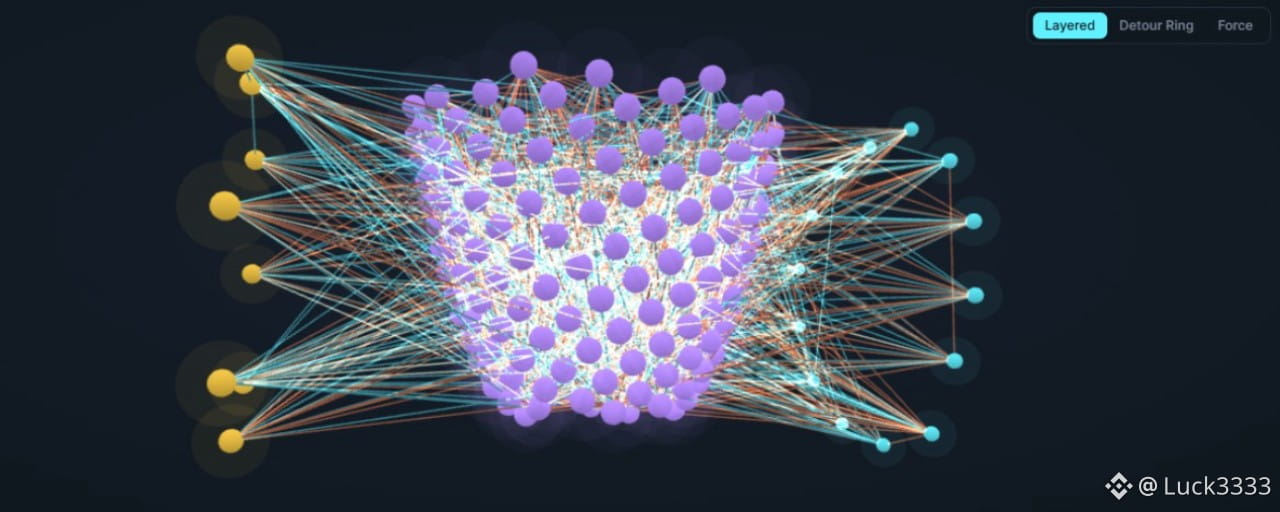
مقالة
الكشف عن منظومة Qubic: UPoW، وJetski Pool، وANN Explorer الثورييتقاطع الذكاء الاصطناعي (AI) مع تقنية البلوك تشين ليُعدّ أكثر السرديات سخونة في عالم الكريبتو الآن. لكن بينما تكتفي أغلب المشاريع بلصق كلمة "AI" على التقنيات المعتادة، فإن Qubic ($QUBIC) يعيد كتابة قواعد الحوسبة الموزعة من الأساس.
إذا كنت متعبًا من الهدر الضخم للطاقة الناتج عن آليات إثبات العمل التقليدية (Proof-of-Work - PoW) ومن مركزية شركات التكنولوجيا الكبرى في مجال الذكاء الاصطناعي، فقد حان الوقت للغوص بعمق في منظومة Qubic من الطبقة الأولى (Layer-1)، والدور الحاسم لمسبح Jetski Pool، وكيف يقوم مستكشف ANN Explorer المرتقب بحل أكبر مشكلة شفافية في عالم العملات المشفرة الخاصة بالذكاء الاصطناعي. 👇
الكشف عن منظومة Qubic: UPoW، وJetski Pool، وANN Explorer الثوري
يتقاطع الذكاء الاصطناعي (AI) مع تقنية البلوك تشين ليُعدّ أكثر السرديات سخونة في عالم الكريبتو الآن. لكن بينما تكتفي أغلب المشاريع بلصق كلمة "AI" على التقنيات المعتادة، فإن Qubic ($QUBIC) يعيد كتابة قواعد الحوسبة الموزعة من الأساس.
إذا كنت متعبًا من الهدر الضخم للطاقة الناتج عن آليات إثبات العمل التقليدية (Proof-of-Work - PoW) ومن مركزية شركات التكنولوجيا الكبرى في مجال الذكاء الاصطناعي، فقد حان الوقت للغوص بعمق في منظومة Qubic من الطبقة الأولى (Layer-1)، والدور الحاسم لمسبح Jetski Pool، وكيف يقوم مستكشف ANN Explorer المرتقب بحل أكبر مشكلة شفافية في عالم العملات المشفرة الخاصة بالذكاء الاصطناعي. 👇
إذا كنت متعبًا من الهدر الضخم للطاقة الناتج عن آليات إثبات العمل التقليدية (Proof-of-Work - PoW) ومن مركزية شركات التكنولوجيا الكبرى في مجال الذكاء الاصطناعي، فقد حان الوقت للغوص بعمق في منظومة Qubic من الطبقة الأولى (Layer-1)، والدور الحاسم لمسبح Jetski Pool، وكيف يقوم مستكشف ANN Explorer المرتقب بحل أكبر مشكلة شفافية في عالم العملات المشفرة الخاصة بالذكاء الاصطناعي. 👇
248
·
--
Qubic "All Hands" AMA👉 https://x.com/i/broadcasts/1YxNrrkWeoQxw
Qubic "All Hands" AMA👉 https://x.com/i/broadcasts/1YxNrrkWeoQxw
92
·
--

مقالة
ما هو الذكاء العام الاصطناعي؟ الحدود والرؤى والتعريفات للذكاء العام الاصطناعيأكاديمية نيروركسون للاستخبارات — المجلد 11
بواسطة الفريق العلمي #Qubic
باختصار: توجد تعابير قليلة تتكرر كثيرًا وتتحدد بشكل قليل جدًا مثل "الذكاء العام الاصطناعي". يدرس هذا المجلد لماذا تقول كل #AGI من التعريفات المطروحة شيئًا مختلفًا، ولماذا لم يشعر مفهوم #AI الضيق الذي يتفوق على البشر أبدًا بأنه ذكاء عام، ولماذا إن أكثر تلميح مفيد لدينا يتمثل في أن الذكاء ليس درجةً بل نظامًا قابلاً للحياة من الأنظمة، وهي القاعدة التي توجه عملنا على #Neuraxon و#aigarth .
ما هو الذكاء العام الاصطناعي؟ الحدود والرؤى والتعريفات للذكاء العام الاصطناعي
أكاديمية نيروركسون للاستخبارات — المجلد 11
بواسطة الفريق العلمي #Qubic
باختصار: توجد تعابير قليلة تتكرر كثيرًا وتتحدد بشكل قليل جدًا مثل "الذكاء العام الاصطناعي". يدرس هذا المجلد لماذا تقول كل #AGI من التعريفات المطروحة شيئًا مختلفًا، ولماذا لم يشعر مفهوم #AI الضيق الذي يتفوق على البشر أبدًا بأنه ذكاء عام، ولماذا إن أكثر تلميح مفيد لدينا يتمثل في أن الذكاء ليس درجةً بل نظامًا قابلاً للحياة من الأنظمة، وهي القاعدة التي توجه عملنا على #Neuraxon و#aigarth .
بواسطة الفريق العلمي #Qubic
باختصار: توجد تعابير قليلة تتكرر كثيرًا وتتحدد بشكل قليل جدًا مثل "الذكاء العام الاصطناعي". يدرس هذا المجلد لماذا تقول كل #AGI من التعريفات المطروحة شيئًا مختلفًا، ولماذا لم يشعر مفهوم #AI الضيق الذي يتفوق على البشر أبدًا بأنه ذكاء عام، ولماذا إن أكثر تلميح مفيد لدينا يتمثل في أن الذكاء ليس درجةً بل نظامًا قابلاً للحياة من الأنظمة، وهي القاعدة التي توجه عملنا على #Neuraxon و#aigarth .
3
178
·
--
ستكون Qubic في حدثين من أكبر فعاليات الذكاء الاصطناعي في أوروبا الأسبوع المقبل، وكلاهما في باريس.
⭐
MACHINA في 7 يوليو في Station F.
RAISE Summit في 8-9 يوليو في Carrousel du Louvre.
جاء حضورهم بفضل تبرعات سخية من أفراد المجتمع الذين أرادوا رؤية Qubic ممثلة في المكان الذي يهم.
MACHINA هو أبرز قمة أوروبية للذكاء الاصطناعي المادي. الروبوتات، الأنظمة الشبيهة بالبشر، الذكاء المُجسّد.
تضم القاعة مؤسسين من Boston Dynamics وNEURA Robotics وقسم الروبوتات التابع لشركة NVIDIA.
هنا يجتمع صانعو الآلات التي تتحرك وتعمل في العالم الحقيقي ليتحاوروا ويقرروا ما الخطوة التالية.
إن تقاطع الذكاء الاصطناعي والبنية التحتية المادية هو المكان بالضبط الذي ينتمي إليه طبقة الحوسبة لدى Qubic في هذه المحادثة.
👉 https://www.machinasummit.com/
⭐⭐
RAISE Summit هو أكبر تجمع لقيادات الذكاء الاصطناعي عبر القطاعات في أوروبا.
أكثر من 9,000 حاضر، وأكثر من 350 متحدثًا بمن فيهم Yann LeCun وEric Schmidt وJim Fan.
80% من الحضور على مستوى المديرين التنفيذيين أو مستوى المؤسسين.
ستشكل المحادثات التي تجري هنا مسار تطوير البنية التحتية للذكاء الاصطناعي، وملكية الحوسبة، وتبنّي المؤسسات خلال العقد القادم.
وجود مجتمع Qubic في تلك القاعة يهم.
👉https://www.raisesummit.com/
تم تنظيم هذا الحضور من الصفر بواسطة Qubic France، وهي مجموعة يقودها المجتمع وتمثل المشروع انطلاقًا من قناعة.
لا يزالون يبحثون عن دعم لتغطية تكاليف السفر والنشر الإعلامي.
تأتي الفعاليات بهذا المستوى بتكاليف حقيقية، وكل مساهمة تعزز كيفية ظهور المشروع.
كلما دعمت الفئة المجتمعية المشروع أكثر، زادت قيمة الأثر.
إذا كنت تريد المساهمة، تواصل مع IrisNova_AI
#Qubic #RAISE #AI #AGI
ستكون Qubic في حدثين من أكبر فعاليات الذكاء الاصطناعي في أوروبا الأسبوع المقبل، وكلاهما في باريس.
⭐
MACHINA في 7 يوليو في Station F.
RAISE Summit في 8-9 يوليو في Carrousel du Louvre.
جاء حضورهم بفضل تبرعات سخية من أفراد المجتمع الذين أرادوا رؤية Qubic ممثلة في المكان الذي يهم.
MACHINA هو أبرز قمة أوروبية للذكاء الاصطناعي المادي. الروبوتات، الأنظمة الشبيهة بالبشر، الذكاء المُجسّد.
تضم القاعة مؤسسين من Boston Dynamics وNEURA Robotics وقسم الروبوتات التابع لشركة NVIDIA.
هنا يجتمع صانعو الآلات التي تتحرك وتعمل في العالم الحقيقي ليتحاوروا ويقرروا ما الخطوة التالية.
إن تقاطع الذكاء الاصطناعي والبنية التحتية المادية هو المكان بالضبط الذي ينتمي إليه طبقة الحوسبة لدى Qubic في هذه المحادثة.
👉 https://www.machinasummit.com/
⭐⭐
RAISE Summit هو أكبر تجمع لقيادات الذكاء الاصطناعي عبر القطاعات في أوروبا.
أكثر من 9,000 حاضر، وأكثر من 350 متحدثًا بمن فيهم Yann LeCun وEric Schmidt وJim Fan.
80% من الحضور على مستوى المديرين التنفيذيين أو مستوى المؤسسين.
ستشكل المحادثات التي تجري هنا مسار تطوير البنية التحتية للذكاء الاصطناعي، وملكية الحوسبة، وتبنّي المؤسسات خلال العقد القادم.
وجود مجتمع Qubic في تلك القاعة يهم.
👉https://www.raisesummit.com/
تم تنظيم هذا الحضور من الصفر بواسطة Qubic France، وهي مجموعة يقودها المجتمع وتمثل المشروع انطلاقًا من قناعة.
لا يزالون يبحثون عن دعم لتغطية تكاليف السفر والنشر الإعلامي.
تأتي الفعاليات بهذا المستوى بتكاليف حقيقية، وكل مساهمة تعزز كيفية ظهور المشروع.
كلما دعمت الفئة المجتمعية المشروع أكثر، زادت قيمة الأثر.
إذا كنت تريد المساهمة، تواصل مع IrisNova_AI
#Qubic #RAISE #AI #AGI
⭐
MACHINA في 7 يوليو في Station F.
RAISE Summit في 8-9 يوليو في Carrousel du Louvre.
جاء حضورهم بفضل تبرعات سخية من أفراد المجتمع الذين أرادوا رؤية Qubic ممثلة في المكان الذي يهم.
MACHINA هو أبرز قمة أوروبية للذكاء الاصطناعي المادي. الروبوتات، الأنظمة الشبيهة بالبشر، الذكاء المُجسّد.
تضم القاعة مؤسسين من Boston Dynamics وNEURA Robotics وقسم الروبوتات التابع لشركة NVIDIA.
هنا يجتمع صانعو الآلات التي تتحرك وتعمل في العالم الحقيقي ليتحاوروا ويقرروا ما الخطوة التالية.
إن تقاطع الذكاء الاصطناعي والبنية التحتية المادية هو المكان بالضبط الذي ينتمي إليه طبقة الحوسبة لدى Qubic في هذه المحادثة.
👉 https://www.machinasummit.com/
⭐⭐
RAISE Summit هو أكبر تجمع لقيادات الذكاء الاصطناعي عبر القطاعات في أوروبا.
أكثر من 9,000 حاضر، وأكثر من 350 متحدثًا بمن فيهم Yann LeCun وEric Schmidt وJim Fan.
80% من الحضور على مستوى المديرين التنفيذيين أو مستوى المؤسسين.
ستشكل المحادثات التي تجري هنا مسار تطوير البنية التحتية للذكاء الاصطناعي، وملكية الحوسبة، وتبنّي المؤسسات خلال العقد القادم.
وجود مجتمع Qubic في تلك القاعة يهم.
👉https://www.raisesummit.com/
تم تنظيم هذا الحضور من الصفر بواسطة Qubic France، وهي مجموعة يقودها المجتمع وتمثل المشروع انطلاقًا من قناعة.
لا يزالون يبحثون عن دعم لتغطية تكاليف السفر والنشر الإعلامي.
تأتي الفعاليات بهذا المستوى بتكاليف حقيقية، وكل مساهمة تعزز كيفية ظهور المشروع.
كلما دعمت الفئة المجتمعية المشروع أكثر، زادت قيمة الأثر.
إذا كنت تريد المساهمة، تواصل مع IrisNova_AI
#Qubic #RAISE #AI #AGI

NVDAUS-6.75%
1
182
·
--
ما عنا وحدة قياس للذكاء.
لا للبشر. ولا للآلات.
عم نتجادل حول هالموضوع لأكثر من قرن.
حتى 45% من المعايير اللي بنستخدمها لتقييم LLMs فيها بيانات تدريب مسربة.
تم بناء ARC-AGI-3 لحل هالمشكلة.
البشر يحلوا 100% منها.
الذكاء الاصطناعي المتقدم يسجل أقل من 1%.
NIA Volume 10 يشرح عامل g، إطار عمل تشوليه، تلوث المعايير، وشو بتطلب قياس ذكاء الآلات فعلياً.
اقرأ بالكامل
👇
[Measuring Machine Intelligence: The g Factor vs. ARC-AGI Benchmark](https://www.binance.com/en/square/post/332806106415490)
@BiBi
#AI #AGI #Qubic #TechTrends #Neuraxon
ما عنا وحدة قياس للذكاء.
لا للبشر. ولا للآلات.
عم نتجادل حول هالموضوع لأكثر من قرن.
حتى 45% من المعايير اللي بنستخدمها لتقييم LLMs فيها بيانات تدريب مسربة.
تم بناء ARC-AGI-3 لحل هالمشكلة.
البشر يحلوا 100% منها.
الذكاء الاصطناعي المتقدم يسجل أقل من 1%.
NIA Volume 10 يشرح عامل g، إطار عمل تشوليه، تلوث المعايير، وشو بتطلب قياس ذكاء الآلات فعلياً.
اقرأ بالكامل
👇
Measuring Machine Intelligence: The g Factor vs. ARC-AGI Benchmark
@Binance BiBi
#AI #AGI #Qubic #TechTrends #Neuraxon
لا للبشر. ولا للآلات.
عم نتجادل حول هالموضوع لأكثر من قرن.
حتى 45% من المعايير اللي بنستخدمها لتقييم LLMs فيها بيانات تدريب مسربة.
تم بناء ARC-AGI-3 لحل هالمشكلة.
البشر يحلوا 100% منها.
الذكاء الاصطناعي المتقدم يسجل أقل من 1%.
NIA Volume 10 يشرح عامل g، إطار عمل تشوليه، تلوث المعايير، وشو بتطلب قياس ذكاء الآلات فعلياً.
اقرأ بالكامل
👇
Measuring Machine Intelligence: The g Factor vs. ARC-AGI Benchmark
@Binance BiBi
#AI #AGI #Qubic #TechTrends #Neuraxon
204
·
--
مقالة
قياس الذكاء الآلي: العامل الج مقابل معيار ARC-AGI#Neuraxon أكاديمية الذكاء — الحجم 10
بواسطة فريق Qubic العلمي
ARC-AGI-3: أول معيار تفاعلي يقيس ما إذا كان الذكاء الاصطناعي يمكنه التعلم حقاً، وليس مجرد تكرار. المصدر: مؤسسة جائزة ARC.
إذا قمنا ببناء نظام اصطناعي ونريد أن نعرف ما إذا كان ذكياً، ماذا نقيس بالضبط؟ نعتقد أننا نعلم عندما نسمع أن ChatGPT-5 يعلن أنه قد هزم DeepSeek ثم أن Claude قد تفوق على Gemini.
لكن السؤال لا يزال موجوداً، كما هو. قياس الذكاء الاصطناعي ليس قياس السرعة أو درجة الحرارة. ليس لدينا وحدة قياس، مهما بدا غريباً.
قياس الذكاء الآلي: العامل الج مقابل معيار ARC-AGI
#Neuraxon أكاديمية الذكاء — الحجم 10
بواسطة فريق Qubic العلمي
ARC-AGI-3: أول معيار تفاعلي يقيس ما إذا كان الذكاء الاصطناعي يمكنه التعلم حقاً، وليس مجرد تكرار. المصدر: مؤسسة جائزة ARC.
إذا قمنا ببناء نظام اصطناعي ونريد أن نعرف ما إذا كان ذكياً، ماذا نقيس بالضبط؟ نعتقد أننا نعلم عندما نسمع أن ChatGPT-5 يعلن أنه قد هزم DeepSeek ثم أن Claude قد تفوق على Gemini.
لكن السؤال لا يزال موجوداً، كما هو. قياس الذكاء الاصطناعي ليس قياس السرعة أو درجة الحرارة. ليس لدينا وحدة قياس، مهما بدا غريباً.
بواسطة فريق Qubic العلمي
ARC-AGI-3: أول معيار تفاعلي يقيس ما إذا كان الذكاء الاصطناعي يمكنه التعلم حقاً، وليس مجرد تكرار. المصدر: مؤسسة جائزة ARC.
إذا قمنا ببناء نظام اصطناعي ونريد أن نعرف ما إذا كان ذكياً، ماذا نقيس بالضبط؟ نعتقد أننا نعلم عندما نسمع أن ChatGPT-5 يعلن أنه قد هزم DeepSeek ثم أن Claude قد تفوق على Gemini.
لكن السؤال لا يزال موجوداً، كما هو. قياس الذكاء الاصطناعي ليس قياس السرعة أو درجة الحرارة. ليس لدينا وحدة قياس، مهما بدا غريباً.
207
·
--

مقالة
شرح الحوسبة المعتمدة على الطرف الثالث في Qubic: كيف ستصبح العقود الذكية بين السلاسلتركز AMA الخاصة بـ Qubic في 3 يونيو على تطوير سيغير كيفية تفاعل البروتوكول مع العالم الخارجي: الحوسبة المعتمدة على الطرف الثالث. انضم المطورون الرئيسيون FNordSpace و Raika إلى المنسق Joetom لتفكيك الهيكل، وشرح نموذج التفويض، ووضع خريطة طريق تستهدف موعد الإطلاق في 29 يوليو. كما قدمت الجلسة نظرة على واقع البناء على قاعدة الشيفرة غير التقليدية لـ Qubic، مع جذب أكثر من 3,500 مشاهد مباشر.
كيف يكون الحال في بناء هيكل Qubic الصلب
شرح الحوسبة المعتمدة على الطرف الثالث في Qubic: كيف ستصبح العقود الذكية بين السلاسل
تركز AMA الخاصة بـ Qubic في 3 يونيو على تطوير سيغير كيفية تفاعل البروتوكول مع العالم الخارجي: الحوسبة المعتمدة على الطرف الثالث. انضم المطورون الرئيسيون FNordSpace و Raika إلى المنسق Joetom لتفكيك الهيكل، وشرح نموذج التفويض، ووضع خريطة طريق تستهدف موعد الإطلاق في 29 يوليو. كما قدمت الجلسة نظرة على واقع البناء على قاعدة الشيفرة غير التقليدية لـ Qubic، مع جذب أكثر من 3,500 مشاهد مباشر.
كيف يكون الحال في بناء هيكل Qubic الصلب
كيف يكون الحال في بناء هيكل Qubic الصلب
1
240
·
--
عامل g: نهج Qubic الراديكالي نحو الذكاء الاصطناعي العام
بينما تسارع صناعة الذكاء الاصطناعي لتوسيع النماذج اللغوية الضخمة، تقترح أبحاث Neuraxon من Qubic مسارًا مختلفًا تمامًا نحو الذكاء الاصطناعي العام (AGI).
أطروحتهم بسيطة:
المزيد من النصوص لا تخلق ذكاء حقيقي.
مستوحاة من نظرية "عامل g" لتشارلز سبيرمان من عام 1904، تجادل Qubic بأن الذكاء الحقيقي ليس في توقع الكلمة التالية، بل في تطوير قدرات معرفية قابلة للنقل — التكيف مع المواقف الجديدة، حل المشكلات غير المألوفة، التعلم من الأخطاء، وتنسيق المعرفة عبر المجالات.
تتفوق النماذج اللغوية الحالية في التنبؤ اللغوي الإحصائي، ومع ذلك فإنها لا تزال تواجه صعوبة عندما يتغير السياق أو التعبير بشكل غير متوقع. إنها تحاكي الذكاء، لكنها تفتقر إلى هيكل معرفي دائم وعام.
تأخذ مشروع Neuraxon اتجاهًا مستوحى من البيولوجيا من خلال محاكاة حياة اصطناعية تُسمى "لعبة الحياة متعددة النورونات Lite 5.0"، حيث تتطور الكائنات الاصطناعية تحت ضغط بيئي.
بدلاً من التدريب على مجموعات نصية لا تنتهي، يحاول Neuraxon تطوير الذكاء نفسه.
المفاهيم الرئيسية تشمل:
• الاختيار التطوري الذي يكافئ القابلية للتكيف
• هياكل شبيهة بالدماغ مستوحاة من الإدراك البشري
• ذكاء ناشئ من خلال التفاعل والتنظيم الذاتي
• التعلم المستمر مع مرور الوقت بدلاً من الاستدلال الثابت
كل هذا يعمل على شبكة Qubic اللامركزية Useful-Compute، مما يحول أجهزة التعدين إلى بنية تحتية ضخمة لأبحاث AGI بدلاً من إهدار الطاقة على التجزئة غير المجدية.
سواء أصبحت هذه خطوة ثورية أم لا، تستكشف Qubic واحدة من أكثر التجارب غير التقليدية والطموحة في AGI في مجال التشفير اليوم.
#crypto #AI #Qubic #AGI #artificialintelligence
عامل g: نهج Qubic الراديكالي نحو الذكاء الاصطناعي العام
بينما تسارع صناعة الذكاء الاصطناعي لتوسيع النماذج اللغوية الضخمة، تقترح أبحاث Neuraxon من Qubic مسارًا مختلفًا تمامًا نحو الذكاء الاصطناعي العام (AGI).
أطروحتهم بسيطة:
المزيد من النصوص لا تخلق ذكاء حقيقي.
مستوحاة من نظرية "عامل g" لتشارلز سبيرمان من عام 1904، تجادل Qubic بأن الذكاء الحقيقي ليس في توقع الكلمة التالية، بل في تطوير قدرات معرفية قابلة للنقل — التكيف مع المواقف الجديدة، حل المشكلات غير المألوفة، التعلم من الأخطاء، وتنسيق المعرفة عبر المجالات.
تتفوق النماذج اللغوية الحالية في التنبؤ اللغوي الإحصائي، ومع ذلك فإنها لا تزال تواجه صعوبة عندما يتغير السياق أو التعبير بشكل غير متوقع. إنها تحاكي الذكاء، لكنها تفتقر إلى هيكل معرفي دائم وعام.
تأخذ مشروع Neuraxon اتجاهًا مستوحى من البيولوجيا من خلال محاكاة حياة اصطناعية تُسمى "لعبة الحياة متعددة النورونات Lite 5.0"، حيث تتطور الكائنات الاصطناعية تحت ضغط بيئي.
بدلاً من التدريب على مجموعات نصية لا تنتهي، يحاول Neuraxon تطوير الذكاء نفسه.
المفاهيم الرئيسية تشمل:
• الاختيار التطوري الذي يكافئ القابلية للتكيف
• هياكل شبيهة بالدماغ مستوحاة من الإدراك البشري
• ذكاء ناشئ من خلال التفاعل والتنظيم الذاتي
• التعلم المستمر مع مرور الوقت بدلاً من الاستدلال الثابت
كل هذا يعمل على شبكة Qubic اللامركزية Useful-Compute، مما يحول أجهزة التعدين إلى بنية تحتية ضخمة لأبحاث AGI بدلاً من إهدار الطاقة على التجزئة غير المجدية.
سواء أصبحت هذه خطوة ثورية أم لا، تستكشف Qubic واحدة من أكثر التجارب غير التقليدية والطموحة في AGI في مجال التشفير اليوم.
#crypto #AI #Qubic #AGI #artificialintelligence
بينما تسارع صناعة الذكاء الاصطناعي لتوسيع النماذج اللغوية الضخمة، تقترح أبحاث Neuraxon من Qubic مسارًا مختلفًا تمامًا نحو الذكاء الاصطناعي العام (AGI).
أطروحتهم بسيطة:
المزيد من النصوص لا تخلق ذكاء حقيقي.
مستوحاة من نظرية "عامل g" لتشارلز سبيرمان من عام 1904، تجادل Qubic بأن الذكاء الحقيقي ليس في توقع الكلمة التالية، بل في تطوير قدرات معرفية قابلة للنقل — التكيف مع المواقف الجديدة، حل المشكلات غير المألوفة، التعلم من الأخطاء، وتنسيق المعرفة عبر المجالات.
تتفوق النماذج اللغوية الحالية في التنبؤ اللغوي الإحصائي، ومع ذلك فإنها لا تزال تواجه صعوبة عندما يتغير السياق أو التعبير بشكل غير متوقع. إنها تحاكي الذكاء، لكنها تفتقر إلى هيكل معرفي دائم وعام.
تأخذ مشروع Neuraxon اتجاهًا مستوحى من البيولوجيا من خلال محاكاة حياة اصطناعية تُسمى "لعبة الحياة متعددة النورونات Lite 5.0"، حيث تتطور الكائنات الاصطناعية تحت ضغط بيئي.
بدلاً من التدريب على مجموعات نصية لا تنتهي، يحاول Neuraxon تطوير الذكاء نفسه.
المفاهيم الرئيسية تشمل:
• الاختيار التطوري الذي يكافئ القابلية للتكيف
• هياكل شبيهة بالدماغ مستوحاة من الإدراك البشري
• ذكاء ناشئ من خلال التفاعل والتنظيم الذاتي
• التعلم المستمر مع مرور الوقت بدلاً من الاستدلال الثابت
كل هذا يعمل على شبكة Qubic اللامركزية Useful-Compute، مما يحول أجهزة التعدين إلى بنية تحتية ضخمة لأبحاث AGI بدلاً من إهدار الطاقة على التجزئة غير المجدية.
سواء أصبحت هذه خطوة ثورية أم لا، تستكشف Qubic واحدة من أكثر التجارب غير التقليدية والطموحة في AGI في مجال التشفير اليوم.
#crypto #AI #Qubic #AGI #artificialintelligence
QubicNews
·
--
عامل g في الحياة الاصطناعية: من فصل سبيرمان الدراسي عام 1904 إلى العقول الاصطناعية المتطورة
أكاديمية نيوراكسون للذكاء، المجلد 9 · بواسطة فريق كيوبيك العلمي
في سطر واحد: الذكاء العام، عامل g الذي قيّمه علماء النفس لأكثر من قرن، هو المكون المفقود في نماذج اللغة اليوم، ومشروع نيوراكسون من كيوبيك يقوم الآن بالاختيار له مباشرة داخل محاكاة حياة اصطناعية.
تشارلز سبيرمان (1863–1945)، الذي حدد لأول مرة عامل g للذكاء العام أثناء دراسته لدرجات الأطفال في المدارس الإنجليزية في عام 1904.
عامل g: من فصل دراسي عام 1904 إلى عقول اصطناعية
في سطر واحد: الذكاء العام، عامل g الذي قيّمه علماء النفس لأكثر من قرن، هو المكون المفقود في نماذج اللغة اليوم، ومشروع نيوراكسون من كيوبيك يقوم الآن بالاختيار له مباشرة داخل محاكاة حياة اصطناعية.
تشارلز سبيرمان (1863–1945)، الذي حدد لأول مرة عامل g للذكاء العام أثناء دراسته لدرجات الأطفال في المدارس الإنجليزية في عام 1904.
عامل g: من فصل دراسي عام 1904 إلى عقول اصطناعية

274
·
--
صحيح جزئيًا
مقالة
عامل g في الحياة الاصطناعية: من فصل سبيرمان الدراسي عام 1904 إلى العقول الاصطناعية المتطورةأكاديمية نيوراكسون للذكاء، المجلد 9 · بواسطة فريق كيوبيك العلمي
في سطر واحد: الذكاء العام، عامل g الذي قيّمه علماء النفس لأكثر من قرن، هو المكون المفقود في نماذج اللغة اليوم، ومشروع نيوراكسون من كيوبيك يقوم الآن بالاختيار له مباشرة داخل محاكاة حياة اصطناعية.
تشارلز سبيرمان (1863–1945)، الذي حدد لأول مرة عامل g للذكاء العام أثناء دراسته لدرجات الأطفال في المدارس الإنجليزية في عام 1904.
عامل g: من فصل دراسي عام 1904 إلى عقول اصطناعية
عامل g في الحياة الاصطناعية: من فصل سبيرمان الدراسي عام 1904 إلى العقول الاصطناعية المتطورة
أكاديمية نيوراكسون للذكاء، المجلد 9 · بواسطة فريق كيوبيك العلمي
في سطر واحد: الذكاء العام، عامل g الذي قيّمه علماء النفس لأكثر من قرن، هو المكون المفقود في نماذج اللغة اليوم، ومشروع نيوراكسون من كيوبيك يقوم الآن بالاختيار له مباشرة داخل محاكاة حياة اصطناعية.
تشارلز سبيرمان (1863–1945)، الذي حدد لأول مرة عامل g للذكاء العام أثناء دراسته لدرجات الأطفال في المدارس الإنجليزية في عام 1904.
عامل g: من فصل دراسي عام 1904 إلى عقول اصطناعية
في سطر واحد: الذكاء العام، عامل g الذي قيّمه علماء النفس لأكثر من قرن، هو المكون المفقود في نماذج اللغة اليوم، ومشروع نيوراكسون من كيوبيك يقوم الآن بالاختيار له مباشرة داخل محاكاة حياة اصطناعية.
تشارلز سبيرمان (1863–1945)، الذي حدد لأول مرة عامل g للذكاء العام أثناء دراسته لدرجات الأطفال في المدارس الإنجليزية في عام 1904.
عامل g: من فصل دراسي عام 1904 إلى عقول اصطناعية
1
1
499
سجّل الدخول لاستكشاف المزيد من المُحتوى
انضم إلى مُستخدمي العملات الرقمية حول العالم على Binance Square
⚡️ احصل على أحدث المعلومات المفيدة عن العملات الرقمية.
💬 موثوقة من قبل أكبر منصّة لتداول العملات الرقمية في العالم.
👍 اكتشف الرؤى الحقيقية من صنّاع المُحتوى الموثوقين.
البريد الإلكتروني / رقم الهاتف
المواضيع الرائجة
HotCPIDecemberHikePriced
37,067 مشاهدات
738 يقومون بالنقاش
متابعة السوق لمؤشر أسعار المستهلك | ارتفاع المؤشر في الولايات المتحدة بنسبة 0.4% في أكتوبر، متجاوزًا التوقعات البالغة 0.3%
Binance News
·19 إعجاب
·35.1k مشاهدات
AnthropicRejectsIPODelayValuationinQuestion
173,903 مشاهدات
1,575 يقومون بالنقاش
NvidiaInvestigatesAfterHuang’sAffairApology
440,926 مشاهدات
3,041 يقومون بالنقاش