


When I first started looking into OpenLedger, what stood out to me wasn’t the usual “AI + blockchain” pitch. Crypto has become crowded with projects trying to attach themselves to artificial intelligence, usually by borrowing the language of both industries without solving much underneath. OpenLedger feels different because the idea at the center of it is surprisingly practical: if AI becomes one of the most important technologies in the world, then the systems that power it probably shouldn’t belong to only a handful of companies.
That sounds obvious when you say it out loud, but most of today’s AI infrastructure is deeply centralized. The models are centralized, the datasets are centralized, the compute is centralized, and the economic rewards are centralized too. A small number of organizations own the models, decide how they’re trained, and capture most of the value created by them. Everyone else contributes indirectly through data, usage, feedback, or content, but very few people participate in the upside.

OpenLedger seems to be approaching that imbalance from a different angle. Instead of trying to compete with the biggest AI companies head-on, it’s trying to build the infrastructure layer for a more open AI economy—one where contributors, developers, and data providers can actually be recognized and rewarded for the role they play.
What makes this interesting is that OpenLedger isn’t positioning blockchain as the product itself. The blockchain is more like an accounting and coordination system sitting underneath AI activity. The focus is less about convincing people to care about chains and more about solving a growing problem around attribution, ownership, and incentives in AI systems.
That philosophy becomes clearer once you look at the concept OpenLedger talks about most often: Proof of Attribution.
The idea behind it is fairly simple, even if the technical execution is difficult. AI models are built from enormous amounts of data and countless layers of contributions. Right now, most of those contributions disappear into a black box. OpenLedger is trying to create a framework where datasets, model improvements, and inference activity can be tracked and connected back to the people or systems responsible for them.
In practice, that could mean contributors getting rewarded when their data improves a model, or developers earning value from specialized AI systems they create. It shifts AI from being something controlled entirely by centralized platforms into something closer to a collaborative economy.
And honestly, that may end up mattering more than people realize.
One of the strange realities of the current AI boom is that the industry depends heavily on public contribution while remaining economically closed. People generate the content, conversations, and datasets that help train AI systems, yet the ownership structure remains concentrated. OpenLedger’s entire thesis seems built around the belief that this model eventually becomes unsustainable, especially as AI becomes more integrated into everyday digital life.
Another thing I find notable is OpenLedger’s focus on specialized models rather than giant general-purpose systems. A lot of the AI conversation today revolves around increasingly massive models competing on scale. OpenLedger appears more interested in smaller domain-specific systems that can be trained, deployed, and monetized more efficiently.
That approach feels more realistic to me over the long term.
Not every industry needs an enormous universal model. A healthcare company may want a medical-focused AI.
A legal team would probably want AI that helps with contracts and regulations, while a game would care more about AI that can interact with players in a natural way.
Specialized models are often cheaper, easier to control, and more useful within focused environments.
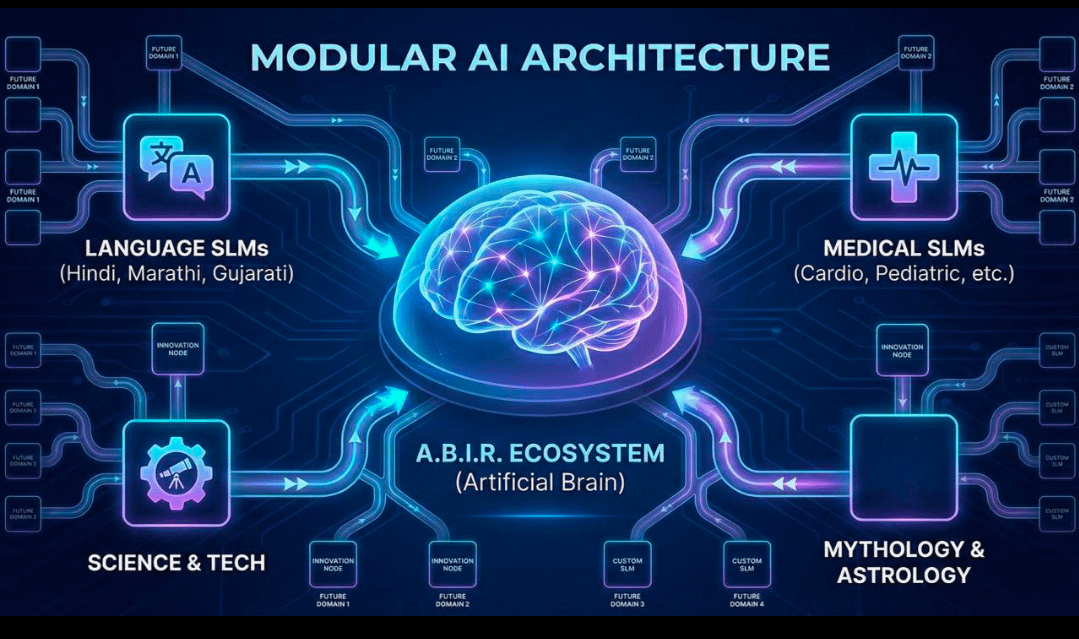
OpenLedger seems designed around the assumption that the future of AI will be modular rather than singular.
That also explains why the project spends so much time talking about data networks and decentralized participation. If AI development becomes more distributed, then systems need ways to coordinate contributions at scale. Blockchain becomes useful here not because it makes AI “cooler,” but because it provides transparency around ownership and economic distribution.
The interesting part is that OpenLedger doesn’t frame this as ideology as much as infrastructure.
A lot of decentralized AI conversations become philosophical very quickly. OpenLedger feels more operational. The emphasis appears to be on creating mechanisms that allow AI ecosystems to function without requiring every participant to trust a single company. That’s a subtle but important distinction.
Looking at the broader architecture, the network itself seems designed specifically for AI-related workloads instead of trying to retrofit AI into a generic blockchain environment. That matters because AI systems generate enormous amounts of activity, whether through inference requests, model interactions, or data validation processes. General-purpose chains often struggle when applications become resource-intensive, especially if costs fluctuate unpredictably.
OpenLedger’s focus on AI-native infrastructure suggests the team understands that decentralized AI cannot work if the underlying economics are unstable or difficult for developers to build around.
The token model also feels relatively grounded compared to a lot of crypto projects. The OPEN token powers things like staking, governance, and network activity, but the more important point is how the token fits into the ecosystem itself. In theory, contributors, validators, developers, and inference providers all participate in the same economic loop.
That creates a structure where value flows through the network rather than accumulating entirely at the top.
Whether that system scales successfully is still an open question, of course. Building decentralized AI infrastructure is extraordinarily difficult. OpenLedger is operating in a space where both blockchain and AI are evolving at the same time, which means the technical and economic challenges compound quickly.
Attribution itself is also a genuinely hard problem. Measuring exactly how much value a dataset contributed to a model isn’t straightforward. Preventing manipulation or low-quality contributions becomes another challenge entirely. These are not small engineering issues—they’re foundational questions the broader AI industry still hasn’t fully solved.
But I think that’s part of why OpenLedger stands out to me in the first place. The project isn’t chasing a superficial trend. It’s trying to address structural problems that will probably become more important as AI systems continue growing.
Stepping back, what I keep coming back to is how OpenLedger views AI as an ecosystem instead of a product. The future it’s building toward isn’t one where a single company owns intelligence. It’s one where intelligence becomes collaborative, composable, and economically shared across networks of contributors.
If that future arrives, infrastructure around attribution and coordination could become just as important as the models themselves.
And realistically, that may be the deeper opportunity here. OpenLedger isn’t trying to build another chatbot people use for a few minutes a day. It’s trying to build the underlying economic layer for decentralized AI systems that may eventually operate everywhere in the background.
If it succeeds, most users probably won’t think much about the blockchain underneath at all. They’ll simply interact with AI products that feel more open, more transparent, and more connected to the communities helping create them.