
The FOMC announced that it would maintain the federal funds rate in the range of 4.25% to 4.50%, in line with market expectations.
Although Bitcoin (BTC) experienced a brief decline below $104,000 after the announcement, it quickly stabilized and had returned to the $105,000 level at the time of writing, demonstrating its resilience to changes in macroeconomic policy. Continued buying by institutional investors is the main driver of Bitcoin's price stabilization.
After the FOMC meeting, Powell stated at a press conference that the U.S. economy is growing steadily. Although inflationary pressures remain, there is no rush to cut rates. The market reacted mildly, with no significant bearish or bullish signals.
Powell stated that the current labor market conditions are insufficient to support a rate cut, reflecting the Federal Reserve's cautious stance as it continues to assess economic trends. Powell's comments suggest that while the effects of inflation may take time to fully manifest, inflation is expected to rise significantly in the coming months.
Since the last adjustment in December of last year, the Federal Reserve has kept the benchmark interest rate in the range of 4.25% to 4.5% and has taken a wait-and-see approach amid ongoing economic uncertainty. Recent data indicates that despite a strong labor market and low unemployment rate, the inflation rate rose to 2.4% in May, up from 2.3% in April. Powell emphasized the need for a comprehensive assessment of the impact of inflation, consistent with the Federal Reserve's dual mandate to promote maximum employment and ensure price stability.
Additionally, the Federal Reserve predicts that this year's inflation and unemployment rates will rise. It is expected that by 2025, the median PCE inflation rate will reach 3%, higher than the 2.7% predicted in March. The unemployment rate forecast also shows an increase, with most officials expecting this year's unemployment rate to be between 4.4% and 4.5%. Despite these forecasts, the Federal Reserve still plans to cut rates twice in 2025, consistent with previous forecasts. However, these rate cuts depend on upcoming economic data.
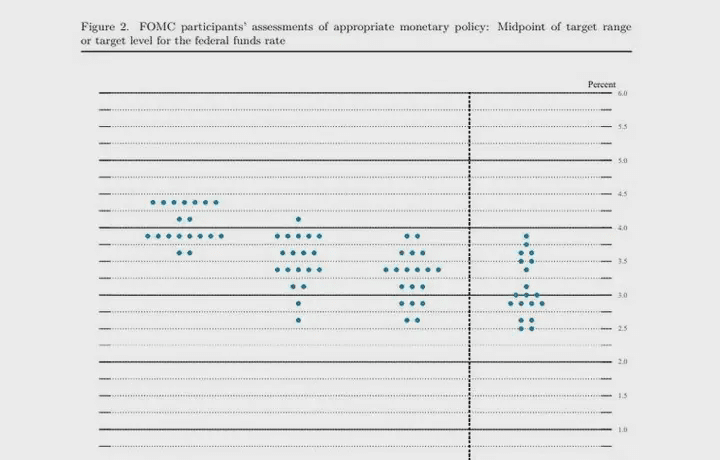
The Federal Reserve maintained interest rates as expected, but the changes in the dot plot became the focus of the market. Although the overall expectation is still for two rate cuts in 2025, the number of committee members supporting no cuts for the year has risen from 4 in May to 7, while those supporting two cuts has decreased from 9 to 8, indicating that the Federal Reserve may gradually lean towards not cutting rates at all. This is believed to be why the U.S. stock and cryptocurrency markets rose before falling.
At the same time, the Federal Reserve lowered its GDP forecast for the U.S. in 2025 to 1.4% while raising its inflation forecast to 3%, signaling that the Federal Reserve expects the U.S. is likely to experience 'stagflation,' suggesting that the U.S. economy will enter a difficult period. Powell stated at the subsequent press conference that the U.S. economy remains strong, with ideal employment data, but inflation has not shown signs of decline and emphasized that the impact of tariffs is still difficult to predict, hence maintaining the current interest rate level.
The FOMC's decision to keep interest rates unchanged did not bring any surprises, as the market had already fully priced this in.
According to CME Group's FedWatch tool, the probability of no change is 99.9%, reflecting a high consensus among investors regarding the Federal Reserve's policy expectations.
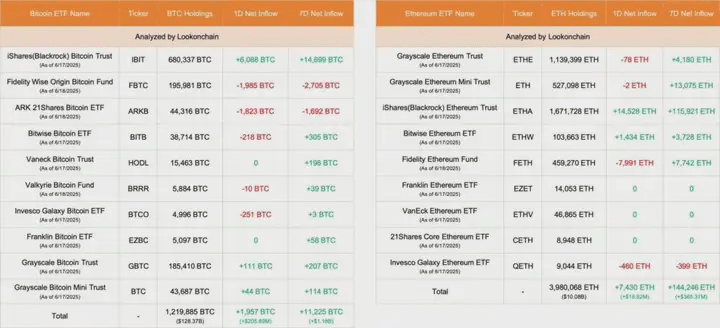
Lookonchain's report shows that before the June 18 FOMC meeting, 10 Bitcoin ETFs recorded a net inflow of 1,957 BTC (approximately $205.89 million), with BlackRock's IBIT fund leading the pack, absorbing 6,088 BTC (approximately $640.69 million), bringing total holdings to 680,337 BTC (approximately $71.59 billion).
Technical analysis shows that Bitcoin successfully broke through the $106,200 resistance on the 4-hour chart, with RSI rising to 58 and a bullish MACD cross beginning to form, indicating a strengthening short-term momentum. The 200-day moving average (around $105,300) continues to provide support; if the price stabilizes above $106,800, it may challenge the annual high of $109,800. CoinEdition points out that despite the geopolitical risks in the Middle East (such as the hacking of the Iranian Nobitex exchange) causing volatility, Bitcoin has demonstrated resilience around $106,000.
The FOMC's decision to keep interest rates unchanged did not bring any surprises, as the market had already fully priced this in. The brief fluctuations in Bitcoin stem more from traders' emotional reactions than from fundamental changes. Continued buying by institutional investors, particularly the net inflow into ETFs, reflects confidence in Bitcoin's long-term prospects. The growth of the stablecoin market (reaching $251.7 billion, a 22% increase) further supports the demand for Bitcoin.
Geopolitical risks have not fully dissipated. If the conflict in the Middle East escalates or if the Federal Reserve's future policy tone shifts, it could exert downward pressure on Bitcoin. Close attention should be paid to the ETF fund flows and geopolitical developments in the coming days, particularly the progress of the conflict between Iran and Israel.
The market has anticipated that old Powell will remain tough, which is considered a bearish outcome, so the impact on the post-market will not be too significant. The Middle East situation is currently what can sway the market, and whether the U.S. will enter the war will still be a turning point for the market.