

Compiled by: Blockchain in Plain Language
 Source: Unsplash
Unless isolated from the world, there's hardly anyone in the crypto space who hasn't noticed Ethereum's decline over the past few months. Price trends, market dominance, and community sentiment—all at historical lows! This top cryptocurrency seems to be plummeting significantly—this cycle hasn't even created a new all-time high. However, in recent days, Ethereum seems to be rebounding. Why has it performed poorly for several months? Can the current momentum propel it back?
The Predicament of Ethereum
Ethereum is struggling, there is no doubt about it. Since December 2024, whenever market sentiment shifts leading to an overall decline in the crypto market, only Bitcoin has been able to rebound to previous levels and break through, while Ethereum has almost never returned to its original point after falling.
Here are Ethereum's market performances over the past few months. In November 2024, the market was on an upward trend, with Bitcoin priced around $96,405 and Ethereum at $3,703. On December 1, 2024, the market experienced a slight decline, with Bitcoin dropping to $93,557 and Ethereum to $3,337. Although both top cryptocurrencies reached significant price levels later that month, they failed to maintain their upward momentum and declined again.
About a month later, on January 1, 2025, Bitcoin's price was $94,500, slightly higher than the previous month, while Ethereum further fell to $3,298. By February 1, price data showed Bitcoin significantly dropped to $84,381, and Ethereum fell to $2,236. Bitcoin later reached $102,000 later that month, but Ethereum failed to rebound to its previous high. In fact, when Bitcoin rose from $84,381 in February to $94,304 in April, Ethereum continued to decline, unable to retest previous highs. In reality, the BTC/ETH ratio has widened, as shown in the chart data.
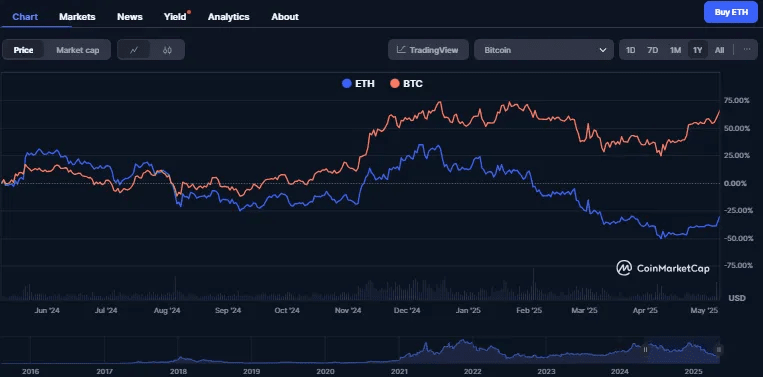 Source: CoinMarketCap
As of the time of writing, Ethereum is trading at around $2,400, which is a decent increase considering its performance over the past few months. However, it has not yet challenged higher price ranges. What exactly is wrong with the Ethereum market? Let's analyze a few key points.
Bitcoin and meme coins are stealing the spotlight
In recent months, Bitcoin and meme coins have been stealing the spotlight. You may have heard about the news regarding the U.S. government's plan to establish a Bitcoin reserve. This plan has been widely discussed among retail and institutional investors, with several U.S. state governments also working towards building strategic Bitcoin reserves. Texas and New Hampshire have made progress in this regard, as have several other states and some other countries.
The interest from sovereign countries has further attracted the attention of market whales and institutional investors. Recently, Michael Saylor announced that Strategy (formerly MicroStrategy) has made additional purchases of Bitcoin to solidify its position as the publicly traded company holding the most Bitcoin. Of the total supply of 21 million Bitcoins, Strategy holds over 555,000 Bitcoins.
While Bitcoin is taking center stage and overshadowing Ethereum, meme coins are doing the same. Unfortunately, these meme coins are not launched on the Ethereum chain. One of the most successful meme coins of 2025, Fartcoin, with a market cap of over $1 billion, was launched on the Solana chain. The popular meme coin issuance platform PumpFun is also on Solana. You may not have noticed, but most of the hottest meme tokens created at the end of 2024 and in 2025 come from PumpFun.
 Source: CoinMarketCap
Thus, Ethereum has clearly missed this wave. Furthermore, discussions around decentralized finance (DeFi) have significantly decreased, as no major innovations have emerged. Overall, Ethereum is not at the center of any major trend—nothing is driving its price up.
Liquidity Flow Subnetwork
The high gas fees on Ethereum have always been a major obstacle to its growth. Worse still, the Ethereum network is flooded with Layer-2 networks such as Polygon, Optimism, Base, Linea, and Arbitrum. These Layer-2 networks compete with Ethereum for liquidity. With the existence of USDC, these networks can operate without needing much ETH. Not to mention, various activities can be conducted on these Layer-2 platforms, thereby reducing transactions through the Ethereum main chain. Therefore, if on-chain usage is high, the demand for ETH should rise, but that is not the case now.
Competing Networks
We have slightly mentioned how competitors like Solana are undermining Ethereum's market dominance. The fact is, Solana offers a better experience for developers and users. Who wouldn't want a faster, cheaper, and more capable chain? According to CoinGecko's report on Solana, the ongoing activity on the Solana chain reveals why it continues to attract more developers and retail investors. Here are some highlighted reasons:
Higher performance and scalability: Solana can handle up to 3,000 transactions per second, theoretically even reaching 65,000 TPS. In any case, Ethereum's processing capacity of 15 transactions per second is completely incomparable. Given Solana's extremely low costs when processing large transactions, the reasons why developers prefer it are obvious. An active and supportive ecosystem: The Solana ecosystem provides developers with a wealth of resources and tools, promoting its growth. The Solana ecosystem offers developer toolkits and funding opportunities that allow new projects to emerge seamlessly. Similar to Solana, Avalanche is also growing in popularity and capability. The institutional adoption of these Layer-1 platforms will further weaken Ethereum's dominance. Hyperliquid and Tron have made progress in perpetual futures trading and stablecoin markets respectively.
Limited Institutional Interest
While global companies, market bigwigs, and nations continue to accumulate Bitcoin, the situation for Ethereum is quite different. According to CoinGecko data, there are very few publicly traded companies holding Ethereum, with a total value of less than $500 million, while Bitcoin's figure exceeds $50 billion.
The crypto ETF market shows a huge gap between the demand for Bitcoin and Ethereum, with the latter failing to record high inflows like the former. ETF inflow data indicates that Bitcoin, with its first-mover advantage and widely accepted store of value function, has attracted a large number of large investors. While Ethereum has recorded billions in spot ETF inflows, its numbers still lag far behind Bitcoin.
Hope for Ethereum: Will it make a comeback?
Ethereum needs an awakening to regain market dominance, attract widespread investment, and achieve a surge in value. At the time of writing, Ethereum has just activated an upgrade. This is a welcome development, but it does not solve the challenges of asset and data bridging in the Ethereum Layer-2 ecosystem. Competitors like Solana still have the upper hand, as users can switch seamlessly between multiple decentralized applications (DApps). Nevertheless, this upgrade seems to have had a positive impact on Ethereum's price, which rose 20% in the past 24 hours to reach $2,400. Will this top altcoin make a comeback this time? We must be patient and observe how much improvement the recent upgrade can bring to the Ethereum chain, and whether it is enough for ETH to get back on track!


